anaheim-gazette 1883-06-02
Scanned page
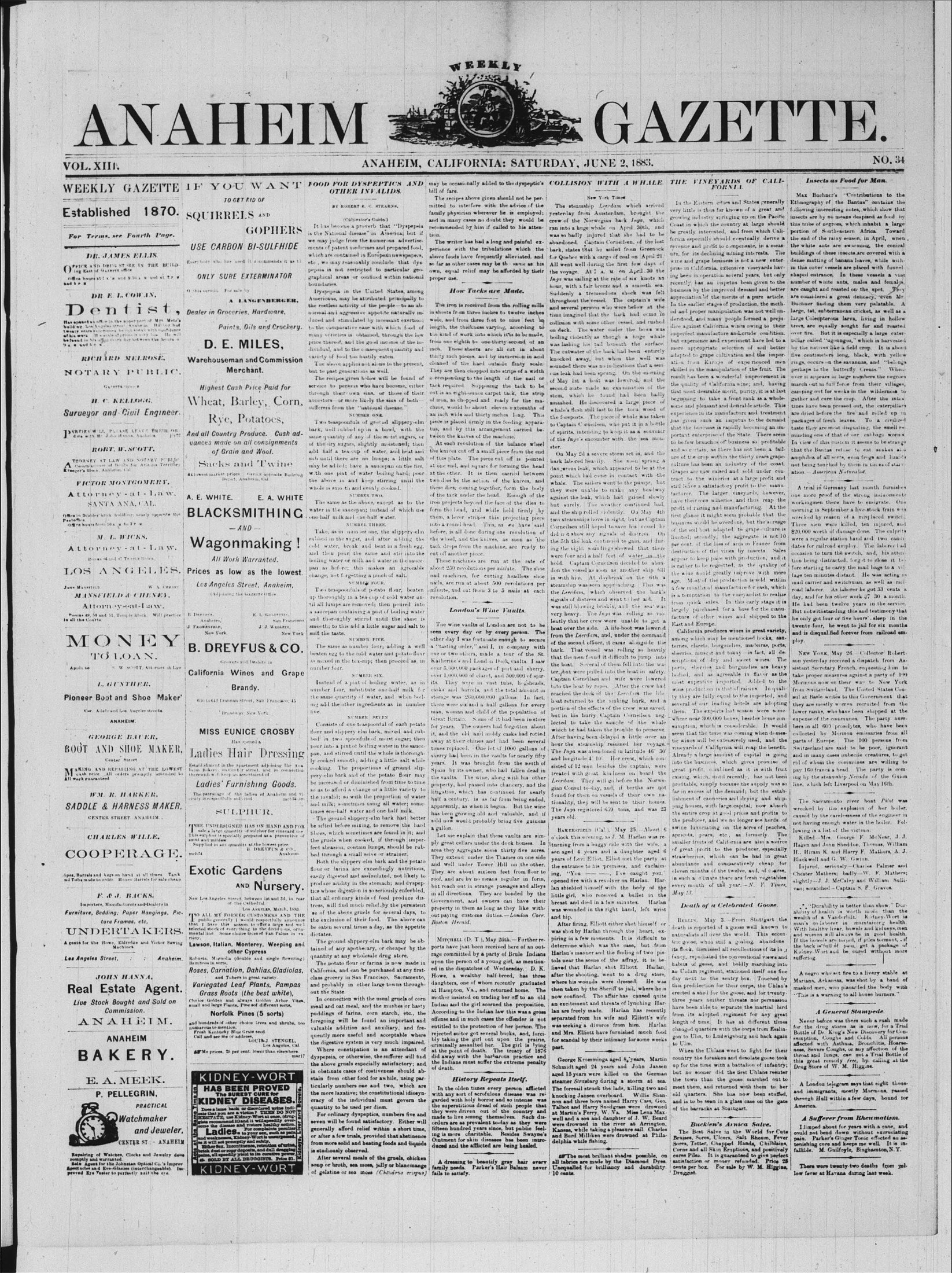
Searchable text
ANAHEIM
VOL. XIII.
WEEKLY GAZETTE
Established 1870.
For Terms, see Fourth Page.
DR. JAMES ELLIS.
OFFICE AND DRUG STORE IN THE BUILDING East of Gazette office.
Office hours at 9:30 a.m. and at 12 noon and by
DR E. L. COWAN,
Dentist,
Has opened an office in the upper part of Mrs. Metta's building in Los Angeles street. He has had twenty years experience, being with confidence of his work. He has all prices is city law. He will be found in his appartment between the hours in Hawthorne and by
RICHARD MELROSE.
NOTARY PUBLIC.
H. C. KELOGG.
Surveyor and Civil Engineer.
PARTIUM WILL, PLEASE LEAVE THE ORDER WITH Mr. John Hanna, Anheima.
ROBT. W. SCOTT.
ATTORNEY AT LAW AND NOTARY PUBLIC
Commissioner of Deeds for Arizona Territory
IF YOU WANT
TO GET RID OF
SQUIRRELS AND
GOPHERS
USE CARBON BI-SULFHIDE
Everybody who has used it recommends it as 11 ONLY SURE EXTERMINATOR
On this verin. For sale by
A. LANGENBERGER,
Dealer in Groceries, Hardware.
Paints, Oils and Crockery.
D. E. MILES,
Warehouseman and Commission Merchant.
Highest Cash Price Paid for
Wheat, Barley, Corn,
Rye, Potatoes,
And all Country Produce. Cash advances made on all consignments of Grain and Wool.
Sacks and Twine
H.C. KELLOGG.
Surveyor and Civil Engineer.
ROBT. W. SCOTT.
VICTOR MONTGOMERY,
Attorney-at-Law.
SANTA ANA, CAL.
M. L. WICKS.
Attorney-at-Law.
LOS ANGELES.
JOHN MANSFIELD
W.A. CHESKY
MANSFIELD & CHENEY,
Attorneys-at-Law.
POOLS 49, 50 and 51, Temple block. Will practice in all the Courts.
MONEY TO LOAN.
Apply to H.W. SCOTT, Attorneys at Law.
L. GUNTHER.
Ploneer Boot and Shoe Maker'
Car. Adele and Los Angeles streets.
ANAHEIM.
GEORGE BAUER,
BOOT AND SHOE MAKER,
Center Street.
MAKING AND REPAIRING AT THE LOWEST cash price. All orders promptly attended to. All work guaranteed.
WM. R. HARKER,
SADDLE & HARNESS MAKER,
CENTER STREET, ANAHEIM.
CHARLES WILLE,
COOPERAGE.
APES, Barrels and kegs on hand at all times. Tank and Tub made to order. Honey Barrels for sale cheap.
F. & J. BACKS.
Highest Cash Price Paid for
Wheat, Barley, Corn,
Rye, Potatoes,
And all Country Produce. Cash advances made on all consignments of Grain and Wool.
Sacks and Twine
At lowest market prices. Office opposite Railroad Depot, Anaheim, Cal.
A. E. WHITE.
E. A. WHITE
BLACKSMITHING
— AND —
Wagonmaking!
All Work Warranted.
Prices as low as the lowest.
Los Angeles Street, Anaheim,
Adjoining the Gazette Office.
B. DREYFUS & CO.
Growers and dealers in California Wines and Grape Brandy.
630 to 642 Brannan Street, San Francisco; 45 Broadway, New York.
MISS EUNICE CROSBY
Has opened a Ladies Hair Dressing Establishment in the apartment adjoining the Anaheim Bakery, on center street, and in connection therewith will keep an assortment of Ladies' Furnishing Goods.
The patronage of the ladies of Anaheim and vicinity is respectfully solicited.
SULPHUR.
THE UNDERSIGNED HAS ON HAND AND FOR sale a large quantity of sulphur for vineyard use. This sulphur is specially prepared as a preventive of snuff and mildew.
Supplied in any quantity at the lowest price.
B. DREYFUS & CO.
Anaheim
Exotic Gardens
AND Nursery.
New Los Angeles Street, between 1st and 3rd in rear
SADDLE & HARNESS MAKER,
CENTER STREET, ANAHEIM.
CHARLES WILLE,
COOPERAGE.
F. & J. BACKS.
Importers, Manufacturers and Dealers in
Furniture, Bedding; Paper Hangings, Picture Frames, etc,
UNDERTAKERS.
Agents for the Howe, Eldredge and Victor Sewing Machines
Los Angeles Street, : Anaheim.
JOHN HANNA,
Real Estate Agent.
Live Stock Bought and Sold on Commission.
ANAHEIM.
ANAHEIM
BAKERY.
E. A. MEEK.
P. PELLEGRIN,
PRACTICAL
Watchmaker
and Jeweler,
CENTER STREET - ANAHEIM
Repairing of Watches, Clocks and Jewelry done promptly and warranted.
Sole Agent for the Johnston Optical Co.'s Improved Spectacles and Eye-Glasses (interchangeable). Improved Eyes Taster to perfectly suit the eye.
SULPHUR.
THE UNDERSIGNED HAS ON HAND AND FOR sale a large quantity of sulphur for vineyard use. This sulphur is specially prepared as a preventive of smut and mildew.
Supplied in any quantity at the lowest price.
B. DREYFUS & CO.
Anaheim
Exotic Gardens
AND Nursery.
New Los Angeles Street, between 1st and 3d, in rear of the Cathedral.
Los Angeles, March, 1883
TO ALL MY FORMER CUSTOMERS AND THE public generally I would respectfully announce that I have this season to offer a large and well-selected stock of everything in the deciduous, ornamental line. Some choice trees of Fan Palms in variety.
Lawson, Italian, Monterey, Weeping and other Cypress
Robusta, Magnolia (double and single flowering) Bamboos in sorts.
Roses, Carnation, Dahlias, Gladiolas, and Tubers in great variety.
Variegated Leaf Plants, Pampas Grass Roots (the best white),
Choice Golden and always Golden Arbor Vites, small and large Plants, Pine sof different sorts.
Norfolk Pines (5 sorts)
and hundreds of other choice trees and shrubs, too numerous to mention.
Fresh Kentucky Blue Grass seed.
Call and see me or address.
LOUIS-J. STENGEL,
Los Angeles, Cal.
Mr prices, 25 per cent lower than elsewhere mar17
KIDNEY-WORT
HAS BEEN PROVED
The SUREST CURE for KIDNEY DISEASES.
Does a lame back or disordered urine indicate that you are a victim? THEN DO NOT HISETATE, use Kidney-Wort at once. (drugs recommend it) and it will speedily overcome the disease and restore healthy action.
For complaints peculiar to your sex, such as pain and weakness, Kidney-Wort is unsurpassed, as it will not promptly and safely.
Either Sex. Incontinence, retention of urine, brisk dust or ropy deposits, and dull dragging pains, all speedily yield to its curative power.
SOLD BY ALL DRUGGISTS. Price $1.
KIDNEY-WORT
FOOD FOR DYSPEPTICS AND OTHER INVALIDS.
BY KOBERT E. C. STEARNS.
(Cultivator's Guide)
It has become a proverb that "Dyspepsia is the National disease" in America; but if we may judge from the numerous advertisements of patent medicines and prepared food, which are contained in European newspapers, etc., we may reasonably conclude that dyspepsia is not restricted to particular geographical areas or confined within national boundaries.
Dyspepsia in the United States, among Americans, may be attributed principally to the restless activity of the people—to an abnormal and aggressive appetite naturally induced and stimulated by incessant exertion; to the comparative ease with which food of many varieties is obtained, through the low price thereof, and the good income of the individual, and to the consequent quantity and variety of food too hastily eaten.
The above applies not alone to the present, but to past generations as well.
The recipes given below will be found of service to persons who have become, either through their own sins, or those of their ancestors—or more likely the sins of both sufferers from the "national disease."
NUMBER ONE
Two teaspoonfuls of ground slippery-elm bark, well rubbed up in a bowl, with the same quantity of any of the moist sugars, or of the dry sugars, slightly moistened; then add half a tea-cup of water, and heat and sub until there are no lumps; a little salt may be added; have a saucepan on the fire, with one pint of water boiling hard; pour may be occasionally added to the dyspeptic's bill of fare.
The recipes above given should not be permitted to interfere with the advice of the family physician wherever he is employed; and in many cases no doubt they would be recommended by him if called to his attention.
The writer has had a long and painful experience with the tribulations which the above foods have frequently alleviated, and so far as other cases may be the same as his own, equal relief may be afforded by their proper use.
How Tacks are Made.
The iron is received from the rolling mills in sheets from three inches to twelve inches wide, and from three feet to nine feet in length, the thickness varying, according to the kind of work into which it is to be made, from one eighth to one-thirty second of an inch. These sheets are all cut in about thirty-inch pieces, and by immersion in acid cleaned of the hard outside finty scale. They are then chopped into strips of a width corresponding to the length of the nail or tack required. Supposing the tack to be cut is an eight-ounce carpet tack, the strip of iron, as chopped and ready for the machine, would be about eleven sixteenths of an inch wide and thirty inches long. This piece is placed firmly in the feeding apparatus, and by this arrangement carried between the knives of the machine.
At each revolution of the balance wheel the knives cut off a small piece from the end of this plate. The piece cut off is pointed at one end, and square for forming the head at the other. It is then carried between COLLISION WITH A WHALE.
New York Times
The steamship Legend which arrived yesterday from Amsterdam, brought the crew of the Norwegian back Inga, which ran into a huge whale on April 30th, and was so badly injured that she had to be abandoned. Captain Corneilen, of the lost bark, states that he sailed from Greenock for Quebec with a cargo of coal on April 21st. All went well during the first few days of the voyage. At 7 A.M. on April 30 the Inga was sailing at the rate of six knots an hour, with a fair breeze and a smooth sea. Suddenly a tremendous shock was felt throughout the vessel. The captain's wife and several persons who were below at the time imagined that the bark had come in collision with some other vessel, and rushed on deck. The water under the bark was boiling violently as though a huge whale was lashing his tail beneath the surface. The cutwater of the bark had been entirely knocked away, but when the well was sounded there was no indications that a serious leak had been sprung. On the morning of May 1st a boat was lowered, and the second mate made an examination of the stem, which he found had been badly amashed. He discovered a large piece of whale's flesh still fast to the torn wood of the foreposts. The piece of whale was taken to Captain Corneilen, who put it in a bottle of spirits, intending to keep it as a souvenir of the Inga's encounter with the sea monster.
On May 2d a severe storm set in, and the bark labored heavily. Sue soon sprang a dangerous leak, which appeared to be at the point where it could penetrate into her body.
The recipes given below will be found of service to persons who have become, either through their own sins, or those of their ancestors or more likely the sins of both sufferers from the "national disease."
NUMBER ONE.
Two teaspoonfuls of ground slippery-elm bark, well rubbed up in a bowl, with the same quantity of any of the moist sugars, or of the dry sugars, slightly moistened; then add half a tea-cup of water, and heat and sub until there are no lumps; a little salt may be added; have a saucepan on the fire, with one pint of water boiling hard; pour the above in and keep stirring until the whole is smooth and evenly cooked.
NUMBER TWO.
The same as the above, except as to the water in the saucepan; instead of which use one-half milk and one-half water.
NUMBER THREE.
Take, as in number one, the slippery-elm rubbed in the sugar, and after adding the cold water, break and beat in a fresh egg and then pour the same and stir into the boiling water or milk and water in the saucepan as before; this makes an agreeable change, not forgetting a pinch of salt.
NUMBER FOUR.
Two teaspoonfuls of potato flour, beaten up thoroughly in a tea-cup of cold water until all lumps are removed; then poured into a saucepan containing a pint of boiling water and thoroughly stirred until the same is smooth; to this add a little sugar and salt to suit the taste.
NUMBER FIVE.
The same as number four; adding a well beaten egg to the cold water and potato flour as mixed in the tea-cup; then proceed as in number four.
NUMBER SIX.
Instead of a pint of boiling water, as in number four, substitute one-half milk for the same quantity of water, and when boiling add the other ingredients as in number five.
NUMBER SEVEN.
Consists of one teaspoonful of each potato flour and slippery-elm bark, mixed and rubbed in two spoonfuls of moist sugar; then pour into a pint of boiling water in the saucepan, and stirred until the whole is thoroughly cooked smooth; adding a little salt while cooking. The proportions of ground slippery-elm bark and of the potato flour may be increased or diminished from time to time so as to afford a change or a little variety to the invalid; so with the proportion of water and milk; sometimes using all water; sometimes one-half water and one-half milk.
The ground slippery-elm bark had better be sifted before mixing, to remove the hard fibres, which sometimes are found in it; and the gruels when cooked, if through imperfect abrasion, contain lumps, should be rubbed through a small seive or strainer.
Both the slippery-elm bark and the potato flour or farina are exceedingly nutritious, easily digested and assimilated, not likely to produce acidity in the stomach; and dyspeptics whose digestion is so seriously enfeebled, that all ordinary kinds of food produce discontinuing to the length of the nail or task required. Supposing the tack to be cut is an eight-ounce carpet tack, the strip of iron, as chopped and ready for the machine, would be about eleven sixteenths of an inch wide and thirty inches long. This piece is placed firmly in the feeding apparatus, and by this arrangement carried between the knives of the machine.
At each revolution of the balance wheel the knives cut off a small piece from the end of this plate. The piece cut off is pointed at one end, and square for forming the head at the other. It is then carried between two dies by the action of the knives, and these dies; coming together, form the body of the tack under the head. Enough of the iron projects beyond the face of the dies to form the head, and while held firmly by them, a lever strikes this projecting piece into a round head. This, as we have said before, is all done during one revolution of the wheel, and the knives, as soon as 'the tack drops from the machine, are ready to cut off another piece.
These machines are run at the rate of about 250 revolutions per minute. The shoe nail machines, for cutting headless shoe nails, are run at about 500 revolutions per minute, and cut from 3 to 5 nails at each revolution.
London's Wine Vaults.
The wine vaults of London are not to be seen every day or by every person. The other day I was fortunate enough to secure a "tasting order," and I, in company with one or two others, made a tour of the St. Katherine's and London Dock vaults. I saw over 5,000,000 packages of port and sherry, over 1,000,000 claret, and 500,000 spirits. They were in vast tubs, hogsheads, casks' and barrels, and the total amount in storage was 260,000,000 gallons. In fact, there were six and a half gallons for every man, woman and child of the population of Great Britain. Some of it had been in store for years. The owners had forgotten about it, and the old and moldy casks had rotted away at their chines and had been several times replaced. One lot of 1000 gallons of sherry had been in the vaults for nearly fifty years. It was brought from the south of Spain by its owner, who had fallen dead in the vaults. The wine, along with his other property, had passed into chancery, and the litigation, which has continued for nearly half a century, is as far from being ended apparently, as when it begun. But the wine has been growing old and valuable, and if sold now would probably bring five guineas a gallon.
Let me explain that these vaults are simply great cellars under the dock houses. In area they aggregate some thirty-five acres. They extend under the Thames on one side and well under Tower Hill on the other. They are about sixteen feet from floor to roof, and are by no means regular in form, but reach out in strange passages and alleys in all directions. They are bonded by the corresponding to the length of the nail or task required. Supposing the tack to be cut is an eight-ounce carpet tack, the strip of iron, as chopped and ready for the machine, would be about eleven sixteenths of an inch wide and thirty inches long. This piece is placed firmly in the feeding apparatus, and by this arrangement carried between the knives of the machine.
On May 2d a severe storm set in, and the bark labored heavily. She soon sprang a dangerous leak, which appeared to be at the point which had come in contact with the whale. The sailors went to the pumps, but they were unable to make any headway against the leak, which had gained slowly but surely. The weather continued bad, and the ship rolled violently. On May 4th two steamships move in sight, but as Captain Corneilsen still hoped to save his vessel he did not show any signals of distress. On the 5th the leak continued to gain, and during the night soundings showed that there were four and half feet of water in the hold. Captain Corneilsen decided to abandon the vessel as soon as another ship fell in with him. At daybreak on the 6th a steamship was seen approaching. This was Leerdam, which observed the bark's signals of distress and went to her aid. It was still blowing briskly, and the sea was very heavy. The Inga was rolling so violently that her crew were unable to get a boat over the side. A life-boot was lowered from Leerdam, and under the command of the second officer, it came alongside the bark. That vessel was rolling so heavily that the men found it difficult to jump into the boat. Several of them fell into the water but were pulled into the boat in safety. Captain Corneilsen and wife were lowered into the boat by ropes. After the crew had reached the deck of Leerdam the life-boot returned to the sinking bark, and a portion of the effects of the crew was saved, but in his hurry Captain Corneilsen neglected to take take sample of the whale which he had taken trouble to preserve. After having been delayed a little over an hour the steamship resumed her voyage. The Inga was abandoned in latitude 46°30'30"and longitudue 4°10'. Her crew, which consisted of 12 men besides the captain, were treated with great kindness on board Leerdam. They will go before the Norwegian Consul to-day, and if bertha are not found for them on vessels of their own nationality, they will be sent to their homes. The Inga registered 659 tons, and was 23 years old.
BAKERSFIELD (Cal.), May 25 — About 6 o'clock this evening, as J.M. Harlan was returning from a buggy ride with the wife, a son aged 4 years and a daughter aged 6 years of Levi Elliot. Elliot met the party at the entrance to his premises, and exclaiming, "You —— , I've caught you," opened fire with a revolver on Harlan. Harlan shielded himself with the body of the little girl, who received a bullet in
The ground slippery-elm bark had better be sifted before mixing, to remove the hard fibres, which sometimes are found in it; and the gruels when cooked, if through imperfect abrasion, contain lumps, should be rubbed through a small sieve or strainer.
Both the slippery-elm bark and the potato flour or farina are exceedingly nutritious, easily digested and assimilated, not likely to produce acidity in the stomach; and dyspeptics whose digestion is so seriously enfeebled, that all ordinary kinds of food produce distress, will find much relief by the persistent use of the above gruels for several days, to the exclusion of their food. The above can be eaten several times a day, as the appetite dictates.
The ground slippery-elm bark may be obtained of any apothecary, or cheaper by the quantity at any wholesale drug store.
The potato flour or farina is now made in California, and can be purchased at any first-class grocery in San Francisco, Sacramento, and probably in other large towns throughout the State.
In connection with the usual gruels of corn meal and oat meal, and the mushes or hasty puddings of farina, corn starch, etc., the foregoing will be found an important and valuable addition and auxiliary, and frequently more useful and acceptable where the digestive system is very much impaired.
Where constipation is an attendant of dyspepsia, or otherwise, the sufferer will find the above gruels especially satisfactory; and in obstinate cases of costiveness should abstain from other food for awhile, using particularly numbers one and two, which are the more laxative; the constitutional idiosyncracy of the individual must govern the quantity to be used per diem.
For ordinary dyspeptica, numbers five and seven will be found satisfactory. Either will generally afford relief within a short time, or after a few trials, provided that abstinence from more solid and heating foods and liquids is studiously observed.
After several meals of the gruels, chicken soup or broth, sea moss, jelly or blanc mange of gelatine or sea moss (Chondrus crispus)
MITCHELL (D. T.), May 26th.—Further reports have just been received here of an outrage committed by a party of Brule Indians upon the person of a young girl, as mentioned in the dispatches of Wednesday. D. K. Howe, a wealthy half-breed, has three daughters, one of whom recently graduated at Hampton, Va., and returned home. The mother insisted on trading her off to an old Indian and the girl scorned the proposition. According to the Indian law this was a gross offense and in such cases the offender is not entitled to the protection of her person. The rejected suitor got several bucks, and, forcibly taking the girl out upon the prairie, criminally assaulted her. The girl is lying at the point of death. The treaty of 1876 did away with the barbarous practice and the Indians must suffer the extreme penalty of death.
History Repeats Itself.
In the olden times every person afflicted with any sort of scrofulous disease was regarded with holy horror and so intense was the superstitious dread of such people that they were driven out of the country and made to live among themselves. Such disorders are as prevalent to-day as they were fifteen hundred years since, but public feeling is more charitable. Besides Swayne's Ointment for skin diseases has been introduced and the afflicted are being healed.
A dressing to beautify gray hair every family needs. Parker's Hair Balsam never fails to satisfy.
BAKERSPIELE (Cal.). May 25.—About 6 o'clock this evening, as J. M. Harlan was returning from a buggy ride with the wife, a son aged 4 years and a daughter aged 6 years of Levi Elliott. Elliott met the party at the entrance to his premises, and exclaiming, "You — — , I've caught you," opened tire with a revolver on Harlan. Harlan shielded himself with the body of the little girl, who received a bullet in the breast and died in a few minutes. Harlan was wounded in the right hand, left wrist and hip.
After firing, Elliott either shot himself or was shot by Harlan through the heart, expiring in a few moments. It is difficult to determine which was the case, but from Harlan's manner and the finding of two pistols near the scene of the affray, it is believed that Harlan shot Elliott. Harlan, after the shooting, went to a drug store, where his wounds were dressed. He was then taken by the Sheriff to jail, where he is now confined. The affair has caused quite an excitement and threats of lynching Harlan are freely made. Harlan has recently separated from his wife and Elliott's wife was seeking a divorce from him. Harlan and Mrs. Elliott have furnished much food for scandal by their intimacy for some weeks past.
George Kromminga aged 8 years, Martin Schmidt aged 24 years and John Jansen aged 15 years were killed on the German steamer Strasburg during a storm at sea. The foresail struck the ladge, killing two and knocking Jansen overboard. Willis Shannon and three boys named Harry Cass, Geo. Talbot and Harry Snodgrass were drowned at Martin's Ferry, W. Va. Miss Lena Maxwell and a son and daughter of J. W. Beard were drowned in the river at Arrington, Kansas, while taking a pleasure sail. Charles and Burd Milliken were drowned at Philadelphia while fishing.
The most brilliant shades possible, on all fabrics are made by the Diamond Dyes. Unequalled for brilliancy and durability. 10 cents.
WITH A WHALE
Lerdam which arrived Amsterdam, brought the European back Inga, which sale on April 30th, and freed that she had to be main Corneilsen, of the lost sailed from Greenock cargo of coal on April 21st. The first few days of A.M. on April 30th the rate of six knots ancreze and a smooth sea, abundant shock was felt vessel. The captain's wife who were below at the bark had come in the other vessel, and rushed under the bows was though a huge whale laid beneath the surface. The bark had been entirely out when the well was no indications that a seri-spring. On the morning it was lowered, and the an examination of the found had been badly covered a large piece of fast to the torn wooft of the piece of whale was taken seen, who put it in a bottle to keep it as a souvenir counter with the sea monster storm set in, and the family. She soon sprang which appeared to be at the bottom.
THE VINEYARDS OF CALIFORNIA.
In the Eastern cities and States generally very little is thus far known of a great and growing industry springing up on the Pacific Coast in which the country at large should be greatly interested, and from which California especially should eventually derive a revenue and profit to compensate, in a measure, for its declining mining interests. The wire and grape business is not a new enterprise in California, extensive vineyards having been in operation several years, but only recently has an impetus been given to the business by the improved demand and better appreciation of the merits of a pure article. In the earlier stages of production, the method and proper manipulation was not well understood, and many people formed a prejudice against California wines owing to their imperfect manufacture and crude condition, but experience and experiment have led to a more appropriate selection of soil better adapted to grape cultivation and the importation from Europe of experienced men skilled in the manipulation of the fruit. The result has been a wonderful improvement in the quality of California wine; and, having that most desirable merit, purity, it is at last beginning to take a front rank as a wholesome and pleasant and desirable article. This experience in its manufacture and treatment has given such an impetus to the demand that the business is rapidly becoming an important enterprise of the State. There seem to be few branches of business so profitable and so certain, as there has not been a failure of the crop within the thirty years grape-culture has been an industry of the coast. Grapes are now raised and sold under con-
Insects as Food for Man.
Max Buchner's "Contributions to the Ethnography of the Bantus" contains the following interesting notes, which show that insects are by no means despised as food by this tribe of negroes, which inhabit a large portion of Southeastern Africa. Toward the end of the rainy season, in April, when the white ants are swarming, the conical buildings of these insects are covered with a dense matting of banana leaves, while within this cover vessels are placed with funnel-shaped entrance. In these vessels a vast number of white ants, males and females are caught and roasted on the spot. They are considered a great delicacy, even Mr. Buchner finding them very palatable. A large, tat, subterranean cricket, as well as a large Coleopterous larva, living in hollow trees, are equally sought for and roasted over fire. But it is especially a large caterpillar called "ugoungoo," which is harvested by the natives like a field crop. It is about five centimeters long, black, with yellow rings, occurs on the savannas, and "belongs perhaps to the butterfly Crenis." When ever it appears in large numbers the negroes march out in full force from their villages, camping out for weeks in the wilderness to gather and cure the crop. After the intestines have been pressed out, the caterpillars are dried before the fire and rolled up in packages of fresh leaves. To a civilized taste they are most disgusting, the smell reminding one of that of our cabbage worms. In view of this custom it seems to be strange that the Bantas refuse to eat snakes and amphibia of all sorts, even frogs and lizards not being touched by them in times of starvation... American Naturalist.
were storm set in, and the
family. See soon sprang
which appeared to be at the
home in contact with the
drivers went to the pumps, but
to make any headway
which had gained slowly
in weather continued bad,
violently. On May 4th
have in sight, but as Captain
taped to save his vessel he
signals of distress. On
continued to gain, and durings showed that there
alf feet of water in the
Corneilsen decided to abanoon as another ship fell
daybreak' on the 6th a
morrow approaching. This was
which observed the bark's
and went to her aid. It
hisiskivy, and the sea' was
Inga was rolling so viow were unable to get a
A life-boot was lowered
and, under the command
er, it came alongside the
ail was rolling so heavily
it difficult to jump into
of them fell into the waried into the boat in safety.
and wife were lowered
hopes. After the crew had
off of the Lecolon the life
the sinking bark, and a
acts of the crew was saved,
Captain Corneilsen negthe trouble to preserve.
delayed a little over an
ship resumed her voyage.
continued latitude 46' 30"
Her crew, which conbesides the captain, were
kindness on board the
will go before the Norwecy, and, if bertha are not
vessels of their own nall will be sent to their homes.
659 tons, and was 23
Cal.), May 25 — About 6
ing, as J. M. Harlan was reggy ride with the wife, a
and a daughter aged 6
ot. Elliot met the party at
premises, and exclaim-
—, I've caught you,
revolver on Harlan. Haraself with the body of the
received a bullet in the
result has been a wonderful improvement in
the quality of California wine; and, having
that most desirable merit, purity, it is at last
begining to take a front rank as a wholesome and pleasant and desirable article. This experience in its manufacture and treatment has given such an impetus to the demand that the business is rapidly becoming an important enterprise of the State. There seem to be few branches of business so profitable and so certain, as there has not been a failure of the crop within the thirty years grape-culture has been an industry of the coast. Grapes are now raised and sold under contract to the wineries at a large profit and still leave a satisfactory profit to the manufacturer. The larger vineyards, however, have their own wineries, and thus reap the profit of raising and manufacturing. At the first glance it might seem probable that the business would be overdone, but the acreage of the soil best adapted to grape-culture is limited; secondly, the aggregate is not 10 per cent. of the loss of area in France from destruction of the vines by insects. Sales appear to keep pace with production, and it rather to be regretted, as the quality of the wine would greatly improve with more age. Most of the production is sold within a few months of manufacture for cash, which is a temptation to the vineyardist to realize from quick sales. In this early stage it is largely purchased for a base for the manufacture of other wines and shipped to the East and Europe.
California produces wines in great variety, among which may be mentioned hocks, sauternes, clarets, burgundies, madeiras, ports, sherrries, muscat and tokay—in fact, all descriptions of dry and sweet wines. The ports, sherrries and burgundies are heavy bodied, and as agreeable in flavor as the most expensive imported. Added to the wine production is that of raisins. In quality they are fully equal to the imported, and several of our leading hotels are adopting them. The exports last season were somewhere near 300,000 boxes, besides home consumption, which is considerable. It would seem that the time was coming when domestic wines will be extensively used, and the vineyards of California will reap the benefit. Already a large amount of capital is going into the business, which gives promise of great profit, combined as it is with fruit raising, which, until recently, has not been profitable, simply because the supply was so far in excess of the demand; but the establishment of canneries and drying and shipping houses, with large capital, now absorb the entire crop at good prices and profits to the producer, and we no longer see herds of swine luxuriating on the acres of peaches, apricots, pears, etc., as formerly. The smaller fruits of California are also a source of great profit to the producer, especially strawberries, which can be had in great abundance and comparatively cheap for eleven months of the twelve, and, of course, in such a climate there are fresh vegetables every month of the year.—N. Y. Times,
May 13.
A trial in Germany last month furnishes one more proof of the strong inducements workingmen there have to engrate. One morning in September a live-stock frain was wrecked by reason of a misplaced switch. Three men were killed, ten injured, and $20,000 worth of damage done. The culprits were a regular station hand and two candidates for railroad employ. The laborers had occasion to turn thie switch, and his attention being distracted, forgot to close it before starting to carry the mail bags to a village ten minutes distant. He was acting as mail carrier and switchman, as well as railroad laborer. As laborer he got 33 cents a day, and for his other work $7 30 a month. He had been twelve years in the service. But notwithstanding this and testimony that he only got four or five hours’ sleep in the twenty-four, he went to jail for six months and is disqualified forever from railroad employ.
New York, May 26 — Collector Robertson yesterday received a dispatch from Assistant Secretary French, requesting him to take proper measures against a party of 100 Mormons now on their way to New York from Switzerland. The United States Consul at Basle writes to this Government that they are mostly women recruited from the lower ranks who have been shipped at the expense of the communes. The party numbers in all 600 proselytes who have been collected by Mormon emissaries from all parts of Europe. The 100 persons from Switzerland are said to be poor, ignorant and in many cases imbecile creatures, to get rid of whom the communes are willing to pay 160 francs a head. The party is coming by the steamship Nebrada of the Guion line, which left Liverpool on May 16th.
The Sacramento river boat Pilot was wrecked by the explosion of her boiler caused by the carelessness of the engineer in not having enough water in the boiler. Following is a list of victims.
Killed—Mrs. George F. McNear, J. J. Hagen and John Sheddon, Thomas William H., Hiram K. and Harry F. Mathers, A. J. Blackwell and G. W. Gwinn.
Injured, seriously—Charles Palmer and Chester Mathers; badly—W. F. Mathers; slightly—J. J. McCalvy and William Sullivan; scratched—Captain S. F. Graves.
Death of a Celebrated Goose.
BERLIN. May 3 — From Stuttgart the death is reported of a goose well known to naturalists all over the world. This eccentric goose, who still a goaling, abandon its flock, dismissed all recollections of its in fancy, repudiated the conventional views and habits of geese, and boldly marching into an Ullam regiment, stationed itself one fine day next to the sentry box. Touched by this predilection for their corps, the Uhlans erected a shed for the goose, and for twenty-three years neither threats nor persuasion have been able to separate the martial bird from its adopted regiment for any great length of time. It has at different times changed quarters with the corps from Esalingen to Ulm, to Ludwigsburg and back again to Ulm.
When the Uhlans went to fight for their country the forsaken and desolate goose took up for the time with a battalion of infantry; but no sooner did the first Uhlans reenter the town than the goose marched out to meet them, and returned with them to her old quarters. She has now been stuffed, and is to be seen in a glass case on the gate of the barracks at Stuttgart.
Bucklen's Arnica Salve.
The Best Salve in the World for Cuts Bruises, Sores, Ulcers, Salt Rheum, Fever Sores, Tetter, Chapped Hands, Chilblains, Corns and all Skin Eruptions, and positively cures Piles. It is guaranteed to give perfect satisfaction or money refunded. Price 25 cents per box. For sale by W. M. Higginss, Druggist.
The Sacramento river boat Pilot was wrecked by the explosion of her boiler, caused by the carelessness of the engineer in not having enough water in the boiler. Following is a list of the victims:
Killed—Mrs. George F. McNear, J. J. Hagen and John Sheddon, Thomas, William H., Hiram K. and Harry F. Mathers, A. J. Blackwell and G. W. Gwinn.
Injured, seriously—Charles Palmer and Chester Mathers; badly—W. F. Mathers; slightly—J. J. McCalvy and William Sullivan; scratched—Captain S. F. Graves.
Durability is better than show." Durability of health is worth more than the wealth of a Vanderbilt. Kidney-Wort is man's collaborer in maintaining health. With healthy liver, bowels and kidneys, men and women will always be in good health. If the bowels are torped, if piles torment, if the back is full of pain, get a package of Kidney-Wort and be cured without more suffering.
A negro who set fire to a livery stable at Mariana, Arkansas, was shot by a band of masked men, who placarded the body with "This is a warning to all house burners."
A General Stampede.
Never before was there such a rush made for the drug stores as is now, for a Trial Bottle of Dr. King's New Discovery for Consumption, Coughs and Colds. All persons affected with Asthma, Bronchitis, Hoarseness, Severe Coughs, or any affection of the throat and lungs, can get a Trial Bottle of this great remedy free, by calling at the Drug Store of W. M. Higginss.
A London telegram says that eight thousands and immigrants, mostly Mormons, passed through Hull within a few days, bound for America.
A Sufferer from Rheumatism.
I limped about for years with a cane, and could not bend down without excruciating pain. Parker's Ginger Tonic effected an astenishing cure and keeps me well. It is infallible. M. Guilfoyle, Binghamton,N.Y.
There were twenty-two deaths from yellow fever at Havana during last week.