anaheim-gazette 1883-03-17
Scanned page
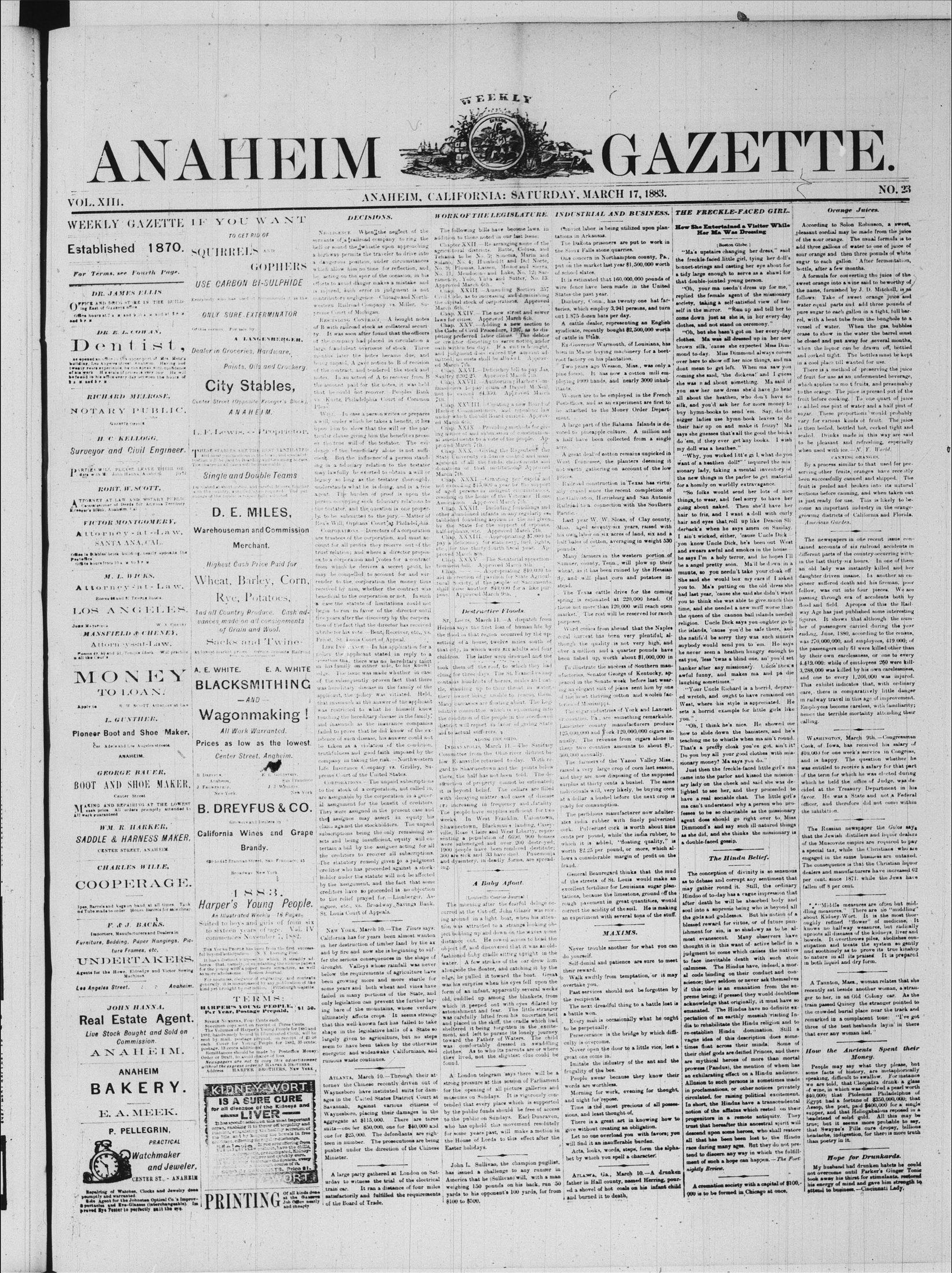
Searchable text
ANAHEIM
VOL. XIII.
WEEKLY GAZETTE IF YOU WANT
Established 1870.
For Terms, see Fourth Page.
DR. JAMES ELLIS
OFFICE AND DRUG STORE IN THE BUILDING East of Anaheim.
Office hours at 7 a.m. and at 1 p.m.
DR. E. L. COWAN,
Dentist,
RICHARD MELROSE,
NOTARY PUBLIC,
Gazette Office
H. C. KELLOGG,
Surveyor and Civil Engineer.
PARTICIPLE WILL PLEASE LEAVE THEIR ORDERS AT 1272.
RICHARD MELROSE,
NOTARY PUBLIC.
Gazette Office
H.C. KELLOGG,
Surveyor and Civil Engineer.
PARTIES WILL PLEASE LEAVE THEIR ORDERS WITH M. JOHN HANNA ANAHEIM 1872
ROBT. W. SCOTT,
ATTORNEY AT LAW AND NOTARY PUBLIC
Commissioner of Deeds for Arizona Territory
Kreeger's Block, Anaheim, Cal.
VICTOR MONTGOMERY,
Attorney-at-Law,
SANTA ANA, CAL.
Office in Dubles brick building, nearly opposite the Post office.
M. L. WICKS,
Attorney-at-Law.
Boone and St. Thomas Block.
LOS ANGELES.
John Mayfield
W.A. CHESNEY
MANSFIELD & CHENEY,
Attorneys-at-Law.
Poems 49, 50 and 51, Tempus Black Will practice all the Court.
MONEY TO LOAN.
Apply to R.W.SCOTT Attorneys at Law.
L.GUNTHER.
Pioneer Boot and Shoe Maker.
Cor. Adele and Los Angeles streets.
ANAHEIM.
GEORGE BAUER,
BOOT AND SHOE MAKER,
Center Street
MAKING AND REPAIRING AT THE LOWEST cash price. All orders promptly attended to. All work guaranteed.
WM. R. HARKER,
SADDLE & HARNESS MAKER,
CENTER STREET, ANAHEIM
CHARLES WILLE,
COOPERAGE.
City Stables,
Center Street (Opposite Kroeger's Block),
ANAHEIM.
L.F. Lewis, Proprietor.
THESE STABLES ARE THE BEST VENTILATED and most conducive to the lawn and specialist treatment will be paid to Boating and Grooming horses.
The charge an all-age will be reasonable.
Single and Double Teams
D. E. MILES,
Warehouseman and Commission Merchant.
Highest Cash Price Paid for Wheat, Barley, Corn, Rye, Potatoes,
And all Country Produce. Cash advances made on all consignments of Grain and Wool.
Sacks and Twine.
At lowest market prices. Service appropriate Railroad Company.
A.E. WHITE.
E.A. WHITE
BLACKSMITHING
—AND—
Wagonmaking!
All Work Warranted.
Prices as low as the lowest Center Street, Angheim.
B. DREYFUS & CO.
Growers and Dealers in California Wines and Grape Brandy.
630 1042 Brannan Street, San Francisco; 45 Broadway New York
1883.
MAKING AND REPAIRING AT THE LOWEST
cash price. All orders promptly attended to
All work guaranteed.
WM. R. HARKER,
SADDLE & HARNESS MAKER,
CENTER STREET, ANAHEIM
CHARLES WILLE,
COOPERAGE.
F. S. J. BACKS.
Importers, Manufacturers and Dealers in
Furniture, Bedding, Paper Hangings, Picture Frames, etc.
UNDERTAKERS.
Agents for the Howe, Eldredge and Victor Sewing Machines.
Los Angeles Street.: Anaheim.
JOHN HANNA,
Real Estate Agent.
Live Stock Bought and Sold on Commission.
ANAHEIM.
ANAHEIM
BAKERY.
E. A. MEEK.
P. PELLEGRIN,
PRACTICAL
Watchmaker and Jeweler,
CENTER ST., - ANAHEIM
Rapairing of Watches, Clocks and Jewelry done promptly and warranted.
Safe Agent for the Johnston Optical Co.'s Improvised spectacles and Eye-Glasses (interchangeable). Improved Eye Center to perfectly suit the eye.
B. DREYFUS & CO.
Growers and Dealers in
California Wines and Grape Brandy.
620 4042 Brannan Street, San Francisco; 45 Broadway, New York
1883.
Harper's Young People.
An Illustrated Weekly - 16 Pages.
Suited to boys and girls of from six to sixteen years of age. Vol. IV commences November 7, 1882.
The Young People has been from the first successful beyond anticipation. N.Y. Evening Post.
It has a distinct purpose to which it steadily adhere that, namely, of implanting the various papers for the young with a paper more attractive, as well as more wholesome. Boston Journal.
For neatness, elegance of engraving, and contents generally, it is mispassed by any publication of the kind yet brought to our notice. Pittsburgh Gazette.
TERMS:
HARPER'S YOUNG PEOPLE,
Per Year, Postage Prepaid,
$1.50.
Single Numbers, Four Cents each.
Specimen copies sent on receipt of Three Cents.
The Volumes of Harper's Young People for 1881 and 1882, handsomely bound in illuminated cloth, will be sent by mail, postage paid, on receipt of $3.90 each. Cover for Young People for 1882, 35 cents; postage, 13 cents additional.
Remittances should be made by Postoffice Money Order or Draft, to avoid chance of loss.
Newspapers are not to copy this advertisement without the express order of Harper & Brothers.
Address: HARPER BROTHERS, New York.
KIDNEY WORT
IS A SURE CURE
for all diseases of the Kidneys and LIVER.
It has special action on this most important organ, enabling it to throw off toxicity and inflammation, furnishing the healthy secretion of the bile and by keeping the bowels in free circulation, effering their discharge.
If you are suffering from malaria, malaria must have the chills, headache, creatinine compulsed, kidney failure and other serious symptoms every day of the course of it.
PRINTING Of all kinds done at the Gassermann Job Office neatly and cheaply.
WEEKLY GA
ANAHEIM, CALIFORNIA: SATURDAY, MARCH 17, 1883.
DECISIONS.
No diligence. When the neglect of the servants of a railroad company to ring the bell or sound the whistle upon approaching a highway permits the traveler to drive into a dangerous position, under circumstances which allow him no time for reflection, and be acting on the spur of the occasion, in his efforts to avoid danger makes a mistake and is injured, such error in judgment is not contributory negligence — Chicago and Northwestern Railroad Company vs. Miller, Supreme Court of Michigan.
RESPONDING CONTRACT. A bought notes of B with railroad stock as collateral security. It was soon after found that the officers of the company had placed in circulation a large fraudulent overissue of stock. Three months later the notes became due, and being unpaid, A gave notice to B of recision of the contract, and tendered "the stock and notes." In an action of A to recover from B the amount paid for the notes, it was held that he could not recover. Peoples Bank vs. Kurtz, Philadelphia Court of Common Plea.
WILL. In case a person writes or prepares a will, under which he takes a benefit, it lies upon him to show that the will or the particular clause giving him the benefit expresses the true will of the testator. The evidence of the beneficiary alone is not sufficient. But the influence of a person standing in a fiduciary relation to the testator may lawfully be exorted to obtain a will or
WORK OF THE LEGISLATURE.
The following bills have become laws, in addition to those noted in our last issue.
Chapter XXII.—Re arranging some of the agricultural districts. Battle, Codusa, and Tehama to be No. 3; Sanoma, Marin and Solano, No. 4; Humboldt and Del Norte, No. 9; Plumas, Lassen, Moscoe and Sierra, No. 11; Mendocino and Lake, No. 12; Sacramento, Yolo, Yuba and Sutter, No. 13. Approved March 6th.
Chap. XXIII.—Amenning Section 257 Civil Code, as to increasing and diminishing the capital stock of corporations. Approved March 6th.
Chap. XXIV.—The new street and sewer laws for cities. Approved March 6th.
Chap. XXV.—Adding a new section to the Code of Civil Procedure, 1207, as to disputing preferred labor claims. The debtor or creditor disputing to serve notice under oath within ten days. If a suit is brought, and judgment does exceed the amount admitted, no costs shall be allowed. Approved March 7th.
Chap. XXVI.—Deficiency bill to pay Jas, Saultry $202.25. Approved March 7th.
Chap. XVII.—Authorizing Harbor Commissioners to pay claim of Daniel McNeil, not to exceed $4,350. Approved March 7th.
Chap. XXVIII.—Creating a new Board of Harbor Commissioners, and repealing law under which the old Board existed. Approved March 6th.
Chap. XXIX.—Providing methods for giving notice of and submission of constitutional amendments to a vote of the people. Approved March 7th.
Chap. XXX.—Giving the Regents of the State University exclusive control and management of all the lands, endowments and donations of that institution. Approved March 7th.
INDUSTRIAL AND BUSINESS.
Convict labor is being utilized upon plantations in Arkansas.
The Dakota prisoners are put to work in the Sioux Falls stone quarries.
One concern in Northampton county, Pa., put on the market last year $1,500,000 worth of school slates.
It is estimated that 160,000,000 pounds of wire fence have been made in the United States the past year.
Danbury, Conn., has twenty-one hat factories, which employ 3,941 persons, and turn out 1,875 dozen hats per day.
A cattle dealer, representing an English syndicate, recently bought $2,500,000 worth of cattle in Utah.
Ex-Governor Warmouth, of Louisiana, has been in Maine buying machinery for a beetroot factory on his plantation.
Two years ago Wesson, Miss., was only a pine forest. It has now a cotton mill employing 1000 hands, and nearly 3000 inhabitants.
Women are to be employed in the French Postoffice, and as an experiment are first to be attached to the Money Order Department.
A large part of the Bahama Islands is devoted to pineapple culture. A million and a half have been collected from a single acre.
A great deal of cotton remains unpicked in West Tennessee; the planters deeming it not worth gathering on account of the low
In an action of A to recover from B the amount paid for the notes, it was held that he could not recover. Peoples Bank vs. Kurtz Philadelphia Court of Common Plea.
Writ. In case a person writes or prepares a will, under which he takes a benefit, it lies upon him to show that the will or the particular clause giving him the benefit expresses the true will of the testator. The evidence of the beneficiary alone is not sufficient. But the influence of a person standing in a fiduciary relation to the testator may lawfully be exerted to obtain a will or legacy so long as the testator thoroughly understands what he is doing, and is a free agent. The burden of proof is upon the person occupying such fiduciary relations to the testator, and the question is one properly to be submitted to the jury — Matter of Reals Will, Orphans' Court at Philadelphia.
Corporations — Directors of a corporation are trustees of the corporation, and must account for all profits they receive out of the trust relation; and where a director proposes to a corporation and votes for a contract from which he derives a secret profit, he may be compelled to account for and surrender to the corporation the money thus received by him, whether the contract was beneficial to the corporation or not. In such a case the statute of limitations could not begin to run in favor of the director until five years after the discovery by the corporation of the fact that the director has received abribery his vote. Bent, Receiver, etc., vs. Prost, St. Louis Court of Appeal.
Life Insurance — In his application for a policy the applicant stated in reply to a question that there was no hereditary taint in his family on either side, to his knowledge. The issue was made whether in case of the subsequently proven fact that there was hereditary disease in the family of the applicant, the policy was vittated. Held, that insufficiency as the answer of the applicant was restricted to what he himself knew touching the hereditary disease in the family, and mastuch as the insurance companies failed to prove that he did know of the existence of such disease, his answer could not be taken as a violation of the condition, truthfulness and good faith imposed by the company in taking the risk. Northwestern Life Insurance Company vs. Gridley, Supreme Court of the United States.
Corporations — The unpaid subscriptions to the stock of a corporation, not called in, are assignable by the corporation in a general assignment for the benefit of creditors. They were assigned in the present case and their assignee may assert in equity his claim against the stockholders. The unpaid subscriptions being the only remaining assets and being insufficient, equity will entertain a bill by the assignee acting for all the creditors to recover all subscriptions. The statutory remedy given go a judgment creditor who has proceeded against a stockholder under the statute will not be affected by the assignment, and the fact that some creditors have so proceeded is no objection to the relief pawned for. — Lionberger, As-
Destructive Floods.
Sr. Louis, March 11. — A dispatch from Helena says the first loss of human life by the flood in that region occurred by the upsetting of a house, twelve miles south of that city, in which were six adults and four children. The latter were drowned and took them off the roof, to which they had clung for three days. The St. Francis swamp contains hundreds of horses, moles and cattle, standing up to their throat in water; their owner being unable to rescue them. Many carcasses are floating about. The Legislative committee which is examining into the condition of the people in the overflowed district will report in favor of giving State aid to actual sufferers.
ALONG THE ORIOX.
INDIANAPOLIS, March 11. — The Sanitary Committee from the Ohio river district below Reansville returned to day. With regard to Shawneetown and the points below there, the half has not been told. The destruction of property cannot be estimated; it is beyond belief. The cellars are filled with decaying matter and cases of disease; increasing in frequency and fatality. The people have supplies sufficient for two weeks. In West Franklin, Uniontown, Shawneetown, Blackman's landing, Caseyville, Rose Claire and West Liberty, representing a population of 6600, 900 houses were submerged and over 200 destroyed; 1900 people have been rendered destitute; 300 are sick and 33 have died. Paulemona and dysentery, in deadly forms, are spreading.
A Baby Afloat.
[Louisville Courier-Journal]
They were assigned in the present case and the assignee may assert in equity his claim against the stockholders. The unpaid subscriptions being the only remaining assets and being insufficient, equity will entertain a bill by the assignee acting for all the creditors to recover all subscriptions. The statutory remedy given to a judgment creditor who has proceeded against a stockholder under the statute will not be affected by the assignment, and the fact that some creditors have so proceeded is no objection to the relief prayed for.—Lionberger, Assignee, etc., vs. Broadway Savings Bank, St. Louis Court of Appeals.
New York, March 10.—The Times says, California has for years been almost wanton in her destruction of timber land by the ax and by fire and now she is beginning to suffer the serious consequences in the shape of drought. Valleys whose rainfall was never below the requirements of agriculture have been growing more and more sterile for some years and both wheat and vines have failed in many portions of the State, and only legislation can prevent the further laying bare of the mountains, whose verdure ultimately affects crops. It seems strange that this well-known fact has failed to take shape in the legislative halls of a State so largely given to agriculture, but no steps seem to have been taken by the otherwise energetic and wideawake Californians, and ruinous waste continues.
ATLANTA, March 10.—Through their attorney the Chinese recently driven out of Waynesboro have instituted suits for damages in the United States District Court at Savannah, against various citizens of Waynesboro, placing their damages in the aggregate at $115,000. There are three suits—one for $50,000, one for $40,000 and one for $25,000. The defendants are eighteen in number. The prosecutions are being pushed under the direction of the Chinese Minister.
A large party gathered at London on Saturday to witness the trial of the electrical train car. It ran a distance of four miles satisfactorily and fulfilled the requirements of the Board of Trade.
A Baby Afloat.
[Louisville Courier Journal]
The morning after the fearful deluge occurred at the Cutoff, John Glazer was rowing around in a light boat, when his attention was attracted to a strange looking object bobbing up and down on the waves some distance out. He rowed across to head the object off, and discovered that it was an old-fashioned baby cradle sitting upright in the water. A few strokes of the oar drew him alongside the floater, and catching it by the edge, he pulled it toward the boat. Great was his surprise when his eyes fell upon the form of an infant, apparently several weeks old, cuddled up among the blankets, from which it peeped out with eyes dilated by astonishment and fear. The little stranger was carefully lifted from his uncertain bed and placed in the skiff, the cradle which had sheltered it being forgotten in the excitement, and left to pursue its lonely journey toward the Father of Waters. The child was comfortably dressed in swaddling clothes. As to who its parents are or where they lived, not the slightest clue could be found.
A London telegram says there will be a strong pressure at this session of Parliament for the opening of all picture galleries and museums on Sundays. It is vigorously contended that every place which is supported by the public funds should be free of access to the public on Sundays. Earl Dunraven, who has upheld this movement resolutely for some years past, will make a motion in the House of Lords to this effect after the Easter holidays.
John L. Sullivan, the champion pugilist, has issued a challenge to any runner in America that he (Sullivan) will, with a man weighing 150 pounds on his back, run 50 yards to his opponent's 100 yards, for from $100 to $500.
MAXIMS.
Never trouble another for what you can do yourself.
Self-denial and patience are sure to meet their reward.
Walk swiftly from temptation, or it may overtake you.
Past services should not be forgotten by the recipients.
The next dreadful thing to a battle lost a battle won.
Every man is occasionally what he ought to be perpetually.
Perseverance is the bridge by which difficulty is overcome.
Never open the door to a little vice, less great one come in.
Imitate the industry of the ant and t frugality of the bee.
People swear because they know the words are worthless.
Morning for work, evening for thought and night for repose.
Time is the most precious of all possessions, and least thought of.
There is a great art in knowing how to give without creating an obligation.
Let no one overload you with favors; you will find it an insufferable burden.
Acts, looks, words, steps, form the alp bet by which you spell a character.
ATLANTA, Ga., March 10.—A drunk father in Hall county, named Herring, pooled a shovel of hot coals on his infant chick and burned it to death.
GAZETTE.
MARCH 17, 1883. NO. 23
AL AND BUSINESS.
is being utilized upon planssas.
prisoners are put to work in
stone quarries.
in Northampton county, Pa.
set last year $1,500,000 worth
that 160,000,000 pounds of
been made in the United
year.
has twenty-one hat facploy 3,941 persons, and turn
hats per day.
representing an English
tly bought $2,500,000 worth
Warmouth, of Louisiana, has
buying machinery for a beetthis plantation.
to Wesson, Miss., was only a
has now a cotton mill emands, and nearly 3000 inhabbe employed in the French
as an experiment are first to
the Money Order Departof the Bahama Islands is deplece culture. A million and
collected from a single
of cotton remains unpicked in
the planters seeming it
tering on account of the low
THE FRECKLE-FACED GIRL.
How She Entertained a Visitor While Her Ma Was Dressing
[Boston Globe]
"Ma's upstairs changing her dress," said the freckle-faced little girl, tying her doll's bonnet-strings and casting her eye about for a tidy large enough to serve as a shawl for that double-jointed young person.
"Oh, your ma needn't dress up for me," replied the female agent of the missionary society, taking a self-satisfied view of herself in the mirror. "Run up and tell her to come down just as she is, in her every-day clothes, and not stand on ceremony."
"Oh, but she hasn't got on her every-day clothes. Ma was all dressed up in her new brown silk,'cause she expected Miss Diamond to-day. Miss Dimmond always comes over here to show off her nice things, and ma don't mean to get left. When ma saw you coming she said, 'the dickens' and I guess she was mad about something. Ma said if you saw her new dress she'd have to hear all about the heathen, who don't have no silk, and you'd ask her for more money to buy hymn-books to send 'em. Say, do the nigger ladies use hymn-book leaves to do their hair up on and make it frizy? Ma says she guesses that's all the good the books do 'em, if they ever get any books. I wish my doll was a heathen."
"Why, you wicked litt'l e girl, what do you want of a heathen doll?" inquired the missionary lady, taking a mental inventory of Orange Juices.
According to Solon Robinson, a sweet, pleasant cordial may be made from the juice of the sour orange. The usual formula is to add three gallons of water to one of juice of sour orange and then three pounds of white sugar to each gallon. After fermentation, bottle, after a few months.
A formula for converting the juice of the sweet orange into a wine said to be worthy of the name, furnished by J. D. Mitchell, is as follows: Take of sweet orange juice and water equal parts and add three pounds of pure sugar to each gallon in a tight, full barrel, with a bent tube from the bunghole to a vessel of water. When the gas bubbles cease to show in the water the barrel must be closed and put away for several months, when the liquor can be drawn off, bottled and corked tight. The bottles must be kept in a cool place till wanted for use.
There is a method of preserving the juice of fruit for use as an unfermented beverage, which applies to most fruits, and presumably to the orange. The juice is pressed out of the fruit before cooking. To one quart of juice is added one pint of water and a half pint of sugar. These proportions would probably vary for various kinds of fruit. The juice is then boiled, bottled hot, corked tight and sealed. Drinks made in this way are said to be pleasant and refreshing, especially when used with ice.—N. Y. World.
CANNING ORANGES.
By a process similar to that used for preserving other fruits, oranges have recently
be employed in the French
has an experiment are first to
the Money Order Departof the Bahama Islands is depleple culture. A million and
been collected from a single
of cotton remains unpicked in
the planters deeming it
merging on account of the low
instruction in Texas has virtuse the recent completion of
Harrisburg and San Antonio
connection with the Southern
W. Sloan, of Clay county,
twenty-six years, raised with
in six acres of land, six and a
cotton, averaging in weight 530
ars in the western portion of
y, Tenn., will plow up their
been ruined by the Hessian
plant corn and potatoes in
cattle drive for the coming
married at 220,000 head. Of
than 120,000 will reach open
rest will be reserved for ranch
from abroad that the Naples
has been very plentiful, allity is not very high, and
and a quarter pounds have
worth about $1,100,000 in
the success of Southern manator George of Kentucky, apponate week before last wearsuit of jeans sent him by one
driving cotton and woolen facsippet.
industries of York and Lancastare something remarkable.
nity manufacturers produce
of York 120,000,000 cigars anrevenue from cigars alone in
counties amounts to about $1,
ly.
of the Yazoo Valley Miss.,
large crop of corn last season,
now disposing of the supposed
city cents a bushel. The same
will, very likely, be buying corn
bushel before the next crop is
umption.
us manufacturer now adulterber with finely pulverized
zinced cork is worth about nine
and while the india rubber, to
added, "floating quality," is
heer pound, or more, which alrable margin of profit on the
The Hindu Belief.
The conception of divinity is so sensuous
as to debase and corrupt any sentiment that
may gather round it. Still, the ordinary
Hindoo of to-day has a vague impression that
of fruit for use as an unfertmented beverage,
which applies to most fruits, and presumably
to the orange. The juice is pressed out of the
fruit before cooking. To one quart of juice
is added one pint of water and a half pint of sugar. These proportions would probably vary for various kinds of fruit. The juice is then boiled, bottled hot, corked tight and sealed. Drinks made in this way are said to be pleasant and refreshing, especially when used with ice — N. Y. World.
CANNING ORANGES.
By a process similar to that used for preserving other fruits, oranges have recently been successfully canned and shipped. The fruit is peeled and broken into its natural sections before canning, and when taken out is just ready for use. This is likely to become an important industry in the orange-growing districts of California and Florida.
American Garden.
The newspapers in one recent issue contained accounts of six railroad accidents in different parts of the country occurring within the last thirty-six hours. In one of them an old lady was instantly killed and her daughter suffered insane. In another an engineer suffered death and his fireman, poor fellow, was cut into four pieces. We are passing through era of accidents both by flood and field. Apropos of this the Railway Age has just published some interesting figures. It shows that although the number of passengers carried during the year ending June, 1880, according to the census, was 270,000,000, and employees, 419,000; of the passengers only 61 were killed other than by their own carelessness, or one to every 4,419,000: while of employees 260 were kill-3,288,000 was killed by his own carelessness, and one to every 1,266,000 was injured. This exhibit indicates that, with ordinary care, there is comparatively little danger in railway travel in this age of improvement. Employees become careless, with familiarity; hence the terrible mortality attending their calling.
WASHINGTON, March 9th. Congressman Cook, of Iowa, has received his salary of $10,000 for one week's service in Congress, and is happy. The question whether he was entitled to receive a salary for that part of the term for which he was elected during which he held the office of Judge, was decided at the Treasury Department in his favor. He was a State and not a Federal officer, and therefore did not come within the inhibition.
The Russian newspaper the Golos says that the Jewish distillers and liquor dealers of the Muscovite empire are required to pay a special tax, while the Christians who are engaged in the same business are untaxed. The consequence is that the Christian liquor dealers and manufacturers have increased 62 per cent since 1871 while the Jews have fallen off 8 per cent.
The Hindu Belief.
The conception of divinity is so sensuous as to debase and corrupt any sentiment that may gather round it. Still, the ordinary Hindoo of today has a vague impression that after death he will be absorbed body and soul into a supreme being who is beyond all the gods and goddesses. But his notion of a blessed reward for virtue, or of future punishment for sin, is so shadowy as to be almost evanescent. Many observers have thought it is this want of active belief in a judgment to come which causes the natives to face inevitable death with such stoic calmness. The Hindus have, indeed, a moral code binding on their conduct and conscience; they seldom or never ask themselves if this code is an emanation from the supreme being; if pressed they would doubtless acknowledge that originally, it must have so emanated. The Hindus have no definite expectation of an earthly messiah visiting India to rehabilitate the Hindu religion and to re-establish Hindu domination. Still a vague idea of this description does sometimes float across their minds. Some of their chief gods are deified Princes, and there are mythical heroes of more than mortal prowess (Pandus), the mention of whom has an exhilarating effect on a Hindu audience. Allusion to such persons is sometimes made in proclamations, or other notices privately circulated, for raising political excitement. In short, the Hindus have a transcendental notion of the afflatus which rested on their progenitors in a remote antiquity. They trust that hereafter this ancestral spirit will descend upon some heroes, who shall restore all that has been been lost to the Hindu race during many ages. But they do not pretend to discern any way in which the fulfillment of such a hope can happen.—The Port nightly Review.
A cremation society with a capital of $100,000 is to be formed in Chicago at once.
The Russian newspaper the Golos says that the Jewish distillers and liquor dealers of the Muscovite empire are required to pay a special tax, while the Christians who are engaged in the same business are untaxed. The consequence is that the Christian liquor dealers and manufacturers have increased 62 per cent since 1871, while the Jews have fallen off 8 per cent.
"Middle measures are often but middling measures." There are no "muddling" about Kidney-Wort. It is the most thoroughly refined "flower" of medicine. It knows no halfway weasures, but radically uproots all diseases of the kidneys, liver and bowels. It overthrows piles, abolishes constipation and treats the system so gently and soothingly as to prove its true kinship to nature in all its praises. It is prepared in both liquid and dry form.
A Taunton, Mass., woman relates that she recently sat beside another woman, a stranger to her, in an Old Colony car. As the train passed Quincy the stranger pointed to the crowded burial place near the track and remarked in a complacent tone: "I've got three of the best hesbands layin' in there that ever any woman had."
How the Ancients Spent their Money.
People may say what they please, but some facts of history, are metaphorically speaking, difficult to swallow. For instance we are told, that Cleopatra drank a glass of wine, in which was dissolved a pearl worth $40,000; that Ptolemus Philadelphus of Egypt had a fortune of $350,000,000; that Aesop, the poet, paid $400,000 for a single supper, and that Heliogabalous reposed in a headstead of solid gold. All this may be true; but it seems more probable to say, that Swayne's Pills cure dropsy, billions headache, indigestion, for there is more truth than poetry in it.
Hope for Drunkards.
My husband had drunken habits he could not overcome until Parker's Ginger Tonic took away his thirst for stimulants, restored his energy of mind and gave him strength to attend to business.—Cincinnati Lady.