anaheim-gazette 1883-03-03
Scanned page
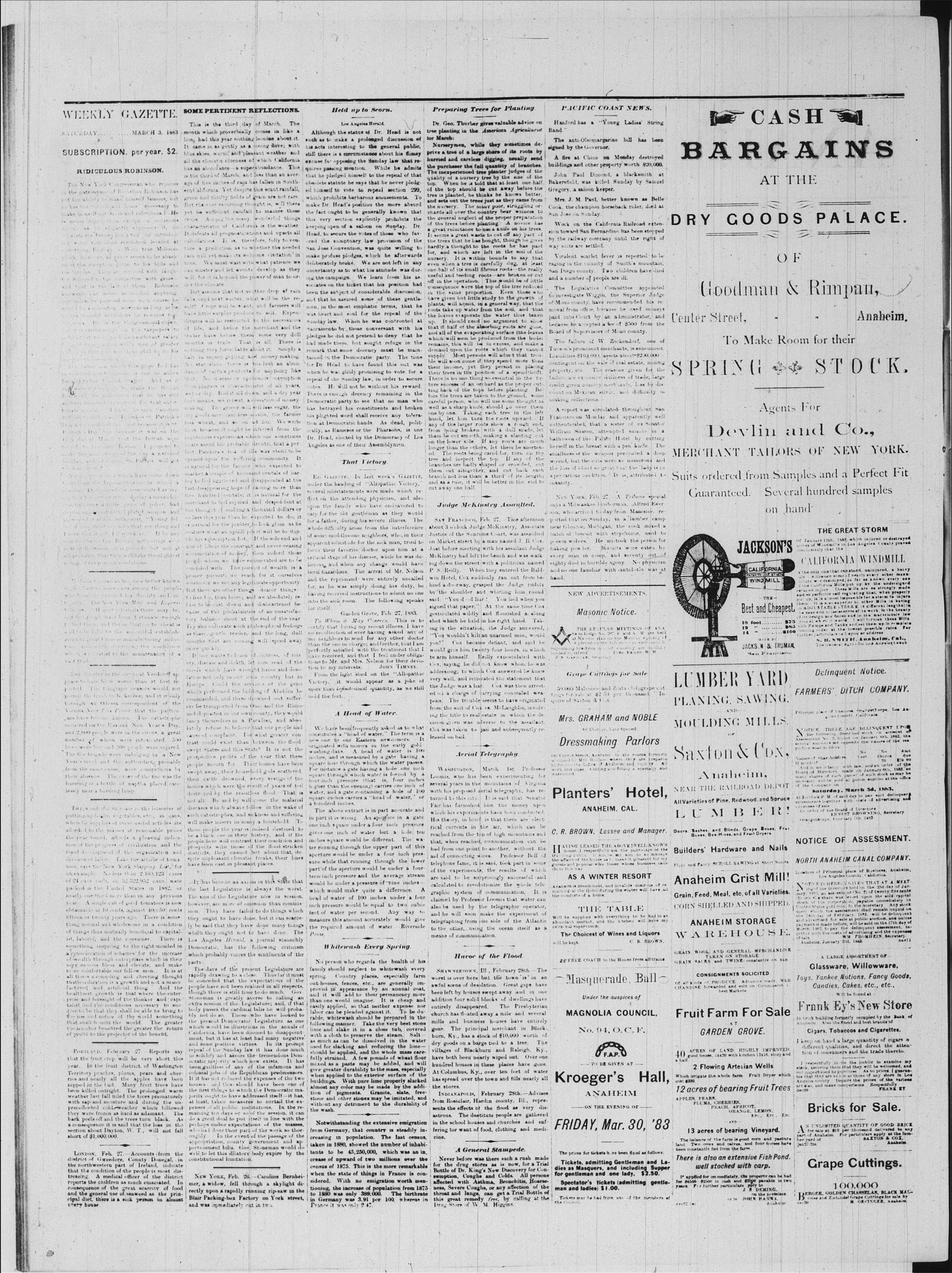
Searchable text
WEEKLY GAZETTE.
SATURDAY, MARCH 3, 1883
SUBSCRIPTION, per year, $2.
RIDICULOUS ROBINSON.
The New York Congressman who resides in the patronymic of Belleen Robinson has not the ability to make himself famous, but he has the charisma and necessary to make himself notorious and rebellious. He is never bound from any occasions where he elegantly expresses it, nor does the beating on a tail by introducing a new irrational revolution leveled at something English. With true Midwestern pride, he never seems to be ashamed of the exception to his bills and rebellion. They are used with laughter followed to the committee with grims and that is the last of them. Robinson keeps vain never accustom anything unless he pursues some such course he would be momentarily whereas as long as he praises himself rational he remains optimistic. He is the most exceptional citizen of the taxpayers to endorse him and his exorbitant salary and bring him into the men of greater importance will have gladly it, for more than this prize fund has no immediate business in one to answer to the United States. And as if there were no problems to make the British government that he has still another reason to consider for that unfortunate situation, he says, Panther rolls out of St Patrick's Day and collapses not because it is not finished but because it was on the third day of March that the British were forced to evacuate Boston. I propose to make the same case of the stay a national holiday without delay. St. Patrick will get this news.
SOME PERTINENT REFLECTIONS.
This is the third day of March. The month which proverbially comes in like a lion, had this year nothing leonine about it. It came in as gently as a coong dove; with blue skies, warm and pleasant weather and all the climatic niceness of which California has an abundance—a superabundance. This is the third of March, and less than an average of five inches of rain has fallen in Southern California. Yet despite this scant rainfall, green and thirsty fields of grain are not rare. But the ever recurring thought is, will there yet be sufficient rainfall to measure these crops. Among the many wonderful things characteristic of California is the weather. It defeats all prognostications and upsets all calculations. It is, therefore, folly to venture a prediction as to whether the needed rain will yet make its welcome visitation in time. We must wait with what patience we can muster and let events develop as they will, for it is beyond the power of man to order the climate.
But assume that not another drop of rain falls until next winter, what will be the result? Crope will be giant, and farmers will have little surplus produce to sell. Expenditures will be restricted to the necessities of life, and hence the merchant and the trader have before them some very dull months in trade. That is all. There is nothing very formidable about it. Simply a salt in money getting and money-making. No starvation; there is too lush an abundance of earth's products for anything like that. No disease or epidemic exemption from plagues is characteristic of all years, wet or dry. Both it all down, and a dry year here means, we repeat, a cessation of money-making. The grocer will sell less sugar, the dry goods more less maintain, the farmer less wheat, and so on ad hoc. We write thus, because it might be inferred from the logarithmic expressions which one sometimes mentions the probable drought, that a perfect Panorama's box of illa was about to be opened upon the suffering community. It is natural for the farmer who expected to market a number of thousand centals of bar-
No disease or epidemic exemption from plagues is characteristic of all years, wetter dry. But it all down, and a dry year here means, we repeat, a dissipation of money-making. The greeter will sell less sugar, the dry goods more, less mash, the farmer less wheat, and so on ad hoc. We write this, because it might be inferred from the longuous expressions which one sometimes bears against the probable drought, that a perfect Pandora's box of ill was about to be opened upon the suffering community. It is natural for the farmer who expected to market a couple of thousand centals of barley to feel aggrieved and disappointed at the fast-disappearing hope of raising more than five hundred cents; it is natural for the merchant to feel injured and dependent at the thought of making a thousand dollars or less this year than he expected to do; it is natural for the printer to look glum as he realizes what an uphill job it will be to double his subscription list. If the sole end and aim of life is the constant and never ceasing accumulation of money, then indeed those people whom we have enumerated are to be considered with. The pursuit of wealth is a prolier pursuit; we reach for it ourselves whenever we see any legitimate opportunity. But there are other things dearer things to live for, than here; and we absolutely refuse to be cast down and disheartened because of the probabilities of an unsatisfactory balance sheet at the end of the year. Try and cultivate such philosophical feelings as these, gentle reader, and the long, dull months that are coming will speed away more quickly.
It one wants to learn of distress, of misery, disease and death, let him read of the floods, which have wrought havoc and desolation not only in our own country but in Europe. Could the services of the gem which performed the building of Abdin be commanded, and these drowned out sufferers be transported from Ohio and the Rhine and departed in our own county, they would fancy themselves in a Paralysis, and absolutely refuse to believe that our people had cause of complaint. For what greater contrast could exist than between the flood-swept States and this State? It is not the prospective profits of the year that these people mourn for. Their homes have been swept away, their household gods scattered, their cattle drowned, every vestige of the houses which were the result of years of toll destroyed by the resistless flood. That is not all. By and by will come the malarial diseases which always follow in the wake of such catastrophes, and sickness and suffering will make misery in many a household. To those people the year is indeed destined to be a black one in their history, and if the people here will contrast their condition and prospects with those of the flood stricken districts, they cannot but admit that, despite unpleasant climatic freaks, their lines have been cast in pleasant places.
It has become an axiom in this State that the last Legislature is always the worst. The sum of the Legislature now in session.
Thought
ED. GAZETTE: under the heading several misstatements on the attention upon the family care for the old girl for a father, during whole diffulty area of some middle-class apparent solicitude force their favorite critical stage of their bribery and when been hazardous and the reprimand for, as he was sinning received into the sick room for itself.
Garden
To Whom it certify that burning no resollection of my neighbors to see than the one in charge perfectly satisfied have received, and thanks to Mr. and Mention to my interest.
From the light Victory, it would more than infind hold the fort.
A Head
We have been constituted a "the new one to our originated with my washing days." In inches, and is mesa square hole through. For instance a gate square through with four-inch pressure higher than the oak water, and a gate square inches carry a hundred inches.
The above extra part it is wrong one inch square inch gives one inch inch inches square wound running through aperture would be sure while that run part of the aperture teen-inch pressure would be under a which would make head of water of
The wordful must use the business of putting up plants, vegetables, etc., in gardens where supplies of these useful articles are afforded to the masses at reasonable prices the year round, affords a pleasing indication of the progress of civilization and the rapid development of the organization and division of labor. Take the article of tomatoes, says the New York Shipping Line, for an example. No less than 2,160,123 cases of 24 canes each, or 52,322,952 canes, were packed in the United States in 1882, or nearly one third more than in any previous year. A single can of good tomatoes is now obtainable at 10 cents, against 400.50 cents fifteen or twenty years ago. There is something normal and wholesome in a condition of things thus mutually beneficial to capitalist, laborer, and the consumer. There is something inspiring to the right-minded in a consideration of schemes for the increase of wealth through enterprises which in their very success bless and elevate, and make more comfortable our fellow men. It is at all times a consoling and cheering thought that civilization is a growth and not a manufactured and artificial thing. And the healthiest growth is that where the enterprise and foreseen of the thinker and capitalist and the conditions necessary to succeed be that they shall be able to bring to the use and notice of the world something that shall benefit the world. The greater the number benefited the greater the return of profit to the projector of the benefit.
PORTLAND, February 27. Reports say that the fruit crop will be very short this year. In the fruit district of Washington Territory peaches, plums, pears and cherries and nearly all the apples have been nipped in the bud. Many fruit trees have been killed outright. The prolonged warm weather last fall nilled the trees prematurely with sap and moisture and during the unprecedented cold-weather which followed they were frozen as hard as adamant. The bark peels off and the trees turn black. As a consequence it is said that the loss in the section about Dayton, W. T., will not fall short of $1,000,000.
LONDON, Feb. 27. Accounts from the district of Gweedore, County Donegal, in the northwestern part of Ireland, indicate that the condition of the people is most distressing. A medical officer of the district reports the children as much emaciated. In consequence of the great scarcity of food and the general use of seaweed as the principal diet, there is a sick person in almost every house.
It has become an axiom in this State that the last Legislature is always the worst. The sins of the Legislature now in session, however, are more of omission than commission. They have failed to do things which they ought to have done, but it can scarce be said that they have done many things which they ought not to have done. The Los Angeles Herald, a journal staunchly Democratic, has the following criticism which probably voices the sentiments of the party:
The days of the present Legislature are rapidly drawing to a close. Thus far it must be conceded that the expectations of the people have not been realized in all respects, though there is still time to do much. Gov. Stoneman is greatly averse to calling an extra session of the Legislature; and, if that body passes the cardinal bills he will probably not do so. Those who have looked to the present Democratic Legislature as one which would be illustrious in the annals of California, have been doomed to disappointment, but it has at least had many negative and some positive virtues. In its prompt repeal of the Sunday law it has done much to solidify and assure the tremendous Democratic majority which now exists. It has been guiltless of any of the infamous and colossal jobs of its Republican predecessors. If it has not reduced the expenses of the two houses and thus should have been one of the first things to which the Democratic majority ought to have addressed itself—it has, at least, taken measures to curtail the expenses of all public institutions. In the remaining ten days or so of the session, it can do a great deal to put itself in line with the perhaps undue expectations of the masses, who had done their part of the work so thoroughly. In the event of the passage of the appropriation, county government and appointment bills, Gov. Stoneman would do well to let this dilatory body expire by the constitutional limitation.
NEW YORK, Feb. 26. Caroline Bernheimer, a widow, fell through a skylight directly upon a rapidly running rip-saw in the Blair Packing-box Factory on York street, and was immediately cut in two.
Held up to Scorn.
Los Angeles Herald.
Although the status of Dr. Head is not such as to make a prolonged discussion of his acts interesting to the general public, still there is a circumstance about his flimsy excuse for opposing the Sunday law that requires passing mention. While he admits that he pledged himself to the repeal of that obsolete statute he says that he never pledged himself to vote to repeal section 299, which prohibits barbarous amusements. To make Dr. Head's position the more absurd the fact ought to be generally known that this very section explicitly prohibits the keeping open of a saloon on Sunday. Dr. Head, to secure the votes of those who favored the sumptuary law provision of the San Jose Convention, was quite willing to make profuse pledges, which he afterwards deliberately broke. We are not left in any uncertainty as to what his attitude was during the campaign. We learn from his associates on the ticket that his position had been the subject of considerable discussion, and that he assured some of these gentlemen, in the most emphatic terms, that he was heart and soul for the repeal of the Sunday law. When he was confronted at Sacramento by those conversant with his pledges he did not pretend to deny that he had made them, but sought refuge in the remark that some decency must be maintained in the Democratic party. The time for Dr. Head to have found this out was when he was glibly promising to vote for a repeal of the Sunday law, in order to secure votes. He will not be without his reward. There is enough decency remaining in the Democratic party to see that no man who has betrayed his constituents and broken his plighted word shall receive any toleration at Democratic hands. As dead, politically, as Rameses or the Pharaohs, is one Dr. Head, elected by the Democracy of Los Angeles as one of their Assemblymen.
That Victory.
Preparing Trees for Planting.
Dr. Geo. Thurber gives valuable advice on tree planting in the American Agriculturist March:
Nurserymen, while they sometimes deprive a tree of a large share of its roots by hurried and careless digging, usually send the purchaser the full quantity of branches. The inexperienced tree planter judges of the quality of a nursery tree by the size of the top. When he is told that at least one half of the top should be cut away before the tree is planted, he thinks he knows better, and sets out the trees just as they came from the nursery. The many poor, struggling orchards all over the country bear witness to the general neglect of the proper preparation of the trees before planting. A novice has a great reluctance to use a knife on his trees. It seems a great waste to cut off any part of the trees that he has bought, though he gives hardly a thought to the roots he has paid for, and which are left in the soil of the nursery. It is within bounds to say that even when a tree is carefully dug, at least one-half of its small fibrous roots—the really useful and teeding roots—are broken or cut off in the operation. This would be of little consequence were the top of the tree reduced in the same proportion. Even those who have given but little study to the growth of plants, will admit, in a general way, that the roots take up water from the soil, and that the leaves evaporate the water thus taken up. It should need no argument to show that half of the absorbing roots are gone, and all of the evaporating surface (the leaves which will soon be produced from the buds) remains, this will be in excess, and make a demand upon the roots which they cannot supply. Most persons will admit that trouble will soon come if they spend more than their income, yet they persist in placing their trees in the position of a spendthrift. There is no one thing so essential to the future success of an orchard as the proper cutting back of the tops before planting. Before the trees are taken to the ground, some careful person, who will use some thought as well as a sharp knife, should go over them one by one. Taking each tree in the left hand, let him turn the roots upward. If any of the larger roots show a rough end, from being broken with a dull shade, let them be cut smooth, making a slanting cut on the lower side. If any roots are much longer than the others, let them be shortened. The roots being cared for, turn up the tree and inspect the top. If any of the branches are badly shaped or crowded, cut them out altogether, and cut back each
PACIFIC COAST NEWS.
Hanford has a "Young Ladies" String Band."
The anti-Oleomargarine bill has been signed by the Governor.
A fire at Chico on Monday destroyed buildings and other property worth $20,000.
John Paul Dimond, a blacksmith at Bakersfield, was killed Sunday by Samuel Gregory, a saloon keeper.
Mrs. J. M. Paul, better known as Belle Cook, the champion horseback rider, died at San Jose on Sunday.
Work on the California Railroad extension toward San Bernardino has been stopped by the railway company until the right of way suits are settled.
Virulent scarlet fever is reported to be raging in the vicinity of Smith's mountain, San Diego county. Two children have died and a number of people are ill.
The Legislative Committee appointed to investigate Wiggin, the Superior Judge of Mono county, have recommended his removal from office because he used moneys paid into Court by an administrator, and because he accepted a fee of $500 from the Board of Supervisors of Mono county.
The failure of W. Zeckendorf, one of Tuccson's prominent merchants, is announced. Liabilities $160,000, assets about $200,000 contingent on the sale of real estate, mining property, etc.
The reasons given for the failure are excessive duplicity of trade, large credit given country merchants, loss by discount on Mexican silver, and difficulty in making collections.
A report was circulated throughout San Francisco on Monday and apparently well authenticated; that a sister of ex Senator William Sharon, attempted suicide in a bathroom of the Palace Hotel by cutting herself in the breast with a pen knife. The smallness of the weapon prevented a deep wound; but the cuts were so numerous and the loss of blood so great that 'the lady' is attributable to
That Victory.
Ed. Gazette. In last week's Gazette, under the heading of "Allopathic Victory," several misstatements were made which reflect on the attending physician, and also upon the family who have endorsed to care for the old gentleman as they would for a father, during his severe illness. The whole difficulty arose from the interference of some middle-aged neighbors, who, in their apparent solicitude for the sick man, tried to force their favorite doctor upon him at a critical stage of his disease, while he was deprived and when any change would have been hazardous. The arrest of Mr. Nelson and the reprimand were entirely uncalled for, as he was simply doing his duty, he having received instructions to admit no one into the sick room. The following speaks for itself.
Garden Grove, Feb 27, 1883.
To Whom it May Concern. This is to certify that during my recent illness, I have no recollection of ever having asked any of my neighbors to send for any other doctor than the one in charge; and further, that I am perfectly satisfied with the treatment that I have received, and that I feel under obligations to Mr. and Mrs. Nelson for their devotion to my interests.
John Timney.
From the light shed on the "Allopathic Victory," it would appear as a joke of more than infinitesimal quantity, as we still hold the fort.
A Head of Water.
We have been frequently asked as to what constitutes a "head of water." The term is a new one to our Eastern newcomers. It originated with miners in the early gold washing days. A head of water is 100 inches, and is measured by a gate having a square hole through which the water passes. For instance a gate having a hole one inch square through which water is forced by a four-inch pressure (that is, four inches higher than the opening) carries one inch of water, and a gate containing a hole of 100 square inches carries a "head of water," or a hundred inches.
The above extract is in part accurate and in part it is wrong. An apogee in a gate one inch square under a four inch pressure gives one inch of water but a hole ten inches square would be different. The water running through the upper part of this aperture would be under a four inch pressure while that running through the lower part of the aperture would be under a fourteen-inch pressure and the average stream would be under a pressure of nine inches—which would make quite a difference. A head of water of 100 inches under a four
Judge McKinstry Assaulted.
San Francisco, Feb 27. This afternoon about 3 o'clock Judge McKinstry, Associate Justice of the Supreme Court, was assaulted on Market street by a man named J. B Cox. Just before meeting with his assailant Judge McKinstry had left the bench and was walking down the street with a politician named P. S. Reilly. When they entered the Baldwin Hotel, Cox suddenly ran out from behind a doorway, grasped the judge rudely by the shoulder and whirling him round said: "You died hair! You tied when you signed that paper." At the same time Cox gesticulated wildly and flourished as slung shot which he held in his right hand. Taking in the situation, the Judge answered, "You wouldn't kill an unarmed man, would you!" Cox became defiant, and said he would give him twenty-four hours in which to arm himself. Reilly exerted with Cox, saying he did not know whom he was addressing; to which Cox answered he knew very well, and reiterated the statement that the Judge was a harrier. Cox was then arrested on a charge of carrying concealed weapons. The trouble seems to have originated from the suit of Cox vs. Mehlaughin, involving the title to real estate in which the decision given was adverse to the assailant. Cox was taken to jail and subsequently released on bail.
Aerial Telegraphy.
Washington, March 1st Professor Loomis, who has been experimenting for several years in the mountains of Virginia with his proposed aerial telegraphy, has returned to this city. It is said that Senator Fair has furnished him the money upon which his experiments have been conducted. His theory, in brief, is that there are electrical currents in the air, which can be reached from the top of high mountains and that, when reached, communication can be had from one point to another without aid of connecting wires. Professor Ball of telephone fame, it is said, took part in some of the experiments, the results of which are said to be surprisingly successful and calculated to revolutionize the whole telegraphic system of communication. It is claimed by Professor Loomis that water can there is no one thing so essential to the nature success of an orchard as the proper cutting back of the tops before planting. Before the trees are taken to the ground, some careful person, who will use some thought as well as a sharp knife should go over them one by one. Taking each tree in the left hand, let him turn the roots upward. If any of the larger roots show a rough end, from being broken with a dull spade, let them be cut smooth, making a slanting cut on the lower side. If any roots are much longer than the others, let them be shortened. The roots being cared for, turn up the tree and inspect the top. If any of the branches are badly shaped or crowded, cut them out altogether, and cut back each branch not less than a third of its length; and as a rule, it will be better in the end to cut away one half.
NEW ADVERTISEMENTS.
Masonic Notice.
THE REGULAR MEETINGS OF ANAheim, Michigan, the cook mixed a batch of biscuit with strychnine, used to poison wolves. He mistook the poison for baking powder. Biscuits were eaten by every man in camp, and seventy out of eighty died in horrible agony. No physician and no one familiar with saintolens was at hand.
Grape Cuttings for Sale.
50,000 Malvolome and Zinta del grape cuts for sale at $2.50 per thousand.
Mrs. GRAHAM and NOBLE
Of Chicago, have opened
Dressmaking Parlors
On Center Street, Anaheim in the rooms formerly occupied by Mrs Wallace where they are prepared to be use in the lodge of Anaheim and vicinity. All work class cutting and fitting a specially and warranted.
Planters’ Hotel,
ANAHEIM, CAL.
C. R. BROWN, Lessee and Manager.
HAVING LEASED THE ABOVE WELL KNOWN HOUSE I respectfully ask the passage of the traveling public. It will be my aim to so manage the affairs of the house as to make it pleasant for my guests and popular with those whose business calls them this way.
AS A WINTER RESORT
Anahiem is presentment, and intrinsic desire of remaining at the Hotel during the winter will have all the comforts of a home.
Whitewash Every Spring.
No person who regards the health of his family should neglect to whitewash every spring. Country places, especially farm out-houses, fences, etc., are generally improved in appearance by an annual coat, and it will add to their permanency more than one would imagine. It is cheap and easily applied, so that neither expense nor labor can be pleaded against it. To be durable, whitewash should be prepared in the following manner. Take the very best stone lime and slake it in a close tub, covered with a cloth to preserve the steam. Salt—as much as can be dissolved in the water used for slacking and reducing the lime—should be applied, and the whole mass carefully strained. A few pounds of wheat flour mixed as a paste may be added, and will give greater durability to the mass, especially when applied to the exterior surface of the buildings. With pure lime properly slacked almost any color may be made by the addition of pigments. Granite, slate, free-stone and other stones may be imitated, and without any detriment to the durability of the wash.
Notwithstanding the extensive emigration from Germauy, that country is steadily increasing in population. The last census, taken in 1880, showed the number of inhabitants to be 45,250,000, which was an increase of upward of two millions over the census of 1875. This is the more remarkable when the state of things in France is considered. With no emigration worth mentioning, the increase of population from 1875 to 1880 was only 389,000. The birthrate in Germany was 3.91 per 100, whereas in France it was only 2.47.
Haroc of the Flood.
SHAWNERTOWN, Ill., February 28th. The worst is over here but the town 'is' in an awful scene of desolation. Great gaps have been left by houses swept away and in one addition four solid blocks of dwellings have entirely disappeared. The Presbyterian church has floated away a mile and several mills and business houses have entirely gone. The principal merchant in Blackburn, Ky., has a stock of $10,000 worth of dry goods on a barge tied to a tree. The villages of Blackburn and Raleigh, Ky., have both been nearly wiped out. Over one hundred houses in these places have gone. At Columbus, Ky., over ten feet of water has spread over the town and fills nearly all the stores.
INDIANAPOLIS, February 28th. Advises from Rosiclair, Hardin county, Ill., represents the effects of the flood as very disastrous. The destitute people are gathered in the school houses and churches and suffering for want of food, clothing and medicine.
A General Stampede.
Never before was there such a rush made for the drug stores as is now, for a Trial Bottle of Dr. King's New Discovery for Consumption, Coughes and Colds. All persons affected with Asthma, Bronchitis, Hoarseness, Severe Coughes, or any affection of the throat and lungs, can get a Trial Bottle of this great remedy free, by calling at the Drug Store of W. M. Higgins.
CASH
BARGAINS
AT THE
DRY GOODS PALACE.
OF
Goodman & Rimpan,
Center Street, Anaheim.
To Make Room for their
SPRING STOCK.
Agents For
Devlin and Co.,
MERCHANT TAILORS OF NEW YORK.
Agents For
Devlin and Co.,
MERCHANT TAILORS OF NEW YORK.
Suits ordered from Samples and a Perfect Fit Guaranteed. Several hundred samples on hand.
THE GREAT STORM
Of January 12th, 1882, which injured or destroyed houses of Windmills in Los Angeles County proved conclusively that the
CALIFORNIA WINDMILL
is the only one that can stand, uninjured, a heavy sale. Although some of nearly every other man-made structure was destroyed, so far as known, one of the California Mills put up by the undersigned caused injury. These Mills are so strongly made and so perfectly self-regulating that, when properly put on, it is almost impossible for a storm to injure them. It is also superior to other Mills in having ADJUSTABLE STROKE (different lengths) in the ease and耐久ness of its work. In the beauty of its design and finish and in the marvelous law price at which it is sold, I will furnish these Mills with Pumps and Tanks and set them up in complete running order at the lowest possible rates. For further particulars call upon or address
N. H. NW338, Anaheim, Cal.
The General Agent for Los Angeles County
LUMBER YARD PLANING, SAWING, AND MOULDING MILLS.
Saxton & Cox,
Anaheim,
NEAR THE RAILROAD DEPOT
All Varieties of Pine, Redwood, and Spruce LUMBER!
Doors, Sashes, and Blinds, Grape Boxes, Fruit Boxes, Bee-Hives, and Fruit Dryers.
Builders' Hardware and Nails
Plain and Fancy SCROLL SAWING at Short Notice.
Anaheim Crist Mill!
Grain, Feed, Meal, etc., of all Varieties.
Delinquent Notice.
FARMERS’ DITCH COMPANY.
Principal place of business, Granetharpe, Los Angeles County, California.
NOTICE THERE ARE DELINQUENT UPON the following deserried stock on account of Assessment No. 2 listed on January 6th, 1882, the several amounts set opposite the names of the respective Shareholders.
No. No. Anat
Names of Shareholders Cert shares due
H. Howard
And in accordance with law, standard order of the Board of Directors, made on January 6th, 1882, so many shares of each parcel of such stock as may be necessary will be sold at public auction at the office of the Company on Saturday, March 3d, 1883.
At Zebekek P.M. said day to pay said delinquency assessments together with costs of advertising and advertisement of sale.
In order of the Board of Directors,
ERNEST BROWNING, Secretary
Orangehorse, February 7th, 1883.
NOTICE OF ASSESSMENT.
NORTH ANAHEIM CANAL COMPANY.
Location of Principal place of Business, Anaheim, Los Angeles County, California.
NOTICE IS HERE GIVEN THAT AT A MEETING of the Directors held on the 23rd day of January, 1883, an assessment No. 2 of twenty-five cents (20 cents a share) was levied upon the said capital
NOTICE OF ASSESSMENT.
NORTH ANAHEIM CANAL COMPANY.
Location of Principal place of Business, Anaheim,
Los Angeles County, California.
NOTICE IS HEREIN GIVEN THAT AT A MERTing of the Directors held on the 23rd day of January, 1883, an assessment (No. 2) of twenty-five cents
(25 cents) a share was levied upon the sold capital stock of the corporation, payable immediately in
United States gold coin to the Secretary. Any stock
used which the assessment shall remain unpaid on
the 24th day of February, 1883, will be delinquent and advertised for sale at public auction, and unless
payment is made before, will be sold on the 17th day of
March, 1883, to pay the delinquent assessment, together with the costs of advertising and the expenses
of sale. WM FROM HEIN, Secretary.
A LARGE ASSORTMENT OF
Glassware, Willowware,
Toys, Yankee Notions, Fancy Goods,
Candies, Cakes, etc., etc.,
Will be found at
Frank Ey's New Store
In brick building formerly occupied by the Bank of Anaheim. Also the finest and best brands of
Cigars, Tobaccos and Cigarettes.
I keep on hand a large quantity of cigars o
different qualities, and direct the attention of consumers and the trade thereto.
I respectfully invite the public to examine my
stock, assuring them that they will be welcomed, and
not importierted to purchase. As to prices I guarantee that they are as low as those of any store in Los
Angeles county. Inquire the prices of the various
artisans, and make comparisons. Respectfully
decide.
Bricks for Sale.
AN UNLIMITED QUANTITY OF GOOD BRICK
for sale at $10 per thousand delivered to any
part of Anaheim. For particulars apply at the lumber yard of
SAXTON & COX,
Anaheim.
Grape Cuttings.
100,000
BERGER, GOLDEN CHASSELAS, BLACK MAhouse and Zinnlandel Grape Cuttings for sale by
M. ORCINGER, Anaheim.