anaheim-gazette 1883-02-17
Scanned page
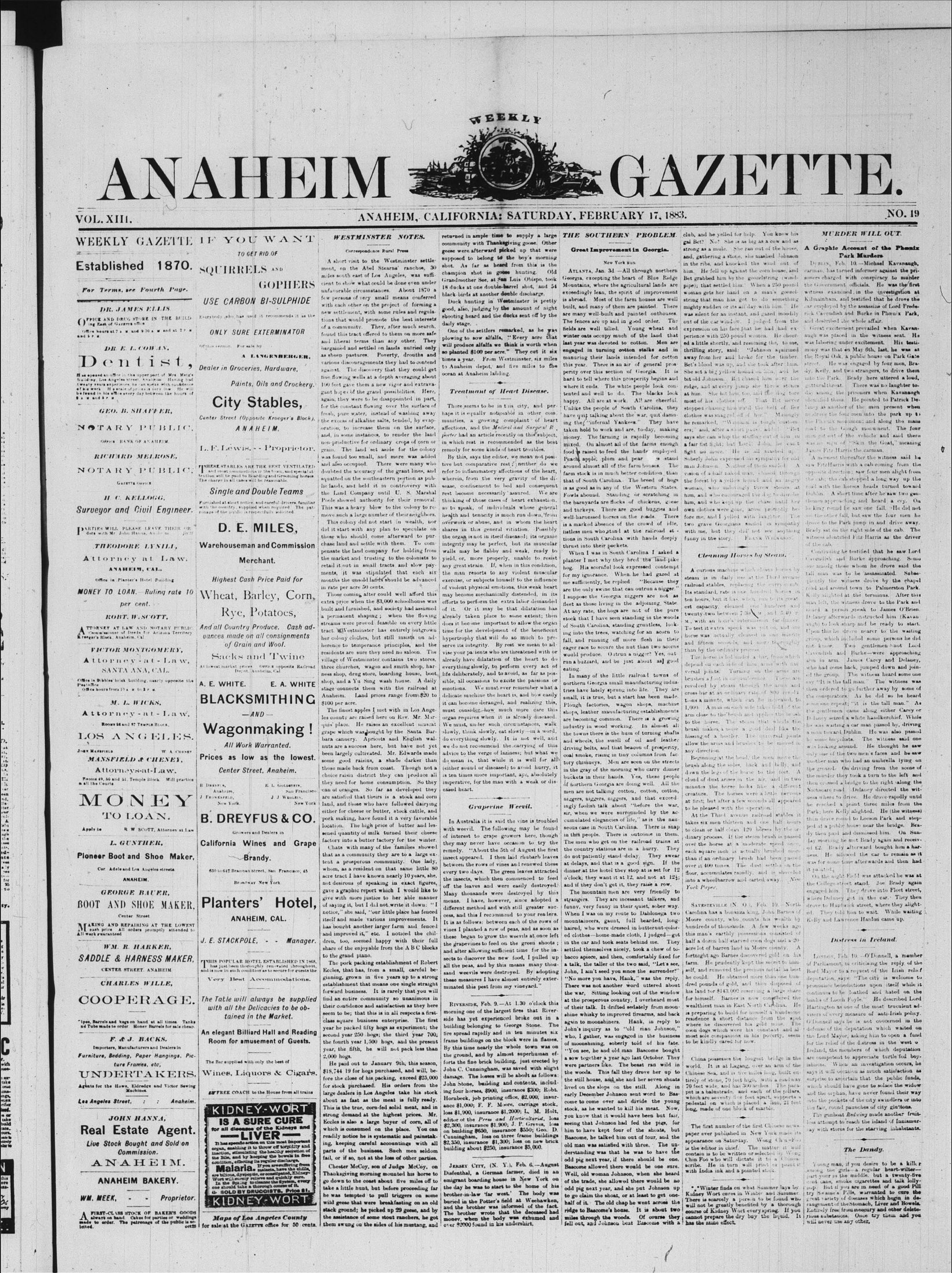
Searchable text
ANAHEIM
VOL. XIII.
WEEKLY GAZETTE IF YOU WANT
Established 1870.
For Terms, see Fourth Page.
DR. JAMES ELLIS
OFFICE AND DRUG STORE IN THE BUILDING East of Anaheim office
Office hours at 2 a.m and at 2 p.m
DR. E. L. COWAN,
Dentist,
Has opened an office in the upper part of Mrs. Metz's building, Los Angeles Street. Having had twenty years experience, he can speak with confidence of his work. His scale of prices is very low. He will be found in his office every day between the hours of 8 a.m and 8 p.m.
GEO. B. SHAFFER,
NOTARY PUBLIC,
OFFICE, BANK OF ANAHEIM.
RICHARD MELROSE,
NOTARY PUBLIC;
GEO. B. SHAFFER,
NOTARY PUBLIC,
OFFICE BANK OF ANAHEIM.
RICHARD MELROSE,
NOTARY PUBLIC,
GAETTE OFFICE
H. C. KELOGG,
Surveyor and Civil Engineer.
PARTIES WILL PLEASE LEAVE THEIR ORDERS WITH MR. JOHN HANNA, ANAHEIM.
THEODORE LYNILL,
Attorney at Law.
ANAHEIM, CAL.
Office in Planter's Hotel Building
MONEY TO LOAN. Ruling rate 10 per cent.
ROBT. W. SCOTT.
ATTORNEY AT LAW AND NOTARY PUBLIC Commissioner of Deeds for Arizona Territory Kreeger's Block, Anaheim, Cal.
VICTOR MONTGOMERY,
Attorney-at-Law,
SANTA ANA, CAL.
Office in Dibbles brick building, nearly opposite the Postoffice.
M. L. WICKS,
Attorney-at-Law.
ROOMS 66 and 87 TEMPLE BLOCK.
LOS ANGELES.
JOHN MANSFIELD
W. A. CHENEY
MANSFIELD & CHENEY,
Attorneys-at-Law.
Rooms 49, 50 and 51, Temple Block Will practice all the Courts.
MONEY TO LOAN.
Apply to R. W. SCOTT, Attorney at Law.
L. GUNTHER,
Ploneer Boot and Shoe Maker,
Cor. Adele and Los Angeles streets.
ANAHEIM.
GEORGE BAUER,
Paints, Oils and Crockery.
City Stables,
Center Street (Opposite Kroeger's Block),
ANAHEIM.
L. F. Lewis. -- Proprietor.
THESE STABLES ARE THE BEST VENTILATED and most commensal in the town, and special attention will be paid to boarding and grooming horace. The charge in all cases will be reasonable.
Single and Double Teams
Furnished at short notice, and careful drivers, familiar with the country supplied when required. The patronage of the public is respectfully solicited.
D. E. MILES,
Warehouseman and Commission Merchant.
Highest Cash Price Paid for Wheat, Barley, Corn, Rye, Potatoes,
And all Country Produce. Cash advances made on all consignments of Grain and Wool.
Sacks and Twine
At lowest market prices. Office opposite Railroad Depot, Anaheim, Cal.
A. E. WHITE.
E. A. WHITE
BLACKSMITHING — AND —
Wagonmaking!
All Work Warranted.
Prices as low as the lowest.
Center Street, Anaheim.
B. DREYFUS,
Anaheim,
San Francisco
J. FROWSFIELD,
New York
B. DREYFUS & CO.
Growers and Dealers in California Wines and Grape Brandy.
630 to 642 Brannan Street, San Francisco; 45 Broadway New York.
The finest les county are quis' place.
Grape which bara cannery nuts are a sucre been largely some good those made by choice raisin they need for can of orange are satisfied land, and the either for cheese pork making location. The sened quantit factory into mats with that as a convent a prosper whom, as a r acre tract I not desirous gave a graphi give with me
MONEY TO LOAN.
Apply to R. W. SCOTT, Attorney at Law
L. GUNTHER,
Pioneer Boot and Shoe Maker,
Cor. Adele and Los Angeles streets.
ANAHEIM.
GEORGE BAUER,
BOOT AND SHOE MAKER,
Center Street
MAKING AND REPAIRING AT THE LOWEST
cash price. All orders promptly attended to
All work guaranteed.
WM. R. HARKER,
SADDLE & HARNESS MAKER,
CENTER STREET, ANAHEIM.
CHARLES WILLE,
COOPERAGE.
Players, Barrels and kegs on hand at all times. Tanks
and Tubs made to order. Honey Barrels for sale cheap.
F. & J. BACKS.
Importers, Manufacturers and Dealers in
Furniture, Bedding, Paper Hangings, Picture Frames, etc,
UNDERTAKERS,
Agents for the Howe, Eldredge and Victor Sewing Machines.
Los Angeles Street: Anaheim.
JOHN HANNA,
Real Estate Agent.
Live Stock Bought and Sold on Commission.
ANAHEIM.
ANAHEIM BAKERY.
WM. MEEK, - Proprietor.
A FIRST-CLASS STOCK OF BAKER'S GOODS
always on hand. Cakes for parties or weddings
made to order. The patronage of the public is so
selected.
B. DREYFUS & CO.
Growers and Dealers in
California Wines and Grape Brandy.
630 to 642 Brannan Street, San Francisco; 45 Broadway New York.
Planters’ Hotel,
ANAHEIM, CAL.
J. E. STACKPOLE, - Manager.
THIS POPULAR HOTEL ESTABLISHED IN 1868,
has just been thoroughly renovated throughout,
and is now in such condition as to secure for guests the
Very Best Accommodations.
The Table will always be supplied with all the Delicacies to be obtained in the Market.
An elegant Billiard Hall and Reading Room for amusement of Guests.
The Bar supplied with only the best of
Wines, Liquors & Cigars.
FREE COACH to the House from all trains
KIDNEY-WORT
IS A SURE CURE
for all diseases of the Kidneys and LIVER
It has sponge action on this most important organ, enabling it to throw off sorpidity and inaction, stimulating the healthy secretion of the bile, and by keeping the bowels in free condition, effecting its regular discharge.
Malaria. If you are suffering from malaria, have the chills, are bilious, dyspeptic, or constipated, Kidney-Wort will surely relieve and quickly cure.
In the Spring to cleanse the System, every one should take a thorough course of it.
G. SOLD BY DRUOGISTS. Price $1.
KIDNEY-WORT
Maps of Los Angeles County
for sale at the GAZETTE office for 50 cents.
WEEKLY
EIM GA
ANAHEIM, CALIFORNIA: SATURDAY, FEBRUARY 17, 1830
WESTMINSTER NOTES.
Correspondence Rural Press
A short visit to the Westminster settlement, on the Abel Stearns' ranchos, 30 miles south east of Los Angeles, was sufficient to show what could be done even under unfavorable circumstances. About 1870 a few persons of very small means conferred with each other on the project of forming a new settlement, with some rules and regulations that would promote the best interests of a community. They, after much search, found this tract offered to them on more safe and liberal terms than any other. They bargained and settled on lands untried only as sheep pastures. Poverty, droughts and various discouragements they had to contend against. The discovery that they could get fine flowing wells at a depth averaging about 100 feet gave them a new vigor and extravagant hopes of the grand possibilities. Here, again, they were to be disappointed in part, for the constant flowing over the surface of fresh, pure water, instead of washing away the excess of alkaline salts, tended, by evaporation, to increase them on the surface, and, in some instances, to render the land non-productive for ordinary crops of corn or grain. The land set aside for the colony was found too small, and more was added and also occupied. There were many who doubted the accuracy of the grant lines, and returned in ample time to supply a large community with Thanksgiving goose. Other geese were afterward picked up that were supposed to belong to the boy's morning shot. As far as heard from this is the champion shot in goose hunting. Old Grandmother See, at San Luis Obispo, took 18 ducks at one double-barrel shot, and 54 black-birds at another double discharge.
Duck hunting in Westminster is pretty good, also, judging by the amount of night shooting heard and the ducks sent off by the daily stage.
One of the settlers remarked, as he was plowing to sow alfalfa, "Every acre that will produce alfalfa we think is worth when so planted $100 per acre." They cut it six times a year. From Westminster, six miles to Anaheim depot, and five miles to the ocean at Anaheim landing.
Treatment of Heart Disease.
There seems to be in this city, and perhaps it is equally notewable in other communities, a growing complaint of heart affections, and the Medical and Surgical R-porter had an article recently on this subject, in which rest is recommended as the best remedy for some kinds of heart troubles.
By this, says the editor, we mean not positive but comparative rest; neither do we refer to inflammatory affections of the heart,
THE SOUTHERN PROBLEM.
Great Improvement in Georgia.
New York Sun
ATLANTA, Jan. 31 — All through northern Georgia, excepting the heart of Blue Ridge Mountains, where the agricultural lands are exceedingly lean, the spirit of improvement is abroad. Most of the farm houses are well built, and many of them are painted. They are many well-built and painted outhouses. The fences are up and in good order. The fields are well tilled. Young wheat and winter oats occupy much of the land there last year was devoted to cotton. Men are engaged in turning cotton stalks and manuring their lands intended for cottage this year. There is an air of general prosperity over this section of Georgia. It hard to tell where this prosperity begins and where it ends. The white people look contented and well to do. The blacks look happy. All are at work. All are cheerful. Unlike the people of South Carolina, they have quiet talking about the war, quit damming the "infernal Yankees." They have taken hold to work and are, to-day, making money. The farming is rapidly becoming mixed. On almost all of the farms enough food is raised to feed the handr employee. Peach apple, plum and pear is star around almost all of the farm houses. The farm stock is in much better condition than
time flowing wells at a depth averaging about 100 feet gave them a new vigor and extravagant hopes of the grand possibilities. Here, again, they were to be disappointed in part, for the constant flowing over the surface of fresh, pure water, instead of washing away the excess of alkaline salts, tended by evaporation, to increase them on the surface, and, in some instances, to render the land non-productive for ordinary crops of corn or grain. The land set aside for the colony was found too small, and more was added and also occupied. There were many who doubted the accuracy of the grant lines, and squatted on the southeastern portion as public lands, and held it in controversy with the Land Company until U. S. Marshal Poole showed authority for their removal. This was a heavy blow to the colony to remove such a large number of their neighbors.
This colony did not start in wealth, nor did it start with any plan to speculate on those who should come afterward to purchase land and settle with them. To compensate the land company for holding from the market and trusting to the colonists to retail it out in small tracts and slow payments, it was stipulated that each six months the unsold lands should be advanced in rate per acre 50 cents.
Those coming after could well afford this extra price when the $3,000 schoolhouse was built and furnished, and society had assumed a permanent shaping; when the flowing streams were proved feasible on every little tract. Westminster has entirely butgrown her colony clothes, but still insists on adherence to temperance principles, and the residents are sure they need no saloon. The village of Westminster contains two stores, three churches, wagon and smith shop, harness shop, drug store, boarding house, boot shop, and a Yu Sing wash house. A daily stage connects them with the railroad at Anaheim. Land prices range from $20 to $100 per acre.
The finest apples I met with in Los Angeles county are raised here on Rev. Mr. Marquis' place. He raises an excellent muscat grape which was bought by the Santa Barbara cannery. Apricots and English walnuts are a success here, but have not yet been largely cultivated. Mr. Edwards made some good raisins, a shade darker than those made back from coast. Though not a choice raisin district they can produce all they need for home consumption. So they can of oranges. So far as developed they are satisfied that theirs is a stock and corn land, and those who have followed dairying either for cheese or butter, stock cattle, and pork making, have found it a very favorable location. The high price of butter and lessened quantity of milk turned their cheese factory into a butter factory for the winter.
Chats with many of the families showed that as a community they are to a large extent a prosperous community. One lady, whom, as a resident on that same little 80 acre tract I have known nearly 10 years, she, not desirous of speaking in exact figures, gave a graphic report which I would like to give with more justice to her able manner
Treatment of Heart Disease.
There seems to be in this city, and perhaps it is equally noticeable in other communities, a growing complaint of heart affections, and the Medical and Surgical R. porter had an article recently on this subject, in which rest is recommended as the best remedy for some kinds of heart troubles.
By this, says the editor, we mean not positive but comparative rest; neither do we refer to inflammatory affections of the heart, wherein, from the very gravity of the disease, confinement to bed and consequent rest become necessarily assured. We are thinking of those cases of heart exhaustion, so to speak, of individuals whose general health and tenacity is much run down, from overwork or abuse, and in whom the heart shares in this general vitiation. Possibly the organ is not in itself diseased; its organic integrity may be perfect, but its muscular walls may be flabby and weak, ready to yield, or more properly unable to resist any great strain. If, when in this condition, the man resorts to any violent muscular exercise, or subjects himself to the influence of violent physical emotions, this weak heart may become mechanically distended, in its efforts to perform the extra labor demanded of it. Or it may be that dilatation has already taken place to some extent; then does it become important to allow the organ time for the development of the beneficent hypertrophy that will do so much to preserve its integrity. By rest we mean to advise your patients who are threatened with or already have dilatation of the heart to do everything slowly, to perform every act of life deliberately, and to avoid, as far as possible, all occasions to excite the passions or emotions. We must ever remember what a delicate machine the heart is, and how easily it can become deranged, and realizing this must consider how much more care this organ requires when it is already diseased. We must under such circumstances walk slowly, think slowly, cat slowly—in a word, do everything slowly. It is not well, and we do not recommend the carrying of this advice to the verge of laziness; but what we do mean is, that while it is well for all (either sound or diseased) to avoid hurry, it is ten times more important, aye, absolutely imperative, for the man with a weak or diseased heart.
Graperine Weevil.
In Australia it is said the vine is troubled with weevil. The following may be found of interest to grape growers here, though they may never have occasion to try the remedy. "About the 5th of August the first insect appeared. I then laid rhubarb leaves between the rows of vines and renewed these every two days. The green leaves attracted the insects, which then commenced to feed off the leaves and were easily destroyed! Many thousands were destroyed by this hard to tell where this prosperity begins and where it ends. The white people look contented and well to do. The blacks look happy. All are at work. All are cheerful. Unlike the people of South Carolina, they have quiet talking about the war, quit damaging the "infernal Yankees." They have taken hold to work and are to-day, making money. The farming is rapidly becoming mixed. On almost all of the farms enough food is raised to feed the handr employee. Peach apple, plum and pear are stored around almost all of the farm houses. The farm stock is in much better condition than that of South Carolina. The breed of horto is as good as in any of the Western States. Fowls abound. Standing or scratching on the barnyards are flocks of chickens, goose and turkeys. There are good bugles and well-harnessed horses on the roads. There is a marked absence of the crowd of idle listless men who stand at the railroad stations in South Carolina with hands deep thrust into their pockets.
When I was in South Carolina I asked planter I met why they bred the land-pig hog. His scornful look expressed contempt for my ignorance. When he had gazed me sufficiently, he replied: "Because there are only swine that can outrun a nigger I suppose the Georgia niggers are not fleet as those living in the adjoining Stairs At any rate, the hogs are not of the pig stock that I have seen standing in the woods of South Carolina, standing gruntless, looking into the trees, watching for an acorn fall, and running off more flesh in the eager race to secure the nut than two acorn would produce. Outrun a nigger? Yes, you run a buzzard, and be just about as] go eating.
In many of the little railroad towns northern Georgia small manufacturing industries have lately sprung into life. They are small, it is true, but a start has been made Plough factories, wagon shops, machined shops, leather manufacturing establishments are becoming common. There is a grown industry in wood working. In almost all the towns there is the hum of turning shawl and wheels; the smell of oil and leather driving belts; and that beacon of prosperity coal smoke; rising in tiny columns from factory chimneys. Men are seen on the streets in gray of the morning who carry dump buckets in their hands. Yes, these people of northern Georgia are doing well. All these men are not talking cotton, cotton, niggers, niggers, and that exceedingly foolish talk about "before the worm air when we were surrounded by the cumulated elegancies of life," as is the name case in South Carolina. There is snail in this people. There is outcome in these men. The men who get on on the railroad trains at the country stations are in a hurry. They do not patiently stand delay. They sweep at delays, and that is a good sign. If they dinner at the hotel they stop at is set for o'clock; they want it at 12, and not at 12 and if they don't get it; they raise a row.
The mountain men are very friendly strangers. They are incarcerated talkers...
In Australia it is said the vine is troubled with weevil. The following may be found of interest to grape growers here, though they may never have occasion to try the remedy. "About the 5th of August the first insect appeared. I then laid rhubarb leaves between the rows of vines and renewed these every two days. The green leaves attracted the insects, which then commenced to feed off the leaves and were easily destroyed. Many thousands were destroyed by this means. I have, however, since adopted a different method and with still greater success, and this I recommend to your readers. It is as follows: between each of the rows of vines I planted a row of peas, and as soon as these began to grow the weevils at once left the grapevines to feed on the green shoots; and after allowing sufficient time for the insects to discover the new food, I pulled up all the peas, and by this means many thousand weevils were destroyed. By adopting these measures I have almost entirely exterminated this pest from my vineyard."
Riverside, Feb. 9.—At 1:30 o'clock this morning one of the largest fires that River-side has yet experienced broke out in a building belonging to George Stone. The fire spread rapidly and in ten minutes six frame buildings on the block were in flames. By this time nearly the whole town was on the ground, and by almost superhuman efforts the fine brick building, just erected by John C. Cunningham, was saved with slight damage. The losses will be about as follows: John Stone, building and contents, including four horses, $900, insurance $300; Robt. Hornbeck, job printing office, $2,000, insurance $1,000; F. F. Moore, carriage stock, loss $1,900, insurance $1,2000; L. M. Holt, editor of the Press and Horticulturist, loss $2,300, insurance $1,900; J. P. Greves, loss on building $650, insurance $550; Geo. D. Cunningham, loss on three frame buildings $2,350, insurance $1,300; loss on new brick building about $250, insurance $5,000.
Jersey City, (N. Y.), Feb. 6.—August Disfenthal, a German farmer, died in an emigrant boarding house in New York on the day he was to start to the home of his brother-in-law 'far west.' The body was buried in the Potter's field at Weehawken, and the brother was informed of the fact. The brother wrote that the deceased had money, when the body was exhumed and over $2000 found in his undershirt.
Graperine Weevil.
In Australia it is said the vine is troubled with weevil. The following may be found of interest to grape growers here, though they may never have occasion to try the remedy. "About the 5th of August the first insect appeared. I then laid rhubarb leaves between the rows of vines and renewed these every two days. The green leaves attracted the insects, which then commenced to feed off the leaves and were easily destroyed! Many thousands were destroyed by this means. I have, however, since adopted a different method and with still greater success, and this I recommend to your readers. It is as follows: between each of the rows of vines I planted a row of peas, and as soon as these began to grow the weevils at once left the grapevines to feed on the green shoots; and after allowing sufficient time for the insects to discover the new food, I pulled up all the peas, and by this means many thousand weevils were destroyed. By adopting these measures I have almost entirely exterminated this pest from my vineyard."
GAZETTE.
February 17, 1883.
NO. 19
SUTHERN PROBLEM.
Improvement in Georgia.
New York Sun.
Jan. 31. All through northern
apting the heart of Blue Ridge
where the agricultural lands are
clean, the spirit of improvement
most of the farm houses are well
any of them are painted. There
well-built and painted outhouses,
are up and in good order. The
full tilled. Young wheat and
occupy much of the land that
devoted to cotton. Men are
turning cotton stalks and in
their lands intended for cotton
there is an air of general prosection of Georgia. It is
where this prosperity begins and
is. The white people look confell to do. The blacks look
are at work. All are cheerful.
People of South Carolina, they
kick about the war, quit damnernal Yankees." They have
to work and are, to-day, making
farming is rapidly becoming
almost all of the farms enough
to feed the handr employed.
Plum and pear is stand
out all of the farm houses. The
in much better condition than
club, and he yelled for help. You know his gal Bet? No! She is as big as a cow and as strong as a mule. She ran out of the house,
and, gathering a stone, she mashed Johnson in the ribs, and knocked the wind out of him. He fell up against the corn house, and Bet grabbed him by the goozeelstring (windpipe); that settled him. When a 250 pound woman gets her hand on a man's goozeelstring that man has got to do something mighty sudden or its all day with him." He was silent for an instant, and gazed moodily out of the car window. I judged from the expression on his face that he had experience with 250-pound women. He cheered a little shortly, and resuming the, to me, thrilling story, said: "Johnson squirmed away from her and broke for the timber. Bet's blood was up, and she took after him. She set a big yellow hound on him, and he bit old Johnson. Bet chased him over the ridge, and at every jump she throw stones at him. She hit him too, and she dog tore most of his clothes off. That Bet never stopped chasing him until the heft of her clothes was snagged off of her." Musingly he remarked, "Winnam is tough customers;" and, after a short pause, added: "Bet says she can whip the stuffing out of him, in a fair fist fight; but Lord John, he can't fight no more." He is all mashed in. Soberly John expressed his sympathy for old man Johnson. Neither of them smiled.
MURDER WILL OUT.
A Graphic Account of the Phoenix Park Murders
DUBLIN, Feb. 10. Michael Kavanaugh, carman, has turned informer against the prisoners charged with conspiracy to murder the Government officials. He was the first witness examined in the investigation at Kilmainham, and testified that he drove the car employed by the assassins of Lord Frederick Cavendish and Burke in Phoenix Park, and described the whole affair.
Great excitement prevailed when Kavanaugh was placed in the witness seat. He was laboring under excitement. His testimony was that on May 6th, last, he was at the Royal Oak, a public house on Park Gate street. He was engaged by four men, Brady, Kelly, and two strangers, to drive them into the Park. Brady here uttered a loud, guttural threat. There was no laughter today among the prisoners when Kavanaugh identified them. He pointed to Patrick Deane as another of the men present when he drove the four men into the park up to the Phoenix monument; and along the main road to the Gough monument. The four men got out of the vehicle and said there was no sign of "Skin the Goat," meaning James Fitz Harris the carman.
A moment thereafter the witness said he saw Fitz Harris with a cab coming from the opposite direction; saw four men alight from
where this prosperity begins and
makes it in South Carolina I asked a
why they breed the land-pike
cornful look expressed contempt
ance. When he had gazed at
day, he replied: "Because they
dwine that can outrun a nigger."
Georgia niggers are not as
living in the adjoining State,
the hogs are not of the pure
have seen standing in the woods
colina, standing gruntless, looktrees, watching for an acorn to
turning off more flesh in their
secure the nut than two acorns
rose. Outrun a nigger? Yes, outand be just about as good
In the little railroad towns of
Georgia small manufacturing industries sprung into life. They are
true, but a start has been made.
bodies, wagon shops, machine
for manufacturing establishments
are common. There is a growing
wood working. In almost all
there is the hum of turning shafts
the smell of oil and leather
and that beacon of prosperity,
raising in tiny columns from facties. Men are seen on the streets
of the morning who carry dinner
in their hands. Yes, these people
Georgia are doing well. All the
walking cotton, cotton, cotton,
ers, niggers, and that exceedtalk about "before the war,
were surrounded by the accegancies of life," as is the nanorth-South Carolina. There is snap
There is outcome in them,
to get on the railroad trains at
stations are in a hurry. They
truly stand-delay. They swear
that is a good sign. If the
hotel they stop at is set for 12
want it at 12, and not at 12;
don't get it, they raise a row.
Cabin men are very friendly to
They are ineasant talkers and bit old Johnson. But chased him over the ridge, and at every jump she throw stones at him. She hit him too, and the dog tore most of his clothes off. That Pat never stopped chasing him until the belt of her clothes was snagged off of her." Musingly he remarked, "Winnie is tough customers; and, after a short pause, added, "Bet says she can whip the stalking out of him in a fair fist fight; but Lark John, he can't fight no more." He is all masking. Soberly John expressed his sympathy for old man Johnson. Neither of them snuck. A vision of a half naked man, clashed through the forest by a yellow hound and an angry woman, who unlovingly threw stones at him, and who encouraged the dog to disrole him, and who kept up the chase until her own clothes were gone, arrows prompt before me, and I yelled with laughter. The two grave Georgians smiled in sympathy with me, but they did not see anything funny in the story.
Frank Williamson.
Cleaning Horses by Steam.
A curious machine which cleans horses by steam is in daily use at the Third avenue railroad stables, replacing the curry comb. Its standard rate is one hundred horses in ten hours, but it has when run to its greatest capacity, cleaned one hundred and twenty-two between 7:30 p.m. and 5:40 p.m., with an hour's intermission for dinner. To test it extra speed was put on, and one horse was actually cleaned in one minute and fifteen seconds, and more thoroughly than by the ordinary process.
The horse is led under a bar, from which depend on each side of him arms with universal joints. Turning on the arms are brushes a foot in circumference. These are revolved by steam through the arms and cross-bar at an ordinary rate of 800 revolutions a minute, which can be increased to 1,000. A man on each side takes hold of the arm close to the brush and applies the brush to the horse. The steam that whirls the brush makes a noise a good deal like the hissing of a hoosler. The universal points allow the arms and brushes to be moved in any direction.
Beginning at the head, the men move the brush along the sides, back and belly, and down the legs of the horse to the feet. A cloud of dust arises in the air, and in two minutes the horse looks like a different creature. The horses were a little nervous at first; but after a few seconds all appeared to be pleased with the operation.
At the Third avenue railroad stables it takes six men thirteen and one half hours to clean or half clean 120 horses by the ordinary process. If the steam brush is passed over the horse at a moderate speed once, each square inch is actually brushed more than if an ordinary brush had been passed over it 400 times. The dust settles on the floor, acenulates rapidly, and is shovelt into a wheelbarrow and carted away.
New York Paper.
Brady here uttered a loud,
guttural threat. There was no laughter today among the prisoners when Kavanaugh identified them. He pointed to Patrick Delaney as another of the men present when he drove the four men into the park up to the Phoenix monument and along the main road to the Gough monument. The four men got out of the vehicle and said there was no sign of "Skin the Goat," meaning James Fitz Harris the carman.
A moment thereafter the witness said he saw Fitz Harris with a cab coming from the opposite direction; saw four men alight from the cab; the cab stopped a long way up the road with the horses heads turned toward Dublin. A short time after he saw two gentlemen approaching and heard a cry. On looking round he saw one fall. He did not see the other fall, but saw the four men he drove to the Park jump in and drive away. Brady sat on the right side of the cab. The witness identified Fitz Harris as the driver of the cab.
Continuing he testified that he saw Lord Cavendish and Burke approaching. Some one amoldd those whom he drove said the tall man was to be assassinated. Subsequently the witness drove by the chapel road and around town to Palmerston Park. Kelly alighted at the terminus. After this man left, the witness drove to the Park and board a person speak to James O'Brien. Delaney afterwards instructed him (Kavanaugh) to look sharp and be ready to start. Upon this he drove nearer to the waiting group, which included some persons he did not know. Two gentlemen—not Lord Cavendish and Burke—were approaching arm in arm. James Carey and Delaney, who had come back, jumped down and joined the group. The witness heard some one say: "It is the tall man." The witness was then ordered to go further away by some of the conspirators. As he did so he heard someone repeat: "it is the tall man." As the gentlemen came along either Carey or Delaney seized a white handkerchief. While he was waiting a car man passed by, driving a man toward Dublin. He was also passed by some bicyclists. The witness said one was looking around. He thought he saw only one of the two men's faces and he saw another man who had an umbrella lying on the ground. On driving from the scene of the murder they took a turn to the left and then crossed a bridge to the right along the Nichscaire road. Delaney directed the witness where to drive. He drove rapidly until he reached a point three miles from the Park; here Kelly alighted. He (the witness) then drove round to Leconon Park and stopped at a public house near the bridge. Brady then paid and dismissed him. On Sunday morning he met Brady again and received 12. Brady afterward bought him a hareness. He allowed the car to remain as it was for some time afterwards and then had it painted.
On the night Field was attacked he was at the College street stand, Joe Brady again engaged him. They drove into Fleet street, where Delaney got in the car. They then
At the Third avenue railroad stables it takes six men thirteen and one half hours to clean or half clean 120 horses by the ordinary process. If the steam brush is passed over the horse at a moderate speed once each square inch is actually brushed more than if an ordinary brush had been passed over it 400 times. The dust settles on the floor, accumulates rapidly, and is shovelled into a wheelbarrow and carted away. New York Paper.
SAVESTEVILLE (N. O.), Feb. 10. North Carolina has a bonanza king, John Barnes of Moore county, who counts his wealth by hundreds of thousands. A few weeks ago this man's earthly possessions consisted of half a dozen half-starved coon dogs and a 20-acre lot of barren land in Moore county. A fortnight ago Barnes discovered gold on his farm. He prudently kept the secret to himself, and removed the precious metal as best he could. He obtained more than one hundred pounds of gold, and then disposed of his land for $143,000 reserving a large share for himself. Barnes is now considered the wealthiest man in East North Carolina. He is preparing to build for himself a handsome residence a short distance from the spot where he discovered his gold mine. The coon dogs which were his constant and almost sole companions in his poverty, seem to be kindly cared for now.
China possesses the longest bridge in the world. It is at Lagang, over an arm of the Chinese Sea, and is five miles long, built entirely of stone, 70 feet high, with a roadway 70 feet wide, and has 900 arches. The parapet is a balustrade, and each of the pillars, which are seventy-five feet apart, supports a pedestal on which is placed a lion, 21 feet long, made of one block of marble.
The first number of the first Chinese newspaper ever published in New York made its appearance on Saturday. Wong Chin Foo is the editor in chief. The matter it will contain is to be written or selected by Wong Chin Foo who will dictate it to a Chinese scribe. He in turn will print or paint it with India ink and a pointed stick.
*Winter finds on what Summer lays by Kidney Wort cures in Winter and Summer. There is scarcely a person to be found who will not be greatly benefited by a thorough course of Kidney Wort every spring. If you cannot prepare the dry buy the liquid. It has the same effect.*
Distress in Ireland.
Lowry, Feb. 10 — O'Donnell, a member of Parliament, in criticising the reply of the Bord Mayor to a request of the Irish relief deputation, says: "The city is welcome to pronounce beneficiations upon itself while it continues to be bathed and hated on the banks of Locch Foyle." He described Lord Hartington as one of the most truculent advisers of every measure of anti-Irish policy. O'Donnell says he is not concerned in the defense of the deputation which waited on the Lord Mayor, asking him to open a fund for the relief of the distress in the west o' Ireland, the members of which deputation are competent to appreciate turtle fed boyishness. When an investigation occurs, he says it will occasion as much satisfaction as surprise to ascertain that the public funds, which should have gone to solace the widow and the orphan, have never found their way into the pockets of the city swindlers or into the fair, round paunches of city gluttonies.
The gunboat Redwing made another fruitless attempt to reach the island of Innamuray with stores for the starving inhabitants.
The Dandy.
Young man, if you desire to be a killer among the girls—a regular heart-wilter—part your in the middle, but a twenty-five cent cane, smoke cigarettes and talk lollypop. But if you are in need of a good Pill try Swain's Pills, warranted to cure the great variety of diseases which begin in derangement of the Stomach, Liver and Bowel. Entirely free from mercury and other deleterious substances. Once try them and you will never use any other.