anaheim-gazette 1883-02-03
Scanned page
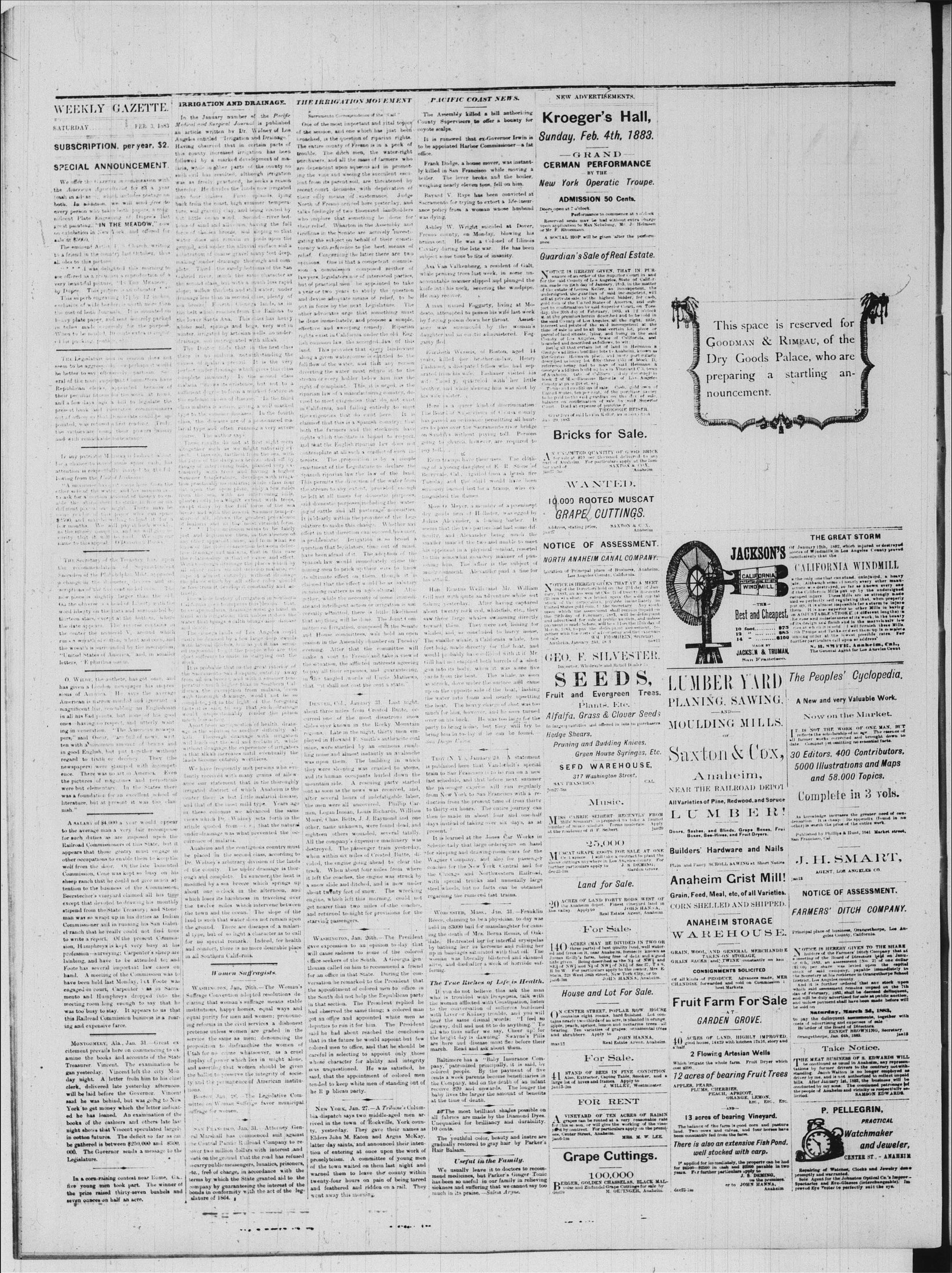
Searchable text
WEEKLY GAZETTE.
SATURDAY... FEB 3, 1883
SUBSCRIPTION, per year, $2.
SPECIAL ANNOUNCEMENT.
We offer the Gazette in combination with the American Agricultural Journal for $3 a year (cash in advance) which includes postage on both. In addition, we will send free to every person who takes both papers, a magnificent Plate Engraving of DuPree's last great painting, "IN THE MEADOW," now on exhibition in New York, and offered for sale at $900.
The eminent Artist L. Church, writing to a friend in the country last October, thanks all to this picture.
I was delighted this morning to see offered as a premium reproduction of a very beautiful picture, "In The Meadow" by DuPree. This picture is an educator.
This superb engraving (17 by 12 inches) exclusive of wide border is worth more than the cost of both journals. It is mounted on heavy plate paper, and sent securely packed in tubes made especially for the purpose. When to be mounted, 10 cents extra is required for packing postage.
The Legislature does not seem to be aggressively or perhaps it would be better to say offerively partisan. Several of the most important Committees have Republican elites appointed because of their peculiar fitness for the work at hand, and a low days ago a bill to legislate the present bank and insurance commissioners out of office so that Democrats could be appointed, was revised a first reading. True, the victors are using their powers wisely and with remarkable force.
If any petitions Mining is looked at about for a chance to invest some spare cash, has attention is respectfully invited to the follower.
IRRIGATION AND DRAINAGE.
In the January number of the Pacific Medical and Surgical Journal is published an article written by Dr. Walney of Los Angeles entitled "Irrigation and Drainage." Having observed that in certain parts of this county increased irrigation has been followed by a marked development of malaria, while in other parts of the county no such evil has resulted, although irrigation was as freely practiced, he seeks a reason therefor. He divides the lands now irrigated into four districts. First plants lying back from the coast, high summer temperature, soil gravely clay, and being visited by but little ocean wind. Second river bottoms of sand and alluvium, having the full force of the sea breeze, soil sloping so that water does not remain in pools upon the ground, and under the alluvial surface soil a substratum of coarse gravel many feet deep, making under drainage thorough and complete. Third the sandy bottoms of the San Gabriel river, much the same character as the second class, but with a much less rapid slope; willow thicket and still water; under drainage less than in second class, plenty of sea breeze. Fourth Geena lands, as in the belt which reaches from the Eallona to the lower Santa Ana. This class has heavy alobe soil, springs and beds, very wet in winter, irrigated by artesian wells no under-drainage, soil impregnated with alkali.
The District fields that in the first class there is no malaria, notwithstanding the causes of malaria prevail. It is the very perfect surfer drainage which gives this class complete immunity. In the second class malaria "shows its existence, but not to a sufficient degree to form a marked feature in the endemic cases of disease." In the third class malaria is active, giving a well-marked type to the summer diseases. In the fourth class, the diseases are of a pronounced material type and often running a very severe course. The author says.
These results do not at first sight seem altogether such as we might naturally expect. Closure, tarthest from the sea, with the corner of the dandy sea breeze shut off by ranges of intermingling hills, planted very extensively with trees and having a higher irrigation and drainage.
THE IRRIGATION.
Sacramento Correspondent
One of the most important of the session, and one unraveled, is the question: The entire county of Pleasant trouble. The ditch mishandlers and all they are dependent upon squirting the vine and wood lent from its parent soil recent court decisions their only means of North of Presno arrive talks feelingly of two who implore that son their relief. Wharton Griffiths in the Senate gating the subject on booency with reference relief. Concerning their opinions. One is that soon a commission lawyers legislators no but of practical men a year or two years to and devise adequate method in force by the new other advocates urge be done immediately effective and sweep rights exist in California common law, the land. This provides along a given water flow flow of the water diverting the water stream or every holder right of complaint. Riparian law of a man visited to meet exigence in California, and fail the exigencies that claimed that this is a both the farmers and rights which the state and that the English contemplate at all southern states. The proposed enactment of the Legisla-
If any petitions Mason is looked about for a chance to invest some spare cash, has attention is respectfully invited to the following from the Landed Leisure:
"A misunderstanding has come here from the other side of the water, and his misgivings to ask for a certain amount of money to enable the skimmer to strike in free or six different places on night. There may be some relics of this power who can spare $250, and maybe willing to lend it for a few months. We will pay it back weekly, as the money comes in, and we will give security that it will be used. We sign our name to this appeal. O Doyne Porter."
The Secretary of the Treasury has upon the recommendation of Superintendent Snowden of the Philadelphia Mini-approved a change in the diameter, devices and inscriptions of the five cent market coin. The new piece is slightly larger than the old On the obverse is head of Liberty with the word liberty on the barm and surrounded by thirteen stars, except at the bottom where the date appears. The reverse contains in the center the numeral V, around which runs a wreath of cotton, wheat and corn, and the wreath is surrounded by the inscription, "United States of America," and no smaller letters, "E pluribus unum."
O. Wittor, the asthette, has got one, and has given a London newspaper his impressions of America. He says the average American is narrow minded and ignorant a magnificent bar, resembling an Englishman in all his bad points, but none of his good ones—having no respect, and utterly wanting in veneration. "The American newspapers," said Oscar, "are full of news written with a minimum amount of brains and in good English, but put together without regard to truth or dececy. They (the newspapers) were stamped with incompetence. There was no art in America. Even the pictures of magazines and periodicals were but elementary. In the States there was a foundation for an excellent school of literature, but at present it was too clamish."
A salary of $4,000 a year would appear to the average man a very fair recompense for such duties as are imposed upon the Railroad Commissioners of this State, but it appears that those gentry must engage in other occupations to enable them to keep the wolf from the door. Of the late Lamented Commission, Cone was kept so busy on his sheep ranch that he could not give much attention to the business of the Commission; Beerstecher's vineyard claimed all his time complete immunity. In the second class malaria shows its existence, but not to a sufficient degree to form a marked feature in the endemic cases of disease. In the third class malaria is active, giving a well-marked type to the summer diseases. In the fourth class, the diseases are of a pronounced malarial type and often running a very severe course. The author says.
These results do not at first sight seem together such as we might naturally expect: classes tarted from the sea, with the force of the daily sea breeze shut off by ranges of intermingling hills, planted very extensively with trees and having a higher Summer temperature, develops with irrigation practically no malaria; while class nourished upon the open plain, only a few miles from the sea, with no intermingling hills, planted only to a wight extent with trees, swept daily by the full force of the sea breeze and when the lowest Summer temperature all allows, the greatest prevalence of malaria and in the most virulent form.
This incision seems to be fairly just and legitimate then, in the absence of any other apparent cause, and from what we know of the close connection between detection drainage and malaria, that in this case the relationship is that of cause and effect. With enough drainage the places which by all other rules should be free from it develop constantly and actively.
The whole history of irrigation in Southern California goes to impress this lesson: to escape malaria, drainage must go hand in hand with irrigation; that unless it does the water that brings wealth also disease and death.
The omega lands of Los Angeles could easily be drained by a few large deep canals with lateral ditches, but as yet has seemed impossible to get the people who are the eldest sufferers to unite in carrying out the work.
It is probable that in the great interior of the Sacramento San Joaquin entirely away from all sea breeze, and with a summer temperature much higher than in Southern California, the exemption from malaria, even with thorough drainage, would not be so complete yet in light of the foregoing facts it is safe to say that such drainage would unquestionably render the poison much less active.
Apart from an question of health drainage is the solution to another difficulty alkali. Through drainage with irrigation will leach out the soil and reclaim it, while without drainage the experience of irrigators is that alkali increases until eventually the lands become entirely worthless.
We have frequently met persons who evidently received with many grains of allowance our statement that in the thoroughly irrigated district of which Anaheim is the center there is but little malarial disease, and that of the most mild type. Years ago in these columns we advanced the same views which Dr. Widney sets forth in the article quoted from — i.e., that the natural under-drainage was what prevented the occurrence of malaria.
Anaheim and the contiguous country must be placed in the second class, according to Dr. Widney's arbitrary division of the lands of the county. The under drainage is thorough and complete. In summer,the heat is modified by a sea breeze which springs up about one o'clock in the afternoon, and which loses its harshness in traveling over complete immunity. In the second class malaria shows its existence, but not to a sufficient degree to form a marked feature in the endemic cases of disease. In the third class malaria is active, giving a well-marked type to the summer diseases. In the fourth class, the diseases are of a pronounced malarial type and often running a very severe course. The author says.
These results do not at first sight seem together such as we might naturally expect: classes tarted from the sea, with the force of the daily sea breeze shut off by ranges of intermingling hills, planted very extensively with trees and having a higher Summer temperature, develops with irrigation practically no malaria; while class nourished upon the open plain, only a few miles from the sea, with no intermingling hills, planted only to a wight extent with trees, swept daily by the full force of the sea breeze and when the lowest Summer temperature all allows, the greatest prevalence of malaria and in the most virulent form.
This incision seems to be fairly just and legitimate then, in the absence of any other apparent cause, and from what we know of the close connection between detection drainage and malaria, that in this case the relationship is that of cause and effect. With enough drainage with irrigation will leach out the soil and reclaim it, while without drainage the experience of irrigators is that alkali increases until eventually the lands become entirely worthless.
We have frequently met persons who evidently received with many grains of allowance our statement that in the thoroughly irrigated district of which Anaheim is the center there is but little malarial disease, and that of the most mild type. Years ago in these columns we advanced the same views which Dr. Widney sets forth in the article quoted from — i.e., that the natural under-drainage was what prevented the occurrence of malaria.
Anaheim and the contiguous country must be placed in the second class, according to Dr. Widney's arbitrary division of the lands of the county. The under drainage is thorough and complete. In summer,the heat is modified by a sea breeze which springs up about one o'clock in the afternoon, and which loses its harshness in traveling over complete immunity. In the second class malaria shows its existence, but not to a sufficient degree to form a marked feature in the endemic cases of disease. In the third class malaria is active, giving a well-marked type to the summer diseases. In the fourth class, the diseases are of a pronounced malarial type and often running a very severe course. The author says.
These results do not at first sight seem together such as we might naturally expect: classes tarted from the sea, with the force of the daily sea breeze shut off by ranges of intermingling hills, planted very extensively with trees and having a higher Summer temperature, develops with irrigation practically no malaria; while class nourished upon the open plain, only a few miles from the sea, with no intermingling hills, planted only to a wight extent with trees, swept daily by the full force of the sea breeze and when the lowest Summer temperature all allows, the greatest prevalence of malaria and in the most virulent form.
This incision seems to be fairly just and legitimate then, in the absence of any other apparent cause, and from what we know of the close connection between detection drainage and malaria, that in this case the relationship is that of cause and effect. With enough drainage with irrigation will leach out the soil and reclaim it, while without drainage the experience of irrigators is that alkali increases until eventually the lands become entirely worthless.
We have frequently met persons who evidently received with many grains of allowance our statement that in the thoroughly irrigated district of which Anaheim is the center there is but little malarial disease, and that of the most mild type. Years ago in these columns we advanced the same views which Dr. Widney sets forth in the article quoted from — i.e., that the natural under-drainage was what prevented the occurrence of malaria.
Anaheim and the contiguous country must be placed in the second class, according to Dr. Widney's arbitrary division of the lands of the county. The under drainage is thorough and complete. In summer,the heat is modified by a sea breeze which springs up about one o'clock in the afternoon, and which loses its harshness in traveling over complete immunity. In the second class malaria shows its existence, but not to a sufficient degree to form a marked feature in the endemic cases of disease. In the third class malaria is active, giving a well-marked type to the summer diseases. In the fourth class, the diseases are of a pronounced malarial type and often running a very severe course. The author says.
These results do not at first sight seem together such as we might naturally expect: classes tarted from the sea, with the force of daily sea breeze shut off by ranges of intermingling hills, planted very extensively with trees and having a higher Summer temperature, develops with irrigation practically no malaria; while class nourished uponthe open plain, only a few miles fromthe sea,withnointermingdinghills,plantedonlytoawitnessextensivewithtreeshiswouldnotbeusedforanyotherpurpose.TheproportionenactmentoftheLegislationhasbeenafraidofitSpanishlawwouldminimizemenotprickitsultimateeffectonclaimedthat anythingwillbemitterforgiving,andHousecommitssessionintheAssessmenovement.Afterthattakealltheexpiredinthetangledworsthatitshallnotco
DENVER,COL.Janaboutthreemilesfromcurrenoleoftheslideseverknowninregions.LateintheplayedinHowardBiminewerestartledlingnoseandalmostwasupenedtheywereseepinganditishumanoccurmountside.Aoutassoasthenathenewhoursmeantallmin.LoganInman.Moore,Cchas.Bettosothernameunknow-eighteenotherswallowedthecompany'sdestroyed.Thepaywhenwithin sixmovedtheenginegrewatleastoffelthecoaches,a snowslideanddabouttwentyfeetenginesleftonenginehousesleftontheearliestdayofthefallingrightofcomplaintatallsoestests.TheproportionenactmentoftheLegislationhasbeenafraidofitSpanishlawwouldminimizemenotprickitsultimateeffectonclaimedthat anythingwillbemitterforgiving,andHousecommitssessionintheAssessmenovement.Afterthattakealltheexpiredinthetangledworsthatitshallnotco
A salary of $4,000 a year would appear to the average man a very fair recompense for such duties as are imposed upon the Railroad Commissioners of this State, but it appears that those gentry must engage in other occupations to enable them to keep the wolf from the door. Of the late lamented Commission, Cone was kept so busy on his sheep ranch that he could not give morn attention to the business of the Commission; Beerstecher's vineyard claimed all his time except that devoted to drawing his monthly stipend from the State Treasury; and Stoneman was so wrapt up in his duties as Indian Commissioner and in running his San Gabriel ranch that he really could not find time to write a report. Of the present Commission, Humphreys is kept very busy at his profession—surveying; Carpenter's sheep are lambing, and have to be attended to; and Foote has several important law cases on hand. A meeting of the Commission was to have been held last Monday, but Foote was engaged in court, Carpenter was in Sacramento and Humphreys dropped into the meeting room long enough to say that he was too busy to stay. It appears to us that this Railroad Commission business is a roaring and expensive farce.
Montgomery, Ala., Jan. 31 — Great excitement prevails here on commencing to examine the books and accounts of the State Treasurer Vincent. The examination be gan yesterday. Vincent left the city Monday night. A letter from him to his chief clerk, delivered late yesterday afternoon, will be laid before the Governor. Vincent said he was behind, but was going to New York to get money which the letter indicated he has loaned. An examination of the books of the cashiers and others late last night shows that Vincent speculated largely in cotton futures. The deficit so far as can be gathered is between $250,000 and $300,000. The Governor sends a message to the Legislature.
In a corn-raising contest near Rome, Ga., five young men took part. The winner of the prize raised thirty-seven bushels and seven ounces on half an acre.
WASHINGTON, Jan. 26th. — The Woman's Suffrage Convention adopted resolutions declaring that woman's suffrage means stable institutions, happy homes, equal ways and equal purity for men and women; pronouncing reforms in the civil services a dishonest pretense unless women are graded in the service the same as men; denouncing the proposition to disfranchise the women of Utah for no crime whatsoever, as a cruel display of power which lies in might alone, and asserting that women should be given the ballot to preserve the integrity of society and the permanence of American institutions.
Boston, Jan. 26. — The Legislative Committee on Woman Suffrage favor municipal suffrage for women.
SAN FRANCISCO, Jan. 31. — Attorney General Marshall has commenced suit against the Central Pacific Railroad Company to recover two million dollars with interest and costs on the ground that the road has refused to carry public messengers, lunatics, prisoners, etc., free of charge, in accordance with the terms by which the State granted aid to the company by guaranteeing the interest of the bonds in conformity with the act of the legislature of 1864.
THE IRRIGATION MOVEMENT
Sacramento Correspondence of the Calif.
One of the most important and vital topics of the session, and one which has just been broached, is the question of riparian rights. The entire county of Presno is in a peck of trouble. The ditch men, the water-right purchasers, and all the mass of farmers who are dependent upon squeeos aid in promoting the vine and wooing the succulent荔枝 from its parent soil, are threatened by recent court decisions with deprivation of their only means of sustenance. Judge North of Presno arrived here yesterday, and talks feelingly of two thousand landholders who implore that something be done for their relief. Wharton in the Assembly and Griffiths in the Senate are actively investigating the subject on behalf of their constituency with reference to the best means of relief. Concerning the latter there are two opinions. One is that a competent commission composed neither of lawyers, legislators nor of interested parties, but of practical men be appointed to take a year or two years to study the question and devise adequate means of relief, to be put in force by the next Legislature. The other advocates urge that something must be done immediately, and propose a simple, effective and sweeping remedy. Riparian rights exist in California under the old English common law, the accepted law of this land. This provides that every landowner along a given watercourse is entitled to the full flow of the water, and that any person diverting the water must return it to the stream or every holder below him has the right of complaint. This, it is urged, is the riparian law of a manufacturing country, devised to meet exigencies that do not exist in California, and failing entirely to meet the exigencies that do exist here. It is claimed that this is a Spanish country; that both the farmers and the stockmen have rights which the State is bound to respect, and that the English riparian law does not contemplate at all such a conflict of such interests. The proposition is by a simple enactment of the Legislature to declare the Spanish riparian law the law of the land.
PACIFIC COAST NEWS.
The Assembly killed a bill authorizing County Supervisors to offer a bounty for coyote scalp.
It is rumored that ex-Governor Irwin is to be appointed Harbor Commissioner—a fat office.
Frank Dodge, a house mover, was instantly killed in San Francisco while moving a boiler. The lever broke and the boiler weighing nearly eleven tons fell on him.
Bayard V. Raye has been convicted at Sacramento for trying to extort a life-insurance policy from a woman whose husband was dying.
Ashley W. Wright snicked at Dover, Presno county, on Monday, blowing his brains out. He was a Colonel of Illinois Cavalry during the late war. He has been subject some time to fits of insanity.
Asa Van Valkenburg, a resident of Galt, while printing trees last week, in some unaccountable manner slipped and plunged the knife into his neck, severing the windpipe. He may recover.
A man named Foggarty, living at Modesto, attempted to poison his wife last week by forcing poison down her throat. Assistance was summoned by the woman's daughter and an estate administered. Foggarty fled.
Elizabeth Wessels, of Boston, aged 14 years, killed her brother-in-law, Henry Fashauer, a dispatched fellow who had separated from his wife. Fashauer visited his wife Tuesdy y quarreled with her little brother, and while abusing him was shot by his wife sister.
Here is a queer kind of discrimination: The Board of Supervisors of Coosa county has passed an ordinance permitting all hunters to pass over the Sacramento river bridge on Sundays without paying toll. Persons going to church, however, are required to pay toll.
Even tramps have their uses. The clothing of a young daughter of E. R. Stone of the town of AuburnCalifornia permitted from a brush fire...
DENVER, Col., January 31. Last night, about three miles from Crested Butte, occurred one of the most disastrous snow slides ever known in the Rocky Mountain regions. Late in the night, thirty men employed in Howard F. Smith's anthracite coal mine, were startled by an ominous rumbling noise and almost instantly an avalanche was upon them. The building in which they were sleeping was crushed to atoms, and its human occupants hurled down the mountain side. A rescuing party started out as soon as the news was received, and after several hours of indefatigable labor, the men were all uncovered. Phillip Carmin, Logan Inman, Louis Richards, William Moore, Chas. Betts, J. J. Raymond and one other, name unknown, were found dead, and eighteen others wounded, several fatality.
All the company's expensive machinery was destroyed. The passenger train yesterday, when within six miles of Crested Butte, divided, the engine going ahead to clear the track. When about four miles from where it left the coaches, the engine was struck by a snow slide and ditched, and is now under about twenty feet of snow. The wrecking machine which left this morning could not crater from his wife. Tasley visited his wife Tuesdy, quarreled with her little brother, and while abusing him was shot by his wife sister.
Here is a queer kind of discrimination. The Board of Supervisors of Coosa county has passed an ordinance permitting all hunters to pass over the Sacramento river bridge on Sundays without paying toll. Persons going to church, however, are required to pay toll.
Even traps have their uses. The clothing of a young daughter of E. R. Stone of Beerryvale, Cal., ignited from a brush fire Tuesday and the child would have been seriously burned but for a tramp who extinguished the flames.
Mose O. Meyer, a member of a prominent dry goods firm of Hollister, was egged by Julius Alexander, a leading barber. It seems that the two parties had had some difficulty, and Alexander being much the smaller man of the two and unable to meet his opponent in a physical combat, resorted to this sons what misavow manner of punishing him. The affair is the subject of much comment. Alexander paid a fine for his attack.
Hon Erastus Wells and Mr. William Gill met with quite an adventure while out fishing yesterday. After having captured about twenty rock edd, whitetfish, etc., they saw three large whales swimming directly toward them. They were not lishing for whales, and so concluded to hurry home. The smaller whale, a California whale, ten feet long, made directly for the boat, and would probably have collided with it if Mr. Gill had not emptied both barrels of a shotgun into its body, when it was some five yards from the boat. The whale, as soon as struck, dove under the surface and came up on the opposite side of the boat, lashing the water into foam and nearly upsetting the boat. The heavy charge of shot was too much for him; however, and he soon turned over on his back. He was too large for the party to bring noone, but they will try to bring him in to-day if he can be found.
San Diego Union.
Troy (N.Y.), January 20. A statement is published here that Vanderbilt's special train to San Francisco is to be run on a new fast schedule, and that before next summer the passenger express will run regularly from New York to San Francisco with a reduction from the present time of from thirty to thirty-six hours. The entire journey can then be made in about four and one-half days instead of taking over six days, as at present.
It is learned at the Jones Car Works in Schenectady that large orders are on hand for sleeping and drawing-room-cars for the Wagner Company, and also for passenger coaches for the New York Central and for the Chicago and Northwestern Railroad, with special trucks and unusually large steel wheels, but no facts can be obtained regarding the rumored fast trains.
Bricks for Sale.
WANTED.
10,000 ROOTED MUSCAT GRAPE CUTTINGS.
NOTICE OF ASSESSMENT.
NORTH ANAHEIM CANAL COMPANY.
LOCATION OF Principal place of Business, Anaheim, Los Angeles County, California.
NOTICE IS HEREBY GIVEN THAT AT A MEETING of the Directors held on the 25th day of January, 1833, an asssumtion (No 2) of twentytwo cents (22 cents) of a share was leased upon the sold capital stock of the corporation; payable innately in United States gold coin; the Secretary Any stock which the assessment shall remain unpaid on the 24th day of February, 1833, will be deferred and advertised for sale at public auction, and unless payment is made before will be lost the 17th day of March, 1834, to pay the delinquent assessment; together with the costs of altering and the expenses of sale Anaheim, January 26th, 1833 nov11
GEO. F. SILVESTER.
Importer: Wholesale and Retail Dealer
SEEDS,
Fruit and Evergreen Treas,
Plants. Etc.
Alfalfa, Grass & Clover Seeds
In large quantities and offered in lots to purchasers
Hedge Shears,
Pruning and Budding Knives,
Green House Syringes, Etc.
SEFD WAREHOUSE,
317 Washington Street,
SAN FRANCISCO.
Jan 27th
Music.
MISS CARRIE SEIBERT RECENTLY FROM Mille Seminary is prepared to take a limited number of music classes. Terms moderate Apply at the residence of B.F. Sebert.
25,000
MUSCAT GRAPE ROOTS FOR SALE AT ONE Cent apiece I will take a contract to plant the above cuttings anywhere in Los Angeles county For further particulars apply to dee25-lm Garden Grove
Land for Sale.
WASHINGTON, Jan. 26th. — The President gave expression to an opinion to-day that will cause sadness to some of the colored office seekers of the South. A Georgia gentleman called on him to recommend a friend for an office in that State. During the conversation he remarked to the President that the appointment of colored men to office in the South did not help the Republican party in that section. The President replied he had observed the same thing; a colored man got an office and appointed white men as deputies to run it for him. The President said he had about reached the conclusion that in the future he would appoint but few colored men to office, and that he should be careful in selecting to appoint only those whose character for ability and integrity was unquestioned. He was satisfied, he said, that the appointment of colored men tended to keep white men of standing out of the Republican party.
NEW YORK, Jan. 27. — A Tribune's Columbia dispatch says two middle-aged men arrived in the town of Rockville, York county, yesterday. They gave their names as Elders John M. Eaton and Argus McKay, latter day saints, and announced their intention of entering at once upon the work of proselytism. A committee of young men of the town waited on them last night and warned them to leave the county within twenty-four hours on pain of being tarred and feathered and ridden on a rail. They went away this morning.
It is learned at the Jones Car Works in Schenectady that large orders are on hand for sleeping and drawing-room cars for the Wagner Company, and also for passenger coaches for the New York Central and for the Chicago and Northwestern Railroad, with special trucks and unusually large steel wheels, but no facts can be obtained regarding the rumored fast trains.
WORCESTER, Mass., Jan. 31. — Franklin Reece, claiming to be a physician, to day was held in $3000 bail for manslaughter for causing the death of Mrs. Berna Remus, of Oakdale. He treated her for internal erysipelas by bathing her in kerosene and rolling her up in bainages saturated with that oil. The woman was literally blistered and skinned alive, and died after a week of horrible suffering.
The True Riches of Life is Health.
If you do not believe this ask the man who is troubled with Dyspepsia, talk with the woman afflicted with Constipation, listen to the conversation of sufferers burdened with Liver or Kidney trouble, and you will hear the same dismal words: "I feel so drowsy, dull and not n't to do anything." To all who thus suffer we say, Cheer up for the bright day is dawning! Swayne's Pillis are here and disease must flee before their march. Read and ask about them.
Baltimore has a "Baby Insurance Company," patronized principally, it is said, by colored people. By the payment of five cents a week parents become beneficiaries in the Company, and on the death of an infant receive $20 and upwards. The longer the baby lives the larger the amount of benefits at the time of death.
The most brilliant shades possible on all fabrics are made by the Diamond Dyes. Unequalled for brilliancy and durability. 10 cents.
The youthful color, beauty and lustre are gradually restored to gray hair by Parker's Hair Balsam.
Useful in the Family.
We usually leave it to doctors to recommend medicines, but Parker's Ginger Tonic has been so useful in our family in relieving sickness and suffering that we cannot say too much in its praise.—Salon Argue.
This space is reserved for Goodman & Rimpaul, of the Dry Goods Palace, who are preparing a startling announcement.
THE GREAT STORM
Of January 12th, 1882, which injured or destroyed scores of Windmills in Los Angeles County proved conclusively that the
CALIFORNIA WINDMILL
is the only one that can stand, uninjured, a heavy sale. Although some of nearly every other manufacture was destroyed, so far as known, one of the Californian mills put up by the underigned escaped injury. Three mills are so strongly made and so perfectly self-regulating that, when properly put up, it is almost impossible for a storm to injure them. It is also superior to other mills in having ADJUSTABLE ENTRANCE (4 different lengths) in the case and maintenance of its work, in the beauty of its design and finish and in the marvelously low rates at which it stood. I will furnish these Mills with Pump and Tanks, and set them up in complete running order at the lowest possible rates. For further particular call upon or address.
N. H. NITTEE, Anaheim, Cal.
The General Agent for Los Angeles Count
LUMBER YARD PLANING. SAWING. AND MOULDING MILLS.
OF
Saxton & Cox,
Anaheim,
NEAR THE RAILROAD DEPOT
All Varieties of Pine, Redwood, and Spruce
LUMBER!
Doors, Sashes, and Blinds, Grape Boxes, Fruit Boxes, Bee-Hives, and Fruit Dryers.
Builders' Hardware and Nails
Plain and Fancy SCROLL SAWING at Short Notice
Anaheim Crist Mill!
Grain, Feed, Meal, etc., of all Varieties.
The Peoples' Cyclopedia.
A New and very Valuable Work.
Now on the Market.
It IS NOT THE WORK OF ONE MAN, BUT reflects the scholarship of an age. The essence of all former works corrected and brought down to date. Compact yet omitting no essential facts.
30 Editors. 400 Contributors,
5000 Illustrations and Maps and 58.000 Topics.
Complete in 3 vols.
As knowledge increases the greater need of condensation. It is cheap. Its appendix (found in no other) is worth the price of the entire work.
Published by Phillips & Hunt, 1941 Market street, San Francisco, Cal.
J. H. SMART,
AGENT, LOS ANGELES CO.
NOTICE OF ASSESSMENT.
LUMBER!
Doors, Sashes, and Blinds, Grape Boxes, Fruit Boxes, Bee-Hives, and Fruit Dryers.
Builders' Hardware and Nails
Plain and Fancy SCROLL SAWING at Short Notice
Anaheim Grist Mill!
Grain, Feed, Meal, etc., of all Varieties.
CORN SHELLED AND SHIPPED.
ANAHEIM STORAGE WAREHOUSE.
GRAIN, WOOL, AND GENERAL MERCHANDISE TAKEN ON STORAGE.
GRAIN BACKS, AND TWINE constantly on hand.
CONSIGNMENTS SOLICITED
Of all kinds of PRODUCE. Advances made, MERCHANDISE forwarded and sold on Commission 1 best Markets.
Fruit Farm For Sale
AT
GARDEN GROVE.
40 ACRES OF LAND, HIGHLY IMPROVED, good house, 14x29 with kitchen 12x16, story and a half.
2 Flowing Artesian Wells
Which irrigate the whole farm. Fruit Dryer which cost $200.
12 acres of bearing Fruit Trees
APPLES, PEARS,
PLUMS, CHERRIES,
PEACH, APRICOT,
ORANGE, LEMON,
ETC., ETC., ETC.
13 acres of bearing Vineyard.
The balance of the farm is good corn and pasture land. Two cows and calves, and four horses have been constantly fed from the farm.
There is also an extensive Fish Pond, well stocked with carp.
1 applied for immediately, the property can be had for $4500-$8200 in cash and $2000 payable in two years. For further particulars apply to J. S. DEMING,
on the premises.
or to JOHN HANNA,
Anaheim
NOTICE OF ASSESSMENT.
FARMERS' DITCH COMPANY.
Principal place of business, Orangethorpe, Los Angeles County, California.
NOTICE IS HEREBY GIVEN TO THE SHARE holders of the Farmers' Ditch Company that at a meeting of the Board of Directors held on January 6th, 1883, an assessment [No. 2] of one dollar ($1.00) per share was levied upon the capital stock of said company, payable immediately to the Secretary at his residence in Orangethorpe School District, Los Angeles county.
And it is further ordered that any stock upon which said assessment remains unpaid on the 7th day of February, 1883, shall be deemed delinquent, and will be duly advertised for sale at public auction, and unless payment shall have been made before will be sold on Saturday, March 3d, 1883,
to pay the delinquent assessments together with costs of advertising and expenses of sale.
By order of the Board of Directors.
ERNEST BROWNING, Secretary
Orangethorpe, Jan. 6th, 1883.
Take Notice.
THE MEAT BUSINESS OF S. EDWARDS WILL be continued as usual in Anaheim, any representations by former drivers to the contrary notwithstanding Jacob Walton is no longer employed as driver by me, and is not authorized to collect unpaid bills. After January 1st, 1883, the business will be conducted by my sons. The continued patronage of the people of Anaheim and vicinity is respectfully solicited.
P. PELLEGRIN,
PRACTICAL Watchmaker and Jeweler,
CENTER ST., - ANAHEIM
Repairing of Watches, Clocks and Jewelry done promptly and warranted.
Sole Agent for the Johnston Optical Co.'s Improvement Specacles and Eye-Glasses (interchangeable). Im proved Eye Tester to perfectly suit the eye.