anaheim-gazette 1882-12-30
Scanned page
Searchable text
SIX-PAGE
ANAHEIM
VOL. XIII.
WEEKLY GAZETTE
Established 1870.
For Terms, see Fourth Page.
ORANGE CULTURE
If there is any other tree more pleasing to the eye than the orange tree—if there can be found in any part of the world a more beautiful vine than that of a well kept orange grove—the pen of author and brush of painter have failed to describe it. It is a beautiful sight at all times and seasons, but it is in its full glory in December, bleak December. For it is then that the fruit becomes a golden yellow, and the leaves, washed by the rains, form an exquisite setting for the ripening orange. The tree itself, naturally symmetrical, is made more abapely by skillful pruning; and, take it all in all, there is no earthly possession more enviable than an orange grove. A writer in the December number of Harper's Magazine, referring to an orange grove in this county, says: "The air was heavy with the fragrance from extensive avenues of limes as we came up to it. The orange trees were propped to prevent them breaking under their weight of fruit. Forty oranges on a single bough, so close together as to touch—I have seen trees. Last season, from these thirty orange trees, she picked, counted and shipped 23,000 oranges, for which she received $175—a sum which would have been greatly increased had it not been for the smallness of the fruit, which, it will be remembered, was a feature of last year's crop. Besides these 23,000 oranges sold, five or six boxes were presented to friends, and quite a large family used the fruit without stint. The lemon trees also here a large crop, but we forgot to ask what the pecuniary returns were from that fruit. It is not to be wondered at that, having such palpable evidence of the horticultural possibilities of the county, the lady should inveigh against the men who asperse the country and declare that its attractiveness and capacity are persistently overrated. If half an acre in orange trees can be made to yield $175 a year, why cannot a twenty-acre orchard be made to give an annual income of $7,000? she very pertinently asks. And she answers the question by alleging incapacity and bad management on the part of the owners."
An intelligent and practical orange grower, writing to the Gazette two years ago on the subject of orange culture, and in reply to the question, "Is there any money in it?" said:
And now, let us get down to the pertinent part of your inquiry, "Whether there is any money in it;" and although I have fully as much faith in seedling trees, yet as budded fruit is now the fashion we will make our calculations on that basis. In Italy, the oldest and best orange growing country from which we can gather authentic facts, they set 100 of seedling and 200 of budded trees to the acre. We will start in with ten acres of land and put only 100 budded trees to the acre." Then we have
the rains, form an exquisite setting for the ripening orange. The tree itself, naturally symmetrical, is made more shape by skillful pruning; and, take it all in all, there is no earthly possession more enviable than an orange grove. A writer in the December number of Harper's Magazine, referring to an orange grove in this county, says: "The air was heavy with the fragrance from extensive avenues of limes as we came up to it. The orange trees were propped to prevent them breaking under their weight of fruit. Forty oranges on a single bough, so close together as to touch—I have seen it with my own eyes." The orange tree bears a close resemblance to the formal idealized plant, with its symmetrical fruit, which the medieval painters were accustomed to construct for that momentous tree of the knowledge of good and evil of the first chapter of Genesis." No wonder, then, that it is the ambition of so many members of the human family to become owners of such groves as depicted, and to live in a land whose generous climate fosters the growth of the tropic orange.
And this leada us to the question of locality. No more erroneous idea was ever entertained than that any part of Southern California—any part of Los Angeles county—is fitted for orange culture. On this point we wrote some years ago: "There are places within the borders of this county that are no more fitted for orange culture than are the pine regions of Maine, and an attempt to raise the juicy orange or the acidulous lemon in such places would be the height of folly. Any locality where the thermometer during winter frequently marks 25° or 28° Fahr., is altogether too arctic for the successful growth of citrus trees. As a matter of fact, the area in which orange culture can be carried on with safety and profit is limited, even in this county. The much-vaunted San Gabriel valley has been frequently visited by injurious frosts; in portions of Los Angeles city the winter frosts are so intense that all attempts to grow orange trees have been abandoned; and in the Downey and Artesia region there are only a few isolated trees growing with any thrift." An orange-grower of experience, referring to the question of locality, said in an address before the Anaheim Horticultural Society:
Land agents are apt to represent the area adapted to the successful culture of the orange larger than actual tests justify. Experience has shown that it is really much smaller than any of us thought a few years ago. Within only a very short time large numbers of trees were being planted throughout the northern part of the State—also in low, wet and cold lands in our immediate vicinity. With but few exceptions, these ventures have proved failures.
These views have been strengthened by subsequent observation and experience, and the warning is of deep import to those who come to this county with the intention of engaging in the culture of the orange, the lemon and the lime.
From a point six miles north and east of Anaheim, clear south to San Diego, and back
THE ANAHEM
The view of the building which was permission of Mr. the Semi-Tropical Fornian) will give the handsome but are taught. It is mostest building o and there is only Angeles city.
The school grows land, bordered w and dotted here pepper trees, wha summer mo erected in 1878, ground to the ma from the ground 75 feet 6 inches. that the building ject. The clock 10 feet square at height of nearly the main roof space above th e pupils and p There are four story—besides co robes, etc., and approved pattern building, furnit
POSSIBILITIES OF FORTY ACRES
“What can be done with forty acres” was the title of an article written for the Gazette some time ago. The writer, after quoting the income of several fruit growers to establish a fair average, says:
“Now let us return to our 40-acre lot. Reserve 2 acres for a house, garden, chicken yard and the necessary out buildings. Set out 20 acres in grapes, and divide the remaining 18 acres equally between oranges and olives.
1. At the end of three years the grapes will bring $1000 if sold raw to the wine-makers, and at least $4000 if turned into raisins at a profit of $200 an acre, which is about 20 per cent. lower than in case (a) mentioned above, and 54 per cent. less than the profit in case (b).
2. At the end of 7 years the olives will be bearing largely and bringing in a profit of not less than $500 an acre, which in nine years, the trees being then in full bearing, will be at least $1000 an acre.
3. At the end of 10 years—or at most 12—the oranges will clear $500 an acre.
Combining these profits, we have:
Raisins, 20 acres @ $200 per acre...$4000
Olives, 9 " @ 1000 " ...9000
Oranges, 9 " @ 500 " ...4500
Total.....$17,500
This total is made by taking amounts per acre very much less than the actual receipts of well-known persons—fully one-half less in the case of oranges and olives; but in order to allow for any possible ill success, let us reduce the estimate still further by one-third, and we shall still have a total of $11,666 as the average annual profit from and after the 10th, or at least the 12th year.
At the full rate of profit made in case (b), the return in the 3d year from the 20 acres of grapes would be $7400, and taking the low rate of $200 an acre, it would be $4000, or one and one-half times the amount spent in purchasing the whole 40 acres, supposing the price to be $75 an acre.
Taking the orange and olive profits at the rate given by the receipts of the gentlemen quoted, we have at the end of the above period an annual income from the 40 acres as follows:
Raisins, 20 acres @ $370 an acre...$7,400
Olives, 9 " @ 2000 " ...18,000
Oranges, 9 " @ 1000 " ...9,000
Total.....$34,400
If this were regarded as interest at the rate of 10 per cent. per annum, it would represent a capital sum of three hundred and forty-four thousand dollars."
An incident of the late vintage was the marvelous yield of a four-year old vineyard of Berger grapes. The average yield was seven tons to the acre.
WEEKLY
EIM GA
ANAHEIM, CALIFORNIA: SATURDAY, DECEMBER 30, 1882.
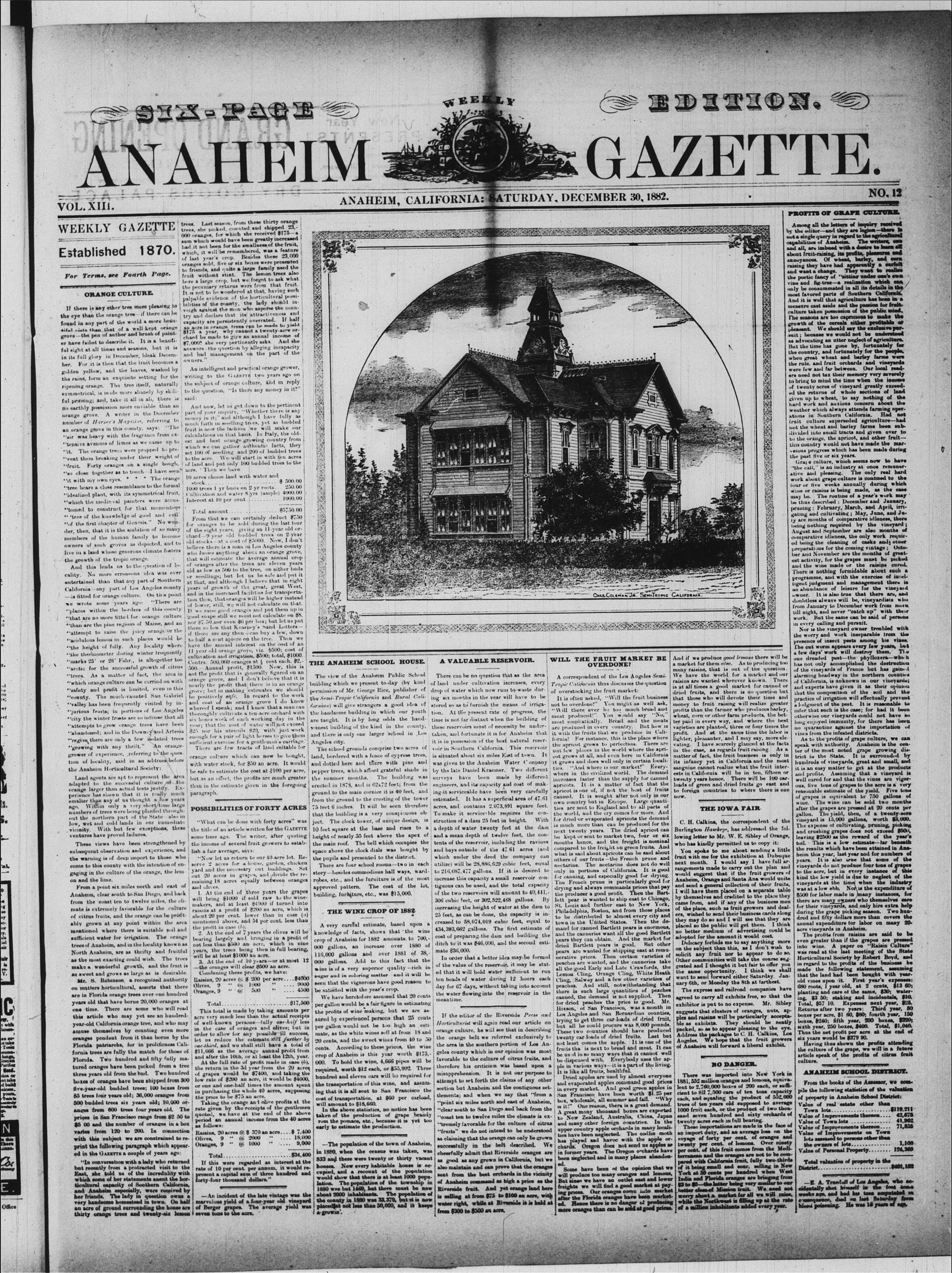
THE ANAHEIM SCHOOL HOUSE.
The view of the Anaheim Public School building which we present to-day (by kind permission of Mr. George Rice, publisher of the Semi-Tropic California and Rural California) will give strangers a good idea of the handsome building in which our youth are taught. It is by long odds the hand-somest building of the kind in the county, and there is only one larger school in Los Angeles city.
The school grounds comprise two acres of land, bordered with a fence of cypress trees, and dotted here and there with pine and pepper trees, which afford grateful shade in the summer months. The building was erected in 1878, and is 62x72 feet; from the ground to the main cornice it is 40 feet, and from the ground to the cresting of the tower 75 feet 6 inches. It will be seen therefore that the building is a very conspicuous object. The clock tower, of unique design, is 10 feet square at the base and rises to a height of nearly 35 feet above the apex of the main roof. The bell which occupies the space above the clock dial was bought by the pupils and presented to the district.
There are four school rooms—two in each story—besides commodious hall ways, wardrobes, etc., and the furniture is of the most approved pattern. The cost of the lot, building, furniture, etc., was $15,000.
A VALUABLE RESERVOIR.
There can be no question that as the area of land under cultivation increases, every drop of water which now runs to waste during six months in the year will have to be stored so as to furnish the means of irrigation. At the present rate of progress, the time is not far distant when the building of these reservoirs must of necessity be undertaken, and fortunate it is for Anaheim that it is in possession of the best natural reservoir in Southern California. This reservoir is situated about six miles East of town. It was given to the Anaheim Water Company by the late Daniel Kraemer. Two different surveys have been made by different engineers, and its capacity and cost of making it serviceable have been very carefully estimated. It has a superficial area of 47.61 acres, and contains 2,073,891 square feet. To make it serviceable requires the construction of a dam 25 feet in height. With a depth of water twenty feet at the dam and a mean depth of twelve feet, the contents of the reservoir, including the ravines and bays outside of the 47.61 acres (and which under the deed the company can utilize) will be 28,886,629 cubic feet, equal to 216,087,477 gallons. If it is desired to increase this capacity a small reservoir contiguous can be used, and the total capacity of the two reservoirs will amount to 40,441.
WILL THE FRUIT MARKET BE OVERDONE?
A correspondent of the Los Angeles Semi-Tropic California thus discusses the question of overstocking the fruit market:
It is often asked, "Will the fruit business not be overdone?" You might as well ask, "Will there ever be too much bread and meat produced?" You would say "No," most emptilyly. Bread and the meats are produced in every country. But how is it with the fruits that we produce in California? For instance, this is the place where the apricot grows to perfection. There are but few places in the world where the apricot grows at all, and even here in California it grows and does well only in certain localities. "And where is our market?" Everywhere in the civilized world. The demand increases faster than the supply for canned apricots. It is a matter of fact that the apricot is one of, if not the best of fruits canned. It is sought after not only in our own country but in Europe. Large quantities are sent to England and to all parts of the world, and the cry comes for more. And for dried or evaporated apricots the demand is much more than can be produced for the next twenty years. The dried apricot can be kept or sent to market two, four or six months hence, and the freight is nominal compared to the freight on green fruits. And what is said about apricots can be said about others of our fruits—the French prune and nectarine. The nectarine does not do well in portions of California. It is good for canning, and especially good for drying. The French prune is particularly good for drying and always commands prices that pay the producer a good profit. Then the Bartlett year is wanted to ship east to Chicago.
THE WINE CROP OF 1882
A very careful estimate, based upon a knowledge of facts, shows that the wine crop of Anaheim for 1882 amounts to 700,000 gallons, an increase over 1880 of 116,000 gallons and over 1881 of 38,000 gallons. Add to this fact that the wine is of a very superior quality—rich in sugar and in coloring matter and it will be seen that the vignerons have good reason to be satisfied with the year's crop.
We have heretofore assumed that 20 cents per gallon would be a fair figure in estimating the profits of wine making, but we are assured by experienced persons that 25 cents per gallon would not be too high an estimate, as the white wines sell at from 18 and 20 cents, and the sweet wines from 40 to 50 cents. According to these prices, the wine crop of Anaheim is this year worth $175,000. To hold the wine, 4,666 pipes will be required, worth $12 each, or $55,992. Three hundred and eleven cars will be required for the transportation of this wine, and assuming that it is all sent to San Francisco the cost of transportation, at $60 per carload, will amount to $18,660.
In the above statistics, no notice has been taken of the production of grape brandy from the pomace, etc., because it is yet too early to estimate the production.
The population of the town of Anaheim, in 1880, when the census was taken, was 833 and there were twenty or thirty vacant houses. Now every habitable house is occupied, and a recount of the population would show that there is at least 1000 population. The population of the township in 1880 was but 1469, but there must be now about 2000 inhabitants. The population of the county in 1880 was 33,379, but it is now placed just not less than 50,000, and it keeps a-grown'.
It has a superficial area of 47,61 acres, and contains 2,073,891 square feet. To make it serviceable requires the construction of a dam 25 feet in height. With a depth of water twenty feet at the dam and a mean depth of twelve feet, the contents of the reservoir, including the ravines and bays outside of the 47,61 acres (and which under the deed the company can utilize) will be 28,886,629 cubic feet, equal to 216,087,477 gallons. If it is desired to increase this capacity a small reservoir contiguous can be used, and the total capacity of the two reservoirs will amount to 40,441,-306 cubic feet, or 302,522,468 gallons. By increasing the height of water at the dam to 25 feet, as can be done, the capacity is increased to 58,074,019 cubic feet, equal to 434,393,662 gallons. The first estimate of cost of preparing the dam and building the ditch to it was $46,000, and the second estimate $36,000.
In order that a better idea may be formed of the value of the reservoir, it may be stated that it will hold water sufficient to run ten heads of water during 12 hours each day for 67 days without taking into account the water flowing into the reservoir in the meantime.
If the editor of the Riverside Press and Horticulturist will again read our article on orange culture, he will see that in describing the orange belt we referred exclusively to the area in the southern portion of Los Angeles county which in our opinion was most favorable to the culture of citrus fruits, and therefore his criticism was based upon a misapprehension. It is not our purpose to attempt to set forth the claims of any other section but Anaheim and the contiguous settlements; and when we say that "from a point six miles north and east of Anaheim," "clear south to San Diego and back from the coast ten to twelve miles the climate is ex-tremely favorable for the culture of citrus" "fruits" we do not intend to be understood as claiming that the orange can only be grown successfully in the belt described. We cheerfully admit that Riverside oranges are as good as any grown in California, but we also maintain and can prove that the oranges sent from the best orchards in the vicinity of Anaheim command as high a price as the Riverside fruit. And yet orange land here is selling at from $75 to $100 an acre, with water right, while at Riverside is held at from $300 to $500 an acre.
Dried apples are used by almost everyone and evaporated apples command good prices in every market. And good green apples in San Francisco have been worth $1.25 per box, wholesale, all summer and fall. "Why is it?" One reason, there is a great demand. A great many thousand boxes are exported to New Zealand, Australia, China, Japan and many other foreign countries. In the upper country apple orchards in many localities have been neglected. The collin moth has played sad havoc with the apple orchards. Oregon does not send us apples as former years. The Oregon orchards have been neglected and in many places abandoned.
Some have been of the opinion that we will produce too many oranges and lemons. But since we have an outlet east and lower freights we will find a good market at paying prices. Our oranges come into market after the Florida oranges have been marketed. Hence there is no danger of producing more oranges than can be sold at good prices.
EDITION.
GAZETTE.
MBER 30, 1882.
NO. 12
PROFITS OF GRAPE CULTURE.
Among all the letters of inquiry received by the editor—and they are lagion—there is not a single query in regard to the agricultural capabilities of Anaheim. The writers, one and all, are imbued with a desire to learn all about fruit-raising, its profits, pleasures and annoyances. Of wheat, barley, and corn raising they have had apparently a surfeit and want a change. They want to realize the poetic fancy of "sitting under one's own vine and fig-tree—a realization which can only be consummated in all its details in the most favored parts of Southern California." And it is well that agriculture has been in a measure cast aside and the passion for fruit-culture taken possession of the public mind. The seasons are too capricious to make the growth of the cereals either profitable or pleasant. We should say the exclusive pursuit; because we would not be understood as advocating an utter neglect of agriculture. But the time has gone by, fortunately for the country, and fortunately for the people, when great wheat and barley farms were the rule, and fruit orchards and vineyards were few and far between. Our local readers need not tax their memory very severely to bring to mind the time when the income of twenty acres of vineyard greatly exceeded the returns of whole sections of land given up to wheat, to say nothing of the hard work and anxious concern about the weather which always attends farming operations in Southern California. Had not fruit culture superseded agriculture—had not the wheat and barley farms been subdivided into small tracts and given over to the orange, the apricot, and other fruit—this country would not have made the marvelous progress which has been made during the past five or six years.
Grape culture, which seems now to have "the call," is an industry at once remunerative and pleasing. The only real hard
FRUIT MARKET BEVERDONE?
It of the Los Angeles Semi- thus discusses the question of the fruit market:
"Will the fruit business be too much bread and you would say 'No,' every country. But how is that we produce in California, this is the place where it is to perfection. There are in the world where the apricots and even here in California is well only in certain localities our market?" Every- vilized world. The demand than the supply for canned matter of fact that the if not the best of fruits bought after not only in our in Europe. Large quanti- England and to all parts of the cry comes for more. And orated apricots the demand can be produced for the years. The dried apricot can be market two, four or six and the freight is nominal freight on green fruits. And apricots can be said but tits—the French prune and nectarine does not do well as of California. It is good especially good for drying. Nune is particularly good for frying commands prices that pay good profit. Then the Bart- and to ship east to Chicago.
And if we produce good lemons there will be a market for them also. As to producing too many raisins, that is out of the question. We have the world for a market and our raisins are wanted wherever known. There is at all times a good market for canned or dried fruits, and there is no question but that those who will devote their time and money to fruit raising will realize greater profits than the farmer who produces barley, wheat, corn or other farm products, the better paid in every way, and where the best varieties are planted, three or four times the profit. And at the same time the labor is lighter, pleasanter, and I may say, more elevating. I have scarcely glanced at the facts in the case, as regards fruit raising. As a matter of fact, the fruit business is only in its infancy yet in California and the most sanguine cannot realize what the fruit interests in California will be in ten, fifteen or twenty years hence. There will be 100 car-loads of green and dried fruits go east and to foreign countries to where there is one now.
THE IOWA FAIR
C. H. Calkina, the correspondent of the Burlington Hawkeye, has addressed the following letter to Mr. W. E. Sibley of Orange, who has kindly permitted us to copy it:
You spoke to me about sending a little fruit with me for the exhibition at Dubuque next month. I would say I have full arrangements made to carry out the plan and would suggest that if the fruit growers of Anaheim, Orange and Santa Ana would unite and send a general collection of their fruits, I will have them placed on a separate table by themselves and credited to the place they need not tax their memory very severely to bring to mind the time when the income of twenty acres of vineyard greatly exceeded the returns of whole sections of land given up to wheat, to say nothing of the hard work and anxious concern about the weather which always attends farming operations in Southern California. Had not fruit culture superseded agriculture—had not the wheat and barley farms been subdivided into small tracts and given over to the orange, the apricot, and other fruit—this country would not have made the marvelous progress which has been made during the past five or six years.
Grape culture, which seems now to have "the call," is an industry at once remunerative and pleasing. The only real hard work about grape culture is confined to the tour or five weeks annually during which wine or raisins is being made, as the case may be. The routine of a year's work may be thus described: December and January, pruning: February, March, and April, irrigating and cultivating; May, June, and July are months of comparative idleness, there being nothing required by the vineyard; August and September are also months of comparative idleness, the only work required being the cleaning of casks and other preparations for the coming vintage; October and November are the months of greatest activity, for the grapes must be picked and the wine made or the raisins cured. There is nothing formidable about such a programme, and with the exercise of intelligent judgment and management there is an abundance of leisure for the vineyard owner. It is also true that there are, and doubtless always will be, vineyardists who from January to December work from morn till night, and never "catch up" with their work. But the same can be said of persons in every calling and pursuit.
Nor is the vineyard owner troubled with the worry and work inseparable from the presence of insect pests among his vines. The cut worm appears every few years, but a few days' work will destroy them. The one dreaded pest—the phylloxera—which has not only accomplished the destruction of the vineyards of France but has gained alarm headway in the northern counties of California, is unknown in our vineyards; and experts have given it as their opinion that the composition of the soil and the practice of irrigation will effectually prevent a lodgment of the pest. It is reasonable to infer that such is the case; for had it been otherwise our vineyards could not have so long enjoyed immunity, for there has been no quarantine against the importation of vines from the infested districts.
As to the profits of grape culture, we can speak with authority. Anaheim is the center of the most noted grape growing district in the State. It is surrounded by hundreds of vineyards, great and small, and it is an easy matter to get at the products and profits. Assuming that a vineyard is well cared for and that the vines are vigorous, five tons of grapes to the acre is a very reasonable estimate of the yield. Five tons of grapes is equivalent to 750 gallons of wine. The wine can be sold two months after the grapes are pressed at 20 cents per gallon. The yield, then, of a twenty-score vineyard is 15,000 gallons, worth $3,000. The expense of cultivating, pruning, picking and crushing grapes does not exceed $604, leaving $2500 as the reward of the year's toil. This is a low estimate—lar beneath the results which have been attained in Anaheim this year, last year and for numbers of years. It is also sure that some of the vineyards do not produce four tons of grapes to the acre, but in every instance of this kind the low yield is due to neglect of the vineyards at the time when the industry was at a low ebb. Nor is the expenditure of $500 for labor made in many instances, for
THE IOWA FAIR.
C. H. Calkina, the correspondent of the Barlington Hawkeye, has addressed the following letter to Mr. W. E. Sibley of Orange, who has kindly permitted us to copy it:
You spoke to me about sending a little fruit with me for the exhibition at Dubuque next month. I would say I have full arrangements made to carry out the plan and would suggest that if the fruit growers of Anaheim, Orange and Santa Ana would unite and send a general collection of their fruits, I will have them placed on a separate table by themselves and credited to the place they came from, and if any of the business men of the place, such as fruit growers and dealers, wished to send their business cards along they may do so and I will see that they are placed so the public will get them. I think no better medium of advertising could be adopted for the amount it would cost.
Delicacy forbids me to say anything more on the subject than this, as I don't wish to solicit any fruit nor to appear to do so. Other communities will take the course suggested and I thought it but fair to offer you the same opportunity. I think we shall want to send forward either Saturday, January 6th, or Monday the 8th at farthest.
The express and railroad companies have agreed to carry all exhibits free, so that the exhibitor is put to no expense. Mr. Sibley suggests that clusters of oranges, nuts, apples and raisins will be particularly acceptable as exhibits. They should be neat packed, so as to appear pleasing to the eye. Address the packages to C. H. Calkina, Los Angeles. We hope that the fruit growers of Anaheim will forward a liberal exhibit.
NO DANGER.
There was imported into New York in 1881, 552 million oranges and lemons, equivalent to 2,760,000 boxes of 200 each, or sufficient to fill 7,500 cars of ten tons capacity each, and equaling the product of 552,000 trees of ten years old supposed to average 1000 fruit each, or the product of two thousand seven hundred sixty orchards of twenty acres each in full bearing.
These importations are made in the face of an import duty, and an average loss on the voyage of forty per cent. of oranges and twenty per cent. of lemons. Over ninety percent of this fruit comes from the Mediterranean and the oranges are not to be compared with California fruit, fully two-thirds of it being small and sour, selling in New York at 50 cents per hundred when West India and Florida oranges are bringing from $3 to $5—the latter being very similar to our better class of Mission fruit. We need not worry about a market for all we will raise, while the Northwest is filling up at the rate of a million inhabitants added every year.
The wine can be sold two months after the grapes are pressed at 20 cents per gallon. The yield, then, of a twenty-acre vineyard is 15,000 gallons, worth $3,000. The expense of cultivating, pruning, picking and crushing grapes does not exceed $600, leaving $2500 as the reward of the year's toll. This is a low estimate—far beneath the results which have been attained in Anaheim this year, last year and for numbers of years. It is also true that some of the vineyards do not produce four tons of grapes to the acre, but in every instance of this kind the low yield is due to neglect of the vineyards at the time when the industry was at a low ebb. Nor is the expenditure of $500 for labor made in many instances, for there are many owners who themselves care for their vineyards, and only hire extra help during the grape picking season. Two hundred and fifty dollars more than covers the annual expenditure for labor on many 20-acre vineyards in Anaheim.
The profits from raisins are said to be even greater than if the grapes are pressed into wine. A paper on "Raisin Culture" was read at the last meeting of the State Horticultural Society by Robert Boyd, and in regard to the profits of the business he made the following statement, assuming that the land had been bought with year-old vines upon it. First year's expenses: 680 roots, 1 year old, at 2 cents; $13 60; planting and care of the same; $30; watering; $3 50; staking and incidental; $10. Total, $57 10. Expenses next year, $25. Returns after two years: Third year, 50 boxes per acre; $1 60; $80; fourth year, 150 boxes; $240; fifth year, 200 boxes; $320; sixth year, 250 boxes; $400. Total, $1,040. Thus the net profit per acre at the end of six years would be $379 90.
Having thus shown the profits attending the culture of the grape, we will in a future article speak of the profits of citrus fruit culture.
ANAHEIM SCHOOL DISTRICT.
From the books of the Assessor, we compile the following statistics of the valuation of property in Anaheim School District:
Value of real estate other than Town lots...$119,211
Value of Improvements thereon...42,675
Value of Town lots...41,962
Value of Improvements thereon...71,835
Value of Improvements on Town lots assessed to persons other than the owners of lots...1,109
Value of Personal Property...124,369
Total valuation of property in the District...$491,152
E. A. Truedall of Los Angeles, who accidentally shot himself in the first home weeks ago, and had his toes amputated in consequence, died on last Saturday from blood poisoning. He was 18 years of age.