anaheim-gazette 1882-12-09
Scanned page
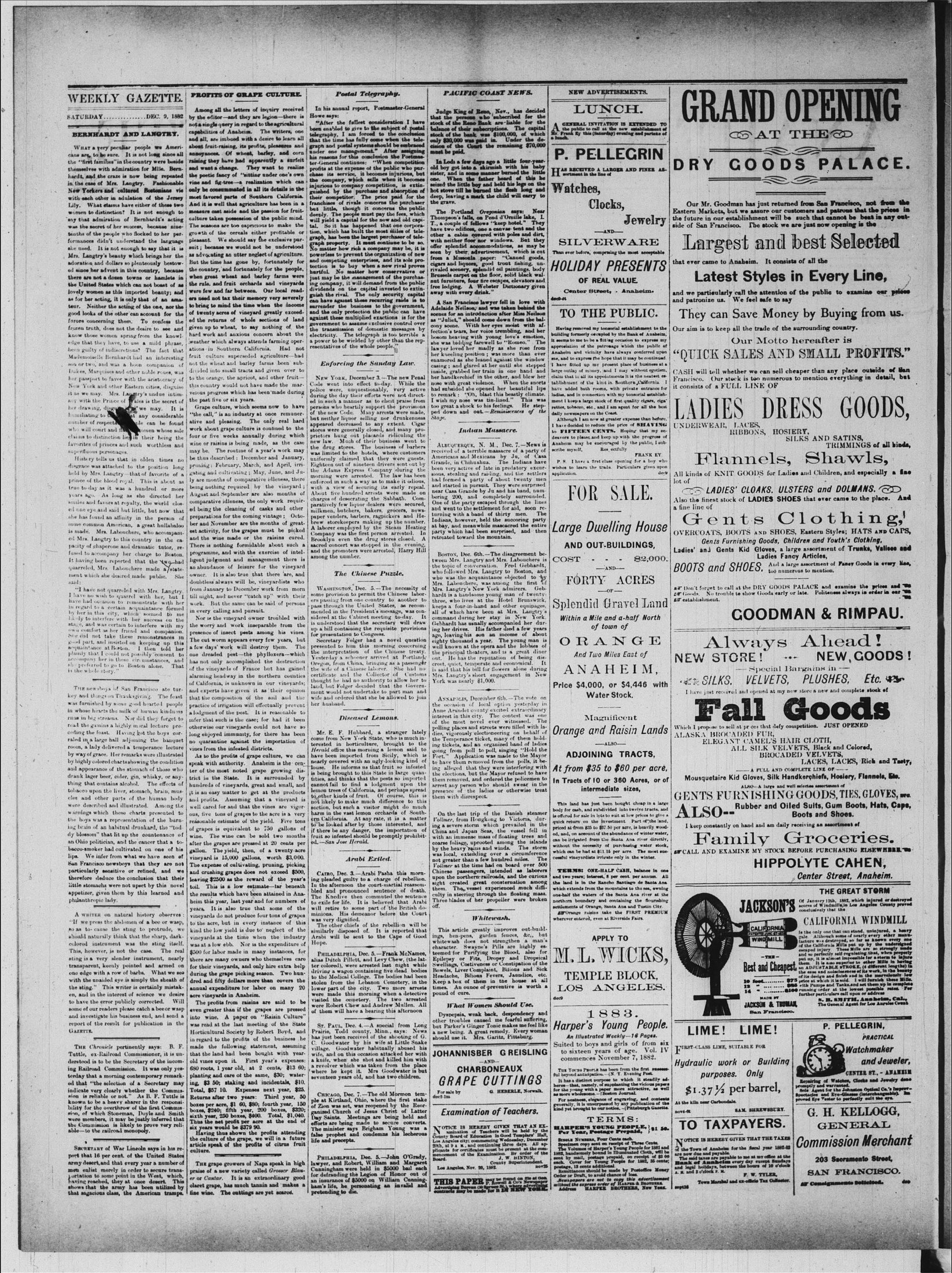
Searchable text
WEEKLY GAZETTE.
SATURDAY...DEC. 9, 1882
BERNHARDT AND LANGTRY.
What a very peculiar people we Americans are, to be sure. It is not long since all the "first families" in the country were beside themselves with admiration for Mile. Bernhardt, and the craze is now being repeated in the case of Mrs. Langtry. Fashionable New Yorkers and cultured Bostonians vie with each other in adulation of the Jersey Lily. What claims have either of these two women to distinction? It is not enough to say that admiration of Bernhardt's acting was the secret of her success, because nineteenth of the people who flocked to her performances didn't understand the language she used. It is not enough to say that it is Mrs. Langtry's beauty which brings her the adoration and dollars so plenteously bestowed since her advent in this country, because there are not a dozen towns or hamlets in the United States which can not boast of as lovely women as this imported beauty; and as for her acting, it is only that of an amateur. Neither the acting of the one, nor the good looks of the other can account for the farore concerning them. To confess the frozen truth, does not the desire to see and know those women spring from the knowledge that they have, to use a mild phrase, been guilty of indiscretions? The fact that Mademoiselle Bernhardt had an interesting son or two, and was a boon companion of Dukes, Marquises and other noble roues, was her passport to favor with the aristocracy of New York and other Eastern cities, disguise it as we may. Mrs. Langtry's undue intimacy with the Prince of Wales is the secret of her drawing, disguising we may. It is humiliating to think that any considerable number of respectful people can be found who will court and flatter women whose sole claims to distinction lie in their being the favorites of princes and such worthless and superfluous personages.
History tells us that in olden times no disgrace was attached to the position long held by Mrs. Langtry—that of favorite of a
PROFITS OF GRAPE CULTURE.
Among all the letters of inquiry received by the editor—and they are legion—there is not a single query in regard to the agricultural capabilities of Anaheim. The writers, one and all, are imbued with a desire to learn all about fruit-raising, its profits, pleasures and annoyances. Of wheat, barley, and corn raising they have had apparently a surfeit and want a change. They want to realize the poetic fancy of "sitting under one's own vine and fig-tree—a realization which can only be consummated in all its details in the most favored parts of Southern California. And it is well that agriculture has been in a measure cast aside and the passion for fruit-culture taken possession of the public mind. The seasons are too capricious to make the growth of the cereals either profitable or pleasant. We should say the exclusive pursuit; because we would not be understood as advocating an utter neglect of agriculture. But the time has gone by, fortunately for the country, and fortunately for the people, when great wheat and barley farms were the rule, and fruit orchards and vineyards were few and far between. Our local readers need not tax their memory very severely to bring to mind the time when the income of twenty acres of vineyard greatly exceeded the returns of whole sections of land given up to wheat, to say nothing of the hard work and anxious concern about the weather which always attends farming operations in Southern California. Had not fruit culture superseded agriculture—had not the wheat and barley farms been subdivided into small tracts and given over to to the orange, the apricot, and other fruit—this country would not have made the marvelous progress which has been made during the past five or six years.
Grape culture, which seems now to have "the call," is an industry at once remunerative and pleasing. The only real hard work about grape culture is confined to the four or five weeks annually during which wine or raisin is being made, as the case may be. The routine of a year's work may be thus described: December and January, pruning; February, March, and April, irrigation and cultivating; May, June, and Ju-
Postage.
In his annual report Howe says:
"After the full been enabled to give telegraphy. I am that the time has graph and postal under one manage his reasons for this ter-General continue profits at the expense its service; the company, whi injurious to compens guished by the their competitor; franchises of rival but little, though deeply. The people will yield a capital tal. So it has bention, which has been graph, has been the graph property. No matter how powerless to prevent and competing entition is to buy hurtful. No man just may be the ming company, it will dividends on the guish the rival." Can have against this surrender the bus and the only prot against these mult government to assist the transmission electricity. The a power to be wired resentatives of th-"
Enforcing
New York, Dec Code went into police were, un- during the day th-ed in such a man persons who heart- of the new Code. but neither liquor appeared decrease stores were general priests hung out new law. Much of the drug stores was limited to this uniformly claimed Eighteen out of nine the Adams Exp-
her passport to favor with the aristocracy of New York and other Eastern cities, disguise it as we may. Mrs. Langtry's undue intimacy with the Prince of Wales is the secret of her drawing, disguising it we may. It is humiliating to think that any considerable number of respectable people can be found who will court and marry women whose sole claims to distinction lie in their being the favorites of princes and such worthless and superfluous personages.
History tells us that in olden times no disgrace was attached to the position long held by Mrs. Langtry—that of favorite of a prince of the blood royal. This is about as true to day as it was a hundred or more years ago. As long as she directed her smiles and favors at royalty, the world closed one eye and said little, but now that she has found an affinity in the person of some common American, a great hullabaloo is made. Mrs. Labouchere, who accompanied Mrs. Langtry to this country in the capacity of chaperone and dramatic tutor, refused to accompany her charge to Boston. It having been reported that the two had quarreled, Mrs. Labouchere made a statement which she desired made public. She said:
"I have not quarreled with Mrs. Langtry. I have no wish to quarrel with her, but I have had occasion to remonstrate with her in regard to a certain acquaintance formed by her in this city, which seemed to me likely to interfere with her success on the stage, and was certain to interfere with my own comfort as her friend and companion. She did not take these remonstrances in good part, and insisted on keeping up this acquaintance at Boston. I then told her plainly that I could not possibly consent to accompany her in these circumstances, and she preferred to go to Boston alone. That is the whole story."
The newsboys of San Francisco ate turkey and things on Thanksgiving. The feast was furnished by some good hearted people in whose hearts the milk of human kindness runs in big streams. Nor did they forget to read the gaints a highly moral lecture preceding the feast. Having got the boys corraled in a large hall adjoining the banquet room, a lady delivered a temperance lecture by way of grace. Her remarks were illustrated by highly colored charts showing the condition and appearance of the stomach of those who drank lager beer, cider, gin, whisky, or anything that contains alcohol. The effects of tobacco upon the liver, stomach, brain, muscles and other parts of the human body were described and illustrated. Among the warnings which these charts presented to the boys was a representation of the burning brain of an habitual drunkard, the "today blossom" that lit up the countenance of an Ohio politician, and the cancer that a tobacco-smoker had cultivated on one of his lips. We infer from what we have seen of San Francisco newsboys that they are not particularly sensitive or refined, and we therefore deduce the conclusion that their little stomachs were not upset by this novel appetizer, given them by this learned and intelligent lady.
Grape culture, which seems now to have "the call," is an industry at once remunerative and pleasing. The only real hard work about grape culture is continued to the four or five weeks annually during which wine or raisins is being made, as the case may be. The routine of a year's work may be thus described: December and January, pruning: February, March, and April, irrigating and cultivating; May, June, and July are months of comparative idleness, there being nothing required by the vineyard; August and September are also months of comparative idleness, the only work required being the cleaning of casks and other preparations for the coming vintage; October and November are the months of greatest activity, for the grapes must be picked and the wine made or the raisins cured. There is nothing formidable about such a programme, and with the exercise of intelligent judgment and management there is an abundance of leisure for the vineyard owner. It is also true that there are, and doubtless always will be, vineyardists who from January to December work from morn till night, and never "catch up" with their work. But the same can be said of persons in every calling and pursuit.
Nor is the vineyard owner troubled with the worry and work inseparable from the presence of insect pests among his vines. The cut worm appears every few years, but a few days' work will destroy them. The one dreaded pest—the phylloxera—which has not only accomplished the destruction of the vineyards of France but has gained alarm headway in the northern counties of California, is unknown in our vineyards; and experts have given it as their opinion that the composition of the soil and the practice of irrigation will effectually prevent a lodgment of the pest. It is reasonable to infer that such is the case; for had it been otherwise our vineyards could not have so long enjoyed immunity, for there has been no quarantine against the importation of vines from the infested districts.
As to the profits of grape culture, we can speak with authority. Anaheim is the center of the most noted grape growing district in the State. It is surrounded by hundreds of vineyards, great and small, and it is an easy matter to get at the products and profits. Assuming that a vineyard is well cared for and that the vines are vigorous, five tons of grapes to the acre is a very reasonable estimate of the yield. Five tons of grapes is equivalent to 750 gallons of wine. The wine can be sold two months after the grapes are pressed at 20 cents per gallon. The yield, then, of a twenty-acre vineyard is 15,000 gallons, worth $3,000. The expense of cultivating, pruning, picking and crushing grapes does not exceed $500, leaving $2500 as the reward of the year's toll. This is a low estimate—far beneath the results which have been attained in Ana-
New York, Dec Code went into police were unaware during the day thined in such a man persons who heard of the new Code but neither liquor appeared decrease stores were general priors hung out new law. Much the drug stores was limited to the uniformly claimed Eighteen out of nine Adams Expert morning were enforced in such with a view of f About five hundred charges of desecration paratively few high milkmen, butcher paper vendors, bar brew storekeepers A laborer employed Company was the Brooklyn even t sacred concert war and the promoter among the numbers.
Discern
Mr. E. F. Hu come from New York teredest in hori Herald office this have been important nearly covered w louce. He informe is being brought t titles, and thinks cannot fail to find lemon trees of Cali- teo other kinds o f not likely to make section, but such harm in the vast nern California. A to be looked after if there be any d fruit so infested s ed.-San Jose H
Arca
Cairo, Dec. 3 ing pleaded guilty In the afternoon bled and pronounced The Khedive th
A WRITER on natural history observes:
"If we press the abdomen of a bee or wasp,
so as to cause the sting to protrude, we
should naturally think that the sharp, darkcolored instrument was the sting itself.
This, however, is not the case. The real
sting is a very slender instrument, nearly
transparent, keenly pointed and armed on
one edge with a row of barbs. What we see
with the unaided eye is simply the sheath of
the sting." This writer is certainly mistaken,
and in the interest of science we desire
to have the error publicly corrected. Will
some of our readers please catch a bee or wasp
and investigate his business end, and send a
report of the result for publication in the
Gazette.
THE Chronicle pertinently says: B. F.
Tuttle, ex-Railroad Commissioner, it is unstood is to be the Secretary of the incoming Railroad Commission. It was only yesterday that a morning contemporary remarked that "the selection of a Secretary may
indicate very clearly whether the Commission is reliable or not." As B. F. Tuttle is
known to be a heavy sharer in the responsibility for the overthrow of the first Commission, of which Stoneman, Doyle and Smith
were members, it may be justly inferred that
the Commission is likely to prove very reliable—to the railroad monopoly.
SECRETARY OF WAR LINEOL says in his report that 16 per cent. of the United States
army desert, and that every year a number of
men enlist merely in order to secure transportation to some point in the West, which,
having reached, they at once desert. This
shows that the army has been utilized by
that sagacious class, the American trampa.
Assuming that a vineyard is well cared for and that the vines are vigorous, five tons of grapes to the acre is a very reasonable estimate of the yield. Five tons of grapes is equivalent to 750 gallons of wine. The wine can be sold two months after the grapes are pressed at 20 cents per gallon. The yield, then, of a twenty-acre vineyard is 15,000 gallons, worth $3,000. The expense of cultivating, pruning, picking and crushing grapes does not exceed $500, leaving $2500 as the reward of the year's toil. This is a low estimate—far beneath the results which have been attained in Anaheim this year, last year and for numbers of years. It is also true that some of the vineyards do not produce four tons of grapes to the acre, but in every instance of this kind the low yield is due to neglect of the vineyards at the time when the industry was at a low ebb. Nor is the expenditure of $500 for labor made in many instances, for there are many owners who themselves care for their vineyards, and only hire extra help during the grape picking season. Two hundred and fifty dollars more than covers the annual expenditure for labor on many 20 acre vineyards in Anaheim.
The profits from raisins are said to be even greater than if the grapes are pressed into wine. A paper on "Raisin Culture" was read at the last meeting of the State Horticultural Society by Robert Boyd, and in regard to the profits of the business he made the following statement, assuming that the land had been bought with year-old vines upon it. First year's expenses: 680 roots, 1 year old, at 2 cents; $13 60; planting and care of the same; $30; watering; $3 50; staking and incidentals; $10. Total, $57 10. Expenses next year, $25. Returns after two years: Third year, 50 boxes per acre; $1 60; $80; fourth year, 150 boxes; $240; fifth year, 200 boxes; $320; sixth year, 250 boxes; $400. Total, $1,040. Thus the net profit per acre at the end of six years would be $379 90.
Having thus shown the profits attending
the culture of the grape, we will in a future article speak of the profits of citrus fruit culture.
The grape growers of Napa speak in high praise of a new variety called Grosser Blauer or Cantar. It is an extraordinary good claret grape, has much tannin and makes a fine wine. The cuttings are yet scarce.
Postal Telegraphy.
In his annual report, Postmaster-General Howe says:
"After the fullest consideration I have been enabled to give to the subject of postal telegraphy. I am forced to the conclusion that the time has fully come when the telegraph and postal systems should be embraced under one management." After assigning his reasons for this conclusion the Postmaster-General continues: "When competition profits at the expense of the public who purchase its service, it becomes injurious, but the company, which sells when it becomes injurious to company competition, is extinguished by the purchase and absorption of their competitor. The price paid for the franchises of rivals concerns the purchaser but little, though it concerns the public deeply. The people must pay the fees, which will yield a capital for the new and old capital. So it has happened that one corporation, which has built the most miles of telegraph, has been the largest purchaser of telegraph property. It must continue to be so. No matter how rich a company may be, it is powerless to prevent the organization of new and competing enterprises, and its sole protection is to buy when a new rival proves hurtful. No matter how conservative or just may be the management of the purchasing company, it will demand from the public dividends on the capital invested to extinguish the rival. The only security capital can have against these recurring raids is to surrender the business to the government, and the only protection the public can have against these multiplied exactions is for the government to assume exclusive control over the transmission of domestic messages by electricity. The telegraph is too terrible a power to be wielded by other than the representatives of the whole people."
Enforcing the Sunday Law.
New York, December 3.—The new Penal Code went into effect today. While the police were, unquestionably, very active during the day their efforts were not directed in such a manner as to elicit praise from persons who heartily support the provisions of the new Code. Many arrests were made, but neither liquor selling nor drunkenness appeared decreased to any extent. Cigar stores were generally closed, and many proprietors hung out placards ridiculing the new law. Much of their business went to the drug stores. The business of barbers was limited to the hotels, where customers uniformly claimed that they were guests. Eighteen out of nineteen drivers sent out by the Adams Express Company during the week.
PACIFIC COAST NEWS.
Judge King of Reno, Nev., has decided that the persons who subscribed for the stock of the Reno Bank are liable for the balance of their subscriptions. The capital stock of the bank was $100,000, of which only $20,000 was paid in. Under the decision of the Court the remaining $70,000 must be paid.
In Lodi a few days ago a little four-year-old boy got into a skirmish with his baby sister, and in some manner burned the little one. When the father heard of this he seized the little boy and held his legs on the hot stove till he burned the flesh long and deep, leaving a mark the child will carry to the grave.
The Portland Oregonian says: Near Thompson's falls, on Pend d'Oreille lake, I.T., a couple of fellows "keep hotel." They have two edifices, one a canvas tent and the other a cabin covered with poles and dirt, with neither floor nor windows. But they offer splendid accommodations, as may be seen by their advertisement, which is cut from a Missoula paper: "Canned goods, cigars and liquors, good trout fishing, unrivaled scenery, splendid oil paintings, body Brussels carpet on the floor, solid black walnut furniture, four fire escapes, elevators and free lodging. A Webster Dictionary given away with every drink."
A San Francisco lawyer fell in love with Adelaide Neilson, and was taken behind the scenes for an introduction after Miss Neilson as "Juliet," should come down from the balcony scene. With her eyes moist with affection's tears, her voice trembling, and her bosom heaving with young love's emotion, she was bidding farewell to "Romeo." The lawyer loved her madly as she rose from her kneeling position; was more than ever enamored as she leaned against the window casing; and glared at her until she stepped inside, grabbed her train in one hand and her handkerchief in the other, and blew her nose with great violence. When the snorts had subsided she opened her beautiful lips to remark: "Oh, blast this beastly climate. I wish my nose was tin-lined." This was too great a shock to his feelings. He stepped down and out.—Reminiscences of the Stage.
Indian Massacre.
ALBUQUERQUE, N.M., Dec. 7.—News is received of a terrible massacre of a party of Americans and Mexicans by Ju., of Casa Grande, in Chihuahua. The Indians have been very active of late in predatory excursions, stealing and raiding, and the settlers
NEW ADVERTISEMENTS.
LUNCH.
A GENERAL INVITATION IS EXTENDED TO THE public to call at the new establishment of Mr. Frank Ey this (Saturday) evening and partake of a lunch.
P. PELLEGRIN
HAS RECEIVED A LARGER AND FINER ABORTION IN THE LINE OF Watches,
Clocks,
Jewelry
AND
SILVERWARE
Than ever before, comprising the most acceptable HOLIDAY PRESENTS OF REAL VALUE.
Center Street · Anaheim.
TO THE PUBLIC.
Having removed my tonsorial establishment to the building formerly occupied by the Bank of Anaheim, it seems to me to be a fitting occasion to express my appreciation of the patronage which the public of Anaheim and vicinity have always conferred upon me, and to express the hope that it may be continued.
I have fitted up my present place of business at a large outlay of money, and I may without egotism claim that in all its appointments it is the nearest establishment of the kind in Southern California. I have added bath rooms, with private entrance for ladies, and in connection with my tonsorial establishment I keep a large stock of first quality cigars, ciga rettes, tobacco, etc., and I am agent for all the best daily newspapers on the Coast.
Although I am now at greater expense than before, I have decided to reduce the price of SHAVING TO FIFTEEN CENTS. Hoping that my endeavors to please and keep up with the progress of Anaheim may be encouraged by the public, I subscribe myself,
FRANK EY
P.S. I have a first class opening for a boy who wishes to learn the trade. Particulars given upon application.
NEW YORK, December 3. The new Penal Code went into effect to-day. While the police were unquestionably, very active during the day their efforts were not directed in such a manner as to elicit praise from persons who heartily support the provisions of the new Code. Many arrests were made, but neither liquor selling nor drunkenness appeared decreased to any extent. Cigar stores were generally closed, and many proprietors hung out placards ridiculing the new law. Much of their business went to the drug stores. The business of barbers was limited to the hotels, where customers uniformly claimed that they were guests. Eighteen out of nineteen drivers sent out by the Adams Express Company during the morning were arrested. The law has been enforced in such a way as to make it odious, with a view of securing its early repeal. About five hundred arrests were made on charges of desecrating the Sabbath. Comparatively few liquor dealers were secured, milkmen, butchers, bakers, grocers, newspaper vendors, barbers, ragpickers and Hebrew storekeepers making up the number. A laborer employed by the Steam Heating Company was the first person arrested. In Brooklyn even the drug stores closed. A sacred concert was stopped in the evening, and the promoters were arrested, Harry Hill among the number.
The Chinese Puzzle.
WASHINGTON, Dec. 5. The necessity of some provision to permit the Chinese laborers passing from one country to another to pass through the United States, as recommended in the President's message, was considered at the Cabinet meeting to-day. It is understood that the secretary will draw up a bill containing the requisite provisions for presentation to Congress.
Secretary Folger had a novel question presented to him this morning concerning the interpretation of the Chinese treaty. Yesterday a schooner arrived at Portland, Oregon, from China, bringing as a passenger the wife of a Chinese laborer. She had no certificate and the Collector of Customs thought he had no authority to allow her to land, but Folger decided that the Government would undertake to part man and wife and ordered that she be allowed to join her husband.
Diseased Lemons.
Mr. E. F. Hubbard, a stranger lately come from New York State, who is much interested in horticulture, brought to the Herald office this morning a lemon said to have been imported from Sicily, which is nearly covered with an ugly-looking kind of house. He informs us that fruit so infested is being brought to this State in large quantities, and thinks that the pests so imported cannot fail to find a lodgment upon the lemon trees of California, and perhaps spread to other kinds of fruit. Of course, this is not likely to make much difference to this section, but such a visitor might do much harm in the vast lemon orchards of Southern California. At any rate, it is a matter to be looked after by those interested, and if there be any danger, the importation of fruit so infested should be promptly prohibited.—San Jose Herald.
Arabi Exiled.
CAIRO, Dec. 3. Arabi Pasha this morning pleaded guilty to a charge of rebellion. In the afternoon the court-martial reassembled and pronounced sentence of death. The Khedive then commuted the sentence
Indian Massacre.
ALBUQUERQUE, N. M., Dec. 7. News is received of a terrible massacre of a party of Americans and Mexicans by Ju., of Casa Grande, in Chihuahua. The Indians have been very active of late in predatory excursions, stealing and raiding, and the settlers had formed a party of about twenty men and started in pursuit. They were surprised near Casa Grande by Ju. and his band, numbering 200, and completely surrounded. One of the party escaped through the lines and went to the settlement for aid, soon returning with a band of thirty men. The Indians, however, held the succoring party at bay, and meanwhile mascared the entire party which had been surprised, and then retreated toward the mountain.
BOSTON, Dec. 6th. The disagreement between Mrs. Langtry and Mrs. Labouchers is the topic of conversation. Fred Gebhardt, who followed Mrs. Langtry to Boston, and who was the acquaintance objected to by Mrs. Labouchere, was among the first of Mrs. Langtry's New York admirers. Gebhardt is a handsome young man of twenty-three, who lives at the Hotel Brunswick, keeps a four-in-hand and other equipages, all of which have been at Mrs. Langtry's command during her stay in New York. Gebhardt has usually accompanied her during her drives. His father died a few years ago, leaving his son an income of about eighty thousand a year. The young man is well known at the opera and the lobbies of the principal theaterists, and is a great diner out. He has reputation of being discreet, quiet, temperate and economical. It is said that his bill for flowers alone during Mrs. Langtry's short engagement in New York was nearly $1,000.
ANNAPOLIS, December 6th. The vote on the occasion of local option yesterday in Anne Arundel county excited extraordinary interest in this city. The contest was one of the most novel ever witnessed. The polling places and streets were filled with ladies, vigorously electioneering on behalf of the Temperance ticket, many of them holding tickets, and an organized band of ladies going from poll to poll, singing "Hold the Fort." Application was made to the Mayor to have them removed from the polls, it being alleged that they were interfering with the elections, but the Mayor refused to have them removed, and ordered the policemen to arrest any person who should swear in the presence of the ladies or otherwise treat them with disrespect.
On the last trip of the Danish steamer Volliner, from Hongkong to Victoria, during a severe storm which prevailed in the China and Japan Seas, the vessel fell in with an immense mass of floating trees and coarse foliage, uprooted among the islands by the heavy rains and winds. The storm was local, extending over a circumference not greater than a few hundred miles. The Volliner at the time had on board over 500 Chinese passengers, intended as laborers upon the northern railroads, and the curious sight created great consternation among them. The vessel experienced much difficulty in steering through the floating mass.
For Sale.
Large Dwelling House
AND OUT-BUILDINGS,
COST ... $2,000.
AND
FORTY ACRES
OF
Splendid Gravel Land
Within a Mile and a-half North of town of
ORANGE
And Two Miles East of
ANAHEIM,
Price $4,000, or $4,446 with Water Stock.
Magnificent Orange and Raisin Lands
ALSO
ADJOINING TRACTS,
At from $35 to $60 per acre,
In Tracts of 10 or 360 Acres, or of intermediate sizes,
This land has just been bought cheap in a large body for cash, and subdivided into twelve tracts, and is offered for sale in lots to suit at low prices to give a quick return on the investment. Part of the land, priced at from $35 to $75.50 per acre, is heavily wooded, and, on account of the abundance of winter water, can be irrigated from the Santa Ana river directly without the necessity of purchasing water stock, which can be had at $11.15 per acre. The most successful vineyardists irritate only in the winter.
TERMS: ONE-HALF CASH; balance in one and two years; interest; 8 per cent. per annum. All the land is in the Rancho Santiago de Santa Ana that extends from the mountains to the sea; owning one-half of the waters of the Santa Ana river at the coast.
This page contains text extracted from an online news article related to real estate transactions involving property owners in New York City. The content includes details about property sales (including dates), locations (such as New York City), types (like residential or commercial properties), and potential buyers (names). There are also references to legal documents (such as contracts) that may affect property valuation or sale decisions.
Please note that while some parts are clearly visible due to high contrast or image quality issues (e.g., blurry text or pixelation), certain sections are more difficult to read accurately because they contain dense text or complex layouts (e.g., paragraphs separated by blank spaces). This type of information is often found in newspapers or online databases like Google Maps or Wikipedia articles.
If you need further assistance with any specific query regarding this page or other related topics please contact us directly using our contact form available on our website.
Thank you for your attention!
Arabi Extled.
Cairo, Dec. 3.—Arabi Pasha this morning pleaded guilty to a charge of rebellion. In the afternoon the court-martial reassembled and pronounced sentence of death. The Khedive then commuted the sentence to exile for life. It is believed that Arabi will retire to some part of the British dominions. His demeanor before the Court was very dignified.
The other chiefs of the rebellion will be similarly disposed of. It is reported that Arabi will be sent to the Cape of Good Hope.
PHILADELPHIA, Dec. 5.—Frank McNamee, alias Dutch Pillett, and Levy Chew, (the latter colored), were arrested last night while driving a wagon containing five dead bodies to the Medical College. The bodies had been stolen from the Lebanon Cemetery, in the lower part of the city. Two more arrests were made this morning when a detective visited the cemetery. The two arrested were Robert Chew and Andrew Mullen. All of them will have a hearing this afternoon.
St. Paul, Dec. 4.—A special from Long Prairie, Todd county, Minn., says: News has just been received of the shooting of G. C. Goodwater by his wife at Little Snake village. Goodwater habitually abused his wife, and on this occasion attacked her with a knife, when she shot and killed him with a revolver which was taken from the place where he kept it. Mrs Goodwater is but seventeen years old, and has two children.
CHICAGO, Dec. 7.—The old Mormon temple at Kirtland, Ohio, where the first stake of Zion was set, was reopened by the Reorganized Church of Jesus Christ of Latter Day Saints. Meetings are being held and efforts are being made to secure converts. The minister says Brigham Young was a false prophet and condemns his lecherous life and precepts.
PHILADELPHIA, Dec. 5.—John O'Grady, lawyer, and Robert William and Margaret Cunningham were held in $5000 bail each for defrauding the Legion of Honor out of an insurance of $5000 on William Cunningham's life, he personating an invalid and pretending to die.
On the last trip of the Danish steamer Vollmer, from Hongkong to Victoria, during a severe storm which prevailed in the China and Japan Seas, the vessel fell in with an immense mass of floating trees and coarse foliage, uprooted among the islands by the heavy rains and winds. The storm was local, extending over a circumference not greater than a few hundred miles. The Vollmer at the time had on board over 500 Chinese passengers, intended as laborers upon the northern railroads, and the curious sight created great consternation among them. The vessel experienced much difficulty in steering through the floating mass. Three blades of her propeller were broken off.
Whitewash.
This article greatly improves out-buildings, hen-pens, garden fences, &c., but whitewash does not strengthen a man's character. Swayne's Pills are highly esteemed for Purifying the Blood, also for Epilepay or Fits, Dropsay and Dropsical Swellings, Costiveness or Constipation of the Bowels, Liver Complaint, Billious and Sick Headache, Bilious Fevers, Jaundice, etc. Keep a box of them in the house at all times. An ounce of preventive is worth a pound of cure.
What Women Should Use.
Dyspepsia, weak back, despondency and other troubles caused me fearful suffering, but Parker's Ginger Tonic makes me feel like a new being. A great remedy. Every woman should use it. Mrs. Garitz, Pittsburg.
JOHANNISBER GREISLING
AND
CHARBONEAUX GRAPE CUTTINGS
For sale by G. HEBERLE, Norwalk.
Examination of Teachers.
NOTICE IS HEREBY GIVEN THAT AN EXamination of Teachers will be held by the County Board of Education in Good Templars' Hall, Los Angeles city; commencing Wednesday, December 20th, at 9 A.M., and continuing three days. All applicants for certificates must be present at the commencement of the Examination. By order of the Board.
J. W. HINTON,
County Superintendent
Los Angeles, Nov. 20, 1882.
THIS PAPER may be found on file at Gea Advertising Bureau (10 Spruce St.), where advertising contracts may be made for it in New York.
This land has just been bought cheap in a large body for cash, and subdivided into twelve tracts, and is offered for sale in lots to suit at low prices to give a quick return on the investment. Part of the land, priced at from $35 to $37.50 per acre, is heavily wooded, and, on account of the abundance of winter water, can be irrigated from the Santa Ana river directly without the necessity of purchasing water stock, which can be had at $11.15 per acre. The most successful vineyardists irritate only in the winter.
TERMS: ONE-HALF CASH, balance in one and two years; interest, 8 per cent. per annum. All the land is in the Rancho Santiago de Santa Ana which extends from the mountains to the sea, owning one-half the waters of the Santa Ana river at the northern boundary and containing the flourishing settlements of Orange, Santa Ana and Tustin City.
Orange raisins take the FIRST PREMIUM wherever entered, even at Riverside Fairs.
APPLY TO M.L.WICKS,
TEMPLE BLOCK,
LOS ANGELES.
dec9
1883.
Harper's Young People.
An Illustrated Weekly—16 Pages.
Suited to boys and girls of from six to sixteen years of age. Vol. IV commences November 7, 1882.
The Young People has been from the first successful beyond anticipation...[N.Y.Evening Post].
It has a distinct purpose to which it steadily adheres—that, namely, of supplanting the vicious papers for the young with a paper more attractive, as well as more wholesome...[Boston Journal].
For neatness, elegance of engraving, and contents generally, it is unsurpassed by any publication of the kind yet brought to our notice...[Pittsburgh Gazette].
TERMS:
HARPER'S YOUNG PEOPLE,
Per Year, Postage Prepaid,
SINOLA NUMERAS, Four Cents each.
Specimen copy sent on receipt of Three Cents.
The Volumes of Harper's Young People for 1881 and 1882 handsomely bound in Illuminated Cloth, will be sent by mail, postage prepaid, on receipt of $3.00 each. Cover for Young People for 1882, 25 cents; postage, 13 cents additional.
Remittances should be made by Postoffice Money Order or Draft, to avoid chance of loss.
Newspapers are not to copy this advertisement without the express order of Harper & Baothua.
Address HARPER BROTHERS, New York.
GRAND OPENING
AT THE
DRY GOODS PALACE.
Our Mr. Goodman has just returned from San Francisco, not from the Eastern Markets, but we assure our customers and patrons that the prices in the future in our establishment will be such that cannot be beat in any outside of San Francisco. The stock we are just now opening is the Largest and best Selected that ever came to Anaheim. It consists of all the Latest Styles in Every Line, and we particularly call the attention of the public to examine our prices and patronize us. We feel safe to say They can Save Money by Buying from us. Our aim is to keep all the trade of the surrounding country.
Our Motto hereafter is "QUICK SALES AND SMALL PROFITS."
CASH will tell whether we can sell cheaper than any place outside of San Francisco. Our stock is too numerous to mention everything in detail, but it consists of a FULL LINE OF LADIES DRESS GOODS,
UNDERWEAR, LACES,
RIBBONS, HOSIERY,
SILKS AND SATINS,
TRIMMINGS of all kinds,
Flannels, Shawls,
All kinds of KNIT GOODS for Ladies and Children, and especially a fine
LADIES DRESS GOODS,
UNDERWEAR, LACES,
RIBBONS, HOSIERY,
SILKS AND SATINS,
TRIMMINGS of all kinds,
Flannels, Shawls,
All kinds of KNIT GOODS for Ladies and Children, and especially a fine lot of
LADIES' CLOAKS, ULSTERS and DOLMANS.
Also the finest stock of LADIES SHOES that ever came to the place. And a fine line of
Gents Clothing,
OVERCOATS, BOOTS AND SHOES, Eastern Styles; HATS AND CAPS,
Gents Furnishing Goods, Children and Youth's Clothing,
Ladies' and Gents Kid Gloves, a large assortment of Trunks, Valises and Ladies Fancy Articles,
BOOTS and SHOES.
And a large assortment of Fancy Goods in every line, too numerous to mention.
Don't forget to call at the DRY GOODS PALACE and examine the prices and Goods. No trouble to show Goods early or late. Politeness always in order in our establishment.
GOODMAN & RIMPAU.
Always Ahead!
NEW STORE! NEW GOODS!
Special Bargains in
SILKS, VELVETS, PLUSHES, Etc.
I have just received and opened at my new store a new and complete stock of
Fall Goods
Which I propose to sell at prices that defy competition. JUST OPENED
ALASKA BROCADED FUR,
ELEGANT CAMEL'S HAIR CLOTH,
ALL SILK VELVETS, Black and Colored,
BROCADED VELVETS,
LACES, LACES, Rich and Tasty,
A FULL AND COMPLETE LINE OF
Mousquetaire Kid Gloves, Silk Handkerchiefs, Hosiery, Flannel, Etc.
ALSO—a large and well selected assortment of
GENTS FURNISHING GOODS, TIES, GLOVES, etc.
Rubber and Oiled Suits, Gum Boots, Hats, Caps, Boots and Shoes.
I keep constantly on hand and am daily receiving an assortment of
Family Groceries.
CALL AND EXAMINE MY STOCK BEFORE PURCHASING ELSEWHERE.
HIPPOLYTE CAHEN,
Center Street, Anaheim.
THE GREAT STORM
ALSO--
Rubber and Oiled Suits, Gum Boots, Hats, Cape,
Boots and Shoes.
I keep constantly on hand and am daily receiving an assortment of
Family Groceries.
CALL AND EXAMINE MY STOCK BEFORE PURCHASING ELSEWHERE.
HIPPOLYTE CAHEN,
Center Street, Anaheim.
THE GREAT STORM
Of January 12th, 1882, which injured or destroyed scores of Windmills in Los Angeles County proved conclusively that the
CALIFORNIA WINDMILL
Is the only one that can stand. uninjured, a heavy gale. Although some of nearly every other manufacture was destroyed, so far as known one of the California Mills put up by the underigned escaped injury. These Mills are so strongly made and so perfectly self-regulating that, when properly put up, it is almost impossible for a storm to injure them. It is also superior to other Mills in having an ADJUSTABLE STROKE, (4 different lengths) in the ease and noiselessness of its work, in the beauty of its design and finish and in the marvelously low price at which it is sold. I will furnish these Mills with Pumpe and Tanks, and set them up in complete running order at the lowest possible rates. For further particulars call upon or address
N. B. SMITH, Amnheim, CAL.
The General Agent for Los Angeles County
LIME! LIME!
FIRST-CLASS LIME, SUITABLE FOR
Hydraulic work or Building purposes. Only
$1.37½ per barrel,
At the kiln near Carbondale.
TO TAXPAYERS.
NOTICE IS HEREBY GIVEN THAT THE TAXES
of the Town of Anahiem for the fiscal year 1882-83 are now due and payable.
The said taxes are payable to me at my office at the Bank of Anahiem every day except Sundays and legal holidays, between the hours of 10 o'clock A.M. and 3 o'clock P.M.
P. PELLEGRIN,
PRACTICAL
Watchmaker
and Jeweler,
CENTER ST., - ANAHEM
Repairing of Watches, Clocks and Jewelry done promptly and warranted.
Sole Agent for the Johnston Optical Co.'s Improvement Spectacles and Eye-Glasses (interchangeable). Im proved Eye Tester to perfectly suit the eye.
G. H. KELLOGG,
GENERAL
Commission Merchant
203 Sacramento Street,
SAN FRANCISCO.
MF Consignments Solicited.