anaheim-gazette 1882-11-18
Scanned page
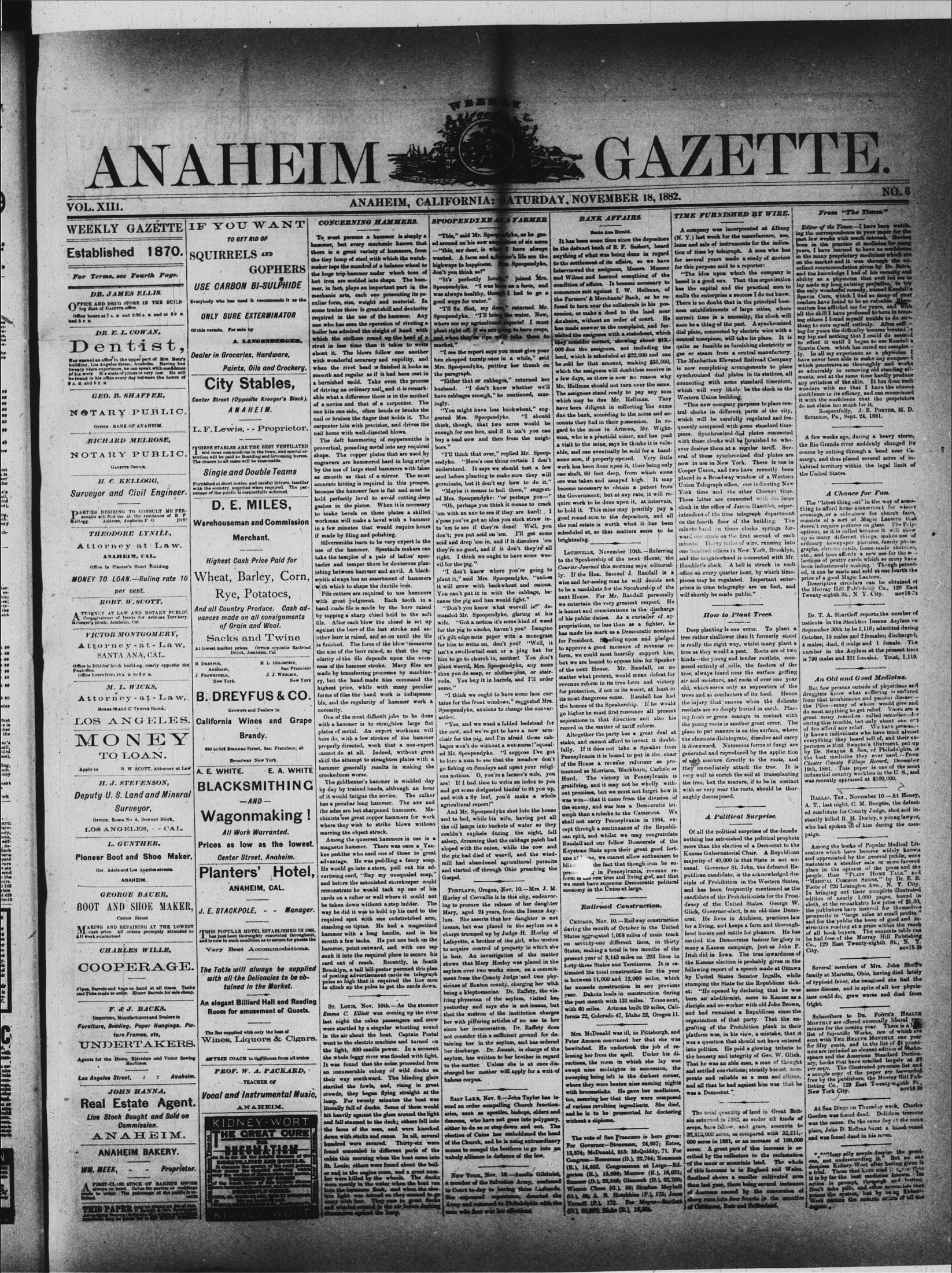
Searchable text
ANAHEIM
VOL. XIII.
WEEKLY GAZÉTTE
Established 1870.
For Terms, see Fourth Page.
DR. JAMES ELLIS.
OFFICE AND DRUG STORE IN THE BUILDING East of GAZETTE office.
Office hours at 7 A.M. and 9:30 A.M. and at 2 P.M. and 8 P.M.
DR. E. L. COWAN,
Dentist,
Has opened an office in the upper part of Mrs. Metz's building, Los Angeles Street, Anaheim. Having had twenty years experience, he can speak with confidence of his work. He a scale of prices is very low. He will be found in his office every day between the hours of 9 A.M. and 8 P.M.
GEO. B. SHAFFER,
NOTARY PUBLIC.
OFFICE - BANK OF ANAHEIM.
RICHARD MELROSE,
NOTARY PUBLIC.
GAZETTE OFFICE.
IF YOU WANT
TO GET RID OF
SQUIRRELS AND
GOPHERS
USE CARBON BI-SULPHIDE
Everybody who has used it recommends it as the ONLY SURE EXTERMINATOR
Of this vermin. For sale by
A. LANGENBERGER,
Dealer in Groceries, Hardware,
Paints, Oils and Crockery.
City Stables,
Center Street (Opposite Kroeger’s Block),
ANAHEIM.
L.F. Lewis, -- Proprietor.
THESE STABLES ARE THE BEST VENTILATED and most commodious in the town, and special attention will be paid to Boarding and Grooming horses. The charve in all cases will be reasonable.
Single and Double Teams
CONCERN
To, west permeable hammer, but even there is a great tiny lump of maker tape the huge trip-hammer, in fact, plays mechanic arts, culiar form, size, some trades there required in the one who has seen boiler has admired which the striking rivet in less time about it. The with wonderful smooth and regular burnished mode of driving an ordeable what a difference of a novice and one hits one side nail or bruises the carpenter hits wail home with.
The deft hand proverbial, ponder shape. The co-engravers are by the use of lace.
GEO. B. SHAFFER,
NOTARY PUBLIC.
OFFICE—BANK OF ANAHEIM.
RICHARD MELROSE,
NOTARY PUBLIC.
GAZETTE OFFICE.
H. C. KELOGG,
Surveyor and Civil Engineer.
PARTIES DESIRING TO CONSULT ME PERSONALLY will find me at the residence of B. F. Kellogg.
Address, Anaheim P.O. Jlv22
THEODORE LYNILL,
Attorney-at-Law.
ANAHEIM, CAL.
Office in Planter's Hotel Building.
MONEY TO LOAN.—Ruling rate 10 per cent.
ROBT. W. SCOTT.
ATTORNEY AT LAW AND NOTARY PUBLIC.
Commissioner of Deeds for Arizona Territory.
Kroeger's Block, Anaheim, Cal.
VICTOR MONTGOMERY,
Attorney-at-Law,
SANTA ANA, CAL.
Office in Dibbles' brick building, nearly opposite the Postoffice.
Office hours from 10 A.M. to 3 P.M.
M. L. WICKS,
Attorney-at-Law.
Rooms 86 and 87 Temple Block;
LOS ANGELES.
MONEY TO LOAN.
Apply to R. W. SCOTT, Attorney at Law.
H. J. STEVENSON,
Deputy U. S. Land and Mineral Surveyor.
Office: Room No 4, Downey Block,
LOS ANGELES, - - CAL.
L. GUNTHER.
Ploneer Boot and Shoe Maker,
Cor. Adele and Los Angeles streets.
ANAHEIM.
GEORGE BAUER,
City Stables,
Center Street (Opposite Kroeger's Block),
ANAHEIM.
L.F. Lewis. -- Proprietor.
THESE STABLES ARE THE BEST VENTILATED and most commodious in the town, and special attention will be paid to Boarding and Grooming horses.
The charve in all cases will be reasonable.
Single and Double Teams
Furnished at short notice, and careful drivers, familiar with the country, supplied when required. The patronage of the public is respectfully solicited.
D. E. MILES,
Warehouseman and Commission Merchant.
Highest Cash Price Paid for
Wheat, Barley, Corn,
Rye, Potatoes,
And all Country Produce. Cash advances made on all consignments of Grain and Wool.
Sacks and Twine
At lowest market prices. Office opposite Railroad Depot, Anaheim, Cal.
B. DREYFUS,
Anaheim,
San Francisco
J. FROWENFIELD,
New York
J. WEOLIN,
B. DREYFUS & CO.
Growers and Dealers in California Wines and Grape Brandy.
630 to 642 Brannan Street, San Francisco; 45 Broadway New York.
A. E. WHITE.
E. A. WHITE
BLACKSMITHING — AND —
Wagonmaking!
All Work Warranted.
Prices as low as the lowest.
Center Street, Anaheim.
Planters' Hotel,
ANAHEIM, CAL.
Surveyor,
Office: Room No 4, Downey Block,
LOS ANGELES, - CAL.
L. GUNTHER.
Ploneer Boot and Shoe Maker,
Cor. Adele and Los Angeles streets.
ANAHEIM.
GEORGE BAUER,
BOOT AND SHOE MAKER,
Center Street
MAKING AND REPAIRING AT THE LOWEST
cash price. All orders promptly attended to
All work guaranteed.
CHARLES WILLE,
COOPERAGE.
Pipes, Barrels and kegs on hand at all times. Tanks
and Tube made to order. Honest Barrels for sale cheap.
F. & J. BACKS.
Importers, Manufacturers and Dealers in
Furniture, Bedding, Paper Hangings, Picture Frames, etc,
UNDERTAKERS,
Agents for the Howe, Eldredge and Victor Sewing Machines.
Los Angeles Street.: Anaheim.
JOHN HANNA,
Real Estate Agent.
Live Stock Bought and Sold on Commission.
ANAHEIM.
ANAHEIM BAKERY.
WM. MEEK, Proprietor.
A FIRST-CLASS STOCK OF BAKERY GOODS
always on hand. Kakes for parties or weddings
made to order. The patronage of the public is solicited.
THIS PAPER may be used for any purpose.
AND
Wagonmaking!
All Work Warranted.
Prices as low as the lowest.
Center Street, Anaheim.
Planters' Hotel,
ANAHEIM, CAL.
J. E. STACKPOLE, Manager.
THIS POPULAR HOTEL ESTABLISHED IN 1868,
has just been thoroughly renovated throughout,
and is now in such condition as to secure for guests the
Very Best Accommodations.
The Table will always be supplied with all the Delicacies to be obtained in the Market.
An elegant Billiard Hall and Reading Room for amusement of Guests.
The Bar supplied with only the best of Wines, Liquors & Cigars.
FREE COACH to the House from all trains
PROF. W. A. PACKARD,
TEACHER OF
Vocal and Instrumental Music,
ANAHEIM.
KIDNEY-WORT
THE GREAT CURE FOR PHYSIATISM
As it is for all the practical demands of the KIDNEY-Liver and Bowels.
It cleans the liver of the most powerful substances
only the毒素 can possess.
Thousands of CARES
FOR THE VESSEL AND BOWELS.
PERFECTLY CURSED.
ST. LOUIS; or
ar and in ther
ber were kill
were mostly
into the immetris light w
crasy with f
and whilde
themse
ANAHEIM, CALIFORNIA: SATURDAY, NOVEMBER 18, 1880
CONCERNING HAMMERS.
To west persons a hammer is simply a hammer, but every mechanic knows that there is a great variety of hammers, from the tiny lump of steel with which the watchmaker taps the mandrel of a balance wheel to the huge trip-hammer under which tons of hot iron are molded into shape. The hammer, in fact, plays an important part in the mechanical arts, each one presenting its peculiar form, size, weight and material. In some trades there is great skill and dexterity required in the use of the hammer. Any one who has seen the operation of riveting a boiler has admired the sleight of hand with which the strikers round up the head of a rivet in less time than it takes to write about it. The blows follow one another with wonderful accuracy and rapidity, and when the rivet head is finished it looks as smooth and regular as if it had been cast in a burnished mold. Take even the process of driving an ordinary nail, and it is remarkable what a difference there is in the method of a novice and that of a carpenter. The one hits one side, often bends or breaks the nail or bruises the finger that holds it. The carpenter hits with precision, and drives the nail home with well-dissected blows.
The deft hammering of coppersmiths is proverbial, pounding metal into any required shape. The copper plates that are used by engravers are hammered hard in long strips by the use of large steel hammers with faces.
SPOOPENDYKE AS A FARMER
“This,” said Mr. Spoopendyke, as he gazed around on his new acquisition of six acres—“this, my dear, is what I have always wanted. A farm and a farmer’s life are the highways to happiness. Mrs. Spoopendyke, don’t you think so?”
“It’s perfectly lovely,” joined Mrs. Spoopendyke. “I was born on a farm, and was always healthy, though I had to go a good ways for water.”
“I’ll fix that, my dear,” returned Mr. Spoopendyke. “I’ll bring the water. Now, where are my agricultural reports? I must plant right off, if we are going to have crops, and when they’re ripe will take them to market.”
“I see the report says you must give your hen chopped turnip once in a while,” said Mrs. Spoopendyke, putting her thumb on the paragraph.
“Either that or cabbages,” returned her husband. “I don’t know whether we’ll have cabbages enough,” he continued, musingly.
“You might have less buckwheat,” suggested Mrs. Spoopendyke. “I should think, though, that two acres would be enough for one hen, and if it isn’t you can buy a load now and then from the neighbors.”
“I’ll think that over,” replied Mr. Spoopendyke. “Here’s one thing certain I don’t understand. It says we should test a few work has been done upon it, their being only one shaft, 60 feet deep, from which some
smooth and regular as if it had been cast in a burnished mold. Take even the process of driving an ordinary nail, and it is remarkable what a difference there is in the method of a novice and that of a carpenter. The one hits one side, often bends or breaks the nail or bruises the finger that holds it. The carpenter hits with precision, and drives the nail home with well-dissected blows.
The deft hammering of coppersmiths is proverbial, pounding metal into any required shape. The copper plates that are used by engravers are hammered hard in long strips by the use of large steel hammers with faces as smooth as that of a mirror. The most accurate hitting is required in this process, because the hammer face is flat and must be held perfectly level to avoid cutting deep gashes in the plates. When it is necessary to make bevels on these plates a skilled workman will make a bevel with a hammer in a few minutes that would require hours if made by filing and polishing.
Silversmiths learn to be very expert in the use of the hammer. Spectacle makers can take the temples of a pair of ladies' spectacles and temper them by dexterous planishing between hammer and anvil. A blacksmith always has an assortment of hammers with which to shape the ductile iron.
File cutters are required to use hammers with great judgment. Each tooth in a hand-made file is made by the burr raised by tapping a sharp chisel held to the soft file. After each blow the chisel is set up against the burr of the last stroke and another burr is raised, and so on until the file is finished. The force of the blow measures the size of the burr raised, so that the regularity of the file depends upon the evenness of the hammer stroke. Many files are made by transferring processes by machinery, but the hand-made files command the highest price, while with many peculiar forms of files the hand work is indispensable, and the regularity of hammer work a necessity.
One of the most difficult jobs to be done with a hammer is to straighten large flat plates of metal. An expert workman will here do, with a few strokes of the hammer properly directed, work that a non-expert cannot do at all. Indeed, without great skill the attempt to straighten plates with a hammer generally results in making the crookedness worse.
The goldbeater's hammer is wielded day by day by trained hands, although an hour of it would fatigue the novice. The calker has a peculiar long hammer. The axe and the adze are but sharpened hammers. Machinists use great copper hammers for work where they wish to strike blows without marring the object struck.
Among the queerest hammers in use is a magnetic hammer. There was once a Yankee peddler who used one of these to great advantage. He was peddling a fancy soap. He would go into a store, pull out his advertising card, "Buy my unequaled soap," and before the astonished storekeeper could remonstrate he would tack up one of his cards on a rafter or wall where it could not
Either that or cabbages," returned her husband. "I don't know whether we'll have cabbages enough," he continued, musingly.
"You might have less buckwheat," suggested Mrs. Spoopendyke. "I should think, though, that two acres would be enough for one hen, and if it isn't you can buy a load now and then from the neighbors."
"I'll think that over," replied Mr. Spoopendyke. "Here's one thing certain I don't understand. It says we should test a few seed before planting to make sure they will germinate, but it don't say how to do it."
"Maybe it means to boil them," suggested Mrs. Spoopendyke: "or perhaps you—"
"Oh, perhaps you think it means to crack 'em with an axe to see if they are hard! I pose you've got an idea you stick straw into 'em to see if they're done! Well, you don't; you put acid on 'em. I'll get some acid and drop 'em in, and if it discolors 'em they're no good, and if it don't they're all right. I think we ought to have some weevil for the pig."
"I don't know where you're going to plant it," said Mrs. Spoopendyke, "unless it will grow with buckwheat and onions. You can't put it in with the cabbage, because the pig and hen would fight."
"Don't you know what weevil is?" demanded Mr. Spoopendyke, glaring at his wife. "Got a notion it's some kind of weed for the pig to smoke, haven't you? Imagine its gilt-edge note paper with a monogram for him to write on, don't you? 'Well, it isn't a swallowtail coat or a plug hat for him to go to church in, neither! You don't plant weevil, Mrs. Spoopendyke, any more than you do soap, or clothes-pins, or stairrods. You buy it in barrels, and I'll order some."
"I think we ought to have some lace curtains for the front windows," suggested Mrs. Spoopendyke, anxious to change the conversation.
"Yes, and we want a folded bedstead for the cow, and we've got to have a new armchair for the pig, and I'm afraid those cabbages won't do without a wet-nurse!" squealed Mr. Spoopendyke. "I suppose I've got to hire a man to see that the meadow don't go fishing on Sundays and upset your religious notions. O, you're a farmer's wife, you are! If I had time to write an index to you and get some dodgasted binder to fit you up, and with a fly leaf, you'd make a whole agricultural report!"
And Mr. Spoopendyke shot into the house and to bed, while his wife, having put all the oil lamps into buckets of water so they couldn't explode during the night, fell asleep, dreaming that the cabbage patch had eloped with the onion, while the cow, and the pig had died of weevil, and the windmill had abandoned agricultural pursuits and started off through Ohio preaching the Gospel.
PORTLAND, Oregon, Nov. 10.-Mrs. J. M. Hurley of Corvallis is in this city, endeavoring to be now more reason why Mr. Hellman should not turn over the same. The assignees stand ready to pay any sum which may be due Mr. Hellman. They have been diligent in collecting the sums due the bank, according to the notes and accounts they had in their possession. In regard to the mine in Arizona, Mr. Wightman, who is a practical miner, and has paid a visit to the mine, says he thinks it is valuable, and can eventually be sold for a hand-some sum, if properly opened. Very little work has been done upon it, their being only one shaft, 60 feet deep, from which some ore was taken and assayed high. It may become necessary to obtain a patent from the Government; but at any rate, it will require work to be done upon it, at intervals, to hold it. This mine may possibly pay a good round sum to the depositors, and all the real estate is worth what it has been scheduled at, so that matters seem to be brightening.
LOUISVILLE, November 10th.-Referring to the Speakership of the next House, the Courier-Journal this morning says editorially: If the Hon. Samuel J. Randall is a wise and far-seeing man he will decide not to be a candidate for the Speakership of the next House. For Mr. Randall personally we entertain the very greatest respect. He is honest and conscientious in the discharge of his public duties. As a curtailed officer propriations, no less than as a fighter, he has made his mark as a Democratic nominee for President. Standing upon and pledging to approve a good measure of revenue reform, we could most heartily support him but we are bound to oppose him for Speaker of the next House. Mr. Randall, on matter what pretext, would mean defeat for revenue reform in its true form and victory for protection, if not in its worst, at least in its most dangerous sense. Randall has had the honors of the Speakership. If he would go higher he must first renounce all present aspirations in that direction and also his record in the matter of tariff reform.
Altogether the party has a great deal stake, and cannot afford to invest it doubly fully. If it does not take a Speaker from Pennsylvania it is bound to put in the chair of the House a revenue reformer as pronounced as Morrison, Blackburn, Carlisle or Hurd. The victory in Pennsylvania gratifying, and it may not be wholly without out promises, but we must not forget how was won--that it came from the division of the enemy, and was less a Democratic triumph than a rebuke to the Camerona. We shall not carry Pennsylvania in 1884, except through a continuance of the Republican can split, and whilst we may congratulate Randall and our fellow Democrats of this Keystone State upon their great good form une at time we cannot allow enthusiasm blind—the fact that though iron be premature in Pennsylvania; revenue form is one true and living god; and this we must have supreme Democratic politics economy in the Union at large.
has a peculiar long hammer. The axe and the adze are but sharpened hammers. Machinists use great copper hammers for work where they wish to strike blows without marring the object struck.
Among the queercest hammers in use is a magnetic hammer. There was once a Yankee peddler who used one of these to great advantage. He was peddling a fancy soap. He would go into a store, pull out his advertising card, "Buy my unequaled soap," and before the astonished storekeeper could remonstrate he would tack up one of his cards on a rafter or wall where it could not be taken down without a step ladder. The way he did it was to hold up his card to the required spot with one outstretched arm, standing on tiptoe. He had a magnetized hammer with a long handle, and in his mouth a few tacks. He put one tack on the hammer, point outward, and with one tap sunk it into the required place to secure his card out of reach. Recently, in South Brooklyn, a tall bill-poster pursued this plan of posting advertisement cards on telegraph poles so high that it required the line men to climb up the poles to get the cards down.
St. Louis, Nov. 10th.—As the steamer Emma C. Elliott was coming up the river last night the cabin passengers and crew were startled by a singular whistling sound in the air about the boat. Captain Postal went to the electric machine and turned on the light, 800 candle power. In a moment the whole foggy river was flooded with light. It was found that the noise proceeded from an innumerable colony of wild ducks on their way southward. The blinding glare startled the fowls, and, rising in great crowds, they began flying straight at the lamp. For twenty minutes the boat was literally full of ducks. Some of them would hit heavily against the glass around the light and fall stunned to the deck; others fell into the faces of the men, and were knocked down with sticks and canes. In all, several hundred were secured. Thirty-six were found concealed in different parts of the cabin this morning when the boat came into St. Louis; others were found about the boiler and in the engine room, and a great number were killed by the wheels. The ducks were mostly in the water when the boat ran into the immense flask, and when the electric light was turned on they seemed to go crazy with fear. They rose in great flocks and whirled around in the air before dashing themselves against the lamp.
Portland, Oregon, Nov. 10.—Mrs. J. M. Hurley of Corvallis is in this city, endearing to procure the release of her daughter Mary, aged 24 years, from the Insane Asylum. She asserts that her daughter is not insane, but was placed in the asylum on a charge trumped up by Judge H. Hurley of Lafayette, a brother of the girl, who wishes to acquire control of property to which she is heir. An investigation of the matter shows that Mary Hurley was placed in the asylum over two weeks since, on a commitment from the County Judge and two physicians of Benton county, charging her with being a kleptomaniac. Dr. Raffety, the visiting physician of the asylum, visited her yesterday and says she is not insane, but that the matron of the institution charges her with pifering articles of no use to her since her incarceration. Dr. Raffety does not consider this a sufficient ground for detaining her in the asylum, and has ordered her discharge. Dr. Joseph, in charge of the asylum, has written to her brother in regard to the matter. Unless she is at once discharged her mother will apply for a writ of habeas corpus.
Salt Lake, Nov. 9.—John Taylor has issued an order compelling Church functionaries, such as apostles, bishops, elders and deacons, who have not gone into polygamy, either to do so or step down and out. The election of Caine has emboldened the head of the Church, and he is using extraordinary means to compel the brethren to go into an unholy alliance in defiance of the law.
New York, Nov. 10.—Amalia Gilchrist, a member of the Salvation Army, confessed in Court to-day to having three Lasbands. She expressed repentance, deserted the Army and returned to Philadelphia with the man who first wint her affection.
And Mr. Spoopendyke shot into the house and to bed, while his wife, having put all the oil lamps into buckets of water so they couldn't explode during the night, fell asleep, dreaming that the cabbage patch had eloped with the onion, while the cow and the pig had died of weevil, and the windmill had abandoned agricultural pursuits and started off through Ohio preaching the Gospel.
Railroad Construction.
Chicago, Nov. 10.—Railway construction during the month of October in the United States aggregated 1,008 miles of main track on seventy-one different lines, in thirty-three States and Territories. It is estimated that total construction for the year is between 11,000 and 12,000 miles, while far exceeds construction in any previous year. Dakota leads in construction during the past month with 131 miles. Texas nears with 60 miles. Arizona built 29 miles, California 22, Colorado 47, Idaho 22, Oregon.
Mrs. McDonald was ill, in Pittsburgh, and Peter Ammon convinced her that she would be leasing her from the spell. Under his directions, the room in which she lay swept nine midnights in succession, sweeping being left in the darkest corner where they were beaten nine ensuing nights with broomsticks. He gave her medicine too, assuring her that they were composed of various revolting ingredients. She did and he is to be prosecuted for doctor without a diploma.
The vote of San Francisco is here given for Governor—Stoneman, 24,057; Estes 13,874; McDonald, 813; McQuiddy, 71; Congress—Rosecrans (D.), 22,744; Neumann (R.), 14,852. Congressmen at Large—Gerton (R.), 15,999; Morrow (R.), 16,000; Sumner (D.), 22,546; Glascock (D.), 22,740; Warren Chase (G.), 58; Stephen May (G.), 58; A. R. Hotchkiss (P.), 175; Joan Yarnall (P.). 172. For Mayor—Bartlett (D.), 20,997; Make (R.), 16,264
GAZETTE.
NO. 6
TIME FURNISHED BY WIRE.
A company was incorporated at Albany (N. Y.) last week for the manufacture, use, lease and sale of instruments for the indication of time by telegraph. A man who has for several years made a study of devices for this purpose said to a reporter:
"The idea upon which the company is based is a good one. That this organization has the capital and the practical men to make the enterprise a success I do not know. There is no doubt that in the principal business establishments of large cities, where correct time is a necessity, the clock will soon be a thing of the past. A synchronized dial plate, connected by electric wire with a central timepiece, will take its place. It is quite as feasible as furnishing electricity or gas or steam from a central manufactory. The Manhattan Elevated Railroad Company is now completing arrangements to place synchronized dial plates in its stations, all connecting with some standard timepiece, which will very likely be the clock in the Western Union building."
"This new company purposes to place central clocks in different parts of the city, which will be carefully regulated and frequently compared with some standard timepiece. Synchronized dial plates connected with these clocks will be furnished to whoever desires them at a regular tariff. Several of these synchronized dial plates are now in use in New York. There is one in Cooper Union, and two have recently been
From "The Times."
Editor of the Times:—I have been watching the correspondence in your paper for the past few weeks with much interest. Having been in the practice of medicine for many years, I have learned to have no confidence in the many proprietary medicines which are on the market and it was through the excellent recommendation given by Dr. Bates, and the knowledge I had of his veracity and ability as a physician that ever led me to lay aside my long existing prejudices, to try the only wonderful remedy, named Kendall's Spavin Cure, which I find so many of your readers have found to be so valuable. Rheumatism has afflicted me for years, and with all the skill I have professed to have in treating others I found myself unable to do anything to cure myself entirely. After suffering for years the difficulty became located in my hip and nothing that I could do seemed to effect it until I began to use Kendall's Spavin Cure, which has cured me completely. In all my experience as a physician I have never been able to make any compound which penetrates so thoroughly and works so admirably in removing old standingiments, and at the same time hardly produces any irritation of the skin. It has done such wonders with me that I have the utmost confidence in its efficacy, and can recommend it with the confidence that the proprietors do not claim too much for it.
Respectfully, J. R. PORTER, M. D.
Scranton, Pa., Sept. 24, 1881.
A few weeks ago, during a heavy storm, the Rio Grande river suddenly changed its course by cutting through a bend near Camargo, and thus placed several acres of inhabited territory within the legal limit of the United States.
November 10th.—Referring ship of the next House, the real this morning says editorial. Samuel J. Randall is a being man he will decide notate for the Speakership of the For Mr. Randall personally one very greatest respect. He conscientious in the discharge duties. As a curtailer of appo no less than as a fighter, he mark as a Democratic nominee Standing upon and pledged good measure of revenue relied most heartily support him, and to oppose him for Speaker House. Mr. Randall, on no pretext, would mean defeat for him in its true form and victory if not in its worst, at least in curious sense. Randall has had the Speakership. If he would must first renounce all present that direction and also his matter of tariff reform.
The party has a great deal at cannot afford to invest it doubtless not take a Speaker from it is bound to put in the chair a revenue reformer as pro-orrison, Blackburn, Carlisle or victory in Pennsylvania is said it may not be wholly without but we must not forget how it that came from the division of land was less a Democratic trireme to the Camerona. Weury Pennsylvania in 1884, ex-na continuance of the Republii whilst we may congratulate our fellow Democrats of the state upon their great good fortune we cannot allow enthusiasm to the fact that though iron be suined in Pennsylvania, revenue true and living god, and that the supreme Democratic political Union at large.
Synchronized dial plates in its stations, all connecting with some standard timepiece, which will very likely be the clock in the Western Union building.
"This new company purposes to place central clocks in different parts of the city, which will be carefully regulated and frequently compared with some standard timepiece. Synchronized dial plates connected with these clocks will be furnished to whoever desires them at a regular tariff. Several of these synchronized dial plates are now in use in New York. There is one in Cooper Union, and two have recently been placed in a Broadway window of a Western Union Telegraph office, one indicating New York time and the other Chicago time. These latter are connected with the large clock in the office of James Hamblet, superintendent of the time telegraph department on the fourth floor of the building. The minute hand on these clocks springs forward one space on the first second of each minute. Thirty miles of wire, running into one hundred offices in New York, Brooklyn, and the neighborhood is connected with Mr. Hamblet's clock. A bell is struck in each office on every quarter hour, by which timepieces may be regulated. Important enterprises in time telegraphy are on foot, and will shortly be made public."
How to Plant Trees.
Deep planting is one error. To plant a tree rather shallower than it formerly stood is really the right way, whilst many plant a tree as they would a post. Roots are of two kinds—the young and tender rootlets, composed entirely of cells, the feeders of the tree, always found near the surface getting air and moisture, and roots of over one year old, which serve only as supporters of the trees and as conductors of its food. Hence the injury that ensues when the delicate rootlets are so deeply buried in earth. Placing fresh or green manure in contact with the young roots is another great error. The place to put manure is on the surface, where the elements disintegrate, dissolve and carry it downward. Numerous forms of fungi are generated and reproduced by the application of such manure directly to the roots, and they immediately attack the tree. It is very well to enrich the soil at transplanting the tree, but the manure, if to be in contact with or very near the roots, should be thoroughly decomposed.
A Political Surprise.
Of all the political surprises of the decade nothing has astonished the political prophets more than the election of a Democrat to the Kansas Gubernatorial Chair. A Republican majority of 40,000 in that State is not unusual. Governor St. John, the defeated Republican candidate, is the acknowledged disciple of Prohibition in the Western States, and has been frequently mentioned as the candidate of the Prohibitionists for the Presst
A few weeks ago, during a heavy storm, the Rio Grande river suddenly changed its course by cutting through a bend near Camargo, and thus placed several acres of inhabited territory within the legal limit of the United States.
A Chance for Fun.
The "latest thing out" in the way of something to afford home amusement for winter evenings, or a side-show for church fairs, consists of a sort of Magic Lantern that doesn't require pictures on glass. The Polyopticon, as it is called because it will show up so many different things, makes use of ordinary newspaper pictures, family photographs, chrono cards, home-made skeletons, etc., and thus affords a new use for the collections of pretty cards which so many have been industriously making. Though patented, it can be made and sold at one fourth the price of a good Magic Lantern.
Descriptive circulars can be obtained at the Murray Hill Publishing Co., 120 East Twenty-eighth St., N.Y.City. nov18:5t
Dr. T.A.Shurtleff reports the number of patients in the Stockton Insane Asylum on September 30th to be 1,116; admitted during October, 18 males and 2 females; discharged, 4 males; died, 6 males and 1 female. The number in the Asylum at the present time is 798 males and 321 females. Total, 1,119.
An Old and Good Medicine.
But few persons outside of physicians and druggists know what suffering is endured from that troublesome and painful disease—the Piles—many of whom would give and do most anything to get relief. There are a great many remedies—called remedies—for curing this trouble, but only about one out of ten afford any relief. We have personally known individuals who have tried almost everything they heard tell of, and their experience is that Swayne's Ointment, put up by Dr.Swayne & Son, of Philadelphia, is the best medicine they ever used. From Chester County Village Record, December 19th, 1881. This paper is one of the most influential country weeklies in the U.S., and was recently appraised at $100,000.
DALLAS,Tex., November 10.-At Heney,A.T., last night,C.M.Burgess,the defeated candidate for County Judge,shot and instantly killed R.M.Dorley,a young lawyerwho had spoken ill of him duringthe campaign.
Among the books of Popular Medical Literature which have become widely known and appreciated by the general public,more maintains a steadier sale or more favored place in the opinion of the press andthe people," than "PLAIN HOME TALK"and "MEDICAL COMMON SENSE,"by Dr.E.B.Foote of 120 Lexington Ave.,N.Y.City.In bringing out their complete illustrated edition of nearly 1,000 pages,bound in
A Political Surprise.
Of all the political surprises of the decade nothing has astonished the political prophets more than the election of a Democrat to the Kansas Gubernatorial Chair. A Republican majority of 40,000 in that State is not unusual. Governor St. John, the defeated Republican candidate, is the acknowledged disciple of Prohibition in the Western States, and has been frequently mentioned as the candidate of the Prohibitionists for the Presidency of the United States. George W. Glick, Governor-elect, is an old-time Democrat. He lives in Atchison, practices law for a living, and keeps a farm and thoroughbred horses and cattle for pleasure. He has carried the Democratic banner for glory in many a Kansas campaign, just as John P. Irish did in Iowa. The true inwardness of the Kansas election is probably given in the following report of a speech made at Ottawa by United States Senator Ingalls, while stumping the State for the Republican ticket: "He opened by declaring that he was born an abolitionist, came to Kansas as a disciple and co-worker with old John Brown, and had remained a Republican since the organization of that party. That the engrafting of the Prohibition plank in their platform was, in his view, a mistake, that it was a question that should not have entered into politics. He paid a glowing tribute to the honesty and integrity of Geo. W. Glick. That he was an able man, a man of thought and settled convictions; strictly honest, temperate and reliable as a man and citizen, and all that he had against him was that he was a Democrat."
The total quantity of land in Great Britain returned in 1882, as under all kinds of crops, bare fallow, and grass, amounts to 32,312,000 acres, as compared with 22,211,000 acres in 1881, or an increase of 100,000 acres. A great part of this increase is ascribed by the collectors to the reclamation of the moor or mountain land. The whole of this increase is in England and Wales. Scotland shows a smaller cultivated area than last year, there being several instances of decrease caused by the conversion of sheep runs into deer forage in the counties of Oldham, Roe and Sutherland.
Among the books of Popular Medical Literature which have become widely known and appreciated by the general public, none maintains a steadier sale or more favored place in the opinion of the press and the people, than "PLAIN HOME TALK" and "MEDICAL COMMON SENSE," by Dr. E. B. Foote of 129 Lexington Ave., N. Y. City. In bringing out their complete illustrated edition of nearly 1,000 pages, bound in cloth, at the remarkably low price of $1.50, the publishers have insured for themselves prosperity in "large sales at small profits," and for the public the boon of good and instructive reading at a price within the reach of all book-buyers. The contents table can be had free of the Murray Hill Publishing Co., 129 East Twenty-eighth St., N. Y. City.
Several members of Mrs. John Shuff's family at Marietta, Ohio, having died lately of typhoid fever, she imagined she had the same disease, and in spite of all her physicians could do, grew worse and died from fright.
Subscribers to Dr. Foote's Health Monthly are offered unusually liberal premiums for the coming year. There is a list of Scientific Works, two of which are sent with THE HEALTH MONTHLY one year for fifty cents, and in the list of $1 premiums are included an elegant edition of Shakespeare and the American Standard Dictionary, books that have retailed largely at $3 per copy. The illustrated premium list and a sample copy of the paper are forwarded free by the publishers, the Murray Hill Publishing Co., 129 East Twenty-eighth St., New York City.
At San Diego on Thursday week, Charles Gordon was found dead. Delirium tremens was the cause. On the same day at the same place, John D. Rollins burst a blood-vessel and was found dead in his room.
Many silly people despise the preludes, not understanding it." But no one despises Kidney-Wort after having given it a trial. Those that have used it agree that it is by far the best medicine known. Its action is prompt, thorough and lasting. Don't take pill, and other minerals that poison the system, but by using Kidney-Wort restores the natural action of all the degenera.