anaheim-gazette 1882-10-28
Scanned page
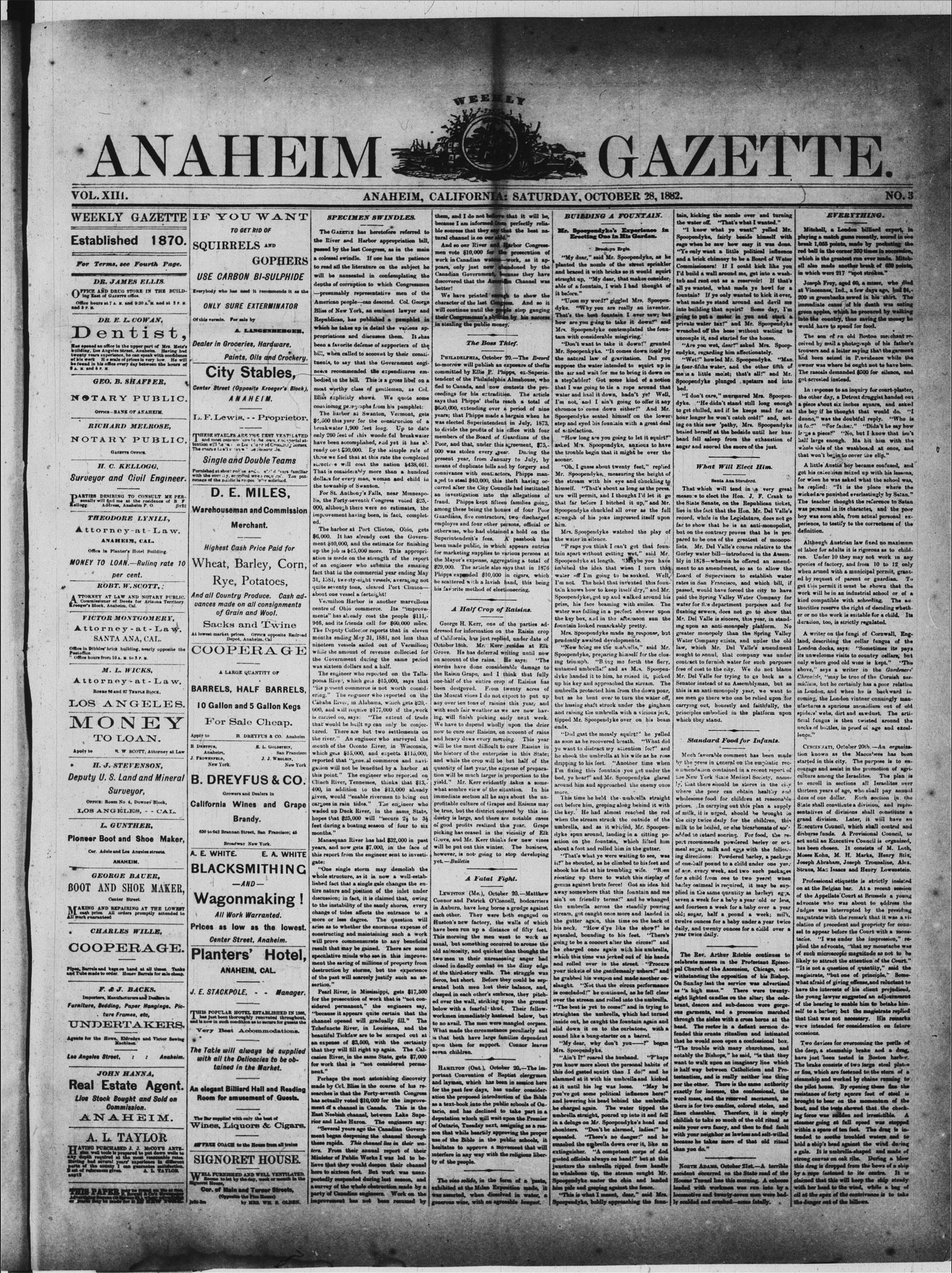
Searchable text
ANAHEIM
VOL. XIII.
WEEKLY GAZETTE
Established 1870.
For Terms, see Fourth Page.
DR. JAMES ELLIS.
OFFICE AND DRUG STORE IN THE BUILDING East of GAZETTE office.
Office hours at 7 A.M. and 9:20 A.M. and at 2 P.M. and 5 P.M.
DR. E. L. COWAN,
Dentist,
Has opened an office in the upper part of Mrs. Metz's building, Dos Angeles Street, Anaheim. Having had twenty years experience, he can speak with confidence of his work. His scale of prices is very low. He will be found in his office every day between the hours of 9 A.M. and 6 P.M.
GEO. B. SHAFFER,
NOTARY PUBLIC.
OFFICE—BANK OF ANAHEIM.
RICHARD MELROSE,
NOTARY PUBLIC.
GAZETTE OFFICE.
H. C. KELLOGG,
IF YOU WANT
TO GET RID OF
SQUIRRELS AND
GOPHERS
U8E CARBON BI-SULPHIDE
Everybody who has used it recommends it as the ONLY SURE EXTERMINATOR
Of this vermin. For sale by
A. LANGENBERGER.
Dealer in Groceries, Hardware,
Paints, Oils and Crockery.
City Stables,
Center Street (Opposite Kroeger’s Block),
ANAHEIM.
L.F. Lewis, - Proprietor.
THESE STABLES ARE THE BEST VESTILATED
and most comfortable to be on, special attention will be given to the leathered crocodiles horses.
The enlarge all your reasonable needs.
Single and Double Teams
SPECIMEN
The Gazette the River and passed by the la colossal swindle to read all the life will be nausea depths of corruption — presumably American people Bliss of New York Republican, has which he takes propriations and been a favorite bill, when called tuents, to say the news recommen bodied in the bill most worthy Bliss explicitly convincing peration The harbor s $2,500 this year breakwater 1,900 only 260 feet of have been accommodate ready cost $30,00 three we find that structure will That is consider
GEO. B. SHAFFER,
NOTARY PUBLIC.
OFFICE—BANK OF ANAHEIM.
RICHARD MELROSE,
NOTARY PUBLIC.
GAZETTE OFFICE.
H. C. KELLOGG,
Surveyor and Civil Engineer.
PARTIES DESIRING TO CONSULT ME PERSONALLY WILL FIND ME AT THE RESIDENCE OF B. F. KELLOGG.
Address: Anaheim P.O. J1v22
THEODORE LYNILL,
Attorney-at-Law.
ANAHEIM, CAL.
Office in Planter's Hotel Building.
MONEY TO LOAN.—Ruling rate 10 per cent.
ROBT. W. SCOTT.:
ATTORNEY AT LAW AND NOTARY PUBLIC.
Commissioner of Deeds for Arizona Territory Kroeger's Block, Anaheim, Cal.
VICTOR MONTGOMERY,
Attorney-at-Law,
SANTA ANA, CAL.
Office in Dibbles' brick building, nearly opposite the Postoffice.
Office hours from 10 A.M. to 3 P.M.
M. L. WICKS,
Attorney-at-Law.
Roems 86 and 87 Temple Block.
LOS ANGELES.
MONEY TO LOAN.
Apply to R. W SCOTT, Attorney at Law
H. J. STEVENSON,
Deputy U. S. Land and Mineral Surveyor,
Office: Roem No 4, Downey Block,
LOS ANGELES, - - CAL.
L. GUNTHER,
Ploneer Boot and Shoe Maker,
Cor. Adele and Los Angeles streets.
ANAHEIM.
GEORGE BAUER,
BOOT AND SHOE MAKER,
Center Street.
City Stables,
Center Street (Opposite Kroeger's Block),
ANAHEIM.
L. F. Lewis.-- Proprietor.
THESE STABLES ARE THE BEST VESTILATED
and most comfortable to be own, especially at
attention will be to Located Grounding horses.
The enclosure will be reasonable.
Single and Double Teams
Furnished at short notice and is familiar
with the country, supplied when required. The pattionage of the public is respectful solitary.
D. E. MILES,
Warehouseman and Commission Merchant.
Highest Cash Price Paid for
Wheat, Barley, Corn,
Rye, Potatoes,
And all Country Produce. Cash advances made on all consignments
of Grain and Wool.
Sacks and Twine
At lowest market prices. Office opposite Railroad Depot, Anaheim, Cal.
COOPERAGE
A LARGE QUANTITY OF
BARRELS, HALF BARRELS,
10 Gallon and 5 Gallon Kegs
For Sale Cheap.
Apply to B. DREYFUS & CO. Anaheim
B. DREYFUS,
E. L. GOLDSTEIN,
Anaheim,
San Francisco
J. FROWENFIELD,
J. WEOLEIN,
New York
B. DREYFUS & CO.
Growers and Dealers in
California Wines and Grape Brandy.
630 to 642 Brannan Street, San Francisco; 45 Broadway New York.
A. E. WHITE.
E. A. WHITE
BLACKSMITHING
AND
Wagonmaking!
OFFICE: Roem No 4, Downey Block,
LOS ANGELES, - - CAL.
L. GUNTHER,
Pioneer Boot and Shoe Maker,
Cor. Adele and Los Angeles streets.
ANAHEIM.
GEORGE BAUER,
BOOT AND SHOE MAKER,
Center Street.
MAKING AND REPAIRING AT THE LOWEST
cash price. All orders promptly attended to
All work guaranteed.
CHARLES WILLE,
COOPERAGE.
Pipe, Barrels and kegs on hand at all times. Tanks
and Tube made to order. Honev Barrels for sale cheap.
F. & J. BACKS.
Importers, Manufacturers and Dealers in
Furniture, Bedding, Paper Hangings, Picture Frames, etc,
UNDERTAKERS.
Agents for the Howe, Eldredge and Victor Sewing Machines.
Los Angeles Street, : : Anaheim.
JOHN HANNA,
Real Estate Agent.
Live Stock Bought and Sold on Commission.
ANAHEIM.
A. L. TAYLOR
HAVING PURCHASED J. J. McCOY'S ARTIFICIAL well tools is prepared to put down wells to any depth required as the most reasonable rate. Having had several years' experience in different parts of the county I can guarantee satisfaction. Best of references given.
A. L. TAYLOR
THIS PAPER may be found on file at the R. Harwell & Co. Advertising Bureau (12 Birch St.), where advertisement or trade may be made for it in NEW YORK.
California Wines and Grape Brandy.
630 to 642 Brannan Street, San Francisco; 45 Broadway New York.
A. E. WHITE.
E. A. WHITE
BLACKSMITHING
—AND—
Wagonmaking!
All Work Warranted.
Prices as low as the lowest.
Center Street, Anaheim.
Planters’ Hotel,
ANAHEIM, CAL.
J. E. STACKPOLE, - - Manager.
THIS POPULAR HOTEL ESTABLISHED IN 1808, has just been thoroughly renovated throughout, and is now in such condition as to secure for guests the Very Best Accommodations.
The Tattle will always be supplied with all the Delicacies to be obtained in the Market.
An elegant Billiard Hall and Reading Room for amusement of Guests.
The Bar supplied with only the best of Wines, Liquors & Cigars,
FREE COACH to the House from all trains
SIGNORET HOUSE.
WELL FURNISHED AND WELL VENTILATED.
Rooms to let by the day, week or month in the Signoret House,
Cor. of Main and Turner Streets,
(Opposite the Pine House)
by Mrs. Wm. R. Olden.
WEEKLY
EIM GA
ANAHEIM, CALIFORNIA: SATURDAY, OCTOBER 28, 1880
SPECIMEN SWINDLES.
The Gazette has heretofore referred to the River and Harbor appropriation bill, passed by the last Congress, as in the main colossal swindle. If one has the patience to read all the literature on the subject he will be nauseated in contemplating the depths of corruption to which Congressmen—presumably representative men of the American people—can descend. Col. George Bliss of New York, an eminent lawyer and Republican, has published a pamphlet in which he takes up in detail the various appropriations and discusses them. It has been a favorite defense of supporters of the bill, when called to account by their constituents, to say that the Government engineers recommended the expenditures embodied in the bill. This is a gross libel on a most worthy class of gentlemen, as Col. Bliss explicitly shows. We quote some convincing paragraphs from his pamphlet:
The harbor at Swanton, Vermont, gets $2,500 this year for the construction of a breakwater 1,900 feet long. Up to date only 260 feet of this woodeful breakwater have been accomplished, and yet it has already cost $30,000. By the simple rule of three we find that at this rate the completed structure will cost the nation $438,461. That is considerably more than a hundred them, and I do not believe that it will be because I am informed from perfectly reliable sources that they say that the best natural channel is on our side."
And so our River and Harbor Congressmen vote $10,000 for the prosecution of work in Canadian waters—work, as it appears, only just now abandoned by the Canadian Government, because they have discovered that the American Channel was better!
We have printed enough to show the character of the last Congress. And so it will continue until the people stop ganging their Congressman's abuses by his success in stealing the public money.
The Boss Thief.
PHILADELPHIA, October 20.—The Record to-morrow will publish an exposure of thefts committed by Ellis P. Phipps, ex-Superintendent of the Philadelphia Almshouse, who fled to Canada, and now contests the proceedings for his extradition. The article says that Phipps' thefts reach a total of $650,000, extending over a period of nine years; that Phipps made a bargain when he was elected Superintendent in July, 1873, to divide the profits of his office with four members of the Board of Guardians of the Poor, and that, under this agreement, $75,000 was stolen every year. During the present year, from January to July, by means of duplicate bills and by forgery and connivance with contractors, Phipps man-
BUILDING A FOUNTAIN.
Mr. Spoopendyke's Experience in Erecting One in His Garden.
Brooklyn Ergle.
"My dear," said Mr. Spoopendyke, as he planted the nozzle of the street sprinkler and braced it with bricks so it would squirt straight up, "My dear, that makes considerable of a fountain, I wish I had thought of it before."
"Upon my word!" giggled Mrs. Spoopendyke. "Why you are really an inventor. That's the best fountain I ever saw; but how are you going to take it down?" and Mrs. Spoopendyke contemplated the fountain with considerable misgiving.
"Don't want to take it down!" grunted Mr. Spoopenkyke. "It comes down itself by the natural law of gravitation. Did you suppose the water intended to squirt up in the air and wait for me to bring it down on a stepladder? Got some kind of a notion that I was going to tie a rope around that water and haul it down, hadn't ye? Well, I'm not, and I ain't going to offer it any chromosome to come down either!" And Mr. Spoopendyke seated himself on the lower step and eyed his fountain with a great deal of satisfaction.
"How long are you going to let it squirt?" asked Mrs. Spoopendyke, anxious to have the trouble begin that it might be over the sooner.
"Oh, I guess about twenty feet," replied Mr. Spoopendyke, measuring the height of
bodied in the bill. This is a gross libel on a most worthy class of gentlemen, as Col. Bliss explicitly shows. We quote some convincing paragraphs from his pamphlet:
The harbor at Swanton, Vermont, gets $1,500 this year for the construction of a breakwater 1,900 feet long. Up to date only 260 feet of this wooden full breakwater have been accomplished, and yet it has already cost $30,000. By the simple rule of three we find that at this rate the completed structure will cost the nation $438,461. That is considerably more than a hundred dollars for every man, woman and child in the township of Swanton.
For St. Anthony's Falls, near Minneapolis, the Forty-seventh Congress voted $25,000, although there were no estimates, the improvement having been, in fact, completed.
The harbor at Port Clinton, Ohio, gets $6,000. It has already cost the Government $40,000, and the estimate for finishing up the job is $15,000 more. This appropriation is made on the strength of the report of an engineer who submits the amazing fact that in the commercial year ending May 31, 1881, twenty-eight vessels, averaging not quite seventy tons, cleared Port Clinton—about one vessel a fortnight!
Vermilion Harbor is another marvellous centre of Ohio commerce. Its "improvements" has already cost the people $111,-946, and its friends call for $60,000 more. The Deputy Collector reports that in eleven months ending May 31, 1881, not less than nineteen vessels sailed out of Vermilion; while the amount of revenue collected for the Government during the same period was sixteen dollars and a half.
The engineer who reported on the Tallapoosa River, which gets $15,000, says that "his present commerce is not worth considering." The engineer who reported on the Cababa River, in Alabama, which gets $20,-000, and will require $177,000 if the work is carried on, says: "The extent of trade that would be built up can only be conjectured. There are but two settlements on the river."
An engineer who surveyed the mouth of the Oconto River, in Wisconsin, which gets $15,000, and expects $115,000, reported that "geneal commerce and navigation will not be benefited by a harbor at this point." The engineer who reported on Clinch River, Tennessee, thinks that $13,-400, in addition to the $13,000 already given, would "enable rivermen to bring out cargoes in rain tides." The engineer who waded up Duck River, in the same State, hopes that $25,000 will "secure 2½ to 3½ feet during a boating season of four to six months."
Manasquan River has had $32,000 in past years, and now gets $7,000, in the face of this report from the engineer sent to investigate:
"One single storm may demolish the whole structure, as it is now a well-established fact that a single gale changes the entire nature and position of the inlet under discussion; in fact, it is claimed that, owing
tendent of the Philadelphia Almshouse, who fled to Canada, and now contests the proceedings for his extradition. The article says that Phipps' theft reach a total of $650,000, extending over a period of nine years; that Phipps made a bargain when he was elected Superintendent in July, 1873, to divide the profits of his office with four members of the Board of Guardians of the Poor, and that, under this agreement, $75,-000 was stolen every year. During the present year, from January to July, by means of duplicate bills and by forgery and connivance with contractors, Phipps managed to steal $40,000; this theft having occurred after the City Councils had instituted an investigation into the allegations of fraud. Phipps kept fifteen families going among these being the houses of four Poor Guardians, five contractors, two discharged employees and four other persons, official or otherwise, who had obtained a hold on the Superintendent's fees. A passbook has been made public in which appears entries for marketing supplies to various persons at the Mayor's expense, aggregating a total of $29,000. The article also says that in 1876 Phipps expanded $10,000 in cigars, which he scattered with a lavish hand, this being his favorite method of electioneering.
A Half Crop of Raisins.
George H. Kerr, one of the parties addressed for information on the Raisin crop of California, has just replied, under date of October 18th. Mr. Kerr resides at Elk Grove. He has deferred writing until now on account of the rains. He says: "The storms have done considerable damage to the Raisin Grape, and I think that fully one-half of the entire crop of Raisins has been destroyed. From twenty acres of the Muscat vines I do not expect to put up any over ten tons of raisins this year, and with such fair weather as we are now having, will finish picking early next week. We have to depend wholly upon the drier now to cure our Raisins, on account of rains and heavy dews every morning. This year will be the most difficult to cure Raisins in the history of the enterprise in this State; and while the crop will be but half of the quantity of last year, the expense of preparation will be much larger in proportion to the yield." Mr. Kerr evidently takes a somewhat sombre view of the situation. In his immediate section all he says about the unprofitable culture of Grapes and Raisins may be true, but the district covered by this industry is large, and there are notable cases of good profits realized this year. Grape picking has ceased in the vicinity of Elk Grove, and Mr. Kerr thinks few new vines will be put out this winter. The business, however, is not going to stop developing yet.
A Fatal Fight.
LEWISTON (Me.), October 20.-Matthew Gannon and Patricia Olmsted.
"A half crop of raisins."
"Now bring me the umbrella," said Mr. Spoopendyke, preparing himself for the closing triumph. "Bring me forth the fiery untamed umbrella!" and as Mrs. Spoopendyke handed it to him, he raised it, picked up his key and approached the stream. The umbrella protected him from the down pour, but as he bent over to turn the water off, the hissing shaft struck under the gingham and raising the umbrella with a vicious jerk, tipped Mr. Spoopendyke over on his beam ends.
"Dod gast the measly squirt!" he yelled as soon as he recovered breath. "What did ye want to distract my attention for?" and he shook the umbrella at his wife as he rose drapping to his feet. "Another time when I'm fixing this fountain you get under the bed, ye hear?" and Mr. Spoopendyke glared around him and approached the enemy once more.
This time he held the umbrella straight out before him, grouping behind it with the key. He had almost reached the rod when the stream struck outside of the umbrella, and as it whirled Mr. Spoopendyke spun around, landing in a sitting position on the fountain, which lifted him about a foot and rolled him in the gutter.
"That's what ye were waiting to see, was it?" he shouted, as he climbed to his feet and shook his fist at his trembling wife. "Been roosting up there to watch display of genius against brute force! Got an idea hid away somewhere that this fountain and me isn't on friendly terms," and he whanged
The engineer who waded up Duck River, in the same State, hopes that $25,000 will "secure 2½ to 3½ feet during a boating season of four to six months."
Manasquan River has had $32,000 in past years, and now gets $7,000, in the face of this report from the engineer sent to investigate:
"One single storm may demolish the whole structure, as it is now a well-established fact that a single gale changes the entire nature and position of the inlet under discussion; in fact, it is claimed that, owing to the instability of the sandy shores, every change of tides affects the entrance to a more or less degree. The question will arise as to whether the enormous expense of constructing and maintaining such a work will prove commensurate to any beneficial result that may be gained. There are some speculative minds who see in this improvement the saving of millions of property from destruction by storms, but the experience of the past will scarcely justify such an assertion."
Pearl River, in Mississippi, gets $17,500 for the prosecution of work that is "not considered permanent," the engineers say, "because it appears quite certain that the channel opened will gradually fill." The Tchefuncte River, in Louisiana, and the beautiful Tickfaw are to be scraped out at an expense of $3,500, with the certainty that they will fill right up again. The Calcasieu River, in the same State, gets $7,000 for work that is "not considered permanent."
Perhaps the most astonishing discovery made by Col. Bliss in the course of his researches is that the Forty-seventh Congress has actually voted $10,000 for the improvement of a channel in Canada. This is the East Neebish channel, between Lake Superior and Lake Huron. The engineers say:
"Several years ago the Canadian Government began deepening the channel through these rapids. This channel lies in their centers. From their annual report of their Minister of Public Works I was led to believe that they would despen their channel here to sixteen feet. But work was unexpectedly suspended during last season, and a survey of the whole obstruction made by a party of Canadian engineers. Work on the improvement has not been resumed by profitable culture of Grapes and Raisins may be true, but the district covered by this industry is large, and there are notable cases of good profits realized this year. Grape picking has ceased in the vicinity of Elk Grove, and Mr. Kerr thinks few new vines will be put out this winter. The business, however, is not going to stop developing yet."—Bulletin
A Fatal Fight.
Lewiston (Me.), October 20.—Matthew Connor and Patrick O'Connell, hodcarriers in Auburn, have long borne a grudge against each other. They were both engaged on Huston's new factory, the walls of which have been run up a distance of fifty feet. This morning the men went to work as usual, but something occurred to arouse the old animosity, and quicker than thought the two men in their unreasoning anger had closed in deadly combat on the dizzy edge of the third-story walls. The struggle was fierce, but short. Before they could be separated both men lost their balance, and clasped in each other's embrace, they pitched over the wall, striking upon the ground below with a fearful thud. Their fellow-workmen immediately hastened below, but to no avail. The men were mangled corpses. What made the circumstance peculiarly sad is that both have large families dependent upon them for support. Connor leaves seven children.
Hamilton (Ont.), October 20.—The important Convention of Baptist clergymen and laymen, which has been in session here for the past few days, has under consideration the proposed introduction of the Bible as a text-book into the public schools of Ontario, and has declined to take part in a deputation which will wait upon the Premier of Ontario, Tuesday next, assigning as a reason that while heartily approving the proper use of the Bible in the public schools, it hesitates to approve a movement that will interfere in any way with the religious liberty of the people.
The vine solide, in the form of a paste, exhibited at the Milan Exposition made, it was asserted, when dissolved in water, a generous wine, with an agreeable bouquet.
This time he held the umbrella straight out before him, groping along behind it with the key. He had almost reached the rod when the stream struck outside of the umbrella, and as it whirled, Mr. Spoopendyke spun around, landing in a sitting position on the fountain, which lifted him about a foot and rolled him in the gutter.
"That's what ye were waiting to see, was it?" he shouted, as he climbed to his feet and shook his fist at his trembling wife. "Been roosting up there to watch this display of genius against brute force! Got an idea hid away somewhere that this fountain and me ain't on friendly terms!" and he whanged the umbrella across the steadily pouring stream, got caught once more and landed in the gutter again, this time on the back of his neck. "How d'ye like the show?" he squealed, bounding to his feet. "There's going to be a concert after the circus!" and he charged once again with his umbrella, which this time was jerked out of his hands and rolled over in the street. "Procure your tickets of the gentlemanly usher!" and he grabbed his weapon and made another onslaught. "Not that the circus performance is concluded!" he continued, as he fell clear over the stream and rolled into the umbrella. "The best is yet come!" and in trying to straighten the umbrella, which had turned inside out, he caught the fountain again and slid down it on to the curbstone, with a sound like a bung-starter on a barrel.
"My dear, why don't you——?" began Mrs. Spoopendyke.
"Ain't It" roared the husband. "P'haps you know more about the personal habits of this dod gasted squirt than I do!" and he slammed at it with his umbrella and kicked at it until his leg was loose. "May be you've got some political influence here!" and lowering his head behind the umbrella he charged again. The water tipped the umbrella straight, poured up into it and fell in a deluge on Mr. Spoopendyke's head and shoulders. "Don't be alarmed, ladies!" he squealed. "There's no danger!" and he smashed the umbrella down over it, like an extinguisher. "A competent corps of dod gasted officials always on hand!" but at this juncture the umbrella ripped from handle to whalebone tip, the stream caught Mr. Spoopendyke under the chin and landed him pale and grasping against the fence.
"This is what I meant, dear," said Mrs. Spoopendyke, boldly approaching the fen-
GAZETTE.
OCTOBER 28, 1882.
ING A FOUNTAIN.
Andyka's Experience in One in His Garden.
Brooklyn Ergle.
Did Mr. Spoopendyke, as he zzzle of the street sprinkler with bricks so it would squirt only dear, that makes consider; in, I wish I had thought of word!" giggled Mrs. Spoopen-you are really an inventor. It fountain I ever saw; but being to take it down?" and Andyka contemplated the foun-ferable misgiving. No take it down!" grunted like. "It comes down itself by way of gravitation. Did you intend to squirt up in it for me to bring it down on Got some kind of a notion to tie a rope around that it down, hadn't ye? Well, I ain't going to offer it any down either!" And Mr. stated himself on the lower fountain with a great deal of you going to let it squirt?" Spoopendyke, anxious to have in that it might be over the about twenty feet," replied tain, kicking the nozzle over and turning the water off. "That's what I wanted."
"I know what ye want!" yelled Mr. Spoopendyke, fairly beside himself with sage when he saw how easy it was done. "Ye only want a little political influence and a brick chimney to be a Board of Water Commissioners! If I could kick like you I'd build a wall around me, get into a wash-tub and rent out as a reservoir! If that's all ye wanted, what made ye howl for a fountain? If ye only wanted to kick it over, what made ye stand around and devil me into building that squirt? Some day, I'm going to put a meter in you and start a private water tax!" and Mr. Spoopendyke wrenched off the hose without waiting to uncouple it, and started for the house.
"Are you wet, dear?" asked Mrs. Spoopendyke, regarding him affectionately.
"Wet!" howled Mr. Spoopendyke. "Man is four-fifths water, and the other fifth of me is a little moist; that's all!" and Mr. Spoopendyke plunged upstairs and into bed.
"I don't care," murmured Mrs. Spoopendyke. "He didn't stand still long enough to get chilled, and if he keeps mad for an hour longer he won't catch cold!" and, acting on this new 'pathy, Mrs. Spoopendyke busied herself at the bedside until her husband fell asleep from the exhaustion of anger and snored the snore of the just.
What Will Elect Him.
EVERYTHING.
Mitchell, a London billiard expert, in playing a match game recently, scored in one break 1,055 points, made by pocketing the red ball in the corner 350 times in succession, which is the greatest run ever made. Mitchell also made another break of 650 points, in which were 217 "spot strokes."
Joseph Frey, aged 60, a miser, who died at Vincennes, Ind., a few days ago, had $4,-200 in greenbacks sewed in his shirt. The immediate cause of his death was eating green apples, which he procured by walking into the country, thus saving the money he would have to spend for food.
The son of an old Boston merchant received by mail a photograph of his father's trousers and a letter saying that the garment had been seized in Providence while the owner was where he ought not to have been. The rascals demanded $500 for silence, and got arrested instead.
In response to an inquiry for court-plaster, the other day, a Detroit druggist handed out a piece about six inches square, and asked the boy if he thought that would do. "I dunno," was the doubtful reply. "Who is it for?" "For father." "Didn't he say how large a piece?" "No, but I know that isn't half large enough. Ma hit him with the whole side of the washboard at once, and that won't begin to cover the clip."
A little Austin boy became confused, and got his catechism mized up with his lessons.
What Will Elect Him.
Santa Ana Standard.
That which will tend in a very great measure to elect the Hon. J. F. Crank to the State Senate, on the Republican ticket, lies in the fact that the Hon. Mr. Del Valle's record, while in the Legislature, does not go far to show that he is an anti-monopolist, but on the contrary proves that he is prepared to be one of the greatest of monopolists. Mr. Del Valle's course relative to the Gorley water bill—introduced in the Assembly in 1878—wherein he offered an amendment to an amendment, so as to allow the Board of Supervisors to establish water rates in San Francisco, and which bill, if passed, would have forced the city to have paid the Spring Valley Water Company for water for fire department purposes and for flushing sewers, does not go to show that Mr. Del Valle is sincere, this year, in standing upon an anti-monopoly platform. No greater monopoly than the Spring Valley Water Company exists, and under the old law, which Mr. Del Valle's amendment sought to annul, that company was under contract to furnish water for such purposes free of cost to the city. We do not blame Mr. Del Valle for trying to go back as a Senator instead of an Assemblyman, but as this is an anti-monopoly year, we want to see men go there who can be relied upon for carrying out, honestly and faithfully, the principles embodied in the platform upon which they stand.
Standard Food for Infants.
Much favorable comment has been made by the press in general on the emphatic recommendation contained in a recent report of the New York State Medical Society, namely, that there should be stores in the city where the poor can obtain healthy and wholesome food for children at reasonable prices. In carrying out this plan a supply of milk, it is urged, should be brought to the city twice daily for the children, this milk to be boiled, or else bicarbonate of sodium added to retard souring. For food, the report recommends powdered barley or oatmeal sugar, milk and eggs with the following directions: Powdered barley, a package of one-half pound to a child under one year of age, every week, and two such packages for a child from one to two years; when barley oatmeal is required, it may be supplied in the same quantity as barley; eggs a week for a baby as young.
CINCINNATI, October 20th — An organization known as the Macacoes has been started in this city. The purpose is to encourage and assist in the promotion of agriculture among the Israelites. The plan is to enroll in sections all Israelites over thirteen years of age, who shall pay annual dues of one dollar. Each section in the State shall constitute a division, and representatives of divisions shall constitute a grand division. Later, it will have an Executive Council, which shall control and burrow funds. A Provisional Council, to act until an Executive Council is organized, has been chosen. It consists of M. Loth, Moses Kohn, M. H. Marks, Henry Stix, Joseph Abraham, Joseph Trounsline, Alex Straus, Max Isaacs and Henry Lowenstein.
Professional etiquette is strictly insisted on at the Belgian bar. At a recent session of the Appellate Court at Brussels a young
The Rev. Arthur Ritchie continues to celebrate masses in the Protestant Episcopal Church of the Ascension, Chicago, notwithstanding the opposition of his Bishop. On Sunday last the service was advertised as "a high mass." There were twenty-eight lighted candles on the altar; the celebrant, deacon and sub-deacon wore gorgeous garments, and a procession marched through the siles with a cross borne at the head. The rector in a defiant sermon defended this ornate ritualism and intimated that he would soon open a confessional box.
"The trouble with many churchmen, and notably the Bishops," he said, "is that they want to walk upon an imaginary line which is half way between Catholicism and Protestantism, and is really neither one thing nor the other. There is the same authority exactly for incense, the confessional, the word mass, and the reserved sacrament, as there is for two candles, colored stoles, and linen chasubles. Therefore, it is simply childish to take so much of the old ritual as suits your own fancy, and then to find fault with your neighbor as lawless and self-willed because he takes more of that old ritual than you do."
North Adams, October 21st.—A terrible accident occurred on the State road of the Hoosac Tunnel line this morning. A caboose loaded with workmen was run into by a locomotive and twenty-seven men were badly scalded and crushed—some fatally.
Professional etiquette is strictly insisted on at the Belgian bar. At a recent session of the Appellate Court at Brussels a young advocate who was about to address the Judges was interrupted by the presiding magistrate with the remark that it was a violation of precedent and propriety for counsel to appear before the Court with a moustache. "I was under the impression," replied the advocate, "that my moustache was of such microscopic magnitude as not to be likely to attract the attention of the Court."
"It is not a question of quantity," said the magistrate, "but one of principle." Somewhat afraid of giving offense, and reluctant to have the interests of his client prejudiced, the young lawyer suggested an adjournment of the hearing to enable him to betake himself to a barber; but the magistrate replied that that was not necessary. His remarks were intended for consideration on future occasions.
Two devices for overcoming the perils of the deep, a steamship brake and a drag, have just been tested in Boston harbor. The brake consists of two large steel plates or fine, which are fastened to the stern of a steamship and worked by chains running to the pilot house. By opening these fins the resistance of forty square feet of steel is brought to bear on the momentum of the boat, and the tests showed that the checking force was sudden and irresistible. A steamer going at full speed was stopped within a space of ten feet. The drag is intended to soothe troubled waters and to hold a ship's head against the wind during a gale. It is umbrella-shaped and made of strong canvas on oak ribs. During a blow this drag is dropped from the bows of a ship by a rope fastened to its centre. It is claimed that this will keep the ship steady with her head to the wind, while a bag of oil at the apex of the contrivance is to take the danger out of the billows.