anaheim-gazette 1882-10-21
Scanned page
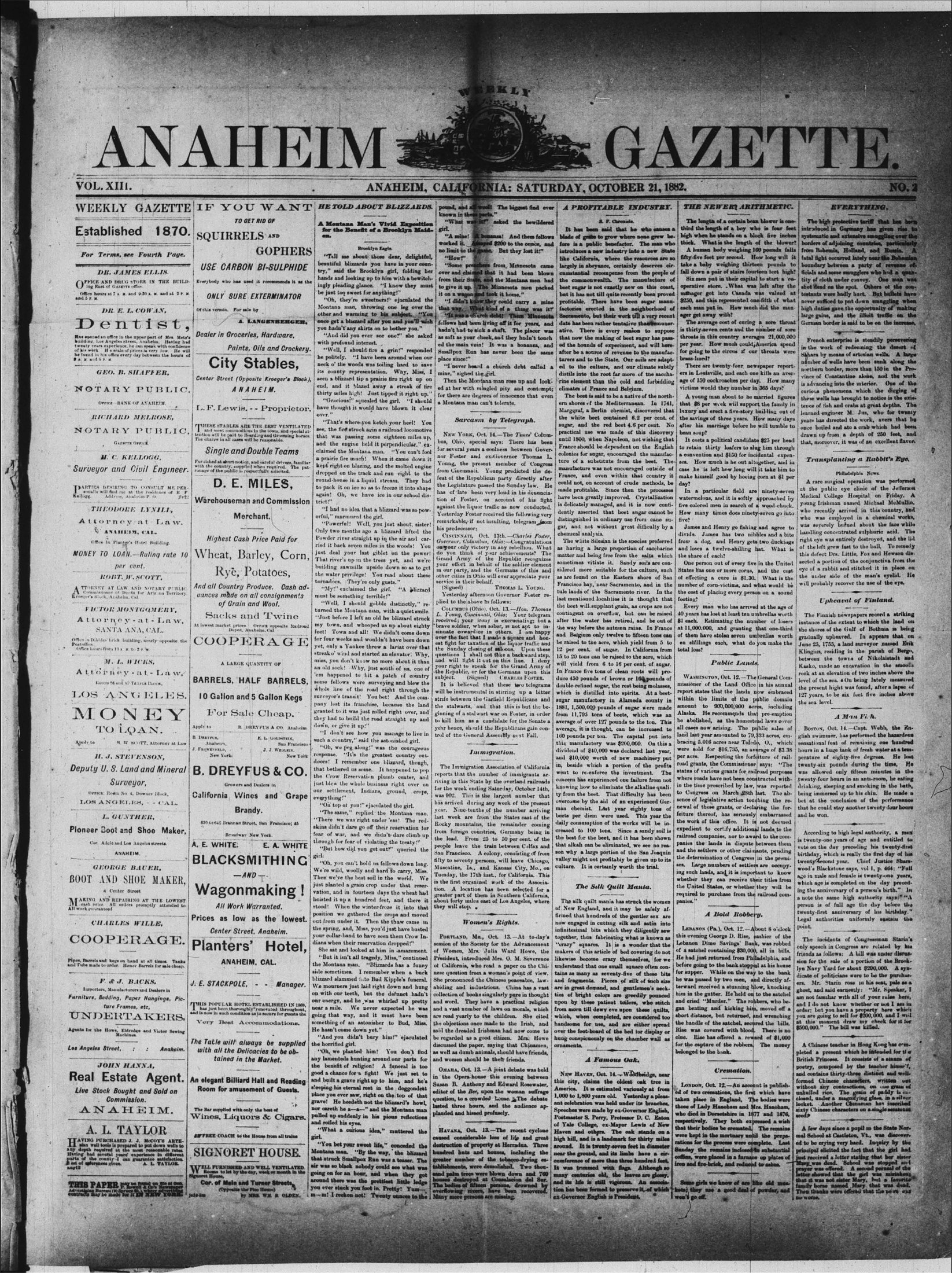
Searchable text
ANAHEIM
VOL. XIII.
WEEKLY GAZETTE
Established 1870.
For Terms, see Fourth Page.
DR. JAMES ELLIS.
OFFICE AND DRUG STORE IN THE BUILDING East of GAZETTE office.
Office hours at 7 A.M. and 9:30 A.M. and at 2 P.M. and 5 P.M.
DR. E. L. COWAN,
Dentist,
Has opened an office in the upper part of Mrs. Metr's building, Los Angeles street, Anaheim. Having had twenty years experience, he can speak with confidence of his work. It is scale of prices is very low. He will be found in his office every day between the hours of 8 A.M. and 5 P.M.
GEO. B. SHAFFER,
NOTARY PUBLIC.
Office - BANK OF ANAHEIM.
RICHARD MELROSE,
NOTARY PUBLIC.
GAZETTE OFFICE.
M. C. KELLOGG,
Surveyor and Civil Engineer.
IF YOU WANT
TO GET RID OF
SQUIRRELS AND
GOPHERS
USE CARBON BI-SULPHIDE
Everybody who has used it recommends it as the ONLY SURE EXTERMINATOR
Of this vermin. For sale by
A. LANGENBERGER.
Dealer in Groceries, Hardware,
Paints, Oils and Crockery.
City Stables,
Center Street (Opposite Kroeger's Block),
ANAHEIM.
L.F. Lewis. -- Proprietor.
THESE STABLES ARE THE BEST VENTILATED
and most commodious in the town, and special attention will be paid to Boarding and Grooming horses.
The charge in all cases will be reasonable.
Single and Double Teams
Furnished at short notice, and careful drivers, familiar with the country, supplied when required. The patronage of the public is respectfully solicited.
HE TOLD
A Montana man other and war once get a blizzard you hadn't anyy
"Oh, they're Montana man other and war once get a blizzard you hadn't anyy"
"And did you with profound
"Well, I shi he politely."
"neck o' the wood its county ree seen a blizzard end, and it thirty miles hi
"Gracious!" have thought it over."
"That's whe see, the fire str that was pass and the eng claimed the Mo a prairie fire m kept right on b dropped on the
NOTARY PUBLIC.
OFFICE BANK OF ANAHEIM.
RICHARD MELROSE,
NOTARY PUBLIC.
GAZETTE OFFICE.
M. C. KELLOGG,
Surveyor and Civil Engineer.
PARTIES DESIRING TO CONSULT ME PERSONALLY WILL FIND ME AT THE RESIDENCE OF B. F. KELLOGG.
Address: Anaheim P. O.
THEODORE LYNILL,
Attorney at Law.
ANAHEIM, CAL.
Office in Planter's Hotel Building.
MONEY TO LOAN.—Ruling rate 10 per cent.
ROBT. W. SCOTT.
ATTORNEY AT LAW AND NOTARY PUBLIC
Counsiderer of Deeds for Arizona Territory Kroeger's Block, Anaheim, Cal.
VICTOR MONTGOMERY,
Attorney-at-Law,
SANTA ANA, CAL.
Office in Dibbles brick building, nearly opposite the Postoffice.
Office hours from 10 A.M. to 5 P.M.
M. L. WICKS,
Attorney-at-Law.
Rooms 56 and 87 Trouble Block.
LOS ANGELES.
MONEY TO LOAN.
Apply to R. W. SCOTT. Attorney at Law
H. J. STEVENSON,
Deputy U. S. Land and Mineral Surveyor.
Office: Room No 4, Downey Block.
LOS ANGELES, - - CAL.
L. GUNTHER,
Ploneer Boot and Shoe Maker,
Cor. Adelaide and Los Angeles streets.
ANAHEIM.
GEORGE BAUER,
BOOT AND SHOE MAKER,
a Center Street
Center Street (Opposite Kroeger's Block),
ANAHEIM.
L. F. Lewis. -- Proprietor.
THESE STABLES ARE THE BEST VENTILATED and most commodious in the town, and special attention will be paid to Boarding and Grooming horses.
The charve in all cases will be reasonable.
Single and Double Teams
Furnished at short notice, and careful drivers, familiar with the country, supplied when required. The patronage of the public is respectfully solicited.
D. E. MILES,
Warehouseman and Commission Merchant.
Highest Cash Price Paid for Wheat, Barley, Corn, Ryë, Potatoes, And all Country Produce. Cash advances made on all consignments of Grain and Wool.
Sacks and Twine
At lowest market prices. Office opposite Railroad Depot, Anaheim, Cal.
COOPERAGE
A LARGE QUANTITY OF
BARRELS, HALF BARRELS,
10 Gallon and 5 Gallon Kegs
For Sale Cheap.
Apply to B. DREYFUS & CO. Anaheim
B. DREYFUS,
Annaheim,
San Francisco
J. FROWENFIELD,
New York
J. WEOLEIN,
New York
B. DREYFUS & CO.
Growers and Dealers in California Wines and Grape Brandy.
630 to 642 Brannan Street, San Francisco; 45 Broadway New York.
A. E. WHITE:
E. A. WHITE
BLACKSMITHING
—and
Wagonmaking!
L. GUNTHER,
Pioneer Boot and Shoe Maker,
Cor. Adele and Los Angeles streets.
ANAHEIM.
GEORGE BAUER,
BOOT AND SHOE MAKER,
a Center Street
Making and Repairing at the Lowest
eash price. All orders promptly attended to
All work guaranteed.
CHARLES WILLE,
COOPERAGE.
Pipes, Barrels and kegs on hand at all times. Tanks
and Tubs made to order. Honov Barrels for sale cheap.
F. & J. BACKS.
Importers, Manufacturers and Dealers in
Furniture, Bedding, Paper Hangings, Picture Frames, etc,
UNDERTAKERS.
Agents for the Howe, Eldredge and Victor Sewing Machines.
Los Angeles Street, : : Anaheim.
JOHN HANNA,
Real Estate Agent.
Live Stock Bought and Sold on Commission.
ANAHEIM.
A. L. TAYLOR
HAVING PURCHASED J. J. McCOY'S ARTESIAN wall tools is prepared to put down wells to any depth required at the most reasonable rates.
Having had several years' experience in different parts of the county-I can guarantee satisfaction.
Best of differences given.
A. L. TAYLOR.
aug12
THIS PAPER may be found on Sie at Glen.
Advertising Bureau (10 Spruce St.) where advertising contracts may be made for it IN NEW YORK.
Brandy.
630 to 642 Brannan Street, San Francisco; 45 Broadway New York.
A. E. WHITE:
E. A. WHITE
BLACKSMITHING
—AND—
Wagonmaking!
All Work Warranted.
Prices as low as the lowest.
Center Street, Anaheim.
Planters’ Hotel,
ANAHEIM, CAL.
J. E. STACKPOLE, - - Manager.
THIS POPULAR HOTEL ESTABLISHED IN 1868,
has just been thoroughly renovated throughout,
and is now in such condition as to secure for guests the Very Best Accommodations.
The Table will always be supplied with all the Delicacies to be obtained in the Market.
An elegant Billiard Hall and Reading Room for amusement of Guests.
The Bar supplied with only the best of Wines, Liquors & Cigars.
FREE COACH to the House from all trains
SIGNORET HOUSE.
WELL FURNISHED AND WELL VENTILATED.
Rooms to let by the day, week or month in the Signoret House,
Cor. of Main and Turner Streets.
(Opposite the Pico House)
by Mrs. Wm. R. OLDEN.
Oh top of you
"The same,"
There we was
skins didn't dare fear of war, and through for fear
But how did girl:
"Oh, you can't We're wild, wood Then we've the just planted a gravation, and in the hoisted it up a stood! When the position we gat out from under in the spring, and your collar-band dians when their She sat and loot
But it isn't a the Montana man side sometimes blizzard alarmed We mourners jump on with our teeth our energy, and near a mile. We going that way, something of an He hasn't come dale
And you did the horrified girl.
"Oh, we plant any lamenteds hut the benefit of re-good a chance for and built a grave sleeping his eternal place you ever sa-grave! He heeded nor careth he a-pulled up sudden and rolled his eyelight"
What a curry girl.
"You bet your Montana man that struck Small air was so black going on for an around there was you ever stuck you m-m! I reckon
WEEKLY GAZETTE
ANAHEIM, CALIFORNIA: SATURDAY, OCTOBER 21, 1860
HE TOLD ABOUT BLIZZARDS.
A Montana Man's Vivid Exposition for the Benefit of a Brooklyn Maiden.
Brooklyn Eagle.
"Tell me about those dear, delightful, beautiful blizzards you have in your country," said the Brooklyn girl, folding her hands and looking up to him with a bewitchingly pleading glance. "I know they must be just too sweet for anything!"
"Oh, they're sweetners!" ejaculated the Montana man, throwing one leg over the other and warming to his subject. "You once get a blizzard after you and you'll wish you hadn't any skirts on to bother you."
"And did you ever see one?" she asked with profound interest.
"Well, I should fire a grin!" responded he politely. "I have been around when our neck o' the woods was toiling hard to save its county representation. Why, Miss, I seen a blizzard tip a prairie fire right up on end, and it blazed away a streak of fire thirty miles high! Just tipped it right up."
"Gracious!" squealed the girl. "I should have thought it would have blown it clear over."
"That's where you ketch your heel! You see, the fire struck again a railroad locomotive that was passing some eighteen miles up, and the engine held it perpendicular." exclaimed the Montana man. "You can't fool a prairie fire much! When it came down it kept right on blazing, and the molted engine dropped on the track and run right to the pound, and all wool! The biggest find ever known in them parts."
"What was it?" asked the bewildered girl.
"A mine! A bonanza! And them fellows worked it. Allowed $200 to the ounce, and no limit to the game. But they lost it!"
"How?"
"Some presidents from Minnesota came over and claimed that it had been blown from their State, and the Montana men had to give it up. The Minnesota men packed it on a wagon and took it home."
"I didn't know they could carry a mine that way. What kind of a thing was it?"
"It was a church debt! The Minnesota fellows had been living off it for years, and hadn't had to sink a shaft. The placer was as soft as your cheek, and they hadn't touched the main vein! It was a bonanza, and Smallpox Run has never been the same place since!"
"I never heard a church debt called a mine," sighed the girl.
Then the Montana man rose up and looked at her with mingled pity and contempt; for there are degrees of innocence that even a Montana man can't tolerate.
Sarcasm by Telegraph.
New York, Oct. 14.—The Times' Columbus, Ohio, special says: There has been for several years a coolness between Governor Foster and ex-Governor Thomas L. Young, the present member of Congress from Cincinnati. Young predicted the de-
A PROFITABLE INDUSTRY.
S. F. Chronicle.
It has been said that he who cansees a blade of grass to grow where none grew before is a public benefactor. The man who introduces a new industry into a new State like California, where the resources are largely in abeyance, certainly deserves circumstantial recompense from the people of the commonwealth. The manufacture of beet sugar is not exactly new on this coast but it has not till quite recently been proved profitable. There have been sugar manufacturers erected in the neighborhood of Sacramento, but their work till a very recent date has been rather tentative than permanent. There is every reason to suppose that now the making of beet sugar has passed the bounds of experiment, and will hereafter be a source of revenue to the manufacturers and to the State. Our soils are adapted to the culture, and our climate subtly distills into the root far more of the saccharine element than the cold and forbidding climates of France and Belgium.
The beet is said to be a native of the northern shores of the Mediterranean. In 1741, Marggraf, a Berlin chemist, discovered that the white beet contained 6.2 per cent. of sugar, and the red beet 4.6 per cent. No practical use was made of this discovery until 1800, when Napoleon, not wishing that France should be dependent on the English colonies for sugar, encouraged the manufacture of a substitute from the beet. The manufacture was not encouraged outside of France and within that country.
seen a blizzard tip a prairie fire right up on end, and it blazed away a streak of fire thirty miles high! Just tipped it right up."
"Gracious!" squealed the girl. "I should have thought it would have blown it clear over."
"That's where you ketch your heel! You see, the fire struck again a railroad locomotive that was passing some eighteen miles up, and the engine held it perpendicular." exclaimed the Montana man. "You can't fool a prairie fire much! When it came down it kept right on blazing, and the melted engine dropped on the track and ran right to the round-house in a liquid stream. They had to pack it on ice so as to freeze it into shape again! Oh, we have ice in our school district!"
"I had no idea that a blizzard was so powerful," murmured the girl.
"Powerful! Well, you just shout, sister! Only two months ago a blizzard lifted the Powder river straight up in the air and carried it back seven miles in the woods! You just deal your last giblet on the power! That river's up in the trees yet, and we're building sawmills upside down so as to get the water privilege! You read about these tornadoes. They're only gusts."
"My!" exclaimed the girl. "A blizzard must be something terrible!"
"Well, I should gobble distinctly," returned the Montana man, with a quiet smile. "Just before I left an old he blizzard struck my town, and whooped us up about eighty feet! Town and all! We didn't come down for four weeks and wouldn't have been down yet, only a Yankee threw a lariat over that streako' wind and started an elevator! Why, miss, you don't know no more about it than an old sock! Why, just south of us, one of 'em happened to hit a patch of country some fellows were surveying and blew the whole line of the road right through the surveyor's transit! You bet! And the company lost its franchise, because the land granted to it was just rolled right over, and they had to build the road straight up and down, or give it up!"
"I don't see how you manage to live in such a country," said the astonished girl.
"Oh, we peg along!" was the courageous response. "It's the greatest country outdoors! I remember one blizzard, though, that bothered us some. It happened to pop the Crow Reservation plumb center, and just blew the whole business right over on our settlement, Indiana, ground, crops, everything!"
"On top of you!" ejaculated the girl.
"The same," replied the Montana man. "There we was right under 'em! The redskins didn't dare go off their reservation tor fear of war, and we didn't dare climb up through for fear of violating the treaty!"
"But how did you get out?" queried the girl.
"Oh, you can't hold us fellows down long. We're wild, woolly and hard to carry, Miss. Then we've the best soil in the world. We just planted a grain crop under that reservation, and in fourteen days the wheat had hoisted it in a hundred feet and there it is."
Then the Montana man rose up and looked at her with mingled pity and contempt; for there are degrees of innocence that even a Montana man can't tolerate.
Sarcasm by Telegraph.
New York, Oct. 14.—The Times' Columbus, Ohio, special says: There has been for several years a coolness between Governor Foster and ex-Governor Thomas L. Young, the present member of Congress from Cincinnati. Young predicted the defeat of the Republican party directly after the Legislature passed the Sunday law. He has of late been very loud in his denunciation of Foster, on account of his fight against the liquor traffic as now conducted. Yesterday Foster received the following very remarkable, if not insulting, telegram from his predecessor:
CINCINNATI, Oct. 13th.—Charles Foster, Governor, Columbus, Ohio:—Congratulations on your only victory in any rebellion. What do you think of your achievements? The Grand Army of the Republic recognizes your effort in behalf of the soldier element in our party, and the Germans of this and other cities in Ohio will ever appreciate your service in their behalf.
(Signed) THOMAS L. YOUG.
Yesterday afternoon Governor Foster replied to the above as follows:
COLUMBUS (Ohio), Oct. 13.—Hon. Thomas L. Young, Cincinnati, Ohio: Your telegram received; your irony is exercising; but a brave soldier, when sober, is not apt to insinuate cowardice in others. I am happy over the fact that I made a square and honest fight for taxation of the liquor traffic and the Sunday closing of saloons. Upon these questions I shall not take a backward step, and will fight it out on this line. I deny your right to speak for the Grand Army of the Republic, or for the Germans upon this subject.
(Signed) CHARLES FOSTER.
It is believed that these two telegrams will be instrumental in stirring up a bitter strife between the Garfield Republicans and the stalwarts, and that this is but the beginning of a stalwart war on Foster, in order to kill him as a candidate for the Senate a year hence, should the Republicans gain control of the General Assembly next Fall.
Immigration.
The Immigration Association of California reports that the number of immigrants arriving in this State by the overland railroads for the week ending Saturday, October 14th, was 902. This is the largest number that has arrived during any week of the present year. Nine-tenths of the number arriving last week are from the States east of the Rocky mountains, the remainder coming from foreign countries, Germany being in the lead. From 25 to 50 per cent. of the people leave the train between Colfax and San Francisco. A colony, consisting of fifty to seventy persons, will leave Chicago, Muscatine, Ia., and Kansas City, Mo., on Tuesday, the 17th inst., for California. This is the first organized work of the Association. A location has been selected for a greater part of them in Southern California, distrusts into the root far more of the saccharine element than the cold and forbidding climates of France and Belgium.
The beet is said to be a native of the northern shores of the Mediterranean. In 1741, Marggraf, a Berlin chemist, discovered that the white beet contained 6.2 per cent. of sugar, and the red beet 4.6 per cent. No practical use was made of this discovery until 1800, when Napoleon, not wishing that France should be dependent on the English colonies for sugar, encouraged the manufacture of a substitute from the beet. The manufacture was not encouraged outside of France, and even within that country it could not, on account of crude methods, be made profitable. Since then the processes have been greatly improved. Crystallization is delicately managed, and it is now confidently asserted that beet sugar cannot be distinguished in ordinary use from cane sugar, and not without great difficulty by a chemical analysis.
The white Silesian is the species preferred as having a large proportion of saccharine matter and being free from the salts which sometimes vitiate it. Sandy soils are considered more suitable for the culture, such as are found on the Eastern shore of San Francisco bay, near Sacramento, and in the tule lands of the Sacramento river. In the last mentioned localities it is thought that the beet will supplant grain, as crops are not contingent on overflow, but can be raised after the water has retired, and be out of the way before the autumn rains. In France and Belgium only twelve to fifteen tons can be raised to the acre, which yield from 5 to 12 per cent. of sugar. In California from 15 to 20 tons can be raised to the acre, which will yield from 6 to 16 per cent. of sugar. In France five tons of clean roots will produce 450 pounds of brown or 160 pounds of double-refined sugar, the rest being molasses, which is distilled into spirits. At a beet-sugar manufactory in Alameda county in 1881, 1,500,000 pounds of sugar were made from 11,793 tons of beets, which was an average of over 127 pounds to the ton. This average, it is thought, can be increased to 160 pounds per ton. The capital put into this manufacturing was $200,000. On this a dividend of $40,000 was declared last year, and $10,000 worth of new machinery put in beside which a portion of the profits went to re-enforce the investment. The concern has experienced one failure from not knowing how to eliminate the alkaline quality from the beet. That difficulty has been overcome by the aid of an experienced German chemist. Last year eighty tons of beets per diem were used. This year the daily consumption of the works will be increased to 100 tons. Since a sandy soil is the best for the beet, and it has been shown that alkah can be eliminated, we see no reason why a large portion of the San Joaquin valley might not profitably be given up to its culture. It is certainly worth the trial.
The Silk Quilt Mania.
"On top of you!" ejaculated the girl.
"The same," replied the Montana man.
"There we was right under 'em! The redskins didn't dare go off their reservation for fear of war, and we didn't dare climb up through for fear of violating the treaty!"
"But how did you get out?" queried the girl.
"Oh, you can't hold us follows down long. We're wild, woolly and hard to carry, Miss. Then we've the best soil in the world. We just planted a grain crop under that reservation, and in fourteen days the wheat had hoisted it up a hundred feet, and there it stood! When the winter froze it into that position we gathered the crops and moved out from under it. Then the thaw came in the spring, and, Miss, you'd just have busted your collar-band to have seen them Crow Indians when their reservation dropped!"
She sat and looked at him in amazement.
"But it isn't all tragedy, Miss," continued the Montana man.
"Blizzards has a funny side sometimes. I remember when a buck blizzard slammed into Bud Kipple's funeral. We mourners just laid right down and hung on with our teeth, but the defunct hadn't our energy, and he was whirled up pretty near a mile. We never expected he was going that way, and it must have been something of an astonisher to Bud, Miss. He hasn't come down yet."
"And you didn't bury him!" ejaculated the horrified girl.
"Oh, we planted him! You don't find any lamenteds hunting around our parts for the benefit of religion! A funeral is too good a chance for a fight! We just set to and built a grave right up to him, and he's sleeping his eternal rest in the doggondest place you ever saw, right on the top of that grave! He heedeth not the blizzard's howl, nor careth he a—a—" and the Montana man pulled up suddenly in his pious reflections and rolled his eyes.
"What a curious idea," muttered the girl.
"You bet your sweet life," conceded the Montana man.
"By the way, the blizzard that struck Smallpox Run was a teaser. The air was so black nobody could see what was going on for an hour, and when they got around there was the prettiest little ledge you ever stuck you foot in. Pretty! Yum—m—m! I reckon not! Twenty ounces to the year. Nine-tenths of the number arriving last week are from the States east of the Rocky mountains, the remainder coming from foreign countries, Germany being in the lead. From 25 to 50 per cent. of the people leave the train between Colfax and San Francisco. A colony, consisting of fifty to seventy persons, will leave Chicago, Muscatine, Ia., and Kansas City, Mo., on Tuesday, the 17th inst., for California. This is the first organized work of the Association. A location has been selected for a greater part of them in Southern California, about forty miles east of Los Angeles, where they will stop."
Women's Rights.
Portland, Me., Oct. 13. At to-day's session of the Society for the Advancement of Women, Mrs. Julia Ward Howe, the President, introduced Mrs. O. M. Severence of California, who read a paper on the Chinese question from a woman's point of view. She pronounced the Chinese peaceable, law-abiding and industrious. China has a vast collection of books singularly pure in thought and word. They have a practical religion and a vast number of laws on morals, which are read yearly to the children. She cited the objections once made to the Irish, and said the dreaded Irishman had now come to be regarded as a good citizen. Mrs. Howe discussed the paper, saying that Chinamen, as well as dumb animals, should have friends, and women should be their friends.
Omaha, Oct. 13. A joint debate was held in the Opera-house this evening between Susan B. Anthony and Edward Rosewater, editor of the Bee, upon the woman suffrage question, to a crowded house. The debate lasted three hours, and the audience applauded and hissed profusely.
Havana, Oct. 13. The recent cyclone caused considerable loss of life and great destruction of property at Herradua. Three hundred huts and houses, including the greater number of the tobacco-drying establishments, were demolished. Two thousand palm trees were blown down and 760 houses destroyed at Consalacion del Sur. The bodies of fifteen persons, drowned by overflowing rivers, have been recovered. Many more persons are missing.
The silk quilt mania has struck the women of New England, and it may be safely affirmed that hundreds of the gentler sex are now engaged in cutting silk and satin into infinitesimal bits which they diligently sew together, thus fabricating what is known as "crazy" squares. It is a wonder that the makers of this article of bed covering do not likewise become crazy themselves, for we understand that one small square often contains as many as seventy-five of these bits and fragments. Pieces of silk of such size are in great demand, and gentlemen neckties of bright colors are greedily pounded upon by these patient toilers, who stitch from morn till dewy eve upon these quilts, which, when completed, are considered too handsome for use, and are either spread over the foot-board of the bed for display or hung conspicuously on the chamber wall as ornaments.
A Famous Oak.
New Haven, Oct. 14. Woodbridge, near this city, claims the oldest oak tree in America. It is estimated variously at from 1,000 to 1,800 years old. Yesterday a pleasant celebration was held under its branches. Speeches were made by ex-Governor English, Postmaster S. Perry, Professor D. C. Eaton of Yale College, ex-Mayor Lewis of New Haven and others. The oak stands on a high hill, and is a landmark for thirty miles around. It is twenty-seven feet in diameter near the ground, and its limbs have a circumference of more than three hundred feet. It was trimmed with flags. Although so many centuries old, the leaves are glossy, and its life is still vigorous. An association has been formed to preserve it, of which ex-Governor English is President.
GAZETTE.
OCTOBER 21, 1882.
TABLE INDUSTRY.
S. F. Chronicle.
It said that he who canes a to grow where none grew beneficial factor. The man who now industry into a new State, where the resources are so rare, certainly deserves compensation from the people of wealth. The manufacture of not exactly new on this coast, still quite recently been proved there have been sugar manufactured in the neighborhood of but their work till a very recent rather tentative than remunerative is every reason to suppose making of beet sugar has passed of experiment, and will hereof receive of revenue to the manufactory State. Our soils are adaptature, and our climate subtly the root far more of the sacchaan the cold and forbiddingrance and Belgium.
It said to be a native of the north-east Mediterranean. In 1741, Berlin chemist, discovered that it contained 6.2 per cent. of the red beet 4.6 per cent. No was made of this discovery when Napoleon, not wishing that be dependent on the English sugar, encouraged the manufacture from the beet. The was not encouraged outside of within that country it
THE NEWER ARITHMETIC.
The length of a certain bean blower is one-third the length of a boy who is four feet high when he stands on a block five inches thick. What is the length of the blower?
A human body weighing 160 pounds falls fifty-five feet per second. How long will it take a baby weighing thirteen pounds to fall down a pair of stairs fourteen feet high?
Six men put in their capital to start a cooperative store. What was left after the manager got into Canada was valued at $250, and this represented one-fifth of what each man put in. How much did the manager get away with?
The average cost of curing a sore throat is thirty-seven cents and the number of sore throats in this country averages 21,000,000 per year. How much could America spend for going to the circus if our throats were brass-lined?
There are twenty-four newspaper reporters in Louisville, and each one kills an average of 150 cockroaches per day. How many victims would they number in 365 days?
A young man about to be married figures that $8 per week will support the family in luxury and erect a five-story building out of the savings of three years. How many days after his marriage before he will tumble to bean soup?
It costs a political candidate $25 per head to retain thirty loafers to slug him through a convention and $150 for incidental expenses. How much is he out altogether, and in case he is left how long will it take him to
EVERYTHING.
The high protective tariff that has been introduced in Germany has given rise to systematic and extensive smuggling over the borders of adjoining countries, particularly from Bohemia, Holland, and Russia. A fatal fight occurred lately near the Bohemian boundary between a party of revenue officials and some smugglers who had a quantity of cloth under convey. One man was shot dead on the spot. Others of the contestants were badly hurt. But bullets have never sufficed to put down smuggling when high duties gave the opportunity of making large gains, and the illicit traffic on the German border is said to be on the increase.
French enterprise is steadily persevering in the work of redeeming the desert of Sahara by means of artesian wells. A large number of wells have been sunk along the northern border, more than 150 in the Province of Constantine alone, and the work is advancing into the interior. One of the curious phenomena which the digging of these wells has brought to notice is the existence of fish and crabs at great depths. The learned engineer M. Jus, who for twenty years has directed the work, avers that he once boiled and ate a crab which had been drawn up from a depth of 250 feet, and that, moreover, it was of an excellent flavor.
Transplanting a Rabbit's Eye.
Philadelphia News.
aid to be a native of the norththe Mediterranean. In 1741,
Berlin chemist, discovered that
it contained 6.2 per cent of
the red beet 4.6 per cent. No
was made of this discovery
when Napoleon, not wishing that
be dependent on the English
sugar, encouraged the manufacturitute from the beet. The
was not encouraged outside of
even within that country it
account of crude methods, bet. Since then the processes
strictly improved. Crystallization
managed, and it is now confilated that beet sugar cannot be
an ordinary use from cane suwithout great difficulty by a
lesian is the species preferred
large proportion of saccharine
ing free from the salts which
date it. Sandy soils are consumitable for the culture, such
in the Eastern shore of San
near Sacramento, and in the
near Sacramento river. In the
localities it is thought that
applant grain, as crops are not
overflow, but can be raised
or has retired, and be out of
the autumn rains. In France
only twelve to fifteen tons can
acre, which yield from 5 to
of sugar. In California from
can be raised to the acre, which
is 6 to 16 per cent. of sugar.
tons of clean roots will produce of brown or 160 pounds of
sugar, the rest being molasses,
died into spirits. At a beetory in Alameda county in
pounds of sugar were made
tons of beets, which was an
127 pounds to the ton. This
ought, can be increased to
ton. The capital put into
ery was $200,000. On this a
000 was declared last year,
worth of new machinery put
which a portion of the profits
force the investment. The
experienced one failure from not
eliminate the alkaline qualit. That difficulty has been
said of an experienced Gerlast year eighty tons of
were used. This year the
son of the works will be intons. Since a sandy soil is
beet, and it has been shown
no eliminated, we see no reaportion of the San Joaquin
profitably be given up to its
certainly worth the trial.
Public Lands.
WASHINGTON, Oct. 12.—The General Commissioner of the Land Office in his annual report states that the lands now embraced within the limits of the public domain amount to 900,000,000 acres, including Alaska. He recommends that pre-emption be abolished, as the homestead laws cover all cases now arising. The public sales of land last year amounted to 79,333 acres, embracing 5.016 acres near Toledo, O., which were sold for $16,735, an average of $3.38 per acre. Respecting the forfeiture of railroad grants, the Commissioner says: "The status of various grants for railroad purposes where roads have not been constructed within the time prescribed by law, was reported to Congress on March 28th last. The absence of legislative action touching the renewal of these grants, or declaring the forfeiture thereof, has seriously embarrassed the work of this office. It is not deemed expedient to certify additional lands to the railroad companies, nor to award to the companies the lands in dispute between them and the settlers or other claimants, pending the determination of Congress in the premises. Large numbers of settlers are occupying such lands, and it is important to know whether they can receive their titles from the United States, or whether they will be required to purchase from the railroad com-
Transplanting a Rabbit's Eye.
Philadelphia News.
A rare surgical operation was performed at the public eye clinic of the Jefferson Medical College Hospital on Friday. A young Irishman named Michael McMullin, who recently arrived in this country, and who was employed in a chemical works, was severely burned about the face while handling concentrated sulphuric acid. The right eye was entirely destroyed, and the left of the left grew fast to the ball. To remedy this defect Drs. Little, Fox and Hewson dissected a portion of the conjunctiva from the eye of a rabbit and stitched it in place on the under side of the man's eyelid. He will probably recover the use of the eye.
Upheaval of Finland.
The Finnish newspapers record a striking instance of the extent to which the land on the shores of the Gulf of Bothnia is being gradually upheaved. In appears that on June 25, 1755, a land surveyor named Erik Klingius, residing in the parish of Berge, between the towns of Nikolaistadt and Kasko, made an excavation in the smooth rock at an elevation of two inches above the level of the sea. On being lately measured the present hight was found, after alapse of 127 years, to be six feet five inches above the sea level.
Man Fi.h.
Boston, Oct. 14.—Capt. Webb, the English swimmer, has performed the hazardous sensational feat of remaining one hundred hours in a huge tank of fresh water at a temperature of eighty-five degrees. He lost twenty-six pounds during the time. He was allowed only fifteen minutes in the twenty-four hours in an anti-room, he eating drinking, sleeping and smoking in the bath, being immersed up to his chin. He made a bet at the conclusion of the performance that he could stay another twenty-four hours and he won.
According to high legal authority, a man is twenty-one years of age and entitled to vote on the day preceding his twenty-first birthday, which is really the first day of his twenty-second year. Chief Justice Sharwood's Blackstone says, vol 1, p. 464: "Full age in male and female is twenty-one years, which age is completed on the day preceding the anniversary of a person's birth." In a note same high authority says: "A
A Bold Robbery.
LEBANON (Pa.), Oct. 12. About 8 o'clock this evening George D. Rise, cashier of the Lebanon Dime Savings Bank, was robbed of a satchel containing $30,000, all in bills. He had just returned from Philadelphia, and before going to the bank stopped at his house for supper. While on the way to the bank he was passed by two men, and directly afterward received a stunning blow, knocking him in the gutter. He held on to the satchel and cried "Murder." The robbers, who began beating and kicking him, moved off a short distance, but returned, and wrenching the handle of the satchel, secured the bills. Rise was covered with blood. There is no clue. Rise has offered a reward of $1,000 for the capture of the robbers. The money belonged to the bank.
Cremation.
LONDON, Oct. 12. An account is published of two cremations, the first which have taken place in England. The bodies were those of Lady Hanoham and Mrs. Hanoham, who died in Dorsetshire in 1877 and 1876, respectively. They both expressed a wish that their bodies be cremated. The remains were kept in the mortuary until the preparations for the process were complete. Last Sunday the remains inclosed in substantial coffins, were placed in a furnace up plates of iron and fire-brick, and reduced to ashes.
Some girls we know of are like old muskets; they use a good deal of powder, and won't go off.
According to high legal authority, a man is twenty-one years of age and entitled to vote on the day preceding his twenty-first birthday, which is really the first day of his twenty-second year. Chief Justice Sharwood's Blackstone says, vol 1, p. 464: "Full age in male and female is twenty-one years, which age is completed on the day preceding the anniversary of a person's birth." In a note the same high authority says: "A person is of full age the day before the twenty-first anniversary of his birthday." Legal authorities uniformly sustain the point.
The incidents of Congressman Starin's only speech in Congress are related by his friends as follows: A bill was under discussion for the sale of a portion of the Brooklyn Navy Yard for about $200,000. A syndicate of politicians were to be the purchasers. Mr. Starin rose in his seat, pale as a ghost, and said earnestly: "Mr. Speaker, I am not familiar with all of your rules here, and I do not know whether or not I am in order; but you have a property here which you are going to sell for $200,000, and I will at this moment draw my check for it for $500,000." The bill was killed.
A Chinese teacher in Hong Kong has completed a present which he intended for the British Princess. It consists of a stanza of poetry, composed by the teacher himself, and contains thirty-three distinct and well-formed Chinese characters, written out without any contractions, on one gram of unbulled rice. The grain of paddy is closed, under a magnifying glass, in a silver locket. Another Chinaman has inscribed sixty Chinese characters on a single assamum seed?
A few days since a pupil in the State Normal School at Castleton, Vt., was discovered to be crying very hard. Inquiry by the principal elicited the fact that the girl had just received a letter stating that her sister Mary was dead. School was stopped and prayer was offered. A second perusal of the letter showed that the girl was mistaken; that it was not sister Mary, but a favorite family horse named Mary that was dead. Then thanks were offered that the peace was no worse.