anaheim-gazette 1882-10-07
Scanned page
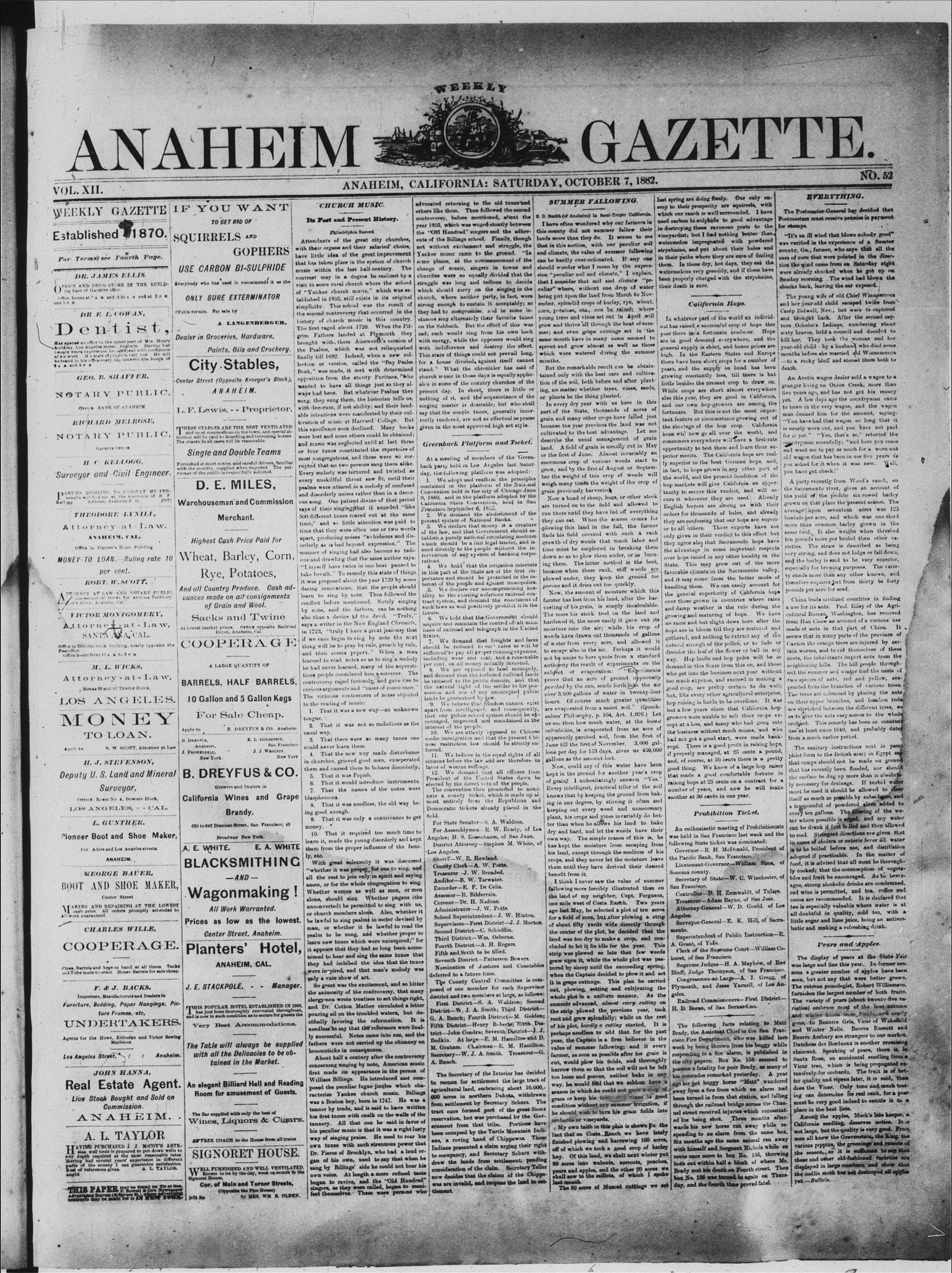
Searchable text
ANAHEIM
VOL. XII.
WEEKLY GAZETTE
Established 1870.
For Terms see Fourth Page.
DR. JAMES ELLIS.
OFFICE AND DRUG STORE IN THE BUILDING East of Gazette office.
Office hours at 7 A.M. and 9:30 A.M. and at 2 P.M. and 5 P.M.
DR. E. L. COWAN,
Dentist,
Has opened an office in the upper part of Mrs Metz's building, Los Angeles street, Angheim. Having had twenty years experience, he can peak with confidence of his work. If a scale of prizes is very low, He will be found in his office every day between the hours of 8 A.M. and 6 P.M.
GEO. B. SHAFFER,
NOTARY PUBLIC.
OFFICE BANK OF ANAHEIM.
RICHARD MELROSE,
NOTARY PUBLIC.
Gazette Office
H. C. KELOGG,
Surgeon and Civil Engineer.
IF YOU WANT
TO GET RID OF
SQUIRRELS AND
GOPHERS
USE CARBON BI-SULPHIDE
Everybody who has used it recommends it as the ONLY SURE EXTERMINATOR
Of this vermin. For sale by
A. LANGENBERGER,
Dealer in Groceries, Hardware,
Paints, Oils and Crockery.
City Stables,
Center Street (Opposite Kroeger's Block),
ANAHEIM.
L.F. Lewis, - Proprietor.
THESE STABLES ARE THE BEST VENTILATED and most commodious in the town, and special attention will be paid to Boarding and Grooming horses. The charre in all cases will be reasonable.
Single and Double Teams
Furnished at short notice, and careful drivers, familiar with the country, supplied when required. The patronage of the public is respectfully solicited.
CHURCH
Its Past and Present
Philadelphia
Attendants of the church with their organs and that have little idea of the music within the last contrast may in a visit to some rural church of "Yankee church" established in 4805, still simplicity. This school the second controversy history of church music. The first raged about grim Fathers landed brought with them the Psalms, which finally till 1692. Induction or version, book," was made, it opposition from the wanted to have all ways had been. But sung, they sung them, with decorum, if not able intentions were motivation of music at this excellence soon dared were lost and none other and music was neglected or four tunes constituted most congregations, and ruptured that no two per Every melody was tor
GEO. B. SHAFFER,
NOTARY PUBLIC.
OFFICE: BANK OF ANAHEIM
RICHARD MELROSE,
NOTARY PUBLIC.
GATEYE OFFICE
H. C. KELLOGG,
Surveyor and Civil Engineer.
PARTIES DESIRED TO CONSULT ME PERSONALLY WILL FIND ME AT THE RESIDENCE OF B. F. KELLOGG
Address: Anaheim P.O. Jv22
THEODORE LYNILL,
Attorney at Law.
ANAHEIM, CAL.
Office in Planter's Hotel Building
MONEY TO LOAN. Ruling rate 10 per cent.
ROBT. W. SCOTT.
ATTORNEY AT LAW AND NOTARY PUBLIC.
Inspector of Deeds for Arizona Territory
Attorney at Law.
SANTA ANA, CAL.
Office in Dibbles brick building, nearly opposite the Postoffice
M. L. WICKS,
Attorney at Law.
Rooms 85 and 87 Temple Block.
LOS ANGELES.
MONEY TO LOAN.
Apply to R. W. SCOTT, Attorney at Law
H. J. STEVENSON,
Deputy U. S. Land and Mineral Surveyor,
OFFICE: Room No. 4, Downey Block.
LOS ANGELES, - - CAL.
L. GUNTHER.
Pioneer Boot and Shoe Maker,
Cor. Adele and Los Angeles streets.
ANAHEIM.
GEORGE BAUER,
BOOT AND SHOE MAKER,
Center Street
Center Street (Opposite Kroeger's Block),
ANAHEIM.
L. F. Lewis, -- Proprietor.
THESE STABLES ARE THE BEST VENTILATED
and most commodious in the town, and special attention will be paid to Boarding and Grooming horses.
The charge in all cases will be reasonable.
Single and Double Teams
Furnished at short notice, and careful drivers, familiar with the country, supplied when required. The patronage of the public is respectfully solicited.
D. E. MILES,
Warehouseman and Commission Merchant.
Highest Cash Price Paid for
Wheat, Barley, Corn, Rye, Potatoes,
And all Country Produce. Cash advances made on all consignments of Grain and Wool.
Sacks and Twine
At lowest market prices. Office opposite Railroad Depot, Anaheim, Cal.
COOPERAGE
A LARGE QUANTITY OF
BARRELS, HALF BARRELS,
10 Gallon and 5 Gallon Kegs
For Sale Cheap.
Apply to B. DREYFUS & Co. Anaheim
B. DREYFUS,
K. L. GOLDSTEIN,
Anaheim,
San Francisco
J. PROWESFIELD,
J. J. WROLEIN,
New York
B. DREYFUS & CO.
Growers and Dealers in California Wines and Grape Brandy.
630 to 642 Brannan Street, San Francisco; 45 Broadway New York.
A. E. WHITE.
E. A. WHITE
BLACKSMITHING
—AND—
Wagonmaking!
opposition from the side wanted to have all ways had been. But sung, they sung them, with decorum, if not able intentions were maltivation of music at H this excellence soon dewere lost and none other and music was neglect or four tunes constituted most congregations, and rupted that no two per Every melody was tormented every unskillful three psalms were uttered in disorderly noises song. One patient says of their singing 500 different tunes rote time;" and so little time that they were o apart, producing noise orderly as is bad beyond manner of singing haunting and drawling than "I myself have twice take breath." To remit it was proposed about daring innovations, learn to sing by no conflict before ment by note, said the else than a device says a writer in the N in 1723, "truly I hail if we once begin to do thing will be to pray and then comes peace learned to read note he had never learned tious people consider controversy raged fur curious arguments and The virtuous content to the reading of mu 1. That it was a tongue.
2. That it was usual way.
3. That there would could never learn th 4. That the new in churches, grieved them and caused th 5. That it was H 6. That it would 7. That the new blasphemous.
8. That it was n ing good enough.
9. That it was o money.
10. That it re learn it, made the y them from the proply, etc.
With great sole "whether it was p all the rest to join amen, or for the w Whether women alone should sing
L. GUNTHER.
Pioneer Boot and Shoe Maker,
Cor. Adele and Los Angeles streets.
ANAHEIM.
GEORGE BAUER,
BOOT AND SHOE MAKER,
Center Street
MAKING AND REPAIRING AT THE LOWEST
cash price. All orders promptly attended to
All work guaranteed.
CHARLES WILLE,
COOPERAGE.
Pipes, Barrels and kegs on hand at all times. Tanks
and Tubs made to order. Honey Barrels for sale cheap.
F. & J. BACKS.
Importers, Manufacturers and Dealers in
Furniture, Bedding, Paper Hangings, Picture Frames, etc,
UNDERTAKERS.
Agents for the Howe, Eldredge and Victor Sewing Machines.
Los Angeles Street.: Anaheim.
JOHN HANNA,
Real Estate Agent.
Live Stock Bought and Sold on Commission.
ANAHEIM.
A. L. TAYLOR
HAVING PURCHASED J. J. MOCOY'S ARTESIAN well tools is prepared to put down wells to any depth required at the most reasonable rates.
Having had several years' experience in different parts of the county I can guarantee satisfaction.
Best of references given. A. L. TAYLOR august 12
THIS PAPER may be found on file at Glen.
P. Rowell & Co.'s Newspaper Advertising Bureau (8 Spruce St.) where advertising contracts may be made for it IN NEW YORK.
California Wines and Grape Brandy.
630 to 642 Brannan Street, San Francisco; 45 Broadway New York.
A. E. WHITE.
E. A. WHITE
BLACKSMITHING
—AND—
Wagonmaking!
All Work Warranted.
Prices as low as the lowest.
Center Street, Anaheim.
Planters’ Hotel,
ANAHEIM, CAL.
J. E. STACKPOLE, - Manager.
THIS POPULAR HOTEL ESTABLISHED IN 1868,
has just been thoroughly renovated throughout,
and is now in such condition as to secure for guests the Very Best Accommodations.
The Table will always be supplied with all the Delicacies to be obtained in the Market.
An elegant Billiard Hall and Reading Room for amusement of Guests.
The Bar supplied with only the best of Wines, Liquors & Cigars.
FREE COACH to the House from all trains
SIGNORET HOUSE.
WELL FURNISHED AND WELL VENTILATED.
Rooms to let by the day, week or month in the Signoret House,
Cor. of Main and Turner Streets,
(Opposite the Pico House)
by MRS. WM. R. OLDEN.
WEEKLY
CIM GAZ
ANAHEIM, CALIFORNIA: SATURDAY, OCTOBER 7, 1882.
CHURCH MUSIC.
Its Past and Present History.
Philadelphia Record.
Attendants of the great city churches, with their organs and their salaried choirs, have little idea of the great improvement that has taken place in the system of church music within the last half-century. The contrast may in a degree be realized by a visit to some rural church where the school of "Yankee church music," which was established in 1805, still exists in its original simplicity. This school was the result of the second controversy that occurred in the history of church music in this country. The first raged about 1720. When the Pilgrim Fathers landed at Plymouth they brought with them Ainsworth's version of the Psalms, which was not relinquished finally till 1692. Indeed, when a new collection or version, called the "Bay Psalm Book," was made, it met with determined opposition from the sturdy Puritans, who wanted to have all things just as they always had been. But whatever Psalms they sung, they sung them, the historian tells us, with decorum, if not ability; and their laudable intentions were manifested by their cultivation of music at Harvard College. But this excellence soon declined. Many books were lost and none others could be obtained; and music was neglected until at last three or four tunes constituted the repertoire of most congregations, and these were so corrupted that no two persons sang them alike. Every melody was tortured and twisted as advocated returning to the old tunes and others like them. Then followed the second controversy, before mentioned, about the year 1805, which was waged stoutly between the "Old Hundred" singers and the adherents of the Billings school. Finally, though not without excitement and struggle, the Yankee music came to the ground. "In some places, at the commencement of the change of music, singers in towns and churches were so equally divided that the struggle was long and tedious to decide which should carry on the singing in the church, where neither party, in fact, were strong enough to sustain it acceptably; so they had to compromise, and in some instances sing alternately their favorite tunes on the Sabbath. But the effect of this was sad; each would sing from his own book with energy, while the opposers would sing with indifference and destroy the effect. This state of things could not prevail long, for a house divided against itself cannot stand." What the chronicler has said of church music in those days is equally applicable in some of the country churches of the present day. In short, there is little or nothing of it, and the acquaintance of the singing master is desirable; but who shall say that the simple tunes, generally incorrectly rendered, are not as effectual as praise given in the most approved high art style.
Greenback Platform and Ticket.
At a meeting of members of the Greenback party held in Los Angeles last Saturday, the following platform was adopted:
SUMMER FALLOWING.
B. R. Smith (of Anaheim) la Semi-Tropical California.
I have often wondered why our farmers in this county did not summer fallow their lands more than they do. It seems to me that in this section, with our peculiar soil and climate, the value of summer fallowing can be hardly over-estimated. If any one should wonder what I mean by the expression "peculiar soil and climate," I explain that I consider that soil and climate "peculiar" where, without one drop of water being put upon the land from March to November, splendid crops of barley, rye, wheat, corn, potatoes, etc., can be raised; where young trees and vines set out in April will grow and thrive all through the heat of summer; and even grape cuttings set in the same month have in many cases seemed to sprout and grow almost as well as those which were watered during the summer months.
But the remarkable result can be obtaintained only with the best care and cultivation of the soil, both before and after planting, no matter whether trees, vines, seeds, or plants be the thing planted.
In every dry year with us here in this part of the State, thousands of acres of grain and many other crops have failed just because the year previous the land was not cultivated to the best advantage. Let me describe the usual management of grain land. A field of grain is usually cut in May or the first of June. Almost invariably an enormous crop of various weeds start to grow, and by the first of August or September
opposition from the sturdy Puritans, who wanted to have all things just as they always had been. Bat whatever Psalms they sung, they sing them, the historian tells us, with decorum, if not ability; and their landable intentions were manifested by their cultivation of music at Harvard College. But this excellence soon declined. Many books were lost and none others could be obtained; and music was neglected until at last three or four tunes constituted the repertoire of most congregations, and these were so corrupted that no two persons sang them alike. Every melody was tortured and twisted as every unskillful throat saw fit, until their psalms were uttered in a melody of confused and disorderly noises rather than in a decorous song. One patient divine of that period says of their singing that it sounded "like 500 different tunes roared out at the same time;" and so little attention was paid to time that they were often one or two words apart, producing noises "so hideous and disorderly as is bad beyond expression." The manner of singing had also become so tedious and drawing that the same author says: "I myself have twice in one beat paused to take breath." To remedy this state of things it was proposed about the year 1729 by some daring innovations, that the people should learn to sing by note. Then followed the conflict before mentioned. Surely singing by note, said the fathers, can be nothing else than a device of the devil. "Truly," says a writer in the New England Chronicle, in 1723, "truly I have a great jealousy that if we once begin to sing by note the next thing will be to pray by rule, preach by rule, and then comes popery." When a man learned to read notes so as to sing a melody he had never learned, many of the superstitious people considered him a sorcerer. The controversy raged furiously, and gave rise to curious arguments and "cases of conscience." The virtuous contenders of notes objected to the reading of music:
1. That it was a new way—an unknown tongue.
2. That it was not so melodious as the usual way.
3. That there were so many tunes one could never learn them.
4. That the new way made disturbance in churches, grieved good men, exasperated them and caused them to behave disorderly.
5. That it was Popish.
6. That it would introduce instruments.
7. That the names of the notes were blasphemous.
8. That it was needless, the old way being good enough.
9. That it was only a contrivance to get money.
10. That it required too much time to learn it, made the young disorderly and kept them from the proper influence of the family, etc.
With great solemnity it was discussed "whether it was proper for one to sing, and all the rest to join only in spirit and saying amen, or for the whole congregation to sing. Whether women as well as men, or men alone should sing. Whether pagans (the church music in those days is equally applicable in some of the country churches of the present day. In short, there is little or nothing of it, and the acquaintance of the singing master is desirable; but who shall say that the simple tunes, generally incorrectly rendered, are not as effectual as praise given in the most approved high art style.
Greenback Platform and Ticket.
At a meeting of members of the Greenback party held in Los Angeles last Saturday, the following platform was adopted:
1. We adopt and reaffirm the principles contained in the platform of the National Convention held in the city of Chicago June 9, 1880, and in the platform adopted by the California State Convention, held in San Francisco September 6, 1882.
2. We demand the abolishment of the present system of National Banks.
3. We declare that money is a creature of the law, and that Government should establish a purely national circulating medium which should be a full legal tender, and issued directly to the people without the intervention of any system of banking corporations.
4. We hold that the irrigation interests in this part of the State are of the first importance and should be protected in interest of the people and against monopolies.
5. We declare our uncompromising hostility to the existing nefarious railroad contract system, and demand the enactment of such laws as will positively prohibit it in the future.
6. We hold that the Government should acquire and maintain the control of all main lines of railroad and telegraph in the United States.
7. We demand that freights and fares should be reduced to such rates as will be sufficient to pay all proper running expenses, including wear and tear, and a reasonable per cent on all money actually invested.
8. We are opposed to land monopoly, and demand that the forfeited railroad lands be restored to the public domain, and that the natural right of the settler to his possession and use of any unoccupied public lands be guaranteed by law.
9. We believe that freedom cannot exist apart from intelligence, and consequently that our public school system should be encouraged, improved and maintained in the interest of the people.
10. We are utterly opposed to Chinese coolie immigration and that the present Chinese restriction law should be strictly enforced.
11. We believe in the equal rights of all citizens before the law and are therefore in favor of woman suffrage.
12. We demand that all officers from President of the United States down be elected by the direct vote of the people.
The convention then proceeded to nominate a county ticket, which is made up almost entirely from the Republican and Democratic tickets already placed in the field.
For State Senator—S. A. Waldron.
For Assemblymen—R. W. Ready, of Los Angeles; H. S. Rosenbaum, of San Juan.
District Attorney—Stephen M. White, of Los Angeles.
Sheriff—W. R. Rowland.
County Clerk—A. W. Potts.
Treasurer—J. W. Broaded.
Auditor—B. W. Tarwater.
Recorder—E. F. De Celis.
Assessor—R. Bilderrain.
In every dry year with us here in this part of the State, thousands of acres of grain and many other crops have failed just because the year previous the land was not cultivated to the best advantage. Let me describe the usual management of grain land. A field of grain is usually cut in May or the first of June. Almost invariably an enormous crop of various weeds start to grow, and by the first of August or September the weight of this crop of weeds will weigh many times the weight of the crop of grain previously harvested.
Now a band of sheep, hogs, or other stock are turned on to the field and allowed to run there until they have fed off everything they can eat. When the season comes for plowing this land in the fall, the farmer finds his field covered with such a rank growth of dry weeds that much labor and time must be employed in breaking them down so as to plow them under, or in burning them. The latter method is the best, because when these rank, stiff weeds are plowed under, they keep the ground too porous and it dries out too quickly.
Now, the amount of moisture which this farmer has lost from his land, after the harvesting of his grain, is simply incalculable. The more his stock trod on the land and hardened it, the more easily it gave out its moisture into the air; while his crop of weeds have drawn out thousands of gallons of water from every acre, and allowed it to escape also in the air. Perhaps it would not be amiss to here quote from a standard authority the result of experiments on the subject of evaporation: "Experiments prove that an acre of ground apparently parched by the sun, sends forth into the air over 3,000 gallons of water in twenty-four hours. Of course much greater quantities are evaporated from a moist soil." (Quackenbus' Philosophy, p. 104, Art. 1,026.) Let us see then how much water, at the lowest calculation, is evaporated from an acre of apparently parched soil, from the first of June till the first of November. 3,000 gallons per day for 153 days, gives us 459,000 gallons as the amount lost.
Now, could any of this water have been kept in the ground for another year's crop of grazing? I unhesitatingly answers "Yes." Every intelligent, practical tiller of the soil knows that by keeping the ground from baking in any degree, by stirring it often and keeping out every weed and unnecessary plant, his crops and vines invariably do better than when he allows his land to bake dry and hard, and let the weeds have their own way. The simple reason of this is, he has kept the moisture from escaping from his land, except through the medium of his crops, and they never let the moisture leave them until they have derived their desired benefit from it.
I think I never saw the value of summer falling more forcibly illustrated than on the land of my neighbor, Capt. Ferguson,
England order they only they have not matter whether trees, vines, seeds or plants be the thing planted.
In every dry year with us here in this part of the State, thousands of acres of grain and many other crops have failed just because the year previous the land was not cultivated to the best advantage. Let me describe the usual management of grain land. A field of grain is usually cut in May or the first of June. Almost invariably an enormous crop of various weeds start to grow, and by the first of August or September the weight of this crop of weeds will weigh many times the weight of the crop of grain previously harvested.
Now a band of sheep, hogs, or other stock are turned on to the field and allowed to run there until they have fed off everything they can eat. When the season comes for plowing this land in the fall, the farmer finds his field covered with such a rank growth of dry weeds that much labor and time must be employed in breaking them down so as to plow them under, or in burning them. The latter method is the best because when these rank, stiff weeds are plowed under, they keep the ground too porous and it dries out too quickly.
Now, could any of this water have been kept in the ground for another year's crop of grazing? I unhesitatingly answers "Yes." Every intelligent, practical tiller of the soil knows that by keeping the ground from baking in any degree, by stirring it often and keeping out every weed and unnecessary plant, his crops and vines invariably do better than when he allows his land to bake dry and hard, and let the weeds have their own way. The simple reason of this is, he has kept the moisture from escaping from his land, except through the medium of his crops,and they never let the moisture leave them until they have derived their desired benefit from it.
I think I never saw the value of summer falling more forcibly illustrated than on the land of my neighbor,Capt.Ferguson,
England order they only they have not matter whether trees,vines,seeds or plants bethethingplantbeethethingplantbeethethingplantbeethethingplantbeethethingplantbeethethingplantbeethethingplantbeethethingplantbeethethingplantbeethethingplantbeethethingplantbeethethingplantbeethethingplantbeethethingplantbeethethingplantbeethethingplantbeethethingplantbeethethingplantbeethethingplantbeethethingplantbeethethingplantbeethethingplantbeethethingplantbeethethingplantbeethethingplantbeethethingplantbeethethingplantbeethethingplantbeethethingplantbeethethingplantbeethethingplantbeethethingplantbeethethingplantbeethethingplantbeethethingplantbeethethingplantbeethethingplantbeethethingplantbeethethingplantbeethethingplantbeethethingplantbeethethingplantbeethethingplantbeethethingplantbeethethingplantbeethethingplantbeethethingplantbe_thethingsplantsplantsplantsplantsplantsplantsplantsplantsplantsplantsplantsplantsplantsplantsplantsplantsplantsplantsplantsplantsplantsplantsplantsplantsplantsplainsplainsplainsplainsplainsplainsplainsplainsplainsplainsplainsplainsplainsplainsplainsplainsplainsplainsplainsplainsplainsplainsplainsplainsplainsplainsplainsplainsplainsplainsplainsplainsplainsplainsplainsplainsplainsplainsplainsplainsplainsplainsplainsplainsplainsplainsplainsplainsplainsplainsplainsplainsplainsplainsplainsplainsplainsplainsplainsplainsplainsplainsplainsplainsplainsplainsplainsplainsplainsplainesplandslandslandslandslandslandslandslandslandslandslandslandslandslandslandslandslandslandslandslandslandslandslandslandslandslandslandslandslandslandslandslandslandslandslandslandslandslandslandslandslandslandslandslandslandeslandeslandeslandeslandeslandeslandeslandeslandeslandeslandeslandeslandeslandeslandeslandeslandeslandeslandeslandeslandeslandeslandeslandeslandeslandeslandeslandeslandeslandeslandeslandeslandeslandeslandeslandeslandeslandeslandeslandeslandeslandeslandeslandeslandeslandeslandeslanesslanesslanesslanesslanesslanesslanesslanesslanesslanesslanesslanesslanesslanesslanesslanesslanesslanesslanesslanesslanesslanesslanesslanesslanesslanesslanesslanesslanesslanesslanesslanesslanesslanesslanesslanesslanesslanesslanesslanesslanesslanesslanesslanesslanesslanesslanesslanesslanesslanes slanes slanes slanes slanes slanes slanes slanes slanes slanes slanes slanes slanes slanes slanes slanes slanes slanes slanes slanes slanes slanes slanes slane slane slane slane slane slane slane slane slane slane slane slane slane slane slane slane slane slane slane slane slane slane slane slane slane slane slane slane slane slane slane slane slane slane slane slane slane slane slane slane slane slane slane slane slane slane slane slaneSlane Slane Slane Slane Slane Slane Slane Slane Slane Slane Slane Slane Slane Slane Slane Slane Slane Slane Slane Slane Slane Slane Slane Slane Slane Slane Slane Slane Slane Slane Slene Slene Slene Slene Slene Slene Slene Slene Slene Slene Slene Slene Slene Slene Slene Slene Slene Slene Slene Slene Slene Slene Slene Slene Slene Slene Slene Slene Slene Slene Slene Slene Slene Slene Slene Slene Slene SleneSleneSleneSleneSleneSleneSleneSleneSleneSleneSleneSleneSleneSleneSleneSleneSleneSleneSleneSleneSleneSleneSleneSleneSleneSleneSleneSleneSleneSleneSleneSleneSleneSleneSleneSleneSleneSleneSleneSlenaSlenezSlenezSlenezSlenezSlenezSlenezSlenezSlenezSlenezSlenezSlenezSlenezSlenezSlenezSlenezSlenezSlenezSlenezSlenezSlenezSlenezSlenezSlenezSlenezSlenezSlenezSlenezSlenezSlenezSlenezSlenezSlenezSlenezSlenezSlenezSLenezSLenezSLenezSLenezSLenezSLenezSLenezSLenezSLenezSLenezSLenezSLenezSLenezSLenezSLenezSLenezSLendezSLendezSLendezSLendezSLendezSLendezSLendezSLendezSLendezSLendezSLendezSLendezSLendezSLendezSLendezSLendezSLendezSLendezSLendezSLendezSLendezSLendezSLendezSLendezSLendezSLendezSLendezSLendezSLendezSLendezSLendezSLendezSLendez SLendezSLendezSLendezSLendezSLendezSLendezSLendezSL rendez SL rendez SL rendez SL rendez SL rendez SL rendez SL rendez SL rendez SL rendez SL rendez SL rendez SL rendez SL rendez SL rendez SL rendez SL rendez SL rendez SL rendez SL rendez SL rendez SL rendez SL rendez SL rendez SL rendez SL rendez SL rendez SL rendez SL rendez SL rendez SL rendez SL rendez SL rendez SL rendez SL rendez SL rendez SL rendez SL rendez SL rendez SL rendez SL rendez SL rendez SL rendez SL rendez SL rendez SL rendez SL rendez SL rendez SL rendez SL rendez SL rendez SL rendez SL rendez SL rendez SL rendez SL rendez SL rendez SL rendez SL rendez SL rendez SL rendez SL rendez SL rendez SL rendez SL rendez SL rendez SL rendez SL rendez SL
8. That it was needless, the old way being good enough.
9. That it was only a contrivance to get money.
10. That it required too much time to learn it, made the young disorderly and kept them from the proper influence of the family, etc.
With great solemnity it was discussed "whether it was proper for one to sing, and all the rest to join only in spirit and saying amen, or for the whole congregation to sing. Whether women as well as men, or men alone, should sing. Whether pagans (the unconverted) be permitted to sing with us, or church members alone. Also, whether it be lawful to sing psalms in meter devised by man, or whether it be lawful to read the psalm to be sung, and whether proper to learn new tunes which were uninspired;" for it appears that they had so long been accustomed to hear and sing the same tunes that they had imbibed the idea that the tunes were inspired, and that man's melody was only a vain show of art.
So great was the excitement, and so bitter the animosity of the controversy, that many clergymen wrote treatises to set things right, and Dr. Cotton Mather circulated a letter pouring oil on the troubled waters, but decidedly favoring the reformation. It is needless to say that the reformers were finally successful. Notes came into use, and the fathers were not carried up the chimney on broomsticks in consequence.
About half a century after the controversy concerning singing by note, American music first made its appearance in the person of William Billings. He introduced and composed the peculiar fugue jingles which characterize Yankee church music. Billings was a Boston boy, born in 1747. He was a tanner by trade, and is said to have written his first tunes with chalk on the walls of the tannery. All that can be said in favor of his peculiar music is that it was a right lusty way of singing praise. He used to roar his own tunes with such strenuous power that Dr. Pierce of Brooklyn, who had a loud organ of his own, used to say that when he sang by Billings' side he could not hear his own voice. At length a more refined taste began to revive, and the "Old Hundred" singers, as they were called, began to manifest themselves. These were persons who most entirely from the Republican and Democratic tickets already placed in the field.
For State Senator—S. A. Waldron.
For Assemblymen—R. W. Ready, of Los Angeles; H. S. Kosenbaum, of San Juan.
District Attorney—Stephen M. White, of Los Angeles.
Sheriff—W. R. Rowland.
County Clerk—A. W. Potts.
Treasurer—J. W. Broaded.
Auditor—B. W. Tarwater.
Recorder—E. F. De Celis.
Assessor—R. Bilderrain.
Coroner—Dr. H. Nadean.
Administrator—J. W. Potts.
School Superintendent—J. W. Hinton.
Supervisors—First District—J. J. Morton.
Second District—C. Schiefflin.
Third District—Wm. Osborne.
Fourth District—A. H. Rogers.
Fifth and Sixth to be filled.
Seventh District—Patterson Bowers.
Nomination of Justices and Constables deferred to a future time.
The County Central Committee is composed of one member for each Supervisor district and two members at large, as follows:
First District—S. A. Waldron; Second District—W. J. A. Smith; Third District—G. A. Bunch; Fourth District—M. Golden; Fifth District—Henry Roberts; Sixth District—John Condra; Seventh District—J. J. Bodkin. At large—E. M. Hamilton and D. M. Graham. Chairman—E. M. Hamilton.Secretary—W. J. A. Smith.Treasurer—G. A. Bunch.
The Secretary of the Interior has decided to reopen for settlement the large tract of agricultural land, embracing about 10,000 acres in northern Dakota, withdrawn from settlement by Secretary Schurz.The tract once formed part of the great Sioux reservation, but was purchased by the Government from that tribe.Portions have been occupied by the Turtle Mountain Indians,a roving band of Chippewas。这些 Indians presented a claim urging their right to occupancy,and Secretary Schurz withdrew the lands from settlement,pending consideration of the claim.Secretary Teller now decides that the claims of the Chippewas are invalid,and reopens the land to settlement.
In any degree,by stirring it often and keeping out every weed and unnecessary plant,his crops and yines invariably do better than when he allows his land to bake dry and hard,and let the weeds have their own way.The simple reason of this is,the has kept the moisture from escaping from his land except through the medium of his crops,and they never let the moisture leave them until they have derived their desired benefit from it.
I think I never saw the value of summer following more forcibly illustrated than on the land of my neighbor.Capt.Ferguson,one mile west of Costa Ranch.Two years ago last May,他 selected a plot of ten acres for a field of corn,但 after plowing a strip of about fifty yards wide directly through the center of the plot,他 decided that the land was too dry to make a crop,and concluded to let lie idle for the yearThis strip was plowed so late that few weeds grew upon it,而the whole plot was pastured by snowpunched until the succeeding spring,when the Captain decided to plow it and set it in grape cuttings This plan he carried out,plowing setting and cultivating the whole plot in a uniform manner.As the summer advanced almost every cutting on the strip plowed the previous year,took root and grew splendidly;while on the rest of his plot,hardly a cutting startedIt is perhaps needless to add that for the past year,the Captain is a firm believer in the value of summer fallowing;and it every farmer,as soon as possible after his grain is cut would plow his fields,and thoroughly harrow them so that the soil will not be left too loose and porous Neither bake in any wayhe would find that we seldom have a season in which he could not grow a crop of grain or keep his fruit in vineins in good condition without any summer irrigation if he should wish to turn his grain fields into orchards or vineyards.
My own taith in this plan is shown jin the fact that on Costa Ranch we have lately finished plowing and harrowing 100 acres off of which we took a good crop of barley hay.Of this land,we shall next winter put 80 acres into walnuts,apricots,peaches,pears and apples,and the other 20 acres we shall sow to the millets,of which I spoke last month.
The 50 acres of Muscat cuttings we set
GAZETTE.
NO. 52
ALLOWING.
In Semi-Tropical California, and why our farmers in summer fallow their crops. It seems to me with our peculiar soil of summer fallowing climate. If any one mean by the expressive climate," I explain, oil and climate "peat one drop of water from March to November of barley, rye, wheat, can be raised; where set out in April will rough the heat of summer cuttings set in the many cases seemed to cost as well as those during the summer.
The result can be obtain-best care and cultivation before and after plantation trees, vines, seeds, or planted.
With us here in this thousands of acres of crops have failed just obvious the land was not advantage. Let me management of grain is usually cut in May. Almost invariably an various weeds start to of August or September of woods will last spring are doing finely. Our only enemy to their prosperity are squirrels, with which our ranch is well surrounded. I have used carbon bi-sulphide to good advantage in destroying these ravenous peats to the vineyardist; but I find nothing better than watermelon impregnated with powdered strychnine, and put about their holes and in their paths where they are sure of finding them. In these dry, hot days, they eat the watermelons very greedily, and if these have been properly charged with the strychnine, their death is sure.
California Hops.
In whatever part of the world an individual has raised a successful crop of hops this year there is a fortunate producer. Hops are in good demand everywhere, and the general supply is short, and hence prices are high. In the Eastern States and Europe there have been short crops for a number of years, and the supply on hand has been growing constantly less, till there is but little besides the present crop to draw on. While crops are short almost everywhere else this year, they are good in California, and our own hop-growers are among the fortunate. But this is not the most important feature or circumstance growing out of the shortage of the hop crop. California hops will now go all over the world, and consumers everywhere will have a first-rate opportunity to test them and learn their superior merits. The California hops are really superior to the best German hops, and, in fact, to hops grown in any other part of the world.
EVERYTHING.
The Postmaster-General has decided that Postmasters must receive pennies in payment for stamps.
"It's an ill wind that blows nobody good" was verified in the experience of a Sumter county, Ga., farmer, who says that all the ears of corn that were pointed in the direction the wind came from on Saturday night were already shucked when he got up on Sunday morning. The wind had blown the shucks back, leaving the ear exposed.
The young wife of old Chief Winnemucca and her year-old child escaped twice from Camp Bidwell, Nev., but were re-captured and brought back. After the second capture Ochoho's Indians, numbering about sixty braves, held a council and decided to kill her. They took the woman and her year-old child - by a husband who died some months before she married old Winnemucca - to a rocky bluff and stoned them both to death.
An Austin wagon dealer sold a wagon to a granger living on Onion Creek, more than five years ago, and has not got his money yet. A few days ago the countryman came to town in the very wagon, and the wagon man dunned him for the amount, saying: "You have had that wagon so long that it is nearly worn out, and you have not paid for it yet." "Yes, that's so," retorted the countryman scornfully; "and here you come and want me to pay as much for a worn-out wagon that has been in use five years as you asked for it when it was new. Well, you have got check!"
with us here in this thousands of acres of crops have failed just because the land was not advantage. Let me manage of grain it is usually cut in May. Almost invariably and various weeds start to bloom of August or September, crop of weeds will be weight of the crop of requested.
keep, hogs, or other stock field and allowed to have fed off everything the season comes for the fall, the farmer used with such a rank that much labor and involved in breaking them under, or in burner method is the best, rank, stiff weeds are kept the ground too untouched too quickly.
of moisture which this land, after the harris simply incalculable. The trod on the land and easily it gave out its air; while his crop of about thousands of gallons of acre, and allowed it air. Perhaps it would quote from a standard of experiments on the operation: "Experiments of ground apparently sends forth into the air of water in twenty-four much greater quantities a moist soil." (Quackp. 104, Art. 1,026.) Let water, at the lowest correlated from an acre of soil, from the first of November. 3,000 gal.-days, gives us 459,000 cent lost.
If this water have been for another year's crop statically answer "Yes." Practical tiller of the soil being the ground from bakery stirring it often and weed and unnecessary and vines invariably do betrays his land to bake let the weeds have their simple reason of this is, he texture from escaping from rough the medium of his ever let the moisture leave have derived their desired
award the value of summeribly illustrated than on neighbor, Capt. Ferguson,
An enthusiastic meeting of Prohibitionists was held in San Francisco last week and the following State ticket was nominated:
Governor—R. H. McDonald, President of the Pacific Bank, San Francisco.
Lieutenant-Governor—William Sims, of Sonoma county.
Secretary of State—W. C. Winchester, of San Francisco.
Controller—D. H. Zumwaldt, of Tulare.
An Austin wagon dealer sold a wagon to a granger living on Union Creek, more than five years ago, and has not got his money yet. A few days ago the countryman came to town in the very wagon, and the wagon man dunned him for the amount, saying: "You have had that wagon so long that it is nearly worn out, and you have not paid for it yet." "Yes, that's so," retorted the countryman scornfully; "and here you come and want me to pay as much for a worn-out old wagon that has been in use five years as you asked for it when it was new. Well, you have got check!"
A party recently from Wood's ranch, on the Sacramento river, gives an account of the yield of the prolific six-rowed barley grown on that place the present season. The average upon seventeen acres was 125 bushels per acre, and which was one-third more than common barley grown in the same field. It also weighs when threshed ten pounds more per bushel than other varieties. The straw is described as being very strong, and does not lodge or fall down, and the barley is said to be very superior, especially for brewing purposes. The variety stools more than any other known, and therefore requires but from thirty to forty pounds per acre for seed.
China leads civilized countries in finding a use for its ants. Prof. Riley of the Agricultural Bureau, Washington, has received from Han Chow an account of a curious use made of ants in that part of China. It seems that in many parts of the province of Canton the orange trees are injured by certain worms, and to rid themselves of these pests, the inhabitants import ants from the neighboring hills. The hill people throughout the summer and winter find the nests of two species of ants, red and yellow, suspended from the branches of various trees. The trees are colonized by placing the ants on their upper branches, and bamboo rods are stretched between the different trees, so as to give the ants easy access to the whole orchard. This remedy has been in constant use at least since 1640, and probably dates from a much earlier period.
The sanitary instructions sent in pamphlet form to the British army in Egypt say that camps should not be made on ground that has recently been flooded, nor should the surface be dug up more than is absolutely necessary for drainage. If turbid water must be used it should be allowed to clear itself as much as possible by subsidence, and a teaspoonful of powdered alum added to every ten gallons. The filtering of the water where possible is urged, and any water can be drank if first boiled and then allowed to cool. Stringent directions are given that in cases of cholera or enteric fever all water is to be boiled before use, and distillation adopted if practicable. In the matter of food, it is advised that all meat be thoroughly cooked; that the consumption of vegetables and fruit be encouraged. As to beverages, strong alcoholic drinks are condemned, red wine is permitted, and tea, coffee and coffee are recommended. It is declared that
Prohibition Ticket.
An enthusiastic meeting of Prohibitionists was held in San Francisco last week and the following State ticket was nominated:
Governor—R. H. McDonald, President of the Pacific Bank, San Francisco.
Lieutenant-Governor—William Sims, of Sonoma county.
Secretary of State—W. C. Winchester, of San Francisco.
Controller—D. H. Zumwaldt, of Tulare.
Treasurer—Adam Bayne, of San Jose.
Attorney-General—W. D. Gould, of Los Angeles.
Surveyor-General—E. K. Hill, of Sacramento.
Superintendent of Public Instruction—R. A. Grant, of Yolo.
Clerk of the Supreme Court—William Cohurst, of San Francisco.
Supreme Judges—H. A. Mayhew, of Red Bluff; Judge Thompson, of San Francisco.
Congressmen-at-Large—A. J. Gregg, of Plymouth, and Jesse Yarnell, of Los Angeles.
Railroad Commissioners—First District—H. D. Boren, of San Bernardino.
The following facts relating to Matt Brady, the Assistant Chief in the San Francisco Fire Department, who was killed last week by being thrown from his buggy while responding to a fire alarm, is published in the city papers: Box No. 156 seemed to possess a fatality for poor Brady, as many of his comrades remarked yesterday. A year ago his pet buggy horse "Matt" wandered away from a fire from which an alarm had been turned in from that station, and falling through the railroad bridge across the Channel street received injuries which necessitated his being shot. Three months afterwards his new horse ran away while responding to an alarm from the same box. Six months ago the same animal ran away with himself and Sergeant Nichols while en route once more to box No. 156, throwing both out within half a block of where Mr. Brady met his death on Fourth street. Then box No. 156 was turned in again on Thursday, and the fourth time proved fatal.
Pears and Apples.
The display of pears at the State Fair was large and fine this year. In former seasons a greater number of apples have been seen, but not any that were better grown. The veteran pomologist, Robert Williamson, furnishes the largest number of both fruits. The variety of pears (about twenty-five varieties) embrace most of the best autumn and winter kinds from Sicilia now nearly gone, to Beaurre Gris, Vicar of Wakefield and Winter Nelis. Beurre Russett and Beurre Ambury are strangers to our market. Dutchess des Bordeaux is another promising claimant. Speaking of pears, there is, in Santa Rosa, an accidental seedling from a Vicar tree, which is being propagated extensively for orchards. The fruit is of better quality and ripens later, it is said, than does the Vicar. Only time and much testing can determine its real rank, for a Pear must be very good indeed to eutitle it to a place in the best lists.
Among the apples, Mock's late keeper, a California seedling, deserves notice. It is not large, but the quality is very good. Fruit men all know the Gravenstein, the King, the various puppins, the greenings and russets of the season, so it is sufficient to say that these and other old-fashioned varieties are displayed in large numbers, and show that the codlin moth has not destroyed all apples yet. —Bulletin.