anaheim-gazette 1882-09-30
Scanned page
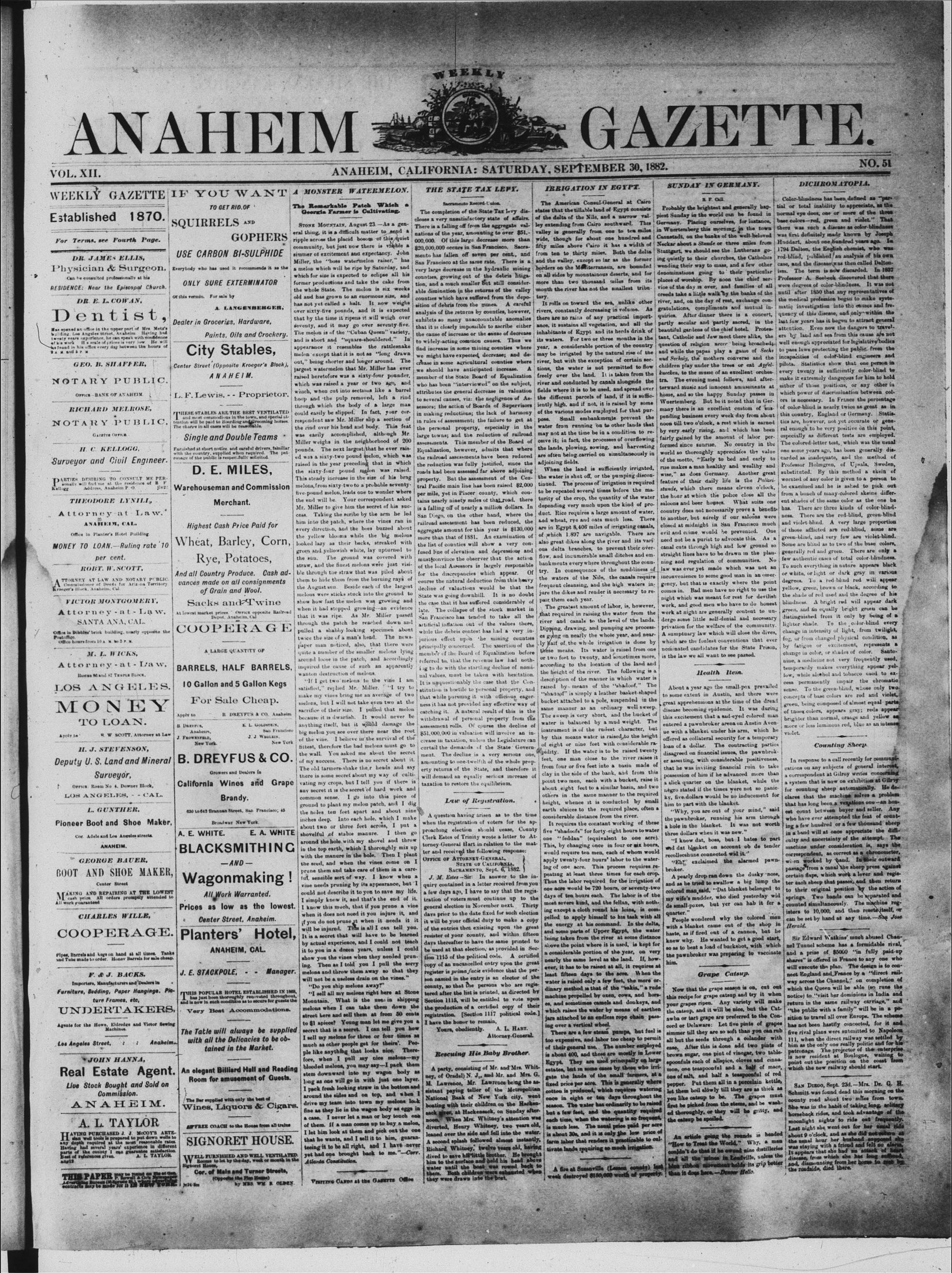
Searchable text
ANAHEIM
VOL. XII.
WEEKLY GAZETTE
Established 1870.
For Terms, see Fourth Page.
DR. JAMES ELLIS,
Physician & Surgeon,
Can be consulted professionally at his
RESIDENCE: Near the Episcopal Church.
DR. E. L. COWAN,
Dentist,
Has opened an office in the upper part of Mrs. Metr's building Los Angeles Street Anaheim. Having had twenty years experience, he can speak with confidence at his work. If a scale of prices is very low He will find in his office every day between the hours of 8 AM and 6 PM.
GEO. B. SHAFFER,
NOTARY PUBLIC.
OFFICE—BANK OF ANAHEIM.
RICHARD MELROSE,
NOTARY PUBLIC.
GAZETTE OFFICE.
H. C. KELLOGG,
Surveyor and Civil Engineer.
IF YOU WANT
TO GET RID OF
SQUIRRELS AND
GOPHERS
USE CARBON BI-SULPHIDE
Everybody who has used it recommends it as the ONLY SURE EXTERMINATOR Of this vermin. For sale by
A. LANGENBERGER,
Dealer in Groceries, Hardware,
Paints, Oils and Crockery.
City Stables,
Center Street (Opposite Kroeger's Block),
ANAHEIM.
L. F. Lewis. - Proprietor.
THESE STABLES ARE THE BEST VENTILATED
and most commodious in the town, and special attention will be paid to Boarding and Grooming horses.
The charve in all cases will be reasonable.
Single and Double Teams
Furnished at short notice and careful drivers, familiar with the country, supplied when required. The patronage of the public is respectfully solicited.
D. E. MILES,
NOTARY PUBLIC.
OFFICE—BANK OF ANAHEIM
RICHARD MELROSE,
NOTARY PUBLIC,
GAZETTE OFFICE.
H. C. KELLOGG,
Surveyor and Civil Engineer.
PARTIES DESIRING TO CONSULT ME PERSONALLY WILL FIND ME AT THE RESIDENCE OF B. P. KELLOGG.
Address: Anaheim P.O. Jiv22
THEODORE LYNILI,
Attorney at Law.
ANAHEIM, CAL.
Office in Planter's Hotel Building.
MONEY TO LOAN.—Ruling rate 10 per cent.
ROBT. W. SCOTT.
ATTORNEY AT LAW AND NOTARY PUBLIC.
Commissioner of Deeds for Arizona Territory Kreger's Block, Anaheim, Cal.
VICTOR MONTGOMERY,
Attorney-at-Law,
SANTA ANA, CAL.
Office in Dibbles' brick building, nearly opposite the Postoffice.
Office hours from 10 a.m. to 3 p.m.
M. L. WICKS,
Attorney-at-Law.
Rooms 86 and 87 Temple Block.
LOS ANGELES.
MONEY TO LOAN.
Apply to R. W. SCOTT, Attorney at Law
H. J. STEVENSON,
Deputy U. S. Land and Mineral Surveyor.
Office: Room No 4, Downey Block,
LOS ANGELES, - - CAL.
L. GUNTHER.
Pioneer Boot and Shoe Maker,
Cor. Adele and Los Angeles streets.
ANAHEIM.
GEORGE BAUER,
BOOT AND SHOE MAKER,
Center Street
MAKING AND REPAIRING AT THE LOWEST cash price. All orders promptly attended to
ANAHEIM.
L. F. Lewis. -- Proprietor.
THESE STABLES ARE THE BEST VENTILATED and most commodious in the town, and special attention will be paid to Boarding and Grooming horses. The charm in all cases will be reasonable.
Single and Double Teams
Furnished at short notice and careful drivers, familiar with the country, supplied when required. The patronage of the public is respectfully solicited.
D. E. MILES,
Warehouseman and Commission Merchant.
Highest Cash Price Paid for
Wheat, Barley, Corn, Rye, Potatoes,
And all Country Produce. Cash advances made on all consignments of Grain and Wool.
Sacks and Twine
At lowest market prices. Office opposite Railroad Depot, Anaheim, Cal.
COOPERAGE
A LARGE QUANTITY OF
BARRELS, HALF BARRELS,
10 Gallon and 5 Gallon Kegs
For Sale Cheap.
Apply to B. DREYFUS & Co., Anaheim
B. DREYFUS,
Anaheim,
San Francisco
J. FROWENFIELD,
New York
B. DREYFUS & CO.
Growers and Dealers in California Wines and Grape Brandy.
630 to 642 Brannan Street, San Francisco; 45 Broadway New York.
A. E. WHITE.
E. A. WHITE
BLACKSMITHING
AND
Wagonmaking!
All Work Warranted.
raised heretofore was a year which was raised a year which was raised a year which was raised a year which was raised a year which was raised a year which was raised a year which was raised a year which was raised a year which was raised a year which was raised a year which was raised a year which was raised a year which was raised a year which was raised a year which was raised a year which was raised a year which was raised a year which was raised a year which was raised a year which was raised a year which was raised a year which was raised a year which was raised a year which was raised a year which was raised a year which was raised a year which was raised a year which was raised a year which was raised a year which was raised a year which was raised a year which was raised a year which was raised a year which was raised a year which was raised a year which was raised a year which was raised a year which was raised a year which was raised a year which was raised a year which was raised a year which was raised a year which was raised a year which was raised a year which was raised a year which was raised a year which was raised a year which was raised a year which was raised a year which was raised a year which was raised a year which was raised a year which was raised a year which was raised a year which was raised a year which was raised a year which was raised a year which was raised a year which was raised a year which was raised a year which was raised a year which was raised a year which was raised a yearwhich is easily accomplished Miller weighs in the pounds. The next large ed was a sixty-two pound raise in the year precede the sixty-four pound raise This steady increase in melons, from sixty-two to five-pound melon, leads the end will be. Your Mr. Miller to give him access. Taking the scribble him into the patch, while every direction, and then the yellow blooms who looked lazy as their green and yellowish whithe sun. The ground straw, and the finest mable through the straw them to hide them from the August sun. Besides melons were sticks stuck show how fast the melons when it had stopped put that it was ripe. After through the patch he pulled a shabby look twice the size of a man paper man noticed, quite a number of the around loose in the past inquired the cause of wanton destruction of "If I get two melons satisfied," replied Mr make my vines bring melons, but I will not sacrifice of their size because it is dwarfish anything itself, but if big melon you see over of the vine I believe hittest, therefore the wall You asked of my success. There The old farmers-shake there is some secret avating my crops, but any secret it is the second common sense. I go ground to plant my melons the holes ten feet inches deep Into each about two or three shovelful of stable around the hole with in the top earth, whitwith the manure in the seed, and when prune them and take sensible sort of vine needs pruning he could not describe it
L. GUNTHER.
Pioneer Boot and Shoe Maker,
Cor. Adele and Los Angeles streets.
ANAHEIM.
GEORGE BAUER,
GOOT AND SHOE MAKER,
Center Street
MAKING AND REPAIRING AT THE LOWEST cash price. All orders promptly attended to. All work guaranteed.
CHARLES WILLE,
COOPERAGE.
Pipes, Barrels and kegs on hand at all times. Tanks and Tube made to order. Honey Barrels for sale cheap.
F. & J. BACKS.
Importers, Manufacturers and Dealers in Furniture, Bedding, Paper Hangings. Picture Frames, etc.
UNDERTAKERS.
Agents for the Howe, Eldredge and Victor Sewing Machines.
Los Angeles Street, : Anaheim.
JOHN HANNA,
Real Estate Agent.
Live Stock Bought and Sold on Commission.
ANAHEIM.
A. L. TAYLOR
HAVING PURCHASED J. J. McOY'S ARTE-ism well tools is prepared to put down wells to any depth required at the most reasonable rates. Having had several years' experience in different parts of the county I can guarantee satisfaction. Best of references given. A. L. TAYLOR ang12
THIS PAPER may be found on File at Gen.
Advertising Bureau (10 Strand St.), where advertising contracts may be made for it in New York.
A. E. WHITE.
E. A. WHITE
BLACKSMITHING
— AND —
Wagonmaking!
All Work Warranted.
Prices as low as the lowest.
Center Street, Anaheim.
Planters’ Hotel,
ANAHEIM, CAL.
J. E. STACKPOLE, - - Manager.
THIS POPULAR HOTEL ESTABLISHED IN 1865, has just been thoroughly renovated throughout, and is now in such condition as to secure for guests the Very Best Accommodations.
The Table will always be supplied with all the Delicacies to be obtained in the Market.
An elegant Billiard Hall and Reading Room for amusement of Guests.
The Bar supplied with only the best of Wines, Liquors & Cigars.
FREE COACH to the House from all trains
SIGNORET HOUSE.
WELL FURNISHED AND WELL VENTILATED.
Rooms to let by the day, weak or month in the Signoret House,
Cer. of Main and Turner Streets,
(Opposite the Plan House)
by NBS WM R OLDEN.
A MONSTER WATERMELON.
The Remarkable Patch Which a Georgia Farmer is Cultivating.
Stone Mountain, August 23.—As a general thing, it is a difficult matter to send a ripple across the placid bosom of this quiet community, but just now there is visible a summer of excitement and expectancy. John Miller, the "boss watermelon raiser," has a melon which will be ripe by Saturday, and which for size is expected to eclipse all his former productions and take the cake from the whole State. The melon is six weeks old and has grown to an enormous size, and has not yet called a halt. It now weighs over sixty-five pounds, and it is expected that by the time it ripens it will weigh over seventy, and it may go over seventy-five. The melon is of the "Cuban Queen" variety, and is short and "square-shouldered." In appearance it resembles the rattlesnake melon except that it is not as "long drawn out," being shorter and longer around. The largest watermelon that Mr. Miller has ever raised heretofore was a sixty-four pounder, which was raised a year or two ago, and which, when cut into sections like a barrel hoop and the pulp removed, left a rind through which the body of a large man could easily be slipped. In fact, your correspondent saw Mr. Miller slip a section of the rind over his head and body. This feat was easily accomplished, although Mr. Miller weighs in the neighborhood of 200 pounds. The next largest that he ever raised was a sixty-two pound melon, which was raised in the year preceding that in which the sixty-four pound melon was raised.
THE STATE TAX LEVY.
Sacramento Record-Union.
The completion of the State Tax levy discloses a very unsatisfactory state of affairs. There is a falling off from the aggregate valuations of the year, amounting to over $51,-000,000. Of this large decrease more than $20,000,000 occurs in San Francisco. Sacramento has fallen off seven per cent., and San Francisco at the same rate. There is a very large decrease in the hydraulic mining counties, growing out of the debris litigation, and a much smaller but still considerable diminution in the returns of the valley counties which have suffered from the deposition of debris from the mines. A careful analysis of the returns by counties, however, exhibits so many unaccountable anomalies that it is clearly impossible to ascribe either the cause of increase or the cause of decrease to widely-acting common causes. Thus we find increase in some mining counties where we might have expected decrease; and decrease in some agricultural counties where we should have anticipated increase. A member of the State Board of Equalization who has been "interviewed" on the subject, attributes the general decrease in valuation to several causes, viz: the negligence of Assessors; the action of Boards of Supervisors in making reductions; the lack of harmony in rules of assessment; the failure to get at the personal property, especially in the large towns; and the reduction of railroad assessments. This member of the Board of Equalization, however, admits that where the railroad assessments have been reduced the reduction was fully justified, since the roads had been assessed far above adjoining states that the tillable land of Egypt consists of the delta of the Nile, and a narrow valley extending from Cairo southward. This valley is generally from one to ten miles wide, though for about one hundred and fifty miles above Cairo it has a width of from ten to thirty miles. Both the delta and the valley, except so far as the former borders on the Mediterranean, are bounded on all sides by mountainous deserts, and for more than two thousand miles from its mouth the river has not the smallest tributary.
It rolls on toward the sea, unlike other rivers, constantly decreasing in volume. As there are no rains of any practical importance, it sustains all vegetation, and all the inhabitants of Egypt and its herds drink of its waters. For two or three months in the year, a considerable portion of the country may be irrigated by the natural rise of the river, but with the exception of certain sections, the water is not permitted to flow freely over the land. It is taken from the river and conducted by canals alongside the fields where it is to be used, and spread over the different parcels of land, if it is sufficiently high, and if not, it is raised by some of the various modes employed for that purpose. Small embankments prevent the water from running on to other lands that may not at the time be in a condition to receive it; in fact, the processes of overflowing the lands, plowing, sowing, and harvesting are often being carried on simultaneously in adjoining fields.
When the land is sufficiently irrigated,
problems persist in Wu Cannas Neck Stuttgart ing quaintly denominate places vice o creeda river, gratul quirie partly beautitant question and wud S childhuck tra terwa home Wu many pendi noon by ve fairly former world of th rise n
raised heretofore was a sixty-four pounder, which was raised a year or two ago, and which, when cut into sections like a barrel hoop and the pulp removed, left a rind through which the body of a large man could easily be slipped. In fact, your correspondent saw Mr. Miller slip a section of the rind over his head and body. This feat was easily accomplished, although Mr. Miller weighs in the neighborhood of 200 pounds. The next largest that he ever raised was a sixty-two pound melon, which was raised in the year preceding that in which the sixty-four pound melon was raised. This steady increase in the size of his brag melons, from sixty-two to a probable seventy-five-pound melon, leads one to wonder where the end will be. Your correspondent asked Mr. Miller to give him the secret of his success. Taking the scribe by the arm he led him into the patch, where the vines ran in every direction, and the bees buzzed about the yellow blooms while the big melons looked lazy as their backs, streaked with green and yellowish white, lay upturned to the sun. The ground was covered with straw, and the finest melons were just visible through the straw that was piled about them to hide them from the burning rays of the August sun. Beside each of the largest melons were sticks stuck into the ground to show how fast the melon was growing and when it had stopped growing—an evidence that it was ripe. As Mr. Miller passed through the patch he reached down and pulled a shabby looking specimen about twice the size of a man's head. The newspaper man noticed, also, that there were quite a number of the smaller melons lying around loose in the patch, and accordingly inquired the cause of such an apparently wanton destruction of melons.
"If I get two melons to the vine I am satisfied," replied Mr. Miller. "I try to make my vines bring me an average of two melons, but I will not take even two at the sacrifice of their size. I pulled that melon because it is dwarfish. It would never be anything itself, but it would damage the big melon you see over there near the root of the vine. I believe in the survival of the fittest, therefore the bad melons must go to the wall. You asked me about the secret of my success. There is no secret about it. The old farmers shake their heads and say there is some secret about my way of cultivating my crops, but I tell you if there is any secret it is the secret of hard work and common sense. I go into this piece of ground to plant my melon patch, and I dig the holes ten feet apart and about nine inches deep. Into each hole, which I make about two or three feet across, I put a shovelful of stable manure. I then go around the hole with my shovel and throw in the top earth, which I thoroughly mix up with the manure in the hole. Then I plant the seed, and when the vines come on I prune them and take care of them in a careful, sensible sort of way. I know when a vine needs pruning by its appearance, but I could not describe it to you to save my life. I simply know it, and that's the end of it."
Law of Registration.
A question having arisen as to the time when the registration of voters for the approaching election should cease, County Clerk Estes of Trinity wrote a letter to Attorney-General Hart in relation to the matter and received the following response:
OFFICE OF ATTORNEY-GENERAL,
STATE OF CALIFORNIA,
SACRAMENTO, Sept. 6, 1882.
J. M. Estes—Sir: In answer to the inquiry contained in a letter received from you a few days ago, I have to say that the registration of voters must continue up to the member of the State Board of Equalization who has been "interviewed" on the subject, attributes the general decrease in valuation to several causes, viz: the negligence of Assessors; the action of Boards of Supervisors in making reductions; the lack of harmony in rules of assessment; the failure to get at the personal property, especially in the large towns; and the reduction of railroad assessments. This member of the Board of Equalization, however, admits that where the railroad assessments have been reduced the reduction was fully justified, since the roads had been assessed far above adjoining property. But the assessment of the Central Pacific main line has been raised $2,000 per mile, yet in Placer county, which contains nearly ninety miles of that road, there is a falling off of nearly a million dollars. In San Diego, on the other hand, where the railroad assessment has been reduced, the aggregate amount for this year is $130,000 more than that of 1881. An examination of the list of counties will show a very confused line of elevation and depression and must convince the observer that the action of local Assessors is largely responsible for the discrepancies which appear. Of course the natural deduction from this heavy decline of valuations would be that the State was going downhill. It is no doubt that it has suffered considerably of late. The collapse of the stock market in San Francisco has tended to take all the artificial inflation out of the values there, while the debris contest has had a very injurious effect upon the mining counties principally concerned. The assertion of the member of the Board of Equalization before referred to, that the revenue law had nothing to do with the startling decline of nominal values, must be taken with hesitation. It is unquestionably the case that the Constitution is hostile to personal property, and that while pursuing it with officious eagerness it has not provided any effective way of catching it. A natural result of this is the withdrawal of personal property from the assessment rolls. Of course the decline of $51,000,000 in valuation will involve an increase in taxation, unless the Legislature can curtail the demands of the State Government. The decline is a very serious one, amounting to one-twelfth of the whole property returns of the State, and therefore it will demand an equally serious increase of taxation to restore the equilibrium.
The greatest amount of labor is, however, that required in raising the water from the river and canals to the level of the lands. Dipping, drawing, and pumping are processes going on nearlythe whole year,and nearly halfofthewholeirigationisdonebythesemeans.Itswaterisraisedfromoneortwofeettotwenty,and sometimesmoreaccordingtochelocationofthelandandtheheightoftheriver.Thefollowingisadescriptionofthemannerinwhichwaterisraisedbymeansofthe“shadooof.”The“shadooof”issimplya leather basket-shapedbucketattachedtoapole,suspendedinthesamemannerasanordinarywellsweep.Thesweepisveryshort,andthebucketofwaterisbalancedbya mudweight.Theinstrumentisoftherudestcharacter,butbythismeanswaterisraisedtotheheightofeightorninefeetwithconsiderablerapidity Ifthewaterisbraisedtwentyfeetonemanclosetotheriverraisesitfromfourorfivefeetintoabasismadeofclayinthesideofthebank,andfromthispointtwomen,eachwithabucket,raiseitabouteightfeettoa similarbasin,andtwoothersinthesame mannertotherequiredheight,whenceitisconductedbysmallearthsluicestotherequiredplace,oftenac considerabledistancefromtheriver.
It requirestheconstantworkingof these five“shadooofs”forforty-eighthourstowaterone“feddan”(equivalenttooneacre).This,bychangingoncein fouror sixhourswouldrequiretenmen,ceachofwhomwouldapplytwenty-fourhours’labortothewateringofoneacreThisprocessrequiresrepeatingatleastthreetimesforcethrop.Suspectlongthathelaborrequiredfortheirirrigationofoneacrewouldbe720hours,或 seventy-twodaysoftenhourseach.Thelaborisofthe
ground to plant my melons patch, and I dig the holes ten feet apart and about nine inches deep. Into each hole, which I make about two or three feet across, I put a shovelful of stabie manure. I then go around the hole with my shovel and throw in the top earth, which I thoroughly mix up with the manure in the hole. Then I plant the seed, and when the vines come on I prune them and take care of them in a careful, sensible sort of way. I know when a vine needs pruning by its appearance, but I could not describe it to you to save my life. I simply know it, and that's the end of it. I know this much, that if you prune a vine when it does not need it you injure it, and if you do not prune it when it needs it it will be injured. This is all I can tell you. It is a secret that will have to be learned by actual experience, and I could not teach it to you in a dozen years, unless I could show you the vines when they needed pruning. Then as I told you I pull the sorry melons and throw them away so that they will not be a useless drain on the vines."
"Do you ship melons away?"
"I sell all my melons right here at Stone Mountain. What is the use in shipping melons when I can take them down the street here and sell them at from 50 cents to $1 apiece? Young man let me give you a secret that is a secret. I can tell you how I sell my melons for three or four times as much as other people get for theirs'. People like anything that looks nice. Therefore, when I pull my nice melons—my blooded melons, you may say—I pack them stem downward into my wagon body as long as one will go in with just one layer. I pack fresh looking straw in the bottom and around the sides and on top, and when I drive my team into town my melons look fine as they lie in the wagon body as eggs in a case. I never let a man or boy touch one of them. If a man comes up to buy a melon, I let him look at them and pick out the one that he wants, and I sell it to him, guaranteeing it to be all right, and I have never yet had one brought back to me."—Corr. Atlanta Constitution.
Visiting Cards at the Gasette Office
Law of Registration.
A question having arisen as to the time when the registration of voters for the approaching election should cease, County Clerk Estes of Trinity wrote a letter to Attorney-General Hart in relation to the matter and received the following response:
Office of Attorney-General,
State of California,
Sacramento, Sept. 6, 1882.
J. M. Estes—Sir: In answer to the inquiry contained in a letter received from you a few days ago, I have to say that the registration of voters must continue up to the general election in November next. Thirty days prior to the date fixed for such election it will be your official duty to make a copy of the entries then existing upon the great register of your county, and within fifteen days thereafter to have the same printed to be used at that election; as provided in Section 1115 of the political code. A certified copy of an uncancelled entry upon the great register is prima facie evidence that the person named in the entry is an elector of the county, so that the persons who are registered after the list is printed, as directed by Section 1115, will be entitled to vote upon the production of a certified copy of their registration. [Section 1117 political code.] I have the honor to remain,
Yours, obediently.
A. L. HART.
Attorney-General.
Rescuing His Baby Brother.
A party, consisting of Mr. and Mrs. Whitney, of Oradel) N. J., and Mr. and Mrs. G. M. Lawrence, Mr. Lawrence being the assistant paying teller of the Metropolitan National Bank of New York city, went boating with their children on the Hackensack river, at Hackensack, on Sunday afternoon. When Mrs. Whitney's attention was diverted, Henry Whitney, two years old, leaned over the side and fell into the water. A second splash followed almost instantly, Richard Whitney, twelve years old, having dived to save his little brother. He brought him to the surface and held his head above water until the boat was rowed back to them. Both children were exhausted when they were drawn into the boat.
height, whence it is conducted by small earth sluices to the required place, often a considerable distance from the river.
It requires the constant working of these five "shadoofs" for forty-eight hours to water one "feddan" (equivalent to one acre). This, by changing once in four or six hours, would require ten men, each of whom would apply twenty-four hours' labor to the watering of one acre. This process requires repeating at least three times for each crop. Thus the labor required for the irrigation of one acre would be 720 hours, or seventy-two days of ten hours each. The labor is of the most severe kind, and the fellan, with nothing except a cloth round his loina, is compelled to apply himself to his task with all the energy at his command. In the delta, and some parts of Upper Egypt, the water being taken from the river at some distance above the point where it is used, is kept for a considerable portion of the year, on very nearly the same level as the land. If, however, it has to be raised at all, it requires at least fifteen days to the acre. When the water is raised only a few feet, the more ordinary method is that of the "seakia," a rude machine propelled by oxen, cows, and horses, and sometimes camels and donkeys, and which raises the water by means of earthen jars attached to an endless rope chain passing over a vertical wheel.
There are a few steam pumps, but fuel is too expensive, and labor too cheap to permit of their general use. The number employed is about 400, and these are mostly in Lower Egypt. They are used principally on large estates, but in some cases by those who irrigate the lands of the small farmers, at a fixed price per acre. This is generally where cotton is produced, which requires watering once in eight or ten days throughout the season. The water has ordinarily to be raised but a few feet, and the quantity required each time, when the watering is so frequent, is much less. The usual price paid per acre is about 30s., and it is only the low price of farm labor that renders it practicable to cultivate lands requiring so much irrigation.
A fire at Susanville (Lassen county) last week destroyed $150,000 worth of property.
GAZETTE.
NOBER 30, 1882.
IN EGYPT.
General at Cairo and of Egypt consists, and a narrow valero southward. This from one to ten miles but one hundred and so it has a width of sixties. Both the delta so far as the former cranesan, are bounded on numerous deserts, and for land miles from its out the smallest tribunal sea, unlike other seas in volume. As many practical importation, and all the lands its herds drink of three months in the portion of the country the natural rise of the exception of certain secs not permitted to flow. It is taken from the canals alongside the used, and spread over of land, if it is sufficient, it is raised by some employed for that purifications prevent the moon to other lands that lie in a condition to reprocesses of overflowing swine, and harvesting on simultaneously in sufficiently irrigated, and the morning disguise.
SUNDAY IN GERMANY.
R.F.Call
Probably the brightest and generally happiest Sunday in the world can be found in Germany. Placing ourselves, for instance, in Wuertemberg this morning, in the town Caonstadt, on the banks of the well-beloved Neckar about a Stunde or three miles from Stuttgart, we should see the Lutherans going quietly to their churches, the Catholics wending their way to mass, and a few other denominations going to their particular places of worship. By noon the chief service of the day is over, and families of all creeds take a little walk by the banks of the river, and, on the day of rest, exchange congratulations, compliments and mutual inquiries. After dinner there is a concert, partly secular and partly sacred, in the beautiful gardens of the chief hotel. Protestant, Catholic and Jew meet there alike, the question of religion never being broached; and while the papas play a game of Sechs und Sechsig, the mothers converse and the children play under the trees or eat Apfel-kuecken, to the music of an excellent orchestra. The evening meal follows, and afterward music and innocent amusements at home, and so the happy Sunday passes in Wuertemberg. But be it noted that in Germany there is an excellent custom of suspending business every week day from about noon till two o'clock, a rest which is earned by very early rising, and which has been fairly gained by the amount of labor performed since sunrise. No country in the world so thoroughly appreciates the value of the motto, "Early to bed and early to rise makes a man healthy and wealthy and wise" as does Germany. Another great color-blindness has been defined as "partial or total inability to appreciate, as the normal eye does, one or more of the three base colors—red, green and violet." That there was such a disease as color-blindness was first definitely made known by Joseph Huddart, about one hundred years ago. In 1794 Dalton, the English chemist, who was red-blind, published an analysis of his own case, and the disease was then called Daltonism. The term is now discarded. In 1837 Professor A. Seebeck discovered that there were degrees of color-blindness. It was not until after 1850 that any representatives of the medical profession began to make systematic investigation into the causes and frequency of this disease, and only within the last few years has it begun to attract general attention. Even now the dangers to travelers by land and sea from this cause are not well enough appreciated for legislative bodies to pass laws protecting the public from the incapacities of color-blind engineers and pilots. Statistics show that one person in every twenty is sufficiently color-blind to make it extremely dangerous for him to hold either of those positions, or any other in which power of discrimination between colors is necessary. In France the percentage of color-blind is nearly twice as great as in this country, England or Germany. Statistics are, however, not yet accurate or general enough to be very positive on this point, especially as different tests are employed. The colored-letter test, which was the usual one some years ago, has been generally discarded as inadequate, and the method of Professor Holmgren, of Upsala, Sweden, substituted. By this method a skein of
It is taken from the canal alongside the river used, and spread over the land, if it is sufficient it is raised by some employed for that purpose to prevent the river to other lands that lie in a condition to reprocesses of overflowing flowing, and harvesting on simultaneously in sufficiently irrigated, or the pumping discharged of irrigation is required times before the maize quantity of the water upon the kind of pro- large amount of water, gets much less. There lies of irrigating canals, navigable. There are the river and its vari- able to prevent their over- small ditches and em- ire throughout the coun- of the muddiness of mille, the canals require and the high waters inder it necessary to re- of labor, is, however, ing the water from the level of the lands. The pumping are process- whole year, and near- irrigation is done by water is raised from one place, and sometimes more, creation of the land and er. The following is a summary in which water is of the "shadoof." The leather basket-shaped pole, suspended in the ordinary well sweep- short, and the bucket of hay a mud weight. The rudest character, but it is raised to the height with considerable rai- is to be raised twenty to the river raises it into a basin made of stone bank, and from this with a bucket, raise it in a similar basin, and two manner to the required was conducted by small required place, often a hole from the river.
Instant working of these forty-eight hours to water equivalent to one acre). Since in four or six hours, even each of whom would hours' labor to the water's process requires re- three times for each crop, forced for the irrigation of 20 hours, or seventy-two such. The labor is of the
Health Item.
About a year ago the small-pox prevailed to some extent in Austin, and there were great apprehensions at the time of the dread disease becoming epidemic. It was during this excitement that a sad-eyed colored man entered a pawnbroker arena on Austin Avenue with a blanket under his arm, which he offered as collateral security for a temporary loan of a dollar. The contracting parties disagreed on financial issues, the pawnbroker assenting, with considerable positiveness, that he was inviting financial ruin to take possession of him if he advanced more than a slick quarter on the blanket, while the negro stated if the times were not so panicky, five dollars would be no inducement for him to part with the blanket.
"Why, you are out of your mind," said the pawnbroker, running his arm through a hole in the blanket. It was not worth three dollars when it was new."
"I know dat, boss, but I hates to part dat blanket on account ob de tender recollechuns connected wid it."
"Ehy" exclaimed the alarmed pawnbroker.
A pearly drop ran down the dusky nose, and as he tried to swallow a big lump the colored man said, "Dat blanket belonged to my wife's mudder, who died yesterday wid make it extremely dangerous for him to hold either of those positions, or any other in which power of discrimination between colors is necessary. In France the percentage of color-blind is nearly twice as great as in this country, England or Germany. Statistics are, however, not yet accurate or general enough to be very positive on this point, especially as different tests are employed. The colored-letter test, which was the usual one some years ago, has been generally discarded as inadequate, and the method of Professor Holmgren, of Upsala, Sweden substituted. By this method a skein of worsted of any color is given to a person to be examined and he is asked to pick out from a bunch of many-colored skeins different shades of the same color as the one he has. There are three kinds of color-blindness. There are the red-blind, green-blind and violet-blind. A very large proportion of those afflicted are red-blind, some are green-blind, and very few are violet-blind. Some are blind as to two of the base colors, generally red and green. There are only a few authentic cases of total color-blindness. To such everything in nature appears black or white, or light or dark gray in various degrees. To a red-blind red will appear yellow, green, brown or black, according to the shade of red used and the degree of his blindness. A bright red will appear dark green, and an equally bright green can be distinguished from it only by being of a lighter shade. To the color-blind every change in intensity of light, from twilight, fog, or from changed physical condition, as by fatigue or excitement, represents a change in color, or shades of color. Santonine, a medicine not very frequently used, temporarily makes everything appear yellow, while alcohol and tobacco used to excess permanently impair the chromatic sense. To the green-blind, whose only two concepts of base colors are red and violet, green, being composed of almost equal parts of those colors, appears gray; reds appear brighter than normal, orange and yellow as more or less luminous red, blue as an intense violet.
Counting Sheep.
In response to a call recently for communications on any subjects of general interest, a correspondent at Gilroy writes concerning a system that is now on exhibition at Gilroy for counting sheep automatically. He declares that the machine solves a problem that has long been a vexation one—an honest count between buyer and seller. Any who have ever attempted the feat of counting a few hundred or a few thousand sheep in a band will at once appreciate the difficulty and uncertainty of the attempt. The machine under consideration is says the correspondent, as correct as a chronometer, when worked by hand. In their outward passage from a canal the sheep press against certain flap, which work a lever and register each sheep that passes, and then return to their original position by the action of springs. Two bands can be separated and
instant working of these forty-eight hours to water equivalent to one acre). Since in four or six hours, even each of whom would hours' labor to the water this process requires three times for each crop, for the irrigation of 20 hours, or seventy-two each. The labor is of the fellan, with nothound his loins, is com- self to his task with all command. In the delta, Upper Egypt, the water the river at some distance are it is used, is kept for month of the year, on very el as the land. If, how- issued at all, it requires at to the acre. When the a few feet, the more or- of the "eakia," a rude by oxen, cows, and horse-mels and donkeys, and water by means of earthen endless rope chain pass-wheel.
Steam pumpa, but fuel is labor too cheap to permit. The number employed these are mostly in Lower raised principally on large cases by those who irri- the small farmers, at a This is generally where which requires watering ten days throughout the was ordinarily to be raised and the quantity required the watering is so frequent, usual price paid per acre is only the low price of dders it practicable to cul- ing so much irrigation.
Villa (Lassen county) last 50,000 worth of property.
"Why, you are out of your mind," said the pawnbroker, running his arm through a hole in the blanket. It was not worth three dollars when it was new."
"I know dat, boss, but I hates to part wid dat blanket on account ob de tender recollechuns connected wil it."
"Eb!" exclaimed the alarmed pawnbroker.
A pearly drop ran down the dusky nose, and as he tried to swallow a big lump the colored man said. "Dat blanket belonged to my wife's mudder, who died yesterday wil de small-poxes, but yer can hab it fer a quarter."
People wondered why the colored man with a blanket came out of the shop in haste, as if fired out of a cannon, but he knew why. He wanted to get a good start, so as to beat a load of buckshot, with which the pawnbroker was preparing to vaccinate him.
Grape Catsup.
Now that the grape season is on, cut out this recipe for grape catsup and try it when your grapes ripen. Any variety will make the catsup, and it will be nice, but the Catawba or tart grape are preferred to the Concord or Delaware: Let five pints of grapes simmer till they are so soft than you can rub all but the seeds through a colander with ease. After this is done add two pints of brown sugar, one pint of vinegar, two table-spoonfuls each of allspice, cloves and cinnamon, one teaspoonful and a half of mace, one salt, and half a teaspoonful of red pepper. Put them all in a porcelain kettle, let them boil slowly till they are as thick as you like catsup to be. The grapes must first be picked from the stems, and be washed thoroughly, or they will be gritty, and the catsup be spoiled.
An article going the rounds is headed "How to Treat the World." Why, a man couldn't do that if he owned nine distilleries and all the mines in Landville, unless the blue ribbon movement holds its grip better than it does here.—Dunner Hello.
Sir Edward Watkins' much abused Channel Tunnel scheme has a formidable rival, and a prize of $5000 "in fully paid-up shares" is offered in France to any one who will execute the plan. The design is to connect England and France by a "direct railway across the Channel," on completion of which the Queen will be able (so runs the notice) to "visit her dominions in India and return in the same railway carriage," and "the public with a family" will be in a position to travel all over Europe. The scheme has not been hastily concocted, for it and five rival plans were submitted to Napoleon 111, when the direct railway was settled by him as the only one really politic and for his patronage. The projector of the enterprise is now resident at Boulogne, waiting to point out the position on the coast from which the new railway should start.
San Diego, Sept. 23d.—Mrs. Dr. G. H. Schmitt was found dead this morning on the county road about two miles from town. She was in the habit of taking long, solitary horseback rides, and took advantage of the moonlight nights to ride out frequently. Last night she went out for her usual ride about 9 o'clock, and as she did not return at the usual hour her husband supposed she was staying with a friend and felt no alarm. It appears that she had an attack of heart disease, from which she has long suffered, and dismounting from her horse to rest by the roadside, died there.