anaheim-gazette 1882-09-02
Scanned page
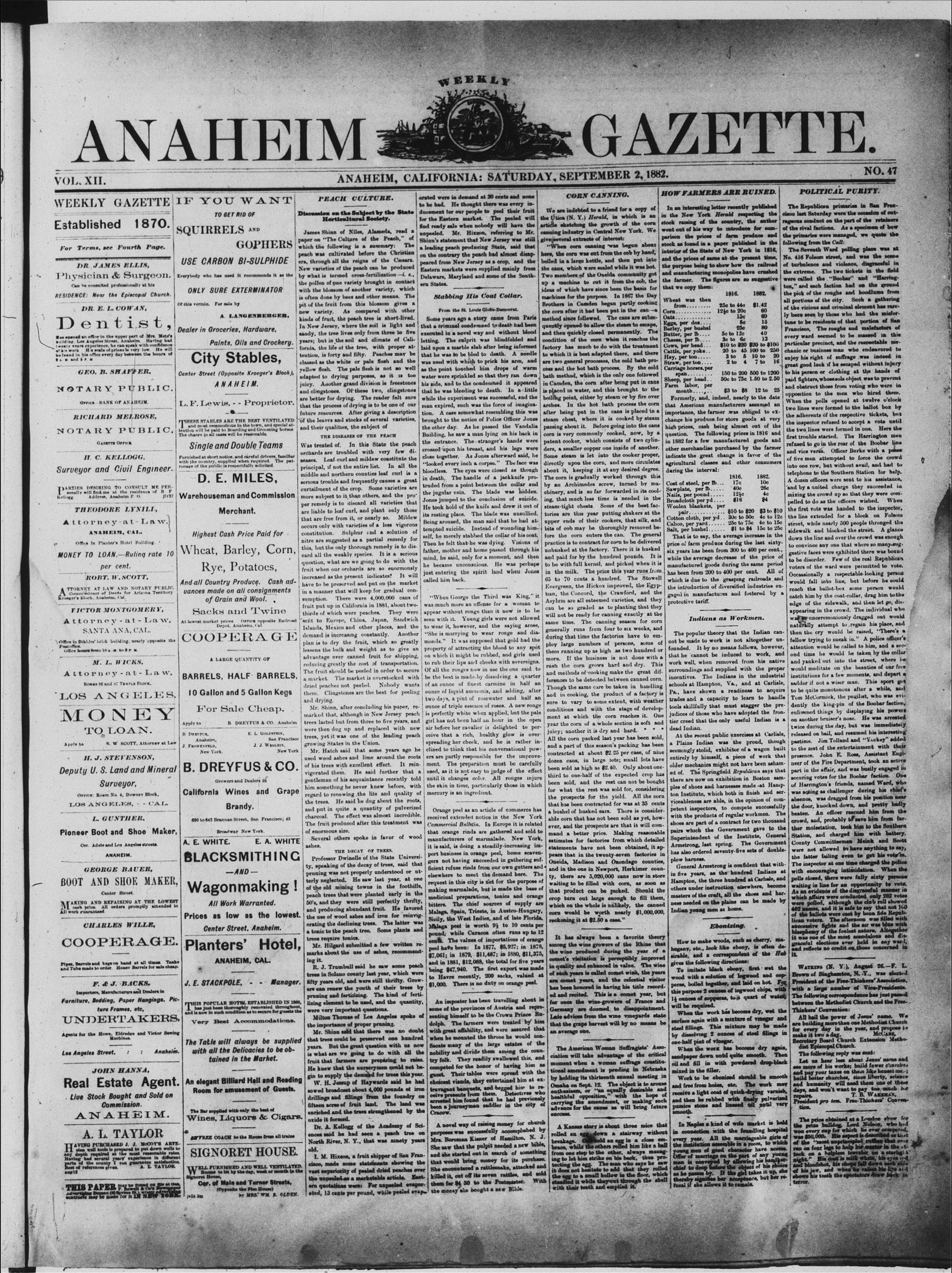
Searchable text
ANAHEIM
VOL. XII.
WEEKLY GAZETTE
Established 1870.
For Terms, see Fourth Page.
DR. JAMES ELLIS,
Physician & Surgeon,
Can be consulted professionally at his
RESIDENCE: Near the Episcopal Church.
DR. E. L. COWAN,
Dentist,
Has opened an office in the upper part of Mrs. Metz's building, Los Angeles Street, Anaheim. Having had twenty years experience, he can speak with confidence of his work. His scale of prices is very low. He will be found in his office every day between the hours of 8 A.M. and 5 P.M.
GEO. B. SHAFFER,
NOTARY PUBLIC.
OFFICE—BANK OF ANAHEIM.
RICHARD MELROSE,
NOTARY PUBLIC.
GAETTEE OFFICE.
H. C. KELLOGG,
Surveyor and Civil Engineer.
IF YOU WANT
TO GET RID OF
SQUIRRELS AND
GOPHERS
USE CARBON BI-SULPHIDE
Everybody who has used it recommends it as the ONLY SURE EXTERMINATOR
Of this vermin. For sale by
A. LANGENBERGER.
Dealer in Groceries, Hardware,
Paints, Oils and Crockery.
City Stables,
Center Street (Opposite Kroeger's Block),
ANAHEIM.
L. F. Lewis. -- Proprietor.
THESE STABLES ARE THE BEST VENTILATED and most commodious in the town, and special attention will be paid to Boarding and Grooming horses. The charm in all cases will be reasonable.
Single and Double Teams
Furnished at short notice, and careful drivers, familiar with the country, supplied when required. The patronage of the public is respectfully solicited.
PEACH C
Discussion on the S
Horticulture
James Shinn of Nipaper on "The Culture
which the following
peach was cultivated
era, through all the reNew varieties of the pby what is termed c
the pollen of one variwith the blossom of an
is often done by bees
pit of the fruit from
new variety. As
kinds of fruit, the peaIn New Jersey, where
sandy, the tree lives e
years; but in the soil
formia, the life of the
tention, is forty and f
classed as the white o
yellow flesh. The paadapted to drying p
juicy. Another granand clingstones. Of t
are better for drying.
that the process of drifuture resources. Afiof the leaves and stock
and their qualities, th
THE DISEASES
Was treated of. In orchards are troubled seases. Leaf curl and principal, if not the e
NOTARY PUBLIC.
OFFICE—BANK OF ANAHEIM.
RICHARD MELROSE,
NOTARY PUBLIC,
GAZETTE OFFICE.
II. C. KELLOGG,
Surveyor and Civil Engineer.
PARTIES DESIRING TO CONSULT ME PERSONALLY will find me at the residence of B. F. Kellogg Address, Anaheim P.O. Jly22
THEODORE LYNILL,
Attorney-at-Law.
ANAHEIM, CAL.
Office in Planter's Hotel Building.
MONEY TO LOAN.—Ruling rate 10 per cent.
ROBT. W. SCOTT.
ATTORNEY AT LAW AND NOTARY PUBLIC.
Commissioner of Deeds for Arizona Territory Kroeger's Block, Anaheim, Cal.
VICTOR MONTGOMERY,
Attorney-at-Law.
SANTA ANA, CAL.
Office in Dibbles' brick building, nearly opposite the Postoffice.
M. L. WICKS.
Attorney-at-Law.
Rooms 86 and 87 Temple Block.
LOS ANGELES.
MONEY TO LOAN.
Apply to R. W. SCOTT, Attorney at Law.
H. J. STEVENSON,
Deputy U. S. Land and Mineral Surveyor,
Office: Room No. 4, Downey Block,
LOS ANGELES, -- CAL.
L. GUNTHER.
Pioneer Boot and Shoe Maker,
Cor. Adele and Los Angeles streets.
GEORGE BAUER,
BOOT AND SHOE MAKER,
Center Street.
ANAHEIM.
L. F. Lewis. - Proprietor.
THESE STABLES ARE THE BEST VENTILATED and most commodious in the town, and special attention will be paid to Boarding and Grooming horses. The charve in all cases will be reasonable.
Single and Double Teams
Furnished at short notice, and careful drivers, familiar with the country, supplied when required. The patronage of the public is respectfully solicited.
D. E. MILES,
Warehouseman and Commission Merchant.
Highest Cash Price Paid for Wheat, Barley, Corn, Rye, Potatoes, And all Country Produce. Cash advances made on all consignments of Grain and Wool.
Sacks and Twine
At lowest market prices Office opposite Railroad Depot, Anaheim, Cal.
COOPERAGE
A LARGE QUANTITY OF
BARRELS, HALF BARRELS,
10 Gallon and 5 Gallon Kegs For Sale Cheap.
Apply to B. DREYFUS & Co. Anaheim
B. DREYFUS,
Anaheim,
San Francisco
J. FROWENFIELD,
New York
J. J. WEOLEIN,
New York
B. DREYFUS & CO.
Growers and Dealers in California Wines and Grape Brandy.
630 to 642 Brannan Street, San Francisco; 45 Broadway New York.
A. E. WHITE.
E. A. WHITE
BLACKSMITHING — AND —
Wagonmaking !
Was treated of. In orchards are troubled seases. Leaf curl and principal, if not the e middle and northern serious trouble and fr curtailment of the cre more subject to it th per remedy is to dis are liable to leaf curl that are free from it, occurs only with vari constitution. Sulph nitre are suggested ad this, but the only th card all the weakly s question, what are w fruit when our orchard increased as the pres have to be preserved in a manner that wil sumption. There w fruit put up in Calif thirds of which were sent to Europe, Ch Islands, Mexico and demand is increasing plan is to dry the lessens the bulk and advantage over can reducing greatly the The fruit should be a market. The man dried peaches not p them. Clingstones and drying.
Mr. Shinn, after marked that, although trees lasted but fro were then dug up trees, yet it was on growing States in th Mr. Hatch said used wood ashes and of his trees with ex vigorated them. He gentleman of his ac him something he m regard to renewing the trees. He said and put in quite a charcoal. The effect The fruit produced of enormous size.
Several others sahes.
THE DEC
Professor Dwiney, speaking of the pruning was not pre terly neglected. H of the old mining peach trees that we
LOS ANGELES, - CAL.
L. GUNTHER,
Pioneer Boot and Shoe Maker,
Cor. Adele and Los Angeles streets.
ANAHEIM.
GEORGE BAUER,
BOOT AND SHOE MAKER,
Center Street.
Making and repairing at the lowest cash price. All orders promptly attended to. All work guaranteed.
CHARLES WILLE,
COOPERAGE.
Pipes, Barrels and kegs on hand at all times. Tanks and Tubs made to order. Honey Barrels for sale cheap.
F. & J. BACKS.
Importers, Manufacturers and Dealers in Furniture, Bedding, Paper Hangings, Picture Frames, etc.
UNDERTAKERS.
Agents for the Howe, Eldredge and Victor Sewing Machines.
Los Angeles Street.: Anaheim.
JOHN HANNA,
Real Estate Agent.
Live Stock Bought and Sold on Commission.
ANAHEIM.
A. L. TAYLOR
Having purchased J. J. McCOY'S ARTE-ist well tools is prepared to put down wells to any depth required at the most reasonable rates. Having had several years' experience in different parts of the county I can guarantee satisfaction. Best of references given.
A. L. TAYLOR august 12
THIS PAPER may be found on file at Gen.
P. Bowell & Own Newspaper Advertising Bureau (10 Spruce St.) where advertising contracts may be made for it IN NEW YORK.
Brandy.
630 to 642 Brannan Street, San Francisco; 45 Broadway New York.
A. E. WHITE.
E. A. WHITE
BLACKSMITHING
AND
Wagonmaking!
All Work Warranted.
Prices as low as the lowest.
Center Street, Anaheim.
Planters’ Hotel,
ANAHEIM, CAL.
J. E. STACKPOLE, - Manager.
THIS POPULAR HOTEL ESTABLISHED IN 1868, has just been thoroughly renovated throughout, and is now in such condition as to secure for guests the Very Best Accommodations.
The Tatle will always be supplied with all the Delicacies to be obtained in the Market.
An elegant Billiard Hall and Reading Room for amusement of Guests.
The Bar supplied with only the best of Wines, Liquors & Cigars.
FREE COACH to the House from all trains
SIGNORET HOUSE.
WELL FURNISHED AND WELL VENTILATED.
Rooms to let by the day, week or month in the Signoret House,
Cor. of Main and Turner Streets,
(Opposite the Plaza House)
by MRS.' WM R. OLDEN.
WEEKLY
CIM GAZ
ANAHEIM, CALIFORNIA: SATURDAY, SEPTEMBER 2, 1882.
PEACH CULTURE.
Discussion on the Subject by the State Horticultural Society.
James Shinn of Niles, Alameda, read a paper on "The Culture of the Peach," of which the following is a summary: The peach was cultivated before the Christian era, through all the reigns of the Caesars. New varieties of the peach can be produced by what is termed cross-fertilization—i.e., the pollen of one variety brought in contact with the blossom of another variety, which is often done by bees and other means. The pit of the fruit from this blossom gives a new variety. As compared with other kinds of fruit, the peach tree is short-lived. In New Jersey, where the soil is light and sandy, the tree lives only from three to five years; but in the soil and climate of California, the life of the tree, with proper attention, is forty and fifty. Peaches may be classed as the white or pale flesh and the yellow flesh. The pale flesh is not so well adapted to drying purposes, as it is too juicy. Another grand division is freestones and clingstones. Of these two, clingstones are better for drying. The reader felt sure that the process of drying is to be one of our future resources. After giving a description of the leaves and stocks of several varieties, and their qualities, the subject of THE DISEASES OF THE PEACH Was treated of. In this State the peach orchards are troubled with very few diseases. Leaf curl and mildew constitute the principal, if not the entire list. In all the middle and northern counties leaf curl is a orated were in demand at 30 cents and none to be had. He thought there was every inducement for our people to peel their fruit for the Eastern market. The peeled will find ready sale when nobody will have the unpeeled. Mr. Hixson, referring to Mr. Shinn's statement that New Jersey was still a leading peach producing State, said that on the contrary the peach had almost disappeared from New Jersey as a crop, and the Eastern markets were supplied mainly from Delaware, Maryland and some of the Southern States.
Stabbing His Coat Collar.
From the St. Louis Globe-Democrat.
Some years ago a story came from Paris that a criminal condemned to death had been executed in a novel way and without blood letting. The culprit was blindfolded and laid upon a marble slab after being informed that he was to be bled to death. A needle was used with which to prick his arm, and as the point touched him drops of warm water were sprinkled so that they ran down his side, and to the condemned it appeared that he was bleeding to death. In a little while the experiment was successful, and the man expired, such was the force of imagination. A case somewhat resembling this was brought to the notice of Police Officer Jones the other day. As he passed the Vandalia Building, he saw a man lying on his back in the entrance. The stranger's hands were crossed upon his breast, and his legs were close together. As Jones afterward said, he "looked every inch a corpse." The face was bloodless. The eyes were closed as though
CORN CANNING.
We are indebted to a friend for a copy of the Utica (N. Y.) Herald, in which is an article sketching the growth of the corn canning industry in Central New York. We give several extracts of interest:
"When corn canning was begun about here, the corn was cut from the cob by hand, boiled in a large kettle, and then put into the cans, which were sealed while it was hot. Two members of the Oneida community got up a machine to cut it from the cob, the ideas of which have since been the basis for machines for the purpose. In 1867 the Day Brothers in Camden began partly cooking the corn after it had been put in the can—a method since followed. The cans are subsequently opened to allow the steam to escape, and then quickly closed permanently. The condition of the corn when it reaches the factory has much to do with the treatment to which it is best adapted there, and there are two general processes, the cold bath process and the hot bath process. By the cold bath method, which is the only one followed in Camden, the corn after being put in cans is placed in water, and this brought to the boiling point, either by steam or by fire over arches. In the hot bath process the corn after being put in the cans is placed in a steam chest, where it is cooked by steam passing about it. Before going into the cans corn is very commonly cooked, now, by a patent cooker, which consists of two cylinders, a smaller copper one inside of another. Some steam is let into the cooker proper, directly upon the corn, and more circulates about it, keeping it at any desired degree."
adapted to drying purposes, as it is too juicy. Another grand division is freestones and clingstones. Of these two, clingstones are better for drying. The reader felt sure that the process of drying is to be one of our future resources. After giving a description of the leaves and stocks of several varieties, and their qualities, the subject of
THE DISEASES OF THE PEACH
Was treated of. In this State the peach orchards are troubled with very few diseases. Leaf curl and mildew constitute the principal, if not the entire list. In all the middle and northern counties leaf curl is a serious trouble and frequently causes a great curtailment of the crop. Some varieties are more subject to it than others, and the proper remedy is to discard all varieties that are liable to leaf curl, and plant only those that are free from it, or nearly so. Mildew occurs only with varieties of a less vigorous constitution. Sulphur and a solution of nitre are suggested as a partial remedy for this, but the only thorough remedy is to discard all the weakly species. It is a serious question, what are we going to do with the fruit when our orchards are so enormously increased as the present indicates? It will have to be preserved and put on the market in a manner that will keep for gradual consumption. There were 4,000,000 cans of fruit put up in California in 1881, about two-thirds of which were peaches. They were sent to Europe, China, Japan, Sandwich Islands, Mexico and other places, and the demand is increasing constantly. Another plan is to dry the fruit, which so greatly lessens the bulk and weight as to give an advantage over canned fruit for shipping, reducing greatly the cost of transportation. The fruit should be peeled in order to secure a market. The market is overstocked with dried peaches not peeled. Nobody wants them. Clingstones are the best for peeling and drying.
Mr. Shinn, after concluding his paper, remarked that, although in New Jersey peach trees lasted but from three to five years, and were then dug up and replaced with new trees, yet it was one of the leading peach growing States in the Union.
Mr. Hatch said that some years ago he used wood ashes and lime around the roots of his trees with excellent effect. It reinvigorated them. He said further that a gentleman of his acquaintance recently told him something he never knew before, with regard to renewing the life and quality of the trees. He said he dug about the roots, and put in quite a quantity of pulverized charcoal. The effect was almost incredible. The fruit produced after this treatment was of enormous size.
Several others spoke in favor of wood ashes.
THE DECAY OF TREES.
Professor Dwinelle of the State University, speaking of the decay of trees, said that pruning was not properly understood or utterly neglected. He saw last year, at one of the old mining towns in the foothills, peach trees that were planted early in the water were sprinkled so that they ran down his side, and to the condemned it appeared that he was bleeding to death. In a little while the experiment was successful, and the man expired, such was the force of imagination. A case somewhat resembling this was brought to the notice of Police Officer Jones the other day. As he passed the Vandalia Building, he saw a man lying on his back in the entrance. The stranger's hands were crossed upon his breast, and his legs were close together. As Jones afterward said, he "looked every inch a corpse." The face was bloodless. The eyes were closed as though in death. The handle of a jackknife protruded from a point between the collar and the jugular vein. The blade was hidden. Jones jumped to the conclusion of suicide. He took hold of the knife and drew it out of its resting place. The blade was unsullied. Being aroused, the man said that he had attempted suicide. Instead of wounding himself, he merely stabbed the collar of his coat. Then he felt that he was dying. Visions of father, mother and home passed through his mind, he said, only for a moment, and then he became unconscious. He was perhaps just entering the spirit land when Jones called him back.
"When George the Third was King," it was much more an offense for a woman to appear without rouge than it now is to be seen with it. Young girls were not allowed to wear it, however, and the saying arose, "She is marrying to wear rouge and diamonds." It was supposed that gold had the property of attracting the blood to any spot on which it might be rubbed, and girls used to rub their lips and cheeks with sovereigns. Of all the rouges now in use the one said to be best is made by dissolving a quarter of an ounce of finest carmine in half an ounce of liquid ammonia, and adding, after two days, a pint of rosewater and half an ounce of triple essence of roses. A new rouge is perfectly white when applied, but the pale girl has not been half an hour in the open air before her cavalier is delighted to perceive that a rich, healthy glow is overspreading her cheek, and he is rather inclined to think that his conversational powers are partly responsible for the improvement. The preparation must be carefully used, as it is not easy to judge of the effect until it changes color. All rouges injure the skin in time, particularly those in which mercury is an ingredient.
Orange peel as an article of commerce has received extended notice in the New York Commercial Bulletin. In Europe it is related that orange rinds are gathered and sold to manufacturers of marmalade. New York, it is said, is doing a steadily-increasing import business in orange peel, home scavengers not having succeeded in gathering sufficient refuse rinds from our own gutters and elsewhere to meet the demand here. The request in this city is not for the purpose of making marmalade, but is made the base of medicinal preparations, tonics and orange bath method, which is the only one followed in Camden, the corn after being put in cans is placed in water, and this brought to the boiling point, either by steam or by fire over arches. In the hot bath process the corn after being put in cans is placed in a steam chest, where it is cooked by steam passing about it. Before going into the cans corn is very commonly cooked, now, by a patent cooker, which consists of two cylinders, a smaller copper one inside of another. Some steam is let into the cooker proper, directly upon the corn, and more circulates about it, keeping it at any desired degree. The corn is gradually worked through this by an Archimedes screw, turned by machinery, and is so far forwarded in its cooling, that much less time is needed in the steam-tight chests. Some of the best factories are this year putting shakers at the upper ends of their cookers, that silk, and bits of cob may be thoroughly removed before the corn enters the can. The general practice is to contract for corn to be delivered unhusked at the factory. There it is husked and paid for by the hundred pounds. It is to be with full kernel, and picked when it is in the milk. The price this year runs from 65 to 70 cents a hundred. The Stowell Evergreen, the Hickox improved, the Egyptian, the Concord, the Crawford, and the Asylum are all esteemed varieties, and they can be so graded as to planting that they will not be ready for canning exactly at the same time. The canning season for corn generally runs from four to six weeks, and during that time the factories have to employ large numbers of persons, some of them running up as high as two hundred or more. If the business is not done with a rush the corn grows hard and dry. This and methods of cooking make the great differences to be detected between canned corn. Though the same care be taken in handling and in cooking, the product of a factory is sure to vary to some extent, with weather conditions and with the stage of development at which the corn reaches it. One year the corn of a whole section is soft and juicy; another it is dry and hard.
All the corn packed last year has been sold, and a part of this season's packing has been contracted at about $2.25 per case, of nine dozen cans, in large lot; small lots have been sold as high as $2.40. Only about one third to one-half of the expected crop has been sold, and the rest can not be bought for what the rest was sold for, considering the prospects for the yield.
All the corn that has been contracted for was at 35 cents a bushel of husked ears. There is considerable corn that has not been sold as yet, however, and the prospects are that it will command a better price. Making reasonable estimates for factories from which detailed statements have not been obtained, it appears that in the twenty-seven factories in Oneida, Madison and Onondago counties, and in the one in Newport, Herkimer county there are 5,020,000 cans now in store waiting to be filled with corn, as soon as that product can be picked. Should the crop turn out large enough to fill them,
---
the trees. He said he dug about the roots,
and put in quite a quantity of pulverized charcoal. The effect was almost incredible.
The fruit produced after this treatment was of enormous size.
Several others spoke in favor of wood ashes.
THE DECAY OF TREES.
Professor Dwinelle of the State University, speaking of the decay of trees, said that pruning was not properly understood or utterly neglected. He saw last year, at one of the old mining towns in the foothills, peach trees that were planted early in the 50's, and they were still perfectly thrifty, and producing abundant fruit. He favored the use of wood ashes and iron for reinvigorating the declining trees. The latter was a tonic to the peach tree. Some plants and trees require tonics.
Mr. Hilgard submitted a few written remarks about the use of ashes, recommending it.
R. J. Trumbull said he saw some peach trees in Solano county last year, which were fifty years old, and were still thrifty. Growers can renew the youth of their trees by pruning and fertilizing. The kind of fertilizing element to be used, and the quantity, were very important questions.
Milton Thomas of Los Angeles spoke of the importance of proper pruning.
Mr. Shinn said that there was no doubt that trees could be preserved one hundred years. But the great question with us now is what are we going to do with all the fruit that farmers are preparing to raise. He knew that the nurserymen could not begin to supply the demand for trees this year.
W. H. Jessup of Haywards said he had sowed broadcast about 4,000 pounds of iron drillings and fillings from the foundry on fifteen acres of fruit land. The land was enriched and the trees strengthened by the oxide it formed.
Dr. A. Kellogg of the Academy of Sciences said he had seen a peach tree on North River, N. Y., that was ninety years old.
I. M. Hixson, a fruit shipper of San Francisco, made some statements showing the vast superiority of pealed dried peaches over the unpeeled as a marketable article. Eastern quotations were: For unpeeled evaporated, 13 cents per pound, while peeled evapo-
Orange peel as an article of commerce has received extended notice in the New York Commercial Bulletin. In Europe it is related that orange rinds are gathered and sold to manufacturers of marmalade. New York, it is said, is doing a steadily-increasing import business in orange peel, home scavengers not having succeeded in gathering sufficient refuse rinds from our own gutters and elsewhere to meet the demand here. The request in this city is not for the purpose of making marmalade, but is made the base of medicinal preparations, tonics and orange bitters. The chief sources of supply are Malaga, Spain, Trieste, in Austro-Hungary, Sicily, the West Indies, and of late Florida. Malaga peel is worth 9½ to 10 cents per pound; while Curacao often runs up to 12 cents. The values of importations of orange peel have been: In 1877, $5,927; in 1878, $7,061; in 1879, $11,487; in 1880, $11,375; and in 1881, $12,088, the total for five years being $47,940. The first export was made to Havre recently, 200 sacks, valued at $1,000. There is no duty on orange peel.
An imposter has been travelling about in some of the provinces of Austria and representing himself to be the Crown Prince Rudolph. The farmers were treated by him with great affability, and were assured that when he mounted the throne he would confiscate many of the large estates of the nobility and divide them among the country folk. They readily swallowed this, and competed for the honor of having him as guest. Their tables were spread with the choicest viands, they entertained him at extravagant banquets, and begged him to receive presents from them. Detectives who arrested him found that he had previously been a journeyman saddler in the city of Cracow.
A novel way of raising money for church purposes was successfully accomplished by Mrs. Boroman Kisner of Hamilton, N. J. She saw that the pulpit needed a new Bible, and she started out in search of something that would bring money for its purchase. She encountered a rattlesnake, attacked and killed it, cut off its seven rattles, and sold them for $4 50 to the Postmaster. With the money she bought a new Bible.
It has always been a favorite theory among the wine growers of the Rhine that the wine produced during the year of a comet's visitation is perceptibly improved in quality and enhanced in value. The wine of such years is called comet wine, the years are comet years, and the celestial visitor has been honored in having his title recorded and recited. This is a comet year, but for once the wine-growers of France and Germany are doomed to disappointment. Late advices from the wine vineyards state that the grape harvest will by no means be an average one.
The American Woman Suffragists' Association will take advantage of the critical moment when a woman suffrage constitutional amendment is pending in Nebraska by holding its thirteenth annual meeting in Omaha on Sept. 12. The object is to arouse enthusiasm, or "an equally desirable and healthful opposition," with the hope of carrying the amendment, or making such advance for the cause as will bring future success.
A Kansas story is about three mice that rolled an egg down a stairway without breakage. One held an egg in a close embrace, while the others rolled him like a ball from one step to the other, always managing to let him strike on his back, thus protecting the egg. The man who says he saw does not hesitate to add that they rolled the egg to a small hollow in the floor, which steadied it while they cut through the shell with their teeth and emptied it.
GAZETTE.
MEMBER 2, 1882. NO. 47
ANNING.
In a friend for a copy of Herald, in which is an account of the growth of the corn central New York. We of interest:
Being was begun about it from the cob by hand, cable, and then put into sealed while it was hot. Oneida community got it from the cob, the since been the basis for purpose. In 1867 the Day began partly cooking been put in the can—a cold. The cans are subsoil the steam to escape, used permanently. The corn when it reaches the do with the treatment adapted there, and there masses, the cold bath process. By the cold is the only one followed after being put in cans and this brought to the by steam or by fire over the bath process the corn the cans is placed in a it is cooked by steam before going into the cans only cooked, now, by a hash consists of two cylin-er one inside of another. Into the cooker proper, corn, and more circulates it at any desired degree.
HOW FARMERS ARE RUINED.
In an interesting letter recently published in the New York Herald respecting the stock raising of the country, the author went out of his way to introduce for comparison the prices of farm produce and stock as found in a paper published in the interior of the State of New York in 1816, and the prices of same at the present time, the purpose being to show how the railroad and manufacturing monopolies have crushed the farmer. The figures are so suggestive that we copy them:
| | 1816. | 1882. |
| :--- | :---: | :---: |
| Wheat was then from ... | 25c to 44c | $1.42 |
| Corn ... | 12¢ to 20c | 60 |
| Oats ... | 15c | 60 |
| Eggs, per dosz ... | 5c | 15 |
| Barley, per bushel | 25c | 80 |
| Butter, per lb ... | 5c to 12c | 40 |
| Cheese, per lb ... | 3c to 6c | 13 |
| Cows, per head ... | $10 to $20 | $20 to $100 |
| Cattle, per yoke ... | 20 to 45 | 100 to 250 |
| Hay, per ton ... | 3 to 5 | 10 to 20 |
| Straw, per ton ... | 2 to 4 | 7 to 16 |
| Carriage horses, per span ... | 150 to 200 | 500 to 1200 |
| Sheep, per head ... | 50c to 75c | 1.50 to 2.50 |
| Farm labor, per month ... | $3 to $8 | 12 to 25 |
Formerly, and indeed, nearly to the date that American manufacturers assumed an importance, the farmer was obliged to exchange his produce for store goods at very high prices, cash being almost out of the question. The following prices in 1816 and in 1882 for a few manufactured goods and other merchandise purchased by the farmer indicate the great change in favor of the agricultural classes and other consumers during the interval:
POLITICAL PURITY.
The Republican primaries in San Francisco last Saturday were the occasion of outrageous conduct on the part of the retainers of the rival factions. As a specimen of how the primaries were managed, we quote the following from the Call:
The Seventh Ward polling place was at No. 416 Folsom street, and was the scene of turbulence and violence, disgraceful in the extreme. The two tickets in the field were called the "Boobar" and "Harrington," and each faction had on the ground the pick of the roughs and hoodlums from all portions of the city. Such a gathering of the vicious and criminal element has rarely been seen by those who had the misfortune to be residents of that portion of San Francisco. The roughs and malefactors of every ward seemed to be massed in this particular precinct, and the respectable mechanic or business man who endeavored to enjoy his right of suffrage was indeed in great good luck if he escaped without injury to his person or clothing at the hands of paid fighters, whose sole object was to prevent and obstruct those from voting who were in opposition to the men who hired them. When the polls opened at twelve o'clock two lines were formed to the ballot box by the adherents of the respective tickets, but the inspector refused to accept a vote until the two lines were formed in one. Here the first trouble started. The Harrington men refused to go in the rear of the Boobar line and vice versa. Officer Burke with a pose of five men attempted to force the crowd into one row, but without avail, and had to telephone to the Southern Station for help.
after being put in cans by steam or by fire over bath process the corn is placed in a can it is cooked by steam before going into the cans easily cooked, now, by a pot consists of two cylinders one inside of another. Into the cooker proper, corn, and more circulates it at any desired degree. They worked through this screw, turned by maid forwarded in its cool-time is needed in the factory. Some of the best facilities putting shakers at the cookers, that silk, and thoroughly removed beers the can. The general cost for corn to be delivered factory. There it is husked hundred pounds. It is shelled, and picked when it is price this year runs from hundred. The Stowell box improved, the Egypt-the Crawford, and the seemed varieties, and they as to planting that they for canning exactly at the scanning season for corn four to six weeks, and the factories have to em-merse persons, some of them high as two hundred or tenness is not done with a news hard and dry. This making make the great dif-ferent between canned corn. Are be taken in handling the product of a factory is some extent, with weather with the stage of develop-ble corn reaches it. One whole section is soft and dry and hard.
And last year has been sold, season's packing has been out $2.25 per case, of nine large lots; small lots have was $2.40. Only about one of the expected crop has the rest can not be bought but was sold for, considering the yield. All the cornracted for was at 35 cents a year. There is consider-not been sold as yet, how-oes are that it will com-prise. Making reasonable stories from which detailed not been obtained, it app- twenty-seven factories in Newport, Herkimer county, 20,000 cans now in store with corn, as soon as be picked. Should the large enough to fill them,
The popular theory that the Indian cannot be made to work is not altogether un-founded. It by no means follows, however, that he cannot be induced to work, and work well, when removed from his native surroundings and supplied with the proper incentives. The Indians in the industrial schools at Hampton, Va., and at Carlisle, Pa., have shown a readiness to acquire trades and a capacity to learn to handle tools skillfully that must stagger the prejudices of those who have adopted the frontier creed that the only useful Indian is a dead Indian.
At the recent public exercises at Carlisle, a Plains Indian was the proud, though seemingly stolid, exhibitor of a wagon built entirely by himself, a piece of work that older mechanics might not have been ashamed of. The Springfield Republican says that there are now on exhibition in Boston samples of shoes and harnesses made-at Hampton Institute, which both in finish and serviceableness are able, in the opinion of competent inspectors, to compete successfully with the products of regular workmen. The shoes are part of a contract for two thousand pairs which the Government gave to the Superintendent of the Institute, General Armstrong, last spring. The Government has also ordered seventy-five sets of double-plow harness.
General Armstrong is confident that within five years, as the hundred Indians at Hampton, the three hundred at Carlisle, and others under instruction elsewhere, become masters of the craft, all the shoes and harb- paid fighters, whose sole object was to prevent and obstruct those from voting who were in opposition to the men who hired them. When the polls opened at twelve o'clock two lines were formed to the ballot box by the adherents of the respective tickets, but the inspector refused to accept a vote until the two lines were formed in one. Here the first trouble started. The Harrington men refused to go in the rear of the Boobar line and vice versa. Officer Burke with a pease of five men attempted to force the crowd into one row, but without avail, and had to telephone to the Southern Station for help. A dozen officers were sent to his assistance, and by a united charge they succeeded in mixing the crowd up so that they were compelled to do as the officers wished. When the first vote was handed to the inspector, the line extended for a block on Folem street, while nearly 500 people thronged the sidewalk and blocked the street. A glance down the line and over the crowd was enough to convince any one that where so many-suggestive faces were exhibited there was bound to be disorder. Few of the real Republican voters of the ward were permitted to vote. Occasionally a respectable-looking person would fall into line, but before he could reach the ballot-box some person would catch him by the coat-collar, drag him to the edge of the sidewalk, and then let go, disappearing in the crowd. The individual who was unceremoniously dragged out would naturally attempt to regain his place, and then the cry would be raised, "There's a fellow trying to sneak in." A police officer's attention would be called to him, and a second time he would be taken by the collar and yanked out into the street, where he would meditate on the beauties of our free institutions for a few moments, and depart a sadder if not a wiser man. This sport got to be quite monotonous after a while, and Tom McCormick, the pugilist, who was evidently the king-pin of the Boobar faction, enliwed things by displaying his powers on another bruiser's nose. He was arrested twice during the day, but was immediately released on bail, and resumed his interesting pastime. Jim Tolland and "Yorkey" added to the zest of the entertainment with their presence. John E. Ross, Assistant Engineer of the Fire Department, took an active part in the affair, and was busily engaged in securing votes for the Boobar faction. One of Harrington's friends, named Ward, who was acting as challenger during his chief's absence, was dragged from his position near door, knocked down, and pretty badly beaten. An officer rescued him from the crowd, and probably to save him from further molestation, took him to the Southern Station, and charged him with battery. County Committee Meink and Scott were not allowed to have anything to say, the latter failing even to get his vote/in. The inspector at one time charged the police with encouraging intimidation. When the polls closed, there were fully sixty persons waiting in line for an opportunity to vote. As an evidence of the disgraceful manner in which affairs were conducted only 262 votes
been a favorite theory growers of the Rhine that and during the year of a is perceptibly improvedanced in value. The wine filled comet wine, the years and the celestial visitor in having his title recordThis is a comet year, but the growers of France and omed to disappointment. the wine vineyards state invest will by no means be
Woman Suffragists' Asso-advantage of the critical woman suffrage constitut is pending in Nebraska thirteenth annual meeting in 22. The object is to arouse "an equally desirable and motion," with the hope of endment, or making such cause as will bring future is about three mice that down a stairway without hold an egg in a close embers rolled him like a ball the other, always manage on his back, thus pro-The man who says he saw to add that they rolled I hollow in the floor, which they cut through the shell and emptied it.
How to make woods, such as cherry, mahogany, etc., look like ebony, is often desirable, and a correspondent of the Hub gives the following directions:
To imitate black ebony, first wet the wood with a solution of logwood and copperas, boiled together, and laid on hot. For this purpose 2 ounces of logwood chips, with 1½ ounces of copperas, to quart of water, will be required.
When the work has become dry, wet the surface again with a mixture of vinegar and steel fillings. This mixture may be made by dissolving 2 ounces of steel filings in one-half pint of vinegar.
When the work has become dry again, sandpaper down until quite smooth. Then oil and fill in with powdered drop-black mixed in the filler.
Work to be ebonized should be smooth and free from holes, etc. The work may receive a light coat of quick-drying varnish, and then be rubbed with finely pulverized pumice stone and lineded oil until very smooth.
In Naples a kind of wife market is held in connection with the foundling hospital every year. All the marriageable girls of the institution assemble in a room, to which young men of good character have access. Offer of marriage on the part of any young man is conveyed by allowing his handkerchief to drop below the object of his choice as he passes by. If the girl takes it up, she thereby signifies her acceptance, but her refusal if she allows it to remain.
Ebonizing.
How to make woods, such as cherry, mahogany, etc., look like ebony, is often desirable, and a correspondent of the Hub gives the following directions:
To imitate black ebony, first wet the wood with a solution of logwood and copperas, boiled together, and laid on hot. For this purpose 2 ounces of logwood chips, with 1½ ounces of copperas, to quart of water, will be required.
When the work has become dry, wet the surface again with a mixture of vinegar and steel fillings. This mixture may be made by dissolving 2 ounces of steel filings in one-half pint of vinegar.
When the work has become dry again, sandpaper down until quite smooth. Then oil and fill in with powdered drop-black mixed in the filler.
Work to be ebonized should be smooth and free from holes, etc. The work may receive a light coat of quick-drying varnish, and then be rubbed with finely pulverized pumice stone and lineded oil until very smooth.
In Naples a kind of wife market is held in connection with the foundling hospital every year. All the marriageable girls of the institution assemble in a room, to which young men of good character have access. Offer of marriage on the part of any young man is conveyed by allowing his handkerchief to drop below the object of his choice as he passes by. If the girl takes it up, she thereby signifies her acceptance, but her refusal if she allows it to remain.
Watkins (N. Y.), August 26.-F. L. Brown of Binghamton, N. Y., was elected President of the Free-Thinkers' Association, with a large number of Vice-Presidents. The following correspondence has just passed between the Methodist Church and the Free-Thinkers' Convention:
All hail the power of Jesus' name. We are building more than one Methodist Church for every day in the year, and propose to make it two a day.
McCann,
Secretary Board Church Extension Methodist Episcopal Church.
The following reply was sent:
Let us hear less about Jesus' name and see more of his works; build fewer churches and pay your taxes on them like honest man; build better churches, since liberty, science and humanity will need them one of these days, and won't want to pay too much for repairs.
T. B. Wakeman,
President pro tem. Free-Thinkers' Convention.
The price obtained at a London show for the prize bulldog, Lord Nelson, who had won every cup for which he ever competed, was $50,000. His aspect is described as that of the "most unprincipled rufflen than ever ran on four legs to help his master in the attack on a helpless traveler on a starlight night." His coat is milk white, his eyes red and bloodshot, his chops fall down each side of his jaw, and when he raises his lips and shows his teeth the spectators draw back in terror.