anaheim-gazette 1882-08-19
Scanned page
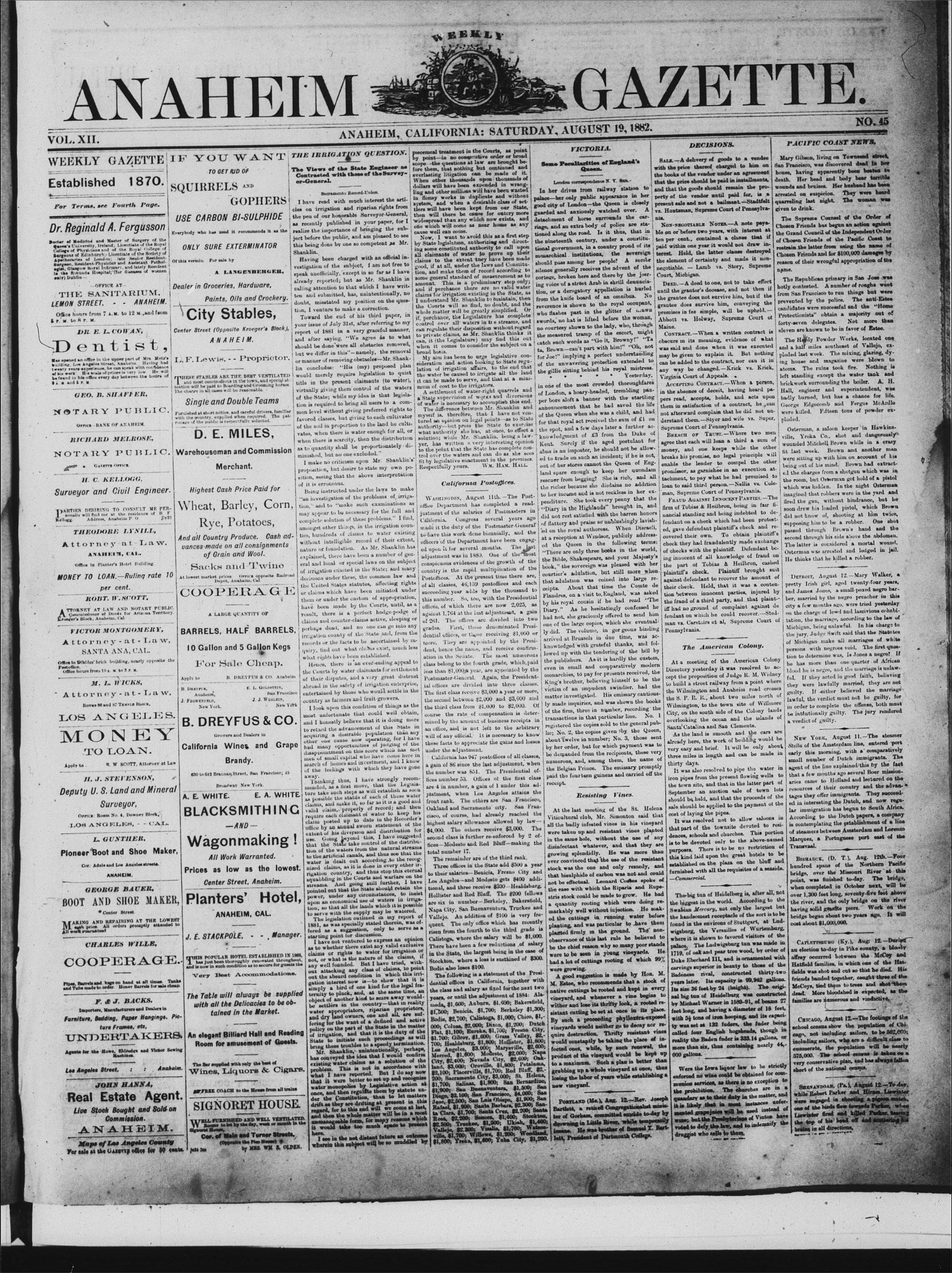
Searchable text
ANAHEIM
VOL. XII.
WEEKLY GAZETTE
Established 1870.
For Terms, see Fourth Page.
Dr. Reginald A. Fergusson
Doctor of Medicine and Master of Surgery of the Queen's University, Ireland; Licentiate of the Royal College of Physicians and of the Royal College of Surgeons of Edinburgh; Licentiate of the Society of Apothecaries of London; Late Senior Resident-Surgeon, Resident-Physician and Assistant Pathologist, Glasgow Royal Infirmary, and lately Resident in the Rotunda Hospital; (for diseases of women only) Dublin.
OFFICE AT
THE SANITARIUM,
LEMON STREET. - ANAHEIM.
Office hours from 7 a.m. to 12 p.m., and from 5 p.m. to 8 p.m.
DR. E. L. COWAN,
Dentist,
Has opened an office in the upper part of Mrs. Meta's building, Los Angeles Street, Anaheim. Having had twenty years experience, he can speak with confidence of his work. His scale of prices is very low. He will be found in his office every day between the hours of 9 a.m. and 5 p.m.
GEO. B. SHAFFER,
NOTARY PUBLIC.
OFFICE - BANK OF ANAHEIM.
RICHARD MELROSE,
NOTARY PUBLIC.
GALETTE OFFICE.
IF YOU WANT
TO GET RID OF
SQUIRRELS AND
GOPHERS
USE CARBON BI-SULPHIDE
Everybody who has used it recommends it as the ONLY SURE EXTERMINATOR
Of this vermin. For sale by
A LANGENBERGER,
Dealer in Groceries, Hardware,
Paints, Oils and Crockery.
City Stables,
Center Street (Opposite Kroeger’s Block),
ANAHEIM.
L.F. Lewis, - Proprietor.
THESE STABLES ARE THE BEST VENTILATED and most commodious in the town, and special attention will be paid to Boarding and Grooming horses. The charge in all cases will be reasonable.
Single and Double Teams
Furnished at short notice, and careful drivers, familiar with the country, supplied when required. The patronage of the public is respectfully solicited.
D. E. MILES,
Warehouseman and Commission Merchant.
THE IRRIGATION
The Views of the South Contrasted with the or-General.
Sacramento Recognizes I have read with much clarity on irrigation and the pen of our honorable as recently published realize the importance of project before the public, and this being done by one Shanklin.
Having been charged with vestigation of the subject speak unofficially, except already reported; but calling attention to that ten and submitted, has doubt, misstated my intention, I venture to make Toward the end of your issue of July 31st, report of 1881 in a vault and after saying, "We should be done were all but we differ in this"—or manner of removing our lin concludes: "His would merely require title in the present virtually giving them off of the State; while my intention is required to bring mon level without giving favored classes, but give of the soil in proportionates, when there is when there is scarcity, as to quantity shall be minished, but no one eats."
I make no criticism proposition, but desire
GEO. B. SHAFFER,
NOTARY PUBLIC.
OFFICE - BANK OF ANAHEIM.
RICHARD MELROSE,
NOTARY PUBLIC.
GAETTE OFFICE.
H. C. KELLOGG,
Surveyor and Civil Engineer.
PARTIES DESIRING TO CONSULT ME PERSONALLY WILL FIND ME AT THE RESIDENCE OF B. F. Kellogg.
Address: Anaheim P.O. Jly22
THEODORE LYNILL,
Attorney at Law.
ANAHEIM, CAL.
Office in Planter's Hotel Building.
MONEY TO LOAN.—Ruling rate 10 per cent.
ROBT. W. SCOTT.
ATTORNEY AT LAW AND NOTARY PUBLIC.
Commissioner of Deeds for Arizona Territory Brokerer's Block, Anaheim, Cal.
VICTOR MONTGOMERY,
Attorney-at-Law,
SANTA ANA, CAL.
Office in Dibbles' brick building, nearly opposite the Postoffice.
Office hours from 10 A.M. to 3 P.M.
M. L. WICKS,
Attorney-at-Law.
Rooms 86 and 87 Temple Block.
LOS ANGELES.
MONEY TO LOAN.
Apply to R. W. SCOTT, Attorney at Law.
H. J. STEVENSON,
Deputy U. S. Land and Mineral Surveyor.
Office: Room No. 4, Downey Block.
LOS ANGELES, - CAL.
L. GUNTHER,
Ploneer Boot and Shoe Maker,
Cor. Adele and Los Angeles streets.
ANAHEIM.
GEORGE BAUER,
BOOT AND SHOE MAKER
THESE STABLES ARE THE BEST VENTILATED and most commensious in the town, and special attention will be paid to Boarding and Grooming horses. The charm in all cases will be reasonable.
Single and Double Teams
Furnished at short notice, and careful drivers, familiar with the country, supplied when required. The patronage of the public is respectfully solicited.
D. E. MILES,
Warehouseman and Commission Merchant.
Highest Cash Price Paid for
Wheat, Barley, Corn, Rye, Potatoes,
And all Country Produce. Cash advances made on all consignments of Grain and Wool.
Sacks and Twine
At lowest market prices. Office opposite Railroad Depot, Anaheim, Cal.
COOPERAGE
A LARGE QUANTITY OF
BARRELS, HALF BARRELS,
10 Gallon and 5 Gallon Kegs
For Sale Cheap.
Apply to R. DREYFUS & Co. Anaheim
B. DREYFUS,
Anaheim,
San Francisco
J. FROWENFIELD,
New York
B. DREYFUS & CO.
Growers and Dealers in California Wines and Grape Brandy.
630 to 642 Brannan Street, San Francisco; 45 Broadway New York.
A. E. WHITE.
E. A. WHITE
BLACKSMITHING
AND
Wagonmaking!
All Work Warranted.
Prices as low as the lowest.
Center Street, Anaheim.
Planters' Hotel
Being instructed under "an investigation of the tion," and to "make may appear to be neces complete solution of the amongst other things, ties, hundreds of cla without intelligible nature or foundation explained, there have eral and local or spe of irrigation enacted the decisions under these the United States state or claims which have them or under the cu have been made by result, there is a ple claims and counter-c perhaps dead, and irrigation county of records or the facts to quiry, find out what rights have been Hence, there is the Courts by water of their disputes, an abroad in the safety entertained by those country as farmers also I look upon this case most unfortunate to and I honestly believe to retard the advance acquiring a dearral other one cause n had many opportunity disappointment on the men of small capital search of homes and of the feelings with away.
Thinking thus, mended, as a first nature take such steps as possible the statue claims, and make it valid claim, proper require each claim claim posted up to office by an annual extent of his divers use. Going beyond that the State take tion of the waters to the artificial can water is dealt ou nized claims, as it rigation country, squabbling in the streams. And go pointed out that the power, under any
Surveyor,
Office: Room No. 4, Downey Block,
LOS ANGELES, - CAL.
L. GUNTHER.
Ploneer Boot and Shoe Maker,
Cor. Adele and Los Angeles streets.
ANAHEIM.
GEORGE BAUER,
BOOT AND SHOE MAKER,
Center Street.
MAKING AND REPAIRING AT THE LOWEST
tough price. All orders promptly attended to
All work guaranteed.
CHARLES WILLE,
COOPERAGE.
Pipes, Barrels and kegs on hand at all times. Tanks
and Tubs made to order. Honev Barrels for sale cheap.
F. & J. BACKS.
Importers, Manufacturers and Dealers in
Furniture, Bedding, Paper Hangings, Picture
Frames, etc,
UNDERTAKERS.
Agents for the Howe, Eldredge and Victor Sewing
Machines.
Los Angeles Street, : : Anaheim.
JOHN HANNA,
Real Estate Agent.
Live Stock Bought and Sold on
Commission.
ANAHEIM.
Maps of Los Angeles County
For sale at the Gazette office for 50 cents.
BLACKSMITHING
AND
Wagonmaking!
All Work Warranted.
Prices as low as the lowest.
Center Street, Anaheim.
Planters' Hotel,
ANAHEIM, CAL.
J. E. STACKPOLE, - - Manager.
THIS POPULAR HOTEL ESTABLISHED IN 1868,
has just been thoroughly renovated throughout,
and is now in such condition as to secure for guests the
Very Best Accommodations.
The Table will always be supplied
with all the Delicacies to be obtained in the Market.
An elegant Billiard Hall and Reading
Room for amusement of Guests.
The Bar supplied with only the best of
Wines, Liquors & Cigars.
FREE COACH to the House from all trains
SIGNORET HOUSE.
WELL FURNISHED AND WELL VENTILATED.
Rooms to let by the day, week or month in the
Signoret House.
Cor. of Main and Turner Streets,
(Opposite the Plan House)
by MRS. WM. R. OLDEN.
THE IRRIGATION QUESTION.
The Views of the State Engineer as Contrasted with those of the Surveyor-General.
Sacramento Record-Union.
I have read with much interest the articles on irrigation and riparian rights from the pen of our honorable Surveyor-General, as recently published in your paper, for I realize the importance of bringing the subject before the public, and am pleased to see this being done by one so competent as Mr. Shanklin.
Having been charged with an official investigation of the subject, I am not free to speak unofficially, except in so far as I have already reported; but as Mr. Shanklin in calling attention to that which I have written and submitted, has, unintentionally, no doubt, misstated my position on the question, I venture to make a correction.
Toward the end of his third paper, in your issue of July 31st, after referring to my report of 1881 in a very graceful manner, and after saying, "We agree as to what should be done were all obstacles removed, but we differ in this"—namely, the removal or manner of removing obstacles—Mr. Shanklin concludes: "His (my) proposed plan would merely require legislation to quiet title in the present claimants (to water), virtually giving them control of the waters of the State; while my idea is that legislation is required to bring all users to a common level without giving preferred rights to favored classes, but giving to each cultivator of the soil in proportion to the land he cultivates, when there is water enough for all, or when there is scarcity, then the distribution as to quantity shall be proportionately diminished, but no one excluded."
I make no criticism upon Mr. Shanklin's proposition, but desire to state my own perspective on the subject.
piecemeal treatment in the Courts, as point by point—in no consecutive order or broad scope—the questions at law are brought before them, that nothing but continued and everlasting litigation can be made of it. When other thousands upon thousands of dollars will have been expended in wrangling and other millions will have been wasted in filmsy works in duplicate and without system, and when a desirable class of settlers will have been kept from our State, then will there be cause for outcry more widespread than any which now exists, and one which will come as near home as any cause well can come.
Now, I want to avoid this as a first step by State legislation, authorizing and directing some constituted authority to call upon all claimants of water to prove up their claims to the extent they have been made good, if at all, under the laws and Constitution, and make them of record according to some general standard of measurement as to amount. This is a preliminary step only; and if perchance there are no valid water claims for irrigation existing in the State, as I understand Mr. Shanklin to maintain, then the Courts will so find, no doubt, and the whole matter will be greatly simplified. Or if, perchance, the Legislature has complete control over all waters in the streams, and can regulate their disposition without regard to private claims, as Mr. Shanklin thinks it can, it (the Legislature) may find this out when it comes to consider the subject on a broad basis.
My aim has been to urge legislative consideration and action looking to State regulation of irrigation affairs, to the end that the water be caused to irrigate all the land it can be made to serve, and that at a minimum of cost to the irrigators.
A settlement of water-right quarrels and a State supervision of works and diversions of water is necessary to accomplish this end.
The difference between Mr. Shanklin and myself is, therefore, that I have not ventured an opinion on legal points—as to State authority—but press the State to exercise what authority she has, at once, to effect a solution; while Mr. Shanklin, being a lawyer, has written a very interesting opinion to the point that the State has complete control over the waters and can do as she sees fit by legislative enactment in the premises. Respectfully yours.
VICTORIA.
Some Peculiarities of England's Queen.
London correspondence N. V. Sun.
In her drives from railway station to palace—her only public appearance in her good city of London—the Queen is closely guarded and anxiously watched over. A detachment of horse surrounds the carriage, and an extra body of police are stationed along the road. Is it thus, in the nineteenth century, under a constitutional government, in a country proud of its monarchical institutions, the sovereign should pass among her people? A sombrer silence generally receives the advent of the cortege, broken here and there by the jeering voice of a street Arab in shrill denunciation, or a derogatory appellation is hurled from the knife board of an omnibus. No reverence is shown to the royal occupant, who flashes past in the glitter of dawn swords, no hat is lifted before the woman, no courtesy shown to the lady, who through the measured tramp of the escort, might catch such words as "Go it, Brown!" "Ta ta, Brown—can't part with him!" "Oh, not for Joe!" implying a perfect understanding of the unwavering protection extended to the gillie sitting behind his royal mistress.
Yesterday, in one of the most crowded thoroughfares of London, a hoary-headed, trembling pauper bore aloft a banner with the startling announcement that he had saved the life of the Queen when she was a child, and had for that royal act received the sum of £1 on the spot, and a few days later a further acknowledgment of £3 from the Duke of Kent. Surely if the aged postulant for alms is an imposter, he should not be allowed to trade on such an incident; if he is not, out of her stores cannot the Queen of England spare enough to keep her quondam
would merely require legislation to quit title in the present claimants (to water), virtually giving them control of the waters of the State; while my idea is that legislation is required to bring all users to a common level without giving preferred rights to favored classes, but giving to each cultivator of the soil in proportion to the land he cultivates, when there is water enough for all, or when there is scarcity, then the distribution as to quantity shall be proportionately diminished, but no one excluded."
I make no criticism upon Mr. Shanklin's proposition, but desire to state my own position, seeing that the above interpretation of it is erroneous.
Being instructed under the laws to make "an investigation of the problems of irrigation," and to "make such examinations as may appear to be necessary for the full and complete solution of these problems." I find, amongst other things, in the irrigation counties, hundreds of claims to water existing without intelligible record of their extent, nature or foundation. As Mr. Shanklin has explained, there have been a number of general and local or special laws on the subject of irrigation enacted in the State; and many decisions under these, the common law and the United States statutes, affecting rights or claims which have been initiated under them or under the custom of appropriation, have been made by the Courts, until, as a result, there is a perfect hodge-podge of claims and counter-claims active, sleeping or perhaps dead, and no one can go into any irrigation county of the State and, from the records or the facts to be ascertained by inquiry, find out what claims exist, much less what rights have been established.
Hence, there is an ever-ending appeal to the Courts by water claimants for settlement of their disputes, and a very great distrust abroad in the safety of irrigation enterprise, entertained by those who would settle in the country as farmers and fruit growers.
I look upon this condition of things as the most unfortunate that could well obtain, and I honestly believe that it is doing more to retard the advancement of this State in acquiring a desirable population than any other one cause now operating; for I have had many opportunities of judging of the disappointment on this score which has met men of small capital who have come here in search of homes and investment, and I know of the feelings with which they have gone away.
Thinking thus, I have strongly recommended, as a first move, that the Legislature take such steps as will establish as soon as possible the status of each of these water claims, and make it, so far as it is a good and valid claim, properly of record; and then require each claimant of water to keep his claim posted up to date in the Recorder's office by an annual sworn statement of the extent of his diversion and distribution for use. Going beyond this, I have suggested that the State take control of the distribution of the waters from the natural streams to the artificial canals, and thus see that the water is dealt out according to the recognized claims, as it is done in every other irrigation country, and thus stop this eternal squabbling in the Courts and warfare on the streams. And going still further, I have pointed out that the State should retain the power, under any circumstances, to insist
California Postoffices.
WASHINGTON, August 11th. The Postoffice Department has completed a readjustment of the salaries of Postmasters in California. Congress several years ago made it the duty of the Postmaster-General to have this work done biennially, and the officers of the Department have been engaged upon it for several months. The last adjustment was in 1880. One of the most conspicuous evidences of the growth of the country is the rapid multiplication of the Postoffices. At the present time there are, of all classes, 46,159 postoffices and each succeeding year adds by the thousand to this number. So, too, with the Presidential offices, of which there are now 2,025, as against 1,764 at the last adjustment, a gain of 261. The offices are divided into two grades. First, those denominated Presidential offices, or those receiving $1,000 or more. They are appointed by the President, hence the name, and receive confirmation in the Senate. The most numerous class belong to the fourth grade, which paid less than $1,000 a year, are appointed by the Postmaster-General. Again, the Presidential offices are divided into three classes. The first class receive $3,000 a year or more, the second between $2,000 and $3,000 and the third class from $1,000 to $2,000. Of course the rate of compensation is determined by the amount of business receipts in an office, and is not left to the arbitrary will of any official. It is necessary to know these facts to appreciate the gains and losses under the adjustment.
California has 947 postoffices of all classes, a gain of 86 since the last adjustment, when the number was 851. The Presidential offices number 53. Offices of the first class are 4 in number, a gain of 1 under this adjustment, when Los Angeles attains the front rank. The others are San Francisco, Oakland and Sacramento city. San Francisco, of course, had already reached the highest salary allowance allowed by law—$4,000. The others receive $3,000. The second class is further re-enforced by 2 offices—Modesto and Red Bluff—making the total number 17.
The remainder are of the third rank.
Three offices in the State add $500 a year to their salaries—Benicia, Fresno City and Los Angeles—and Modesto gets $400 additional, and three receive $300—Healdsburg Hollister and Red Bluff. The $200 fellows in one of the most crowded thoroughfares of London, a hoary-headed, trembling paper bore aloft a banner with the startling announcement that he had saved the life of the Queen when she was a child, and had for that royal act received the sum of £1 on the spot, and a few days later a further acknowledgment of £3 from the Duke of Kent. Surely if the aged postulant for alms is an imposter, he should not be allowed to trade on such an incident; if he is not out of her stores cannot the Queen of England spare enough to keep her quondam rescuer from begging? She is rich, and all the richer because she diedains no addition to her income and is not reckless in her expenditure. She took every penny that the "Diary in the Highlands" brought in, and did not rest satisfied with the barren honors of flattery and praise so unblushingly lavish on the royal authoress. When Disraeli at a reception at Windsor publicly addressed the Queen in the following terms: "There are only three books in the world, the Bible, Shakespeare, and your Majesty's book," the sovereign was pleased with her courtier's adulation, but still more when that adulation was coined into large receipts. About that time the Comte de Flandres, on a visit to England, was asked by his royal cousin if he had read "The Diary." As he hesitatingly confessed he had not, she graciously offered to send him one of the large copies, which she eventually did. The volume, in gor geous binding arrived at Brussels in due time, was acknowledged with grateful thanks, and followed up with the tendering of the bill by the publishers. As it is hardly the custom even in small and comparatively modern monarchies, to pay for presents received, the King's brother, believing himself to be the victim of an impudent swindler, had the matter investigated. His emissary cautiously made inquiries, and was shown the books of the firm three in number, recording the transactions in that particular line. No. 1 registered the copies sold to the general public; No. 2,the copies given bythe Queen,bear twelve in number; No. 3,these sent by her order,但 for which payment was to be demanded from the recipients,these very numerous,and among them,the name ofthe Belgian Prince.The emissary promptly paidthe fourteen guineas and carried offthe receipt.
Resisting Vines.
At the last meeting of the St. Helena Viticultural club,Mr. Simonton said that allthe badly infested vines in his vineyard were taken up and resistant vines planted inthe same holewithouttheuseofany disinfectant whatever,andthat theyare growing splendidly.Hewasmore than ever convinced thattheuseofthe resistant stockwastheoneandonlyremedy,andthat bisulphideofcarbonwasnotandcouldnotbeeffectual.LenardCoatesspokeoftheeasywithwhichtheRipariaandRupestrisstockcouldbemadetogrow.Hewad
as possible the status of water claims, and make it so far as it is a good and valid claim, properly of record; and then require each claimant of water to keep his claim posted up to date in the Recorder's office by an annual sworn statement of the extent of his diversion and distribution for use.
Going beyond this, I have suggested that the State take control of the distribution of the waters from the natural streams to the artificial canals, and thus see that the water is dealt out according to the recognized claims, as it is done in every other irrigation country, and thus stop this eternal squabbling in the Courts and warfare on the streams.
And going still further, I have pointed out that the State should retain the power, under any circumstances, to insist upon an economical use of waters in irrigation, so that all the lands which it is possible to serve with the supply may be watered.
The legislation outlined in my report of 1881, as was specially stated therein, was offered as a suggestion, only to serve as a starting point for discussion.
I have not ventured to express an opinion as to whether there exist any valid exclusive claims or rights to water for irrigation or not, or what is the nature of the claims, if any well founded.
But I have tried, without attacking any class of claims, to point out the absurd condition in which this irrigation interest now is—to show that it is simply a bird of one kind for the legal fraternity to pluck, and, at the same time, an object of another kind to scare away would be settlers in the country—that in reality water appropriators, riparian proprietors, and dry land owners, one and all, are suffering for the want of a defined and active policy on the part of the State in the matter of irrigation, and that it is the duty of the State to initiate such proceedings as will bring these troubles to a speedy termination.
Mr. Shanklin, unintentionally, perhaps, has conveyed the idea that I would confirm existing water claims as a solution of the problem. This is not in accordance with what I have reported. But I do say now that it were better to set up and recognize water monopolies by Legislative action at once, and then regulate them by statute under the Constitution, than to let matters drift as they drifting at present in this regard, for to this end will we come at last, and then the whole matter will be in a most unmanageable form, for many reasons which it would take too much space to present here.
I see in the not distant future an outcome wherein this subject will be so muddled by
At the last meeting of the St. Helena Viticultural club, Mr. Simonton said that all the badly infested vines in his vineyard were taken up and resistant vines planted in the same hole, without the use of any disinfectant whatever, and that they are growing splendidly. He was more than ever convinced that the use of the resistant stock was the one and only remedy, and that bisulphide of carbon was not and could not be effectual. Leonard Coates spoke of the ease with which the Riparia and Rupeis stock could be made to grow. He had a quantity rooting which were doing remarkably well without injection. He soaked the cuttings in running water before planting, and was particular to have them planted firmly in the ground. The non-observance of this last rule he believed to be the chief reason why so many poor stands were to be seen in young vineyards. He had a lot of cuttings rooting of which 99% were growing.
A good suggestion is made by Hon. M. Estee, who recommends that a stock of native cuttings be rooted and kept in every vineyard, and whenever a vine begins to wither and lose its thrifty look, a rooted resistant cutting be set at once in its place. By such a proceeding phylloxera-exposed vineyards would neither go to decay nor require destruction. Thrifty resistant vines would constantly be taking the place of infected ones, while, by such renewal, the product of the vineyard would be kept up to a maximum. Such a plan is better than grubbing up a whole vineyard at once, thus losing the labor of years while establishing a new vineyard.
PORTLAND (Me.), Aug. 12.—Rev. Joseph Bartlett, a retired Congregationalist minister of Gorham, committed suicide today by drowning in Little River, while temporarily insane. He was brother of Samuel T. Bartlett, President of Dartmouth College.
GAZETTE.
AST 19, 1882.
DECISIONS.
SALE.—A delivery of goods to a vendee with the price thereof charged to him on the books of the vendor under an agreement that the price should be paid in installments, and that the goods should remain the property of the vendor until paid for, is a present sale and not a bailment.—Stadtfelt vs. Huntaman, Supreme Court of Pennsylvania.
NON-NEGOTIABLE NOTES.—A note payable on or before two years, with interest at ten per cent., contained a clause that if paid within one year it would not draw interest. Held, the latter clause destroyed the element of certainty and made it non-negotiable. — Lamb vs. Story, Supreme Court, Michigan.
DEED.—A deed to one, not to take effect until the grantor's decease, and not then if the grantee does not survive him, but if the grantee does survive him, conveying the premises in fee simple, will be upheld.—Abbott vs. Holway, Supreme Court of Maine.
CONTRACT.—When a written contract is obscure in its meaning, evidence of what was said and done when it was executed may be given to explain it. But nothing can be added to the contract, nor can it in any way be changed.—Krick vs. Krick, Virginia Court of Appeals.
ACCEPTING CONTRACT.—When a person, in the absence of deceit, having heard papers read, accepts, holds, and acts upon them in satisfaction of a contract, he can not afterward complain that he did not understand them.—Styer and wife vs. Super, Supreme Court of Pennsylvania.
BREACH OF TRUST.—Where two men agree that each will loan a third a sum of money, and one keeps while the other breaks his promise, no legal principle will enable the lender to compel the other promissor, as garnishee in an execution at-
PACIFIC COAST NEWS.
Mary Gibson, living on Townsend street, San Francisco, was discovered dead in her house, having apparently been beaten to death. Her head and body bear terrible wounds and bruises. Her husband has been arrested on suspicion. They were heard quarreling last night. The woman was given to drink.
The Supreme Counsel of the Order of Chosen Friends has begun an action against the Grand Council of the Independent Order of Chosen Friends of the Pacific Coast to restrain the latter from using the name of Chosen Friends and for $100,000 damages by reason of their wrongful appropriation of the name.
The Republican primary in San Jose was hotly contested. A number of roughs went from San Francisco to run things but were prevented by the police. The anti-Estee candidates were successful and the "Home Protectionists" obtain a majority out of forty-seven delegates. Not more than eleven are known to be in favor of Estee.
The Hardy Powder Works, located one and a half miles southeast of Vallejo, exploded last week. The mixing, glazing, dying house and magazine were blown to atoms. The ruins took fire. Nothing is left standing except the water tank and brickwork surrounding the boiler. A.H. Hall, engineer and superintendent, was badly burned, but has a chance for life. George Edgecomb and Fergus McArdle were killed. Fifteen tons of powder exploded.
Osterman, a saloon keeper in Hawkinsville, Yreka Co., shot and dangerously wounded Mitchell Brown while in a crazy fit last week. Brown and another man were sitting up with him on account of his being out of his mind. Brown had extracted the charges from a shotgun which was in
Yesterday, a crowded thoroughfare headed, trembling pauter with the startling noise had saved the life of a child, and had
saved the sum of £1 on ways later a further accomption from the Duke of York should not be allowment incident; if he is not, not the Queen of England keep her quondam She is rich, and all
diedains no addition not reckless in her exception every penny that the courts" brought in, and
with the barren honors also unblushingly lavish
press. When Disraeli, Hudson, publicly addressthe following terms:
The books in the world, there, and your Majesty's
was pleased with her but still more when
coined into large retention time the Comte de
Depto, England, was asked
if he had read "The
satisfatingly confessed he
only offered to send him
notes, which she eventually in gorgeous binding
in due time, was accuteful thanks, and folendering of the bill by
it is hardly the custom,
comparatively modern
for presents received, the
receiving himself to be the
agent swindler, had the
His emissary cautious
and was shown the books
number, recording the
particular line. No. 1
is sold to the general pubness given by the Queen,
number; No. 3, those sent
for which payment was to
the recipients, these very
long them, the name of
The emissary promptly
quinesas and carried off the
The American Colony.
At a meeting of the American Colony Directory yesterday it was resolved to accept the proposition of Judge R. M. Widney to build a street railway from a point where the Wilmington and Anaheim road crosses the S. P. R. K., about two miles north of Wilmington, to the town site of Willmore City, on the south side of the Colony lands overlooking the ocean and the islands of Santa Catalina and San Clemente.
As the land is smooth and the cars are already here, the work of building would be very easy and brief. It will be only about three miles in length and can be made in thirty days.
It was also resolved to pipe the water in iron pipes from the present flowing wells to the town site, and that in the latter part of September an auction sale of town lots should be held, and that the proceeds of the sale should be applied to the payment of the cost of laying the pipes.
It was resolved not to allow saloons in that part of the townsite devoted to residences, schools and churches. This portion is to be devoted only to the above-named purposes. There is to be no restriction of this kind laid upon the great hotels to be established on the plaza on the bluff and furnished with all the requisites of a seaside.
Commercial.
The big tun of Heidelberg is, after all, not Virginia Court of Appeals.
Accepting Contract.—When a person, in the absence of deceit, having heard papers read, accepts, holds, and acts upon them in satisfaction of a contract, he can not afterward complain that he did not understand them.—Styer and wife vs. Super, Supreme Court of Pennsylvania.
Breach of Trust.—Where two men agree that each will loan a third a sum of money, and one keeps while the other breaks his promise, no legal principle will enable the lender to compel the other promissor, as garnishee in an execution attachment, to pay what he had promised to loan to said third person.—Nellis vs. Coleman, Supreme Court of Pennsylvania.
Fraud Against Innocent Parties.—The firm of Tobias & Heilbron, being in fair financial standing and being indebted to defendant on a check which had been protested, gave defendant plaintiff's check and recovered their own. To obtain plaintiff's check they had fraudulently made exchange of checks with the plaintiff. Defendant being innocent of all knowledge of fraud on the part of Tobias & Heilbron, cashed plaintiff's check. Plaintiff brought suit against defendant to recover the amount of their check. Held, that it was a contention between innocent parties, injured by the fraud of a third party, and that plaintiff had no ground of complaint against defendant on which he could recover.—Sedman vs. Carstairs et al, Supreme Court of Pennsylvania.
The American Colony.
At a meeting of the American Colony Directory yesterday it was resolved to accept the proposition of Judge R. M. Widney to build a street railway from a point where the Wilmington and Anaheim road crosses the S. P. R. K., about two miles north of Wilmington, to the town site of Willmore City, on the south side of the Colony lands overlooking the ocean and the islands of Santa Catalina and San Clemente.
As the land is smooth and the cars are already here, the work of building would be very easy and brief. It will be only about three miles in length and can be made in thirty days.
It was also resolved to pipe the water in iron pipes from the present flowing wells to the town site, and that in the latter part of September an auction sale of town lots should be held, and that the proceeds of the sale should be applied to the payment of the cost of laying the pipes.
It was resolved not to allow saloons in that part of the townsite devoted to residences, schools and churches. This portion is to be devoted only to the above-named purposes. There is to be no restriction of this kind laid upon the great hotels to be established on the plaza on the bluff and furnished with all the requisites of a seaside.
Commercial.
The big tun of Heidelberg is, after all, not Virginia Court of Appeals.
Accepting Contract.—When two men agree that each will loan a third a sum of money, and one keeps while the other breaks his promise, no legal principle will enable the lender to compel the other promissor, as garnishee in an execution attachment, to pay what he had promised to loan to said third person.—Nellis vs. Coleman, Supreme Court of Pennsylvania.
Fraud Against Innocent Parties.—The firm of Tobias & Heilbron, being in fair financial standing and being indebted to defendant on a check which had been protested, gave defendant plaintiff's check and recovered their own. To obtain plaintiff's check they had fraudulently made exchange of checks with the plaintiff. Defendant being innocent of all knowledge of fraud on the part of Tobias & Heilbron, cashed plaintiff's check. Plaintiff brought suit against defendant to recover the amount of their check. Held, that it was a contention between innocent parties, injured by the fraud of a third party, and that plaintiff had no ground of complaint against defendant on which he could recover.—Sedman vs. Carstairs et al, Supreme Court of Pennsylvania.
Detroit, August 12.—Mary Walker, a pretty Irish girl, aged twenty-four years, and James Jones, a small-poxed negro barber, married by the negro preacher in this city a few months ago, were tried yesterday on the charge of lewd and lascivious cohabitation, the marriage, according to the law of Michigan, being unlawful. In his charge to the jury, Judge Swift said that the Statutes of Michigan make all marriages of white persons with negroes void. The first question to determine was Is Jones a negro? If he has more than one quarter of African blood he is negro, and the marriage is unlawful. If they acted in good faith, believing they were lawfully married, they are not guilty. If either believed the marriage lawful, the verdict must not be guilty, for in order to complete the offense both must be intentionally guilty. The jury rendered a verdict of guilty.
New York, August 11.—The steamer Stella of the Amsterdam line, entered port early this morning, with a comparatively small number of Dutch immigrants. The agent of the line explained this by the fact that a few months ago several Boer missionaries came to Holland and lectured on the resources of their country and the advantages they offer immigrants. They succeeded in interesting Dutch, and now regular immigration has begun to South Africa. According to the Dutch papers, a company is contemplating the establishment of a line of steamers between Amsterdam and Lorenzo Marquez, a Portuguese port east of the Transvaal.
Bismarck (D. T.). Aug. 12th.—Four hundred spans of the Northern Pacific bridge over the Missouri River at this point was finished today. The bridge when completed in October next will be over 1,300 feet long, seventy-five feet above
The big tun of Heidelberg is, after all, not the biggest in the world. According to the Swabian Mercury, not only the largest but the handsomest receptacle of the sort is to be found in the environs of Stuttgart, at Ludwigsburg, the Versailles of Wurtemburg, where it is shown to favored visitors of the palace. The Ludwigsburg tun was made in 1719, of oak and pear tree wood, by order of Duke Eberhard III, and is ornamented with carvings superior in beauty to those of the Badenese rival, constructed thirty-two years later. Its capacity is 99,942 gallons. Its size 36 feet by 24 (height). The original big tun of Heidelburg was constructed by Michael Warner in 1589-91, of beams 27 feet long, and having a diameter of 16 feet, with 5½ tons of iron hooping, and its capacity was set at 132 fuders, the fuder being called four English hogsheads, though in reality the Baden fuder is 333.14 gallons, or more than six, thus containing nearly 44,000 gallons.
Were the Iowa liquor law to be strictly enforced no wine could be obtained for communion services, as there is no exception to the prohibition. The churches are in a quandary as to their duty in the matter, and it is likely that in most instances unfermented grape juice will be used instead of wine; but the Presbyterians of Vinton have voted to defy the law, and to indemnify the druggist who sells to them.
It was resolved not to allow saloons in that part of the townsite devoted to residences, schools and churches. This portion is to be devoted only to the above-named purposes. There is to be no restriction of this kind laid upon the great hotels to be established on the plaza on the bluff and furnished with all the requisites of a seaside.
BISMARCK, (D. T.). Aug. 12th.—Four hundred spans of the Northern Pacific bridge, over the Missouri River at this point, was finished to-day. The bridge, when completed in October next, will be over 1,300 feet long, seventy-five feet above the river, and the only bridge on the river having solid granite piers. Work on the bridge began about two years ago. It will cost about $1,000,000.
CATLETSBURG (Ky.), Aug. 12.—During an election to-day in Pike county, a bloody affray occurred between the McCoy and Hatfield families, in which one of the Hatfields was shot and cut so that he died. His friends banded together, caught three of the McCoys, tied them to trees and shot them dead. More bloodshed is expected, as the families are numerous and vindictive.
CHICAGO, August 12.—The footings of the school census show the population of Chicago, not including sailors, to be 562,000; including sailors, who are a difficult class to enumerate, the population will be nearly 575,000. The school census is taken on a very conservative plan, and has always fallen short of the national census.
SHENANDOAH, (Pa.), August 12.—To-day, while Robert Parker and Hiram Liawinter were engaged in shooting a pigeon match, one of the birds flew towards Parker, when Liswinter fired and killed Parker, tearing the top of his head off and scattering his brains in all directions.