anaheim-gazette 1882-07-08
Scanned page
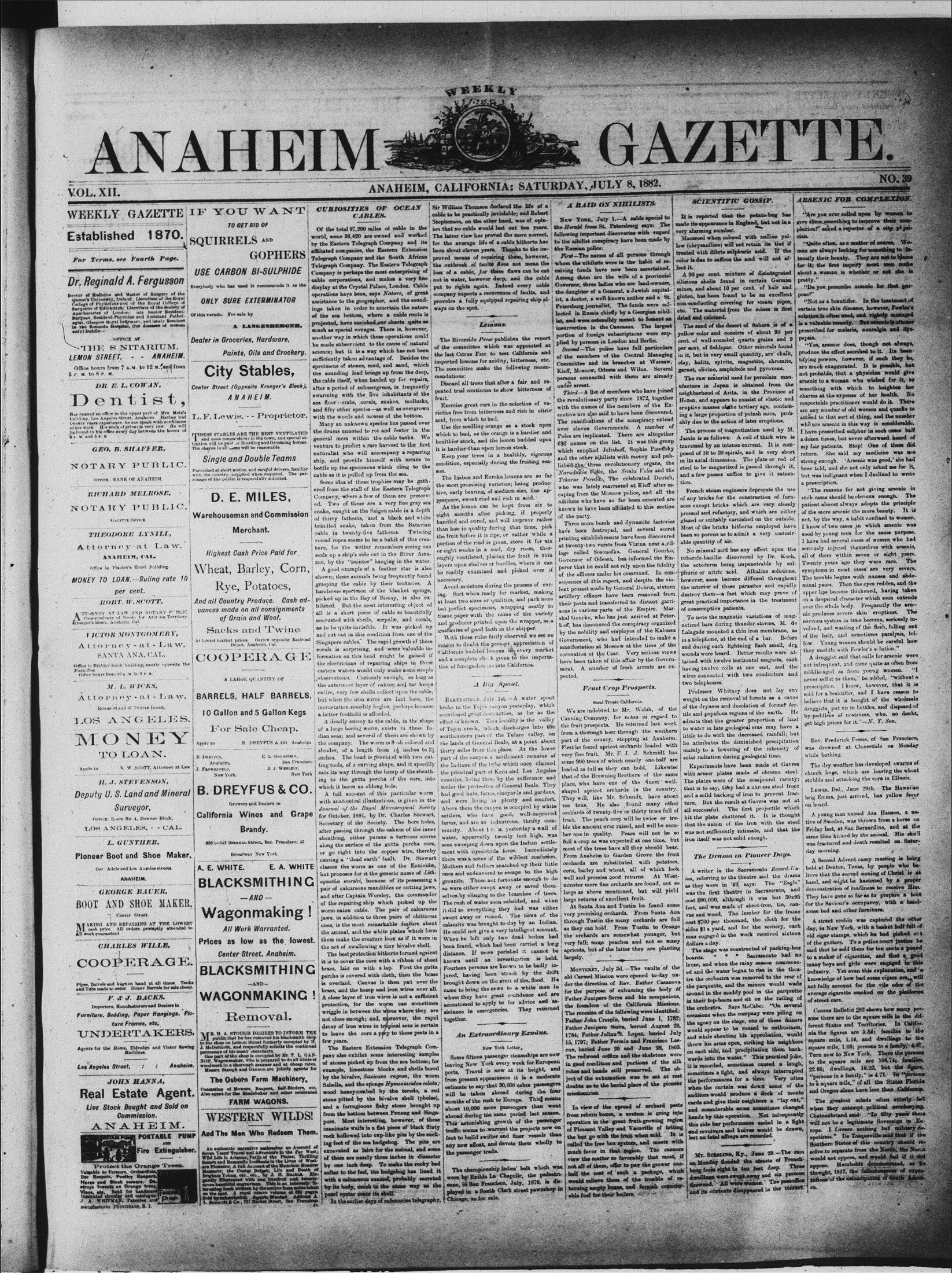
Searchable text
ANAHEIM
VOL. XII.
WEEKLY GAZETTE
Established 1870.
For Terms, see Fourth Page.
Dr. Reginald A. Fergusson
Doctor of Medicine and Master of Surgery of the Queen's University, Ireland; Licentiate of the Royal College of Physicians and of the Royal College of Surgeons of Edinburgh; Licentiate of the Society of Apachecaries of London; late Senior Resident-Burgeon, Resident Physician and Assistant Pathologist, Glangow Royal Infirmary, and lately Resident in the Retunda Hospital, (for diseases of women only) Dublin.
OFFICE AT THE SNITARIUM.
LEMON STREET. - - ANAHEIM.
Office hours from 7 A.M. to 12 M., and from 5 P.M. to 8 P.M.
DR. E. L. COWAN,
Dentist,
Has opened an office in the upper part of Mrs. Mettr's building, Los Angeles Street, Anaheim. Having had twenty years experience, he can speak with confidence of his work. His scale of prices is very low. He will be found in his office every day between the hours of 9 A.M. and 5 P.M.
GEO. B. SHAFFER,
NOTARY PUBLIC.
IF YOU WANT TO GET RID OF SQUIRRELS AND GOPHERS USE CARBON BI-SULPHIDE
Everybody who has used it recommends it as the ONLY SURE EXTERMINATOR Of this vermin. For sale by A. LANGENBERGER.
Dealer in Groceries, Hardware, Paints, Oils and Crockery.
City Stables,
Center Street (Opposite Kroeger's Block),
ANAHEIM.
L. F. Lewis, - Proprietor.
THESE STABLES ARE THE BEST VENTILATED and most commodious in the town, and special attention will be paid to Boarding and Grooming horses. The charve in all cases will be reasonable.
Single and Double Teams
Furnished at short notice, and careful drivers, familiar with the countries supplied when required. The pat-
DR. E. L. COWAN,
Dentist,
Has opened an office in the upper part of Mrs. Metz's building, Los Angeles Street, Anaheim. Having twenty years experience, he can speak with confidence of his work. He scale of prices is very low. He will be found in his office every day between the hours of 9 A.M. and 5 P.M.
GEO. B. SHAFFER,
NOTARY PUBLIC.
OFFICE: BANK OF ANAHEIM.
RICHARD MELROSE,
NOTARY PUBLIC.
GAZETTE OFFICE.
THEODORE LYNILL,
Attorney at Law.
ANAHEIM, CAL.
Office in Planter's Hotel Building.
MONEY TO LOAN.—Ruling rate 10 per cent.
RORT. W. SCOTT.
ATTORNEY AT LAW AND NOTARY PUBLIC.
Commissioner of Dues for Arizona Territory.
Kroeger's block, Anaheim, Cal.
VICTOR MONTGOMERY,
Attorney-at-Law,
SANTA ANA, CAL.
Office in Dibbles' brick building, nearly opposite the Postoffice.
Office hours from 10 A.M. to 3 P.M.
M. L. WICKS,
Attorney-at-Law.
Rooms 86 and 87 Temple Block.
LOS ANGELES.
MONEY TO LOAN.
Apply to R. W. SCOTT, Attorney at Law
H. J. STEVENSON,
Deputy U.S. Land and Mineral Surveyor,
Office: Room No 4, Downey Block,
LOS ANGELES, -- CAL.
L. GUNTHER.
Pioneer Boot and Shoe Maker,
Cor. Adelaide and Los Angeles streets.
ANAHEIM.
GEORGE BAUER.
CITY STABLES,
Center Street (Opposite Kroeger's Block),
ANAHEIM.
L.F. Lewis, - Proprietor.
THESE STABLES ARE THE BEST VENTILATED and most commodious in the town, and special attention will be paid to Boarding and Grooming horses. The charge in all cases will be reasonable.
Single and Double Teams
Furnished at short notice, and careful drivers, familiar with the country, supplied when required. The patrolage of the public is respectfully solicited.
D. E. MILES,
Warehouseman and Commission Merchant.
Highest Cash Price Paid for:
Wheat, Barley, Corn, Rye, Potatoes,
And all Country Produce. Cash advances made on all consignments of Grain and Wool.
Sacks and Twine.
At lowest market prices. Offer opposite Railroad Depot, Anaheim, Cal.
COOPERAGE
A LARGE QUANTITY OF
BARRELS, HALF BARRELS,
10 Gallon and 5 Gallon Kegs
For Sale Cheap.
Apply to B. DREYFUS & Co., Anaheim
B. DREYFUS,
Annaheim,
San Francisco
J. FROWENFELD,
New York
J. WEGLEIN,
New York
B. DREYFUS & CO.
Growers and Dealers in California Wines and Grape Brandy.
630 to 642 Brannan Street, San Francisco; 45 Broadway New York.
A. E. WHITE.
E. A. WHITE
BLACKSMITHING
AND —
Surveyor,
Office: Room No 4, Downey Block,
LOS ANGELES, - CAL.
L. GUNTHER.
Pioneer Boot and Shoe Maker,
Cor. Adele and Los Angeles streets.
ANAHEIM.
GEORGE BAUER,
BOOT AND SHOE MAKER,
Center Street
Making and Repairing at the Lowest cash price. All orders promptly attended to. All work guaranteed.
CHARLES WILLE,
COOPERAGE.
Pipes, Barrels and kegs on hand at all times. Tanks and Tube made to order. Honev Barrels for sale cheap.
F. & J. BACKS.
Importers, Manufacturers and Dealers in Furniture, Bedding, Paper Hangings, Picture Frames, etc,
UNDERTAKERS,
Agents for the Howe, Eldredge and Victor Sewing Machines.
Los Angeles Street, : Anaheim.
JOHN HANNA,
Real Estate Agent.
Live Stock Bought and Sold on Commission.
ANAHEIM.
PORTABLE PUMP AND Fire Extinguisher.
Protect the Orange Trees.
Valeable to Farmers, Orchardists, Bee Keepers, Poetry Keepers, Horse and Stock owners. Do stroys insects on Orange trees, Vines, etc. Send for handsome illustrated circular and catalogue.
J. A. WHITMAN, Palenise and manufacturer. Providence, R.I.
Growers and Dealers in California Wines and Grape Brandy.
630 to 642 Brannan Street, San Francisco; 45 Broadway New York.
A. E. WHITE.
E. A. WHITE
BLACKSMITHING
—AND—
Wagonmaking!
All Work Warranted.
Prices as low as the lowest.
Center Street, Anaheim.
BLACKSMITHING
—AND—
WAGONMAKING!
Removal.
MR. H. A. STOUGH DESIRES TO INFORM THE public that he has removed his blacksmith shop to the shop on Lemon Street formerly occupied by H. J. McDermott, and respectfully solicits the continued patronage of his many customers.
One part of the shop is occupied by Mr. T. L. GAN-NON, Wagonmaker, who is prepared to do all kinds of woodwork in a thorough manner and at cheap rates. Messrs Stough and Gannon are jointly agents for The Osborn Farm Machinery.
Consisting of Mowers, Reapers, Self-Binders, etc. Also agent for the Stulebaker and other celebrated FARM WAGONS.
WESTERN WILDS!
And The Men Who Redeem Them.
An authentic narrative embracing an Account of Seven Years' Travel and Adventure in the Far West; Wild Life in Arizona; Perils of the Plains; Thrilling Scenes and Romantic Incidents in the Lives of Western Pioneers; A full Account of the Mountain Meadow Massacre; the Custer Defeat; Life and Death of Brigham Young, etc., etc., by J. H. Buanka. Eigantly Illustrated with one hundred twenty-seven beautiful engravings. This is an intensely interesting book written by the author from notes taken on the spot. A royal octavo volume of 684 pages Sold by subscription. Agents Wentad. Address A. L. Baneroft & Co., 721 Market Street, San Francisco.
WEEKLY
EIM GA
ANAHEIM, CALIFORNIA: SATURDAY, JULY 8, 1882.
CURIOSITIES OF OCEAN CABLES.
Of the total 97,200 miles of cable in the world, some 36,420 are owned and worked by the Eastern Telegraph Company and its affiliated companies, the Eastern Extension Telegraph Company and the South African Telegraph Company. The Eastern Telegraph Company is perhaps the most enterprising of cable corporations, and makes a very fine display at the Crystal Palace, London. Cable operations have been, says Nature, of great assistance to the geographer, and the soundings taken in order to ascertain the nature of the sea bottom, where a cable route is projected, have enriched our charts quite as much as special voyages. There is, however, another way in which these operations could be made subservient to the cause of natural science; but it is a way which has not been sufficiently taken advantage of. Besides the specimens of stones, mud, and sand, which the sounding lead brings up from the deep, the cable itself, when hauled up for repairs, after a period of submergence, is frequently swarming with the five inhabitants of the sea floor—crabs, corals, snakes, mollusks, and fifty other species—as well as overgrown with the weeds and mosses of the bottom.
Many an unknown species has passed over the drums unnoted to rot and fester in the general mess within the cable tanks. We venture to predict a rare harvest to the first naturalist who will accompany a repairing ship, and provide himself with means to bottle up the specimens which cling to the cable as it is pulled up from the sea.
Sir William Thomson declared the life of a cable to be practically inviolable; and Robert Stephenson, on the other hand, was of opinion that no cable would last out ten years. The latter view has proved the more correct, for the average life of a cable hitherto has been about eleven years. Thanks to the improved means of repairing them, however, the outbreak of faults does not mean the loss of a cable, for these flaws can be cut out in water, however deep, and the cable put to rights again. Indeed every cable company expects a recurrence of faults, and provides a fully equipped repairing ship always on the spot.
LEMONS.
The Riverside Press publishes the report of the committee which was appointed at the last Citrus Fair to test California and imported lemons for acidity, bitterness, etc. The committee make the following recommendations:
Discard all trees that after a fair and repeated trial continues to show bitterness of fruit.
Exercise great care in the selection of varieties free from bitterness and rich in citric acid, from which to bud.
Use the seedling orange as a stock upon which to bud, as the orange is a hardier and healthier stock, and the lemon budded upon it is harder than upon lemon stock.
Keep your trees in a healthy, vigorous condition, especially during the fruiting season.
A RAID ON NIHILISTS:
New York, July 1.—A cable special to the Herald from St. Petersburg says: The following important discoveries with regard to the nihilist conspiracy have been made by the Russian police:
First—The names of all persons through whom the nihilists were in the habit of receiving funds have now been ascertained. Among them are the wife of a provincial Governor, three ladies who are land-owners, the daughter of a General, a Jewish capitalist, a doctor, a well-known author and a St. Petersburg journalist. The funds were collected in Russia chiefly by a Georgian nihilist, and were extensively meant to foment an insurrection in the Caucasus. The largest portion of foreign subscriptions were supplied by persons in London and Berlin.
Second—The police have full particulars of the members of the Central Managing Committee and its branches at Warsaw, Kieff, Moscow, Odessa and Wilns. Several persons connected with them are already under arrest.
Third—A list of members who have joined the revolutionary party since 1872, together with the names of the members of the Executive are also said to have been discovered. The ramifications of the conspiracy extend over eleven Governments. A number of Poles are implicated. There are altogether 680 names on the list. It was this group which supplied Jeliaboff, Sophie Pieoffsky and the other nihilists with money and published the three revolutionary organs, the Naradaia Volia, the Semla Volia and the
Some an unknown species has passed over the drums unnoted to rot and fester in the general mess within the cable tanks. We venture to predict a rare harvest to the first naturalist who will accompany a repairing ship, and provide himself with means to bottle up the specimens which cling to the cable as it is pulled up from the sea.
Some idea of these trophies may be gathered from the stall of the Eastern Telegraph Company, where a few of them are preserved. Two of these are a very fine gray sea snake, caught on the Saigon cable in a depth of thirty fathoms, and a black and white brindled snake, taken from the Batavian cable in twenty-five fathoms. Twisting round ropes seems to be a habit of this creature, for the writer remembers seeing one scale up a ship's side out in the River Amazon, by the "painter" hanging in the water.
A good example of a feather star is also shown; these animals being frequently found grasping the cable by their tentacles. A handsome specimen of the blanket sponge, picked up in the Bay of Biscay, is also exhibited. But the most interesting object of all is a short piece of cable so beautifully encrusted with shells, serpula, and corals, as to be quite invisible. It was picked up and cut out in this condition from one of the Singapore cables. The rapid growth of these corals is surprising, and some valuable information on this head might be gained if the electricians of repairing ships in these eastern waters would only make some simple observations. Curiously enough, so long as the outermost layer of oakum and tar keeps entire, very few shells collect upon the cable, but when the iron wires are laid bare, the incrustation speedily begins, perhaps because a better foothold is afforded.
A deadly enemy to the cable, in the shape of a large boring worm, exists in these Indian seas; and several of them are shown by the company. The worm is flesh colored and slender, of a length from 14 inches to 23 inches. The head is provided with two cutting tools, of a curving shape, and it speedily eats its way through the hemp of the sheathing to the gutta percha of the core, into which it bores an oblong hole.
A full account of this particular worm, with anatomical illustrations, is given in the Journal of the Royal Microscopical Society for October, 1881, by Dr. Charles Stewart, Secretary of the Society. The bore holes, after passing through the oakum of the inner sheathing, either pursue a tortuous course along the surface of the gutta percha core, or go right into the copper wire, thereby causing a "dead earth" fault. Dr. Stewart classes the worm as one of the Eunicidae, but proposes for it the generic name of Lithognatha worslei, because of its possessing a pair of calcareous mandibles or cutting jaws, and after Captain Worsley, the commander
Discard all trees that after a fair and repeated trial continues to show bitterness of fruit.
Exercise great care in the selection of varieties free from bitterness and rich in citric acid, from which to bud.
Use the seedling orange as a stock upon which to bud, as the orange is a hardier and healthier stock, and the lemon budded upon it is harder than upon lemon stock.
Keep your trees in a healthy, vigorous condition, especially during the fruiting season.
The Lisbon and Eureka lemons are so far the most promising varieties; being productive, early bearing, of medium size, fine appearance, sweet rind and rich in acid.
As the lemon can be kept from six to eight months after picking, if properly handled and cured, and will improve rather than lose in quality during that time, pick the fruit before it is ripe, or rather while a portion of the rind is green, store it for six or eight weeks in a cool, dry room, thoroughly ventilated, placing the fruit in thin layers upon shelves or hurdles, where it can be readily examined and picked over if necessary.
Avoid moisture during the process of curing. Sort when ready for market, making at least two sizes or qualities, and pack none but perfect specimens, wrapping neatly in tissue paper with the name of the variety and producer printed upon the wrapper, as a guarantee of good faith in the shipper.
With these rules fairly observed we see no reason to doubt the prompt appreciation of California budded lemons in every market and a complete check given to the importation of foreign lemons into California.
A Big Spout.
BAKERFIELD, July 1st.—A water spout broke in the Tejon canyon yesterday, which occasioned great destruction, as far as the effect is known. This locality is the valley of Tejon creek, which discharges into the southeastern part of the Tulare valley, on the lands of General Beale, at a point about thirty miles from this place. At the lower part of the canyon a settlement remains of the Indians of the tribe which once claimed the principal part of Kern and Los Angeles counties, living there by the sufferance and under the protection of General Beale. They had good huts, farms, vineyards and gardens, and were living in plenty and comfort. Above them the canyon is occupied by white settlers, who have good, well-improved farms, and are an industrious, thrifty community. About 4 p.m. yesterday a wall of water, apparently twenty feet high, was seen sweeping down upon the Indian settlement with irresistible force. Immediately there was a scene of the wildest confusion. Mothers and fathers snatched up their little ones and endeavored to escape to the high grounds. Those not fortunate enough to do so were either swept away or saved themselves by clinging to the branches of trees.
Persons connected with them are already under arrest.
Third—A list of members who have joined the revolutionary party since 1872, together with the names of the members of the Executive are also said to have been discovered. The ramifications of the conspiracy extend over eleven Governments. A number of Poles are implicated. There are altogether 680 names on the list. It was this group which supplied Jeliaiboff, Sophie Pieffsky and other nihilists with money and published the three revolutionary organs, the Naradaia Volia, the Semla Volia and the Tchorne Perela. The celebrated Deutsch who was lately rearrested at Kieff after escaping from Moscow police, and all the nihilists who have so far been executed are known to have been affiliated to this section of the party.
Three more bomb and dynamite factories have been destroyed, and several secret printing establishments have been discovered at twenty-two versts from Vizina near a village called Sosonofka. General Gourko Governor of Olesna, has informed the Emperor that he could not rely upon the fidelity of the officers under his command. In consequence of this report, and despite the violent protest made by General Dobrin, sixteen artillery officers have been removed from their posts and transferred to distant garriers in various parts of the Empire. Marshal Gourke, who has just arrived at Peter Hoff, has denounced the conspiracy organizer by the nobility and employees of the Kalone Government, who had intended to make a manifestation at Moscow at the time of her coronation of the Czar. Very serious views have been taken of this affair by the Government. A number of fresh arrests are expected.
Fruit Crop Prospects.
Seml-Tropic California.
We are indebted to Mr. Welsh, of The Canning Company, for notes in regard to the fruit prospects. He returned last week from a thorough tour through the southern part of the county, stopping at Anaheim First he found apricot orchards loaded with very fine fruit. Mr. F. J. J. Schmidt has some 900 trees of which nearly one-half are loaded as full as they can hold. Likewise that of the Browning Brothers of the same place, who have one of the finest well-shaped apricot orchards in the country. They will, like Mr. Schmidt, have about ten tons. He also found many other orchards of twenty-five or thirty trees full fruit. The peach crop will be twice or triplethe amount ever raised, and will be number one in quality. Pearls will not be full a crop as was expected at one time; but most of the trees have all they should be.From Anaheim to Garden Grove the fright orchards are substituted with potato corn; barley and wheat; all of which loom well and promise good returns.At Westminster more fine orchards are found; not large as above mentioned; but will yield large returns of excellent fruit.
with anatomical illustrations, is given in the Journal of the Royal Microscopical Society for October, 1881, by Dr. Charles Stewart, Secretary of the Society. The bore holes, after passing through the oakum of the inner sheathing, either pursue a tortuous course along the surface of the gutta percha core, or go right into the copper wire, thereby causing a "dead earth" fault. Dr. Stewart classes the worm as one of the Eunicidae, but proposes for it the generic name of Lithognatha worslei, because of its possessing a pair of calcareous mandibles or cutting jaws, and after Captain Worsley, the commander of the repairing ship which picked up the worm-eaten cable. The pair of calcareous jaws, in addition to three pairs of chitinous ones, is the most remarkable feature about the animal, and the white plates which form them make the creature look as if it were in the act of swallowing a tiny bivalve shell.
The best protection hitherto formed against it is to cover the core with a ribbon of sheet brass, laid on with a lap. First the gutta percha is covered with cloth, then the brass is overlaid. Canvas is then put over the brass, and the hemp and iron wires over all. A close layer of iron wires is not a sufficient protection, for the worm can sometimes wriggle in between the wires where they are not close enough; and, moreover, the rapid decay of iron wires in tropical seas is certain to leave the core a prey to these pests in a few years.
The Eastern Extension Telegraph Company also exhibit some interesting samples of stones picked up from the sea bottom; for example, limestone blocks and shells bored by the bivalve, Saxicava ragosa, the worm Sabella, and the sponge Hymeniscidon celata; wood honeycombed by the teredo, a red stone pitted by the bivalve shell (pholas), and a ferruginous flaky stone brought up from the bottom between Penang and Singapore. Most interesting, however, of these inanimate waifs is a flat piece of black flint rock hollowed into cup-like pits by the sucking feet of the sea hedgehog. The pits are excavated as lairs for the animal, and some of them are nearly three inches in diameter by one inch deep. To make the rocky bed softer to the feel, the hedgehog has lined it with a calcareous enamel, probably secreted by its body, much in the same way as the pearl oyester coats its shell.
In the earlier days of submarine telegraphy, and were living in plenty and comfort. Above them the canyon is occupied by white settlers, who have good, well-improved farms, and are an industrious, thrifty community. About 4 P.M. yesterday a wall of water, apparently twenty feet high, was seen sweeping down upon the Indian settlement with irresistible force. Immediately there was a scene of the wildest confusion. Mothers and fathers snatched up their little ones and endeavored to escape to the high grounds. Those not fortunate enough to do so were either swept away or saved themselves by clinging to the branches of trees. The rush of water soon subsided, and when it did so everything they had was either swept away or ruined. The news of the calamity was brought to-day by an Indian. He could not give a very intelligent account. When he left only two dead bodies had been found, which had been carried a long distance. If more perished it cannot be known until an investigation is held. Fourteen persons are known to be badly injured, having been struck by the drift brought down on the crest of the flood. He came to bring the news to a white man in whom they have great confidence and are accustomed to apply to for advice and assistance in emergencies. They returned together.
An Extraordinary Exodus.
New York Letter.
Some fifteen passenger steamships are now leaving New York every week for European ports. Travel is now at its height, and from present appearances it is a moderate estimate to say that 30,000 cabin passengers will be taken abroad during the four months of the rush to Europe. This means about 10,000 more passengers than went abroad during the same period last season. This astonishing growth of the passenger traffic seems to warrant the projects now on foot to build swifter and finer vessels than any now afloat, and devote them wholly to the passenger trade.
The championship ladies' belt which was worn by Exilda La Chapelle, the pedestrienne, in San Francisco, July, 1879, is displayed in a South Clark street pawnshop in Chicago, as for sale.
In view of the spread of orchard pigs from return boxes, a system is going operation in the great fruit-growing reef of Pleasant Valley and Vacaville of let-the box go with the fruit when sold. I called the free box system, and meets much favor in that region. The cannery view the matter so favorably that most not all of them, offer to pay the grower half the cost of such a package, we would relieve them of the trouble of turning empty boxes, and furnish countable fuel for their boilers.
GAZETTE.
JULY 8, 1882.
ON NIHILISTS:
July 1.—A cable special to St. Petersburg says: The great discoveries with regard to conspiracy have been made by virtue of all persons through which were in the habit of re-remove now been ascertained. Are the wife of a provincial ladies who are landowners, a General, a Jewish capital-well-known author and a St. Paulist. The funds were collected chiefly by a Georgian nihilistically meant to foment an insurrection in the Caucasus. The largest sign subscriptions were superseded in London and Berlin. Police have full particulars of the Central Managing Board at Warsaw, Odessa and Wilna. Several articles related with them are already available.
All members who have joined any party since 1872, together with the members of the Excise said to have been discovered, sons of the conspiracy extend Government. A number of educated. There are altogether in the list. It was this group Jeliaboff, Sophie Pieoffsky, Nihilists with money and publishes revolutionary organs, theologia, the Semla Volia and the arsenic for complexion.
It is reported that the potato-bug has made its appearance in England, but not in a very alarming number.
Macaroni when colored with aniline yellow (chrysaniline) will not retain its tint if treated with dilute sulphuric acid. If the color is due to saffron the acid will not affect it.
A 90 per cent. mixture of disintegrated silicious shells found in certain German mines, and about 10 per cent. of hair and gluten, has been found to be an excellent non-conducting covering for steam pipes, etc. The material from the mines is first dried and calcined.
The sand of the desert of Sahara is of a yellow color and consists of about 90 per cent. of well-rounded quartz grains and 9 per cent. of fieldspar. Other minerals found in it, but in very small quantity, are chalk, clay, halitz, sylvite, magnetite, chromite, garnet, olivine, amphibole and pyroxene.
The raw material used for porcelain manufacture in Japan is obtained from the neighborhood of Arita, in the Province of Hezen, and appears to consist of elastic and eruptive masses of the tertiary age, containing a large proportion of potash mica, probably due to the action of later eruptions.
The process of magnetization used by M. Jamin is as follows: A coil of thick wire is traversed by an intense current. It is composed of 10 to 20 spirals, and is very short in its axial dimension. The plate or rod of steel to be magnetized is passed through it, and a few passes suffice to give it saturation.
ARSENIC FOR COMPLEXION.
"Are you ever called upon by women to give them something to improve their complexion?" asked a reporter of a city physician.
"Quite often, as a matter of course. Women are always looking for something to intensify their beauty. They are not to blame for it; the first inquiry most men make about a woman is whether or not she is pretty."
"Do you prescribe arsenic for that purpose?"
"Not as a beautifier. In the treatment of certain true skin diseases, however, Powler's solution is often used, and rightly managed is a valuable remedy. But arsenic is oftener prescribed for malaria, neuralgia and dyspepsia."
"Yes, arsenic does, though not always, produce the effect ascribed to it. Its beautifying powers, however, if such they be, are much exaggerated. It is possible, but not probable, that a physician would give arsenic to a woman who wished for it, as something with which to heighten her charms at the expense of her health. No respectable practitioner would do it. There are any number of old women and quacks to attend to that sort of thing, and the number who use arsenic in this way is considerable. I have prescribed sulphur in such cases half a dozen times, but never afterward heard of my fair patients. Stop! One of them did return. She said my medicine was not strong enough." Arsenic was good," she had been told, and she not only asked me for it, but may indigestion when I declined to write...
The raw material used for porcelain manufacture in Japan is obtained from the neighborhood of Arita, in the Province of Hezen, and appears to consist of elastic and eruptive masses of the tertiary age, containing a large proportion of potash mica, probably due to the action of later eruptions.
The process of magnetization used by M. Jamin is as follows: A coil of thick wire is traversed by an intense current. It is composed of 10 to 20 spirals, and is very short in its axial dimension. The plate or rod of steel to be magnetized is passed through it, and a few passes suffice to give it saturation.
French steam engineers deprecate the use of any bricks for the construction of furnaces except brick which are very closely pressed and refractory, and which are either glazed or suitably varnished on the outside. Most of the bricks hitherto employed have been so porous as to admit a very undesirable quantity of air.
No mineral acid has any effect upon the tubercle-bacillus discovered by Dr. Koch, the ectoderm being impenetrable by sulphuric or nitric acid. Alkaline solutions, however, soon become diffused throughout the interior of these parasites and rapidly destroy them—a fact which may prove of great practical importance in the treatment of consumptive patients.
To note the magnetic variations of magnetized bars during thunder-storms, M. de Lalagade mounted a thin iron membrane, as in a telephone, at the end of a bar. Before and during each lightning flash small, dry sounds were heard. Better results were attained with twelve horizontal magnets, each having twelve coils at one end, and the wires connected with two conductors and two telephones.
Professor Whitney does not lay any weight on the removal of forests as a cause of the dryness and desolation of former fertile and populous regions of the earth. He admits that the greater proportion of land to water in late geological eras may have a little to do with the decreased rainfall; but he attributes the diminished precipitation mainly to a lowering of the intensity of solar radiation during geological time.
Experiments have been made at Gavres with armor plates made of chrome steel. The plates were of the compound variety; that is to say, they had a chrome steel front and a solid backing of iron to prevent fracture. But the result at Gavres was not at all successful. The first projectile which hit the plate shattered it. It is thought that the union of the iron with the steel was not sufficiently intimate, and that the iron itself was not solid enough.
The Drama in Pioneer Days.
A writer in the Sacramento Record-Union, referring to the theatre and the drama as they were in '49, says: The "Eagle" was the first theatre in Sacramento, and cost $80,000 although it was but 30x95 not probable, that a physical would give arsenic to a woman who wished for it, as something with which to heighten her charms at the expense of her health. No respectable practitioner would do it. There are any number of old women and quacks to attend to that sort of thing, and the number who use arsenic in this way is considerable. I have prescribed sulphur in such cases half a dozen times, but never afterward heard of my fair patients. Stop! One of them did return. She said my medicine was not strong enough. 'Arsenic was good,' she had been told, and she not only asked me for it, but was indignant when I declined to write a prescription.
"The reasons for not giving arsenic in such cases should be obvious enough. The patient almost always adopts the principle of the more arsenic the more beauty. It is not, by the way, a habit confined to women. I know of two cases in which arsenic was used by young men for the same purpose. I have had several cases of women who had seriously injured themselves with arsenic, all of them within seven or eight years. Twenty years ago they were rare. The symptoms in most cases are very severe. The trouble begins with nausea and abdominal pains. Then the eyes redden, and the upper lips become thickened, having taken on a dropsical character which soon extends over the whole body. Frequently the arsenic produces severe skin eruptions. The nervous system in time becomes, seriously involved, and wasting of the flesh, falling out of the hair, and sometimes paralysis, follow. Young women should be careful how they meddle with Powler's solution."
A druggist said that calls for arsenic were not infrequent, and came quite as often from middle-aged as from young women. "I never sell it to them," he added, "without a prescription. I know, however, that it is sold for a beautifier, and I have reason to believe that it is bought of the wholesale druggists, put up in bottles, and disposed of by peddlers of nostrums, who no doubt get high prices for it."—N. Y. Sun.
Rev. Frederick Fenne, of San Francisco, was drowned at Cloverdale on Monday while bathing.
The dry weather has developed swarms of chinch bugs, which are leaving the wheat stubble and attacking the corn in Illinois.
Lewes, Del., June 29th.-The Hawaiian brig Emma, just arrived, has yellow fever on board.
A young man named Asa Hanson, a native of Sweden, was thrown from a horse on Friday last, at San Bernardino, and at the same time kicked by the animal. His skull was fractured and death resulted on Saturday morning.
A Second Advent camp meeting is being held at Denton, Texas, by people who believe that the second coming of Christ is at hand, and might be hastened by a proper demonstration of readiness to receive Him. They have gone so far as to prepare a tent
He also found many other twenty-five or thirty trees full of peach crop will be twice or treenight ever raised, and will be numuality. Pears will not be so was expected at one time, but trees have all they should bear.
From Garden Grove the fruit substituted with potatoes, and wheat, all of which look sunrise good returns. At West-Fine orchards are found, not so severe mentioned, but will yield of excellent fruit.
Ana and Tustin he found some young orchards. From Santa Ana in the many orchards are full hold. From Tustin to Orange are somewhat younger, but large peaches and not so many of the latter they are planting.
July 3d.—The vaults of the mission were opened to-day unction of Rev. Father Casanova purpose of exhuming the body ofpero Serra and his companions, of the California Missions. Of the following were identified:
Crespin, buried June 1, 1782;
pero Serra, burned August 28,
Julian S. Lopez, buried July
Father Fermin and Francisco LasJune 26 and June 28, 1803.
coffins and the skeletons were addition and portions of the silk bands still preserved. The obexhumation was to set at rest in the burial place of the pioneer
Of the spread of orchard pests in boxes, a system is going into on the great fruit-growing region Valley and Vacaville of letting with the fruit when sold. It is three box system, and meets with in that region. The canners matter so favorably that most, if them, offer to pay the grower one cost of such a package, which have them of the trouble of reupty boxes, and furnish considera their boilers.
Mr. Sterling, Ky., June 29.—The rain on Monday flooded the streets of Frenchburg from eight to ten feet deep. Three dwellings were swept away and six persons drowned. All were women. The postoffice and its contents disappeared in the torrent.
The Drama in Pioneer Days.
A writer in the Sacramento Record-Union, referring to the theatre and the drama as they were in '49, says: The "Eagle" was the first theatre in Sacramento, and cost $80,000, although it was but 30x95 feet, and was made of sheet-iron, tin, canvas and wood. The lumber for the frame cost $700 per thousand, the cloth for the sides $1 a yard, and for the scenery, each man engaged in the work received sixteen dollars a day.
The stage was constructed of packing-box boards. Sacramento had no levee, and when the rainy season commenced and the water began to rise in the theatre the orchestra was removed to the rear of the parquette, and the miners would wade around in the muddy pool in the parquette in their top-boots and sit on the railing of the orchestra. Says McCabe: "On several occasions when the company were piling on the agony on the stage, one of these miners would appear to be roased to enthusiasm, and while shouting his approbation, would throw his arms open, striking his neighbors on each side, and precipitating them backwards into the water." This practical joke, it is recorded, sometimes caused a laugh, sometimes a fight, and always interrupted the performances for a time. Very often when the curtain was down some of the auditors would produce a deck of monte cards and give their neighbors a "lay out," and considerable sums sometimes changed hands by this operation. Not infrequently this side bar performance ended in a fight end revolvers and knives would be drawn, but no fatal affrays are recorded.
Census Bulletin 282 shows how many persons there are to the square miles in the different States and Territories. In California the figures are 5.54; families to the square mile, 1.14; and dwellings to the square mile, 1.03; persons to a family, 4.87. Turn now to New York. There the persons to the square mile are 106.74; families, 22.66; dwellings, 16.22, but the figure, "persons in a family," is 4.71. In "persons to a square mile," of all the States Florida and Oregon alone have less than California.
The greatest minds often utterly fail when they attempt political prophecying. Chateaubriand said: "In fifty years there will not be a legitimate Sovereign in Europe. I foresee nothing but military despotisms." De Tocqueville said that if the Southern States of this country should resolve to separate from the North, the Noron would not oppose, and would fail if it did oppose. Humboldt demonstrated, as he thought, 1817, the fallaciousness of expectations of the emancipation of South America.