anaheim-gazette 1882-06-24
Scanned page
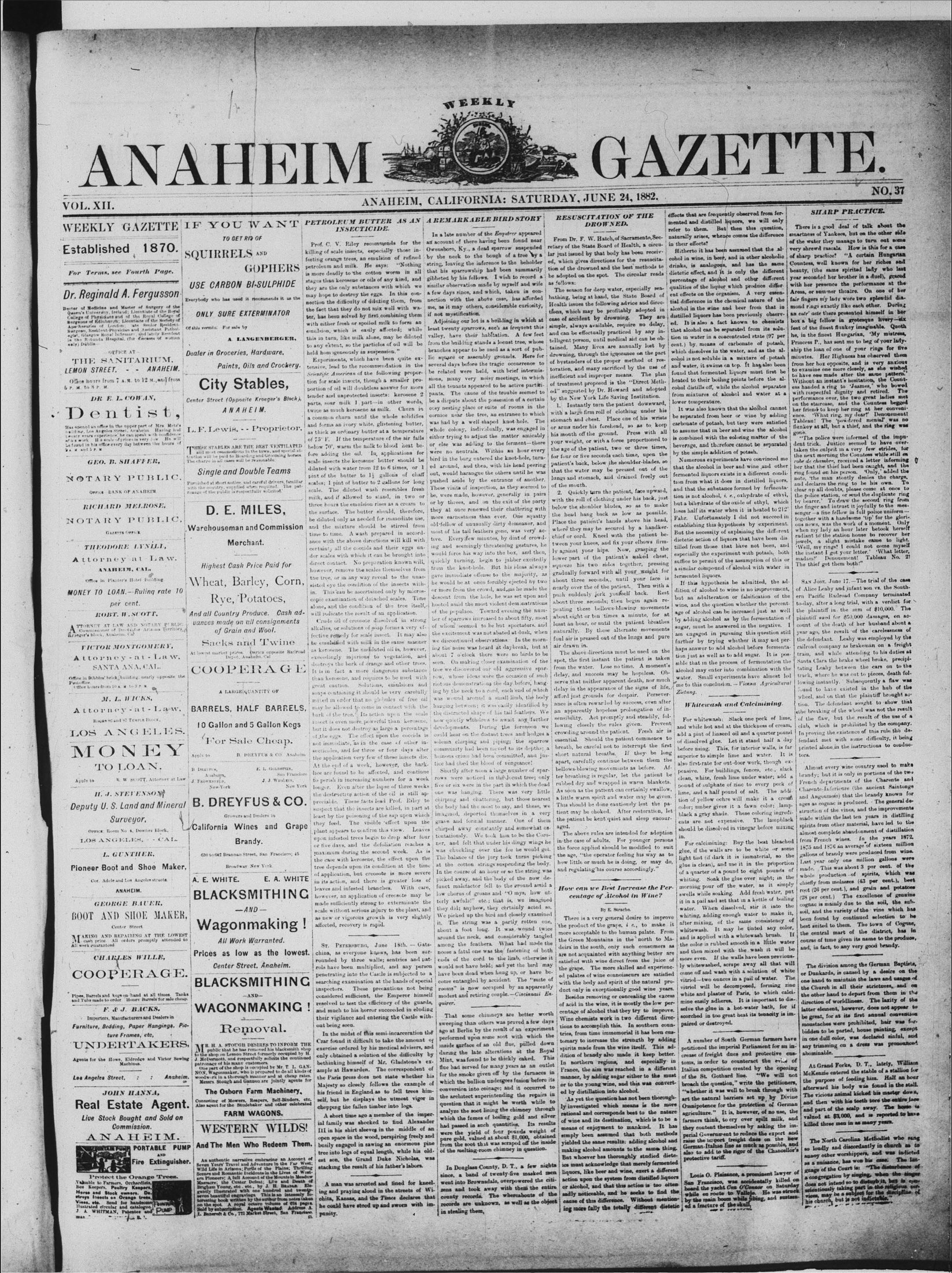
Searchable text
ANAHEIM
VOL. XII.
WEEKLY GAZETTE
Established 1870.
For Terms, see Fourth Page.
Dr. Reginald A. Fergusson
Doctor of Medicine and Master of Surgery of the Queen's University, Ireland; Licentiate of the Royal College of Physicians and of the Royal College of Surgeons of Edinburgh; Licentiate of the Society of Apothecaries of London; ate Senior Resident Nurse, Resident Physician and Assistant Pathologist, Glasgow Royal Infirmary; and later President in the Rotunda Hospital (for Diseases of women only) Dublin.
OFFICE AT
THE SANITARIUM,
LEMON STREET. - - ANAHEIM.
Office hours from 7 A.M. to 12 M., and from 6 P.M. to 8 P.M.
DR E. L. COWAN,
Dentist,
Has opened an office in the upper part of Mrs Metz's building, Los Angeles Street, Anaheim. Having had twenty years experience, he can speak with confidence at his work. His scale of prices is very low. He will be found in his office every day between the hours of 8 A.M. and 5 P.M.
GEO. B. SHAFFER,
IF YOU WANT
TO GET RID OF
SQUIRRELS AND
GOPHERS
USE CARBON BI-SULPHIDE
Everybody who has used it recommends it as the ONLY SURE EXTERMINATOR
Of this vermin. For sale by
A LANGENBERGER,
Dealer in Groceries, Hardware,
Paints, Oils and Crockery.
City Stables,
Center Street (Opposite Kroeger’s Block),
ANAHEIM.
L.F. Lewis, - Proprietor.
THESE STABLES ARE THE BEST VENTILATED and most commodious in the town, and special attention will be paid to Boarding and Grooming horses. The charge in all cases will be reasonable.
Single and Double Teams
PETROLEUM INSECTS
Prof. C. V. Riley killing of scale insects festing orange trees petroleum and milk is more deadly to stages than kerosene they are the only source may hope to destroy connection the difficulty the fact that they enter, has been solved with either fresh or emulsion, which is this in turn, like us to any extent, so that held homogeneous.
Experiments, when tensive, lead to the Scientific American question for scale insect portion of oil will tender and unprotect parts, sour milk twice as much keratin a common churn u and forms an ivory as thick as ordinary of 75°F. If the tallow below 70°, warm the fore adding the scale insects the kind diluted with water.
DR E. L. COWAN,
Dentist,
Has opened an office in the upper part of Mrs Metz's building, Los Angeles Street, Anaheim. Having had twenty years experience he can speak with confidence at his work. His scale of prices is very low. He will be found in his office every day between the hours of 8 P.M. and 5 P.M.
GEO. B. SHAFFER,
NOTARY PUBLIC.
OFFICE: BANK OF ANAHEIM
RICHARD MELROSE,
NOTARY PUBLIC.
GAZETTER OFFICE
THEODORE LYNILL,
Attorney at Law.
ANAHEIM, CAL.
Office in Planter's Hotel Building.
MONEY TO LOAN.—Ruling rate 10 per cent.
ROBT W. SCOTT.
ATTORNEY AT LAW AND NOTARY PUBLIC.
Commissioner of Design for Arizona Territory.
Kroeger's Block, Anaheim, Cal.
VICTOR MONTGOMERY,
Attorney-at-Law,
SANTA ANA, CAL.
Office in Dibbles' brick building, nearly opposite the Postoffice.
Office hours from 10 A.M. to 3 P.M.
M. L. WICKS,
Attorney-at-Law.
Rooms 86 and 87 Temple Block.
LOS ANGELES.
MONEY TO LOAN.
Apply to R. W. SCOTT, Attorney at Law
H. J. STEVENSON,
Deputy U. S. Land and Mineral Surveyor.
OFFICE: Room No 4, Downey Block.
LOS ANGELES, - CAL.
L. GUNTHER,
Pioneer Boot and Shoe Maker,
Cor. Adelaide and Los Angeles streets.
ANAHEIM.
City Stables,
Center Street (Opposite Kroeger's Block),
ANAHEIM.
L.F. Lewis. -- Proprietor.
THESE STABLES ARE THE BEST VENTILATED and most commodious in the town, and special attention will be paid to Boarding and Grooming horses. The charge in all cases will be reasonable.
Single and Double Teams
Purchased at short notice, and careful drivers, familiar with the country, supplied when required. The patronage of the public is respectfully solicited.
D. E. MILES,
Warehouseman and Commission Merchant.
Highest Cash Price Paid for Wheat, Barley, Corn, Rye, Potatoes, And all Country Produce. Cash advances made on all consignments of Grain and Wool.
Sacks and Twine
At lowest market prices. Offer opposite Railroad Depot, Anaheim, Cal.
COOPERAGE
A LARGE QUANTITY OF
BARRELS, HALF BARRELS,
10 Gallon and 5 Gallon Kegs For Sale Cheap.
Apply to R. DREYFUS & Co., Anaheim
B. DREYFUS,
Anaheim,
San Francisco
J. FROWENLEE,
New York
J. WESLEIN,
New York
B. DREYFUS & CO.
Growers and Dealers in California Wines and Grape Brandy.
630 to 642 Brannan Street, San Francisco; 45 Broadway New York.
A. E. WHITE.
E. A. WHITE
BLACKSMITHING
Deputy U. S. Land and Mineral Surveyor,
Office: Room No 4, Downey Block,
LOS ANGELES, - CAL.
L. GUNTHER.
Pioneer Boot and Shoe Maker,
Cor. Adele and Los Angeles streets.
ANAHEIM.
GEORGE BAUER.
BOOT AND SHOE MAKER,
Center Street
MAKING AND REPAIRING AT THE LOWEST cash price. All orders promptly attended to. All work guaranteed.
CHARLES WILLE,
COOPERAGE.
Pipes, Barrels and kegs on hand at all times. Tanks and Tubs made to order. Honey Barrels for sale cheap.
F. & J. BACKS.
Importers, Manufacturers and Dealers in Furniture, Bedding, Paper Hangings, Picture Frames, etc,
UNDERTAKERS,
Agents for the Howe, Eldredge and Victor Sewing Machines.
Los Angeles Street, : Anaheim.
JOHN HANNA,
Real Estate Agent.
Live Stock Bought and Sold on Commission.
ANAHEIM.
PORTABLE PUMP AND Fire Extinguisher.
Protect the Orange Trees.
Vulnerable to Farmers, Orchardists, Bees Keepers, Poultry Keepers, Horses and Stock owners. De-stroys Insects on Orange trees, Vices, etc. Send for handsome illustrated circular and catalogue.
J. A. WHITMAN, Patentee and man.
B. DREYFUS & CO.
Growers and Dealers in California Wines and Grape Brandy.
630 to 642 Brannan Street, San Francisco; 45 Broadway New York.
A. E. WHITE.
E. A. WHITE
BLACKSMITHING
AND
Wagonmaking!
All Work Warranted.
Prices as low as the lowest. Center Street, Anaheim.
BLACKSMITHING
AND
WAGONMAKING!
Removal.
MR. H. A. STOUGH DESIRES TO INFORM THE public that he has removed his blacksmith shop to the shop on Lemon Street formerly occupied by H. J. McDermott, and respectfully solicits the continued patronage of his many customers.
One part of the shop is occupied by Mr. T. L. GANNON, Wagonmaker, who is prepared to do all kinds of woodwork in a thorough manner and at cheap rates. Messrs. Stough and Gannon are jointly agents for The Osborn Farm Machinery.
Consisting of Mowers, Reapers, Self-Binders, etc. Also agent for the Studebaker and other celebrated FARM WAGONS.
WESTERN WILDS!
And The Men Who Redeem Them.
An authentic narrative embracing an Account of Seven Years' Travel and Adventure in the Far West; Wild Life in Arizona; Perils of the Plains; Thrilling Scenes and Romantic Incidents in the Lives of Western Pioneers; A full Account of the Mountain Meadow Massacre; the Custer Defest; Life and Death of Brigham Young, etc., etc., by J. H. BRADLE. Elegantly illustrated with one hundred and twenty-seven beautiful engravings. This is an intensely interesting book written by the author from notes taken on the spot. A royal octavo volume of 624 pages. Sold by subscription. Agents Wanted. Address A. L. Banereft & Co., 721 Market Street, San Francisco.
WEEKLY
EIM GA
ANAHEIM, CALIFORNIA: SATURDAY, JUNE 24, 1882.
PETROLEUM BUTTER AS AN INSECTICIDE.
Prof. C. V. Riley recommends for the killing of scale insects, especially those infesting orange trees, an emulsion of refined petroleum and milk. He says: "Nothing is more deadly to the cotton worm in all stages than kerosene or oils of any kind, and they are the only substances with which we may hope to destroy the eggs. In this connection the difficulty of diluting them, from the fact that they do not mix well with water, has been solved by first combining them with either fresh or spoiled milk to form an emulsion, which is easily affected; while this in turn, like milk alone, may be diluted to any extent, so the particles of oil will be held homogeneously in suspension."
Experiments, which have been quite extensive, lead to the recommendation in the Scientific American of the following proportion for scale insects, though a smaller proportion of oil will doubtless answer for more tender and unprotected insects: kerosene 2 parts, sour milk 1 part—in other words, twice as much kerosene as milk. Churn in a common churn until the whole solidifies and forms an ivory white, glistening butter, as thick as ordinary butter at a temperature of 75° F. If the temperature of the air falls below 70°, warm the milk to blood heat before adding the oil. In applications for scale insects the kerosene butter should be diluted with water from 12 to 6 times, or 1 part of the butter to the gallons of chaff.
AREMARKABLE BIRD STORY
In a late number of the Enquirer appeared an account of there having been found near Owensboro, Ky., a dead sparrow suspended by the neck to the bough of a tree by a string, leaving the inference to the beholder that his sparrowship had been summarily gibbeted by his fellows. I wish to record a similar observation made by myself and wife a few days since, and which, taken in connection with the above case, has afforded me, as it may others, considerable curiosity, if not mystification.
Adjoining our lot is a building in which at least twenty sparrows, such as frequent this valley, have their habitation. A few feet from the building stands a locust tree, whose branches appear to be used as a sort of public square or assembly grounds. Here for several days before the tragic occurrence to be related were held, with brief intermissions, many very noisy meetings, in which all the tenants appeared to be active participants. The cause of the trouble seemed to be a dispute about the possession of a certain easy nesting place or suite of rooms in the cornice near the tree, an entrance to which was had by a well shaped knot-hole. The whole colony, individually, was engaged in either trying to adjust the matter amicably or else was adding to the ferment—there were no neutrals. Within an hour every bird in the burg entered the knot-hole, turned around, and then, with his head peering out, would harangue the others until he was resuscitated of the drowned.
From Dr. F. W. Hatch, of Sacramento, Secretary of the State Board of Health, a circular just issued by that body has been received, which gives directions for the resuscitation of the drowned and the best methods to be adopted on the spot. The circular reads as follows:
The season for deep water, especially seabathing, being at hand, the State Board of Health issues the following advice and directions, which may be profitably adopted in case of accident by drowning. They are simple, always available, require no delay, and can be effectually practiced by any intelligent person, until medical aid can be obtained. Many lives are annually lost by drowning through the ignorance on the part of bystanders of the proper method of restoration, and many sacrificed by the use of inefficient and improper means. The plan of treatment proposed is the "Direct Method" suggested by Dr. Howard and adopted by the New York Life Saving Institution.
1. Instantly turn the patient downward, with a large firm roll of clothing under his stomach and chest. Place one of his wrists or arms under his forehead, so as to keep his mouth off the ground. Press with all your weight, or with a force proportioned to the age of the patient, two or three times, for four or five seconds each time, upon the patient's back, below the shoulder-blades, so that the water may be pressed out of the
Scientific American of the following proportion for scale insects, though a smaller proportion of oil will doubtless answer for more tender and unprotected insects: kerosene 2 parts, sour milk 1 part—in other words, twice as much kerosene as milk. Churn in a common churn until the whole solidifies and forms an ivory white, glistening butter, as thick as ordinary butter at a temperature of 75° F. If the temperature of the air falls below 70°, warm the milk to blood heat before adding the oil. In applications for scale insects the kerosene butter should be diluted with water from 12 to 6 times, or 1 pint of the butter to 1½ gallons of chaff scales; 1 pint of butter to 2 gallons for long scale. The diluted wash resembles fresh milk, and if allowed to stand, in two or three hours the emulsion rises as a cream to the surface. The butter should, therefore, be diluted only as needed for immediate use, and the mixture should be stirred from time to time. A wash prepared in accordance with the above directions will kill with certainty all the cocciids and their eggs under scales which it can be brought into direct contact. No preparation known will however, remove the scales themselves from the tree, or in any way reveal to the unaassisted eye the condition of the insects within. This can be ascertained only by microscopic examination of detached scales. Time alone, and the condition of the tree itself, will indicate the result of an application.
Crude oil of cresolene dissolved in strong alkalies, or solutions of soap forms a very effective remedy for scale insect. It may also be emulsified with milk in the same manner as kerosene. The undiluted oil is, however, exceedingly injurious to vegetation, and destroys the bark of orange and other trees. It is in fact a more dangerous substance than kerosene, and requires to be used with great caution. Solutions, emulsions and soaps containing it should be very carefully mixed in order that no globules of free oil may be allowed to come in contact with the bark of the tree. Its action upon the scale insect is even more powerful than kerosene, but it does not destroy as large a percentage of the eggs. The effect upon the cocciids is not immediate, as in the case of other insecticides, and for three or four days after the application very few of these insects die. At the end of a week, however, the barkicee is found to be affected, and continue to perish in increasing numbers for a week longer. Even after the lapse of three weeks the destructive action of the oil is still appreciable. These facts lead Prof. Eiley to suspect that the insects are killed, in part at least by the poisoning of the sap upon which they feed. The visible effect upon the plant appears to confirm this view. Leaves upon infested trees begin to drop after four or five days, and the defoliation reaches a maximum during the second week. As is the case with kerosene, the effect upon the tree depends upon its condition at the time of application, but creosote is more severe in its action, and there is greater loss of leaves and infested branches. With care, however, an application of creosote may be inefficient and improper means. The plan of treatment proposed is the "Direct Method" suggested by Dr. Howard and adopted by the New York Life Saving Institution.
1. Instantly turn the patient downward, with a large firm roll of clothing under his stomach and chest. Place one of his wrists or arms under his forehead, so as to keep his mouth off the ground. Press with all your weight, or with a force proportioned to the age of the patient, two or three times, for four or five seconds each time, upon the patient's back, below the shoulder-blades, so that the water may be pressed out of the lungs and stomach, and drained freely out of the mouth.
2. Quickly turn the patient face upward, with the roll of clothing under his back, just below the shoulder blades, so as to make the head hang back as low as possible. Place the patient's hands above his head, where they may be secured by a handkerchief or cord. Kneel with the patient between your knees, and fix your elbows firmly against your hips. Now, grasping the lower part of the patient's naked chest, squeeze his two sides together, pressing gradually forward with all your weight for about three seconds., until your face is nearly over the of the patient. Then with a push suddenly jerk yourself back. Rest about three seconds; then begin again repeating these bellows-blowing movements about eight or ten times a minute, for at least an hour, or until the patient breathes naturally. By these alternate movements foul air is pressed out of the lungs and pure air drawn in.
The above directions must be used on the spot, the first instant the patient is taken from the water. Lose no time. A moment's delay, and success may be hopeless. Observe that neither apparent death nor much delay in the appearance of the signs of life afford just grounds for despair. Perseverance is often rewarded by success, even after an apparently hopeless prolongation of insensibility. Act promptly and steadily, following closely the rules given. Prevent crowding around the patient. Fresh air is essential. Should the patient commence to breath, be careful not to interrupt the first short natural breaths. If they be long apart, carefully continue between them the bellows-blowing movements as before.
After breathing is regular, let the patient be rubbed dry and wrapped in warm blankets. As soon as the patient can certainly swallow a little warm spirit and water may be given. This should be done cautiously less the patient may be choked. After restoration, let the patient be kept quiet and sleep encouraged.
The above rules are intended for adoption in the case of adults. For younger persons the force applied should be modified to suit the age,"the operator feeling his way as to how little or much he is doing, or may do, and regulating his course accordingly."
St. Petersburg, June 18th. — Gatschina, as everyone knows, has been surrounded by three walls; sentries and patrols have been multiplied, and any person penetrating into the Castle is subjected to a searching examination at the hands of special inspectors. These precautions not being considered sufficient, the Emperor himself resolved to test the efficiency of the guards, and much to his horror succeeded in eluding their vigilance and entering the Castle without being seen.
In the midst of this semi-incarceration the Czar found it difficult to take the amount of exercise ordered by his medical advisers, and only obtained a solution of the difficulty by bethinking himself of Mr. Gladstone's example at Hawarden. The correspondent of the Paris press does not state whether his Majesty so closely follows the example of his friend in England as to fell trees himself, but he displays the utmost vigor in chopping the fallen timber into logs.
A short time ago a member of the imperial family was shocked to find Alexander III in his shirt sleeves in the middle of an open space in the wood, perspiring freely and busily engaged in sawing an enormous pine tree into logs of equal length, while his oldest son, the Grand Duke Nicholas, was stacking the result of his father's labors.
A man was arrested and fined for kneeling and praying aloud in the streets of Wichita, Kansas, and the Times declares that he could have stood up and sworn with impunity.
In Douglass County, D. T., a few nights since, a band of twenty-five masked men went into Brownsdale, overpowered the citizens and took away with them the entire county records. The whereabouts of the records are unknown, as well as the object in stealing them,
a little warm spirit and when may be patient may be choked. After restoration, let the patient be kept quiet and sleep encouraged.
The above rules are intended for adoption in the case of adults. For younger persons the force applied should be modified to suit the age, "the operator feeling his way as to how little or much he is doing, or may do, and regulating his course accordingly."
How can we Best Increase the Percentage of Alcohol in Wine?
By E. Strache.
There is a very general desire to improve the product of the grape, i.e., to make it more acceptable to the human palate. From the Green Mountains in the north to Madre de la Sierra in the south, only such consumers are not acquainted with anything better are satisfied with wine direct from the juice of the grape. The more skilled and experienced palates of wine connoisseurs are satisfied with the body and spirit of the natural product only in exceptionally good wine years.
Besides removing or concealing the excess of acid in the wine, it is mostly the low percentage of alcohol that they try to improve. Wine chemists work in two different directions to accomplish this. In southern countries, from time immemorial it has been customary to increase the strength by adding spirits made from the wine itself. This addition of brandy also made it keep better. In northern regions, and especially in France, the aim was reached in a different manner, by adding sugar either to the munt or to the young wine, and this was converted by distillation into alcohol.
As yet the question has not been thoroughly investigated which means is the most rational and corresponds best to the nature of wine and its destination, which is to be means of enjoyment to mankind. It has simply been assumed that both methods yielded the same results: adding alcohol and making alcohol amounts to the same thing. But whoever has thoroughly studied diets must acknowledge that merely fermented liquors, like beer and wine, exert a different action upon the system from distilled liquor or alcohol, and that this action is too often noticeable, and he seeks to find the cause of this difference. Without mentioning more fully the totally different distinctions...
GAZETTE.
JUNE 24, 1882.
ACTION OF THEOWNED.
The Hatch, of Sacramento, Sec. Board of Health, a circuit that body has been receivcions for the resuscitaed and the best methods to spot. The circular reads keep water, especially sea-land, the State Board of Following advice and direc- tive profitably adopted in any drowning. They are available, require no delay, usually practiced by any in- tentil medical aid can be ob- jeves are annually lost by on the ignorance on the part of the proper method of res- sucy sacrificed by the use of proper means. The plan posed is the "Direct Meth- Dr. Howard and adopted Life Saving Institution. Turn the patient downward, roll of clothing under his at. Place one of his wrists forehead, so as to keep ground. Press with all with a force proportioned to client, two or three times, seconds each time, upon the follow the shoulder-blades, so may be pressed out of the effects that are frequently observed from fermented and distilled liquors, we will only refer to them. But then this question, naturally arises, whence comes the difference in their effects?
Hitherto it has been assumed that the alcohol in wine, in beer, and in other alcoholic drinks, is analogous, and has the same dietetic effect, and it is only the different percentage of alcohol and other different qualities of the liquor which produce differ- ent effects on the organism. A very essen-tial difference in the chemical nature of the alcohol in the wine and beer from that in distilled liquors has been previously observed. It is also a fact known to chemists that alcohol can be separated from its solu- tion in water in a concentrated state (97 per cent.) by means of carbonate of potash, which dissolves in the water, and as the alcohols not soluble in a mixture of potash and water, it swims on top. It has also been found that fermented liquors must first be heated to their boiling points before the alcohols distills off, while the alcohol separates from mixtures of alcohol and water at a lower temperature.
It was also known that the alcohol cannot be separated from beer or wine by adding carbonate of potash, but taey were satisfied to assume that in beer and wine the alcohol is combined with the coloring matter of the beverage, and therefore cannot be separated by the simple addition of potash.
Numerous experiments have convinced me that the alcohol in beer and wine and other fermented liquors exists in a different condi-
SHARP PRACTICE.
There is a good deal of talk about the smartness of Yankees, but on the other side of the water they manage to turn out some very shrewd rascals. How is this for a case of sharp practice? "A certain Hungarian Countess, well known for her riches and beauty, (the same spirited lady who last year seconded her brother in a duel), graced with her presence the performance at the Aressa, or summer theatre. On one of her fair fingers my lady wore two splendid diamond rings exactly like each other. During an entr' acte there presented himself in her box a big fellow in grotesque livery—six feet of the finest flunkey imaginable. Quoth he, in the finest Hungarian, 'My mistress, Princess P., has sent me to beg of your lady-ship the loan of one of your rings for five minutes. Her Highness has observed them from her box opposite, and is very anxious to examine one more closely, as she wished to have one made after the same pattern." Without an instant's hesitation, the Countess handed a ring to 'Jeames,' who bowed with respectful dignity and retired. The performance over, the two great ladies met on the staircase, and the Countess begged her friend to keep her ring at her convenience. "What ring, my dear?" Denouement! Tableau! The 'powdered menial' was no flunkey at all, but a thief, and the ring was gone.
"The police were informed of the impudent trick. Justice seemed to have overtaken the culprit in a very few strides, for the next morning the Countess while still en rohe de chambre, received a letter informing her that the thief had been caught, and the ring found on his person. Only," added the
The Best Increase the Perf of Alcohol in Wine?
On the patient, face upward, clothing under his back, just over blades, so as to make back as low as possible. It's hands above his head, secured by a handkerchief with the patient behind, and fix your elbows firmships. Now, grasping the patient's naked chest, two sides together, pressing with all your weight for pounds, until your face is off the patient. Then with a fork yourself back. Rest hands; then begin again reeledows-blowing movements ten times a minute, for at least until the patient breathes these alternate movements out of the lungs and pure reactions must be used on the instant the patient is taken. Lose no time. A moment's stress may be hopeless. Observer apparent death, nor much appearance of the signs of life, needs for despair. Persevered by success, even after hopeless prolongation of instability promptly and steadily, follow the rules given. Prevent the patient. Fresh air is held the patient commence to cool not to interrupt the first breaths. If they be long continue between them the movements as before. Afrequent, let the patient be wrapped in warm blankets. Patient can certainly swallow, spirit and water may be given alone cautiously lest the panicked. After restoration, let cent quiet and sleep encourage.
Are intended for adoption adults. For younger persons should be modified to suit operator feeling his way as to much he is doing, or may do, this course accordingly."
Whitewash and Calcimining.
For whitewash: Slack one peck of lime, and while hot and at the thickness of cream, add a pint of linseed oil and a quarter pound of dissolved glue. Let it stand half a day before using. This, for interior walls, is far superior to simple lime and water. It is also first-rate for out-door work, though expensive. For buildings, fences, etc., slack clean, white, fresh lime under water; add a pound of sulphate of zinc to every peck of lime, and a half pound of salt. The addition of yellow ochre will make it a creamy color; umber gives it a fawn color; lampblack a gray shade. These coloring ingredients are not expensive. The lampblack should be dissolved in vinegar before mixing in.
For calcimining: Buy the best bleached glue, if the walls are to be white or some light tint (if dark it is immaterial, so the glue is clean), and use it in the proportion of a quarter of a pound to eight pounds of whiting. Soak the glue over night; in the morning pour off the water, as it simply swells while soaking. Add fresh water, put heated to their boiling points before the alcohol distills off, while the alcohol separates from mixtures of alcohol and water at a lower temperature.
It was also known that the alcohol cannot be separated from beer or wine by adding carbonate of potash, but taey were satisfied to assume that in beer and wine the alcohol is combined with the coloring matter of the beverage, and therefore cannot be separated by the simple addition of potash.
Numerous experiments have convinced me that the alcohol in beer and wine and other fermented liquors exists in a different condition from what it does in distilled liquors, and that the substance formed by fermentation is not alcohol, i.e., oxhydrate of ethyl, but a bihydrate of the oxide of ethyl, which loses half its water when it is heated to 212° Fahr. Unfortunately I did not succeed in establishing this hypothesis by experiment. But the necessity of explaining the different dietetic action of liquors that have been distilled from those that have not been, and especially the experiment with potash, both suffice to permit of the assumption of this or a similar compound of alcohol with water in fermented liquors.
If this hypothesis be admitted, the addition of alcohol to wine is no improvement, but an adulteration or falsification of the wine, and the question whether the percentage of alcohol can be increased just as well by adding alcohol as by the fermentation of sugar, must be answered in the negative. I am engaged in pursuing this question still further by trying whether it may not perhaps answer to add alcohol before fermentation just as well as to add sugar. It is possible that in the process of fermentation the alcohol may enter into combination with the water. Small experiments have almost led me to this conclusion. — Vienna Agricultural Zietung.
SAN JOSE. June 17.—The trial of the case of Alice Leahy and infant son vs. the Southern Pacific Railroad Company terminated today, after a long trial, with a verdict for the plaintiff in the sum of $10,000. The plaintiff sued for $50,000 damages, on account of the death of her husband about a year ago, the result of the carelessness of the defendant. Leahy was employed by the railroad company as brakeman on a freight train, and while attending to his duties at Santa Clara the brake wheel broke, precipitating Leahy between the cars on to the track, where he was cut to pieces, death following instantly. Subsequently a flaw was found to have existed in the hub of the wheel, and on that the plaintiff brought action. The defendant sought to show that the breaking of the wheel was not the result of the flaw, but the result of the use of a club, which is prohibited by the company. In proving the existence of this rule the defendant met with some difficulty, it being printed alone in the instructions to conductors.
Almost every wine country used to make brandy; but it is only in portions of the two French departments of the Charente and Charente-Inferieure (the ancient Saintonga and Angoumois) that the brandy known for ages as cognac is produced. The general destruction of the vines, and the improvements made within the last ten years in distilling spirits from other material, have led to the almost complete abandonment of distillation from French wines. In the years 1872, 1875 and 1876 an average of sixteen million gallons of brandy were produced from wine. Last year only one million gallons were made. This was about 3 per cent. of the whole production of spirits, which was chiefly from molasses (43 per cent.), beet root (26 per cent.), and grain and potatoes (28 per cent.) The excellence of genuine
The Best Increase the Perf of Alcohol in Wine?
By E. Strache.
Every general desire to improve the grape, i.e., to make it more to the human palate. From contains in the north to Maath, only such consumers as rated with anything better are wine direct from the juice of the more skilled and experience-grown connoisseurs are satisfied and spirit of the natural exceptionally good wine years. Moving or concealing the excess wine, it is mostly the low percolator that they try to improve. A work in two different directions this. In southern countryside immemorial it has been increase the strength by adding from the wine itself. This adably also made it keep better regions, and especially in them was reached in a different adding sugar either to the must and wine, and this was conversion into alcohol.
Question has not been thoroughly which means is the more corresponds best to the nature of destination, which is to be a payment to mankind. It has assumed that both methods same results: adding alcohol and oil amounts to the same thing, has thoroughly studied diethionde that merely fermented beer and wine, exert a different system from distilled liquors and that this action is too often able, and he seeks to find the difference. Without mention-ly the totally different dietetic tion of yellow ochre will make it a cream color; umber gives it a fawn color; lamp-black a gray shade. These coloring ingredients are not expensive. The lampblack should be dissolved in vinegar before mixing in.
For calcimining: Buy the best bleached glue, if the walls are to be white or some light tint (if dark it is immaterial, so the glue is clean), and use it in the proportion of a quarter of a pound to eight pounds of whiting. Soak the glue over night; in the morning pour off the water, as it simply swells while soaking. Add fresh water, put it in a pail and set that in a kettle of boiling water. When dissolved, stir it into the whiting, adding enough water to make it, after mixing, of the same consistency of whitewash. It may be tinted any color, and is applied with a whitewash brush. If the color is rubbed smooth in a little water and then mixed with the wash it will be more even. If the walls have been previously whitewashed, scrape away all that will come off and wash with a solution of white vitriol—two ounces in a pail of water. The vitriol will be decomposed, forming zinc white and plaster of Paris, to which calcimine easily adheres. It is important to dissolve the glue in a hot-water bath, for if scorched in too great heat its tenacity is impaired or destroyed.
A number of South German farmers have petitioned the imperial Parliament for an increase of freight dues and protective customs, in order to counteract the evils of Italian competition created by the opening of the St. Gothard line. "We will not broach the question," write the petitioners, "whether it was well to break through with art the natural barriers set up by Divine Omnipotence for the protection of German agriculture." It is, however, of no use, the farmers think, to cry over spilt milk, and they content themselves by asking the imperial Government to reduce the export and raise the import freight dues on the new German-Italian line as much as possible, and also to add to the rigor of the Chancellor's protective tariff.
Louis O. Plaisance, a prominent lawyer of San Francisco, was accidentally killed on board the yacht Con O'Connor on Saturday while en route to Vallejo. He was struck by the main boom while firing, and sustained a fracture of the skull.
The division among the German Baptists, or Dunkards, is caused by a desire on the one hand to maintain the laws and usages of the Church in all their strictness, and on the other hand to depart from them in the direction of worldliness. The laxity of the latter element, however, does not appear to be great, for at its first annual convention moustaches were prohibited, hair was bidden to be parted, house painting, except in one dull color, was declared sinful, and any trimming on a dress was pronounced abominable.
At Grand Forks, D. T., lately, William McKenzie entered the stable of a stallion for the purpose of feeding him. Half an hour afterward his body was found in the stall. The vicious animal kicked his master down, and then with his teeth tore the entire face and part of the scalp away. The horse is valued at $3,000, and is reported to have killed three men in as many years.
The North Carolina Methodist who sang so loudly and discordantly in church as to annoy other worshippers, and was indicted as a nuisance, has won his case. The language of the Court is: "The disturbance of a congregation by singing, when the singer does not intend so to disturb it, but is consciously taking part in the religious services, may be a subject for the discipline of his church, but is not indictable."