anaheim-gazette 1882-06-03
Scanned page
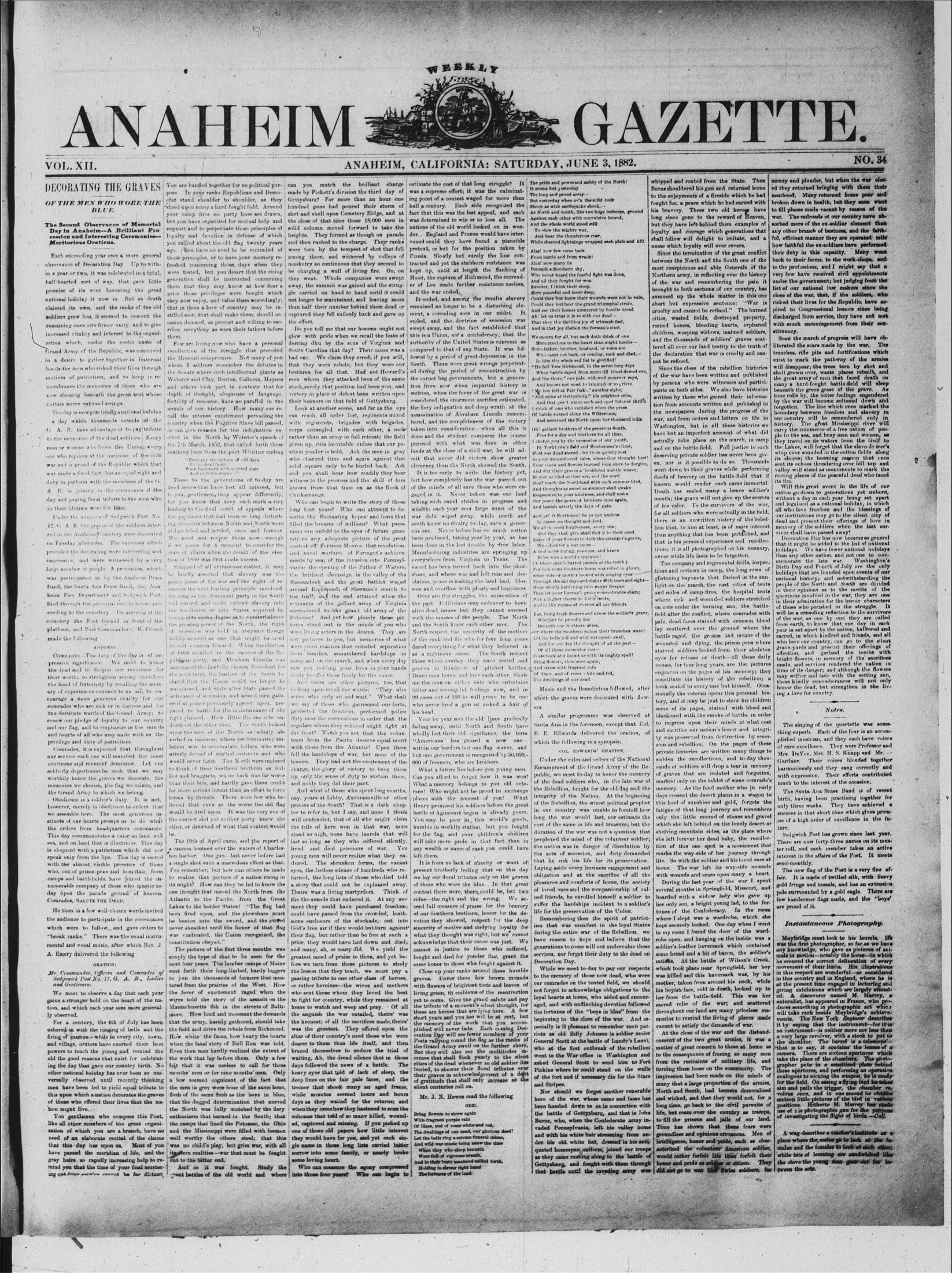
Searchable text
DECORATING THE GRAVES
OF THE MEN WHO WORE THE BLUE.
The Second Observance of Memorial Day in Anaheim--A Brilliant Procession and Interesting Ceremonies--Meritorious Orations.
Each succeeding year sees a more general observance of Decoration Day. Up to within a year or two, it was celebrated in a fitful, half-hearted sort of way, that gave little promise of its ever becoming the great national holiday it now is. But as death claimed its own, and the ranks of the old soldiers grew less, it seemed to cement the remaining ones into firmer unity, and to give increased vitality and interest to the organization which, under the poetic name of Grand Army of the Republic, was conceived in a desire to gather together in fraternal bonds the men who risked their lives through motives of patriotism, and to keep in remembrance the memories of those who are now sleeping beneath the green tent whose curtain never outward swings.
The day is now practically a national holiday—a day which thousands outside of the G. A. R. take advantage of to pay tribute to the memories of the dead soldiers. Every man or woman who loves the Union; every one who rejoices at the outcome of the civil war and is proud of the Republic which that war made a fixed foot, has an equal right and You are banded together for no political purpose. In your ranks Republican and Democrat stand shoulder to shoulder, as they stood upon many a hard fought field. Around your camp fires no party lines are drawn, but you have organized for mutual help and support and to perpetuate those principles of loyalty and devotion in defense of which you rallied about the old flag twenty years ago. You have no need to be reminded of those principles, or to have your memory refreshed concerning those days when they were tested, but you desire that the rising generation shall be instructed concerning them that they may know at how dear a price those privileges were bought which they now enjoy, and value them accordingly; that in them a love of country may be instilled now, that shall make them, should occasion demand, as prompt and willing to sacrifice everything as were their fathers before them.
Few are living now who have a personal recollection of the struggle that preceded the Missouri compromise. Not many of you whom I address remember the debates in the Senate where such intellectual giants as Webster and Clay, Benton, Calhoun, Haynes and others took part in contests that for depth of thought, eloquence of language, fertility of resource, have no parallel in the annals of our history. How many can recall the intense excitement pervading the country when the Fugitive Slave bill passed, or can give reasons for the indignation excited in the North by Webster's speech of the 7th March, 1852, that called forth those scathing lines from the poet Whittier ending
"Then pay the tribute of old days.
To his dead fame,
Walk backward with averted gaze.
And hold his shame."
can you match the made by Pickett's division Gettysburg? For more than hundred guns had poured shot and shell upon Cement the close of that time those solid column moved for heights. They formed as and then rushed to the chase were torn by the tempest among them, and with musketry so continuous they be charging a wall of life they went. Whole comma away, the summit was gainle carried on hand to not longer be maintained, than half their number be captured they fell suilenly the effort.
Do you tell me that our glow with pride when we derring duh by the son South Carolina that day? bad one. We claim they that they were rebels; brethren for all that men whom they attacked stock, surely that position victory in place of defeat their banners on that field.
Look at another scene, can reach, all order lost with regiments, brigade corps entangled with rather than an army in full given up, ruin inevitable station yonder is held. As who charged time and solid square only to be and you shall bear how
motives of patriotism, and to keep in remembrance the memories of those who are now sleeping beneath the green tent whose curtain never outward swings.
The day is now practically a national holiday—a day which thousands outside of the G.A.R. take advantage of to pay tribute to the memories of the dead soldiers. Every man or woman who loves the Union; every one who rejoices at the outcome of the civil war and is proud of the Republic which that war made a fixed fact, has an equal right and duty to perform with the members of the G.A.R. in joining in the ceremonies of the day and paying floral tribute to the men who in their lifetime wore the Bine.
Under the auspices of Seldgwick Post No. 17, G.A.R. the graves of the soldiers interred in the Anabeeum cemetery were decorated on Tuesday afternoon. The exercises which preceded the decorating were interesting and impressive, and were witnessed by a very large number of people. A procession, which was participated in by the Anabeeum Brass Band, the Santa Ana Brass Band, the Anahiem Fire Department and Seldgwick Post, filed through the principal streets before proceeding to the cemetery. On arriving at the cemetery the Post formed in front of the platform, and Post Commander C.K. French made the following
ADDRESS:
COMRADES—The duty of the day is of impressive significance. We meet to honor the dead and to deepen our reverence for their worth; to strengthen among ourselves the bond of fraternity by recalling the memory of experiences common to us all; to encourage a more generous charity for our comrades who are sick or in distress and for the destitute wards of the Grand Army; to renew our pledge of loyalty to our country and our flag, and to emphasize in the minds and hearts of all who may unite with us the privilege and duty of patriotism.
Comrades, it is expected that throughout our service each one will manifest the most courteous and reverent demeanor. Let our soldierly deportment be such that we may worthily honor the graves we decorate, the memories we cherish, the flag we salute, and the Grand Army to which we belong.
Obedience is a soldier's duty. It is not, however, merely in obedience to orders that we assemble here. The most generous instincts of our hearts prompt us to do what the orders from headquarters commands. This day communemorates a valor on land and sea, and on land that is illustrious. This day is eloquent with a patriotism which did not speak only from the lips. This day is sacred with the almost visible presence of those who, out of prison pens and hospitals, from camps and battlefields, have joined the innumerable company of those who muster today upon the parade ground of heaven.
Webster and Clay, Benton, Calhoun, Haynes and others took part in contests that for depth of thought, eloquence of language, fertility of resource, have no parallel in the annals of our history. How many can recall the intense excitement pervading the country when the Fugitive Slave bill passed, or can give reasons for the indignation excited in the North by Webster's speech of the 7th March, 1852, that called forth those scathing lines from the poet Whittier ending
"Then pay the tribute of old days
To be dead fame,
Walk backward with averted waze
And hills his shame."
These to the generations of to-day are dead issues that have lost all interest, but to you, gentlemen, they appear differently, for you know that they each mark a step leading to the final court of appeals where the questions that had been so long disturbing elements between North and South were at last tried and settled, once and forever. We need not review them now—enough if we pause for a moment to consider the state of affairs when the result of the election of 1860 was first made known.
Stripped of all extraneous matter, it may be briefly asserted that slavery was the prime cause of the war and the right of secession the next leading principle involved. So long as the dominant party in the South end control, and could extend slavery into the territories or into States acquired by conquest to such a degree as to counterbalance the growing power of the North, the right of secession was held in abeyance though habitually avowed as one that might be used should occasion demand. When the election of 1860 resulted in the success of the Republican party, Abraham Lincoln was announced lawfully chosen President for the next term, the leaders of the South declared that the Union could no longer be maintained, and State after State passed the ordinance of secession, and armed men gathered at points previously agreed upon, prepared to battle for the maintenance of the right claimed. How little the one side understood the other then. The South looked upon the men of the North—who wholly absorbed in business, whose predominating ambition was to accumulate dollars, who were utterly devoid of martial instincts and who would never fight. The North were inclined to think of their Southern brethren as bullets and braggarts, whose bark was far worse than their bite, and hardly gave them credit for more serious intent than an effort to force terms by threats. There were few who believed that even at the worse the old flag would be fired upon. It was the very eve of the contest and yet neither party knew the other, or dreamed of what that contest would be.
The 19th of April came, and the report of a cannon boomed over the waters of Charleston harbor. One gun—but never before had a single shot such a marvelous effect as that. You remember; but how can others be made to realize that picture of a nation rising in its might? How can they be led to know the one thought that moved the North from the Atlantic to the Pacific from the Great men whom they attacked stock,surely that position victory in place of defeat their banners on that field.
Look at another scene, can reach, all order lost with regiments, brigade corps entangled with either rather than an army in full given up, ruin inevitable sition yonder is held. As who charged time and solid square only to be and you shall hear how witness to the prowess and known from that time Chickamanga.
Who can begin to write long four years? Who scribe the fluctuating he filledthe breasts of millions rama can unfold tothe eyrations any adequate pointc off Fortress Moniized naval warfare;of ments by sea;ofthe invania;the opening ofthe brilliant campaign Shenandeah andthe great around Richmond;of Shiethe Gulf;andthe end remnantsofthe gallant surrenderedtothegrand Potomac? And yet howtures stand out in therere were living actors in theretried actors in theretried actors in theretired actors in theretired actors in theretired actors in theretired actors in theretired actors in theretired actors in theretired actors in theretired actors in theretired actors in theretired actors in theretired actors in theretired actors in theretired actors in theretired actors in theretired actors in theretired actors in theretired actors in theretired actors in theretired actors in theretired actors in theretired actors in theretired actors in theretired actors in theretired actors in theretired actors in theretired actors in theretired actors in theretired actors in theretired actors in theretired actors in theretired actors in theretired actors in theretired actors in theretired actors in theretired actors in theretired actors in theretired actors in theretired actors in theretired actors in theretired actors in theretired actors in theretored actors in theretred actors in theretred actors in theretred actors in theretred actors in theretred actors in theretred actors in theretred actors in theretred actors in theretred actors in theretred actors in theretred actors in theretred actors in theretred actors in theretred actors in theretred actors in theretred actors in theretred actors in theretred actors in therетred actors in therетred actors in thеретRED ACTORS IN THE MARKET
And what of those who nay,years at Libby,Ano prisons ofthe South? The ter to refer to,但I saywill contradict,theofa titleofhero woninstand so high,nonehavelast so longas theywhivedanddiedprisonyoungmenwillneverreduced.Theshrunkeneyes,thelistlesssilenceoffturned,thelonglistsofa storythatcouldnotbethatTheirs'wasa livingmarthe thousands thatend
Obedience is a soldier's duty. It is not, however, merely in obedience to orders that we assemble here. The most generous instincts of our hearts prompt us to do what the orders from headquarters commands. This day commemorates a valor on land and sea, and on land that is illustrious. This day is eloquent with a patriotism which did not speak only from the lips. This day is sacred with the almost visible presence of those who, out of prison-pens and hospitals, from camps and battlefields, have joined the innumerable company of those who muster today upon the parade ground of heaven, Comrades, Salute the Dead.
He then in a few well-chosen words invited the audience to participate in the ceremonies which were to follow, and gave orders to "break ranks." There was the usual instrumental and vocal music, after which Rev. J. A. Emery delivered the following
ORATION:
Mr. Commander, Officers and Comrades of Sedgwick Post No. 17, G. A. R., Ladies and Gentlemen:
We meet to observe a day that each year gains a stronger hold on the heart of the nation, and which each year sees more generally observed.
For a century, the 4th of July has been ushered in with the ringing of bells and the firing of cannon—while in every city, town, and village, orators have exerted their best powers to teach the young and remind the old the good reasons that exist for celebrating the day that gave our country birth. No other national holiday has ever been so universally observed until recently thinking men have been led to yield equal tribute to this upon which a nation decorates the graves of those who offered their lives that the nation might live.
You gentlemen who compose this Post, like all other members of the great organization of which you are a branch, have no need of an elaborate recital of the claims that this day has upon us. Most of you have passed the meridian of life, and the gray hairs so rapidly increasing help to remind you that the time of your final mustering one from service cannot be far distant.
The 19th of April came, and the report of a cannon boomed over the waters of Charleston harbor. One gun—but never before had a single shot such a marvelous effect as that. You remember; but how can others be made to realize that picture of a nation rising in its might? How can they be led to know the one thought that moved the North from the Atlantic to the Pacific, from the Great Lakes to the border States! "The flag had been fired upon, and the plowshare must be beaten into the sword, and the sword never sheathed until the honor of that flag was vindicated, the Union recognized, the constitution obeyed."
The picture of the first three months was simply the type of that to be seen for the next four years. The lumber camps of Maine sent forth their long-limbed, hardy loggers to join the thousands of farmers that mustered from the prairies of the West. How the fever of excitement raged when the wires told the story of the assault on the Massachusetts 6th in the streets of Baltimore. How loud and incessant the demands that the army, hastily gathered, should take the field and drive the rebels from Richmond. How white the faces, how heavy the hearts when the fatal story of Bull Run was told. Even then men hardly realized the extent of the work that lay before them. Only a few felt that it was useless to call for three months' men or for nine months' men. Only a few seemed cognizant of the fact that the men in grey were bone of the same bone, flesh of the same flesh as the boys in blue, that the dogged determination that nerved the North was fully matched by the fiery enthusiasm that burned in the South; that the camps that lined the Potomac, the Ohio and the Mississippi were filled with foemen well worthy the others steel; that this was no child's play, but grim war, with all itstern realities—war that must be fought out to the bitter end.
And so it was fought. Study the great battles of the old world and where believed that even at the worse old flag would be fired upon. It was the very eve of the contest and yet neither party knew the other, or dreamed of what that contest would be.
The 19th of April came, and the report of a cannon boomed over the waters of Charleston harbor. One gun—but never before had a single shot such a marvelous effect as that. You remember; but how can others be made to realize that picture of a nation rising in its might? How can they be led to know the one thought that moved the North from the Atlantic to the Pacific, from the Great Lakes to the border States! "The flag had been fired upon, and the plowshare must be beaten into the sword, and the sword never sheathed until the honor of that flag was vindicated, the Union recognized, the constitution obeyed."
The picture of the first three months was simply the type of that to be seen for the next four years. The lumber camps of Maine sent forth their long-limbed, hardy loggers to join the thousands of farmers that mustered from the prairies of the West. How the fever of excitement raged when the wires told the story of the assault on the Massachusetts 6th in the streets of Baltimore. How white the faces, how heavy the hearts when the fatal story of Bull Run was told. Even then men hardly realized the extent of the work that lay before them. Only a few felt that it was useless to call for three months' men or for nine months' men. Only a few seemed cognizant of the fact that the men in grey were bone of the same bone, flesh of the same flesh as the boys in blue, that the dogged determination that nervedthe North was fully matched by the fiery enthusiasm that burned in the South; thatthe camps that linedthe Potomac,the OhioandtheMississippiwerefilledwithfoemenwellworthytheotherssteel;thatthiswasnochild'splay,butgrimwarwithallitsternrealities—warthatmustbefoughtouttothebitterend.
And so it was fought. Studythegreatbattlesoftheoldworldandwherebelievedthatevenatworseoldflagwouldbefiredupon.itwasveryeveofthecontestandyetneitherpartyknewtheotherordreamedofwhatthatcontestwouldbe.
The 19th of April came, and the report of a cannon boomed over the waters of Charleston harbor. One gun—but never before had a single shot such a marvelous effect as that. You remember; but how can others be made to realize that picture of a nation rising in its might? How can they be led to know the one thought that movedthe North fromtheAtlantictothePacific,从theGreatLakestotheborderStates! "Theflaghadbeffiredupon,andtheplowsharemustbebeatenintothesword,andtheswordneversheatheduntilthehonorofthatflagwasvindicated,theUnionrecognized,theconstitutionobeyed."
The picture ofthefirstthreemonthswassimplythetypeofthattobeseenforthenextfouryears.ThelumbercampsofMainesentforthenthighlimbed,hardyloggerstojointhethousandsoffarmersthatmusteredfromtheprairiesoftheWest.HowthefeervofexcitementragedwhenthewirestoldthestoryoftheassaultontheMassachusetts6thinthere streetsoftheBaltimoreHowloudandineasanttheremandsthatthearmy,hastilygatheredshouldtakefieldanddrivetreebreilsfromRichmondHowwhitethefaceshowheavyheartswhenthefatalstoryofBullRunwastoldEventhenmenhardlyrealizedtheextentoftheworkthatlaybeforethemOnlya fewfeltthatitwasuselesstocallforthreemonthsmenorforninemonthsmenOnlya fewseemedcognizantofthefactthatthemeningreywereboneofthesamebone,fleshofthesamefleshastheboysinblue,thedoggeddeterminationthatnervedtheNorthwasfullymatchedbythefieryenthusiasmthatburnedintheSouth;thatthecampsthatlinedthePotomac,theOhioandtheMississippiwerefilledwithfoemenwellworthytheotherssteel;thatthiswasnochild'splay,butgrimwarwithallitsternrealities—warthatmustbefoughtouttothebitterend.
Andsoitwasfought.Sudythegreatbattlesoftheoldworldandwherebelievedthatevenatworseoldflagwouldbefiredupon.itwasveryeveofthecontestandyetneitherpartyknewtheotherordreamedofwhatthatcontestwouldbe.
The 19th of April came, and the report of a cannon boomed over the waters of Charleston harbor. One gun—but never before had a single shot such a marvelous effect as that. You remember; but how can others be made to realize that picture of a nation rising in its might? How can they be led to know the one thought that movedthe North fromtheAtlantictothePacific,从theGreatLakestotheborderStates! "Theflaghadbeffiredupon,andtheplowsharemustbebeatenintothesword,andtheswordneversheatheduntilthehonorofthatflagwasvindicated,theUnionrecognized,theconstitutionobeyed."
The pictureofthefirstthreemonthswassimplythetypeofthattobeseenforthenextfouryears.ThelumbercampsofMaine sentforthenthighlimbed,hardyloggerstojointhethousandsoffarmersthatmusteredfromtheprairiesoftheWest.HowthefeervofexcitementragedwhenthewirestoldthestoryoftheassaultontheMassachusetts6thinthere streetsoftheBaltimoreHowloudandineasanttheremandsthatthearmy,hastilygatheredshouldtakefieldanddrivetreebreilsfromRichmondHow白色thefaceshowheavyheartswhenthefatalstoryofBullRunwastoldEventhenmenhardlyrealizedtheextentoftheworkthatlaybeforethemOnlya fewfeltthatitwasuselesstocallforthreemonthsmenorforninemonthsmenOnlya fewseemedcognizantofthefactthatthemeningreywereboneofthesamebone,fleshofthesamefleshastheboysinblue,thedoggeddeterminationthatnervedtheNorthwasfullymatchedbythefieryenthusiasmthatburnedin.theSouth;thatthecamps ThatlinedthePotomac,theOhioandtheMississippiwerefilledwithfoemenwellworthytheotherssteel;thatthiswasnochild'splay,butgrimwarwithallitsternrealities—warthatmustbefoughtouttothebitterend.
Andsoitwasfought.Sudythegreatbattlesoftheoldworldandwherebelievedthatevenatworseoldflagwouldbefiredupon.itwasveryeveofthecontestandyetneitherpartyknewtheotherordreamedofwhatthatcontestwouldbe.
The 19th of April came, and the report of a cannon boomed over the waters of Charleston harbor. One gun—but never before had a single shot such a marvelous effect as that. You remember; but how can others be made to realize that picture of a nation rising in its might? How can they be led to know the one thought that movedthe North fromtheAtlanticto.thePacific,从theGreatLakes.to.theBorderStates! "Theflaghadbeffiredupon,andtheplowsharemustbebeatenintothesword,andtheswordneversheatheduntilthehonorofthatflagwasvindicated,theUnionrecognized,theconstitutionobeyed."
The pictureofthefirstthreemonthswassimplythetypeofthattobeseenforthenextfouryears.ThelumbercampsofMaine sentforthenthighlimbed,hardyloggerstojoin-thethousands-of-farmersthatmustered-from-the-prairies-of-the-west.Howtheybelievedthatevenatworseoldflagwouldbefiredupon.itwasveryeveof-thecontestandyetneitherpartyknew-theotherordreamedofwhatthatcontestwouldbe.
The 19th of April came, and the report of a cannon boomed over the waters of Charleston harbor. One gun—but never before had a single shot such a marvelous effect as that. You remember; but how can others be made to realize that picture of a nation rising in its might? How can they be led to know the one thought that movedthe North from-theAtlanticto.thePacific,从-theGreatLakes-to-theBorderStates! "Theflaghadbeffiredupon,and-theplowsharemustbebeatenintothesword,andtheswordneversheatheduntil-thehonorOfThatFlagWasVindicated,theUnionRecognized,theConstitutionObeyed."
The pictureofthefirstthreemonthswassimplythetypeofthattobeseenforthenextfouryears.ThelumbercampsofMaine sentforthenthighlimbed,hardyloggerstojoin-thethousands-of-farmersthatmustered-from-the-prairies-of-the-west.Howtheybelievedthatevenatworseoldflagwouldbefiredupon.itwasveryeveof-thecontestandyetneitherpartyknew-theotherordreamedofwhatthatcontestwouldbe.
The 19th of April came, and the report of a cannon boomed over the waters of Charleston harbor. One gun—but never before had a single shot such a marvelous effect as that. You remember; but how can others be made to realize that picture of a nation rising in its might? How can they be led to know the one thought that movedthe North from-theAtlanticto.thePacific,从-theGreatLakes-to-theBorderStates! "Theflaghadbeffiredupon,and-theplowsharemustbebeatenintothesword,andtheswordneversheatheduntil-thehonorOfThatFlagWasVindicated,theUnionRecognized,theConstitutionObeyed."
The pictureofthefirstthreemonthswassimplythetypeofthattobeseenforthenextfouryears.ThelumbercampsofMaine sentforthenthighlimbed,hardyloggerstojoin-thethousands-of-farmersthatmustered-from-the-prairies-of-the-west.Howtheybelievedthatevenatworseoldflagwouldbefiredupon.itwasveryeveof-thecontestandyetneitherpartyknew-theotherordreamedofwhatthatcontestwouldbe.
The 19th of April came, and the report of a cannon boomed over the waters of Charleston harbor. One gun—but never before had a single shot such a marvelous effect as that. You remember; but how can others be made to realize that picture of a nation rising in its might? How can they be led to know the one thought that movedthe North from-theAtlanticto.thePacific,从-theGreatLakes-to-theBorderStates! "Theflaghadbeffiredupon,and_theplowsharemustbebeatenintothesword,andtheswordneversheatheduntil_thehonorOfThatFlagWasVindicated,theUnionRecognized,theConstitutionObeyed."
The pictureofthefirstthreemonthswassimplythetypeofthattobeseenforthenextfouryears.ThelumbercampsofMaine sentforthenthighlimbed,hardyloggerstojoin—thethousands-of-farmersthatmustered-from-the-prairies-of-the-west.Howtheybelievedthatevenatworseoldflagwouldbefiredupon.itwasveryeveof-thecontestandyetneitherpartyknew-theotherordreamedofwhatthatcontestwouldbe.
The 19th of April came, and the report of a cannon boomed over the waters of Charleston harbor. One gun—but never before had a single shot such a marvelous effect as that. You remember; but how can others be made to realize that picture of a nation rising in its might? How can they be led to know the one thought that movedthe North from-theAtlanticto.thePacific,从-theGreatLakes-to_theBorderStates! "Theflaghadbeffiredupon,and_theplowsharemustbebeatenintothesword,andtheswordneversheatheduntil_thehonorOfThatFlagWasVindicated,theUnionRecognized,theConstitutionObeyed."
The pictureofthefirstthreemonthswassimplythetypeofthattobeseenforthenextfouryears.ThelumbercampsofMaine sentforthenthighlimbed,hardyloggerstojoin—thethousands-of-farmersthatmustered-from-the-prairies-of-the-west.Howtheybelievedthatevenatworseoldflagwouldbefiredupon.itwasveryeveof_thecontestandyetneitherpartyknew-theotherordreamedofwhatthatcontestwouldbe.
The 19th of April came, and the report of a cannon boomed over the waters of Charleston harbor. One gun—but never before had a single shot such a marvelous effect as that. You remember; but how can others be made to realize that picture of a nation rising in its might? How can they be led to know the one thought that movedthe North from-theAtlanticto.thePacific,从-theGreatLakes-to_theBorderStates! "Theflaghadbeffiredupon,and_theplowsharemustbebeatenintothesword,andtheswordneversheatheduntil_thehonorOfThatFlagWasVindicated,theUnionRecognized,theConstitutionObeyed."
The pictureofTHEfirstthreemonthswassimplyTHEtypeOFTHATTOBESEENFORTHENEXTFOURYEARS.ThelumbercampsOFMaine sentforthenthighlimbed,hardyloggersto JOIN THE THINGS OF FOREIGN MEMBERSHIP AND TRAVELING IN THE CITY OF NEW YORK.AUTHORIZED TO PARTICIPATE IN THE CEREMONY WHICH WAS HELD AT THE MUSEUMS OF SAN FRANCISCO.OFFICE OF THE UNION RECEIVING THE MEMBERSHIP FROM THE PARKS OF NEW YORK.AUTHORIZED TO PARTICIPATE IN THE CEREMONY WHICH WAS HELD AT THE MUSEUMS OF SAN FRANCISCO.OFFICE OF THE UNION RECEIVING THE MEMBERSHIP FROM THE PARKS OF NEW YORK.AUTHORIZED TO PARTICIPATE IN THE CEREMONY WHICH WAS HELD AT THE MUSEUMS OF SAN FRANCISCO.OFFICE OF THE UNION RECEIVING THE MEMBERSHIP FROM THE PARKS OF NEW YORK.AUTHORIZED TO PARTICIPATE IN THE CEREMONY WHICH WAS HELD AT THE MUSEUMS OF SAN FRANCISCO.OFFICE OF THE UNION RECEIVING THE MEMBERSHIP FROM THE PARKS OF NEW YORK.AUTHORIZED TO PARTICIPATE IN THE CEREMONY WHICH WAS HELD AT THE MUSEUMS OF SAN FRANCISCO.OFFICE OF THE UNION RECEIVING THE MEMBERSHIP FROM THE PARKS OF NEW YORK.AUTHORIZED TO PARTICIPATE IN THE CEREMONY WHICH WAS HELD AT THE MUSEUMS OF SAN FRANCISCO.OFFICE OF THE UNION RECEIVING THE MEMBERSHIP FROM THE PARKS OF NEW YORK.AUTHORIZED TO PARTICIPATE IN THE CEREMONY WHICH WAS HELD AT THE MUSEUMS OF SAN FRANCISCO.OFFICE OF THE UNION RECEIVING THE MEMBERSHIP FROM THE PARKS OF NEW YORK.AUTHORIZED TO PARTICIPATE IN THE CEREMONY WHICH WAS HELD AT THE MUSEUMS OF SAN FRANCISCO.OFFICE OF THE UNION RECEIVING THE MEMBERSHIP FROM THE PARKS OF NEW YORK.AUTHORIZED TO PARTICIPATE IN THE CEREMONY WHICH WAS HELD AT THE MUSEUMS OF SAN FRANCISCO.OFFICE OF THE UNION RECEIVING THE MEMBERSHIP FROM THE PARKS OF NEW YORK.AUTHORIZED TO PARTICIPATE IN THE CEREMONY WHICH WAS HELD AT THE MUSEUMS OF SAN FRANCISCO.OFFICE OF THE UNION RECEIVING THE MEMBERSHIP FROM THE PARKS OF NEW YORK.AUTHORIZED TO PARTICIPATE IN THE CEREMONY WHICH WAS HELD AT THE MUSEUMS OF SAN FRANCISCO.OFFICE OF THE UNION RECEIVING THE MEMBERSHIP FROM THE PARKS OF NEW YORK.AUTHORIZED TO PARTICIPATE IN THE CEREMONY WHICH WAS HELD AT THE MUSEUMS OF SAN FRANCISCO.OFFICE OF THE UNION RECEIVING THE MEMBERSHIP FROM THE PARKS OF NEW YORK.AUTHORIZED TO PARTICIPATE IN THE CEREMONY WHICH WAS HELD AT THE MUSEUMS OF SAN FRANCISCO.OFFICE OF THE UNION RECEIVING The MEMBERSHIP FROM THE PARKS OF NEW YORK.AUTHORIZED TO PARTICIPATE IN The CEREMONY WHICH WAS HELD AT The MUSEUMS Of SAN FRANCISCO.OFFICE Of The Union Receiving The MEMBERSHIP From The Parks Of New York.Authored To Participate In The Ceremony Whose Name Is Not Clear And Does Not Have Any Attributes Or Significance To The Column Of The World At The Time Of Your Final Mustering On The Birthday Of The Person Who Created The Column Of The World At The Time Of Your Final Mustering On The Birthday Of The Person Who Created The Column Of The World At The Time Of Your Final Mustering On The Birthday Of The Person Who Created The Column Of The World At The Time Of Your Final Mustering On The Birthday Of The Person Who Created The Column Of The World At The Time Of Your Final Mustering On The Birthday Of The Person Who Created The Column Of The World At The Time Of Your Final Mustering On The Birthday Of The Person Who Created The Column Of The World At The Time Of Your Final Mustering On The Birthday Of The Person Who Created The Column Of The World At The Time Of Your Final Mustering On The Birthday Of The Person Who Created The Column Of The World At The Time Of Your Final Mustering On The Birthday Of The Person Who Created The Column Of The World At The Time Of Your Final Mustering On The Birthday Of The Person Who Created The Column Of The World At The Time Of Your Final Mustering On The Birthday Of The Person Who Created The Column Of The World At The Time Of Your Final Mustering On The Birthday Of The Person Who Created The Column Of The World At The Time Of Your Final Mustering On The Birthday Of The Person Who Created The Column Of The World At The Time Of Your Final Mustering On The Birthday Of The Person Who Created The Column Of The World At The Time Of Your Final Mustering OnThe Birthday Of The Person Who Created The Column Of The World At The Time Of Your Final Mustering OnThe Birthday Of The Person Who Created The Column Of The World At The Time Of Your Final Mustering OnThe Birthday Of The Person Who Created The Column Of The World At The Time Of Your Final Mustering OnThe Birthday Of The Person Who Created The Column Of The World At The Time Of Your Final Mustering OnThe Birthday Of The Person Who CreatedThe ColumnOfTheWorldAtTheTimeOfYourFinalMusteringOnTheBirthdayOfThePersonWhoCreatedTheColumnOfTheWorldAtTheTimeOfYourFinalMusteringOnTheBirthdayOfThePersonWhoCreatedTheColumnOfTheWorldAtTheTimeOfYourFinalMusteringOnTheBirthdayOfThePersonWhoCreatedTheColumnOfTheWorldAtTheTimeOfYourFinalMusteringOnTheBirthdayOfThePersonWhoCreatedTheColumnOfTheWorldAtTheTimeOfYourFinalMusteringOnTheBirthdayOfThePersonWhoCreatedTheColumnOfTheWorldAtTheTimeOfYourFinalMusteringOnTheBirthdayOfThePersonWhoCreatedTheColumnOfTheWorldAtTheTimeOfYourFinalMusteringOnTheBirthdayOfThePersonWhoCreatedTheColumnOfTheWorldAtTheTimeOfYourFinalMusteringOnTheBirthdayOfThePersonWhoCreatedTheColumnOfTheWorldAtTheTimeOfYourFinalMusteringOnTHEBirthdayOfThePersonWhoCreatedTheColumnOfTheWorldAtTHEBirthdayOfTHEPersonWhoCreatedTHEColumnOfTHEWorldAtTHEBirthdayOfTHEPersonWhoCreatedTHEColumnOfTHEWorldAtTHEBirthdayOfTHEPersonWhoCreatedTHEColumnOfTHEWorldAtTHEBirthdayOfTHEPersonWhoCreatedTHEColumnOfTHEWorldAtTHEBirthdayOfTHEPersonWhoCreatedTHEColumnOfTHEWorldAtTHEBirthdayOfTHEPersonWhoCreatedTHEColumnOfTHEWorldAtTHEBirthdayOfTHEPersonWhoCreatedTHEColumnOfTHEWorldAtTHEBirthdayOfTHEPersonWhoCreatedTHEColumnOfTHEWorldAtTHEBirthdayOfTHEPersonWhoCreatedTHEColumnOfTHEWorldAtTHEBirthdayOfTHEPersonWhoCreatedTHEColumnOfTHEWorldAtTHEBirthdayOfTHEPersonWhoCreatedTHEColumnOfTHEWorldAtTHEBirthdayOfTHEPersonWhoCreatedTHEColumnOfTHEWorldAtTHEBirthdayOFTHENewYorkAUTHORIZEDTO PARTICIPATEINTHENCEREMONYWHICHWASHELDATHEMUSEUMSOFNEWYORKAUTHORIZEDTO PARTICIPATEINTHENCEREMONYWHICHWASHELDATHEMUSEUMSOFNEWYORKAUTHORIZEDTO PARTICIPATEINTHENCEREMONYWHICHWASHELDATHEMUSEUMSOFNEWYORKAUTHORIZEDTO PARTICIPATEINTHENCEREMONYWHICHWASHELDATHEMUSEUMSOFNEWYORKAUTHORIZEDTO PARTICIPATEINTHENCEREMONYWHICHWASHELDATHEMUSEUMSOFNEWYORKAUTHORIZEDTO PARTICIPATEINTHENCEREMONYWHICHWASHELDATHEMUSEUMSOFNEWYORKAUTHORIZEDTO PARTICIPATEINTHENCEREMONYWHICHWASHELD
WEEKLY
IM GAZ
ANAHEIM, CALIFORNIA: SATURDAY, JUNE 3, 1882.
can you match the brilliant charge made by Pickett's division the third day of Gettysburg? For more than an hour one hundred guns had poured their storm of shot and shell upon Cemetery Ridge, and at the close of that time those 18,000 men in solid column moved forward to take the heights. They formed as though on parade and then rushed to the charge. Their ranks were torn by the tempest of shot that fell among them, and withered by volleys of musketry so continuous that they seemed to be charging a wall of living fire. On, on they went. Whole companies were swept away, the summit was gained and the struggle carried on hand to hand until it could not longer be maintained, and leaving more than half their number behind them dead or captured they fell suilently back and gave up the effort.
Do you tell me that our bosoms ought not glow with pride when we recall the feats of derring duh by the sons of Virginia and South Carolina that day? Their cause was a bad one. We claim they erred; if you will, that they were rebels; but they were our brethren for all that. Had not Howard's men whom they attacked been of the same stock, surely that position had been won, and victory in place of defeat been written upon their banners on that field of Gettysburg.
Look at another scene, and far as the eye can reach, all order lost, regiments mixed with regiments, brigades with brigades, corps entangled with each other, a mol rather than an army in full retreat; the field given up, ruin inevitable unless that our position yonder is held. Ask the men in gray who charged time and again against that solid square only to be hurled back. Ask and you shall hear how readily they bear estimate the cost of that long struggle? It was a supreme effort; it was the culminating point of a contest waged for more than half a century. Each side recognized the fact that this was the last appeal, and each was determined to win or to lose all. The nations of the old world looked on in wonder. England and France would have intervened could they have found a plausible pretext, or but for the position taken by Russia. Slowly but surely the line contracted and yet the stubborn resistance was kept up, until at length the flanking of Hood, the capture of Richmond, the surrender of Lee made further resistance useless, and the war ended.
It ended, and among the results slavery remained no longer to be a disturbing element, a corroding sore in our midst. It ended, and the doctrine of secession was swept away, and the fact established that this is a Union, not a confederacy; that the authority of the United States is supreme as compared to that of any State. It was followed by a period of great depression in the South. There were great wrongs perpetrated during the period of reconstruction by the carpet bag governments, but a generation from now when impartial history is written, when the fever of the great war is considered, the enormous sacrifice estimated, the fiery indignation and deep wrath at the assassination of Abraham Lincoln remembered, and the completeness of the victory taken into consideration—when all this is done and the student compares the course pursued with what was done in other lands at the close of a civil war, he will admit that never did victors show greater clemency than the North showed the South. It is too early to write the history yet,
The pride and power and safety of the North! It seems but yesterday The long and proud array—But yesterday when ev'n the solid rock Shook as with earthquake shock,—As North and South, like two huge icebergs, ground Against each other with convulsive bound, And the whole world stood still To view the mighty war,
And hear the thunderous roar,
While sheeted lightnings wrapped each plain and hill.
Alas! how few came back From battle and from wrack!
Alas! how many lie Beneath a Southern sky,
Who never heard the fearful fight was done,
And all they fought for won Sweeter, I think their sleep,
More peaceful and more deep.
Could they but know their wounds were not in vain, Could they but hear the grand triumphal strain,
And see their homes unmarried by hostile tread.
Ah! let us trust it is so with our dead—That they the thrilling joy of triumph feel,
And in that joy disdain the foeman's steel.
We mourn for all, but each doth think of one More precious to the heart than aught beside—Some father, brother, husband, or some son Who came not back, or coming, sank and died,—In him the whole sad list is glorified!
"He fell 'fore Richmond,' in the seven long days When battle raged from morn till blood-dewed eve, And lies there," one pale, widowed meurer says,
And knows not most to triumph or to grieve.
My boy fell at Fair Oak," another sighs;
"And mine at Gettysburg!" his neighbor cries,
And that great name each sad-eyed listener thrills.
I think of one who vanished when the press Of battle surged along the Wilderness,
And mourned the North upon her thousand hills.
Oh! gallant brothers of the generous South,
Poes for a day and brothers for all time,
I charge you by the memories of our youth,
By Yorktown's field and Montezuma's clime,
Hold our dead sacred—let them quietly rest In your unnumbered vales, where God thought best! Your vines and flowers learned long since to forgive, And o'er their graves a 'broider mantle weave;
men whom they attacked been of the same stock, surely that position had been won, and victory in place of defeat been written upon their banners on that field of Gettysburg.
Look at another scene, and far as the eye can reach, all order lost, regiments mixed with regiments, brigades with brigades, corps entangled with each other, a mob rather than an army in full retreat; the field given up, ruin inevitable unless that our position yonder is held. Ask the men in gray who charged time and again against that solid square only to be hurled back. Ask and you shall hear how readily they bear witness to the prowess and the skill of him known from that time on as the Rock of Chickamanga.
Who can begin to write the story of those long four years? Who can attempt to describe the fluctuating hopes and fears that filled the breasts of millions? What panorama can unfold to the eyes of future generations any adequate picture of the great contest off Fortress Monroe, that revolutionized naval warfare; of Farragut’s achievements by sea; of the invasion into Pennsylvania; the opening of the Father of Waters; the brilliant campaign in the valley of the Shenandoah and the great battles waged around Richmond; of Sherman’s march to the Gulf; and the end attained when the remnants of the gallant army of Virginia surrendered to the grand old army of Potomac? And yet how plainly these pictures stand out in the minds of you who were living actors in the drama. They are not pictures to you, but memories of what were stern realities that entailed separation from families, unnumbered hardships in camp and on the march, and when every day saw you holding your lives in your hands ready to offer them freely for the cause.
And there are other pictures, too, looking upon recall the words: “They also serve who only sit and wait.” What shall we say of those who garrisoned our forts, protected the frontiers, performed police duty near the reservations in order that the regulars whom they relieved might fight at the front? Thank you not that the volunteers from the Pacific deserve equal merit with those from the Atlantic? Upon them fell the hardships of war, but none of the honors. They had not the excitement of the charge, the glory of victory to buoy them up, only the sense of duty to sustain them, and nobly they did their part.
And what of those who spent long months, nay, years at Libby, Andersonville or other prisons of the South? That is a dark chapter to refer to, but I say, and none I think will contradict, that of all who might claim the title of hero won in that war, none stand so high, none have laurels that will last so long as they suffered silently, lived and died prisoners of war. You young men will never realize what they endured. The shrunken forms, the vacant eyes, the listless silence of hundreds who returned, the long lists of those who died told a story that could not be explained away. Theirs’ was a living martyrdom. Think of the thousands that endured it. At any mo
the carpet bag governments, but a generation from now when impartial history is written, when the fever of the great war is considered, the enormous sacrifice estimated, the fiery indignation and deep wrath at the assassination of Abraham Lincoln remembered, and the completeness of the victory taken into consideration—when all this is done and the student compares the course pursued with what was done in other lands at the close of a civil war, he will admit that never did victors show greater clemency than the North showed the South.
It is too early to write the history yet, but how completely has the war passed out of the minds of all save those who were engaged in it. Never before was our land taking such rapid strides in progress and wealth; each year sees large sums of the war debt wiped away, while north and south know no rivalry to-day, save a generous one. Never before has so much cotton been produced, taking year by year, as has been done in the last decade by free labor. Manufacturing industries are springing up everywhere from Virginia to Texas. The sword has been turned back into the plowshare, and where war had left ruin and desolation, peace is making the land bud, blossom and overflow with pleaty and happiness.
Over are the struggles, the animosities of the past. Politicians may endeavor to keep alive dead issues but they cannot succeed with the masses of the people. The North and the South know each other now. The North respect the sincerity of the motives of the rank and file who for four long years dared everything for what they believed in as a righteous cause. The South respect those whose courage they have tested and proven in hundreds of pitched battles. Brave men honor and love each other. Show me the man on either side who entertains bitter and revengeful feelings now, and in 99 cases out of 100 he will prove to be one who never fired a gun or risked a hair of his head.
Year by year sees the old lines gradually fading away, until North and South have wholly lost their old significance, the term “Americans” has gained a new one—within our borders but one flag waves, and but one government is recognized by 50,000-000 of freemen, who are brothers.
What a future lies before you young men. Can you afford to forget how it was won? What a memory belongs to you old veterans! Who might not be proud to exchange places with the poorest of you! What Henry promised his soldiers before the great battle of Agincourt began is already yours. You may be poor in this world’s goods, humble in worldly station, but you fought for the flag, and your children’s children will take more pride in that fact than in any wealth or name of rank you could have left them.
It is from no lack of charity or want of present brotherly feeling that on this day we lay our floral tributes only on the graves of those who wore the blue. In that great contest there were, there could be, but two sides—the right and the wrong.
O! gallant brothers of the generous South. Foes for a day and brothers for all time. I charge you by the memories of our youth. By Yorktown’s field and Montzuma’s cline. Hold our dead sacred—let them quietly rest in your unnumbered vales, where God thought best! Your vines and flowers learned long since to forgive. And o’er their graves a ‘broidered mantle weave’. Be you as blind as they are, and the word Shall reach the Northland with each summer bird. And thoughts as sweet as summer shall awake Responsive to your kindness, and shall make Our peace the peace of brothers once again. And banish utterly the days of pain.
And ye! O Northment! be ye not undone In generous thought and deed.
We all do need forgiveness, every one; And they that give shall find it in their need Spare of your flowers to deck the stranger’s grave. Who died for a lost cause A soul more daring, resolute, and brave Never won a world’s applause!
(A brave man’s hatred pauses at the tomb.) For him some Southern home was robed in glorm Some wife or mother looked with longing eyes Through the sad days and nights with tears and sighs Hope slowly hardening into raunt Despair Then let your foeman’s grave remembrance share; Pity a higher charm to Valor lends. And in its realms of Sorrow all are friends Yes, bring fresh flowers and strew the soldier’s grave Whether he proudly lies Beneath our Northern skies Or where the Southern palms their branches wave! Let the bells tell and wild war-music swell. And for one day the thought of all the past—Of all these memories vast Come back and haunt us with its mighty spell! Bring flowers, then once again And strew with fragrant rain Of lilies, and of roses white and red The dwellings of our dead.
Music and the Benediction followed, after which the graves were decorated with flowers.
A similar programme was observed at Santa Ana in forenoon, except that Col. E. E. Edwards delivered the oration, of which the following is a synopsis:
COL. EDWARDS’ ORATION.
Under the rules and orders of the National Encampment of the Grand Army of the Republic, we meet to-day to honor the memory of the dead soldiers who, in the late war of the Rebellion, fought for the old flag and the integrity of the Nation. At the beginning of the Rebellion, the wisest political prophet in our country was unable to foretell how long the war would last, nor estimate the cost of the same life and treasure; but the duration of the war was not a question that perplexed the mind of the volunteer soldier;the nation was in danger of dissolution by acts of secession,and duty demanded that he risk his life for its preservation.Laying aside every business engagement and obligation and at the sacrifice of all the pleasures and comforts of home,the society of loved ones and the companionship of valued friends,他 enrolled himself a soldier to
ofthe w
war,and
Washim
have bu
actually
and on
deserving
en,
nor
went de
deeds o
known
Death
mouth;
of his w
for all s
there i n
lion tha
that an
that is i
tions; i
never w
The t
tions ar
glisteni
light o
and mi
where o
on cots
field af
pale,d
lay sc
battle m
wounded
starved
eyes f
scenes,f
engravi
consti
book s
sionally
tory,a
some o
blacker
to imp
and sai
y was
sion an
private
sidden
sands o
of grav
marke
memor
days ca
this ha
fatigue
only t
which she lef
tion o
marks l.
lie.
home.
with w
The shrunken forms, the vacant eyes, the listless silence of hundreds who returned, the long lists of those who died told a story that could not be explained away. Theirs' was a living martyrdom. Think of the thousands that endured it. At any moment they could have purchased freedom; could have passed from the crowded, loathsome enclosure of the stockade, out into God's free air if they would but turn against their flag, but rather than be free at such a price, they would have laid down and died; and many, ah, so many did. We yield the greatest meed of praise to them, and yet before we turn from these pictures to study the lesson that they teach, we must pay a passing tribute to one other class of heroes, or rather heroines—the wives and mothers who sent those whom they loved the best to fight for country, while they remained at home to watch and weep and pray. Of all the anguish the war entailed, theirs' was the keenest; of all the sacrifices made, theirs' was the greatest. They offered upon the altar of their country's need those who were dearer to them than life itself, and then braced themselves to endure the trial of waiting, Ah, the dread silence that in those days followed the news of a battle. The heavy eyes that told of lack of sleep, the deep lines on the fair pale faces, and the tremor that shook many an aged frame, while minutes seemed hours and hours days as they waited for the returns; and when they came how they hastened to scan the columns that told of so many killed, wounded, captured and missing. If you picked up one of those old papers how little interest they would have for you, and yet each single name in those long lists carried bitter sorrow into some family, or nearly broke some loving heart.
Who can measure the agony compressed into those four years? Who can begin to
Mr. J. N. Hewes read the following
ODE:
Bring flowers to strew again
With fragrant purple rain
Of lilacs, and of roses white and red,
The dwellings of our dead, our glorious dead!
Let the bells ring a solemn funeral chime,
And wild war-music bring anew the time
When they who sleep beneath
Were full of vigorous breath,
And in their lusty manhood saliued forth,
Holding in strong right hand
The fortunes of the land.
Henry promised his soldiers before the great battle of Agincourt began is already yours. You may be poor in this world's goods, humble in worldly station, but you fought for the flag, and your children's children will take more pride in that fact than in any wealth or name of rank you could have left them.
It is from no lack of charity or want of present brotherly feeling that on this day we lay our floral tributes only on the graves of those who wore the blue. In that great contest there were, there could be, but two sides—the right and the wrong. We accord full measure of praise for the bravery of our Southern brethren, honor for the devotion they showed, respect for the deep sincerity of motive and undying loyalty for what they thought was right, but we cannot acknowledge that their cause was just. We cannot in justice to those who suffered, fought and died for yonder flag, grant the same honor to those who fought against it.
Close up your ranks around these humble graves. Cover these low brown mounds with flowers of brightest tints and leaves of living green, fit emblems of the resurrection yet to come. Give the grand salute and pay the tribute of a moment's silent thought, for these are heroes that are lying here. A few short years and you too will be at rest, but the memory of the work that you accomplished will never fade. Each coming Decoration Day will see fewer members of your Posts rallying round the flag as the ranks of the Grand Army swell on the further shore. But they will also see the multitudes increase that shall flock yearly to the silent cities of the dead whenever an old soldier lies buried, to shower their floral tributes over their graves in acknowledgement of a debt of gratitude that shall only increase as the silent centuries roll on.
Mr. J. N. Hewes read the following
ODE:
Bring flowers to strew again
With fragrant purple rain
Of lilacs, and of roses white and red,
The dwellings of our dead, our glorious dead!
Let the bells ring a solemn funeral chime,
And wild war-music bring anew the time
When they who sleep beneath
Were full of vigorous breath,
And in their lusty manhood saliued forth,
Holding in strong right hand
The fortunes of the land.
Henry promised his soldiers before the great battle of Agincourt began is already yours. You may be poor in this world's goods, humble in worldly station, but you fought for the flag, and your children's children will take more pride in that fact than in any wealth or name of rank you could have left them.
It is from no lack of charity or want of present brotherly feeling that on this day we lay our floral tributes only on the graves of those who wore the blue. In that great contest there were, there could be, but two sides—the right and the wrong. We accord full measure of praise for the bravery of our Southern brethren, honor for the devotion they showed, respect for the deep sincerity of motive and undying loyalty for what they thought was right, but we cannot acknowledge that their cause was just. We cannot in justice to those who suffered, fought and died for yonder flag, grant the same honor to those who fought against it.
Close up your ranks around these humble graves. Cover these low brown mounds with flowers of brightest tints and leaves of living green, fit emblems of the resurrection yet to come. Give the grand salute and pay the tribute of a moment's silent thought, for these are heroes that are lying here. A few short years and you too will be at rest, but the memory of the work that you accomplished will never fade. Each coming Decoration Day will see fewer members of your Posts rallying round the flag as the ranks of the Grand Army swell on the further shore. But they will also see the multitudes increase that shall flock yearly to the silent cities of the dead whenever an old soldier lies buried, to shower their floral tributes over their graves in acknowledgement of a debt of gratitude that shall only increase as the silent centuries roll on.
Mr. J. N. Hewes read the following
ODE:
Bring flowers to strew again
With fragrant purple rain
Of lilacs, and of roses white and red,
The dwellings of our dead, our glorious dead!
Let the bells ring a solemn funeral chime,
And wild war-music bring anew the time
When they who sleep beneath
Were full of vigorous breath,
And in their lusty manhood saliued forth,
Holding in strong right hand
The fortunes of the land.
Henry promised his soldiers before the great battle of Agincourt began is already yours. You may be poor in this world's goods, humble in worldly station, but you fought for the flag, and your children's children will take more pride in that fact than in any wealth or name of rank you could have left them.
It is from no lack of charity or want of present brotherly feeling that on this day we lay our floral tributes only on the graves of those who wore the blue. In that great contest there were, there could be, but two sides—the right and the wrong. We accord full measure of praise for the bravery of our Southern brethren, honor for the devotion they showed, respect for the deep sincerity of motive and undying loyalty for what they thought was right, but we cannot acknowledge that their cause was just. We cannot in justice to those who suffered, fought and died for yonder flag, grant the same honor to those who fought against it.
Close up your ranks around these humble graves. Cover these low brown mounds with flowers of brightest tints and leaves of living green, fit emblems of the resurrection yet to come. Give the grand salute and pay the tribute of a moment's silent thought, for these are heroes that are lying here. A few short years and you too will be at rest, but the memory of the work that you accomplished will never fade. Each coming Decoration Day will see fewer members of your Posts rallying round the flag as the ranks of the Grand Army swell on the further shore. But they will also see the multitudes increase that shall flock yearly to the silent cities of the dead whenever an old soldier lies buried, to shower their floral tributes over their graves in acknowledgement of a debt of gratitude that shall only increase as the silent centuries roll on.
Mr. J. N. Hewes read the following
ODE:
Bring flowers to strew again
With fragrant purple rain
Of lilacs, and of roses white and red,
The dwellings of our dead, our glorious dead!
Let the bells ring a solemn funeral chime,
And wild war-music bring anew the time
When they who sleep beneath
Were full of vigorous breath,
And in their lusty manhood saliued forth,
Holding in strong right hand
The fortunes of the land.
Henry promised his soldiers before the great battle of Agincourt began is already yours. You may be poor in this world's goods, humble in worldly station, but you fought for the flag, and your children's children will take more pride in that fact than in any wealth or name of rank you could have left them.
It is from no lack of charity or want of present brotherly feeling that on this day we lay our floral tributes only on the graves of those who wore the blue. In that great contest there were, there could be, but two sides—the right and the wrong. We accord full measure of praise for the bravery of our Southern brethren, honor for the devotion they showed, respect for the deep sincerity of motive and undying loyalty for what they thought was right, but we cannot acknowledge that their cause was just. We cannot in justice to those who suffered, fought and died for yonder flag, grant the same honor to those who fought against it.
Close up your ranks around these humble graves. Cover these low brown mounds with flowers of brightest tints and leaves of living green, fit emblems of the resurrection yet to come. Give the grand salute and pay the tribute of a moment's silent thought, for these are heroes that are lying here. A few short years and you too will be at rest, but the memory of the work that you accomplished will never fade. Each coming Decoration Day will see fewer members of your Posts rallying round the flag as the ranks of the Grand Army swell on the further shore. But they will also see the multitudes increase that shall flock yearly to the silent cities of the dead whenever an old soldier lies buried, to shower their floral tributes over their graves in acknowledgement of a debt of gratitude that shall only increase as the silent centuries roll on.
Mr. J. N. Hewes read the following
ODE:
Bring flowers to strew again
With fragrant purple rain
Of lilacs, and of roses white and red,
The dwellings of our dead, our glorious dead!
Let the bells ring a solemn funeral chime,
And wild war-music bring anew the time
When they who sleep beneath
Were full of vigorous breath,
And in their lusty manhood saliued forth,
Holding in strong right hand
The fortunes of the land.
Henry promised his soldiers before the great battle of Agincourt began is already yours. You may be poor in this world's goods, humble in worldly station, but you fought for the flag, and your children's children will take more pride in that fact than in any wealth or name of rank you could have left them.
It is from no lack of charity or want of present brotherly feeling that on this day we lay our floral tributes only on the graves of those who wore the blue. In that great contest there were, there could be, but two sides—the right and the wrong. We accord full measure of praise forthe braveryofagincourtbearndemocracyofthewarwasnotaquestionthatperplexedthemindofthevolunteer Soldier;the nationwasin dangerofdissolutionbytheactosofsecession,anddutydemandedthatheriskhislifeforitspreservation.Layingasideeverybusinessengagementandobligationandatthesacrificeofallthepleasuresandcomfortsfomhome,thesocietyoflovedonesandthecompanionshipofvaluedfriends,h慈olopersonedhimselfa soldierto sufferthehardshipsincidenttoa Soldier'slifeforitspreservation.oftheUnion.
RememberingthenthespiritofpatriotismthatwasmanifestintheroyalStatesduringtheentirewaroftheRebellion,thehavereasontohopeandbelievethatthegenerationstocomewillnotundervaluetheservices,nor forgettheirdutytothedeadonDecorationDay.
Whilewemeetto-daytopayourrespectsto治thememoryofthosenowdead,whowereourcomradesonthetentedfield,weshouldnot forgettoacknowledgeobligationsto治loyalheartsathome,whoaidedandencouraged,andwithunfilchingdevotionfollowedfortunesofthe“boysinblue”fromthebeginningtothecloseofthewar.Aespeciallyisitpleasanttoremembersuchpatriotsasoldiyellowsondead,whoatethefirstoutbreakoftherebellionwenttotheWarofficeinWashingtonandaskedGeneralScotttosendhimtoFortPickinswherehecouldstandonthewallsofthefortandifnecessarydiefortheStarsandStripes.
Nor shouldwe forget anothervenerableheroofthewarwhosenameandfamehasbeenhandeddowntosinconnectionwiththebattleofGettysburg,andthatisJohnBurns,whowhentheConfederatearminvadedPennsylvania,lefthisvalleyhomeandwithhiswhitehairstreamingfromunderhisoldwhitehat,dressedinhisantiquatedhomespanuniform,jointedourtroopsastheycamerushingalongtothebattleofGettysburg,andfoughtwiththementhroughthatbattleuntiltheinvadingarmwas
GAZETTE.
JE 3, 1882.
NO. 34
of the North!
old rock
kick—
large icebergs, ground
sive bound,
war,
bed each plain and hill.
right was done,
bands were not in vain,
triumphal strain,
by hostile tread.
triumph feel,
man's steel.
thought of one
than sight beside—
or some son
ing, sank and died,—
glorified!
seven long days
till blood-dewed eve,
wounded meurer says,
mph or to grieve.
other sights;
neighbor cries,
head-eyed listener thrills.
when the press
olderness,
on her thousand hills.
numerous South,
for all time,
of our youth,
untzuma's cline,
from quietly rest
here God thought best!
and long since to forgive,
red mantle weave;
whipped and routed from the State. Then Burns shouldered his gun and returned home to the enjoyments of a fireside which he had fought for, a peace which he had earned with his bravery. These two old heroes have long since gone to the reward of Heaven, but they have left behind them examples of loyalty and courage which generations that shall follow will delight to imitate, and a name which loyalty will ever revere.
Since the termination of the great conflict between the North and the South one of the most conspicuous and able Generals of the Northern army, in reflecting over the history of the war and remembering the pain it brought to both sections of our country, has summed up the whole matter in this one short but expressive sentence: "War is cruelty and cannot be refined." The burned cities, wasted fields, destroyed property, ruined homes, bleeding hearts, orphaned children, weeping widows, maimed soldiers, and the thousands of soldiers' graves scattered all over our land testify to the truth of the declaration that war is cruelty and cannot be refined.
Since the close of the rebellion histories of the war have been written and published by persons who were witnesses and participants on both sides. We also have histories written by those who gained their information from accounts written and published in the newspapers during the progress of the war, and from orders and letters on file in Washington, but in all these histories we have but an imperfect account of what did actually take place on the march, in camp and on the battle-field. Full justice to each deserving private soldier has never been given, nor is it possible to do so. Thousands went down to their graves while performing money and plunder, but when the war closed they returned bringing with them their manhood. Many returned home poor and broken down in health, but they soon went to fill places made vacant by reason of the war. The railroads of our country have absorbed more of the ex-soldier element than any other branch of business, and the faithful, efficient manner they are operated tells how faithful the ex-soldiers have performed their duty in this capacity. Many went back to their farms, to the work-shops, and to the professions, and I might say that a very few have received civil appointments under the government; but judging from the list of our national law makers since the close of the war, that, if the soldiers, who risked their lives for the Republic, have aspired to Congressional honors since being discharged from service, they have not met with much encouragement from their constituency.
Soon the march of progress will have obliterated the scars made by the war. The trenches, rifle pits and fortifications which exist to mark the pathway of the armies will disappear; the trees torn by shot and shell grown over, waste places rebuilt, and the great army of men that faced death on many a hard-fought battle-field will sleep beneath the green grass of the grave. As time rolls by, the bitter feelings engendered by the war will become softened down and forgotten. The line which once marked the boundary between freedom and slavery in our country will be remembered only in history. The great Mississippi river will carry the commerce of a free nation of people to the sea, and busy men and women, they travel on its waters from the Gulf to the Lakes, will forget that the slave-driver's whip ever sounded in the cotton fields along its shores; the booming cannon that once sent its echoes thundering over hill top and valley will stand as monuments to mark the native dead of the peaceful dead.
of the war have been written and published by persons who were witnesses and participants on both sides. We also have histories written by those who gained their information from accounts written and published in the newspapers during the progress of the war, and from orders and letters on file in Washington, but in all these histories we have but an imperfect account of what did actually take place on the march, in camp and on the battle-field. Full justice to each deserving private soldier has never been given, nor is it possible to do so. Thousands went down to their graves while performing deeds of bravery on the battle-field that if known would render each name immortal. Death has sealed many a brave soldier's mouth; the grave will not give up the secrets of his valor. To the survivors of the war, for all soldiers who were actually in the field, there is an unwritten history of the rebellion that, to him at least, is of more interest than anything that has been published, and that is his personal experience and recollections; it is all photographed on his memory, never life lasts to be forgotten.
The company and regimental drills, inspections and reviews in camp, the long rows of glistening bayonets that flashed in the sunlight on the march, the vast cities of tents and miles of camp-fires, the hospital tents where sick and wounded soldiers stretched on cots under the burning sun, the battlefield after the conflict, where comrades with pale, dead faces stained with crimson blood lay scattered over the ground where the battle raged, the groans and moans of the wounded and dying, the prison pens where starved soldiers looked from their skeleton eyes for release or death—all these daily scenes, for four long years, are the pictures engraven on the pages of his memory; they constitute his history of the rebellion; a book sealed to every one but himself. Occasionally the veteran opens this personal history, and at may be just to show his children some of its pages, stained with blood and blackened with the smoke of battle. In order to impress upon their minds at what cost and sacrifice our nation's honor and integrity was preserved from destruction by secession and rebellion. On the pages of these private histories are written many things to sadden the recollections, and to-day thousands of soldiers will drop a tear in memory of graves that are isolated and forgotten, marked only on the tablet of some comrade's memory. As the fond mother who in early days crossed the desert plains in a wagon to this land of sunshine and gold, forgets the fatigue of that long journey and remembers only the little mound of stones and gravel which she left behind on the lonely desert or shelving mountain sides, as the place where she left forever her dead baby, the recollection of this one spot is a monument that marks the way-side of her journey through litre. So with the soldier and his loved ones at home. The war left its way-side mounds with wounds and scars upon many a heart.
During the last year of the war I spent several months in Springfield, Missouri, and boarded with a widow lady who gave up
the great army of men that faced death on many a hard-fought battle-field will sleep beneath the green grass of the grave. As time rolls by, the bitter feelings engendered by the war will become softened down and forgotten. The line which once marked the boundary between freedom and slavery in our country will be remembered only in history. The great Mississippi river will carry the commerce of a free nation of people to the sea, and busy men and women, as they travel on its waters from the Gulf to the Lakes, will forget that the slave-driver's whip ever sounded in the cotton fields along its shores; the booming cannon that once sent its echoes thundering over hill top and valley will stand as monuments to mark the resting places of the peaceful dead who faced its fire.
Will this great event in the life of our nation go down to generations yet unborn, without a day in each year being set apart and legalized as a national holiday, in which all who love freedom and the blessings of our institutions may go to the silent city of dead and present their offerings of love in memory of the soldiers when the last survivor shall have passed away?
Decoration Day has now become so general that it might be added to the list of national holidays. We have fewer national holidays than any other nation, and not one to commemorate the late war. Washington's Birth Day and Fourth of July are the only holidays that are founded upon events of our national history; and notwithstanding the people of North and South are divided in their opinions as to the merits of the questions involved in the war, they are one in their admiration for the heroic characters of those who perished in the struggle. It will be a consoling reflection to the survivors of the war, as one by one they are called from earth, to know that one day in each year is set apart by the nation, halLOWED and sacred, in which kindred and friends, and all who love our country; can go to the silent grave-yards and present their offerings of affection, and garland the tombs with bright flowers, in memory of the sacrifices made, and services rendered the nation in time of its danger; and although the flowers may wither and fade with the setting sun, these kindly rememberances will not only honor the dead, but strengthen in the living a love for country.
Notes.
The singing of the quartette was something superb. Each of the four is an accomplished musician, and they each have voices of rare excellence. They were Professor and Mrs. DeYoe, Mrs. H. S. Knapp and Mr. Gardner. Their voices blended together harmoniously and they sang correctly and with expression. Their efforts contributed much to the interest of the occasion.
The Santa Ana Brass Band is of recent birth, having been practicing together for only three weeks. They have achieved a success in that short time which gives promise of a high order of excellence in the future.
Solgwick Post has grown since last year. There are now forty-three names on its master roll, and each member takes an active interest in the affairs of the Post. It meets semi-monthly.
The new flag of the Post is a very fine affair. It is made of twilled silk, with heavy gold fringe and tassels, and has an extension pole surmounted by a gold eagle. There are few handsome flags made, and the 'hoove'
the spirit of patriotism in the loyal States of the Rebellion, we and believe that the not undervalue these duty to the dead on to pay our respects to now dead, who were sent field, we should large obligations to the no aided and encouring devotion followed days in blue" from the of the war. And es-remember such paterson (a soldier under sale of Lundy's Lane), break of the rebellion in Washington and send him to Fort stand on the walls many die for the Stars yet another venerable name and fame has us in connection with war, and that is John Confederate army in his valley home streaming from un-dressed in his anti-mem, joined our troops long to the battle of it with them through invading army was this land of sunshine and gold, forgets the fatigue of that long journey and remembers only the little mound of stones and gravel which she left behind on the lonely desert or shelving mountain sides, as the place where she left forever her dead baby, the recollection of this one spot is a monument that marks the way-side of her journey through life. So with the soldier and his loved ones at home. The war left its way-side mounds with wounds and scars upon many a heart.
During the last year of the war I spent several months in Springfield, Missouri, and boarded with a widow lady who gave up her only son, a bright young lad, to the fortunes of the Confederacy. In the room where I slept was a wardrobe, which she kept securely locked. One day when I went to my room I found the door of the wardrobe open, and hanging on the inside was a soldier's leather haversack which contained some bread and a bit of bacon, the soldier's rations. At the battle of Wilson's Creek, which took place near Springfield, her boy was killed and this haversack was, by his mother, taken from around his neck, while his boyish face, cold in death, looked up to her from the battle-field. This was her sacred relié of the war; and scattered throughout our land are many priceless memos to remind the living of places made vacant to satisfy the demands of war.
At the close of the war and the disbandment of the two great armies, it was a matter of great concern to those at home as to the consequence of freeing so many men from the restraints of military life, and turning them loose on the community. The impression had been made on the minds of many that a large proportion of the armies, North and South, had become demoralized and wicked, and that they would not, for a long time, go back to the civil pursuits of life, but roam over the country as tramps, to fill the prisons and jails of our land. Time has shown that these fears were groundless and opinions erroneous. Men of intelligence, honor and pride, such as characterized the volunteer American soldier, would rather forfeit life than forfeit their honor and pride as soldier or citizen. They did not go to war like Swiss soldiers, for birth, having been practicing together for only three weeks. They have achieved a success in that short time which gives promise of a high order of excellence in the future.
Solgwick Post has grown since last year. There are now forty-three names on its master roll, and each member takes an active interest in the affairs of the Post. It meets semi-monthly.
The new flag of the Post is a very fine affair. It is made of twilled silk, with heavy gold fringe and tassels, and has an extension pole surmounted by a gold eagle. There are few handsomers flags made, and the "boys" are proud of it.
Instantaneous Photography.
Maybridge must look to his laurels. He was the first photographer, so far as we have any knowledge, who gave us pictures of animals in motion—notably the horses—in which he secured the correct delineation of every movement of their limbs. His illustrations in this respect are wonderful—so considered in this country and in England, where he is at the present time engaged in lecturing and giving exhibitions which are largely attended. A discoverer named M. Marrey, a naturalist, has appeared in France, who produces something in photographic art which will take rank beside Maybridge's achievements. The New York Engineer describes it by saying that the instrument—for it is an instrument—is neither more nor less than a very large revolver, with a stock to put to the shoulder. The barrel is a telescope that is to say, it contains the lenses of a camera. There are sixteen apertures which take the place of the chambers. The photographer puts in a sensitized plate behind these apertures, and performing an operation analogous to cocking the weapon, he is ready for the field. On seeing a flying bird he takes aim and palls the trigger, the chamber revolves once, and in one second he obtains sixteen little pictures of the bird in various positions. Hitherto M. Marrey has made use of 12 photographic gun for the purpose of investigating the flight of birds.
A wag describes a teacher's institute as a place where the males go to look at the females and the females to look at each other, while bits of learning are sandwiched like the clove the young man goes out for between the acts.