anaheim-gazette 1882-05-27
Scanned page
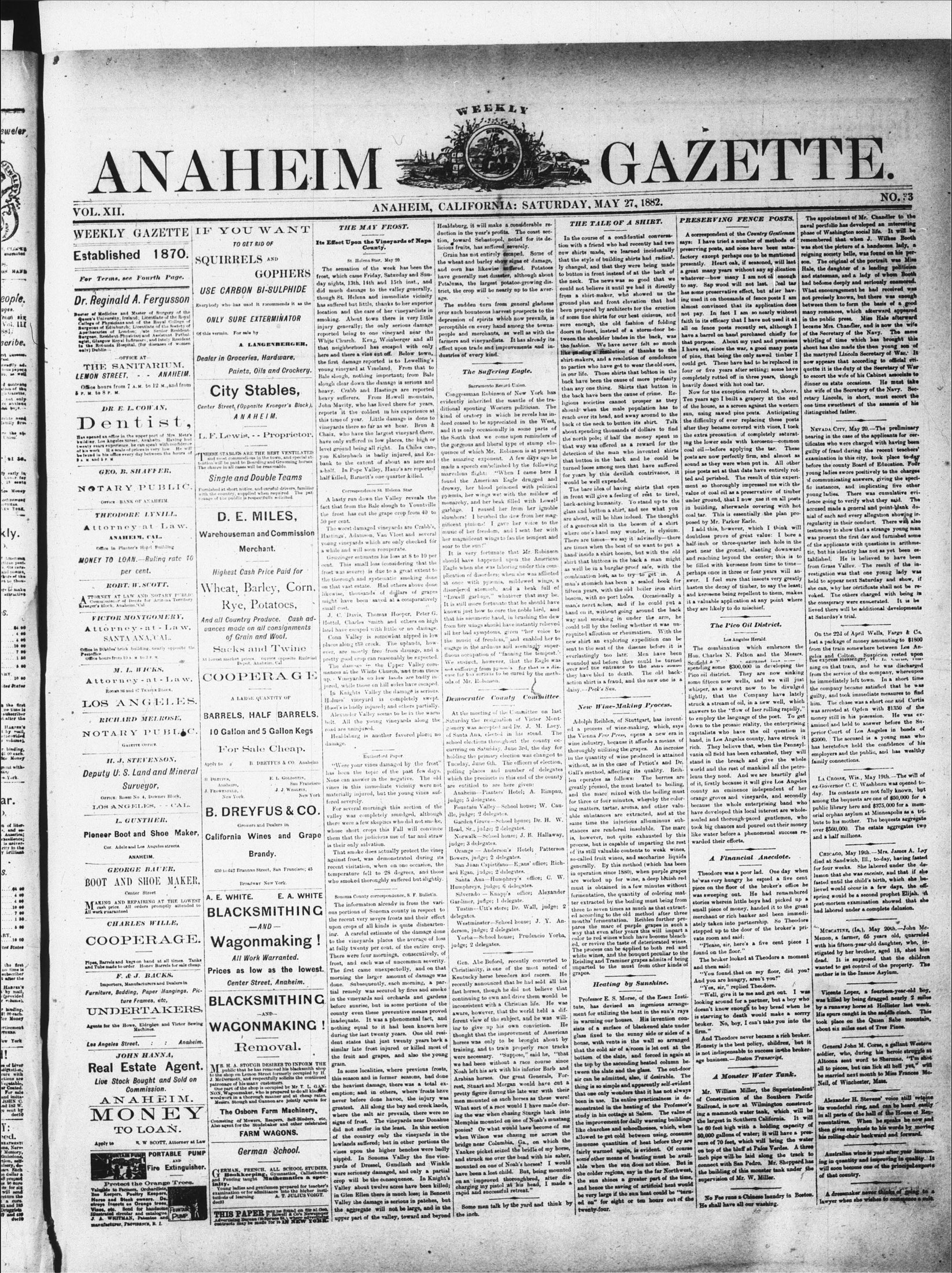
Searchable text
ANAHEIM
VOL. XII.
WEEKLY GAZETTE
Established 1870.
For Terms, see Fourth Page.
Dr. Reginald A. Fergusson
Doctor of Medicine and Master of Surgery of the Queen's University, Ireland; Licentiate of the Royal College of Physicians and of the Royal College of Burgess of Edinburgh; Licentiate of the Society of Aphecaries of London; late Senior Resident-Burgess, Resident-Physician and Assistant Pathologist, Glasgow Royal Infirmary, and lately Resident in the Rotunda Hospital. (for diseases of women only) Dublin
OFFICE AT
THE SANITARIUM.
LEMON STREET. - - ANAHEIM.
Office hours from 7 A.M. to 12 M., and from 8 P.M.
DR. E. L. COWAN,
Dentist,
Has opened an office in the upper part of Mrs. Mettr's building, Los Angeles Street, Anaheim. Having had twenty years experience, he can speak with confidence of his work. If a scale of prices is very low, He will be found in his office every day between the hours of 8 A.M. and 8 P.M.
GEO. B. SHAFFER.
IF YOU WANT
TO GET RID OF
SQUIRRELS AND
GOPHERS
USE CARBON BI-SULPHIDE
Everybody who has used it recommends it as the ONLY SURE EXTERMINATOR
Of this vermin. For sale by
A LANGENBERGER,
Dealer in Groceries, Hardware,
Paints, Oils and Crockery.
City Stables,
Center Street, (Opposite Kroeger’s Block),
ANAHEIM.
L. F. Lewis, - - Proprietor.
THESE STABLES ARE THE BEST VENTILATED
and most commodious in the town, and special attention will be paid to Boarding and Grooming horses.
The charve in all cases will be reasonable.
ITS Effect Upward
The sensation frost, which can last nights, 13th did much damage though St. Helens has suffered but location and smoking. About injury general reported being White Church that neighbor here and there the first damal young vineyard Bale slough, m slough clear de heavy. Crabb heavy sufferer John Mavity reports it the time of your vineyards there Chaix, who has only suffice level ground by you Kaltenbaum bank to the a-half. In Po
DR. E. L. COWAN,
Dentist,
Has opened an office in the upper part of Mrs. Metz's building, Los Angeles Street, Anaheim. Having had twenty years experience, he can speak with confidence of his work. It is a scale of prices is very low. He will be found in his office every day between the hours of 8 A.M. and 5 P.M.
GEO. B. SHAFFER,
NOTARY PUBLIC,
OFFICE BANK OF ANAHEIM.
THEODORE LYNILL.
Attorney at Law.
ANAHEIM, CAL.
Office in Planter's Hotel Building
MONEY TO LOAN.—Ruling rate 10 per cent.
ROBT. W. SCOTT.
ATTORNEY AT LAW AND NOTARY PUBLIC
Commissioner of Deeds for Arizona Territory Kroeger's Block, Anaheim, Cal.
VICTOR MONTGOMERY,
Attorney at Law.
SANTA ANA, CAL.
Office in Dibbles' brick building, nearly opposite the Postoffice.
Office hours from 10 A.M. to 3 P.M.
M. L. WICKS.
Attorney at Law.
ROOMS 58 and 57 TRAILER BLOCK.
LOS ANGELES.
RICHARD MELROSE,
NOTARY PUBLIC.
GAZETTE OFFICE.
H. J. STEVENSON.
Deputy U. S. Land and Mineral Surveyor,
OFFICE: Room No. 4, Downey Block,
LOS ANGELES, - - CAL.
L. GUNTHER.
Ploneer Boot and Shoe Maker,
Cor. Adele and Los Angeles streets.
ANAHEIM.
GEORGE BAUER,
BOOT AND SHOE MAKER,
Center Street
City Stables,
Center Street (Opposite Kroeger's Block),
ANAHEIM.
L. F. Lewis. - Proprietor.
THESE STABLES ARE THE BEST VENTILATED and most commodious in the town, and special attention will be paid to Boarding and Grooming horses. The charm in all cases will be reasonable.
Single and Double Teams
Furnished at short notice, and careful drivers, familiar with the country, supplied when required. The patronage of the public is respectfully solicited.
D. E. MILES,
Warehouseman and Commission Merchant.
Highest Cash Price Paid for
Wheat, Barley, Corn, Rye, Potatoes,
And all Country Produce. Cash advances made on all consignments of Grain and Wool.
Sacks and Twine
At lowest market prices. Office opposite Railroad Depot, Anaheim, Cal.
COOPERAGE
A LARGE QUANTITY OF
BARRELS, HALF BARRELS,
10 Gallon and 5 Gallon Kegs
For Sale Cheap.
Apply to:
B. DREYFUS & CO., Anaheim
H. DREYFUS,
ANAHEIM,
San Francisco
J. FROWENFIELD,
New York
B. DREYFUS & CO.
Growers and Dealers in California Wines and Grape Brandy.
620 to 642 Brannan Street, San Francisco; 45 Broadway New York.
A. E. WHITE.
E. A. WHITE
L. GUNTHER.
Ploneer Boot and Shoe Maker,
Cor. Adele and Los Angeles streets.
ANAHEIM.
GEORGE BAUER,
BOOT AND SHOE MAKER,
Center Street
MAKING AND REPAIRING AT THE LOWEST cash price. All orders promptly attended to. All work guaranteed.
CHARLES WILLE,
COOPERAGE.
Pipes, Barrels and kegs on hand at all times. Tanks and Tube made to order. Honey Barrels for sale cheap.
F. & J. BACKS.
Importers, Manufacturers and Dealers in Furniture, Bedding, Paper Hangings, Picture Frames, etc.
UNDERTAKERS,
Agents for the Howe, Eldregge and Victor Sewing Machines.
Los Angeles Street.: Anaheim.
JOHN HANNA,
Real Estate Agent.
Live Stock Bought and Sold on Commission.
ANAHEIM.
MONEY TO LOAN.
Apply to R. W SCOTT, Attorney at Law
PORTABLE PUMP AND Fire Extinguisher.
Protect the Orange Trees.
Valuable to Farmers, Orchardists, Bee Keepers, Poultry Keepers, Morses and Stock owners. De-etroys Insects on Orange trees, Visees, etc. Send for handsome illustrated circular and catalogue.
J. A. WHITMAN, Patentee and manufacturer, Providence, R. I.
B. DREYFUS & CO.
Growers and Dealers in California Wines and Grape Brandy.
630 to 642 Brannan Street, San Francisco; 45 Broadway New York.
A. E. WHITE.
E. A. WHITE
BLACKSMITHING
AND
Wagonmaking!
All Work Warranted.
Prices as low as the lowest.
Center Street, Anaheim.
BLACKSMITHING
AND
WAGONMAKING!
Removal.
MR. H. A. STOUGH DESIRES TO INFORM THE public that he has removed his blacksmith shop to the shop on Lemon Street formerly occupied by H. J. McDermott, and respectfully solicits the continued patronage of his many customers.
One part of the shop is occupied by Mr. T. L. GAN-NON, Wagonmaker, who is prepared to do all kinds of woodwork in a thorough manner and at cheap rates. Messrs. Stough and Gannon are jointly agents for The Osborn Farm Machinery.
Consisting of Mowers, Reapers, Self-Binders, etc. Also agent for the Studebaker and other celebrated FARM WAGONS.
German School.
GERMAN, FRENCH, ALL SCHOOL STUDIES,
Bookkeeping, Gymnastics, Callisthenics and Fencing taught Mathematics a specialty.
Young ladies and gentlemen prepared for teacher's examination or for admittance into the higher institutions of learning.
A. T. JULIUS VOIGT.
THIS PAPER may be found on site at Gen.
P. Howell & Co.'s Newspaper Advertising Bureau (10 Spruce St.), where advertising contracts may be made for it in NEW YORK.
WEEKLY
EIM GA
ANAHEIM, CALIFORNIA: SATURDAY, MAY 27, 1882.
THE MAY FROST.
Its Effect Upon the Vineyards of Napa County.
St. Helena Star, May 20.
The sensation of the week has been the frost, which came Friday, Saturday and Sunday nights, 13th, 14th and 15th inst., and did much damage to the valley generally, though St. Helena and immediate vicinity has suffered but little, thanks to her superior location and the care of her vineyardists in smoking. About town there is very little injury generally; the only serious damage reported being to one vineyard near the White Church. Krug, Weinberger and all that neighborhood has escaped with only here and there a vine cut off. Below town, the first damage reported is to Lewelling's young vineyard at Vineland. From that to Bale slough, nothing important; from Bale slough clear down the damage is serious and heavy. Crabb and Hastings are reported heavy sufferers. From Howell mountain, John Mavity, who has lived there for years, reports it the coldest in his experience at this time of year. Little damage is done to vineyards there so far as we hear. Brun & Chaix, who have the largest vineyard there, have only suffered in low places, the high or level ground being all right. In Chiles canyon Kaltenbach is badly injured, and Eubank to the extent of about an acre and a half. In Pope Valley, Hauz's are reported Healdsburg, it will make a considerable reduction in the year's profits. The coast section, toward Sebastopol, noted for its delicious fruits, has suffered severely.
Grain has not entirely escaped. Some of the wheat and barley show signs of damage, and corn has likewise suffered. Potatoes have generally met disaster, although about Petaluma, the largest potatoe-growing district, the crop will be nearly up to the average.
The sudden turn from general gladness over such bountious harvest prospects to the depression of spirits which now prevails, is perceptible on every hand among the townspeople and merchants, as well as with the farmers and vineyardists. It has already its effect upon trade and improvements and industries of every kind.
The Suffering Eagle.
Sacramento Record Union.
Congressman Robinson of New York has evidently inherited the mantle of the traditional spouting Western politician. The kind of oratory in which he revels has indeed ceased to be appreciated in the West, and it is only occasionally in some parts of the South that we come upon reminders of the gorgeous and liberal type of stump eloquence of which Mr. Robinson is at present the amazing exponent. A few days ago he made a speech embellished by the following marvelous flight: "When I came here I turned loose among men that have suffered for years by this devilish contrivance,
THE TALE OF A SHIRT.
In the course of a confidential conversation with a friend who had recently had two new shirts made, we learned incidentally that the style of building shirts had radically changed, and that they were being made to button in front instead of at the back of the neck. The news was so good that we could not believe it until we had it directly from a shirt-maker, who showed us the ground plan and front elevation that had been prepared by architects for the erection of some fine shirts for our best citizens, and sure enough, the old fashion of folding doors in front, instead of a storm-door between the shoulder blades in the back, was the fashion. We have never felt so much like passing a resolution of thanks to the shirt-makers, and a resolution of condolence to parties who have got to wear the old ones in our life. Those shirts that button in the back have been the cause of more profanity than any one thing. Shirts that button in the back have been the cause of crime. Religious societies cannot prosper as these should when the male population has reached over its head, and away around to the back of the neck to button its shirt. Talk about spending thousands of dollars to find the north pole; if half the money spent that way was offered as a reward for detection of the man who invented shirts that button in the back and he could turn loose among men that have suffered for years by this devilish contrivance.
Bale slough, nothing important; from Bale slough clear down the damage is serious and heavy. Crabb and Hastings are reported heavy sufferers. From Howell mountain, John Mavity, who has lived there for years, reports it the coldest in his experience at this time of year. Little damage is done to vineyards there so far as we hear. Brun & Chaix, who have the largest vineyard there, have only suffered in low places, the high or level ground being all right. In Chiles canyon Kaltenbach is badly injured, and Eubank to the extent of about an acre and a half. In Pope Valley, Hauz's are reported half killed, Barnett's one-quarter killed.
Correspondence St. Helena Star.
A basty run down the Valley reveals the fact that from the Bale slough to Yountville the frost has cut the grape crop from 40 to 50 per cent.
The worst damaged vineyards are Crabb's, Hastings', Adamson, Van Vleet and several young vineyards which are only checked for a while and will soon recuperate.
Grozinger estimates his loss at 8 to 10 per cent. This small loss (considering that the frost was severe) is due to a great extent to the thorough and systematic smoking done on that vast estate. Had others above done likewise, thousands of dollars of grapes might have been saved at a comparatively small cost.
J. C. Davis, Thomas Hooper, Peter G. Hottel, Charles Smith and others on high land have escaped with little or no damage.
Conn Valley is somewhat nipped in low places along the creek. The uplands, however, are mostly free from damage, and a pretty good crop can reasonably be expected.
The damage in the Upper Valley commences at the White Church, and from there up. Vineyards on low lands are badly injured, while those on hill sides have escaped.
In Knights' Valley the damage is serious. Holmes' vineyard is completely swept. Hood's is badly injured; and others partially.
Alexander Valley seems to be in the warm belt. All the young vineyards along the road are uninjured.
Healdsburg is another favored place; no damage.
Rutherford Paper.
"Were your vines damaged by the frost" has been the topic of the past few days. None can answer in the negative. The old vines in this immediate vicinity were not materially injured, but the young vines suffered severely.
For several mornings this section of the valley was completely smudged, although there were a few skeptics who did not smoke, whose short crops this Fall will convince them that the judicious use of tar and straw is their only salvation.
That smoke does actually protect the vines against frost, was demonstrated during its recent visitation, when on one occasion, the temperature fell to 28 degrees, and those who smoked thoroughly suffered but slightly.
Sonoma County correspondence, S. F. Bulletin.
Sacramento Record Union.
Congressman Robinson of New York has evidently inherited the mantle of the traditional spouting Western politician. The kind of oratory in which he revels has indeed ceased to be appreciated in the West, and it is only occasionally in some parts of the South that we come upon reminders of the gorgeous and liberal type of stump eloquence of which Mr. Robinson is at present the amazing exponent. A few days ago he made a speech embellished by the following marvelous flight: "When I came here I found the American Eagle drugged and drowsy, her blood poisoned with political pyemia, her wings wet with the mildew of monarchy, and her beak filled with Lowell garbage. I roused her from her ignoble slumbers! I brushed the dew from her magnificent pinions! I gave her voice to the music of her freedom, and I sent her with her magnificent wings to fan the tempest and soar to the sun!"
It is very fortunate that Mr. Robinson should have happened upon the American Eagle when she was laboring under this complication of disorders; when she was afflicted at once with pyemia, mildewed wings, a disordered stomach, and a beak full of "Lowell garbage," whatever that may be. It is still more fortunate that he should have known just how to cure the noble bird, and that his mesmeric hand, in brushing the dew from her wings should have instantly relieved all her bad symptoms, given "her voice to the music of freedom," and enabled her to engage in the arduous and seemingly superfluous occupation of "fanning the tempest." We suspect, however, that the Eagle was not suffering from pneumonia for that is a disease far too serious to be cured by the methods of Mr. Robinson.
Democratic County Committee.
At the meeting of the Committee on last Saturday the resignation of Victor Montgomery was accepted and Dr. J. M. Lacy, of Santa Ana, elected in his stead. The school elections throughout the county occurred on Saturday, June 3rd, the day for holding the primary election was changed to Tuesday, June 6th. The officers of election, polling places and number of delegates which the precincts in this end of the county are entitled to are here given:
Anaheim—Planters' Hotel; A. Rimpau, judge; 5 delegates.
Fountain Valley—School house; W. Candle, judge; 2 delegates.
Garden Grove—School house; Dr. H. W. Head, Sr., judge; 2 delegates.
Norwalk—School house; J. B. Hallaway, judge; 3 delegates.
Orange — Anderson's Hotel; Patterson Bowers, judge; 2 delegates.
San Juan Capistrano—Egans' office; Richard Egan, judge; 2 delegates.
Santa Ana—Humphrey's office; C. W. Humphreys, judge; 6 delegates.
Silverado — Knapp's office; Alexander in our life. Those shirts that entered back have been the cause of more profanities than any one thing. Shirts that button in the back have been the cause of crime. Religious societies cannot prosper as they should when the male population has reached over its head, and away around to the back of the neck to button its shirt. Tails about spending thousands of dollars to find the north pole; if half the money spent that way was offered as a reward for the detection of the man who invented shirts that button in the back and he could turn loose among men that have suffered for years by this devilish contrivance, would be well expended.
The bare idea of having shirts that open in front will give a feeling of rest to tired back-aching humanity. To stand up to glass and button a shirt, see what you are about, will be bliss indeed. The thought of a generous slit in the bosom of a shirt where one's hand may wonder, is eclipsing There are times—we say it advised—the are times when best of us want to put hand inside a shirt bosom, but with the shirt that buttons in the back a man must as well be in a burglar-proof safe, with combination lost, as to try to get in. Man's stomach has been a sealed book fifteen years, with the old boiler iron skosom, with no port holes. Occasionally man's heart aches, and if he could put hand on it, without going around the back way and sneaking in under the arm, could tell by the feeling whether it was required affection or rheumatism. With new shirt an exploring expedition can sent to the seat of the disease before it everlastingly too late. Men have been wounded and before they could be turned over and the entrance to the stairs they have bled to death. The old bra action shirt is a fraud, and the new one is daisy.-Peck's Sun.
New Wine-Making Process.
Adolph Reiblen, of Stuttgart, has invaded a process of wine-making, which led by the Vienna Free Press, opens a new wine industry because it affords a means thoroughly utilizing the grapes. An increase in the quantity of wine produced is attained without, as in the case of Petiot's and Gall's method, affecting its quality. Len operates as follows: The berries greatly pressed, the must heated to boiling matters, tartar, aroma, and other valuable substances are extracted, and at same time the injurious albuminous stances are rendered insoluble. The ice is, however, not quite exhausted by process, but is capable of imparting thereto its still valuable contents to weak wines so-called fruit wines, and saccharine liquids generally. By this method (which has been in operation since 1880), when purple grapes are worked up for wine, a deep bruise must be obtained in a few minutes with fermentation, the quantity of coloring
For several mornings this section of the valley was completely smudged, although there were a few skepies who did not smoke, whose short crops this Fall will convince them that the judicious use of tar and straw is their only salvation.
That smoke does actually protect the vine against frost, was demonstrated during its recent visitation, when on one occasion, the temperature fell to 28 degrees, and those who smoked thoroughly suffered but slightly.
Sonoma County correspondence, S. F. Bulletin.
The information already in from the various portions of Sonoma county in respect to the recent very severe frosts and their effect upon crops of all kinds is quite disheartening. A careful estimate of the damage done to the vineyards places the average loss at fully twenty per cent. of the entire crop. There were four mornings, consecutively, of frost, and each was of uncommon severity. The first came unexpectedly, and on that morning the larger amount of damage was done. Subsequently, each morning, a partial remedy was secured by fires and smoke in the vineyards and orchards and gardens before sunrise, but in some portions of the county even these preventive means proved inadequate. It was a phenomenal fact, and nothing equal to it had been known here during the last twenty years. One old resident states that just twenty years back a similar late frost injured or killed most of the fruit and grapes, and also the young grain.
In some localities, where previous frosts, this season and in former seasons, had done the heaviest damage, there was a total exemption; and in others, where frosts have never before done havoc, the injury was greatest. All along the bay and creek lands, where the salt air prevails, there were no signs of frost. The vineyards near Donahue did not suffer in the least. In this section of the country only the vineyards in the lowlands suffered; but in other portions the vines upon the higher benches were badly nipped. In Sonoma Valley the fine vineyards of Dressel, Gundlach and Winkle were seriously damaged, and only a partial crop will be the consequence. In Knight's Valley about twelve acres have been killed; in Glen Ellen there is much loss; in Bennett Valley the damage is serious in patches, but the aggregate will not be large, and in the upper part of the valley, toward and beyond judge; 5 delegates.
Fountain Valley—School house; W. Candle, judge; 2 delegates.
Garden Grove—School house; Dr. H. W. Head, Sr., judge; 2 delegates.
Norwalk—School house; J. B. Hallaway, judge; 3 delegates.
Orange — Anderson's Hotel; Patterson Bowers, judge; 2 delegates.
San Juan Capistrano—Egans' office; Richard Egan, judge; 2 delegates.
Santa Ana—Humphrey's office; C. W. Humphreys, judge; 6 delegates.
Silverado — Knapp's office; Alexander Gardiner, judge; 1 delegate.
Tustin—Utt's store; Dr. Wall, judge; 2 delegates.
Westminster—School house; J. Y. Anderson, judge; 2 delegates.
Yorba—School house; Prudencio Yorba, judge; 2 delegates.
Gen. Abe Buford, recently converted to Christianity, is one of the most noted of Kentucky horse breeders and racers. He recently announced that he had sold all his fast horses, though he did not believe that continuing to own and drive them would be inconsistent with a Christian life. He was aware, however, that the world held a different view of the subject, and he was willing to give up his own conviction. He thought that the improvement of American horses was only to be brought about by training, and to train properly race tracks were necessary. "Suppose," said he, "that we had been without a race course since Noah left his ark with his inferior Barb and Arabian horses. Our great Generals, Forrest, Stuart and Morgan would have cut a pretty figure during the late war with their men mounted on such horses as these were! What sort of a race would I have made during the war when chasing Sturgis back into Memphis mounted on one of Noah's mustang ponies? Or what would have become of me when Wilson was chasing me across the bridge near Columbia, Ga., on which the Yankee picket seized the bridle of my horse, and struck me over the head with his saber, mounted on one of Noah's horses? I would have been a lost child. But, being mounted on an improved thoroughbred, after discharging my pistol at his head, I made a rapid and successful retreat."
Some men talk by the yard and think by the inch.
Professor E. S. Morse, of the Essex state, has devised an ingenious argument for utilizing the heat in the sun's in warming our houses. His invention sists of a surface of blackened slate glass fixed to the sunny side or side house, with vents in the wall so arranged that the cold air of a room is let out at bottom of the slate, and forced in at top by the ascending heated column between the slate and the glass. The air can be admitted, also, if desirable thing is so simple and apparently self-fashioned that one only wonders that it has not been in use. Its entire practicalness is monstrated in the heating of the Prototype study in his cottage at Salem. The improvement for daily warming built like churches and schoolhouses, which allowed to get cold between using oil immense quantities of heat before they fairly warmed again, is evident. Of some other means of heating must be able when the sun does not shine, the colder regions, say in far North America, she shines a greater part of the day and hence the saving of artificial heat be very large if the sun heat could be used on eight or ten hours out twenty-four.
GAZETTE.
MAY 27, 1882.
ALE OF A SHIRT.
of a confidential conversation who had recently had two made, we learned incidentally of building shirts had radical. And that they were being made instead of at the back of the news was so good that we believe it until we had it directly to the maker, who showed us the front elevation that had by architects for the erection shirts for our best citizens, and the old fashion of folding instead of a storm-door beader blades in the back, was We have never felt so much resolution of thanks to the and a resolution of condolence to have got to wear the old ones, those shirts that button in the when the cause of more profanity thing. Shirts that button in has been the cause of crime. Re-licies cannot prosper as they the male population has to head, and away around to the neck to button its shirt. Talking thousands of dollars to find me; if half the money spent in is offered as a reward for the man who invented shirts in the back and he could be among men that have suffered this devilish contrivance, it
PRESERVING FENCE POSTS.
A correspondent of the Country Gentleman says: I have tried a number of methods of preserving posts, and none have been satisfactory except perhaps one to be mentioned presently. Heart oak, if seasoned, will last a great many years without any application whatever—how many I am not old enough to say. Sap wood will not last. Coal tar has some preservative effect, but after having used it on thousands of fence posts I am almost convinced that its application does not pay. In fact I am so nearly without faith in its efficacy that I have not used it at all on fence posts recently set, although I have a barrel on hand purchased chiefly for that purpose. About my yard and premises I have set, since the war, a good many posts of pine, that being the only sawed timber I could get. These have had to be replaced in four or five years after setting; some have completely rotted off in three years, though heavily dosed with hot coal tar.
Now for the exception referred to above. Ten years ago I built a grapery at the end of the house, as a screen against the western sun, using sawed pine posts. Anticipating the difficulty of ever replacing these posts after they became covered with vines, I took the extra precaution of completely saturating the lower ends with kerosene—common coal oil—before applying the tar. These posts are now perfectly firm, and almost as sound as they were when put in. All other pine posts set at that date have entirely rotated.
The appointment of Mr. Chandler to the naval portfolio has developed an interesting phase of Washington social life. It will be remembered that when J. Wilkes Booth was shot the picture of a handsome lady, a reigning society belle, was found on his person. The original of the portrait was Miss Hale, the daughter of a leading politician and statesman, and a lady of whom Booth had become deeply and seriously enamored. What encouragement he had received was not precisely known, but there was enough between them to form the basis of a good many romances, which afterward appeared in the public press. Miss Hale afterward became Mrs. Chandler, and is now the wife of the Secretary of the Navy. The same whirling of time which has brought this about has also made the then young son of the martyred Lincoln Secretary of War: It now appears that according to official etiquette it is the duty of the Secretary of War to escort the wife of his Cabinet associate to dinner on state occasions. He must take the wife of the Secretary of the Navy. Secretary Lincoln, in short, must escort the one time sweetheart of the assassin of his distinguished father.
Nevada City, May 20.—The preliminary hearing in the case of the applicants for certificates who were charged with having been guilty of fraud during the recent teachers' examination in this city, took place today before the county Board of Education. Four young ladies swore positively to the charges
The cause of more profanity in clothing. Shirts that button in been the cause of crime. Re-cries cannot prosper as they have the male population has to head, and away around to the neck to button its shirt. Talking thousands of dollars to find money; if half the money spent in offered as a reward for the man who invented shirts on the back and he could be among men that have suffered this devilish contrivance, it will expended.
Alea of having shirts that open give a feeling of rest to tired, humanity. To stand up to the cotton a shirt, and see what you will be bliss indeed. The thought is all in the bosom of a shirt hand may wonder, is elyrium.ines—we say it advisedly—there when the best of us want to put a shirt bosom, but with the old buttons in the back a man might a burglar proof safe, with the lost, as to try to get in. A which has been a sealed book for him, with the old boiler iron shirt no port holes. Occasionally aaches, and if he could put a without going around the back breaking in under the arm, he may the feeling whether it was unction or rheumatism. With the man exploring expedition can be least of the disease before it is very too late. Men have been told before they could be turned into entrance to the stairs sounded to death. The old back is a fraud, and the new one is a Ke Sun.
Wine-Making Process.
Reiblen, of Stuttgart, has invented of wine-making, which says Free Press, opens a new era inetry, because it affords a means of utilizing the grapes. An increase quantity of wine produced is attained in the case of Petiot's and Dr.ood, affecting its quality. Reiblen as follows: The berries are pressed, the must heated to boiling, marc mixed with the boiling must for four minutes, whereby the colors, tartar, aroma, and other valuances are extracted, and at the end the injurious albuminous substance rendered insoluble. The marc water, not quite exhausted by this sort is capable of imparting the rest valuable contents to weak wines, fruit wines, and saccharine liquids.
By this method (which has been known since 1880), when purple grapes up for wine, a deep bhush-red obtained in a few minutes without ion, the quantity of coloring material completely rotted off in three years, though heavily dosed with hot coal tar.
Now for the exception referred to above. Ten years ago I built a grapery at the end of the house, as a screen against the western sun, using sawed pine posts. Anticipating the difficulty of ever replacing these posts after they became covered with vines, I took the extra precaution of completely saturating the lower ends with kerosene—common coal oil—before applying the tar. These posts are now perfectly firm, and almost as sound as they were when put in. All other pine posts set at that date have entirely rotated and perished. The result of this experiment so thoroughly impressed me with the value of coal oil as a preservative of timber under ground, that I now use it on all posts in building, afterwards covering with hot coal tar. This is essentially the plan proposed by Mr. Parker Earle.
I add this, however, which I think will doubtless prove of great value: I bore a half-inch or three-quarter inch hole in the post near the ground, slanting downward and reaching beyond the center; this is to be filled with kerosene from time to time—perhaps once in three or four years will answer. I feel sure that insects very greatly hasten the decay of timber, to say the least; and kerosene being repellent to them, makes it a valuable application at any point where they are likely to do mischief.
The Pico Oil District.
Los Angeles Herald.
The combination which embraces the Hon. Charles N. Felton and the Messrs. Scofield & T., entrusted just spending some $300,000 in developing the Pico oil district. They are now sinking some fifteen new wells, and we will just whisper, as a secret now to be divulged lightly, that the Company have lately struck a stream of oil, in a new well, which answers to the "flow of Iser rolling rapidly," to employ the language of the poet. To get down to the prosaic reality, the enterprising capitalists who have the oil question in hand, in Los Angeles county, have struck it rich. They believe that, when the Pennsylvania oil field has been exhausted, they will stand in the breach and give the whole world and the rest of mankind all the petroleum they need. And we are heartily glad of it, firstly because it will give Los Angeles county an eminence independent of her orange groves and vineyards, and secondly because the whole enterprising band who have developed this local interest are wholesouled and thorough-paced gentlemen, who took big chances and poured out their money like water before a phenomenal success rewarded their efforts.
A Financial Anecdote.
Theodore was a poor lad. One day when he was very hungry he espied a five cent piece on the floor of the broker's office he was sweeping out. He had remembered to escort the wife of his Cabinet associate to dinner on state occasions. He must take the wife of the Secretary of the Navy. Secretary Lincoln, in short, must escort the one time sweetheart of the assassin of his distinguished father.
Nevada City, May 20.-The preliminary hearing in the case of the applicants for certificates who were charged with having been guilty of fraud during the recent teachers' examination in this city, took place to-day before the county Board of Education. Four young ladies swore positively to the charges of communicating answers, giving the specific instances, and implicating five other young ladies. There was cumulative evidence going to verify what they said. The accused made a general and point-blank denial of each and every allegation showing irregularity in their conduct. There was also testimony to show that a strange young man was present first day and furnished some of the applicants with questions in arithmetic, but his identity has not as yet been established. He is believed to have been from Grass Valley. The result of the investigation was that one young lady was held to appear next Saturday and show, if she can, why her certificate shall not be revoked. The others charged with being in the conspiracy were exonerated. It is believed there will be additional developments at Saturday's trial.
On the 22d of April Wells, Fargo & Co., lost a package of money amounting to $1800 from the train somewhere between Los Angeles and Colton. Suspicion rested upon the express messenger, W. L. Curtsis, running on that train, and he was discharged from the service of the company, whereupon he immediately left town. In a short time the company became satisfied that he was guilty, and took immediate measures to find him. The chase was a short one and Curtis was arrested at Ogden with $1350 of the money still in his possession. He was examined and held to answer before the Superior Court of Los Angeles in bonds of $3000. The accused is a young man who has heretofore held the confidence of his employers and the public, and has wealthy family connections.
LA Crosse, Wis., May 19th.-The will of ex-Governor C. C. Washburn was opened today. Its contents are not fully known, but among the bequests are one of $50,000 for a public library here and $375,000 for a memorial orphan asylum at Minneapolis as a tribute to his mother. The bequests aggregate over $500,000. The estate aggregates two and a half millions.
Chicago, May 19th.-Mrs. James A. Lay died at Sandwich, Ill., to-day, having fasted for four weeks. She labored under the delusion that she was enceinte, and that if she fasted until the child's birth, which she believed would occur in a few days, the offspring would be a second prophet Elijah.
For four minutes, whereby the color of wines, tartar, aroma, and other valuations are extracted, and at the end the injurious albuminous substance rendered insoluble. The marc matter, not quite exhausted by this heat, is capable of imparting the rest of valuable contents to weak wines, fruit wines, and saccharine liquids.
By this method (which has been used since 1880), when purple grapes were up for wine, a deep bluish-red substance in a few minutes without ionization, the quantity of coloring materialized by the boiling must be from seven times as much as that extracting to the old method after three fermentation. Reihlen further preyed on marble of purple grapes in such a severe after years this will impart a red wine which have become bleachive the taste of deteriorated wines. Press can be applied to both red and white, and the bouquet peculiar to the land Traminer grapes admits of being to the must from other kinds of heating by Sunshine.
Door E. S. Morse, of the Essex Institution, devised an ingenious arrangement utilizing the heat in the sun's rays among our houses. His invention contained a surface of blackened slate underbed to the sunny side or sides of a depth vents in the wall so arranged cold air of a room is let out at the end of the slate, and forced in again at the ascending heated column beneath slate and the glass. The out-door door is admitted, also, if desirable. The door is simple and apparently self-evident only wonders that it has not always cause. Its entire practicalness is detected in the heating of the Professor's cottage at Salem. The value of movement for daily warming buildings arrches and schoolhouses, which, when heated get cold between using, consume the quantities of heat before they are warmed again, is evident. Of course either means of heating must be available when the sun does not shine. But in older regions, say in the far Northwest, he shines a greater part of the time, once the saving of artificial heat would be large if the sun heat could be "turned off" for eight or ten hours out of the four.
A Financial Anecdote.
Theodore was a poor lad. One day when he was very hungry he espied a five cent piece on the floor of the broker's office he was sweeping out. He had remembered stories wherein little boys had picked up a small piece of money, handed it to the great merchant or rich banker and been immediately taken into partnership. So Theodore stepped up to the door of the broker's private room and said:
"Please sir, here's a five cent piece I found on the floor."
The broker looked at Theodore a moment and then said:
"You found that on my floor, did you? And you are hungry, aren't you?"
"Yes, sir," replied Theodore.
"Well, give it to me and get out. I was looking around for a partner, but a boy who doesn't know enough to buy bread when he is starving to death would make a sorry broker. No, boy, I can't take you into the firm."
And Theodore never became a rich broker. Honesty is the best policy, children, but it is not indispensable to success in the brokerage business.—Boston Transcript.
A Monster Water Tank.
Mr. William Miller, the Superintendent of Construction of the Southern Pacific Railroad, is now at Wilmington constructing a mammoth water tank, which will be the largest in Southern California. It will be 60 feet high with a holding capacity of 50,000 gallons of water; it will have a pressure of 70 feet, which will bring the water on top of the bluff at Palos Verdes. A three inch pipe will be laid along the track to connect with San Pedro. Mr. Sheppard has the building of this monster tank under the supervision of Mr. W. Miller.
No Fee runs a Chinese laundry in Boston. He shall have all our washing.
Chicago, May 19th.—Mrs. James A. Lay died at Sandwich, Ill., to-day, having fasted for four weeks. She labored under the delusion that she was enceinte, and that if she fasted until the child's birth, which she believed would occur in a few days, the offspring would be a second prophet Elijah. A post-mortem examination showed that she had labored under a complete delusion.
Muscatine, (La.), May 20th.—John McMenon, a farmer, 65 years old, quarreled with his fifteen-year-old daughter, who instigated by her brother, aged 18, shot him dead. It is supposed that the children wanted to get control of the property. The mother is in the Insane Asylum.
Vicente Lopez, a fourteen-year-old boy, was killed by being dragged nearly 2 miles by a runaway horse at Hollister last week. His spurs caught in the saddle cinch. This took place on the Quien Sabe mountain, about six miles east of Trees Pinox.
General John M. Corse, a gallant Western soldier, who, during his heroic struggle at Altoona sent word to Sherman. "I'm shot all to pieces, but can lick all bell yet," will be married next month to Miss Frances McNeil, of Winchester, Mass.
Alexander H. Stevens' voice still retains its wonderful ring, and can be heard easily in all parts of the hall of the House of Representatives. When he speaks he now and then gives emphasis to his words by moving his rolling-chair backward and forward.
Australian wine is year after year increasing in quantity and improving in quality. It will soon become one of the principal exports of that country.
A dressmaker never thinks of going to a lawyer when she wishes to contend a suit.