anaheim-gazette 1882-04-29
Scanned page
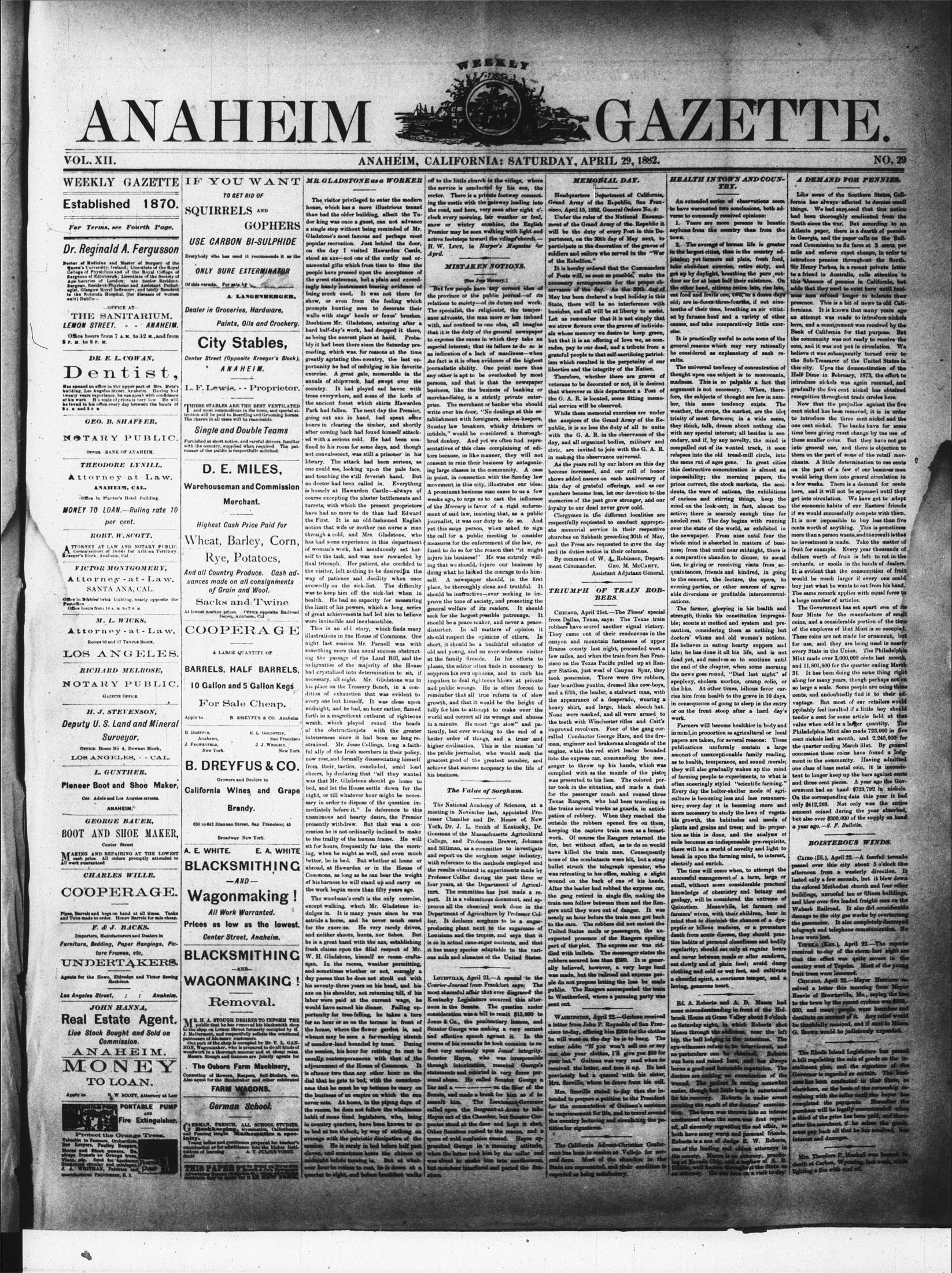
Searchable text
ANAHEIM
VOL. XII.
WEEKLY GAZETTE
Established 1870.
For Terms, see Fourth Page.
Dr. Reginald A. Fergusson
Doctor of Medicine and Master of Surgery of the Queen's University; Ireland; Licentiate of the Royal College of Physicians and of the Royal College of Surgeons of Ealnburgh; Licentiate of the Society of Ape-hocaries of London; late Senior Resident-Surgeon, Resident-Physician and Assistant Pathologist, Glasgow Royal Infirmary, and lately Resident in the Rotunda Hospital, (for diseases of women only) Dublin—
OFFICE AT—
THE SANITARIUM.
LEMON STREET. -- ANAHEIM.
Office hours from 7 a.m. to 32 m., and from 5 p.m. to 8 p.m.
DR. E. L. COWAN,
Dentist,
Has opened an office in the upper part of Mrs. Metra's building, Los Angeles Street, Araheim. Having had twenty years experience, he can speak with confidence of his work. He will be found in his office every day between the hours of 9 a.m. and 8 p.m.
GEO. B. SHAFFER,
NOTARY PUBLIC.
Office: BANK OF ANAHEIM.
THEODORE LYNILL,
IF YOU WANT
TO GET RID OF
SQUIRRELS AND
GOPHERS
USE CARBON BI-SULPHIDE
Everybody who has used it recommends it as the ONLY SURE EXTERMINATOR
Of this vermin. For sale by
A LANGENBERGER,
Dealer in Groceries, Hardware,
Paints, Oils and Crockery.
City Stables,
Center Street (Opposite Kroeger's Block),
ANAHEIM.
L.F. Lewis. -- Proprietor.
THESE STABLES ARE THE BEST VENTILATED and most commodious in the town, and special attention will be paid to Boarding and Grooming horses. The charve in all cases will be reasonable.
Single and Double Teams
Furnished at short notice, and careful drivers familiar with the country, supplied when required. The patronage of the public is respectfully solicited.
D. E. MILES,
DENTIST,
Has opened an office in the upper part of Mrs. Meta's building, Los Angeles Street, Anaheim. Having had twenty years experience, he can speak with confidence of his work. His scale of prices is very low. He will be found in his office every day between the hours of 9 A.M. and 5 P.M.
GEO. B. SHAFFER,
NOTARY PUBLIC.
Office - BANK OF ANAHEIM.
THEODORE LYNILL,
Attorney at Law.
ANAHEIM, CAL.
Office in Planter's Hotel Building.
MONEY TO LOAN.—Ruling rate 10 per cent.
ROBT. W. SCOTT.
ATTORNEY AT LAW AND NOTARY PUBLIC.
Commissioner of Deeds for Arizona Territory.
Kraeger's Block, Anaheim, Cal.
VICTOR MONTGOMERY,
Attorney-at-Law,
SANTA ANA, CAL.
Office in Dibbles brick building, nearly opposite the Postoffice.
Office hours from 10 A.M. to 3 P.M.
M. L. WICKS,
Attorney-at-Law,
Rooms 86 and 87 Temple Block.
LOS ANGELES.
RICHARD MELROSE,
NOTARY PUBLIC.
Gazette Office.
H. J. STEVENSON,
Deputy U. S. Land and Mineral Surveyor,
OFFICE: Room No 4, Downey Block,
LOS ANGELES, - - CAL.
L. GUNTHER.
Ploneer Boot and Shoe Maker,
Cor. Adele and Los Angeles streets.
ANAHEIM.
GEORGE BAUER,
BOOT AND SHOE MAKER,
Center Street
MAKING AND REPAIRING AT THE LOWEST cash price. All orders promptly attended to. All work guaranteed.
CHARLES WILLE,
COOPERAGE.
L. F. Lewis, -- Proprietor.
THESE STABLES ARE THE BEST VENTILATED and most commodious in the town, and special attention will be paid to Boarding and Grooming horses. The charm in all cases will be reasonable.
Single and Double Teams
Furnished at short notice, and careful drivers, familiar with the country, supplied when required. The patronage of the public is respectfully solicited.
D. E. MILES,
Warehouseman and Commission Merchant.
Highest Cash Price Paid for Wheat, Barley, Corn, Rye, Potatoes,
And all Country Produce. Cash advances made on all consignments of Grain and Wool.
Sacks and Twine
At lowest market prices. Office opposite Railroad Depot, Anaheim, Cal.
COOPERAGE
A LARGE QUANTITY OF
BARRELS, HALF BARRELS,
10 Gallon and 5 Gallon Kegs
For Sale Cheap.
Apply to B. DREYFUS & CO. Anaheim
B. DREYFUS,
K. L. GOLDSTEIN,
Annaheim,
San Francisco
J. FROWESFIELD,
New York
J. J. WEOLEIN,
New York
B. DREYFUS & CO.
Growers and Dealers in California Wines and Grape Brandy.
630 to 642 Brannan Street, San Francisco; 45 Broadway New York
A. E. WHITE.
E. A. WHITE
BLACKSMITHING
AND
Wagonmaking!
This is an old illustration in the night last session something more than the passage of indignation of the had crystalized into necessary, all night his place on the Treedition of exhaustion every one but him midnight, and he had forth in a magnificent wrath, which plaed of the obstruction intenseness since strained. Mr. Jesful ally of the Irish now rose, and formed from their tactics, cheers, by declaring was that Mr. Glads bed, and let the Hot night, or till whatever in order to dismediately before it unanimous and he presently with drew cession he is not ored to the trailty of the sit for hours, frequenting, when he might better, be in bed abroad, at Haward Commons, as long as of his harness he wihe the work begun moo
GEORGE BAUER,
BOOT AND SHOE MAKER,
Center Street
MAKING AND REPAIRING AT THE LOWEST
cash price. All orders promptly attended to
All work guaranteed
CHARLES WILLE,
COOPERAGE.
Pipes, Barrels and kegs on hand at all times. Tanks
and Tubes made to order. Honev Barrels for sale cheap.
F. & J. BACKS.
Importers, Manufacturers and Dealers in
Furniture, Bedding, Paper Hangings, Picture Frames, etc,
UNDERTAKERS.
Agents for the Howe, Eldridge and Victor Sewing Machines.
Los Angeles Street, : : Anaheim.
JOHN HANNA,
Real Estate Agent.
Live Stock Bought and Sold on Commission.
ANAHEIM.
MONEY TO LOAN.
Apply to R. W SCOTT, Attorney at Law
PORTABLE PUMP
AND
Fire Extinguisher.
Protect the Orange Trees.
Valuable to Farmers, Orchardists,
Bee Keepers, Poetry Keepers,
Mortars and Stock owners.
Dusty insects on Orange trees,
Vines, etc.
Send for handsome illuminated circular and catalogues.
J. A. WHITMAN, Patentee and manufacturer. Providence, R. I.
Brandy.
630 to 642 Brannan Street, San Francisco; 45 Broadway New York.
A. E. WHITE.
E. A. WHITE
BLACKSMITHING
—AND—
Wagonmaking!
All Work Warranted.
Prices as low as the lowest.
Center Street, Anaheim.
BLACKSMITHING
—and
WAGONMAKING!
Removal.
MR. H. A. STOUGH DESIRES TO INFORM THE
public that he has removed his blacksmith shop
to the shop on Lemon Street formerly occupied by H.
J. McDermott, and respectfully solicits the continued
patronage of his many customers.
One part of the shop is occupied by Mr. T. L. GANNON, Wagonmaker, who is prepared to do all kinds of woodwork in a thorough manner and at cheap rates.
Messera, Stough and Gannon are jointly agents for The Osborn Farm Machinery.
Consulting of Mowers, Reapers, Self-Binders, etc.
Also agent for the Studebaker and other celebrated FARM WAGONS.
German School.
GERMAN, FRENCH, ALL SCHOOL STUDIES,
Bookkeeping, Gymnastics, Callisthenics
and Fencing taught Mathematics a specialty.
Young ladies and gentlemen prepared for teacher's examination or for admission into the higher institutions of learning.
A. T. JULIUS VOIGT.
THIS PAPER may be found on file at Gov.
Advertising Bureau (Osborne) with a copy of contracts may be sent for it in NEW YORK.
The woodman's credit except walking, which dulges in. It is made astride a horse, and for the exercise and neither shoots, he is a great hand w fresh claims upon the W. H. Gladstone man. In the recent and sometimes when day passes that he his seventy-three years axe on his shoulder, labor were paid at would have earned portunity for tree-felling for an hour or so on the house, where the whence may be seen of meadow-land board the session, his house usually contemporary adjournment of the day is oftener two than dial that he gets to ness that he must be the business of an ever sets. At home the recession, he does habit of some tired in country quarter to bed at ten o'clock average with the pa session. He is rare eleven, and sometimes midnight before turn over hour he returns quarter to eight, an
MR. GLADSTONE as a WORKER
The visitor privileged to enter the modern house, which has a more illustrious tenant than had the older building, albeit the Tuor king was once a guest, can not advance a single step without being reminded of Mr. Gladstone's most famous and perhaps most popular recreation. Just behind the door, on the day I visited Hawarden Castle, stood an axe—not one of the costly ornamental gifts which from time to time the people have pressed upon the acceptance of the great statesman, but a plain and exceedingly handy instrument bearing evidence of being much used. It was not there for show, or even from the feeling which prompts hunting men to decorate their walls with stags' heads or foxen' brushes. Doubtless Mr. Gladstone, entering after a hard half-day's work, had dropped it there, as being the nearest place at hand. Probably it had been there since the Saturday preceding, which was, for reasons at the time greatly agitating the country, the last opportunity he had of indulging in his favorite exercise. A great gale, memorable in the annals of shipwreck, had swept over the country. It had played sad havoc with trees everywhere, and some of the lords of the ancient forest which skirts Hawarden Park had fallen. The next day the Premier, going out axe in hand, had spent some hours in clearing the timber, and shortly after coming back had found himself attacked with a serious cold. He had been confined to his room for some days, and though not convalescent, was still a prisoner in his library. The attack had been serious, as one could see, looking upon the pale face.
off to the little church in the village, where the service is conducted by his son, the rector. There is a private footway connecting the castle with the gateway leading into the road, and here, very soon after eight o'clock every morning, fair weather or foul, snow or wintry sunshine, the English Premier may be seen walking with light and active footsteps toward the village church. — H. W. Lucy, in Harper's Magazine for April.
MISTAKEN NOTIONS.
(San Jose Mercury.)
But few people have any correct idea of the province of the public journal—of its relations to society—of its duties and work. The specialist, the religionist, the temperance advocate, the man more or less imbued with, and confined to one idea, all imagine that it is the duty of the general newspaper to expense the cause in which they take an especial interest; that its failure to do so is as indication of a lack of manliness—when she fact is it is often evidence of the highest journalistic ability. One point more than any other is apt to be overlooked by most persons, and that is that the newspaper business, like the business of banking or merchandising, is a strictly private enterprise. The merchant or banker who should write over his door, "No dealings at this establishment with foreigners, saloon-keepers, Sunday law breakers, whisky drinkers or infidels," would be considered a thorough-bred donkey. And yet we often find representatives of this class complaining of editors because, in like manner, they will not consent to ruin their business by antagonizing large classes in the community. A case
MEMORIAL DAY.
Headquarters Department of California, Grand Army of the Republic, San Francisco, April 15, 1832, General Orders No. 4:
Under the rules of the National Encampment of the Grand Army of the Republic it will be the duty of every Post in this Department, on the 30th day of May next, to participate in the decoration of the graves of soldiers and sailors who served in the "War of the Rebellion."
It is hereby ordered that the Commanders of Posts will, as soon as possible, make the necessary arrangements for the proper observance of the day. As the 30th day of May has been declared a legal holiday in this State, there will be no interference with business, and all will be at liberty to assist. Let us remember that it is not simply that we strew flowers over the graves of individuals whose memory we desire to keep green, but that it is an offering of love we, as comrades, pay to our dead, and a tribute from a grateful people to that self-sacrificing patriotism which resulted in the perpetuity of our liberties and the integrity of the Nation.
Therefore, whether there are graves of veterans to be decorated or not, it is desired that wherever in this department a Post of the G. A. R. is located, some fitting memorial service will be observed.
While these memorial exercises are under the auspices of the Grand Army of the Republic, it is no less the duty of all to unite with the G. A. R. in the observance of the day, and all organized bodies, military and civic, are invited to join with the G. A. R. in making the observance universal.
As the years roll by our labors on this day become increased, and our roll of honor
A great gale, memorable in the annals of shipwreck, had swept over the country. It had played sad havoc with trees everywhere, and some of the lords of the ancient forest which skirts Hawarden Park had fallen. The next day the Premier, going out axe in hand, had spent some hours in clearing the timber, and shortly after coming back had found himself attacked with a serious cold. He had been confined to his room for some days, and though not convalescent, was still a prisoner in his library. The attack had been serious, as one could see, looking upon the pale face, and touching the still feverish hand. But no doctor had been called in. Everything is homely at Hawarden Castle—always of course excepting the plaster battlements and turrets, with which the present proprietors have had no more to do than had Edward the First. It is an old-fashioned English notion that wife or mother can nurse a man through a cold, and Mrs. Gladstone, who has had some experience in this department of woman's work, had assiduously set herself to the task, and was now rewarded by final triumph. Her patient, she confided to the visitor, left nothing to be desired in the way of patience and docility when once avowedly on the sick-list. The difficulty was to keep him off the sick-list when in health. He had no capacity for measuring the limit of his powers, which a long series of great achievements had led him to believe were invincible and inexhaustible.
This is an old story, which finds many illustrations in the House of Commons. One night last session Mr. Parnell was with something more than usual success obstructing the passage of the Land Bill, and the indignation of the majority of the House had crystalized into determination to sit, if necessary, all night. Mr. Gladstone was in his place on the Treasury Bench, in a condition of exhaustion that was evident to every one but himself. It was close upon midnight, and he had, an hour earlier, flamed forth in a magnificent outburst of righteous wrath, which played round the heads of the obstructionists with the greater intenseness since it had been so long restrained. Mr. Jesse Collings, long a faithful ally of the Irish members in their policy, now rose, and formally disassociating himself from their tactics, concluded, amid loud cheers, by declaring that "all they wanted was that Mr. Gladstone should go home to bed, and let the House settle down for the night, or till whatever hour might be necessary in order to dispose of the question immediately before it." In deference to this unanimous and hearty desire, the Premier presently withdrew. But that was a concession he is not ordinarily inclined to make to the trailty of the human frame. He will sit for hours, frequently far into the morning, when he might as well, and even much better, be in bed. But whether at home or abroad, at Hawarden or in the House of Commons, as long as he can bear the weight of his harness he will stand up and carry on the work begun more than fifty years ago.
The woodman's craft is the only exercise.
A great gale, memorable in the annals of shipwreck, had swept over the country. It had played sad havoc with trees everywhere, and some of the lords of the ancient forest which skirts Hawarden Park had fallen. The next day the Premier, going out axe in hand, had spent some hours in clearing the timber, and shortly after coming back had found himself attacked with a serious cold. He had been confined to his room for some days, and though not convalescent, was still a prisoner in his library. The attack had been serious, as one could see, looking upon the pale face, and touching the still feverish hand. But no doctor had been called in. Everything is homely at Hawarden Castle—always of course excepting the plaster battlements and turrets, with which the present proprietors have had no more to do than had Edward the First. It is an old-fashioned English notion that wife or mother can nurse a man through a cold, and Mrs. Gladstone, who has had some experience in this department of woman's work, had assiduously set herself to the task, and was now rewarded by final triumph. Her patient, she confided to the visitor, left nothing to be desired in the way of patience and docility when once avowedly on the sick-list. The difficulty was to keep him off the sick-list when in health. He had no capacity for measuring the limit of his powers, which a long series of great achievements had led him to believe were invincible and inexhaustible.
This is an old story, which finds many illustrations in the House of Commons. One night last session Mr. Parnell was with something more than usual success obstructing the passage of the Land Bill, and the indignation of the majority of the House had crystalized into determination to sit, if necessary, all night. Mr. Gladstone was in his place on the Treasury Bench, in a condition of exhaustion that was evident to every one but himself. It was close upon midnight, and he had an hour earlier, flamed forth in a magnificent outburst of righteous wrath, which played round the heads of the obstructionists with the greater intenseness since it had been so long restrained. Mr. Jesse Collings, long a faithful ally of the Irish members in their policy, now rose, and formally disassociating himself from their tactics, concluded, amid loud cheers, by declaring that "all they wanted was that Mr. Gladstone should go home to bed, and let the House settle down for the night, or till whatever hour might be necessary in order to dispose of the question immediately before it." In deference to this unanimous and hearty desire, the Premier presently withdrew. But that was a concession he is not ordinarily inclined to make to the trailty of the human frame. He will sit for hours, frequently far into the morning, when he might as well, and even much better, be in bed. But whether at home or abroad, at Hawarden or in the House of Commons, as long as he can bear the weight of his harness he will stand up and carry on the work begun more than fifty years ago.
The woodman's craft is the only exercise.
A great gale, memorable in the annals of shipwreck, had swept over the country. It had played sad havoc with trees everywhere, and some of the lords of the ancient forest which skirts Hawarden Park had fallen. The next day the Premier, going out axe in hand, had spent some hours in clearing the timber, and shortly after coming back had found himself attacked with a serious cold. He had been confined to his room for some days, and though not convalescent, was still a prisoner in his library. The attack had been serious, as one could see, looking upon the pale face, and touching the still feverish hand. But no doctor had been called in. Everything is homely at Hawarden Castle—always of course excepting the plaster battlements and turrets, with which the present proprietors have had no more to do than had Edward the First. It is an old-fashioned English notion that wife or mother can nurse a man through a cold, and Mrs. Gladstone, who has had some experience in this department of woman's work, had assiduously set herself to the task, and was now rewarded by final triumph. Her patient, she confided to the visitor, left nothing to be desired in the way of patience and docility when once avowedly on the sick-list. The difficulty was to keep him off the sick-list when in health. He had no capacity for measuring the limit of his powers, which a long series of great achievements had led him to believe were invincible and inexhaustible.
This is an old story, which finds many illustrations in the House of Commons. One night last session Mr. Parnell was with something more than usual success obstructing the passage of the Land Bill, and the indignation of the majority of the House had crystalized into determination to sit, if necessary, all night. Mr. Gladstone was in his place on the Treasury Bench, in a condition of exhaustion that was evident to every one but himself. It was close upon midnight, and he had an hour earlier, flamed forth in a magnificent outburst of righteous wrath, which played round the heads of the obstructionists with the greater intenseness since it had been so long restrained. Mr. Jesse Collings, long a faithful ally of the Irish members in their policy, now rose,and formally disassociating himself from their tactics,concluded,amid loud cheers,by declaring that "all they wanted was that Mr. Gladstone should go home to bed,and let the House settle down for the night,或 till whatever hour might be necessary in order to dispose of the question immediately before it." In deference to this unanimous and hearty desire,the Premier presently withdrew. But that was a concession he is not ordinarily inclined to make to the trailty of the human frame。He will sit for hours,frequently far into the morning,when he might as well,and even much better,be in bed。但 whether at home or abroad,at Hawarden or in the House of Commons,as long as he can bear the weight of his harness he will stand up和 carry on the work begun more than fifty years ago.
The woodman's craft is the only exercise.
A great gale,memorable in the annals of shipwreck,had swept over the country。它 Had played sad havoc with trees everywhere,and some of the lords of the ancient forest which skirts Hawarden Park had fallen。The next day the Premier,going out axe in hand,had spent some hours in clearing the timber,and shortly after coming back had found himself attacked with a serious cold。He had been confined to his room for some days,and though not convalescent,was still a prisoner who should write over his door,“No dealings at this establishment for foreigners,saloon-keepers,Sunday law breakers,whisky drinkers or infidels,” would be considered a thoroughbred donkey。And yet we often find representatives of this class complaining of editors because,在like manner,他们will not consent to ruin their business by antagonizing large classes inthe community。A case point,in connection withthe Sunday law movement inthis city,illustrates our idea:A prominent business man came to usa few weeks ago,to urge us to castthe influenceofthe Mercuryis favorofa rigid enforcementof said law,insistingthat,asapublic journalist,它was dutyto do so。Andyet this same person,when askedto signthe callfora public meetingto considermeasuresforthe enforcementofthelaw,refusedto do so forthe reasonthat“it might injurehis business!”He was entirely willingthatwe shouldinjureourbusinessbydoingwhathe lackedthe couragetodohimself.Anewspapershould,inthefirstplace,bethoroughcleanandtruthfulItshouldbeinstructive—ever seekingtoimprovethetoneofsociety,andpromotingthegeneralwelfareofitsreaders.它should seekforthelargestpossiblepatronage.它shouldbeapeace-maker,andneverapeace-disturber.Inallmattersofopinionitshouldrespecttheopinionsofothers.Inshort,它shouldbeahealthfuleducatorofoldandyoung,andan ever-welcomevisitoratthefamilyfireside.Inhiseffortsplease,theeditoroftenfinditnecessarytosuppresshisownopinions,andtocurbhisimpulsestodealrighteousblowsatprivateandpublicwrongs。他is oftened forcedtorememberthatalltruereformisofslowgrowth,andthatitwouldbetheheightoffollyforhimtoattempttomakeovertheworldandcorrectallitswrongsandabusesina minute.Hewmust“go slow”andpatiently,但everyworkingtotheendofabetterorderofthings,anda truerandhighercivilizationThisisthemission‘ofthepublisher,thewouldseekthegreatestgoodofthegreatestnumber,andachievethatsuccessnecessarytothelifeofhisbusiness.
The Value of Sorghum.
The National AcademyofSciences,ata meetinginNovemberlastappointedProfessorChandlerandDr.MooreofNewYork,Dr.J.L.SmithofKentucky,Dr.GoesmanoftheMassachusettsAgriculturalCollege,andProfessorsBrewerJohnsonandSilliman,asacommittee治 investigateandreportonthesorghumsugarindustrywithreferencetothemethodsemployedandresultobtainedinexperimentsmadebyProfessorCollierduringthepastthreeorfouryears,attheDepartmentOfAgriculture.Thecommitteehasjustmadeareport.itIsavoluminousdocumentandanimportantreasonhowtherereviewedinsinglefile,makingthe
TRIUMPHOF TRAIN ROBBERS.
Chicago,April21st.-TheTimes'specialfromDallas,Texas,says:TheTexastrainrobbershave scored another signal victory.They came outof their rendezvousinthecanyonandmountainfastnessesofupperBrazoscountylastnight,proceededwestafewmiles,andwhenthetrainfromSanFranciscoontheTexasPacificpulledupatRangerStation,justwestofCanyonSpur,the tookpossession.Thetherewerefiverobbers,fourbeardlessyouths,dressedlikecow-boys,anda fifth,theleader,astalwartmanwiththeappearanceofadesperado.wearingheavyshirt,andlargeblacksloucheat.Noneweremasked,andallwerearmedtotheteethwithWinchesterriflesandCoit'simprovedrevolvers.FourofthegangcorralledConductorGeorgeHare,andthefireman、engineerandbrakemanalongsideoftheengine;whilethered shirtleaderboundintotheexpresscar Commandingthemesengertothrowuphishandswhichwascompliedwithasthemuzzleofthepistojwaspresentedtohisface.Thecoloredporter tookinthe situation,andmadea dashforthepassengercoachandrousedthreeTexasRangerswhohadbeentravelingonthetrainsseveralweeksasguards,inticipationofrobbery。Whenthey reachedtheoutside Robbersopenedfireon them,kepingthecaptivetrainmenasabreastwork.OfcourseTheRangersreturnedthefire,但without effect,asto dosowouldhavetheideatedRobberystep-thetelegraphoperator,thewereretrainingtohisoffice,makingasidewoundonthebackofoneofhishands.Aftertheleaderhadrobbedtheexpresscar,thegangretiredinsinglefile,makingthe
The woodman's craft is the only exercise, except walking, which Mr. Gladstone indulges in. It is many years since he was astride a horse, and he never much cared for the exercise. He very rarely drives, and neither shoots, hunts, nor hares. But he is a great hand with the axe, establishing fresh claims upon the filial respect of Mr. W. H. Gladstone, himself no mean craftsman. In the recess, weather permitting, and sometimes whether or not, scarcely a day passes that he does not stroll out with his seventy-three years on his head, and his axe on his shoulder, not returning till, if his labor were paid at the current wage, he would have earned his dinner. Failing opportunity for tree-felling, he takes a turn for an hour or so on the terrace in front of the house, where the flower garden is, and whence may be seen a far-reaching stretch of meadow-land bounded by trees. During the session, his hour for retiring to rest is usually contemporaneous with that of the adjournment of the House of Commons. It is oftener two than any other hour on the dial that he gets to bed, with the consciousness that he must be up betimes to carry on the business of an empire on which the sun never sets. At home, in the piping days of the recession, he does not follow the wholesome habit of some tired legislators, who, being in country quarters, have been known to go to bed at ten o'clock, by way of striking an average with the patriotic dissipation of the session. He is rarely in bed before half past eleven, and sometimes he chimes at midnight before turning in. But at whatever hour he retires to rest, he is down at a quarter to eight, and before breakfast walks
The National Academy of Sciences, at a meeting in November last, appointed Professor Chandler and Dr. Moore of New York, Dr. J. L. Smith of Kentucky, Dr. Goesman of the Massachusetts Agricultural College, and Professors Brewer, Johnson and Silliman, as a committee to investigate and report on the sorghum sugar industry, with reference to the methods employed and the results obtained in experiments made by Professor Collier during the past three or four years, at the Department of Agriculture. The committee has just made a report. It is a voluminous document, and approves all the chemical work done in the Department of Agriculture by Professor Collier. It declares sorghum to be a sugar-producing plant next to the sugarcane of Louisiana and the tropics, and says that it is so in actual cane-sugar contents, and that it has many species adaptable to the various soils and climates of the United States.
LOUISVILLE, April 21.—A special to the Courier-Journal from Frankfort says: The most shameful affair that ever disgraced the Kentucky Legislature occurred this afternoon in the Senate. The question under consideration was a bill to remit $15,000 to Jones & Co., the penitentiary leases, and Senator George was making a very earnest and effective speech against it. In the course of his remarks he took occasion to reflect very seriously upon Jones' integrity. Senator Hayes, who was irresponsible through intoxication, resented George's statements and retorted in very fierce personal abuse. He called Senator George liar and a —— on the floor of the Senate, and made a break for him as if to assault him. The Lieutenant-Governor called upon the Sergeant-at-Arms to take Hayes out of the Chamber, but Senator Carpenter stood at the door and kept it shut. Other Senators rushed to the rescue, and a scene of wild confusion ensued. Hayes approached George in a menacing attitude when the latter took him by the collar and was about to strike him into another nausea, but members interfered and parted the Senate.
WASHINGTON, April 22.—Guiteau received a letter from John P. Reynolds of San Francisco to-day, offering him $300 for the clothes he will wear on the day he is to hang. The writer adds: "If you won't sell me or any one else your clothes, I'll give you $50 for your hat." Guiteau was very mad when he received the letter, and foresight it up. He had previously had a quarrel with his sister, Mrs. Scoville, whom he drove from his cell.
Mrs. Scoville stated to-day that she intended to prepare a petition to the President for the commutation of Guiteau's sentence to imprisonment for life, and to travel around the country lecturing and circulating the petition for signatures.
The California Advent-Christian Conference has been in session at Vellejo for several days. Most of the churches in the State are represented, and their condition is reported as being satisfactory.
GAZETTE.
APRIL 29, 1882.
DEMICAL DAY.
Department of California,
the Republic, San Francisco,
General Orders No. 4:
of the National Encampment
Army of the Republic it
of every Post in this Department, 30th day of May next, to
decorate of the graves of
who served in the "War
sured that the Commanders
soon as possible, make the
ments for the proper obday. As the 30th day of
shared a legal holiday in this
be no interference with
will be at liberty to assist,
that it is not simply that
over the graves of individuwe desire to keep green,
offering of love we, as comlead, and a tribute from a
what self-sacrificing patriotin the perpetuity of our
integrity of the Nation.
Other there are graves of
or not, it is desired
this department a Post of
related, some fitting memoobserved.
Memorial exercises are under
the Grand Army of the Rethe duty of all to unite
in the observance of the
razed bodies, military and
to join with the G. A. R.
servance universal.
by our labors on this day
and our roll of honor
HEALTH IN TOWN AND COUNTRY.
An extended series of observations seem
to have warranted two conclusions, both adverse to commonly received opinions:
1. There are more persons in lunatic
asylums from the country than from the
town.
2. The average of human life is greater
in the largest cities, than in the country adjoining; yet farmers eat plain, fresh food,
take abundant exercise, retire early, and
get up by daylight, breathing the pure outdoor air for at least half their existence. On
the other hand, citizens retire late, rise late,
eat food and fruits one, two, or a dozen days
old; are in-doors three-fourths, if not ninetenths of their time, breathing an air vitiated
by furnace heat and a variety of other
causes, and take comparatively little exercise.
It is practically useful to note some of the
general reasons which may very rationally
be considered as explanatory of such results.
The universal tendency of concentration of
thought upon one subject is to monomania,
madness. This is so palpable a fact that
argument is not necessary. When, therefore,
the subjects of thought are few in number, this same tendency exists. The weather,
the crops, the market, are the idol
trinity of most farmers; in a wide sense,
they think, talk, dream about nothing else
with any special interest; all besides is secondary, and if, by any novelty, the mind is
compelled out of its wonted track, it soon
relapses into the old tread-mill circle, into
the same rut of ages gone. In great cities
this destructive concentration is almost an
A DEMAND FOR PENNIES.
Like some of the Southern States, Calfornia has always affected to despise small things. We had supposed that this notion
had been thoroughly eradicated from the
South since the war. But according to an Atlanta paper, there is a dearth of pennies in Georgia, and the paper calls on the Railroad Commission to fix fares at 3 cents per mile and enforce exact change, in order to introduce pennies throughout the South.
Sir Henry Parkes, in a recent private letter to a friend in Australia, calls attention to this absence of pennies in California, but adds that they used to exist here until business men refused longer to tolerate their presence. This is a bit of news to old Californians. It is known that many years ago an attempt was made to introduce nickels here, and a consignment was received by the Bank of California for that purpose. But the community was not ready to receive the coin, and it was not put in circulation. We believe it was subsequently turned over to the Sub-Treasurer of the United States in this city. Upon the demonetization of the Half Dime in February, 1873, the effort to introduce nickels was again resumed, and gradually the five cent nickel has obtained recognition throughout trade circles here.
Now that the prejudice against the five cent nickel has been removed, it is in order to introduce the three cent nickel and the one cent nickel. The banks have for some time been giving exact change by the use of these smaller coins. But they have not got into general use, and there is objection to them on the part of some of the retail merchants. A little determination to use cents on the part of a few of our business men
Memorial exercises are under the Grand Army of the Republic in the duty of all to unite in the observance of the organized bodies, military and to join with the G. A. R. Reservation universal.
By our labors on this day and our roll of honor lies on each anniversary of helpful offerings, and as our less, let our devotion to the last grow stronger, and our never grow cold.
The different localities are invited to conduct appropriation in their respective with preceding 30th of May, requested to give the day cause in their columns.
W. A. Robinson, Department Assistant Adjutant General.
OF TRAIN ROBBERS.
21st.—The Times' special says: The Texas train and another signal victory of their rendezvous in the train fastnesses of upper east night, proceeded west at the train from San Francisco pulled up at Randall of Canyon Spur, they there were five robbers, both, dressed like cow-boys, leader, a stalwart man, with a desperado, wearing a large, black slouch hat, and all were armed to unleather rifles and Coit's arms. Four of the gang corp George Hare, and the fire-brakeman alongside of the red shirt leader bounded by commanding the mesup his hands, which was the muzzle of the pistol his face. The colored poration, and made a dash coach and roused three who had been traveling on weeks as guards, in anticlerical effect, as to do so would train men. Consequently assistants were hit, but a stray telegraph operator, who was office, making a slight back of one of his hands. And robbed the express car in single file, making the thought upon one subject is to monomania, madness. This is so palpable a fact that argument is not necessary. When, therefore, the subjects of thought are few in number, this same tendency exists. The weather, the crops, the market, are the idiot trinity of most farmers; in a wide sense, they think, talk, dream about nothing else with any special interest; all besides is secondary, and if, by any novelty, the mind is compelled out of its wonted track, it soon relapses into the old tread-mill circle, into the same rut of ages gone. In great cities this destructive concentration is almost an impossibility; the morning papers, the prices current, the stock markets, the accidents, the wars of nations, the exhibitions of curious and stirring things, keep the mind on the look-out; in fact, almost too active; there is scarcely enough time for needed rest. The day begins with running over the state of the world, as exhibited in the newspaper. From nine until four the whole mind is absorbed in matters of business; from that until near midnight, there is a comparative abandon to dinner, to social ties, to giving or receiving visits from acquaintances, friends and kindred, in going to the concert, the lecture, the opera, to evening parties, or other sources of agreeable diversions or profitable intercommunications.
The farmer, glorying in his health and strength, thinks his constitution impregnable; scouts at method and system and precaution, considering them as nothing but doctors' whims and old women's notions. He believes in eating hearty suppers and late; he has done it all his life, and is not dead yet, and resolves so to continue until the end of the chapter, when some morning the news goes round, "Died last night" of apoplexy, cholera morbus, cramp colic, or the like. At other times, bilious fever carries him from health to the grave in 10 days, in consequence of going to sleep in the entry or on the front stoop after a hard day's work.
Farmers will become healthier in body and in mind, in proportion as agricultural or local papers are taken, for several reasons: These publications uniformly contain a large amount of unexceptionable family reading as to health, temperance, and sound morals; they will also gradually waken up the mind of farming people to experiments, to what is often sneeringly styled "scientific farming." Every day the helter-skelter mode of agriculture is becoming less and less remunerative; every day it is becoming more and more necessary to study the laws of vegetable growth, the habitudes and needs of plants and grains and trees; and in proportion as this is done, and the analysis of soils becomes an indispensable pre-requisite, there will be a world of novelty and light to break in upon the farming mind, to interest, electrify and enrich.
The time will come when, to attempt the successful management of a farm, large or small, without some considerable practical knowledge of chemistry and botany will be considered the extreme of thought upon one subject is to monomania, madness. This is so palpable a fact that argument is not necessary. When, therefore, the subjects of thought are few in number, this same tendency exists. The weather, the crops, the market, are the idiot trinity of most farmers; in a wide sense, they think, talk, dream about nothing else with any special interest; all besides is secondary, and if, by any novelty, the mind is compelled out of its wonted track, it soon relapses into the old tread-mill circle, into the same rut of ages gone. In great cities this destructive concentration is almost an impossibility; the morning papers, the prices current, the stock markets, the accidents, the wars of nations, the exhibitions of curious and stirring things, keep the mind on the look-out; in fact, almost too active; there is scarcely enough time for needed rest. The day begins with running over the state of the world, as exhibited in the newspaper. From nine until four the whole mind is absorbed in matters of business; from that until near midnight, there is a comparative abandon to dinner, to social ties, to giving or receiving visits from acquaintances, friends and kindred, in going to the concert, the lecture, the opera, to evening parties, or other sources of agreeable diversions or profitable intercommunications.
The farmer, glorying in his health and strength, thinks his constitution impregnable; scouts at method and system and precaution, considering them as nothing but doctors' whims and old women's notions. He believes in eating hearty suppers and late; he has done it all his life, and is not dead yet, and resolves so to continue until the end of the chapter, when some morning the news goes round,"Died last night" of apoplexy, cholera morbus,cramp colic,or the like. At other times,bilious fever carries him from health to the grave in 10 days,in consequence of going to sleep in the entry or on the front stoop after a hard day's work.
Farmers will become healthier in body and in mind,in proportion as agricultural or local papers are taken,for several reasons: These publications uniformly contain a large amount of unexceptionable family reading,as to health,temperance,and sound morals;they will also gradually waken up the mind of farming people to experiments,to what is often sneeringly styled "scientific farming." Every day the helter-skelter mode of agriculture is becoming less and less remunerative;every day it is becoming more and more necessary to study the laws of vegetable growth,the habitudes和 needs of plants和grains和trees;and in proportion as this is done,and the analysis of soils becomes an indispensable pre-requisite,there will be a world of novelty和 light to break in upon the farming mind,to interest,electrify和 enrich.
The time will come when,to attempt the successful management of a farm,large or small,without some considerable practical knowledge of chemistry和 botany will be considered the extreme of thought upon one subject is to monomania,madness. This is so palpable a fact that argument is not necessary. When,因此,the subjects of thought are few in number,this same tendency exists. The weather,the crops,the market,are the idiot trinity of most farmers;in a wide sense,they think,talk,dream about nothing else with any special interest;all besides is secondary,and if,by any novelty,the mind is compelled out of its wonted track,它 soon relapses into the old tread-mill circle,into the same rut of ages gone. In great cities this destructive concentration is almost an impossibility;the morning papers,the prices current,the stock markets,the accidents,the wars of nations,the exhibitions of curious and stirring things,keep the mind on the look-out;in fact, almost too active;there is scarcely enough time for needed rest. The day begins with running over the state of the world,as exhibited in the newspaper.From nine until four the whole mind is absorbed in matters of business;from that until near midnight,这是一个 comparative abandon to dinner,到社会 ties,给 giving or receiving visits,从 acquaintances,friends和 kindred,在去到 concert,到 lecture,到 opera,在进行 circulation。We have got to adopt economic habits of our Eastern friends if we would successfully compete with them。它是 now impossible to buy less than five cents worth of anything。这 sometimes more than a person wants,and then result is that no investment is made。Take the matter of fruit for example。Every year thousands of dollars worth of fruit is left to rot in orchards,或 spoils in hands of dealers。它 is evident that the consumption of fruit would be much larger if every one could buy just what he wants to eat from his hand.The same remark applies with equal force to a large number of articles.
The Government has set apart one of its four Mints for the manufacture of small coins,和 a considerable portion of the time of employees of that Mint is so occupied。这些 coins are not made for ornament,但 for use,和 they are being used in nearly every State in the Union。The Philadelphia Mint made over 3 ,000 ,000 cents last month,and 11 ,801 ,800 for the quarter ending March 31.Its has been doing this thing right along for many years,though perhaps not on so large a scale.Some people are using these cents,and undoubtedly find it to their advantage。但 most of our retailers would probably feel insulted if a little boy should tender a cent for some article held at that value when sold in a larger quantity.The Philadelphia Mint also made 723 ,000 in five cent nickels last month,and 2 ,245 ,800 for the quarter ending March 31.BY general concession these coins have found a lodgment in the community.Having admitted one class of base metal coin,它 is inconsistent to longer keep up the bars against cents and three cent pieces.A year ago she Government had on hand $729 ,792 in nickels.On the corresponding date this year it had only $412 ,268.Not only was the entire amount coined during year absorbedbut also over $300 ,000ofthe supply on handa year ago.-S.F.Bulletin.
BOISTEROUS WINDS.
CAIRO (Ill.), April 22.-A fearful tornado passed over this city about 5 o'clock this afternoon from a westerly direction. It lasted only a few seconds,但 it blew downthe colored Methodist church and four other buildings,unroofed ten or fifteen buildings,
BOISTEROUS WINDS.
When they reached the horses opened fire on them, drove train men as a breaststroke the Rangers returned the effect, as to do so would train men. Consequently, stants were hit, but a stray telegraph operator, who was office, making a slight back of one of his hands, robbed the express car in single file, making the between them and the Rancher out of danger. It was more the train men got back robbers did not molest the cattle or passengers, the uncle of the Rangers spoiling The express car was ridiculed. The messenger states the loss than $500. It is generally wever, a very large haul railroad and expresspoor letting the loss be made by drivers accompanied the train there a pursuing party was
April 22.—Guiteau received P. Reynolds of San Francisco him $300 for the clothes he day he is to hang. The you won't sell me or any others, I'll give you $50 for man was very mad when he was, and torre it up. He had quarrel with his sister, then he drove from his cell stationed to-day that she insisted petition to the President of Guiteau's sentence for life, and to travel around and circulating the parish.
Advent-Christian Conference at Vallejo for service of the churches in the town, and their condition is satisfactory.
Ed. A. Roberts and A. D. Mason had some misunderstanding in front of the Holbrook House at Grass Valley about 8 o'clock on Saturday night, in which Roberts shot Mason through the abdomen, near the left hip, the ball lodging in the intestines. The eye-witnesses refuse to be interviewed, and no particular can be obtained. Roberts was born and raised here, and has always borne a good and honorable reputation. The doctors are making an examination of the wound. The patient is resting somewhat easier, though but little hope is entertained for his recovery. Roberts is under arrest awaiting the result of the doctors' examination. The town was thrown into an intense excitement when the news was first reported, all sincerely regretting the sad affair, as both have many warm and personal friends. Roberts is a son of Judge E. W. Roberts, one of the leading and oldest attorneys in the county. Mason is an attorney, practicing at Nevada City, and a nephew of A. B. Dibble, well known throughout the State as an attorney. He was here on a visit to-day.
BOISTEROUS WINDS.
Cairo (Ill.), April 22.—A fearful tornado passed over this city about 5 o'clock this afternoon from a westerly direction. It lasted only a few seconds, but it blew down the colored Methodist church and four other buildings, unroofed ten or fifteen buildings, and blew over five loaded freight cars on the Wabash Railroad. It also did considerable damage to the city gas works by overturning the gasometer. It also completely destroyed telegraph and telephone communication. No lives were lost.
Topeka (Kan.), April 22.—The reports received to-day of the storm last night are that the effect was quite severe in the country west of Topeka. Most of the young fruit trees were leased.
Chicago, April 22.—Mayor Harrison received a letter this morning from Mayor Reavis of Brownsville, Mo., saying the loss to the town by the recent cyclone was $250,-000, and many people were homeless and destitute on account of it. Any relief would be thankfully received, and if sent to Mason G. Brown would be judiciously expanded.
The Rhode Island Legislature has passed a bill regulating the sale of goods on the installment plan, and the signature of the Governor is regarded as certain. The business has been conducted in that State, as elsewhere, on the basis of the ownership remaining with the seller until the buyer has completed the payments. Horsesfer the purchase will be legally consumed when a third of the price has been paid, and therafter the merchant, if he suises the goods, must pay back all that he has received, like interest and damages.
Mrs. Theodore P. Hankall was burned to death at Carbon, Wyoming; last week, while lighting a fire with coal oil.