anaheim-gazette 1882-04-22
Scanned page
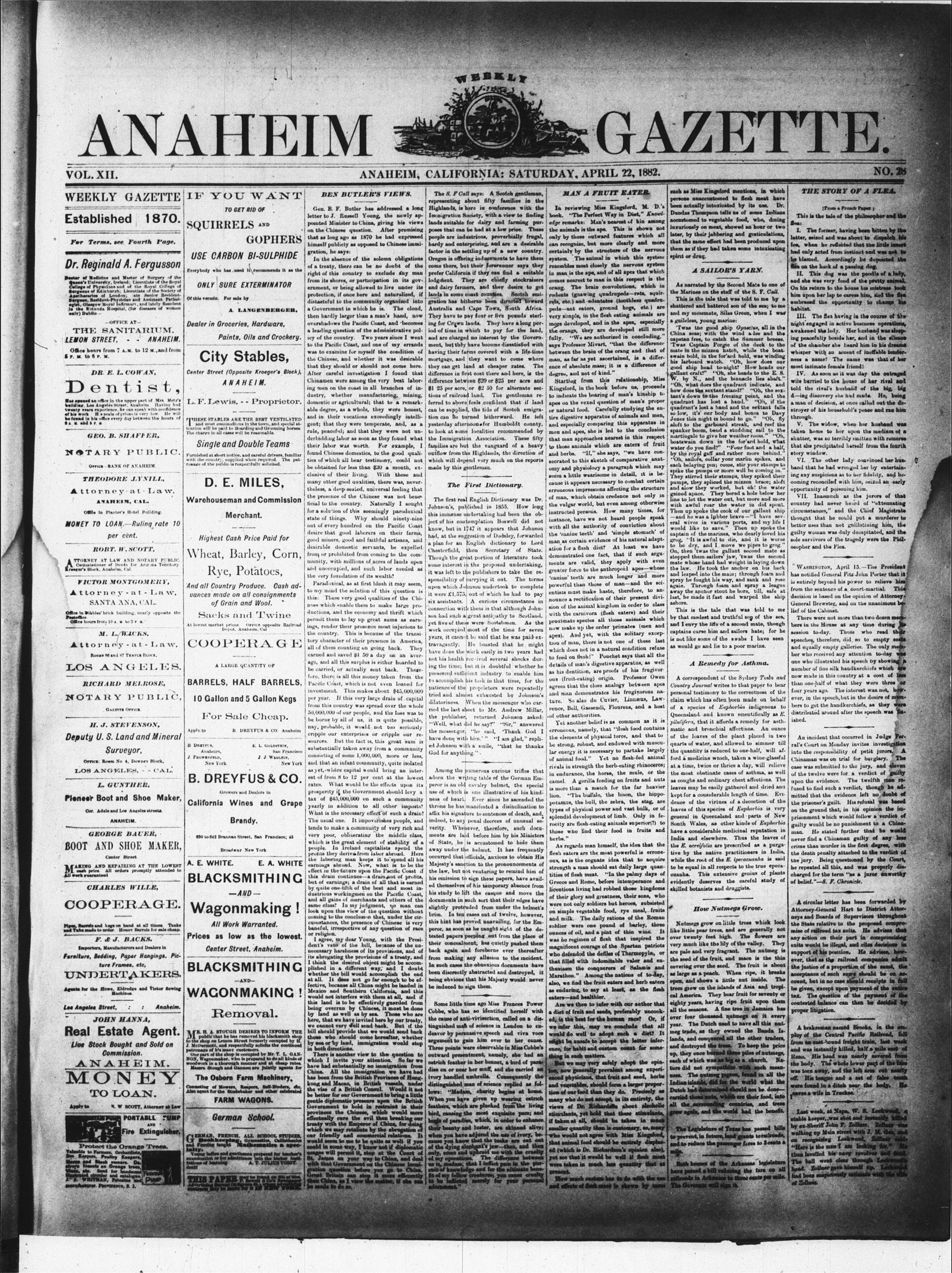
Searchable text
ANAHEIM
VOL. XII.
WEEKLY GAZETTE
Established 1870.
For Terms, see Fourth Page.
Dr. Reginald A. Fergusson
Doctor of Medicine and Master of Surgery of the Queen's University, Ireland; Licentiate of the Royal College of Physicians and of the Royal College of Surgeons of Edinburgh; Licentiate of the Society of Apothecaries of London; Senior Resident-Surgeon, Resident-Physician and Assistant Pathologist, Glasgow Royal Infirmary, and lately Resident in the Rotunda Hospital (for diseases of women only) Dublin.
OFFICE AT—
THE SANITARIUM.
LEMON STREET, - - ANAHEIM.
Office hours from 7 a.m. to 12 m., and from 5 p.m. to 8 p.m.
DR E. L. COWAN,
Dentist,
Has opened an office in the upper part of Mrs. Metr's building, Los Angeles Street, Anaheim. Having had twenty years experience, he can speak with confidence of his work. If a scale of prices is very low, He will be found in his office every day between the hours of 9 a.m. and 8 p.m.
GEO. B. SHAFFER,
NOTARY PUBLIC.
Office—BANK OF ANAHEIM.
IF YOU WANT
TO GET RID OF
SQUIRRELS AND
GOPHERS
USE CARBON BI-SULPHIDE
Everybody who has used it recommends it as the ONLY SURE EXTERMINATOR
Of this vermin. For sale by
A. LANGENBERGER,
Dealer in Groceries, Hardware,
Paints, Oils and Crockery.
City Stables,
Center Street (Opposite Kroeger’s Block),
ANAHEIM.
L. F. Lewis. - Proprietor.
THESE STABLES ARE THE BEST VENTILATED
and most commodious in the town, and special attention will be paid to Boarding and Grooming horses.
The charve in all cases will be reasonable.
Single and Double Teams
Furnished at short notice, and careful drivers, familiar with the country, supplied when required. The patronage of the public is respectfully solicited.
BEN BUTLER
Gen. B. F. Butler letter to J. Russell pointed Minister to on the Chinese question that as long ago as himself publicly asked gration, he says:
In the absence of a treaty, there o right of this county from its shores, or ernment, or being protection, if once distasteful to the c Government in w then hardly larger overshadows the P leading question iety of the country.
to the Pacific Coas was to examine for the Chinese, and w that they should o After careful invi Chinamen were an ing men on the cos dustry, whether domestic or agricul able degree, as a w and in their voca gent; that they we rule, peaceful; and derbidding labor as their labor was w found Chinese dom ties of which all be obtained for less clusive of their li
Dentist,
Has opened an office in the upper part of Mrs. Metz's building, Los Angeles Street, Anaheim. Having had twenty years experience, he can speak with confidence of his work. His scale of prices is very low. He will be found in his office every day between the hours of 9 A.M. and 6 P.M.
GEO. B. SHAFFER,
NOTARY PUBLIC.
Office—BANK OF ANAHEIM.
THEODORE LYNILL,
Attorney-at-Law.
ANAHEIM, CAL.
Office in Planter's Hotel Building.
MONEY TO LOAN.—Ruling rate 10 per cent.
ROBT. W. SCOTT.
ATTORNEY AT LAW AND NOTARY PUBLIC.
Commissioner of Deeds for Arizona Territory Kreager's Block, Anaheim, Cal.
VICTOR MONTGOMERY,
Attorney-at-Law,
SANTA ANA, CAL.
Office in Bibbles' brick building, nearly opposite the Postoffice.
Office hours from 10 A.M. to 3 P.M.
M. L. WACKS,
Attorney-at-Law.
Rooms 86 and 87 Temple Block.
LOS ANGELES.
RICHARD MELROSE,
NOTARY PUBLIC.
Gazette Office.
H. J. STEVENSON,
Deputy U. S. Land and Mineral Surveyor.
Office: Room No 4, Downey Block,
LOS ANGELES, — CAL.
L. GUNTHER,
Pioneer Boot and Shoe Maker,
Cor. Adele and Los Angeles streets.
ANAHEIM.
GEORGE BAUER,
BOOT AND SHOE MAKER,
Center Street
MAKING AND REPAIRING AT THE LOWEST cash price. All orders promptly attended to all work guaranteed.
CHARLES WILLE,
ANAHEIM.
L. F. Lewis. -- Proprietor.
THESE STABLES ARE THE BEST VENTILATED and most commodious in the town, and special attention will be paid to Boarding and Grooming horses. The charge in all cases will be reasonable.
Single and Double Teams
Furnished at short notice, and careful drivers, familiar with the country, supplied when required. The patronage of the public is respectfully solicited.
D. E. MILES,
Warehouseman and Commission Merchant.
Highest Cash Price Paid for
Wheat, Barley, Corn,
Rye, Potatoes,
And all Country Produce. Cash advances made on all consignments of Grain and Wool.
Sacks and Twine
At lowest market prices. Office opposite Railroad Depot, Anaheim, Cal.
COOPERAGE
A LARGE QUANTITY OF
BARRELS, HALF BARRELS,
10 Gallon and 5 Gallon Kegs
For Sale Cheap.
Apply to B. DREYFUS & CO. Anaheim
B. DREYFUS,
Anaheim,
San Francisco
J. FROWESFIELD,
New York
New York
B. DREYFUS & CO.
Growers and Dealers in California Wines and Grape Brandy.
630 to 642 Brannan Street, San Francisco; 45 Broadway New York
A. E. WHITE.
E. A. WHITE
BLACKSMITHING
—and
Pioneer Boot and Shoe Maker,
Cor. Adele and Los Angeles streets.
ANAHEIM.
GEORGE BAUER,
BOOT AND SHOE MAKER,
Center Street
MAKING AND REPAIRING AT THE LOWEST
M cash price. All orders promptly attended to
All work guaranteed
CHARLES WILLE,
COOPERAGE.
Pipe, Barrels and keys on hand at all times. Tanks
and Tube made to order. Honev Barrels for sale cheap.
F. & J. BACKS.
Importers, Manufacturers and Dealers in
Furniture, Bedding, Paper Hangings, Picture Frames, etc,
UNDERTAKERS.
Agents for the Howe, Eldredge and Victor Sewing Machines.
Lee Angeles Street, : Anaheim.
JOHN HANNA,
Real Estate Agent.
Live Stock Bought and Sold on Commission.
ANAHEIM.
MONEY TO LOAN.
Apply to R. W SCOTT, Attorney at Law
PORTABLE PUMP
AND
Fire Extinguisher.
Protect the Orange Trees.
Valuable to Farmers, Orchardists,
Bee Keepers, Poultry Keepers,
Marmons and Stacks owners. Dastrope Insulcs on Orange trees,
Worms, etc. Send for handmade
Illustrated circular and catalogue.
J. A. WHITMAN, Patentes and
manufacturer. Providence, R. I.
California Wines and Grape
Brandy.
630 to 642 Brannan Street, San Francisco; 45
Broadway New York
A. E. WHITE.
E. A. WHITE
BLACKSMITHING
— AND —
Wagonmaking!
All Work Warranted.
Prices as low as the lowest.
Center Street, Anaheim.
BLACKSMITHING
— AND —
WAGONMAKING!
Removal.
MR. H. A. STOUGH DESIRES TO INFORM THE
public that he has removed his blacksmith shop
to the shop on Leonon Street formerly occupied by H.
J. McDermott, and respectfully solicits the continued patronage of b's many customers.
One part of the shop is occupied by Mr. T. L GANNON, Wagonmaker, who is prepared to do all kinds of woodwork in a thorough manner and at cheap rates.
Messrs Stough and Gannon are jointly agents for The Osborn Farm Machinery,
Consisting of Mowers, Reapers, Self-Binders, etc.
Also agent for the Studebaker and other celebrated FARM WAGONS.
German School.
GERMAN, FRENCH. ALL SCHOOL STUDIES,
Bookkeeping, Gynecology, Callisthenics
and Feeding taught Mathematics a speciality.
Young ladies and gentlemen prepared for teacher's examination or for admittance into the higher institutions of learning.
A. T. JULIUS VOIGT.
THIS PAPER may be found on file at Glen,
Advertising Bureau (in Sorensen), where advertisements may be made for it in NEW YORK.
ANAHEIM, CALIFORNIA: SATURDAY, APRIL 22, 1882.
BEN BUTLER'S VIEWS.
Gen. B. F. Butler has addressed a long letter to J. Russell Young, the newly appointed Minister to China, giving his views on the Chinese question. After premising that as long ago as 1870 he had expressed himself publicly as opposed to Chinese immigration, he says:
In the absence of the solemn obligations of a treaty, there can be no doubt of the right of this country to exclude any man from its shores, or participation in its government, or being allowed to live under its protection, if once here and naturalized, if distasteful to the community organized into a Government in which he is. The cloud, then hardly larger than a man's hand, now overshadows the Pacific Coast, and becomes a leading question of the administrative policy of the country. Two years since I went to the Pacific Coast, and one of my errands was to examine for myself the condition of the Chinese, and whether it was desirable that they should or should not come here. After careful investigation I found that Chinamen were among the very best laboring men on the coast in all branches of industry, whether manufacturing, mining, domestic or agricultural; that to a remarkable degree, as a whole, they were honest, and in their vocations exceedingly intelligent; that they were temperate, and, as a rule, peaceful; and that they were not underbidding labor as soon as they found what their labor was worth. For example, I found Chinese domestics, to the good qualities of which all bear testimony, could not be obtained for less than $30 a month, exclusive of their living. With these and
The S. F Call says: A Scotch gentleman, representing about fifty families in the Highlands, is here in conference with the Immigration Society, with a view to finding lands suitable for dairy and farming purposes that can be had at a low price. These people are industrious, proverbially frugal, hardy and enterprising, and are a desirable factor in the settling up of a new country. Oregon is offering inducements to have them come there, but their forerunner says they prefer California if they can find a suitable lodgment. They are chiefly stockraisers and dairy farmers, and they desire to get lands in some coast counties. Scotch emigration has hitherto been directed toward Australia and Cape Town, South Africa. They have to pay four or five pounds sterling for Crown lands. They have a long period of time in which to pay for the land, and are charged no interest by the Government, but they have become dissatisfied with having their farms covered with a life-time mortgage, and they want to come where they can get land at cheaper rates. The difference in first cost there and here, is the difference between $20 or $25 per acre and $1 25 per acre, or $2 50 for alternate sections of railroad land. The gentleman referred to above feels confident that if land can be supplied, the title of Scotch emigration can be turned hitherward. He left yesterday afternoon for Humboldt county, to look at some localities recommended by the Immigration Association. These fifty families are but the vanguard of a heavy outflow from the Highlands, the direction of which will depend very much on the reports made by this gentleman.
MAN A FRUIT EATER.
In reviewing Miss Kingsford, M. D.'s book, "The Perfect Way in Diet," knowledge remarks: Man's nearest kin among the animals is the ape. This is shown not only by those outward features which all can recognize, but more clearly and more certainly by the structure of the nervous system. The animal in which this system resembles most closely the nervous system in man is the ape, and of all apes that which comes nearest to man in this respect is the orang. The brain convolutions, which in rodents (gnawing quadrupeds—rats, squirrels, etc.) and edentates (toothless quadrupeds—ant eaters, ground hogs, etc.) are very simple, in the flesh eating animals are more developed, and in the apes, especially the orangs, they are developed still more fully. "We are authorized in concluding," says Professor Milvart, "that the difference between the brain of the orang and that of man, as far as yet ascertained, is a difference of absolute mass; it is a difference of degree, and not of kind."
Starting from this relationship, Miss Kingsford, in the book before us, proceeds to indicate the bearing of man's kinship to apes on the vexed question of man's proper or natural food. Carefully studying the entire digestive apparatus of animals and men, and especially comparing this apparatus in men and apes, she is led to the conclusion that man approaches nearest in this respect to those animals which are eaters of fruit and herbs. "If," she says, "we have consecrated to this sketch of comparative anatomy and physiology a paragraph which may be little wearisome in detail; it is be-
After careful investigation I found that Chinamen were among the very best laboring men on the coast in all branches of industry, whether manufacturing, mining, domestic or agricultural; that to a remarkable degree, as a whole, they were honest, and in their vocations exceedingly intelligent; that they were temperate, and, as a rule, peaceful; and that they were not underbidding labor as soon as they found what their labor was worth. For example, I found Chinese domestics, to the good qualities of which all bear testimony, could not be obtained for less than $30 a month, exclusive of their living. With these and many other good qualities, there was, nevertheless, a deep-seated, universal feeling that the presence of the Chinese was not beneficial to the country. Naturally I sought for a solution of this seemingly paradoxical state of things. Why should ninety-nine out of every hundred on the Pacific Coast desire that good laborers on their farms, good miners, good and faithful artisans, and desirable domestic servants, be expelled from or prohibited from coming to the community, with millions of acres of lands open and unoccupied, and such labor needed as the very foundation of its wealth?
Paradoxical, as at first blush it may seem, to my mind the solution of this question is this: These very good qualities of the Chinese which enable them to make large productions, and the economy and thrift which permit them to lay up great sums as earnings, render their presence most injurious to the country. This is because of the transitory character of their presence in America, all of them counting on going back. They earned and saved $150 a day on an average, and all this surplus is either hoarded to be carried, or actually sent back. Therefore, there is all this money taken from the Pacific Coast, which is not even loaned for investment. This makes about $45,000,000 per year. If this very large drain of capital from this country was spread over the whole 50,000,000 of our people, and the loss was to be borne by all of us, it is quite possible, nay, probable, it would not too seriously cripple our enterprises or cripple our resources. But the fact is, this great sum is substantially taken away from a community consisting of some 1,000,000 more or less, and that an infant community, quite isolated as yet, where capital would bring an interest of from 8 to 12 per cent at the lowest rates. What would be the effects upon its prosperity if the Government should levy a tax of $45,000,000 on such a community yearly in addition to all other imposts? What is the necessary effect of such a drain? The usual one. It impoverishes people, and tends to make a community of very rich and very poor, obliterating the middle class, which is the great element of stability of a people. In Ireland capitalists spend the profits they derive from labor abroad. Here the laboring man keeps it to spend all his earnings abroad. Now, what is to be the effect in the future upon the Pacific Coast if this drain continues—a drain not of profits, but of earnings; a drain of all that is earned by quite one-fifth of the best and most industrious workingmen on the Pacific Coast, and all strains of merchants and others of the documents in such sort that their admirable difference between $20 or $25 per acre and $125 per acre, or $250 for alternate sections of railroad land. The gentleman referred to above feels confident that if land can be supplied, the tide of Scotch emigration can be turned hitherward. He left yesterday afternoon for Humboldt county, to look at some localities recommended by the Immigration Association. These fifty families are but the vanguard of a heavy outflow from the Highlands, the direction of which will depend very much on the reports made by this gentleman.
The First Dictionary.
The first real English Dictionary was Dr. Johnson's, published in 1855. How long this immense undertaking had been the object of his contemplation Boswell did not know, but in 1747 it appears that Johnson had, at the suggestion of Dodsley, forwarded a plan for an English dictionary to Lord Chesterfield, then Secretary of State. Though the great portion of literature took some interest in the proposed undertaking, it was left to the publishers to take the responsibility of carrying it out. The terms upon which Johnson undertook to complete it were £1,575, out of which he had to pay six assistants. A curious circumstance in connection with them is that although Johnson had such a great antipathy to Scotland, yet five of these were Scotchmen. As the work occupied most of the time for seven years, it cannot be said that he was paid extravagantly. He boasted that he might have done the work easily in two years had not his health received several shocks during the time; but it is doubtful whether he possessed sufficient industry to enable him to accomplish his task in that time, for the patience of the proprietors were repeatedly tried and almost exhausted by Johnson's dilatoriness. When the messenger who carried the last sheet to Mr. Andrew Millar, the publisher, returned Johnson asked: "Well, what did he say?" "Sir," answered the messenger, "he said, 'Thank God I have done with him.'" "I am glad," replied Johnson with a smile, "that he thanks God for anything."
Among the numerous curious trifles that adorn the writing table of the German Emperor is an old cavalry helmet, the special use of which is one illustrative of his kindness of heart. Ever since he ascended the throne he has manifested a disinclination to affix his signature to sentences of death, and indeed, to any penal decrees of unusual severity. Whenever therefore, such documents are laid before him by his Ministers of State, he is accustomed to hide them away under the helmet. It has frequently occurred that officials, anxious to obtain His Majesty's sanction to the pronouncements of law, but not venturing to remind him of his omission to sign these papers, have availed themselves of his temporary absence from his study to lift the casque and move the documents in such sort that their admirable difference between $20 or $25 per acre and $125 per acre, or $250 for alternate sections of railroad land. The gentleman referred to above feels confident that if land can be supplied, the tide of Scotch emigration can be turned hitherward. He left yesterday afternoon for Humboldt county, to look at some localities recommended by the Immigration Association. These fifty families are but the vanguard of a heavy outflow from the Highlands, the direction of which will depend very much on the reports made by this gentleman.
Starting from this relationship, Miss Kingsford, in the book before us, proceeds to indicate the bearing of man's kinship to apes on the vexed question of man's proper or natural food. Carefully studying the entire digestive apparatus of animals and men, and especially comparing this apparatus in men and apes, she is led to the conclusion that man approaches nearest in this respect to those animals which are eaters of fruit and herbs. "If," she says, "we have consecrated to this sketch of comparative anatomy and physiology a paragraph which may seem a little wearisome in detail, it is because it appears necessary to combat certain erroneous impressions affecting the structure of man, which obtain credence not only in the vulgar world, but even among otherwise instructed persons. How many times, for instance, have we not heard people speak with all the authority of conviction about the 'canine teeth' and 'simple stomach' of man as certain evidence of his natural adaptation for a flesh diet? At least we have demonstrated one fact, that if such arguments are valid, they apply with even greater force to the anthropoid apes—whose 'canine' teeth are much longer and more powerful than those of man—and the scientists must make haste; therefore, to announce a rectification of their present division of the animal kingdom in order to class with the carnivora (flesh eaters) and their proximate species all those animals which now make up the order primates (men and apes). And yet, with the solitary exception of man, there is not one of these last which does not in a natural condition refuse to feed on flesh!"
Pouchet says that all the details of man's digestive apparatus, as well as his dentition, are proofs of his frugivorous (fruit-eating) origin. Professor Owen agrees that the close analogy between apes and man demonstrates his frugivorous nature. So also do Cuvier, Linnaeus Lawrence Bell,Gassendi Flourens,and a host of other authorities.
Yet another belief is as common as it is erroneous, namely, that "filess food contains the elements of physical force," and that to be strong, robust,and endowed with muscular energy it is necessary to partake largely of animal food." Yet no flesh-fed animal rivals in strength the herb-eating rhinoceros; in endurance,the horse,the mule,或the camel.A gorilla feeding on fruits and nuts is more than a match for far heavier lion.“The buffalo,the bison,the hippopotamus,the bull,the zebra,the stag,and types of physical power and vast bulk,或of splendid development of limb Only in ferocity are flesh-eating animals superior(?)to those who find their food in fruits and herbs.”
As regards man himself,the idea that the flesh eaters are the most powerful is erroneous,aas is the cognate idea that to acquire strength a man should eat daily large quantities of flesh meat.“In the palmy days of Greece and Rome,before intemperance and licentious living had robbed those kingdoms of their glory and greatness,their sons,_who
tax of $15,000,000 on such a community yearly in addition to all other imposts? What is the necessary effect of such a drain? The usual one. It impoverishes people, and tends to make a community of very rich and very poor, obliterating the middle class, which is the great element of stability of a people. In Ireland capitalists spend the profits they derive from labor abroad. Here the laboring man keeps it to spend all his earnings abroad. Now, what is to be the effect in the future upon the Pacific Coast if this drain continues—a drain not of profits, but of earnings; a drain of all that is earned by quite one-fifth of the best and most industrious workingmen on the Pacific Coast, and all gains of merchants and others of the same class? In my judgment, no man can look upon this view of the question without coming to the conclusion that, under the circumstances, the presence of Chinese is very baneful, irrespective of any question of race or religion.
I agree, my dear Young, with the President's veto of the bill, because of the unnecessary harshness of its provisions, and of its abrogating the provisions of a treaty, and I think the desired object might be accomplished in a different way; and I doubt whether the bill would accomplish the end at all. It does not go far enough to be effective, because all China might be landed in Mexico and Southern California, and this would not interfere with them at all, and if this land is to be effectively guarded from being overrun by Chinese, it must be done by land as well as by sea. Those who are here, that we have invited here by our treaty, we cannot very well send back. But if the bill should provide that we would send back those who should come hereafter, whether by sea or by land, immigration would stop in both directions.
There is another view to the question to which I invite your attention. So far we have had substantially no immigration from China. All the immigration we have had has been from the British Provinces of Hongkong and Macao, in British vessels, under the vise of a British Consul. Would it not be better for our Government to bring a little gentle diplomatic pressure upon the British Government to hold in restraint in their provinces the Chinese, which would more effectually cure the evil than breaking our treaty with the Emperor of China, for doing which we may retaliate by the abrogation of our friendly and commercial relations. It would seem to me to be quite as well if you could in some way, I know not if diplomatic usages will permit it, stop at the Court of St James on your way to China, and deal with that Government on the Chinese immigration question before you go to China. Great Britain can stop it more efficiently than China, as I view the matter, if she can be made to do so.
Some little time ago Miss Frances Power Cobbe, who has so identified herself with the cause of anti-vivisection, called on a distinguished mah of science in London to endeavor by persuasive speech and viva voce argument to gain him over to her cause. Three points were observable in Miss Cobbe's outward presentment, namely, she had an ostrich feather in her bonnet, a bird of paradise on or near her muff, and she carried an ivory handled umbrella. Consequently the distinguished man of science replied as follows: "Madam, charity begins at home. When you have given up wearing ostrich feathers, which are plucked from the living bird, causing the most exquisite pain; and birds of paradise, which, in order to enhance their beauty and luster, are skinned alive; when you have adjured the use of ivory, because you know that the tusks are cut out of the dying elephant's jaw—then, and then only, come and upbraid me with the cruelty of my operations. The difference between us is, madam, that I inflict pain in the pursuit of knowledge and for the ultimate benefit of my fellow creatures; you cause cruelty to be inflicted merely for your personal adornment."
As regards man himself, the idea that the flesh eaters are the most powerful is erroneous, as is the cogitate idea that to acquire strength a man should eat daily large quantities of flesh meat. "In the palmy days of Greece and Rome, before intemperance and licentious living had robbed those kingdoms of their glory and greatness, their sons, who were not only soldiers but heroes, subsisted on simple vegetable food, rye meal, fruits and milk. The daily rations of the Roman soldier were one pound of barley, three ounces of oil, and a pint of thin wine. It was no regimen of flesh that inspired the magnificent courage of the Spartan patriots who defended the defiles of Thermopylae, or that filled with indomitable valor and enthusiasm the conquerors of Salamis and Marathon." Among the nations of today, also, we find the fruit eaters and herb eaters as enduring, to say at least, as the flesh eaters—and healthier.
Are we then to infer with our author that a diet of fruit and seeds, preferably uncooked, is the best for the human race? Or, if we infer this, may we conclude that all would do well to adopt such a diet? It might be unsafe to accept the latter inference, for habit and custom count for something in such matters.
But we may very safely adopt the opinion now generally prevalent among experienced physicians, that fruit and seed herbs and vegetables should form a larger proportion of our food than they do. Precisely as many who do not accept, in its entirety, the views of Dr. Richardson about alcoholic stimulants, yet hold that these stimulants, if taken at all, should be taken in much smaller quantity than is customary; so many who would not agree with Miss Kingford, that animal food should be entirely displaced (which is Dr. Richardson's opinion also), yet see that it would be well if flesh meat were taken in much less quantity that at present.
How much customs has to do with the use and effects of flesh meat is shown by cases...
GAZETTE.
APRIL 22, 1882.
FRUIT EATER.
Miss Kingsford, M. D.'s Secret Way in Diet," Knowlman's nearest of kin among escape. This is shown not toward features which all more clearly and more structure of the nervous system and of all apes that which man in this respect is the convolutions, which in quadrupeds—rata, squirrelates (toothless quadruple ground hogs, etc.) are flesh eating animals and in the apes, especially are developed still more authorized in concluding." Heart, "that the difference of the orang and that of ascertained, is a differ-ness; it is a difference of kind."
This relationship, Miss book before us, proceeds during of man's kinship to question of man's proper Carefully studying the enviratus of animals and men, preparing this apparatus in led to the conclusion lies nearest in this respect which are eaters of fruit she says, "we have con- tach of comparative anatomy a paragraph which may some in detail, it is be- such as Miss Kingsford mentions, in which persons unacustomed to flesh meat have been actually intoxicated by its use. Dr. Dundas Thompson tells us of some Indians accustomed to vegetable food, who, dining luxuriously on meat, showed an hour or two later, by their jabbering and gesticulations, that the same effect had been produced upon them as if they had taken some intoxicating spirit or drug.
A SAILOR'S YARN.
As narrated by the Second Mate to one of the Marines on the staff of the S. F. Call.
This is the tale that was told to me by a shattered and battered son of the sea; to me and my messmate, Silas Green, when I was a guileless, young marine:
Twas the good ship Gyasius, all in the China seas; with the wind a-lee and the capstan free, to catch the Summer breeze. Twas Captain Porgie of the deck to the mate in the mizzen hatch, while the boat-swain bold, in the for'ard hold, was winding his larboard watch. "Oh, how does our good ship head to-night? How heads our gallant craft?" "Oh, she heads to the E. S. W. by N., and the binnacle lies abaft." "Oh, what does the quadrant indicate, and how does the sextant stand?" "Oh, the sextant's down to the freezing point, and the quadrant has lost a hand." "Oh, if the quadrant's lost a hand and the sextant falls so low, it's our body and bones to Davy Jones this night is bound to go." "Oh, fly aloft to the garboard streak, and reef the spanker boom, bend a studding sail to the martingale to give her weather room." "Oh, boatswain down in the for'ard hold, what water do you find?" "Four foot and a half, by the royal gaff and rather more behind." "Oh, sailors, collar your marlin spikea, and each belaying pin; come, stir your stumps to spike the pumps or more will be coming in."
THE STORY OF A FLEA.
[From a French Paper]
This is the tale of the philosopher and the flea:
I. The former, having been bitten by the latter, seized and was about to dispatch his foe, when he reflected that the little insect had only acted from instinct and was not to be blamed. Accordingly he deposited the flea on the back of a passing dog.
II. This dog was the pooch of a lady, and she was very fond of the pretty animal. On his return to the house his mistress took him upon her lap to caress him, and the flea embraced the opportunity to change his habitat.
III. The flea having in the course of the night engaged in active business operations, awakened the lady. Her husband was sleeping peacefully beside her, and in the silence of the chamber she heard him in his dreams whisper with an accent of ineffable tenderness a name! The name was that of her most intimate female friend!
IV. As soon as it was day the outraged wife hurried to the house of her rival and told the rival's husband of the big, big d—ing discovery she had made. He, being a man of decision, at once called out the destroyer of his household's peace and ran him through.
V. The widow, when her husband was taken home to her upon the medium of a shutter, was so terribly smitten with remorse that she precipitated herself from the fourth story window.
VI. The other lady convinced her husband that he had wronged her by entertaining any suspicion as to her fidelity, and
Miss Book before us, proceeds in writing of man's kinship to question of man's proper carefully studying the environs of animals and men, preparing this apparatus in which are eaters of fruit she says, "we have conceived of comparative anatomy a paragraph which may some in detail, it is necessary to combat certain diseases affecting the structure again credence not only in but even among otherwise how many times, for not heard people speak maturity of conviction about and 'simple stomach' of evidence of his natural adaptability? At least we have fact, that if such argument they apply with even the anthropoid apes—whose much longer and more difficult of man—and the sciasthenic, therefore, to anion of their present dividing kingdom in order to class (flesh eaters) and their all those animals which order primates (men and with the solitary exception is not one of these last a natural condition refuse Pouchet says that all the digestive apparatus, as well are proofs of his frugivorous origin. Professor Owen uses analogy between apes that he frugivorous natives Cuvier, Linnaeus, Lawandi, Flourens, and a host of others. He is as common as it is that "tilesh food contains physical force, and that to and endowed with muscusecessary to partake largely Yet no flesh-fed animal the herb-eating rhinoceros; horse, the mule, or the feeding on fruits and nuts match for the far heavier so, the bison, the hippopotamus the zebra, the stag, are power and vast bulk, or of great of limb. Only in feeding animals superior(!) to their food in fruits and himself, the idea that the most powerful is erroneate idea that to acquire would eat daily large quantities. In the palmy days of before intemperance and had robbed those kingdoms greatness, their sons, who
W. by N., and the binacle lies abaft." "Oh, what does the quadrant indicate, and how does the sextant stand?" "Oh, the sextant's down to the freezing point, and the quadrant has lost a hand." "Oh, if the quadrant's lost a hand and the sextant falls so low, it's our body and bones to Davy Jones this night is bound to go." "Oh, fly aloft to the garboard streak, and reef the spanker boom, bend a studding sail to the martingale to give her weather room." "Oh, boatawain down in the forard hold, what water do you find!" "Four foot and a half, by the royal gaff and rather more behind." "Oh, sailors, collar your marlin spike, and each belaying pun; come, stir your stumps to spike the pumps or more will be coming in." They stirred their stumps, they spiked their pumps, they spliced the mizzen brace; aloft and allow they worked, but oh! the water gained apace. They bored a hole below her line to let the water out, but more and more with awful roar the water in did spout. Then up spoke the cook of our gallant ship—and he was a lubber brave—"I have several wives in various ports, and my life I would like to save." Then up spoke the captain of the marines, who dearly loved his grog. "It is awful to die, and it is worse to be dry, and I move we pipes to grog." On then 'twas the gallant second mate as stopped them sailors' jaw, 'twas the second mate whose hand had weight in laying down the law. He took the anchor on his back and leaped into the main; through foam and spray he fought his way, and sank and rose again. Through foam and spray a league away the anchor stout he bore, till safe at last, he made it fast and warped the ship ashore.
This is the tale that was told to me by that modest and truthful sag of the sea, and I envy the life of a second mate, though captains curse him and sailors hate; for he is not like some of the swabs I have seen as would go and lie to a poor marine.
A Remedy for Asthma.
A correspondent of the Sydney Toiba and Country Journal writes to that paper to bear personal testimony to the correctness of the claim which has often been made on behalf of a species of Euphorbia indigenous to Queensland- and known scientifically as E. pilulifera, that it affords a remedy for astmatic and bronchial affections. An ounce of the leaves of the plant placed in two quartz of water, and allowed to simmer till the quantity is reduced to one-half, will afford a medicine which, taken a wine-glassful at a time, twice or thrice a day, will relieve the most obstinate cases of asthma, as well as coughs and ordinary chest affections. The leaves may be easily gathered and dried and kept for a considerable length of time. Evidence of the virtues of a decoction of the leaves of this species of Euphorbia is very general in Queensland and parts of New South Wales, as other kinds of Euphorbia have a considerable medicinal reputation in India and elsewhere. Thus the leaves of the E. nereifolia are prescribed as a purgative by the native practitioners in India, while the root of the E. speacauhanha is said to be equal in all respects to the true epecauhanha. This extensive genius of plants evidently deserves the careful study of skilled botanists and druggists.
V. As soon as it was day the outraged wife hurried to the house of her rival and told the rival's husband of the big, big d--ing discovery she had made. He, being a man of decision, at once called out the destroyer of his household's peace and ran him through.
V. The widow, when her husband was taken home to her upon the medium of a shutter, was so terribly smitten with remorse that she precipitated herself from the fourth story window.
VI. The other lady convinced her husband that he had wronged her by entertaining any suspicions as to her fidelity, and becoming reconciled with him, seized an early opportunity of poisoning him.
VII. Inasmuch as the jurors of that country had never heard of "exteminating circumstances," and the Chief Magistrate thought that he could put a murderer to better uses than not guillotining him, the guilty woman was duly decapitated, and the sole survivors of the tragedy were the Philosopher and the Flea.
WASHINGTON, April 15.—The President has notified General Fitz John Porter that it is entirely beyond his power to relieve him from the sentence of a court-martial. This decision is based on the opinion of Attorney-General Brewster, and on the unanimous belief of the Cabinet.
There were not more than two dozen members in the House at any time during its session today. Those who read their speeches, therefore, did so to empty seats and equally empty galleries. The only member who received any attention to-day was one who illustrated his speech by showing a number of fine silk handkerchiefs which are now made in this country at a cost of less than one-half of what they were three or four years ago. The interest was not, however, in the speech, but in the desire of members to get the handkerchiefs, as they were distributed around after the speech was finished.
An incident that occurred in Judge Ferral's Court on Monday invites investigation into the responsibility of petit jurors. A Chinaman was on trial for burglary. The case was submitted to the jury, and eleven of the twelve were for a verdict of guilty upon the evidence. The twelfth man refused to find such a verdict, though he admitted that the evidence left no doubt of the prisoner's guilt. His refusal was based on the ground that, in his opinion the imprisonment which would follow a verdict of guilty would be no punishment to a Chinman. He stated further that he would never find a Chinaman guilty of any less crime than murder in the first degree, with the death penalty attached to the verdict of the jury. Being questioned by the Court, he repeated all this, and was properly discharged for the term "as a juror unworthy of belief."—S. F. Chronicle.
How Nutmegs Grow.
Nutmegs grow on little trees which look like little pear trees, and are generally not over twenty feet high. The flowers are very much like the lily of the valley. They are pale and very fragrant. The nutmeg is the seed of the fruit, and mace is the thin covering over the seed. The fruit is about as large as a peach. When ripe, it breaks open, and shows a little nut inside. The trees grow on the islands of Asia and tropical America. They bear fruit for seventy or eighty years, having ripe fruit upon them all the seasons. A fine tree in Jamaica has over four thousand nutmegs on it every year. The Dutch used to have all this nutmeg trade, as they owned the Banda Islands, and conquered all the other traders, and destroyed the trees. To keep the price up, they once burned three piles of nutmegs, each of which was as big as a church. Nature did not sympathize with such meanness. The nutmeg pigeon, found in all the Indian islands, did for the world what the Dutch had determined should not be done—carried these nuts, which are their food, into all the surrounding countries, and trees grow again, and the world had the benefit.
The Legislature of Texas has passed bills to prevent, in future, land grants to railroads, and to reduce the passenger fares to 3 cents a mile.
Both houses of the Arkansas legislature have passed a bill reducing the fare on all railroads in Arkansas to three cents per mile. The Governor will sign it.
A circular letter has been forwarded by Attorney-General Hart to District Attorneys and Boards of Supervisors throughout the State relative to the proposed compromise of railroad tax suits. He advises that any action on their part in compromising suits would be illegal, and cites decisions in support of his position. He advises, however, that as the railroad companies admit the justice of a proportion of the same, the acceptance of such sums should be on account, but in no case should receipts in full be given, except upon payment of the entire tax. The question of the payment of the contested balance can then be decided by proper litigation.
A brakesman named Brooks, in the employ of the Central Pacific Railroad, fell from an east-bound freight train, last week and was instantly killed, half a mile east of Reno. His head was nearly severed from the body. The whole lower part of the face was torn away, and the left arm cut nearly off. His tongue and a set of false teeth were found in a ditch near the body. He leaves a wife in Truckee.
Last week, at Napa, W. S. Lockwood, a stable keeper, was shot and instantly killed by ex-Sheriff John P. Zollner. Zollner was walking up Main street with J. M. Gee, and on recognizing Lockwood, Zollner said: "Here is the man I am looking for." He then levelled his navy revolver and fired. The ball went clear through Lockwood's head. Zollner gave himself up. Lockwood had been suspiciously intimate with the wife of Zollner.