anaheim-gazette 1882-04-15
Scanned page
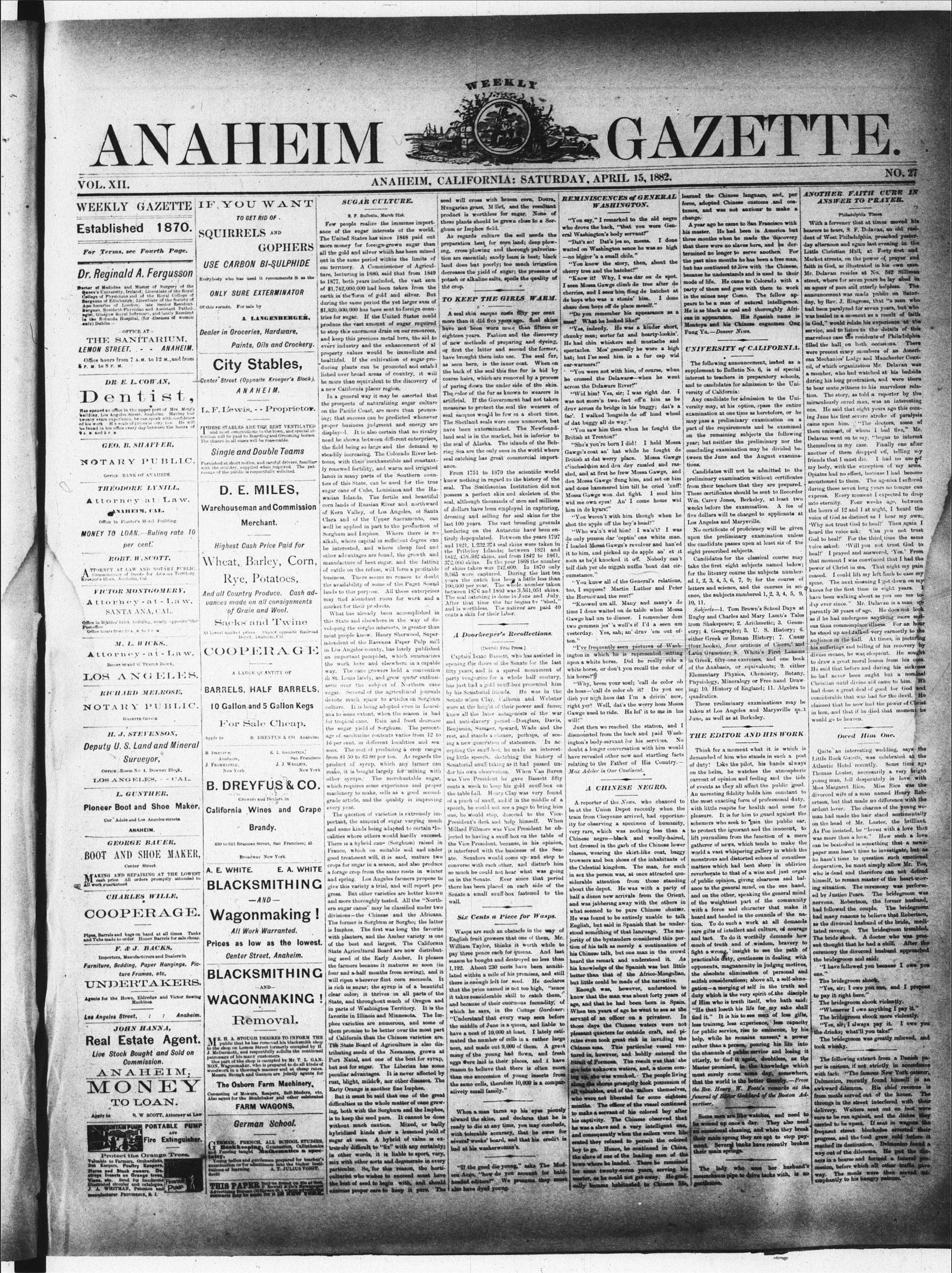
Searchable text
ANAHEIM
VOL. XII.
WEEKLY GAZETTE
Established 1870.
For Terms, see Fourth Page.
Dr. Reginald A. Fergusson
Doctor of Medicine and Master of Surgery of the Queen's University, Ireland; Licentiate of the Royal College of Physicians and of the Royal College of Surgeons of Edinburgh; Licentiate of the Society of Apothecaries of London; late Senior Resident Burgeon, Resident Physician and Assistant Pathologist, Glasgow Royal Infirmary, and lately Resident in the Rotunda Hospital (for diseases of women only) Dublin
OFFICE ATTHE SANITARIUM,
LEMON STREET, - - ANAHEIM.
Office hours from 7 a.m. to 12 p.m., and from 5 p.m. to 8 p.m.
DR. E. L. COWAN,
Dentist,
Has opened an office in the upper part of Mrs Metz's building, Los Angeles Street, Anaheim. Having had twenty years experience, he can speak with confidence of his work. If a scale of prices is very low He will be found in his office every day between the hours of 9 a.m. and 8 p.m.
GEO. B. SHAFFER,
NOTARY PUBLIC.
IF YOU WANT
TO GET RID OF -
SQUIRRELS AND
GOPHERS
USE CARBON BI-SULPHIDE
Everybody who has used it recommends it as the ONLY SURE EXTERMINATOR
Of this vermin. For sale by
A LANGENBERGER,
Dealer in Groceries, Hardware,
Paints, Oils and Crockery.
City Stables,
Center Street (Opposite Kroeger's Block),
ANAHEIM.
L.F. Lewis. - Proprietor.
THESE STABLES ARE THE BEST VENTILATED and most commissions in the town, and special attention will be paid to Boarding and Grooming horses. The charve in all cases will be reasonable.
Single and Double Teams
Furnished at short notice, and careful drivers, familiar with the country, supplied when required. The patrolage of the public is respectfully solicited.
DR. E. L. COWAN,
Dentist,
Has opened an office in the upper part of Mrs. Metz's building, Los Angeles street, Anaheim. Having had twenty years experience, he can speak with confidence of his work. His scale of prices is very low. He will be found in his office every day between the hours of 9 AM and 8 PM.
GEO. B. SHAFFER,
NOTARY PUBLIC.
Office: BANK OF ANAHEIM.
THEODORE LYNILL,
Attorney at Law,
ANAHEIM, CAL.
Office in Planter's Hotel Building.
MONEY TO LOAN.—Ruling rate 10 per cent.
ROBT. W. SCOTT.
ATTORNEY AT LAW AND NOTARY PUBLIC.
Commissioner of Deeds for Arizona Territory, Kroeger's Block, Anaheim, Cal.
VICTOR MONTGOMERY,
Attorney-at-Law,
SANTA ANA, CAL.
Office in Dibbles' brick building, nearly opposite the Postoffice.
Office hours from 10 A.M. to 3 P.M.
M. L. WICKS,
Attorney-at-Law,
Rooms 86 and 87 Temple Block,
LOS ANGELES.
RICHARD MELROSE,
NOTARY PUBLIC.
GAZETTE OFFICE
H. J. STEVENSON,
Deputy U. S. Land and Mineral Surveyor,
Office: Room No 4, Downey Block,
LOS ANGELES, - - CAL.
L. GUNTHER,
Pioneer Boot and Shoe Maker,
Cor. Adele and Los Angeles streets.
ANAHEIM.
GEORGE BAUER,
BOOT AND SHOE MAKER,
Center Street
MAKING AND REPAIRING AT THE LOWEST cash price. All orders promptly attended to.
CHARLES WILLE,
Center Street (Opposite Kroeger's Block),
ANAHEIM.
L.F. Lewis, -- Proprietor.
THESE STABLES ARE THE BEST VENTILATED and most commissions to the town, and special attention will be paid to boarding and grooming horses. The charm in all cases will be reasonable.
Single and Double Teams
Furnished at short notice, and careful drivers, familiar with the country, supplied when required. The patrolage of the public is respectfully solicited.
D. E. MILES,
Warehouseman and Commission Merchant.
Highest Cash Price Paid for Wheat, Barley, Corn, Rye, Potatoes,
And all Country Produce. Cash advances made on all consignments of Grain and Wool.
Sacks and Twine
At lowest market prices. Office opposite Railroad Depot, Anaheim, Cal.
COOPERAGE
A LARGE QUANTITY OF
BARRELS, HALF BARRELS,
10 Gallon and 5 Gallon Kegs
For Sale Cheap.
Apply to B. DREYFUS & Co. Anaheim
B. DREYFUS;
Anaheim,
San Francisco
J. FROWENFIELD,
New York
J. WEGLEIN,
New York
B. DREYFUS & CO.
Growers and Dealers in California Wines and Grape Brandy.
630 to 642 Brannan Street, San Francisco; 45 Broadway New York.
A. E. WHITE.
E. A. WHITE
BLACKSMITHING
This State and developing the most people intendent of in Los Angeles an important the work way. The in St. Louis astic over sugar. Sev devote much culture. It ana to some for tropical the sugar age of saccharide 16 per cent., sons. The from $1 50 product of make, it is other symr which require machinery grade article every year.
The que portant, thand some kcalities wh There is a France, w good treat crops for st a forage crea and spring give this v grees. Bu
Ploneer Boot and Shoe Maker,
Cor. Adele and Los Angeles streets.
ANAHEIM.
GEORGE BAUER,
BOOT AND SHOE MAKER,
Center Street
MAKING AND REPAIRING AT THE LOWEST cash price. All orders promptly attended to. All work guaranteed.
CHARLES WILLE,
COOPERAGE.
Pipes, Barrels and kegs on hand at all times. Tanks and Tubs made to order. Honey Barrels for sale cheap.
F. & J. BACKS,
Importers, Manufacturers and Dealers in
Furniture, Bedding, Paper Hangings, Picture Frames, etc,
UNDERTAKERS,
Agents for the Howe, Eldredge and Victor Sewing Machines.
Los Angeles Street.: Anaheim.
JOHN HANNA,
Real Estate Agent.
Live Stock Bought and Sold on Commission.
ANAHEIM.
MONEY TO LOAN.
Apply to R. W SCOTT, Attorney at Law
PORTABLE PUMP
AND Fire Extinguisher.
Protect the Orange Trees.
Valuable to Farmers, Orchardists, Bus Keepers, Poultry Keepers, Horse and Stock owners. De-stroys insects on Orange trees, Vinees, etc. Send for handsome illustrated circular and catalogue J. A. WHITMAN, Patentee and manufacturer. PROVIDENCE, R. L.
California Wines and Grape Brandy.
630 to 642 Brannan Street, San Francisco; 45 Broadway New York.
A. E. WHITE.
E. A. WHITE
BLACKSMITHING
—AND—
Wagonmaking!
All Work Warranted.
Prices as low as the lowest.
Center Street, Anaheim.
BLACKSMITHING
—and
WAGONMAKING!
Removal.
Mr. H. A. STOUGH DESIRES TO INFORM THE public that he has removed his blacksmith shop to the shop on Lemon Street formerly occupied by H. J. McDermott, and respectfully solicits the continued patronage of his many customers.
One part of the shop is occupied by Mr. T. L. GANNON, Wagonmaker, who is prepared to do all kinds of woodwork in a thorough manner and at cheap rates. Messrs Stough and Gannon are jointly agents for The Osborn Farm Machinery.
Consisting of Mowers, Reapers, Self-Binders, etc., Also agent for the Studebaker and other celebrated FARM WAGONS.
German School.
GERMAN, FRENCH, ALL SCHOOL STUDIES,
Bookkeeping, Gymnastics, Callisthenics
and Fencing taught Mathematics a specialty.
Young ladies and gentlemen prepared for teacher's examination or for admittance into the higher institutions of learning.
A. T. JULIUSVOIGT.
THIS PAPER may be found on file at Gen Advertising Bureau (10 Spruce St.), where service contracts may be made for it in NEW YORK.
WEEKLY
EIM GA
ANAHEIM, CALIFORNIA: SATURDAY, APRIL 15, 1882.
SUGAR CULTURE.
R. F. Bulletin, March 31st.
Few people realize the immense importance of the sugar interests of the world. The United States has since 1848 paid out more money for foreign-grown sugar than all the gold and silver which has been mined out in the same period within the limits of our territory. A Commissioner of Agriculture, lecturing in 1880, said that from 1849 to 1877, both years included, the vast sum of $1,742,000,000 had been taken from the earth in the form of gold and silver. But during the same period the yet larger sum of $1,820,000,000 has been sent to foreign countries for sugar. If the United States could produce the vast amount of sugar required to stop this enormous drain on our resources, and keep this precious metal here, the aid to every industry and the enhancement of all property values would be immediate and healthful. If the cultivation of sugar-producing plants can be promoted and established over broad areas of country, it will be more than equivalent to the discovery of a new California placer region.
In a general way it may be asserted that the prospects of naturalizing sugar culture on the Pacific Coast, are more than promising; that success can be predicted whenever proper business judgment and energy are displayed. It is also certain that no rivalry need be shown between different enterprises, the field being so large and the demand so steadily increasing. The Colorado River bottoms, with their inexhaustible and constantly renewed fertility, and warm and irrigated soil will cross with broom corn, Doura, Hungarian grass, Millet, and the resultant product is worthless for sugar. None of these plants should be grown close to a Sorghum or Imphee field.
As regards culture the soil needs the preparation best for corn land; deep plowing, cross-plowing and thorough pulverization are essential; sandy loam is best; black land does but poorly; too much irrigation decreases the yield of sugar; the presence of potash or alkaline salts spoils the quality of the crop.
TO KEEP THE GIRLS WARM.
A seal skin sacque costs fifty per cent more than it did five years ago. Seal skins have not been worn more than fifteen or eighteen years. Fashion and the discovery of new methods of preparing and dyeing, or first the latter and second the former, have brought them into use. The seal fur, as seen here, is the inner coat. When on the back of the seal this fine fur is hid by coarse hairs, which are removed by a process of paring down the under side of the skin. The color of the fur as known to wearers is artificial. If the Government had not taken measures to protect the seal the wearers of seal sacques would be few in a short time. The Shetland seals were once numerous, but have been exterminated. The Newfoundland seal is in the market, but is inferior to the seal of Alaska. The islands of the Behring Sea are the only ones in the world where seal catching has great commercial importance.
From 1751 to 1870 the scientific world
REMINISCENCES OF GENERAL WASHINGTON.
"You say," I remarked to the old negro who drove the back, "that you were General Washington's body servant?"
"Dat's so! Dat'sjes so, mossa. I don't waited on Washington sence he was so high—no bigger'n a small chile."
"You know the story, then, about the cherry tree and the hatchet?"
"Know it? Why, I was dar on de spoon I seen Mossa Gawge climb de tree after cherries, and I seen him fling de hatchet de boys who was a stonin' him. I do chase dem boys off de place meself."
"Do you remember his appearance as man? What he looked like?"
"Yes, indeedy. He was a kinder shanky man; sorter fat and hearty-looking. He had chin whiskers and mustache and spectacles. Mos' generally he wore a hi hat; but I've seed him in a fur cap we ear-warmers!"
"You were not with him, of course, when he crossed the Delaware—when he went across the Delaware River?"
"Wid him? Yes, sir; I was right dar. Was not more'n two feet off'n him as druv across de bridge in his buggy; dat's fac.' I walked 'longside de off hind whof dat buggy all de way.""
"You saw him then when he fought British at Trenton?""
"Sho's you're born I did! I held Mossa Gawge's coat an' hat while he fought British at dat werry place. Mossa Gawge'cinched him and den de dy rassled and nled, and at first he frew Mossa Gawge,
In a general way it may be asserted that the prospects of naturalizing sugar culture on the Pacific Coast, are more than promising; that success can be predicted whenever proper business judgment and energy are displayed. It is also certain that no rivalry need be shown between different enterprises, the field being so large and the demand so steadily increasing. The Colorado River bottoms, with their inexhaustible and constantly renewed fertility, and warm and irrigated lands in many parts of the Southern counties of this State, can be used for the true sugar cane of Cuba, Louisiana and the Hawaiian Islands. The fertile and beautiful cornlands of Russian River and northward of Kern Valley, of Los Angeles, of Santa Clara and of Upper Sacramento, can well be applied in part to the production of Sorghum and Imphee. Where there is no alkali, where capital in sufficient degree can be interested, and where cheap fuel and other advantages are found, the growth and manufacture of beet sugar, and the fatting of cattle on the refuse, will form a profitable business. There seems no reason to doubt the availability of some of the Puget Sound lands to this purpose. All these enterprises may find abundant room for work and a market for their products.
What has already been accomplished in this State and elsewhere in the way of developing the sorgho interests, is greater than most people know. Henry Sherwood, Superintendent of the Ravenna Paper Pulp mill in Los Angeles county, has lately published an important pamphlet, which summarizes the work here and elsewhere in a capable way. The cane growers held a convention in St. Louis lately, and grew quite enthusiastic over the subject of Northern cane sugar. Several of the agricultural journals devote much space to articles on Sorghum culture. It is being adopted even in Louisiana to some extent, when the season is bad for tropical cane. Rain and frost decrease the sugar yield of Sorghum. The percentage of saccharine contents varies from 12 to 16 per cent, in different localities and seasons. The cost of producing a crop ranges from $150 to $300 per ton. As regards the product of syrup, which any farmer can make, it is bought largely for mixing with other syrups. The merchantable sugar, which requires some experience and proper machinery to make, sells as a good second-grade article, and the quality is improving every year.
The question of varieties is extremely important, the amount of sugar varying much and some kinds being adapted to certain localities where others would hardly succeed. There is a hybrid cane (Sorghum) raised in France, which on suitable soil and under good treatment will, it is said, mature two crops for sugar in a season, and also produce a forage crop from the same roots in winter and spring. Los Angeles farmers propose to give this variety a trial, and will report progress. But other varieties are better known.
A Doorkeeper's Recollections.
[Detroit Free Press]
Captain Isaac Bassett, who has assisted in opening the doors of the Senate for the last fifty years, and is a spared monument of party vengeance for a whole half century, has just had a gold snuff-box presented him by his Senatorial friends. He was in the Senate when Clay, Calhoun and Webster were at the height of their power and fame; knew all the later antagonists of the war and anti-slavery period—Douglass, Davis, Benjamin, Sumner, Seward, Wade and the rest, stands a chance, perhaps, of seeing a new generation of statesmen. In accepting the snuff-box he made an interesting little speech, sketching the history of Senatorial snuff-taking as it had passed under his own observation. When Van Buren was Vice President he gave Bassett fifty cents a week to keep his gold snuff-box on the table fall. Henry Clay was very found of a pinch of snuff, and if in the middle of a speech, he could not see a page to bring him one, he would stop, descend to the Vice-President's desk and help himself. When Millard Fillmore was Vice President he objected to having a snuff-box on the table of the Vice President, because, in his opinion, it interfered with the business of the Senate. Senators would come up-and-stop to converse with each other, and disturb him so much he could not hear what was going on in the Senate. Ever since that period there has been placed on each side of the Senate a small snuff-box fastened to the coarse hairs, which are removed by a process of paring down the under side of the skin. The color of the fur as known to wearers is artificial. If the Government had not taken measures to protect the seal the wearers of seal sacques would be few in a short time. The Shetland seals were once numerous, but have been exterminated. The Newfoundland seal is in the market, but is inferior to the seal of Alaska. The islands of the Behring Sea are the only ones in the world where seal catching has great commercial importance.
From 1751 to 1870 the scientific world knew nothing in regard to the history of the seal. The Smithsonian Institution did not possess a perfect skin and skeleton of the seal, although thousands of men and millions of dollars have been employed in capturing, dressing and selling fur seal skins for the last 100 years. The vast breeding grounds bordering on the Antarctic have been entirely depopulated. Between the years 1797 and 1821, 1,232,374 seal skins were taken in the Pribyloy Islands; between 1821 and 1842, 458,502 skins, and from 1842 to 1861, 372,000 skins. In the year 1868 the number of skins taken was 242,000. In 1870 only 9,965 were captured. During the last ten years the catch has been a little less than 100,000 per year. The whole number taken between 1876 and 1880 was 3,561,051 skins. The seal catching is done in June and July. After that time the fur begins to "shed," and is worthless. The natives are paid 40 cents a skin for their labor.
A Doorkeeper's Recollections.
[Detroit Free Press]
Captain Isaac Bassett, who has assisted in opening the doors of the Senate for the last fifty years, and is a spared monument of party vengeance for a whole half century, has just had a gold snuff-box presented him by his Senatorial friends. He was in the Senate when Clay, Calhoun and Webster were at the height of their power and fame; knew all the later antagonists of the war and anti-slavery period—Douglass, Davis, Benjamin, Summer, Seward, Wade and the rest, stands a chance, perhaps, of seeing a new generation of statesmen. In accepting the snuff-box he made an interesting little speech, sketching the history of Senatorial snuff-taking as it had passed under his own observation. When Van Buren was Vice President he gave Bassett fifty cents a week to keep his gold snuff-box on the table fall. Henry Clay was very found of a pinch of snuff, and if in the middle of a speech, he could not see a page to bring him one, he would stop, descend to the Vice-President's desk and help himself. When Millard Fillmore was Vice President he objected to having a snuff-box on the table of the Vice President, because, in his opinion, it interfered with the business of the Senate. Senators would come up-and-stop to converse with each other, and disturb him so much he could not hear what was going on in the Senate. Ever since that period there has been placed on each side of the Senate a small snuff-box fastened to the coarse hairs, which are removed by a process of paring down under side of the skin. The color of the fur as known to wearers is artificial. If the Government had not taken measures to protect the seal the wearers of seal sacques would be few in a short time. The Shetland seals were once numerous, but have been exterminated. The Newfoundland seal is in the market, but is inferior to the seal of Alaska. The islands of the Behring Sea are the only ones in the world where seal catching has great commercial importance.
From 1751 to 1870 the scientific world knew nothing in regard to the history of the seal. The Smithsonian Institution did not possess a perfect skin and skeleton of the seal, although thousands of men and millions of dollars have been employed in capturing, dressing and selling fur seal skins for the last 100 years. The vast breeding grounds bordering on the Antarctic have been entirely depopulated. Between the years 1797 and 1821, 1,232,374 seal skins were taken in the Pribyloy Islands; between 1821 and 1842, 458,502 skins, and from 1842 to 1861, 372,000 skins. In the year 1868 the number of skins taken was 242,000. In 1870 only 9,965 were captured. During the last ten years the catch has been a little less than 100,000 per year. The whole number taken between 1876 and 1880 was 3,561,051 skins. The seal catching is done in June and July. After that time the fur begins to "shed," and is worthless. The natives are paid 40 cents a skin for their labor.
A Doorkeeper's Recollections.
[Detroit Free Press]
Captain Isaac Bassett, who has assisted in opening the doors of the Senate for the last fifty years, and is a spared monument of party vengeance for a whole half century, has just had a gold snuff-box presented him by his Senatorial friends. He was in the Senate when Clay, Calhoun and Webster were at the height of their power and fame; knew all the later antagonists of the war and anti-slavery period—Douglass, Davis, Benjamin, Summer, Seward,Wade和the rest,andstandsachance,pureseaNewgenerationofStatesmen.Inacceptingthesnuff-boxhemadeaninterestinglittlespeech,sketchingthehistoryofSenatorialsnuff-takingasithadpassedunderhisownobservation.WhenVanBurenwasVicePresidenthegaveBassettfiftycentsawekeworldkeepinhisgoodsecondgradearticle,andthequalityisimprovingeveryyear.
The question of varieties is extremely important,theamountofsugarvaryingmuchandsomekindsbeingadaptedtocertainlocalitieswhereotherswouldhardly succeedThereisahybridcane(Sorghum)raisedinFrancewhichonsuitablesoilandundergoodtreatmentwillitissaid,maturetwocropsforsugarinaseason,andalsoproduceaforagecropfromthesamerootsinwinterandspring.LosAngelesfarmersproposetos Givethisvarietya trial,andwillreportprogressButothervarietiesarebetterknown
I’ve frequently seen pictures OfWingtoninwhichheisrepresentedsittuponapwhitehorse.Didhereallyridwhitehorse,或don'tyourecallthecolorhishorse?
Why,bressyour soul;'calldecolorobitit?Do you dish yer nigh hoss datI'mdriv'nme rightyer?Well,dat'stheweryhossMegawgeusedto ride.Hlefittomeinwill!
Just then we reachedthestation,anddisminountedfromthehackandpaidWington'sbody-servantforhisservices.doubtablongerconversationwithhimwohaverevealedothernewandstartlingtributingtotheFatherOfHisCountryMaxAdelerinOurContinent.
A CHINESE NEGRO.
A reporteroftheNews.whochauntebeatattheUnionDepotrecentlywhentrainfromCheyennearrived,hadopportunityforobservingapieceofhumanveryrarewhichwasnothingthatsuchinese negro—blackand woolly-hairbutdressedinthegarboftheChineseLclasses.wearingtheskirt-likecoat,browtersandboxshoesoftheinhabitatetheCelestialkingdom.Theman,forsinsexthepersonwas.atonceattractedsiderableattentionfromthosestandsaboutthedepot.Hewithaparthalfa dozennewarrivalsfromTheOn
The question of varieties is extremely important, the amount of sugar varying much and some kinds being adapted to certain localities where others would hardly succeed. There is a hybrid cane (Sorghum) raised in France, which on suitable soil and under good treatment will, it is said, mature two crops for sugar in a season, and also produce a forage crop from the same roots in winter and spring. Los Angeles farmers propose to give this variety a trial, and will report progress. But other varieties are better known and more thoroughly tested. All the "Northern sugar canes" may be classified under two divisions—the Chinese and the Africans. The former is Sorghum or Sorgho; the latter is Imphee. The first was long the favorite with planters, and the Amber variety is one of the best and largest. The California State Agricultural Board are now distributing seed of the Early Amber. It pleases the farmers because it matures so soon (in four and a half months from sowing), and it will ripen wherever flint corn succeeds. It is rich in sugar; the syrup is of a beautiful clear color; it thrives in all parts of the State, and throughout much of Oregon and in parts of Washington Territory. It is the favorite in Illinois and Minnesota. The Imphee varieties are numerous, and some of them promise to be better over the most part of California than the Chinese varieties are. The State Board of Agriculture is also distributing seeds of the Neeazana, grown at Port Natal, and one of the best for syrup, but not for sugar. The Liberian has some peculiar advantages. It is never affected by rust, blight, mildew, nor other diseases. The Early Orange is another fine Imphee.
But it must be said that one of the great difficulties in the whole matter of cane growing, both with the Sorghum and the Imphee, is to keep the seed pure. It cannot be done without much caution. Mixed, or badly hybridized kinds show a lessened yield of sugar at once. A hybrid of value is extremely difficult to "fix" with any certainty; in other words, it is liable to sport, vary, mix with other sorts and degenerate in every particular. So, for this reason, the horticulturist who wishes to succeed must have the best of seed to begin with, and should exercise proper care to keep it pure. The speech, he could not see a page to bring him one, he would stop, descend to the Vice-President's desk and help himself. When Millard Fillmore was Vice President he objected to having a snuff-box on the table of the Vice President, because, in his opinion, it interfered with the business of the Senate. Senators would come up and stop to converse with each other, and disturb him so much he could not hear what was going on in the Senate. Ever since that period there has been placed on each side of the Senate a small snuff-box fastened to the wall.
Six Cents a Piece for Wasps.
Wasps are such an obstacle in the way of English fruit growers that one of them, Mr. William Taylor, thinks it worth while to pay three pence each for queens. And last season he bought and destroyed no less than 1,192. About 230 nests have been annihilated within a mile of his premises, and still there is enough left for seed. He declares that the price named is not too high, "since it takes considerable skill to catch them," and because of their enormous fecundity, of which he says, in the Cottage Gardener: "Understand that every wasp seen before the middle of June is a queen, and liable to have a nest of 10,000 at least. I lately estimated the number of cells in a rather large nest, and made out 9,000 of them. A great many of the young had flown, and fresh eggs were laid in their places, and I have reason to believe that there is often more than one succession of young insects from the same cells, therefore 10,000 is a comparatively small family."
When a man turns up his eyes piously toward the skies, and declares that he is ready to die at any time, you may conclude, with tolerable accuracy, that he owes for several weeks' board, and that his credit is bad at his washerwoman's.
"If the good die young," asks The Modern Argo, "how do you account for bald-headed editors?" We presume they must also have dyed young.
A reporter of the News. who chance be at the Union Depot recently when train from Cheyenne arrived, had opportunity for observing a specimen of human very rare, which was nothing less than Chinese negro—black and woolly-hair but dressed in the garb of the Chinese classes, wearing the skirt-like coat, brow trowsers and box shoes of the inhabitant the Celestial kingdom. The man, for in sex the person was, at once attracted siderable attention from those stars about the depot. He was with a part half a dozen new arrivals from the Orkney and was jabbering away with the other what seemed to be pure Chinese charm. He was found to be entirely unable to English, but said in Spanish that he understood something of that language. The jority of the bystanders considered thisention of his talk as merely a continuation his Chinese talk, but one man in the crowd heard the remark and understood it. His knowledge of the Spanish was but better than that of the African-Mongue but little could be made of the narrative.
Enough was, however, understood know that the man was about forty years age, and that he had been born in Seymour when ten years of age he went to sea as servant of an officer on a privateer. Those days the Chinese waters were pleasant quarters for outside craft, and rates even took great risk in invading Chinese seas. This particular vessel tured in, however, and boldly entered Strait of Formosa. The result was that got into unknown waters, and a storming up, she was wrecked. The people along the abores promptly took possession all valuables, and of the sailors themselves who were not liberated for some eight months. The officer of the vessel conti-
to make a servant of his colored boy his captivity. The Chinese observed he was a slave and a very intelligent and consequently when the sailors were created they refused to permit the boy to go. Hence, he continued in Orcadia slave of one of the leading men owe town where he landed. There he remitted for some twenty-seven years, serving master, as he could not get away. He usually became habituated to Chinese
GAZETTE.
APRIL 15, 1882.
INCENCES OF GENERAL WASHINGTON.
I remarked to the old negro he hack, "that you were Genton's body servant?"
Dat's jes so, mossa. I done washington sence he was so high in a small chile."
For the story, then, about the hatchet?
Why, I was dar on de spot. Gawge climb de tree after de I seen him fling de hatchet at was a stonin' him. I done days off de place meself."
Remember his appearance as a he looked like?"
Needy. He was a kinder short, sorter fat and hearty-looking'.
Whiskers and mustache and Mos' generally he wore a high seed him in a fur cap wid."
Is not with him, of course, when the Delaware—when he went Delaware River?"
Yes, sir; I was right dar. I ne'n two-feet off'n him as he rode bridge in his buggy; dat's a used 'longside de off hind wheel all de way."
In him then when he fought therenton?"
I'm born I did! I held Mossa at an' hat while he fought de werry place. Mossa Gawge and den dey rassled and rasfirst he frew Mossa Gawge, and learned the Chinese language, and, per force, adopted Chinese customs and costumes, and was not anxious to make a change.
A year ago he came to San Francisco with his master. He had been in America but three months when he made the discovery that there were no slaves here, and he determined no longer to serve another. For the past nine months he has been a free man, but has continued to live with the Chinese, because he understands and is used to their mode of life. He came to Colorado with a party of them and goes with them to work in the mines near Como. The fellow appears to be a man of natural intelligence. He is as black as coal and thoroughly African in appearance. His Spanish name is Montoya and his Chinese cognomen Ong Fung Yu.—Denver News.
UNIVERSITY OF CALIFORNIA.
The following announcement, issued as a supplement to Bulletin No. 6, is of special interest to teachers in preparatory schools, and to candidates for admission to the University of California:
Any candidate for admission to the University may, at his option, pass the entire examination at one time as heretofore, or he may pass a preliminary examination on a part of the requirements and be examined on the remaining subjects the following year; but neither the preliminary nor the concluding examination may be divided between the June and the August examinations.
Candidates will not be admitted to the
ANOTHER FAITH CURE IN ANSWER TO PRAYER.
Philadelphia Times.
With a fervency that at times moved his hearers to tears, S. F. Delavan, an old resident of West Philadelphia, preached yesterday afternoon and again last evening in the Little Christian Hall, at Forty first and Market streets, on the power of prayer and faith in God, as illustrated in his own case. Mr. Delavan resides at No. 542 Silliman street, where for seven years he lay abed in an agony of pain and utterly helpless. The announcement was made public on Saturday, by Rev. J. Ringrose, that "a man who had been paralyzed for seven years, but who was healed in a moment as a result of faith in God," would relate his experience at the service, and to listen to the details of this marvelous case the residents of Philadelphia filled the hall on both occasions. There were present many members of an American Mechanics' Lodge and Manchester Council, of which organization Mr. Delavan was a member, who had watched at his bedside during his long prostration, and were there to bear mute witness to his marvelous relation. The story, as told a reporter by the miraculously cured man, was an interesting one. He said that eight years ago this coming June his first severe stroke of paralysis came upon him. "'The doctors, some of them eminent,' of whom I had five," Mr. Delavan went on to say, "began to interest themselves in my case. Finally one after another of them dropped off, telling my friends that I must die. I had no use of my body, with the exception of my arms. Ouiates had no effect, because I had become
When he went to Delaware—when he went to Delaware River?
Yes, sir; I was right dar. I were'n two-feet off him as he made bridge in his buggy; dat's a knotted 'longside de off hind wheel all de way."
He then when he fought the Prenton?
I'm born I did! I held Mossa at an' hat while he fought de werry place. Mossa Gawge and den dev rassled and ras first he frew Mossa Gawge, and Gawge flung him, and set on him commerred him till he cried 'nuff! He won dat fight. I seed him eye! An' I come home wid eyes!"
Don't with him though when he broke off the boy's head?"
I can't wid him? I wa'n't? I was upon dar 'ceptin' one white man. Mossa Gawge's revolver and han'ed and picked up de apple an' et it knocked it off. Nobody can't ole niggah nuffin 'bout dat circum all of the General's relations, nose? Martin Luther and Peter and the rest?"
I um all. Many and many's de waited on de table when Mossa rum to dinner. I remember dem enjes's well's if I'd a seen um Yes, sah; an'druv 'em out of frequently seen pictures of Wash-which he is represented sitting like horse. Did he really ride a or don't you recall the color of press your soul; 'call de color ob call de color ob it? Do you see high hoss dat I'm a drivin' now, Well, dat's the wery hoss Mossa to ride. He lef' it to me in his we reached the station, and I from the hack and paid Washily-servant for his services. No longer conversation with him would need other new and startling facts of the Father of His Country.—or in Our Continent.
CHINESE NEGRO.
Ofer of the News, who chanced to Union Depot recently when the Cheyenne arrived, had opportun- serving a specimen of humanity, which was nothing less than a negro—black and woolly-haired, in the garb of the Chinese lower earring the skirt-like coat, baggy and box shoes of the inhabitants of real kingdom. The man, for such person was, at once attracted con- attention from those standing elepot. He was with a party of new arrivals from the Orient,
interest to teachers in preparatory schools, and to candidates for admission to the University of California:
Any candidate for admission to the University may, at his option, pass the entire examination at one time as heretofore, or he may pass a preliminary examination on a part of the requirements and be examined on the remaining subjects the following year; but neither the preliminary nor the concluding examination may be divided between the June and the August examinations.
Candidates will not be admitted to the preliminary examination without certificates from their teachers that they are prepared. These certificates should be sent to Recorder Wm. Carey Jones, Berkeley, at least two weeks before the examination. A fee of five dollars will be charged to applicants at Los Angeles and Marysville.
No certificate of proficiency will be given upon the preliminary examination unless the candidate passes upon at least six of the eight prescribed subjects.
Candidates for the classical course may take the first eight subjects named below; for the literary course the subjects numbered 1, 2, 3, 4, 5, 6, 7, 9; for the course of letters and science, and the courses in science, the subjects numbered 1, 2, 3, 4, 5, 9, 10, 11.
Subjects—1. Tom Brown's School Days at Rugby and Charles and Mary Lamb's Tales from Shakspeare; 2. Arithmetic; 3. Geometry; 4. Geography; 5. U. S. History; 6. either Greek or Roman History; 7. Caesar (four books), four orations of Cicero,' and Latin Grammar; 8. White's First Lessons in Greek, fifty-one exercises, and one book of the Anabasis, or equivalents; 9. either Elementary Physics, Chemistry, Botany, Physiology, Mineralogy or Free-hand Drawing; 10. History of England; 11. Algebra to quadratics.
These preliminary examinations may be taken at Los Angeles and Marysville next June, as well as at Berkeley.
THE EDITOR AND HIS WORK
Think for a moment what it is which is demanded of him who stands in such a post of duty! Like the pilot, his hands always on the helm, he watches the atmospheric current of opinion and feeling and the tide of events as they all affect the public good. An unresting fidelity holds him constant to the most exacting form of professional duty, with little respite for health and none for pleasure. It is for him to guard against the schemers who seek to gain the public ear, to protect the ignorant and the innocent, to lift journalism from the function of a mere gatherer of news, which tends to make the world a vast whispering gallery in which the monstrous and distorted echoes of countless matters which had best sleep in oblivion reverberate to that of a wise and just organ of public opinion, giving clearness and balance to the general mind, on the one hand, and on the other, speaking the general mind.
Owed Him One.
Quite an interesting wedding, says the Little Rock Gazette, was celebrated at the Atlantic Hotel recently. Some time ago Thomas Luster, necessarily a very bright young man, fell desperately in love with Miss Margaret Rice. Miss Rice was the divorced wife of a man named Henry Robertson, but that made no difference with the ardent lover. The charms of the young woman had made the hair stand sentimentally on the head of Mr. Luster, the brilliant As Poe insisted, he "loved with a love that was more than a love." How such a love can be bestowed is something that a newspaper man hasn't time to investigate, but as he hasn't time to question such emotional desperation, he must simply allow Mr. Poe who is dead and therefore can not defend himself, to remain master of the heart-moving situation. The ceremony was performed by Justice Pears. The bridegroom was
The Union Depot recently when the Cheyenne arrived, had opportunity serving a specimen of humanity, which was nothing less than a negro—black and woolly-haired, all in the garb of the Chinese lower class in the garb of the Chinese lower class in the garb of the Chinese lower class in the garb of the Chinese lower class in the garb of the Chinese lower class in the garb of the Chinese lower class in the garb of the Chinese lower class in the garb of the Chinese lower class in the garb of the Chinese lower class in the garb of the Chinese lower class in the garb of the Chinese lower class in the garb of the Chinese lower class in the garb of the Chinese lower class in the garb of the Chinese lower class in the garb of the Chinese lower class in the garb of the Chinese lower class in the garb of the Chinese lower class in the garb of the Chinese lower class in the garb of the Chinese lower class in the garb of the Chinese lower class in the garb of the Chinese lower class in the garb of the Chinese lower class in the garb of the Chinese lower class in the garb of the Chinese lower class in the garb of the Chinese lower class in thegarb oftheChineselowerclassinthegarboftheChineselowerclassinthegarboftheChineselowerclassinthegarboftheChineselowerclassinthegarboftheChineselowerclassinthegarboftheChineselowerclassinthegarboftheChineselowerclassinthegarboftheChineselowerclassinthegarboftheChineselowerclassinthegarboftheChineselowerclassinthegarboftheChineselowerclassinthegarboftheChineselowerclassinthegarboftheChineselowerclassinthegarboftheChineselowerclassinthegarboftheChineselowerclassintheregioncrowdedwithotherpeople
Some men are like watches, and need to be wound up once a day. They also need occasional cleaning, and when they break their main spring they are apt to stop payment. Several banks have recently broken their main springs.
The lady who uses her husband's meerschaum pipe to drive tacks with, is no gentleman.
The most exacting form of professional duty, with little respite for health and none for pleasure. It is for him to guard against schemers who seek to gain the public ear, to protect the ignorant and the innocent, to lift journalism from the function of a mere gatherer of news, which tends to make the world a vast whispering gallery in which the monstrous and distorted echoes of countless matters which had best sleep in oblivion reverberate to that of a wise and just organ of public opinion, giving clearness and balance to the general mind, on the one hand, and on the other, speaking the general mind of the weightiest part of the community with a force and character that make it heard and heeded in the councils of the nation. To do such a work at all demands rare gifts of intellect and culture, of courage and tact. To do it worthily demands how much of truth and of wisdom, bravery to fight a wrong, insight to see the path of practicable duty, gentleness in dealing with opponents, magnanimity in judging motives, the absolute elimination of personal and selfish considerations; above all, a self-abnegation—a merging of self in the truth and duty which is the very spirit of the disciple of Him who is truth itself, who hath said: "He that loseth his life for my sake shall find it." It is his to see men of less gifts, less training, less experience, less capacity for public service, rise to eminence, by his help, while he remains unseen," a power rather than a person, pouring his life into the channels of public service and losing it utterly, to find it again, doubtless, as the Master promised, in the knowledge which must surely come some day, somewhere, that the world is the better thereby.—From The Rev. Henry W. Foote's remarks at the funeral of Editor Goddard of the Boston Advertiser.
The following extract from a Danish paper is curious, if not strictly in accordance with fact: "The famous New York caterer, Delmonico, recently found himself in an awkward dilemma. His chief revenue is from meals served out of the house. The throngs in the street interfered with their delivery. Waiters sent out on foot were sure to be run against, and the dishes they carried to be upset. If seat in wagons the frequent street blockades arrested their progress, and the food grew cold before it reached its destination. Delmonico found a way out of the dilemma. He put the dinners in a hearse and formed a funeral procession, before which all other traffic gave way. The meals were then served tumultantly to his hungry patrons."