anaheim-gazette 1882-04-08
Scanned page
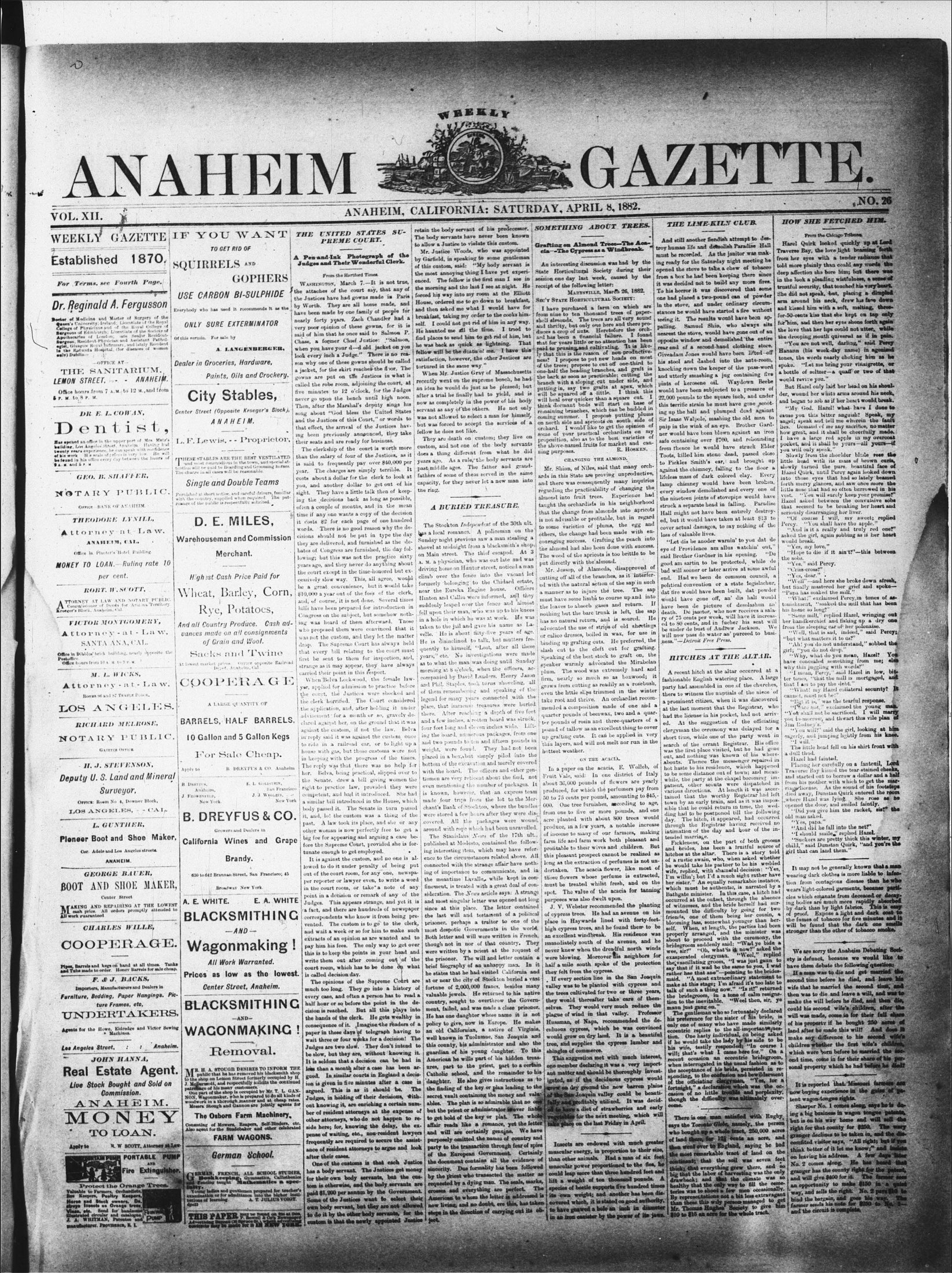
Searchable text
ANAHEIM
VOL. XII.
WEEKLY GAZETTE
Established 1870.
For Terms, see Fourth Page.
Dr. Reginald A. Fergusson
Doctor of Medicine and Master of Surgery of the Queen's University, Ireland; Licentiate of the Royal College of Physicians and of the Royal College of Surgeons of Edinburgh; Licentiate of the Society of Apothecaries of London; State Senior Resident-Surgeon, Resident Physician and Assistant Pathologist, Glasgow Royal Infirmary, and Lately Resident in the Ratunda Hospital (for diseases of women only) Dublin—
OFFICE AT—
THE SANITARIUM.
LEMON STREET. — ANAHEIM.
Office hours from 7 A.M. to 12 M., and from 6 P.M. to 8 P.M.
DR E. L. COWAN,
Dentist,
Has opened an office in the upper part of Mrs. Metre's building, Los Angeles street, Anaheim. Having had twenty years experience, he can speak with confidence of his work. It is scale of prices is very low. He will be found in his office every day between the hours of 9 A.M. and 5 P.M.
IF YOU WANT TO GET RID OF SQUIRRELS AND GOPHERS USE CARBON BI-SULPHIDE
Everybody who has used it recommends it as the ONLY SURE EXTERMINATOR Of this vermin. For sale by
A. LANGENBERGER,
Dealer in Groceries, Hardware,
Paints, Oils and Crockery.
City Stables,
Center Street (Opposite Kroeger's Block),
ANAHEIM.
L. F. Lewis, -- Proprietor,
THESE STABLES ARE THE BEST VENTILATED and most comfortable in the town, and special attention will be paid to Boarding and Grooming horses. The charge in all cases will be reasonable.
THE UNITED PREME C
A Pen-and-Ink Ph
Judges and Their W
From the Hartt
WASHINGTON, March
the attaches of the cothe Justices have had go
by Worth. They are a
have been made by one
nearly forty years. Z
very poor opinion of tha
said of him that he once
Chase, a former Chiewhen you have your dlook every inch a Judge
son why one of these go
a jacket, for the skirt r
gowns are put on thi
called the robe room, a
five minutes to 12 o'-
never go upon the benThen, after the Marshasong about "God bless
and the Justices of this
that effect, the arrival
being previously a
their seats and are read
The clerkship of the than the salary of four is said to frequently year. The charges are
LEMON STREET. - - ANAHEIM.
Office hours from 7 A.M. to 12 M., and from 8 P.M.
DR E. L. COWAN,
Dentist,
Has opened an office in the upper port of Mrs. Metz's building, Los Angeles Street, Anaheim. Having had twenty years experience, he can speak with confidence of his work. He is a scale of prices very low. He will be found in his office every day between the hours of 9 A.M. and 6 P.M.
GEO. B. SHAFFER,
NOTARY PUBLIC.
OFFICE: BANK OF ANAHEIM.
THEODORE LYNILL,
Attorney at Law.
ANAHEIM, CAL.
Office in Planter's Hotel Building
MONEY TO LOAN.—Ruling rate 10 per cent.
ROBT W. SCOTT.
ATTORNEY AT LAW AND NOTARY PUBLIC.
Commissioner of Deeds for Arizona Territory Kroeger's Block, Anaheim, Cal.
VICTOR MONTGOMERY,
Attorney at-Law,
SANTA ANA, CAL.
Office in Dibbles brick building, nearly opposite the Postoffice
Office hours from 10 A.M. to 3 P.M.
M. L. WICKS,
Attorney at-Law.
Rooms 56 and 87 Temple Block.
LOS ANGELES.
RICHARD MELROSE,
NOTARY PUBLIC.
GAETER OFFICE.
H. J. STEVENSON,
Deputy U. S. Land and Mineral Surveyor.
Office: Room No 4, Downey Block.
LOS ANGELES, - - CAL.
L GUNTHER,
Ploneer Boot and Shoe Maker,
Cor. Adele and Los Angeles streets.
ANAHEIM.
GEORGE BAUER,
BOOT AND SHOE MAKER,
Center Street
Paints, Oils and Crochery.
City Stables,
Center Street (Opposite Kroeger's Block),
ANAHEIM.
L. F. Lewis. -- Proprietor,
THESE STABLES ARE THE BEST VENTILATED and most comfortable in the town, and special attention will be paid to Boarding and Grooming horses.
The charge in all cases will be reasonable.
Single and Double Teams
Furnished at short notice, and careful drivers, familiar with the country, supplied when required. The patronage of the public is respectfully solicited.
D. E. MILES,
Warehouseman and Commission Merchant.
Highest Cash Price Paid for Wheat, Barley, Corn, Rye, Potatoes,
And all Country Produce. Cash advances made on all consignments of Grain and Wool.
Sacks and Twine
At lowest market prices. Office opposite Railroad Depot, Anaheim, Cal.
COOPERAGE
A LARGE QUANTITY OF
BARRELS, HALF BARRELS.
10 Gallon and 5 Gallon Kegs For Sale Cheap.
Apply to B. DREYFUS & Co. Anaheim
B. DREYFUS,
Anaheim,
San Francisco
J. FROWENFIELD,
New York
J. WROGLYS,
New York
B. DREYFUS & CO.
Growers and Dealers in California Wines and Grape Brandy.
630 to 642 Brannan Street, San Francisco; 45 Broadway New York.
It is against the law to do it under out of the court room per reporter or lawyer in the court room, or point in a decision of gowns are put on the called the robe room, five minutes to 12 o'clock never go upon the benchthem after the Marshal song about "God bless and the Justices of this that effect, the arrival being previously at their seats and are read.The clerkship of them than the salary of four is said to frequently year.The charges are costs about a dollar for you,and another dollar sight They have a littering the decisions back often a couple of months time if any one wants it costs $2 for each word There is no good decisions should not be delivered,and bates of Congress are allowing;but this was many years ago,and they need the court except in thecessively slow way.Tobe a great convenience $10,000 a year out of whichand of course,它 is no bills have been prepared Congress on the subject was heard of who proposed them was not the custom,a drop.The Supreme Court that every bill relates first be sent to them strange as it may appear carried their point inWhen Belva Lockwyer,applied for admissthe court,the Justicethe clerk horrified.the application,and.advisement for a more clared against her,or against the custom.in reply said it was able to ride in a railroad house with gas,but thain keeping with theThe reply was that her.Belva,being pledright to practice law competent,and had a similar bill introducedbody passed it.Theit,and lot!thecustompast.A law took its other woman is now big fee for appearing fore the Supreme Courttunate enough to getIt is against the lawowed to do it underout of the court roomper reporter or lawyerin the court room,coint in a decision of
L. GUNTHER,
Ploneer Boot and Shoe Maker,
Cor. Adele and Los Angeles streets.
ANAHEIM.
GEORGE BAUER,
BOOT AND SHOE MAKER,
Center Street
MAKING AND REPAIRING AT THE LOWEST
cash price. All orders promptly attended to
All work guaranteed.
CHARLES WILLE,
COOPERAGE.
Piper, Barrels and kegs on hand at all times. Tanks
and Tubs made to order. Honey Barrels for sale cheap.
F. & J. BACKS,
Importers, Manufacturers and Dealers in
Furniture, Bedding, Paper Hangings, Picture Frames, etc,
UNDERTAKERS,
Agents for the Howe, Eldridge and Victor Sewing Machines.
Los Angeles Street, : Anaheim.
JOHN HANNA,
Real Estate Agent.
Live Stock Bought and Sold on Commission.
ANAHEIM.
MONEY TO LOAN.
Apply to R. W SCOTT, Attorney at Law.
PORTABLE PUMP
AND
Fire Extinguisher.
Protect the Orange Trees.
Valuable to Farmers, Orchardists,
Bee Keepers, Poetry Keepers,
Horse and Stock owners, Dashyo insects on Orange trees,
Vines, etc. Send for handsome
illustrated circular and catalogue.
J. A. WHITMAN, Patentee and
manufacturer. Providence, R.I.
New York.
B. DREYFUS & CO.
Growers and Dealers in
California Wines and Grape
Brandy.
630 to 642 Brannan Street, San Francisco; 45
Broadway New York.
A. E. WHITE.
E. A. WHITE
BLACKSMITHING
— AND —
Wagonmaking!
All Work Warranted.
Prices as low as the lowest.
Center Street, Anaheim.
BLACKSMITHING
— AND —
WAGONMAKING!
Removal.
MR. H. A. STOUGH DESIRES TO INFORM THE
public that he has removed his blacksmith shop
to the shop on Lemon Street formerly occupied by H.
J. McDermott, and respectfully solicits the continued patronage of his many customers.
One part of the shop is occupied by Mr. T. L. GANNON, Wagonmaker, who is prepared to do all kinds of woodwork in a thorough manner and at cheap rates.
Messrs Stough and Gannon are jointly agents for The Osborn Farm Machinery.
Consulting of Mowers, Reapers, Self-Binders, etc.
Also agent for the Studebaker and other celebrated FARM WAGONS.
German School.
GERMAN, FRENCH, ALL SCHOOL STUDIES,
Bookkeeping, Gymnastics, Callisthemics
and Fencing taught Mathematics a specialty.
Young ladies and gentlemen prepared for teacher's examination or for admittance into the higher institutions of learning.
A. T. JULIUS VOIGT.
THIS PAPER may be found on file at Gen.
Advertising Bureau (18 Spruce St.), where advertising contracts may be made for it in NEW YORK.
The opinions of the public too long. The every case, and often half hour or so before decision is reached. The hands of the clear consequence of it. Paper in these days wait three or four weeks Judges are two slow be slow, but they are seldom that a less than a month agued. In similar condition is given in five argued. This is a Judges, in holding out knowing it, are number of resident attorneys, which side here; for, know expense of waiting, etc., frequently are required of resident attentive after their cases.
One of the custom has a body servant for their own body tom is otherwise paid $1,200 per annum. Some of the Justices own body servant, to do it by the other custom is that the
THE UNITED STATES SUPREME COURT.
A Pen-and-Ink Photograph of the Judges and Their Wonderful Clerk.
From the Hartford Times.
WASHINGTON, March 7.—It is not true, the attaches of the court say, that any of the Justices have had gowns made in Paris by Worth. They are all home made, and have been made by one family of people for nearly forty years. Zach Chandler had a very poor opinion of these gowns, for it is said of him that he once said to Salmon P. Chase, a former Chief Justice: "Salmon, when you have your d—d old jacket on you look every inch a Judge." There is no reason why one of these gowns should be called a jacket, for the skirt reaches the floor. The gowns are put on the Justices in what is called the robe room, adjoining the court, at five minutes to 12 o'clock, for the Judges never go upon the bench until high noon. Then, after the Marshal's deputy sings his song about "God bless the United States and the Justices of this Court," or words to that effect, the arrival of the Justices having been previously announced, they take their seats and are ready for business.
The clerkship of the court is worth more than the salary of four of the Justices, as it is said to frequently pay over $40,000 per year. The charges are simply terrible. It retain the body servant of his predecessor. The body servants have never been known to allow a Justice to violate this custom.
Mr. Justice Woods, who was appointed by Garfield, in speaking to some gentleman of this custom, said: "My body servant is the most annoying thing I have yet experienced. The fellow is the first man I see in the morning and the last I see at night. He forced his way into my room at the Elliott House, ordered me to go down to breakfast, and then asked me what I would have for breakfast, taking my order to the cooks himself. I could not get rid of him in any way. He haunted me all the time. I tried to find places to send him to get rid of him, but he was back as quick as lightning. That fellow will be the death of me. I have this satisfaction, however, the other Justices are tortured in the same way."
When Mr. Justice Gray of Massachusetts recently went on the supreme bench, he had an idea he would do just as he pleased; but after a trial he finally had to yield, and is now as completely in the power of his body servant as any of the others. He not only was not allowed to select a man for himself, but was forced to accept the services of a fellow he does not like.
They are death on custom; they live on custom, and not one of the body servants does a thing different from what he did years ago. As a rule, the body servants are past middle ages. The father and grandfather of some of them served in the same
SOMETHING ABOUT TREES.
Grafting on Almond Trees—The Acacia—The Cypress as a Windbreak.
An interesting discussion was had by the State Horticultural Society during their session one day last week, caused by the receipt of the following letter:
MARYSVILLE, March 26, 1882.
SEC'Y STATE HORTICULTURAL SOCIETY:
I have purchased a farm on which are from nine to ten thousand trees of paper-shell almonds. The trees are all very sound and thrifty, but only one here and there produces a crop of nuts. Heretofore the orchard has been a financial failure. I found that for years little or no attention has been paid to pruning and cultivating. It is likely that this is the reason of non-productiveness! I propose to put new heads on most of the trees; propose to cut off one-third to one-half the heading branches, and graft in the bark as soon as practicable; cutting the branch with a sloping cut under side, and putting in, say two grafts at apex, which will be squared off a little. I think this will heal over quicker than a square cut. I think dormant buds will start on base of remaining branches, which can be budded in coming summer. I propose putting plums on north side and apricots on south side of orchard. I would like to get the opinion of some of your practical orchardists on my proposition, also as to the best varieties of the above-named fruits for market and canning purposes.
R. HOSKEN.
CHANGING THE ALMOND.
Mr. Shinn, of Niles, said that many orchards are proving unproductive.
gowns are put on the Justices in what is called the robe room, adjoining the court, at five minutes to 12 o'clock, for the Judges never go upon the bench until high noon. Then, after the Marshal's deputy sings his song about "God bless the United States and the Justices of this Court," or words to that effect, the arrival of the Justices having been previously announced, they take their seats and are ready for business.
The clerkship of the court is worth more than the salary of four of the Justices, as it is said to frequently pay over $40,000 per year. The charges are simply terrible. It costs about a dollar for the clerk to look at you, and another dollar to get out of his sight. They have a little talk then of keeping the decisions back as long as possible, often a couple of months, and in the mean time if any one wants a copy of the decision it costs $2 for each page of one hundred words. There is no good reason why the decisions should not be put in type the day they are delivered, and furnished as the debates of Congress are furnished, the day following; but this was not the practice sixty years ago, and they never do anything about the court except in the time-honored but excessively slow way. This, all agree, would be a great convenience, but it would take $10,000 a year out of the fees of the clerk, and, of course, it is not done. Several times bills have been prepared for introduction in Congress on the subject, but somehow nothing was heard of them afterward. Those who proposed them were convinced that it was not the custom, and they let the matter drop. The Supreme Court has always held that every bill relating to the court must first be sent to them for inspection, and, strange as it may appear, they have always carried their point in this respect.
When Belva Lockwood, the female lawyer, applied for admission to practice before the court, the Justices were shocked and the clerk horrified. The Court considered the application, and after holding it under advisement for a month or so, gravely declared against her, on the ground that it was against the custom, if not the law. Belva in reply said it was against the custom once to ride in a railroad car, or to light up a house with gas, but those customs were not in keeping with the progress of the times. The reply was that there was no help for her. Belva, being practical, slipped over to the Senate, drew a bill giving women the right to practice law, provided they were competent, and had it introduced. She had a similar bill introduced in the House, which body passed it. The Senate in turn passed it, and lot of the custom was a thing of the past. A law took its place, and she or any other woman is now perfectly free to get a big fee for appearing and arguing a case before the Supreme Court, provided she is fortunate enough to get employed.
It is against the custom, and no one is allowed to do it under penalty of being put out of the court room, for any one, newspaper reporter or lawyer even, to write a word in the court room, or take a note of any point in a decision or remark of any of the recently went on the supreme bench, he had an idea he would do just as he pleased; but after a trial he finally had to yield, and is now as completely in the power of his body servant as any of the others. He not only was not allowed to select a man for himself, but was forced to accept the services of a fellow he does not like.
They are death on custom; they live on custom, and not one of the body servants does a thing different from what he did years ago. As a rule, the body servants are past middle ages. The father and grand-fathers of some of them served in the same capacity, for they never let a new man into the ring.
A BURIED TREASURE.
The Stockton Independent of the 30th ult. has a local romance. A policeman on the Sunday night previous saw a man stealing a shovel at midnight from a blacksmith's shop on Main street. The thief escaped. At 3 A.M. a physician, who was out late and was driving home on Hunter street, noticed a man climb over the fence into the vacant lot formerly belonging to the Chidard estate, near the Eureka Engine house. Officers Hinton and Callin were informed, and they suddenly leaped over the fence and almost fell upon their man, who was up to his knees in a hole in which he was at work. He was taken to the jail and gave his name as Lavelle. He is about fifty-five years of age. He is disinclined to talk, but mutters frequently to himself. "Lost, after all these years," etc. No investigations were made as to what the man was doing until Sunday morning at 8 o'clock, when the officers, accompanied by David Landers, Henry Jason and Phil Staples, took turns shoveling, all of them remembering and speaking of the legend for many years connected with the place, that immense treasures were buried there. After reaching a depth of five feet and a few inches, a rotten board was struck, four feet long and eleven inches wide. Lifting the board, numerous packages, from one and two pounds to ten and fifteen pounds in weight, were found. They had not been placed in a box, but simply piled into the bottom of the excavation and merely covered with the board. The officers and other gentlemen are very reticent about the find, not even mentioning the number of packages. It is known, however, that an express team made four trips from the lot to the Merchant's Bank of Stockton, where the bundles were stored a few hours after they were discovered. All the packages were wound around with rope which had been unravelled.
The Stanislaus News of the 17th ult., published at Modesto, contained the following interesting item, which may have reference to the circumstances related above. All connected with the strange affair have nothing of importance to communicate, and in the meantime Lavalle while kept in confinement, is treated with a great deal of consideration. The News article says: A strange bark as soon as practicable; cutting the branch with a sloping cut under side, and putting in, say two grafts at apex, which will be squared off a little. I think this will heal over quicker than a square cut. I think dormant buds will start on base of remaining branches, which can be baddied in coming summer. I propose putting plums on north side and apricots on south side of orchard. I would like to get the opinion of some of your practical orchardists on my proposition, also as to the best varieties of above-named fruits for market and canning purposes.
CHANGING THE ALMOND.
Mr. Shinn, of Niles, said that many orchards in this State are proving unproductive, and there was consequently many inquiries regarding the practicability of changing the almond into fruit trees. Experience had taught the orchardists in his neighborhood that the change from almonds into apricots is not advisable or profitable, but in regard to some varieties of plums, the egg and others, the change had been made with encouraging success. Grafting the peach into the almond had also been done with success. The wood of the apricots is too brittle to be put directly with the almond.
Mr. Jessop, of Alameda, disapproved of cutting off all of the branches, as it interfered with the natural action of the sap in such a manner as to injure the tree. The sap must have some limbs to course up and into the leaves to absorb gases and return. If nothing but the bare trunk is left, the sap has no natural return, and is soured. He advocated use of strips of old sheets or calico dresses, boiled in wax, for use in binding up grafting cuts. He preferred the slash cut to the cleft cut for grafting. Speaking of the best stock to graft on, the speaker warnily advocated the Mirabolan plum. The wood was extremely hard and firm, nearly so much as boxwood; it grows from cutting as readily as a rosebush, even the little slips trimmed in the winter take root and thrive. An orchardist recommended a composition made of one and a quarter pounds of beeswax, two and a quarter pounds of rosin and three-quarters of a pound of tallow as an excellent thing to cover up grafting cuts. It can be applied in very thin layers, and will not melt nor run in the hottest weather.
ON THE ACACIA.
In a paper on the acacia, E. Wolleb, of Fruit Vale, said: In one district of Italy about 36,000 pounds of flowers are yearly produced for which the perfumers pay from 50 to 75 cents per pound, amounting to $45-1000. One tree furnishes according to age, from one to five or more pounds,and one acre planted with about 800 trees would produce,在a few years,a notable increase of income to many of our farmers,making farm life and farm work both pleasant and profitable to their wives and children. But this pleasant prospect cannot be realized as long as the extraction of perfumes is not undertaken.The acacia flower,如 most of those flowers whose perfume is extracted,must be treated whilst fresh,and onthe spot.The value ofthe acacia for tanning purposes was also dwelt upon
a similar bill introduced in the House, which body passed it. The Senate in turn passed it, and lo! the custom was a thing of the past. A law took its place, and she or any other woman is now perfectly free to get a big fee for appearing and arguing a case before the Supreme Court, provided she is fortunate enough to get employed.
It is against the custom, and no one is allowed to do it under penalty of being put out of the court room, for any one, newspaper reporter or lawyer even, to write a word in the court room, or take a note of any point in a decision or remark of any of the Judges. This appears strange, and yet it is a fact, and there are hundreds of newspaper correspondents who know it from being prevented. The custom is to go to the clerk, and wait a week or so for him to make such extracts of an opinion as are wanted and to pay him his fees. The only way to get over this is to keep the points in your head and write them out after coming out of the court room, which has to be done on what is called decision day.
The opinions of the Supreme Court are much too long. They go into a history of every case, and often a person has to read a half hour or so before the point in the decision is reached. But all this plays into the hands of the clerk. He gets wealthy in consequence of it. Imagine the readers of a paper in these days of telegraph having to wait three or four weeks for a decision! The Judges are two slow. They don't intend to be slow, but they are, without knowing it. It is seldom that a decision can be had in less than a month after a case has been argued. In similar courts in England a decision is given in five minutes after a case is argued. This is as it should be. The Judges, in holding off their decisions, without knowing it, are enriching a certain number of resident attorneys at the expense of other attorneys, who do not happen to reside here; for, knowing the delay, the expense of waiting, etc., non-resident lawyers frequently are required to secure the assistance of resident attorneys to argue and look after their cases.
One of the customs is that each Justice has a body servant. The Justices get money for their own body servants, but the custom is otherwise, and the body servants are paid $1,200 per annum by the Government. Some of the Justices want to select their own body servant, but they are not allowed to do it by the other body servants, for the custom is that the newly appointed Justice made four trips from the lot to the Merchant's Bank of Stockton, where the bundles were stored a few hours after they were discovered. All the packages were wound around with rope which had been unravelled.
The Stanislaws News of the 17th ult., published at Modesto, contained the following interesting item, which may have reference to the circumstances related above. All connected with the strange affair have nothing of importance to communicate, and in the meantime Lavalle, while kept in confinement, is treated with a great deal of consideration. The News article says: A strange and most singular letter was opened not long since at this place. The letter contained the last will and testament of a political prisoner, perhaps a traitor to one of the most despotic Governments in the world. Both letter and will were written in French, though not in nor of that country. They were written by a priest at the request of the prisoner. The will and letter contain a brief biography of an unhappy man. In it he states that he had visited California and at or near the city of Stockton buried a vast fortune of 2,000,000 francs, besides many valuable jewels. He returned to his native country, sought to overthrow the Government, failed, and was made a close prisoner. He has one daughter whose name it is not policy to give, now in Europe. He makes an old Californian, a native of Virginia, well known in Tuolumne, San Joaquin and this county, his administrator and also the guardian of his young daughter. To this American he wills part of his hidden treasures, part to the priest, part to a certain Catholic school, and the remainder to his daughter. He also gives instructions as to the finding of the key or plan leading to the secret vault containing the money and valuables. The plan is so admirable that no one but the priest or administrator is ever liable to get hold of the key or plat. The whole affair reads like a romance, yet the letter and will are certainly genuine. We have purposely omitted the names of country and party to the transaction through fear of spies of the European Government. Certainly the document contains all the evidence of sincerity. Due formality has been followed by the priest who transacted the matter as requested by a dying man. The seals, marks, crosses and everything are perfect. The American to whom the letter in addressed is now living, and no doubt, ere this, has taken steps in the direction of carrying out its object.
Insects are endowed with much greater muscular energy, in proportion to their size, than other animals. Had a man of six feet muscular power proportioned to the fleas, he could leap more than three hundred feet and lift a weight of ten thousand pounds. A species of beetle supports five hundred times its own weight; and another has been discovered which, it is stated on good authority, to have guawed a hole an inch in diameter in an iron canister by the power of its jaws.
GAZETTE.
MIL 8, 1882.
ABOUT TREES.
The trees—The Acorns as a Windbreak.
Passion was had by the society during their week, caused by the letter:
March 26, 1882.
NATURAL SOCIETY:
A farm on which are and trees of paper are all very sound here and there profferetofore the orchard failure. I found no attention has been activating. It is liken- to non-productive new heads on most cut off one-third to branches, and graft in practicable; cutting the cut under side, and crafts at apex, which little. I think this than a square cut. I will start on base of which can be budded in propose putting plums roots on south side of to get the opinion of orchardists on my the best varieties of for market and can-R. Hosken.
THE LIME-KILN CLUB.
And still another fiendish attempt to destroy human life and demolish Paradise Hall must be recorded. As the janitor was making ready for the Saturday night meeting he opened the stove to take a chew of tobacco from a box he had been keeping there since it was decided not to build any more fires. To his horror it was discovered that some one had placed a two-pound can of powder in the stove, and under ordinary circumstances he would have started a fire without seeing it. The results would have been appalling. Samuel Shin, who always sits nearest the stove, would have gone out of an opposite window and demolished the entire rear end of a second-hand clothing store. Giveadam Jones would have been lifted-off his stool and dashed into the ante-room, knocking down the keeper of the pass-word and utterly smashing a jug containing five pints of kerosene oil. Waydown Beebe would have been subjected to a pressure of 22,000 pounds to the square inch, and under this terrific strain he must have gone scooting up the hall and plumped dead against Sir Isaac Walpole, mashing the old man to pulp in the wink of an eye. Brother Gardner would have been blown against an iron safe containing over $700, and rebounding from thence he would have struck Elder Toots, killed him stone dead, passed close to Piekles Smith's ear, and brought up against the chimney, falling to the floor a
HOW SHE FETCHED HIM.
From the Chicago Tribune.
Hazel Quirk looked quickly up at Lord Traverse Bay, the love light beaming forth from her eyes with a tender radiance that told more plainly than could any words the deep affection she bore him; but there was in the look a pleading wistfulness, a sense of trustful security, that touched his very heart. She did not speak, but, placing a dimpled arm around his neck, drew his face down and kissed him with a soft, melting three-for-50-cents kiss that she kept on tap only for him, and then her eyes shone forth again the love that her lips could not utter, while the drooping mouth quivered as if in pain.
"You are not well, darling," said Perey Hanann (his week-day name) in agonized tones, the words nearly choking him as he spoke. "Let me bring your vinaigrette, or a bottle of saltzer—a quaff or two of that would revive you."
But Hazel only laid her head on his shoulder, wound her white arms around his neck, and began to sob as if her heart would break.
"My God. Hazel! what have I done to cause you this bitter anguish? Speak, my angel; speak and tell me wherein the fault lies. Demand of me any sacrifice, no matter how great, and it shall be cheerfully made. I have a large red apple in my overcoat pocket, and it shall be yours—all yours—if you will only speak."
Slowly from the shoulder blade rose the little head with its mass of brown curls, slowly turned the pure, beautiful face of Hazel Quirk, until Perey again looked down
and utterly smashing a jug containing five pints of kerosene oil. Waydown Beebe would have been subjected to a pressure of 22,000 pounds to the square inch, and under this terrific strain he must have gone scooting up the hall and plumped dead against Sir Isaac Walpole, mashing the old man to pulp in the wink of an eye. Brother Gardner would have been blown against an iron safe containing over $700, and rebounding from thence he would have struck Elder Toots, killed him stone dead, passed close to Pickles Smith's ear, and brought up against the chimney, falling to the floor a lifeless mass of dark colored clay. Every lamp chimney would have been broken, every window demolished and every one of the nineteen joints of stovepipe would have struck a separate head in falling. Paradise Hall might not have been entirely destroyed, but it would have taken at least $13 to cover actual damages, to say nothing of the loss of valuable lives.
"Let dis be another warnin' to you dat de eye of Providence am allus watchin' out," said Brother Gardner in his opening. "De good am sartin to be protected, while de bad will sooner or later arrive at some awful end. Had we been de common council, a political convention or a state legislature, dat fire would have been built, dat powder would have gone off, an' dis hall would have been de picture of desolashun an' death. De jantor, who now receives a salary of 75 cents per week, will have it increased to 80 cents, and in fucher his seat will be under de bust of Andrew Jackson. We will now pass de water an' purceed to business."—Detroit Free Press.
HITCHES AT THE ALTAR.
A recent hitch at the altar occurred at a fashionable English watering place. A large party had assembled in one of the churches, there to witness the nuptials of the niece of a prominent citizen, when it was discovered at the last moment that the Registrar, who had the license in his pocket, had not arrived. At the suggestion of the officiating clergyman the ceremony was delayed for a short time, while one of the party went in search of the errant Registrar. His office was the first place visited, but he had gone out, and nothing was known of his whereabouts. Thence the messenger repaired in hot haste to his residence, which happened to be some distance out of town; and meanwhile, the party at the chapel becoming impatient, other scouts were dispatched in various directions. At length it was ascertained that the worthy Registrar had left town by an early train, and as it was impossible that he could return in time, the wedding had to be postponed till the following day. The hitch, it appeared, had occurred through the Registrar having received no intimation of the day and hour of the intended marriage.
Fickleness, on the part of both grooms and brides, has been a fruitful source of hitches at the altar. There is a story told of a rustic swain, who, when asked whether he would take his partner to be his wedded wife, replied with shameful decision: "Yes, I'm willin'; but I'd a much sight rather have her sister." An equally remarkable instance, which must be authentic, is narrated by a Bathgate minister. In this case, a hitch had occurred at the contact through the absence would revive you.
But Hazel only laid her head on his shoulder, wound her white arms around his neck, and began to sob as if her heart would break.
My God, Hazell what- have I done to cause you this bitter anguish? Speak, my angel; speak and tell me wherein the fault lies. Demand of me any sacrifice, no matter how great, and it shall be cheerfully made. I have a large red apple in my overcoat pocket, and it shall be yours—if you will only speak."
Slowly from the shoulder blade rose the little head with its mass of brown curls, slowly turned the pure beautiful face of Hazel Quirk, until Percy again looked down into those eyes that had so lately beamed forth merry glances, and saw once more the little nose that had so often burrowed in his vest. "You will surely keep your promise?" Hazel asked between the convulsive sobs that seemed to be breaking her heart and seriously disarranging her liver.
"Of course I will, my sweet; replied Percy. 'You shall have the apple.'
And is it a really and truly red one?' asked the girl, again sobbing as if her heart would break.
Yes, my love.
Hope to die if it ain't!"—this between the sobs.
Yes," said Percy.
Criss-cross!
Yes, dear.
Well—and here she broke down afresh, but finally mastered her grief and spoke—Papa has soaked the mill.
What!" exclaimed Percy, in tones of astonishment, "soaked the mill that has been his home so long?
Same mill," replied Hazel, wringing out her handkerchief and fishing up a dry one from the sleeping car of her polonaise.
Well, that is sad, indeed," said Percy; "but what matters it to us?
Ah! you do not understand," sobbed the girl; "you do not drop."
Why, what do you mean, Hazel? You have concealed something from me; also why this juggling with words?
I mean, Percy," said Hazel in low, bitter tones," that the mill is mortgaged, and that I am to pay the debt.
What! my Hazel collateral security? It cannot, must not be!
But it is," was the tearful response.
I are not," exclaimed the young man.
Yok shall not be sacrificed. I will marry you to morrow, and thwart this vile plan of Jim Rodney's.
You will," said the girl, looking at him eagerly, and jumping lightly from his knee.
I will.
The little head fell on his shirt front with a dull thud.
Hazel had fainted.
Placing her carefully on a fanteuil, Lord Traverse Bay kissed the tear-stained cheeks, and started out to borrow a dollar and a half from his mother with which to get the marriage license. As the sound of his footsteps died away, Dunstan Quirk entered the room where Hazel was lying. She rose as he opened the door, and smiled faintly.
Did you give him the racket, sis?" the old man asked.
Yes, papa.
And did he fall into the net?
I should smile," replied Hazel.
Suckers are pretty thick this winter, my child," said Dunstan Quirk," and you're the girl that can land them."
Recommended the planting he had an avenue on his lined with forty-feet and he found them to be weak. His residence was of the avenue, and he the drearful north winds recover his neighbors for spoke of the protection ypress.
Some in the San Joaquin counted with cypress and for two or three years, later take care of them and very much reduce the that valley. Professor recommended the de which he was convinced land. It is a beautiful cypress lumber and pine.
Not with much interest, it was a very important be thoroughly investeciduous cypress would the now barren plains the valley could be beauti utilized. It was decidif strawberries and early next meeting, which will last Friday in April.
owed with much greater proportion to their size, Had a man of six feet proportioned to the flea, he than three hundred feet and ten thousand pounds. A supports five hundred times another has been dis stated on good authority, whole an inch in diameter by the power of its jaws.
There is one man satisfied with Rugby, says the Toronto Globe, namely, the person who bought up a whole tract, 250,000 acres of land there, for 124 cents an acre, and then went over to England, saying he had the most remarkable tract of land on the continent; that the soil was seven feet thick; that everything grew there, and so big that the labor of harvesting was the only drawback; and that the climate was so healthy that the only way to fill the cemeteries was to shoot a few men occasionally. By representations not a bit less extravagant than these this wily person managed to get Mr. Thomas Hughes Society to give him $10 to $15 an acre for the whole trac.
It may not be generally known that a man wearing dark clothes is more liable to infection from contagious disease than he wears light-colored garments, because particles which eiginate from deceased or decaying bodies are much more rapidly absorbed by dark than by light fabrics. This is easy proof. Expose a light and dark coat to the fumes of tobacco for five minutes and it will be found that the dark one smells stronger than the other of tobacco smoke.
We are sorry the Anaheim Debating Society is defunct, because we would like to have them debate the following question:
If a man was to die and get married the second time before he died, and leave his wife that he married the second time, and then was to die and leave a will, and was to make the will before he died, and then die, could his second wife's children, after the will was made, come in for their full share of his property if he bought 250 acres of land after he made this will? And does it make any difference to his second wife's children whether the first wife's children, which were born before he married the second time, come in for their share of his personal property which he had before he died?
It is reported that Missouri farmers are now buying experience in the guise of patent wagon-tongue rights.
Sharper No. 1 comes along, says he is doing a big business in wagon tongue patents, but is on his way home and will sell the right for that county for $250. The wary granger declines to be taken in, and the discomfited visitor says, "All right; but if you think better of it let me know;" and insists on leaving his address. A few days later No. 2 comes along. He has heard that granger has the county right for the patent, and will give $400 for it. The farmer sees an opportunity to make $150 in a quiet way, and sells the right. No. 2 pays $10 to bind the bargain, and goes his way. The farmer sends his note for $250 to No. 1—and the circuit is complete.