anaheim-gazette 1882-03-25
Scanned page
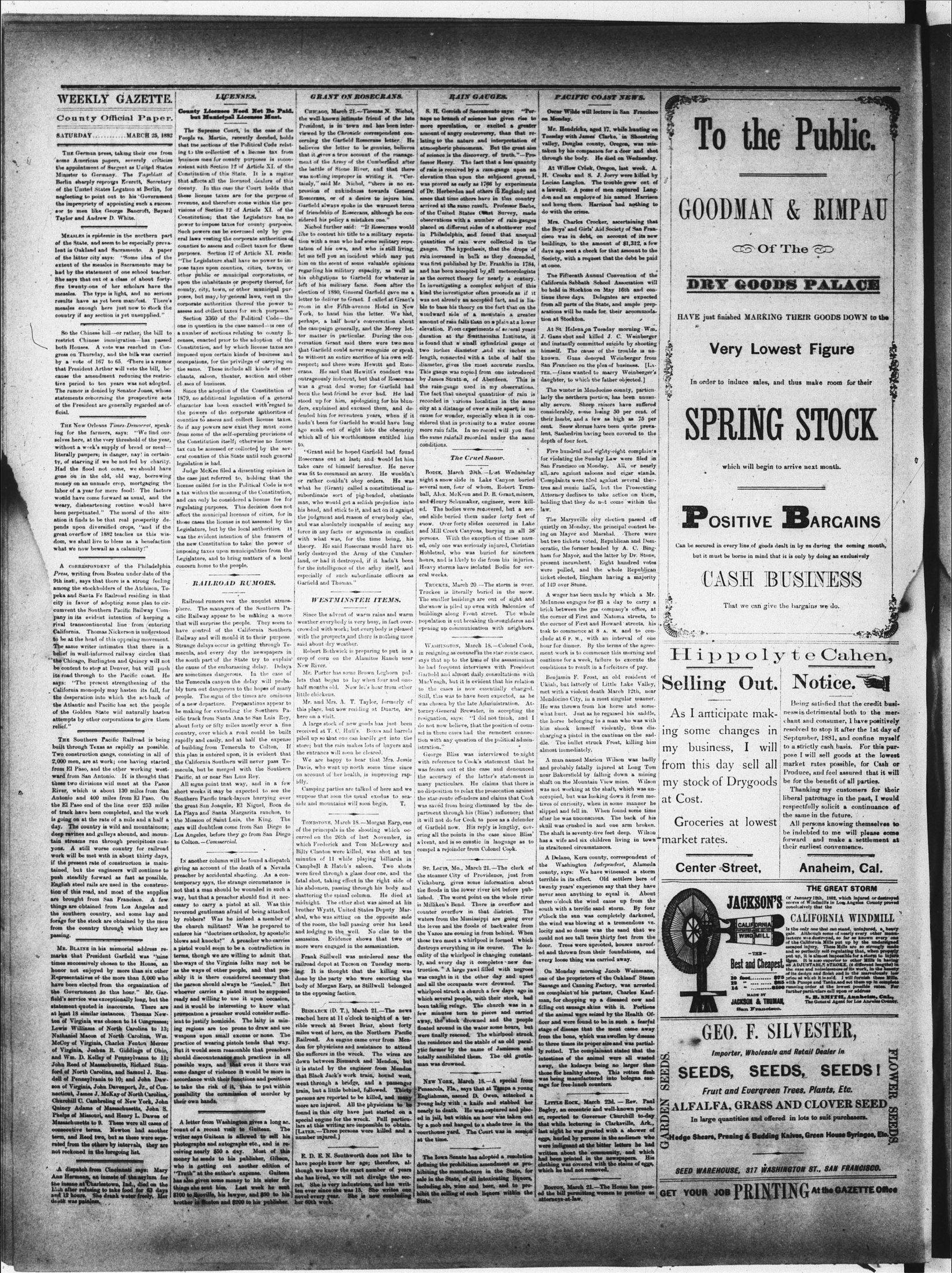
Searchable text
WEEKLY GAZETTE.
County Official Paper.
SATURDAY... MARCH 25, 1882
The German press, taking their one from some American papers, severely criticise the appointment of Sargent as United States Minister to Germany. The Tageblatt of Berlin sharply reproves Everett, Secretary of the United States Legation at Berlin, for neglecting to point out to his Government the impropriety of appointing such a successor to men like George Bancroft, Bayard Taylor and Andrew D. White.
Measles is epidemic in the northern part of the State, and seem to be especially prevalent in Oakland and Sacramento. A paper of the latter city says: "Some idea of the extent of the measles in Sacramento may be had by the statement of one school teacher. She says that out of a class of about forty-five twenty-one of her scholars have the measles. The type is light, and no serious results have as yet been manifest. There's measles enough here just now to stock the country if any section is yet unsupplied."
So the Chinese bill—or rather, the bill to restrict Chinese immigration—has passed both Houses. A vote was reached in Congress on Thursday, and the bill was carried by a vote of 167 to 65. There is a rumor that President Arthur will veto the bill, because the amendment reducing the restrictive period to ten years was not adopted. The rumor is denied by Senator Jones, whose statements concerning the prospective acts of the President are generally regarded as official.
The New Orleans Times-Democrat, speaking for the farmers, says: "We find ourselves here, at the very threshold of the year, without a week's supply of bread or meat—literally paupers; in danger, nay! in certainty, of starving if we be not fed by charity. Had the flood not come, we should have
LICENSES.
County Licenses Need Not Be Paid, but Municipal Licenses Must.
The Supreme Court, in the case of the People vs. Martin, recently decided, holds that the sections of the Political Code relating to the collection of a license tax from business men for county purposes is inconsistent with Section 12 of Article XI. of the Constitution of this State. It is a matter that affects all the licensed dealers of this county. In this case the Court holds that these license taxes are for the purpose of revenue, and therefore come within the provisions of Section 12 of Article XI. of the Constitution; that the Legislature has no power to impose taxes for county purposes. Such powers can be exercised only by general laws vesting the corporate authorities of counties to assess and collect taxes for these purposes. Section 12 of Article XI. reads: "The Legislature shall have no power to impose taxes upon counties, cities, towns, or other public or municipal corporations, or upon the inhabitants or property thereof, for county, city, town, or other municipal purposes, but may, by general laws, vest in the corporate authorities thereof the power to assess and collect taxes for such purposes."
Section 3360 of the Political Code—the one in question in the case named—is one of a number of sections relating to county licenses, enacted prior to the adoption of the Constitution, and by which license taxes are imposed upon certain kinds of business and occupations, for the privilege of carrying on the same. These include all kinds of merchants, saloon, theater, auction and other classes of business.
Since the adoption of the Constitution of 1879, no additional legislation of a general character has been enacted with regard to the powers of the corporate authorities of counties to assess and collect license taxes. So if any powers now exist they must come from some of the self-operating provisions of the Constitution itself; otherwise no license tax can be assessed or collected by the several counties of this State until such general legislation is had.
Judge McKee filed a dissenting opinion in
CHICAGO, March 21st—the well-known intimate President, is in town viewed by the Chroniclecerning the Garfield believes the letter that it gives a true account of the Army of the battle of Stone Hill was nothing improper tainly," said Mr. Nichol's pression of unkindness Rosceans, or of a Garfield always spoken of friendship of Rosceans sidered his policy a more Nichol further said he like to contest his titling with a man who lamented his own inclusion him on the scent of so regarding his military obligations to Garfield left of his military foe election of 1880. General letter to deliver to Grant room in the Fifth-air York, to hand him perhaps a half hour after campaign generally matter in particularversation Grant said that Garfield could need to without an entire respect; and these were crans. He said that he outrageously indecent was a great deal we been the best friend he stood up for him, apologists explained and exfended him for seventh hadn't been for Garfield ago sunk out of sight which all of his worthiness to.
"Grant said he hope Rosecrans out at last take care of himself was fit to command an
The New Orleans Times-Democrat, speaking for the farmers, says: "We find ourselves here, at the very threshold of the year, without a week's supply of bread or meat—literally paupers; in danger, nay! in certainty, of starving if we be not fed by charity. Had the flood not come, we should have gone on in the old, old way, borrowing money on an unmade crop, mortgaging the labor of a year for mere food! The factors would have come forward as usual, and the weary, disheartening routine would have been perpetuated." The moral of the situation it finds to be that real prosperity depends upon diversified crops, "and if the great overflow of 1882 teaches us this wisdom, we shall live to bless as a benefaction what we now bewail as a calamity!"
A correspondent of the Philadelphia Press, writing from Boston under date of the 9th inst., says that there is a strong feeling among the stockholders of the Atchison, Topeka and Santa Fe Railroad residing in that city in favor of adopting some plan to circumvent the Southern Pacific Railway Company in its evident intention of keeping a rival transcontinental line from entering California. Thomas Nickerson is understood to be at the head of this opposing movement. The same writer intimates that there is a belief in well-informed railway circles that the Chicago, Burlington and Quincy will not be content to stop at Denver, but will push its road through to the Pacific coast. He says: "The present strengthening of the California monopoly may hasten its fall, for the desperation into which the set-back of the Atlantic and Pacific has set the people of the Golden State will naturally hasten attempts by other corporations to give them relief."
The Southern Pacific Railroad is being built through Texas as rapidly as possible. Two construction gangs, consisting in all of 2,000 men, are at work; one having started from El Paso, and the other working westward from San Antonio. It is thought that these two divisions will meet at the Pasos River, which is about 130 miles from San Antonio and 400 miles from El Paso. On the El Paso end of the line over 253 miles of track have been completed, and the work is going on at the rate of a mile and a half a day. The country is wild and mountainous; deep ravines and gulleys abound, and mountain streams run through precipitous canyons. A still worse country for railroad work will be met with in about thirty days, if the present rate of construction is maintained, but the engineers will continue to push steadily forward as fast as possible. English steel rails are used in the construction of this road, and most of the supplies are brought from San Francisco.
Since the adoption of the Constitution of 1879, no additional legislation of a general character has been enacted with regard to the powers of the corporate authorities of counties to assess and collect license taxes. So if any powers new exist they must come from some of the self-operating provisions of the Constitution itself; otherwise no license tax can be assessed or collected by the several counties of this State until such general legislation is had.
Judge McKee filed a dissenting opinion in the case just referred to, holding that the license called for in the Political Code is not a tax within the meaning of the Constitution, and can only be considered a license fee for regulating purposes. This decision does not affect the municipal licenses of cities, for in those cases the license is not assessed by the Legislature, but by the local authorities. It was the evident intention of the framers of the new Constitution to take the power of imposing taxes upon municipalities from the Legislature, and to bring matters of a local concern home to the people.
RAILROAD RUMORS.
Railroad rumors vex the unquiet atmosphere. The managers of the Southern Pacific Railway appear to be making a move that will surprise the people. They seem to have control of the California Southern Railway and will mould it to their purpose. Strange delays occur in getting through Temecula, and every day the newspapers in the south part of the State try to explain the cause of the embarrassing delay. Delays are sometimes dangerous. In the case of the Temecula canyon the delay will probably turn out dangerous to the hopes of many people. The signs of the times are ominous of a new departure. Preparations appear to be making for extending the Southern Pacific track from Santa Ana to San Luis Rey, about forty or fifty miles mostly over a fine country, over which a road could be built rapidly and easily, and at half the expense of building from Temecula to Colton. If this plan is entered upon, it is evident that the California Southern will never pass Temecula, but be merged with the Southern Pacific, at or near San Luis Rey.
All signs point that way, and in a few short weeks it may be expected to see the Southern Pacific track-layers hurrying over the great San Joaquin, El Niguel, Boca de La Playa and Santa Margarita ranchos, to the Mission of Saint Luis, the King. The cars will doubtless come from San Diego to Los Angeles, before they go from San Diego to Colton. —Commercial.
In another column will be found a dispatch giving an account of the death of a Nevada preacher by accidental shooting. As a contemporary says, the strange circumstance is not that a man should be wounded in such a way, but that a preacher should find it nec-
WESTMINSTER
Since the advent of weather everybody is crowded with work; bed with the prospects and said about dry weather.
Robert Bothwick is crop of corn on the New River.
Mr. Porter has some lets that began to lay half months old. Now little chickens.
Mr. and Mrs. A. T. this place, but now reside here on a visit.
A large stock of new received at T. C. Hull piled up so that one can store; but the rain makes the entrance will soon.
We are happy to be Davis, who want up now on account of her health idly.
Camping parties are suppose that soon the u side and mountains will
TOMBSTONE, March 16 of the principals in their curred on the 26th of which Frederick and Billy Clanton were killed minutes of 11 while Campbell & Hatch's were fired through a glacial shot, taking effect his abdomen, passing thistletering the spinal co
Mr. Blaine in his memorial address remarks that President Garfield was "nine times successively chosen to the House, an honor not enjoyed by more than six other Representatives of the more than 5,000 who have been elected from the organization of the Government to this hour." Mr. Garfield's service was exceptionally long, but the statement quoted is inaccurate. There are at least 18 similar instances. Thomas Newton of Virginia was chosen to 14 Congresses; Lewis Williams of North Carolina to 13; Nathaniel Macon of North Carolina, Wm. McCoy of Virginia, Charles Fenton Mercer of Virginia, Joshua R. Giddings of Ohio, and Wm. D. Kelley of Pennsylvania to 11; John Reed of Massachusetts, Richard Stanford of North Carolina, and Samuel J. Randell of Pennsylvania to 10; and John Dawson of Virginia, John Davenport, Jr., of Connecticut, James J. McKay of North Carolina, Churehill C. Cambreling of New York, John Quincy Adams of Massachusetts, John S. Phelps of Missouri, and Henry L. Dawes of Massachusetts to 9. These were all cases of consecutive terms. Newton had another term, and Reed two, but as these were separated from the others by intervals, they are not reckoned in the foregoing list.
A dispatch from Cincinnati says: Mary Ann Hermann, an inmate of the asylum for the insane at Charlestown, Ind., died on the last after refusing to take food for 63 days and 12 hours. She drank water freely. Her death was painless.
In another column will be found a dispatch giving an account of the death of a Nevada preacher by accidental shooting. As a contemporary says, the strange circumstance is not that a man should be wounded in such a way, but that a preacher should find it necessary to carry a pistol at all. Was this reverend gentleman afraid of being attacked by robbers? Was he indeed a member of the church militant? Was he prepared to enforce his "doctrines orthodox, by apostolic blows and knocks?" A preacher who carries a pistol would seem to be a contradiction in terms, though we are willing to admit that the ways of the Virginia folks may not be as the ways of other people, and that possibly it is there considered necessary that the parson should always be "heeled." But whoever carries a pistol must be supposed ready and willing to use it upon occasion, and it would be interesting to know what provocation a preacher would consider sufficient to justify homicide. The laity in mining regions are too prone to draw and use weapons upon small excuse or none. The practice of wearing pistols tends that way. But it would seem reasonable that preachers should discountenance such practices in all possible ways, and that even if there was some danger of violence it would be more in accordance with their functions and positions to take the risk of it, than to put within possibility the commission of murder by their own hands.
A letter from Washington gives a long count of a recent visit to Guiteau. The writer says Guiteau is allowed to sell his photographs and autographs etc., and is receiving nearly $50 a day. Most of this money he sends to his publisher, Gibson, who is getting out another edition of "Truth" at the author's expense. Guiteau has also given some money to his sister for things she sent him. Last week he sent $100 to Groville, his lawyer, and $50 to his brother in Boston and $200 to his publisher.
TOMBSTONE, March 17th of the principals in the courthouse curred on the 26th of which Frederick and Billy Clanton were killed minutes of 11 while Campbell & Hatch's were fired through a glare fatal shot, taking effect his abdomen, passing thither shattering the spinal cord midnight. The other brother Wyatt, United Shal, who was sitting on the room, the ball pad and lodging in the well assassins. Evidence more were engaged in the trial.
Frank Stillwell was railroad depot at Tucson ing. It is thought that done by the party who body of Morgan Earp, was to the opposing faction.
BISMARCK (D. T.), reached here at 11 o'clock wrible wreck at Sweet miles west of here, on the Railroad. An engine eider for physicians and the sufferers in the wreck down between Bismarck it is stated by the enforcer that Black Jack's work went through a bridge train, but a little behind persons are reported to more are injured. All found in this city have special engine for the wives at this writing are [LATER.] Three person number injured.]
GRANT ON ROSECRANS.
CHICAGO, March 21.—Thomas N. Nichol, the well-known intimate friend of the late President, is in town and has been interviewed by the Chronicle correspondent concerning the Garfield Rosecrans letter. He believes the letter to be genuine, believes that it gives a true account of the management of the Army of the Cumberland after the battle of Stone River, and that there was nothing improper in writing it. "Certainly," said Mr. Nichol, "there is no expression of unkindness towards General Rosecrans, or of a desire to injure him. Garfield always spoke in the warmest terms of friendship of Rosecrans, although he considered his policy a mistaken one."
Nichol further said: "It Rosecrans would like to contest his title to a military reputation with a man who had some military reputation of his own, and who is still living, let me tell you an incident which may put him on the scent of some valuable opinions regarding his military capacity, as well as his objections to Garfield for whatever is left of his military fame. Soon after the election of 1880, General Garfield gave me a letter to deliver to Grant. I called at Grant's room in the Fifth-avenne Hotel in New York, to hand him the letter. We had, perhaps, a half hour's conversation about the campaign generally, and the Morey letter matter in particular. During the conversation Grant said there were two men that Garfield could never recognize or speak to without an entire sacrifice of his own self-respect; and these were Hewitt and Rosecrans. He said that Hewitt's conduct was outrageously indecent, but that of Rosecrans was a great deal worse; for Garfield had been the best friend he ever had. He had stood up for him, apologizing for his blunders, explained and excused them, and defended him for seventeen years, when if it hadn't been for Garfield he would have long ago sunk out of sight into the obscurity which all of his worthlessness entitled him to.
"Grant said he hoped Garfield had found Rosecrans out at last; and would let him take care of himself hereafter. He never was fit to command an army. He wouldn't
RAIN GAUGES.
S. H. Gervish of Sacramento says: "Perhaps no branch of science has given rise to more speculation, or excited a greater amount of angry controversy, than that relating to the nature and interpretation of atmospheric phenomena. But the great aim of science is the discovery of truth." — Professor Henry. The fact that a less quantity of rain is received by a rain-gauge upon an elevation than upon the subjacent ground, was proved as early as 1766 by experiments of Dr. Herberden and others in England; and since that time others have in this country arrived at the same result. Professor Bache, of the United States Coast Survey, made observations with a number of rain-gauges placed on different sides of a shottower roof in Philadelphia, and found that unequal quantities of rain were collected in the gauges. The hypothesis, that the drops of rain increased in bulk as they descended, was first published by Dr. Franklin in 1784, and has been accepted by all meteorologists as the correct theory for nearly a century. In investigating a complex subject of this kind the investigator often proceeds as if it was not already an accepted fact, and is liable to base his theory on the fact that on the windward side of a mountain a greater amount of rain falls than on a plain at a lower elevation. From experiments of several years duration at the Smithsonian Institute, it is found that a small cylindrical gauge of two inches diameter and six inches in length, connected with a tube of half the diameter, gives the most accurate results. This gauge was copied from one introduced by James Stratton, of Aberdeen. This is the rain-gauge used in my observations. The fact that unequal quantities of rain is recorded in various localities in the same city at a distance of over a mile apart, is no cause for wonder, especially when it is considered that in proximity to a water course more rain falls. In no record will you find the same rainfall recorded under the same conditions.
The Cruel Snow.
BODIE, March 20th.—Last Wednesday
PACIFIC COAST NEWS.
Oscar Wilde will lecture in San Francisco on Monday.
Mr. Hendricks, aged 17, while hunting on Tuesday with James Clarke, in Shoestring valley, Douglas county, Oregon, was mistaken by his companion for a deer and shot through the body. He died on Wednesday.
At Willow Creek, Oregon, last week, A. H. Croeks and S. J. Jorry were killed by Lucian Langdon. The trouble grew out of a lawsuit. A posse of men captured Langdon and an employee of his named Harrison and hung them. Harrison had nothing to do with the crime.
Mrs. Charles Crocker, ascertaining that the Boys' and Girls' Aid Society of San Francisco was in debt, on account of its new buildings, to the amount of $1,312, a few days ago sent a check for that amount to the Society, with a request that the debt be paid at once.
The Fifteenth Annual Convention of the California Sabbath School Association will be held in Stockton on May 16th and continue three days. Delegates are expected from all parts of the State, and ample preparations will be made for their accommodation at Stockton.
At St Helena on Tuesday morning Wm., J. Gans shot and killed J. C. Weinberger and instantly committed suicide by shooting himself. The cause of the trouble is unknown. Gans decoyed Weinberger from San Francisco on the plea of business. [LATE.]—Gans wanted to marry Weinberger's daughter, to which the father objected.
The winter in Meudocino county, particularly the northern portion, has been unusually severe. Sheep raisers have suffered considerably, some losing 50 per cent. of their lambs, and a few as high as 75 per cent. Snow storms have been quite prevalent, Sanhedrim having been covered to the depth of four feet.
Five hundred and eighty-eight complaints for violating the Sunday Law were filed in San Francisco on Monday. All, or nearly all, are against saloons and cigar stands.
outrageously indecent, but that of Rosecrans was a great deal worse; for Garfield had been the best friend he ever had. He had stood up for him, apologizing for his blunders, explained and excused them, and defended him for seventeen years, when if it hadn’t been for Garfield he would have long ago sunk out of sight into the obscurity which all of his worthlessness entitled him to.
“Grant said he hoped Garfield had found Rosecrans out at last; and would let him take care of himself hereafter. He never was fit to command an army. He wouldn’t or rather couldn’t obey orders. He was what he (Grant) called a constitutional subordinate sort of pig-headed, obstinate man, who would get a selfish prejudice into his head, and stick to it, and act on it against the judgment and reason of everybody else, and was absolutely incapable of seeing any force in any facts or arguments in conflict with what was, for the time being, his theory. He said Rosecrans would have utterly destroyed the Army of the Cumberland, or had it destroyed, if it hadn’t been for the intelligence of the army itself, and especially of such subordinate officers as Garfield and Thomas.”
WESTMINSTER ITEMS.
Since the advent of warm rains and warm weather everybody is very busy, in fact overcrowded with work; but everybody is pleased with the prospects and there is nothing more said about dry weather.
Robert Bothwick is preparing to put in a crop of corn on the Alamitos Ranch near New River.
Mr. Porter has some Brown Leghorn pullets that began to lay when four and one-half months old. Now let’s hear from other little chickens.
Mr. and Mrs. A. T. Taylor, formerly of this place, but now residing at Duarte, are here on a visit.
A large stock of new goods has just been received at T. C. Hull’s. Boxes and barrels piled up so that one can hardly get into the store; but the rain makes lots of buyers and the entrance will soon be cleared.
We are happy to hear of Mrs. Jessie Davis, who went up north some time since on account of her health, is improving rapidly.
Camping parties are talked of here and we suppose that soon the usual exodus to seaside and mountains will soon begin.
TOMBSTONE, March 18.—Morgan Earp, one of the principals in the shooting which occurred on the 26th of last November, in which Frederick and Tom McLowery and Billy Canton were killed, was shot at ten minutes of 11 while playing billiards in Campbell & Hatch’s saloon. Two shots were fired through a glass door one, and the fatal shot, taking effect in the right side of his abdomen, passing through his body and shattering the spinal column. He died at by James Strattin, of Aberdeen. This is the rain-gauge used in my observations. The fact that unequal quantities of rain is recorded in various localities in the same city at a distance of over a mile apart, is no cause for wonder, especially when it is considered that in proximity to a water course more rain falls. In no record will you find the same rainfall recorded under the same conditions.
The Cruel Snow.
BODIE, March 20th.—Lost Wednesday night a snow slide in Lake Canyon buried several men, four of whom, Robert Trumball, Alex. McKeon and D. B. Grant, miners, and Henry Schumaker, engineer, were killed. The bodies were recovered, but a second slide buried them under forty feet of snow. Over forty slides occurred in Lake and Mill Creek Canyons, burying in all 38 persons. With the exception of those named, only one was seriously injured, Christian Hobletzel, who was buried for nineteen hours, and is likely to die from his injuries. Heavy storms have isolated Bodie for several weeks.
TRUCKEE, March 20.—The storm is over. Truckee is literally buried in the snow. The smaller buildings are out of sight and the snow is piled up even with balconies of buildings along Front street. The whole population is out breaking thoroughfares and opening up communication with neighbors.
WASHINGTON, March 18.—Colonel Cook, in resigning as counsel in the star-route cases, says that up to the time of the assassination he had frequent interviews with President Garfield and almost daily consultations with MacVeagh, but it is evident that his relation to the cases is now essentially changed. Still, this was to have been expected, as he chosen by the late Administration. Attorney-General Brewster, in accepting the resignation, says: “I did not think, and I do not now believe, that the position of counsel in these cases had the remotest connection with any question of the political administration.”
George Bliss was interviewed tonight with reference to Cook’s statement that he was frozen out of the case and denounced the accuracy of the latter’s statement in many particulars. He claims that there is no disposition to relax the prosecution against the star-route offenders and claims that Cook was saved from being dismissed by the department through his (Bliss’) influence; that it will not do for Cook to pose as a defender of Garfield now. His reply is lengthy, covering all the points in the case since Bliss’ alent, and is so caustic in language as to compel a rejoinder from Colonel Cook.
ST. LOUIS, Mo., March 21.—The clerk of the steamer City of Providence, just from Vicksburg, gives some information about the floods in the lower river not before published. The worst point on the whole river daughter, to which the father objected.]
The winter in Mendocino county, particularly the northern portion, has been unusually severe. Sheep raisers have suffered considerably, some losing 50 per cent. of their lambs, and a few as high as 75 per cent. Snow storms have been quite prevalent, Sanhedrim having been covered to the depth of four feet.
Five hundred and eighty-eight complaints for violating the Sunday Law were filed in San Francisco on Monday. All, or nearly all, are against saloons and cigar stands. Complaints were filed against several theories and music halls, but the Prosecuting Attorney declines to take action on them, holding that they do not come within the law.
The Marysville city election passed quietly on Monday, the principal contest being on Mayor and Marshal. There were but two tickets voted, Republican and Democratic, the former headed by A. C. Bingham for Mayor, and the latter by Dr. Stone, present incumbent. Eight hundred votes were polled, and the whole Republican ticket elected, Bingham having a majority of 149 over Stone.
A wager has been made by which a Mr. McInness engages for $3 a day to carry a brick between the gas company’s office, at the corner of First and Natoma streets, to the corner of First and Howard streets, his task to commence at 8 A.M. and to conclude at 6 P.M., with an interval of one hour for dinner. By the terms of the agreement work is to commence this morning and continue for a week, failure to execute the conditions to result in a forfeiture of pay.
Benjamin F. Frost, an old resident of Ukiah, but latterly of Little Lake Valley, met with a violent death March 12th, near Mendocino City, in a most singular manner. He was thrown from his horse and somewhat hurt. Just as he regained his saddle, the horse belonging to a man who was with him shook himself violently, thus discharging a pistol in the cantinas on the saddle. The bullet struck Frost, killing him almost immediately.
A man named Marion Wilson was badly and probably fatally injured at Long Tom near Bakerstield by falling down a mining shaft on the Mountain View mine. Wilson was not working at the shaft, which was unoccupied, but was looking down it from motives of curiosity, when in some manner he slipped and fell in. When found some time after he was unconscious. The back of his skull was crushed in and one arm broken. The shaft is seventy-five feet deep. Wilson has a wife and six children living in town in straitened circumstances.
A Delano, Kern county, correspondent of the Washington Independent, Alameda county, says: We have witnessed a storm terrible in its effect. Old settlers here of twenty years’ experience say that they have never seen anything to equal it. About
TOMBSTONE, March 18. — Morgan Earp, one of the principals in the shooting which occurred on the 26th of last November, in which Frederick and Tom McLowery and Billy Clanton were killed, was shot at ten minutes of 11 while playing billiards in Campbell & Hatch’s saloon. Two shots were fired through a glass door one, and the fatal shot, taking effect in the right side of his abdomen, passing through his body and shattering the spinal column. He died at midnight. The other shot was aimed at his brother Wyatt, United States Deputy Marshal, who was sitting on the opposite side of the room, the ball passing over his head and lodging in the well. No clue to the assassins. Evidence shows that two or more were engaged in the assassination.
Frank Stillwell was murdered near the railroad depot at Tucson on Tuesday morning. It is thought that the killing was done by the party who were escorting the body of Morgan Earp, as Stillwell belonged to the opposing faction.
BISMARCK (D. T.), March 21. — The news reached here at 11 o’clock to-night of a terrible wreck at Sweet Briar, about forty miles west of here, on the Northern Pacific Railroad. An engine came over from Mendon for physicians and assistance to attend the sufferers in the wreck. The wires are down between Bismarck and Mendon, but it is stated by the engineer from Mendon that Black Jack’s work train, bound west, went through a bridge, and a passenger train, but a little behind, followed. Thirty persons are reported to be killed, and many more are injured. All the physicians to be found in this city have just started on a special engine for the wreck. Full particulars at this writing are impossible to obtain. [LATER.] Three persons were killed and a number injured.]
R. D. E. N. Southworth does not like to have people know her age; therefore, although we know the exact number of years she has lived, we will not divulge the secret. She is very industrious, and has written ever since she was 15. She writes one novel every year. She is now concluding her 60th work.
ST. LOUIS, Mo., March 21. — The clerk of the steamer City of Providence, just from Vicksburg, gives some information about the floods in the lower river not before published. The worst point on the whole river is Milliken’s Bend. There is overflow and counter overflow in that district. The waters from the Mississippi are going over the levee and the floods of backwater from the Yazoo are coming in from behind. When these two meet a whirlpool is formed which destroys everything in its course. The locality of the whirlpool is changing constantly, and every day it completes new destruction. A large yawl filled with negroes was caught in it the other day and upset and all the occupants were drowned. The whirlpool struck a church a few days ago in which several people, with their stock, had been taking refuge. The church was in a few minutes torn to pieces and carried away, the stock drowned and the people floated around in the water some hours, but were finally rescued. The whirlpool struck the residence and the stable of an old paralytic farmer by the name of Jamieson and totally annihilated them. The old gentleman was drowned.
NEW YORK, March 18. — A special from Pensacola, Fla., says that at Tampa a young Englishman, named D. Owen, attacked a young lady with a knife and stabbed her nearly to death. He was captured and placed in jail, but within an hour was taken out by a mob and hanged to a shade tree in the courthouse yard. The Court was in session at the time.
The Iowa Senate has adopted a resolution defining the prohibition amendment as prohibiting the manufacture in the State, for sale in the State, of all intoxicating liquors, including ale, wine and beer, and to prohibit the selling of such liquors within the State.
A Delano, Kern county, correspondent of the Washington Independent, Alameda county, says: We have witnessed a storm terrible in its effect. Old settlers here of twenty years’ experience say that they have never seen anything to equal it. About three o’clock the wind came up from the south with a terrific sand storm. By four o’clock the sun was completely darkened, the wind was blowing at a tremendous velocity and so dense was the sand that we could not see tall trees thirty feet from the door. Trees were uprooted, houses unroofed and thrown from their foundations, and every loose thing was carried away.
On Monday morning Jacob Weinmann, one of the proprietors of the Oakland Steam Sausage and Canning Factory, was arrested on complaint of his partner, Charles Kaufman, for chopping up a diseased cow and filling out sausage skins with it. Portions of the animal were seized by the Health Officer and were found to be in such a fearful stage of disease that the meat came away from the bone, which was swollen by disease to three times its proper size and was partially rotted. The complainant stated that the intestines of the animal were all wasted away, the kidneys being no larger than those for healthy sbeep. This rotten flesh was being manufactured into bologna sausage for free-lunch counters.
LITTLE Rock, March 22d. — Rev. Paul Bagley, an eccentric and well-known prescriber, reported to Governor Churchill to-day that while lecturing in Clarksville, Ark., last night he was greeted with a shower of eggs, hurled by persons in the audience who were indignant at the bitter letters he had written about the community, and which had been printed in the newspapers. His clothing was covered with the stains of eggs, which he had not removed.
BOSTON, March 21. — The House has passed the bill permitting women to practice as attorneys-at-law.
To the Public.
GOODMAN & RIMPAU
Of The
DRY GOODS PALACE
HAVE just finished MARKING THEIR GOODS DOWN to the
Very Lowest Figure
In order to induce sales, and thus make room for their
SPRING STOCK
which will begin to arrive next month.
In order to induce sales, and thus make room for their
SPRING STOCK
which will begin to arrive next month.
POSITIVE BARGAINS
Can be secured in every line of goods dealt in by us during the coming month,
but it must be borne in mind that it is only by doing an exclusively
CASH BUSINESS
That we can give the bargains we do.
Hippolyte Cahen,
Selling Out. Notice.
As I anticipate making some changes in my business, I will from this day sell all my stock of Drygoods at Cost.
Groceries at lowest market rates.
Center Street,
Anaheim, Cal.
Being satisfied that the credit business is detrimental both to the merchant and consumer, I have positively resolved to stop it after the 1st day of September, 1881, and confine myself to a strictly cash basis. For this purpose I will sell goods at the lowest market rates possible, for Cash or Produce, and feel assured that it will be for the benefit of all parties.
Thanking my customers for their liberal patronage in the past, I would respectfully solicit a continuance of the same in the future.
All persons knowing themselves to be indebted to me will please come forward and make a settlement at their earliest convenience.
THE GREAT STORM
Groceries at lowest market rates.
Center Street,
Anaheim, Cal.
THE GREAT STORM
Of January 12th, 1882, which injured or destroyed scores of Windmills in Los Angeles County proved conclusively that the
CALIFORNIA WINDMILL
Is the only one that can stand, uninjured, a heavy gale. Although some of nearly every other manufacture was destroyed, so far as known every one of the California Mills put up by the undersigned escaped injury. These Mills are so strongly made and so perfectly self-regulating that, when properly put up, it is almost impossible for a storm to injure them. It is also superior to other Mills in having an ADJUSTABLE STROKE. (A different length) in the ease and noiselessness of its work, in the beauty of its design and finish and in the marvelously low price at which it is sold. I will furnish these Mills with Pumps and Tanks and set them up in complete running order at the lowest possible rates. For further particulars call upon or address
N. B. SMITH, Anaheim, Cal.
The General Agent for Los Angeles County.
GEO. F. SILVESTER,
Importer, Wholesale and Retail Dealer in
SEEDS, SEEDS, SEEDS!
Fruit and Evergreen Trees, Plants, Etc.
ALFALFA, GRASS AND CLOVER SEED
In large quantities and offered in lots to suit purchasers.
Hedge Shears, Pruning & Budding Knives, Green House Syringes, Elm
SEED WAREHOUSE, 317 WASHINGTON ST., SAN FRANCISCO.
GET YOUR JOB PRINTING At the GAZETTE Office