anaheim-gazette 1882-03-18
Scanned page
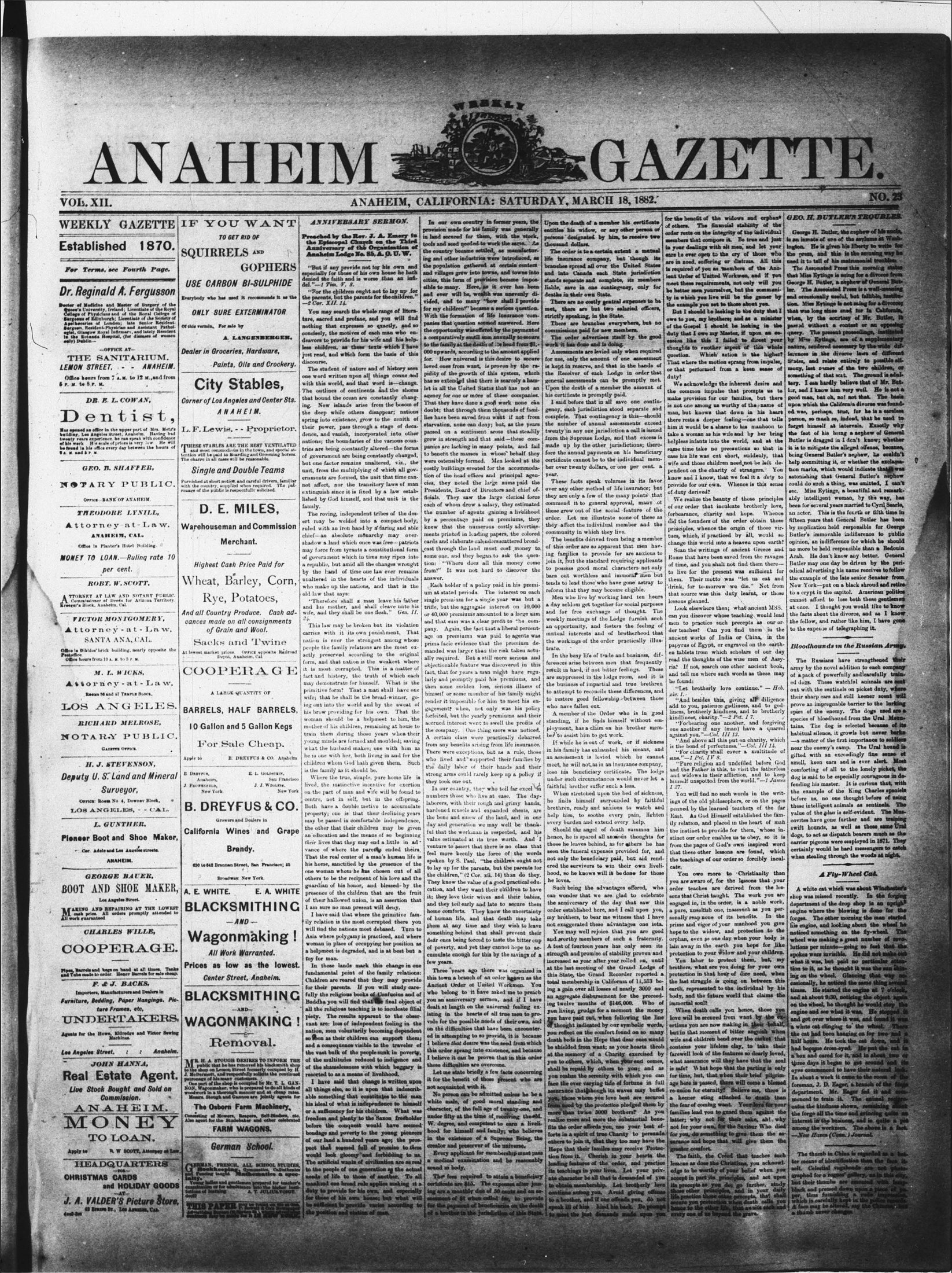
Searchable text
ANAHEIM
VOL. XII.
WEEKLY GAZETTE
Established 1870.
For Terms, see Fourth Page.
Dr. Reginald A. Fergusson
Doctor of Medicine and Master of Surgery of the Queen's University, Ireland; Licentiate of the Royal College of Physicians and of the Royal College of Surgeons of Edinburgh; Licentiate of the Society of Apothecaries of London; late Senior Resident Surgeon, Resident Physician and Assistant Pathologist, Glasgow Royal Infirmary, and lately Resident in the Botuada Hospital (for diseases of women only) Dublin—
OFFICE AT—
THE SANITARIUM.
LEMON STREET. - - ANAHEIM.
Office hours from 7 a.m. to 12 m., and from 5 p.m. to 8 p.m.
DR. E. L. COWAN,
Dentist,
Has opened an office in the upper part of Mrs. Metz's building, Los Angeles Street, Anaheim. Having had twenty years experience, he can speak with confidence of his work. His scale of prices is very low. He will be found in his office every day between the hours of 9 a.m. and 5 p.m.
GEO. B. SHAFFER,
IF YOU WANT
TO GET RID OF
SQUIRRELS AND
GOPHERS
USE CARBON BI-SULPHIDE
Everybody who has used it recommends it as the ONLY SURE EXTERMINATOR
Of this vermin. For sale by
A. LANGENBERGER,
Dealer in Groceries, Hardware,
Paints, Oils and Crockery.
City Stables,
Corner of Los Angeles and Center Sts.
ANAHEIM.
L. F. Lewis. - Proprietor.
THESE STABLES ARE THE BEST VENTILATED and most commodious in the town, and special attention will be paid to Boarding and Grooming horses. The charve in all cases will be reasonable.
Single and Double Teams
DR. E. L. COWAN,
Dentist,
Has opened an office in the upper part of Mrs. Metz's building, Los Angeles Street, Anaheim. Having had twenty years experience, he can speak with confidence of his work. His scale of prices is very low. He will be found in his office every day between the hours of 9 A.M. and 5 P.M.
GEO. B. SHAFFER,
NOTARY PUBLIC.
OFFICE—BANK OF ANAHEIM.
THEODORE LYNILL,
Attorney-at-Law.
ANAHEIM, CAL.
Office in Planter's Hotel Building.
MONEY TO LOAN.—Ruling rate 10 per cent.
ROBT. W. SCOTT.
ATTORNEY AT LAW AND NOTARY PUBLIC.
Commissioner of Deeds for Arizona Territory.
Kreeger's Block, Anaheim, Cal.
VICTOR MONIGOMERY,
Attorney-at-Law.
SANTA ANA, CAL.
Office in Dibbles' brick building, nearly opposite the Postoffice.
Office hours from 10 A.M. to 3 P.M.
M. L. WICKS,
Attorney-at-Law.
Rooms 86 and 87 Temple Block.
LOS ANGELES.
RICHARD MELROSE,
NOTARY PUBLIC.
GAZETTE OFFICE.
H. J. STEVENSON,
Deputy U. S. Land and Mineral Surveyor.
Office: Room No. 4, Downey Block.
LOS ANGELES, -- CAL.
L. GUNTHER.
Pioneer Boot and Shoe Maker,
Cor. Adele and Los Angeles streets.
ANAHEIM.
GEORGE BAUER,
BOOT AND SHOE MAKER,
City Stables,
Corner of Los Angeles and Center 8ts.
ANAHEIM.
L. F. Lewis, -- Proprietor.
THESE STABLES ARE THE BEST VENTILATED and most commodious in the town, and special attention will be paid to Boarding and Grooming horses.
The charm in all cases will be reasonable.
Single and Double Teams
Furnished at short notice, and careful drivers, familiar with the country, supplied when required. The pal-ronage of the public is respectfully solicited.
D. E. MILES,
Warehouseman and Commission Merchant.
Highest Cash Price Paid for Wheat, Barley, Corn, Rye, Potatoes,
And all Country Produce. Cash advances made on all consignments of Grain and Wool.
Sacks and Twine
At lowest market prices. Office opposite Railroad Depot, Anaheim, Cal.
COOPERAGE
A LARGE QUANTITY OF
BARRELS, HALF BARRELS,
10 Gallon and 5 Gallon Kegs For Sale Cheap.
Apply to B. DREYFUS & Co., Anaheim
B. DREYFUS,
Anaheim,
San Francisco
J. FROWESPELD,
New York
J. WEGLEIN,
New York
B. DREYFUS & CO.
Growers and Dealers in California Wines and Grape Brendy.
630 to 642 Brannan Street, San Francisco; 45 Broadway New York.
A. E. WHITE.
E. A. WHITE
Where the true, lived, the instinctive on the part of man's centre, not in self Both have a double property; one is that may be passed in co- other that their an education and their lives that they vance of where tha That the real center his home, sanctified one woman whom others to be the ree guardian of his hom presence of the chil
L. GUNTHER.
Ploneer Boot and Shoe Maker,
Car. Adele and Los Angeles streets.
ANAHEIM.
GEORGE BAUER,
BOOT AND SHOE MAKER,
Los Angeles Street.
Making and repairing at the lowest cash price. All orders promptly attended to. All work guaranteed.
CHARLES WILLE,
COOPERAGE.
Pipes, Barrels and keys on hand at all times. Tanks and Tabs made to order. Honey Barrels for sale cheap.
F. & J. BACKS.
Importers, Manufacturers and Dealers in Furniture, Bedding, Paper Hangings, Picture Frames, etc.
UNDERTAKERS.
Agents for the Howe, Eldredge and Victor Sewing Machines.
Los Angeles Street.: Anaheim.
JOHN HANNA,
Real Estate Agent.
Live Stock Bought and Sold on Commission.
ANAHEIM.
MONEY TO LOAN.
Apply to R. W SOOTT, Attorney at Law.
HEADQUARTERS
FOR CHRISTMAS CARDS and HOLIDAY GOODS
AT
J. A. VALDER'S Picture Store,
43 Seymour St., Los Angeles, Ca.
B. DREYFUS & CO.
Growers and Dealers in California Wines and Grape Brandy.
630 to 642 Brannan Street, San Francisco; 45 Broadway, New York.
A. E. WHITE.
E. A. WHITE
BLACKSMITHING
AND
Wagonmaking!
All Work Warranted.
Prices as low as the lowest. Center Street, Anaheim.
BLACKSMITHING
AND
WAGONMAKING!
Removal.
MR. H. A. STOUGH DESIRES TO INFORM THE public that he has removed his blacksmith shop to the shop on Lemon Street formerly occupied by H. J. McDermott, and respectfully solicits the continued patronage of his many customers.
One part of the shop is occupied by Mr. T. L. GANNON, Wagonmaker, who is prepared to do all kinds of woodwork in a thorough manner and at cheap rates. Messrs. Stough and Gannon are jointly agents for The Osborn Farm Machinery.
Consisting of Mowers, Reapers, Self-Hinders, etc. Also agent for the Studebaker and other celebrated FARM WAGONS.
German School.
GERMAN, FRENCH, ALL SCHOOL STUDIES,
Bookkeeping, Gymnastics, Callisthenics
and Posing taught Mathematics a specialty.
Young ladies and gentlemen prepared for teacher's examination or for admittance into the higher institutions of learning.
A. T. JULIUS VOIGT.
THIS PAPER may be found on file no Qua.
Advertising Bureau (18 Seymour St.) where advertising employs may be made for it in New York.
ANAHEIM, CALIFORNIA: SATURDAY, MARCH 18, 1882.
ANNIVERSARY SERMON.
Preached by the Rev. J. A. Emery in the Episcopal Church on the Third Anniversary of the Organisation of Anaheim Lodge No. 85, A. O. U. W.
"But if any provide not to lay up for the parents, but the parents for the children." —2 Cor. XII. 14.
You may search the whole range of literature, sacred and profane, and you will find nothing that expresses so exactly, and so concisely, the motives of each man who endeavors to provide for his wife and his helpless children, as these texts which I have just read, and which form the basis of this discourse.
The student of nature and of history sees one word written upon all things connected with this world, and that word is—change. The outlines of continents and the shores that bound the ocean are constantly changing. New islands arise from the bosom of the deep while others disappear; nations spring into existence, grow to the zenith of their power, pass through a stage of decadence, and vanish, incorporated into other nations; the boundaries of the various countries are being constantly altered—the forms of government are being constantly changed, but one factor remains unaltered, viz., the unit, from the multiplying of which all governs.
In our own country in former years, the provision made for his family was generally in land secured for them, with the stock, tools and seed needed to work the same. As the country became settled, as manufacturing and other industries were introduced, as the population gathered at certain centers and villages grew into towns, and towns into cities, this form of provision became impossible to many. Here, as it ever has been and ever will be, wealth was unevenly divided, and to many "how shall I provide for my children?" became a serious question. With the formation of life insurance companies that question seemed answered. Here the opportunity was offered by the payment of a comparatively small sum annually to secure to the family at the death of its head from $1,000 npwards, according to the amount applied for. How universal is this desire to secure loved ones from want, is proven by the rapidity of the growth of this system, which has so extended that there is scarcely a hamlet in all the United States that has not an agency for one or more of these companies. That they have done a good work none can doubt; that through them thousands of families have been saved from want if not from starvation, none can deny; but, as the years passed on a sentiment arose that steadily grew in strength and that said—these companies are lacking in many points, and fail to benefit the masses in whose behalf they were ostensibly formed. Men looked at the costly buildings erected for the accommodation of the needy office and municipal agent.
Upon the death of a member his certificate entitles his widow, or any other person or persons designated by him, to receive two thousand dollars.
The order is to a certain extent a mutual life insurance company, but though its branches spread all over the United States and into Canada each State jurisdiction stands separate and complete, its members liable, save in one contingency, only for deaths in their own State.
There are no costly general expenses to be met, there are but two salaried officers, strictly speaking, in the State.
There are branches everywhere, but no commissions paid for new members.
The order advertises itself by the good work it has done and is doing.
Assessments are levied only when required for use, only the amount of one assessment is kept in reserve, and that in the hands of the Receiver of each Lodge in order that general assessments can be promptly met. Upon the death of a member the amount of his certificate is promptly paid.
I said before that in all save one contingency, each jurisdiction stood separate and complete. That contingency is this—should the number of annual assessments exceed twenty in any one jurisdiction a call is issued from the Supreme Lodge, and that excess is made up by the other jurisdictions; therefore the annual payments on his beneficiary certificate cannot be to the individual member over twenty dollars, or one per cent. a year.
one word written upon all things connected with this world, and that word is—change. The outlines of continents and the shores that bound the ocean are constantly changing. New islands arise from the bosom of the deep while others disappear; nations spring into existence, grow to the zenith of their power, pass through a stage of decence, and vanish, incorporated into other nations; the boundaries of the various countries are being constantly altered—the forms of government are being constantly changed, but one factor remains unaltered, viz., the unit, from the multiplying of which all governments are formed, the unit that time cannot affect, nor the transitory laws of man extinguish since it is fixed by a law established by God himself, and that unit is the family.
The roving, independent tribes of the desert may be welded into a compact body, ruled with an iron hand by a daring and able chief—an absolute monarchy may overshadow a land which once was free—patriots may force from tyrants a constitutional form of government which in time may ripen into a republic, but amid all the changes wrought by the hand of time one law ever remains unaltered in the hearts of the individuals who make up the nations, and that is the old law that says:
"Therefore shall a man leave his father and his mother, and shall cleave unto his wife, and they shall be one flesh." Gen. II. 24.
This law may be broken but its violation carries with it its own punishment. That nation is ever the strongest among whose people the family relations are the most exactly preserved according to the original form, and that nation is the weakest where it is most corrupted. This is a matter of fact and history, the truth of which each may demonstrate for himself. What is the primitive form? That a man shall have one wife; that he shall be the bread-winner, going out into the world and by the sweat of his brow providing for his own. That the woman should be a helpmeet to him, the mother of his children, remaining at home to train during those years when their young minds are formed and moulded; saving what the husband makes; one with him as he is one with her, both living in and for the children whom God hath given them. Such is the family as it should be.
Where the true, simple, pure home life is lived, the instinctive incentive for exertion on the part of man and wife will be found to centre, not in self, but in the offspring. Both have a double motive to accumulate property; one is that their declining years may be passed in comfortable independence, the other that their children may be given an education and the means of so beginning their lives that they may end a little in advance of where the parents ended theirs. That the real center of a man's human life is his home, sanctified by the presence of the one woman whom he has chosen out of all others to be the recipient of his love and the guardian of his honor, and blessed by the presence of the children that are the fruit of their hollow prison in an orphanage that parity of the growth of this system, which has so extended that there is scarcely a hamlet in all the United States that has not an agency for one or more of these companies. That they have done a good work none can doubt; that through them thousands of families have been saved from want if not from starvation, none can deny; but, as the years passed on a sentiment arose that steadily grew in strength and that said—these companies are lacking in many points, and fail to benefit the masses in whose behalf they were ostensibly formed. Men looked at the costly buildings erected for the accommodation of the head offices and principal agencies, they noted the large sums paid the Presidents, Board of Directors and chief officials. They saw the large clerical force each of whom drew a salary, they estimated the number of agents gaining a livelihood by a percentage paid on premiums, they knew that the numerous costly advertisements printed in loading papers, the colored cards and elaborate calendars scattered broadcast through the land must cost money to some one, and they began to ask the question: "Where does all this money come from?" It was not hard to discover the answer.
Each holder of a policy paid in his premium at stated periods. The interest on each single premium for a single year was but a trifle, but the aggregate interest on 10,000 or 40,000 premiums amounted to a large sum and that sum was a clear profit to the company. Again, the fact that a liberal percentage on premiums was paid to agents was prima facie evidence that the premium demanded was larger than the risk taken actually required. But a still more serious and objectionable feature was discovered in this fact, that for years a man might have regularly and promptly paid his premiums, and then some sudden loss, serious illness of himself or some member of his family might render it impossible for him to meet his engagement; when, not only was his policy forfeited, but the yearly premiums and their accrued interest went to swell the profits of the company. One thing more was noticed. A certain class were practically debarred from any benefits arising from life insurance. There were exceptions, but as a rule, those who lived and supported their families by the daily labor of their hands and their strong arms could rarely keep up a policy if they took one out.
In our country, they who till far excel in numbers those who live at ease. The day-laborers, with their rough and grimy hands, hardened muscle and expanded chests, are the bone and sinew of the land, and in our day and generation we may well be thankful that the workman is respected, and his value estimated at its true worth. And I venture to assert that there is no class that feel more keenly the force of the words spoken by S. Paul, "the children ought not to lay up for the parents, but the parents for the children," (2 Cor. xii. 14) than do they. They know the value of a good practical education, and they want their children to have it; they love their wives and their babies,
I said before that in all save one contingency, each jurisdiction stood separate and complete. That contingency is this—should the number of annual assessments exceed twenty in any one jurisdiction a call is issued from the Supreme Lodge, and that excess is made up by the other jurisdictions; therefore the annual payments on his beneficiary certificate cannot be to the individual member over twenty dollars, or one per cent. a year.
These facts speak volumes in its favor over any other method of life insurance; but they are only a few of the many points that commend it to general approval, many of these grew out of the social feature of the order. Let me illustrate some of these as they affect the individual member and the community in which they live.
The benefits derived from being a member of this order are so apparent that men having families to provide for are anxious to join it, but the standard requiring applicants to possess good moral characters not only bars out worthless and immoral men but tends to lead those who have gone astray to reform that they may become eligible.
Men who live by working hard ten hours a day seldom get together for social purposes and for free exchange of thought. The weekly meetings of the Lodge furnish such an opportunity, and fosters the feeling of mutual interests and of brotherhood that the workings of the order practically illustrate.
In the busy life of trade and business, differences arise between men that frequently result in hard, if not bitter feelings. These are suppressed in the lodge room, and it is the business of impartial and true brethren to attempt to reconcile these differences, and to restore good fellowship between those who have fallen out.
A member of the Order who is in good standing, if he finds himself without employment, has a claim on his brother member to assist him to get work.
If while he is out of work, or if sickness in his family has exhausted his means, and an assessment is levied which he cannot meet, he will not as in an insurance company, lose his beneficiary certificate. The lodge under such circumstances would never let a faithful brother suffer such a loss.
When stretched upon the bed of sickness, he finds himself surrounded by faithful brethren, ready and anxious to watch and help him, to soothe every pain, lighten every burden and extend every help.
Should the angel of death summon him hence, he is spared all anxious thoughts for those he leaves behind, as for others he has seen the funeral expenses provided for, and not only the beneficiary paid, but aid rendered to win their own livelihood, so he knows will it be done for those he loves.
Such being the advantages offered, who can wonder that we are glad to celebrate
Both have a double motive to accumulate property; one is that their declining years may be passed in comfortable independence, the other that their children may be given an education and the means of so beginning their lives that they may end a little in advance of where the parents ended theirs. That the real center of a man's human life is his home, sanctified by the presence of the one woman whom he has chosen out of all others to be the recipient of his love and the guardian of his honor, and blessed by the presence of the children that are the fruit of their hallowed union, is an assertion that I am sure no man present will deny.
I have said that where the primitive family relation is the most corrupted there you will find the nations most debased. Turn to Asia where polygamy is practiced, and where woman in place of occupying her position as a helpmeet is degraded, and is at best but a toy for man.
In those lands mark this change in one fundamental point of the family relations: Children are reared that they may provide for their parents. If you will study carefully the religious books of Confucius and of Buddha you will find that the final object of all the religious teaching is to inculcate filial piety. The results apparent to the observant are: loss of independent feeling in the nation, men voluntarily becoming dependent so soon as their children can support them; and a consequence visible to the traveler of the vast bulk of the people sunk in poverty, of the multitudes reduced to indigence and of the shamelessness with which beggary is resorted to as a means of livelihood.
I have said that change is written upon all things else, so it is upon that indescribable something that constitutes to the man his ideal of what is independence to himself or a sufficiency for his children. What was freedom and plenty to the Saxon freeholder before the conquest would have seemed bondage and poverty to the young pioneers of our land a hundred years ago; the prospect that seemed full of promise to them would look gloomy and forbidding to us. The artificial wants of civilization are as real to the people of one generation as the actual needs of life to those of another. To all mankind one broad rule applies making it a duty to provide for his own, and especially for those of his own house; but what will be sufficient to provide varies according to the position and station of man.
The fees required to attain a beneficiary certificate are $15. The expenses after joining are a monthly due of 50 cents and an assessment of $1 when called for, to provide for the payment of beneficiaries on the death of a brother in the jurisdiction of this State, laborers, with their rough and grimy hands, hardened muscle and expanded chests, are the bone and sinew of the land, and in our day and generation we may well be thankful that the workman is respected, and his value estimated at its true worth. And I venture to assert that there is no class that feel more keenly the force of the words spoken by S. Paul, "the children ought not to lay up for the parents, but the parents for the children," (2 Cor. xii. 14) than do they. They know the value of a good practical education, and they want their children to have it; they love their wives and their babies, and they toil early and late to secure them home comforts. They know the uncertainty of human life, and that death may take them at any time and they wish to leave something behind that shall prevent their dear ones being forced to taste the bitter cup of poverty, and yet they cannot hope to accumulate enough for this by the savings of a few years.
Three years ago there was organized in this town a branch of an order known as the Ancient Order of United Workmen. You who belong to it have asked me to preach you an anniversary sermon, and if I have dealt at length on the universal feeling existing in the hearts of all true men to provide for the possible needs of their own, and on the difficulties that have been encountered in attempting to so provide, it is because I believe that desire was the seed from which this order sprang into existence, and because I believe it can be proven that in this order those difficulties are overcome.
Let me state briefly a few facts concerning it for the benefit of those present who are not acquainted with it.
No person can be admitted unless he be a white male, of good moral standing and character, of the full age of twenty-one, and under fifty at the time of receiving the M.W. degree, and competent to earn a livelihood for himself and family; who believes in the existence of a Supreme Being, the creator and preserver of the universe.
Every applicant for membership must pass a medical examination and be reasonably sound in body.
The fees required to attain a beneficiary certificate are $15. The expenses after joining are a monthly due of 50 cents and an assessment of $1 when called for, to provide for the payment of beneficiaries on the death of a brother in the jurisdiction of this State, laborers, with their rough and grimy hands, hardened muscle and expanded chests, are the bone and sinew of the land, and in our day and generation we may well be thankful that the workman is respected, and his value estimated at its true worth. And I venture to assert that there is no class that feel more keenly the force of the words spoken by S. Paul, "the children ought not to lay up for the parents, but the parents for the children," (2 Cor. xii. 14) than do they. They know the value of a good practical education, and they want their children to have it; they love their wives and their babies, and they toil early and late to secure them home comforts. They know the uncertainty of human life, and that death may take them at any time and they wish to leave something behind that shall prevent their dear ones being forced to taste the bitter cup of poverty, and yet they cannot hope to accumulate enough for this by the savings of a few years.
Three years ago there was organized in this town a branch of an order known as the Ancient Order of United Workmen. You who belong to it have asked me to preach you an anniversary sermon, and if I have dealt at length on the universal feeling existing in the hearts of all true men to provide for the possible needs of their own, and on the difficulties that have been encountered in attempting to so provide, it is because I believe that desire was the seed from which this order sprang into existence, and because I believe it can be proven that in this order those difficulties are overcome.
Let me state briefly a few facts concerning it for the benefit of those present who are not acquainted with it.
No person can be admitted unless he be a white male, of good moral standing and character, of the full age of twenty-one, and under fifty at the time of receiving the M.W. degree, and competent to earn a livelihood for himself and family; who believes in the existence of a Supreme Being, the creator and preserver of the universe.
Every applicant for membership must pass a medical examination and be reasonably sound in body.
The fees required to attain a beneficiary certificate are $15. The expenses after joining are a monthly due of 50 cents and an assessment of $1 when called for, to provide for the payment of beneficiaries on the death of a brother in the jurisdiction of this State, laborers, with their rough and grimy hands, hardened muscle and expanded chests, are the bone and sinew of the land, and in our day and generation we may well be thankful that the workman is respected, and his value estimated at its true worth. And I venture to assert that there is no class that feel more keenly the force of the words spoken by S. Paul, "the children ought not to lay up for the parents, but the parents for the children," (2 Cor. xii. 14) than do they. They know the value of a good practical education, and they want their children to have it; they love their wives and their babies, and they toil early and late to secure them home comforts. They know the uncertainty of human life, and that death may take them at any time and they wish to leave something behind that shall prevent their dear ones being forced to taste the bitter cup of poverty, and yet they cannot hope to accumulate enough for this by the savings of a few years.
Three years ago there was organized in this town a branch of an order known as the Ancient Order of United Workmen. You who belong to it have asked me to preach you an anniversary sermon, and if I have dealt at length on the universal feeling existing in the hearts of all true men to provide for the possible needs of their own, and on the difficulties that have been encountered in attempting to so provide, it is because I believe that desire was the seed from which this order sprang into existence, and because I believe it can be proven that in this order those difficulties are overcome.
Let me state briefly a few facts concerning it for the benefit of those present who are not acquainted with it.
No person can be admitted unless he be a white male, of good moral standing and character, of the full age of twenty-one, and under fifty at the time of receiving the M.W. degree, and competent to earn a livelihood for himself and family; who believes in the existence of a Supreme Being, the creator and preserver of the universe.
Every applicant for membership must pass a medical examination and be reasonably sound in body.
The fees required to attain a beneficiary certificate are $15. The expenses after joining are a monthly due of 50 cents and an assessment of $1 when called for, to provide for the payment of beneficiaries on the death of a brother in the jurisdiction of this State, laborers, with their rough and grimy hands, hardened muscle和 expanded chests,aretheboneandsinewoftheland,andinourdayandgenerationwemaywellbe thankfulthattheworkmanisrespected,andhisvalueestimatedatitstrueworth.AndIventuretoassertthatthereisnoclassthatfeelmorekeenlytheforceofthewordsspokenbyS.Paul,thechildrenoughtnottolayupfortheparents,buttheparentsforthechildren,"(2Cor.xii.14)thandothey.Theknowthevalueofagoodpracticaleducation,andtheywanttheirchildrentohaveit;theylovetheirwivesandtheirbabies,andtheytoilearlyandlatetostecurethehomecomforts.Theknowtheuncertaintyofhumanlife,andthatdeathmaytakethematanytimeandtheywishtoleave somethingbehindthatshallpreventthedearonesbeingforcedtotastethebittercupofpoverty,andyettheycannothopetocumulateenoughforthisbythesavingsofafewyears.
Three years ago there was organized in this town a branch of an order known as the Ancient Order of United Workmen. You who belong to it have asked me to preach you an anniversary sermon,andifIhavedealtatlengthontheuniversalfeelingexistingintheheartsofalltruementoprovideforthepossibleneedsoftheirown,andonthedifficultiesthathavebeenencounteredinattemptingtotosaveitbecauseIbelievethatdeadfromwhichthisordertsprungintotheexistence,andbecauseIbelieveitcanbeproventhatinthisorderthosedifficultiesareovercome.
Let me state briefly a few facts concerning it for the benefit of those present who are not acquainted with it.
No person can be admitted unless he be a white male,of good moral standing和character,ofthefullageoftwenty-one,andunderfiftyatthetimeofreceivingtheM.W.degree,andcompetenttoearnlaivelihoodforthimselfandfamily;whobelievesinthenexistenceofthesupremeBeing,thecreatorandpreserveroftheuniverse.
Every applicant for membership must pass a medical examination和be reasonably sound in body.
The fees required to attain a beneficiary certificate are $15. The expenses after joining are a monthly due of 50 cents and an assessment of $1 when called for,to provide forthepaymentofbeneficiariesonthedeathofabrotherinthejurisdictionofthisState,laborers,withtheirroughandgrimyhands,hardenedmuscleandexpandedchests,aretheboneandsinewoftheland,andinourdayandgenerationwemaywellbe thankfulthattheworkmanisrespected,andhisvalueestimatedatitstrueworth.AndIventuretoassertthatthereisnoclassthatfeelmorekeenlytheforceofthewordsspokenbyS.Paul,thechildrenoughtnottolayupfortheparents,buttheparentsforthechildren,"(2Cor.xii.14)thandothey.Theknowthevalueofagoodpracticaleducation,andtheywanttheirchildrentohaveit;theylovetheirwives和theirbabies,andtheytoilearlyandlatetostecurethehomecomforts.Theknowtheuncertaintyofhumanlife,andthatdeathmaytakethematanytimeandtheywishtoleave somethingbehindthatshallpreventthedearonesbeingforcedtotastethebittercupofpoverty,andyettheycannothopetocumulateenoughforthisbythesavingsofafewyears.
Three years ago there was organized in this town a branch of an order known as the Ancient Order of United Workmen. You who belong to it have asked me to preach you an anniversary sermon,andifIhavedealtatlengthontheuniversalfeelingexistingintheheartsofalltruementoprovideforthepossibleneedsoftheirown,andonthedifficultiesthathavebeenencounteredinattemptingtotosaveitbecauseIbelievethatdeadfromwhichthisordertsprungintotheexistence,andbecauseIbelieveitcanbeproventhatinthisorderthosedifficultiesareovercome.
Let me state briefly a few facts concerning it for the benefit of those present who are not acquainted with it.
No person can be admitted unless he be a white male,of good moral standing和character,ofthefullageoftwenty-one,andunderfiftyatthetimeofreceivingtheM.W.degree,andcompetenttoearnlaivelihoodforthimselfandfamily;whobelievesinthenexistenceofthesupremeBeing,thecreatorandpreserveroftheuniverse.
Every applicant for membership must pass a medical examination和be reasonably sound in body.
The fees required to attain a beneficiary certificate are $15. The expenses after joining are a monthly due of 50 cents and an assessment of $1 when called for,to provide forthepaymentofbeneficiariesonthedeathofabrotherinthejurisdictionofthisState,laborers,withtheirroughandgrimyhands,Hardenedmuscleandexpandedchests,aretheboneandsinewoftheland,andinourdayandgenerationwemaywellbe thankfulthattheworkmanisrespected,andhisvalueestimatedatitstrueworth.AndIventuretoassertthatthereisnoclassthatfeelmorekeenlytheforceofthewordsspokenbyS.Paul,thechildrenoughtnottolayupfortheparents,buttheparentsforthechildren,"(2Cor.xii.14)thandothey.Theknowthevalueofagoodpracticaleducation,andtheywanttheirchildrentohaveit;theylove-theywives和theirbabies,andtheytoilearlyandlatetostecure-thehomecomforts.Theknow.theuncertainty.of.humanlife,andthatdeath.maytake_them.atanytime_andtheywish.toleave.somethingbehindthatshallprevent.thedearonesbeingforced.totaste.thebittercup.of.poverty,andyettheycannothopetocumulateenough.forthis.by.the.jurisdiction.of.the.university."
Such being-the advantages offered,who can wonder that we are glad to celebrate-the anniversary-of-the-day that saw this order established here,and I call upon you,我 brothers,to bear me witness that I have not exaggerated these advantages one iota.
You may well rejoice that you are good and worthy members-of such a fraternity.A test-of fourteen years has only seen its strength and promise-of stability proven-and increased as year after year rolled on,until at last meeting-of-the Grand Lodge-of this State,the Grand Recorder reported-a total membership-in California-of 11,533 being-a gain over all losses-of nearly 3000 and an aggregate disbursement-for-the preceding twelve months-of $146,000。WhoOfyou living,grudge for-a moment-the money you have paid out,when following-the line-of thought indicated by our symbolic words,你 reflect on-the comfort found on so many death beds in-the Hope that dear ones would be shielded from want;as your hearts thrub at-the memory-of-a Charity exercised by you-to others,which,when your end comes,shall be repaid-by others-to you;and as you realize-the serenity-with which you can face-the ever-varying tide-of fortune-in full assurance-that although its waves may buffet you,那些 whom you love best are secured from need by-the protection pledged them by more than twice 5000 brothers? As you realize more-and more-the substantial benefits-the order affords you,用your best efforts-in-a spirit-of-true Charity-to perennale others-to join it,that they too may have-the-Hope that their families may receive Protection-from it.Cherish-in your hearts-the leading features-of-the order、and practice its teachings-in your lives.Let your private character-be all that is demanded-of you-to obtain membership.Let brotherly love continue among you.Avoid giving offense-to-a brother、and if one offends-you-do-not speak ill-of him-hind his back.So meet-the just demands-made upon you
GAZETTE.
MARCH 18, 1882.
NO. 23
A member his certificate or any other person or by him, to receive two certain extent a mutual company, but though its over the United States Reach State jurisdiction complete, its members be contingency, only for State.
Only general expenses to be paid two salaried officers, the State.
There everywhere, but no new members.
Tries itself by the good and is doing.
Evided only when required amount of one assessment and that in the hands of each Lodge in order that can be promptly met.
A member the amount of promptly paid.
In all save one continuation stood separate and contingency is this—should usual assessments exceed jurisdiction a call is issued Lodge, and that excess is other jurisdictions; there-ments on his beneficiary to the individual mem-ders, or one per cent. a for the benefit of the widows and orphan of others. The financial stability of the order rests on the integrity of the individual members that compose it. Be true and just in your dealings with alt men, and let your ears be ever open to the cry of those who are in need, suffering or distress. All this is required of you as members of the Ancient Order of United Workmen, and if you meet these requirements, not only will you be better men yourself, but the community in which you live will be the gainer by the example you set to those about you.
But I should be lacking in the duty that I owe to you, my brothers; and as a minister of the Gospel I should be lacking in the duty that I owe my Master, if upon an occasion like this I failed to direct your thoughts to another aspect of this whole question. Which action is the higher?
That where the motion sprang from impulse, or that performed from a keen sense of duty?
We acknowledge the inherent desire and the common impulse that prompts us to make provision for our families, but there is not one among us worthy of the name of man, but knows that down in his heart there rests a deeper feeling—one that tells him it would be a shame to his manhood to take a woman as his wife and by her bring helpless infants into the world, and at the same time take no precautions so that in case his life was cut short, suddenly, that wife and those children need not be left dependent on the charity of strangers. You
GEO. H. BUTLER'S TROUBLES.
George H. Butler, the nephew of his uncle, is an inmate of one of the asylums at Washington. He is given his liberty to write for the press, and this is the amazing way he used it to tall of his maframonial troubles.
The Associated Press this morning states that Miss Kytinge is suing for a divorce from George H. Butler, a nephew of General Butler. The Associated Press is a well-meaning and occasionally useful, but fallible institution. Miss Kytinge is not suing for a divorce that was long since sued for in California, when, by the courtesy of Mr. Butler, it passed without a contest or an opposing query. The present proceedings, instigated by Miss Kytinge, are of a supplementary nature, rendered necessary by the wide differences in the divorce laws of different States, and relate entirely to possible al-mony, last names of the two children, or something of that sort. The ground is adultery. I can hardly believe that of Mr. Butler, and I know him very well. He is not a good man, but oh, no! not that. The basis upon which the California divorces was founded was, perhaps, true, for he is a careless person, so much so, indeed, that he used to forget himself at intervals. Exactly why the fact of his being a nephew of General Butler is dragged in I don't know; whether it is to mitigate the alleged offense, because being General Butler's nephew, he couldn't help committing it, or whether the exclamation marks, which would indicate that it was
We acknowledge the inherent desire and the common impulse that prompts us to make provision for our families, but there is not one among us worthy of the name of man, but knows that down in his hearts there rests a deeper feeling—one that tells him it would be a shame to his manhood to take a woman as his wife and by her bring helpless infants into the world, and at the same time take no precautions so that in case his life was cut short, suddenly, that wife and those children need, not be left dependent on the charity of strangers. You know and I know, that we feel it a duty to provide for our own. Whence is this sense of duty derived?
We realize the beauty of those principles of our order that inculcate brotherly love, forbearance, charity and hope. Whence did the founders of the order obtain those principles, whence the origin of those virtues, which, if practiced by all, would so change this world into a heaven upon earth?
Scan the writings of ancient Greece and Rome that have been saved from the ravages of time, and you shall not find them there—to live for the present was sufficient for them. Their motto was "let us eat and drink, for to-morrow we die." Not from that source was this duty learnt, or those lessons gleaned.
Look elsewhere then; what ancient MSS. can you discover whose teaching would lead men to practice such precepts as our order teaches? Can you find them in the ancient works of India or China, in the papyrus of Egypt, or engraved on the earthen tablets from which scholars of our day read the thoughts of the wise men of Assyria? If not, search one other ancient book, and tell me where such words as these may be found:
"Let brotherly love continue." — Heb. xiv. 1.
"And besides this, giving all diligence add to you, patience godliness, and to godliness, brotherly kindness, and to brotherly kindness, charity." —2 Pet. 17.
"Forbearing one another, and forgiving one another if any (man) have a quarrel against you." —Col. III 13.
"And above all this put on charity, which is the bond of perfectness." —Col. III 14.
"For charity shall cover a multitude of sins." —1 Pet. IV 8.
"Pure religion and undefiled before God and the Father is this, to visit the fatherless and widows in their affliction, and to keep himself unspotted from the world." —1 James 127.
You will find no such words in the writings of the old philosophers, or on the pages penned by the learned teachers of the far East. As God Himself established the family relation, and placed in the heart of mah the instinct to provide for them, whose instinct our order enables us to obey, so it is from the pages of God's own inspired word that these other lessons are found, which the teachings of our order so forcibly inculcate.
You owe more to Christianity than you are aware of, for the lessons that your order teaches are derived from the lessons that Christ taught. The work you are something of that sort. The ground is adaltery. I can hardly believe that of Mr. Butler, and I know him very well. He is not a good man, but oh, not that. The basis upon which the California divorce was founded was, perhaps, true, for he is a careless person, so much so, indeed, that he used to forget himself at intervals. Exotically why the fact of his being a nephew of General Butler is dragged in I don't know; whether it is to mitigate the alleged offense, because being General Butler's nephew, he couldn't help committing it, or whether the exclamation marks, which would indicate that it was astonishing that General Butler's nephew could do such a thing, was omitted. I can't see. Miss Eytinge, a beautiful and remarkably intelligent woman, by the way, has been for several years married to Cyril Searle, an actor. This is the fourth or fifth time in fifteen years that General Butler has been by implication held responsible for George Butler's immovable indifference to public opinion, an indifference for which he should no more be held responsible than a Bedouin Arab. He don't know any better. General Butler may one day be driven by the periodical advertising his name receives to follow the example of the late senior Senator from New York—put on a black shroud and retire to a crypt in the capitol. American politics cannot afford to lose both these gentlemen at once. I thought you would like to know the facts about the divorce, and as I know the fellow, and rather like him, I have gone to the expense of telegraphing it.
Bloodhounds in the Russian Army.
The Russians have strengthened their army by the novel addition to each company of a pack of powerfully and carefully trained dogs. These watchful animals are sent out with the sentinels on picket duty, where their sharp ears and still keener scent will prove an impregnable barrier to the lurking spies of the enemy. The dogs used are a species of bloodhound from the Ural Mountains. The dog is selected because of its habitual silence, it growls but never barks—a matter of the first importance to soldiers near the enemy's camp. The Ural hound is gifted with an exceedingly fine sense of smell, keen ears and is ever alert. Most comforting of all to the lonely picket, the dog is said to be especially courageous in defending his master. It is curious that, with the example of the King Charles spaniels before us, no one thought before of using these intelligent animals as sentinels. The value of the plan is self-evident. The Muscovites have gone further and are training swift hounds, as well as these same Ural dogs, to act as dispatch bearers much as the carrier pigeons were employed in 1871. They certainly would be hard messengers to catch when stealing through the woods at night.
A Fly-Wheel Cat.
A white cat which was about Winchester's shop was missed recently. In the forging
of death summon him
all anxious thoughts for
mind, as for others he has
expenses provided for,
and diary paid, but aid rendto win their own liveliwill it be done for those
advantages offered, who
we are glad to celebrate
the day that saw this
here, and I call upon you,
for me witness that I have
these advantages one iota.
joice that you are good
ers of such a fraternity.
years has only seen its
use of stability proven and
after year rolled on, until
of the Grand Lodge of
Band Recorder reported a
in California of 11,533 belosses of nearly 3000 and
persent for the preceded of $146,000. Who of
for a moment the money
when following the line
by our symbolic words,
comfort found on so many
hope that dear ones would
ant; as your hearts throb
A charity exercised by
such, when your end comes,
others to you; and as
enity with which you can
ing tide of fortune in full
eng its waves may buffet
you love best are secured
protection pledged them by
6000 brothers? As you
more the substantial benedues you, use your best eftrue Charity to peranade
that they too may have the
miles may receive Protecterish in your hearts the
the order, and practice
our lives. Let your prival that is demanded of you
ship. Let brotherly love
un. Avoid giving offense
of one offends you, do not
hind his back. Be prompt
demands made upon you
You owe more to Christianity than
you are aware of, for the lessons that your
order teaches are derived from the leassons that Christ taught. The work you are
engaged in, in the order, is a noble work,
a pure, unselfish one, inasmuch as you personally reap none of its benefits. In the
prime and vigor of your manhood you give
hope to the widow, and protection to the
orphan, even as one day when your body is
lain away in the earth you hope for like
protection to your widow and your children.
You labor to protect them, but, my
brothers, what are you doing for your own
protection in that hour of dire need, when
the last struggle is going on between this
earth, represented to the individual by his
body, and the future world that claims the
immortal soul?
When death calls you hence, those you
love will be secured from want by the exertions you are now making in their behalf,
but in that moment of bitter anguish when wife and children bend over the casket that contains your lifeless clay, to take their farewell look of the features so dearly loved,
what assurance will they have that the soul is safe? What hope that the parting is only for time, but, that when their brief pilgrimage here is passed, there will come a blessed re-union for eternity? Believe me, there is a keener sting attached to death than the fear of coming want. Your love for your families lead you to guard them against the latter; why not for their sake, ah! why not for your own, for the Saviour Who died for you, do something to give them the assurance and hope that will give them the greater comfort.
The faith, the Creed that teaches such lessons as does the Christians, you acknowledge to be worthy of your belief when you accept in part its principles, and act upon its precepts as you do; go further, study these other principles, and in your daily life practice those other precepts, that shall secure you protection when death calls you hence to the other life, that awaits each and every one of us beyond the grave.
before us, no one thought before or using these intelligent animals as sentinels. The value of the plan is self-evident. The Muscovites have gone further and are training swift hounds, as well as these same Urnal dogs, to act as dispatch bearers much as the carrier pigeons were employed in 1871. They certainly would be hard messengers to catch when stealing through the woods at night.
A Fly-Wheel Cat.
A white cat which was about Winchester's shop was missed recently. In the forging department of the drop shop is an upright engine where the blowing is done for the forges. The other morning the man started his engine, and looking about the wheel he noticed something on the fly-wheel. The wheel was making a great number of revolutions per minute—going so fast that the spokes were invisible. He did not make out what it was, but paid no particular attention to it, as he thought it was the sun shining on the wheel. Glancing that way occasionally, he noticed the same thing several times. He started the engine at 7 o'clock, and at about 9:30, noticing the object again on the wheel, he thought he would stop the engine and see what it was. He stopped it and got over where it was, and found it was a white cat clinging to the wheel. There the cat had been hanging on for two and a half hours. He took the cat down, and it had begone cross-eyed. He put the cat in a box and cared for it, and in about two or three days it began to get around and its eyes commenced to have their natural lock. In about a week it came to the room of the foreman, J. D. Eager, a branch of the force department. Mr. Eager fed it and commenced to train it. The animal recuperates the kindness shown, remaining about the forge all the time and evincing quits an interest in the business, and in quits a pet among the workmen. The above is a fact.
New Haven (Conn.) Journal.
The thumb in China is regarded as a better means of identification than the face itself. Celestial vagabonds are not photographed for a rogue gallery, as in this city, but their thumbs are amazed with lamp-black and pressed down upon a piece of paper, thus furnishing a rude impression which is carefully kept in the police camera. A face may be altered, say the Chinese, into a thumb never changes.