anaheim-gazette 1882-02-25
Scanned page
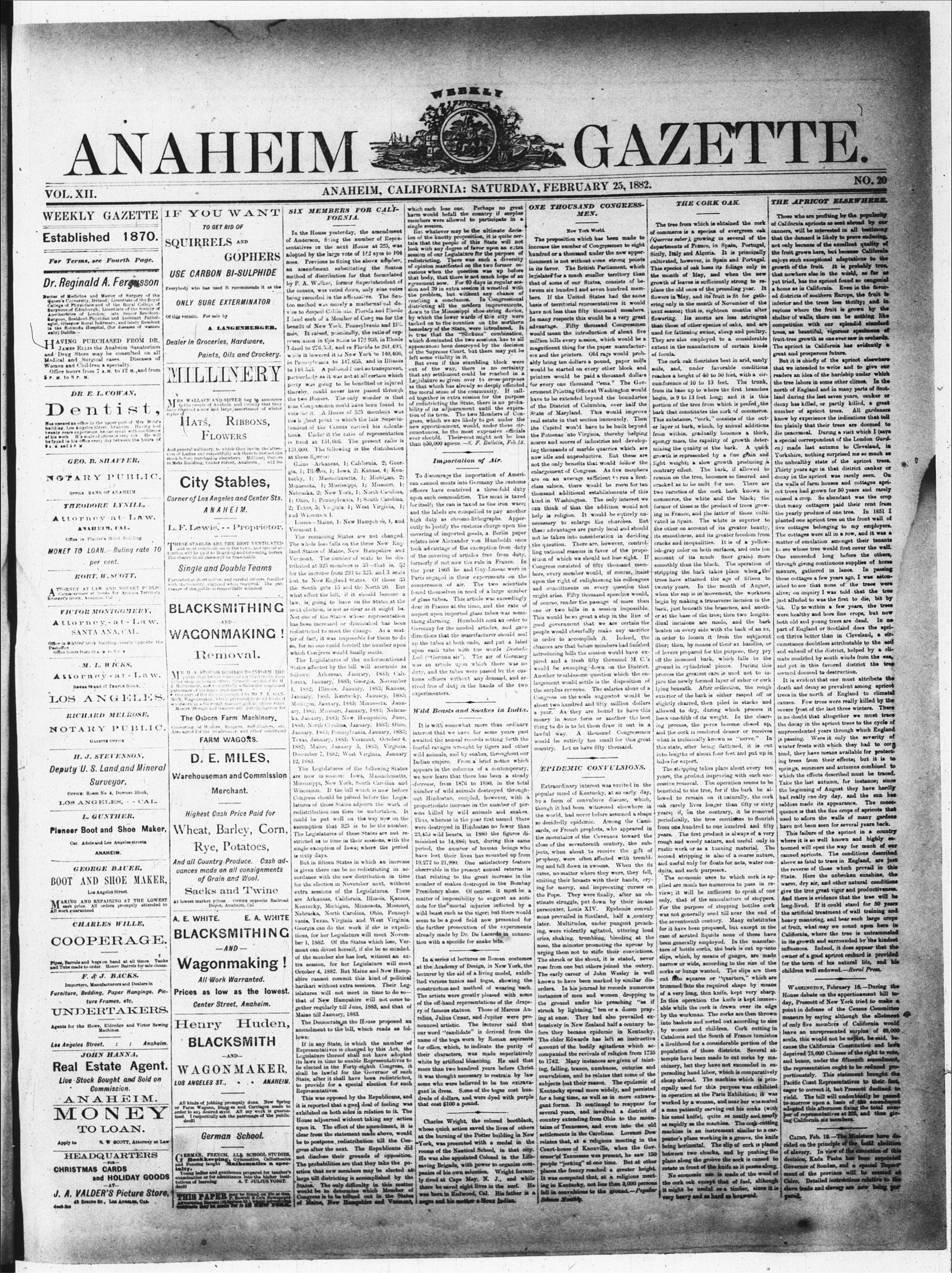
Searchable text
ANAHEIM
VOL. XII.
WEEKLY GAZETTE
Established 1870.
For Terms, see Fourth Page.
Dr. Reginald A. Fergusson
Doctor of Medicine and Master of Surgery of the Queen's University, Ireland; Licentiate of the Royal College of Physicians and of the Royal College of Surgeons of Edinburgh; Licentiate of the Society of Apothecaries of London; late Senior Resident Surgeon, Resident Physician and Assistant Pathologist, Glasgow Royal Infirmary, and lately Resident in the Rotunda Hospital (for diseases of women only) Dublin—
HAVING PURCHASED FROM DR. JAMES ELLIS the Anaheim Sanatorium and Drug Store may be consulted on all Medical and Surgical cases. Diseases of Women and Children a specialty.
Office hours from 7 a.m. to 12 p.m., and from 5 p.m. to 8 p.m.
DR. E. L. COWAN,
Dentist,
Has opened an office in the upper part of Mrs. Metz's building, Los Angeles Street, Anaheim. Having had twenty years experience, he can speak with confidence of his work. His scale of prices is very low. He will be found in his office every day between the hours of 9 a.m. and 5 p.m.
GEO. B. SHAFFER,
IF YOU WANT TO GET RID OF SQUIRRELS AND GOPHERS USE CARBON BI-SULPHIDE
Everybody who has used it recommends it as the ONLY SURE EXTERMINATOR
Of this vermin. For sale by A. LANGENBERGER,
Dealer in Groceries, Hardware,
Paints, Oils and Crockery.
MILLINERY
MRS. WALLACE AND SISTER beg to announce to the people of Anaheim and vicinity that they have received a new and large assortment of winter styles of HATS, RIBBONS, FLOWERS
And general millinery, to which they invite the attention of Ladies and respectfully ask them to inspect the stock before purchasing elsewhere. Millinery Parors in Metz Building, Center Street, Anaheim, n123m
SIX MEMBERS FORNIA
In the House yesterday, the Anderson, fixing the presentations in the next Hall adopted by the large vote noes. Previous to fixing the amendment substitute method of distribution formed by P. A. Walker, former census, was voted down being recorded in the affiiction method was merely a vice to despoil California I land each of a Member benefit of New York, Pennsylvania. It raised, practically presentation in this State to Island to 276,541, and in while it lowered it in New in Pennsylvania to 147,600 to 146,525. A political party was going to be thereby, could never have the two Houses. The only nine Congressmen could vote for it. A House of 276 highest point to which tendent of the Census contions. Under it the ration is fixed at 151,606. The following is at these figures:
Gains Arkansas, 1; Georgia, 1; Illinois, 1; Iowa, 2
DR. E. L. COWAN,
Dentist,
Has opened an office in the upper part of Mrs. Metz's building, Los Angeles Street, Anaheim. Having had twenty years experience, he can speak with confidence of his work. He is a scale of prices very low. He will be found in his office every day between the hours of 8 A.M. and 5 P.M.
GEO. B. SHAFFER,
NOTARY PUBLIC.
OFFICE: BANK OF ANAHEIM.
THEODORE LYNILL,
Attorney at Law,
ANAHEIM, CAL.
Office in Plaster's Hotel Building.
MONEY TO LOAN. Ruling rate 10 per cent.
ROBT. W. SCOTT.
ATTORNEY AT LAW AND NOTARY PUBLIC Commissioner of Deeds for Arizona Territory Kroeger's Block, Anaheim, Cal.
VICTOR MONTGOMERY,
Attorney at Law,
SANTA ANA, CAL.
Office in Dibbles' brick building, nearly opposite the Postoffice.
Office hours from 10 A.M. to 3 P.M.
M. L. WICKS,
Attorney at Law.
Roem 86 and 87 Temple Block.
LOS ANGELES.
RICHARD MELROSE,
NOTARY PUBLIC.
GAZETTE OFFICE.
H. J. STEVENSON,
Deputy U. S. Land and Mineral Surveyor.
Office: Roem No 4, Downey Block.
LOS ANGELES, - - CAL.
L. GUNTHER.
Pioneer Boot and Shoe Maker,
Cor. Adele and Los Angeles streets.
ANAHEIM.
GEORGE BAUER,
BOOT AND SHOE MAKER,
Los Angeles Street.
MRS WALLACE AND SISTER beg to announce to the people of Anaheim, and vicinity that they have received a new and large assortment of winter styles of HATS, RIBBONS, FLOWERS
And general millinery, to which they invite the attention of Ladies and respectfully ask them to inspect the stock before purchasing elsewhere. Millinery Parsons in Metz Building, Center Street, Anaheim, 612-3m
City Stables,
Corner of Los Angeles and Center Sts.
ANAHEIM.
L.F. Lewis.- Proprietor.
THESE STABLES ARE THE BEST VENTILATED and most comfortable in the town, and special attention will be paid to Boarding and Grooming horses. The charge in all cases will be reasonable.
Single and Double Teams
Purchased at short notice, and careful drivers, familiar with the country, supplied when required. The patronage of the public is respectfully solicited.
BLACKSMITHING
AND
WAGONMAKING!
Removal.
MR. H.A. STOUGH DESIRES TO INFORM THE public that he has removed his black mith shop to the shop on Lemon Street formerly occupied by H.J. McIlermott, and respectfully welcomes the continued patronage of his many customers.
One part of the shop is occupied by Mr. T. E. GANON. Wagoonmaker, who prepared to do kind of woodwork in a thorough manner and cheap rates. Mosers, Stough and Gammon are jointly agents for The Osborn Farm Machinery.
Consisting of Mowers, Respers, Self-Clinders, etc. Also agent for the stalebaker and other celebrated FARM WAGOORS.
D.E. MILES,
Warehouseman and Commission Merchant.
Highest Cash Price Paid for Wheat, Barley, Corn, Rye, Potatoes,
And all Country Produce. Cash advances made on all consignments of Grain and Wool.
Sacks and Twine
particularly as it was not a party was going to be borne thereby, could never have the two Houses. The only nine Congressmen could invote for it. A House of Suffolk the highest point to which tendent of the Census census. Under it the ration is fixed at 151,606. The 131,000. The following is at these figures:
Gains Arkansas, 1; Georgia, 1; Illinois, 1; Iowa, 2; tucky, 1; Massachusetts Minnesota, 1; Mississippi Nebraska, 2; New York, 1; Ohio, 1; Pennsylvania, 2; Texas, 5; Virginia, 1; and Wisconsin 1.
Losses Maine, 1; New Vermont 1.
The remaining States are the whole loss falls on the land States of Maine, New Vermont. The number of distributed at 325 members for the increase from 293 lost to New England State the South gets 15 and what effect the bill, if it law, is going to have no next election, is not as close Not one of the States which has been increased or districtted to meet the cetero of fact, it was imposed so, for no one could foretell which Congress would find.
The Legislatures of the States affected by the bill follows: Arkansas, Januformia, January, 1883; California, January, 1882; Illinois, January, 1883; Kentucky Michigan, January, 1883; Missouri January, 1883; New Jersey January, 1883; Pennsylvania Texas January, 1883; Virginia January, 1882; Maine January December 7, 1882; West Virginia 12, 1883.
The Legislatures of the states are now in session: Louisiana New York Wisconsin. If the bill Congress should be passed latures of those States a redistribution can then be put well on assumption that 325 in The Legislatures of the states restricted as to time in the single exception of Iowa is sixty days.
But in fifteen States it is given there can be no cordance with the new vote for the election in November extra sessions of the Legislature Arkansas. California
L. GUNTHER.
Pioneer Boot and Shoe Maker,
Cor. Adele and Los Angeles streets.
ANAHEIM.
GEORGE BAUER.
BOOT AND SHOE MAKER,
Los Angeles Street.
MAKING AND REPAIRING AT THE LOWEST cash price. All orders promptly attended to. All work guaranteed.
CHARLES WILLE,
COOPERAGE.
Pipes, Barrels and kegs on hand at all times. Tanks and Tubs made to order. Honey Barrels for sale cheap.
F. & J. BACKS.
Importers, Manufacturers and Dealers in Furniture, Bedding, Paper Hangings, Picture Frames, etc.
UNDERTAKERS.
Agents for the Howe, Eldredge and Victor Sewing Machines.
Los Angeles Street.: Anaheim.
JOHN HANNA,
Real Estate Agent.
Live Stock Bought and Sold on Commission.
ANAHEIM.
MONEY TO LOAN.
Apply to R. W SCOTT, Attorney at Law
HEADQUARTERS
FOR CHRISTMAS CARDS and HOLIDAY GOODS
AT J. A. VALDER'S Picture Store,
42 Spring St., Los Angeles, CA.
Highest Cash Price Paid for
Wheat, Barley, Corn,
Rye, Potatoes,
And all Country Produce. Cash advances made on all consignments of Grain and Wool.
Sacks and Twine
At lowest market prices. Office opposite Railroad Depot, Anaheim, Cal.
A. E. WHITE.
E. A. WHITE
BLACKSMITHING
AND
Wagonmaking!
All Work Warranted.
Prices as low as the lowest.
Center Street, Anaheim.
Henry Huden,
BLACKSMITH
AND
WAGONMAKER,
LOS ANGELES ST., ••••ANAHEIM.
All kinds of jobbing promptly done. New Spring or Farm Wagons, Bugges and Carriages made to order in any desired style. All my work is guaranteed. I respectfully ask the patronage of the public dec31
German School.
GERMAN, FRENCH, ALB SCHOOL STUDIES,
Bookkeeping, Gymnastics, Callisthenies and Pencing taught Mathematics a specialty.
Young ladies and gentlemen prepared for teacher's examination or for admittance into the higher institutions of learning A.T.JULIUS VOIGT.
THIS PAPER may be found on file at Geo.P. Rowell & Co.'s Newspaper Advertising Bureau (10 Spruce St.), where advertising materials may be made for it in NEW YORK.
SIX MEMBERS FOR CALIFORNIA.
In the House yesterday, the amendment of Anderson, fixing the number of Representatives in the next House at 325, was adopted by the large vote of 142 ayes to 104 noes. Previous to fixing the above number, an amendment substituting the Seaton method of distribution for that formulated by P. A. Walker, former Superintendent of the census, was voted down, only nine votes being recorded in the affirmative. The Seaton method was merely a mathematical device to despoil California, Florida and Rhode Island each of a Member of Congress for the benefit of New York, Pennsylvania and Illinois. It raised, practically, the ratio of representation in this State to 172,938, in Rhode Island to 276,531, and in Florida to 261,493, while it lowered it in New York to 140,406, in Pennsylvania to 147,685, and in Illinois to 146,555. A political fund so transparent, particularly as it was not at all certain which party was going to be benefited or injured thereby, could never have passed through the two Houses. The only wonder is that none Congressmen could have been found to vote for it. A House of 325 members was the highest point to which the late Superintendent of the Census carried his calculations. Under it the ratio of representation is fixed at 151,606. The present ratio is 131,000. The following is the distribution at these figures:
Gains: Arkansas, 1; California, 2; Georgia, 1; Illinois, 1; Iowa, 2; Kansas, 4; Ken-
which each lose one. Perhaps no great harm would befall the country if surplus members were allowed to participate in a single session.
But whatever may be the ultimate decision of the knotty proposition, it is quite certain that the people of this State will not look with any degree of favor upon an extra session of our Legislature for the purpose of redistricting. There was such a diversity of opinion manifested on the two former occasions when the question was up before that body, that there is not much hope of an agreement now. For 60 days in regular session and 39 in extra session it wrestled with the problem, but without any chance of reaching a conclusion. In Congressional districting all the modern improvements, down to the Mississippi shoe-string device, by which the lower wards of this city were tacked on to the counties on the northern boundary of the State, were introduced. It is true that the "Slickens" combination, which dominated the two sessions, has to all appearances been destroyed by the decision of the Supreme Court, but there may yet be left some vitality in it.
But even if this stumbling block were out of the way, there is no certainty that any settlement could be reached in a Legislature so given over to cross-purposes as that which has already so deeply offended the moral sense of the community. If called together in extra session for the purpose of redistricting the State, there is no probability of its adjournment until the expiration of its term. The two Members of Congress, which we are likely to get under the new apportionment, would, under these circumstances, be the most expensive officials ever elected. Their cost might not be less than $50,000 apiece.—S. F. Bulletin, Feb. 18.
Importation of Air.
One Thousand Congressmen.
New York World.
The proposition which has been made to increase the number of Congressmen to eight hundred or a thousand under the new apportionment is not without some strong points in its favor. The British Parliament, which legislated for a much smaller territory than that of some of our States, consists of between six hundred and seven hundred members. If the United States had the same basis of territorial representatives it would have not less than fifty thousand members. In many respects this would be a very great advantage. Fifty thousand Congressmen would mean the introduction of about five million bills every session, which would be a magnificent thing for the paper manufacturers and the printers. Old rags would probably bring ten dollars a pound, paper mills would be started on every other block and printers would be paid a thousand dollars for every one thousand "ems." The Government Printing Office at Washington would have to be extended beyond the boundaries of the District of Columbia, over half the State of Maryland. This would improve real estate in that section immensely. Then the Capitol would have to be built beyond the Potomac into Virginia, thereby helping scores and scores of industries and developing thousands of marble quarries which are now idle and unproductive. But these are not the only benefits that would follow the enlargement of Congress. As five members
particularly as it was not at all certain which party was going to be benefited or injured thereby, could never have passed through the two Houses. The only wonder is that nine Congressmen could have been found to vote for it. A House of 325 members was the highest point to which the late Superintendent of the Census carried his calculations. Under it the ratio of representation is fixed at 151,606. The present ratio is 151,000. The following is the distribution at these figures:
Gains—Arkansas, 1; California, 2; Georgia, 1; Illinois, 1; Iowa, 2; Kansas, 4; Kentucky, 1; Massachusetts, 1; Michigan, 2; Minnesota, 1; Mississippi, 1; Missouri, 1; Nebraska, 2; New York, 1; North Carolina, 1; Ohio, 1; Pennsylvania, 1; South Carolina, 2; Texas, 5; Virginia, 1; West Virginia, 1; and Wisconsin 1.
Losses—Maine, 1; New Hampshire, 1; and Vermont 1.
The remaining States are not changed. The whole loss falls on the three New England States of Maine, New Hampshire and Vermont. The number of seats to be distributed at 325 members is 35—that is, 32 for the increase from 293 to 325, and 3 seats lost to New England States. Of these 35 the South gets 15 and the North 20. But what effect the bill, if it should become a law, is going to have on the States at the next election, is not as clear as it might be. Not one of the States whose representation has been increased or diminished has been redistricted to meet the change. As a matter of fact, it was impossible for them to do so, for no one could foretell the number upon which Congress would finally settle.
The Legislatures of the undermentioned States affected by the bill will assemble as follows: Arkansas, January, 1883; California, January, 1883; Georgia, November 1, 1882; Illinois, January, 1883; Kansas, January, 1883; Kentucky, January, 1883; Michigan, January, 1883; Minnesota, January, 1883; Missouri, January, 1883; Nebraska, January, 1883; New Hampshire, June, 1883; North Carolina, January, 1883; Ohio, January, 1883; Pennsylvania, January, 1883; Texas, January, 1883; Vermont, October 4, 1882; Maine, January 5, 1883; Virginia, December 7, 1882; West Virginia, January 12, 1883.
The Legislatures of the following States are now in session: Iowa, Massachusetts, Mississippi, New York, South Carolina and Wisconsin. If the bill which is now before Congress should be passed before the Legislatures of those States adjourn the work of redistribution can then be undertaken. It could be put well on the way now on the assumption that 325 is to be the number. The Legislatures of these States are not restricted as to time in their sessions, with the single exception of Iowa; where the period is sixty days.
But in fifteen States in which an increase is given there can be no redistricting in accordance with the new distribution in time for the election in November next, without extra sessions of the Legislatures. These are Arkansas, California, Illinois, Kansas.
Importation of Air.
To discourage the importation of American canned meats into Germany the customs officers have contrived a three-fold duty upon such commodities. The meat is taxed for itself; the can is taxed as fine iron ware; and the labels are compelled to pay another high duty as chromo-lithographs. Apparently to justify the customs charge upon the covering of imported goods, a Berlin paper relates how Alexander von Humboldt once took advantage of the exemption from duty of the covering of articles free from duty, formerly if not now the rule in France. In the year 1805 he and Guy-Lussac were in Paris engaged in their experiments on the compression of air. The two scientists found themselves in need of a large number of glass tubes. This article was exceedingly dear in France at the time, and the rate of impost upon imported glass tubes was something alarming. Humboldt sent an order to Germany for the needed articles, and gave directions that the manufacturer should seal up the tubes at both ends, and put a label upon each tube with the words Deutsche Lufl ("German air"). The air of Germany was an article upon which there was no duty, and the tubes were passed by the customs officers without any demand, and arrived free of duty in the hands of the two experimenters.
Wild Beasts and Snakes in India.
It is with somewhat more than ordinary interest that we have for some years past awaited the annual records setting forth the fearful ravages wrought by tigers and other wild animals, and by snakes throughout our Indian empire. From a brief notice which appears in the columns of a contemporary, we now learn that there has been a steady decrease, from 1876 to 1880, in the total number of wild animals destroyed throughout Hindostan, coupled however, with a proportionate increase in the number of persons killed by wild animals and snakes. Thus whereas in the year first named there were destroyed in Hindostan no fewer than 23,453 wild beasts, in 1880 the figures diminished to 14,886; but during this same period, the number of human beings who have lost their lives has mounted up from 19,272 to 21,990. One satisfactory feature observable in the present annual returns is that relating to the great increase in the number of snakes destroyed in the Bombay Presidency alone. Of course it must be a matter of impossibility to suggest an anti-printers would be paid a thousand dollars for every one thousand "ema." The Government Printing Office at Washington would have to be extended beyond the boundaries of the District of Columbia, over half the State of Maryland. This would improve real estate in that section immensely. Then the Capitol would have to be built beyond the Potomac into Virginia, thereby helping scores and scores of industries and developing thousands of marble quarries which are now idle and unproductive. But these are not only benefits that would follow the enlargement of Congress. As five members are on an average sufficient to run a first-class saloon, there would be room for ten thousand additional establishments of this kind in Washington. The only interest we can think of that the addition would not help is religion. It would be entirely unnecessary to enlarge the churches. But these advantages are purely local and should not be taken into consideration in deciding the question. There are however controlling national reasons in favor of the proposition of which we should not lose sight. If Congress consisted of fifty thousand members, every member would, of course, insist upon the right of enlightening his colleagues and constituents on every question that might arise. Fifty thousand speeches would, of course, render the passage of more than one or two bills in a session impossible. This would be so great a step in line of good government that we are certain the people would cheerfully make any sacrifice in order to accomplish it. Indeed, chances are that before members had finished introducing bills the session would have expired and a fresh fifty thousand M.C.'s would be swooping down on the District. Another troublesome question which the enlargement would settle is the disposition of the surplus revenue. The salaries alone of a Congress on the scale suggested would be about two hundred and fifty million dollars a year. As they are bound to have this money in some form or another best thing to do is to let them draw it out in a lawful way. A thousand Congressmen would be entirely too small for this great country. Let us have fifty thousand.
EPIDEMIC CONVULSIONS.
Extraordinary interest was excited in the popular mind of Kentucky, at an early day, by a form of convulsive disease, which though it had been witnessed elsewhere in the world, had never before assumed a shape so decidedly epidemic. Among the Camisards, or French prophets, who appeared in the mountains of the Ceveunes toward the close of the seventeenth century,the subjects when about to receive the gift of prophesy were often affected with trembling and fell down in swoons. When the fit came,nothing where they were,they fell,simiting their breasts with their hands,crying for mercy,and imprecating curses on the Pope. They were finally,after an objection from its own members from its own members from its own members from its own members from its own members from its own members from its own members from its own members from its own members from its own members from its own members from its own members from its own members from its own members from its own members from its own members from its own members from its own members from its own members from its own members from its own members from its own members from its own members from its own members from its own members from its own members from its own members from its own members from its own members from its own members from its own members from its own members from its own members from its own members from its own members from its own members from its own members from its own members from its own members from its own members from its own members from its own members from its own members from its own members from its own members from its own members from its own members from its own members from its own members from its own members from its own members from its own members from its own members from its own members from its ownMembersfromitsownmembersfromitsownmembersfromitsownmembersfromitsownmembersfromitsownmembersfromitsownmembersfromitsownmembersfromitsownmembersfromitsownmembersfromitsownmembersfromitsownmembersfromitsownmembersfromitsownmembersfromitsownmembersfromitsownmembersfromitsownmembersfromitsownmembersfromitsownmembersfromitsownmembersfromitsownmembersfromitsownmembersfromitsownmembersfromitsownmembersfromitsownmembersfromitsownmembersfromitsownmembersfromitsownmembersfromitsownmembersfromitsownmembersfromitsownmembersfromitsownmembersfromitsownmembersfromitsownmembersfromitsownmembersfromitsownmembersfromitsownmembersfromitsownmembersfromitsownmembersfromitsownmembersfromitsownmembersfromitsownmembersfromitsownmembersfromitsownmembersfromitsownmembersfromitsownmembersfromitsownmembersfromitsownmembersfromitsownmembersfromitsownmembersfromitsownmembersfromitsownmembersfromitsown MembersfromitsownMembers从其所属的成员们从其所属的成员们从其所属的成员们从其所属的成员们从其所属的成员们从其所属的成员们从其所属的成员们从其所属的成员们从其所属的成员们从其所属的成员们从其所属的成员们从其所属的成员们从其所属的成员们从其所属的成员们从其所属的成员们从其所属的成员们从其所属的成员们从其所属的成员们从其所属的成员们从其所属的成员们从其所属的成员们从其所属的成员们从其所属的成员们从其所属的成员们从其所属的成员们从其所属的成员们从其所属的成员们从其所属的成员们从其所属的成员们从其所属的成员们从其所属的成员们从其所属的成员们从其所属的成员们从其所属的成员们从其所属的成员们从其所属的成员们从其所属的成员们从其所属的成员们从其所属的成员们从其所属的成员们从其所属的成员们从其所属的成员们从其所属的成员们从其所属的成员们从其所属的成员们从其所属的成员们从其所属的成员们从其所属的成员们从其所属的成员们从其所属的成员们从其所属的成员们从其所属的成员们从其所属的成员们从其所属的成员们从其所属的成员们从其所属的成员们从其所属的成员们从其所属的球员们从其所属的球员们从其下属的球员们从下属的球员们从下属的球员们从下属的球员们从下属的球员们从下属的球员们从下属的球员们从下属的球员们从下属的球员们从下属的球员们从下属的球员们从下属的球员们从下属的球员们从下属的球员们从下属的球员们从下属的球员们从下属的球员们从下属的球员们从下属的球员们从下属的球员们从下属的球员们从下属的球员们从下属的球员们从下属的球员们,从下属的球员们,从下属的球员们,从下属的球员们,从下属的球员们,从下属的球员们,从下属的球员们,从下属的球员们,从下属的球员们,从下属的球员们,从下属的球员们,从下属的球员们,从下属的球员们,从下属的球员们,从下属的球员们,从下属的球员们,从下属的球员们,从下属的球员们,从下属的球员們,从下属の球员們,从下属の球员們,从下属の球员們,从下属の球员們,从下属の球员們,从下属の球员們,从下属の球员們,从下属の球员們,从下属の球员們,从下属の球员們,从下属の球员們,从下属の球员們,从下属の球员們,从下属の球员們,从下属の球员們,从下属の球员們,从下属の球员們,从下属の球员們,从下属の球员們,从下属の球员們,从下属の球员們,从下属の会员們,从下属の会员們,从下属の会员們,从下属の会员們,从下属の会员們,从下属の会员們,从下属の会员們,从下属の会员們,从下属の会员們,从下属の会员們,从下属の会员們,从下属の会员們,从下属の会员們,从下属の会员們,从下属の会员們,从下属の会员們,从下属の会员們,从家属の会员們,从家属の会员們,从家属の会员們,从家属の会员們,从家属の会员們,从家属の会员們,从家属の会员們,从家属の会员們,从家属の会员們,从家属の会员們,从家属の会员們,从家属の会员們,从家属の会员們,从家属の会员們,从家属の会员們,从家属の会员們,从家属の会员們,从家属の会员們,从家属の会员們,从家属の会员們,从亲属の会员們,从亲属の会员們,从亲属の会员們,从亲属の会员們,从亲属の会员們,从亲属의会员們,从亲属의会员們,从亲属의会员們,从亲属의会员們,从亲属의会员們,从亲属의会员們,从亲属의会员們,从亲属의会员們,从亲属의会员們,从亲属의会员們,从亲属의会员們,从亲属의会员們,从亲属의会员們,从亲属의会员們,从亲属의会员們,从亲属의会员們,从亲属의会员們,从亲属의会员們,从亲属의会员們, 从亲属의会员們, 从亲属의会员們, 从亲属의会员們, 从亲属의会员們, 从亲属의会员們, 从亲属의会员們, 从亲属의议员, 从亲属议员, 从亲属议员, 从亲属议员, 从亲属议员, 从亲属议员, 从亲属议员, 从亲属议员, 从亲属议员, 从亲属议员, 从亲属议员, 从亲属议员, 从亲属议员, 从亲属议员, 从亲属议员, 从亲属议员, 从亲属议员, 从亲属议员, 从亲属议员, 从亲属议员, 从亲属议员, 从亲属议员, 从亲属议员, 从亲属议员, 从亲属议员, 从亲属議员, 从亲属議员, 从亲属議员, 从亲属議员, 从亲属議员, 从亲属議员, 从亲属議员, 从亲属議员, 从亲属議员, 从亲属議员, 从亲属議员, 从婚姻議员, 从婚姻議员, 从婚姻議员, 从婚姻議员, 从婚姻議员, 从婚姻議员, 从婚姻議员, 从婚姻議员, 从婚姻議员, 从婚姻議员, 从婚姻議员, 从婚姻議员, 从婚姻議员, 从婚姻議员, 从婚姻議员, 从婚姻議员, 从婚姻議员, 从婚姻議员, 从婚姻議员, 从婚姻議员,
From this page you can see that there are many lines with different characters.
The text is clearly visible despite some blurring or scribbling.
The numbers are clearly visible.
The letters are clearly visible.
The punctuation marks are clearly visible.
The words are clearly visible.
The sentences are clearly visible.
The paragraphs are clearly visible.
The headings are clearly visible.
The subheadings are clearly visible.
The main body is clearly visible.
The footnotes are clearly visible.
The references are clearly visible.
The copyright information is clearly visible.
The image quality is clear.
The colors used are natural.
The text is legible.
The font style is serif.
The layout is clean.
The images are clear.
The text is accurate.
The language is formal.
The tone is serious.
The context is historical.
The purpose is informative.
The audience is likely readers interested in history or politics.
This page contains text related to historical events involving multiple states (New York), various forms (including legislative bodies), different organizations (such as Congress), and specific details about individuals (like politicians). The text also includes references to geographical locations (North America) and dates (early to mid-20th century).
Congress should be passed before the Legislatures of those States adjourn the work of redistribution can then be undertaken. It could be put well on the way now on the assumption that 325 is to be the number. The Legislatures of these States are not restricted as to time in their sessions, with the single exception of Iowa; where the period is sixty days.
But in fifteen States in which an increase is given there can be no redistricting in accordance with the new distribution in time for the election in November next, without extra sessions of the Legislatures. These are Arkansas, California, Illinois, Kansas, Kentucky, Michigan, Minnesota, Missouri, Nebraska, North Carolina, Ohio, Pennsylvania, Texas, Virginia and West Virginia. Georgia can do the work if she is expedious, for her Legislature will meet November 1, 1882. Of the States which lose, Vermont can divest herself, if she be so minded of the member she has lost, without an extra session, for her Legislature will meet October 4, 1882. But Maine and New Hampshire cannot commit this kind of political harikari without extra sessions. Their Legislatures will not meet in time to do so—that of New Hampshire will not come together regularly till June, 1883, and that of Maine till January, 1883.
The Democrats in the House proposed an amendment to the bill, which reads as follows:
If in any State, in which the number of Representatives is changed by this Act, the Legislature thereof shall not have adopted its laws in time to enable Representatives to be elected in the Forty-eighth Congress, it shall be lawful for the Governor of such State, after it shall have been redistricted, to provide for a special election for such Representatives.
This was opposed by the Republicans, and it is reported that a good deal of feeling was exhibited on both sides in relation to it. The House adjourned without taking any action upon it. The effect of the amendment, it is clear from the statement made above, would be to postpone redistribution till the Congress after the next. The Republicans did not disclose their grounds of opposition. The probabilities are that they take the position that new members may be elected at large till districting is accomplished by the States. The only difficulty in this matter would be to determine which Member of Congress is to be turned out in the States of Maine, New Hampshire and Vermont,
Charles Wright, the colored bootblack, whose quick action saved the lives of others at the burning of the Potter building in New York, was presented with a medal in the rooms of the Nautical School, in that city. He was also appointed Colonel in the Life-saving Brigade, with power to organize companies of his own selection. Wright formerly lived at Cape May, N. J., and while there he saved eight lives in the surf. He was born in Redwood, Cal. His father is a negro and his mother a Sloux Indian.
In a series of lectures on Roman costumes at the Academy of Design, in New York, the lecturer by the aid of a living model, exhibited various tunics and togas, showing the construction and method of wearing each. The artists were greatly pleased with some of the off-hand representations of the drapery of famous statues. Those of Marcus Aurelius, Julius Caesar, and Jupiter were pronounced artistic. The lecturer said that our word "candidate" is derived from the name of the toga worn by Roman aspirants for office, which, to indicate the purity of their characters, was made superlatively white by artificial bleaching. He said that more than two hundred years before Christ it was thought necessary to restrain by law some who were believed to be too extravagant in dress. Some of the togas cost hundreds of dollars, and were dyed with purple that cost $100 a pound.
Among the Camisards, or French prophets, who appeared in the mountains of the Cevennes toward the close of the seventeenth century, the subjects, when about to receive the gift of prophesy, were often affected with trembling and fell down in swoons. When the fit came, no matter where they were, they fell, smiting their breasts with their hands, crying for mercy, and imprecating curses on the Pope. They were finally, after an obstinate struggle, put down by their insane persecuter, Louis XIV. Epidemic convulsions prevailed in Scotland, half a century later. Multitudes, under pungent preaching, were violently agitated, uttering loud cries, shaking. trembling, bleeding at the nose, the minister promoting the uproar by urging them not to stifle their convictions. The shriek or the shout, it is stated, never rose from one but others joined the outey. The early career of John Wesley is well known to have been marked by similar disorders. In his journal he records numerous instances of men and women dropping to the ground under his preaching "as if struck by lightning," ten or a dozen praying at once. They had also prevailed extensively in New Zealand half a century before they became epidemic in Kentucky. The elder Edwards has left an instructive account of the bodily agitations which accompanied the revivals of religion from 1735 to 1742. Many instances are given of tainting, falling, trance, numbness, outcries and convulsions, and he relates that some of the subjects lost their reason. The epidemic of Kentnicky spread more widely, and persisted for a long time, as well as in more extravagant forms. It continued to reappear for several years, and involved a district of country extending from Ohio to the mountains of Tennessee, and even into the old settlements in the Carolinas. Lorenzo Dow relates that, at a religious meeting in the Court-house of Knoxville, when the Governor of Tennessee was present, he saw 150 people "jerking" at one time. But at other places the frenzy reached a greater height. It was computed that, at a religious meeting in Kentucky, not less than 3,000 persons fall in convulsions to the ground.
Popular Science Monthly.
GAZETTE.
February 25, 1882. NO. 20
CONGRESShas been made to congressmen to eight under the new apper-ome strong points of Parliament, which later territory than consists of be-ven hundred mem-bates had the same intentions it would thousand members. It would be a very great and Congressmen of about five which would be a paper manufactur-ral rags would prob-ound, paper mills by other block and a thousand dollars "ems." The Gov-ron Washington would and the boundariesbia, over half the trees would improve immensely. Then it to be built beyond thereby helping estries and develop-quarries which are here. But these are it would follow the As five members
THE CORK OAK.
The tree from which is obtained the cork of commerce is a species of evergreen oak (Quercus suber), growing in several of the departments of France, in Spain, Portugal, Sicily, Italy and Algeria. It is principally cultivated, however, in Spain and Portugal. This species of oak loses its foliage only in the month of May, and when the new growth of leaves is sufficiently strong to replace the old ones of the preceding year. It flowers in May, and its fruit is fit for gather-ring only in the month of November of the next season; that is, eighteen months after flowering. Its acorns are less astringent than those of other species of oaks, and are used for fattening swine, sheep and poultry. They are also employed to a considerable extent in the manufacture of certain kinds of fecula.
The cork oak flourishes best in arid, sandy soils, and, under favorable conditions reaches a height of 40 to 50 feet, with a circumference of 10 to 13 feet. The trunk, from its base up to where the first branches begin, is 9 to 13 feet long; and it is this portion of the tree from which is peeled, the bark that constitutes the cork of commerce. This substance, "cork," consists of the outer layer of bark, which, by annual additions from within, gradually becomes a thick, spongy mass, the rapidity of growth determining the quality of the bark. A quick growth is represented by a fine grain and light weight; a slow growth producing a contrary effect. The bark, if allowed to
THE APRICOT ELSEWHERE.
Those who are profiting by the popularity of California apricots as sent abroad by our canners, will be interested in all testimony that the demand is likely to prove enduring, not only because of the excellent quality of the fruit grown here, but because California enjoys such exceptional adaptations to the growth of the fruit. It is probably true, that nowhere else in the world, as far as yet tried, has the apricot found so congenial a home as in California. Even in the favored districts of southern Europe, the fruit is inferior and the trees less thrifty; and in regions where the fruit is grown by the shelter of walls, there can be nothing like competition with our splendid standard trees, as beautiful, vigorous specimens of fruit-tree growth as one ever saw in orchards. The apricot in California has evidently a great and prosperous future.
But it is chiefly of the apricot elsewhere that we intended to write and to give our readers an idea of the hardship under which the tree labors in some other climes. In the north of England and in many parts of Scotland during the last seven years, canker or decay has killed, or partly killed, a great number of apricot trees. All gardeners know by experience the indications that tell too plainly that their trees are doomed to die peacemeal. During a visit which I (says a special correspondent of the London Garden) made last autumn to Cleveland, in Yorkshire, nothing surprised me so much as the unhealthy state of the apricot trees. Thirty years ago in that district canker or
As five members sufficient to run a first-bed room for ten establishments of this the only interest we addition would not be entirely unite the churches. But locally local and should operation in deciding how, however, control flavor of the proposed not lose sight. If fifty thousand memorial, of course, insistening his colleagues every question that and speeches would message of more than one session impossible. Step in the line of we are certain the make any sacrifice it. Indeed, the members had finished vision would have exy thousand M.C.'s worn on the District. Question which the envisions the disposition of the salaries alone of a suggested would be fifty million dollars bound to have this for another the best can draw it out in a thousand Congressmen small for this great fifty thousand.
CONVULSIONS.
It was excited in the day, at an early day, have disease, which, unless elsewhere in before assumed a shape Among the Camerata, who appeared in Fevenues toward the 10th century, the subreceive the gift of affected with tremblous. When the fit they were, they fell, with their hands, cry-imprecating curses on finally, after an objection.
The stripping takes place about every ten years, the product improving with each successive removal. The operation seems to be beneficial to the tree, for if the bark be allowed to remain on it naturally, the cork oak rarely lives longer than fifty or sixty years; if, on the contrary, it be removed periodically, the tree continues to flourish from one hundred to one hundred and fifty years. The first product is always of a very rough and woody nature, and useful only in rustic work or as a tanning material. The second stripping is also of a coarse nature, and useful only for floats for nets, water conduits, and such purposes.
The economic uses to which cork is applied are much too numerous to pass in review; it will be sufficient to speak of one only, that of the manufacture of stoppers.
readers an idea of the hardship under which the tree labors in some other climes. In the north of England and in many parts of Scotland during the last seven years, canker or decay has killed, or partly killed, a great number of apricot trees. All gardeners know by experience the indications that tell too plainly that their trees are doomed to die peacemeal. During a visit which I (says a special correspondent of the London Garden) made last autumn to Cleveland, in Yorkshire, nothing surprised me so much as the unhealthy state of the apricot trees. Thirty years ago in that district canker or decay in the apricot was rarely seen. On the walls of farm houses and cottages apricot trees had grown for 50 years and rarely missed a crop. So abundant was the crop that many cottagers paid their rent from the yearly produce of one tree. In 1851 I planted one apricot tree on the front wall of five cottages belonging to my employers. The cottages were all in a row, and it was a matter of emulation amongst their tenants to see whose tree would cover the wall. One succeeded long before the others, through giving continuous supplies of horse manure, gathered in lanes. In passing these cottages a few years ago, I was astonished to see that none of the trees were alive; on inquiry I was told that the tree just alluded to was the first to die, bit by bit. Up to within a few years, the trees were healthy and bore fine crops, but now both old and young trees are dead. In no part of England or Scotland does the apricot thrive better than in Cleveland, a circumstance doubtless attributable to the soil and subsoil of the district, helped by a climate modified by south winds from the sea, and yet in this favored district the tree seemed doomed to destruction.
It is evident that one must attribute the death and decay so prevalent among apricot trees in the north of England to climatal causes. Few trees were really killed by the severe frost of the last three winters. There is no doubt that altogether we must trace the decay in the apricot trees to the cycle of unprecedented years through which England is passing. Were it only the severity of winter frosts with which they had to cord tend, they have means available for protecting trees from their effects; but it is to springs, summers and autumns combined to which the effects described must be traced. Take the last autumn, for instance; since the beginning of August they have hardly had really one dry day, and the sun has seldom made its appearance. The consequence is that the fine crops of apricots that used to adorn the walls of many gardens have not been seen for several years back.
This failure of the apricot in a country where it is so well known and highly esteemed will open the way for much of our canned apricots. The conditions described above as fatal to trees in England, are just the reverse of those which prevail in this State. Here the unbroken sunshine, the warm, dry air, and other natural conditions give the tree great vigor and productiveness. And there is evidence that the tree will be
Among the Camiets, who appeared in Fevennes toward the 18th century, the sub-receive the gift of affected with tremblings. When the fit they were, they fell, with their hands, cryingprecating curses on finally, after an obnoxion by their insane Epidemic convulsa land, half a century under pungent preach-attitated, uttering loud singing, bleeding at the notting the uproar by rifle their convictions. It, it is stated, never joined the outcry. John Wesley is well marked by similar dis- tincts numerous women dropping to this preaching "as if ten or a dozen prayed also prevailed ex- and half a century be-demic in Kentucky. As left an instructive agitations which ac- cues of religion from 1735 nooses are given of taint- umbness, outcries andulates that some of the reason. The epidemic of the widely, and persisted will as in more extravag- enned to reappear for involved a district of from Ohio to the moun- and even into the old Carolinas. Lorenzo Dow religious meeting in the ville, when the Gov- ersus present, he saw 150 one time. But at other shed a greater height, at a religious meet- less than 2,000 persons on the ground.—Popular
The economic uses to which cork is applied are much too numerous to pass in review; it will be sufficient to speak of one only, that of the manufacture of stoppers. For the purpose of stopping bottles cork was not generally used till near the end of the seventeenth century. Many substitutes for it have been proposed, but except in the case of aerated liquids none of these have been generally employed. In the manufacture of bottle corks, the bark is cut up into slips, which, by means of gauges, are made narrow or wide, according to the size of the corks or bungs wanted. The slips are then cut into squares or "quarters," which are trimmed into the required shape by means of a very long, thin knife, kept very sharp. In this operation the knife is kept immovable while the cork is drawn over its edge by the workman. The corks are then thrown into baskets and sorted out according to size by women and children. Cork cutting in Catalonia and the South of France furnishes a livelihood for a considerable portion of the population of those districts. Several attempts have been made to cut corks by machinery, but they have not succeeded in superseding hand labor, which is comparatively cheap abroad. The machine which is principally used for this purpose was exhibited in operation at the Paris Exhibition; it was worked by a woman, and near her was seated a man patiently carving out his corks (with his usual knife), quite as neatly and nearly as rapidly as the machine. The cork-cutting machine is an instrument similar to a carpenter's plane working in a groove, the knife being horizontal. The slip of cork is placed between two chucks, and by pushing the plane along the groove the sork is caused to rotate in front of the knife as it passes along.
No economic use is made of the wood of the cork oak except that of fuel, although it might be useful as a timber, since it is very heavy and as hard as boxwood.
WASHINGTON, February 18.—During the House debate on the apportionment bill today, Prescott of New York tried to make a point in defense of the Census Committee measure by saying although the allotment of only five members of California would leave an unrepresented surplus of 68,000 souls, this would not be unjust, he said, because the California Constitution and laws deprived 75,000 Chinese of the right to vote, and hence, under the fifteenth amendment, the representation ought to be reduced proportionately. This statement brought the Pacific Coast Representatives to their feet, eager to correct it, but Prescott declined to yield. The bill will undoubtedly be passed to morrow upon a basis of the amendment adopted this afternoon fixing the total number of representatives at 325, and thus giving California six members.
CAIRO, Feb. 18.—The Ministers have decided on the principle of the total abolition of slavery. In view of the execution of this decision, Kada Pasha has been appointed Governor of Soudan, and a special Department of the province will be created at Cairo. Detailed instructions relative to this slave trade and slavery are now being prepared.