anaheim-gazette 1882-02-04
Scanned page
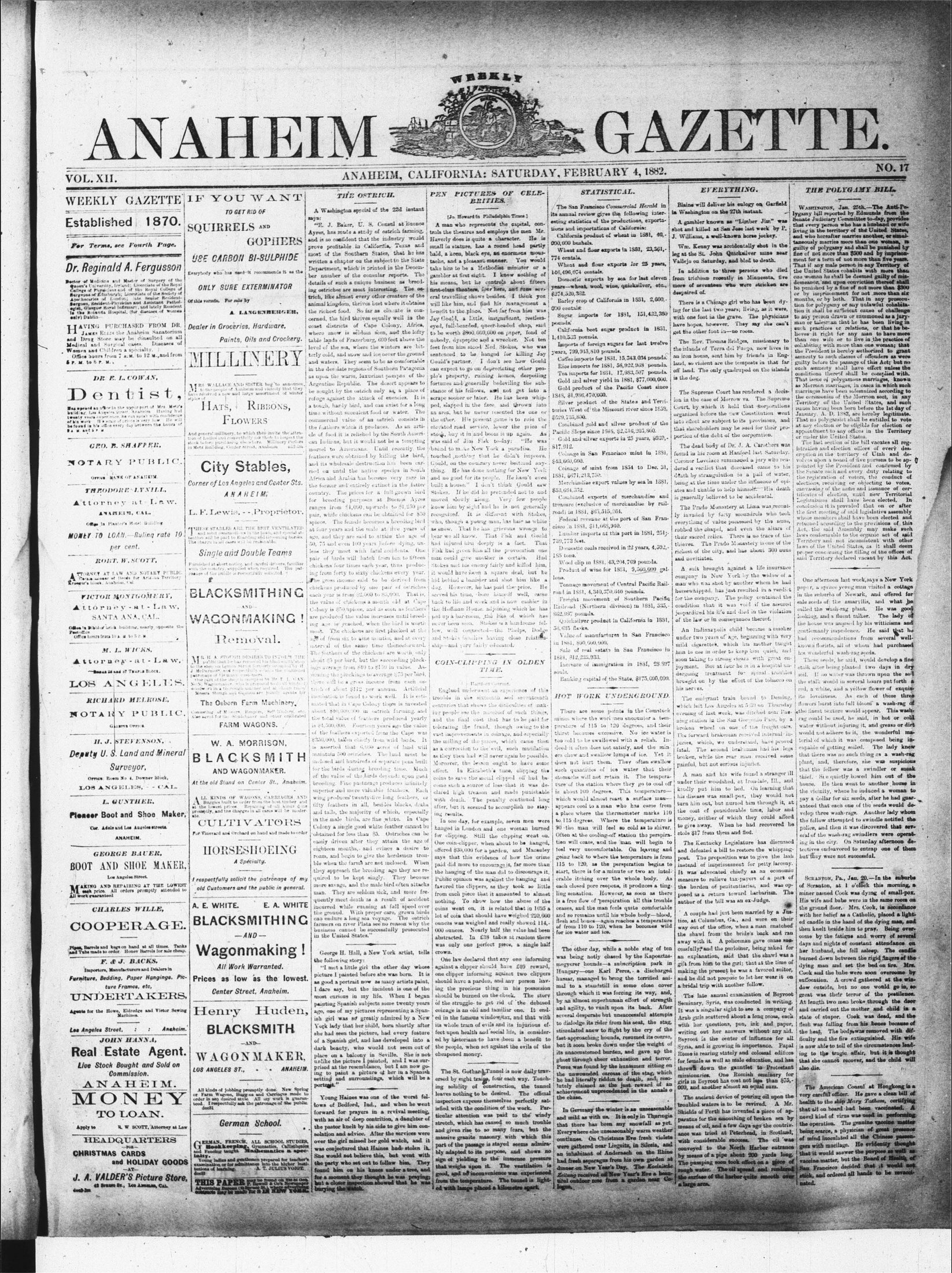
Searchable text
ANAHEIM
VOL. XII.
WEEKLY GAZETTE
Established 1870.
For Terms, see Fourth Page.
Dr. Reginald A. Fergusson
Doctor of Medicine and Master of Surgery of the Queen's University, Ireland; Licentiate of the Royal College of Physicians and of the Royal College of Surgeons of Edinburgh; Licentiate of the Society of Aphecaries of London; Late Senior Resident-Surgeon, Resident-Physician and Assistant Pathologist, Glasgow Royal Infirmary; and lately Resident in the Rotunda Hospital (for diseases of women only) Dublin.
HAVING PURCHASED FROM DR. JAMES ELLIS the Anaheim Sanatorium and Drug Store may be consulted on all Medical and Surgical cases. Diseases of Women and Children a specialty. Office hours from 7 a.m. to 12 p.m., and from 5 p.m. to 6 p.m.
DR. E. L. COWAN,
Dentist,
Has opened an office in the upper part of Mrs. Mette's building, Los Angeles street Anaheim. Having had twenty years experience, he can assist with confidence of his work. He is a member of or very low. He will be found in his office every day between the hours of 9 a.m. and 6 p.m.
GEO. B. SHAFFER,
NOTARY PUBLIC.
IF YOU WANT TO GET RID OF SQUIRRELS AND GOPHERS USE CARBON BI-SULPHIDE
Everybody who has used it recommends it as the ONLY SURE EXTERMINATOR
Of this vermin. For sale by A. LANGENBERGER,
Dealer in Groceries, Hardware,
Paints, Oils and Crockery.
MILLINERY
MRS WALLACE AND SISTER beg to announce, to the people of Anaheim and vicinity that they have received a new and large assortment of winter styles of HATS, RIBEONS, FLOWERS
And general millinery, to which they invite the attention of Ladies and respectfully ask those to inspect the stock before purchasing elsewhere. Millinery Parlors in Metz Building, Confer Street, Anaheim 612-3m
City Stables,
DR. E. L. COWAN,
Dentist,
Has opened an office in the upper part of Mrs. Metz's building, Los Angeles street Anaheim. Having had twenty years experience he can aply with confidence of his work. He amide of crimes is very low. He will be found in his office every day between the hours of 8 a.m and 4 p.m.
GEO. B. SHAFFER,
NOTARY PUBLIC.
OFFICE MANK OF ANAHEIM.
THEODORE LYNILL,
Attorney at Law,
ANAHEIM, CAL.
Office in Planter's Hotel Building
MONEY TO LOAN.—Ruling rate 10 per cent.
ROBT. W. SCOTT.
ATTORNEY AT LAW AND NOTARY PUBLIC. Ceramics mason of Doods for Arizona Territory Kroeger's block, Anaheim, Cal.
VICTOR MONTGOMERY,
Attorney-at-Law,
SANTA ANA, CAL.
Office in Bible of brick building, nearly opposite the Postoffice.
Office hours from 10 a.m to 3 p.m.
M. L. WICKS,
Attorney-at-Law,
Bronx and of Trouble Block.
LOS ANGELES.
RICHARD MELROSE,
NOTARY PUBLIC.
Galley Office.
H. J. STEVENSON,
Deputy U. S. Land and Mineral Surveyor,
Office: Room No. 4, Downev Block,
LOS ANGELES, - CAL.
L. GUNTHER.
Pioneer Boot and Shoe Maker,
Cur. Adole and Los Angeles streets.
ANAHEIM.
GEORGE BAUER,
BOOT AND SHOE MAKER,
Los Angeles Street.
MAKING AND REPAIRING AT THE LOWEST cash price. All orders promptly attended to all work guaranteed.
MRS. WALLACE AND SISTER beg to announce, to the people of Anaheim and vicinity that they have received a new and large assortment of winter styles of HATS, RIBBONS, FLOWERS
And general millinery, to which they invite the attention of Ladies and respectfully ask them to inspect the stock before purchasing elsewhere. Millinery Parlors in Metz Building, Center Street, Anaheim n1234m
City Stables,
Corner of Los Angeles and Center Sts.
ANAHEIM.
L. F. Lewis, -- Proprietor.
THESE STABLES ARE THE BEST VENTILATED and most commodious in the town, and special attention will be paid to Boarding and Grooming borders. The charge in all cases will be reasonable.
Single and Double Teams
Furnished at short notice, and careful drivers, familiar with the country, supplied when required. The pat-tenance of the public is respectfully solicited.
BLACKSMITHING
AND
WAGONMAKING!
Removal.
MR. H. STOUGH DESIRES TO INFORM THE public that he has removed his blacksmith's shop to the shop on Lagoon Street formerly occupied by J. Melvermont, and respectfully solicits the continued patronage of the many customers.
One part of the shop is occupied by Mr. F. L. GAN-NON, Wagonmaker who is prepared to all kinds of woodwork in a thorough manner and at cheap rates. Monera Stough and Gagon are jointly agents for The Osborn Farm Machinery.
Consisting of Mowers, Reapers, Self-drivers, etc., also agent for the Schleicher and other celebrated FARM WAGONS.
W. A. MORRISON,
BLACKSMITH
AND WAGONMAKER.
At the old Stand on Center St., Anaheim.
ALL KINDS OF WAGONS, CARRIAGES AND Buggies built to order from the best timber and at the lowest prices. Repairing of all kinds done promptly, and the charges in all cases will be moderate.
CULTIVATORS
For Vineyard and Orchard on hand and made to order
HORSESHOEING
A Specialty.
I respectfully solicit the patronage of my old Customers and the public in general.
as upon the warm Argentine Republic be sought by the cottage against the tough, hardly birt time without succ commercial value the feathers which clef of food it is re can Indians, but in momel to America feathers were obtai and its wholesale ried on until the Africa and Arabia the former and en country. The pri for breeding pu ranges from $1,00 pair, while chickens apiece. The fem at four years and age, and they are 50, 75 and even less they meet w pair of birds will chickens four tim ing from forty to forty. The gross income chickens produce each year is from the value of chick Colony is $50 spi are produced ther age is reach most. The chick age of from six to interval of the The feathers of th about $5 per bird ages average from staining the pluck there will be a gr trich of about $1 incubation is found mated that in Car about $40,000;00 the total value o is $4,500,000. F or of the feathers o $350,000,taken is asserted that maintain 500 octen closed and hum for the birds dur of the value of th breeding. Fine superior and mo wing produces'th fifty feathers in tails,the ma in the male bird Colony a single g obtained for less easily driven af eighteen month roam,and begin able when the far they approach th quired to be k more savage,and man. They are
L. GUNTHER.
Pioneer Boot and Shoe Maker,
Our. Adele and Los Angeles streets.
ANAHEIM.
GEORGE BAUER,
BOOT AND SHOE MAKER,
Los Angeles Street.
Making and Repairing at the Lowest
each price. All orders promptly attended to
All work guaranteed.
CHARLES WILLE,
COOPERAGE.
Plates, Barrels and kegs on hand at all times. Tanks
and Tube made to order. Honey Barrels for sale cheap.
F. & J. BACKS.
Importers, Manufacturers and Dealers in
Furniture, Bedding, Paper Hangings, Picture Frames, etc,
UNDERTAKERS,
Agents for the Howe, Eldredge and Victor Sewing Machines.
Los Angeles Street.: Anaheim.
JOHN HANNA,
Real Estate Agent.
Live Stock Bought and Sold on Commission.
ANAHEIM.
MONEY TO LOAN.
Apply to R. W SCOTT, Attorney at Law
HEADQUARTERS
FOR CHRISTMAS CARDS
AND HOLIDAY GOODS
ATJ. A. VALDER'S Picture Store,
42 Stratford St., Los Angeles, Cal.
CULTIVATORS
For Vineyard and Orchard on hand and made to order.
HORSESHOEING
A Specialty.
I respectfully solicit the patronage of my old Customers and the public in general.
A. E. WHITE.
E. A. WHITE
BLACKSMITHING
—AND—
Wagonmaking!
All Work Warranted.
Prices as low as the lowest.
Center Street, Anaheim.
Henry Huden,
BLACKSMITH
—AND—
WAGONMAKER,
LOS ANGELES ST., ...ANAHEIM.
All kinds of jobbing promptly done. New Spring or Farm Wagons, Bugges and Carriages made to order in any desired style. All my work is guaranteed. I respectfully ask the patronage of the public.
German School.
GERMAN, FRENCH, ALL SCHOOL STUDIES,
Bookkeeping, Gymnastics, Callisthenics
and Fencing taught Mathematics a specialty.
Young ladies and gentlemen prepared for teacher's examination or for admittance into the higher institutions of learning.
A. T. JULIUS VOIGE.
THIS PAPER may be found on me at Geo.
Advertising Bureau (10 Spruce St.), where advertising companies may be made for it at NEW YORK.
ANAHEIM, CALIFORNIA: SATURDAY, FEBRUARY 4, 1882.
THE OSTRICH.
A Washington special of the 22d instant says:
"E. J. Baker, U. S. Consul at Buenos Ayres, has made a study of ostrich farming, and is so confident that the industry would prove profitable in California, Texas and most of the Southern States, that he has written a chapter on the subject to the State Department, which is printed in the December number of the consular reports. The details of such a unique business as breeding ostriches are most interesting. The ostrich, like almost every other creature of the animal kingdom, thrives best where it obtains the richest food. So far as climate is concerned, the bird thrives equally well in the coast districts of Cape Colony, Africa, where snow is seldom seen, and the lofty table lands of Frazerburg, 600 feet above the level of the sea, where the winters are bitterly cold, and snow and ice cover the ground and waters. They seem to be as comfortable in the desolate regions of Southern Patagonia as upon the warm, luxuriant pampas of the Argentine Republic. The desert appears to be sought by the ostrich only as a place of refuge against the attack of enemies. It is a tough, hardy bird, and can exist for a long time without succulent food or water. The commercial value of an ostrich consists in the feathers which it produces. As an article of food it is relished by the South American Indians, but it would not be a tempting morsel to Americans. Until recently the feathers were obtained by killing the bird, and its wholesale destruction has been carried on until the native species in South America."
PEN PICTURES OF CELEBRITIES.
[Jo. Howard in Philadelphia Times.]
A man who represents the capital, controls the theatres and employs the men Mr. Haverly does is quite a character. He is small in stature, has a round head partly bald, a keen, black eye, an enormous moustache, and a pleasant manner. You would take him to be a Methodist minister or a gambler at first sight. I know nothing of his means, but he controls about fifteen first-class剧院s four here, and runs several travelling shows besides. I think you will like him, and find his management a benefit to the place. Not far from him was Jay Gould, a little insignificant, restless-eyed, full-bearded, queer-headed chap, said to be worth $800,000,000 on paper, fond of nobody, dyspeptic and a wrecker. Not ten feet from him stood Ned Stokes, who was sentenced to be hanged for killing Jay Gould's partner. I don't see how Gould can expect to go on depreciating other people's property, ruining homes, despoiling fortunes and generally beievilling the substance of his fellows, and not get into a scrape sooner or later. He has been whipped, slapped in the face and thrown into an area, but he never resented the one or the other. His present game is to roin the elevated road service, lower the price of stock; buy it in and boom it up again. As was said of Jim Fisk today: "He was bound to make New York a paradise. He touched nothing that he didn't improve. Could, on the contrary never bettered anything. He has done nothing for New York."
STATISTICAL.
The San Francisco Commercial Herald in its annual review gives the following interesting statistics of the productions, exportations and importations of California:
California product of wheat in 1881, 40,-000,000 bushels.
Wheat and flour exports in 1881, 23,561,-774 centals.
Domestic exports by sea for last eleven years—wheat, wool, wine, quicksilver, etc., $274,520,382.
Barley crop of California in 1881, 2,600,-000 cents.
Sugar imports for 1881, 151,432,360 pounds.
California best sugar product in 1881, 1,410,533 pounds.
Imports of foreign sugars for last twelve years, 799,915,810 pounds.
Coffee imports for 1881, 15,343,034 pounds.
Rice imports for 1881, 56,922,968 pounds.
Tea imports for 1881, 17,983,507 pounds.
Gold and silver yield in 1881,$77,000,000.
Gold product of the Pacific Coast since 1848,$1,986,470,000.
Silver product of the States and Territories West of the Missouri river since 1853,$529,735,800.
Combined gold and silver product of the Pacific Slope since 1848,$2,516,205,860.
Gold and silver exports in 25 years,$920,-817,912.
Collage in San Francisco mint in 1881,$43,660,600.
Collage of mint from 1854 to Dec. 31,
$6671,-759.
as upon the warm, luxuriant pampus of the Argentine Republic. The desert appears to be sought by the ostrich only as a place of refuge against the attack of enemies. It is a tough, hardly bird, and can exist for a long time without succulent food or water. The commercial value of an ostrich consists in the feathers which it produces. As an article of food it is relished by the South American Indians, but it would not be a tempting morsel to Americans. Until recently the feathers were obtained by killing the bird, and its wholesale destruction has been carried on until the native species in South Africa and Arabia has become very rare in the former and entirely extinct in the latter country. The prices for a full grown bird for breeding purposes at Buenos Aires ranges from $1,000 upwards to $1,250 per pair, while chickens can be obtained for $50 apiece. The female becomes a breeding bird at four years and the male at five years of age, and they are said to attain the age of 50, 75 and even 100 years before dying, unless they meet with fatal accidents. One pair of birds will hatch from ten to fifteen chickens four times each year, thus producing from forty to sixty chickens every year. The gross income said to be derived from chickens produced by one pair of ostriches each year is from $2,000 to $8,000. That is, the value of chickens a month old at Cape Colony is $50 apiece, and as soon as feathers are produced the value increases until breeding age is reached, when the bird is worth most. The chickens are first plucked at the age of six to nine months, and at every interval of the same time theneerforward. The feathers of the chickens are worth only about $5 per bird, but the succeeding pluckings average from $49 to $150 in value. Assuming the pluckings to average $75 per bird, there will be a gross income from each ostrich of about $112 per annum. Artificial incubation is found to work well. It is estimated that in Cape Colony these is invested about $40,000,000 in ostrich farming, and the total value of feathers produced yearly is $4,500,000. Fourteen years ago the value of the feathers exported from the Cape was $350,000, taken closely from wild birds. It is asserted that 6,000 acres of land will maintain 500 ostriches. The land must be included and hundreds of separate pens built for the birds during breeding time. Much of the value of the birds depends upon good breeding. Fine pasturage produces infinitely superior and more valuable feathers. Each wing produces twenty-five long feathers, or fifty feathers in all, besides blacks, drabs and tails, the majority of which, especially in the male birds, are fine white. In Cape Colony a single good white feather cannot be obtained for less than $5. Ostriches can be easily driven after they attain the age of eighteen months, and evince a desire to roam, and begin to give the herdsmen trouble when the farms are not inclosed. When they approach the breeding age they are required to be kept singly. They become more savage, and the male bird often attacks man. They are seldom sick, and more frequently meet death as a result of accident.
COIN-CLIPPING IN OLDEN TIME.
England underwent an experience of this troubles in the sixteenth and seventeenth centuries that shows the difficulties of making people see the mischief of such things, and the final cost that has to be paid for tolerating the fraud, though owing to the vast improvements in coinage, and especially the milling of the pieces, which came then as a correction to the evil, such mutilation as they then had will never again be possible. Moreover, the lesson ought to have some effect. In Elizabeth's time, clipping the coins to save the metal clipped off had become such a source of loss—that it was declared high treason and made punishable with death. The penalty continued long after, but it seemed to accomplish no staying results.
In one day, for example, seven men were hanged in London and one woman burned for clipping. Still the clipping weat on One coin-clipper, when about to be hanged, offered $30,000 for a parden, and Macauley says that this evidence of how the crime paid did more to encourage it, far more than the hanging of the man did to discourage it. Public opinion was against the hanging and favored the clippers, as they took so little from each piece that it amounted to almost people's property, ruining homes, despoiling fortunes and generally bedevilting the substance of his fellows, and not get into a scrape sooner or later. He has been whipped, slapped in the face, and thrown into an area, but he never resented the one or other. His present game is to role the elevated road service, lower the price of stock, buy it in and boom it up again. As was said of Jim Fisk today: "He was bound to make New York a paradise. He touched nothing that he didn't improve. Could, on the contrary never bettered anything. He has done nothing for New York and no good for its people. He hasn't even built a house." I don't think Gould saw Stokes. If he did he pretended not to and moved slowly along. Very few people know him by sight and he is not generally recognized. It is different with Stokes who, though a young man, has hair as white as snow. That he has grievous wrongs to hear we all know. That Fisk and Gould had injured him deeply is a fact. That Fisk had given him all the provocation one man could give another is certain. Had Stokes met his enemy fairly and killed him, it would have been a square deal, but he hid behind a banister and shot him like a dog. However, he has paid the price. He served his time, bore himself well, came back to life and work and is now cashier in the Hoffman House. adjoining which he has put up a bar-room; this like of which has never been seen. Stokes is a handsome fellow, well connected—the Phelps, Dodge and Stokes families having close relationship—and very fairly educated.
HOT WORK UNDERGROUND.
There are some points in the Comstock mines where the worm neuer encounter a temperature of 115 to 120 degrees, and their thirst becomes excessive. No ice water is too cold to be swallowed with a relish. Indeed it often does not satisfy, and the miners chew and swallow lumps of ice. Yet it does not hurt them. They often swallow such quantities of ice water that their stomachs will not retain it. The temperature of the station where they go to cool off is about 100 degrees. This temperature—which would almost roast a surface man—appears cool to a man who has come from a place where the thermometer marks 110 to 115 degrees. Where the temperature is 90—the man will feel so cold as to shiver. Often at the cooling-off station the perspiration will cease, and the man will begin to feel very uncomfortable. On leaving and going back to where the temperature is from 115 to 120, as the perspiration begins to start, there is for a minute or two an intolerable itching over the whole body. As each closed pore reopens, it produces a tingling sensation. However, as soon as there
George H. Hall, a New York artist, tells the following story:
"I met a little girl the other day whose picture I painted before she was born. It is as good a portrait now as many artists paint, I dare say, but the incident is one of the most curious in my life. When I began painting Spanish subjects some twenty years ago, one of my pictures representing a Spanish girl was so greatly admired by a New York lady that her child, born shortly after she had seen the picture, had every feature of a Spanish girl, and has developed into a dark beauty, who would not seem out of place on a balcony in Seville. She is not unlike the picture I painted, and I was surprised at the resemblance, but I am now going to paint a picture of her in a Spanish setting and surroundings, which will be a portrait."
Young Haines was one of the worst fellows of Bedford, Ind., and when he went forward for prayers in a revival meeting, with an air of deep contrition, a daughter of the pastor knelt by his side to give him consolation and advice. After the services were over the girl missed her gold watch, and it was conjectured that Haines had stolen it. She would not believe this, but went with the party who set out to follow him. They found him on his knees under a tree, and for a moment they thought he was praying; but a closer inspection showed that he was burying the watch.
The penalty continued long after, but it seemed to accomplish no staying results.
In one day, for example, seven men were hanged in London and one woman burned for clipping. Still the chipping weat on. One coin-clipped, when about to be hanged, offered $30,000 for a pardon, and Macauley says that this evidence of how the crime paid did more to encourage it, far more than the hanging of the man did to discourage it. Public opinion was against the hanging and favored the clippers, as they took so little from each piece that it amounted to almost nothing. To show how the abuse of the coins went on, it is related that in 1695 a lot of coin that should have weighed 220,000 ounces was weighed and really showed 114,000 ounces. Nearly half the value had been abstracted. In £38 taken at random there was only one perfect piece, a single half crown.
One law declared that any one informing against a clipper should have £49 reward, one clipper informing against two clippers should have a pardon, and any person having the precious thing in his possession should be burned on the cheek. The story of the struggle to get rid of the debased coinage is an old and familiar one. It ended in the famous windowstax, and that with its whole train of evils and its injurious effect upon health and social life, is considered by historians to have been a benefit to the people, when set against the evils of the cheapened money.
The St. Gothard Tunnel is now daily traversed by eight trains, four each way. Touching solidity of construction, the tunnel leaves nothing to be desired. The official inspectors express themselves perfectly satisfied with the condition of the work. Particular attention was paid to the windy stretch, which has caused so much trouble and given rise to so many fears, but the massive granite masonry with which this part of the passage is stayed seems admirably adapted to its purpose, and shows no sign of yielding to the immense pressure that weighs upon it. The ventilation is good, and no inconvenience was experienced from the temperature. The tunnel is lighted with lamps placed a kilometre apart.
The other day, while a noble stag of ten was being notly chased by the Kaposztasmygerer hounds—a subscription park in Hungary—one Karl Peres, a discharged hussar, managed to bring the terrified animal to a standstill in some close cover through which it was forcing its way, and, by an almost superhuman effort of strength and agility, to vault upon its back. After several desperate but unsuccessful attempts to dislodge its rider from his seat, the stag, stimulated anew to flight by the cry of the fast-approaching hounds, resumed its course, but it soon broke down under the weight of its unaccustomed burden, and gave up the ghost through sheer exhaustion and terror. Peres was found by the huntmen sitting on the unwounded carcass of the stag, which he had literally ridden to death, and resolutely claimed as the just reward of an achievement unprecedented in the annals o the chase.
In Germany the winter is as unseasonable and mild as with us. It is only in Thuringia that there has been any snowfall as yet. Everywhere else unseasonably warm weather continues. On Christmas Eve fresh violets were gathered near Liegnitz, in Silesia, and an inhabitant of Andernach on the Rhine had fresh asparagus from his own garden at dinner on New Year's Day. The Koolnische Zeitung received off New Year's Eve a beautiful outdoor rose from a garden near Cologne.
GAZETTE.
JUARY 4, 1882. NO. 17
STISTICAL.
Missico Commercial Herald in New York gives the following intersection of the productions, exportations of California:
export of wheat in 1881, 40,
exports in 1881, 23,561,
exports for 25 years,
parts by sea for last eleven
col, wine, quicksilver, etc.
California in 1881, 2,600,
sugar product in 1831,
design sugars for last twelve
pounds.
For 1831, 15,343,034 pounds.
For 1881, 56,922,968 pounds.
For 1831, 17,983,507 pounds.
Yield in 1881, $77,000,000.
of the Pacific Coast since
1800.
of the States and Territhe Missouri river since 1858.
and silver product of the
receipts in 25 years, $920,
Francisco mint in 1881,
from 1854 to Dec. 31,
EVERYTHING.
Blaine will deliver his eulogy on Garfield
in Washington on the 27th instant.
A gambler known as "Limber Jim" was
shot and killed at San Jose last week by P.
J. Williams, a well-known horse jockey.
Wm. Kenny was accidentally shot in the
leg at the St. John Quicksilver mine near
Vallejo on Saturday, and bled to death.
In addition to three persons who died
from trichium recently in Minnesota, five
more of seventeen who were stricken are
despaired of.
There is a Chicago girl who has been dying
for the last two years; living, as it were,
with one foot in the grave. The physicians
have hopes, however. They say she can't
get the other foot in—no room.
The Rev. Thomas Bridges, missionary to
the islands of Terra del Fuego, now lives in
an iron house, sent him by friends in Englaland, so violent are the tempests in that far
off land. The only quadruped on the islands
is the dog.
The Supreme Court has rendered a decision in the case of Morrow vs. The Supreme
Court, by which it held that corporations
organized before the new Constitution went
into effect are subject to its provisions,
and that shareholders may be sued for their proportion of the debt of the corporation.
The dead body of Dr. J. A. Carothers was
found in his room at Hanford last Saturday.
Coroner Leviace summoned a jury who rended a verdict that deceased came to his death by strangulation in a rail of water.
THE POLYGAMY BILL.
WASHINGTON, Jan. 25th.—The Anti-Polygamy bill reported by Edmunds from the Senate Judiciary Committee to-day provides that every person who has a husband or wife living in the territory of the United States,
and who hereafter marries another, or simultaneously marries more than one woman, is guilty of polygamy and shall be punished by fine of not more than $500 and by imprisonment for a term of not more than five years.
That if any male person in any Territory of
the United States cohabits with more than one woman he shall be deemed guilty of misdemeanor, and upon conviction thereof shall be punished by a fine of not more than $300 or by imprisonment for not more than six months, or by both. That in any prosecution for polygamy or any unlawful cohabitation it shall be sufficient cause of challenge to any person drawn or summoned as a juryman or talisman that he has been living in such practices or relations, or that he believes it right for any man to have more than one wife or to live in the practice of cohabiting with more than one woman; that the President is hereby authorized to grant amnesty to such classes of offenders as were guilty before the passage of this Act; but no such amnesty shall have effect unless the conditions thereof shall be complied with. That issue of polygamous marriages, known as Mormon marriages, in cases in which such marriages have been solumnized according to the ceremonies of the Mormon sect, in any Territory of the United States, and such issues having been born before the 1st day of January, A. D. 1883, are hereby legitimate. That no polygamist shall be entitled to vote at any election or be eligible for election or appointment to any offices in the Territory or under the United States.
The last section of the bill vacates all registration and election offices of every description in the territory of Utah and devotes upon a board of five persons to be appointed by the President and confirmed by the Senate each and every duty relating to
The Supreme Court has rendered a decision in the case of Morrow va. The Supreme Court, by which it held that corporations organized before the new Constitution went into effect are subject to its provisions, and that shareholders may be sued for their proportion of the debt of the corporation.
The dead body of Dr. J. A. Carothers was found in his room at Hanford last Saturday. Coroner Lovelace summoned a jury who rendered a verdict that deceased came to his death by strangulation in a pail of water, being at the time under the influence of opiates and unable to help himself. His death is generally believed to be accidental.
The Prado Monastery at Lima was recently invaded by forty secondirds who took everything of value possessed by the nuns, robbed the chapel, and even the altars of their sacred relics. There is no trace of the thieves. The Prado Monastery is one of the richest of the city, and has about 300 nuns and novitiates.
A suit brought against a life insurance company in New York by the widow of a man who was shot by another whom he had horsewhipped, has just resulted in a verdict for the company. The policy contained the condition that it was void if the assured jeopardized his life and died in the violation of the law or in consequence thereof.
An Indianapolis child became a smoker under two years of age, beginning with very mild cigarettes, which his mother taught him to use in order to keep him quiet, and soon taking to strong cigars with great enjoyment. But at four he is in a hospital undergoing treatment for spinal troubles brought on by the effect of the tobacco on his nerves.
The emigrant train bound to Deming, which left Los Angeles at 5:39 on Thursday evening of last week, was ditched near Pasing station in the San Gorgonio Pass, by a broken wheel on one of the freight cars. The forward brakeman received internal injuries, which we understand, have proved fatal. The second brakeman had his legs broken, while the rear man received some painful, but not serious injuries.
A man and his wife found a stranger ill under their woodshed, at Irondale, Ill., and kindly put him to bed. On learning that his disease was small-pox, they would not turn him out, but nursed him through it, at the cost of considerable time, labor and money, neither of which they could afford to give away. When he had recovered he stole $17 from them and fled.
The Kentucky Legislature has discussed and defeated a bill to restore the whipping-post. The proposition was to give the lash instead of imprisonment for petty larceny. It was advocated chiefly as an economic measure to relieve tax-payers of a part of the burden of penitentiaries, and was opposed as a return toward barbarism. The conditions therein shall be compiled with that issue of polygamous marriages, known as Mormon marriages, in cases in which such marriages have been solemnized according to the ceremonies of the Mormon sect, in any Territory of the United States, and such issues having been born before the last day of January. A. D. 1882, are hereby legitimate. That no polygenist shall be entitled to vote at any election or be eligible for election or appointment to any offices in the Territory or under the United States.
The last section of the bill vacates all registration and election offices of every description in the territory of Utah and devolves upon a board of five persons to be appointed by the President and confirmed by the Senate each and every duty relating to the registration of votes, the conduct of elections, receiving or objecting to votes, canvassing of the same and issuance of certificates of election, until new Territorial Registrators shall have been elected. In conclusion it is provided that on or after the first meeting of said legislative assembly whose members shall have been elected and returned according to the provisions of this Act, the said Assembly may make such laws comfortable to the organic act of said Territory and not inconsistent with other laws of the United States, as it shall deem proper concerning the filling of the offices of said Territory declared vacant by this Act.
One afternoon last week, says a New York paper, a spruce young man visited a cottage in the suburbs of Newark, and offered for sale seeds of the amaryllis, and what he called the wash-rag plant. He was good looking, and a fluent talker. The lady of the house was amused by his witticisms and gentleness impudence. He said that he had recommendations from several well-known florists, all of whom had purchased his wonderful wash-rag seeds.
These seeds, he said, would develop a fine stalk after being planted two days in dry soil. If no water was thrown upon the soil the stalk would in several hours put forth a red, a white, and a yellow flower of exquisite loveliness. As each of these three flowers burst into full bloom a wash-rag of the finest texture would appear. This wash-rag could be used, he said, in hot or cold water without injuring it, and grease or dirt would not adhere to it, the wonderful material of which it was composed being incapable of getting soiled. The lady knew that there was no such thing as a wash-rag plant, and therefore, she was suspicious that the fellow was a swindler or snake thief. She quietly bowed him out of the house. He then went to another house in the vicinity, where he induced a woman to pay a dollar for six seeds, after he had guaranteed that each one of the seeds would develop three wash-rags. Another lady whom the fellow attempted to swindle notified the police, and then it was discovered that several of the wash-rag swindlers were operating in the city. On Saturday afternoon detectives endeavored to entrap one of them but they were not successful.
SCRANTON, Pa., Jan. 20.—In the suburbs of Scranton, at 1 o'clock this morning, a miner named Cook was dying of small-pox.
The Kentucky Legislature has discussed and defeated a bill to restore the whipping-post. The proposition was to give the lash instead of imprisonment for petty larceny. It was advocated chiefly as an economic measure to relieve tax-payers of a part of the burden of penitentiaries, and was opposed as a return toward barbarism. The author of the bill was an ex-Judge.
A couple had just been married by a Justice, at Columbus, Ga., and were on their way out of the office, when a man snatched the shawl from the bride's back and ran away with it. A policeman gave chase successfully, and the purloiner, being asked for an explanation, said that the shawl was a gift from him to the girl; that at the time of making the present he was a favored suitor, and he did not propose to let her wear it on a bridal trip with another fellow.
The late annual examination of Beyroot Seminary, Syria, was conducted in writing. It was a singular sight to see a company of Arab girls scattered about a long room, each with her questions, pen, ink and paper, writing out her answers without any aid. Beyroot is the center of influence for all Syria, and is growing in importance. Papal Rome is rearing stately and colossal edifices for females as well as male education, and has thrown down the gauntlet to Protestant missionaries. One Romish seminary for girls in Beyroot has cost not less than $75,-000, and another almost an equal sum.
The ancient device of pouring oil upon the troubled waters is to be revived. A Mr. Shields of Perth has invented a piece of apparatus for the smoothing of broken sea by means of oil, and a few days ago the contrivance was tried at Peterhead, in Scotland, with considerable success. The oil was conveyed to the North Harbor entrance by means of a pipe about 200 yards long. The pumping soon took effect on a piece of rough water. The oil spread and rendered the surface of the harbor quite smooth over a large area.
Scranton, Pa., Jan. 20.—In the suburbs of Scranton, at 1 o'clock this morning, a miner named Cook was dying of small-pox. His wife and babe were in the same room on the ground floor. Mrs. Cook, in accordance with her belief as a Catholic, placed a lighted candle in the hand of the dying man, and then knelt beside him to pray. Being overcome by the fatigue and worry of several days and nights of constant attendance on her husband, she fell asleep. The candle burned down between the rigid fingers of the dying man and set the bed on fire. Mrs. Cook and the babe were soon overcome by suffocation. A crowd gathered at the window outside, but no one would go in, so great was their terror of the pestilence. At length two men broke through the door and carried out the mother and child in a state of stupor. Cook was dead, and the flesh was falling from his bones because of the heat. The body was removed with difficulty and the fire extinguished. His wife is now able to toll of the circumstances leading to the tragic affair, but it is thought that she cannot recover, and the child will also die.
The American Consul at Hongkong is a very careful officer. He gave a clean bill of health to the ship Mary Tatham, certifying that all on board had been vaccinated. A novel kind of virus was used in performing the operation. The genuine vaccine matter being scarce, a physician of great presence of mind inoculated all the Chinese passengers with mucilage. He evidently thought that it would answer the purpose as well as vaccine matter, but the Board of Health of San Francisco decided that it would not stick, and ordered all hands to be invacciated.