anaheim-gazette 1882-01-21
Scanned page
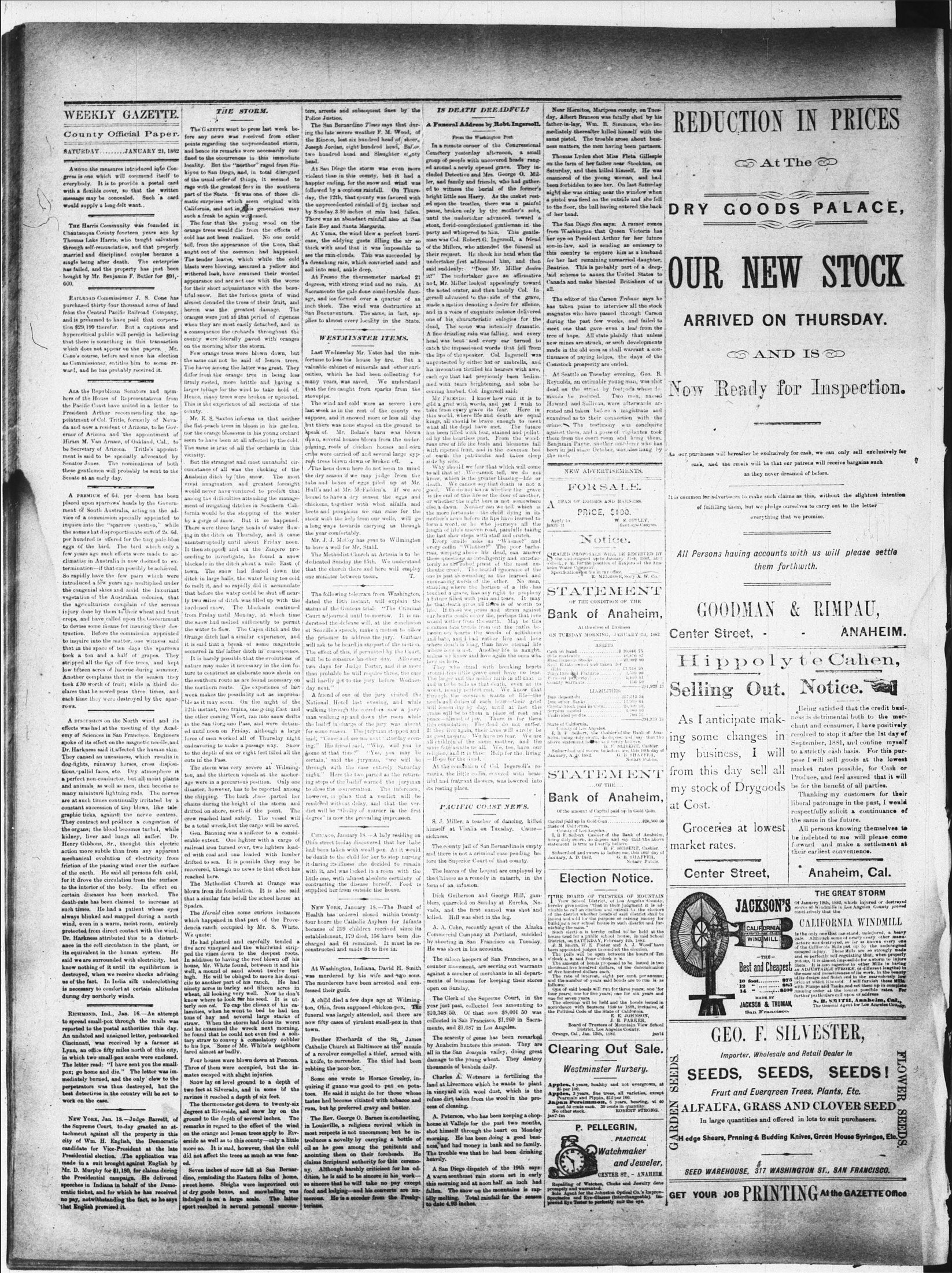
Searchable text
WEEKLY GAZETTE.
County Official Paper.
SATURDAY...JANUARY 21, 1882
Among the measures introduced into Congress is one which will commend itself to everybody. It is to provide a postal card with a flexible cover, so that the written message may be concealed. Such a card would supply a long-felt want.
The Harris Community was founded in Chautauqua County fourteen years ago by Thomas Lake Harris, who taught salvation through self-renunciation, and that properly married and disciplined couples became a single being after death. The enterprise has failed, and the property has just been bought by Mr. Benjamin F. Butler for $91,000.
Railroad Commissioner J. S. Cone has purchased thirty-four thousand acres of land from the Central Pacific Railroad Company, and is presumed to have paid that corporation $29,199 therefor. But a captions and hypercritical public will persist in believing that there is something in this transaction which does not appear on the papers. Mr. Cone's course, before and since his election as Commissioner, entitles him to some reward, and he has probably received it.
All the Republican Senators and members of the House of Representatives from the Pacific Coast have united in a letter to President Arthur recommending the appointment of Col. Tritle, formerly of Nevada and now a resident of Arizona, to be Governor of Arizona and the appointment of Hiram M. Van Arnain, of Oakland, Cal., to be Secretary of Arizona. Tritle's appointment is said to be specially advocated by Senator Jones. The nominations of both these gentlemen will probably be sent to the
THE STORM.
The Gazette went to press last week before any news was received from other points regarding the unprecedented storm, and hence its remarks were necessarily confined to the occurrences in this immediate locality. But the "norther" raged from Siskiyou to San Diego, and, in total disregard of the usual order of things, it seemed to rage with the greatest fury in the southern part of the State. It was one of those climatic surprises which seem original with California, and not in this generation may such a freak be again witnessed.
The fear that the young wood on the orange trees would die from the effects of cold has not been realized. No one could tell, from the appearance of the trees, that aught out of the common had happened. The tender leaves, which while the cold blasts were blowing, assumed a yellow and withered look, have resumed their wonted appearance and are not one whit the worse for their short acquaintance with the beautiful snow. But the furious gusts of wind almost denuded the trees of their fruit, and herein was the greatest damage. The oranges were just at that period of ripeness when they are most easily detached, and as a consequence the orchards throughout the county were literally paved with oranges on the morning after the storm.
Few orange trees were blown down, but the same can not be said of lemon trees. The havoc among the latter was great. They differ from the orange tree in being less firmly rooted, more brittle and having a larger tobage for the wind to take hold of. Hence, many trees were broken or uprooted. This is the experience of all sections of the county.
Mr. E. S. Saxton informs us that neither the flat-peach trees in bloom in his garden nor the orange blossoms in his young orchard seem to have been at all affected by the cold. The same is true of all the orchards in this vicinity.
But the strangest and most unnatural circumstance of all was the choking of the
ters, arrests and sundry Police Justice.
The San Bernardino ing the late severe fire at the Rincon, lost six Joseph Jordan, eight two hundred head head.
At San Diego they violent than in this happier ending, for followed by a copio day, the 12th, that the unprecedented by Sunday 3:30 inch There was an abun Luis Rey and Santa
At Yuma, the wild cane, the eddying thick with sand that see the rain-clouds. A drenching rain, wet soil into mud, ankle
At Fresno the t degrees, with strong Sacramento the gal age, and ice formed inch thick. The w San Buenaventura applies to almost every
A PREMIUM of 6d. per dozen has been placed upon sparrows' heads by the Government of South Australia, acting on the advice of a commission specially appointed to inquire into the "sparrow question," while the somewhat disproportionate sum of 2a. 6d. per hundred is offered for the tiny pale-blue eggs of the bird. The bird which only a few years ago such efforts were made to acclimatize in Australia is now doomed to extermination—if that can possibly be achieved. So rapidly have the few pairs which were introduced a few years ago multiplied under the congenial skies and amid the luxuriant vegetation of the Australian colonies, that the agriculturists complain of the serious injury done by them to their wheat and fruit crops, and have called upon the Government to devise some means for insuring their destruction. Before the commission appointed to inquire into the matter, one witness said that in the space of ten days the sparrows took a ton and a half of grapes. They stripped all the figs off five trees, and kept low fifteen acres of lucerne during summer. Another complains that in the season they took £30 worth of fruit; while a third declares that he sowed peas three times, and each time they were destroyed by the sparrows.
A DISCUSSION on the North wind and its effects was had at the meeting of the Academy of Sciences in San Francisco. Engineers spoke of its effect on the magnetic needle, and Dr. Harkness said it affected the human skin. They caused an uneasiness, which results in dog-fights, runaway horses, cross dispositions, pallid faces, etc. Dry atmosphere is a perfect non-conductor, but all moist plants and animals, as well as men, then become so many miniature lightning rods. The nerves are at such times continually irritated by a constant succession of tiny blows, like telegraphic ticks, against the nerve centres. They contract and produce a congestion of the organs; the blood becomes turbid, while kidney, liver and lungs all suffer. Dr. Henry Gibbons, Sr., thought this electric action more subtle than from any apparent mechanical evolution of electricity from friction of the passing wind over the surface of the earth. He said all persons felt cold, for it drove the circulation from the surface to the interior of the body. Its effect on certain diseases has been marked. The differ from the orange tree in being less firmly rooted, more brittle and having a larger toilage for the wind to take hold of. Hence, many trees were broken or uprooted. This is the experience of all sections of the county.
Mr. E. S. Saxton informs us that neither the flat-peach trees in bloom in his garden nor the orange blossoms in his young orchard seem to have been at all affected by the cold. The same is true of all the orchards in this vicinity.
But the strangest and most unnatural circumstance of all was the choking of the Anaheim ditch by the snow. The most vivid imagination and greatest foresight would never have ventured to predict that among the difficulties attending the management of irrigating ditches in Southern California would be the stopping of the water by a gorge of snow. But it so happened. There were three large heads of water flowing in the ditch on Thursday, and it came uninterruptedly until about Friday noon. It then stopped, and on the Zanjero proceeding to investigate, he found a snow blockade in the ditch about a mile East of town. The snow had floated down the ditch in large balls, the water being too cold to melt it, and so rapidly did it accumulate that before the water could be shut off nearly two miles of ditch was filled up with the hardened snow. The blockade continued from Friday until Monday, at which time the snow had melted sufficiently to permit the water to flow. The Cajon ditch and the Orange ditch had a similar experience, and it is said that a break of some magnitude occurred in the latter ditch in consequence.
It is barely possible that the evolutions of nature may make it necessary in the dim future to construct as elaborate snow sheds on the southern route as are found necessary on the northern route. The experience of last week makes the possibility not as improbable as it may seem. On the night of the 12th instant, two trains, one going East and the other coming West, ran into snow drifts in the San Gorgonio Pass, and were detained until noon on Friday, although a large force of men worked all of Thursday night endeavoring to make a passage way. Snow to the depth of six or eight feet filled all the cuts in the Pass.
The storm was very severe at Wilmington, and the thirteen vessels at the anchorage were in a precarious position. Only one disaster, however, has to be reported among the shipping. The bark Amie parted her chains during the height of the storm and drifted on shore, north of the point. The crew reached land safely. The vessel will be a total wreck, but the cargo will be saved.
Gen. Banning was a sufferer to a considerable extent. One lighter with a cargo of railroad iron turned over, two lighters loaded with coal and one loaded with lumber drifted to sea. It is possible they may be recovered, though no news to that effect has reached here.
The Methodist Church at Orange was blown from its foundation. It is also said that a similar fate befell the school house at different sites from where he was born taken with death to the child it during its illness with it, and was lost little one, with almost contracting the diarrhea supplied her from one oily place.
The following telegram dated the 19th instant status of the Guite Court adjourned undertoldthe defense of Scoville's speechthe prisoner to ask to be heard.The effect of this, it will be to consume two days for Judgment than probable he will hardly get to day next."
A friend of one National Hotel walking through this man walking up and downthe bailiff in charge for some reason.Teal said,"Come and seeing."His friend soon come at that time certainly,said therethrough withthe night."Here there being stops ofthe bailiffto closethe convergencehowever,inplainrenderedwithoutdietwillbe"Guilty degree"isnowthe
are at such times continually irritated by a constant succession of tiny blows, like telegraphic ticks, against the nerve centres. They contract and produce a congestion of the organs; the blood becomes turbid, while kidney, liver and lungs all suffer. Dr. Henry Gibbons, Sr., thought this electric action more subtle than from any apparent mechanical evolution of electricity from friction of the passing wind over the surface of the earth. He said all persons felt cold, for it drove the circulation from the surface to the interior of the body. Its effect on certain diseases has been marked. The death-rate has been claimed to increase at such times. He had a patient whose eyes always blinked and snapped during a north wind, even in a warm, moist room, entirely protected from direct contact with the wind. Dr. Harkness attributed this to a disturbance in the cell circulation in the plant, or its equivalent in the human system. He said we are surrounded with electricity, but know nothing of it until its equilibrium is destroyed, when we receive shocks advising us of the fact. In India silk underclothing is necessary to comfort at certain altitudes during dry northerly winds.
Richmond, Ind., Jan. 16.—An attempt to spread small-pox through the mails was reported to the postal authorities this day. An undated and unsigned letter, postmarked Cincinnati, was received by a farmer at Lynn, an office fifty miles north of this city, in which two small-pox scabs were enclosed. The letter read: "I have sent you the small-pox; go home and die." The letter was immediately burned, and the only clew to the perpetrators was thus destroyed, but the best detectives in the country will be set to work on the case.
New York, Jan. 18.—Judge Barrett, of the Supreme Court, to-day granted an attachment against all the property in this city of Wm. H. English, the Democratic candidate for Vice-President at the late Presidential election. The application was made in a suit brought against English by Mr. D. Murphy for $1,180, for claims during the Presidential campaign. He delivered speeches in Indiana in behalf of the Democratic ticket, and for which he has received no pay, notwithstanding the fact, as he says that English promised it.
Gen. Banning was a sufferer to a considerable extent. One lighter with a cargo of railroad iron turned over, two lighters loaded with coal and one loaded with lumber drifted to sea. It is possible they may be recovered, though no news to that effect has reached here.
The Methodist Church at Orange was blown from its foundation. It is also said that a similar fate befell the school house at Spadra.
The Herald cites some curious instances which happened in that part of the Providence ranch occupied by Mr. S. White. We quote:
He had planted and carefully tended a five acre vineyard and the whirlwind stripped the vines down to the deepest roots. In addition to having the roof blown off his house, Mr. White found, between it and his well, a mound of sand about twelve feet high. He will be obliged to move his domicile to another part of his ranch. He had ninety acres in barley and fifteen acres in wheat, all looking very well. Now he don't know where to look for his seed. It is utterly non edt.
To cap the climax of his calamities, when he went to bed he had ten tons of hay and several large stacks of straw. When the storm had done its worst and he examined the wreck next morning, he found that he could not even find a solitary straw to convey a consolatory cobbler to his lips. Some of Mr. White's neighbors fared almost as badly.
Four houses were blown down at Pomona. Three of them were occupied, but the inmates escaped with shight injuries.
Snow lay on level ground to a depth of two feet at Silverado, and in some of the ravines it reached a depth of six feet.
The thermometer got down to twenty-six degrees at Riverside, and snow lay on the ground to the depth of several inches. The remarks in regard to the effect of the wind on the orange and lemon trees apply to Riverside as well as to this county—only a little more so. It is said, however, that the cold did not affect the trees as much as was feared.
Seven inches of snow fell at San Bernardino, reminding the Eastern folks of home, sweet home. Sleighs were improvised out of dry goods boxes, and snowballing was indulged in on a large scale. The latter sport resulted in several personal encounters during the height of the storm and drifted on shore, north of the point. The crew reached land safely. The vessel will be a total wreck, but the cargo will be saved.
Gen. Banning was a sufferer to a considerable extent. One lighter with a cargo of railroad iron turned over, two lighters loaded with coal and one loaded with lumber drifted to sea. It is possible they may be recovered, though no news to that effect has reached here.
The Methodist Church at Orange was blown from its foundation. It is also said that a similar fate befell the school house at Spadra.
The Herald cites some curious instances which happened in that part of the Providence ranch occupied by Mr. S. White. We quote:
He had planted and carefully tended a five acre vineyard and the whirlwind stripped the vines down to the deepest roots. In addition to having the roof blown off his house, Mr. White found, between it and his well, a mound of sand about twelve feet high. He will be obliged to move his domicile to another part of his ranch. He had ninety acres in barley and fifteen acres in wheat, all looking very well. Now he don't know where to look for his seed. It is utterly non edt.
To cap the climax of his calamities, when he went to bed he had ten tons of hay and several large stacks of straw. When the storm had done its worst and he examined the wreck next morning, he found that he could not even find a solitary straw to convey a consolatory cobbler to his lips. Some of Mr. White's neighbors fared almost as badly.
Four houses were blown down at Pomona. Three of them were occupied, but the inmates escaped with shight injuries.
Snow lay on level ground to a depth of two feet at Silverado, and in some of the ravines it reached a depth of six feet.
The thermometer got down to twenty-six degrees at Riverside, and snow lay on the ground to the depth of several inches. The remarks in regard to the effect of the wind on the orange and lemon trees apply to Riverside as well as to this county—only a little more so. It is said, however, that the cold did not affect the trees as much as was feared.
Seven inches of snow fell at San Bernardino, reminding the Eastern folks of home, sweet home. Sleighs were improvised out of dry goods boxes, and snowballing was indulged in on a large scale. The latter sport resulted in several personal encounters during the height of the storm and drifted on shore, north of the point. The crew reached land safely. The vessel will be a total wreck, but the cargo will be saved.
Gen. Banning was a sufferer to a considerable extent. One lighter with a cargo of railroad iron turned over, two lighters loaded with coal and one loaded with lumber drifted to sea. It is possible they may be recovered, though no news to that effect has reached here.
The Methodist Church at Orange was blown from its foundation. It is also said that a similar fate befell the school house at Spadra.
The Herald cites some curious instances which happened in that part of the Providence ranch occupied by Mr. S. White. We quote:
He had planted and carefully tended a five acre vineyard and the whirlwind stripped the vines down to the deepest roots. In addition to having the roof blown off his house, Mr. White found, between it and his well, a mound of sand about twelve feet high. He will be obliged to move his domicile to another part of his ranch. He had ninety acres in barley and fifteen acres in wheat, all looking very well. Now he don't know where to look for his seed. It is utterly non edt.
To cap the climax of his calamities, when he went to bed he had ten tons of hay and several large stacks of straw. When the storm had done its worst and he examined the wreck next morning, he found that he could not even find a solitary straw to convey a consolatory cobbler to his lips. Some of Mr. White's neighbors fared almost as badly.
Four houses were blown down at Pomona. Three of them were occupied, but the inmates escaped with shight injuries.
Snow lay on level ground to a depth of two feet at Silverado, and in some of the ravines it reached a depth of six feet.
The thermometer got down to twenty-six degrees at Riverside, and snow lay on the ground to the depth of several inches. The remarks in regard to the effect of the wind on the orange and lemon trees apply to Riverside as well as to this county—only a little more so. It is said, however, that the cold did not affect the trees as much as was feared.
Seven inches of snow fell at San Bernardino, reminding the Eastern folks of home, sweet home. Sleighs were improvised out of dry goods boxes, and snowballing was indulged in on a large scale. The latter sport resulted in several personal encounters during the height of the storm and drifted on shore, north of the point. The crew reached land safely. The vessel will be a total wreck, but the cargo will be saved.
Gen. Banning was a sufferer to a considerable extent. One lighter with a cargo of railroad iron turned over, two lighters loaded with coal and one loaded with lumber drifted to sea. It is possible they may be recovered, though no news to that effect has reached here.
The Methodist Church at Orange was blown from its foundation. It is also said that a similar fate befell the school house at Spadra.
The Herald cites some curious instances which happened in that part of the Providence ranch occupied by Mr. S. White. We quote:
He had planted and carefully tended a five acre vineyard and the whirlwind stripped the vines down to the deepest roots. In addition to having the roof blown off his house, Mr. White found, between it and his well, a mound of sand about twelve feet high. He will be obliged to move his domicile to another part of his ranch. He had ninety acres in barley and fifteen acres in wheat, all looking very well. Now he doesn't know where to look for his seed. It is utterly non edt.
To cap the climax of his calamities, when he went to bed he had ten tons of hay and several large stacks of straw. When the storm had done its worst and he examined the wreck next morning, he found that he could not even find a solitary straw to convey a consolatory cobbler to his lips. Some of Mr. White's neighbors fared almost as badly.
Four houses were blown down at Pomona. Three of them were occupied, but the inmates escaped with shight injuries.
Snow lay on level ground to a depth of two feet at Silverado, and in some of the ravines it reached a depth of six feet.
The thermometer got down to twenty-six degrees at Riverside, and snow lay on the ground to the depth of several inches. The remarks in regard to the effect of the wind on the orange and lemon trees apply to Riverside as well as to this county—only a little more so. It is said, however, that the cold did not affect the trees as much as was feared.
Seven inches of snow fell at San Bernardino, reminding the Eastern folks of home, sweet home. Sleighs were improvised out of dry goods boxes, and snowballing was indulged in on a large scale. The latter sport resulted in several personal encounters during the height of the storm and drifted on shore, north of the point. The crew reached land safely. The vessel will be a total wreck, but the cargo will be saved.
Gen. Banning was a sufferer to a considerable extent. One lighter with a cargo of railroad iron turned over, two lighters loaded with coal and one loaded with lumber drifted to sea. It is possible they may be recovered, though no news to that effect has reached here.
The Methodist Church at Orange was blown from its foundation. It is also said that a similar fate befell the school house at Spadra.
The Herald cites some curious instances which happened in that part of the Providence ranch occupied by Mr. S. White. We quote:
He had planted and carefully tended a five acre vineyard and the whirlwind stripped the vines down to the deepest roots. In addition to having the roof blown off his house, Mr. White found, between it and his well, a mound of sand about twelve feet high. He will be obliged to move his domicile to another part of his ranch. He had ninety acres in barley and fifteen acres in wheat, all looking very well. Now he doesn't know where to look for his seed. It is utterly non edt.
To cap the climax of his calamities, when he went to bed he had ten tons of hay and several large stacks of straw. When the storm had done its worst and he examined the wreck next morning, he found that he could not even find a solitary straw to convey a consolatory cobbler to his lips. Some of Mr. White's neighbors fared almost as badly.
Four houses were blown down at Pomona. Three of them were occupied, but the inmates escaped with shight injuries.
Snow lay on level ground to a depth of two feet at Silverado, and in some of the ravines it reached a depth of six feet.
The thermometer got down to twenty-six degrees at Riverside, and snow lay on the ground to the depth of several inches. The remarks in regard to the effect of the wind onthe orange and lemon trees apply to Riverside as well as to this county—only a little more so. It is said,however,thatthe cold did not affectthetreesasmuchasfeared.
Seven inches of snow fell at San Bernardino,remindingtheEasternfolksofhome,sweethome.Sleighswereimprovisedoutofdrygoodsboxes,and雪balllingwasindulgedinonalargescale.Thelatterspartresultedinseveralpersonalencountersduringtheheightofthestormanddriftedonshore,northofthepoint.Thecrewreachedlandsafely.Thecrewwillbeatotalwreckbutthecargowillbewarded.Achildmostrespectisnottoproducea noveltyoilashegoesamaintainingthemeliascripturalany.Althoughharsditiesheissaidtoso sincerethathewfoodandlodging—simmerous.Hewissaidsextterianans。
ters, arrests and subsequent fines by the Police Justice.
The San Bernardino Times says that during the late severe weather F. M. Wool, of the Rincon, lost six hundred head of sheep, Joseph Jordan, eight hundred head, Ballou two hundred head and Slaughter eighty head.
At San Diego the storm was even more violent than in this county, but it had a happier ending, for the snow and wind was followed by a copious rainfall. On Thursday, the 12th, that county was favored with the unprecedented rainfall of 2½ inches and by Sunday 3.80 inches of rain had fallen. There was an abundant rainfall also at San Luis Rey and Santa Margarita.
At Yuma, the wind blew a perfect hurricane, the eddying gusts filling the air so thick with sand that it was impossible to see the rain-clouds. This was succeeded by a drenching rain, which converted sand and soil into mud, ankle deep.
At Fresno the thermometer marked 21 degrees, with strong wind and no rain. At Sacramento the gale done considerable damage, and ice formed over a quarter of an inch thick. The wind was destructive at San Buenaventura. The same, in fact, applies to almost every locality in the State.
WESTMINSTER ITEMS.
Last Wednesday Mr. Yates had the misfortune to lose his house by fire. But a valuable cabinet of minerals and other curiosities, which he had been collecting for many years, was saved. We understand that the fire caught from sparks from the stovepipe.
The wind and cold were as severe here last week as in the rest of the county we suppose, and it snowed more or less all day but there was none stayed on the ground to speak of. Mr. Bolan's barn was blown down, several houses blown from the underpinning, roofs of chicken houses and corn cribs were carried off and several large cypress trees blown down or broken off.
The hens down here do not seem to mind the danger if we were here from the Police Justice.
IS DEATH DREADFUL?
A Funeral Address by Robt. Ingersoll.
From the Washington Post.
In a remote corner of the Congressional Cemetery yesterday afternoon, a small group of people with uncovered heads ranged around a newly opened grave. They included Detective and Mrs. George O. Miller, and family and friends, who had gathered to witness the burial of the former's bright little son Harry. As the casket rested upon the trestles, there was a painful pause, broken only by the mother's sobs, until the undertaker advanced toward a stout, florid-complexioned gentleman in the party and whispered to him. This gentleman was Col. Robert G. Ingersoll, a friend of the Millers, who attended the funeral at their request. He shook his head when the undertaker first addressed him, and then said suddenly: "Does Mr. Miller desire it?" The undertaker gave an affirmative nod, Mr. Miller looked appealingly toward the noted orator, and then hastily Col. Ingersoll advanced to the side of the grave, made a motion denoting a desire for silence, and in a voice of exquisite cadence delivered one of his characteristic eulogies for the dead. The scene was intensely dramatic. A fine drizzling rain was falling, and every head was bent and every ear turned to catch the impassioned words that fell from the lips of the speaker. Col. Ingersoll was unprotected by either hat or umbrella, and his invocation tarried his hearers with awe, each eye that had previously been bedimmed with tears brightening, and sobs becoming hushed. Col. Ingersoll said:
MY FRIENDS: I know how vain it is to gild a grief with words, and yet I wish to take from every grave its fear. Here in this world, where life and death are equal kings, all should be brave enough to meet what all the dead have met. The future has been filled with fear, stained and polluted by the heartless past. From the wondrous tree of life the buds and blossoms fall with ripened fruit, and in the common bed of earth the patriarchs and babes sleep side by side.
Why should we fear that which will come to all that is? We cannot tell, we do not Near Hornitos, Mariposa county, on Tuesday, Albert Branson was fatally shot by his father-in-law, Wm. B. Simmons, who immediately thereafter killed himself with the same pistol. The trouble arose about business matters, the men having been partners.
Thomas Lyden shot Miss Fleta Gillespie on the farm of her father near Stockton, on Saturday, and then killed himself. He was enamored of the young woman, and had been forbidden to see her. On last Saturday night she was sitting near the window when a pistol was fired on the outside and she fell to the floor, the ball having entered the back of her head.
The San Diego Sun says: A rumor comes from Washington that Queen Victoria has her eye on President Arthur for her future son-in-law, and is sending an emissary to this country to capture him as a husband for her last remaining unmarried daughter, Beatrice. This is probably part of a deep-laid scheme to annex the United States to Canada and make blarsted Britishers of us all.
The editor of the Carson Tribune says he has taken pains to interview all the stock magnates who have passed through Carson during the past few weeks, and failed to meet one that gave even a leaf from the tree of hope. All state plainly that unless new mines are struck, or such developments made in the old ones as shall warrant a continuance of paying lefdes, the days of the Comstock prosperity are ended.
At Seattle on Tuesday evening, Geo. R. Reynolds, an estimable young man, was shot dead on the street by footpads whose demands he resisted. Two men named Howard and Sullivan were afterwards arrested and taken before a magistrate and examined as to their connection with the crime. The testimony was conclusive against them, and a pose of vigilantes took them from the court room and hung them. Benjamin Payne another murderer who has been in jail since October, was also hung by the mob.
NEW ADVERTISEMENTS.
The wind and cold were as severe here last week as in the rest of the county we suppose, and it snowed more or less all day but there was none stayed on the ground to speak of. Mr. Bolan's barn was blown down, several houses blown from the underpinning, roofs of chicken houses and corn cribs were carried off and several large cypress trees blown down or broken off.
The hens down here do not seem to mind the dry season if we may judge from the tubs and boxes of eggs piled up at Mr. Hull's and at Mr. McFadden's. If we are bound to have a dry season the eggs and chickens, together with what alfalfa and beets and pumpkins we can raise for the stock with the help from our wells, will go a long way towards carrying us through the year comfortably.
Mr. J. J. McCoy has gone to Wilmington to bore a well for Mr. Stahl.
The Methodist Church at Artesia is to be dedicated Sunday the 15th. We understand that the church there and here will employ one minister between them.
The following telegram from Washington, dated the 18th instant, will explain the status of the Guiteau trial: "The Criminal Court adjourned until to-morrow. It is understood the defense will, at the conclusion of Scoville's speech, make a motion to allow the prisoner to address the jury." Guiteau will ask to be heard in support of the motion. The effect of this, if permitted by the Court, will be to consume another day. Allowing two days for Judge Porter, and it is more than probable he will require three, the case will hardly get to the jury before Wednesday next."
A friend of one of the jury visited the National Hotel last evening, and while walking through the corridors saw a juryman walking up and down the room while the bulldozer in charge of the jury was absent for some reason. The juryman stopped and said, "Come and see me next Saturday evening." His friend said, "Why, will you be come at that time?" "Yes, you may be certain," said the juryman, "we will be through with the case entirely Saturday night." Here the two parted as the returning stops of the bailiff warned the juryman to close the conversation. The inference, however, is plain that a verdict will be rendered without delay, and that the verdict will be "Guilty of murder in the first degree" is now the prevailing impression.
Chicago, January 18. — A lady residing on Ohio street to-day discovered that her babe had been taken with small-pox. As it would be death to the child for her to stop nursing it during its illness she decided to remain with it, and was locked in a room with the little one, with almost absolute certainty of contracting the disease herself. Food is supplied her from outside the house.
My friends I know how vain it is to gild a grief with words, and yet I wish to take from every grave its fear. Here in this world, where life and death are equal kings, all should be brave enough to meet what all the dead have met. The future has been filled with fear, stained and polluted by the heartless past. From the wondrous tree of life the beads and blossoms fall with ripened fruit, and in the common bed of earth the patriarchs and babes sleep side by side.
Why should we fear that which will come to all that is? We cannot tell, we do not know, which is the greater blessing—life or death. We cannot say that death is not a good. We do not know whether the grave is the end of this life or the door of another, or whether the night here is not somewhere else a dawn. Neither can we tell which is the more fortunate—the child dying in its mother's arms before its lips have learned to form a word, or he who journeys all the length of life's unseen road, painfully taking the last slow steps with staff and crutch.
Every cradle asks us "Whence?" and every coffin "Whither?" The poor barbarian, weeping above his dead, can answer these questions intelligently and satisfactorily as the robed priest of the most authentic creed. The fearful ignorance of the one is just as counseling as the learned and unmeant words of the other. No man, standing where the horizon of a life has touched a grave, has any right to prophecy a future filled with pain and tears. It may be that death gives all there is of worth to life. If those we press and strain against our hearts could never die, perhaps that love would wander from the earth. May be this common fate trends from out the paths between our hearts the weeds of selfishness and hate, and I had rather live and love where death is king, than have eternal life where love is not. Another life is naught, unless we know and love again the ones who have us here.
They who stand with breaking hearts around this little grave need have no fear. The larger and the milder faith in all that is and is to be tells us that death, even at its worst, is only perfect rest. We know that through the common wants of life—the needs and duties of each hour—their grief will leasen day by day, until at last this gravel will be to them a place of rest and peace—almost of joy. There is for them this consolation: The dead do not suffer. If they live again their lives will surely be as good as ours. We have no tear. We are all children of the same mother, and the same fate awaits us all. We too, have our religion, and it is thus: Help for the living—Hope for the dead.
At the conclusion of Col. Ingersoll's remarks, the little collin, covered with beautiful fragrant flowers, was lowered into its resting place.
PACIFIC COAST NEWS.
S. J. Miller, a teacher of dancing, killed himself at Visalia on Tuesday, Cause—sickness.
The county jail of San Bernardino is empty and there is not a criminal case pending before the Superior Court of that county.
The leaves of the Loquat are employed by the Chinese as a remedy in catarrh, in the form of an infusion.
Dick Guiberson and George Hill, gam-
At Seattle on Tuesday evening, Goo B. Reynolds, an estimable young man, was shot dead on the street by footpads whose demands he resisted. Two men named Howard and Sullivan, wore afterwards arrested and taken before a magistrate and examined as to their connection with the crime. The testimony was conclusive against them, and a pose of vigilantes took them from the court room and hung them. Benjamin Payne, another murderer who has been in jail since October, was also hung by the mob.
NEW ADVERTISEMENTS.
FOR SALE.
A SPAN OF HORSES AND HARNESS.
PRICE, $100.
W E SUPPLY,
Santiago Canyon.
Notice.
SEALED PROPOSALS WILL BE RECEIVED BY THE UNDERGROUND UP TO JANUARY 21st, 1882, AT 3 O'clock P.M., FOR THE POSITION OF ZANJERO OF THE ANAHEIM WATER COMPANY.
Specification on file in my office.
R. MELROSE, Secy A.W.Co.
STATEMENT OF THE CONDITION OF THE Bank of Anaheim,
At the close of Business ON TUESDAY MORNING, JANUARY 3d, 1882
ASSETS.
Cash on hand.....$ 10,946 75
Bills receivable.....$ 10,476 87
Miscellaneous Stocks.....$ 22,002 90
Real Estate owned and taken for debt.....$ 11,248 29
Furniture and Fixtures.....$ 3,509 90
Personal property.....$ 1,400 81
County warrants.....$ 106 50
LIABILITIES.....$ 912,920 13
Due depositors.....$ 357,312 34
Due other Banks.....$ 13,000 64
Capital Stock paid in Coin.....$ 20,000 60
Surplus capital.....$ 4,000 90
Unidified profits.....$ 706 15
State of California.......$ 912,920 13
County of Los Angeles.....
I. R. F. Sebert; Cashier of the Bank of Anaheim being daily sworn; do depose and say that the above statement is true as I verily believe.
R. F. Sebert; Cashier.
Subserviced and sworn to before me this 10th day of January,A.D.1882
G.B.SHAFFER,
Notary Public.
Election Notice.
THE BOARD OF TRUSTEES OF MOUNTAIN
CHICAGO, January 18. — A lady residing on Ohio street to-day discovered that her babe had been taken with small-pox. As it would be death to the child for her to stop nursing it during its illness she decided to remain with it, and was locked in a room with the little one, with almost absolute certainty of contracting the disease herself. Food is supplied her from outside the house.
NEW YORK, January 18. — The Board of Health has ordered closed within twenty-four hours the Catholic Asylum for Infants because of 399 children received since its establishment, 179 died, 156 have been discharged and 64 remained. It must be reconstructed and made fit to live in.
At Washington, Indiana, David H. Smith was murdered by his wife and sons. The murderers have been arrested and confessed their guilt.
A child died a few days ago at Wilmington, Ohio, from supposed chicken-pox. The funeral was largely attended, and there are now fifty cases of virulent small-pox in that town.
Brother Eberhardt of the St. James Catholic Church at Baltimore at the muzzle of a revolver compelled a thief, armed with a knife, to surrender. The thief had been robbing the poor-box.
Some one wrote to Horace Greeley, inquiring if guano was good to put on potatoes. He said it might do tor those whose tastes had become vitiated with tobacco and rum, but he preferred gravy and butter.
The Rev. George O. Barnes is conducting, in Louisville, a religious revival which in most respects is not uncommon; but he introduces a novelty by carrying a bottle of oil as he goes among the penitents and anointing them on their foreheads. He claims Scriptural authority for this ceremony. Although harshly criticised for his oddities, he is said to be sincere in his work—so sincere that he will take no pay except food and lodging—and his converts are numerous. He is a seceder from the Presbyterians.
PACIFIC COAST NEWS.
S. J. Miller, a teacher of dancing, killed himself at Visalia on Tuesday. Cause—sickness.
The county jail of San Bernardino is empty and there is not a criminal case pending before the Superior Court of that county.
The leaves of the Loquat are employed by the Chinese as a remedy in catarrh, in the form of an infusion.
Dick Guiberson and George Hill, gamblers, quarreled on Sunday at Eureka, Nevada, and the first named was shot and killed. Hill was shot in the leg.
A. A. Cohn, recently agent of the Alaska Commercial Company at Portland, suicided by shooting in San Francisco on Tuesday. He was short in his accounts.
The saloon keepers of San Francisco, as a counter movement, are serving out warrants against a number of merchants in all departments of business for keeping their stores open on Sunday.
The Clerk of the Supreme Court, in the year just past, collected fees amounting to $10,348 50. Of that sum $8,001 50 was collected in San Francisco, $1,260 in Sacramento, and $1,087 in Los Angeles.
The scarcity of geese has been remarked by Anaheim hunters this season. They are all in the San Joaquin valley, doing great damage to the young wheat. They destroy thousands of bushels daily.
Charles A. Wetmore is fertilizing the land at Livermore which he wants to plant in vineyard with wool dust, which is the refuse dirt taken from the wool in the process of cleaning.
A. Peterson, who has been keeping a chap-house at Vallejo for the past two months, shot himself through the heart on Monday morning. He has been doing a good business, and had money in bank and no family. The trouble was that he had been drinking heavily.
A San Diego dispatch of the 19th says: A warm southeast rain storm set in early this morning and at noon half an inch had fallen. The snow on the mountains is rapidly melting. Total rainfall for the season to date 4.93 inches.
Election Notice.
THE BOARD OF TRUSTEES OF MOUNTAIN View School District, of Los Angeles County, hereby give notice "that in their judgment it is advisable to call an election and submit to the electors of the district whether bonds of said district shall be issued and sold for the purpose of raising money for building a new school house in such district and furnishing the same."
Such election is hereby called to be held at the house used for a public school house, in said School District, on SATURDAY, February 4th, 1882.
J. M. Smith, W. E. Foster and A. J. Wood have been appointed judges to conduct the election.
The polls will be open between the hours of Ten o'clock A.M. and Four o'clock P.M.
The amount of bonds proposed to be issued is two thousand five hundred dollars, of the denomination of five hundred dollars each.
The rate of interest, eight per cent per annum; and the number of years said bonds are to run is as follows:
One of said bonds will run for three years; one for four years; one for five years; one for six years and one for seven years.
The election will be held and the bonds issued in accordance with Seasons 1889 to 1888, inclusive, of the Political Code of the State of California.
E. E. JOHNSON,
J. B. PARKER,
Board of Trustees of Mountain View School District, Los Angeles County.
Orange Cal., Jan. 13th, 1882
Clearing Out Sale.
Westminster Nursery.
Apples, 4 years, healthy and not overgrown, at $5 per 100.
Apples, 3 years, fine trees, all varieties except Pearmain and Pippin, $12 per 100.
Japan Persimmon, 6 years, bearing, at 40 and 50 cents each. 30 cents in quantity.
No other stock.
ROBERT STRONG.
jan7-1m
P. PELLEGRIN,
PRACTICAL Watchmaker and Jeweler,
CENTER ST., - ANAHEIM.
Repairing of Watches, Clocks and Jewelry done promptly and warranted.
Sole Agent for the Johnston Optical Co.'s Improved Spectacles and Eye-Glasses (Interchangeable). Improved Eye Tester to perfectly suit the eye.
REDUCTION IN PRICES
At The
DRY GOODS PALACE,
OUR NEW STOCK
ARRIVED ON THURSDAY.
AND IS
Now Ready for Inspection.
As our purchases will hereafter be exclusively for cash, we can only sell exclusively for cash, and the result will be that our patrons will receive bargains such as they never dreamed of before.
Now Ready for Inspection.
As our purchases will hereafter be exclusively for cash, we can only sell exclusively for cash, and the result will be that our patrons will receive bargains such as they never dreamed of before.
It is common for advertisers to make such claims as this, without the slightest intention of fulfilling them, but we pledge ourselves to carry out to the letter everything that we promise.
All Persons having accounts with us will please settle them forthwith.
GOODMAN & RIMPAU,
Center Street, - - ANAHEIM.
Hippolyte Cahen,
Selling Out. Notice.
As I anticipate making some changes in my business, I will from this day sell all my stock of Drygoods at Cost.
Groceries at lowest market rates.
Center Street,
Being satisfied that the credit business is detrimental both to the merchant and consumer, I have positively resolved to stop it after the 1st day of September, 1881, and confine myself to a strictly cash basis. For this purpose I will sell goods at the lowest market rates possible, for Cash or Produce, and feel assured that it will be for the benefit of all parties.
Thanking my customers for their liberal patronage in the past, I would respectfully solicit a continuance of the same in the future.
All persons knowing themselves to be indebted to me will please come forward and make a settlement at their earliest convenience.
Anaheim, Cal.
at Cost.
Groceries at lowest market rates.
Center Street,
Anaheim, Cal.
THE GREAT STORM
Of January 12th, 1882, which injured or destroyed scores of Windmills in Los Angeles County proved conclusively that the
CALIFORNIA WINDMILL
is the only one that can stand, uninjured, a heavy gale. Although some of nearly every other manufacture was destroyed, so far as known one of the California Mills put up by the undersigned escaped injury. These Mills are so strongly made and so perfectly self-regulating that, when properly put up, it is almost impossible for a storm to injure them. It is also superior to other Mills in having an ADJUSTABLE STROKE (4 different lengths) in the ease and robustness of its work, in the beauty of its design and finish and in the marvelously low price at which it is sold. I will furnish these Mills with Pumps and Tanks, and set them up in complete running order at the lowest possible rates. For further particulars call upon or address
S. H. SMITH, Anaheim, Cal., The General Agent for Los Angeles County.
GEO. F. SILVESTER,
Importer, Wholesale and Retail Dealer in
SEEDS, SEEDS, SEEDS!
Fruit and Evergreen Trees, Plants, Ete.
ALFALFA, GRASS AND CLOVER SEED
In large quantities and offered in lots to suit purchasers.
Hedge Shears, Prnning & Budding Knives, Green House Syringes, Ete.
SEED WAREHOUSE, 317 WASHINGTON ST., SAN FRANCISCO.
GET YOUR JOB PRINTING At the GAZETTE Office