anaheim-gazette 1882-01-07
Scanned page
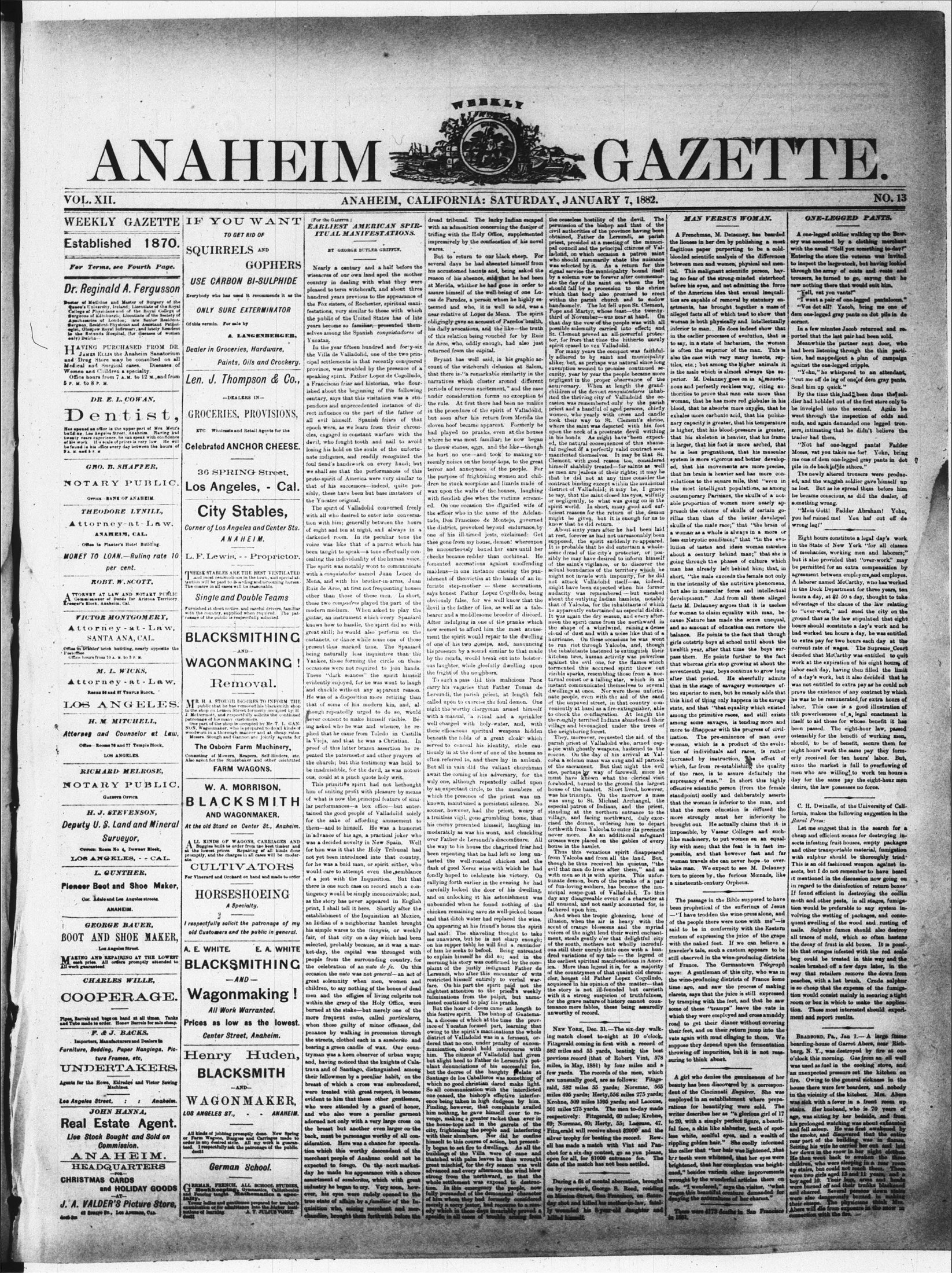
Searchable text
ANAHEIM
VOL. XII.
WEEKLY GAZETTE
Established 1870.
For Terms, see Fourth Page.
Dr. Reginald A. Fergusson
Doctor of Medicine and Master of Surgery of the Queen's University, Ireland; Licentiate of the Royal College of Physicians and of the Royal College of Surgeons of Edinburgh; Licentiate of the Society of Apothecaries of London; Late Senior Resident Surgeon, Resident Physician and Assistant Pathologist, Glasgow Royal Infirmary; and lately Resident in the Rotunda Hospital, (for diseases of women only) Dublin.
HAVING PURCHASED FROM DR. JAMES ELLIS the Anaheim Sanatorium and Drug Store may be consulted on all Medical and Surgical cases. Diseases of Women and Children a specialty.
Office hours from 7 a.m. to 12 m., and from 5 p.m. to 8 p.m.
DR. E. L. COWAN,
Dentist,
Has opened an office in the upper part of Mrs. Metz's building, Los Angeles Street, Anaheim. Having had twenty years experience, he can speak with confidence of his work. If a scale of prices is very low He will be found in his office every day between the hours of 9 a.m. and 5 p.m.
GEO. B. SHAFFER,
IF YOU WANT TO GET RID OF SQUIRRELS AND GOPHERS USE CARBON BI-SULPHIDE
Everybody who has used it recommends it as the ONLY SURE EXTERMINATOR Of this vermin. For sale by A. LANGENBERGER.
Dealer in Groceries, Hardware, Paints, Oils and Crockery.
Len. J. Thompson & Co.,
—DEALERS IN—
GROCERIES, PROVISIONS,
ETC. Wholesale and Retail Agents for the Celebrated ANCHOR CHEESE.
36 SPRING Street.
DR. E. L. COWAN,
Dentist,
Has opened an office in the upper part of Mrs. Met's building, Los Angeles Street, Anaheim. Having had twenty years experience, he can speak with confidence of his work. If a scale of prices is very low, He will be found in his office every day between the hours of 9 a.m. and 8 p.m.
GEO. B. SHAFFER,
NOTARY PUBLIC.
Office—BANK OF ANAHEIM.
THEODORE LYNILL,
Attorney-at-Law,
ANAHEIM, CAL.
Office in Planter's Hotel Building.
MONEY TO LOAN.—Ruling rate 10 per cent.
ROBT. W. SCOTT,
ATTORNEY AT LAW AND NOTARY PUBLIC Commissioner of Dues for Arizona Territory Kreger's Block, Anaheim, Cal.
VICTOR MONTGOMERY,
Attorney-at-Law,
SANTA ANA, CAL.
Office in Dublin brick building, nearly opposite the Postoffice.
Office hours from 10 a.m. to 3 p.m.
M. L. WICKS,
Attorney-at-Law,
Rooms 86 and 87 Temple Block.
LOS ANGELES:
H. M MITCHELL,
Attorney and Counselor at Law,
Office—Rooms 76 and 77 Temple Block.
LOS ANGELES.
RICHARD MELROSE,
NOTARY PUBLIC.
Officer: Room No 4, Downey Block.
LOS ANGELES, - - CAL.
L GUNTHER,
Pioneer Boot and Shoe Maker,
Our Adelaide and Los Angeles streets.
Len. J. Thompson & Co.,
DEALERS INGroceries, Provisions,
ETC. Wholesale and Retail Agents for the
Celebrated Anchor Cheese.
36 SPRING Street.
Los Angeles, - Cal.
City Stables,
Corner of Los Angeles and Center Sts.
ANAHEIM.
L. F. Lewis, - Proprietor.
THESK STABLES ARE THE BEST VENTILATED and most comfortable in the town, and special attention will be paid to boarding and trooming horses. The curve in all cases will be reasonable.
Single and Double Teams
Furnished at short notice, and careful drivers, familiar with the country, supplied when required. The patronage of the public is respectfully solicited.
BLACKSMITHING
AND
WAGONMAKING!
Removal.
MR H A STOUGH DESIRES TO INFORM THE public that he has removed his blacksmith shop to the shop on Leon Street formerly occupied by H. METERMITT, and respectfully solicits the continued patronage of his many customers.
One part of the shop is occupied by Mr. T. L. GANNON, Wagonmaker, who is prepared to do all kinds of woodwork in a thorough manner and at cheap rates. Messrs Stough and Gannon are jointly agents for The Osborn Farm Machinery.
Consisting of Mowers, Reapers, Self Binders, etc. Also agent for the Studebaker and other celebrated FARM WAGONS.
W. A. MORRISON,
BLACKSMITH
AND WAGONMAKER.
At the old Stand on Center St., Anaheim.
ALL KINDS OF WAGONS, CARRIAGES AND Buggies built to order from the best timber and at the lowest prices. Repairing of all kinds done promptly, and the charges in all cases will be moderate.
CULTIVATORS
For Vineyard and Orchard on hand and made to order
HORSESHOEING
The spirit of Val with all who desiretion with him; genius of eight and ten at darkened room. His voice was like tha been taught to spee caling the individua The spirit was nota with a conquistaor Mena, and with his Ruiz de Arce, at this other than those these two compudre modern medium guitar, an instrument knows how to handle great skill; he would castanets, or dance present thus mark being naturally lo Yankee, those form occasions were not These "dark scans evidently enjoyed, and chuckle without He was of a disposs that of some of h though repeatedly y never consent to m ing asked who he w plied that he came la Vieja, and that proof of this latter perted the paternof the church; but tha be inadmissible, for ous, could at a pinne This primitifie shim of uniting prof of what is now the lar performances—tainted the good peo for the sake of them—and to him in advance of his a was a decided novel for him was it that not yet been introduced for he was a bold m would care to attend of a jest with tha there is one such ca tingency would be s
H. J. STEVENSON,
Deputy U. S. Land and Mineral Surveyor,
Orviet: Room No 4, Downey Block,
LOS ANGELES, - - CAL.
L. GUNTHER,
Pleneer Boot and Shoe Maker,
Our Adale and Los Angeles streets.
ANAHEIM.
GEORGE BAUER,
BOOT AND SHOE MAKER,
Los Angeles Street.
MAKING AND REPAIRING AT THE LOWEST
mach prices. All orders promptly attended to
All work guaranteed.
CHARLES WILLE,
COOPERAGE.
Pipes, Barrels and kegs on hand at all times. Tanks
and Tube made to order. Honev Barrels for sale cheap.
F. & J. BACKS.
Importers, Manufacturers and Dealers in
Furniture, Bedding, Paper Hangings, Picture Frames, etc,
UNDERTAKERS,
Agents for the Howe, Eldredge and Victor Sewing Machines.
Los Angeles Street, : Anaheim.
JOHN HANNA,
Real Estate Agent.
Live Stock Bought and Sold on Commission.
ANAHEIM.
HEADQUARTERS
FOR CHRISTMAS CARDS
AND HOLIDAY GOODS
AT
J. A. VALDER'S Picture Store,
62 Brande St., Los Angeles, Ca.
BLACKSMITH
AND WAGONMAKER.
At the old Stand on Center St., Anaheim.
ALL KINDS OF WAGONS, CARRIAGES AND
Buggies built to order from the best timber and
at the lowest prices. Repairing of all kinds done
promptly, and the charges in all cases will be moderate.
CULTIVATORS
For Vineyard and Orchard on hand and made to order
HORSESHOEING
A Specialty.
I respectfully solicit the patronage of my
old Customers and the public in general.
A. E. WHITE.
E. A. WHITE
BLACKSMITHING
— AND —
Wagonmaking!
All Work Warranted.
Prices as low as the lowest.
Center Street, Anaheim.
Henry Huden,
BLACKSMITH
—and —
WAGONMAKER,
LOS ANGELES ST., - - ANAHEIM.
All kinds of jobbing promptly done. New Spring or Farm Wagons, Buggies and Carriages made to order in any desired style. All my work is guaranteed. I respectfully ask the patronage of the public deed1
German School.
GERMAN, FRENCH, ALL SCHOOL STUDIES,
Hookkeeping, Gymnastics, Callisthemis
and Pencing taught Mathematics a specfially.
Young ladies and gentlemen prepared for teacher's examination or for admission into the higher institu-tions of learning.
A. T. JULIUS VOIGT.
ANAHEIM, CALIFORNIA: SATURDAY, JANUARY 7, 1882.
[For the GAZETTE]
EARLIEST AMERICAN SPIRITUAL MANIFESTATIONS.
BY GEORGE BUTLER GRIPFIN.
Nearly a century and a half before the wiseacres of our own land aped the mother country in dealing with what they were pleased to term witchcraft, and about three hundred years previous to the appearance of the Fox sisters, of Rochester, spiritual manifestations, very similar to those with which the public of the United States has of late years become so familiar—presented themselves among the Spanish conquistadores of Yucatan.
In the year fifteen hundred and forty-six the Villa de Valladolid, one of the two principal settlements in that recently conquered province, was troubled by the presence of a speaking spirit. Father Lopez de Cogolludo, a Franciscan friar and historian, who flourished about the beginning of the following century, says that this visitation was a stupendous and unprecedented instance of direct influence on the part of the father of all evil himself. Spanish friars of that epoch were, as we learn from their chronicles, engaged in constant warfare with the devil, who fought tooth and nail to avoid losing his hold on the souls of the unfortunate indigenees, and readily recognized the foul fiend's handiwork on every hand; but we shall see that the performances of this dread tribunal. The lucky Indian escaped with an admonition concerning the danger of trifling with the Holy Office, supplemented impressively by the confiscation of his novel wares.
But to return to our black sheep. For several days he had absented himself from his accustomed haunts and, being asked the reason of his absence, said that he had been at Merida, whither he had gone in order to assure himself of the well-being of one Lucas de Paredes, a person whom he highly esteemed and who, it is well to add, was a near relative of Lopez de Mena. The spirit obligingly gave an account of Paredos' health, his daily avocations, and the like—the truth of this relation being vouched for by Ruiz de Arce, who, oddly enough, had also just returned from the capital.
Bryant has well said, in his graphic account of the witchcraft delusion at Salem, that there is "a remarkable similarity in the narratives which cluster around different periods of nervous excitement," and the case under consideration forms no exception to the rule. At first there had been no malice in the procedure of the spirit of Valladolid, but soon after his return from Merida the cloven hoof became apparent. Formerly he had played no pranks, even at the houses where he was most familiar; he now began to throw stones, eggs, and the like—though he hurt no one—and took to making unseemly noises on the house-tops, to the great terror and annoyance of the people. For the ceaseless hostility of the devil. The permission of the bishop and that of the civil authorities of the province having been obtained, Father de Lersundi, as parish priest, presided at a meeting of the municipal council and the principal citizens of Valladolid, on which occasion a patron saint who should summarily abate the nuisance was selected by it. As a return for this signal service the municipality bound itself by a solemn vow to forever after commemorate the day of the saint on whom the lot should fall by a procession to the shrine which that body also promised to erect within the parish church and to endow handsomely. The lot fell upon St. Clement, Pope and Martyr, whose feast—the twenty-third of November—was near at hand. On that day the vow of the people was with all possible solemnity carried into effect; and St. Clement proved an all-powerful protector, for from that time the hitherto unruly spirit ceased to vex Valladolid.
For many years the compact was faithfully adhered to by saint and municipal alike; but, as perhaps was natural since long exemption seemed to promise continued security, year by year the people became more negligent in the proper observance of the anniversary. When at length the grandchildren of the devout conquistadores inhabited the thriving city of Valladolid the occasion was remembered only by the parish priest and a handful of aged persons, chiefly women, who yearly with cross and candle took their way to St. Clement's shrine, where the saint was depicted with his foot upon the neck of a prostrate devil writhing in his bonds. As might have been expected, the natural consequences of this shameful neglect of a perfectly valid contract soon manifested themselves. It may be that St. Clement, with good reason too, considered himself shabbily treated—for saints as well as men are jealous of their rights; it may be
speaking spirit. Father Lopez de Cogollado, a Franciscan friar and historian, who flourished about the beginning of the following century, says that this visitation was a stupendous and unprecedented instance of direct influence on the part of the father of all evil himself. Spanish friars of that epoch were, as we learn from their chronicles, engaged in constant warfare with the devil, who fought tooth and nail to avoid losing his hold on the souls of the unfortunate indigenes, and readily recognized the foul fiend's handwork on every hand; but we shall see that the performances of this proto-spirit of America were very similar to that of his successors—indeed, quite possibly, these have been but base imitators of the Yucatec original.
The spirit of Valladolid conversed freely with all who desired to enter into conversation with him; generally between the hours of eight and ten at night, and always in a darkened room. In its peculiar tone the voice was like that of a parrot which has been taught to speak—a tone effectually concealing the individuality of the human voice. The spirit was notably wont to communicate with a compuistador named Juan Lopez de Mena, and with his brother-in-arms, Juan Ruiz de Arce, at first not frequenting houses other than those of these men. In short, these two compuistadores played the part of the modern medium. When asked to play the guitar, an instrument which every Spaniard knows how to handle, the spirit did so with great skill; he would also perform on the castanets, or dance while some one of those present thus marked time. The Spaniard being naturally less inquisitive than the Yankee, those forming the circle on these occasions were not required to join hands. These "dark seances" the spirit himself evidently enjoyed, for he was wont to laugh and chuckle without any apparent reason. He was of a disposition more retiring than that of some of his modern kin, and, although repeatedly urged to do so, would never consent to make himself visible. Being asked who he was and whence, he replied that he came from Toledo in Castilla la Vieja, and that he was a Christian. In proof of this latter brazen assertion he repeated the paternoster and other prayers of the church; but this testimony was held to be inadmissible, for the devil, as was notorious, could at a pinch quote holy writ.
This primitivē spirit had not bethought him of uniting profit with pleasure by means of what is now the principal feature of similar performances—a box office—but entertained the good people of Valladolid solely for the sake of affording amusement to them—and to himself. He was a humorist in advance of his age, a practical joker who was a decided novelty in New Spain. Well for him was it that the Holy Tribunal had not yet been introduced into that country, for he was a bold man, or spirit either, who would care to attempt even the semblance of a jest with the Inquisition. But that there is one such case on record such a contingency would be simply inconceivable; and, speaking spirit. Father Lopez de Cogollodo, a Franciscan friar and historian, who flourished about the beginning of the following century, says that this visitation was a stupendous and unprecedented instance of direct influence on the part of the father of all evil himself. Spanish friars of that epoch were, as we learn from their chronicles, engaged in constant warfare with the devil, who fought tooth and nail to avoid losing his hold on the souls of the unfortunate indigenes, and readily recognized the foul fiend's handwork on every hand; but we shall see that the performances of this proto-spirit of America were very similar to that of his successors—indeed, quite possibly, these have been but base imitators of the Yucatec original.
The spirit of Valladolid conversed freely with all who desired to enter into conversation with him; generally between the hours of eight and ten at night, and always in a darkened room. In its peculiar tone the voice was like that of a parrot which has been taught to speak—a tone effectually concealing the individuality of the human voice. The spirit was notably wont to communicate with a compuistador named Juan Lopez de Mena, and with his brother-in-arms, Juan Ruiz de Arce, at first not frequenting houses other than those of these men. In short, these two compuistadores played the part of the modern medium. When asked to play the guitar, an instrument which every Spaniard knows how to handle, the spirit did so with great skill; he would also perform on the castanets, or dance while some one of those present thus marked time. The Spaniard being naturally less inquisitive than the Yankee, those forming the circle on these occasions were not required to join hands. These "dark seances" the spirit himself evidently enjoyed, for he was wont to laugh and chuckle without any apparent reason. He was of a disposition more retiring than that of some of his modern kin, and, although repeatedly urged to do so, would never consent to make himself visible. Being asked who he was and whence, he replied that he came from Toledo in Castilla la Vieja, and that he was a Christian. In proof of this latter brazen assertion he repeated the paternoster and other prayers of the church; but this testimony was held to be inadmissible, for the devil, as was notorious, could at a pinch quote holy writ.
This primitivē spirit had not bethought him of uniting profit with pleasure by means of what is now the principal feature of similar performances—a box office—but entertained the good people of Valladolid solely for the sake of affording amusement to them—and to himself. He was a humorist in advance of his age, a practical joker who was a decided novelty in New Spain. Well for him was it that the Holy Tribunal had not yet been introduced into that country, for he was a bold man, or spirit either, who would care to attempt even the semblance of a jest with the Inquisition. But that there is one such case on record such a contingency would be simply inconceivable; and,
that there is a remarkable similarity in the narratives which cluster around different periods of nervous excitement," and the case under consideration forms no exception to the rule. At first there had been no malice in the procedure of the spirit of Valladolid, but soon after his return from Merida cloven hoof became apparent. Formerly he had played no pranks, even at the houses where he was most familiar; he now began to throw stones, eggs, and the like—though he hurt no one—and took to making uneemly noises on the house-tops, to the great terror and annoyance of the people. For the purpose of frightening women and children he stuck scorpions and lizards made of wax upon the walls of the houses, laughing with fiendish glee when the victims screamed. On one occasion the dignified wife of the officer who in name of the Adelantado, Don Francisco de Montejo, governed the district, provoked beyond endurance, by one of his ill-timed jests, exclaimed: Getthe gone from my house, demon! whereinpon he uncourteously boxed her ears until her cheeks became redder than cochineal. He fomented accusations against unoffending maidens—in one instance causing the punishment of their victim at the hands of an infuriate step-mother — these accusations, says honest Father Lopez Cogolludo, being obviously false, for we well know that the devil is the father of lies, as well as a tale-bearer and a middlesome breeder of discord. After indulging in one of the pranks which now seemed to afford him the most amusement the spirit would repair to the dwelling of one of his two gossips, and, announcing his presence by a sound similar to that made by the cuaca, would break out into boisterous laughter, while gleefully dwelling upon the fright of the neighbors.
To such a pass did this malicious Puck carry his vagaries that Father Tomas de Lersundi, the parish priest, at length felt called upon to exercise the foul demon. One night the worthy clergyman armed himself with a manual, a ritual and a sprinkler well charged with holy-water, and, with these effusive spiritual weapons hidden beneath the folds of a great cloak which served to conceal his identity, stole cautiously in at the door of one of the houses so often referred to, and there lay in ambush. But all in vain did the valiant churchman await the coming of his adversary, for the wily one, although repeatedly called upon by an expectant circle, to the members of which the presence of the priest was unknown, maintains a persistent silence. No sooner, however, had the priest, weary of a truitless vigil, gone grumbling home, than his enemy presented himself, laughing immoderately as was his wont, and chuckling over Father de Lersundi's discomfiture. All the way to his house she chagrined friar had been repenting that he had left so long untasted the well-roasted chicken and the flask of good Xerez wine with which he had fondly hoped to celebrate his victory. On rallying forth earlier in the evening he had carefully locked the door of his dwelling, and on unlocking it his astonishment was curryy year by year the people became more negligent in the proper observance of the anniversary. When at length the grandchildren of the devout conquisidores inhabited the thriving city of Valladolid the occasion was remembered only by the parish priest and a handful of aged persons, chiefly women, who yearly with cross and candle took their way to St. Clement's shrine, where she saint depicted with his foot upon the neck of a prostrate devil writhing in his bonde. As might have been expected, the natural consequences of this shameful neglect of a perfectly valid contract soon manifested themselves. It may be that St. Clement, with good reason too, considered himself shabbily treated—for saints as well as men are jealous of their rights; it may be that he did not at any time consider the contract binding except within the municipal district of Valladolid; it may be I,grieve to say,that the saint closed his eyes,wilfully or negligently,to what was going on in the spirit world. In short, many good and sufficient reasons for the return of the demon might be given,但它 is enough for us to know that they did return.
About sixty years after he had been laid at rest,forever as had not unreasonably been supposed,the spirit suddenly re-apparated. It is probable that he did entertain a wholesome dread of the city's protector,或 possibly he may have desired to inform himself of the saint's vigilance,或 to discover actual boundaries of the territory which he might not invade with impunity,for he did not attack Valladolid itself—as, indeed,might have been expected when his former audacity was remembered—but sneaked about the outlying Indian hamlets,notably that of Yaleoba,for the inhabitants of which he apparently entertained an especial dislike. It was againthe dry season,and every afternoonthe spirit came fromthe northwardinthe shapeofa whirlwind,raisinga dense cloudof dust andwitha noise likethatofa hurricane.On these occasionshe was wontto run riot through Yaleoba,and,thoughthe inhabitants hastened to extinguish their kitchen fires,human activity was powerless againstthe evil one,forthe flameswhich tormentedthis accursed spirit threw outvisible sparks,resembling those froma nocturnal comet ora falling star,which in an instant communicated themselves to several dwellingsat once.Nor were these unfortunatepeople,evenwiththeaidofthe sandofunpaved street,在thatcountry convenientathandasafire-extinguuisher,abletochecktheconflagration.Atlengththe thoroughly terrified Indians abandoned their villageandbivonackedunderthetreesoftheneighboringforest.
They,moreover,therequestedtheaidoftheparish priestofValladolidwho,armedcapa-piewithghostlyweapons,hastenedtotherescue.OnthedayofthisarrivalatYaleobaasolemnmawassungandallpartookofthe sacrament.Butthatnighttheevilone,p perhapsbywayoffarewell,sincehemusthaveknownwhattheclericalvisitforeboded,burnedtothegroundthe largesthouseofthehamlet.Shortlivedhowever,washistriumph.Onthemorrowa masswas sungtoSt.MichaelArchangel,theespeciallypatronofIndians,andtheprieststandingatthenorthern entrancetothevillage,andfacenorthward,dulyexorisedthedom.orderinghimtodepartforthwithfromYaleobaotenteritsprecinctnevermore.Asanadditionalsafeguardcrosseswere placedonthegablesofeveryhouseinthehamlet.
Thusthis vexatious spirit disappearedfromYaleobaandfromalltheland。但thoughhe thus receivedhisquietus,"theevilthatmendo livesafterthem,"andaswithmensoitiswithspirits。这unfortunate demon,bornofthepranksofa pairoffun-loving soldiers,hasbecomethemunicipalscape-goatofValladolid.Tothisdayanydisagreeableeventofacharacterat
of what is now the principal feature of similar performances—a box office—but entertained the good people of Valladolid solely for the sake of affording amusement to them—and to himself. He was a humorist in advance of his age, a practical joker who was a decided novelty in New Spain. Well for him was it that the Holy Tribunal had not yet been introduced into that country, for he was a bold man, or spirit either, who would care to attempt even the semblance of a jest with the Inquisition. But that there is one such case on record such a contingency would be simply inconceivable; and, as the story has never appeared in English print, I shall tell it here. Shortly after the establishment of the Inquisition at Mexico, an Indian of a neighboring hamlet brought his simple wares to the tianguis, or weekly fair, of that city on a day which had been selected, probably because, as it was a market-day, the capital was thronged with people from the surrounding country, for the celebration of an auto de fe. On this occasion the auto was not general—an act of great solemnity when men, women and children, to say nothing of the bones of dead men and the effigies of living culprits not within the grasp of the Holy Office, were burned at the stake—but merely one of the more frequent autos, called particulares, when those guilty of minor offenses did penance by walking in procession through the streets, clothed each in a samberito and bearing a green candle of wax. Our countryman was a keen observer of urban ways; and, having noticed that the knights of Calatrava and of Santiago, distinguished among their fellowmen by a peculiar habit, on the breast of which a cross was embroidered, were treated with great respect, it became evident to him that these other gentlemen, who were attended by a guard of honor, and who also wore a peculiar garment adorned not only with a very large cross on the breast but another even larger on the back, must be personages worthy of all consideration. Here was a chance for speculation which this worthy descendant of the merchant people of Anahuac could not be expected to forego. On the next marketplace he made his appearance with a choice assortment of samberitos, which with great industry he began to cry. Very soon, however, his eyes were rudely opened to the true state of affairs by a familiar of the Inquisition who, seizing merchant and merchandise, brought them forthwith before the known, maintained a persistent silence. No sooner, however, had the priest, weary of a truitless vigil, gone grumbling home, than his enemy presented himself, laughing moderately as was his wont, and chuckling over Father de Lersundi's discomfiture. All the way to his house the chagrined friar had been repenting that he had left so long untasted the well-roasted chicken and the flask of good Xerez wine with which he had fondly hoped to celebrate his victory. On rallying forth earlier in the evening he had carefully locked the door of his dwelling, and on unlocking it his astonishment was unbounded when he found nothing of the chicken remaining save its well-picked bones and that ditch water had replaced the wine. On appearing at his friend's house the spirit had said: The shaveling thought to take me unawares, but he is not sharp enough; on his supper table he will find a reminder of him he seeks to be fool. Being entreated to explain himself he did so; and in the morning his story was confirmed by the complaint of the justly indignant Father de Lersundi, who after this encounter of wits restricted himself entirely to verbal warfare. On his part the spirit paid not the slightest attention to the priest's weekly fulminations from the pulpit, but unmolested continued to play his pranks.
But the hour of doom came at length to this festive spirit. The bishop of Guatemala, a diocese of which at the time the province of Yucatan formed part, learning that owing to the spirit's machinations the whole district of Valladolid was in a ferment, ordered that no one under penalty of excommunication should hold intercourse with him. The citizens of Valladolid had given but alight heed to Father de Lersundi's petulant denunciations of his successful foe, but the decree of the haughty Pelate at Santiago de los Caballeros was something of which no good Christian dared make light. So all communication with the interdicted one ceased, the bishop's effective interference being taken in high dudgeon by him. Finding, however, that complaints availed him nothing, he gave himself over to revenge, making a greater racket than ever in the house-tops and in the garrets of the city, frightening the people and interfering with their alnumbers. Nor did he confine himself to this course of action, but presently began to set fire to dwellings. As all the buildings of the Villa were of cane and thatched with palm leaves he thus wrought great mischief, for the dry season was well advanced and every afternoon the wind blew strong from the northward, so that the whole settlement was exposed to destruction. In this emergency the people, now fully persuaded of the demonessal character of him whom they had formerly considered merely a sorry jester, had recourse to a remedy which in those days invariably proved a specific in all cases of trouble arising from
New York, Dec. 31.—The six-day walking match closed to night at 10 o'clock, Fitzgerald coming in first with a record of 582 miles and 55 yards, beating the best previous record (that of Robert Vint, 578 miles, in May, 1881) by four miles and a few yards. The records of the men, which are unusually good, are as follows: Fitzgerald, 582 miles 55 yards; Noremac, 565 miles 495 yards; Herty, 556 miles 275 yards; Krohne, 509 miles 1595 yards; and Lacouse, 501 miles 275 yards. The men to-day made respectively: Fitzgerald, 60 miles; Krohne, 69; Noremac, 60; Herty, 55; Lacouse, 47. Fitzgerald will receive about $2000 and the silver trophy for beating the record. Rowell has made a match with Vint and Panchoft for a six-day contest, go as you please, open for all, for $1000 entrance fee. The date of the match has not been settled.
During a fit of mental aberration, brought on by overwork, George B. Reed, residing on Mission Street, San Francisco, on Saturday shot and killed his mother-in-law, fatally wounded his 8-year-old daughter and killed himself.
GAZETTE.
JARY 7, 1882. NO. 13
ability of the devil. The bishop and that of the province having been de Lersundi, as parish a meeting of the municipal principal citizens of Valo occasion a patron saint nearly abate the nuisance. As a return for this municipality bound itself to forever after commemoration on whom the lot procession to the shrine also promised to erect church and to endow lot fell upon St. Clement, whose feast—the twenty-nine—was near at hand. On of the people was with all carried into effect; and an all-powerful protec-time the hitherto unruly Valladolid. The compact was faithful-saint and municipal capsa was natural since long to promise continued se-ar the people became more proper observance of the men at length the grand-out conquistadores inhabi-ity of Valladolid the occered only by the parish soul of aged persons, chiefly with cross and candle in St. Clement's shrine, is depicted with his foot prostrate devil writhing might have been expect-sequences of this shame-perfectly valid contract soon follows. It may be that St. Clement reason too, considered treated—for saints as well of their rights; it may be
MAN VERSUS WOMAN.
A Frenchman, M. Delauney, has bearded the lioness in her den by publishing a most flagitious paper purporting to be a cold-blooded scientific analysis of the differences between men and women, physical and mental. This malignant scientific person, hav-ing no fear of the strong-minded sisterhood before his eyes, and not admitting the force of the American idea that sexual inequalities are capable of removal by statutory enactments, has brought together a mass of alleged facts all of which tend to show that woman is both physically and intellectually inferior to man. He does indeed show that in the earlier processes of evolution, that is to say, in a state of barbarism, the woman is often the superior of the man. This is also the case with very many insects, reptiles, etc.; but among the higher animals it is the male which is almost always the superior. M. Delauney goes on in monotonous and perfectly reckless way, citing authorities to prove that man eats more than woman, that he has more red globules in his blood, that he absorbs more oxygen, that he exhales more carbonic acid, that his pulmonary capacity is greater, that his temperature is higher, that his blood-pressure is greater, that his skeleton is heavier, that his frame is larger, that his foot is more arched, that he is less prognathous, that his muscular system is more vigorous and better developed, that his movements are more precise, that ha brain is heavier and has more con-
ONE-LEGGED PANTS.
A one-legged soldier walking up the Bawery was accosted by a clothing merchant with the usual "Sell you something to-day?" Entering the store the veteran was invited to inspect the large-stock, but having looked through the array of coats and veats and trousers, he turned to go, saying that he saw nothing there that would suit him.
"Vell, vat you vants?"
"I want a pair of one-legged pantaloons."
"Vos dot all? Yacob, bring me one of dem one-legged gray pants on dot pile in de corner.
In a few minutes Jacob returned and reported that the last pair had been sold.
Meanwhile the partner next door, who had been listening through the thin partition, had mapped out a plan of campaign against the one-legged cripple.
"Yohn," he whispered to an attendant,
"cut me off de leg of one of dem gray pants. Send him up quick."
By the time this had been done the sol-dier had hobbled out of the first store only to be inveigled into the second. Again he went through the inspection of odds and ends, and again demanded one legged trousers, intimating that he didn't believe the trader had them.
"Not haf one-legged pantal! Fadder Moses, vat you takes me for? Yohn, bring me one of dem one-legged gray pants in dot pile in de back of de athore."
the people became more proper observance of the men at length the grand-out conquistores inhabited by Valladolid the occident only by the parish soul of aged persons, chiefly with cross and candle St. Clement's shrine, is depicted with his foot prostrate devil writhing might have been expect-sequences of this shame- perfectly valid contract soon follows. It may be that St. and reason too, considered treated—for saints as well of their rights; it may be that any time consider the except within the municipal solid; it may be, I grieve not closed his eyes, wilfully what was going on in the short, many good and suff the return of the demon but it is enough for us to return.
Lars after he had been laid had not unreasonably been spirit suddenly re-apparared. He did entertain a whole-city's protector, or posed desired to inform himselfance, or to discover the of the territory which he with impunity, for he did Valladolid itself—as indeed, expected when his former membered—but anneaked Indian hamlets, notably for the inhabitants of which contained an especial dishke. every season, and every after from the northward in whirlwind, raising a dense with a noise like that of a these occasions he was wont high Yalcoba, and, though attained to extinguish their man activity was powerless one, for the flames which occurred spirit threw out umbling those from a no-nocalling star, which in an attached themselves to several Nor were these unfortu-with the aid of the sand street, in that country contains a fire-extinguisher, able migration. At length the old Indians abandoned their locked under the trees of nest.
requested the aid of the Valladolid who, armed cap-wheapons, hastened to the day of his arrival at Yalcoba was sung and all partook But that night the evil way of farewell, since he in what the clerical visit to the ground the largest set. Short lived, however, On the morrow a mass Michael Archangel, the Indians, and the priest, northern entrance to the long northward, duly exor-ordering him to depart Valladolid to enter its precincts on an additional safeguard on the gables of every t.
stations spirit disappeared from all the land. But, received his quietus, "the lives after them," and as with spirits. This unfolded of the pranks of a pairers, has become the mu- of Valladolid. To this male event of a character at superior. M. Delanney goes on in a monotonous and perfectly reckless way, citing authorities to prove that man eats more than woman, that he has more red globules in his blood, that he absorbs more oxygen, that he exhales more carbonic acid, that his pulmonary capacity is greater, that his temperature is higher, that his blood-pressure is greater, that his skeleton is heavier, that his frame is larger, that his foot is more arched, that he is less pronounous, that his muscular system is more vigorous and better developed, that his movements are more precise, that his brain is heavier and has more convolutions to the square mile, that "even in the most intelligent populations, as among contemporary Parisians, the skulls of a notable proportion of women more nearly approach the volume of skulls of certain gorillas than that of the better developed skulls of the male race;" that "the brain of a woman as a whole is always in a more or less embryotic condition;" that "in the evolution of tastes and ideas woman marehes about a century behind man;" that she is going through the phases of culture which man has already left behind him; that, in short, "the male exceeds the female not only in the intensity of the nutritive phenomena, but also in muscular force and intellectual development." And from all these alleged facts M. Delanney argues that it is useless for woman to claim equality with man, because Nature has made the sexes unequal, and no amount of education can restore the balance. He points to the fact that though girls outstrip boys at school until about the twelfth year, after that time the boys surpass them. He points further to the fact that whereas girls stop growing at about the seventeenth year, boys continue to grow long after that period. He cheerfully admits that in the stage of savagery women are often superior to men, but he meanly adds that this kind of thing only happens in the savage state, and that "that equality which existed among the primitive races, and still exists among some savages, is tending more and more to disappear with the progress of civilization. The pre-eminence of man over woman, which is a product of the evolution of individuals and races, is rather increased by instruction, the effect of which, far from re-establishing the quality of the race, is to assure definitely the supremacy of man." In short this highly offensive scientific person (from the female standpoint) coolly and deliberately asserts that the woman is inferior to the man, and that the more education is diffused the more strongly must her inferiority be brought out. He actually claims that it is impossible, by Vassar Colleges and such-like machinery, to put women on an equality with men; that the feat is in fact impossible, and that however fast and far woman travels she can never hope to overtake man. We expect to see M. Delanney torn to pieces by the furious Moonads, like a nineteenth-century Orpheus.
"cut me off de leg of one of dem gray pants. Send him up quick."
By the time this had been done the soldier had hobbled out of the first store only to be invigiled into the second. Again he went through the inspection of odds and ends, and again demanded one legged trousers, intimating that he didn't believe the trader had them.
"Not hat one-legged pants! Fadder Moses, vat you takes me for? Yohn, bring me one of dem one-legged gray pants in dot pile in de back of de store."
The newly altered trousers were produced, and the waggish soldier gave himself up as lost. But as he spread them before him he became conscious, as did the dealer, of something wrong.
"Mein Gott! Fadder Abraham! Yohn, you haf ruined me! You haf cut off de wrong leg!"
Eight hours constitute a legal day's work in the State of New York "for all classes of mechanics, working men and laborers;" but it also provided that "over-work" may be permitted for an extra compensation by agreement between employers and employees. A laborer named McCarthy, who has worked in the Dock Department for three years, ten hours a day, at $2 50 a day thought to take advantage of the clause of the law relating to "over-work," and sued the city on the ground thus as the law stipulated that eight hours should constitute a day's work and he had worked ten hours a day, he was entitled to extra pay for two hours each day at the current rate of wages. The Supreme Court decided that McCarthy was entitled to quit work at the expiration of his eight hours of labor each day, having then filled the limit of a day's work, but it also decided that he was not entitled to extra pay as he could not prove the existence of any contract by which he was to be remunerated for extra hours of labor. This case is a good illustration of the powerlessness of a legal enactment in itself to aid those for whose benefit it has been passed. The eight-hour law, passed ostensibly for the benefit of working men, should, to be of benefit, secure them for eight hours' work the same pay they formerly received for ten hours' labor. But since the market is full to overflowing of men who are willing to work ten hours a day for the same pay the eight-hour men desire, the law possesses no force.
C. H. Dwinelle, of the University of California, makes the following suggestion in the Rural Press:
Let me suggest that in the search for a cheap and efficient means for destroying insects infesting fruit houses, empty packages and other transportable material, fumigation with sulphur should be thoroughly tried. This is an old fashioned weapon against insects, but I do not remember to have heard it mentioned in the discussion now going on in regard to the disinfection of return boxes. If found efficient in destroying the codlin
Michael Archangel, the Indians, and the priest, northern entrance to the big northward, duly exorcising him to depart Nicola to enter its precincts on an additional safeguard on the gables of every tentious spirit disappeared from all the land. But, received his quietus, "the lives after them," and as with spirits. This unfolded of the pranks of a pair of Valladolid. To this event of a character at not easily accounted for, is a topic gloaming, hour of air is heavy with the bosoms and the myriad blend their weird enchantment that delightful cityers not wholly incredulously little ones with a hummy tale — the legend of real manifestations in America it is, for a majority of that quaint old chronicle Lopez Cogolludo, mention of the matter—that still-founded but carrith suspicion of truthfulness, one of history cannot count, these being assuredly real.
31. The six-day walk to-night at 10 o'clock, in first with a record of yards, beating the best beat of Robert Vint, 578 by four miles and a records of the men, which are as follows: Fitzgeorge 55 yards; Noremac, 565 yards; Liberty, 556 miles 275 yards; Lacouse, 1595 yards; and Lacouse, 47. Give about $2000 and the eating the record. Row-ach with Vint and Panontest, go as you please, 1000 entrance fee. The has not been settled.
mental aberration, brought George S. Reed, residing San Francisco, on Saturday his mother-in-law, fatal-year-old daughter and
The passage in the Bible supposed to have been prophetical of the sufferings of Jesus — "I have trodden the wine-press alone, and of the people there were none with me"—is said to be in conformity with the Eastern custom of expressing the juice of the grape with the naked feet. If we can believe a traveler's tale, such a custom appears to be still observed in the wine-producing districts of France. The Germantown Telegraph says: A gentleman of this city, who was in the wine-producing districts of France some time ago, and saw the process of making clarets, says that the juice is still expressed by tramping with the feet, and that he saw some of these "tramps" leave the vats in which they were employed and cross amuddy road to get their dinner without covering their feet, and on their return jump into the vats again with mud clinging to them. We suppose they depend upon the fermentation throwing off impurities, but it is not reassuring to think about.
A girl who denies the genuineness of her beauty has been discovered by a correspondent of the Cincinnati Enquirer. She was employed in an establishment where preparations for beautifying were sold. The writer describes her as "a glorious girl of 17 to 20, with a simply perfect figure, a beautiful face, a skin like alabaster, teeth of spotless white, soulful eyes, and a wealth of rippling golden hair." She coolly informed the caller that "her hair was lightened, that her teeth were whitened, that her eyes were brightened, that her complexion was heightened," besides various other improvements wrought by the wonderful articles there on sale. "I wondered," says the visitor, "what wages this beautiful creature demanded for desyting the naturalness of her charma."
These were 4173 deaths in San Francisco in 1881.
C. H. Dwinelle, of the University of California, makes the following suggestion in the Rural Press:
Let me suggest that in the search for a cheap and efficient means for destroying insects infesting fruit houses, empty packages and other transportable material, fumigation with sulphur should be thoroughly tried. This is an old fashioned weapon against insects, but I do not remember to have heard it mentioned in the discussion now going on in regard to the disinfection of return boxes. If found efficient in destroying the codlin moth and other pests, in all stages, fumigation would be preferable to any system involving the wetting of packages, and consequent swelling of the wood and rusting of nails. Sulphur fumes should also destroy all traces of mold, which often hastens the decay of fruit in old boxes. It is possible that oranges infested with the red scale bug could be treated in this way and the scales brushed off a few days later, in the way that retailers remove the down from peaches, with a hat brush. Crude sulphur is so cheap that the expense of the fumigation would consist mainly in securing a tight room or box in which to make the application. Those most interested should experiment and report results.
Bradford, Pa., Jan 1.—A large frame boarding-house of Garret Abers, near Richburg, N.Y., was destroyed by fire at one o'clock this morning. Gas from an oil well was used as fuel in the cooking stove, and an unexpected pressure set the kitchen on fire. Owing to the general sickness in the house there were few boarders, and nobody in the vicinity of the kitchen. Mrs. Abers was sick with a fever in a front room up stairs. Her husband, who is 70 years of age, was sitting by her bedside, and from his prolonged watching was about exhausted and fell asleep. He was awakened by the smoke, and discovered that the entire rear part of the building was in flames. Seizing his wife he carried her out and laid her down in the snow in her night clothes. He then went back to awaken the three children, who were sleeping in a rear room up stairs, but could not reach them. There were two girls aged 13 and 11 years, and a boy aged 10. Their large arms and heads were burned off and their trunks blackened and charred. Several persons down stairs were also dangerously burned in making their escape. The physicians think Mrs. Abers will die from exposure in the snow in connection with the fire.