anaheim-gazette 1881-12-17
Scanned page
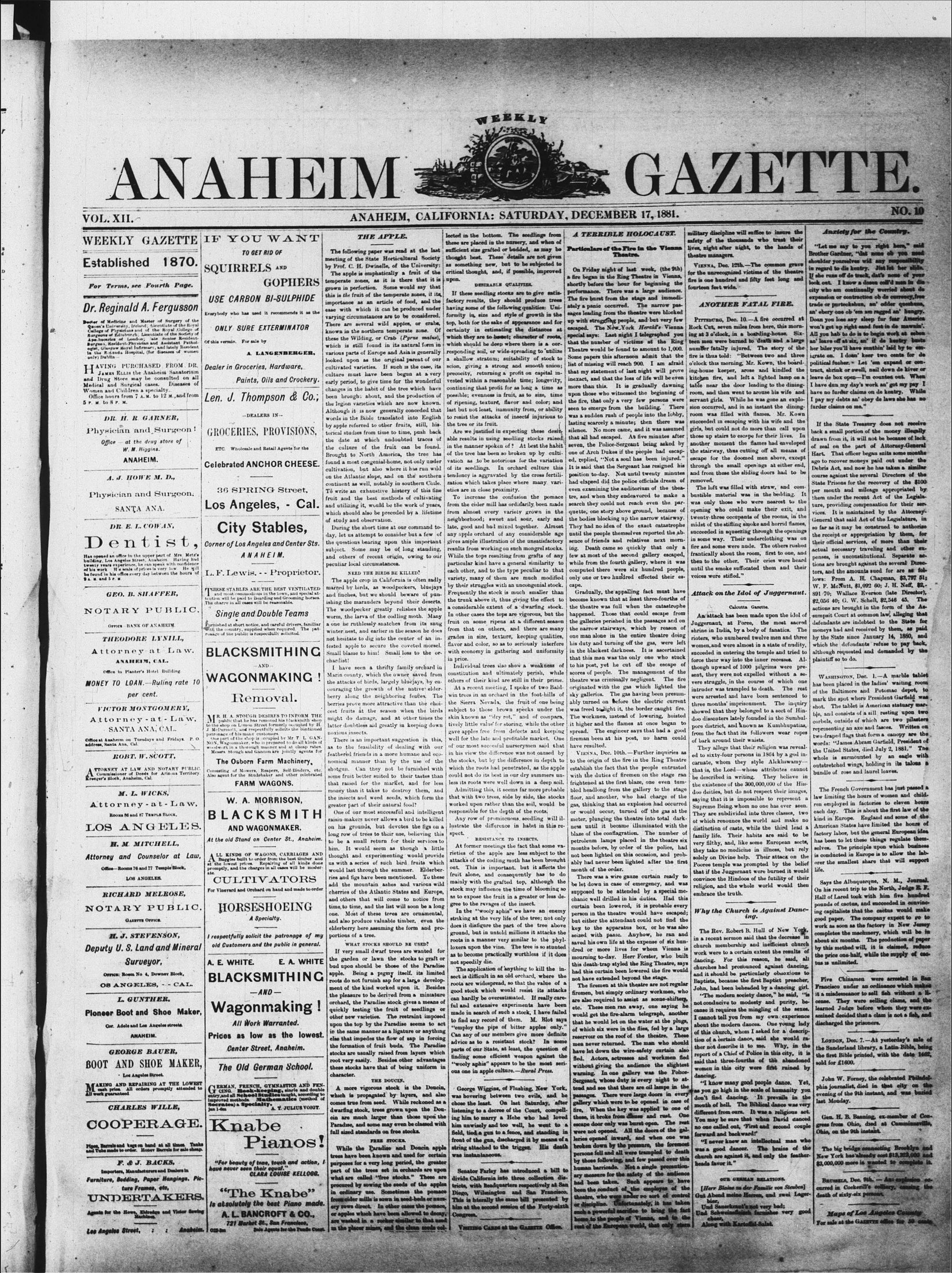
Searchable text
ANAHEIM
VOL. XII.
WEEKLY GAZETTE
Established 1870.
For Terms, see Fourth Page.
Dr. Reginald A. Fergusson
Doctor of Medicine and Master of Surgery of the Queen's University, Ireland; Excidentate of the Royal College of Physicians and of the Royal College of Surgeons of Edinburgh; Excidentate of the Society of Apotheosis of London; Late Senior Resident Burgeon, Resident Physician and Assistant Pathologist, Glasgow Royal Infirmary, and lately Resident in the Rutland Hospital, (for diseases of women only) Dublin.
HAVING PURCHASED FROM DR. JAMES ELLIS the Anaheim Sanatorium and Drug Store may be consulted on all Medical and Surgical cases. Diseases of Women and Children a specialty.
Office hours from 7 a.m. to 12 m., and from 5 p.m. to 8 p.m.
DR. H. R. GARNER,
Physician and Surgeon!
Office — at the drug store of W. M. Higgins.
ANAHEIM.
IF YOU WANT
TO GET RID OF
SQUIRRELS AND
GOPHERS
USE CARBON BI-SULPHIDE
Everybody who has used it recommends it as the ONLY SURE EXTERMINATOR
Of this vermin. For sale by
A. LANGENBERGER,
Dealer in Groceries, Hardware,
Paints, Oils and Crockery.
Len. J. Thompson & Co.;
—DEALERS IN—
GROCERIES, PROVISIONS,
ETC. Wholesale and Retail Agents for the Celebrated ANCHOR CHEESE.
DR. H. R. GARNER,
Physician and Surgeon!
Office — at the drug store of
W. M. Higgins.
ANAHEIM.
A. J. HOWE M. D.,
Physician and Surgeon;
SANTA ANA.
DR. E. L. COWAN,
Dentist,
Has opened an office in the upper part of Mrs. Metz's building, Los Angeles Street, Anaheim. Having had twenty years experience, he can speak with confidence of his work. His scale of prices is very low. He will be found in his office every day between the hours of 9 A.M. and 5 P.M.
GEO. B. SHAFFER,
NOTARY PUBLIC.
Office BANK OF ANAHEIM.
THEODORE LYNILL,
Attorney at Law.
ANAHEIM, CAL.
Office in Planter's Hotel Building.
MONEY TO LOAN.—Ruling rate 10 per cent.
VICTOR MONTGOMERY,
Attorney-at-Law,
SANTA ANA, CAL.
Office at Anaheim on Tuesdays and Fridays. P.O. address, Santa Ana, Cal.
ROBT. W. SCOTT,
ATTORNEY AT LAW AND NOTARY PUBLIC.
Commissioner of Deeds for Arizona Territory.
Kreeger's Block, Anaheim, Cal.
M. L. WICKS,
Attorney-at-Law,
Rooms 86 and 87 Temple Block,
LOS ANGELES.
H. M. MITCHELL,
Attorney and Counselor at Law,
Office—Rooms 76 and 77 Temple Block,
LOS ANGELES.
RICHARD MELROSE,
Paints, Oils and Crockery.
Len. J. Thompson & Co.;
DEALERS INGROCERIES, PROVISIONS,
ETC. Wholesale and Retail Agents for the Celebrated ANCHOR CHEESE.
36 SPRING Street,
Los Angeles, - Cal.
City Stables,
Corner of Los Angeles and Center Sts.
ANAHEIM.
L.F. Lewis.- Proprietor.
THESE STABLES ARE THE BEST VENTILATED and most commodious in the town, and special attention will be paid to Boarding and Grooming horses. The charve in all cases will be reasonable.
Single and Double Teams
Furnished at short notice, and careful drivers, familiar with the country, supplied when required. The patronage of the public is respectfully solicited.
BLACKSMITHING
AND
WAGONMAKING!
Removal.
MR. H. A. STOUGH DESIRES TO INFORM THE public that he has removed his blacksmith shop to the shop on Lemon Street formerly occupied by H. J. McDermott, and respectfully solicits the continued patronage of his many customers.
One part of the shop is occupied by Mr. T. L. GAN-NON, Wagoonmaker, who is prepared to do all kinds of woodwork in a thorough manner and at cheap rates. Mesers Stough and Gannon are jointly agents for The Osborn Farm Machinery.
Consisting of Mowers, Reapers, Self Binders, etc. Also agent for the Studsbaker and other celebrated FARM WAGONS.
W. A. MORRISON,
BLACKSMITH AND WAGONMAKER.
At the old Stand on Center St., Anaheim.
ALL KINDS OF WAGONS, CARRIAGES AND Buggies built to order from the best timber and at the lowest prices. Repairing of all kinds done promptly, and the charges in all cases will be moderate.
CULTIVATORS
For Vineyard and Orchard on hand and made to order
ATTORNEY-AT-LAW,
ROOMS 96 AND 87 TEMPLE BLOCK,
LOS ANGELES.
H. M. MITCHELL,
Attorney and Counselor at Law,
Office—Rooms 76 and 77 Temple Block,
LOS ANGELES.
RICHARD MELROSE,
NOTARY PUBLIC,
GAZETTE OFFICE.
H. J. STEVENSON,
Deputy U. S. Land and Mineral Surveyor,
Office: Room No 4, Downey Block,
OS ANGELES, - - CAL.
L. GUNTHER,
Ploneer Boot and Shoe Maker,
Cor. Adele and Los Angeles streets.
ANAHEIM.
GEORGE BAUER,
BOOT AND SHOE MAKER,
Los Angeles Street.
MAKING AND REPAIRING AT THE LOWEST
m cash price. All orders promptly attended to
All work guaranteed.
CHARLES WILLE,
COOPERAGE.
Pipes, Barrels and kegs on hand at all times. Tanks
and Tube made to order. Honey Barrels for sale cheap.
F. & J. BACKS,
Importers, Manufacturers and Dealers in
Furniture, Bedding, Paper Hangings, Picture Frames, etc.
UNDERTAKERS.
Agents for the Howe, Eldredge and Victor Sewing
Machines.
Leo Angeles Street, : : Anaheim.
W. A. MORRISON,
BLACKSMITH
AND WAGONMAKER.
At the old Stand on Center St., Anaheim.
ALL KINDS OF WAGONS, CARRIAGES AND
Buggies built to order from the best timber and
at the lowest prices. Repairing of all kinds done
promptly, and the charges in all cases will be moderate.
CULTIVATORS
For Vineyard and Orchard on hand and made to order
HORSESHOEING
A Specialty.
I respectfully solicit the patronage of my
old Customers and the public in general.
A. E. WHITE.
E. A. WHITE
BLACKSMITHING
—AND—
Wagonmaking!
All Work Warranted.
Prices as low as the lowest.
Center Street, Anaheim.
The Old German School.
GERMAN, FRENCH, GYMNASTICS AND FENCING.
Book-keeping, single and double entry,and all School Studies taught, according to improved methods.
Mathematics (method of Socrates) a Specialty.
jan 1-6m.
Knabe
Pianos!
"For beauty of tone, touch and action, I have never seen their equal."
CLARA LOUISE KELLOGG.
"The Knabe"
Is absolutely the best Piano made.
A. L. BANCROFT & CO.,
721 Market St., San Francisco,
023-8m.
Sole Agents for the Funbe Coast.
WEEKLY
ANAHEIM, CALIFORNIA: SATURDAY, DECEMBER 17, 1881
THE APPLE.
The following paper was read at the last meeting of the State Horticultural Society by Prof. C. H. Dwinelle, of the University:
The apple is emphatically a fruit of the temperate zones, as it is there that it is grown in perfection. Some would say that this is the fruit of the temperate zones, it its importance as an article of food, and the ease with which it can be produced under varying circumstances are to be considered. There are several wild apples, or crabs, known in the northern temperate zone. Of these the Wilding, or Crab (Pyrus malus), which is still found in its natural form in various parts of Europe and Asia is generally looked upon as the original parent of our cultivated varieties. If such is the case, its culture must have been begun at a very early period, to give time for the wonderful changes in the habit of the tree which have been brought about, and the production of the legion varieties which are now known. Although it is now generally conceded that words in the Bible translated into English by apple referred to other fruits, still, historical studies from time to time, push back the date at which undoubted traces of the culture of the fruit can be found. Brought to North America, the tree has found a most congenial-home, not only under cultivation, but also where it has run wild lected in the bottom. The seedlings from these are placed in the nursery, and when of sufficient size grafted or budded, as may be thought best. These details are not given as something new, but to be subjected to critical thought, and, if possible, improved upon.
DESIRABLE QUALITIES.
If these seedling stocks are to give satisfactory results, they should produce trees having some of the following qualities: uniformity in size and style of growth in the top, both for the sake of appearance and for certainty in estimating the distances at which they are to be set; character of roots, which should be deep where there is a corresponding soil, or wide-spreading to utilize a shallow stratum; suitability of stock to scion, giving a strong and smooth union; precocity, returning a profit on capital invested within a reasonable time; longevity, continuing that profit for as long a time as possible; evenness in fruit, as to size, time of ripening, texture, flavor and color; and last but not least, immunity from, or ability to resist the attacks of insects injurious to the tree or its fruit.
Are we justified in expecting these desirable results in using seedling stocks raised in the manner spoken of? At best the habit of the tree has been so broken up by cultivation as to be notorious for the variation of its seedlings. In orchard culture this tendency is aggravated by the cross fertility.
A TERRIBLE HOLOCAUST
Particular of the Fire in the Vienna Theatre.
On Friday night of last week, (the fire began in the Ring Theatre in Vienna shortly before the hour for beginning performance). There was a large audience. The fire burst from the stage and immediately a panic occurred. The narrow sages leading from the theatre were blocked up with struggling people, and but very escaped. The New York Herald's View special says: Last night I telegraphed that the number of victims at the Vienna Theatre would be found to amount to 1,000. Some papers this afternoon admit that a list of missing will reach 900. I am afraid that my statement of last night will pave inexact, and that the loss of life will be more than this. It is gradually dawning upon those who witnessed the beginning of the fire, that only a very few persons were seen to emerge from the building. This was a sudden rush of people into the lowlasting scarcely a minute; then there was silence. No more came, and it was assumed that all had escaped. At five minutes after seven, the Police-Sergeant being asked one of Arch Dukes if the people had escaped, replied, "Not a soul has been injured." It is said that the Sergeant has resigned position to-day. Not until twenty minu
culture must have been begun at a very early period, to give time for the wonderful changes in the habit of the tree which have been brought about, and the production of the legion varieties which are now known. Although it is now generally conceded that words in the Bible translated into English by apple referred to other fruits, still, historical studies from time to time, push back the date at which undoubted traces of the culture of the fruit can be found.
Brought to North America, the tree has found a most congenial home, not only under cultivation, but also where it has run wild on the Atlantic slope, and on the southern continent as well, notably in southern Chile. To write an exhaustive history of this fine fruit and the best methods of cultivating and utilizing it, would be the work of years, which should also be preceded by a lifetime of study and observation.
During the short time at our command today, let us attempt to consider but a few of the questions bearing upon this important subject. Some may be of long standing, and others of recent origin, owing to our peculiar local circumstances.
NEED THE BIRDS BE KILLED?
The apple crop in California is often sadly marred by birds, as woodpeckers, bluejays and finches, but we should beware of punishing the marauders beyond their deserts. The woodpecker greatly relishes the apple worm, the larva of the codling moth. Many a one he ruthlessly snatches from its snug winter nest, and earlier in the season he does not hesitate to dig into the center of an infested apple to secure the coveted morsel. Small blame to him! Small loss to the orchardist!
I have seen a thrifty family orchard in Marin county, which the owner saved from the attacks of birds, largely bluejays, by encouraging the growth of the native elderberry along the neighboring fences. The berries prove more attractive than the choicest fruits at the season when the birds might do damage, and at other times the latter doubtless aid greatly in keeping down noxious insects.
There is an important suggestion in this, as to the feasibility of dealing with our feathered friends in a more humane and economical manner than by use of the shotgun. Can they not be furnished with some fruit better suited to their tastes than that raised for the market, and for less money than it takes to destroy them, and the insects and weed seeds, which form the greater part of their natural food?
One of our most successful and intelligent raisin-makers never allows a bird to be killed on his grounds, but devotes the figs on a long row of trees to their use, believing this to be a small return for their services to him. It would seem as though a little thought and experimenting would provide us with a series of such bird fruits which would last through the summer. Elderberries and figs have been mentioned. To these add the mountain ashes and various wild cherries of the Atlantic States and Europe, and others that will come to notice from
precocity, returning a profit on capital invested within a reasonable time; longevity, continuing that profit for as long a time as possible; evenness in fruit, as to size, time of ripening, texture, flavor and color; and last but not least, immunity from, or ability to resist the attacks of insects injurious to the tree or its fruit.
Are we justified in expecting these desirable results in using seedling stocks raised in the manner spoken of? At best the habit of the tree has been so broken up by cultivation as to be notorious for the variation of its seedlings. In orchard culture this tendency is aggravated by the cross fertilization which takes place where many varieties are in close proximity.
To increase the confusion the pomace from the cider mill has ordinarily been made from almost every variety grown in the neighborhood; sweet and sour, early and late, good and bad mixed together. Almost any apple orchard of any considerable age gives ample illustration of the unsatisfactory results from working on such mongrel stocks. While the tops resulting from grafts of any particular kind have a general similarity to each other, and to the type peculiar to that variety, many of them are much modified by their struggles with an uncongenial stock.
Frequently the stock is much smaller than the trunk above it, thus giving the effect to a considerable extent of a dwarfing stock. In other cases the tops are vigorous, but the fruit on some ripens at a different season from that on others, and there are many grades in size, texture, keeping qualities, flavor and color, so as to seriously interfere with economy in gathering and uniformity in price.
Individual trees also show a weakness of constitution and ultimately perish, while others of their kind are still in their prime.
At a recent meeting, I spoke of two Baldwin trees in an orchard in the foot-hills of the Sierra Nevada, the fruit of one being subject to those brown specks under the skin known as "dry rot," and of comparatively little value for storing, while the other gave apples free from defects and keeping well for the late and profitable market. One of our most successful nurserymen said that in his view the difference was not caused by the stocks, but by the difference in depth to which the roots had penetrated, as the apple could not do its best in our dry summers unless its roots were well down in a deep soil.
Admitting this, it seems far more probable that with two trees, side by side, the stocks worked upon rather than the soil, would be responsible for the depth of the roots.
Any row of promiscuous seedling will illustrate the difference in habit in this respect.
RESISTANCE TO INSECTS.
At former meetings the fact that some varieties of the apple are less subject to the attacks of the codling moth has been brought out. This is important, but it affects the fruit alone, and consequently has to do mainly with the grafted top, although the stock may influence the time of blooming so as to expose the fruit in a greater or less depreciety, returning a profit on capital invested within a reasonable time; longevity, continuing that profit for as long a time as possible; evenness in fruit, as to size, time of ripening, texture, flavor and color; and last but not least, immunity from, or ability to resist the attacks of insects injurious to the tree or its fruit.
Are we justified in expecting these desirable results in using seedling stocks raised in the manner spoken of? At best the habit of the tree has been so broken up by cultivation as to be notorious for the variation of its seedlings. In orchard culture this tendency is aggravated by the cross fertilization which takes place where many varieties are in close proximity.
To increase the confusion the pomace from the cider mill has ordifiarly been made from almost every variety grown in the neighborhood; sweet and sour, early and late, good and bad mixed together. Almost any apple orchard of any considerable age gives ample illustration of the unsatisfactory results from working on such mongrel stocks. While the tops resulting from grafts of any particular kind have a general similarity to each other, and to the type peculiar to that variety, many of them are much modified by their struggles with an uncongenial stock.
Frequently the stock is much smaller than the trunk above it, thus giving the effect to a considerable extent of a dwarfing stock. In other cases the tops are vigorous, but the fruit on some ripens at a different season from that on others, and there are many grades in size, texture, keeping qualities, flavor and color, so as to seriously interfere with economy in gathering and uniformity in price.
Individual trees also show a weakness of constitution and ultimately perish, while others of their kind are still in their prime.
At a recent meeting, I spoke of two Baldwin trees in an orchard in the foot-hills of the Sierra Nevada, the fruit of one being subject to those brown specks under the skin known as "dry rot," and of comparatively little value for storing, while the other gave apples free from defects and keeping well for the late and profitable market. One of our most successful nurserymen said that in his view the difference was not caused by the stocks, but by the difference in depth to which the roots had penetrated, as the apple could not do its best in our dry summers unless its roots were well down in a deep soil.
Admitting this, it seems far more probable that with two trees, side by side, the stocks worked upon rather than the soil, would be responsible for the depth of the roots.
Any row of promiscuous seedling will illustrate the difference in habit in this respect.
VIENNA. Dec. 10th.—Further inquiry to the origin of fire in The Ring Thieves establish that fact that the people entrusted with the duties of firemen on the stage frightened at the first blaze, one even bled headlong from the gallery tothe floor,and another,thewhadchargeofgas,t thinkingthatanexplosionhadoccursorwouldoccur,转offthegasmeter.plungingtheatreintotalnessuntilitbecameilluminatedwithblazeoftheconflagration.Thenumberpetroleumlampsplacedinthetheatertomonthsbefore,bydirectionofthepolicenotbeenlightedonthisoccasion,andablyhadneverbeenlightedafterthemonthoftheorder.
There was a wire gauze curtain ready be let down in case of emergency,and supposedtobeattendedbyaspecia chicwelldrilledinhisdutica.Had
One of our most successful and intelligent raisin-makers never allows a bird to be killed on his grounds, but devotes the figs on a long row of trees to their use, believing this to be a small return for their services to him. It would seem as though a little thought and experimenting would provide us with a series of such bird fruits which would last through the summer. Elderberries and figs have been mentioned. To these add the mountain ashes and various wild cherries of the Atlantic States and Europe, and others that will come to notice from time to time, and the list will soon be a long one. Most of these trees are ornamental, and also produce valuable timber, even the elderberry here assuming the form and proportions of a tree.
WHAT STOCKS SHOULD BE USED?
If very small dwarf trees are wanted for the garden or lawn the stocks to graft or bud upon should be those of the Paradise apple. Being a pigmy itself, its limited roots do not furnish sap for a large development of the kind worked upon it. Besides the pleasure to be derived from a miniature orchard, the Paradise stock gives a means of quickly testing the fruit of seedlings or other new varieties. The restraint imposed upon the top by the Paradise seems to act in the same manner as a ligature or anything else that impedes the flow of sap in forcing the formation of fruit buds. The Paradise stocks are usually raised from layers which root very easily. Besides other advantages these stocks have that of being uniform in character.
THE DOUCIN.
A more vigorous stock is the Doucin, which is propagated by layers, and also comes true from seed. While reckoned as a dwarfing stock, trees grown upon the Doucin are much larger than those upon the Paradise, and some may even be classed with full sized standards on free stocks.
FREE STOCKS.
While the Paradise and Doucin apple trees have been known and used for certain purposes for a very long period, the greater part of the trees set in orchards are upon what are called "free stocks." These are procured by sowing the seeds of the apples in ordinary use. Sometimes the pomace from cider mills is sown in seed-beds or nursery rows direct. In other cases the pomace, or apples which have been allowed to decay, are washed in a rocker similar to that used in the place mines, and the clean seeds col-
George Wiggins, of Flushing. New York, was hovering between two evils, and he chose the least. On last Saturday, after listening to a decree of the Court, compelling him to marry a Hebe who had loved him unwisely and too well, he went to a field, tied a gun to a fence, and standing in front of the gun, discharged it by means of a string attached to the trigger. His death was instantaneous.
Senator Farley has introduced a bill to divide California into three collection districts, with headquarters respectively at San Diego, Wilmington and San Francisco. This is literally the same bill presented by him at the second session of the Forty-sixth Congress.
VISITING CARDS AS THE GARDEN OFFICE.
worked upon rather than the soil, would be responsible for the depth of the roots.
Any row of promiscuous seedling will illustrate the difference in habit in this respect.
RESISTANCE TO INSECTS.
At former meetings the fact that some varieties of the apple are less subject to the attacks of the codling moth has been brought out. This is important, but it affects the fruit alone, and consequently has to do mainly with the grafted top, although the stock may influence the time of blooming so as to expose the fruit in a greater or less degree to the ravages of the insect.
In the "woolly aphis" we have an enemy striking at the very life of the tree; not only does it disfigure the part of the tree above ground, but in untold millions it attacks the roots in a manner very similar to the phylloxera upon the vine. The tree is so stunted as to become practically worthless if it does not speedily die.
The application of anything to kill the insect is difficult in an old orchard, where the roots are widespread, so that the value of a good stock which would resist its attacks can hardly be overestimated. If really careful and extensive experiments have been made in search of such a stock, I have failed to find any record of them. M. Blot says "employ the pips of bitter apples only." Can any of our members give more definite advice as to a resistant stock? In some parts of our State, at least, the question of finding some efficient weapon against the "woolly aphis" appears to be the most serious one in apple culture.—Rural Press.
Sergeant, whose duty is every night tend and see that there are oil lamps in passages. There were large doors in gallery which were to be opened in fire. When the key was applied to these, it broke from disuse and rust. escape door only was burst open. They were not opened. All the doors of these opened inward, and when one broken down by the pressure, the four persons fell and all were trampled to by those following, and few passed over human barricade. Not a single measure for the safety of the sun had been taken. Such appears to be the conduct of the employees of theatre, who were under no sort of or discipline. Unfortunately, it has such a powerful sacrifice to bring this home to the people of Vienna, and not rest of the European world, that only
GAZETTE.
EMBER 17, 1881. NO. 10
CARRIE HOLOCAUST.
Fire of the Fire in the Vienna Theatre.
Day night of last week, (the 9th) in the Ring Theatre in Vienna, before the hour for beginning the fire. There was a large audience. First from the stage and immediate occurred. The narrow passage from the theatre were blocked by struggling people, and but very few The New York Herald's Vienna: Last night I telegraphed you number of victims at the Ring should be found to amount to 1,000. At this afternoon admit that the ring will reach 900. I am afraid statement of last night will prove that the loss of life will be even this. It is gradually dawning who witnessed the beginning of that only a very few persons were merge from the building. There then rush of people into the lobby, rarely a minute; then there was no more came, and it was assumed escaped. At five minutes after Police-Sergeant being asked by Dukes if the people had escaped, "Not a soul has been injured." That the Sergeant has resigned his day. Not until twenty minutes military discipline will suffice to insure the safety of the thousands who trust their lives, night after night, to the hands of theatre managers.
VIENNA, Dec. 12th.—The common grave for the unrecognized victims of the theatre fire is one hundred and fifty feet long and fourteen feet wide.
ANOTHER FATAL FIRE.
PITTSBURG, Dec. 10.—A fire occurred at Rock Cut, seven miles from here, this morning at 3 o'clock, in a boarding-house. Sixteen men were burned to death and a large number fatally injured. The story of the fire is thus told: "Between two and three o'clock this morning, Mr. Kown, the boarding-house keeper, arose and kindled the kitchen fire, and left a lighted lamp on a table near the door leading to the dining-room, and then went to arouse his wife and servant girls. While he was gone an explosion occurred, and in an instant the dining-room was filled with flames. Mr. Kown succeeded in escaping with his wife and the girls, but could not do more than call upon those up stairs to escape for their lives. In another moment the flames had enveloped the stairway, thus cutting off all means of escape for the doomed men above, except through the small openings at either end, and from these the sliding doors had to be
Anxiety for the Country.
"Let me say to you right here," said Brother Gardner, "dat none ob you need shoulder your resolves wid any responsibility in regard to dis kentry. Jist let her slide. If she runs off de track, dat's none of your look out. I know a dozen coll'd man in dis city who am continually worried about de expansion or contraction ob de currency, free trade or purteckshun, an' odder queshuna, an' ebery one ob 'em am ragged an' hungry. Doan you lose any sleep fur fear America won't get up right sand fust in de mawnin'. All you hab to do is to begin work at saben an' leave off at six, an' if de kentry busts her biler you'll have sunthin' laid by to emigrate on. I doan' keer two cents for de political fucher. Let 'em expand or contract, shrink or swell, nail down de kiver or leave de box open—I'm counted out. When I have dun my day's work an' got my pay I have no furder claims on de kentry. While I pay my debts an' obey de laws she has no furder claims on me."
If the State Treasury does not receive back a small portion of the money illegally drawn from it, it will not be because of lack of zeal on the part of Attoruey-General Hart. That officer began suits some months ago to recover moneys paid out under the Debris Act, and now he has taken a similar course against the several Directors of the
It is gradually dawning on who witnessed the beginning of that only a very few persons were emerge from the building. There been rush of people into the lobby, precisely a minute; then there was no more came, and it was assumed had escaped. At five minutes after Police-Sergeant being asked by Dr. Dukes if the people had escaped, "Not a soul has been injured." That the Sergeant has resigned his day. Not until twenty minutes did the police officials dream of mining the auditorium of the theatre they endeavored to make a play could not reach even the parade story above ground, because of blocking up the narrow stairway. No idea of the exact catastrophe people themselves reported the abject friends and relatives next morning came so quickly that only a part of the second gallery escaped, in the fourth gallery, where it was there were six hundred people, or two hundred effected their escape.
The appalling fact must have known that at least three-fourths of the fire was full when the catastrophe occurred. Those that could escape from fires perished in the passages and on my stairways, which by reason of one in the entire theatre doing and turning off the gas, were left thickest darkness. It is ascertained that man was the only one who stuck yet he cut off the escape of people. The management of the gas criminally negligent. The fire with the gas which lighted the houses. The gas having been presumed on before the electric current to light it, the border caught fire. Men, instead of lowering, hoisted and the flames at once began to move. The engineer says that had a good men at his post, no harm could be caused.
Dec. 10th.—Further inquiries asinin of the fire in the Ring Theatre the fact that the people entrusted duties of firemen on the stage ran at the first blaze, one even tumbling from the gallery to the stage another, who had charge of the thing that an explosion had occurred occur, turned off the gas at the singing the theatre into total darkness it became illuminated with the conflagration. The number of lamps placed in the theatre six before, by order of the police, hadightened on this occasion, and probably been lighted after the first order.
Was a wire gauze curtain ready toown in case of emergency, and wasto be attended by a special meill drilled in his duties. Had this kitchen fire, and left a lighted lamp on a table near the door leading to the diningroom, and then went to arouse his wife and servant girls. While he was gone an explosion occurred, and in an instant the diningroom was filled with flames. Mr. Kown succeeded in escaping with his wife and the girls, but could not do more than call upon those up stairs to escape for their lives. In another moment the flames had enveloped the stairway, thus cutting off all means of escape for the doomed men above, except through the small openings at either end, and from these the sliding doors had to be removed.
The loft was filled with straw, and combustible material was in the bedding. It was only those who were nearest to the opening who could make their exit, and twenty-three occupants of the rooms, in the midst of the stifling smoke and horrid flames, succeeded in squeezing through the openings in some way. Their underclothing was on fire and some were nude. The others rushed frantically about the room, first to one, and then to the other. Their cries were heard until the smoke suffocated them and their voices were stifled."
Attack on the Idol of Juggernaut.
Calcutta Gazette.
An attack has been made upon the idol of Juggernaut, at Poree, the most sacred shrine in India, by a body of fanatics. The rioters, who numbered twelve men and three women, and were almost in a state of nudity, succeeded in entering the temple and tried to force their way into the inner recesses. Although upward of 1000 pilgrims were present, they were not expelled without a severe struggle, in the course of which one intruder was trampled to death. The rest were arrested and have been sentenced to three months' imprisonment. The inquiry showed that they belonged to a sect of Hindoo dissenters lately founded in the Sumbalpore district, and known as Kumbhupatias, from the fact that its followers wear ropes of bark around their waists.
They allege that their religion was revealed to sixty-four persons in 1864 by a goal incarnate, whom they style Alekhswamy—that is, the Lord—whose attributes cannot be described in writing. They believe in the existence of the 300,000,000 of the Hindoo deities, but do not respect their images, saying that it is impossible to represent a Supreme Being whom no one has ever seen. They are subdivided into three classes, two of which renounce the world and make no distinction of caste, while the third lead a family life. Their habits are said to be very filthy, and, like some European sects, they take no medicine in illness, but rely solely on Divine help. Their attack on the Pooree temple was prompted by the belief that if the Juggernaut were burned it would convince the Hindoos of the futility of their religion, and the whole world would then embrace the truth.
If the State Treasury does not receive back a small portion of the money illegally drawn from it, it will not be because of lack of zeal on the part of Attorney-General Hart. That officer began suits some months ago to recover moneys paid out under the Debris Act, and now he has taken a similar course against the several Directors of the State Prisons for the recovery of the $100 per month and mileage appropriated by them under the recent Act of the Legislature, providing compensation for their services. It is maintained by the Attorney-General that said Act of the Legislature, in so far as it may be construed to authorize receipt or appropriation by them, for their official services, of more than their actual necessary traveling and other expenses, is unconstitutional. Separate actions are brought against the several Directors, and the amounta sued for are as follows: From A. H. Chapman, $3,797 51; W. F. McNutt, $1,092 60; J. H. Neff, $2,-891 70; Wallace Everson (late Director), $2,056 40; G. W. Schell, $2,546 45. The actions are brought in form of the Assumpsit Court at common law, alleging that defendants are indebted to the State for moneys had and received by them, as paid by the State since January 14, 1880, and which the defendants refuse to pay back although requested and demanded by the plaintiff so to do.
WASHINGTON, Dec. 1.—A marble tablet has been placed in the ladies' waiting room of the Baltimore and Potomac depot, to mark the spot where President Garfield was shot. The tablet is American statuary marble, and consists of a sill resting upon two corbels outside of which are two pilasters representing an axe and fasces. Written on two draped flags that form a canopy are the words: "James Abram Garfield, President of the United States; died July 2, 1881." The whole is surmounted by an eagle with outstretched wings, holding in its talons a bundle of rose and laurel leaves.
The French Government has just passed a law limiting the hours of women and children employed in factories to eleven hours each day. This is about the first law ofthe kind in Europe. England and some ofthe American States have limitedthe hoursof factory labor, butthe general Europeanidea has been to let these things regulate themselves. The principle upon which business is conducted in Europe is to allowthe laborerthe smallest share that will support life.
Says the Albuquerque, N. M., Journal.On his recent trip tothe North,Judge E.F.Hall of Lared took with him five hundred
Why the Church is Against Dancing.
The Rev. Robert B. Hull of New York, in a recent sermon said that the decrease in church membership and inefficient church work were to a certain extent the results of dancing. For this reason, he said, all churches had pronounced against dancing, and it should be particularly obnoxious to Baptists, because the first Baptist preacher, John, had been beheaded by a dancing girl.
"The modern society dance," he said, "is not conducive to modesty and purity, because it requires the mingling of the sexes. I cannot tell you from my own experience about the modern dances. One young lady of this church, whom I asked for a description of a certain dance, said she would rather not describe it to me. Why, in the report of a Chief of Police in this city, it is said that three-fourths of the abandoned women in this city were first ruined by dancing.
"I know many good people dance. Yet, as you go high in the scale of humanity you don't find dancing. It prevails in the month of hell. The Biblical dance was very different from ours. It was a religious act. You may be sure that when David danced no one called out, 'First and second couple forward and backward!'
"I never knew an intellectual man who was a good dancer. The brains of the church are against it, and only the feather-heads favor it."
OUR GERMAN RELATIONS.
[Herr Blaine zu der Familie von Steuben]
Gut Abend meine Herren, und zwei Lagerbier,
Und Sauerkraut's not very bad;
Und Schweineflasch furnishes very good cheese,
Along with Kartoffel Salat.