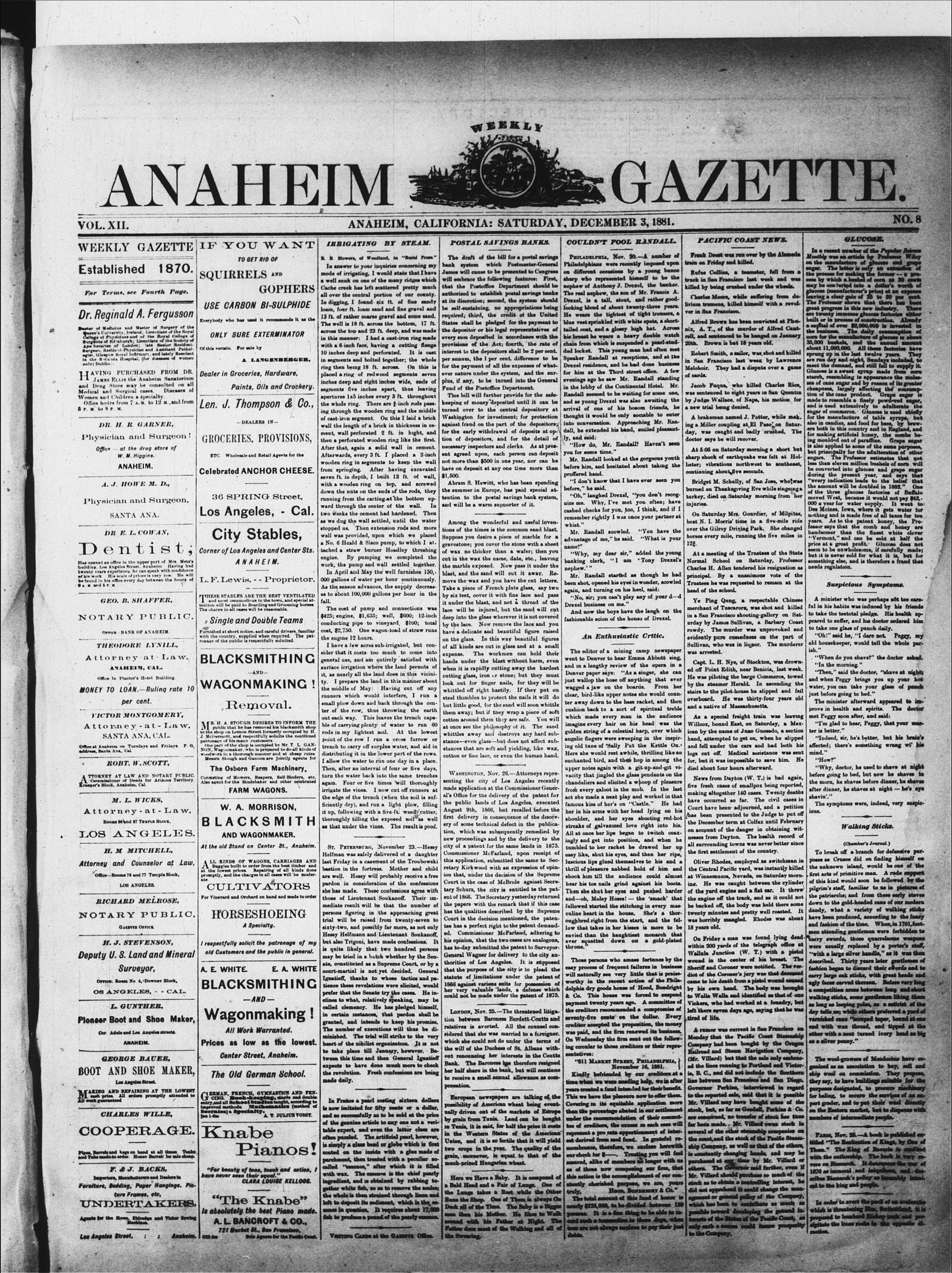
anaheim-gazette 1881-12-03
Scanned page
Searchable text
ANAHEIM
VOL. XII.
WEEKLY GAZETTE
Established 1870.
For Terms, see Fourth Page.
Dr. Reginald A. Fergusson
Doctor of Medicine and Master of Surgery of the Queen's University, Ireland; Licentiate of the Royal College of Physicians and of the Royal College of Surgeons of Minneapolis; Licentiate of the Society of Aphecaries of London; late Senior Resident Burgeon, Resident Physician and Assistant Pathologist, Glasgow Royal Infirmary, and lately Resident in the Rotunda Hospital (for diseases of women only) Dublin.
HAVING PURCHASED FROM DR. JAMES ELLIS the Anaheim Sanatorium and Drug Store may be consulted on all Medical and Surgical cases. Diseases of Women and Children a specialty.
Office hours from 7 A.M. to 12 M., and from 5 P.M. to 8 P.M.
DR. H. R. GARNER,
Physician and Surgeon!
Office at the drug store of W. M. Higgins.
ANAHEIM.
IF YOU WANT TO GET RID OF SQUIRRELS AND GOPHERS USE CARBON BI-SULPHIDE
Everybody who has used it recommends it as the ONLY SURE EXTERMINATOR Of this vermin. For sale by
A. LANGENBERGER,
Dealer in Groceries, Hardware, Paints, Oils and Crockery.
Len. J. Thompson & Co.,
DEALERS INGROCERIES, PROVISIONS,
ETC. Wholesale and Retail Agents for the Celebrated ANCHOR CHEESE.
DR. H. R. GARNER,
Physician and Surgeon!
Office — at the drug store of
W. M. Higgins.
ANAHEIM.
A. J. HOWE M. D.,
Physician and Surgeon.
SANTA ANA.
DR. E. L. COWAN,
Dentist;
Has opened an office in the upper part of Mrs. Metr's building, Los Angeles Street, Anaheim. Having had twenty years experience, he can speak with confidence of his work. His scale of prices is very low. He will be found in his office every day between the hours of 8 A.M. and 6 P.M.
GEO. B. SHAFFER,
NOTARY PUBLIC.
OFFICE — BANK OF ANAHEIM.
THEODORE LYNILL,
Attorney at Law.
ANAHEIM, CAL.
Office in Planter's Hotel Building.
MONEY TO LOAN.—Ruling rate 10 per cent.
VICTOR MONTGOMERY,
Attorney-at-Law,
SANTA ANA, CAL.
Office at Anaheim on Tuesdays and Fridays. P.O. address, Santa Ana, Cal.
ROBT. W. SCOTT.
ATTORNEY AT LAW AND NOTARY PUBLIC.
Commissioner of Deeds for Arizona Territory.
Kreeger's Block, Anaheim, Cal.
M. L. WICKS,
Attorney-at-Law,
Rooms 86 and 87 Temple Block.
LOS ANGELES.
H. M MITCHELL,
Attorney and Counselor at Law,
Office — Rooms 76 and 77 Temple Block.
LOS ANGELES.
DEALERS INGROCERIES, PROVISIONS,
ETC. Wholesale and Retail Agents for the
Celebrated ANCHOR CHEESE.
36 SPRING Street,
Los Angeles, - Cal.
City Stables,
Corner of Los Angeles and Center Sts.
ANAHEIM.
L. F. Lewis, -- Proprietor.
THESE STABLES ARE THE BEST VENTILATED and most commodious in the town, and special attention will be paid to Boarding and Grooming horses.
Single and Double Teams
Furnished at short notice, and careful drivers, familiar with the country, supplied when required. The patronage of the public is respectfully solicited.
BLACKSMITHING
AND
WAGONMAKING!
Removal.
MR. H. A. STOUGH DESIRES TO INFORM THE public that he has removed his blacksmith shop to the shop on Lemon Street formerly occupied by H. J. McBermott, and respectfully solicits the continued patronage of his many customers.
One part of the shop is occupied by Mr. T. L. GAN-NON, Wagoonmaker, who is prepared to do all kinds of woodwork in a thorough manner and at cheap rates.
Mesera Stough and Gannon are jointly agents for The Osborn Farm Machinery,
Consisting of Mowers, Reapers, Self-Binders, etc. Also agent for the Studebaker and other celebrated FARM WAGONS.
W. A. MORRISON,
BLACKSMITH AND WAGONMAKER.
At the old Stand on Center St., Anaheim.
ALL KINDS OF WAGONS, CARRIAGES AND Burgles built to order from the best timber and at the lowest price. Repairing all kinds done promptly, and the charges in all cases will be moderate.
CULTIVATORS
For Vineyard and Orchard on hand and made to order
M. L. WICKS,
Attorney-at-Law,
Rooms 86 and 87 Temple Block.
LOS ANGELES.
H. M MITCHELL,
Attorney and Counselor at Law,
Office—Rooms 76 and 77 Temple Block,
LOS ANGELES.
RICHARD MELOSE,
NOTARY PUBLIC,
GARBETTE OFFICE.
H. J. STEVENSON,
Deputy U. S. Land and Mineral Surveyor,
Office: Roem No. 4, Downev Block,
OS ANGELES, - - CAL.
L. GUNTHER,
Pioneer Boot and Shoe Maker,
Cor. Adele and Los Angeles streets.
ANAHEIM.
GEORGE BAUER,
BOOT AND SHOE MAKER,
Los Angeles Street.
MAKING AND REPAIRING AT THE LOWEST cash price. All orders promptly attended to. All work guaranteed.
CHARLES WILLE,
COOPERAGE.
Pipe, Barrels and kegs on hand at all times. Tanks and Tubes made to order. Home Barrels for sale cheap.
F. & J. BACKS,
Importers, Manufacturers and Dealers in Furniture, Bedding, Paper Hangings, Picture Frames, etc,
UNDERTAKERS,
Agents for the House, Eldridge and Victor Sewing Machines.
Los Angeles Street, Anaheim.
W. A. MORRISON,
BLACKSMITH AND WAGONMAKER.
At the old Stand on Center St., Anaheim.
ALL KINDS OF WAGONS, CARRIAGES AND Burgles built to order from the best timber and at the lowest prices. Repairing of all kinds done promptly, and the charges in all cases will be moderate.
CULTIVATORS
For Vineyard and Orchard on hand and made to order
HORSESHOEING
A Specialty.
I respectfully solicit the patronage of my old Customers and the public in general.
A. E. WHITE.
E. A. WHITE
BLACKSMITHING
AND
Wagonmaking!
All Work Warranted.
Prices as low as the lowest.
Center Street, Anaheim.
The Old German School.
GERMAN, FRENCH, GYMNASTICS AND PENCING. Book-keeping, single and double entry, and all School Studies taught, according to improved methods. Mathematics (method of Secraten's Specialty).
Jan 1-8m
Knabe
Pianos!
"For beauty of tone, touch and action, I have never seen their equal."
CLARA LOUISE KELLOGG.
"The Knabe"
Is absolutely the best Piano made.
A. L. BANCROFT & CO.,
721 Market St., San Francisco,
Oceano Agente for the Panico Coast.
WEEKLY
EIM GA
ANAHEIM, CALIFORNIA: SATURDAY, DECEMBER 3, 1881.
IRRIGATING BY STEAM.
R. B. Blowers, of Woodland, in "Rural Press."
In answer to your inquiries concerning my mode of irrigating, I would state that I have a well sunk on one of the many ridges which Cache creek has left scattered pretty much all over the central portion of our county. In digging, I found six ft. of fine sandy loam, four ft. loam sand and fine gravel and 13 ft. of rather coarse gravel and some sand. The well is 18 ft. across the bottom, 17 ft. across the top and 23 ft. deep, and was made in this manner: I had a cast-iron ring made with a 6-inch face, having a cutting flange 10 inches deep and perforated. It is cast in segments and bolted together; the whole ring then being 18 ft. across. On this is placed a ring of redwood segments seven inches deep and eight inches wide, ends of segments five inches apart, thus leaving apertures 1x5 inches every 3 ft. throughout the whole ring. There are 4-inch rods passing through the wooden ring and the middle of cast-iron segment. On this I laid a brick wall the length of a brick in thickness in cement, wall perforated 2 ft. in height, and then a perforated wooden ring like the first. After that, again a solid wall in cement. Afterwards, every 3 ft. I placed a 2-inch wooden ring in segments to keep the wall from springing. After having excavated
POSTAL SAVINGS BANKS.
The draft of the bill for a postal savings bank system which Postmaster-General James will cause to be presented to Congress will embrace the following features: First, that the Postoffice Department should be authorized to establish postal savings banks at its discretion; second, the system should be self-sustaining, no appropriations being required; third, the credit of the United States shall be pledged for the payment to the depositor or his legal representatives of every sum deposited in accordance with the provisions of the Act; fourth, the rate of interest to the depositors shall be 2 per cent. per annum, the 1 per cent. difference to be for the payment of all the expenses of whatever nature under the system, and the surplus, if any, to be turned into the General Fund of the Postoffice Department.
This bill will further provide for the safekeeping of money deposited until it can be turned over to the central depository at Washington for investment; for protection against fraud on the part of the depositors; for the early withdrawal of deposits at option of depositors, and for the detail of necessary inspectors and clerks. As at present agreed upon, each person can deposit not more than $500 in one year, nor can he have on deposit at any one time more than $1,500.
COULDN'T FOOL RANDALL.
Philadelphians were recently imposed upon different occasions by a young bungo sharp who represented himself to be the nephew of Anthony J. Drezel, the banker. The real nephew, the son of Mr. Francis Drezel, is a tall, stout, and rather good-looking blond of about twenty-three years. He wears the tightest of tight trousers; blue vest sprinkled with white spots, a short tailed coat, and a glossy high hat. Across his breast he wears a heavy double water chain from which is suspended a pearl-stud locket. This young man had often met Speaker Randall at receptions, and at the Drezel residence, and he had done business for him at the Third street office. A few evenings ago he saw Mr. Randall standing in the lobby of the Continental Hotel. Mr. Randall seemed to be waiting for some occasion and as young Drezel was also awaiting the arrival of one of his bosom friends, thought it would be only sociable to enter into conversation. Approaching Mr. Randall, he extended his hand, smiled pleasantly, and said:
"How do, Mr. Randall? Haven't you seen you for some time."
Mr. Randall looked at the gorgeous young before him, and hesitated about taking the proffered hand.
placed a ring of redwood segments seven inches deep and eight inches wide, ends of segments five inches apart, thus leaving apertures 1x5 inches every 3 ft. throughout the whole ring. There are 4-inch rods passing through the wooden ring and the middle of cast-iron segment. On this I laid a brick wall the length of a brick in thickness in cement, wall perforated 2 ft. in height, and then a perforated wooden ring like the first. After that, again a solid wall in cement. Afterwards, every 3 ft. I placed a 2-inch wooden ring in segments to keep the wall from springing. After having excavated seven ft. in depth, I built 13 ft. of wall, with a wooden ring on top, and screwed down the nuts on the ends of the rods, they running from the casting at the bottom upward through the center of the wall. In two weeks the cement had hardened. Then as we dug the wall settled, until the water stopped us. Then extension rods and more wall was provided, upon which we placed a No. 6 Heald & Sisco pump, to which I attached a straw burner Hoadley threshing engine. By pumping we completed the work, the pump and wall settled together.
In April and May the well furnishes 150,000 gallons of water per hour continuously. As the season advances, the supply decreases to about 100,000 gallons per hour in the fall.
The cost of pump and connections was $425; engine, $1,635; well, $600; 12-inch conducting pipe in vineyard. $100; total cost, $2,750. One wagon-load of straw runs the engine 12 hours.
I have a few acres sub-irrigated, but consider that it costs too much to come into general use, and am entirely satisfied with surface irrigation where the land permits it, as nearly all the land does in this vicinity. I prepare the land in this manner about the middle of May: Having cut off any runners which would interfere, I run a small plow down and back through the center of the row, thus throwing the earth out each way. This leaves the trench capable of carrying plenty of water to run 60 rods in my lightest soil. At the lowest point of the row I run a cross furrow or trench to carry off surplus water, and aid in distributing it in the lower part of the rows. I allow the water to run one day in a place. Then, after an interval of four or five days, turn the water back into the same trenches again. Four or five times will thoroughly irrigate the vines. I now cut off runners at the edge of the trench (when the soil is sufficiently dry), and run a light plow, filling it up, following with a five-ft. weed-cutter, thoroughly tilling the exposed soil as well as that under the vines. The result is good.
St. Petersburg, November 23.—Hessy Helfman was safely delivered of a daughter last Friday in a casement of the Troubowski bastion in the fortress. Mother and child are well. Hessy will probably receive a free pardon in consideration of the confessions she has made. These confessions agree with those of Lieutenant Soukanoff. Their imme
St. Petersburg, November 23.—Hessy Helfman was safely delivered of a daughter last Friday in a casement of the Troubowski bastion in the fortress. Mother and child are well. Hessy will probably receive a free pardon in consideration of the confessions she has made. These confessions agree with those of Lieutenant Soukanoff. Their immediate result will be that the number of persons figuring in the approaching great trial will be raised from twenty-seven to sixty-two, and possibly far more, as not only Hessy Helfmann and Lieutenant Soukanoff, but also Trigoni, have made confessions. It is quite likely that two hundred persons may be tried in a batch whether by the Senate, constituted as a Supreme Court, or by a court-martial is not yet decided. General Ignatieff, thanks to whose tactics and patience these revelations were elicited, would prefer that the Senate try the cases. He inclines to what, relatively speaking, may be called clemency. He has pledged himself, in certain instances, that pardon shall be granted, and intends to keep his promise. The number of executions will thus be diminished. The trial will strike to the very heart of the nihilist organization. It is not to take place till January, however. Between this time and then General Ignatieff expects to have done much more to check the revolution. Fresh confessions are being made daily.
In France a pearl costing sixteen dollars is now imitated for fifty cents or a dollar, and so successfully as to be sold at the price of the genuine article to any one not a veritable expert, and even the latter class are often puzzled. The artificial pearl, however, is simply a glass bead or globe which is first coated on the inside with a glue made of parchment, then treated with a peculiar so-called "emence," after which it is filled with wax. The emence is the chief pearly ingredient, and is obtained by rubbing together white fish, so as to remove the scales; the whole is then strained through linen and left to deposit its sediment, which is the emence in question. It requires about 17,000 fish to produce a pound of the pearly emense.
VIRTING CARDS at the GASHTTE Office.
August 9th, 1866, but recalled before the first delivery in consequence of the discovery of some technical defect in the publication, which was subsequently remedied by new proceedings and by the delivery to the city of a patent for the same lands in 1875. Commissioner McFarland, upon receipt of this application, submitted the same to Secretary Kirkwood with an expression of opinion that, under the decision of the Supreme Court in the case of McBride against Secretary Schurz, the city is entitled to the patent of 1866. The Secretary yesterday returned the papers with the remark that if this case has the qualities described by the Supreme Court in the decision mentioned, the patentee has a perfect right to the patent demanded. Commissioner McFarland, adhering to his opinion, that the two cases are analogous, has to-day submitted the patent to Surveyor-General Wagner for delivery to the city authorities of Los Angeles. It is supposed that the purpose of the city is to plead the statute of limitations under the patent of 1866 against various suits for possession of her very valuable lands, a defense which could not be made under the patent of 1875.
LONDON, Nov. 25.—The threatened litigation between Baroness Burdett-Coutts and relatives is avorted. All the counsel considered that she was married to a freigner, which she could not do under the terms of the will of the Duchess of St. Albans without renouncing her interests in the Coutts Bank. The Baroness has therefore resigned her half share in the bank, but will continue to receive a small annual allowance as compensation.
European newspapers are talking of the possibility of American wheat being eventually driven out of the markets of Europe by grain from Tunisia. Land can be bought in Tunisia, it is said, for half the price it costs in the Western States of the American Union, and it is so fertile that it will yield two crops in the year. The quality of the grain, moreover, is equal to that of the much-prized Hungarian wheat.
Here we Have a Baby. It is composed of a Bald Head and a Fair of Lungs. One of the Lungs takes a Rest while the Other Runs the Shop. One of Them is always On Deck all of the Time. The Baby is a Bigger man than his Mother. He likes to Walk around with his Father at Night. The Father does most of the Walking and all of the Swearing.
Those persons who amass fortunes by easy process of frequent failures in business will naturally see very little that is praised worthy in the recent action of the Philadelphia dry goods house of Hood, Bondriest & Co. This house was forced to suspend payment twenty years ago. A committee of creditors recommended a compromise seventy-five cents on the dollar. Every creditor accepted the proposition, the money was paid, and the firm renewed its business.On Wednesday the firm sent out the following circular to those creditors or their representatives:
"811 MARKET STREET, PHILADELPHIA November 16, 1881.
Kindly befriended by our creditors time when we were needing help, we in a few years created a fund intended for their benefit. This we have the pleasure now to offer them Covering in its equitable application more than the percentage abated in our settlement under the recommendation of their creditors, the excess in each case represent a pro-rata apportionment of interest derived from said fund. In grateful membrance, therefore, we enclose herein our check for $——. Trusting you will assured, alike of members no longer with us of those now composing our firm, this action is the accomplishment of our stantly cherished purpose, we are, you truly.
HOOD, BONDRIEST & CO."
The total amount of this fund of honor nearly $125,000, to be divided between persons. It is a fine thing to be able to cord such a transaction in three days, men are not always anxious to pay their debts."
GAZETTE.
EMBER 3, 1881. NO. 8
PACIFIC COAST NEWS.
Frank Drest was run over by the Alameda train on Friday and killed.
Rufus Collins, a teamster, fell from a truck in San Francisco last week and was killed by being crushed under the wheels.
Charles Moore, while suffering from delirium tremens, killed himself with a revolver in San Francisco.
Alfred Brown has been convicted at Phoenix, A.T., of the murder of Alfred Cantrell, and sentenced to be hanged on January 20th. Brown is but 18 years old.
Robert Smith, a sailor, was shot and killed in San Francisco last week by Lawrence Melohoir. They had a dispute over a game of cards.
Jacob Fuqua, who killed Charles Rice, was sentenced to eight years in San Quentin by Judge Wallace, of Napa, his motion for a new trial being denied.
A brakeman named J. Potter, while making a Miller coupling at El Paso on Saturday, was caught and badly crushed. The doctor says he will recover.
At 5:05 on Saturday morning a short but sharp shock of earthquake was felt at Hollist; vibrations northwest to southeast, continuing about five seconds.
GLUCOSE.
In a recent number of the Popular Science Monthly was an article by Professor Wilby on the manufacture of glucose and grape sugar. The latter is only an extension of the process for making the former—a process by which a bushel of corn at 30 cents may be converted into a dollar's worth of glucose (manufacturer's price) at an expense leaving a clear gain of $5 to $6 per cent. The Professor shows that there has been great progress in this new industry. There are twenty immense glucose factories either built or in process of construction. Already a capital of over $2,000,000 is invested in the business. The daily consumption of corn for the manufacture of glucose is about 35,000 bushels, and the annual amount about 11,000,000. All these factors have sprung up in the last twelve years. They are run day and night, Sundays included, to meet the demand, and still fail to supply it. Glucose is a sweet syrup made from corn starch, resembling in appearance the molasses of cane sugar and by reason of its greater cheapness, largely affecting the consumption of the cane product. Grape sugar is made to resemble a finely powdered sugar, and is used extensively to adulterate the sugar of commerce. Glucose is used chiefly for the manufacture of table syrups, but also in candies, and food for bees, by brewers both in this country and in England, and for making artificial honey, the combs being moulded out of paraffine. Grape sugar is also applied to some of the same purposes, but principally for the adulteration of other sugars. The Professor estimates that not less than eleven million bushels of corn will be converted into glucose and grape sugar during the present year and that
Mr. Randall? Haven't seen it time."
All looked at the gorgeous youth and hesitated about taking the lead.
Now that I have ever seen you said.
Eugene Drexel, "you don't recognize why, I've met you often; have us for you, too, I think; and if I mightly I was once your partner at all scowled. 'You have the same,' he said. 'What is your dear sir,' added the young Mark, "I am Tony Drexel's hall started as though he had opened his eyes in wonder, scowled burning on his heel, said:
'You can't play any of your d—ness on me.'
The boys have the laugh on the occasion of the house of Drexel.
Enthusiastic Crttic.
A mining camp newspaper never to hear Emma Abbott sing, gently review of the opera in her says: "As a singer, she can the hose off anything that ever saw on the boards. From her take upper notes she would connown to the bass racket, and then talk to a sort of spiritual treble like every man in the audience hair on his head was the ring of a celestial harp, over which ears were sweeping in the inspirations of Sally Put the Kettle On." Would rest awhile, thrilling like an bird, and then hop in among the again with a git-up-and-git ving-jingled the glass pendants on the hand elicited a whoop of pleasure galoot in the mob. In the last be a neat play and worked in that of her's on "Castle." He had arms with her head lying on his hand and her eyes shooting red-hot galvanized love right into his other lips began to twitch coaxed into position, and when he either racket he drawn her up but his eyes, and then her ripe, glued themselves to his and a measure nabbed hold of him and still the audience could almost nails grind against his boots. But her eyes and pushed harder below House! — the 'amack' that
Jacob Fuqua, who killed Charles Rice, was sentenced to eight years in San Quentin by Judge Wallace, of Napa, his motion for a trial being denied.
A brakeman named J. Potter, while making a Miller coupling at El Paso on Saturday, was caught and badly crushed. The doctor says he will recover.
At 5:05 on Saturday morning a short but sharp shock of earthquake was felt at Holster; vibrations northwest to southeast, continuing about five seconds.
Bridget M. Schully, of San Jose, who was burned on Thanksgiving Eve while singing a turkey, died on Saturday morning from her injuries.
On Saturday Mrs. Gourdier, of Milpitas, beat N. I. Morris' time in a five-mile ride over the Gilroy Driving Park. She changed horses every mile, running the five miles in 123.
At a meeting of the Trustees of the State Normal School on Saturday, Professor Charles H. Allen tendered his resignation as principal. By a unanimous vote of the Trustees he was requested to remain at the head of the school.
Ye Ping Qung, a respectable Chinese merchant of Tucarora, was shot and killed in a San Francisco shooting-gallery on Saturday by James Sullivan, a Barbary Coast rowdy. The murder was unprovoked and evidently pure cussness on the part of Sullivan, who was in liquor. The murderer was arrested.
Capt. L. H. Nye, of Stockton, was drowned off Point Edith, near Benicia, last week. He was piloting the barge Commerce, towed by the steamer Herald. In ascending the stairs to the pilot-house he slipped and fell under the cars and had both his legs cut off. Medical assistance was sent for, but it was impossible to save him. He died about four hours afterward.
News from Dayton (W. T.) is bad again, five fresh cases of smallpox being reported, making altogether 140 cases. Twenty deaths have occurred so far. The civil cases in Court have been adjourned, and a petition has been presented to the Judge to put off the December term at Colfax until February on account of the danger in obtaining witnesses from Dayton. The health record of all surrounding towns was never better since the first settlement of the country.
Oliver Rhodes, employed as switchman in the Central Pacific yard, was instantly killed at Winnemucca, Nevada, on Saturday morning. He was caught between the cylinder of the yard engine and a flat ear. It threw the engine off the track, and as it could not starch, resembling in appearance the molasses of cane sugar and by reason of its greater cheapness, largely affecting the consumption of the cane product. Grape sugar is made to resemble a finely powdered sugar, and is used extensively to adulterate the sugar of commerce. Glucose is used chiefly for the manufacture of table syrups, but also in candies, and food for bees, by brewers both in this country and in England, and for making artificial honey, the combs being moulded out of paraffine. Grape sugar is also applied to some of the same purposes, but principally for the adulteration of other sugars. The Professor estimates that not less than eleven million bushels of corn will be converted into glucose and grape sugar during the present year, and says that "every indication leads to the belief that the amount will be doubled in 1882." One of the three glucose factories of Buffalo moved West, because it would not pay $42,-000 a year for water supply. It went to Des Moines, Iowa, where it gets water for nothing and is made free of all taxes for ten years. As to the patent honey, the Professor says that the comb and honey are handsomer than the finest white clover "Vermont," and can be sold at half the price at a great profit. Glucose does not seem to be unwholesome, if carefully made; but it is never sold for what it is, but for something else, and is therefore a fraud that needs regulation.
Suspicious Symptoms.
A minister who was perhaps not too careful in his habits was induced by his friends to take the teetotal pledge. His health appeared to suffer, and his doctor ordered him to take one glass of punch daily.
"Oh!" said he, "I dare not. Peggy, my old housekeeper, would tell the whole parish."
"When do you shave?" the doctor asked.
"In the morning."
"Then," said the doctor, "shave at night; and when Peggy brings you up your hot water, you can take your glass of punch just before going to bed."
The minister afterward appeared to improve in health and spirits. The doctor met Peggy soon after, and said:
"I'm glad to hear, Peggy, that your master is better."
"Indeed, sir, he's better, but his brain's affected; there's something wrang wi' his mind."
"How?"
"Why, doctor, he used to shave at night before going to bed, but now he shaves in the morn; he shaves before dinner; he shaves at night — he's eye shavin'."
The symptoms were indeed, very suspicious.
Walking Sticks.
(Chamber's Journal.)
To break off a branch for defensive purposes as Crusoe did on finding himself on the unknown island, would be one of the first acts of primitive man. A rude support of this kind would soon be followed by the pilgrim's staff, familiar to us in pictures of the patriarchs; and from these early staves
The symptoms were, indeed, very suspicious.
Walking Sticks.
(Chamber's Journal.)
To break off a branch for defensive purposes as Crusoe did on finding himself on the unknown island, would be one of the first acts of primitive man. A rude support of this kind would soon be followed by the pilgrim's staff, familiar to us in pictures of the patriarchs; and from these early staves down to the gold-headed cane of our modern dandy, what a variety of walking sticks have been produced, according to the fancy and fashion of the time. When, in 1701, footmen attending gentlemen were forbidden to carry swords, those quarrelsome weapons were usually replaced by a porter's staff, "with a large silver handle," as it was then described. Thirty years later gentlemen of fashion began to discard their swords and to carry large oak sticks, with great heads and ugly faces carved theremon. Before very long a competition arises between long and short walking sticks, some gentlemen liking them as long as leaping poles, as a matriot of the day tells us; while others preferred a yard of varnished cane "turped taper, bound at one end with wax thread, and tipped at the other with a neat turned ivory head as big as a silver penny."
The wool-growers of Mondocine have organized as an association to buy, sell and ship wool on commission. They propose they say, to have buildings suitable for the purposes designated, to procure machinery for baling, to secure the services of an expert grader, and to put their wool directly on the Eastern market, but to dispense with numbers of intermediate people.
Paris, Nov. 25.—A book is published entitled "The Realization of Kings, by One of Them." The King of Bavaria is audited with the authorship. The book is very severe on Bismarck. It denounces the war of 1570 as immoral and iniquitous, and describes Bismarck's policy as inscrutable to the king and people.
In order to assert the peril of an armless which is threatening Him, Switzerland, it is proposed to bombard Hickop peak and precipitate the locus ruins in the opposite direction.