anaheim-gazette 1881-11-19
Scanned page
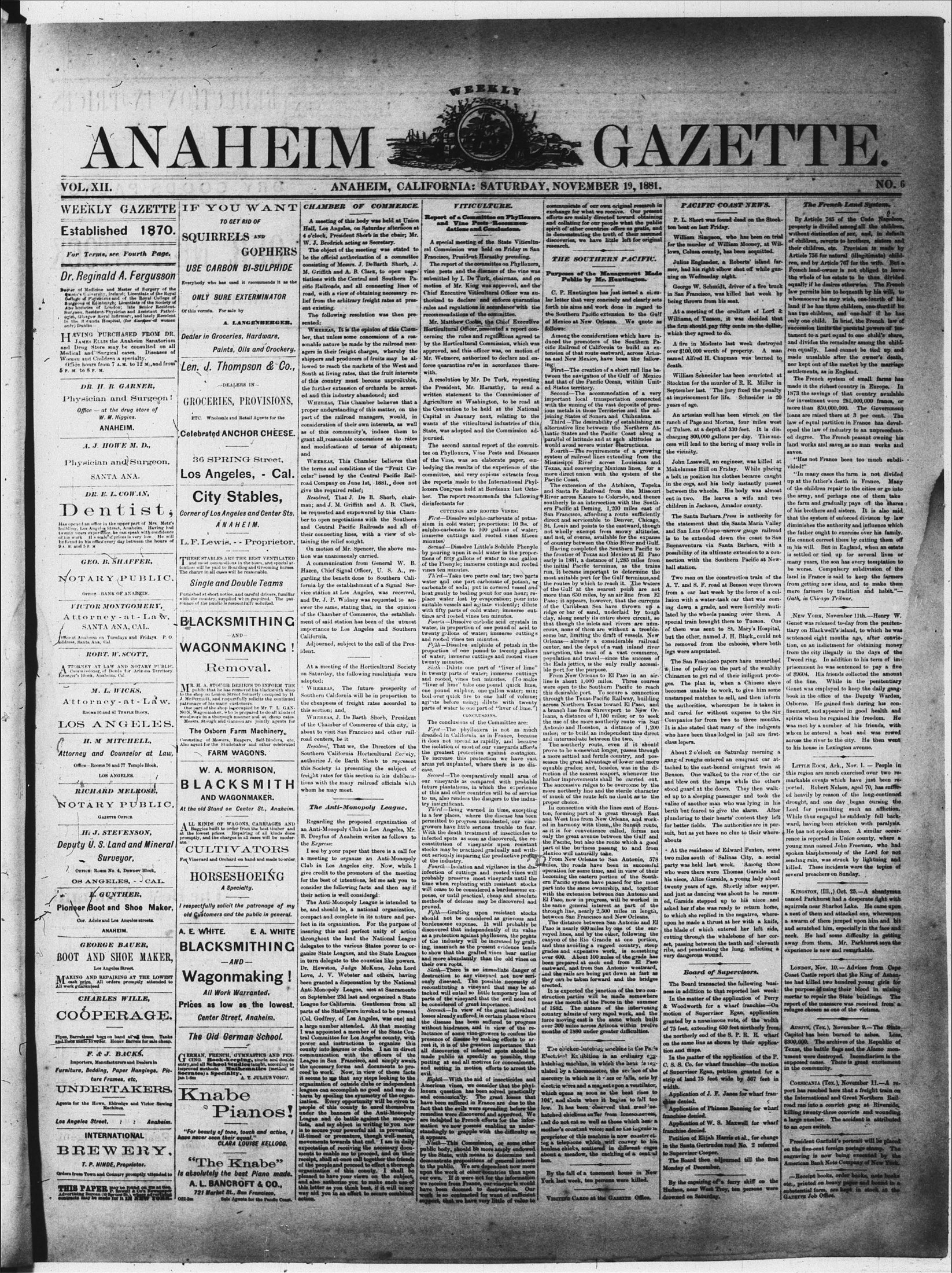
Searchable text
ANAHEIM
VOL. XII.
WEEKLY GAZETTE
Established 1870.
For Terms, see Fourth Page.
Dr. Reginald A. Fergusson
Doctor of Medicine and Master of Surgery of the Queen's University, Ireland; Licentiate of the Royal College of Physicians and of the Royal College of Surgeons of Edinburgh; Licentiate of the Society of Appreciaries of London; Late Senior Resident Nurse, Resident Physician and Assistant Pathologist, Glasgow Royal Infirmary, and lately Resident in the Rutunda Hospital (for diseases of women only) Dublin.
HAVING PURCHASED FROM DR. JAMES ELLIS the Anaheim Sanatorium and Drug Store may be consulted on all Medical and Surgical cases. Diseases of Women and Children a specialty.
Office hours from 7 A.M. to 12 M., and from 5 P.M. to 8 P.M.
DR. H. R. GARNER,
Physician and Surgeon!
Office — at the drug store of W. M. Higgins.
ANAHEIM.
A. J. HOWE M. D.,
Physician and Surgeon.
IF YOU WANT TO GET RID OF SQUIRRELS AND GOPHERS USE CARBON BI-SULPHIDE
Everybody who has used it recommends it as the ONLY SURE EXTERMINATOR Of this vermin. For sale by A. LANGENBERGER.
Dealer in Groceries, Hardware, Paints, Oils and Crockery.
Len. J. Thompson & Co.,
DEALERS INGROCERIES, PROVISIONS,
ETC. Wholesale and Retail Agents for the Celebrated ANCHOR CHÈSE.
36 SPRING Street,
Los Angeles - Cal.
DR. H. R. GARNER,
Physician and Surgeon!
Office — at the drug store of
W. M. Higgins.
ANAHEIM.
A. J. HOWE M. D.,
Physician and Surgeon.
SANTA ANA.
DR. E. L. COWAN,
Dentist,
Has opened an office in the upper part of Mrs. Metz's building, Los Angeles Street, Anaheim. Having had twenty years experience, he can speak with confidence of his work. His scale of prices is very low. He will be found in his office every day between the hours of 9 A.M. and 5 P.M.
GEO. B. SHAFFER,
NOTARY PUBLIC.
Office — BANK OF ANAHEIM.
VICTOR MONTGOMERY,
Attorney-at-Law,
SANTA ANA, CAL.
Office at Anaheim on Tuesdays and Fridays. P.O. Address, Santa Ana, Cal.
ROBT. W. SCOTT,
ATTORNEY AT LAW AND NOTARY PUBLIC.
Commissioner of Deeds for Arizona Territory.
Kroeger's Block, Anaheim, Cal.
M. L. WICKS,
Attorney-at-Law.
Rooms 86 and 87 Temple Block.
LOS ANGELES.
H. M MITCHELL,
Attorney and Counselor at Law,
Office — Rooms 76 and 77 Temple Block.
LOS ANGELES.
RICHARD MELROSE,
NOTARY PUBLIC.
GASETTE OFFICE.
H. J. STEVENSON,
Deputy U.S. Land and Mineral Surveyor,
Office: Room No. 4, Downev Block,
OS ANGELES, - - CAL.
L. GUNTHER,
DEALERS INGroceries, Provisions,
ETC. Wholesale and Retail Agents for the
Celebrated ANCHOR CHÈESE.
36 SPRING Street,
Los Angeles, - Cal.
City Stables,
Corner of Los Angeles and Center Sts.
ANAHEIM.
L. F. Lewis.- Proprietor.
THESE STABLES ARE THE BEST VENTILATED and most commodities in the town, and special attention will be paid to Boarding and Grooming horses.
Single and Double Teams
Purchased at short notice, and careful drivers, familiar with the country, supplied when required. The patronage of the public is respectfully solicited.
BLACKSMITHING
AND
WAGONMAKING!
Removal.
MR. H. A. STOUGH DESIRES TO INFORM THE public that he has removed his blacksmith shop to the shop on Lemon Street formerly occupied by H. J. McBernott, and respectfully solicits the continued patronage of his many customers.
One part of the shop is occupied by Mr. T. L. GAN-NON, Wagoonmaker, who is prepared to do all kinds of woodwork in a thorough manner and at cheap rates.
Messrs. Stough and Gannon are jointly agents for The Osborn Farm Machinery.
Consisting of Mowers, Reapers, Self-Binders, etc.
Also agent for the Studebaker and other celebrated FARM WAGONS.
W. A. MORRISON,
BLACKSMITH
AND WAGONMAKER.
At the old Stand on Center St., Anaheim.
ALL KINDS OF WAGONS, CARRIAGES AND Buggies built to order from the best timber and at the lowest prices. Repairing of all kinds done promptly, and the charges in all cases will be moderate.
CULTIVATORS
For Vineyard and Orchard on hand and made to order.
HORSESHOEING
A Specialty.
At a meeting of the on Saturday, the foll-
adopted:
WHEREAS, The Southern California wi
the cheapness of frei
this section; and,
WHEREAS, J. De B
of the Chamber of Co
about to visit San Fr
road centers, be it
Resolved, That we
Southern California authorize J. de Bart
this Society in pres
freight rates for this
tions with the many
whom he may meet.
The Anti-MonRegarding the proan Anti-Monopoly Clu
B. Dreyfus of Anaheim
the Express:
I see by your paper a meeting to organi
Club in Los Angeles give credit to the profor the best of intent consider the following their action is well co
NOTARY PUBLIC,
Gazette Office.
H. J. STEVENSON,
Deputy U. S. Land and Mineral Surveyor,
Office: Room No. 6, Downev Block,
OS ANGELES, - CAL.
E. GUNTHER,
Pioneer Boot and Shoe Maker,
Cor. Adele and Los Angeles streets.
ANAHEIM.
GEORGE BAUER,
BOOT AND SHOE MAKER,
Los Angeles Street.
MAKING AND REPAIRING AT THE LOWEST cash price. All orders promptly attended to. All work guaranteed.
CHARLES WILLE,
COOPERAGE.
Pipes, Barrels and kegs on hand at all times. Tanks and Tubs made to order. Honey Barrels for sale cheap.
F. & J. BACKS.
Importers, Manufacturers and Dealers in Furniture, Bedding, Paper Hangings, Picture Frames, etc.
UNDERTAKERS.
Agents for the Howe, Eldredge and Victor Sewing Machines.
Los Angeles Street.: Anaheim.
INTERNATIONAL BREWERY.
T. P. HINDE, Proprietor.
Orders from Town and Country promptly attended to.
THIS PAPER may be found on Site at Geo.
Advertising Bureau (10 Spruce St., where advertising contracts may be made for it IN NEW YORK.
AND WAGONMAKER.
At the old Stand on Center St., Anaheim.
ALL KINDS OF WAGONS, CARRIAGES AND Buggies built to order from the best timber and at the lowest prices. Repairing of all kinds done promptly, and the charges in all cases will be moderate.
CULTIVATORS
For Vineyard and Orchard on hand and made to order.
HORSESHOEING
A Specialty.
I respectfully solicit the patronage of my old Customers and the public in general.
A. E. WHITE.
E. A. WHITE
BLACKSMITHING
— AND —
Wagonmaking!
All Work Warranted.
Prices as low as the lowest.
Center Street, Anaheim.
The Old German School.
GERMAN, FRENCH, GYMNASTICS AND PENCING.
Book-keeping, single and double entry, and all School Studies taught, according to improved methods.
Mathematics (method of Secrates) Specialty.
Jan 1-6m
Knabe
Pianos!
"For beauty of tone, touch and action, I have never seen their equal."
CLARA LOUISE KELLOGG.
"The Knabe"
Is absolutely the best Piano made.
A. L. BANCROFT & CO.,
721 Market St., San Francisco,
Sales Agent for the Pacific Coast.
Regarding the provision of anti-Monopoly Clubs in Los Angeles, give credit to the provider for the best of intent to consider the following their action is well cohesive.
The Anti-Monopoly be, and should be, a compact and complete effect in its organization insuring this and passing throughout the land delegates to the various organize State Leagues, in turn delegate to the Dr. Hewston, Judge Love, J. V. Webster been granted a dispense Anti-Monopoly League on September 23d last League for California parts of the State weres (Col. Godfrey, of Los Angeles) a large number attendee I was appointed a central Committee for Law power and instruction county into leagues or communication with League in San Francisco the necessary forms are needed to work Now, it seems to me that an organization of outside leagues can accomplish harm by spoiling the organization. Every oppose people of this country under the banners of League and do battle lists, and my object is to secure your power ill-timed or premature movements towards the expectation of receiving items to enable me to receipt, shall at once call of the people and process this letter as you think way aid you in an effective action.
WEEKLY
EIM GA
ANAHEIM, CALIFORNIA: SATURDAY, NOVEMBER 19, 1881.
CHAMBER OF COMMERCE.
A meeting of this body was held at Union Hall, Los Angeles, on Saturday afternoon at 4 o'clock, President Shorb in the chair; Mr. W. J. Brodrick acting as Secretary.
The object of the meeting was stated to be the official authorization of a committee consisting of Messrs. J. DeBarth Shorb, J. M. Griffith and A. B. Clark, to open negotiations with the Central and Southern Pacific Railroads, and all connecting lines of road, with a view of obtaining necessary relief from the arbitrary freight rates at present existing.
The following resolution was then presented:
WHEREAS, It is the opinion of this Chamber, that unless some concessions of a reasonable nature be made by the railroad managers in their freight charges, whereby the shippers and producers of fruits may be allowed to reach the markets of the West and South at living rates, that the fruit interests of this country must become unprofitable, the further extension of orchards be arrested and this industry abandoned; and
WHEREAS, This Chamber believes that a proper understanding of this matter, on the part of the railroad managers, would, in consideration of their own interests, as well as of this community's, induce them to grant all reasonable concessions as to rates and modifications of terms of shipment; and
WHEREAS, This Chamber believes that the terms and conditions of the "Fruit Circulation" by the Central Pacific Railway.
VITICULTURE.
Report of a Committee on Phylloxera and Vine Pests—Recommendations and Conclusions.
A special meeting of the State Viticultural Commission was held on Friday in San Francisco, President Harazthy presiding.
The report of the committee on Phylloxera, vine pests and the diseases of the vine was submitted by L. De Turk, chairman, and motion of Mr. King was approved, and the Chief Executive Viticultural Officer was authorized to declare and enforce quarantine rules and regulations in accordance with the recommendations of the committee.
Mr. Matthew Cooke, the Chief Executive Horticultural Officer, presented a report concerning the rules and regulations agreed to by the Horticultural Commission, which was approved, and this officer was, on motion of Mr. Wetmore, authorized to declare and enforce quarantine rules in accordance therewith.
A resolution by Mr. De Turk, requesting the President, Mr. Harazthy, to send a written statement to the Commissioner of Agriculture at Washington, to be read at the Convention to be held at the National Capital in January next, relating to the wants of the viticultural industries of this State, was adopted and the Commission adjourned.
The second annual report of the committee on Phylloxera, Vine Pests and Diseases of the Vine, was an elaborate paper, embodying the results of the experience of the committee, and very conious extracts from communicate of our own original research in exchange for what we receive. Our present efforts are mainly directed toward obtaining and collating for our people what the public spirit of other countries offers us gratis, and in demonstrating the truth of their assumed discoveries, we have little left for original research.
THE SOUTHERN PACIFIC.
Purposes of the Management Made Public by Mr. Huntington.
C. P. Huntington has just issued a circular letter that very concisely and clearly sets forth his aims and work done in regard to the Southern Pacific extension to the Gulf of Mexico at New Orleans. We quote as follows:
Among the considerations which have induced the promoters of the Southern Pacific Railroad of California to build an extension of that route eastward, across Arizona and New Mexico, have been the following:
First—The creation of a short rail line between the navigation of the Gulf of Mexico and that of the Pacific Ocean, within United States territory.
Second—The accommodation of a very important local transportation connected with the mining of the vast deposits of precious metals in those Territories and the adjoining States of Sonora and Chihuahua.
Third—The desirability of establishing an alternative line between the Northern Atlantic States and the Pacific Coast along a parallel of latitude and at such altitudes as would avoid severe winter obstructions.
Fourth—The requirements of a growing system of railroad lines extending from the Mississippi River across Louisiana and Texas, and converging Mexican lines, for a more direct union with the system of the
At a meeting of the Horticultural Society on Saturday, the following resolutions were adopted:
Whereas, The future prosperity of Southern California will be in proportion to the cheapness of freight rates accorded to this section; and,
Whereas, J. De Barth Shorb, President of the Chamber of Commerce of this city, is about to visit San Francisco and other railroad centers, be it
Resolved, That we, the Directors of the Southern California Horticultural Society, authorize J. de Barth Shorb to represent this Society in presenting the subject of freight rates for this section in his deliberations with the many railroad officials with whom he may meet.
The Anti-Monopoly League.
Regarding the proposed organization of an Anti-Monopoly Club in Los Angeles, Mr. B. Dreyfus of Anaheim writes as follows to the Express:
I see by your paper that there is a call for a meeting to organize an Anti-Monopoly Club in Los Angeles city. Now, while I give credit to the promoters of the meeting for the best of intentions, let me ask you to consider the following facts and then say if their action is well considered:
A resolution by Mr. De Turk, requesting the President, Mr. Harazthy, to send a written statement to the Commissioner of Agriculture at Washington, to be read at the Convention to be held at the National Capital in January next, relating to the wants of the viticultural industries of this State, was adopted and the Commission adjourned.
The second annual report of the committee on Phylloxera, Vine Pests and Diseases of the Vine, was an elaborate paper, embodying the results of the experience of the committee, and very copious extracts from the reports made to the International Phylloxera Congress held at Bordeaux last October. The report recommends the following disinfectants for CUTTINGS AND ROOTED VINES:
First—Dissolve sulpho-carbonate of potassium in cold water; proportions: 10 lbs. of sulpho-carbonate to 100 gallons of water; immerse cuttings and rooted vines fifteen minutes.
Second—Dissolve Little's Soluble Phenyle by pouring upon it cold water in the proportions of nitry gallons of water to one gallon of the Phenyle; immerse cuttings and rooted vines ten minutes.
Third—Take two parts coal tar; two parts water and one part carbonate of potash, or carbonate of soda; put in covered vessel and heat gently to boiling point for one hour; replace water lost by evaporation; pour into suitable vessels and agitate violently; dilute with fifty parts of cold water; immerse cuttings and rooted vines ten minutes.
Fourth—Dissolve carbolic acid crystals in water, in proportion of one pound of acid to twenty gallons of water; immerse cuttings and rooted vines ten minutes.
Fifth—Dissolve sulphide of potash in the proportion of one pound to twenty gallors of water; immerse cuttings and rooted vines twenty minutes.
Sixth—Dilute one part of "liver of lime" in twenty parts of water; immerse cuttings and rooted vines ten minutes. (To make "liver of lime" take one pound quick line, one pound sulphur, one gallon water; mix; boil over quick fire to one half of volume; agitate before using; dilute with twenty parts of water to one part of "liver of lime.")
CONCLUSIONS.
The conclusions of the Committee are:
First—The phylloxera is not as much dreaded in California as in France, because it does not spread as rapidly, and because the isolation of most of our vineyards affords the greatest protection against contagion. To increase this protection we have vast areas yet unplanted, where there is no disease.
Second—The comparatively small area of our vineyards as compared with probable future plantations, in which the experience of this and other countries will be of service to us, also renders the dangers to the industry insignificant.
Third—Being warned in time, excepting in a few places, where the disease has been permitted to progress unmolested, our vinegrowers have little serious trouble to fear. With the death treatment of insecticides to infected spots as soon as discovered, the reconstitution of vineyards upon resistant stocks may be practiced gradually and without seriously impairing the productive power of the industry.
Fourth—Isolation and vigilance in the disinfection of cuttings and rooted vines will probably preserve most vineyards until the time when replanting with resistant stocks will cease to be considered a burdensome expense, or until practical, cheap and absolute
between the navigation of the Gulf of Mexico and that of the Pacific Ocean, within United States territory.
Second—The accommodation of a very important local transportation connected with the mining of the vast deposits of precious metals in those Territories and the adjoining States of Sonora and Chihuahua.
Third—The desirability of establishing an alternative line between the Northern Atlantic States and the Pacific Coast along a parallel of latitude and at such altitudes as would avoid severe winter obstructions.
Fourth—The requirements of a growing system of railroad lines extending from the Mississippi River across Louisiana and Texas, and converging Mexican lines, for a more direct union with the system of the Pacific Coast.
The extension of the Atchison, Topeka and Santa Fe Railroad from the Missouri River across Kansas to Colorado, and thence southerly to an intersection with the Southern Pacific at Deming, 1,200 miles east of San Francisco, affording a route sufficiently direct and serviceable to Denver, Chicago, St. Louis and points to the eastward, though not wholly exempt from snowy altitudes, and not, of course, available for the expanse of country between the Ohio River and Gulf.
Having completed the Southern Pacific to the frontier of Texas and Mexico at El Paso early in 1881, a distance of 1,285 miles from the initial Pacific terminus, as the trains run, it became important to determine the most suitable port for the Gulf terminus,and the routes by which to reach it. The waters of the Gulf at the nearest point are not more than 650 miles, by an air line from El Paso; it appears, however, that the currents of the Caribbean Sea have thrown up a ridge or bar of sand, underlaid by tough clay, along nearly its entire shore circuit, so that though the inlets and rivers are numerous, none of them are without a troublesome bar, limiting the draft of vessels. New Orleans—already a considerable railroad center, and the depot of a vast inland river navigation,the seat of a vast commerce,population and travel—since the successof the Eads jetties is,the only really accessible port for the purpose.
From New Orleans to El Paso in an airline is about 1,000 miles. Three courses were open to the Southern Pacific to reach this desirable port. To secure a connection through the Texas-Pacific Railway,building across Northern Texas toward El Paso,and a branch line from Shreveport to New Orleans,a distance of 1,150 miles;or to seek use of the more southerly route via San Antonio and Houston,a distance of 1,200 miles;or to build an independent tine direct and intermediate between the two.
The southerly route,even if it should prove to be somewhat longer,passes through a more settled and fertile country,and possesses the great advantage of lower and more equable grades;and,b besides,d was in the direction of the nearest seaport,wheneverthe harbor improvements shall be carried out.The successive ridges to be overcome bythe more northerly line and the sterile characterof much of the route left no doubt as tothe proper choice.
In connection with the lines east of Houston,forming part of a great through Eastand West line from New Orleans,and worked in harmony with them,the Sunset route,ait is for convenience called.forms not onlythe great avenue betweenthe Gulfandthe Pacific,但alsothe routewhicha good partofthe businesspassingtoandfromMexicowillnaturallytake.
From New Orleans to San Antonio,578 miles,the roads have been in successful operation for some time,and in viewof their becomingthe eastern portionofthe SouthernPacific system have passedforthe mostpartintothe same ownership,and,togetherwiththeextensionbetweenSanAntonioandElPasowillinprogresswillbeworkedin
Regarding the proposed organization of an Anti-Monopoly Club in Los Angeles, Mr. B. Dreyfus of Anaheim writes as follows to the Express:
I see by your paper that there is a call for a meeting to organize an Anti-Monopoly Club in Los Angeles city. Now, while I give credit to the promoters of the meeting for the best of intentions, let me ask you to consider the following facts and then say if their action is well considered:
The Anti-Monopoly League is intended to be, and should be, a national organization, compact and complete in its nature and perfect in its organization. For the purpose of insuring this and perfect unity of action throughout the land the National League delegates to the various States power to organize State Leagues, and the State Leagues in turn delegate to the counties like powers. Dr. Hewston, Judge McKune, John Lord Love, J. V. Webster and others, having been granted a dispensation by the National Anti-Monopoly League, met at Saeramento on September 23rd last and organized a State League for California. Gentlemen from all parts of the State were invoked to be present (Col. Godfrey, of Los Angeles, was one) and a large number attended. At that meeting I was appointed a member of the State Central Committee for Los Angeles county, with power and instructions to organize this county into leagues or clubs. I am in direct communication with the officers of the League in San Francisco, and simply await the necessary forms and documents to proceed to work. Now, in view of these facts it seems to me that any steps looking to the organization of outside clubs or independent leagues can accomplish no good and may do harm by spoiling the symmetry of the organization. Every opportunity will be given to people of this county to enrol themselves under the banners of the Anti-Monopoly League and do battle against the monopolists, and my object in writing to you now is to secure your powerful aid in preventing ill-timed or premature, though well-meant, movements towards that end. I am in daily expectation of receiving the necessary documents to enable me to proceed, and on their receipt, shall at once call together the friends of the people and proceed to effect a thorough organization of this county. I shall be pleased to have your views on the subject, and also authorize you to make such use of this letter as you think best, if it will in any way aid you in an effort to secure combined action.
Third—Being warned in time, excepting in a few places, where the disease has been permitted to progress unmolested, our vinegrowers have little serious trouble to fear. With the death treatment of insecticides to infected spots as soon as discovered, the reconstitution of vineyards upon resistant stocks may be practiced gradually and without seriously impairing the productive profit of the industry.
Fourth—Isolation and vigilance in the disinfection of cuttings and rooted vines will probably preserve most vineyards until the time when replanting with resistant stocks will cease to be considered a burdensome expense, or until practical, cheap and absolute methods of defense may be discovered and proved.
Fifth—Grafting upon resistant stocks should not be considered as grievous and burdensome expense. It will probably be discovered that independently of its value as a protection against phylloxera, the profts of the industry will be increased by grafting, inasmuch as the present evidence tends to show that the grafted vines bear earlier and more abundantly than the old vines on their own roots.
Sixth—There is no immediate danger of destruction to any vineyard not now seriously diseased. The possible necessity of reconstituting a vineyard that may be attacked will entail so little temporary loss of parts of the vineyard that the evil need not be considered of great importance.
Seventh—In view of the great individual losses already suffered in certain places where the disease has been suffered to progress without hindrance, and in view of the reluctance of some vine-growers to confess the presence of disease by making efforts to arrest it, it is of the greatest importance that all discoveries of infested spots should be made public as speedily as possible, thus putting at end all motives for concealment, and setting in motion efforts to arrest the evil.
Eighth—With the aid of insecticides and American vines, we consider that the phylloxera question has been solved practically and economically. The great losses that have been suffered in France are due to the fact that the evils were spreading before the remedies were discovered and approved. We are indebted to French efforts for the information we now possess enabling us understandingly to grapple with the difficulty as it appears.
Ninth—This Commission, or some other public body, should be more amply endowed by the State, with means to determine and demonstrate propositions of general interest to the public. We are dependent now more upon the work of other countries than upon our own. If it were not for the information we receive from France, our vineyard is would have been doomed to destruction. Our work is so contracted for want of sufficient support, that we have very little of value to
In connection with the lines east of Houston, forming part of a great through East and West line from New Orleans, worked in harmony with them, the Sunset route, as it is for convenience called, forms not only the great avenue between the Gulf and the Pacific, but also the route which a good part of the business passing to and from Mexico will naturally take.
From New Orleans to San Antonio, 578 miles, the roads have been in successful operation for some time, and in view of their becoming the eastern portion of the Southern Pacific system have passed for the most part into the same ownership, and together with the extension between San Antonio and El Paso, now in progress, will be worked in the same general interest as part of the through line, nearly 2,500 miles in length, between San Francisco and New Orleans.
The distance between San Antonio and El Paso is nearly 600 miles by one of the surveyed lines, and by the other, following the canyon of the Rio Grande at one portion, and thus avoiding a rugged country, steep grades and expensive work, is something over 600. About 100 miles of the grade has been prepared at each end from El Paso eastward, and from San Antonio westward, and the rails are being put down as fast as they can be taken forward and the bridges erected.
It is expected that the junction of the two construction parties will be made somewhere near the mouth of the Pecos in the summer of 1882. The nature of the intervening country admits of very rapid work, and the force moving east is the same which built over 300 miles across Arizona within twelve months of 1880 under greater difficulties.
The chicken-hatching machine in the Paris Electrical Exhibition is an ordinary egg-hatching machine, in which the heat is regulated by a thermometer, the surface of the mercury in which it rises or falls acts by electric wires and a magnet upon a ventilator, which opens as soon as the heat rises to 104°, and shuts when it begins to fall too low. It has been observed that machine-hatched chickens suffer from lonesomess, and do not eat so well as those which bear a mother's constant voice; and so that ingenio is proprietor of this machine is now constructing a telephone which will convey to his heless chicks, scattered in different cages about a meadow, the cackling of a central hen.
By the fall of a tanement house in New York last week, tan persons were killed.
VISITING CARDS at THE GARDEN OFFICE.
GAZETTE.
BER 19, 1881.
NO. 6
PACIFIC COAST NEWS.
P. L. Short was found dead on the Stockton boat on last Friday.
William Simpson, who has been on trial for the murder of William Mooney, at Willows, Colusa county, has been acquitted.
Julius Englander, a Roberta' island farmer, had his right elbow shot off while gunning on Wednesday night.
George W. Schmidt, driver of a fire truck in San Francisco, was killed last week by being thrown from his seat.
At a meeting of the creditors of Lord & Williams, of Tucson, it was decided that the firm should pay fifty cents on the dollar, which they agreed to do.
A fire in Modesto last week destroyed over $100,000 worth of property. A man named Alfred H. Chapman was burned to death.
William Schneider has been convicted at Stockton for the murder of R. E. Miller in September last. The jury fixed the penalty at imprisonment for life. Schneider is 20 years of age.
An artesian well has been struck on the ranch of Page and Morton, four miles west of Tulare, at a depth of 330 feet. It is discharging 800,000 gallons per day. This success will lead to the boring of many wells in the vicinity.
John Lasswell, an engineer, was killed at Mokelumne Hill on Friday. While placing
The French Land System.
By Article 745 of the Code Napoleon, property is divided among all the children, without distinction of sex, and, in default of children, reverts to brothers, sisters and their children, etc. Provision is made by Article 756 for natural (illegitimate) children, and by Article 767 for the wife. But a French land-owner is not obliged to leave the whole of his estate to be thus divided equally if he desires otherwise. The French law permits him to bequeath by his will, to whomsoever he may wish, one-fourth of his land if he has three children, one-third if he has two children, and one-half if he has only one child. In brief, the French law of succession limits the parental powers of testament to a part equal to one child's share, and divides the remainder among the children equally. Land cannot be tied up and made unsalable after the owner's death, nor kept out of the market by the marriage settlements, as in England.
The French system of small farms has made it the richest country in Europe. In 1873 the savings of that country available for investment were 281,000,000 francs, or more than $50,000,000. The Government loans are raised there at 3 per cent. The law of equal partition in France has developed the law of industry to an unprecedented degree. The French peasant owning his land works and saves as no man works and saves.
"Has not France been too much subdivided?"
William Schneider has been convicted at Stockton for the murder of R. E. Miller in September last. The jury fixed the penalty at imprisonment for life. Schneider is 20 years of age.
An artesian well has been struck on the ranch of Page and Morton, four miles west of Tulare, at a depth of 330 feet. It is discharging 800,000 gallons per day. This success will lead to the boring of many wells in the vicinity.
John Lasswell, an engineer, was killed at Mokelumne Hill on Friday. While placing a bolt in position his clothes became caught in the cogs, and his body instantly passed between the wheels. His body was almost cut in two. He leaves a wife and two children in Jackson, Amador county.
The Santa Barbara Press is authority for the statement that the Santa Maria Valley and San Luis Obispo narrow gauge railroad is to be extended down the coast to San Buenaventura via Santa Barbara, with a possibility of its ultimate extension to a connection with the Southern Pacific at Newhall station.
Two men on the construction train of the A. T. and S. F. road at Benson were thrown from a car last week by the force of a collision with a water-tank car that was coming down a grade, and were horribly mutilated by the wheels passing over them. A special train brought them to Tucson. One of them was sent to St. Mary's Hospital, but the other, named J. H. Black, could not be removed from the caboose, where both legs were amputated.
The San Francisco papers have unearthed a line of policy on the part of the wealthy Chinamen to get rid of their indigent proteges. The plan is, when a Chinese slave becomes unable to work, to give him some unstamped matches to sell, and then inform the authorities, whereupon he is taken in and cared for without expense to the Six Companies for from two to three months. It is also stated that many of the indigents who have been thus lodged in jail are first-class lepers.
About 2 o'clock on Saturday morning a gang of roughs entered an emigrant train at Benson. One walked to the rear of the car and blew out the lamps while the others stood guard at the doors. They then walked up to a sleeping passenger and took the valise of another man who was lying in his berth but feared to give the alarm. After plundering to their hearts' content they left for better fields. The authorities are in pursuit, but as yet have no clue to their whereabouts.
At the residence of Edward Fenton, some two miles south of Salinas City, a social party was held last week. Among those who were there were Thomas Garside and his niece, Alice Garside, a young lady about twenty years of age. Shortly after supper, and just as dancing was about to be resumed, she made it the richest country in Europe. In 1873 the savings of that country available for investment were 281,000,000 francs, or more than $50,000,000. The Government loans are raised there at 3 per cent. The law of equal partition in France has developed the law of industry to an unprecedented degree. The French peasant owning his land works and saves as no man works and saves.
"Has not France been too much subdivided?"
In many cases the farm is not divided up at the father's death in France. Many of the children repair to the cities or go into the army, and perhaps one of them take the farm and gradually pays off the shares of his brothers and sisters. It is also said that the system of enforced division by law diminishes the authority and influence which the father ought to exercise over his family. He cannot correct them by cutting them off in his will. But in England, when an estate is settled or tied up for several lives or many years, the son has every temptation to be worse. Compulsory subdivision of the land in France is said to keep the farmers from getting new ideas, and to make them mere farmers by tradition and habit."—Gath, in Chicago Tribune.
New York, November 11th.—Henry W. Genet was released to-day from the penitentiary on Blackwell's island, to which he was sentenced eight months ago, after conviction, on an indictment for obtaining money from the city illegally in the days of the Tweed ring. In addition to his term of imprisonment he was sentenced to pay a fine of $9604. His friends collected the amount of the fine. While in the penitentiary Genet was employed to keep the daily gangbook in the office of the Deputy Warden, Osborne. He gained flesh during his confinement, and appeared in good health and spirits when he regained his freedom. He was met by a number of his friends, with whom he entered a boat and was rowed across the river to the city. He then went to his house in Lexington avenue.
Little Rock, Ark., Nov. 1. — People in this region are much exercised over two remarkable events which have just been reported. Robert Nelson, aged 70, has suffered heavily by reason of the long-continued drought, and one day began cursing the Lord for permitting such an affliction. While thus engaged he suddenly fell backward, having been stricken with paralysis. He has not spoken since. A similar occurrence is reported in Union county, where a young man named John Freeman, who had spoken blasphemously of the Lord for not sending rain, was struck by lightning and killed. These incidents were the topics of several preachers on Sunday.
Kingston, (Ill.), Oct. 25.—A shantyman named Parkhurst had a desperate fight with
At the residence of Edward Fenton, some two miles south of Salinas City, a social party was held last week. Among those who were there were Thomas Garside and his niece, Alice Garside, a young lady about twenty years of age. Shortly after supper, and just as dancing was about to be resumed, Garside stepped up to his niece and asked her if she was ready to return home, to which she replied in the negative, whereupon he made a thrust at her with a knife, the blade of which entered her left side, cutting through the whalebone of her corset, passing between the tenth and eleventh ribs, and penetrating the lung, inflicting a very dangerous wound.
Board of Supervisors.
The Board transacted the following business in addition to that reported last week:
In the matter of the application of Perry & Woodworth for a wharf franchise—On motion of Supervisor Egan, application granted by a unanimous vote, of the width of 75 feet, extending 650 feet northerly from the northerly end of the S. P. R. K. wharf on the same line as shown by their application and maps.
In the matter of the application of the P. C. S. S. Co. for wharf franchise—On motion of Supervisor Egan, petition granted for a strip of land 75 feet wide by 567 feet in width.
Application of J. F. Janes for wharf franchise denied.
Application of Phineas Banning for wharf franchise denied.
Application of W. S. Maxwell for wharf franchise denied.
Petition of Elijah Harris et al., for change in the Santa Gertrudes road No. 2 referred to Supervisor Cooper.
The Board then adjourned till the first Monday of December.
By the capizing of a ferry skiff on the Hudson, near West Troy, ten persons were drowned on Saturday.
Kingston, (Ill.) Oct. 25.—A shantyman named Parkhurst had a desperate fight with squirrels near Sharbot Lake. He came upon a nest of them and attacked one, whereupon a swarm of them jumped upon him and bit and scratched him, especially in the face and neck. He had some difficulty in getting away from them. Mr. Parkhurst says the experience is new and remarkable.
London, Nov. 10.—Advices from Cape Coast Castle report that the King of Ashantee had killed two hundred young girls for the purpose of using their blood in mixing mortar to repair the State buildings. The report of the massacre was received from a refugee chosen as one of the victims.
Austin, (Tex.), November 9.—The State Capitol has been burned to ashes. Loss $300,000. The archives of the Republic of Texas, the battle flags and the Alamo monument were destroyed. Incendiarism is the supposed cause. There is great excitement in the community.
Corsicania (Tex.), November 11.—A report has reached here that a freight train on the International and Great Northern Railroad ran into a convict gang at Riverside, killing twenty-three convicts and wounding a large number. The accident is attributed to an open switch.
President Garfield's portrait will be placed on the five-cent foreign postage stamp. The engraving is now being executed by the American Bank Note Company of New York.
—Receipt books, order books, note books etc., printed on heavy paper and bound in a substantial form, are kept in stock at the Gazette Job Office.