anaheim-gazette 1881-11-12
Scanned page
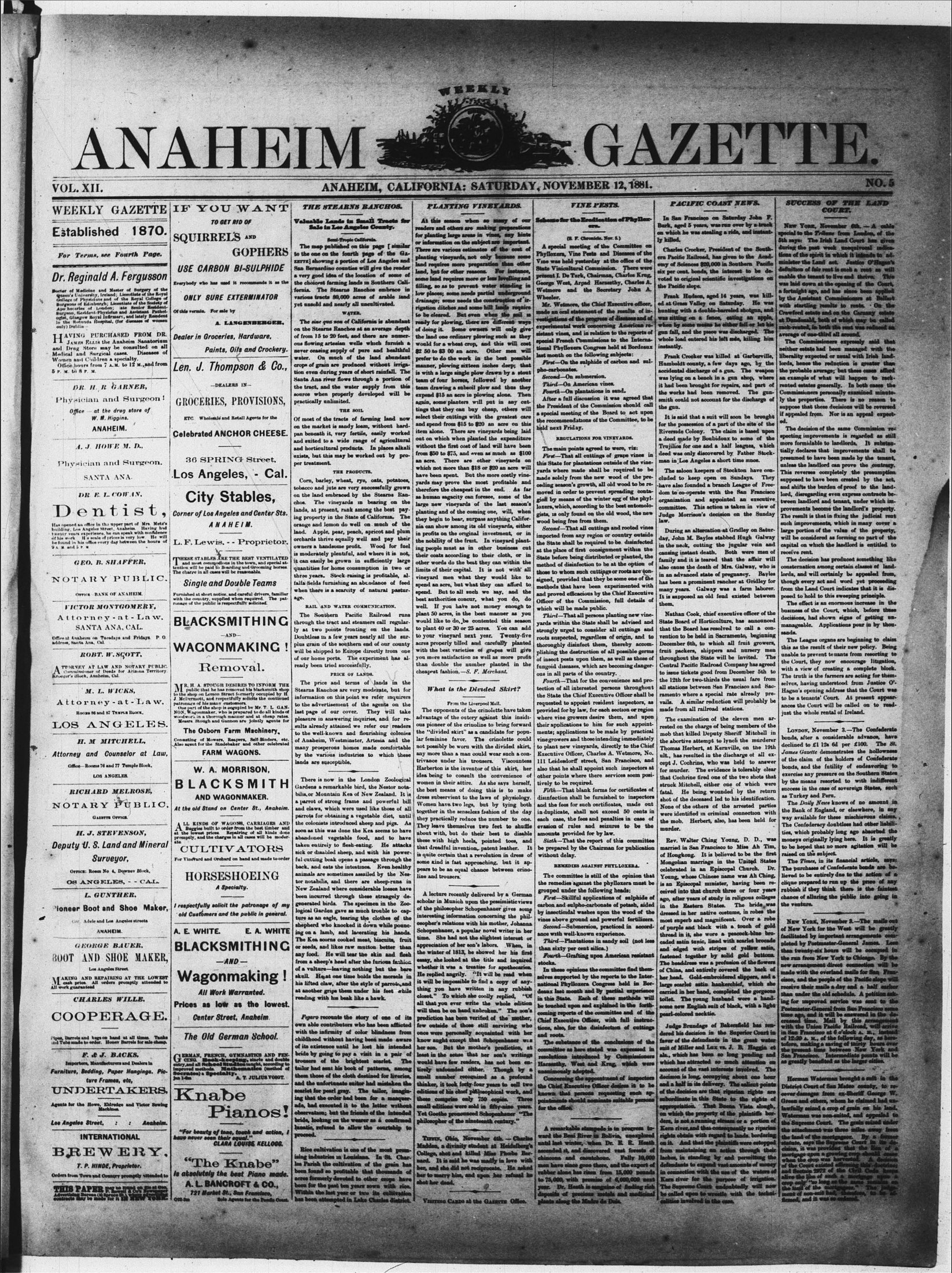
Searchable text
ANAHEIM
VOL. XII.
WEEKLY GAZETTE
Established 1870.
For Terms, see Fourth Page.
Dr. Reginald A. Fergusson
Doctor of Medicine and Master of Surgery of the Queen's University, Ireland; Licentiate of the Royal College of Physicians and of the Royal College of Surgeons of Edinburgh; Licentiate of the Society of Apothecaries of London; late Senior Resident-Surgeon, Resident-Physician and Assistant Pathologist, Glasgow Royal Infirmary, and lately Rendent in the Rotunda Hospital, (for diseases of women only) Dublin.
HAVING PURCHASED FROM DR. JAMES ELLIS the Anaheim Sanatorium and Drug Store may be consulted on all Medical and Surgical cases. Diseases of Women and Children a specialty.
Office hours from 7 A.M. to 12 M., and from 5 P.M. to 8 P.M.
DR. H. R GARNER,
Physician and Surgeon!
Office — at the drug store of W. M. Higgins.
ANAHEIM.
A. J. HOWE M. D.
Physician and Surgeon.
IF YOU WANT TO GET RID OF SQUIRRELS AND GOPHERS USE CARBON BI-SULPHIDE
Everybody who has used it recommends it as the ONLY SURE EXTERMINATOR Of this vermin. For sale by A. LANGENBERGER.
Dealer in Groceries, Hardware.
Paints, Oils and Crockery.
Len. J. Thompson & Co.,
—DEALERS IN—
GROCERIES, PROVISIONS,
ETC. Wholesale and Retail Agents for the Celebrated ANCHOR CHEESE.
36 SPRING Street,
Los Angeles - Cal
THE STEARNE
Valuable Lands in Sale in Los Angeles
Semi-Tropic
The map published on to the one on the fourteenth showing a portion San Bernardino counties a very good idea of the choice farming land formia. The Stearns Various tracts 80,000 yet unsold and nearly a water.
The sine qua non of on the Stearns Ranchos of from 15 to 20 feet, amous flowing artesian we never ceasing supply of water. On much of crops of grain are production even during years of Santa Ana river flows the tract, and the water source when properly practically unlimited.
THE S
Of most of the tracts on the market is sandy pan beneath it, very few and suited to a wide range and horticultural product exists, but this may be per treatment.
DR. H. R GARNER,
Physician and Surgeon!
Office — at the drug store of
W. M. Higgins.
ANAHEIM.
A. J. HOWE M. D.
Physician and Surgeon.
SANTA ANA.
DR E. L. COWAN.
Dentist.
Has opened an office in the upper part of Mrs. Meta's building, Los Angeles Street, Anaheim. Having had twenty years experience, he can speak with confidence of his work. If a scale of prices is very low, He will be found in his office every day between the hours of 9 A.M. and 5 P.M.
GEO. B. SHAFFER,
NOTARY PUBLIC.
OFFICE — BANK OF ANAHEIM.
VICTOR MONTGOMERY,
Attorney-at-Law,
SANTA ANA, CAL.
Office at Anaheim on Tuesdays and Fridays. P.O. address, Santa Ana, Cal.
ROBT. W. SCOTT.
ATTORNEY AT LAW AND NOTARY PUBLIC.
Commissioner of Deeds for Arizona Territory: Kroeger's Block, Anaheim, Cal.
M. L. WICKS,
Attorney-at-Law,
Rooms 86 and 87 Temple Block.
LOS ANGELES.
H. M MITCHELL,
Attorney and Counselor at Law,
Office — Rooms 76 and 77 Temple Block.
LOS ANGELES.
RICHARD MELROSE,
NOTARY PUBLIC.
GAETTE'S OFFICE.
H. J. STEVENSON,
Deputy U. S. Land and Mineral Surveyor,
Office: Room No 4, Downey Block,
OS ANGELES, - - CAL.
L. GUNTHER.
DEALERS IN—
GROCERIES, PROVISIONS,
ETC. Wholesale and Retail Agents for the
Celebrated ANCHOR CHEESE.
36 SPRING Street,
Los Angeles, - Cal.
City Stables,
Corner of Los Angeles and Center Sts.
ANAHEIM.
L. F. Lewis, -- Proprietor.
THESE STABLES ARE THE REST VENTILATED
and most commodious in the town, and special attention will be paid to Boarding and Grooming horses.
The charge in all cases will be reasonable.
Single and Double Teams
Furnished at short notice, and careful drivers, familiar with the country, supplied when required. The patronage of the public is respectfully solicited.
BLACKSMITHING
AND
WAGONMAKING !
Removal.
MR. H. A. STOUGH DESIRES TO INFORM THE
public that he has removed his blacksmith shop to the shop on Lemon Street formerly occupied by H. J. Melbermott, and respectfully solicits the continued patronage of his many customers.
One part of the shop is occupied by Mr. T. L. GAN-NON, Wagoonmaker, who is prepared to do all kinds of woodwork in a thorough manner and at cheap rates.
Messrs Stough and Gannon are jointly agents for The Osborn Farm Machinery.
Consisting of Mowers, Reapers, Self-Binders, etc.
Also agent for the Studebaker and other celebrated FARM WAGONS.
W. A. MORRISON,
BLACKSMITH
AND WAGONMAKER.
At the old Stand on Center St., Anaheim.
ALL KINDS OF WAGONS, CARRIAGES AND Buggies built to order from the best timber and at the lowest prices. Repairing of all kinds done promptly, and the charges in all cases will be moderate.
CULTIVATORS
For Vineyard and Orchard on hand and made to order
HORSESHOEING
A Specialty.
Of most of the tracts owe on the market is sandy pan beneath it, very few and suited to a wide range of horticultural products exists, but this may be per treatment.
THE PROCorn, barley, wheat, tobacco and jute are very on the land embraced by chos. The vineyards lands, at present, rank in property in the State orange and lemon do well land. Apple, pear, peach orchards thrive equally among owners a handsome profit is moderately plentiful; it can easily be grown quantities for home construction three years. Stock-raisersalfa fields furnishing an when there is a scarcity age.
RAIL AND WATER O
The Southern Pacific through the tract and stily at two points from Doubtless in a few years plus grain of the southern will be shipped to Europe of our home ports. This ready been tried successes.
PRICE OF
The price and terms Stearns Ranchos are very information on this point to the advertisement of last page of our cover pleasure in answering itsults already attained wto the well-known and of Anaheim, Westminster many prosperous homes by the various industries lands are susceptible.
There is now in the Gardens a remarkable bibilis, or Mountain Kea a parrot of strong frame and claws, which were parrots for obtaining a the colonists introduced soon as this was done to abandoned vegetable taken entirely to flesh-sick or disabled sheep, ful cutting beak opens back, and eats the inte animals are sometimes notabilis, and there New Zealand where could been incurred through
NOTARY PUBLIC,
GAETTE OFFICE.
H. J. STEVENSON,
Deputy U. S. Land and Mineral Surveyor,
Office: Room No 4, Downev Block,
OS ANGELES, - CAL.
L. GUNTHER.
Pioneer Boot and Shoe Maker,
Cor. Adele and Los Angeles streets.
ANAHEIM.
GEORGE BAUER.
BOOT AND SHOE MAKER,
Los Angeles Street.
MAKING AND REPAIRING AT THE LOWEST
cash price. All orders promptly attended to
All work guaranteed.
CHARLES WILLE.
COOPERAGE.
Pipes, Barrels and kegs on hand at all times. Tanks
and Tubes made to order. Honey Barrels for sale cheap.
F. & J. BACKS.
Importers, Manufacturers and Dealers in
Furniture, Bedding, Paper Hangings. Picture Frames, etc,
UNDERTAKERS.
Agents for the Howe, Eldredge and Victor Sewing Machines.
Los Angeles Street, : Anaheim.
INTERNATIONAL
BREWERY.
T. P. HINDE, Proprietor.
Orders from Town and Country promptly attended to
THIS PAPER may not be found on file at Can.
Advertising Bureau (10 Spruce St.), where advertising contracts may be made for it in New York.
At the old Stand on Center St., Anaheim.
ALL KINDS OF WAGONS, CARRIAGES AND Buggies built to order from the best timber and at the lowest prices. Repairing of all kinds done promptly, and the charges in all cases will be moderate.
CULTIVATORS
For Vineyard and Orchard on hand and made to order
HORSESHOEING
A Specialty.
I respectfully solicit the patronage of my old Customers and the public in general.
A. E. WHITE.
E. A. WHITE
BLACKSMITHING
—AND—
Wagonmaking!
All Work Warranted.
Prices as low as the lowest.
Center Street, Anaheim.
The Old German School.
GERMAN, FRENCH, GYMNASTICS AND PENCING.
Hook-keeping, single and double entry, and all School Studies taught, according to improved methods.
Mathematics (method of Secrets) a Specialty.
Jan 1-dm
Knabe
Pianos!
"For beauty of tone, touch and action, I have never seen their equal."
CLARA LOUISE KELLOGG.
"The Knabe"
is absolutely the best Piano made.
A. L. BANCROFT & CO.,
721 Market St., San Francisco,
Role Agents for the Pacific Coast.
Figaro recounts the own able contributors with the infirmity of childhood without having of its existence until his bride by going to pay trousers of the bright tailor had sent his book them those of the cloth and the unfortunate suit scarlet for pearl gray.
ing that the order had made, had executed it to observation; but the fright bride, looking on the wunatic, refused to allow proceed.
Rice cultivation is ongoing industries in Louisville Parish the cultivation been found so profitable acres formerly devoted been for the past ten years Within the last year or has been attempted in
THE STEARNS RANCHOS.
Valuable Lands in Small Tracts for Sale in Los Angeles County.
Semi-Tropic California.
The map published on this page [similar to the one on the fourth page of the Gazette] showing a portion of Los Angeles and San Bernardino counties will give the reader a very good idea of the location of some of the choicest farming lands in Southern California. The Stearns Ranchos embrace in various tracts 80,000 acres of arable land yet unsold and nearly all uncultivated.
WATER.
The sine qua non of California is abundant on the Stearns Ranchos at an average depth of from 15 to 20 feet, and there are numerous flowing artesian wells which furnish a never ceasing supply of pure and healthful water. On much of the land abundant crops of grain are produced without irrigation even during years of short rainfall. The Santa Ana river flows through a portion of the tract, and the water supply from this source when properly developed will be practically unlimited.
THE SOIL.
Of most of the tracts of farming land now on the market is sandy loam, without hardpan beneath it, very fertile, easily worked and suited to a wide range of agricultural and horticultural products. In places alkali exists, but this may be worked out by proper treatment.
THE PRODUCTS.
PLANTING VINEYARDS.
At this season when so many of our readers and others are making preparations for planting large areas in vines, any hints or information on the subject are important. There are various estimates of the cost of planting vineyards, not only because some land requires more preparation than other land, but for other reasons. For instance, some land requires more or less levelling and filling, so as to prevent water standing in low places; some needs partial underground drainage; some needs the construction of irrigation ditches and some hill lands require to be cleared. But even when the soil is ready for plowing, there are different ways of doing it. Some owners will only give the land one ordinary plowing such as they would for a wheat crop, and this will cost $2 50 to $3 00 an acre. Other men will prefer to do the work in the best possible manner, plowing sixteen inches deep; that is with a large single plow drawn by a stout team of four horses, followed by another team drawing a subsoil plow and thus they expend $15 an acre in plowing alone. Then again, some planters will put in any cuttings that they can buy cheap, others will select their cuttings with the greatest care and spend from $15 to $20 an acre on this item alone. There are vineyards being laid out on which when planted the expenditure without the first cost of land will have been from $50 to $75, and even as much as $100 an acre. There are other vineyards on which not more than $18 or $20 an acre will have been spent. But the more costly vine-
VINE PESTS.
Scheme for the Eradication of Phylloxera.
(B. F. Chronicle. Nov. 5.)
A special meeting of the Committee on Phylloxera, Vine Pests and Diseases of the Vine was held yesterday at the office of the State Vinicultural Commission. There were present I. De Turk, Chairman, Charles Krug, George West, Arpad Harasathy, Charles A. Wetmore and the Secretary John A. Wheeler.
Mr. Wetmore, the Chief Executive officer, made an oral statement of the results of investigations of the progress of diseases and of experimental work concerning American resistant vines, and in relation to the reports of special French Commissions to the International Phylloxera Congress held at Bordeaux last month on the following subjects:
First—On the sulphide of carbon and sulpho-carbonates.
Second—On submersion.
Third—On American vines.
Fourth—On plantations in sand.
After a full discussion it was agreed that the President of the Commission should call a special meeting of the Board to act upon the recommendations of the Committee, to be held next Friday.
REGULATIONS FOR VINEYARDS.
The main points agreed to were, viz:
First—That all cuttings of grape vines in this State for plantations outside of the vineyards where made shall be required to be
Santa Ana river flows through a portion of the tract, and the water supply from this source when properly developed will be practically unlimited.
THE SOIL
Of most of the tracts of farming land now on the market is sandy loam, without hardpan beneath it, very fertile, easily worked and suited to a wide range of agricultural and horticultural products. In places alkali exists, but this may be worked out by proper treatment.
THE PRODUCTS.
Corn, barley, wheat, rye, oats, potatoes, tobacco and jute are very successfully grown on the land embraced by the Stearns Ranchos. The vineyards in bearing on the lands, at present, rank among the best paying property in the State of California. The orange and lemon do well on much of the land. Apple, pear, peach, apricot and plum orchards thrive equally well and pay their owners a handsome profit. Wood for fuel is moderately plentiful, and where it is not, it can easily be grown in sufficiently large quantities for home consumption in two or three years. Stock-raising is profitable, alfalfa fields furnishing an abundance of feed when there is a scarcity of natural pasturage.
RAIL AND WATER COMMUNICATION.
The Southern Pacific Railroad runs through the tract and steamers call regularly at two points fronting on the lands. Doubtless in a few years nearly all the surplus grain of the southern end of our county will be shipped to Europe directly from one of our home ports. The experiment has already been tried successfully.
PRICE OF LANDS.
The price and terms of lands in the Stearns Ranchos are very moderate, but for information on this point we refer inquirers to the advertisement of the agents on the last page of our cover. They will take pleasure in answering inquiries, and for results already attained we refer our readers to the well-known and flourishing colonies of Anaheim, Westminster, Artesia and the many prosperous homes made comfortable by the various industries to which these lands are susceptible.
There is now in the London Zoological Gardens a remarkable bird, the Nestor notabilis, or Mountain Kea of New Zealand. It is a parrot of strong frame and powerful bill and claws, which were used like those of all parrots for obtaining a vegetable diet, until the colonists introduced sheep and pigs. As soon as this was done the Kea seems to have abandoned vegetable food, and to have taken entirely to flesh-eating. He attacks sick or disabled sheep, and with his powerful cutting beak opens a passage through the back, and eats the intestines. Even healthy animals are sometimes assailed by the Nestor notabilis, and there are sheep-runs in New Zealand where considerable losses have been incurred through these strangely deprived team of four horses, followed by another team drawing a subsoil plow and thus they expend $15 an acre in plowing alone. Then again, some planters will put in any cuttings that they can buy cheap, others will select their cuttings with the greatest care and spend from $15 to $20 an acre on this item alone. There are vineyards being laid out on which when planted the expenditure without the first cost of land will have been from $50 to $75, and even as much as $100 an acre. There are other vineyards on which not more than $18 or $20 an acre will have been spent. But the more costly vineyards may prove the most profitable and therefore the cheapest in the end. As far as human sagacity can foresee, some of the large new vineyards of the last season's planting and of the coming one, will, when they begin to bear, surpass anything California can show among its old vineyards, either in profits on the original investment, or in the nobility of the fruit. In vineyard planting people must as in other business cut their coats according to their cloth, or in other words do the best they can within the limits of their capital. It is not with' all vineyard men what they would like to spend an acre, but what they can afford to spend. But to all such we say, and the best authorities concur, what you do, do well. If you have not money enough to plant 50 acres, in the best manner as you would like to do, be contented this season to plant 40 or 30 or 25 acres. You can add to your vineyard next year. Twenty-five acres properly tilled and carefully planted with the best varieties of grapes will give you more satisfaction as well as more profit than double the number planted in the cheapest fashion.—S. F. Merchant.
What is the Divided Skirt?
From the Liverpool Mall.
The opponents of the crinolette have taken advantage of the outcry against this insidious pioneer of the crinoline to bring forward the "divided skirt" as a candidate for popular feminine favor. The crinolette could not possibly be worn with the divided skirt, any more than a man could wear such a contrivance under his trousers. Viscountess Harberton is the inventor of this skirt, her idea being to consult the convenience of women in their attire. As she says herself, the best means of doing this is to make dress subservient to the laws of physiology. Women have two legs, but by tying both together in the senseless fashion of the day they practically reduce the number to one. They leave themselves two feet to shuffle about with, but do their best to disable these with high heels, pointed toes, and that dreadful invention, patent leather. It is quite certain that a revolution in dress of some kind is fast approaching, but it appears to be an equal chance between crinoline and trousers.
A lecture recently delivered by a German team of four horses, followed by another team drawing a subsoil plow and thus they expend $15 an acre in plowing alone. Then again, some planters will put in any cuttings that they can buy cheap, others will select their cuttings with the greatest care and spend from $15 to $20 an acre on this item alone. There are vineyards being laid out on which when planted the expenditure without the first cost of land will have been from $50 to $75, and even as much as $100 an acre. There are other vineyards on which not more than $18 or $20 an acre will have been spent. But the more costly vineyards may prove the most profitable and therefore the cheapest in the end. As far as human sagacity can foresee, some of the large new vineyards of the last season's planting and of the coming one, will, when they begin to bear, surpass anything California can show among its old vineyards, either in profits on the original investment, or in the nobility of the fruit. In vineyard planting people must as in other business cut their coats according to their cloth, or in other words do the best they can within the limits of their capital. It is not with' all vineyard men what they would like to spend an acre, but what they can afford to spend. But to all such we say, and the best authorities concur, what you do, do well. If you have not money enough to plant 50 acres, in the best manner as you would like to do, be contented this season to plant 40 or 30 or 25 acres. You can add to your vineyard next year. Twenty-five acres properly tilled and carefully planted with the best varieties of grapes will give you more satisfaction as well as more profit than double the number planted in the cheapest fashion.—S. F. Merchant.
Second—On submersion.
Third—On American vines.
Fourth—On plantations in sand.
After a full discussion it was agreed that the President of the Commission should call a special meeting of the Board to act upon the recommendations of the Committee, to be held next Friday.
REGULATIONS FOR VINEYARDS.
The main points agreed to were, viz:
First—That all cuttings of grape vines in this State for plantations outside of the vineyards where made shall be required to be made solely from the new wood of the preceding season's growth, all old wood to be removed in order to prevent spreading contagion by means of the winter egg of the phylloxera, which, according to the best entomologists, is only found on the old wood, the new wood being free from them.
Second—That all cuttings and rooted vines imported from any region or country outside the State shall be required to be disinfected at the place of first consignment within the State before being distributed or planted, the method of disinfection to be at the option of those to whom such cuttings or roots are consigned, provided that they be some one of the methods that have been experimented with and proved efficacious by the Chief Executive Officer of the Commission, full details of which will be made public.
Third—That all persons planting new vineyards within the State shall be advised and strongly urged to consider all cuttings and roots suspected, regardless of origin, and to thoroughly disinfect them, thereby accomplishing the destruction of all possible germs of insect pests upon them, as well as those of fungoid diseases, which are becoming dangerous in all parts of the country.
Fourth—That for the convenience and protection of all interested persons throughout the Statethe Chief Executive Officer shall be requested to appoint resident inspectors, as provided for by law, for each section or region where vine growers desire them, and upon their applications to him for such appointments; applications to be made by practical vine growers and those intending immediately to plant new vineyards directly to the Chief Executive Officer, Charles A. Wetmore, No. 111 Leidesdorff street, San Francisco, and also that he shall appoint such inspectors at other points where there services seem positively to be required.
Fifth—That blank forms for certificates of disinfection shall be furnished to inspectors and the fees for such certificates made out in duplicate, shall not exceed 50 cents in each case,the fees and penalties in case of evasion of rules and seizures to be the amounts provided for by law.
Sixth—That report of this committee be prepared by the Chairman for publication without delay.
REMEDIES AGAINST PHYLLOXERA.
The committee is still of the opinion that the remedies against the phylloxera must be grouped under following heads:
First—Skillful applications of sulphide of Santa Ana river flows through a portion of the tract, and the water supply from this source when properly developed will be practically unlimited.
THE SOIL.
Of most of the tracts of farming land now on the market is sandy loam, without hardpan beneath it; very fertile, easily worked and suited to a wide range of agricultural and horticultural products. In places alkali fields thrive equally well and pay their owners a handsome profit. Wood for fuel is moderately plentiful,and where it is not,它 can easily be grown in sufficiently large quantities for home consumption in two or three years. Stock-raising is profitable,alfalfa fields furnishing an abundance of feed when there is a scarcity of natural pasturage.
RAIL AND WATER COMMUNICATION.
The Southern Pacific Railroad runs through the tract and steamers call regularly at two points fronting on the lands.Doubtless in a few years nearly all the surplus grain ofthe southern endof our countywill be shippedto Europe directlyfrom oneof ourhome ports.The experimenthas alreadybe triedsuccessfully.
PRICE OF LANDS.
The priceandtermsoflandsintheStearnsRanchosareverymoderate,但forinformationonthispointwereferinquirerstotheadvertisementoftheagentsonthelastpageofourcover.Thetheywilltakepleasureinansweringinquiries,andforresultsalreadyattainedwereferourreaderstothewell-knownandflourishingcoloniesofAnasheimWestminsterArtesiaandthemanyprosperoushomesmadecomfortablebythevariousindustriestowhichtheselandsareusceptible.
ThereisnowintheLondonZoologicalGardensaremarkablebird,theNestornotabilis,或MountainKeaofNewZealand。它isaparrotofstrongframeandpowerfulbillandclawsWhichwereusedlikethoseofallparrotsforobtainingavegetablediet,tuntilthecolonistsintroducedsheepandpigs.Aso soonasthiswasdonetheKeaseemstohavebenabled蔬食食物,andtohave takenentirelytoflesh-eating.Hewatacksickordisabledsheep,andwithhispowerfulcuttingbeakopensa passagethroughtheback,andeatstheintestines.Evenhealthyanimalsare sometimesassailedbytheNestornotabilis,andtherearesheep-runsinNewZealandwhereconsiderablelosseshavebeenincurredthroughthesestrangelydeprivedlandsinytheselandsareusceptible。
a parrot of strong frame and powerful bill and claws, which were used like those of all parrots for obtaining a vegetable diet, until the colonists introduced sheep and pigs. As soon as this was done the Kea seems to have abandoned vegetable food, and to have taken entirely to flesh-eating. He attacks sick or disabled sheep, and with his powerful cutting beak opens a passage through the back, and eats the intestines. Even healthy animals are sometimes assailed by the Neator notabilis, and there are sheep-runs in New Zealand where considerable losses have been incurred through these strangely degenerated birds. The specimen in the Zoological Garden gave as much trouble to capture as an eagle, tearing the clothes of the shepherd who knocked it down while pouncing on a lamb, and lacerating his hands. The Kea scorns cooked meat, biscuits, fruit or seeds, and likes raw mutton better than any food. He will tear the skin and flesh from a sheep's head after the furious fashion of a vulture—leaving nothing but the bare skull. He at one time holds the morsels in his lifted claw, after the style of parrot, and at another grips them under his feet while rending with his beak like a hawk.
Figaro recounts the story of one of its own able contributors who has been afflicted with the infirmity of color blindness from childhood without having been made aware of its existence until he lost his intended bride by going to pay a visit in a pair of trousers of the brightest scarlet. The tailor had sent his book of patterns, among them those of the cloth destined for liveries, and the unfortunate suitor had mistaken the scarlet for pearl gray. The tailor, imagining that the order had been for a masquerade, had executed it to the letter without observation; but the friends of the intended bride, looking on the wearer as a confirmed lunatic, refused to allow the courtship to proceed.
Rice cultivation is one of the most promising industries in Louisiana. In St. Charles Parish the cultivation of the grain has been found so profitable that thousands of acres formerly devoted to other crops have been for the past ten years sown with rice. Within the last year or two its cultivation has been attempted in Lake Charles district.
A lecture recently delivered by a German scholar in Munich upon the pessimistic views of the philosopher Schopenhauer gives some interesting information concerning the philosopher's relations with his mother, Johanna Schopenhauer, a popular novel writer in her time. She had not the alightest interest or appreciation of her son's labors. When, in the winter of 1813, he showed her his first essay, she looked at the title and inquired whether it was a treatise for apothecarica. He replied angrily. "It will be read when it will be impossible to find a copy of anything you have written in any rubbish closet." To which she coolly replied, "Of all that you ever write the whole edition will then be on hand unbroken." The son's prediction has been verified of the mother, few outside of those still surviving who once were personally acquainted with her know aught except that Schopenhauer was her son. But the mother's prediction, at least in the sense that her son's writings would have few readers, has not been entirely unfounded either. Though by a small number recognized as a profound thinker, it took forty-four years to sell two editions of his chief philosophical work, and these comprise only 750 copies. Three small editions were sold in fifty-nine years. Yet Goethe pronounced Schopenhauer "The philosopher of the nineteenth century."
TIVETX, Ohio, November 4th. — Charles Madden, a divinity student at Heidelberg's College, shot and killed Miss Phoebe Bernard. It is said he was madly in love with her, and she did not reciprocate. He asked her to marry him, and upon her refusal he shot her dead.
VISTING CARD at the GAZETTE Office.
Women have two legs, but by tying both together in the senseless fashion of the day they practically reduce the number to one. They leave themselves two feet to shuffle about with, but do their best to disable these with high heels, pointed toes, and that dreadful invention, patent leather. It is quite certain that a revolution in dress of some kind is fast approaching, but it appears to be an equal chance between crinoline and trousers.
A lecture recently delivered by a German scholar in Munich upon the pessimistic views of the philosopher Schopenhauer gives some interesting information concerning the philosopher's relations with his mother, Johanna Schopenhauer, a popular novel writer in her time. She had not the alightest interest or appreciation of her son's labors. When, in the winter of 1813, he showed her his first essay, she looked at the title and inquired whether it was a treatise for apothecarica. He replied angrily. "It will be read when it will be impossible to find a copy of anything you have written in any rubbish closet." To which she coolly replied, "Of all that you ever write the whole edition will then be on hand unbroken." The son's prediction has been verified of the mother, few outside of those still surviving who once were personally acquainted with her know aught except that Schopenhauer was her son. But the mother's prediction, at least in the sense that her son's writings would have few readers, has not been entirely unfounded either. Though by a small number recognized as a profound thinker, it took forty-four years to sell two editions of his chief philosophical work, and these comprise only 750 copies. Three small editions were sold in fifty-nine years. Yet Goethe pronounced Schopenhauer "The philosopher of the nineteenth century."
A remarkable stampede is in progress toward the Beni River in Bolivia, unexplored until last winter, when Dr. K. R. Heath ascended it, and discovered vast forests of chincone and casutchone. Fully 10,000 men have since gone there, and the export of rubber alone has risen from 15,000 pounds to 75,000, with promise of 6,000,000 next year. Dr. Heath is sanguine of finding rich deposits of precious metals and medicinal plants along the Madre de Dios.
GAZETTE.
MER 12, 1881. NO. 5
PESTS.
Invention of Phylloxera.
Date: Nov. 5.
Of the Committee on and Diseases of the by at the office of the Commission. There were Sirman, Charles Krug, Harasthy, Charles A. Secretary John A.
Chief Executive officer, of the results of interest of diseases and of concerning American re-ration to the reports of missions to the Interna-ress held at Bordeaux showing subjects:
Side of carbon and sulion.
Vines.
Owens in sand.
It was agreed that commission should call the Board to act upon of the Committee, to be
FOR VINEYARDS.
ed to were, viz:
Images of grape vines in some outside of the vine-all be required to be
PACIFIC COAST NEWS.
In San Francisco on Saturday John F. Burk, aged 5 years, was run over by a track on which he was stealing a ride, and instantly killed.
Charles Crocker, President of the Southern Pacific Railroad, has given to the Academy of Sciences $20,000 in Southern Pacific six per cent. bonds, the interest to be devoted to original scientific investigations on the Pacific slope.
Frank Hudson, aged 14 years, was killed at Grass Valley on Saturday. He was hunting with a double-barreled shotgun, and was sitting on a fence, eating an apple, when by some means he either fell or let his gun fall, and the piece was discharged. The whole load entered his left side, killing him instantly.
Frank Crocker was killed at Garberville, Humboldt county, a few days ago, by the accidental discharge of a gun. The weapon was lying on a bench in a gun shop, where it had been brought for repairs, and part of the works had been removed. The gun-smith could not account for the discharge of the gun.
It is said that a suit will soon be brought for the possession of a part of the site of the Riverside Colony. The claim is based upon a deed made by Boubidoux to some of the Trujilios for one and a half leagues, which deed was only discovered by Father Stockman in Los Angeles a short time since.
The saloon keepers of Stockton have con-
SUCCESS OF THE LAND COURT.
New York, November 6th. — A cable special to the Tribune from London, of the 5th says: The Irish Land Court has given during the past week unequivocal indications of the spirit in which it intends to administer the Land act. Justice O'Hagan's definitions of fair rent is such a rent as will enable the tenant to live and thrive. This was laid down at the opening of the Court, a fortnight ago, and has since been applied by the Assistant Commissioners at Belfast with startling results to rents. On the Crawford estate and on the Carnany estate at Dundenald, both of which may be called rack-rented, in both the rent was reduced an average of one-third all around.
The Commissioners expressly said that neither estate had been managed with the liberality expected or usual with Irish landlords; hence the reduction is greater than the probable average; but these cases afford an example of what will happen to rack-rented estates generally. In both cases the Commissioners personally examined minutely the properties. There is no reason to suppose that these decisions will be reversed if appealed from. Nor is an appeal expected.
The decision of the same Commission respecting improvements is regarded as still more formidable to landlords. It substantially declares that improvements shall be presumed to have been made by the tenant, unless the landlord can prove the contrary. This reverses completely the presumption
FOR VINKYARDS.
led to were, viz:
rings of grape vines in
mains outside of the vineshall be required to be
new wood of the preall old wood to be rerent spreading contaiwinter egg of the phylto the best entomolothe old wood, the new
hem.
settings and rooted vines
on or country outside
direced to be disinfected
assignment within the
distributed or planted, the
to be at the option of
settings or roots are conthey be some one of the
man experimented with
by the Chief Executive
session, full details of
public.
ous planting new vineshall be advised and
older all cuttings and
less of origin, and to
them, thereby accomof all possible germs
them, as well as those
of are becoming dangercountry.
a convenience and propers persons throughout
Executive Officer shall be
resident inspectors, as
each section or region
require them, and upon
him for such appointment made by practical
intending immediately,
directly to the Chief
Charles A. Wetmore, No.
B. San Francisco, and
aint such inspectors at
are services seem posiorms for certificates of
unrhinished to inspectors
certificates, made out
at exceed 50 cents in
penalties in case of
seizures to be the by law.
port of this committee
chairman for publication
ST FHYLLOXERA.
full of the opinion that
the phylloxera must be
allowing heads:
operations of sulphide of
was lying on a bench in a gun shop, where it had been brought for repairs, and part of the works had been removed. The gun-smith could not account for the discharge of the gun.
It is said that a suit will soon be brought for the possession of a part of the site of the Riverside Colony. The claim is based upon a deed made by Boubidoux to some of the Trujilios for one and a half leagues, which deed was only discovered by Father Stockman in Los Angeles a short time since.
The saloon keepers of Stockton have concluded to keep open on Sundays. They have also founded a branch League of Freedom to co-operate with the San Francisco organization and appointed an executive committee. This action is taken in view of Judge Morrison's decision on the Sunday law.
During an altercation at Gridley on Saturday, John M. Bayles stabbed Hugh Galway in the neck, cutting the jugular vein and causing instant death. Both were men of family and it is teared that the affair will also cause the death of Mrs. Galway, who is in an advanced state of pregnancy. Bayles has been a prominent rancher at Gridley for many years. Galway was a farm laborer. It is supposed an old feud existed between them.
Nathan Cook, chief executive officer of the State Board of Horticulture, has announced that the Board has resolved to call a convention to be held in Sacramento, beginning December 6th, to which all fruit growers, fruit packers, shippers and nursery men throughout the State will be invited. The Central Pacific Railroad Company has agreed to issue tickets good from December 5th to the 12th for two-thirds the usual fare from all stations between San Francisco and Sacramento where a special rate already prevails. A similar reduction will probably be made from all railroad stations.
The examination of the eleven men arrested on the charge of being members of the mob that killed Deputy Sheriff Mitchell in the abortive attempt to lynch the murderer Thomas Herbert, at Kernville, on the 19th ult., has resulted in the discharge of all except J. Cochrine, who was held to answer for murder. The evidence is tolerably clear that Cochrine fired one of the two shots that struck Mitchell, either one of which were fatal. He being wounded by the return shot of the deceased led to his identification. None of the others of the arrested parties were identified in criminal connection with the mob. Herbert, also, has been held for murder.
Rev. Walter Ching Young, D. D., was married in San Francisco to Miss Ah Tim, of Hongkong. It is believed to be the first Mongolian marriage in the United States celebrated in an Episcopal Church. Dr. Young, whose Chinese name was Ah Ching, is an Episcopal minister, having been received into that church three or four years ago, after years of study in religious colleges
an example of what will happen to rack-rented estates generally. In both cases the Commissioners personally examined minutely the properties. There is no reason to suppose that these decisions will be reversed if appealed from. Nor is an appeal expected.
The decision of the same Commission respecting improvements is regarded as still more formidable to landlords. It substantially declares that improvements shall be presumed to have been made by the tenant, unless the landlord can prove the contrary. This reverses completely the presumption supposed to have been created by the act, and shifts the burden of proof to the landlord, disregarding even express contracts between landlord and tenant, under which improvements become the landlord's property. The result is that in fixing the judicial rent such improvements, which in many cover a large portion of the value of the property, will be considered as forming no part of the capital on which the landlord is entitled to receive rent.
The decision has produced something like consternation among certain classes of landlords, and will certainly be appealed from, though every act and word yet proceeding from the Land Court indicates that it is disposed to hold to this sweeping principle.
The effect is an enormous increase in the business of the Court, which, before these decisions, had shown signs of getting unmanageable. Applications pour in by thousands.
The League organs are beginning to claim this as the result of their new policy. Being unable to prevent tenants from resorting to the Court, they now encourage litigation, with a view of creating a complete block. The truth is the farmers are acting for themselves, having understood from Justice O'Hagan's opening address that the Court was to be a tenants' Court. At present appearances the Court will be called on to readjust the whole rental of Ireland.
LONDON, November 3.-The Confederate bonds, after a considerable advance, have declined to £1 12a 6d per £100. The St. James Gazette demonstrates the hollowness of the claim of the holders of Confederate bonds, and the futility of endeavoring to exercise any pressure on the Southern States by the means resorted to with indifferent success in the case of sovereign States, such as Turkey and Peru.
The Daily News knows of no amount in the Bank of England, or elsewhere, in any way available for these mischievous claims. The Confederacy doubtless had other liabilities, which probably long ago absorbed the moneys originally lying here. It is greatly to be hoped that no more agitation will be raised on the subject.
The Times, in its financial article says: The purchases of Confederate bonds are believed to be entirely due to the action of a clique prepared to run up the price of any rubbish if they think there is the faintest chance of alluring the public into going in
Rev. Walter Ching Young, D. D., was married in San Francisco to Miss Ah Tim, of Hongkong. It is believed to be the first Mongolian marriage in the United States celebrated in an Episcopal Church. Dr. Young, whose Chinese name was Ah Ching, is an Episcopal minister, having been received into that church three or four years ago, after years of study in religious colleges in the Eastern States. The bride was dressed in her native costume, in robes the most superb and magnificent. Over a robe of purple and black with a touch of gold thread in it, she wore a peacock-blue brocaded satin tunic, lined with scarlet brocade and edged with stripes of yellow satin, fastened together by solid gold buttons. The headdress was a profusion of the flowers of China, and entirely covered the back of her head. Gold-embroidered slippers, and a large scarlet satin hankerchief, which she carried in her hand, completed the gorgeous toilet. The young husband wore a handsome new English suit of black, with a light pearl-colored necktie.
Judge Brundage of Bakerfield has rendered his decision in the Superior Court in favor of the defendants in the great water suit of Miller and Lax vs. J. B. Haggin et al., which has been so long pending and which has attracted so much attention on account of the vast interests involved. The decision is long, occupying about one hour and a half in its delivery. The salient points of the decision are that riparian rights are subordinate in this State to the rights of appropriation. That Butea Vista alough, on which the property of the plaintiffs borders, is not a running stream or a portion of Kern river, and thus consequently no riparian rights obtain with regard to lands bordering on it. And that the plaintiffs were estopped from maintaining an action through their laches, in standing by and permitting the defendants to expend vast amounts of money in connection with the use of the waters of Kern river for the purpose of irrigation. The Supreme Court undoubtedly will now be called upon to wrestle with the technicalities involved in the case.
The Daily News knows of no amount in the Bank of England, or elsewhere, in any way available for these mischievous claims. The Confederacy doubtless had other liabilities, which probably long ago absorbed the moneys originally lying here. It is greatly to be hoped that no more agitation will be raised on the subject.
The Times, in its financial article, says: The purchases of Confederate bonds are believed to be entirely due to the action of a clique prepared to run up the price of any rubbish if they think there is the faintest chance of alluring the public into going in the venture.
New York, November 3.—The mails out of New York for the West will be greatly facilitated by important arrangements completed by Postmaster-General James. Less than twenty-six hours will be occupied in the run from New York to Chicago. By the new arrangement direct connection will be made with the overland mails for San Francisco, and the people of the Pacific slope will receive their mails a day and a half earlier than under the old schedule. A petition asking for improved service was sent to the Postmaster-General from San Francisco some time ago, and it will be answered in the decreased time. Mail by this arrangement with the Union Pacific Railroad, will arrive in San Francisco at 6 o'clock A.M., instead of 12:20 A.M., of the following day, as hartefores, making a saving of thirty hours over the present time between New York and San Francisco. Intermediate points will be as greatly benefited as the larger cities.
Herman Waterman brought a suit in the District Court of San Mateo county, to recover damages from ex-Sheriff George W. Green and others, whom he claimed had unlawfully seized a crop of grain on his land. Waterman was non-suited, and appealed to the Supreme Court. The grain seized under the attachment was three miles away from the land of the mortgagee. By a former statute, says the Supreme Court in its decision, it was provided that the lien of a mortgage upon a growing crop should cease when the crop was harvested. A decision of the Court existed affirming this doctrine; and Section 1972 of the Civil Code keeps alive the lien of such a mortgage upon a crop only "no long as the same remains on the land of the mortgagee." The judgment of non-suit had, therefore, to be affirmed, and it was no ordained.