anaheim-gazette 1881-10-29
Scanned page
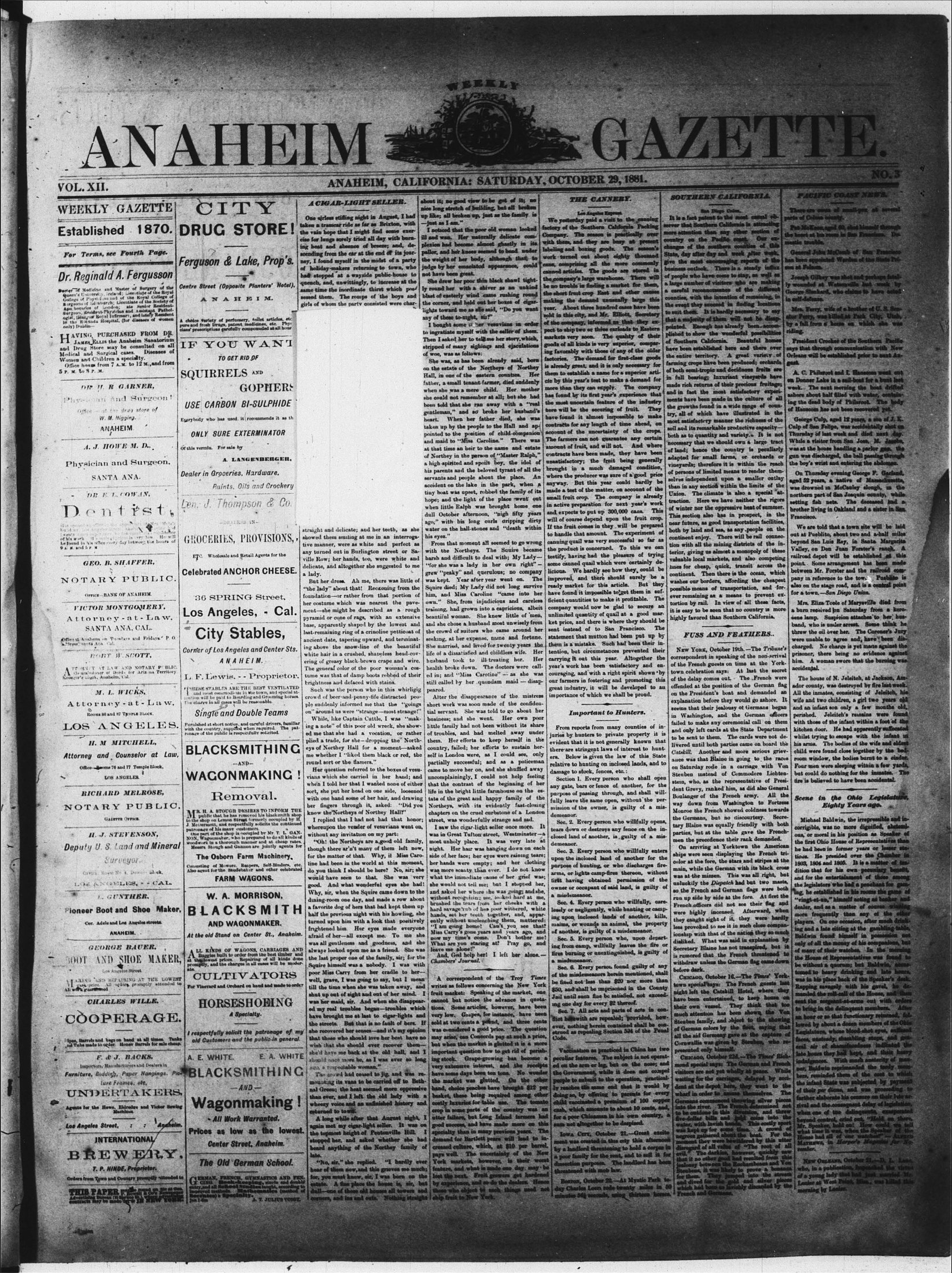
Searchable text
ANAHEIM
VOL. XII.
WEEKLY GAZETTE
Established 1870.
For Terms, see Fourth Page.
Dr. Reginald A. Fergusson
Bacter of Medicine and Master of Surgery of the Queen's University, Ireland; Licentiate of the Royal College of Physicians and of the Royal College of Surgeons of Edinburgh; Licentiate of the Society of Apothecaries of London; ate Senior Resident-Surgeon, Resident-Physician and Assistant Pathologist, Disgow Royal Infirmary, and later Resident in the R&Randa Hospital. (for diseases of women only) Dublin—
HAVING PURCHASED FROM DR. JAMES ELLIS the Anaheim Sanatorium and Drug Store may be consulted on all Medical and Surgical cases. Diseases of Women and Children a specialty.
Office hours from 7 a.m. to 12 m., and from 5 p.m. to 8 p.m.
DR H. R GARNER,
Physician and Surgeon!
Office — at the drug store of W. M. Higging.
ANAHEIM
A. J. HOWE M. D.
Physician and Surgeon.
CITY DRUG STORE!
Ferguson & Lake, Prop's.
Centre Street (Opposite Planters' Hotel).
ANAHEIM.
A choice variety of perfumery, toilet articles, etc pure and fresh Drugs, patent medicines, etc. Phyclans' prescriptions carefully compounded at all hour.
IF YOU WANT
TO GET RID OF
SQUIRRELS AND
GOPHERS
USE CARBON BI-SULPHIDE
Everybody who has used it recommends it as the ONLY SURE EXTERMINATOR
Of this vermin. For sale by
A. LANGENBERGER,
Dealer in Groceries, Hardware.
DR. H. R. GARNER,
Physician and Surgeon!
Office at the drug store of
W. M. Higging.
ANAHEIM.
A. J. HOWE M. D..
Physician and Surgeon.
SANTA ANA.
DR. E. L. COWAN,
Dentist.
GEO. B. SHAFFER,
NOTARY PUBLIC.
OFFICE—BANK OF ANAHEIM.
VICTOR MONTGOMERY,
Attorney-at-Law,
SANTA ANA, CAL.
Offices at Anaheim on Tuesdays and Fridays. P.O.
Address Santa Ana, Cal.
ROBT W. SCOTT.
ATTORNEY AT LAW AND NOTARY PUBLIC.
Commissioner of Deeds for Arizona Territory.
Kroger's block, Anaheim, Cal.
M. L. WICKS,
Attorney-at-Law.
Rooms 86 and 87 TRIple Block.
LOS ANGELES.
H. M MITCHELL,
Attorney and Counselor at Law,
Office—Rooms 76 and 77 Temple Block.
LOS ANGELES.
RICHARD MELROSE,
NOTARY PUBLIC.
GALETTE OFFICE.
H. J. STEVENSON,
Deputy U.S. Land and Mineral Surveyor.
Office—Room No. A, Downey block.
LOS ANGELES, - - CAL.
L. GUNTHER.
GOPHERS
USE CARBON BI-SULPHIDE
Everybody who has used it recommends it as the ONLY SURE EXTERMINATOR
Of this vermin. For sale by
A. LANGENBERGER.
Dealer in Groceries, Hardware.
Paints, Oils and Crockery
Len. J. Thompson & Co.
DEALERS INGROCERIES, PROVISIONS,
ETC. Wholesale and Retail Agents for the
Celebrated ANCHOR CHEESE.
36 SPRING Street.
Los Angeles, - Cal.
City Stables,
Corner of Los Angeles and Center Sts.
ANAHEIM.
L. F. Lewis.- Proprietor.
THESE STABLES ARE THE BEST VENTILATED
and most commodious in the town, and special attention will be paid to Boarding and Grooming horses.
The charve in all cases will be reasonable.
Single and Double Teams
Furnished at short notice, and careful drivers, familiar with the country, supplied when required. The patronage of the public is respectfully solicited.
BLACKSMITHING
AND
WAGONMAKING!
Removal.
MR. H. A. STOUGH DESIRES TO INFORM THE
public that he has removed his blacksmith shop to the shop on Lemon Street formerly occupied by H. J. Meiermott, and respectfully solicits the continued patronage of his many customers.
One part of the shop is occupied by Mr. T. L. GAN-NON, Wagounmaker, who is prepared to do all kinds of woodwork in a thorough manner and at cheap rates.
Messrs Stough and Gannon are jointly agents for The Osborn Farm Machinery.
Consisting of Mowers, Reapers, Self-Binders, etc.
Also agent for the Studebaker and other celebrated FARM WAGONS.
W. A. MORRISON,
straight and delicate showed them smiling tive manner, were any turned out in Bville Row; her hand delicate, and altogether a lady.
But her dress. A "the lady" about the foundation—or rather her costume which meant—she might be pyramid or cone of n base, apparently she last-remaining ring of ancient date, tapering above the snow white hair in a crushering of greasy black. The general color of tume was that of dark brightness and defaul.
Such was the per cent crowd of beer-and-pple suddenly inform on" around us were While, like Capturing a note" of this she had applied a trade, for she eyes of Northey Ha me whether I "like round sort or the f Her question ref vians which she ca when I told her that sort, she put her b with one hand sound her fingers through know the Northeys I replied that I whereupon the ver without any invita "Oh! the North though there arn't for the matter of the time had been in th do you think I should would have seen good. And what Why, sir, when th
NOTARY PUBLIC,
GARNETTE OFFICE.
H. J. STEVENSON,
Deputy U.S. Land and Mineral Surveyor.
Officer, Room No. 4, Downtown Los Angeles, Cal.
L. GUNTHER.
Pioneer Boot and Shoe Maker,
Cor. Adele and Los Angeles streets.
GEORGE BAUER.
BOOT AND SHOE MAKER,
Los Angeles Street.
MAKING AND REPAIRING AT THE LOWEST cash price. All orders promptly attended to.
CHARLES WILLE.
COOPERAGE.
Ipees, barrels and kegs on hand at all times. Tanks and Tubs made to order. Honey Barrels for sale cheap.
F. & J. BACKS.
Importers, Manufacturers and Dealers in Furniture, Bedding, Paper Hangings, Picture Frames, etc.
UNDERTAKERS.
Agents for the Howe, Edlredge and Victor Sewing Machines.
Los Angeles Street, : Anaheim.
INTERNATIONAL BREWERY.
T. P. HINDE, Proprietor.
Orders from Town and Country promptly attended to.
THIS PAPER may be made for the New York Advertising Bureau (10 Spaces St.) where advertising contracts may be made for it.
MR. H. A. STOUGH DESIRES TO INFORM THE public that he has removed his blacksmith shop to the shop on Lemon Street formerly occupied by H. J. Meidermott, and respectfully solicits the continued patronage of his many customers.
One part of the shop is occupied by Mr. T. L. GAN-NON, Wagonmaker, who is prepared to do all kinds of woodwork in a thorough manner and at cheap rates. Messrs. Stough and Gannon are jointly agents for The Osborn Farm Machinery.
Consisting of Mowers, Reapers, Self-Binders, etc. Also agent for the Studebaker and other celebrated FARM WAGONS.
W. A. MORRISON,
BLACKSMITH AND WAGONMAKER.
At the old Stand on Center St., Anaheim.
ALL KINDS OF WAGONS, CARRIAGES AND Buggies built to order from the best timber and at the lowest prices. Repairing of all kinds done promptly, and the charges in all cases will be moderate.
CULTIVATORS
For Vineyard and Orchard on hand and made to order
HORSESHOEING
A Specialty.
I respectfully solicit the patronage of my old Customers and the public in general.
A. E. WHITE.
E. A. WHITE
BLACKSMITHING
AND
Wagonmaking!
- All Work Warranted.
Prices as low as the lowest.
Center Street, Anaheim.
The Old German School.
GERMAN, FRENCH, GYMNASTICS AND FENCING.
Hookkeeping, minteo and double entry, and all Schneelstudies taught according to improved methods.
Mathematics (method of Riemann's Speciality).
A. T. JULIUS VONZEL.
Mr. H. A. STOUGH DESIRES TO INFORM THE public that he has removed his blacksmith shop to the shop on Lemon Street formerly occupied by H. J. Meidermott, and respectfully solicits the continued patronage of his many customers.
One part of the shop is occupied by Mr. T. L. GAN-NON, Wagonmaker, who is prepared to do all kinds of woodwork in a thorough manner and at cheap rates. Messrs. Stough and Gannon are jointly agents for The Osborn Farm Machinery.
Consisting of Mowers, Reapers, Self-Binders, etc. Also agent for the Studebaker and other celebrated FARM WAGONS.
W. A. MORRISON,
BLACKSMITH AND WAGONMAKER.
At the old Stand on Center St., Anaheim.
ALL KINDS OF WAGONS, CARRIAGES AND Buggies built to order from the best timber and at the lowest prices. Repairing of all kinds done promptly, and the charges in all cases will be moderate.
CULTIVATORS
For Vineyard and Orchard on hand and made to order
HORSESHOEING
A Specialty.
I respectfully solicit the patronage of my old Customers and the public in general.
A. E. WHITE.
E. A. WHITE
BLACKSMITHING
AND
Wagonmaking!
- All Work Warranted.
Prices as low as the lowest.
Center Street, Anaheim.
The Old German School.
GERMAN, FRENCH, GYMNASTICS AND FENCING.
Hookkeeping, minteo and double entry, and all Schneelstudies taught according to improved methods.
Mathematics (method of Riemann's Speciality).
A. T. JULIUS VONZEL.
Mr. H. A. STOUGH DESIRES TO INFORM THE public that he has removed his blacksmith shop to the shop on Lemon Street formerly occupied by H. J. Meidermott, and respectfully solicits the continued patronage of his many customers.
One part of the shop is occupied by Mr. T. L. GAN-NON, Wagonmaker, who is prepared to do all kinds of woodwork in a thorough manner and at cheap rates. Messrs. Stough and Gannon are jointly agents for The Osborn Farm Machinery.
Consisting of Mowers, Reapers, Self-Binders, etc. Also agent for the Studebaker and other celebrated FARM WAGONS.
W. A. MORRISON,
BLACKSMITH AND WAGONMAKER.
At the old Stand on Center St., Anaheim.
ALL KINDS OF WAGONS, CARRIAGES AND Buggies built to order from the best timber and at the lowest prices. Repairing of all kinds done promptly, and the charges in all cases will be moderate.
CULTIVATORS
For Vineyard and Orchard on hand and made to order
HORSESHOEING
A Specialty.
I respectfully solicit the patronage of my old Customers and the public in general.
A. E. WHITE.
E. A. WHITE
BLACKSMITHING
AND
Wagonmaking!
- All Work Warranted.
Prices as low as the lowest.
Center Street, Anaheim.
The Old German School.
GERMAN, FRENCH, GYMNASTICS AND FENCING.
Hookkeeping, minteo and double entry, and all Schneelstudies taught according to improved methods.
Mathematics (method of Riemann's Speciality).
A. T. JULIUS VONZEL.
Mr. H. A. STOUGH DESIRES TO INFORM THE public that he has removed his blacksmith shop to the shop on Lemon Street formerly occupied by H. J. Meidermott, and respectfully solicits the continued patronage of his many customers.
One part of the shop is occupied by Mr. T. L. GAN-NON, Wagonmaker, who is prepared to do all kinds of woodwork in a thorough manner and at cheap rates. Messrs. Stough and Gannon are jointly agents for The Osborn Farm Machinery.
Consisting of Mowers, Reapers, Self-Binders, etc. Also agent for the Studebaker and other celebrated FARM WAGONS.
W. A. MORRISON,
BLACKSMITH AND WAGONMAKER.
At the old Stand on Center St., Anaheim.
ALL KINDS OF WAGONS, CARRIAGES AND Buggies built to order from the best timber and at the lowest prices. Repairing of all kinds done promptly, and the charges in all cases will be moderate.
CULTIVATORS
For Vineyard and Orchard on hand and made to order
HORSESHOEING
A Specialty.
I respectfully solicit the patronage of my old Customers and the public in general.
A. E. WHITE.
E. A. WHITE
BLACKSMITHING
AND
Wagonmaking!
- All Work Warranted.
Prices as low as the lowest.
Center Street, Anaheim.
The Old German School.
GERMAN, FRENCH, GYMNASTICS AND FENCING.
Hookkeeping, minteo and double entry, and all Schneelstudies taught according to improved methods.
Mathematics (method of Riemann's Speciality).
A.T.JULIUSVOENZEL
Mr.H.A.stough.desires.to.inform.thepublicthathehasremovedhisblacksmithshoptotheshoponLemonStreetformerlyoccupiedbyH.J.Meidermottandrespectfullysolicitthepatronageofmyoldcustomersandthepublicingeneral.
A.E.WHITE.
E.A.WHITE
BLACKSMITHING
AND
Wagonmaking!
- All Work Warranted.
Prices as low as the lowest.
Center Street, Anaheim.
The Old German School.
GERMAN,FRENCH,GYMNASTICS AND FENCING.
Hookkeeping,minceoanddoubleentry,andallSchneelstudiestaughtaccordingtoimprovedmethods.Mathematics(methodofRiemann'sSpeciality).
WEEKLY
EIM GA
ANAHEIM, CALIFORNIA: SATURDAY, OCTOBER 29, 1881.
ACIGAR-LIGHT SELLER.
One airless stifling night in August, I had taken a tramcar ride as far as Brixton, with the vain hope that I might find some exercise for lungs sorely tried all day with burning heat and absence of breeze; and, descending from the car at the end of its journey, I found myself in the midst of a party of holiday-makers returning to town, who had stopped at a wayside public-house to quench, and, unwittingly, to increase at the same time the inordinate thirst which posed them. The romps of the boys and girls of whom the party consisted were char-
about it; no good view to be got of it; no nice long stretch of building, but all broken up like; all broken up, just as the family is—just as I am."
I noticed that the poor old woman looked ill and wan. Her naturally delicate complexion had become almost ghostly in its pallor, and her knees seemed to bend under the weight of her body, although that to judge by her emasculated appearance, could not have been great.
She drew her poor thin black shawl tightly round her with a shiver as an unkind blast of easterly wind came rushing round the corner, and held out her boxes of cigar-lights toward me as she said, "Do you want any of these to-night, sir?"
I bought some other vesuvians in order to ingratiate myself with the seller of them. Then I asked her to tell me her story, which stripped of many sighings and ejaculations of woe, was as follows:
She was, as has been already said, born on the estate of the Northeys of Northey Hall, in one of the eastern counties. Her father, a small tenant farmer, died suddenly when she was a mere child. Her mother she could not remember at all; but she had been told that she ran away with a "real gentleman," and so broke her husband's heart. When her father died, she was taken up by the people to the Hall and appointed to the position of child-companion and maid to "Miss Caroline." There was at that time an heir to the name and estate of Northey in the person of "Master Ralph," a high-spirited and spoilt boy, the idol of his parents and the beloved tyrant of all the
THE CANNERY.
Los Angeles Express.
We yesterday paid a visit to the canning factory of the Southern California Packing Company. The season is practically over with them, and they are busy at present labeling and boxing goods. The season's work turned out about eighty thousand cans, comprising all the more commonly canned articles. The goods are stored in the company's large warehouse. There will be no trouble in finding a market for them, the short fruit crop East and other causes making the demand unusually large this year. About three hundred cases have been sold in this city, and Mr. Elliott, Secretary of the company, informed us that they expect to ship two or three earloads to Eastern markets very soon. The quality of their goods of all kinds is very superior, comparing favorably with those of any of the older factories. The demand for first-class goods is already great, and it is only necessary for them to establish a name for a superior article by this year's test to make a demand for more than they can supply. The company has found by its first year's experience that the most uncertain feature of the industry here will be the securing of fruit. They have found it almost impossible to make contraets for any length of time ahead, on account of the uncertainty of the crops. The farmers can not guarantee any certain amount of fruit, and will not. And where contracts have been made, they have been unsatisfactory; the fruit being generally brought in a much damaged condition, where the vendors were sure of a good price.
straight and delicate; and her teeth, as she showed them smiling at me in an interrogative manner, were as white and perfect as any turned out in Burlington street or Saville Row; her hands, too, were white and delicate, and altogether she suggested to me a lady.
But her dress. Ah me, there was little of "the lady" about that! Reckoning from the foundation—or rather from that portion of her costume which was nearest the pavement—she might be described as a rough pyramid or cone of rags, with an extensive base, apparently shaped by the lowest and last-remaining ring of a crinoline petticoat of ancient date, tapering upward, and terminating above the snow-line of the beautiful white hair in a crushed, shapeless head-covering of greasy black-brown crape and wire. The general color of the poor woman's costume was that of damp boots robbed of their brightness and defaced with stains.
Such was the person who in this whirligig crowd of beer-and-penny-fly-distracted people suddenly informed me that the "goings on" around us were "strange—most strange!"
While, like Captain Cuttle, I was "making a note" of this poor old wreck, she showed me that she had a vocation, or rather plied a trade, for she—dropping the Northeys of Northey Hall for a moment—asked me whether I "liked them black or red, the round sort or the flamers."
Her question referred to the boxes of vesuvians which she carried in her hand; and when I told her that I wanted none of either sort, she put her head on one side, loosened with one hand some of her hair, and drawing her fingers through it, asked: "Did you know the Northeys of Northey Hall?"
I replied that I had not had that honor; whereupon the vendor of vesuvians went on, without any invitation on my part:
"Oh! the Northeys are a good old family, though there aren't many of them left now, for the matter of that. Why, it Miss Caroline had been in the world at this moment, do you think I should be here? No, sir; she would have seen to that. She was very good. And what wonderful eyes she had! Why, sir, when the Squire came down to the dining room one day, and made a row about Hall, in one of the eastern counties. Her father, a small tenant-farmer, died suddenly when she was a mere child. Her mother she could not remember at all; but she had been told that she ran away with a "real gentleman," and so broke her husband's heart. When her father died, she was taken up by the people to the Hall and appointed to the position of child-companion and maid to "Miss Caroline." There was at that time an heir to the name and estate of Northey in the person of "Master Ralph," a high-spirited and spoilt boy, the idol of his parents and the beloved tyrant of all the servants and people about the place. An accident on the lake in the park, when a tiny boat was upset, robbed the family of its hope; and the light of the place went out when little Ralph was brought home one dull October afternoon, "nigh fifty years ago," with his long curls crippling dirty water on the hall-stones and "death within his eyes."
From that moment all seemed to go wrong with the Northeys. The Squire became harsh and difficult to deal with; My Lady—"for she was a lady in her own right"—grew "peaky" and querulous; no company was kept. Year after year went on. The Squire died; My Lady did not long survive him, and Miss Caroline "came into her own." She, from injudicious and careless training, had grown into a capricious, albeit beautiful woman. She knew little of men, and she chose a husband most unwisely from the crowd of suitors who came around her seeking, at her expense, name and fortune. She married, and lived for twenty years the life of a dissatisfied and childless wife. Her husband took to ill-treating her. Her health broke down. The doctors were called in; and "Miss Caroline"—as she was still called by her quondam maid—disappeared.
Alter the disappearance of the mistress short work was soon made of the confidential servant. She was told to go about her business; and she went. Her own poor little family had not been without its share of troubles, and had melted away under them. Her efforts to keep herself in the country, failed; her efforts to sustain herself in London were, as I could see, only partially successful; and as a policeman came to move her on, and she shuffled away uncomplainingly, I could not help feeling that the contrast of the beginning of her life in the bright little farmhouse on the estate of the great and happy family of the Northeys, with its evidently fast-closing chapters on the cruel curbstone of a London street, was wonderfully strange and sad.
I saw the cigar-light seller once more. It was in Great Tufton street, Westminster—a most unholy place. It was very late at night. Her hair was hanging down on each side of her face; her eyes were raining tears; her hands were empty; and her clothing was more scanty than ever. I do not know what the immediate cause of her grief was; she would not tell me; but I stopped her, and asked her where she was going; and she without recognizing me, took hard at me,
them to establish a name for a supermarket by this year's test to make a demand for more than they can supply. The company has found by its first year's experience that the most uncertain feature of the industry here will be the securing of fruit. They have found it almost impossible to make contracts for any length of time ahead, on account of the uncertainty of the crops. The farmers can not guarantee any certain amount of fruit, and will not. And where contracts have been made, they have been unsatisfactory; the fruit being generally brought in a much damaged condition, where the producer was sure of a good price anyway. But this year could hardly be made a test of the matter, on account of the small fruit crop. The company is already in active preparation for next year's work and expects to put up 300,000 cans. This will of course depend upon the fruit crop. If the fruit comes in they will be prepared to handle that amount. The experiment of canning quail was very successful so far as the product is concerned. To this we can testify, having had the pleasure of trying some canned quail which were certainly delicious. We hardly see how they could be improved, and there should surely be a ready market for this article. But they have found it impossible to get them in sufficient quantities to make it profitable. The company would now be glad to secure an unlimited quantity of quail at a good market price, and there is where they should be sent instead of to San Francisco. The statement that mutton had been put up by them is a mistake. Such had been their intention, but circumstances prevented their carrying it out this year. Altogether the year's work has been satisfactory and encouraging, and with a right spirit shown by our farmers in fostering and promoting this great industry, it will be developed to an importance of which we shall be proud.
Important to Hunters.
From reports from many counties of injuries by hunters to private property it is evident that it is not generally known that there are stringent laws of interest to hunters. Below is given the law of this State relative to hunting on inclosed lands, and to damage to stock, fences, etc.:
Section 1. Every person who shall open any gate, bars or fence of another, for the purpose of passing through, and shall willfully leave the same open without the permission of the owner, is guilty of a misdemeanor.
Sec. 2. Every person who willfully opens, tears down or destroys any fence on the inclosed land of another, is guilty of a misdemeanor.
Sec. 3. Every person who willfully enters upon the inclosed land of another for the purpose of hunting, or who discharges firearms, or lights camp-fires thereon, without first having obtained permission of the owner or occupant of said land, is guilty of a misdemeanor.
with one hand some of her hair, and drawing her fingers through it, asked: "Did you know the Northeys of Northey Hall?"
I replied that I had not had that honor; whereupon the vender of vesuvians went on, without any invitation on my part:
"Oh! the Northeys are a good old family, though there aren't many of them left now, for the matter of that. Why, it Miss Caroline had been in the world at this moment, do you think I should be here? No, sir; she would have seen to that. She was very good. And what wonderful eyes she had! Why, sir, when the Squire came down to the dining-room one day, and made a row about a favorite dog of hers that had kept them up half the previous night with his howling, she turned upon him with a look that positively frightened him. Her eyes made everyone afraid of her—all except me. To me she was all gentleness and goodness, and she always looked upon me as a friend. She was the last proper one of the family, sir; for the Squire himself was a nobody. I was with poor Miss Carry from her cradle to her well, grave, I was going to say, but I mean till the time when she was taken away, and shut up out of sight and out of her mind. I was her maid, sir. And when she disappeared my real troubles began—troubles which have brought me at last to cigar-lights and the streets. But that is no fault of hers. If she recovered her senses—and it's my opinion that those who should love her best have no wish that she should ever recover them—they'd have me back at the old hall, and I should once more be, as I was ever so long ago—a respectable woman."
The crowd had ceased to jig, and was remounting its vans to be carried off to Bethnal Green; the heat seemed more oppressive than ever, and I left the old lady with a wheezey voice and an unfinished history and returned to town.
A long while after that August night, I again met my cigar-light seller. It was on the topmost height of Pentonville Hill. I stopped her, and asked whether she had heard anything of the Northey family of lais.
"No, sir," she replied. "I hardly ever hear of them now, and this grieves me much; for you must know, sir, I was born on the estate. A fine place the house is, sir, but dull—one of those old houses all towers and corners, and ins and outs. Nothing straight date of the great and happy family of the Northeys, with its evidently fast-closing chapters on the cruel curbstone of a London street, was wonderfully strange and sad.
I saw the cigar-light seller once more. It was in Great Tufton street, Westminster—a most unholy place. It was very late at night. Her hair was hanging down on each side of her face; her eyes were raining tears; her hands were empty; and her clothing was more scanty than ever. I do not know what the immediate cause of her grief was; she would not tell me; but I stopped her, and asked her where she was going; and she without recognizing me, looked hard at me, brushed the tears from her cheeks with a hard savage rub of has poor withered, white hands, set her teeth together, and, apparently without unclenching them, muttered: "I am going home! Can't you see that? Miss Carry's gone years and years ago, and now my time's come. Don't bother me! What are you staring at? Pray go, and leave me alone!"
And God help her! I left her alone. — Chambers' Journal.
A correspondent of the Troy Times writes as follows concerning the New York fruit market: Speaking of the market, one cannot but notice the advance in quotations. Some articles, however, have been very low. Grapes, for instance, have been sold at two cents a pound, and three cents was considered a good price. The question may arise, can Concords pay at such a price, but when the market is glutted it is a more important question how to get rid of perishing stock. Grape-growing has become a very extensive interest, and the receipts have some days been ten tons. No wonder the market was glutted. On the other hand, choice peaches have brought $12 per basket, these being required among other costly luxuries for table use. The tomato crop in some parts of the country was an utter failure, but Long Island farmers had good success, and have made more on this specialty than in many previous years. The demand for Hartlett pears will lead to increased culture, which, at $10 per barrel, pays well. The uncertainty of the New York markets, however, is their worst feature, and what is made one day may be lost the next. Fruit growers get hardened by experience, and so do the dealers. Hence those who object to such things used not ship fruit to New York.
Vaccination as practiced in China has two peculiar features. The subject is not operated on the arm or leg, but on the nose; and the Government, while it does not compel people to submit to the operation, practically reaches the same end that it would by doing so, by offering to parents for every child vaccinated a premium of 100 copper cash, which amounts to about 10 cents, and for a poor Chinaman in his own country, a sum not altogether to be despised.
Iowa Creek, October 21.—Great excitement was created in this city this afternoon by a landlord threatening to hold a corpse in a poor family for the rent, and to sell it for dissection purposes. The landlord has been threatened with mob law.
Boston, October 22.—At Mystic Park today Charles Loew rode twenty miles in 50 minutes 56 seconds using thirteen horses.
GAZETTE.
MAR 29, 1881.
ANNERY.
A visit to the canning
Southern California Packing
店 is practically over
and are busy at present
goods. The season's
about eighty thousand
of the more commonly
goods are stored in
warehouse. There will
be a market for them,
East and other causes
unusually large this
hundred cases have been
Mr. Elliott, Secretary
formed as that they exprise carloads to Eastern
The quality of their
very superior, comparbose of any of the older
and for first-class goods
it is only necessary for
name for a superior artistist to make a demand for
supply. The company
last year's experience that
feature of the industry
occurring of fruit. They
most impossible to make
length of time ahead, on
certainty of the crops.
not guarantee any certain
will not. And where
made, they have been
the fruit being generally
damaged condition,
comes rare of a good price
SOUTHERN CALIFORNIA.
San Diego, Calif.
It is a fact patent to the most casual observer that Southern California is attenting
more attention than any other nation of country on the Pacific coast. Our exchanges of the southern counties of this State, day after day and week after week,
give the most encouraging reports of the business outlook. There is a steady influx
of people who have come to stay, as well as a large number of visitors who are making
a careful reconnoissance of the different counties, with the intention of remaining, in
the event they succeed in finding locations to suit them. It is hardly necessary to say
that a majority of them will not be disappointed. Enough has already been accomplished to show the wonderful possibilities
of Southern California. Beautiful homes
have been established here and there over
the entire territory. A great variety of farming crops have been produced; orchards
of both semi-tropic and deciduous fruits are in full bearing; luxuriant vineyards have made rich returns of their precious fruiting;
and in fact the most satisfactory experiments have been made in the culture of all the growths found in a wide range of countrys, all of which have illustrated in the most satisfactory manner the richness of the soil and its remarkable productive capacity—both as to quantity and variety. It is not necessary that we should own a large tract of land; hence the country is peculiarly adapted for small farms, or orchards or vineyards; therefore it is within the reach of persons of limited means to render them
PACIFIC COAST NEWS.
There are cases of small-pox at several parts of Colum county.
Fan McKenna, aged 60, shot himself through the heart at his room in San Francisco. Domestic trouble.
General John McComb of San Francisco has been appointed Warden of the State Prison at Palomar.
Joseph Gilkey was shot and perhaps fatally wounded at Watsonville last week by George Shankard, who claims to have acted in self-defense.
Mrs. Ferry, wife of a brother of U.S. Senator Perry, was killed at Park City, Utah, by a fall from a horse on which she was riding.
President Crocker of the Southern Pacific says that through communication with New Orleans will be established prior to next August.
A. C. Philzoot and I. Hanscom went out on Donner Lake in a sail-boat for a hunt last week. The next morning the boat drifted ashore about half filled with water, containing the dead body of Philzoot. The body of Hanscom has not been recovered yet.
George Culp, aged 12 years, a son of J. K. Culp of San Felipe, was accidentally shot on Thursday of last week and died next day. While a visitor from San Jose, M. Jacobs, was at the house handling a parlor gun, the gun was discharged, the ball passing through the boy’s wrist and entering the abdomen.
On Thursday evening George P. Garland.
to make a demand for supply. The company last year's experience that feature of the industry occurring of fruit. They most impossible to make length of time ahead, on uncertainty of the crops. Not guarantee any certain will not. And where made, they have been the fruit being generally much damaged condition, or was sure of a good price by year could hardly be matter, on account of the company is already upon for next year's work up 300,000 cans. This and upon the fruit crop, then they will be prepared at count. The experiment of every successful so far as observed. To this we can the pleasure of trying which were certainly deny see how they, could be there should surely be a article. But they possible to get them in suffice make it profitable. The new be glad to secure an way of quail at a good marrure is where they should be No San Francisco. The cotton had been put up by Such had been their instances prevented their this year. Altogether the seen satisfactory and enrich a right spirit shown by ordering and promoting this will be developed to an which we shall be proud.
FUSS AND FEATHERS...
New York, October 19th.—The Tribune's correspondent in speaking of the non-arrival of the French guests on time at the Yorktown celebration says: At last the secret of the delay comes out. The French were offended at the position of the German flag on the President's boat and demanded an explanation before they would go ashore. It seems that their jealousy of Germans began in Washington, and the German officers failed to make any ceremonial call on them and only left cards at the State Department to be sent to them. The cards were not delivered until both parties came on board the Catskill. Another and more serious grievance was that Blaine in going to the races on Saturday rode in a carriage with Von Steuben instead of Commodore Lichtenstein, who, as the representative of President Grevy, ranked him, as did also General Boulanger of the French army. All the way down from Washington to Fortress Monroe the French showed coldness towards the Germans, but no discourtesy. Secretary Blaine was equally friendly with both parties, but at the table gave the Frenchmen the precedence their rank demanded.
On arriving at Yorktown the American ships were seen displaying the French tricolor at the fore, the stars and stripes at the main, while the German with its black cross was at the mizzen. This was all right, but unluckily the Dispatch had but two masta, so the French and German flags were both run up side by side at the fore. At first the en Donner Lake in a sail-boat for a hunt last week. The next morning the host drifted ashore about half filled with water, containing the dead body of Philaroot. The body of Hanscom has not been recovered yet.
George Culp, aged 12 years, a son of J. K. Culp of San Felipe, was accidentally shot on Thursday of last week and died next day. While a visitor from San Jose, M. Jacobs, was at the house handling a parlor gun, the gun was discharged, the ball passing through the boy's wrist and entering the abdomen.
On Thursday evening George F. Garland, aged 52 years, a native of Massachusetts, was drowned in McCaulay slough, in the northern part of San Joaquin county, while setting fish nets. The deceased had a brother living in Oakland and a sister in San Francisco.
We are told that a town site will be laid out at Pueblito, about two and a-half miles beyond San Luis Rey, in Santa Margarita Valley, on Don Juan Forater's ranch. A railroad depot will be established at this point. Some arrangement has been made between Mr. Forster and the railroad company in reference to the town. Pueblito is also on the stage road, and is a central point for a town.—San Diego Union.
Mrs. Eliza Tooke of Marysville died from a burn received on Saturday from a kerosene lamp. Suspicion attaches to her husband, who is under arrest. Some think he threw the oil over her. The Coroner's Jury were unable to agree and, have been discharged. No charge is yet made against the prisoner, there being no evidence against him. A woman swore that the burning was accidental.
The house of N. Jeleitch, at Jackson, Amador county, was destroyed by fire last week. All the inmates, consisting of Jeleitch, his wife and two children, a girl two years old and an infant son only a few months old, perished. Jeleitch's remains were found with those of the infant within a foot of the kitchen door. He had apparently suffocated whilst trying to escape with the infant in his arms. The bodies of the wife and oldest child were found close together by the bedroom window, the bodies burnt to a cinder. Four men were sleeping within a few yards, but could do nothing for the inmates. The tire is believed to have been accidental.
Scene in the Ohio Legislature, Eighty Years ago.
Michael Baldwin, the irrepressible and incorrigible, was no more dignified, abstemious, or moral in his position as Speaker of the first Ohio House of Representatives than he had been in former years or lesser stations. He presided over the Chamber in 1803, 1804 and 1805. It is a matter of tradition that for his own pecuniary benefit, and for the entertainment of those among the legislators who had a penchant for gaming, he established in his rooms the game of "himself" alone acting as bachelor and
The subject is not operat-leg, but on the nose; and while it does not compel to the operation, practical-ome end that it would be during to parents for every premium of 100 copper counts to about 10 cents, and, man in his own country, a mer to be despised.
October 21.—Great excite d in this city this afternoon freestening to hold a corpse in the rent, and to sell it for seas. The landlord has been mob law.
October 22.—At Mystic Park to turn rode twenty miles in 50 pounds, using thirteen horses.
On arriving at Yorktown the American ships were seen displaying the French tricolor at the fore, the stars and stripes at the main, while the German with its black cross was at-the mizzen. This was all right, but unluckily the Dispatch had but two masta, so the French and German flags were both run up side by side at the fore. At first the French officers did not see their flag and were highly incensed. Afterward, when they caught sight of it, they were hardly less provoked to see it in such close companionship with that of the nation they so much disliked. What was said in explanation by Secretary Blaine has not transpired, but it is rumored that the French threatened to withdraw unless the German flag came down before dark.
Chicago, October 16.—The Times' Yorktown special says: The French guest last night left the Catskill Hotel, where they have been entertained, to keep house on their own vessel. They think that too much attention has been shown the Von Steuben family, and object to the showing of German colors by the fleet, saying that all the aid Germany gave at the captures of Cornwallia was given by Steuben, who represented only himself.
Chicago, October 22d.—The Times' Richmond special says: The German and French visitors are not yet wholly at peace. While waiting for the carriages, delayed by accident at the depot here, they went to the wharf in order to amuse themselves. The Germans commenced throwing silver pieces into the river. The French determined not to be outdone in this diversion, and throw five-dollar bills and gold coins into the water, with lavish hands. This costly sport was kept up for some time. A crowd of negroes gathered about the boat. For the moment they were bewildered by this utter disregard of all value of "The root of all evil." The darkness, however, quickly saw that it no other good had resulted from this jealousy between the Rechambre and Von Steuben, it was likely to prove a bename for them. They jumped into the stream and dived for the gold and silver pieces which had been so lavishly discarded by the French and Germans.
Michael Baldwin, the irrepressible and incorrigible, was no more dignified, abstemious, or moral in his position as Speaker of the first Ohio House of Representatives than he had been in former years or lesser stations. He presided over the Chamber in 1803, 1804 and 1805. It is a matter of tradition that for his own pecuniary benefit, and for the entertainment of those among the legislators who had a penchant for gaming, he established in his rooms the game of "ringt-at-un," himself acting as banker and dealer, and as a matter of course winning more frequently than any of the other players. On one occasion, after much drinking and a late sitting at the gambling table, Baldwin found himself in possession not only of all the money of his companions, but of many of their watches. In the morning the House of Representatives was found to be without a quorum; but Baldwin, commanded to heavy drinking and late hours, was in his place back of the Speaker's desk. Rapping savagely with his gavel, he demanded the roll-call of the House, and then sent the corgeant-at-arms out with orders to bring in the delinquent members. After an hour or so that functionary returned, followed by about a dozen members of the Ohio Legislature, whose blood-shot eyes, enflamed faces, unsteady, shambling steps, and general air of shame facedness indicated the late hours they had kept, and their heavy indulgences. With much ansterity of manner, Baldwin reprimanded the tardy members, reminded them of the cost to which the infant State was subjected by payment of their per diems, and was proceeding to further elaborate his content on their late arrival and the consequent delay of legislation, when one of the delinquents, accompanied beyond control, cried out, "Hold on there, Mr. Speaker; hold on! How could we tell what time it was, when the Speaker of the House had all of our watchers?" — Alarma Mathewsa, in Harper's Magazine for November.
New Orleans, October 21.—D. L. Lane, who, in a publication Impressed the views of a young lady that had just married Mr. Lanier at West Point, Miss., was killed this morning by Lamien.