anaheim-gazette 1881-10-22
Scanned page
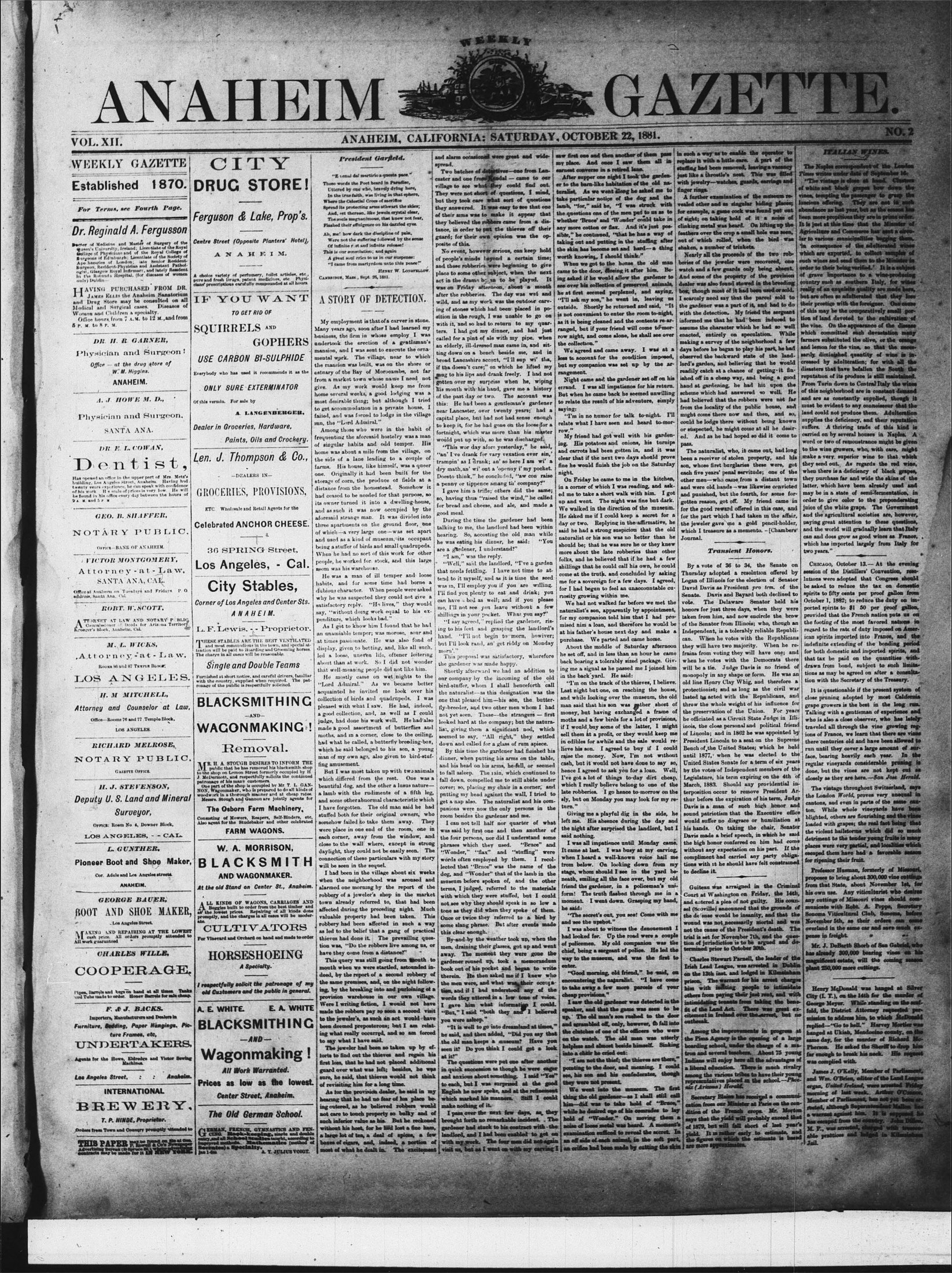
Searchable text
ANAHEIM
VOL. XII.
WEEKLY GAZETTE
Established 1870.
For Terms, see Fourth Page.
Dr. Reginald A. Fergusson
Doctor of Medicine and Master of Surgery of the Queen's University, Ireland; Licentiate of the Royal College of Physicians and of the Royal College of Surgeons of Edinburgh; Licentiate of the Society of Apothecaries of London; into Senior Resident Surgeon, Resident-Physician and Assistant Pathologist, Glasgow Royal Infirmary, and lately Resident in the Rotunda Hospital. (for diseases of women only) Dublin.
HAVING PURCHASED FROM DR. JAMES ELLIS the Anaheim Sanatorium and Drug Store may be consulted on all Medical and Surgical cases. Diseases of Women and Children a specialty.
Office hours from 7 A.M. to 12 M., and from 5 P.M. to 8 P.M.
DR. H. R GARNER,
Physician and Surgeon!
Office — at the drug store of W. M. Higgins.
ANAHEIM.
A. J. HOWE M. D.,
Physician and Surgeon.
SANTA ANA.
DR. E. L. COWAN,
Dentist,
CITY DRUG STORE!
Ferguson & Lake, Prop's.
Centre Street (Opposite Planters' Hotel),
ANAHEIM.
A choice variety of perfumery, toilet articles, etc., pure and fresh Drugs, patent medicines, etc. Physicians' prescriptions carefully compounded at all hours.
IF YOU WANT TO GET RID OF SQUIRRELS AND GOPHERS USE CARBON BI-SULPHIDE
Everybody who has used it recommends it as the ONLY SURE EXTERMINATOR Of this vermin. For sale by A. LANGENBERGER,
Dealer in Groceries, Hardware,
Paints, Oils and Crockery.
Len. J. Thompson & Co.,
Presence
"Even when these words the Uttered by me In the true façade Where the Celebrities Spread its protections And, set them The souls may Flashed their eyes Ah, me! how do I Were not the Of infinite rarity This is our own great soul "I came from Cambridge, Massachusetts
A STORY
My employment Many years ago business, the first undertook the mansion, and I mental work. The mansion was estnary of the B from a market to give. As my home several wives most desirable to get accommodated failed, and was uninn, the "Lord Among those frequenting the side of singular habitation home was about the side of a large farms. His house one. Originally
ANAHEIM.
A. J. HOWE M. D., Physician and Surgeon, Santa Ana.
DR. E. L. COWAN, Dentist,
Has opened an office in the upper part of Mrs. Meta's building, Los Angeles Street, Anaheim. Having had twenty years experience, he can speak with confidence of his work. His scale of prices is very low. He will be found in his office every day between the hours of 9 A.M. and 5 P.M.
GEO. B. SHAFFER, NOTARY PUBLIC.
OFFICE—BANK OF ANAHEIM.
VICTOR MONTGOMERY, Attorney-at-Law, Santa Ana, Cal.
Office at Anaheim on Tuesdays and Fridays P.O. address, Santa Ana, Cal.
ROBT. W. SCOTT.
ATTORNEY AT LAW AND NOTARY PUBLIC Commissioner of Deeds for Arizona Territory Kroeger's Block, Anaheim, Cal.
M. L. WICKS, Attorney-at-Law, Rooms 86 and 87 Temple Block, LOS ANGELES.
H. M MITCHELL, Attorney and Counselor at Law, Office—Rooms 76 and 77 Temple Block, LOS ANGELES.
RICHARD MELROSE, NOTARY PUBLIC, Gazette Office.
H. J. STEVENSON, Deputy U. S. Land and Mineral Surveyor, Office: Room No. 4, Downev Block, LOS ANGELES, -- CAL.
L. GUNTHER, Pioneer Boot and Shoe Maker, Cor. Adele and Los Angeles streets, Anaheim.
ONLY SURE EXTERMINATOR Of this vermin. For sale by
A. LANGENBERGER, Dealer in Groceries, Hardware, Paints, Oils and Crockery.
Len. J. Thompson & Co., DEALERS IN—GROCERIES, PROVISIONS,
ETC. Wholesale and Retail Agents for the Celebrated ANCHOR CHEESE.
36 SPRING Street, Los Angeles, - Cal.
City Stables, Corner of Los Angeles and Center Sts. ANAHEIM.
L.F. Lewis. -- Proprietor.
THESE STABLES ARE THE BEST VENTILATED and most commodious in the town, and special attention will be paid to boarding and grooming horses. The charve in all cases will be reasonable.
Single and Double Teams Furnished at short notice, and careful drivers, familiar with the country, supplied when required. The patronage of the public is respectfully solicited.
BLACKSMITHING —AND—WAGONMAKING! Removal.
MR. H. A. STOUGH DESIRES TO INFORM THE public that he has removed his blacksmith shop to the shop on Lemon Street formerly occupied by H. J. McDernott, and respectfully solicits the continued patronage of his many customers.
One part of the shop is occupied by Mr. T. L. GAN-NON, Wagonmaker, who is prepared to do all kinds of woodwork in a thorough manner and at cheap rates. Messrs. Stough and Gannon are jointly agents for The Osborn Farm Machinery,
Consisting of Mowers, Reapers, Self-Binders, etc. Also agent for the Studebaker and other celebrated FARM WAGONS.
W. A. MORRISON, BLACKSMITH AND WAGONMAKER.
At the old Stand on Center St., Anaheim.
Deputy U.S. Land and Mineral Surveyor,
Office: Room No 4, Downev Block,
LOS ANGELES, - CAL.
L. GUNTHER,
Pioneer Boot and Shoe Maker,
Cor. Adele and Los Angeles streets.
ANAHEIM.
GEORGE BAUER,
BOOT AND SHOE MAKER,
Los Angeles Street.
MANING AND REPAIRING AT THE LOWEST
cash price. All orders promptly attended to
All work guaranteed.
CHARLES WILLE,
COOPERAGE,
Pipes, Barrels and kegs on hand at all times. Tanks
and Tubs made to order. Honey Barrels for sale cheap.
F. & J. BACKS.
Importers, Manufacturers and Dealers in
Furniture, Bedding, Paper Holdings, Picture Frames, etc,
UNDERTAKERS,
Agents for the Howe, Eldreke and Victor Sewing
Machines.
Los Angeles Street, : Anaheim.
INTERNATIONAL
BREWERY,
T. P. HINDE, Proprietor.
Orders from Town and Country promptly attended to
THIS PAPER may not be found on file at Gen.
Advertising Bureau (10 Spruce St., where advertising contracts may be made for it in NEW YORK).
The Osborn Farm Machinery,
Consisting of Mowers, Reapers, Self-Binders, etc.
Also agent for the Studebaker and other celebrated
FARM WAGONS.
W. A. MORRISON,
BLACKSMITH
AND WAGONMAKER.
At the old Stand on Center St., Anaheim.
ALL KINDS OF WAGONS, CARRIAGES AND
Buggies built to order from the best timber and
at the lowest prices. Repairing of all kinds done
promptly, and the charges in all cases will be moderate.
CULTIVATORS
For Vineyard and Orchard on hand and made to order
HORSESHOEING
A Specialty.
I respectfully solicit the patronage of my old Customers and the public in general.
A. E. WHITE.
E. A. WHITE
BLACKSMITHING
—AND—
Wagonmaking!
All Work Warranted.
Prices as low as the lowest.
Center Street, Anaheim.
The Old German School.
GERMAN, FRENCH, GYMNASTICS AND FENCING.
Hook-keeping, simple and double entry, and all School Studies taught, according to improved methods.
Mathematics (method of Recursion) a Specialty.
A. T. JULIUS VOIGT.
WEEKLY
EIM GA
ANAHEIM, CALIFORNIA: SATURDAY, OCTOBER 22, 1881.
President Garfield.
"Even dal martirio a questa pace."
These words the Poet heard in Paradise,
Uttered by one who, bravely dying here,
In the true faith, was living in that sphere,
Where the Celestial Cross of sacrifice
Spread its protecting arms athwart the skies;
And, set therem, like jewels crystal clear,
The souls magnanimous, that knew not fear,
Flashed their effulgence on his dazzled eyes.
Ah, me! how dark the discipline of pain,
Were not the suffering followed by the sense
Of infinite rest and infinite release!
This is our consolation; and again
A great soul cries to us in our suspense:
"I came from martyrdom unto this peace!"
Henry W. Loxgfellow.
Cambridge, Mass., Sept. 26, 1881.
A STORY OF DETECTION.
My employment is that of a carver in stone.
Many years ago, soon after I had learned my business, the firm in whose employ I was undertook the erection of a gentleman's mansion, and I was sent to execute the ornamental work. The village, near to which the mansion was built, was on the shore or estuary of the Bay of Morocambe, not far from a market town whose name I need not give. As my work would keep me from home several weeks, a good lodging was a most desirable thing; but although I tried to get accommodation in a private house, I failed, and was forced to lodge in the village inn, the "Lord Admiral."
Among those who were in the habit of frequenting the aforesaid hostelry was a man of singular habits and odd temper. His home was about a mile from the village, on the side of a lane leading to a couple of farms. His house, like himself, was a queer one. Originally it had been built for the and alarm occasioned were great and widespread.
Two batches of detectives—one from Lancaster and one from Hendal—came to our village to see what they could find out. They were not short of questions, I mind, but they took care what sort of questions they answered. It was easy to see that one of their aims was to make it appear that they believed the robbers came from a distance, in order to put the thieves off their guard; for their own opinion was the opposite of this.
No event, however serious, can keep hold of people's minds beyond a certain time; and these robberies were beginning to give place to some other subject, when the next act in the drama began to be played. It was on Friday afternoon, about a month after the robberies. The day was wet and wild, and as my work was the outdoor carving of stones which had been placed in position in the rough, I was unable to go on with it, and so had to return to my quarters. I had got my dinner, and had just called for a pint of ale with my pipe. When an elderly, ill-dressed man came in, and sitting down on a bench beside me, and in broad Lancashire accent, "I'll sup wi' tha, if tha doesn't care;" on which he lifted my mug to his lips and drank freely. I had not gotten over my surprise when he, wiping his mouth with his hand, gave me a history of the past day or two. The account was this: He had been a gentleman's gardener near Lancaster, over twenty years; had a capital place, but had not had sense enough to keep it, for he had gone on the loose for a fortnight, which was more than his master would put up with, so he was discharged.
"This wor day afore yesterday," he said,
"an' I've drank for vary vexation ever sin,' trampin' as I drank; an' so here I am wi' a dry math, an' wi' out a 'openny i' my pocket."
saw first one and then another of them pass my place. And once I saw them all in earnest converse in a retired lane.
After supper one night I took the gardener to the barn-like habitation of the old naturalist. As we went along he asked me to take particular notice of the dog and the lamb, "for," said he, "I was struck with the questions one of the men put to us as to whether 'Bruce' and 'Wonder' could take in any more cotton or flax. And it's just possible," he continued, "that he has a way of taking out and putting in the stuffing after the skin has become set and hard—a thing worth knowing. I should think."
When we got to the house the old man came to the door, closing it after him. Being asked if he would allow the gardener to see over his collection of preserved animals, he at first seemed perplexed, and saying, "I'll ask my son," he went in, leaving us outside. Shortly he returned and said, "It is not convenient to enter the room to-night, as it is being cleaned and the contents re-arranged, but if your friend will come to-morrow night, and come alone, he shall see over the collection."
We agreed and came away. I was at a loss to account for the condition imposed, but my companion was set up by the arrangement.
Night came and the gardener set off on his errand. I was all impatience for his return. But when he came back he seemed unwilling to relate the result of his adventure, simply saying:
"I'm in no humor for talk to-night. I'll relate what I have seen and heard to-morrow."
My friend had got well with his gardening. His potatoes and onions, his turnips and carrots had been gotten in, and it was clear that if the next two days should prove fine he would finish the job on the Saturday night.
Among those who were in the habit of frequenting the aforesaid hostelry was a man of singular habits and odd temper. His home was about a mile from the village, on the side of a lane leading to a couple of farms. His house, like himself, was a queer one. Originally it had been built for the storage of corn, the produce of fields at a distance from the homestead. Somehow it had ceased to be needed for that purpose, so its owner turned it into a dwelling-house, and as such it was now occupied by the aforesaid strange man. It was divided into three apartments on the ground floor, one of which—a very large one—was set apart and used as a kind of museum, its occupant being a stuffer of birds and small quadrupeds. When he had no sort of this work for other people, he worked for stock, and this large room was his warehouse.
He was a man of ill temper and loose habits, and for some time had borne a dubious character. When people were asked why he was suspected they could not give a satisfactory reply. "He lives," they would say, "without doing work equal to his expenditure, which looks bad."
As I got to know him I found that he had an unamiable temper; was morose, sour and at times passionate. He was also fond of display, given to betting, and, like all such, led a loose, uneven life, oftener loitering about than at work. So I did not wonder that well-meaning people did not like him.
He mostly came on wet nights to the "Lord Admiral." As we became better acquainted he invited me look over his collection of birds and quadrupeds. I was pleased with what I saw. He had, indeed, a good collection, and, as well as I could judge, had done his work well. He had also made a good assortment of butterflies and moths, and in a corner, close to the ceiling, had what he called, a butterfly breeding-box, which he said belonged to his son, a young man of my own age, also given to bird-stuffing amusement.
But I was most taken up with two animals which differed from the rest. One was a beautiful dog, and the other a lusus nature—a lamb with the rudiments of a fifth leg, and some other abnormal characteristic which I have forgotten. The old man said he had stuffed both for their original owners, who somehow failed to take them away. They were place in one end of the room, one in each corner, away from the window, and close to the wall where, except in strong daylight, they could not be easily seen. The connection of these particulars with my story will be seen in the sequel.
I had been in the village about six weeks when the neighborhood was aroused and alarmed one morning by the report of the robbery of a jeweler's shop in the market
Night came and the gardener set off on his errand. I was all impatience for his return. But when he came back he seemed unwilling to relate the result of his adventure, simply saying:
"I'm in no humor for talk to-night. I'll relate what I have seen and heard to-morrow row."
My friend had got well with his gardening. His potatoes and onions, his turnip and carrots had been gotten in, and it was clear that if the next two days should prove fine he would finish the job on the Saturday night.
On Friday he came to me in the kitchen in a corner of which I was reading, and asked me to take a short walk with him. I go up and went. The night was fine but dark. We walked in the direction of the museum. He asked me if I could keep a secret for a day or two. Replying in the affirmative, he said he had a strong suspicion that the old naturalist or his son was no better than he should be; that he was sure he or they knew more about the late robberies than other folks, and he believed that if he had a few shillings that he could call his own, he could come at the truth. And concluded by asking me for a sovereign for a few days. I agreed for I had begun to feel an unaccountable curiosity growing within me.
We had not walked far before we met the naturalist's son, apparently by appointment for my companion told him that I had promised him a loan, and therefore he would buy at his father's house next day and make purchase. We parted and came home.
About the middle of Saturday afternoon he set off, and in less than an hour he came back bearing a tolerably sized package. Giving me a signal as he passed me I joined him in the back yard. He said:
"I'm on the track of the thieves, I believe Last night but one, on reaching the house and while looking over the museum, the old man said that his son was rather short of money, but having exchanged a frame of moths and a few birds for a lot of provision if I would buy some of the latter, I might sell them at a profit, or they would keep me in edibles for awhile and the sale would relieve his son. I agreed to buy if I could raise the money. Now I'm not without cash, but it would not have done to say she hence I agreed to ask you for a loan. Well I've got a lot of things to-day dirt cheek which I really believe belong to one of the late robberies. I go hence to-morrow on this sly, but on Monday you may look for my return."
Giving me a playful dig in the side, he left me. His absence during the day and the night after surprised the landlord, but said nothing.
I was all impatience until Monday came. It came at last. I was busy at my carving when I heard a well-known voice hail me from below. On looking down from my stage, whom should I see in the yard be neatly smiling all the face over, but my own friend the gardener, in a policeman's uniform! The truth flashed through me in
and some other abnormal characteristic which I have forgotten. The old man said he had stuffed both for their original owners, who somehow failed to take them away. They were place in one end of the room, one in each corner, away from the window, and close to the wall where, except in strong daylight, they could not be easily seen. The connection of these particulars with my story will be seen in the sequel.
I had been in the village about six weeks when the neighborhood was aroused and alarmed one morning by the report of the robbery of a jeweler's shop in the market town already referred to, that had been affected during the preceding night. Much valuable property had been taken. This robbery had been affected in such a way as led to the belief that a gang of practical thieves had done it. The prevailing question was, "Do the robbers live among us, or have they come from a distance?"
This query was still going from mouth to mouth when we were startled, astounded indeed, by the report of a second robbery of the same premises, and, on the night following, by the breaking into and purloining of a provision warehouse in our own village. Were I writing fiction, I would not have made the robbers pay so soon a second visit to the jeweler's, as such an act would have been deemed preposterous; but I am relating what really occurred, and so am forced to say what I have said.
The jeweler had been so taken up by efforts to find out the thieves and regain his first loss, that he had not placed additional guard over what was left; besides, he was sure, he said, that thieves would not think of revisiting him for a long time.
As for the provision dealer, he said in my hearing that he had no fear of his place being entered, as he believed robbers would not care to touch property so bulky and of such inferior value as his. But he reckoned without his host, for he had lost a fine ham, a large lot of tea, a deal of spices, a few boxes of cigars, and, indeed, a portion of most of what he dealt in. The excitement get a nap also. The naturalist and his companions were now the only persons in the room besides the gardener and me.
I can not tell half nor quarter of what was said by first one and then another of the four persons, nor did I understand some phrases which they used. "Bruce" and "Wonder," "flax" and "stuffing" were words often employed by them. I recollected that "Bruce" was the name of the dog, and "Wonder" that of the lamb in the museum before spoken of, and the other terms, I judged, referred to the materials with which they were stuffed, but I could not see why they should speak in so low a tone as they did when they spoke of them. Once or twice they referred to a bird by some slang phrase. But after events made this clear enough.
By-and-by by the weather took up, when the men, draining their glasses, got up and went away. The moment they were gone the gardener roused up, took a memorandum book out of his pocket and began to write therein. He then asked me if I knew who the men were, and what was their occupation, and if I had understood any of the words they uttered in a low tone of voice. I gave him what information I could. "But," I said "both they and I believed you were asleep."
"It is well to go into dreamland at times," he said, and then added, "Did you say that the old man keeps a museum? Have you seen it? Do you think I could get a look at it?"
The questions were put one after another in quick succession as though he were eager and anxious about something. I said "Yes" to each, but I was surprised at the good English he now spoke, and at the refinement which marked his manners. Still I could make nothing of it.
I pass over the next few days, as they brought forth no remarkable incident. The gardener had stuck to his contract with the landlord, and I had been enabled to get on with my work. The four men did not again visit us, but as I went on with my carving I
Giving me a playful dig in the side, he left me. His absence during the day after surprised the landlord, but said nothing.
I was all impatience until Monday came. It came at last. I was busy at my carving when I heard a well-known voice hail me from below. On looking down from my stage, whom should I see in the yard be neath, smiling all the face over, but my own friend the gardener, in a policeman's uniform! The truth flashed through me in a moment. I went down. Grasping my hand he said:
"The secret's out, you see! Come with me and see the upshot."
I was about to witness the denouncement that had looked for. Up the road were a couple of policemen. My old companion was the chief, being a sergeant of police. He led the way to the museum, and was the first enter.
"Good morning, old friend," he said, encountering the naturalist. "I have come to take away a few more parcels of your cheap provisions."
I saw the old gardener was detected in the speaker, and that the game was seen to up. The old man's son rushed to the door and scrambled off, only, however, to fall in on the clutches of one of the officers who were on the watch. The old man was utter helpless and almost beside himself. Sinking into a chair he cried out:
"I am not the thief; the thieves are there pointing to the door, and meaning. I cannot see his son and his confederates, though they were not present.
We went into the museum. The first thing the old gardener—as I shall still call him—did was to take hold of "Bruce" while he desired one of his comrades to hold of "Wonder." On moving them noise of loose metal was heard. A moment examination sufficient to reveal the secret. An off side of each animal, in the soft paint an crifice had been made by cutting the skin
GAZETTE.
BER 22, 1881.
NO. 2
and then another of them pass
once I saw them all in
in a retired lane.
one night I took the gardenlike habitation of the old name went along he asked me to
notice of the dog and the
sid he, "I was struck with
one of the men put to us as to
'Wonder' could take in
a slax. And it's just posnued, "that he has a way of
putting in the stuffing after
come set and hard—a thing
I should think."
to the house the old man
for, closing it after him. Bewould allow the gardener to
collection of preserved animals,
med perplexed, and saying,
"he went in, leaving us
only he returned and said, 'It
went to enter the room to-night,
cleaned and the contents re-aryour friend will come to-morcome alone, he shall see over
and came away. I was at a
for the condition imposed,
union was set up by the arand the gardener set off on his
all impatience for his return.
came back he seemed unwilling
result of his adventure, simply
humor for talk to-night. I'll
have seen and heard to-morgot well with his gardentoes and onions, his turnips
had gotten in, and it was
the next two days should prove
finish the job on the Saturday
in such a way as to enable the operator to replace it with a little care. A part of the stuffing had been removed, leaving a vacancy just like a throstle's nest. This was filled with jewelry—watches, guards, earrings and finger rings.
A further examination of the museum revealed other and as singular hiding places; for example, a game cock was found put out of sight; on taking hold of it a noise of clinking metal was heard. On lifting up the feathers over the crop a small hole was seen, out of which rolled, when the bird was shaken, a number of trinkets.
Nearly all the proceeds of the two roberies of the jeweler were recovered, one watch and a few guards only being absent. And some of the property of the provision dealer was also found stowed in the breeding box, though most of it had been used or sold. I scarcely need say that the parcel sold to the gardener was a part of it, and had to do with the detection. My friend the sergeant informed me that he had been induced to assume the character which he had so well enacted, entirely on speculation. While making a survey of the neighborhood a few days before he began to play his part, he had observed the backward state of the landlord's garden, and believing that he would readily catch at a chance of getting it finished off in a cheap way, and being a good hand at gardening, he had hit upon the scheme which had answered so well. He had believed that the robbers were not far from the locality of the public house, and might come there now and then, and so, could he lodge there without being known or suspected, he might come at all he desired. And as he had hoped so did it come to pass.
The naturalist, who, it came out, had long been a receiver of stolen property, and his son, whose first burglaries these were, got each five years' penal servitude; one of the
ITALIAN WINES.
The Naples correspondent of the London Times writes under date of September 16:
"The vintage is close at hand. Clusters of white and black grapes bow down the vines, tempting the passenger to grasp the lassions offering. They are not in such abundance as last year, but as the season has been more propitious they are in prime order. It is just at this time that the Minister of Agriculture and Commerce has sent a circular to various municipalities bugging them,
'in consequence of the adulterated wines which are exported, to collect sampler of such wines and send them to the Minister in order to their being verified.' It is a subject of grave importance to a wine-producing country such as southern Italy, for when really of an exquisite quality are made here, but are often so adulterated that they lose their prestige with the foreigner. One cause of this may be the comparatively small portion of land devoted to the cultivation of the vine. On the appearance of the disease which committed such devastation many farmers substituted the olive, or the orange and lemon for the vine, so that the necessarily diminished quantity of wine is increased by adulteration; for with all the disasters that have befallen the South the reputation of its produce is still maintained. From Turin down to Central Italy the wines of this neighborhood are in constant demand and are as constantly supplied, though it must be evident to any connoisseur that the land could not produce them. Adulteration supplies the deficiency, and their reputation suffers. A thriving trade of this kind is carried on by several houses in Naples. A word or two of remonstrance might be given to the wine growers, who, with care, might make a very superior wine to that which they send out. As regards the red wine, when there is a deficiency of black grapes,
and the gardener set off on his all impatience for his return. He came back he seemed unwilling result of his adventure, simply humor for talk to-night. I'll have seen and heard to-morrow got well with his garden-atoes and onions, his turnips had been gotten in, and it was the next two days should prove finish the job on the Saturday morning came to me in the kitchen, which I was reading, and asked a short walk with him. I got the night was fine but dark. The direction of the museum. If I could keep a secret for a Replying in the affirmative, he strong suspicion that the old his son was no better than he but he was sure he or they knew the late robberies than other believed that if he had a few ones could call his own, he could death, and concluded by asking resign for a few days. I agreed, then to feel an unaccountable culping within me.
We walked far before we met the man, apparently by appointment, whom told him that I had proponed, and therefore he would be at house next day and make a parte parted and came home.
A middle of Saturday afternoon in less than an hour he came to a tolerably sized package. Giving as he passed me I joined him ardour. He said:
He track of the thieves, I believe. But one, on reaching the house, taking over the museum, the old his son was rather short of having exchanged a frame of new birds for a lot of provisions, by some of the latter, I might profit, or they would keep me awake while and the sale would re-agree to buy if I could they. Now, I'm not without would not have done to say so, and to ask you for a loan. Well, of things to-day dirt cheap, my believe belong to one of the I go hence to-morrow on the Monday you may look for my re-operation until Monday came.
It. I was busy at my carving, a well-known voice hail me. On looking down from my shoulder I see in the yard being all the face over, but my old gardener, in a policeman's unruth flashed through me in a disheated off in a cheap way, and being a good hand at gardening, he had hit upon the scheme which had answered so well. He had believed that the robbers were not far from the locality of the public house, and might come there now and then, and so, could he lodge there without being known or suspected, he might come at all he desired. And as he had hoped so did it come to pass.
The naturalist, who, it came out, had long been a receiver of stolen property, and his son, whose first burglaries these were, got each five years' penal servitude; one of the other men—who came from a distant town and were old hands—was likewise convicted and punished, but the fourth, for some forgotten reason, got off. My friend came in for the good reward offered in this case, and for the part which I had taken in the affair, the jeweler gave me a gold pencil-holder, which I treasure as a memento. —[Chambers' Journal.
Transient Honors.
By a vote of 36 to 34, the Senate on Thursday adopted a resolution offered by Logan of Illinois for the election of Senator David Davis as President pro tem. of the Senate. Davis and Bayard both declined to vote. The Delaware Senator held his honors for just three days, when they were taken from him, and now encircle the brow of the Senator from Illinois; who, though an Independent, is a tolerably reliable Republican. When he votes with the Republicans they will have two majority. When he refrains from voting they will have one; and when he votes with the Democrats there will be a tie. Judge Davis is no friend of monopoly in any shape or form. He was an old line Henry Clay Whig, and therefore a protectionist; and as long as the civil war lasted he acted with the Republicans, and throw the whole weight of his influence for the preservation of the Union. For years he officiated as a Circuit State Judge in Illinois, the close personal and political friend of Lincoln; and in 1862 he was appointed by President Lincoln to a seat on the Supreme Bench of the United States; which he held until 1877; when he was elected to the United States Senate for a term of six years by the votes of Independent members of the Legislature, his term expiring on the 4th of March, 1883. Should any providential interposition occur to remove President Arthur before the expiration of his term, Judge Davis is a man of such high honor and sound patriotism that the Executive office would suffer no disgrace or humiliation at his hands. On taking the chair, Senator Davis made a brief speech, in which he said the high honor conferred on him had come without any expectation on his part. If the compliment had carried any party obligations with it he should have felt constrained to decline it.
Guiteau was arraigned in the Criminal Court at Washington on Friday, the 14th reputation of its produce is still maintained. From Turin down to Central Italy the wines of this neighborhood are in constant demand and are as constantly supplied, though it must be evident to any connexseur that the land could not produce them. Adulteration supplies the deficiency, and their reputation suffers. A thriving trade of this kind is carried on by several houses in Naples. A word or two of remonstrance might be given to the wine growers, who, with care, might make a very superior wine to that which they send out. As regards the red wine, when there is a deficiency of black grapes, they purchase far and wide the skins of the latter, which have been already used and may be in a state of semi-fermentation, in order to give color to the preponderating juice of the white grape. The Government and the agricultural societies are, however, paying great attention to these questions, and the world will gradually learn that Italy can and does grow as good wines as France, which has imported largely from Italy for two years."
Chicago, October 13.—At the evening session of the Distillers' Convention, resolutions were adopted that Congress should be asked to reduce the tax on domestic spirits to fifty cents per proof gallon from October 1, 1882; to reduce the duty on imported spirits to $1 50 per proof gallon provided that the French nation puts us on the footing of the most favored nations in regard to the rate of duty imposed on American spirits imported into France, and the indefinite extending of the bonding period for both domestic and imported spirits, and that tax be paid on the quantities withdrawn from bond, subject to such limitations as may be agreed on after a consultation with the Secretary of the Treasury.
It is questionable if the present system of close pruning adopted by most California grape growers is best in the long run. Talking with a gentleman of experience and who is also a close observer, who has lately traveled all through the vine growing regions of France, we learn that there are vines there centuries old and have been allowed to run until they cover a large amount of surface, bearing heavily each year. In the regular vineyards considerable pruning is done, but the vines are not kept cut as closely as they are here.—San Jose Hernald.
The vintage throughout Switzerland says the London World proves very unequal in cantons, and even in parts of the same canton. While whole vineyards have been blighted, others are flourishing and the vines loaded with grapes; the real fact being that the violent hailstorms which did so much detriment to the tender young fruits in many places were very partial, and localities which escaped them have had a favorable season for ripening their fruit.
Professor Husman, formerly of Missouri, proposes to bring about 300,000 vine cuttings from that State, about November 1st, for his own use. Any viticulturist who desires any vintages of Missouri vines should som
a playful dig in the side, he absence during the day and surprised the landlord, but I compatience until Monday came. It. I was busy at my carving, a well-known voice hail me On looking down from my should I see in the yard be all the face over, but my old gardener, in a policeman's unruth flashed through me in a event down. Grasping my hand, it's out, you see! Come with me pehot."
It to witness the denouement I up. Up the road were a couple My old companion was the sergeant of police. He led the museum, and was the first to morning, old friend," he said, on the naturalist. "I have come a few more parcels of yourona."
Old gardener was detected in the that the game was seen to be man's son rushed to the door off, only, however, fall into one of the officers who were The old man was utterly almost beside himself. Sinking he cried out: the thief; the thieves are there," the door, and meaning. I could and his confederates, though present.
into the museum. The first gardener—as I shall still call us to take hold of "Bruce," hired one of his comrades to lay Wonder." On moving them a metal was heard. A moment's sufficed to reveal the secret. In each animal, in the soft part, I been made by cutting the skin thur before the expiration of his term, Judge Davis is a man of such high honor and sound patriotism that the Executive office would suffer no disgrace or humiliation at his hands. On taking the chair, Senator Davis made a brief speech, in which he said the high honor conferred on him had come without any expectation on his part. If the compliment had carried any party obligations with it he should have felt constrained to decline it.
Guitean was arraigned in the Criminal Court at Washington on Friday, the 14th, and entered a plea of not guilty. His counsel (Scoville) announced that the grounds of the defense would be insanity, and that the wound was not necessarily mortal and was not the cause of the President's death. The trial is set for November 7th, and the question of jurisdiction is to be argued and determined prior to October 30th.
Charles Stewart Parnell, the leader of the Irish Lead League, was arrested in Dublin on the 13th inst. and lodged in Kilmainham prison. The warrant for his arrest charges him with inciting people to intimidate others from paying their just rent, and with intimidating tenants from taking the benefit of the Land Act. There was great excitement in Ireland over the arrest, but no outbreak.
Among the improvements in progress at the Pima Agency is the opening of a large boarding school, under the charge of a matron and several teachers. About 75 young Indians will enjoy here all the advantages of a liberal education. There is much rivalry among the various tribes to have their young representatives placed in the school. Phoenix (Arizona) Herald.
Secretary Blaine has received a communication from our Minister at Paris on the condition of the French crops. Mr. Morton says that the yield will probably exceed that of 1879, but will fall short of last year's yield. It is rather early to estimate, and the figures on which the estimate is based are mere approximates.
Professor Husman, formerly of Missouri, proposes to bring about 300,000 vine cuttings from that State, about November 1st, for his own use. Any viticulturist who desires any cuttings of Missouri vines should communicate with Robt. A. Poppa, Secretary Sonoma Viticultural Club, Sonoma, before November 5th, as their orders can come overland in the same car and save much expense in freight.
Mr. J. DeBarth Shorb of San Gabriel, who has already 300,000 bearing vines on his magnificent estate, will the coming season plant 250,000 more cuttings.
Henry McDonald was hanged at Silver City (I. T.), on the 14th for the murder of George Meyer. While standing on the saffold, the District Attorney requested permission to address him, to which McDonald replied—"Go to hell." Harvey Mortier was hanged at Ukiah, Mendocino county, on the same day, for the murder of Richard McPherson. He asked the Sheriff to drop him far enough to break his neck. His request was complied with.
James J. O'Kelly, Member of Parliament, and Wm. O'Brien, editor of the Land League organ, United Ireland, were arrested Friday morning of last week. Arthur O'Connor, Member of Parliament, has not yet been arrested, although Superintendent Mallon has a warrant against him. It is supposed he has escaped from the country. John Dillon, M. P., was arrested, charged with treasonable practices and indiged in Kilmainham Jail.