anaheim-gazette 1881-10-08
Scanned page
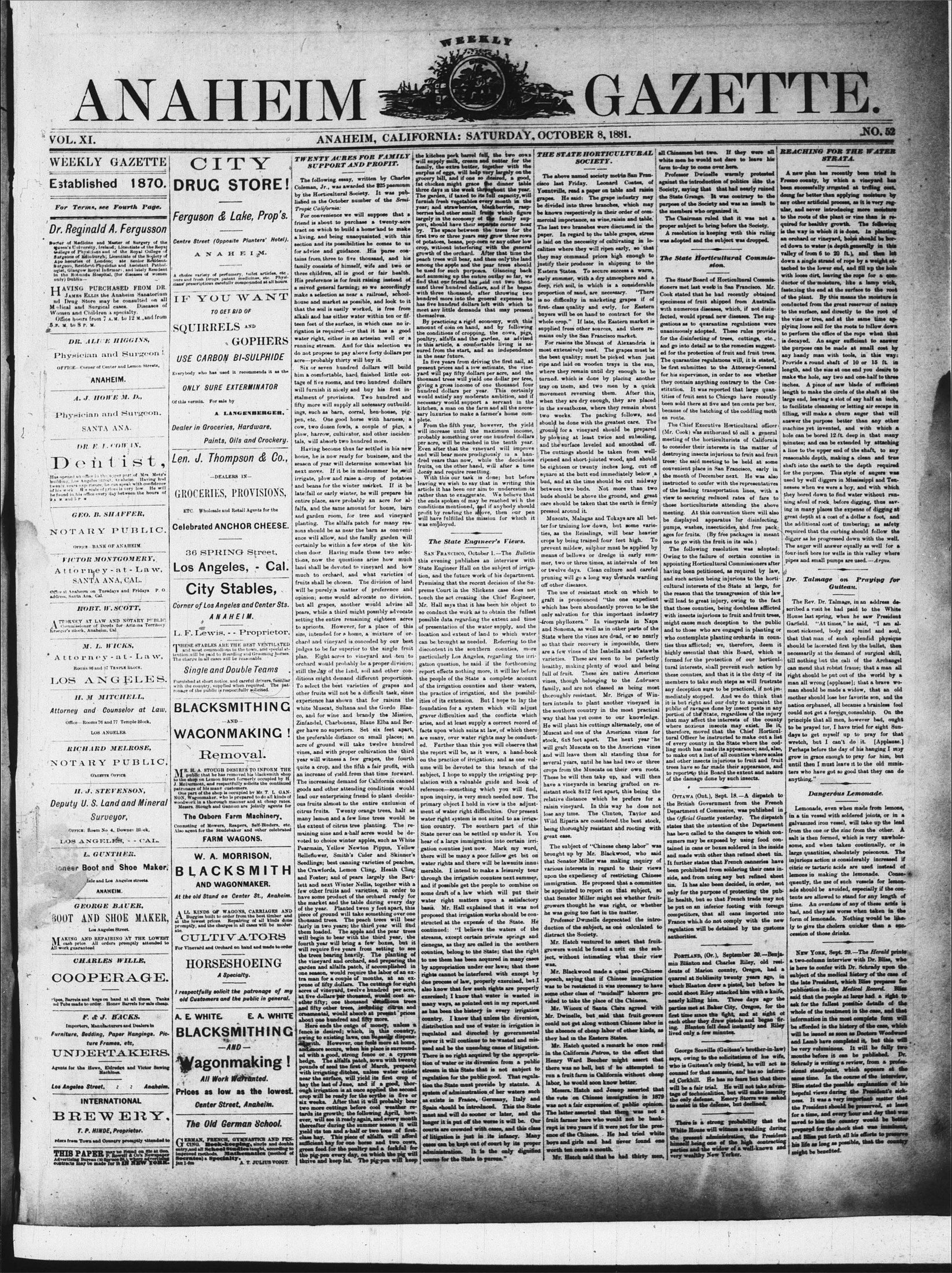
Searchable text
ANAHEIM
VOL. XI.
WEEKLY GAZETTE
Established 1870.
For Terms, see Fourth Page.
Dr. Reginald A. Fergusson
Bacter of Medicine and Master of Surgery of the Queen's University, Ireland; Licentiate of the Royal College of Physicians and of the Royal College of Surgeons of Edinburgh; Licentiate of the Society of Apoeces of London; ate Senior Resident Surgeon, Resident-Physician and Assistant Pathologist, Glasgow Royal Infirmary, and lately Resident in the Rotunda Hospital (for diseases of women only) Dublin—
HAVING PURCHASED FROM DR. JAMES ELLIS the Anaheim Sanatorium and Drug Store may be consulted on all Medical and Surgical cases. Diseases of Women and Children a specialty.
Office hours from 7 a.m. to 12 m., and from 5 p.m. to 8 p.m.
DR. ALICE HIGGINS,
Physician and Surgeon!
OFFICE—Corner of Center and Lemon Streets,
ANAHEIM.
A. J. HOWE M. D.,
Physician and Surgeon.
SANTA ANA.
DR. E. L. COWIN.
Dentist,
CITY DRUG STORE!
Ferguson & Lake, Prop's.
Centre Street (Opposite Planters' Hotel).
ANAHEIM.
A choice variety of perfumery, toilet articles, etc., cure and fresh Drugs, patent medicines, etc. Physicians' prescriptions carefully compounded at all hours.
IF YOU WANT TO GET RID OF SQUIRRELS AND GOPHERS
USE CARBON BI-SULPHIDE
Everybody who has used it recommends it as the ONLY SURE EXTERMINATOR Of this vermin. For sale by A LANGENBERGER,
Dealer in Groceries, Hardware.
Paints, Oils and Crockery.
Len. J. Thompson & Co.,
TWENTY ACRES SUPPORT AN
The following essay, Coleman, Jr., was awarded by the Horticultural Societylished in the October n Tropic California:
For convenience we will friend is about to purchase tract on which to build a living, and being una section and its possibility for advice and guidance tains from three to five family consists of himself three children, all in g His preference is for fre a mixed general farming make a selection as near house and market as possible that the soil is easily w alkali and has either w teen feet of the surface, rigation is required—or water right, either in a running stream. And do not propose to pay a acre—probably thirty w Six or seven hundred him a comfortable, hard age of five rooms, and will furnish it nicely and stalment of provisions. Fifty more will supply aings, such as barn, corn pen, etc. One good ho cow, two dozen fowls, plow, harrow, cultivato tals, will absorb two hu Having become thus home, he is now ready season of year will det next move. If it be in
ANAHEIM.
A. J. HOWE M. D., Physician and Surgeon. Santa Ana.
DR. E. L. COWIN, Dentist.
GEO. B. SHAFFER, NOTARY PUBLIC.
VICTOR MONTGOMERY, Attorney-at-Law. Santa Ana, Cal.
ROBT. W. SCOTT, Attorney at Law and Notary Public Commissioner of Deeds for Arizona Territory Kroeger's block, Anaheim, Cal.
M. L. WICKS, Attorney-at-Law. Rooms 86 and 87 Temple Block.
LOS ANGELES.
H. M MITCHELL, Attorney and Counselor at Law. Office—Rooms 76 and 77 Temple Block, Los Angeles.
RICHARD MELROSE, NOTARY PUBLIC.
GAZETTE OFFICE.
H. J. STEVENSON, Deputy U. S. Land and Mineral Surveyor. Office—Room No 4, Downey Block, Los Angeles, -- Cal.
L. GUNTHER, pioneer Boot and Shoe Maker,iale and Los Angeles streets. Anaheim.
ONLY SURE EXTERMINATOR Of this vermin. For sale by A LANGENBERGER, Dealer in Groceries, Hardware. Paints, Oils and Crockery.
Len. J. Thompson & Co., DEALERS IN GROCERIES, PROVISIONS, ETC. Wholesale and Retail Agents for the Celebrated ANCHOR CHEESE.
36 SPRING Street, Los Angeles, - Cal.
City Stables, Corner of Los Angeles and Center Sts. Anaheim.
L. F. Lewis.- Proprietor.
THESE STABLES ARE THE BEST VENTILATED and most commodious in the town, and special attention will be paid to Boarding and Grooming horses. The charm in all cases will be reasonable.
Single and Double Teams Furnished at short notice, and careful drivers, familiar with the country, supplied when required. The patronage of the public is respectfully solicited.
BLACKSMITHING AND WAGONMAKING! Removal.
MR. H. A. STOUGH DESIRES TO INFORM THE public that he has removed his blacksmith shop to the shop on Lemon Street formerly occupied by H. J. Meilermott, and respectfully solicits the continued patronage of his many customers.
One part of the shop is occupied by Mr. T. L GAN-NON, Wagounmaker, who is prepared to do all kinds of woodwork in a thorough manner and at cheap rates. Mesers, Stough and Gannon are jointly agents for The Osborn Farm Machinery.
Consisting of Mowers, Reapers, Self-Binders, etc. Also agent for the Studebaker and other celebrated FARM WAGONS.
W. A. MORRISON, BLACKSMITH AND WAGONMAKER.
At the old Stand on Center St., Anaheim.
Everybody who wishes to have a comfortable home will furnish it nicely and stalment of provisions.
Fifty more will supply aings, such as barn, corn pen, etc. One good ho cow, two dozen fowls, plow, harrow, cultivator tals, will absorb two hu Having become thus a home, he is now ready for season of year will dete next move. If it be irrigate, plow and raise and beans for the winter late fall or early winter entire place, save proba falfa, and the same am and garden room, for planting. The alfalfa sons should be as near ence will allow, and th certainly be within a fe chen door Having mations, now the question land shall be devoted to much to orchard, and fruits shall be chosen. Will be purely a matter opinion; some would a but all grapes, another pears, while a third min setting the entire remi to apricots. However size, intended for a ho chard and vineyard is judgets to be far superior plan. Eight acres to orchard would probably still the lay of the land conditions might demand To select the best var other fruits will not be experience has shown white Muscat, Sultana co, and for wine and Zinfandel, Charboneau ger have no superiors. the preferable distance acre of ground will t vines, and with proper year will witness a few quite a crop, and the f an increase of yield fro The increasing demand goods and other attend lead our enterprising fous fruits almost to the citrus fruits. Twenty many lemon and a few the extent of citrus tree maining nine and a-h voted to choice winter Pearmain, Yellow New Belleflower, Smith's Seedlings; best canning the Crawforda, Lemon and Foster; and of peett and next Winter few other fruits and have some product of
Deputy U. S. Land and Mineral Surveyor,
Office: Room No 4, Downey Block,
LOS ANGELES, - CAL.
L. GUNTHER.
Pioneer Boot and Shoe Maker,
Tele and Los Angeles streets.
ANAHEIM.
GEORGE BAUER,
BOOT AND SHOE MAKER,
Los Angeles Street.
MAKING AND REPAIRING AT THE LOWEST cash price. All orders promptly attended to.
All work guaranteed.
CHARLES WILLE,
COOPERAGE.
Tipes, Barrels and kegs on hand at all times. Tanks and Tubs made to order. Honev Barrels for sale cheap.
F. & J. BACKS.
Importers, Manufacturers and Dealers in Furniture, Bedding, Paper Hangings, Picture Frames, etc.
UNDERTAKERS.
Agents for the Howe, Eldredge and Victor Sewing Machines.
Los Angeles Street, : Anaheim.
INTERNATIONAL BREWERY.
T. P. HINDE, Proprietor.
Orders from Town and Country promptly attended to.
THIS PAPER may be found on file at Geo. P. Rowell & Co.'s Newspaper Advertising Bureau (10 Spruce St., where advertising contracts may be made for it in NEW YORK.
The Osborn Farm Machinery.
Consisting of Mowers, Reapers, Self-Binders, etc.
Also agent for the Studebaker and other celebrated FARM WAGONS.
W. A. MORRISON,
BLACKSMITH AND WAGONMAKER.
At the old Stand on Center St., Anaheim.
ALL KINDS OF WAGONS, CARRIAGES AND Buggies built to order from the best timber and at the lowest prices. Repairing of all kinds done promptly, and the charges in all cases will be moderate.
CULTIVATORS
For Vineyard and Orchard on hand and made to order
HORSESHOEING
A Specialty.
I respectfully solicit the patronage of my old Customers and the public in general.
A. E. WHITE.
E. A. WHITE
BLACKSMITHING
—AND—
Wagonmaking!
All Work Warranted.
Prices as low as the lowest.
Center Street, Anaheim.
The Old German School.
GERMAN, FRENCH, GYMNASTICS AND PENCING. Book-keeping, single and double entry, and all School Studies taught, according to improved methods. Mathematics (method of Secrates) a Specialty.
Jan 1-6m
A. T. JULIUS VOIGT.
TWENTY ACRES FOR FAMILY SUPPORT AND PROFIT.
The following essay, written by Charles Coleman, Jr., was awarded the $25 paeimum by the Horticultural Society. It was published in the October number of the Semi-Tropic California:
For convenience we will suppose that a friend is about to purchase a twenty-acre tract on which to build a home and to make a living, and being unacquainted with this section and its possibilities he comes to us for advice and guidance. His purse contains from three to five thousand, and his family consists of himself, wife and two or three children, all in good or fair health. His preference is for fruit raising instead of a mixed general farming; so we accordingly make a selection as near a railroad, school-house and market as possible, and look to it that the soil is easily worked, is free from alkali and has either water within ten or fifteen feet of the surface, in which case no irrigation is required—or that it has a good water right, either in an artesian well or a running stream. And for this selection we do not propose to pay above forty dollars per acre—probably thirty will buy it.
Six or seven hundred dollars will build him a comfortable, hard finished little cottage of five rooms, and two hundred dollars will furnish it nicely and buy his first instalment of provisions. Two hundred and fifty more will supply all necessary outbuildings, such as barn, corral, hen-house, pigpen, etc. One good horse with harness, a cow, two dozen fowls, a couple of pigs, a plow, harrow, cultivator, and other incidentals, will absorb two hundred more.
Having become thus far settled in his new home, he is now ready for business, and the season of year will determine somewhat his next move. If it be in midsummer he will the kitchen pork barrel full, the two coats will supply milk, cream and butter for the family, the extra butter, together with the surplus of eggs, will help very largely on the grocery bill, and if one so desired, a good fat chicken might grace the dinner table three days in the week throughout the year. The garden, if taxed to its full capacity, will furnish fresh vegetables every month in the year; and strawberries, blackberries, raspberries and other small fruits which figure largely in the economy of the family support, should have their separate corner near by. The space between the trees for the first two or three years may grow three rows of potatoes, beans, pop-corn or any other low crop, without interfering with the general growth of the orchard. After that time the peach trees will bear, and then only the land among the apple and the pear trees should be used for such purposes. Glancing back and summing up the entire outlay so far, we find that our friend has paid out two thousand three hundred dollars, and if he began with three thousand, after throwing two hundred more into the general expenses he has five hundred dollars left with which to meet any little demands that may present themselves.
By practicing a rigid economy, with this amount of coin on hand, and by following the conditions of cropping, the cows, pigs, poultry, alfalfa and the garden, as advised in this article, a comfortable living is assured from the start, and an independence in the near future.
In five years from driving the first nail, at present prices and a low estimate, the vineyard will pay fifty dollars per acre, and the thousand trees will yield one dollar per tree, giving a gross income of one thousand four hundred dollars per year. This certainly would satisfy any moderate ambition, and if necessary would support a servant in the kitchen, a man on the farm and all the necessary luxuries to make a farmer's home complete.
From the fifth year, however, the yield will increase until the maximum income, probably something over one hundred dollars per acre, will be reached in the tenth year. Even after that the vineyard will improve and will bear more prodigiously in a hundred years than now, while the deciduous fruits on the other hand will after a time decay and require resetting.
THE STATE HORTICULTURAL SOCIETY.
The above named society met in San Francisco last Friday. Leonard Coates, of Yountville, read a paper on table and raisin grapes. He said: The grape industry may be divided into three branches, which may be known respectively in their order of commercial importance, as wine, raisin and table. The last two branches were discussed in the paper. In regard to the table grapes, stress is laid on the necessity of cultivating in localities where they will ripen early, so that they may command prices high enough to justify their producer in shipping to the Eastern States. To secure success a warm, early summer, with a dry atmosphere and a deep, rich soil, in which is a considerable proportion of sand, are necessary. "There is no difficulty in marketing grapes if of first-class quality and early, for Eastern buyers will be on hand to contract for the whole crop." If late, the Eastern market is supplied from other sources, and there remains only the San Francisco market.
For raisins the Muscat of Alexandria is most extensively used. The grapes must be the best quality; must be picked when just ripe and laid on wooden trays in the sun, where they remain until dry enough to be turned. which is done by placing another tray on them, and two men by a quick movement reversing them. After this, when they are dry enough, they are placed in the sweatboxes, where they remain about two weeks. The packing follows, and should be done with the greatest care. The ground for a vineyard should be prepared by plowing at least twice and subsoiling, and the surface leveled and smoothed off. The cuttings should be taken from well-ripened and short-jointed wood, and should be eighteen or twenty inches long, cut off square at the butt end immediately below a
him a comfortable, hard finished little cottage of five rooms, and two hundred dollars will furnish it nicely and buy his first instalment of provisions. Two hundred and fifty more will supply all necessary outbuildings, such as barn, corral, hen-house, pigpen, etc. One good horse with harness, a cow, two dozen fowls, a couple of pigs, a plow, harrow, cultivator, and other incidentals, will absorb two hundred more.
Having become thus far settled in his new home, he is now ready for business, and the season of year will determine somewhat his next move. If it be in midsummer he will irrigate, plow and raise a crop of potatoes and beans for the winter market. If it be late fall or early winter, he will prepare his entire place, save probably an acre for alfalfa, and the same amount for house, barn and garden room, for tree and vineyard planting. The alfalfa patch for many reasons should be as near the barn as convenience will allow, and the family garden will certainly be within a few steps of the kitchen door. Having made these two selections, now the questions arise how much land shall be devoted to vineyard and how much to orchard, and what varieties of fruits shall be chosen. The division of land will be purely a matter of preference and opinion; some would advocate no division, but all grapes, another would advise all pears, while a third might possibly advocate setting the entire remaining eighteen acres to apricots. However, for a place of this size, intended for a home, a mixture of orchard and vineyard is conceded by our best judges to be far superior to the single fruit plan. Eight acres to vineyard and ten to orchard would probably be a proper division; still the lay of the land, soil and other conditions might demand different proportions. To select the best varieties of grapes and other fruits will not be a difficult task, since experience has shown that for raisins the white Muscat, Sultana and the Gordo Blanco, and for wine and brandy the Mission, Zinfandel, Charbonean, Blue Elba and Berger have no superiors. Set six feet apart, the preferable distance on small places; an acre of ground will take twelve hundred vines, and with proper cultivation the third year will witness a few grapes, the fourth quite a crop, and the fifth a fair profit, with an increase of yield from that time forward. The increasing demand for California canned goods and other attending conditions would lead our enterprising friend to plant deciduous fruits almost to the entire exclusion of citrus fruits. Twenty orange trees, halt as many lemon and a few lime trees would be the extent of citrus tree planting. The remaining nine and a half acres would be devoted to choice winter apples, such as White Pearmain, Yellow Newton Pippin, Yellow Belleflower, Smith's Cider and Skinner's Seedlings; best canning varieties of peaches, the Crawfords, Lemon Ching, Heath Cling and Foster; and of pears largely the Bartlett and next Winter Nellis, together with a few other fruits and varieties, in order to have some product of the orchard ready for him a comfortable, hard finished little cottage of five rooms, and two hundred dollars will furnish it nicely and buy his first instalment of provisions. Two hundred and fifty more will supply all necessary outbuildings, such as barn, corral, hen-house, pigpen, etc. One good horse with harness; a cow, two dozen fowls, a couple of pigs, a plow, harrow, cultivator, and other incidentals, will absorb two hundred more.
Having become thus far settled in his new home, he is now ready for business, and the season of year will determine somewhat his next move. If it be in midsummer he will irrigate, plow and raise a crop of potatoes and beans for the winter market. If it be late fall or early winter, he will prepare his entire place, save probably an acre for alfalfa, and the same amount for house, barn and garden room, for tree and vineyard planting. The alfalfa patch for many reasons should be as near the barn as convenience will allow, and the family garden will certainly be within a few steps of the kitchen door. Having made these two selections, now the questions arise how much land shall be devoted to vineyard and how much to orchard, and what varieties of fruits shall be chosen. The division of land will be purely a matter of preference and opinion; some would advocate no division, but all grapes, another would advise all pears, while a third might possibly advocate setting the entire remaining eighteen acres to apricots. However, for a place of this size, intended for a home, a mixture of orchard and vineyard is conceded by our best judges to be far superior to the single fruit plan. Eight acres to vineyard and ten to orchard would probably be a proper division; still the lay of the land, soil and other conditions might demand different proportions. To select the best varieties of grapes and other fruits will not be a difficult task, since experience has shown that for raisins the white Muscat, Sultana and the Gordo Blanco, and for wine and brandy the Mission, Zinfandel, Charbonean, Blue Elba and Berger have no superiors. Set six feet apart, the preferable distance on small places; an acre of ground will take twelve hundred vines, and with proper cultivation the third year will witness a few grapes, the fourth quite a crop, and the fifth a fair profit, with an increase of yield from that time forward. The increasing demand for California canned goods and other attending conditions would lead our enterprising friend to plant deciduous fruits almost to the entire exclusion of citrus fruits. Twenty orange trees, halt as many lemon and a few lime trees would be the extent of citrus tree planting. The remaining nine and a half acres would be devoted to choice winter apples, such as White Pearmain, Yellow Newton Pippin, Yellow Belleflower, Smith's Cider and Skinner's Seedlings; best canning varieties of peaches, the Crawfords, Lemon Ching, Heath Cling and Foster; and of pears largely the Bartlett and next Winter Nellis, together with a few other fruits and varieties, in order to have some product of the orchard ready for him a comfortable, hard finished little cottage of five rooms, and two hundred dollars will furnish it nicely and buy his first instalment of provisions. Two hundred and fifty more will supply all necessary outbuildings such as barn, corral,hen-house,pigpen,etc. One good horse with harness;a cow,two dozen fowls,a couple of pigs,a plow,harrow,cultivator,and other incidentals,will absorb two hundred more.
Having become thus far settled in his new home,he is now ready for business,and the season of year will determine somewhat his next move. If it be in midsummer he will irrigate,plow和raise a crop of potatoes和beans for the winter market。If it be late fall或 early winter,he will prepare his entire place,save probably an acre for alfalfa,和the same amount for house,barn和 garden room,for tree和 vineyard planting。The alfalfa patch for many reasons should be as near the barn as convenience will allow,and the family garden will certainly be within a few steps of the kitchen door.Having made these two selections,今the questions arise how much land shall be devoted to vineyard和how much to orchard,和what varieties of fruits shall be chosen.The division of land will be purely a matter of preference和 opinion;some would advocate no division,但all grapes,another would advise all pears,而a third might possibly advocate setting the entire remaining eighteen acres to apricotsHowever,for a place of this size,intended for a home,a mixture of orchard和 vineyard is conceded by our best judges to be far superior to the single fruit plan.Eight acres to vineyard和ten to orchard would probably be a proper division;still the lay of the land,soil和其他 conditions might demand different proportions.To select the best varieties of grapes和 other fruits will not be a difficult task,since experience has shown that for raisins the white Muscat,Sultana和the Gordo Blanco,and for wine和 brandythe Mission,Zinfandel,Charbonean,Blue Elba和Berger have no superiors.Set six feet apart,the preferable distance on small places;an acre of ground will take twelve hundred vines,and with proper cultivation the third year will witness a few grapes,the fourth quite a crop,and the fifth a fair profit.with an increase of yield from that time forward.The increasing demand for California canned goods和 other attending conditions would lead our enterprising friend to plant deciduous fruits almost to the entire exclusion of citrus fruits.Twenty orange trees,halt as many lemon and a few lime trees would be the extent of citrus tree planting.The remaining nine and a half acres would be devoted to choice winter apples,such as White Pearmain,Yellow Newton Pippin,Yellow Belleflower,Smith's Cider和Skinner's Seedlings;best canning varieties of peaches,the Crawfords,Lemon Ching,Heath Clingand Foster;and of pears largelythe BartlettandnextWinterNellis,togetherwithafewotherfruitsandvarieties.inordertohavesomeproductoftheorchardreadyforhimacomfortable,hardfinishedlittlecottageoffiverooms,andtwohundreddollarsperacre,andthethousandtreeswill yieldonedollarpertree,givinga grossincomeofone thousandfourhundreddollarsperacre,andifnecessarywouldsupportaservantinthekitchen,amanonthe farmandallthenecessaryluxuriestomakeafarmer'shomecomplete.Fromthefifthyear,however,theywillincreaseuntilthemaximumincomeprobably somethingoveronehundreddollarsperacre,andwillbe reachedinthetenthyear.Evenafterthatthevineyardwillimproveandwillbearmoreprodigiouslyinahundredyears thannow,而thedeciduousfruits.ontheotherhand.willafteratimedecayandrequireresetting.Withthistaskisdone;但beforeleavingwe wishto saythatinwritingthisarticleithasbeenouraimtounderestimateratherthantoexaggerate.Welievethattheendsspokenofmaybereachedwiththeconditionsmentioned,andifanybodyshouldprofitbyreadingtheabove,thenewpenwillhavefulilledthemissionforwhichitwasemployed.
TheStateEngineer'sViews.
SANFRANCISCO,October1.-TheBulletinthiseveningpublishesaninterviewwithStateEngineerHallonthesubjectofirrigation,andthefutureworkofhisdepartment.Premisingthatthe recent decisionoftheSupremeCourtintheSlickenscasedoesnottouchtheactcreatingtheChiefEngineerMr.Hall says thatithasbeenhisobjecttoso conducttheworkastoobtainthefullestpossibledataregardingtheextentandtimeofpresentationofthewatersupply,andthelocationandextentoflandtowhichwatercanbroughtasneeded.Referringtothediscontentinthesoutherncounties,moreparticularlyLosAngeles,rregardingtherigiationquestion,thesaidiftheforthcomingreporteffectsnothingmore.itwilllaybefoundthepeopleoftheStateacompleteaccountoftheirigationcountiesandtheywaters,thepracticeofirrigation,andtheposibilitiesofitsextension.ButIhopetolaythefoundationforasystemwhichwilladjustgraverifficultiesandtheconflictswhich arise,andatleastsupplyacorrectrecordoffactsonuptwichatsatlaw.ofwhichtherearemanyOverwaterrightsmagbeconducted.Furtherthanthisyouwillobservethatthereportwillbe,asitwere,ahand-bookonthepracticeofirrigation;andasonevolumewillbedevotedtocothbranchofthesubject.Ihopeto Supplytheirirrigatingpopulationwithavaluableguideandbookofreference—somethingwhichyouwillfind,p uponinquiry,visverymuchneedednow.TheprimaryobjectIholdinviewistheadjustmentofwaterrightdifficulties.Ourpresentwaterrightsystemisnotsuitedtoanirrigationcountry.Thesouthernpartofthesystemcanbesettledupunderit.Youhearofalargeimmigrationinto certainirrigationcountiesjustnow.Markmywordtherewillbemanyapoorfellowgetbitonwaterrightsandtherewillbelawsuitsinnumerable.I intendto makealeisuretourthroughtheirirrigationcountiesnextsummer,andifpossiblegetthepeopletocombineonsomedraftoflawwhichwillput theirmatterrightmatteruponasatisfactory
Theuseofresistantstockonwhichtograftispronounced“theoneexpedientwhichhasbeen abundantlyproventobetheonlysalvationforthisimportantindustryfromphylloxera.”InvineyardsinNapaandSonoma.aswellasinotherpartsoftheStatewherevinesaredead.orso nearlyso that their recoveryisimpossible,theareafewvinesoftheIsabellaandCatawbiavarieties。这些seentobeperfectlyhealthy,making plentyofwoodandbeingfulloffruit。这些arenativeAmericanvinesthoughbelongingtotheLabruscafamily,andarenotclassedasbeingmostthoroughly resistant.Mr.BriggsofWintersintendtoplantanothervineyardinthesoutherncountryinthemostpracticalwaythathasyetcometoourknowledge.Hewillplanthiscuttingsalternately,一oMuscatandoneoftheAmericanvinesforstock,x68feetapart.ThenextyearhewillgraftMuscatsontotheAmericanvinesandwillleave themallstandingthusforseveralyears,t untilhehashadtworoadorthreecropsfromtheMuscatson theirownroots.Thesewillthentakeup,andwillthenhaveavineydairsin bearinggraftedonresistantstock8x12feetapart,这beingrelativedistancewhichheprefersforaraisinvineyard.Inthiswayhedoesnotloseanytime.TheClinton,TaylorandWildRipariaareconsidered.thebeststock.be thoroughlyresistantandrootingwithgreatease.
Thesubjectof“Chinesecheap labor”was broughtupbyMr.Blackwoodwho said thatSenator Miller was making inquiryof various interests in regard to their views upon the expediencyofrestrictingChineseimmigration.Hew proposedthatacommitteebeappointedtoreportonthatsubject,sothemenatrillermustseewhitereference
ous fruits almost to the entire exclusion of citrus fruits. Twenty orange trees, halt as many lemon and a few lime trees would be the extent of citrus tree planting. The remaining nine and a-half acres would be devoted to choice winter apples, such as White Pearmain, Yellow Newton Pippin, Yellow Belleflower, Smith's Cider and Skinner's Seedlings; best canning varieties of peaches, the Crawfords, Lemon Cling, Heath Cling and Foster; and of pears largely the Bartlett and next Winter Nellis, together with a few other fruits and varieties, in order to have some product of the orchard ready for the market and the table during every day of the year. Planted twenty y feet apart, this piece of ground will take something over one thousand trees. The peach trees will bear fairly in two years; the third year will find them loaded. The apple and the pear trees will begin to bear with the third year, the fourth year will bring a few boxes, but it will require five years from setting to see the trees bearing heavily. The planting of the vineyard and orchard, and preparing the garden and alfalfa patch, if accomplished in one season, would require the labor of an extra man for a couple of months, at an expense of fifty dollars. The cuttings for eight acres of vineyard, twelve hundred per acre, at five dollars per thousand, would cost another fifty; one thousand deciduous trees and fifty other trees, including citrus and ornamental, would absorb at present prices about one hundred and fifty more.
Here ends the outgo of money, unless a fence is desired; which, in this country, owing to existing laws, can be easily dispensed with. However, one feels more at home, and more secure, when his place is surrounded with a good, strong fence or a cypress hedge. The alfalfa patch, sown with twenty pounds of seed the first of March, prepared with irrigating ditches, unless water exists near the surface, will yield its first crop of hay the last of June, and if a good, thorough irrigation is at once applied the second crop will be ready for the sythetie in five or six weeks. After that it will probably bear two more cuttings before cool weather retards its growth; the following April, however, will see it ready again, and every month thereafter during the summer season it will yield its ton and a-half or two tons of first-class hay. This piece of alfalfa will afford sufficient hay for one horse and two cows, green feed for the poultry and a forkful for the pig-pen every day, on which the pig will thrive and keep fat. The pig-pen will keep primary object I hold in view is the adjustment of water right difficulties. Our present water right system is not suited to an irrigation country. The southern part of this State never can be settled up under it. You hear of a large immigration into certain irrigation counties just now. Mark my word, there will be many a poor fellow get bit on water rights and there will be lawsuits innumerable. I intend to make a leisurely tour through the irrigation counties next summer, and if possible get the people to combine on some draft of a law which will put their water right matters upon a satisfactory basis. Mr. Hall explained that it was not proposed that irrigation works should be constructed at the expense of the State. He continued: "I believe the waters of the streams, except certain private springs and cienergas, as they are called in the southern counties, belong to the State; that the right to use them has been acquired in many cases by appropriation under our laws; that these rights cannot be interfered with except by due process of law, properly exercised, but I also know that few such rights are properly exercised; I know that water is wasted in many ways, as pointed out in my report,and as has been the history in every irrigation country. I know that unless the diversion, distribution and use of water in irrigation is regulated and directed by governmental power it will continue to be wasted and misused and be the unending cause of litigation. There is no right acquired by the appropriation of water or its diversion from a public stream in this State that is not subject to regulation for the public good. That regulation the State must provide by statute. A system of administration of her waters such as exists in France, Germany, Italy and Spain should be introduced. This the State must and will do sooner or later, and the longer it is put off the worse it will be. Our courts are crowded with cases, and this class of litigation is just in its infancy. Many cases can be kept out of court by its proper administration. It is the only dignified course for the State to pursue."
The subject of "Chinese cheap labor" was brought up by Mr. Blackwood, who said that Senator Miller was making inquiry of various interests in regard to their views upon the expediency of restricting Chinese immigration. He proposed that a committee be appointed to report on that subject, so that Senator Miller might see whether fruit-growers thought he was right, or whether he was going too fast in the matter.
Professor Dwinelle deprecated the introduction of the subject, as one calculated to distract the Society.
Mr. Hatch ventured to assert that fruit-growers would be found a unit on the subject, without intimating what their view was.
Mr. Blackwood made a quasi pro-Chinese speech, saying that if Chinese immigration was to be restricted it was necessary to have some other class of "mudaill" laborers provided to take the place of the Chinese.
Mr. Wiicox of Santa Clara agreed with Mr. Dwinelle, but said that fruit-growers could not get along without Chinese labor in the absence of cheap labor of other kinds, as they had in the Eastern States.
Mr. Hatch quoted a remark he once read in the California Patron, to the effect that Henry Ward Beecher might assert that there was no hell, but if he attempted to run a fruit farm in California without cheap labor, he would soon know better.
Messrs. Hatch and Jessup asserted that the vote on Chinese immigration in 1879 was not a fair expression of public opinion. The latter asserted that there was not a fruit farmer here who would not be bankrupt in two years if it were not for the presence of the Chinese. He had tried white boys and girls and had never found one worth ten cents a month.
Mr. Hatch said that he had thirty men,
GAZETTE.
NO. 52
ARTICULTURAL SOCIETY.
Society met in San Francisco, of over on table and raisin grape industry may branches, which may in their order of comwine, raisin and table. were discussed in the table grapes, stress of cultivating in lo-ripen early, so that prices high enough to in shipping to the secure success a warm, dry atmosphere and a which is a considerable necessary. "There marketing grapes if of early, for Eastern to contract for the Eastern market is resources, and there re-francisco market.
cat of Alexandria is The grapes must be not be picked when just ten trays in the sun, until dry enough to be by placing another two men by a quick them. After this, though, they are placed where they remain about packing follows, and the greatest care. The should be prepared twice and subsoiling, seeded and smoothed off. be taken from well-used wood, and should inches long, cut off immediately below all Chinamen but two. If they were all white men he would not dare to leave his farm to-day to come over here.
Professor Dwinelle warmly protested against the introduction of politics into the Society, saying that had nearly ruined the State Grange. It was contrary to the purpose of the Society and was an insult to the members who organized it.
The Chairman ruled that it was not a proper subject to bring before the Society.
A resolution in keeping with this ruling was adopted and the subject was dropped.
The State Horticultural Commission.
The State Board of Horticultural Commissioners met last week in San Francisco. Mr. Cook stated that he had recently obtained specimens of fruit shipped from Australia with numerous diseases, which, if not disinfected, would spread new diseases. The suggestions as to quarantine regulations were unanimously adopted. These rules provide for the disinfecting of trees, cuttings, etc., and go into detail as to the remedies suggested for the protection of fruit and fruit trees. The quarantine regulations will, it is stated, be first submitted to the Attorney-General for his supervision, in order to see whether they contain anything contrary to the Constitution. It was reported that large quantities of fruit sent to Chicago have recently been sold there at five and ten cents per box because of the hatching of the coddling moth en route.
The Chief Executive Horticultural officer (Mr. Cook) was authorized to call a general meeting of the horticulturists of California to consider their interests in the matter of destroying insects injurious to fruit and fruit trees; the said meeting to be held at some convenient place in San Francisco, early in the month of December.
REACHING FOR THE WATER STRATA.
A new plan has recently been tried in Fresno county, by which a vineyard has been successfully irrigated at trifling cost, doing far better than applying moisture by any other artificial process, as it is very regular, and never introducing more moisture to the roots of the plant or vine than is required for healthy growth. The following is the way in which it is done. In planting an orchard or vineyard, holes should be bored down to water (a depth generally in this valley of from 6 to 20 ft.), and then let down a single strand of rope by a weight attached to the lower end, and fill up the hole with loose dirt, leaving the rope for a conductor of the moisture, like a lamp wick, fastening the end at the surface to the root of the plant. By this means the moisture is conducted from the great reservoir of nature to the surface, and directly to the root of the vine or tree, and at the same time applying loose soil for the roots to follow down to perform the office of the rope when that is decayed. An auger sufficient to answer the purpose can be made at small cost by any handy man with tools, in this way: Provide a round shaft of 10 or 15 ft. in length, and the size at one end you desire to make the hole, say two and one-half to three inches. A piece of saw blade of sufficient length to make the circle of the shaft at the large end, leaving a slot of say half an inch, to facilitate cleansing or letting air escape in filling, will make a churn auger that will answer the purpose better than any other machine yet invented, and with which a hole can be bored 12 ft. deep in that many minutes; and can be extended by attaching a line to the upper end of the shaft, to any reasonable depth, making a clean and true shaft into the earth to the depth required for the purpose. This style of augers was
by placing another two men by a quick them. After this, though, they are placed where they remain about packing follows, and the greatest care. The should be prepared twice and subsoliling, and smoothed off. Be taken from well-instructed wood, and should inches long, cut off immediately below a should be cut midway. Not more than two feet ground, and great that the earth is firmly.
Tokays are all betown, but some variegations will bear heavier four feet high. Tothur must be applied by dredge in early summers, at intervals of ten man culture and careful way towards warding stock on which to "the one expedient evidently proven to be the most important industry on vineyards in Napa as in other parts of the states are dead, or so nearly is impossible, there Isabella and Catawba seen to be perfectly quiet of wood and being are native American inging to the Labrusca classed as being most Mr. Briggs of Winchester another vineyard in any in the most practical mode to our knowledge. Settings alternately, one of the American vines for it. The next year he en to the American vines all standing thus for he has had two or three roots on their own roots. Make up, and will then bearing grafted on reef apart, this being which he prefers for a this way he does not Clinton, Taylor and considered the best stock, assistant and rooting with Chinese cheap labor" was Blackwood, who said was making inquiry of regard to their views of restricting Chinese proposed that a committee report on that subject, so might see whether fruit-
Ottawa (Ont.), Sept. 18.—A dispatch to the British Government from the French Department of Commerce, was published in the Official Gazette yesterday. The dispatch states that the intention of the Department has been called to the dangers to which consumers may be exposed by using food contained in cans or boxes soldered in the inside and made with other than refined sheet tin. It further states that French canneries have been prohibited from soldering their cans inside, and from using any but refined sheet tin. It has also been decided, in order, not only for the purpose of protecting the public health, but so that French trade may not make the hole, say two and one-half to three inches. A piece of saw blade of sufficient length to make the circle of the shaft at the large end, leaving a slot of say half an inch, to facilitate cleansing or letting air escape in filling, will make a churn auger that will answer the purpose better than any other machine yet invented, and with which a hole can be bored 12 ft. deep in that many minutes; and can be extended by attaching a line to the upper end of the shaft, to any reasonable depth, making a clean and true shaft into the earth to the depth required for the purpose. This style of augers was used by well diggers in Mississippi and Tennessee when we were a boy, and with which they bored down to find water without running afoul of rock before digging, thus saving in many places the expense of digging at great depth at a cost of a dollar a foot, and the additional cost of timbering; as safety required that the curbing should follow the digger as he progressed down with the well. The auger will answer equally as well for a four-inch bore for wells in this valley where pipes and small pumps are used.—Argus.
Dr. Talmage on Praying for Gutteau.
The Rev. Dr. Talmage, in an address described a visit he had paid to the White House last spring, when he saw President Garfield. "At times," he said, "I am almost sickened, body and mind and soul, that that man of such splendid physique should be lacerated first by the bullet, then necessarily at the demand of surgical skill, till nothing but the call of the Archangel can mend that robust frame; that a man all right should be put out of the world by a man all wrong [applause]; that a brave woman should be made a widow, that an old mother should lose her favorite son, and the nation orphaned, all because a brainless fool could not get a foreign consulship. On the principle that all men, however bad, ought to be prayed tor, I have tried for eight Sundays to get myself up to pray for that wretch, but I can't do it. [Applause.] Perhaps before the day of his hanging I may grow in grace enough to pray for him, but until then I must leave it to the old ministers who have got so good that they can do anything."
Dangerous Lemonade.
Lemonade, even when made from lemons, in a tin vessel with soldered joints, or in a galvanized iron vessel, will take up the lead from the one or the zinc from the other. A salt is then formed, which is very unwholesome, and when taken continually, or in large quantities, absolutely poisonous. The injurious action is considerably increased if citric or tartaric acids are used instead of lemons in making the lemonade. Consequently, the use of such vessels for lemonade should be avoided, especially if the contents are allowed to stand for any length of
"Chinese cheap labor" was Blackwood, who said it was making inquiry of the regard to their views of restricting Chinese proposed that a committee report on that subject, so might see whether fruit was right, or whether not in the matter.
The deprecated the introduction, as one calculated to assert that fruit found a unit on the sub-ating what their view made a quasi pro-Chinese if Chinese immigration it was necessary to have "mudsill" laborers produce of the Chinese.
Santa Clara agreed with said that fruit growers without Chinese labor in deep labor of other kinds, as Western States.
A remark he once read Patron, to the effect that Patron might assert that about if he attempted to California without cheap know better.
And Jessup asserted that these immigration in 1879 occasion of public opinion that there was not a who would not be banked it were not for the preside. He had tried white had never found one month.
That he had thirty men,
Portland, (Or.), September 30.—Benjamin Blanton and Charles Riley, old residents of Marion county, Oregon, had a quarrel at Sublimity twenty years ago, in which Blanton drew a pistol, but before he could shoot Riley attacked him with a knife, nearly killing him. Three days ago the parties met at Baker City, Oregon, for the first time since the fight, and at sight of each other they drew pistols and began firing. Blanton fell dead instantly and Riley lived only a few minutes.
George Scoville (Guitean's brother-in-law) says, owing to the solicitations of his wife, who is Guitean's only friend, he will act as counsel for that assassin, and has so informed Corkhill. He has no fears but that there will be a fair trial. He will not take advantage of technicalities, but will make insanity the only defense. Emory Storrs was asked to assist in the defense, but declined.
There is a strong probability that the White House will witness a wedding during the present administration, the President himself being one of the high contracting parties and the widow of a well-known and very wealthy New Yorker.
Lemonade, even when made from lemons, in a tin vessel with soldered joints, or in a galvanized iron vessel, will take up the lead from the one or the zinc from the other. A salt is then formed, which is very unwholesome, and when taken continually, or in large quantities, absolutely poisonous. The injurious action is considerably increased if citric or tartaric acids are used instead of lemons in making the lemonade. Consequently, the use of such vessels for lemonade should be avoided, especially if the contents are allowed to stand for any length of time. An overdose of any of these acids is bad, and they are worse when taken in the form of lemonade. Nothing would be likely to give the cholera quicker than a succession of those drinks.
New York, Sept. 29.—The Herald prints a two-column interview with Dr. Bliss, who is here to confer with Dr. Schrady upon the subject of the medical history of the case of the late President, which Bliss prepares for publication in the Medical Record. Bliss said that the people at large had a right to ask for the fullest possible details of the whole of the treatment in the case, and that information in the most complete form will be afforded in the history of the case, which will be issued as soon as Doctors Woodward and Lamb have completed it, but this will be very voluminous. It will be fully two months before it can be published. Dr. Schrady is writing a review, from a professional standpoint, which appears at the same time. In the course of the interview, Bliss stated the possible explanation of his hopeful views during the President's sickness. It was a very important matter that the President should be preserved, at least for a time, and every hour and day that was saved to him the country would be better prepared for the shock that was imminent, and Bliss put forth all his efforts to preserve his life as long as possible, that the country might be benefited.