anaheim-gazette 1881-09-24
Scanned page
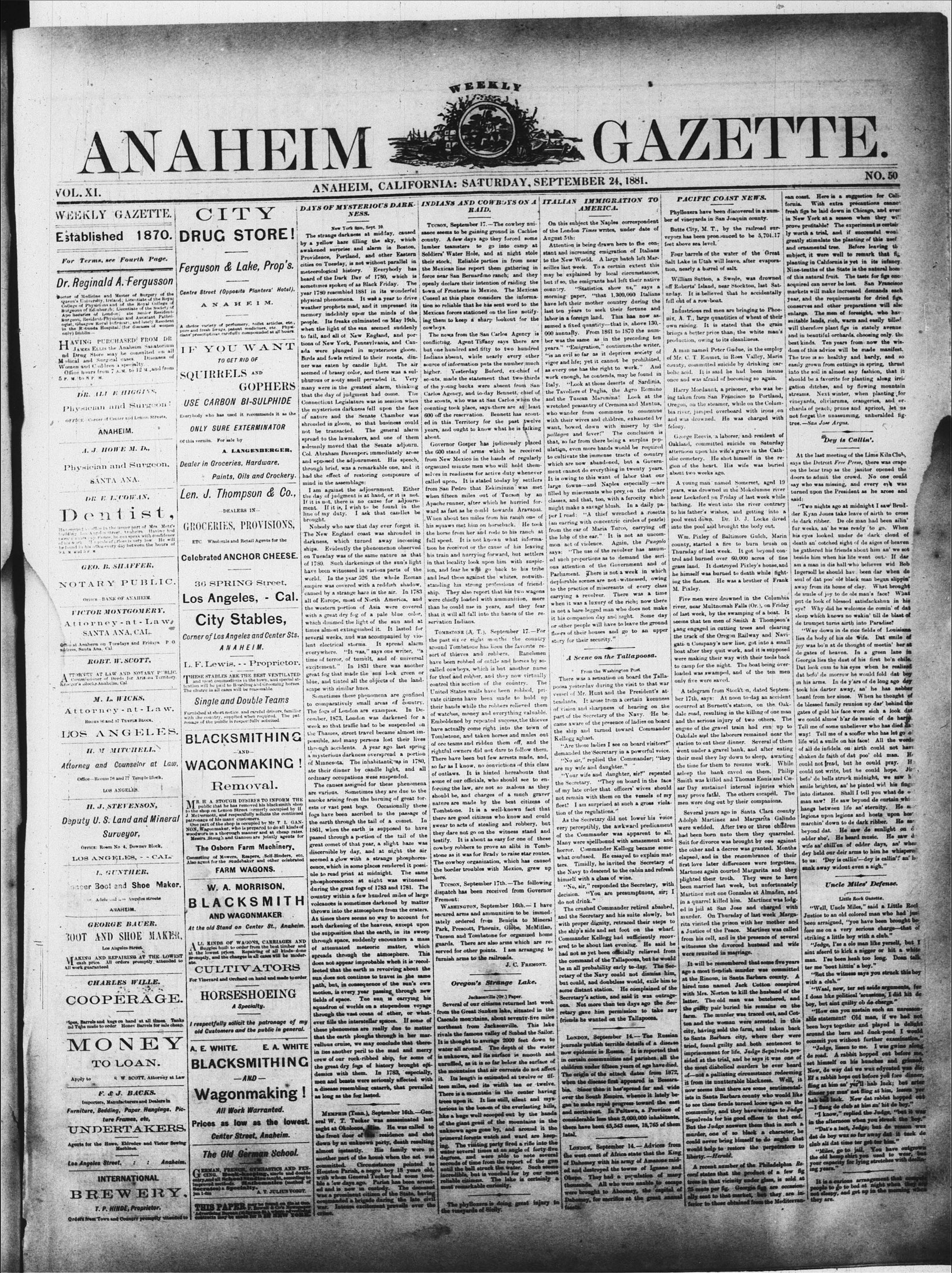
Searchable text
ANAHEIM
VOL. XI.
ANAHEIM
WEEKLY GAZETTE.
Established 1870.
For Terms, see Fourth Page.
Dr. Reginald A. Fergusson
Doctor of Medicine and Master of Surgery of the Queen's University, Ireland; Lieutenant of the Royal College of Physicians and of the Royal College of Surgeons of Edinburgh; Lieutenant of the Society of Apoios Reserves of London;ate Senior Resident-Surgeon, Resident-Physician and Assistant Pathologist, Glasgow Royal Infirmary, and lately Resident in the Rotunda Hospital (for diseases of women only) Dublin—
HAVING PURCHASED FROM DR. JAMES ELLIS the Anaheim Sanatorium and Drug Store may be consigned on all Medical and Surgical cases. Diseases of Women and Children a specialty. Office hours from 7 A.M. to 12 M., and from 5 P.M. to 8 P.M.
DR. ALI E HIGGINS,
Physician and Surgeon!
OFFICE: Corner of Center and Lemon Streets,
ANAHEIM.
A. J. HOWE M. D.,
Physician and Surgeon.
CITY DRUG STORE!
Ferguson & Lake, Prop's.
Centre Street (Opposite Planters' Hotel).
ANAHEIM.
A choice variety of perfumery, toilet articles, etc., pure and fresh Drugs, patent medicines, etc. Physicians' prescriptions carefully compounded at all hours.
IF YOU WANT TO GET RID OF SQUIRRELS AND GOPHERS
USE CARBON BI-SULPHIDE
Everybody who has used it recommends it as the ONLY SURE EXTERMINATOR
of this vermin. For sale by A. LANGENBERGER,
Dealer in Groceries, Hardware.
DAYS OF MYSTERY
New York:
The strange darkness by a yellow haze fills awakened surprise and Providence, Portland cities on Tuesday, is meteorological history heard of the Dark Day sometimes spoken of year 1780 resembled physical phenomena. Weather prophets make memory indelibly unpeople. Its freaks occur when the light of the sun fails, and all of New York ada were plunged Birds and fowls retireer was eaten by c seemed of brassy color phurous or sooty smo many were in the gr that the day of judge Connecticut Legislature the mysterious darkness of nature and the shrouded in gloom, not be transacted spread to the lawma solemnly moved than Col. Abraham Davenport and opposed the adjourn through brief, was a
DR. ALI E HIGGINS,
Physician and Surgeon!
OFFICE: Corner of Center and Lemon Streets,
ANAHEIM.
A. J. HOWE M. D.,
Physician and Surgeon,
SANTA ANA.
DR. E. L.COWAN,
Dentist,
Has commenced a office in the upper part of Mrs. Metz's building, Los Angeles Street, Anaheim. Having had twenty years experience, he can speak with confidence of his work. The scale of prices is very low. He will be found in his office every day between the hours of 5 P.M. to 8 P.M.
GEO. B. SHAFFER,
NOTARY PUBLIC.
OFFICE: BANK OF ANAHEIM.
VICTOR MONTGOMERY,
Attorney-at-Law,
SANTA ANA, CAL.
Office at Anaheim on Tuesdays and Fridays. P.O. address, Santa Ana, Cal.
ROBT. W. SCOTT,
ATTORNEY AT LAW AND NOTARY PUBLIC.
Commissioner of Deeds for Arizona Territory.
Kroger's blocks Anaheim, Cal.
M. L. WICKS,
Attorney-at-Law,
Rooms 36 and 37 Temple Block.
LOS ANGELES.
H. M MITCHELL,
Attorney and Counselor at Law,
Office—Rooms 76 and 77 Temple Block.
LOS ANGELES.
H. J. STEVENSON,
Deputy U.S. Land and Mineral Surveyor,
OFFICE: Room No 4, Downey Block.
LOS ANGELES, - - CAL.
L. GUNTHER,
Officer Boot and Shoe Maker,
QUIRRELS AND GOPHERS
USE CARBON BI-SULPHIDE
Everybody who has used it recommends it as the ONLY SURE EXTERMINATOR
Of this vermin. For sale by
A. LANGENBERGER,
Dealer in Groceries, Hardware,
Paints, Oils and Crockery.
Len. J. Thompson & Co.,
DEALERS INGROCERIES, PROVISIONS,
ETC. Wholesale and Retail Agents for the
Celebrated ANCHOR CHEESE.
36 SPRING Street.
Los Angeles, - Cal.
City Stables,
Corner of Los Angeles and Center Sts.
ANAHEIM.
L. F. Lewis, -- Proprietor.
THESE STABLES ARE THE BEST VENTILATED and most commodious in the town, and special attention will be paid to Boarding and Grooming horses.
The charre in all cases will be reasonable.
Single and Double Teams
Furnished at short notice, and careful drivers, familiar with the country, supplied when required. The patronage of the public is respectfully solicited.
BLACKSMITHING
AND
WAGONMAKING!
Removal.
MR. H. A. STOUGH DESIRES TO INFORM THE public that he has removed his blacksmith shop to the shop on Lemon Street formerly occupied by H. J. Metermott, and respectfully solicits the continued patronage of his many customers.
One part of the shop is occupied by Mr. T. L. GAN-NON, Wagonmaker, who is prepared to do all kinds of woodwork in a thorough manner and at cheap rates.
Messrs. Stough and Gannon are jointly agents for The Osborn Farm Machinery.
Consisting of Mowers, Reapers, Self-Binders, etc.
Also agent for the Studebaker and other celebrated FARM WAGONS.
W. A. MORRISON,
PHOTOGRAPHY
H. J. STEVENSON,
Deputy U. S. Land and Mineral Surveyor,
Orrick: Room No 4, Downey Block,
LOS ANGELES, - CAL.
L. GUNTHER.
Boot and Shoe Maker,
Aldie and Los Angeles streets
ANAHEIM.
GEORGE BAUER.
BOOT AND SHOE MAKER,
Los Angeles Street.
Making and repairing at the lowest cash price. All orders promptly attended to. All work guaranteed.
CHARLES WILLE.
COOPERAGE.
Wipes, Barrels and kegs on hand at all times. Tanks and Tubes made to order. Honey Barrels for sale cheap.
MONEY TO LOAN.
Apply to R. W. SCOTT, Attorney at Law
F. & J. BACKS.
Importers, Manufacturers and Dealers in Furniture, Bedding, Paper Hangings, Picture Frames, etc,
UNDERTAKERS,
Agents for the Howe, Eldredge and Victor Sewing Machines.
Los Angeles Street.: Anaheim.
INTERNATIONAL BREWERY.
T. P. MINDE, Proprietor.
Orders from Town and Country promptly attended to.
MR. H. A. STOUGH DESIRES TO INFORM THE public that he has removed his blacksmith shop to the shop on Lemon Street formerly occupied by H. J. Meltermott, and respectfully solicits the continued patronage of his many customers.
One part of the shop is occupied by Mr. T. L. GAN-NON, Wagonmaker, who is prepared to do all kinds of woodwork in a thorough manner and at cheap rates. Messrs. Stough and Gannon are jointly agents for The Osborn Farm Machinery.
Consisting of Mowers, Reapers, Self-Binders, etc. Also agent for the Studebaker and other celebrated FARM WAGONS.
W. A. MORRISON,
BLACKSMITH AND WAGONMAKER.
At the old Stand on Center St., Anaheim.
ALL KINDS OF WAGONS, CARRIAGES AND Buggies built to order from the best timber and at the lowest prices. Repairing of all kinds done promptly, and the charges in all cases will be moderate.
CULTIVATORS
For Vineyard and Orchard on hand and made to order.
HORSESHOEING
A Specialty.
I respectfully solicit the patronage of my old Customers and the public in general.
A. E. WHITE.
E. A. WHITE
BLACKSMITHING
AND
Wagonmaking!
All Work Warranted.
Prices as low as the lowest.
Center Street, Anaheim.
The Old German School.
GERMAN, FRENCH, GYMNASTICS AND PENCING.
Book-keeping, simple and double entry, and all School Studies taught according to improved methods.
Mathematics (method of Secrates) a Specialty.
Jan 1-0m.
A. T. JULIUS VOIGT.
THIS PAPER may be found on Sir at Geo.
Advertising Bureau (29 Smith St.) when advertising contracts may be made for it in NEW YORK.
DAYS OF MYSTERIOUS DARKNESS.
New York Sun, Sept. 10.
The strange darkness at midday, caused by a yellow haze filling the sky, which awakened surprise and alarm in Boston, Providence, Portland, and other Eastern cities on Tuesday, is not without parallel in meteorological history. Everybody has heard of the Dark Day of 1780, which is sometimes spoken of as Black Friday. The year 1780 resembled 1881 in its wonderful physical phenomena. It was a year to drive weather prophets mad, and it impressed its memory indelibly upon the minds of the people. Its freaks culminated on May 19th, when the light of the sun seemed suddenly to fail, and all of New England, and portions of New York, Pennsylvania, and Canada were plunged in mysterious gloom. Birds and fowls retired to their roosts, dinner was eaten by candle light. The air seemed of brassy color, and there was a sulphurous or sooty smell pervaded it. Very many were in the greatest alarm, thinking that the day of judgment had come. The Connecticut Legislature was in session when the mysterious darkness fell upon the face of nature and the Senate Chamber was shrouded in gloom, so that business could not be transacted. The general alarm spread to the lawmakers, and one of them solemnly moved that the Senate adjourn. Col. Abraham Davenport immediately arose and opposed the adjournment. His speech, through brief, was a remarkable one, and it had the effect of restoring composure of
INDIANS AND COWBOYS ON A RAID.
Tucson, September 17.—The cowboy nuisance seems to be gaining ground in Cachise county. A few days ago they forced some lumber teamsters to go into camp at Soldiers' Water Hole, and at night stole their stock. Reliable parties in from near the Mexican line report them gathering in force near San Bernardo ranch; and they openly declare their intention of raiding the town of Fronteras in Mexico. The Mexican Consul at this place considers the information so reliable that he has sent word to the Mexican forces stationed on the line notifying them to keep a sharp lookout for the cowboys.
The news from the San Carlos Agency is conflicting. Agent Tiffany says there are but one hundred and fifty to two hundred Indians absent, while nearly every other source of information puts the number much higher. Yesterday Buford, ex-chief of scouts, made the statement that two-thirds of the young bucks were absent from San Carlos Agency, and to-day Bennett, chief of the scouts, who was at San Carlos when the counting took place, says there are at least 600 off the reservation. Bennett has scouted in this Territory for the past twelve years, and ought to know what he is talking about.
Governor Gosper has judiciously placed the 600 stand of arms which he received from New Mexico in the hands of regularly organized minute men who will hold themselves in readiness for active duty whenever
ITALIAN IMMIGRATION TO AMERICA.
On this subject the Naples correspondent of the London Times writes, under date of August 5th:
Attention is being drawn here to the constant and increasing emigration of Italians to the New World. A large batch left Marseilles last week. To a certain extent this may be explained by local circumstances, but if so, the emigrants had left their native country. "Statistica show us," says a morning paper, "that 1,300,000 Italians have left their mother country during the last ten years to seek their fortune and labor in a foreign land. This has now assumed a fixed quantity—that is, above 130,000 annually. From 1861 to 1870 the number was the same as in the preceding ten years." "Emigration," continues; the writer, "is an evil so far as it deprives society of vigor and life; yet it cannot be prohibited, as every one has the right to work." And work enough, he contends, may be found in Italy. "Look at those deserts of Sardinia, the Tavoliere of Puglia, the Agro Romano and the Tuscan Maremima! Look at the wretched peasantry of Cremona and Mantua, who wander from commune to commune with their wives and children, exhausted by want, bowed down with misery by the pallagra and fever!" The conclusion is that, so far from there being a surplus population, even more hands would be required to cultivate the immense tracts of country which are now abandoned, but a Government cannot do everything in twenty years.
phurous or sooty smell pervailed it. Very many were in the greatest alarm, thinking that the day of judgment had come. The Connecticut Legislature was in session when the mysterious darkness fell upon the face of nature and the Senate Chamber was shrouded in gloom, so that business could not be transacted. The general alarm spread to the lawmakers, and one of them solemnly moved that the Senate adjourn. Col. Abraham Davenport immediately arose and opposed the adjournment. His speech, through brief, was a remarkable one, and it had the effect of restoring composure of mind in the assemblage:
I am against the adjournment. Either the day of judgment is at hand, or it is not. If it is not, there is no cause for adjournment. If it is, I wish to be found in the line of my duty. I ask that candles be brought.
Nobody who saw that day ever forgot it. The New England coast was shrouded in darkness, which turned away incoming ships. Evidently the phenomenon observed on Tuesday was of the same nature as that of 1780. Such darkenings of the sun's light have been witnessed in various parts of the world. In the year 526 the whole Roman empire was covered with a reddish shadow, caused by a strange haze in the air. In 1783 all of Europe, most of North America, and the western portion of Asia were covered with a great dry fog of a pale blue color, which dimmed the light of the sun and at times almost extinguished it. It lasted for several weeks, and was accompanied by violent electrical storms. It spread alarm everywhere. "It was," says one writer, "a time of terror, of tumult, and of universal excitement." In 1831 there was another great fog that made the sun look green or blue, and tinted all the objects of the landscape with similar hues.
Sometimes these phenomena are confined to comparatively small areas of country. The fogs of London are examples. In December, 1873, London was darkened for a week so that traffic had to be suspended on the Thames, street travel became almost impossible, and many persons lost their lives through accidents. A year ago last spring a mysterious darkness overspread a portion of Minnesota. The inhabitants, as in 1780, ate their dinner by candle light, and all ordinary occupations were suspended.
The causes assigned for these phenomena are various. Sometimes they are due to the smoke arising from the burning of great forests or vast peat bogs. Occasionally these fogs have been ascribed to the passage of the earth through the tail of a comet. In 1861, when the earth is supposed to have passed through a portion of the tail of the great comet of that year, a slight haze was discernible by day, and at night the air seemed a glow with a strange phosphorescence, which in some places rendered it possible to read print at midnight. The same phosphorescence at night was witnessed during the great fogs of 1783 and 1781. The country within a few hundred miles of large scents, made the statement that two-thirds of the young bucks were absent from San Carlos Agency, and to-day Bennett, chief of the scouts, who was at San Carlos when the counting took place, says there are at least 600 off the reservation. Bennett has scouted in this Territory for the past twelve years, and ought to know what he is talking about.
Governor Gosper has judiciously placed the 600 stand of arms which he received from New Mexico in the hands of regularly organized minute men who will hold themselves in readiness for active duty whenever called upon. It is stated today by settlers from San Pedro that Eskiminzin was met when fifteen miles out of Tucson by an Apache runner, after which he hurried forward as fast as he could towards Aravapai. When about ten miles from his ranch one of his squaws met him on horseback. He took the horse from her and rode to his ranch at full speed. It is not known what information he received or the cause of his leaving his train and hurrying forward, but settlers in that locality look upon him with suspicion, and fear he will go back to his tribe and lead them against the whites, notwithstanding his strong professions of friendship. They also report that his two wagons were chiefly loaded with ammunition, more than he could use in years, and they fear that it will all fall into the hands of the reservation Indians.
TOMBSTONE (A. T.), September 17.—For the past six or eight months the country around Tombstone has been the favorite resort of thieves and robbers. Ranchmen have been robbed of cattle and horses by so-called cowboys, which is but another name for thief and robber, and they now virtually control this section of the country. The United States mails have been robbed, private citizens have been made to hold up their hands while the robbers relieved them of watches, money and everything valuable. Emboldened by repeated success, the thieves have actually come right into the town of Tombstone, and taken horses and mules out of ore teams and ridden them off, and the rightful owners did not dare to follow them. There have been but few arrests made, and so far as I know, no convictions of this class of outlaws. It is hinted hereabouts that some of our officials, who should see to enforcing the law, are not so zealous as they should be, and charges of a much graver nature are made by the best citizens of Tombstone. It is a well-known fact that there are good citizens who know and could swear to acts of stealing and robbery, but they dare not go on the witness stand and testify. It is about as easy for one of these cowboy robbers to prove an alibi in Tombstone as it was for Brady to raise star routes. The cowboy organization, which has caused the border troubles with Mexico, grew up here.
TUCSON, September 17th.—The following dispatch has been received from Governor Ferguson:
work enough, he contends, may be found in Italy. “Look at those deserts of Sardinia, the Tavoliere of Puglia, the Agro Romano and the Tuscan Marenima! Look at the wretched peasantry of Cremona and Mantua, who wander from commune to commune with their wives and children, exhausted by want, bowed down with misery by the pallagra and fever!” The conclusion is that, so far from there being a surplus population, even more hands would be required to cultivate the immense tracts of country which are now abandoned, but a Government cannot do everything in twenty years. It is owing to this want of labor that our large towns—and Naples especially—are filled by miscreants who prey on the richer classes, and that, too, with a ferocity which might make a savage blush. In a daily paper I read: “A thief wrenched a rosetta (an earring with concentric circles of pearls) from the ear of Maria Turco, carrying off the lobe of the ear.” It is not an uncommon act of violence. Again, the Pungolo says: “The use of the revolver has assumed such proportions as to demand the serious attention of the Government and of Parliament. There is not a week in which deplorable scenes are not witnessed, owing to the practice of miscreants of every class carrying a revolver. There was a time when it was a luxury of the rich; now there is not a bare-legged man who does not make it his companion day and night. Some day or other people will have to leave the ground floors of their houses and go to an upper story for their security.”
A Scene on the Tallapoosa.
From the Washington Post
There was a sensation on board the Tallapoosa yesterday during the visit to that war vessel of Mr. Hunt and the President’s attendants. It arose from a certain keenness of vision and sharpness of hearing on the part of the Secretary of the Navy. He became aware of the presence of ladies on board the ship and turned toward Commander Kellogg agast.
“Are those ladies I see on board visitors?” demanded the Secretary in a powerful voice.
“No sir,” replied the Commander; “they are my wife and daughter.”
“Your wife and daughter, sir?” repeated the Secretary. “They on board in the face of my late order that officers’ wives should not remain with them on the vessels of my fleet? I am surprised at such a gross violation of the regulations.”
As the Secretary did not lower his voice very perceptibly, the awkward predicament of the Commander was apparent to all. Many were spellbound with amazement and horror. Commander Kellogg became somewhat confused. He essayed to explain matters. Timidly, he invited the Secretary of the Navy to descend to the cabin and refresh himself with a glass of wine.
“No, sir,” responded the Secretary, with decision.
“You are presumptuous, sir!”
smoke arising from the burning of great forests or vast peat bogs. Occasionally these fogs have been ascribed to the passage of the earth through the tail of a comet. In 1861, when the earth is supposed to have passed through a portion of the tail of the great comet of that year, a slight haze was discernible by day, and at night the air seemed a glow with a strange phosphorescence, which in some places rendered it possible to read print at midnight. The same phosphorescence at night was witnessed during the great fogs of 1783 and 1781. The country within a few hundred miles of large volcanoes is sometimes darkened by matter thrown into the atmosphere from the craters. At times there seems no way to account for such darkening of the heavens, except upon the supposition that the earth, in its sweep through space, suddenly encounters a mass of attenuated meteoric matter, which spreads through the atmosphere. This does not appear improbable when it is recollected that the earth in revolving about the sun does not continue to travel in the same path, but, in consequence of the sun's own motion, is every year passing through new fields of space. The sun is carrying his squadron of worlds on a stupendous voyage through the vast ocean of ether, or whatever fills the interstellar spaces. If some of these phenomena are really due to matter that the earth ploughs through in her marvellous cruise, we may conclude that therein lies another peril to the mad and merry crew of our rock-ribbed ship, for some of the great dry fogs of history brought epidemics with them. In 1783, especially, men and beasts were seriously affected with a disease resembling catarrh, that prevailed as long as the fog lasted.
MEMPHIS (Tenn.), September 16th.—General W. T. Tucker was assassinated last night at Okoloona, Miss. He was called to the front door of his residence and shot down by an unknown party, death resulting almost instantly. His family were in another part of the house when the act was committed. Circumstances pointed to Houston Parish, a negro boy 18 years old, with whom General Tucker had some trouble a few days ago. Parish has been arrested and is now in custody. The deceased was a prominent citizen of the State, having commanded a brigade during the late civil war. Intense excitement prevails over the crime.
nature are made by the best citizens of Tombstone. It is a well-known fact that there are good citizens who know and could swear to acts of stealing and robbery, but they dare not go on the witness stand and testify. It is about as easy for one of these cowboy robbers to prove an alibi in Tombstone as it was for Brady to raise star routes. The cowboy organization, which has caused the border troubles with Mexico, grew up here.
TUCSON, September 17th.—The following dispatch has been received from Governor Fremont:
WASHINGTON, September 16th.—I have secured arms and ammunition to be immediately ordered from Benicia to Mineral Park, Prescott, Phoenix, Globe, McMillan, Tucson and Tombstone for organized home guards. There are also arms which are reserved for other points. I am arranging to furnish arms to the railroads.
J. C. FREMONT.
Oregon’s Strange Lake.
Jacksonville (Or.) Paper.
Several of our citizens returned last week from the Great Sunken lake, situated in the Cascade mountains, about seventy-five miles northeast from Jacksonville. This lake rivals the famous valley of Sunbad the Sailor. It is thought to average 2000 feet down to water all around. The depth of the water is unknown, and its surface is smooth and unruffled, as it is so far below the surface of the mountains that air currents do not affect it. Its length is estimated at twelve or fifteen miles, and its width ten or twelve. There is a mountain in the center having trees upon it. It lies still, silent and mysterious in the bosom of the everlasting hills, like a huge well scooped out by the hands of the giant genii of the mountains in the unknown ages gone by, and around it the primeval forests watch and ward are keeping. The visiting party fired a rifle into the water several times at an angle of forty-five degrees, and were able to note several seconds of time from the report of the gun until the ball struck the water. Such seems incredible, but is vouchered for by our most reliable citizens. The lake is certainly a most remarkable curiosity.
The phylloxera is doing great injury to the vineyards of Sicily.
As the Secretary did not lower his voice very perceptibly, the awkward predicament of the Commander was apparent to all. Many were spellbound with amazement and horror. Commander Kellogg became somewhat confused. He essayed to explain matters. Timidly, he invited the Secretary of the Navy to descend to the cabin and refresh himself with a glass of wine.
“No, sir,” responded the Secretary, with decision. “You are presumptuous, sir; I do not drink.”
The crushed Commander retired abashed and the Secretary and his suite slowly, but with proper dignity, retraced their steps to the ship’s side and set foot on the wharf. Commander Kellogg had sufficiently recovered to be about last evening. He said he had not as yet been officially relieved from the command of the Tallapoosa, but he would be in all probability early to-day. The Secretary of the Navy could not dismiss him but could, and doubtless would, exile him to some distant station. He complained of the Secretary’s action, and said it was outraged us. Not more than ten days ago the Secretary gave him permission to take any friends he wanted on the Tallapoosa.
LONDON, September 14.—The Russian journals publish terrible details of a disease now epidemic in Russia. It is reported that in certain communities and parishes all children under fifteen years of age have died. The origin of the attack dates from 1875 when the disease first appeared in Bessasbia. Since then it has spread far and wide over the South Empire, whence it lately began to make rapid progress toward the east and northwest. In Pultawa, a Province considerable less than 2,000,000 inhabitants there have been 45,543 cases, 18,765 of this fatal.
LONDON, September 14.—Advices from the west coast of Africa state that the King of Dahomey with his army of Amazons raided and destroyed the towns of Ignano and Ohepo. They had a population of many thousands. All who were unable to escape were brought to Aboomey, the capital Dahomey, for sacrifice at the great annual feasts.
MIGRATION TO AMERICA.
The Naples correspondent writes, under date of drawn here to the con-emigration of Italians. A large batch left Marito to a certain extent this day local circumstances, grants had left their native stock show us," says a that 1,300,000 Italians other country during the week their fortune and land. This has now activity—that is, above 130,000 in 1861 to 1870 the numbers in the preceding ten years," continues the writer, it deprives society of cannot be prohibited, the right to work." And contends, may be found in those deserts of Sardinia, the Agro Romano marina! Look at the of Cremona and Mantua, commune to commune and children, exhausted by with misery by the war!" The conclusion is there being a surplus popbands would be required immense tracts of country abandoned, but a Govern- everything in twenty years.
PACIFIC COAST NEWS.
Phylloxera have been discovered in a number of vineyards in San Joaquin county.
Butte City, M. T., by the railroad surveyors has been pronounced to be 5,701.17 feet above sea level.
Four barrels of the water of the Great Salt Lake in Utah will leave after evaporation, nearly a barrel of salt.
William Sutton, a Swede, was drowned off Roberta' Island, near Stockton, last Saturday. It is believed that he accidentally fell out of a row-boat.
Industrious red men are bringing to Phoenix, A. T., large quantities of wheat of their own raising. It is stated that the grain brings a better price than the white man's production, owing to its cleanliness.
A man named Peter Gudue, in the employ of Mr. C. T. Emmet, in Ross Valley, Marin county, committed suicide by drinking carbohe acid. It is said he had been insane once and was afraid of becoming so again.
Harry Mordaunt, a prisoner, who was being taken from San Francisco to Portland, Oregon, on the steamer, while on the Columbia river, jumped overboard with irons on and was drowned. He was charged with felony.
George Reevis, a laborer, and resident of Oakland, committed suicide on Saturday afternoon upon his wife's grave in the Catholic cemetery. He shot himself in the region of the heart. His wife was buried about two weeks ago.
can coast. Here is a suggestion for California. With extra precautions cannot fresh figs be laid down in Chicago, and even in New York at a season when they will prove profitable? The experiment is certainly worth a trial, and if successful would greatly stimulate the planting of this useful and ornamental tree. Before leaving the subject, it were well to remark that fig planting in California is yet in its infancy. Nine-tenths of the State is the natural home of this natural fruit. The taste for figs once acquired can never be lost. San Francisco markets will make increased demands each year, and the requirements for dried figs conserves and other preparations will also enlarge. The men of foresight, who have suitable lands, rich, warm and easily tilled will therefore plant figs in stately avenues and in beautiful orchards, choosing only the best kinds. Ten years from now the wisdom of this advice will be made manifest. The tree is so healthy and hardy, and so easily grown from cuttings in spring, thrust into the soil in almost any fashion, that it should be a favorite for planting along irrigation ditches, and by flowing mountain streams. Next winter, when planting for vineyards, oliviarums, orangeries, and orchards of peach, prune and apricot, let us not forget the unassuming, unheralded fig-tree. —San Jose Argus.
Dey is Callin'.
At the last meeting of the Lime Kiln Club, says the Detroit Free Press, there was crape on the bear trap as the janitor opened the
On the Tallapoosa.
The Washington Post
Commission on board the Talladuring the visit to that war
ent and the President's atpose from a certain keenness
urgence of hearing on the
tactics of the Navy. He became presence of ladies on board
burned toward Commander
Lies I see on board visitors?"
Secretary in a powerful voice,
died the Commander; "they
daughter."
And daughter, sir?" repeated
"They on board in the face
that officers' wives should
them on the vessels of my
prised at such a gross violalations."
Lies did not lower his voice,
the awkward predicament
under was apparent to all.
Bound with amazement and
sander Kellogg became someone.
He essayed to explain mathe invited the Secretary of
ascend to the cabin and refresh
glass of wine.
Responded the Secretary, with
you are presumptuous, sir; I
Harry Mordaunt, a prisoner, who was being taken from San Francisco to Portland,
Oregon, on the steamer, while on the Columbia river, jumped overboard with irons on
and was drowned. He was charged with felony.
George Reevis, a laborer, and resident of Oakland, committed suicide on Saturday afternoon upon his wife's grave in the Catholie cemetery. He shot himself in the region of the heart. His wife was buried
about two weeks ago.
A young man named Somerset, aged 19 years, was drowned in the Mokelumne river near Lockeford on Friday of last week while bathing. He went into the river contrary to his father's wishes, and getting into a pool went down. Dr. D. J. Locke dived into the pool and brought the body out.
Wm. Pixley of Baltimore Gulch, Marin county, started a fire to burn brush on Thursday of last week. It got beyond control and burned over 60,000 acres of fine grass land. It destroyed Pixley's house, and he himself was burned to death while fighting the flames. He was a brother of Frank M. Pixley.
Five men were drowned in the Columbia river, near Multnomah Falls (Or.), on Friday of last week, by the swamping of a boat. It seems that ten men of Smith & Thompson's gang engaged in cutting trees and clearing the track of the Oregon Railway and Navigation Company's new line, got into a small boat after they quit work, and it is supposed were making their way with their tools back to camp for the night. The boat being over-loaded was swamped, and of the ten men only five were saved.
A telegram from Stockton, dated September 17th, says: At noon to dag an accident occurred at Burnett's station, on the Oak-dale road, resulting in the killing of one man and the serious injury of two others. The engine of the gravel train had run up to Oakidale and the laborers remained near the station to eat their dinner. Several of them went under a gravel bank, and after eating their meal they lay down to sleep, awaiting the time for them to resume work. While asleep the bank caved on them. Philip Smith was killed and Thomas Ennis and Cesar Day sustained internal injuries which may prove fatal. The others escaped. The men were dug out by their companions.
Several years ago in Santa Clara county Adolph Martinez and Margarita Galindo were wedded. After two or three children had been born unto them they quarreled. Suit for divorce was brought by one against the other and a decree was granted. Months elapsed, and in the remembrance of their first love later differences were forgotten. Martinez again courted Margarita and they plighted their troth. They were to have been married last week, but unfortunately Martinez met one Gonzales at Almaden, and should be a favorite for planting along irrigation ditches, and by flowing mountain streams. Next winter, when planting for vineyards, oliviarums, orangeries, and orchards of peach, prune and apricot, let us not forget the unassuming, unheralded figtree.—San Jose Argus.
Dey is Callin'.
At the last meeting of the Lime Kiln Club,
says the Detroit Free Press, there was crape
on the bear trap as the janitor opened the doors to admit the crowd. No one could say who was missing, and every eye was turned upon the President as he arose and said:
"Two nights ago at midnight I saw Brudder Kyan Jones take leave of airth to cross de dark ribber. De ole man had been ailin' fur weeks, an' he was ready 'to go. When his eyes looked under de dark cloud of death an' cotched sight of de aiges of heaven he gathered his friends about him an' we sat beside him when his life went out. If dar am a man in dis hall who believes wid Bob Ingersoll he should have been dar when de soul of dat poo' ole black man began slippin' away from its home of clay. What brought de smile of joy to de ole man's face? What put de look of blessed satisfackshun in his eye? Why did he welcome de comin' of dat sleep which knows no wakin' till de blast of de trumpet turns airth into Paradise?
"Way down in de rice fields of Louisiana lies de body of his ole wife. Dat smile of joy was bo'n at de thought of meetin' her at de gates of heaven. In a green lane in Georgia lies the dust of his first bo'n chile. Dat look cum to his eyes when he realized dat befo' de morrow he would fold dat boy in his arms. In de y'ars of de long ago day took his darter away, an' he has nebber heard from her since. When he thought of de blessed family reunion up dar' behind the gates of gold his face wore sich a look dat we could almos'h'ar de music of de harp. Tell me of some unbeliever who has died da-way! Tell me of a scoffer who has let go oife wid a smile on his face! All the words of all de infidelis, ou airth could not have shaken de faith of dat poo' old man. He could not read, but he could pray. He could not write, but he could hope. Jim befo' de bells struk midnight, we saw h smile brighten, an' he pinted wid his fingers into distance. Shall I tell you what do oman saw? He saw beyond de curtain whihangs between life an' eternity. He sai legions upon legions and hosts upon hoarcmin' down to de dark ribber. He sai beyond dat. He saw de sunlight on de odder sho'. He heard music. He saw dw wife an' chill'en of odder days, an' when dey held our deir arms to him he whispered to us: 'Dey is callin'—dey is callin'" an' he sunk away widout even a sigh."
Several years ago in Santa Clara county Adolph Martinez and Margarita Galindo were wedded. After two or three children had been born unto them they quarreled. Suit for divorce was brought by one against the other and a decree was granted. Months elapsed, and in the remembrance of their first love later differences were forgotten. Martinez again courted Margarita and they plighted their troth. They were to have been married last week, but unfortunately Martinez met one Gonzales at Almaden, and in a quarrel killed him. Martinez was lodged in jail at San Jose and charged with murder. On Thursday of last week Margarita visited the prison with her mother and a Justice of the Peace. Martinez was called from his cell, and in the presence of several witnesses the divorced husband and wife were reunited in marriage.
It will be remembered that some five years ago a most fictional murder was committed at the Rincon, in Santa Barbara county. A hired man named Jack Cotton conspired with Mrs. Norton to kill the husband of the latter. The old man was butchered, and the guilty pair buried his remains on the farm. The murder was traced out, and Cotton and the woman were arrested in this city, having sold the farm, and taken back to Santa Barbara city, where they were tried, found guilty and both sentenced to imprisonment for life. Judge Sepulveda presided at the trial, and he says it was one of the most diabolical murders he ever heard of—not a palliating circumstance redeeming it from its unutterable blackness. Well, it now seems that there are some sentimentalists in Santa Barbara county who would like to see these fiends turned loose again on the community, and they have written to Judge Sepulveda for his good offices to that end. But the Judge answers them that in such a murder, one of so black a character, he could never bring himself to do sight that would help to restore the perpetrators to liberty.—Herald.
A recent number of the Philadelphia Record states that the product of a few fig trees in that vicinity under glass, is sold at 25 cents per fig. Georgia figs are occasionally seated to that market, but they are inferior to those obtained from the Mediterranean men were dug out by their companions.
man saw? He saw beyond de curtain whi hangs between life an' eternity. He a legions upon legions and hosts upon host marchin' down to de dark ribber. He sa beyond dat. He saw de sunlight on de odder sho'. He heard music. He saw dw wife an' chill'en of odder days, an' when dey held our deir arms to him he whispered to us: 'Dey is callin'—dey is callin'!" an' h sunk away widout even a sigh."
Uncle Miles' Defense.
Little Rock Gazette.
"Well, Uncle Miles," said a Little Rock Justice to an old colored man who had just been arraigned, "you have been brought before me on a very serious charge—that of striking a little boy with a club."
"Jedge, I'e a ole man like yerself, but I aint afeerd to kick a nigger or hit a white man. I've been heah too long. Doan talk ter me 'bont hittin' a boy."
"But the witness says you struck this boy with a club."
"Waal, now, ter set aside arguments, fur I doan like political 'scussions, I did hit de boy, butaint guilty ob de charges."
"How can you sustain such an unreasonable statement? Old man, if we had not been boys together and played in delight around the barn and duck-pond I would commit you without further examination."
"Jedge, lissen to me. I was gwine along de road. A rabbit hopped out before me, set himself on his hunches and grinned. Now, de way dat we wuz edycated was dis; Ef a rabbit hops out before you fore dinner, fling at him an' yer'll hab luck; but arter dinner yer mus' net fling at him, lessen yer hab bad luck. Now dat rabbit hopped out—I flung de club at him an' hit de boy."
"I know," replied the Judge, "but it was in the afternoon when you struck the hoy."
"Dat's a fact, Jedge; but de reason wuz dat de boy wuz so fur away dat it tack de club all dat time ter get tar him."
"Miles, go to jail. You have outgrown the old hemp shirt you used to wear, but your capacity for lying stretches with dealing years."
It is a curious arrangement that compels people to go to bed at night when they are not sleepy, and got up in the morning when they are.