anaheim-gazette 1881-09-10
Scanned page
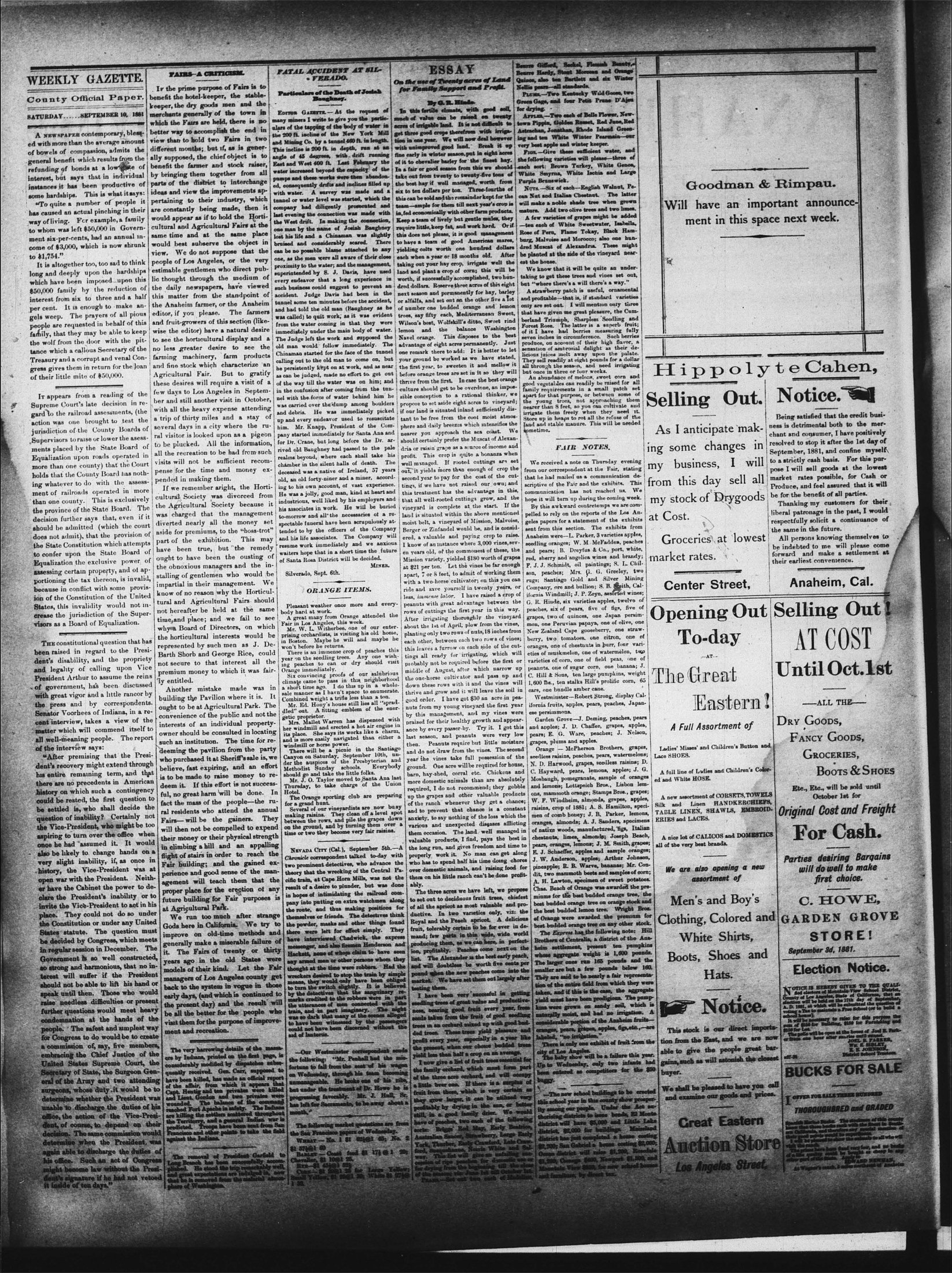
Searchable text
WEEKLY GAZETTE.
County Official Paper.
SATURDAY...SEPTEMBER 10, 1891
A NEWSPAPER contemporary, blessed with more than the average amount of bowels of compassion, admits the general benefit which results from the refunding of bonds at a low rate of interest, but says that in individual instances it has been productive of some hardships. This is what it says:
"To quite a number of people it has caused an actual pinching in their way of living. For example, a family to whom was left $50,000 in Government six-per-cents, had an annual income of $3,000, which is now shrunk to $1,754."
It is altogether too, too sad to think long and deeply upon the hardships which have been imposed upon this $50,000 family by the reduction of interest from six to three and a half per cent. It is enough to make angels weep. The prayers of all pious people are requested in behalf of this family, that they may be able to keep the wolf from the door with the pit-tance which a callous Secretary of the Treasury and a corrupt and venal Congress gives them in return for the loan of their little mite of $50,000.
It appears from a reading of the Supreme Court's late decision in regard to the railroad assessments, (the action was one brought to test the jurisdiction of the County Boards of Supervisors to raise or lower the assessments placed by the State Board of Equalization upon roads operated in more than one county) that the Court holds that the County Board has noth-
PAIRS—A CRITICISM.
If the prime purpose of Fairs is to benefit the hotel-keeper, the stable-keeper, the dry goods men and the merchants generally of the town in which the Fairs are held, there is no better way to accomplish the end in view than to hold two Fairs in two different months; but if, as is generally supposed, the chief object is to benefit the farmer and stock raiser, by bringing them together from all parts of the district to interchange ideas and view the improvements appertaining to their industry, which are constantly being made, then it would appear as if to hold the Horticultural and Agricultural Fairs at the same time and at the same place would best subserve the object in view. We do not suppose that the people of Los Angeles, or the very estimable gentlemen who direct public thought through the medium of the daily newspapers, have viewed this matter from the standpoint of the Anaheim farmer, or the Anaheim editor, if you please. The farmers and fruit-growers of this section (like-wise the editor) have a natural desire to see the horticultural display and a no less greater desire to see the farming machinery, farm products and fine stock which characterize an Agricultural Fair. But to gratify these desires will require a visit of a few days to Los Angeles in September and still another visit in October, with all the heavy expense attending a trip of thirty miles and a stay of several days in a city where the rural visitor is looked upon as a pigeon to be plucked. All the information, all the recreation to be had from such visits will not be sufficient recompense for the time and money ex-
PATAL ACCIDENT AND VERADO.
Particulars of the Death of Baughney.
EDITOR GAZETTE.—At the many miners I write to give yourulars of the tapping of the body on the 200 ft. incline of the New and Mining Co. by a tunnel 460 ft. This incline is 200 ft. in depth angle of 45 degrees, with d East and West 400 ft. Last water increased beyond the cap pumps and these works were th ed, consequently drifts and incl with water. A survey was done tunnel or water level was started company had diligently pro- last evening the connection was the West drift. In making that one man by the name of Josiah lost his life and a Chinaman brushed and considerably scared can be no possible blame atta one, as the men were all aware proximity to the water; and the superintended by S. J. Davis every endeavor that a long such business could suggest ta accident. Judge Davis had tunnel some ten minutes before and had told the old man (Bass was called) to quit work; as it from the water coming in tha immediately under the main b The Judge left the work and he old man would follow imme- Chinaman started for the face calling out to the old man to be persistently kept on at work as can be judged, made no effo f of the way till the water was in the confusion after coming nel with the force of water he was carried over the dump and debris. He was immer up and every endeavor used him. Mr. Knapp, President pany started immediately for Dr. Crane, but long before rived old Baughney had passed realms beyond, where each chamber in the silent halls o deceased was a native of Ire-
It appears from a reading of the Supreme Court's late decision in regard to the railroad assessments, (the action was one brought to test the jurisdiction of the County Boards of Supervisors to raise or lower the assessments placed by the State Board of Equalization upon roads operated in more than one county) that the Court holds that the County Board has nothing whatever to do with the assessment of railroads operated in more than one county. This is exclusively the province of the State Board. The decision further says that, even if it should be admitted (which the court does not admit), that the provision of the State Constitution which attempts to confer upon the State Board of Equalization the exclusive power of assessing certain property, and of apportioning the tax thereon, is invalid, because in conflict with some provision of the Constitution of the United States, this invalidity would not increase the jurisdiction of the Supervisors as a Board of Equalization.
The constitutional question that has been raised in regard to the President's disability, and the propriety and legality of calling upon Vice President Arthur to assume the reins of government, has been discussed with great vigor and a little rancor by the press and by correspondents. Senator Voorhees of Indiana, in a recent interview, takes a view of the matter which will commend itself to all well-meaning people. The report of the interview says:
"After premising that the President's recovery might extend through his entire remaining term, and that there are no precedents in American history on which such a contingency could be rested, the first question to be settled is, who shall decide the question of inability? Certainly not the Vice-President, who might be too aspiring to turn over the office when once he had assumed it. It would also be likely to change hands on a very slight inability, if, as once in history, the Vice-President was at open war with the President. Neither have the Cabinet the power to declare the President's inability or to Agricultural Fair. But to gratify these desires will require a visit of a few days to Los Angeles in September and still another visit in October, with all the heavy expense attending a trip of thirty miles and a stay of several days in a city where the rural visitor is looked upon as a pigeon to be plucked. All the information, all the recreation to be had from such visits will not be sufficient recompense for the time and money expended in making them.
If we remember aright, the Horticultural Society was divorced from the Agricultural Society because it was charged that the management diverted nearly all the money set aside for premiums, to the "hoss-trot" part of the exhibition. This may have been true, but the remedy ought to have been the ousting of the obnoxious managers and the instilling of gentlemen who would be impartial in their management. We know of no reason why the Horticultural and Agricultural Fairs should not hereafter be held at the same time and place; and we fail to see why a Board of Directors, on which the horticultural interests would be represented by such men as J. DeBarth Shorb and George Rice, could not secure to that interest all the premium money to which it was fairly entitled.
Another mistake made was in building the Pavilion where it is. It ought to be at Agricultural Park. The convenience of the public and not the interests of an individual property owner should be consulted in locating such an institution. The time for redeeming the pavilion from the party who purchased it at Sheriff's sale is, we believe, fast expiring, and an effort is to be made to raise money to redeem it. If this effort is not successful, no great harm will be done. In fact the mass of the people—the rural residents who attend the annual Fairs—will be the gainers. They will then not be compelled to expend their money or their physical strength in climbing a hill and an appalling flight of stairs in order to reach the Fair building; and the gained experience and good sense of the management will teach them that the proper place for the erection of any future building for Fair purposes is"
ORANGE ITEM
Pleasant weather once made body hard at work.
A great many from Orange Fair in Los Angeles, this week.
Mr. W. L. Witherbee, one prising orchardists, is visiting Boston. Maybe he will won't before he returns.
There is an immense crop year on the seedling trees, ing peaches to can or d Orange immediately.
Six convincing proofs of climate came to pass in this short time ago. I do this sale manner as I haven't space Combined weight a trifle less Mr. Ed. Hony's house stilled" out. A fitting emblem getic proprietor.
Mrs. Mallet Warren has her windmill and erected at its place. She says its work and is more easily navigated windmill or horse power.
There will be a picnic Canyon on Saturday, Sept der the auspices of the Methodist Sunday school should go and take the little Mr. J. O. Taylor moved Thursday, to take charge Hotel.
The Orange sporting club for a grand hunt.
Several of our vineyardis making raisins. They clear between the rows, and pile on the ground, and by turr time or two they become v
NEVADA CITY (Cal.), Se Chronicle correspondent talks two prominent detectives, theory that the wrecking cific train, at Cape Horn M result of a desire to plunder in hopes of intimidating t
could be rested, the first question to be settled is, who shall decide the question of inability? Certainly not the Vice-President, who might be too aspiring to turn over the office when once he had assumed it. It would also be likely to change hands on a very slight inability, if, as once in history, the Vice-President was at open war with the President. Neither have the Cabinet the power to declare the President's inability or to invite the Vice-President to act in his place. They could not do so under the Constitution or under any United States statute. The question must be decided by Congress, which meets in regular session in December. The Government is so well constructed, so strong and harmonious, that no interest will suffer if the President should not be able to lift his hand or speak until then. Those who would raise needless difficulties or present further questions would meet heavy condemnation at the hands of the people. The safest and simplest way for Congress to do would be to create a commission of, say, five members, embracing the Chief Justice of the United States Supreme Court, the Secretary of State, the Surgeon General of the Army and two attending surgeons, whose duty it would be to determine whether the President was unable to discharge the duties of his office, the action of the Vice-President, of course, to depend on their decision. The same commission would determine when the President, was again able to discharge the duties of his office. Such an act of Congress might become law without the President's signature if he had not vetoed it inside of ten days."
The very harrowing details of the massacre by Indiana, printed on the first page, is considerably modified by dispatchers subsequently received. Gen. Carr, supposed to have been killed, has made an official report of the affair, from which it appears that Capt. Hentig and ten privates were killed and Lieut. Gordon and two privates were wounded. The balance of the command reached Port Apache in safety. The Indians are killing the settlers scattered throughout the Territory, and a general Indian war is predicted. Troops have been sent from San Francisco and other points to take the field against the Indiana.
The removal of President Garfield to Long Branch has been successfully accomplished. He stood the trip remarkably well, and great expectations are indulged in, now that he is removed from the molar atmosphere of Washington.
PATAL ACCIDENT AT SILVERADO.
Particulars of the Death of Josiah Baughney.
EDITOR GAZETTE.—At the request of many miners I write to give you the particulars of the tapping of the body of water in the 200 ft. incline of the New York Mill and Mining Co. by a tunnel 460 ft. in length. This incline is 200 ft. in depth, run at an angle of 45 degrees, with drift running east and West 400 ft. Last February the water increased beyond the capacity of the pumps and these works were then abandoned, consequently drifts and inclines filled up with water. A survey was made and a tunnel or water level was started, which the company had diligently prosecuted and most evening the connection was made with the West drift. In making the connection, one man by the name of Josiah Baughney lost his life and a Chinaman was slightly frightened and considerably scared. There can be no possible blame attached to any cause, as the men were all aware of their close proximity to the water; and the management, superintended by S. J. Davis, have used every endeavor that a long experience in such business could suggest to prevent an accident. Judge Davis had been in the tunnel some ten minutes before the accident, and had told the old man (Baughney as he was called) to quit work; as it was evident from the water coming in that they were immediately under the main body of water. The Judge left the work and supposed the old man would follow immediately. The Chinaman started for the face of the tunnel calling out to the old man to come on, but he persistently kept on at work, and as near as can be judged, made no effort to get out of the way till the water was on him; and on the confusion after coming from the tunnel with the force of water behind him he was carried over the dump among boulders and debris. He was immediately picked up and every endeavor used to resuscitate him. Mr. Knapp, President of the Company started immediately for Santa Ana and for Dr. Crane, but long before the Dr. arrived old Baughney had passed to the pale realms beyond, where each shall take his chamber in the silent halls of death. The deceased was a native of Ireland, 57 years
ESSAY
On the use of Twenty acres of Land for Family Support and Profit.
By G.R. Hinde.
In this fertile climate, with good soil, much of value can be raised on twenty acres of irrigable land. It is not difficult to get three good crops therefrom with irrigation in one year. We will now deal however with unimproved good land. Break it up fine early in winter season, put in eight acres of it to chevalier barley for the finest hay. In a fair or good season from this we should take out from twenty to twenty-five tons of the best hay if well managed, worth from six to ten dollars per ton. Three-fourths of this can be sold and the remainder kept for the team—ample for them till next year's crop is in fed economically with other farm products. Keep a team of lively but gentle mules, they require little, keep fat, and work hard. Or if this does not please, it is good management to have a team of good American mares, yielding colts worth one hundred dollars each when a year or 18 months old. After taking out your hay crop, irrigate well the land and plant a crop of corn; this will be worth, if successfully accomplished, two hundred dollars. Reserve three acres of this eight next season and permanently for hay, barley or alfalfa, and set out on the other five a lot of number one budded orange and lemon trees, say fifty each, Mediterranean Sweet, Wilson's best, Wolfskill's ditto, Sweet rind lemon and the balance Washington Navel orange. This disposes to the best advantage of eight acres permanently. Just one remark there to add: It is better to let your ground be worked as we have stated, the first year, to sweeten it and mellow it before orange trees are set in it so they will thrive from the first. In case the best orange culture should get to be overdone, an impossible conception to a rational thinker, we propose to set aside eight acres to vineyard; if our land is situated inland sufficiently distant to be free from the cool moist atmosphere and daily breezes which intensifies the nearer you approach the sea coast. We should certainly prefer the Muscat of Alexandria or raisin grape as a source of income and profit. This crop is quite a bonanza when well managed. If rooted cuttings are set out, it yields more than enough of crop the
Burre Gifford, Seekal, Flemish Beauty,
Beurre Hardy, Stout Morceau and Orange Quince, also ten Bartlett and six Winter Nellis pears—all standards.
PLUMS—Two Kentucky Wild Goose, two Green Gaga, and four Petit Prune D'Ajue for drying.
APPLES—Two each of Belle Flower, New-town Pippin, Golden Russet, Red June, Red Astrachan, Jonathan, Rhode Island Greening and ten White Winter Pearmain—our very best apple and winter keeper.
FIGS—Give these sufficient water, and the following varieties will please—three of each sort: Brown Turkey, White Genoa, White Smyrna, White Ischia and Large Purple Brunswick.
NUTS—Six of each—English Walnut, Pean Nut and Italian Chestnut. The latter will make a noble shade tree when grown mature. Add two olive trees and two limes.
A few varieties of grapes might be added—ten each of White Sweetwater, Isabella, Rose of Peru, Flame Tokay, Black Hamburg, Malvoise and Morocco; also one hundred Muscat of Alexandria. These might be planted at the side of the vineyard nearest the house.
We know that it will be quite an undertaking to get these trees and vines set out, but "where there's a will there's a way."
A strawberry patch is useful, ornamental and profitable—that is, if standard varieties only are set out. I will mention only three that have given me great pleasure, the Cumberland Triumph, Sharpless Seedling and Forest Rose. The latter is a superb fruit; if it have had berries measuring fully seven inches in circumference. Such berries produce on account of their high flavor, a sensation of ambrosial delight as their delicious juices melt away upon the palate. They sell readily at eight pounds for a dollar all through the season, and need irrigating but once in three or four weeks.
An abundance of melons, sweet corn and good vegetables can readily be raised for all family requirements in a small patch set apart for that purpose, or between some of the young trees, not approaching them nearer than 8 feet, so you can cultivate and irrigate them freely when they need it. Store up in heaps to rot all the refuse of the Land and stable manure. This will be needed sometime.
FAIR NOTES.
We received a note on Thursday evening from our correspondent at the Fair, stating
ORANGE ITEMS.
Pleasant weather once more and everybody hard at work.
A great many from Orange attended the Fair in Los Angeles, this week.
Mr. W. L. Witherbee, one of our enterprising orchardists, is visiting his old home in Boston. Maybe he will and maybe he won't before he returns.
There is an immense crop of peaches this year on the seedling trees. Any one wishing peaches to can or dry should visit Orange immediately.
Six convincing proofs of our salubrious climate came to pass in this neighborhood a short time ago. I do this up in a wholesale manner as I haven't space to enumerate. Combined weight a trifle less than a ton.
Mr. Ed. Hony's house still lies all "apraddled" out. A fitting emblem of the energetic proprietor.
Mrs. Mallet Warren has dispensed with her windmill and erected a hot air engine in its place. She says its works like a charm, and is more easily navigated than either a windmill or horse power.
There will be a picnic in the Santiago Canyon on Saturday, September 10th, under the auspices of the Presbyterian and Methodist Sunday schools. Everybody should go and take the little folks.
Mr. J. O. Taylor moved to Santa Ana last Thursday, to take charge of the Union Hotel.
The Orange sporting club are preparing for a grand hunt.
Several of our vineyardists are now busy making raisins. They clean off a level spot between the rows, and pile the grapes down on the ground, and by turning them over a time or two they become very fair raisins.
NEVADA CITY (Cal.), September 5th.—A Chronicle correspondent talked to-day with two prominent detectives, who advance the theory that the wrecking of the Central Pacific train, at Cape Horn Mills, was not the result of a desire to plunder, but was done in hopes of intimidating the railroad combefore orange trees are set in so easy thrive from the first. In case the best orange culture should get to be overdone, an impossible conception to a rational thinker, we propose to set aside eight acres to vineyard; if our land is situated inland sufficiently distant to be free from the cool moist atmosphere and daily breezes which intensifies the nearer you approach the sea coast. We should certainly prefer the Muscat of Alexandria or raisin grape as a source of income and profit. This crop is quite a bonanza when well managed. If rooted cuttings are set out, it yields more than enough of crop the second year to pay for the cost of the cuttings, if we have not raised our own; and this treatment has the advantage in this, that all well-rooted cuttings grow, and the vineyard is complete at the start. If the land is situated within the above mentioned moist belt, a vineyard of Mission, Malvoise, Berger or Zinfandel would be, and is considered, a valuable and paying crop to raise. I know of an instance where 3,000 vines, seven years old, of the commonest of these, the Mission variety, yielded $180 worth of grapes at $21 per ton. Let the vines be far enough apart, 7 or 8 feet, to admit of working them with a two-horse cultivator; on this you can ride and save yourself in twenty years, or less, immense labor. I have raised a crop of peanuts with great advantage between the rows of cuttings the first year in this way. After irrigating thoroughly the vineyard about the lat of April, plow from the vines, planting only two rows of nuts, 18 inches from each other, between each two rows of vines; this leaves a furrow on each side of the cuttings all ready for irrigation, which will probably not be required before the first or middle of August, after which narrow up the one-horse cultivator and pass up and down these rows with it and the vines will thrive and grow and it will leave the soil in good order. I have got $30 an acre in peanuts from my young vineyard the first year by this management, and my vines were praised for their healthy growth and appearance by every passer-by. Try it. I got this last season, and peanuts were very low then. Peanuts require but little moisture and do not draw from the vines. The second year the vines take full possession of the ground. One acre will be required for house, barn, hay-shed, corral etc. Chickens and more domestic animals than are absolutely required, I do not recommend; they gobble up the grapes and other valuable products of the ranch whenever they get a chance; and to prevent that chance is a constant anxiety, to say nothing of the loss which the various and unexpected diseases afflicting them occasion. The land well managed in valuable products, I find, pays the best in the long run, and gives freedom and time to properly work it. No man can get along who has to spend half his time doing chores over domestic animals, and raising food for them on his little ranch can't be done profitably.
The three acres we have left, we propose to set out to deciduous fruit trees, chiefest before orange trees are set in so easy thrive from the first. In case the best orange culture should get to be overdone, an impossible conception to a rational thinker, we propose to set aside eight acres to vineyard; if our land is situated inland sufficiently distant to be free from the cool moist atmosphere and daily breezes which intensifies the nearer you approach the sea coast. We should certainly prefer the Muscat of Alexandria or raisin grape as a source of income and profit. This crop is quite a bonanza when well managed. If rooted cuttings are set out, it yields more than enough of crop the second year to pay for the cost of the cuttings, if we have not raised our own; and this treatment has the advantage in this, that all well-rooted cuttings grow, and the vineyard is complete at the start. If the land is situated within the above mentioned moist belt, a vineyard of Mission, Malvoise, Berger or Zinfandel would be, and is considered, a valuable and paying crop to raise. I know of an instance where 3,000 vines, seven years old, of the commonest of these, the Mission variety, yielded $180 worth of grapes at $21 per ton. Let the vines be far enough apart, 7 or 8 feet, to admit of working them with a two-horse cultivator; on this you can ride and save yourself in twenty years, or less, immense labor. I have raised a crop of peanuts with great advantage between the rows of cuttings the first year in this way. After irrigating thoroughly the vineyard about the lat of April, plow from the vines, planting only two rows of nuts, 18 inches from each other, between each two rows of vines; this leaves a furrow on each side of the cuttings all ready for irrigation, which will probably not be required before the first or middle of August, after which narrow up the one-horse cultivator and pass up and down these rows with it and the vines will thrive and grow and it will leave the soil in good order. I have got $30 an acre in peanuts from my young vineyard the first year by this management, and my vines were praised for their healthy growth and appearance by every passer-by. Try it. I got this last season, and peanuts were very low then. Peanuts require but little moisture and do not draw from the vines. The second year the vines take full possession of the ground. One acre will be required for house, barn, hay-shed, corral etc. Chickens and more domestic animals than are absolutely required, I do not recommend; they gobble up the grapes and other valuable products of the ranch whenever they get a chance; and to prevent that chance is a constant anxiety, to say nothing of the loss which the various and unexpected diseases afflicting them occasion. The land well managed in valuable products, I find, pays the best in the long run, and gives freedom and time to properly work it. No man can get along who has to spend half his time doing chores over domestic animals, and raising food for them on his little ranch can't be done profitably.
The three acres we have left, we propose to set out to deciduous fruit trees, chiefest before orange trees are set in so easy thrive from the first. In case the best orange culture should get to be overdone, an impossible conception to a rational thinker, we propose to set aside eight acres to vineyard; if our land is situated inland sufficiently distant to be free from the cool moist atmosphere and daily breezes which intensifies the nearer you approach the sea coast. We should certainly prefer the Muscat of Alexandria or raisin grape as a source of income and profit. This crop is quite a bonanza when well managed. If rooted cuttings are set out, it yields more than enough of crop the second year to pay for the cost of the cuttings, if we have not raised our own; and this treatment has the advantage in this, that all well-rooted cuttings grow,andthe vineyard is complete at the start. If the land is situated within the above mentioned moist belt,a vineyard of Mission,Malvoise,Berger or Zinfandel would be,andis considered,a valuable and paying crop to raise.I knowofaninstancewhereinthenyearsold.ofthecommonestofthemes,theMissionvariety,yieldeds180worthgrapesat$21perton.Letthevinesbefarenewapart,t7or8feet,totadmitofworkingthemwithatwo-horsecultivator;onthisyoucanrideandsaveyourselfintwentyyears,或less,intenselabor.Ihaveraisedacropofpeanutswithgreatadvantagebetweentherowsofcuttingsthefirstyearinthisway.AfterirrigatingthoroughlythevineyardaboutthelatofApril,plowfromthevinesplantingonlytworerowsofnuts,18inchesfromeachother,betweeneachtworerowsofvines;thisleavesafurrowoncertainsideofthecuttingsallreadyforirrigatingwhichwillprobablynotbefoundbeforethefirstormiddleofAugust,afterwhichnarrowuptheone-horsecultivatorandpassupanddowntherowswithitandthevineswillthriveandgrowanditwillleavethesoilingoodorder.Ihavegot$30anacreinpeanutsfrommyyoungvineyardthefirstyearbythismanagement,andmyvineswerepraisedfortheirhealthygrowthandappearancebyeverypasser-by.Tryit.Igotthislastseason,andpeanutswereverylowthen.Peanutsrequirebutlittlemoistureanddonotdrawfromthevines.Thesecondyearthevinestakefullpossessionoftheground。一O.D.Harwood,grapes.seedlessraisins;D.C.Hayward,pears,lemons,apples;J.G.Mosbaugh,pomegranate,sampleoforangesandlemons;LottapeichBros.,Lisbonlimons,mammothorange;StampsBros.,graps;W.F.Windheim,almonds,grapes,apples,raisins,cropof1881;A.S.Hamilton,specimenofcombhoney;J.B.Parker,lemons,oranges,almonds;A.J.Sanders,specimensofnativewoods,mufactured,figs,Italianchestnuts,limes,almonds;JosephBeach,pears,oranges,lemons;J.M.Smith,grapes;E.J.Schaeffer,applesandsampleoranges;J.W.Anderson,apples;ArthurJohnson pineapple;R.B.Warve,bananas;Mr.Condit,twomammothbeetsandsamplesofcorn;A.H.Lawton,specimenofsweetpotatoes。Chas.BeachofOrangewas awardedthepremiumforthebestbuddedorangetree。
NEVADA CITY (Cal.), September 5th.—A Chronicle correspondent talked to-day with two prominent detectives, who advance the theory that the wrecking of the Central Pacific train, at Cape Horn Mills, was not the result of a desire to plunder, but was done in hopes of intimidating the railroad company into putting on extra watchmen along the route, and thus making positions for themselves or friends. The detectives think the powder, masks and other things found there were left for effect simply. They have interviewed Chadwick, the express messenger, and also fireman Henderson and Hackett, none of whom claim to have seen any armed men or other persons whom they thought at the time were robbers. Had the wreckers desired to stop the train by simple means, they would only have been obliged to turn the switch slightly. It is believed by the detectives that the sanguinary remarks credited to the robbers were in part utterances of men connected with the train, and in part imaginary. The night was so dark that many of the scenes alleged to have been witnessed by the passengers could not have been discerned without the aid of lanterus.
—Our Westminster correspondent sends the following: "Mr. Penhall had the misfortune to fall from the seat of his wagon on Wednesday, through his team becoming unmanageable. He broke one of his ribs, but under the treatment of Dr. Howe he is progressing favorably. Mr. J. Hull, Sr. has left for Sacramento, to be away about a month."
The following market quotations are from the San Francisco papers of Wednesday.
Wheat — No. 1 $1 62@1 65; No. 2 $1 57@1 60
Barley — Coast feed $1 17@1 20; Chevallier $1 19@1 25.
Bryn — $1 45@1 52;
Corn — $1 20@1 20 for Large Yellow; Small Yellow; $1 25@1 20; Whits $1 27@1 33.
I now give a list of fruit trees essential for the family orchard, which must form part of the three acre orchard, and will occupy a little ever one. If there is a surplus of fruit from these, which is very certain as they grow larger, it can be utilized very profitably by drying in the sun, or better still, in a good family drier. We would have of peaches, two each of the following sorts: Briggs' Red May, Early Bessice, Australian Sancer, Strawberry, Large Early York, Thurber, Early Crawford, Lata Crawford, Susquehanna, Norris White and Salway. This hat will give an unfailing succession of ripe peaches for domestic use or for drying from the beginning till the close of the season viz June 1st till October 1st.
FRANS — Set out two each of Madiline,
W. F. Windheim, almonds, grapes, apples, raisins, crop of 1881; A. S. Hamilton, specimen of comb honey; J. B. Parker, lemons, oranges, almonds; A. J. Sanders, specimens of native woods, manufactured, figs, Italian chestnutts, limes, almonds; Joseph Beach, pears, oranges, lemons; J. M. Smith, grapes; E. J. Schaeffer, apples and sample oranges; J. W. Anderson, apples; Arthur Johnson, pineapple; R. B. Warve, bananas; Mr. Condit, two mammoth beets and samples of corn; A. H. Lawton, specimen of sweet potatoes. Chas. Beach of Orange was awarded the premium for best budded orange tree on any other stock.
The Express has the following note: Hill Brothers of Centralia, a district of the Anaheim settlement, present ten pumpkins whose aggregate weight is 1,600 pounds. The larger ones run 165 pounds and the smaller are but a few pounds below 160. They are said to be nearly a fair representation of the entire field from which they were taken, and if this is the case, the aggregate yield must have been prodigious. The pumpkins were grown on sandy soil, which is naturally moist, and had no irrigation. A considerable portion of the Anaheim fruits—oranges, pears, grapes, apples, figs, etc.,—are labeled, "no irrigation."
There is only one exhibit of fruit from the city of Los Angeles.
The baby show will be a failure this year. Up to Wednesday, only two infants had been enforced as competitors for the $50 buggy.
—The new school buildings to be erected this school year in this county show prosperity among our people. Under the Act authorizing districts to issue bonds, El Monte district will have $5,000 and Little Lake district, $2,000 for buildings. Maizeland district has just completed a house costing $2,200; San Gabriel a home costing $2,000; Ocean district will raise $1,200; Rosendale $1,200; Osage $400; Newport $1,500; and Mountain View $800 for new school houses and furniture, by direct tax.
Goodman & Rimpau.
Will have an important announcement in this space next week.
Hippolyte Cahen,
Selling Out.
As I anticipate making some changes in my business, I will
Notice.
Being satisfied that the credit business is detrimental both to the merchant and consumer, I have positively resolved to stop it after the 1st day of September, 1881, and confine myself to a strictly cash basis. For this purpose I will sell goods at the lowest
Selling Out.
As I anticipate making some changes in my business, I will from this day sell all my stock of Drygoods at Cost.
Groceries at lowest market rates.
Center Street,
Notice.
Being satisfied that the credit business is detrimental both to the merchant and consumer, I have positively resolved to stop it after the 1st day of September, 1881, and confine myself to a strictly cash basis. For this purpose I will sell goods at the lowest market rates possible, for Cash or Produce, and feel assured that it will be for the benefit of all parties.
Thanking my customers for their liberal patronage in the past, I would respectfully solicit a continuance of the same in the future.
All persons knowing themselves to be indebted to me will please come forward and make a settlement at their earliest convenience.
Anaheim, Cal.
Opening Out To-day
AT THE Great Eastern!
A Full Assortment of
Ladies' Misses' and Children's Button and Lace SHOES.
A full line of Ladies and Children's Colored and White HOSE.
A new assortment of CORSETS, TOWELS Silk and Linen HANDKERCHIEFS, TABLE LINEN, SHAWLS, EMBROIDERIES and LACES.
A nice lot of CALICOS and DOMESTICS all of the very best brands.
We are also opening a new assortment of
Men's and Boy's
Selling Out!
AT COST
Until Oct.1st
ALL THE
Dry Goods,
Fancy Goods,
Groceries,
Boots & Shoes
Ete., Etc., will be sold until October 1st for Original Cost and Freight
For Cash.
Parties desiring Barqains will do well to make first choice.
A nice lot of CALICOS and DOMESTICS all of the very best brands.
We are also opening a new assortment of
Men's and Boy's Clothing, Colored and White Shirts, Boots, Shoes and Hats.
Notice.
This stock is our direct importation from the East, and we are now able to give the people great bargains, such as will astonish the closest buyer.
We shall be pleased to have you call and examine our goods and prices.
Great Eastern Auction Store
Los Angeles Street,
Original Cost and Freight
For Cash.
Parties desiring Barqains will do well to make first choice.
C. HOWE,
GARDEN GROVE STORE!
September 3d, 1881.
Election Notice.
NOTICE IS HEREBY GIVEN TO THE QUALIFIED electors of Mountain View School District, County of Los Angeles, State of California, that an election will be held on the 17th day of September, A.D. 1881, at which will be submitted the question of voting a Tax to maintain a Free School (or to build a school house).
It will be necessary to raise for this purpose the sum of $550 for Building, $150 for Purchasing and $150 for Lot.
The public will be open at the houses of Joel R. Parker from one hour after noon until sunset.
JOEL R. PARKER,
W.K. MIDLEY,
K.E.J. JOHNSON,
District School Trustees.
BUCKS FOR SALE
OFFER FOR SALE THREE HUNDRED
THOROUGHBRED AND GRADED
Spanish Marine Snails. The stockmen of this county know that these hooks each with the finest in Southern California, and therefore any mutual mention of their good points would be superfluous.
I will be pleased to show the animals to all who will visit the ranch.
The prices here have fixed very low, and we banks of a like quality could be bought as cheap in any other part of the State.
HOWARD NEWMAN,
At Wagner's ranch, 5 miles northeast of Anaheim.