anaheim-gazette 1881-08-06
Scanned page
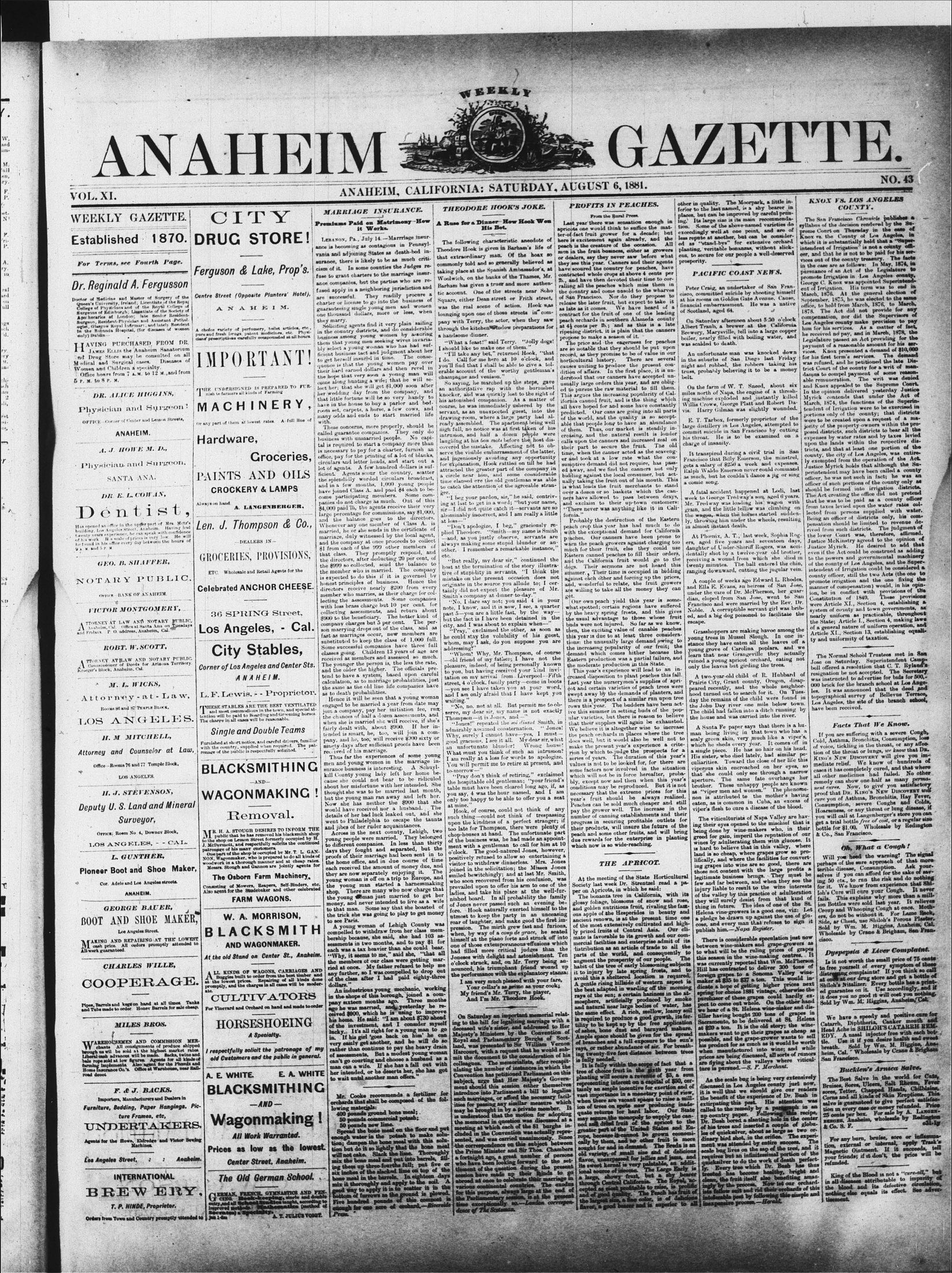
Searchable text
ANAHEIM
VOL. XI.
WEEKLY GAZETTE.
Established 1870.
For Terms, see Fourth Page.
Dr. Reginald A. Fergusson
Doctor of Medicine and Master of Surgery of the Queen's University, Ireland; Licentiate of the Royal College of Physicians and of the Royal College of Surgeons of Edinburgh; Legislature of the Society of Apothecaries of London; Late Senior Resident-Surgeon, Resident-Physician and Assistant-Pathologist, Glasgow Royal Infirmary, and lately Resident in the Rolandia Hospital (for diseases of women only) Dublin.
HAVING PURCHASED FROM DR. JAMES ELLIS the Anaheim Sanatorium and Drug Store may be consulted on all Medical and Surgical cases. Diseases of Women and Children a specialty.
Office hours from 7 A.M. to 12 M., and from 5 P.M. to 8 P.M.
DR. ALICE HIGGINS,
Physician and Surgeon!
OFFICE: Corner of Center and Lemon Streets,
ANAHEIM.
A. J. HOWE M. D.,
Physician and Surgeon,
CITY DRUG STORE!
Ferguson & Lake, Prop's.
Centre Street (Opposite Planters' Hotel),
ANAHEIM.
A choice variety of perfumery, toilet articles, etc., pure and fresh Drugs, patent medicines, etc. Physicians' prescriptions carefully compounded at all hours.
IMPORTANT!
THE UNDERSIGNED IS PREPARED TO FURNISH to farmers all kinds of Farming
MACHINERY,
Or any part of them at lowest rates. A full line of Hardware,
Groceries,
PAINTS AND OILS
MARRIAGE
Premiums Payable
LEBANON, Pa.
ance is becoming vania and adjournance there is a crisis of it. In fuse to grant chance companies fused apply in are successful charter or license guaranteeing one thousand dollars they marry.
Soliciting age in the country business among them that you might select a your sufficient business to get herself inquence is that their hard earn the hope that we come along hurley her; that she her wedding day that little fortune have in the house room set, carpeting many odds and with.
These concern called guarantee business with total is required to office, pay for circulars and lot of agents. Agent
DR. ALICE HIGGINS,
Physician and Surgeon!
OFFICE—Corner of Center and Lemon Streets,
ANAHEIM.
A. J. HOWE M. D.,
Physician and Surgeon,
SANTA ANA.
DR. E. L. COWAN,
Dentist,
Has opened an office in the upper part of Mrs. Metz's building, Los Angeles Street, Anaheim. Having had twenty years experience, he can speak with confidence of his work. He is a scale of prices is very low. He will be found in his office every day between the hours of 9 A.M. and 5 P.M.
GEO. B. SHAFFER,
NOTARY PUBLIC.
OFFICE—BANK OF ANAHEIM.
VICTOR MONTGOMERY,
ATTORNEY AT LAW AND NOTARY PUBLIC,
Anahiem, Cal. Office at Santa Ana on Tuesday and Fridays. P.O. address, Anahiem, Cal.
ROBT. W. SCOTT,
ATTORNEY AT LAW AND NOTARY PUBLIC.
Commissioner of Deeds for Arizona Territory. Kroeger's Block, Anahiem, Cal.
M. L. WICKS,
Attorney-at-Law,
Rooms 86 and 87 Temple Block,
LOS ANGELES.
H. M MITCHELL,
Attorney and Counselor at Law,
Office—Rooms 76 and 77 Temple Block,
LOS ANGELES.
H. J. STEVENSON,
Deputy U.S. Land and Mineral Surveyor,
Office; Roem No 4, Downey Block,
LOS ANGELES, - CAL.
L. GUNTHER,
Ploneer Boot and Shoe Maker,
Cor. Adele and Los Angeles streets.
ANAHEIM.
THE UNDERSIGNED IS PREPARED TO FURnish to farmers all kinds of Farming
MACHINERY,
Or any part of them at lowest rates. A full line of
Hardware,
Groceries,
PAINTS AND OILS
CROCKERY & LAMPS
Always on hand.
A. LANGENBERGER.
Len. J. Thompson & Co.,
DEALERS IN
GROCERIES, PROVISIONS,
ETC. Wholesale and Retail Agents for the
Celebrated ANCHOR CHEESE.
36 SPRING Street,
Los Angeles, - Cal.
City Stables,
Corner of Los Angeles and Center Sts.
ANAHEIM.
L.F. Lewis, - Proprietor.
THESE STABLES ARE THE BEST VENTILATED
and most commodious in the town, and special attention will be paid to Boarding and Grooming horses.The charge in all cases will be reasonable.
Single and Double Teams
Furnished at short notice, and careful drivers, familiar with the country, supplied when required. The patronage of the public is respectfully solicited.
BLACKSMITHING
AND
WAGONMAKING!
Removal.
MR. H. A. STOUGR DESIRES TO INFORM THE public that he has removed his blacksmith shop to the shop on Lemon Street formerly occupied by H. J. McFernott, and respectfully solicits the continued patronage of his many customers.
One part of the shop is occupied by Mr. T. L. GAN-NON, Wagonmaker, who is prepared to do all kinds of woodwork in a thorough manner and at cheap rates.Messrs. Stough and Gannon are jointly agents for The Osborn Farm Machinery.
Consisting of Mowers, Reapers, Self-Binders, etc.Also agent for the Studebaker and other celebrated FARM WAGONS.
The hope that we come along humble to her; that she her wedding does that little fortune have in the house set, carpet many odds and with.
These concern called guarantee business with her tal is required it is necessary to office, pay for the circulars and lot of agents.ficient.Agent the splendidly and in a few have joined Class come participan panies do not $4,000 paid The large percentage and the bala Whenever any married, he or marriage,daily and the company $1 from each class.the directors,the $999 so co.the member w is expected to honest principi directors rece member who lecting the act with loss brace collecting as $900 to the b company cha son marrying fast as marris substituted to Some success classes going received as m The younger and the older tend to have calculation, as the same as t as to death p Hence it w engaged to be join a compa the chances s when she is fairly dealt tended is smany pany,and ha ninety days received of h Thus far t men and your surance busi kill County cause she co about her m thought she but the you Now she h would have details of he went to Phi and jibes o Across in young people to different days they proofs of th the home o each receive they are no young women the young shop.The
Deputy U. S. Land and Mineral Surveyor,
Office: Roem No 4, Downey Block,
LOS ANGELES, - CAL.
L. GUNTHER,
Ploneer Boot and Shoe Maker,
Cor. Adele and Los Angeles streets.
ANAHEIM.
GEORGE BAUER,
BOOT AND SHOE MAKER,
Los Angeles Street.
MAKING AND REPAIRING AT THE LOWEST cash price. All orders promptly attended to. All work guaranteed.
CHARLES WILLE,
COOPERAGE.
Pipes, Barrels and kegs on hand at all times. Tanks and Tubs made to order. Honey Barrels for sale cheap.
MILES BROS.
WAREHOUSEMEN AND COMMISSION MERCHANTS. All consignments of produce shipped through us will be sold at the highest market rates. Liberal cash advances will be made. Sacks, twine and bale rope sold at low figures. Agents for all kinds of farming implements. Also agent for the Phonix and Home Insurance Co.'s Office at Warehouse, near Railroad depot.
F. & J. BACKS.
Importers, Manufacturers and Dealers in Furniture, Bedding, Paper Hangings. Picture Frames, etc.
UNDERTAKERS.
Agents for the Howe, Eldredge and Victor Sewing Machines.
Los Angeles Street.: Anaheim.
INTERNATIONAL BREWERY.
T. P. HINDE, Proprietor.
Orders from Town and Country promptly attended to.
Removal.
MR. H. A. STOUGH DESIRES TO INFORM THE public that he has removed his blacksmith shop to the shop on Lemon Street formerly occupied by H. J. Mcfermott, and respectfully solicits the continued patronage of his many customers.
One part of the shop is occupied by Mr. T. L. GAN-NON, Wagonmaker, who is prepared to do all kinds of woodwork in a thorough manner and at cheap rates. Messrs. Stough and Gannon are jointly agents for The Osborn Farm Machinery.
Consisting of Mowers, Reapers, Self-Binders, etc. Also agent for the Studebaker and other celebrated FARM WAGONS.
W. A. MORRISON,
BLACKSMITH AND WAGONMAKER.
At the old Stand on Center St., Anaheim.
ALL KINDS OF WAGONS, CARRIAGES AND Buggies built to order from the best timber and at the lowest prices. Repairing of all kinds done promptly, and the charges in all cases will be moderate.
CULTIVATORS
For Vineyard and Orchard on hand and made to order
HORSESHOEING
A Specialty.
I respectfully solicit the patronage of my old Customers and the public in general.
A. E. WHITE.
E. A. WHITE
BLACKSMITHING
—AND—
Wagonmaking!
All Work Warranted.
Prices as low as the lowest Center Street, Anaheim.
The Old German School.
GERMAN, FRENCH, GYMNASTICS AND PENCING. Black-keeping, single and double entry, and all School Studies taught, according to improved methods. Mathematical (method of Secrets) a Specialty.
A. T. JULIUS VOIGT.
Now she would have details of her days they proofs of the home of each receive they are not young women the young shop. The young compelled bership best sessions each was a "Why, it is the member ried at once any further of the class dollars."
An industry in the shop pany sixteenth ago he waived received $900 his home of the invlucky. I in. If his very easily rather than of assessment can't go man can a her intention to wait until
WEEKLY
EIM GA
ANAHEIM, CALIFORNIA: SATURDAY, AUGUST 6, 1881.
MARRIAGE INSURANCE.
Premiums Paid on Matrimony How it Works.
LEBANON, Pa., July 14.—Marriage insurance is becoming as contagious in Pennsylvania and adjoining States as death-bed insurance, there is likely to be as much criticism of it. In some counties the Judges refuse to grant charters to the marriage insurance companies, but the parties who are refused apply in a neighboring jurisdiction and are successful. They readily procure a charter or license to go into the business of guaranteeing single young men and women one thousand dollars, more or less, when they marry.
Soliciting agents find it very plain sailing in the country districts, and do considerable business among young women by assuring them that young men seeking wives invariably select a young woman who has had sufficient business tact and judgment about her to get herself insured in time. The consequence is that the young women pay over their hard earned dollars and then revel in the hope that very soon a young man will come along hunting a wife; that he will select her; that she will get $1,000 soon after her wedding day from the company, and that little fortune will be so very handy to have in the house to buy a parlor and bedroom set, carpets, a horse, a few cows, and many odds and ends to start married life with.
These concerns, more properly, should be called guarantee companies. They only do business with unmarried people. No capital is required to start a company more than is necessary to pay for a charter, furnish an office, pay for the printing of a lot of blanks, circulars and letter heads, and start out a lot of agents. A few hundred dollars is sufficient. Agents scour the country, scatter
THEODORE HOOK'S JOKE.
A Ruse for a Dinner How Hook Won His Bet.
The following characteristic anecdote of Theodore Hook is given in Barham's life of that extraordinary man. Of the hoax so commonly told and so generally believed as taking place at the Spanish Ambassador's, at Woolwich, on the banks of the Thames, Mr. Barham has given a truer and more authentic account. One of the streets near Soho Square, either Dean street or Frith street, was the real scene of action. Hook was lounging upon one of those streets in company with Terry, the actor, when they saw through the kitchen window preparations for a handsome dinner.
“What a feast!” said Terry. “Jolly dogs! I should like to make one of them.”
“I'll take any bet,” returned Hook, “that I do. Call for me here at 10 o'clock, and you'll find that I shall be able to give a tolerable account of the worthy gentleman's champagne and venison.”
So saying, he marched up the steps, gave an authoritative rap with the burnished knocker, and was quickly lost to the sight of his astonished companion. As a matter of course, he was immediately ushered by the servant, as an unexpected guest, into the drawing-room, where a large party had already assembled. The apartment being well high full, no notice was at first taken of his intrusion, and half a dozen people were laughing at his bon mots before the host discovered the mistake. Affecting not to observe the visible embarrassment of the latter, and ingeniously avoiding any opportunity for explanation, Hook rattled on till he had attracted the greater part of the company in close proximity with him, and some considerable
PROFITS IN PEACHES.
From the Rural Press.
Last year there was sensation enough in apricots one would think to suffice the matter-of-fact fruit grower for a decade; but here is excitement again already, and the peach is the creature of the occasion. All men in the fruit business, either as growers or dealers, say they never saw before what they see this year. Canners and their agents have scoured the country for peaches, have contracted whole crops at above 4 cents per lb., and have then devoted their time to corraling all the peaches which miss them in the country and come unsold to the wharves of San Francisco. Nor do they propose to release the later fruit, but expect to take it as late as it comes. We have heard of a contract for the fruit of one of the leading peach orchards in southern Alameda county at 41 cents per lb.; and as this is a late ripening district, it is plain that the canners propose to make a season of it.
The price and the eagerness for peaches are so notable that they should be put upon record, as they promise to be of value in our horticultural history. There are several causes uniting to produce the present condition of affairs. In the first place, it is understood that our canners have accepted unusually large orders this year, and are obliged to pursue the raw material to fill them. This argues the increasing popularity of California canned fruit, and is the thing which all have hoped for and some have constantly predicted. Our cans are going into all parts of the world, and the quality is so acceptable that people long to have an abundance of them. Thus, our market is steadily increasing, and the natural result is louse calls upon the canners and increased zeal of their part to secure the fruit. The old time, when the canner acted as the scavenger and took at a low rate what the cosmetic demand did not require, has passed away, and we find the canners not on account against the local consumer but an
the hope that very soon a young man will come along hunting a wife; that he will select her; that she will get $1,000 soon after her wedding day from the company, and that little fortune will be so very handy to have in the house to buy a parlor and bedroom set, carpets, a horse, a few cows, and many odds and ends to start married life with.
These concerns, more properly, should be called guarantee companies. They only do business with unmarried people. No capital is required to start a company more than is necessary to pay for a charter, furnish an office, pay for the printing of a lot of blanks, circulars and letter heads, and start out a lot of agents. Agents seize the country, scatter the splendidly worded circulars broadcast, and in a few months, 1,000 young people have joined Class A, and paid $4 each to become participating members. Some companies do not charge as much. Out of this $4,000 paid in, the agents receive their very large percentage for commissions, say $1,000, and the balance goes to the directors. Whenever any one member of Class A. is married, he or she sends in the certificate of marriage, duly witnessed by the local agent, and the company at once proceeds to collect $1 from each of the 999 other members of that class. They promptly respond, and the directors, after deducting 20 per cent, of the $999 so collected, send the balance to the member who is married. The company is expected to do this if it is governed by honest principles of business. Hence the directors receive nearly $200 from every member who marries, as their charge for collecting the assessments. Some companies with less brass charge but 10 per cent. for collecting assessments, and return about $900 to the beneficiary. The better kind of company charges but 5 per cent. The person marrying drops out of the class, and as fast as marriages occur, new members are substituted to keep the class of 1,000 full. Some successful companies have three full classes going. Children 13 years of age are received as members and assessed so much. The younger the person is, the less the rate, and the older the higher. The officials pretend to have a system, based upon careful calculation, as to marriage probabilities, just the same as the old line life companies have as to death probabilities.
Hence it will be seen that a young woman engaged to be married a year from date may join a company, pay her initiation fee, run the chances of half a dozen assessments, and when she is married she will receive, if she's fairly dealt with, about $900. If her intended is smart, he, too, will join a company, and he, too, will receive $900 sixty or ninety days after sufficient proofs have been received of his marriage.
Thus far the experiences of some young men and young women in the marriage insurance business is interesting. A Schuylkill County young lady left her home because she could not bear to be ridiculed about her misfortune with her intended. She thought she was to be married last month, but the young man ran away and left her. Now she has neither the $900 that she would have received nor a husband. The details of her bad luck leaked out, and she went to Philadelphia to escape the taunts and jibes of her ruder acquaintances.
Across in the next county, Lehigh, two young people were married. They belonged to different companies. In less than thirty days they fought and separated, but the proofs of their marriage had been sent in to the home office, and in due course of time each received the amount of money due, and they are now separately enjoying it. The young woman is off on a trip to Europe, and the young man started a harnessmaking shop. There are many who now charge that the young woman just married to get her champagne and venison."
So saying, he marched up the steps, gave an authoritative rap with the burnished knocker, and was quickly lost to the sight of his astonished companion. As a matter of course, he was immediately ushered by the servant, as an unexpected guest, into the drawing-room, where a large party had already assembled. The apartment being well high full, no notice was at first taken of his intrusion, and half a dozen people were laughing at his bon mota before the host discovered the mistake. Affecting not to observe the visible embarrassment of the latter, and ingeniously avoiding any opportunity for explanation, Hook rattled on till he had attracted the greater part of the company in a circle near him, and some considerable time elapsed ere the old gentleman was able to catch the attention of the agreeable stranger.
"I beg your pardon, sir," he said, contriving at last to get in a word; "but your name, sir—I did not quite quote it—servants are so abominably incorrect, and I am really a little at loss—"
"Don't apologize, I beg," graciously replied Theodore. "Smith—my name is Smith—and, as you justly observe, servants are always making some stupid blunder or another. I remember a remarkable instance," etc.
But really, my dear sir," continued the host at the termination of the story illustrative of stupidity in servants. "I think the mistake on the present occasion does not originate in the source you allude to; I certainly did not expect the pleasure of Mr. Smith's company at dinner-to-day."
No, I dare say not; you said 4 in your note, I know, and it is now, I see a quarter past 5—you are a little fast, by the way—the fact is I have been detained in the city, and I was about to explain when—"
Pray," exclaimed the other, as soon as he could stay the volubility of his guest, whom may I ask, do you suppose you are addressing."
Whom? Why, Mr. Thompson, of course—old friend of my father; I have not the pleasure indeed, of being personally known to you, but having received your kind invitation on my arrival from Liverpool—Fifth street, 4 o'clock family party—come in boots—you see I have taken you at your word, and I am only afraid that I have kept you waiting."
No, no. not at all. But permit me to observe, my dear sir, my name is not exactly Thompson—it is Jones, and—
Jones!" repeated assumed consternation. "Jones! Why surely I cannot have—yes, I must—good gracious. I see it all. My dear sir, what an unfortunate blunder! Wrong house! What must you think of such an intrusion? I am really at a loss for words to apologize. You will permit me to retire at present, and to-morrow—"
Pray don't think of retiring," exclaimed the hospitable old gentleman; "your friend's table must have been cleared long ago, if as you say, 4 was the hour named, and I am only too happy to be able to offer you a seat at mine.
Hook, of course, could not think of any such thing—could not think of trespassing upon the kindness of a perfect stranger; if too late for Thompson, there were plenty of chop-houses at hand. The unfortunate part of the business was, he had made an appointment with a gentleman to call for him at 10 o'clock. The good-natured Jones, however positively refused to allow so entertaining a visitor to withdraw dinnerless. Mrs. Jones joined in the solicitation; the Misses Jones smiled bewitchingly; and at last Mr. Smith, who soon recovered from his confusion, was prevailed upon to offer his arm to one of the ladies, and take his place at the well-furished board. In all probability the family understood that our canners have accepted unusually large orders this year, and are obliged to pursue the raw material to fill them. This argues the increasing popularity of California canned fruit, and is the thing which all have hoped for and some have constantly predicted. Our cans are going into all parts of the world, and the quality is so acceptable that people long to have an abundance of them. Thus our market is steadily in creasing, and the natural result is louder calls upon the canners and increased zeal on their part to secure the fruit. The old time when the canner acted as the scavenger and took at a low rate what the cooler cumulative demand did not require, has passed away,and we find the canners not only bidding against the local consumer,但 actually taking the fruit out of his mouth. This is what leads the fruit merchants to stand over a dozen or so baskets which the canners have allowed to pass between drains and exclaim to their up-town customers: "There never was anything like it in California."
Probably the destruction of the Eastern peach crop this year has had much to do with the exceptional demand for California peaches. Our canners have been prone warmthe peach growers against charging much for their fruit; else they could win Eastern cannées peaches to fill their order and the California fruit would go to dogs. Their sermons are not heard in bids against each other and forcing up the prizes,and wonderful to relate,the fruit growers are willing to take all the money they get.
Our own peach yield this year is so what spotted; certain regions have suffered bythe heavy spring frosts,and this gives us usual advantage to those whose fir buds were not injured.So far as we know,the exciting value of cannable peaches this year is due to at least three considerations:the unusually large demand owingtothe increasing popularity of our fruit;demand which comes hither becauseEastern production was a partial failure,the moderate production in this State.
This year's experience will lead to an increased disposition to plant peaches this Last yearthe nurserymen's supplies of acot and certain varieties of peach trees will sweep away bythe demands of planters,these is a prospect of a similar run upon rows this year.The budders have been live this summer in setting buds of theseular varieties,because there is reason to believeWe believe it is altogether wise to increasethe peach orchards in places where there does well,但它 would also be well not makethe present year's experience a cornerby which to judgethe prospectsfir seriesof years.The duration of this year's values is not to be looked for,for there some factors now involved inthe situationwhich will not be in force hereafter,pablyexcept now and then this yew conditions may be reproduced.But it isnecessary that extreme prices foryear's fruit should be always readPeaches can be sold much cheaperandpaythe grower well.The increase in number of canning establishmentsandinprogressin securing profitable outletsforpeach and some other fruits,andwilldue rewardsforthe enterprisein playwhich nowisso wide-reaching.
THE APRICOT.
At the meeting of the State Horticulture Society last week Dr. Strentzel read per on Apricots,在which he said:
The bonanza tree in California,widely
Now she has neither the $900 that she would have received nor a husband. The details of her bad luck leaked out, and she went to Philadelphia to escape the taunts and jibes of her ruder acquaintances.
Across in the next county, Lehigh, two young people were married. They belonged to different companies. In less than thirty days they fought and separated, but the proofs of their marriage had been sent in to the home office, and in due course of time each received the amount of money due, and they are now separately enjoying it. The young woman is off on a trip to Europe, and the young man started a harnessmaking shop. There are many who now charge that the young woman just married to get her money, and never intended to live as a wife to that man. Some say that she boasted of the trick she was going to play to get money to see Paris.
A young woman of Lehigh County was compelled to withdraw from her class membership because, she said, she had 103 assessments in two months, and to pay $1 for each was a tax heavier than she could bear. "Why, it seems to me," said she, "that all the members of our class were getting married at once. My father refused to help me any further, so I was compelled to drop out of the class after I had paid eighty-three dollars."
An industrious young mechanic, working in the shops of this borough, joined a company sixteen months ago. Three months ago he was married, and yesterday he received $900, which he is using to improve his home. He said: "I am about $730 ahead of the investment, and I consider myself lucky. It's all right for a young man to go in. His girl goes back on him' he can very easily get another, and he will do so rather than continue to pay the heavy drain of assessments. But a modest young woman can't go courting and choose a husband as a man can a wife. If she has a fall out with her intended, or he deserts her, she has got to wait until another man offers."
Mr. Cooke recommends a fertilizer for orchards that shall be composed of the following materials:
400 pounds ground bone meal;
50 pounds commercial potash;
50 pounds new lime.
Spread the bone meal on the floor and put enough water in the potash to make solution; dampen the bone meal with this solution but do it so lightly that the bone meal will not cake. Slack the lime. Thoroughly mix the bone meal and put into barrels, filling them up three-fourths full; put five or six inches of the slacked lime on top of the bone meal in the barrels. In eighteen days mix it thoroughly and apply to the soil. A good way to apply it is to scatter it in the bottom of furrows as the ground is plowed. Five hundred pounds of this compost is enough for one acre of orchard.
Riverside Press.
Hook, of course, could not think of any such thing—could not think of trespassing upon the kindness of a perfect stranger; if too late for Thompson, there were plenty of chop-houses at hand. The unfortunate part of the business was, he had made an appointment with a gentleman to call for him at 10 o'clock. The good-natured Jones, however, positively refused to allow so entertaining a visitor to withdraw dinnerless. Mrs. Jones joined in the solicitation; the Misses Jones smiled bewitchingly; and at last Mr. Smith, who soon recovered from his confusion, was prevailed upon to offer his arm to one of the ladies, and take his place at the well-furnished board. In all probability the family of Jones never passed such an evening before. Hook naturally exerted himself to the utmost to keep the party in an unceasing roar of laughter, and make good the first impression. The mirth grew fast and furious, when by way of a coup de grace, he seated himself at the piano forte and struck off into one of those extemporaneous effusions which had filled more critical judges than the Joneses with delight and astonishment. Ten o'clock struck, and, on Mr. Terry being announced, his triumphant friend wound up the performance with the explanatory stanza:
I am very much pleased with your fare,
Your cellar's as prime as your cook;
My friend's Mr. Terry, the player,
And I'm Mr. Theodore Hook.
On Saturday an important memorial relating to the bill for legalizing marriage with a deceased wife's sister, and addressed to Her Majesty's Ministers by the Convention of Royal and Parliamentary Burghs of Scotland, was presented to Sir William Vernon Harcourt, with a request that he would submit the document to the consideration of his colleagues. The memorialists, after recapitulating the number of instances in which the Convention has petitioned Parliament on this subject, urge that Her Majesty's Government should this session either themselves introduce into Parliament a bill to legalize such marriages, or afford the necessary facilities for passing any similar measure which may be brought in by a private member. It is understood that the motion for adopting the memorial in question was discussed at a meeting at which each of the 81 burghs included in the Convention was actually represented, and was carried unanimously. Since the correspondence on this subject between the Prime Minister and Sir Thomas Chambers a fortnight ago, a great number of persons who have been looking forward to the settlement of the question during the present session have made up their minds to go abroad at once to celebrate their marriage in various continental countries. The oxodus for this purpose, always large at the end of the Parliamentary session, is at the present time exceptionally so—London correspondence of The Scoteman.
At the meeting of the State Horticulture Society last week Dr. Strentzel read per on Apricots, in which he said:
The bonan tree in California, with glossy foliage, blossoms of snow and golden nutritious fruit, rivaling our apple of the Hesperides in beauty ancient renown, is at the present time of most extensively cultivated and highly prized fruits of Central Asia. Our mate is favorable to its growth and our mercial facilities and enterprise admit distribution as an article of trade to parts of the world, and consequently augment the prosperity of our people. Habit of the tree of early blossoming sets it to injury by late spring frosts, avoid this a sheltered location is required to produce a good growth; tility to be kept up by the free apples of ashes, bone dust and barnyard Ample space should be given for these branches and a full exposure to ther rays, or rather abundance of air. Forging twenty-five feet distance between is fully needed.
It is fully within the scope of fact tree of choice fruit in the sixth year planting will secure a revenue of $50 representing interest on a capital of $25 tainly an ample incentive for exertion vast importance in a monetary point when there are vacant spaces to raise quotation for hard labor. Our may secure the monopoly to supply naked and dried fruit of the spruce greater part of the United States rope, because it cannot be grown easily by them, and no other fruit sought for and in demand. The Bray old variety, of small size and often flavor, unsurpassed for jellies and juices sweet kernal is very palatable, an ideal source of income. The Large variety, of large showy fruit, but a shiny through Central California. The Accepted as most profitable to raise it and of good quality. The Peach has the largest size, a fine color, is of flavor, a good buster and is superior
GAZETTE.
EST 6, 1881.
ITS IN PEACHES.
There was sensation enough in
should think to suffice the matgrower for a decade; but
ment again already, and the
feature of the occasion. All
business, either as growers
they never saw before what
sear. Canners and their agents
the country for peaches, have
crops at above 4 cents per
when devoted their time to corpeaches which miss them in
come unsold to the wharves.
Nor do they propose to
ear fruit, but expect to take it
names. We have heard of a
fruit of one of the leading
in southern Alameda county
flb.; and as this is a late
act, it is plain that the canners
take a season of it.
And the eagerness for peaches
that they should be put upon
promise to be of value in our
history. There are several
to produce the present consults. In the first place, it is unour canners have accepted unorders this year, and are obliging the raw material to fill them.
The increasing popularity of Calfruit, and is the thing which
for and some have constantly
our cans are going into all parts
and the quality is so acceptable long to have an abundance
of us, our market is steadily inthe natural result is louder
canners and increased zeal on
to secure the fruit. The old
canner acted as the scavenging a low rate what the coumand did not require, has passwe find the canners not only
that the local consumer but act-
other in quality. The Moorpark, a little inferior to the last named, is a shy bearer in
places, but can be improved by careful pruning.' Its large size is its main recommendation. Some of the above-named varieties do exceedingly well at one point, and are of less repute at another, but can be considered as "stand-bys" for extensive orchard planting, veritable bonanza, without slickens, to secure for our people a well-deserved prosperity.
PACIFIC COAST NEWS.
Peter Craig, an undertaker of San Francisco, committed suicide by shooting himself at his rooms on Golden Gate Avenue. Cause, financial embarrassment. He was a native of Scotland, aged 64.
On Saturday afternoon about 5:30 o'clock Albert Traub, a brewer at the California Brewery, Marysville, fell into a large copper boiler, nearly filled with boiling water, and was scalded to death.
An unfortunate man was knocked down in the suburbs of San Diego last Friday night and robbed, the robbers taking his truss, probably believing it to be a money belt.
On the farm of W. T. Sneed, about six miles north of Napa, the engine of a throashing machine exploded and instantly killed Willis Crowe, George Platt and Robert Davis. Harry Gilman was slightly wounded.
E. T. Tarbox, formerly proprietor of the large distillery in Los Angeles, attempted to commit suicide in San Francisco by cutting his throat. He is to be examined on a charge of insanity.
It transpired during a civil trial in San Francisco that Billy Emerson, the minstrel, gets a salary of $250 a week and expenses. Ralph Waldo Emerson never could command other in quality. The Moorpark, a little inferior to the last named, is a shy bearer in places, but can be improved by careful pruning.' Its large size is its main recommendation. Some of the above-named varieties do exceedingly well at one point, and are of less repute at another, but can be considered as "stand-bys" for extensive orchard planting, veritable bonanza, without slickens, to secure for our people a well-deserved prosperity.
KNOX VS. LOS ANGELES COUNTY.
The San Francisco Chronicle publishes a syllabus of the decision rendered by the Supreme Court on Thursday in the case of Knox vs. the County of Los Angeles, in which it is substantially held that a "Superintendent of Irrigation" is not a county officer, and that he is not to be paid for his services out of the county treasury. The facts in the case are as follows: In May, 1874, in pursuance of an Act of the Legislature to promote Irrigation in Los Angeles county, George C. Knox was appointed Superintendent of Irrigation. His term was to end in March, 1876. At the general election of September, 1875, he was elected to the same office, to hold from March, 1876, to March, 1878. The Act did not provide for any compensation, nor did the Supervisors of Los Angeles county make provision to pay him for his services. As a matter of fact, he received no pay, and in March, 1878, the Legislature passed an Act providing for the payment of a reasonable amount for his services. Knox presented a demand of $10,000 for his first term's services. The demand was refused, and he petitioned the late District Court of the county for a writ of mandamus to compel payment of some reasonable remuneration. The writ was denied and Knox appealed to the Supreme Court. In the opinion delivered yesterday Justice Myrick contends that under the Act of March, 1874, the functions of the Superintendent of Irrigation were to be exercised in portions only of the county; that districts were to be created upon a request of a majority of the property owners within the proposed districts, such districts to bear all the expenses by water rates and by taxes levied upon the lands within the respective districts, and that at least one portion of the county, the city of Los Angeles, was entirely exempted from the operation of the Act. Justice Myrick holds that although the Superintendent may have been called a county
On the farm of W. T. Sneed, about six miles north of Napa, the engine of a threshing machine exploded and instantly killed Willis Crowe, George Platt and Robert Davis. Harry Gilman was slightly wounded.
E. T. Tarbox, formerly proprietor of the large distillery in Los Angeles, attempted to commit suicide in San Francisco by cutting his throat. He is to be examined on a charge of insanity.
It transpired during a civil trial in San Francisco that Billy Emerson, the minstrel, gets a salary of $250 a week and expenses. Ralph Waldo Emerson never could command as much, but he couldn't dance a jig or sing a comic song.
A fatal accident happened at Lodi, last week to George Treidway's son, aged 6 years. Mr. Treidway was loading his wagon with gran, and the little yellow was climbing on the wagon, when the horses started suddenly, throwing him under the wheels, resulting in almost instant death.
At Phoenix, A. T., last week, Sophia Rogers, aged five years and seventeen days, daughter of Under-Sheriff Rogers, was accidentally shot by a twelve-year old brother, receiving a wound from which she died in twenty minutes. The ball entered the chin, ranging downward, cutting the jugular vein.
A couple of weeks ago Edward L. Rhodes, and Ella E. Evans, an heiress of San Jose, under the care of Dr. McPherson, her guardian, eloped from San Jose, went to San Francisco and were married by the Rev. Dr. Noble. A corruptible servant girl was bribed, and a big dog poisoned to facilitate the escape.
Grasshoppers are making havoc among the young trees in Mussel Slough. In one instance they have eaten all the leaves off a young grove of Carolina poplars, and we learn that near Grangeville they actually ruined a young apricot orchard, eating not only the leaves but girdling the trees.
A two-year-old child of R. Hubbard of Prairie City, Grant county, Oregon, disappeared recently, and the whole neighborhood turned out to search for it. On Tuesday the remains of the child were found in the John Day River one mile below town. The child had fallen into a ditch running by the house and was carried into the river.
A Santa Fe paper says that there is a human being living in that town who has a scaly green skin, very much like a viper's which he sheds every year. It comes off in a single piece. He has no hair on his head. His sister, who died lately, had similar peculiarities. Toward the close of her life this venomous skin encroached on her eyes, so that she could only see through a narrow aperture. The same fate overhangs her brother. These unhappy people are known as "viper men and women." The phenomenon is attributed to the mother's having eaten, as is common in Cuba, an excess of viper's flesh to cure a disease of the blood.
The viticulturists of Napa Valley are having their eyes opened to the mischief that is being done by wine-makers who, in their greed for gain, imperil the reputation of our wines by adulterating them with glucose. It is hard to believe that in this valley, where land is so cheap, where grapes grow so prolifically, and where the facilities for converting grapes into wine are so good, there are those not content with the large profits a legitimate business brings. They must be few and far between, and when they see the injury liable to result to the wine interests of the valley by this practice of adulteration will nearly desist from that kind of damage to compel payment of some damages.
In Knox appealed to the Supreme Court. In the opinion delivered yesterday Justice Myrick contends that under the Act of March, 1874, the functions of the Superintendent of Irrigation were to be exercised in portions only of the county; that districts were to be created upon a request of a majority of the property owners within the proposed districts, such districts to bear all the expenses by water rates and by taxes levied upon the lands within the respective districts, and that at least one portion of the county, the city of Los Angeles, was entirely exempted from the operation of the Act. Justice Myrick holds that although the Superintendent may have been called a county officer, he was not such in fact; he was an officer of such portions of the county only as should be formed into irrigation districts. The Act creating the office did not pretend that he was to be paid as a county officer from taxes levied upon the water rates collected from persons supplied with water. Being an officer of districts only, his compensation should be limited to revenue derived from such districts. The judgment of the lower Court was, therefore, affirmed. Justice McKinstry agreed to the opinion of Justice Myrick. He desired to add that even if the Act could be construed as adding to the powers and governmental machinery of the county of Los Angeles, and the Superintendent of Irrigation could be considered a county officer, still the two Acts (the one to promote irrigation and the one fixing the manner of compensation) would, in his opinion, be in conflict with provisions of the Constitution of 1849. These provisions were Article XI., Section 4, establishing a system of county and town governments, as nearly uniform as practicable, throughout the State; Article I., Section 4, making laws of a general nature of uniform operation, and Article XI., Section 13, establishing equality and uniformity of taxation.
The Normal School Trustees met in San Jose on Saturday. Superintendent Campbell offered a resolution that C. T. Ryland's resignation be not accepted. The Secretary was instructed to advertise for bids for 500,-000 brick for the branch school at Los Angeles. It was announced that the deed and topographical survey of Bellevue Terrace, Los Angeles, the site of the branch school, have been received.
Facts That We Know.
If you are suffering with a severe Cough, Cold, Asthma, Bronchitis, Consumption, loss of voice, tickling in the throat, or any affection of the throat or lungs, we know that Dr. King's New Discovery will give you immediate relief. We know of hundreds of cases it has completely cured, and that where all other medicines had failed. No other remedy can show one-half as many permanent cure. Now, to give you satisfactory proof that Dr. King's New Discovery will cure you of Asthma, Bronchitis, Hay Fever, Consumption, severe Coughs and Colds, Hoarseness, or any throat or lung disease, if you will call at Langenberger's store you can get a trial bottle free of cost, or a regular size bottle for $1.00. Wholesale by Redington & Co., San Francisco.
Oh What a Cough!
Will you heed the warning? The signal perhaps of the sure approach of that more terrible disease, Consumption. Ask yourselves if you can afford for the sake of saving 50 cents; to run the risk and do nothing for it. We know from experience that Shiloh's Cure will cure your Cough. It never fails. This explains why more than a mill-
THE APRICOT.
meeting of the State Horticultural last week Dr. Strentzel read a parricots, in which he said:
manza tree in California, with its image, blossoms of snow and rose, nutritious fruit, rivaling the family of the Hesperides in beauty and tenown, is at the present time one most extensively cultivated and high-fruits of Central Asia. Our clivavorable to its growth and our communicities and enterprise admit of its
known as an article of trade to all the world, and consequently to the prosperity of our people. The
tree of early blossoming subjects
by late spring frosts, and to
as a sheltered location is required.
Rising hillside of western aspect is adapted in warding off the morning sun; a certain hasiness in the attire, artificially produced by smoke
near large bodies of water, has its effect. A rich, mellow, loamy soil used to produce a good growth, its fertile bone dust and barnyard mahure,
space should be given for the spread of trees and a full exposure to the sun's brather abundance of air. For breaththirty-five feet distance between trees needed.
fully within the scope of fact that a choice fruit in the sixth year from any will secure a revenue of $5, a sum getting interest on a capital of $50, certain ample incentive for exertion and of importance in a monetary point of view, there are vacant spaces to raise a millcree on spots now producing inadeturns for hard labor. Our State
ensure the monopoly to supply the candried fruit of the apricot to the part of the United States and Europe because it cannot be grown economily them, and no other fruit is more for and in demand. The Breda is an industry, of small size and of delicious unasspassed for jellies and jam, and yet kernal is very palatable, an additsource of income. The Large Early is showy fruit, but a shy bearer in Central California. The Royal aces most profitable to raise, is prolific good quality. The Peach has fruit of highest size, a fine color, is of delicious good taste and is superior to all
The viticulturists of Napa Valley are having their eyes opened to the mischief that is being done by wine-makers who, in their greed for gain, imperil the reputation of our wines by adulterating them with glucose. It is hard to believe that in this valley, where land is so cheap, where grapes grow so prolifically, and where the facilities for converting grapes into wine are so good, there are those not content with the large profits a legitimate business brings. They must be few and far between, and when they see the injury liable to result to the wine interests of the valley by this practice of adulteration they will surely desist from that kind of thing in future. The idea of one of the St. Helena vine-growers is a good one, viz: Let a pledge be drawn up against the use of glucose, and every man that refuses to sign it publish him.—Napa Register.
There is considerable speculation just now between wine-makers and grape-growers as to what will be the ruling prices of grapes this season in the wine-making centres. It was currently reported that Wm. McPherson Hill has contracted to deliver 300 tons of foreign grapes to a Sonoma Valley wine-maker at $35 to $37 a ton. This would indicate a hope of getting higher prices next spring for choice 1881 vintage, otherwise the purchaser of these grapes could hardly expect to come out whole. On the other hand we hear of a St. Helena wine-maker and distiller having bought 200 tons of grapes in Sacramento, to be delivered at St. Helena at $20 a ton. It is the old story; the wine-makers want to get their grapes as cheap as possible, and the grape-grower wants to sell his product for as much as it would be worth when manufactured into wine; and while prices are being discussed, all sorts of rumors are flying about the valleys where viticulture is pursued.—S. P. Merchant.
As the scale bug is being very extensively discussed in Los Angeles county just now, it is well that we should give our readers the benefit of the experience of Dr. Bush in extirpating this pest. His attention was called to the remedy by a paragraph in an up country paper. Following this recipe, Dr. Bush bored a slanting hole in the center of his trees and inserted a couple of globules of quicksilver, about as large as two ordinary bird shot, in the orifice. The experiment was attended by entire success. The scale bug lives on the sap of the tree, and it requires but an infinitessimal portion of the quicksilver to do the work of death perfectly. Every tree which Dr. Bush has thus treated has become healthy, bright and clean, the fruit itself also benefiting amazingly by the process. Now let our orchardists follow suit and rid their orchards of this intolerable pest by following this simple and insensitive process.—Herald.
Oh, What a Cough!
Will you heed the warning? The signal perhaps of the sure approach of that more terrible disease, Consumption. Ask yourselves if you can afford for the sake of saving 50 cts., to run the risk and do nothing for it. We know from experience that Shiloh's Cure will cure your Cough. It never fails. This explains why more than a million Bottles were sold last year. It relieves Croup and Whooping Cough at once. Mothers, do not be without it. For Lame Back, Side, ar Chest, use Shiloh's Porous Plaster. Sold by Wm. M. Higgins, Anaheim, Cal.
Wholesale by Crane & Brigham, San Francisco.
Dyspepsia & Liver Complaint.
Is it not worth the small price of 75 cents to free yourself of every symptom of these distressing complaints? If you think so call at once at our drug store and get a bottle of Shiloh's Nitalizer. Every bottle has a printed guarantee on it. Use accordingly, and if it does you no good it will cost you nothing. Sold by Wm. M. Higgins, Anaheim, Cal.
We have a speedy and positive cure for Catarrh, Diphtheria, Canker mouth and Head Ache in SHILOH'S CATARRH REMEDY. A nasal injector free with each bottle. Use it if you desire health and sweet breath. Sold by Wm. M. Higgins, Anaheim, Cal." Wholesale by Crane & Brigham San Francisco.
Bucklen's Arnica Salve.
The Best Salve in the world for Cuts,
Bruises, Sores, Ulcers, Salt Rheum, Fever sores, Tetter, Chapped Hands, Chillblaine,
Corns and all kinds of Skin Eruptions. This salve is guaranteed to give perfect satisfaction in every case or money refunded. Price 25 cents per box. For sale by A. LANGENBERGER, Anaheim, wholesale by Redington & Co. S.F.
For any burn, bruise, sore or inflammation, external or internal, apply Trask's Magnetic Ointment. If it succeeds, tell your friends; if it don't, the price will be refunded.
King of the Blood is not a "cure-all," but in all diseases attributable to impurity of the blood and its defective circulation, nothing else equals its effect. See advertisement.