anaheim-gazette 1881-07-02
Scanned page
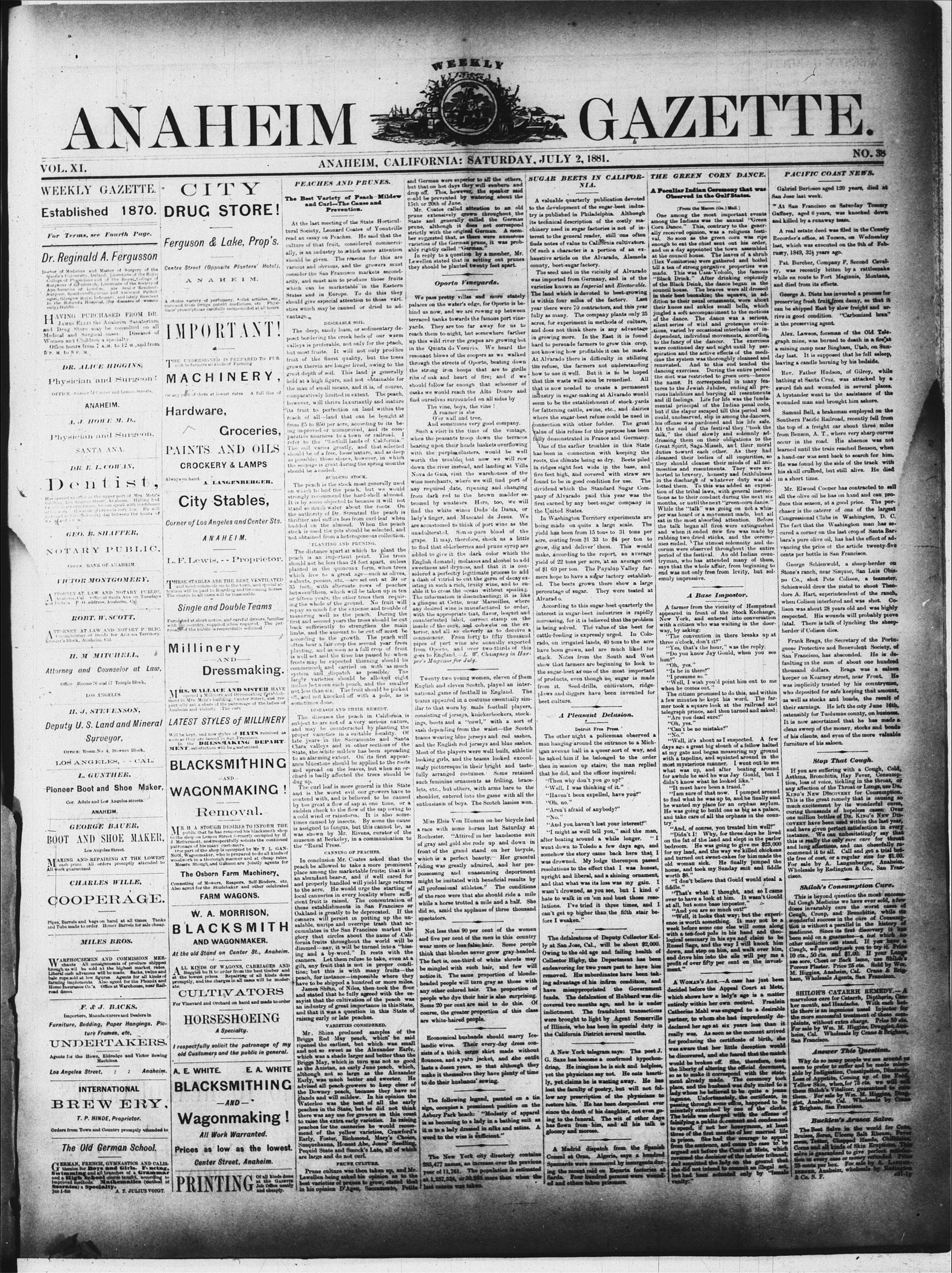
Searchable text
ANAHEIM
VOL. XI.
WEEKLY GAZETTE.
Established 1870.
For Terms, see Fourth Page.
Dr. Reginald A. Fergusson
Doctor of Medicine and Master of Surgery of the Queen's University, Ireland; Locentiate of the Royal College of Physicians and of the Royal College of Surgeons of Edinburgh; Locentiate of the Society of Apothecaries of London; ate Senior Resident-Surgeon, Resident-Physician and Assistant Pathologist, Glasgow Royal Infirmary; and lately Resident in the Rolunda Hospital (for diseases of women only) Dublin.
HAVING PURCHASED FROM DR. JAMES ELLIS the Anaheim Sanatorium and Drug Store may be consulted on all Medical and Surgical cases. Diseases of Women and Children a specialty. Office hours from 7 a.m. to 12 p.m., and from 5 p.m. to 8 p.m.
DR. ALICE HIGGINS,
Physician and Surgeon!
OFFICE: Corner of Center and Lemon Streets,
ANAHEIM.
A.J. HOWE M.D.
Physician and Surgeon,
SANTA ANA.
DR.E.L.COWAN,
CITY DRUG STORE!
Ferguson & Lake, Prop's.
Centre Street (Opposite Planters' Hotel).
ANAHEIM.
A choice variety of perfumery, toilet articles, etc., pure and fresh drugs, patent medicines, etc. Physicians' prescriptions carefully compounded at all hours.
IMPORTANT!
THE UNDERSIGNED IS PREPARED TO FURTHER to farmers all kinds of Farming
MACHINERY,
Or any part of them at lowest rates. A full line of Hardware,
Groceries,
PAINTS AND OILS
CROCKERY & LAMPS
PEACHES AND
The Best Variety of Fruit and Curl—The Cake Prevention
At the last meeting of the rural Society, Leonard Coat read an essay on Peaches. Culture of that fruit, consistently is an industry to which should be given. The reason various and obvious, and the consider the San Francisco area, and must aim to produce which can be marketable States and in Europe. Should give especial attention eties which may be canned vantage.
DESIRABLE S
The deep, sandy loam, or posit bordering the creek valleys is preferable, not o but most fruits. It will fruit of the finest quality grown therein are longer in great depth of soil. This held at a high figure, and the man of small means, and comparatively limited in extent however, will thrive luxuriously its fruit to perfection on reach of all—land that from £5 to $50 per acre, acting improved or unimproved parative nearness to a town refer to the "foothill land." The soil varies greatly, should be of a free, loose as possible; those slopes, the seepage is great during should be avoided.
Physician and Surgeon!
OFFICE. Corner of Center and Lemon Streets,
ANAHEIM.
A. J. HOWE M. D.
Physician and Surgeon,
SANTA ANA.
DR. E. L. COWAN,
Dentist,
Has opened an office in the upper port of Mrs. Metz's building, Los Angeles street, Anaheim. Having had two years experience he can speak with confidence old and new. His scale of prices is very low. He will be found in his office every day between the hours of 8:00 AM and 10:00 PM.
GEO. B. SHAFFER,
NOTARY PUBLIC,
OFFICE. BANK OF ANAHEIM.
VICTOR MONTGOMERY,
ATTORNEY AT LAW AND NOTARY PUBLIC,
Anaheim, Cal. Office at Santa Ana on Tuesday and Friday. P.O. address, Anaheim, Cal.
ROBT. W. SCOTT,
ATTORNEY AT LAW AND NOTARY PUBLIC,
Commissioner of Deeds for Arizona Territory, Krocker's Block, Anaheim, Cal.
H. M MITCHELL,
Attorney and Counselor at Law,
Office: Rooms 76 and 77 Temple Block,
LOS ANGELES.
H. J. STEVENSON,
Deputy U. S. Land and Mineral Surveyor,
OFFICE: Room No 4, Downey Block,
LOS ANGELES, -- CAL.
L. GUNTHER.
Pioneer Boot and Shoe Maker,
Cor. Adele and Los Angeles streets.
ANAHEIM.
GEORGE BAUER,
BOOT AND SHOE MAKER,
Los Angeles Street.
MAKING AND REPAIRING AT THE LOWEST cash price. All orders promptly attended to. All work guaranteed.
CHARLES WILLE,
COOPERAGE
GEORGE BAUER,
BOOT AND SHOE MAKER,
Los Angeles Street.
MAKING AND REPAIRING AT THE LOWEST cash price. All orders promptly attended to. All work guaranteed.
CHARLES WILLE,
COOPERAGE.
Pipes, Barrels and kegs on hand at all times. Tanks and Tubs made to order. Honey Barrels for sale cheap.
MILES BROS.
WAREHOUSEMEN AND COMMISSION MERCHANTS. All consignments of produce shipped through us will be sold at the highest market rates. Liberal cash advances will be made. Backs, twine and bale rope sold at low figures. Agents for all kinds of farming implements. Also agent for the Phoenix and Home Insurance Co.'s Office at Warehouse, near Railroad denot.
F. & J. BACKS.
Importers, Manufacturers and Dealers in Furniture, Bedding, Paper Hangings, Picture Frames, etc.
UNDERTAKERS.
Agents for the Howe, Eldredge and Victor Sewing Machines.
Los Angeles Street, : : Anaheim.
INTERNATIONAL BREWERY.
T. P. HINDE, Proprietor.
Orders from Town and Country promptly attended to.
The Old German School.
GERMAN, FRENCH, GYMNASTICS AND CALISHTONICS for Boys and Girls. Fencing, Swimming and all branches of a Grammar and a High School course taught, according to improved methods. Mathematics (method of Secrates) a Specialty.
Jan 1-6m.
A. T. JULIUS VOIGT.
Removal.
MR. H. A. STOUGH DESIRES TO INFORM THE public that he has removed his blacksmith shop to the shop on Lemon Street formerly occupied by H. J. McBermott, and respectfully solicits the continued patronage of his many customers.
One part of the shop is occupied by Mr. T. L. GAN-NON, Wagonmaker, who is prepared to do all kinds of woodwork in a thorough manner and at cheap rates. Messrs. Stough and Gannon are jointly agents for The Osborn Farm Machinery.
Consisting of Mowers, Reapers, Self-Binders, etc. Also agent for the Studebaker and other celebrated FARM WAGONS.
W. A. MORRISON,
BLACKSMITH AND WAGONMAKER.
At the old Stand on Center St., Anaheim.
ALL KINDS OF WAGONS, CARRIAGES AND Burgries built to order from the best timber and at the lowest prices. Repairing of all kinds done promptly, and the charges in all cases will be moderate.
CULTIVATORS
For Vineyard and Orchard on hand and made to order
HORSESHOEING
A Specialty.
I respectfully solicit the patronage of my old Customers and the public in general.
A. E. WHITE.
E. A. WHITE
BLACKSMITHING
AND
Wagonmaking!
All Work Warranted.
Prices as low as the lowest.
Center Street, Anaheim.
PRINTING
Of all kinds done at the QANTRYS Job Office neatly and cheaply.
In conclusion Mr. Copeach be allowed to take place among the market's abundant bearer, and properly handled with to the acre. He would local canneries in every cient fruit is raised; these establishments Oakland is greatly to be canners will persist in salable, unripe and overcumulates in the San Francisco glory that circles about formia fruits throughout dimmed—nay, it will bring and a by-word." canners. Let them reef gift, any fruit that is not this wise peach, for instance—in have to be shipped a h James Shinn, of Nile and stated that he fully sayist that the cultivation an industry of great importance and that it was a queen raising early or late p VARIETIES OF Mr. Shinn produced Briggs Red May ripened the earliest, which was a shade larger Briggs May, which in as the Anistan, an ear although not so large Early, was much better advised all peach-growthe Downey peach, glands and will milde Waterloo was the best peaches in the State there was any use for to raise the extra earlier peaches for the canne mend of the yellow Early, Foster, Richie Susquehanna, Honest Pequid State and Sm are large and do not prune Prune culture was Lewellen being asked best varieties of prunin his opinion D'Age
PEACHES AND PRUNES.
The Best Variety of Peach—Mildew and Curl—The Cause and Prevention.
At the last meeting of the State Horticultural Society, Leonard Coates of Yountville read an essay on Peaches. He said that the culture of that fruit, considered commercially, is an industry to which more attention should be given. The reasons for this are various and obvious, and the growers must consider the San Francisco markets secondarily, and must aim to produce those fruits which can be marketable in the Eastern States and in Europe. To do this they should give especial attention to those varieties which may be canned or dried to advantage.
DESIRABLE SOIL.
The deep, sandy loam, or sedimentary deposit bordering the creek beds of our warm valleys is preferable, not only for the peach, but most fruits. It will not only produce fruit of the finest quality, but the trees grown therein are longer lived, owing to the great depth of soil. This land is generally held at a high figure, and not obtainable for the man of small means, and it is, of course, comparatively limited in extent. The peach, however, will thrive luxuriantly and mature its fruit to perfection on land within the reach of all—land that can be bought at from $5 to $50 per acre, according to its being improved or unimproved, and its comparative nearness to a town or railroad. I refer to the "toothill lands of California." The soil varies greatly, and that selected should be of a free, loose nature, and as deep as possible; those slopes, however, in which the seepage is great during the spring months should be avoided.
and German were superior to all the others, but that on hot days they will sunburn and drop off. This, however, the speaker said could be prevented by watering about the 15th or 20th of June.
Mr. Coates called attention to an old prune extensively grown throughout the State and generally called the German prune, although it does not correspond strictly with the original German. A member suggested that, as there were numerous varieties of the German prune, it was probably rightly called "German."
In reply to a question by a member, Mr. Lewellen stated that in setting out prunes they should be planted twenty feet apart.
Oporto Vineyards.
We pass pretty villas and more stately palaces on the water's edge, for Oporto is behind us now, and we are rowing up between terraced banks towards the famous port vineyards. They are too far away for us to reach them to-night, but somewhere farther up this wild river the grapes are growing hot in the Quinta do Vesuvio. We heard the resonant blows of the cooperers as we walked through the streets of Oporto, beating down the strong iron hoops that are to girdle ribs of oak and heart of fire; and if we should follow far enough that schooner of casks we would reach the Alto Douro and find ourselves surrounded on all sides by
The vine, boys, the vine!
A roamer is she
O'er wall and tree,
And sometimes very good company.
Such a visit in the time of the vintage, when the peasants troop down the terraces bearing upon their heads baskets overflowing with the purple clusters, would be well worth the trouble; but now we will row down the river instead, and landing at Villa Nova de Gaia visit the warehouses of the
SUGAR BEETS IN CALIFORNIA.
A valuable quarterly publication devoted to the development of the sugar-beet industry is published in Philadelphia. Although its technical description of the costly machinery used in sugar factories is not of interest to the general reader, still one often finds notes of value to California cultivators. Of such a character is a portion of an exhaustive article on the Alvarado, Alameda county, beet-sugar factory.
The seed used in the vicinity of Alvarado was imported from Germany, and is of the varieties known as Imperial and Electorable. The land which is devoted to beet-growing is within four miles of the factory. Last year there were 70 contractors, and this year fully as many. The company plants only 25 acres, for experiment in methods of culture, and does not think there is any advantage in growing more. In the East it is found hard to persuade farmers to grow this crop, not knowing how profitable it can be made. At Alvarado there is difficulty in utilizing the refuse, the farmers not understanding how to use it well. But it is to be hoped that this waste will soon be remedied. All that is now needed to create a permanent industry in sugar-making at Alvarado would seem to be the establishment of stock-yards for fattening cattle, swine, etc., and dairies where the sugar-beet refuse could be used in connection with other fodder. The great value of this refuse for this purpose has been fully demonstrated in France and Germany.
One of the earlier troubles in this State has been in connection with keeping the roots, the climate being so dry. Beets piled in ridges eight feet wide in the base, and five feet high, and covered with straw are
great depth of soil. This plant is held at a high figure, and not obtainable for the man of small means, and it is, of course, comparatively limited in extent. The peach, however, will thrive luxuriantly and mature its fruit to perfection on land within the reach of all—land that can be bought at from $5 to $50 per acre, according to its being improved or unimproved, and its comparative nearness to a town or railroad. I refer to the "toothill lands of California." The soil varies greatly, and that selected should be of a free, loose nature, and as deep as possible; those slopes, however, in which the seepage is great during the spring months should be avoided.
BUDDING STOCK.
The peach is the stock most generally used on which to bind the peach, but we would strongly recommend the hard-shell almond. It is by some objected to because it will not stand so much water about the roots. On the authority of Dr. Strentzel the peach is thrifter and suffers less from curl-leaf when budded on the almond. When the peach stock is used the pits should be selected, and not obtained from a heterogeneous collection.
PLANTING AND PRUNING.
The distance apart at which to plant the peach is an important point. The trees should not be less than 24 feet apart, unless planted in the quincunx form, when trees which live to a great age—such as olives, walnuts, pecans, etc.—are set out at 30 or 35 feet, with alternate rows of peaches between them, which will be taken up in ten or fifteen years, the other trees then requiring the whole of the ground. No fruit will repay so much for the expense and trouble of manuring well as the peach. During the first and second years the trees should be cut back sufficiently to strengthen the main limbs, and the amount to be cut off must be according to the growth. The peach will often bear a fair crop the second year from planting, and as soon as a full crop of fruit is well set and the time has passed by when frosts may be expected thinning should be commenced and carried on with as much system and dispatch as possible. The larger varieties should be allowed eight inches between each peach, and the smaller not less than six. The fruit should be picked off, and not knocked off with a pole, as is sometimes done.
DISEASES AND THEIR REMEDY.
The diseases the peach in California is subject to are not of a very serious nature, and may be counteracted by planting the proper varieties in a suitable locality. Of late years in the Sacramento and Santa Clara valleys and in other sections of the State, the white mildew has been spreading to an alarming extent. On its first appearance bluestone should be applied to the roots and spread on the leaves, but when an orchard is badly affected the trees should be dug up.
The curl leaf is more general in this State and is the worst evil our growers have to contend with, and is believed to be caused by too great a flow of sap at one time, or a sudden check to the flow of the sap owing to a cold wind or rainstorm. It is also sometimes caused by insects. By some the cause is assigned to fungus, but this cannot be, as was shown by Mr. Rivens, curator of the museum at Berkeley, in a communication to the "Rural Press."
CANNING OF PEACHES.
In conclusion Mr. Coates asked that the peach be allowed to take a more prominent place among the marketable fruits; that it is an abundant bearer, and if well cared for and properly handled will yield large returns to the acre. He would urge the starting of local caneries in every locality where sufficiency its fruit to perfection on land within the reach of all—land that can be bought at from $5 to $50 per acre, according to its being improved or unimproved, and its comparative nearness to a town or railroad. I refer to the "toothill lands of California." The soil varies greatly, and that selected should be of a free, loose nature, and as deep as possible; those slopes, however, in which the seepage is greatest during the spring months should be avoided.
BUDDING STOCK.
The peach is the stock most generally used on which to bind the peach, but we would strongly recommend the hard-shell almond. It is by some objected to because it will not stand so much water about the roots. On the authority of Dr. Strentzel the peach is thrifter and suffers less from curl-leaf when budded on the almond. When the peach stock is used the pits should be selected, and not obtained from a heterogeneous collection.
PLANTING AND PRUNING.
The distance apart at which to plant the peach is an important point. The trees should not be less than 24 feet apart, unless planted in the quincunx form, when trees which live to a great age—such as olives, walnuts, pecans, etc.—are set out at 30 or 35 feet, with alternate rows of peaches between them, which will be taken up in ten or fifteen years, the other trees then requiring the whole of the ground. No fruit will repay so much for the expense and trouble of manuring well as the peach. During the first and second years the trees should be cut back sufficiently to strengthen the main limbs, and the amount to be cut off must be according to the growth. The peach will often bear a fair crop the second year from planting, and as soon as a full crop of fruit is well set and the time has passed by when frosts may be expected thinning should be commenced and carried on with as much system and dispatch as possible. The larger varieties should be allowed eight inches between each peach, and the smaller not less than six. The fruit should be picked off, and not knocked off with a pole, as is sometimes done.
DISEASES AND THEIR REMEDY.
The diseases the peach in California is subject to are not of a very serious nature, and may be counteracted by planting the proper varieties in a suitable locality. Of late years in the Sacramento and Santa Clara valleys and in other sections of the State, the white mildew has been spreading to an alarming extent. On its first appearance bluestone should be applied to the roots and spread on the leaves, but when an orchard is badly affected the trees should be dug up.
The curl leaf is more general in this State and is the worst evil our growers have to contend with, and is believed to be caused by too great a flow of sap at one time, or a sudden check to the flow of the sap owing to a cold wind or rainstorm. It is also sometimes caused by insects. By some the cause is assigned to fungus, but this cannot be, as was shown by Mr. Rivens, curator of the museum at Berkeley, in a communication to the "Rural Press."
CANNING OF PEACHES.
In conclusion Mr. Coates asked that the peach be allowed to take a more prominent place among the marketable fruits; that it is an abundant bearer, and if well cared for and properly handled will yield large returns to the acre. He would urge the starting of local caneries in every locality where sufficiency its fruit to perfection on land within the reach of all—land that can be bought at from $5 to $50 per acre, according to its being improved or unimproved, and its comparative nearness to a town or railroad. I refer to the "toothill lands of California." The soil varies greatly, and that selected should be of a free, loose nature, and as deep as possible; those slopes, however, in which the seepage is greatest during the spring months should be avoided.
BUDDING STOCK.
The peach is the stock most generally used on which to bind the peach, but we would strongly recommend the hard-shell almond. It is by some objected to because it will not stand so much water about the roots. On the authority of Dr. Strentzel the peach is thrifter and suffers less from curl-leaf when budded on the almond. When the peach stock is used the pits should be selected, and not obtained from a heterogeneous collection.
PLANTING AND PRUNING.
The distance apart at which to plant the peach is an important point. The trees should not be less than 24 feet apart, unless planted in the quincunx form, when trees which live to a great age—such as olives, walnuts, pecans, etc.—are set out at 30 or 35 feet, with alternate rows of peaches between them, which will be taken up in ten or fifteen years, the other trees then requiring the whole of the ground. No fruit will repay so much for the expense and trouble of manuring well as the peach. During the first and second yearsthe trees should be cut back sufficiently to strengthenthe main limbs,andtheamounttobecutoffmustbeaccordingtothegrowth.Thepeachwilloftenbeara faircropthesecondyearfromplanting,andassoonasafterafullcropoffruitiswellsetandthetimehaspassedbywhenfrostsmaybespectedthinningshouldbecommencedandcarriedonwithasmuchsystemanddispatchaspossible.Thelargervarietiesshouldbeallowedeightinchesbetweeneachpeach,andthesmallernotlessthansix.Thefruitshouldbepickedoff,andnotknockedoffwithapole.asisometimesdone.
DISEASES AND THEIR REMEDY.
The diseasesthepeachinCaliforniaissubjecttoarenotofaveryseriousnature,andmaybecounteractedbyplantingthepropervarietiesinasuitablelocality.OftaleyearsintheSacramentoandSantaClaravalleysandinothersectionsoftheState,thewhitemildewhasbeenspreadingtoanalarmingextent.Onitsfirstappearancebluestoneshouldbeappliedtotherootssandspreadontheleavesbutwhenanorchardisbadlyaffectedthetreesshouldbenguldup.
ThecurlleafismoregeneralinthisStateandistheworstevilourgrowershavetocontendwith,andisbelievedtobewoundedbytoogreataflowsatapatonetime.orascundchecktotheflowofthesapowingtoacoldwindorrainstorm.Iitalso sometimescausedbyinsects.Bysomethecauseisassignedtofungus,butthiscannotbe,aswasshownbyMr.Rivens,curatorofthemuseumatBerkeley.inacommunicationtothe"RuralPress."
CANNING OF PEACHES.
In conclusion Mr. Coates asked that the peach be allowed to take a more prominent place amongthemarketable fruits;thatititisanabundantbearer,andifwellcarefdorproperlyhandledwill yieldlargereturnstotheacre.Hewouldurgethestartingoflocalcaneriesineverylocalitywhere sufficiency its fruit to perfection on land withinthereachofall—landthatcanbebuyedinRochester.“Attiredinherhandsomesuitofgrayandgoldsherodupanddowninfrontofgrandstandonherbicyclewhichisaperfectbeauty.“Hergracetulridingwasgreatlyadmired,andherprepossessingandunassumingdepartmentmightbemitiquatedwithbeneficialresultsbyallprofessionalathletes.”Theconditionsoftheracewerethatsheshouldrideamileribsofoakandheartoffire;andifweshouldfollowfarenoughthatschoonerofcaskswouldreachfarenthemochestbrownandfindourselvessurroundedonallsidebyThevine,boysbethive!
A Pleasant Delusion.
DetroitFreePress.
Theothernighta policemanobservedmanhangingaroundthe entrancetoMichiganavenuehallinaqueersortofway,andheaskedhimifhebelongedtotheordertheninsessionupstairs;theman repliedthathe did,andtheofficerinquired:
“Thenwhydon'tyougoup?”
“WellIwasthinkingofit.”
“Haven'tbeexpelled,haveyou?”
“Ohno."
“Aren'tafraidofanybody?”
“No.”
“Andyouhavn'tlostyourinterest?”
“Imightaswelltellyou,"saidtheman,afterbeatingaroundawhilelonger.“IwentdownToToledoafewdaysago,andsomehowthe story camebackherethatIwasdrowned.Mylodgethereponpass resolutionstotheeffectthatIwashonest,
uprightandliberal,andashiningornament,andthatwhatwasitslosswasmygain.Iwasn'tdrowned.asyousee,但Ikindo hatewalkinon'emandbuusthereso-
A Pleasant Delusion.
DetroitFreePress.
Theothernighta policemanobservedmanhangingaroundthe entrancetoMichiganavenuehallinaqueersortofway,andheaskedhimifhebelongedtotheordertheninsessionupstairs;theman repliedthathe did,andtheofficerinquired:
“Thenwhydon'tyougoup?”
“WellIwasthinkingofit.”
“Haven'tbeexpelled,haveyou?”
“Ohno."
“Aren'tafraidofanybody?”
“No.”
“Andyouhavn'tlostyourinterest?”
“Imightaswelltellyou,"saidtheman,afterbeatingaroundawhilelonger.“IwentdownToToledoafewdaysago,andsomehowthe story camebackherethatIwasdrowned.Mylodgethereponpass resolutionstotheeffectthatIwashonest,
uprightandliberal,andashiningornament,andthatwhatwasitslosswasmygain.Iwasn'tdrowned.asyousee,但Ikindo hatewalkinon'emandbuusthereso-
CONTENT WITH, AND IS BELOWED TO BE CAUSED BY TOO GREAT A FLOW OF SAP AT ONE TIME, OR A SUDDEN CHECK TO THE FLOW OF THE SAP OWING TO A COLD WIND OR RAINSTORM. IT IS ALSO SOMETIMES CAUSED BY INSECTS. BY SOME THE Cause IS ASSIGNED TO FUNGUS, BUT THIS CANNOT BE, AS WAS SHown By Mr. Rivens, Curator Of The Museum At Berkeley, In A COMMunication To The "Rural Press."
CANNING OF PEACHES.
In conclusion Mr. Coates asked that the peach be allowed to take a more prominent place among the marketable fruits; that it is an abundant bearer, and if well cared for and properly handled will yield large returns to the acre. He would urge the starting of local canneries in every locality where sufficient fruit is raised. The concentration of these establishments in San Francisco or Oakland is greatly to be deprecated. If the canners will persist in putting up the unsalable, unripe and overripe trash that accumulates in the San Francisco market the glory that circles about the name of California fruits throughout the world will be dimmed—nay, it will be turned into a "hissing and a by-word." It rests with the canners. Let them refuse to take, even at a gift, any fruit that is not in proper condition; but this is with many fruits—the peach, for instance—impossible where they have to be shipped a hundred or more miles. James Shinn, of Niles, then took the floor and stated that he fully agreed with the essayist that the cultivation of the peach was an industry of great importance in this State, and that it was a question in this State of raising early or late peaches.
VARIETIES CONSIDERED.
Mr. Shinn produced samples of the Briggs Red May peach, which he said ripened the earliest, but which was small and not so sweet as the Alexander Early, which was a shade larger and better than the Briggs May, which in turn was not so good as the Anistan, an early June peach, which, although not so large as the Alexander Early, was much better and sweeter. He advised all peach-growers to keep clear of the Downey peach, because they have no glands and will mildew. In his opinion the Waterloo was the best of all the early peaches in the State, but he did not think there was any use for growers on this coast to raise the extra early varieties. In raising peaches for the canneries he would recommend of the yellow varieties, Crawford's Early, Foster, Richmond, Mary's Choice, Susquehanna, Honest Abe, Jones' Seedling, Pequid State and Smock's Late, all of which are large and do not curl.
PRUNE CULTURE.
Prune culture was then taken up, and Mr. Lawellen being asked his opinion as to the best varieties of prunes to grow, stated that in his opinion D'Agen, Sacramento, Petila
Miss Elsie Von Blumen on her bicycle had a race with some horses last Saturday at Rochester. "Attired in her handsome suit of gray and gold she rode up and down in front of the grand stand on her bicycle, which is a perfect beauty." Her graceful riding was greatly admired, and her possessing and unassuming deportment might be imitated with beneficial results by all professional athletes." The conditions of the race were that she should ride a mile while a horse trotted a mile and a half. She did so, amid the applause of three thousand spectators.
Not less than 90 per cent of the women and five per cent of the men in this country wear more or less false hair. Some people think that blondes never grow gray-headed. The fact is, one-third of white shreds may be mingled with such hair, and few will notice it. The same proportion of blonde-headed people will turn gray as those with any other colored hair. The proportion of people who dye their hair is also surprising. Some 20 per cent are said to do this. Of course, the greater proportion of this class are white-haired people.
Economical husbands should marry Icelandic wives. Their everyday dress consists of a thick serge skirt made without flounces, and a yarn jacket, and she outfit lasts a dozen years, so that although they make it themselves they have plenty of time to do their husbands' sewing.
The following legend, painted on a tin sign, occupies a prominent position on the Asbury Park beach: "Modesty of apparel is as becoming to a lady in a bathing suit as it is to a lady dressed in silks and satins. A word to the wise is sufficient."
The New York city directory contains 285,477 names, an increase over the previous year of 11,761. The population is estimated at 1,257,534, or 50,984 more than when the last census was taken.
"Oh, no."
"Aren't afraid of anybody?"
"No."
"And you haven't lost your interest?"
"I might as well tell you," said the man, after beating around a while longer. "I went down to Toledo a few days ago, and somehow the story came back here that I was drowned. My lodge thereupon passed resolutions to the effect that I was honest, upright and liberal, and a shining ornament, and that what was its loss was my gain. I wasn't drowned, as you see, but I kind o' hate to walk in on 'em and bust those resolutions. I've tried it three times, and I can't get up higher than the fifth stair before I weaken."
The defalcations of Deputy Collector Kelly at San Jose, Cal., will be about $2,000. Owing to the old age and failing health of Collector Higby, the Department has been endeavoring for two years past to have him removed. His subordinates have been taking advantage of his infirm condition, and have misappropriated the Government funds. The defalcation of Hubbard was discovered two months ago, and he is under indictment. The fraudulent transactions were brought to light by Agent Somerville of Illinois, who has been on special duty in the California District several months.
A New York telegram says: The poet J. G. Saxe has become a confirmed hypochondriac. He imagines he is sick and helpless, yet the physicians say not. He eats heartily, yet claims he is wasting away. He has lost the faculty of poetry, but will not follow any prescription of the physicians to restore him. He has been despondent ever since the death of his daughter, not even going to the funeral. The wit of other days has flown from him, and all his talk is gloomy and morose.
A Madrid dispatch from the Spanish Consul at Oran, Algeria says a hundred Spaniards were massacred by insurgents during the recent raid on Esparta factories at Sarda. Four hundred persons were wounded and others taken prisoners.
GAZETTE.
NO. 38
THE GREEN CORN DANCE.
A peculiar Indian Ceremony that was Observed in the Gulf States.
[From the Macon (Ga.) Mail.]
One among the most important events among the Indians was the annual "Green Corn Dance." This, contrary to the generally received opinion, was a religious festival. So soon as the green corn was ripe enough to eat the chief sent out his order, and on a day appointed the town assembled at the council house. The leaves of a shrub (Ilex Vomitoria) were gathered and boiled till a tea of strong purgative properties was made. This was Usa-Yoholo, the famous "Black Drink." After drinking copiously of the Black Drink, the dance began in the council house. The braves were all dressed in their best buckskin; the squaws, in addition to their usual ornaments, wore about their knees and ankles small bells, which jingled a soft accompaniment to the motions of the dance. The dance was a serious, silent series of wild and grotesque evolutions, varied by occasional interludes of independent, individual movements, according to the fancy of the dancer. The exercises were continued day and night until by perspiration and the active effects of the medicine the system was thoroughly cleansed and renovated. And to this end tended the dancing exercises. During the entire period the diet was restricted to green corn—hence the name. It corresponded in many features to the Jewish Jubilee, ending all previous liabilities and burying all resentments and ill feelings. Life for life was the fundamental principal of the Indian penal code, but if the slayer escaped till this period and could, unobserved, slip in among the dancers, his offense was pardoned and his life safe. At the end of the festival they "took the talk," the chief slowly and solemnly addressing them on their obligations to the Great Spirit, Saga-Misseh, and their moral duties toward each other. As they had cleansed their bodies of all impurities, so they should cleanse their minds of all animosities and resentments. They were exhorted to bravery, honesty and faithfulness.
PACIFIC COAST NEWS.
Gabriel Buriosco aged 120 years, died at San Jose last week.
At San Francisco on Saturday Tommy Gaffney, aged 6 years, was knocked down and killed by a runaway team.
A real estate deed was filed in the County Recorder's office, at Tucson, on Wednesday last, which was executed on the 9th of February, 1849, 32 years ago.
Pat. Burcher, Company F, Second Cavalry, was recently bitten by a rattlesnake while en route to Fort Maginnis, Montana, and died from its effects.
George A. Dietz has invented a process for preserving fresh fruit from decay, so that it can be shipped East by slow freight and arrive in good condition. "Carbonized bran" is the preserving agent.
Alex Lawson, foreman of the Old Telegraph mine, was burned to death in a fire at a mining camp near Bingham, Utah, on Sunday last. It is supposed that he fell asleep, leaving a candle burning by his bedside.
Rev. Father Hudson, of Gilroy, while bathing at Santa Cruz, was attacked by a sword fish and wounded in several places. A bystander went to the assistance of the wounded man and brought him ashore.
Samuel Bell, a brakeman employed on the Southern Pacific Railroad, recently fell from the top of a freight car about three miles from Benson, A. T., where very sharp curves occur in the road. His absence was not learned until the train reached Benson, when a hand-car was sent back to search for him. He was found by the side of the track with his skull crushed, but still alive. He died
This purpose has been created at Alvarado would be used in stock-yards, etc., and dairies could be used in fodder. The great this purpose has beenSTANCE and Germany. Doubles in this State with keeping the so dry. Beets piled in the base, and dried with straw are addition for use. The Standard Sugar Company this year was the sugar company in story experiments are a large scale. The tons to 31 tons per 3 to $4 per ton to them. This would report, an average rate, at an average cost Puyalup Valley far-gar factory establish there show a large They were tested at sugar-beet quarterly the industries is rapidly believed that the problem value of the beet for daily urged. In Colo-40 tons to the acre are much liked for the South and West beginning to look to of the most important high no sugar is made cultivators, ridge-been invented for
Delusion.
Free Press.
policeman observed at the entrance to a Mich-queer sort of way, and belonged to the orderairs; the man replied officer inquired: you go up?" ing of it."elled, have you?"
anybody?
Most your interest?" well you," said the man, a while longer. "I a few days ago, and came back here that Iodge thereupon passed meet that I was honest, and a shining ornament, loss was my gain. I you see, but I kind o'mm and bust those reso-the diet was restricted to green corn—hence the name. It corresponded in many features to the Jewish Jubilee, ending all previous liabilities and burying all resentments and ill feelings. Life for life was the fundamental principal of the Indian penal code, but if the slayer escaped till this period and could, unobserved, slip in among the dancers, his offense was pardoned and his life safe. At the end of the festival they "took the talk," the chief slowly and solemnly addressing them on their obligations to the Great Spirit, Saga-Misseh, and their moral duties toward each other. As they had cleansed their bodies of all impurities, so they should cleanse their minds of all animities and resentments. They were exhorted to bravery, honesty and faithfulness in the discharge of whatever duty was allotted them. To this was added an exposition of the tribal laws, with general instructions as to their conduct during the next six months, or until the next "green-corn dance."
While the "talk" was going on not a whisper was heard or a movement made, but all sat in the most absorbed attention. Before the talk began all fires were extinguished and when it ended new fire was made by rubbing two dried sticks, and the ceremonies ended. The utmost solemnity and decorum were observed throughout the entire period of the festival. An old Indian countryman, who has attended many of them, says that the whole affair, from beginning to end was not only free from levity, but solemnly impressive.
A Base Impostor.
A farmer from the vicinity of Hempstead appeared in front of the Stock Exchange, New York, and entered into conversation with a citizen who was waiting in the doorway, by asking:
"The convention in there breaks up at three o'clock, don't it?"
"Yes, that's the hour," was the reply.
"Do you know Jay Gould, when you see him?"
"Oh, yes."
"Is he in there?"
"I presume so."
Well, I wish you'd point him out to me when he comes out."
The citizen promised to do this, and within a few minutes he kept his word. The farmer took a square look at the railroad and telegraph prince, and then turned and asked:
"Are you dead sure?"
"Oh, yes."
"Can't be no mistake?"
No."
Well, it's about as I suspected. A few days ago a great big slouch of a fellow halted at my gate and began measuring my ground with a tapeline, and squinted around in the most mysterious manner. I went out to see what was up, and after beating around for awhile he said he was Jay Gould, but I didn't know what he looked like."
"It must have been a trand."
"I am sure of that now. I pumped around to find what he was up to, and he finally said he wanted my place for an orphan asylum. He was going to build one as big as a palace, and take care of all the orphans in the country."
And, of course, you treated him well?
"Didn't I! Why, for three days he lived on the fat of the land and slept in the parlor bedroom. He was going to give me $25,000 for my land, and the way we killed chickens and turned out sweet-cakes for him made the old woman sick. He finally jumped the house, and took my Sunday suit and fiddle worth $8."
"I don't believe that Gould would steal a fiddle."
That's what I thought, and so I came over to have a look at him. It wasn't Gould bathing at Santa Cruz, was attacked by a sword fish and wounded in several places. A bystander went to the assistance of the wounded man and brought him ashore.
Samuel Bell, a brakeman employed on the Southern Pacific Railroad, recently fell from the top of a freight car about three miles from Benson, A. T., where very sharp curves occur in the road. His absence was not learned until the train reached Benson, when a hand-car was sent back to search for him. He was found by the side of the track with his skull crushed, but still alive. He died in a short time.
Mr. Elwood Cooper has contracted to sell all the olive oil he has on hand and can produce this season, at a good price. The purchaser is the caterer of one of the largest Congressional Clubs in Washington, D.C. The fact that the Washington man has secured a corner on the last crop of Santa Barbara's pure olive oil, has had the effect of advancing the price of the article twenty-five cents per bottle in San Francisco.
George Schienwold, a sheep-herder on Stone's ranch, near Sisquoe, San Luis Obispo Co., shot Pete Colison, a teamster, Schienwold drew the pistol to shoot Theodore A. Hart, superintendent of the ranch, when Colison interfered and was shot. Colison was about 28 years old and was highly respected. His wounds will probably prove fatal. There is talk of lynching the sheep-herder if Colison dies.
Frank Braga, the Secretary of the Portuguese Protective and Benevolent Society, of San Francisco, has absconded. He is defaulting in the sum of about one hundred thousand dollars. Braga was a saloon keeper on Kearney street, near Front. He was implicitly trusted by his countrymen, who deposited for safe keeping that amount, as well as stocks and bonds, the result of their earnings. He left city June 16th, ostensibly for Tuolumne county, on business. It is now ascertained that he has made a clean sweep of the money, stocks and bonds of his clients, and even of the more valuable furniture of his saloon.
Stop That Cough.
If you are suffering with a Cough, Cold,
Asthma, Bronchitis, Hay Fever, Consumption, loss of voice, tickling in the throat, or any affection of the Throat or Lung, use Dr.
King's New Discovery for Consumption.
This is the great remedy that is causing so much excitement by its wonderful cures,
curing thousands of hopeless cases. Over one million bottles of Dr. King's New Discovery have been used within the last year,
and have given perfect satisfaction in every instance. We can unhesitatingly say that this is really the only cure for throat and lung affections, and can cheerfully recommend it to all. Call and get a trial bottle free of cost, or a regular size for $1.00.
For sale by A. Langenberger, Anaheim.
Wholesale by Redington & Co., San Francisco.
Shiloh's Consumption Cure.
This is beyond question the most success-
lost your interest?"
shall you," said the man,
a while longer. "I am a few days ago, and came back here that I judge thereupon passed
act that I was honest,
and a shining ornament,
loss was my gain. I see, but I kind o'
tum and bust those resouthree times, and I
than the fifth stair beof Deputy Collector Kelwill be about $2,000.
and failing health of
the Department has been
years past to have him
ordinates have been takinfirm condition, and
attended the Government
ation of Hubbard was disage, and he is under
fraudulent transactions
that by Agent Somerville
been on special duty in
dict several months.
A Woman's Age.—A case has just been decided before the Appeal Court at Metz, which shows how a lady's age is a matter entirely within her own control. Fraulein Catherine Mahl was engaged to a desirable partner, to whom she had imprudently declared her age at six years less than it really was. As soon as the moment arrived for producing the certificate of birth, she was aware that her little deception would be discovered, and she feared that the match would be broken off. She, therefore, took the liberty of altering the official document, so as to make it correspond with the statement already made. The ceremony took place, and the husband was duly united to a lady whom he believed to be quite a jeune ingenne. Unfortunately, the certificate, in passing through some office, happened to be minutely examined by one of the clerks. The bride was charged with the offense of falsifying a public document and condemned to spend, if not her honeymoon, at least three of the first months of her married life in prison. She had the courage to appeal from the sentence, and cause the case to be argued out before the Court at Metz, which reversed the decision of the inferior tribunal, and acquitted the lady on the ground that she did not intend to commit an illegal act, but had been actuated only by "female vanity:"
This is the great remedy that is causing so much excitement by its wonderful cure, curing thousands of hopeless cases. Over one million bottles of Dr. King's New Discovery have been used within the last year, and have given perfect satisfaction in every instance. We can unhesitatingly say that this is really the only cure for throat and lung affections, and can cheerfully recommend it to all. Call and get a trial bottle free of cost, or a regular size for $1.00. For sale by A. Langenberger, Anaheim. Wholesale by Redington & Co., San Francisco.
Shiloh's Consumption Cure.
This is beyond question the most successful Cough Medicine we have ever sold, a few doses invariably cure the worst cases of Cough, Croup, and Brenchitis, while its wonderful success in the cure of Consumption is without a parallel in the history of medicine. Since its first discovery it has been sold on a guarantee—a test which no other medicine can stand. If you have a Cough, we earnestly ask you to try it. Price 10 cts., 50 cts., and $1.00. If your Lungase sore, Chest or Back lame, use Shiloh's Porous Plaster. Price 25 cts. Sold by Wm. M. Higgins, Anaheim, Cal. Crane & Brigham, Wholesale Agents, San Francisco.
SHILOH'S CATARRH REMEDY.—A marvelous cure for Catarrh, Diptheria, Canker mouth, and Headache. With each bottle there is an ingenious nasal Injector for the more successful treatment of these complaints, without extra charge. Price 50 cts. For sale by Wm. M. Higgins, Druggist, Anaheim, Cal. Wholesale by Crane & Brigham, San Francisco.
Answer This Question.
Why do so many people we see around us seem to prefer to suffer and be made miserable by Indigestion, Constipation, Dizziness, Loss of Appetite, Coming up of the Food Yellow Skin, when for 75 cts. we will sell them Shiloh's Vitalizer, guaranteed to cure them. For sale by Wm. M. Higgins, Druggist, Anaheim, Cal. Wholesale by Crane & Brigham, San Francisco.
Bucklen's Arnica Salve.
The Best Salve in the world for Cats, Bruises, Sores, Ulcers, Salt Rheum, Fever sores, Tether, Chapped Hands, Chillblains, Cornea and all kinds of Skin Eruptions. This salve is guaranteed to give perfect salivation in every case or money refunded. Price 25 cents per box. For sale by A. Langenberger, Anaheim, wholesale by Redington & Co., S.F.