anaheim-gazette 1881-05-28
Scanned page
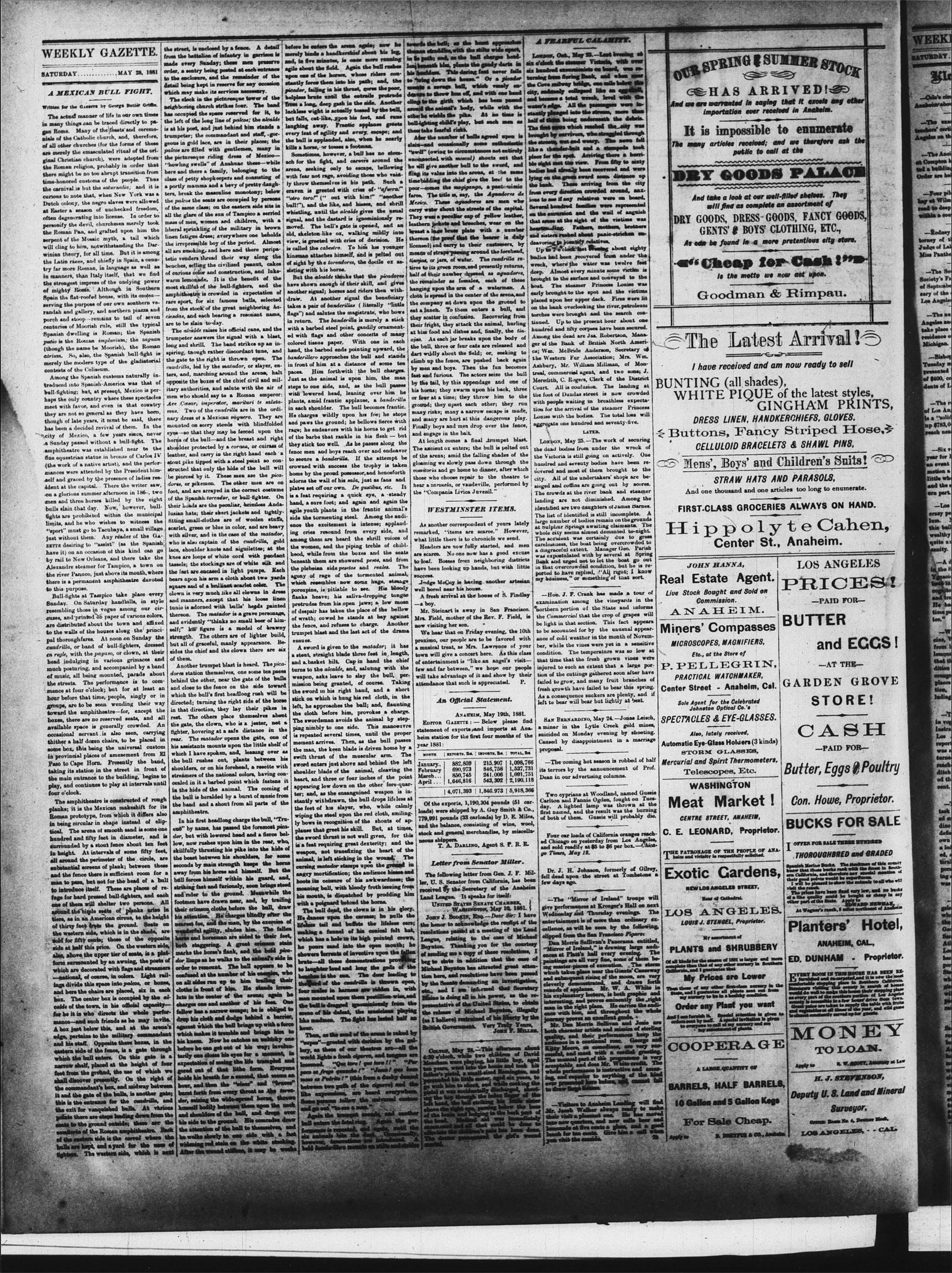
Searchable text
WEEKLY GAZETTE.
SATURDAY... MAY 28, 1881
A MEXICAN BULL FIGHT.
Written for the Gazette by George Butler Griffin.
The actual manner of life in our own times in many things can be traced directly to pagan Rome. Many of the feasts and ceremonies of the Catholic church, and, therefore, of all other churches (for the forms of these are merely the emasculated ritual of the original Christian church), were adopted from the Roman religion, probably in order that there might be no too abrupt transition from time-honored customs of the people. Thus the carnival is but the saturnalia; and it is curious to note that, when New York was a Dutch colony, the negro slaves were allowed at Easter a season of unchecked freedom, often degenerating into license. In order to personify the devil, churchmen merely took the Roman Pan, and grafted upon him the serpent of the Mosaic myth, a tail which will cling to him, notwithstanding the Darwinian theory, for all time. But it is among the Latin races, and chiefly in Spain, a country far more Roman, in language as well as in manners, than Italy itself, that we find the strongest impress of the undying power of mighty Rome. Although in Southern Spain the flat-roofed house, with its azotea—serving the purpose of our own southern verandah and gallery, and northern piazza and porch and stoop—remains to tell of seven centuries of Moorish rule, still the typical Spanish dwelling is Roman; the Spanish patio is the Roman impluvium; the zaguan (though the name be Moorish), the Roman atrium. So, also, the Spanish bull-fight is merely the modern type of the gladiatorial contests of the Coliseum.
Among the Spanish customs naturally introduced into Spanish-America was that of bull-fighting; but, at present, Mexico is perhaps the only country where these spectacles meet with favor, and even in that country they are not so general as they have been, though of late years, it must be said, there has been a decided revival of them. In the city of Mexico, a few years since, never a Sunday passed without a bull-fight. The amphitheatre was established near to the fine equestrian statue in bronze of Carlos IV (the work of a native artist), and the performances were attended by the President himself, the street, is enclosed by a fence. A detail from the battalion of infantry in garrison is made every Sunday; these men preserve order, a sentry being posted at each entrance to the enclosure, and the remainder of the detail being kept in reserve for any occasion which may make its services necessary.
The clock in the picturesque tower of the neighboring church strikes four. The band has occupied the space reserved for it, to the left of the long line of palcos; the alcalde is at his post, and just behind him stands a trumpeter; the commandant and staff, gorgeous in gold lace, are in their places; the palcos are filled with gentlemen, many in the picturesque riding dress of Mexico—"howling swells" of Anahuac these—while here and there a family, belonging to the class of petty shopkeepers and consisting of a portly mamma and a bravy of pretty daughters, break the masculine monotony; below the palcos the seats are occupied by persons of the same class; on the eastern side sits in all the glare of the sun of Tampico a serried mass of men, women and children, with a liberal sprinkling of the military in brown linen fatigue dress; everywhere one beholds the irrepressible boy of the period. Almost all are smoking, and here and there peripatetic vendors thread their way along the benches, selling the civilized peanut, cakes of curious color and construction, and lukewarm lemonade. It is the benefit of the most skillful of the bull-fighters, and the amphitheatre is crowded in expectation of rare sport, for six famous bulls, selected from the stock of the great neighboring haciendas, and each bearing a resonant name, are to be slain to-day.
The alcalde raises his official cane, and the trumpeter answers the signal with a blast, long and shrill. The band strikes up an inspiring, though rather discordant tune, and the gate to the right is thrown open. The cuadrilla, led by the matador, or slayer, enters, and marching around the arena, halt opposite the boxes of the chief civil and military authorities, and salute with the air of men who should say to a Roman emperor: Ace Casar, imperator, morituri te salutamus. Two of the cuadrilla are in the ordinary dress of a Mexican vaquero. They are mounted on sorry steeds with blindfolded eyes—so that they may be ferced upon the horses of the bull—and the breast and right shoulder protected by a coraza, or cuirass of leather, and carry in the right hand each a stout pike tipped with a steel point so constructed that only the hide of the bull will before he enters the arena merely binds a handkerchief and, in five minutes, is one agile about the field. Agree upon one of the horses, we stantly force them into his thunder helpless brute until the end from a long, deep gash in this lackless wight is actually taken but falls, cat-like, upon his laughing away. Frantic every feat of agility and ease—the bull is applauded, also kills a horse, or tosses a fox.
Sometimes, however, a leach for the fight, and cares arena, seeking only to with fear not rage, avoidingly throw themselves in his eraven is greeted with candy "odro torol" ("out with bull!"), and like, and whistling, until the alcalde signal, and the dastard is moved. The bull's gate in old skeleton-like ox, waits view, is greeted with cries is called the cabestro. To kinsman attaches himself to sight by the toreadores sifting with his horns.
But the alcalde thinks they have shown enough of their another signal; horses and draw. At another sign takes a pair of banderillas flags") and salutes the maiden in return. The banderilla with a barbed steel point ed with flags and other colored tissue paper. With hand, the barbed ends pooled banderillero approaches them in front of him at a distance. Him forthwith Just as the animal is up steps to one side, and with lowered head learn plants, amid frantic applause in each shoulder. The be He charges wildly upon paws the ground; her rage; he endeavors with bark of the barbs that rankle they stick too well. As fence men and boys reach to secure a banderilla crowned with success through home by the proud possess
Among the Spanish customs naturally introduced into Spanish-America was that of bull-fighting; but, at present, Mexico is perhaps the only country where these spectacles meet with favor, and even in that country they are not so general as they have been, though of late years, it must be said, there has been a decided revival of them. In the city of Mexico, a few years since, never a Sunday passed without a bull-fight. The amphitheatre was established near to the fine equestrian statue in bronze of Carlos IV (the work of a native artist), and the performances were attended by the President himself and graced by the presence of ladies resident at the capital. There the writer saw, on a glorious summer afternoon in 1862, two men and three horses killed by the eight bulls slain that day. Now, however, bull-fights are prohibited within the municipal limits, and he who wishes to witness the "sport" must go to Tacubaya, a small village just without them. Any reader of the Gazette desiring to "assist" (as the Spanish have it) on an occasion of this kind can go by rail to New Orleans, and there take the Alexandre steamer for Tampico, a town on the river Panoco, just above its mouth, where there is a permanent amphitheatre devoted to this purpose.
Bull-fights at Tampico take place every Sunday. On Saturday handbills, in style resembling those in vogue among our circuses, and printed on paper of various colors, are distributed about the town and affixed to the walls of the houses along the principal thoroughfares. At noon on Sunday the cuadrilla, or band of bull-fighters, dressed en regle, with the payaso, or clown, at their head indulging in various grimaces and much posturing, and accompanied by a band of music, all being mounted, parade about the streets. The performance is to commence at four o'clock; but for at least an hour before that time, people, singly or in groups, are to be seen wending their way toward the amphitheatre—for, except the boxes, there are no reserved seats, and all available space is generally crowded. An occasional servant is also seen, carrying thither a half dozen chairs, to be placed in some box, this being the universal custom in provincial places of amusement from El Paso to Cape Horn. Presently the band, taking its station in the street in front of the main entrance to the building, begins to play, and continues to play at intervals until four o'clock.
The amphitheatre is constructed of rough planks; it is the Mexican makeshift for its Roman prototype, from which it differs also in being circular in shape instead of eliptical. The arena of smooth sand is some one hundred and fifty feet in diameter, and is surrounded by a stout fence about ten feet in height. At intervals of some fifty feet, all around the perimeter of the circle, are substantial screens of plank; between these and the fence there is sufficient room for a man to pass, but not for the head of a bull to introduce itself. These are places of refuge for hard pressed bull-fighters, and each opposite the boxes of the chief civil and military authorities, and salute with the air of men who should say to a Roman emperor: Ace Caesar, imperator, morituri te salutamus. Two of the cuadrilla are in the ordinary dress of a Mexican vaquero. They are mounted on sorry steeds with blindfolded eyes—so that they may be forced upon the horses of the bull—and the breast and right shoulder protected by a coraca, or cuirass of leather, and carry in the right hand each a stout pike tipped with a steel point so constructed that only the hide of the bull will be pierced by it. These men are the picadores, or pikemen. The other men are on foot, and are arrayed in the correct costume of the Spanish torcador, or bull-fighter. On their heads are the peculiar brindles Andalusian hats; their short jackets and tightly-fitting small-clothes are of woolen stuffs, scarlet, green or blue in color, and are heavy with silver, and in the case of the matador, who is also captain of the cuadrilla, gold lace, shoulder knots and niguilettes; at the knee are loops of white cord with pendant tassels; the stockings are of white silk and the feet are encased in light pumps. Each bears upon his arm a cloth about two yards square and of a brilliant scarlet color. The clown is very much like all clowns in dress and manners, except that his loose linen tunic is adorned with bulla' heads painted thereon. The matador is a grave personage, and evidently "thinks no small beer of himself;" his figure is a model of brawny strength. The others are of lighter build, but all of graceful, manly appearance. Besides the chief and the clown there are six of them.
Another trumpet blast is heard. The picadores station themselves, one some tenpaces behind the other, near the gate of the bulls and close to the fence on the side toward which the bull's first headlong rush will be directed; turning the right side of the horse in that direction, they lay their pikes in rest. The others place themselves about the gate, the clown, who is a jester, not a fighter, hovering at a safe distance in the rear. The matador opens the gate, one of his assistants mounts upon the little shelf of which I have spoken, and leaning over as the bull rushes out, plants between his shoulders, or on his forehead, a resette with streamers of the national colors, having concealed in it a barbed point which fastens it in the hide of the animal. The coming of the bull is heralded by a burst of music from the band and a shout from all parts of the amphitheatre.
In his first headlong charge the bull," Truend" by name, has passed the foremost picador, but with lowered head and a fierce below, now rushes upon him in the rear, who skillfully thrusting his pike into the hide of the beast between his shoulders, for some seconds by main strength keeps the horns away from his horse and himself. But the bull forces himself within his guard, and striking fast and furiously soon brings steed and rider to the ground. Meanwhile he trembles and marching around the arena, mat opposite the boxes of the chief civil and military authorities, and salute with the air of men who should say to a Roman emperor: Ace Caesar, imperator, morituri te salutamus. Two of the cuadrilla are in the ordinary dress of a Mexican vaquero. They are mounted on sorry steeds with blindfolded eyes—so that they may be forced upon the horses of the bull—and the breast and right shoulder protected by a coraca, or cuirass of leather, and carry in the right hand each a stout pike tipped with a steel point so constructed that only the hide of the bull will be pierced by it. These men are the picadores, or pikemen. The other men are on foot, and are arrayed in the correct costume of the Spanish torcador, or bull-fighter. On their heads are the peculiar brindles Andalusian hats; their short jackets and tightly-fitting small-clothes are of woolen stuffs, scarlet, green or blue in color, and are heavy with silver, and in the case of the matador, who is also captain of the cuadrilla, gold lace, shoulder knots and niguilettes; at the knee are loops of white cord with pendant tassels; the stockings are of white silk and the feet are encased in light pumps. Each bears upon his arm a cloth about two yards square and of a brilliant scarlet color.
The clown is very much like all clowns in dress and manners, except that his loose linen tunic is adorned with bulla' heads painted thereon. The matador is a grave personage, and evidently "thinks no small beer of himself;" his figure is a model of brawny strength. The others are of lighter build, but all of graceful, manly appearance. Besides the chief and the clown there are six of them.
Another trumpet blast is heard. The picadores station themselves, one some tenpaces behind the other, near the gate of the bulls and close to the fence on the side toward which the bull's first headlong rush will be directed; turning the right side of the horse in that direction, they lay their pikes in rest. The others place themselves about the gate, the clown, who is a jester, not a fighter,hovering at a safe distance in the rear. The matador opens the gate,一名of his assistants mounts uponthe little shelfofwhichIhavespoken,andleaningoverasthebulrushesout,plantsbetweenhisshoulders,或onhisforehead,aresettewithstreamersofthenationalcolors,havingconcealedinitabarbedpointwhichfastensitinthehideoftheanimal.Thecomingofthebulrushisheraldedbyaburstofmusicfromthebandandashoutfromallpartsofthemamphitheatre.
In his first headlong chargethe bull," Truend"byname,hasspassedforemostpicador,但withloweredhead和a fiercebelow,nowrushesuphimintherear,谁skillfully thrustinghispikeintothehideofthebeastbetweenthishoulders,或somesecondsbymainstrengthkeepsthehornsawayfromhishorseandhimself。但thebulrusheselfwithinhisguard,andstrikingfastandfuriousaly,soonbringsteerdandridertotheground。Meanwhilethetremblingaboutthearea,mattoppositetheboxesofthechiefcivilandmilitaryauthorities,andsalutewiththeairofmenwhoshouldsaytoaRomanemperor:AceCaesar,imperator,morituri te salutamus。TwoofthecuadrillaareinordinarydressofaMexicanvaquero。Theyaremountedonsorrysteedswithblindfoldedeyes—sothattheymaybeforceduponthehorsesofthebulrush—andthebreastandrightshoulderprotectedbyacoraca,或cuirassofleather,andcarryin,therighthandeacha stoutpiketippedwithasteelpointsoconstructedthatonlythehideofthebulrushbeipiercedbyit。Thesemenarethepicadores,andpikemen。Theothermenarethepucciniesthereinthehomebytheproudpossenadornsthewallofhissalat platessetoffourown.Dieisafreatrequiringaquiethand,a surefoot;andagileyouthplantsinthersidetormentingsteenchencetheexcitementis ingcriespoundfromamongthemareheardtowhenthewomen,andthepipihood,而从thebeene beneaththemareshowertheplebeiansidepesetosangonyraqofrageofthewhichresemblesnowaporeupine,是pititabletoflanksheave;hissalidprotrudesfromhisopeningdespairhas takentheheartofwrath;cowedhestairsteemefrance,andrefusestotrumpetblastandthelawensues.
A sword is given to tha stenthestreetstraightbladethistand.abankeltilt.Capturnstoothecalde,andweapon,sasksleavetoarmissionbeinggranted,theswordinhislightstickonwhichishunghohelfehapproachestheclothbeforehim.Theswordmanavoidspingniblytoonesideisrepeatedseveraltime momentarrives。Thenetheman,thekeenbladeswiftthrustofthemseaworthentjustaboveshoulder bladeofthenearheart,andthreeorfounereappearinglowdownonther;and.asetheensanguishingstantlywithdrawn,thefeetofhisslayer.wipingthesteelupontheryibowsinrecognitionthatispausethatgreethisskilletheworldthrustisnotisafectrequiringgrease weapon,不transfixing animal.isleftsticking cursingmatador stamping angry mortification;thothootitscensureoffroamingbull.withbleighismouth.isdispatched
The amphitheatre is constructed of rough planks; it is the Mexican makeshift for its Roman prototype, from which it differs also in being circular in shape instead of eliptical. The arena of smooth sand is some one hundred and fifty feet in diameter, and is surrounded by a stout fence about ten feet in height. At intervals of some fifty feet, all around the perimeter of the circle, are substantial screens of plank; between these and the fence there is sufficient room for a man to pass, but not for the head of a bull to introduce itself. These are places of refuge for hard pressed bull-fighters, and each one of them will shelter two persons. All around the bigle seats of planks arise in tiers, as in an American circus, to the height of thirty feet from the ground. Seats on the western side, which is in the shade, are sold for fifty cents; those of the opposite side at half this price. On the western side, also, above the upper tier of seats, is a platform surmounted by an awning, the posts of which are decorated with flags and streamers—national, of course, in colors. Light railings divide this space into palcos, or boxes, and here the chairs are placed, six in each box. The center box is occupied by the alcalde of the town, in his official capacity—for he it is who directs the whole performance—and such friends as he may invite. A box just below this, and at the arena's edge, pertains to the military commandant and his staff. Opposite these boxes, in the eastern side of the fence, is a gate through which the bull enters. On this gate is a narrow shelf, placed at the height of four feet from the ground, the use of which we shall discover presently. On the right of the commandant's box, and midway between it and the gate of the bulls, is another gate; this is the entrance for the canndilla, and the exit for vanquished bulls. At various points there are steps leading down from the seats to the ground outside; these are the semitoria of the Roman amphithenaira. Back of the eastern side is the corveal where the bulls are kept, and a yard for the uses of fighters. The western side, which is next
In his first headlong charge the bull, "Truenó" by name, has passed the foremost picador, but with lowered head and a fierce below, now rushes upon him in the rear, who, skillfully thrusting his pike into the hide of the beast between his shoulders, for some seconds by main strength keeps the horns away from his horse and himself. But the bull forces himself within his guard, and, striking fast and furiously, soon brings steed and rider to the ground. Meanwhile the footmen have drawn near, and, by trailing their crimson cloths before the bull, draw his attention. He charges blindly after the nearest foe, and the man, by the exercise of wonderful agility, sludes him. The fallen horse and horsesman are aided to their feet, both staggering. A great crimson stain marks the horse's flank, and the hold picador limps as he walks to the animal's side in order to remount. The bull appears to be confused at the number of his enemies, who on all sides run up to him trailing their clothes in front of him. He stands irresolute in the center of the arena; again he charges one and another of his foes. One fellow has a narrow escape; he is obliged to drop his cloth and dodge behind a barrier against which the bull brings up with a force which makes it tremble and brings him to his knees. Now he catches an unhicky one before he can get out of his way; involuntarily one closes his eyes for a moment, in expectation of seeing the life trampled and gored out of that lithe form. Everyone holds his breath for a second, that seems an hour, and then the "viens" and "bruves" burst forth from every throat as the torader seizing the wide-spread horns, throws himself bodily between them upon the neck and shoulders of the hall, and drops over his side to the ground. His comrades draw the attention of the bull to themselves, and he walks slowly to one side with a fast widening red stain on the white stocking. After the wound stiffens, it may be weeks
stantly withdrawn, then the feet of his slayer, wiping the steel upon them ly bows in recognition of plause that greet his skillet thrust is not is a feat requiring great weapon, not transfixing animal, is left sticking cursing matador stamping angry mortification; they boots its censure of moaning bull, with blinding mouth, is dispatch with a poignard behm.
The bull dead, the He dances upon the lifeless tail and buffles making a funnel of which has a hole in it he pours sand into showers forrents of brute—all these demons to laughter loud and benches in the sun. The ward of the cuadron four mules in harness men mounted upon thie bull is dragged up some of his defeat hikes madmen. The first hour.
Then, as the sand eats "uupes"—greeted with laryx, as these of our world lights a fresh oozed. "Que torque pace as fruego quencha massa es Pedrito!" (the between two puffs like expressions), Some persons follow and go out "to see a Again the trumpeter bull enters the fatal furnace is repeated six animals bite thie however, innovation hold tenderiere me
before he enters the arena again; now he merely binds a handkerchief about his leg,
and, in five minutes, is once more running agile about the field. Again the bull rushes upon one of the horses, whose riders constantly force them into his path; and, the picador, failing in his thrust, gores the poor, helpless brute until the entrails protrude from a long, deep gash in the side. Another lackless wight is actually tossed by the bull, but falls, cat-like, upon his feet, and runs laughing away. Frantic applause greets every feat of agility and every escape; and the bull is applauded, also, when he nearly kills a horse, or toeses a footman.
Sometimes, however, a bull has no stomach for the fight, and careers around the arena, seeking only to escape, bellowing with fear not rage, avoiding those who vainly throw themselves in his path. Such a eraven is greeted with cries of "afuera!" "otro torol" ("out with him!" "another bull!"), and the like, and hisses, and shrill whistling, until the alcalde gives the usual signal, and the dastard is ignominiously removed. The bull's gate is opened, and an old, skeleton-like ox, walking mildly into view, is greeted with cries of derision. He is called the cabestro. To him has younger kinsman attaches himself, and is pelted out of sight by the toreadores, the docile ox assisting with his horns.
But the alcalde thinks that the picadores have shown enough of their skill, and gives another signal; horses and riders then withdraw. At another signal the beneficiary takes a pair of banderillas (literally "little flags") and salutes the magistrate, who bows in return. The banderilla is merely a stick with a barbed steel point, gaudily ornamented with flags and other conceits of many colored tissue paper. With one in each hand, the barbed ends pointing upward, the banderillero approaches the bull and stands in front of him at a distance of some ten paces. Him forthwith the bull charges. Just as the animal is upon him, the man steps to one side, and, as the bull passes with lowered head, leaning over him he plants, amid frantic applause, a banderilla in each shoulder. The bull becomes frantic. He charges wildly upon his foe; he stops and paws the ground; he bellows fierce with rage; he endeavors with his horns to get rid of the barbs that rankle in his flesh — but they stick too well. As he passes along the fence men and boys reach over and endeavor to secure a banderilla. If the attempt be crowned with success the trophy is taken home by the proud possessor, and henceforth towards the bull; as the bear approaches them straddles with the stilts wide apart, in its path; and, as the bull charges headlong beneath him, plants the gandy darts in his shoulders. This daring feat never fails to bring down the house." Or a picador mounts a savage bull, which vanily endures to throw him off, and with one hand cling to the girth which has been passed around the animal's body, while with the other he winds the pike. At no time is bull-lighting child's play, but such men as these take fearful risks.
After the number of bulls agreed upon is slain—and occasionally some enthusiastic "twirl" (owing to circumstances not entirely unconnected with mescal) shouts out that he will give another bull to the sword, and firing its value into the arena, at the same time bidding the chief give the beef to the poor—comes the mogiganga, a pantomimic faece. The title is say, the Aguadorea de Mexico. These aquadores are men who carry water about the streets of the capital. They wear a peculiar cap of yellow leather, leathern jackets and brooches, wear on the breast a large brass plate with a number thereon (the proof that the bearer is duly licensed) and carry to their customers, by means of straps passing around the forehead, tinajas, or jara, of water. The cuadrilla retires to its green room,and presently returns, half of their number dressed as aguadorea,the remainder as females,each of these hanging upon the arm of a waterman. A cloth is spread in the center of the arena,and the company at down upon the ground to eat a lunch. To them enters a bull,and they scatter in confusion. Recovering from their fright,they attack the animal,hurling at him food and dishes and,finally,the tinajas.As each jar breaks upon the body of the bull,三或四 cats are released and dart wildly about the field;or,seking to climb up the fence are pushed back again by men and boys. Then the fun becomes fast and furious.The actors seize the bull by the tail,bY this appendage and one of his horns;they swarm upon his back,tthree or four at a time;they throw him to the ground;they upset each other;they run many risks;many a narrow escape is made,and many are hurt at this dangerous play.Finally boys and men drop over the fence,and engage in the bait.
At length comes a final trumpet blast.The ancient ox enters;the bull is pelted out of the arena;amid the falling shades of the gloaming we slowly pass down through the vomitoria and go home to dinner,after which
A FEARFUL CALAMITE.
London, Oct., May 25.-Last evening at six o'clock the steamer Victoria,with over six hundred encomnians on board was returning from Spring Bank,and when near the Cove railway bridge,一只 mile below the city,suddenly collapsed like an eggshield,and became a total wreck.level with the water's edge.All the passengers were instantly plunged into the stream,more than half of them being underneath the debris.The first crew which reached the city was brought by survivors,who struggled through the streets,and weary.The news fall like a thunder-belt and a stampede took place for the spot.Arriving there a horrible sight met the view.From fifty to sixty bodies had already been recovered and were lying on the green sward some distance up the bank Those arriving from city from every direction crowded around,x anxious to see if any relatives were on board.Several hundred families were represented on the excursion and the wail of anguish that arrose at the sight of the victims was heartwaking.Fathers,mothers,brothers and sisters rushed about panic-stricken endeavoring to identify relatives.
Up to two clock last evening about eighty bodies had been recovered from under the wreck where the water was twelve feet deep.Almost every minute some victim is brought to the surface and conveyed to the boat.The steamer Princess Louise was early brought to the spot and the victims placed upon her upper deck.Fires were lit on the bank overlooking the river,petroleuni torches were brought andthe search continued.Up to the present hour about one hundred and fifty corpses have been secured.Among the dead are Jaa.Robertson,Manger of the Bank of British North America;Wm.MeBride Anderson,Secretary ofthe Western Fur Association;Mrs.Wm.Ashbury,Mr.William Millman,(of Montreal,commercial agent,and two sons;J.Meredith,C.Rogers,Clerk ofthe District Court.All is confusion.The landing atthe foot of Dundas street is now crowdedwith people waiting in breathless expectation forthe arrival ofthe steamer Princess Louisewiththe bodies.The total losswillaggregate one hundred and seventy-five.
LATER.
London, May 25.-The work of securingthe dead bodies from underthe wreckofthe Victoriais still going on actively.One hundredand seventy bodies have been recoveredand most of them brought to
Just as the animal is upon him, the man steps to one side, and, as the bull passes with lowered head, leaning over him he plants, amid frantic applause, a banderilla in each shoulder. The bull becomes frantic. He charges wildly upon his foe; he stops and paws the ground; he bellows fierce with rage; he endeavors with his horns to get rid of the barbs that rattle in his flesh — but they stick too well. As he passes along the fence men and boys reach over and endeavor to secure a banderilla. If the attempt be crowned with success the trophy is taken home by the proud possessor, and hence forth adorns the wall of his sala, just as fans and plates set off our own. De gustibus, etc. It is a feat requiring a quick eye, a steady hand, a sure foot; and again and again the agile youth plants in the frantic animal's side the tormenting steel. Among the audience the excitement is intense; applauding cries resound from every side, and among them are heard the shrill voices of the women, and the piping treble of childhood, while from the boxes and the seats beneath them are showered pests, and from the plebeian side pesetos and reales. The agony of rage of the tormented animal, which resembles now some huge strange porcupine, is pitiable to see. His bloody flanks heave; his saliva-dropping tongue protrudes from his open jaws; a low moan of despair has taken the place of the bellow of wrath; cowed he stands at bay against the fence, and refuses to charge. Another trumpet blast and the last act of the drama ensues.
A sword is given to the matador; it has a stout, straight blade three feet in length, and a basket hilt. Cap in hand the chief turns to the alcalde, and saluting with the weapon, asks leave to slay the bull, permission being granted, of course. Taking the sword in his right hand, and a short stick on which is hung his red cloth, in the left, he approaches the bull; and, flaunting the cloth before him, provokes a charge. The swordsman avoids the animal by stepping nimbly to one side. This manoeuvre is repeated several times, until the proper moment arrives. Then, as the bull passes the man, the keen blade is driven home by a swift thrust of the muscular arm. The sword enters just above and behind the left shoulder blade of the animal, cleaving the heart, and three or four inches of the point appearing low down on the other fore-quarter; and, as the ensanguined weapon is instantly withdrawn, the bull drops lifeless at the feet of his slayer, who, while calmly wiping the steel upon the red cloth, smiling bows in recognition of the shouts of applause that greet his skill. But, at times, the sword thrust is not well given, for this is a feat requiring great dexterity; and the weapon, not transfixing the heart of the animal, is left sticking in the wound. The cursing matador stamps upon the ground in angry mortification; the audience hisses and boots its censure of his awkwardness; the moaning bull, with bloody froth issuing from his mouth, is dispatched by prodding him fast and furious. The actors seize the bull by the tail, by this appendage and one of its horns; they swarm upon his back, three or four at a time; they throw him to the ground; they upset each other; they run many risks; many a narrow escape is made, and many are hurt at this dangerous play. Finally boys and men drop over the fence, and engage in the bait.
At length comes a final trumpet blast. The ancient ox enters; the bull is pelted out of the arena; amid the falling shades of the gloaming we slowly pass down through the vomitoria and go home to dinner, after which those who choose repair to the theatre to hear a zarzuela, or vaudeville, performed by the "Compania Livica Juvenil."
WESTMINSTER ITEMS.
As another correspondent of yours lately remarked, "items are scarce." However, what little there is to chronicle we send.
Headers are now fully started, and men are scarce. No one now has a good excuse to loaf. Bosses from neighboring districts have been looking up hands, but with little success.
Judge McCoy is having another artesian well bored near his house.
A fresh arrival at the house of S. Findlay—a boy.
Mr. Steinart is away in San Francisco. Mrs. Field, mother of the Rev. F. Field, is now visiting her son.
We hear that on Friday evening, the 10th proximo, our people are to be favored with a musical treat, as Mrs. Lawrence of your town will give a concert here. As this class of entertainment is "like an angel's visit—few and far between," we hope our people will take advantage of it and show by their attendance that such is appreciated.
An Official Statement.
ANAHEIM, May 19th, 1881.
EDITOR GAZETTE: — Below please find statement of exports and imports at Anaheim station for the first four months of the year 1881:
MONTH | EXPORTS. DOE | IMPORTS. DOE | TOTAL. BOIS
January. 882,859 215,907 1,098,766
February 690,973 846,758 1,537,731
March... 850,745 241,006 1,091,751
April ... 1,646,816 543,302 2,190,118
4,071,393 | 1,846.973 | 5,918,366
Of the exports, 1,190,304 pounds (51 carloads) were shipped by A. Guy Smith & Co., 779,991 pounds (33 carloads) by D. E. Miles, and the balance consisting of wine, wool, stock and general merchandise, by miscellaneous shippers.
T. A. DARLING, Agent S. P. R.R.
Letter from Senator Miller.
The following letter from Gen. J. F. Miller, U.S. Senator from California, has been received by the Secretary of the Anabime Land League. It speaks for itself:
Meredith, C. Rogers, Clerk of the District Court. All is confusion. The landing at the foot of Dundas street is now crowded with people waiting in breathless expectation for the arrival of the steamer Princess Lounse with the bodies. The total loss will aggregate one hundred and seventy-five.
LATER.
London, May 25. — The work of securing the dead bodies from under the wreck of the Victoria is still going on actively. One hundred and seventy bodies have been recovered and most of them brought to the city. All of the undertakers' shops are beigeed and coffins are going out by scores. The crowds at the river bank and steamer landing are not diminished. Among the identified are two daughters of James Barnes. The list of identified is still incomplete. A large number of bodies remain on the grounds at Sulphur Springs awaiting claimants. The whole city seems almost demented to night. The accident was certainly due to gross carelessness; the boat being overcrowded to a disgraceful extent. Manager Geo. Parish was expostulated with by several at Spring Bank and urged not to let the boat go out in that overcrowded condition, but he is reported to have replied, "All right! I know my business," or something of that sort.
Hon. J. F. Crank has made a tour of examination among the vineyards in northern portion of the State and informs the Commercial that the crop of grapes will be light in that section. This fact appears to be accounted for by the unusual appearance of cold weather in the month of November; while the vines were yet in a sensitive condition. The temperature was so low at that time that the fresh grown vines were injured to such an extent that a large portion of the cuttings gathered soon after have failed to grow; and many fruit branches of fresh growth have failed to bear this spring. As a consequence suckers are plenty; if left to bear will bear but lightly at best.
San Bernardino, May 24. — Jonas Leisch,a miner in the Lytle Creek gold mines,suicided on Monday evening by shooting.Caused by disappointment in a marriage proposal.
The coming hot season is robbed of half its terrors by the announcement of Prof.Dean in our advertising columns.
Two cyprians at Woodland,named Gussie Carlton and Fannie Ogden,fought on Tuesday.A lighted lamp was thrown atthe first named,andthe resultwastheburningofbothofthem.Gussieswillprobablydie.FourcarloadsofaliforniaorangesreachedChicagoonyesterdayfromLosAngeles,and soldreadilyat$5to$6perbox.-ChicagoTimes,May12.
Dr.J.H.Johnson formerlyofGilroy,felldeaduponthestreetatTombstonea fewdaysago.The"MicrosofIreland"trounewill
stantly withdrawn, the bull drope lifeless at
the feet of his slayer, who, while calmly
wiping the steel upon the red cloth, smilingly bows in recognition of the shouts of applause that greet his skill. But, at times,
the sword thrust is not well given, for this
is a feat requiring great dexterity; and the
weapon, not transfixing the heart of the
animal, is left sticking in the wound. The
cursing matador stamps upon the ground in
angry mortification; the audience hisses and
hoots its censure of his awkwardness; the
moaning bull, with bloody froth issuing from
his mouth, is dispatched by prodding him
with a poignard behind the horns.
The bull dead, the clown is in his glory.
He dances upon the carcase; he pulls the
lifeless tail and buffets the lifeless ears;
making a funnel of his conical felt hat,
which has a hole in its high pointed crown,
he pours sand into the open mouth; he
showers torrents of invective upon the fallen
brute—all these demonstrations provoking
to laughter loud and long the gods of the
benches in the sun. The door leading to
the ward of the cuadrilla is thrown open,
four mules in harness are ridden in, with
men mounted upon them postillion-wise, and
the bull is dragged ignominiously from the
scene of his defeat, the musicians playing
like madman. The sight has lasted half an
hour.
Then, as the sand of the arena is raked by
"super"—greeted with derision by the gallery,
as those of our theater are—all the world lights a fresh cigarre, and tugnane are leasened. "Qu toro! qu toro!!" "Per
peco at frugo guanche!" "Jesus! que buon
mone es Pedrito!" (this from a dinky denail
between two puffs of the cigarre) and the
like expressions, are heard everywhere.
Some persons follow the universal custom
and go out "to see a man."
Again the trumpet sounds, and another
bull catches the fatal ring. Again the performance is repeated, and again, until the
six animals bite the duck. Occasionally,
however, innovations are introduced. A
hold tenderer moves on skids and chinns
Of the exports, 1,190,304 pounds (51 carloads) were shipped by A. Guy Smith & Co.,
779,991 pounds (33 carloads) by D. E. Miles,
and the balance, consisting of wine, wool,
stock and general merchandise, by miscellaneous shippers.
T. A. DARLING, Agent S. P. R. R.
Letter from Senator Miller.
The following letter from Gen. J. F. Miller,
U. S. Senator from California, has been
received by the Secretary of the Anaheim
Land League. It speaks for itself:
UNITED STATES SENATE CHAMBER,
WASHINGTON, May 10, 1881.
John J. BODKIN, Esq.—Dear Sir: I have
the honor to acknowledge the receipt of the
resolutions passed at a meeting of the Land
League, relating to the case of Michael Boynton.
Thanking you for the courtesy
of sending me a copy of these resolutions, I beg to state in addition that the case of Michael Boynton has attracted great attention here, and resolutions have been passed by the Senate demanding an investigation,
etc., and I am informed that Secretary Blaine is doing all in his power, as the representative of the United States, to obtain the release of Michael Boynton, illegally
(as I believe) restrained of his liberty by the British Government. Very Truly You're,
John P. Miller.
Colton, May 24.—This afternoon about 6:30 o'clock, while two children of David Mancham were playing, his little boy, aged ten years, went into the house and took his father's pistol, a small-sized Hemington, and pursued his little meter, aged six years, to go with him to shoot, and while cooking the pistol it was accidentally discharged, shooting the boy through the index finger of the left hand, the ball striking his little sister above the right eye, passing below the base of the brain and lodging in the back part of the head. Medical aid was immediately commanded and all that could be done to alleviate the children's pain has been done. The doctor pronounced the girl's wound mortal.
Carlton and Fannie Ogden fought on Tuesday. A lighted lamp was thrown at the first named, and the result was the burning of both of them. Gussie will probably die.
Four car loads of California oranges reached Chicago on yesterday from Los Angeles, and sold readily at $5 to $6 per box.—Chicago Times, May 12.
Dr. J. H. Johnson, formerly of Gilroy, fell dead upon the street at Tombstone a few days ago.
—The "Mirror of Ireland" troupe will give performances at Kroeger's Hall on next Wednesday and Thursday evenings. The entertainment is of more than ordinary excellence, as will be seen by the following, clipped from the San Francisco Figaro:
Dan Morris Sullivan's Panorama entitled,
"Mirror of Ireland," is drawing large audiences at Platt's hall every evening. The paintings are all very fine, some of them being master-pieces of execution. The storm which takes place near the Giants' Caneway and subsequent rising of the moon, are very cleverly demonstrated, and draws forth rounds of applause. Mr. W. A. White in his explanatory lecture, in both graphic and interesting, and proves eminently the right man in the right place. He carries the audience with him, and throughout the whole journey proves an excellent guide.
Mr. Dan Morris Sullivan and Jonie are both character artists and mimics of sterling quality, and their performances keep the audience in a continual roar. George and Kitty Moore, as comedians, are very successful, and meet with a cordial greeting. The musical part of this programme is very acceptable, and does Mr. White credit. The whole performance is instructive and amusing, and superior to anything of the kind ever presented here before, and cannot fail to draw large hearts.
Visitors to Anaheim Landing will find Mr. Jacob Walker always ready to make their visit a pleasant one. He has moved into new quarters, and now sells beer and lemonade at five cents a glass, and a good lunch for ten cents. Give him a call when you visit the station.
OUR SPRING & SUMMER STOCK
HAS ARRIVED!
And we are warranted in saying that it excels any other importation ever received in Anaheim.
It is impossible to enumerate
The many articles received; and we therefore ask the public to call at the
DRY GOODS PALACE
And take a look at our well-filled shelves. They will find as complete an assortment of
DRY GOODS, DRESS GOODS, FANCY GOODS,
GENTS' & BOYS' CLOTHING, ETC.,
As can be found in a more pretentious city store.
"Cheap for Cash!"
Is the motto we now act upon.
Goodman & Rimpau.
The Latest Arrival!
I have received and am now ready to sell
BUNTING (all shades),
WHITE PIQUE of the latest styles,
GINGHAM PRINTS,
DRESS LINEN, HANDKERCHIEFS, GLOVES.
Buttons, Fancy Striped Hose,
CELLULOID BRACELETS & SHAWL PINS,
Mens', Boys' and Children's Suits!
BUNTING (all shades),
WHITE PIQUE of the latest styles,
GINGHAM PRINTS,
DRESS LINEN, HANDKERCHIEFS, GLOVES.
Buttons, Fancy Striped Hose,
CELLULOID BRACELETS & SHAWL PINS.
Mens', Boys' and Children's Suits!
STRAW HATS AND PARASOLS,
And one thousand and one articles too long to enumerate.
FIRST-CLASS GROCERIES ALWAYS ON HAND.
Hippolyte Cahen,
Center St., Anaheim.
JOHN HANNA,
Real Estate Agent.
Live Stock Bought and Sold on Commission.
ANAHEIM.
Miners' Compasses
MICROSCOPES, MAGNIFIERS,
Etc., at the Store of
P. PELLEGRIN,
PRACTICAL WATCHMAKER,
Center Street - Anaheim, Cal.
Sole Agent for the Celebrated Johnston Optical Co.'s
SPECTACLES & EYE-GLASSES.
Also, lately received,
Automatic Eye-Glass Holiers (3 kinds)
STORM GLASSES,
Mercurial and Spirit Thermometers,
Telescopes, Etc.
WASHINGTON
Meat Market!
CENTRE STREET, ANAHEIM,
C. E. LEONARD, Proprietor.
THE PATRONAGE OF THE PEOPLE OF ANAheim and vicinity is respectfully solicited.
Exotic Gardens,
NEW LOS ANGELES STREET,
Baza of Cathedral.
LOS ANGELES
PRICES!
—PAID FOR—
BUTTER
and EGGS!
—AT THE—
GARDEN GROVE
STORE!
CASH
—PAID FOR—
Butter, Eggs Poultry
Con. Howe, Proprietor.
BUCKS FOR SALE
I OFFER FOR SALE THREE HUNDRED
THOROUGHBRED and GRADED
Spanish Marine Bucka. The Mockmen of this county know that these buckas rank with the finest in Southern California, and therefore any special mention of their good points would be superfluous.
I will be pleased to show the animals to all who will visit the ranch.
The prices have been fixed very low, and no bucks of a like quality could be bought as cheap in any
Meat Market!
CENTRE STREET, ANAHEIM,
C. E. LEONARD, Proprietor.
THE PATRONAGE OF THE PEOPLE OF ANAheim and vicinity is respectfully solicited.
Exotic Gardens,
NEW LOS ANGELES STREET,
Rear of Cathedral.
LOS ANGELES.
LOUIS J. STENGEL, Proprietor.
My assortment of
PLANTS and SHRUBBERY
Of all kinds for the season of 1821 is larger and more complete than that of any other nursery in Southern California, and I guarantee that
My Prices are Lower
Than those of any other first-class nursery in the State, and I guarantee all plants sent out from my nursery to be in a healthy condition.
Order any Plant you want
And I can furnish it. Special attention is given to orders sent by mail. A special invitation is given to everyone to call at my nursery and see my assortment of plants.
COOPERAGE
A LARGE QUANTITY OF
BARRELS, HALF BARRELS,
10 Gallon and 5 Gallon Kegs
For Sale Cheap.
Apply to R. DREYFUS & CO., Anahaim
Con. Howe, Proprietor.
BUCKS FOR SALE
I OFFER FOR SALE THREE HUNDRED
THOROUGHBRED and GRADED
Spanish Merino Bucha. The Moedman of this county know that these bucks rank with the finest in Southern California, and therefore any special mention of their good points would be superfluous.
I will be pleased to show the animals to all who will visit the ranch.
The prices have been fixed very low, and no bucks of a like quality could be bought as cheap in any other part of the State. Apply to WAGNER NEWHAM,
At Wagner's ranch, 5 miles northeast of Anahaim
Planters' Hotel,
ANAHEIM, CAL.
ED. DUNHAM - Proprietor.
EVERY BOOM IN THIS HOUSE HAS BEEN REfurnished and re-carpeted, and it is now the most comfortable stopping place in Southern California. Strangers visiting this county in search of homes would do well to make this house their stopping place as every part of the southern portion of Los Angeles county is accessible in a few hours' drive from town. Great prizes are taken to supply the table with fruits and vegetables at all times of the year, and wild game is almost constantly served up for guests.
MONEY TO LOAN.
Apply to R. W. MOOST, Attorney at Law
H. J. STEVENSON,
Deputy U. 8. Land and Mineral Surveyor,
Owens: Boam No. 4, Downey Block,
LOS ANGELES, - - CAL-