anaheim-gazette 1881-05-21
Scanned page
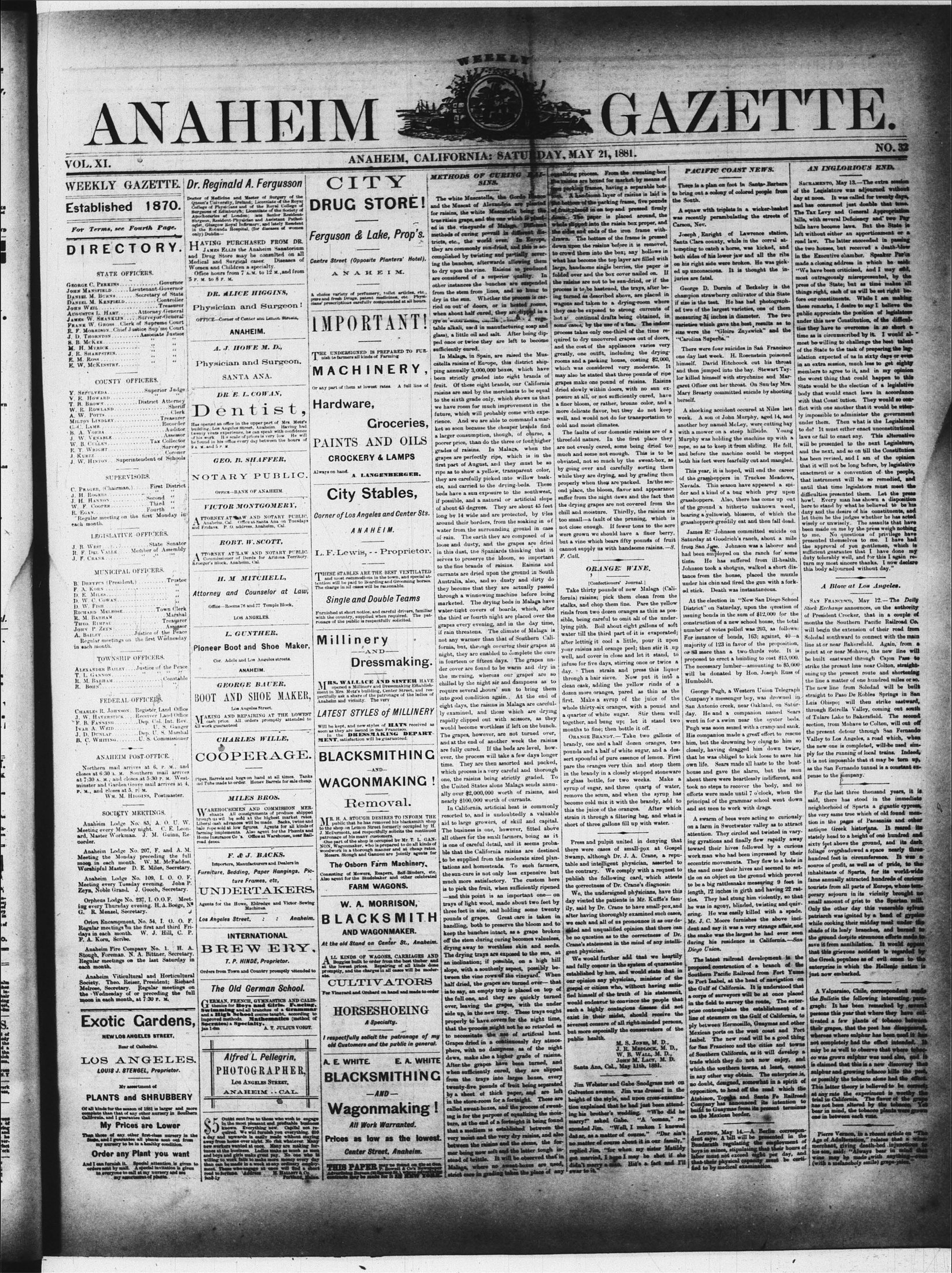
Searchable text
ANAHEIM
VOL. XI.
WEEKLY GAZETTE.
Established 1870.
For Terms, see Fourth Page.
DIRECTORY.
STATE OFFICERS.
GEORGE C. PERKINS ... Governor
JOHN MANNFIELD ... Lieutenant-Governor
DANIEL M. BURNS ... Secretary of State
DANIEL M. KENFIELD ... Controller
JOHN WEIL ... Treasurer
AUGUSTUS L. HART ... Attorney-General
JAMES W. SHANKLIN ... Surveyor-General
FRANK W. GROSS ... Clerk of Supreme Court
R. F. MORRISON ... Chief Justice Supreme Court
J. D. THORNTON ... Associate Justice
S. B. McKEE ... " "
M. H. MYRICK ... " "
J. R. SHARPATEIN ... " "
E. M. ROSS ... " "
E. W. McKINSTRY ... " "
COUNTY OFFICERS.
Y. SEPULVEDA ... Superior Judge
V. E. HOWARD ... " "
T. B. BROWN ... District Attorney
W. R. ROWLAND ... Sheriff
A. W. POTTS ... Clerk
MILTON LINDLEY ... Treasurer
C.C. LAMB ... Recorder
B. A. YORKA ... Auditor
J. W. VENABLE ... Assessor
W. B. COLLEN ... Tax Collector
E.T.WRIGHT ... Surveyor
J.KURTZ ... Coroner
J.W.HINTON ... Superintendent of Schools
Dr. Reginald A. Fergusson
Doctor of Medicine and Master of Surgery of the Queen's University, Ireland; Licentiate of the Royal College of Physicians and of the Royal College of Surgeons of Edinburgh; Licentiate of the Society of Apothecaries of London; late Senior Resident-Surgon, Resident-Physician and Assistant Pathologist, Glasgow Royal Infirmary, and lately Resident in the Rotunda Hospital (for diseases of women only) Dublin—
HAVING PURCHASED FROM DR.JAMES ELLIS the Anaheim Sanatorium and Drug Store may be consulted on all Medical and Surgical cases. Diseases of Women and Children a specialty.
Office hours from 7 a.m. to 12 m., and from 5 p.m. to 8 p.m.
DR. ALICE HIGGINS,
Physician and Surgeon!
OFFICE—Corner of Center and Leaton Streets,
ANAHEIM.
A.J.HOWE M.D.
Physician and Surgeon,
SANTA ANA.
DR.E.L.COWAN,
Dentist,
Has opened an office in the upper part of Mrs.Metr's building, Los Angeles Street, Anaheim. Having had twenty years experience, he can speak with confidence of his work. His scale of prices is very low. He will be found in his office every day between the hours of 9 a.m. and 5 p.m.
GEO.B.SHAFFER,
COUNTY OFFICERS.
Y. SEFULVEDA... Superior Judge
V. E. HOWARD ... ""
T. R. BROWN... District Attorney
W. R. ROWLAND... Sheriff
A. W. POTTS... Clerk
MILTON LINDLEY... Treasurer
C. C. LAMB... Recorder
B. A. YORRA... Auditor
J. W. VENABLE... Assessor
W. B. COLLEN... Tax Collector
E. T. WRIGHT... Surveyor
J. KURTZ... Coroner
J. W. HINTON... Superintendent of Schools
SUPERVISORS.
C. PRAGER, (Chairman) First District
J. H. ROGERS Second
J. H. HANNON Third
W. F. COOPER Fourth
R. EGAN Regular meeting on the first Monday in each month.
LEGISLATIVE OFFICERS.
J. B. WEST State Senator
R. F. DEL VALLE Member of Assembly
J. F. CRANK
MUNICIPAL OFFICERS.
B. DREYFCUS (President) Trustee
F. A. KORN ...
D. E. MILES ...
D. W. C. COWAN ...
D. W. FISH
RICHARD MELROSE Town Clerk
R. M. BARHAM Marshal
THEO. RIMPAU Treasurer
JOHN P. ZEYN Assessor
A. BAILEY Justice of the Peace
Regular meetings on the first Wednesday in each month.
TOWNSHIP OFFICERS.
ALEXANDER BAILEY Justice of the Peace
T. L. GANNON Constable
R. M. BARHAM Constable
R. BOHN ...
FEDERAL OFFICERS.
CHARLES R. JOHNSON Register Land Office
J. W. HAYVERSTICK Receiver Land Office
F. B. FANNING Dep. Col Int Rev.
IVAR A. WEID U.S.Ganger
J. D. DUNLAP Dep.U.S.Marshal
B.C.WHITING U.S.Commissioner
ANAHEIM POST-OFFICE.
Northern mail arrives at 6, P.M., and closes at 6:30 A.M.; Southern mail arrives at 7:30 A.M., and closes at 5:30 P.M.; Westminster and Garden Grove mail arrives at 4, P.M., and closes at 5, P.M.
WM.M.HIGGINS Postmaster.
SOCIETY MEETINGS.
Anaheim Lodge No. 85, A.O.U.W Meeting every Monday night.
C.E Leonard, Master Workman.J.M.Guinn.Recorder.
Anaheim Lodge No. 207,F and A.M.Meeting the Monday preceding the full moon in each month.W.M.Meafalden, Worshipful Master.D.E.Miles, Secretary.
Anaheim Lodge No. 109,L.O.O.F.Meeting every Tuesday evening.John P.Zeyn,Noble Grand.J.Gooch,Secretary.
SANTA ANA.
DR.E.L.COWAN,
Dentist,
Has opened an office in the upper part of Mrs.Metr's building,Los Angeles Street,Anaheim.Having had twenty years experience,he can speak with confidence of his work.His scale of prices is very low He will be found in his office every day between the hours of 9.A.M and 5.P.M.
GEO.B.SHAFFER,
NOTARY PUBLIC.
OFFICE—BANK OF ANAHEIM.
VICTOR MONTGOMERY,
ATTORNEY AT LAW AND NOTARY PUBLIC,
Anaheim,Cal Office at Santa Ana on Tuesdays and Fridays.P.O.address,Anaheim,Cal.
ROBT.W.SCOTT,
ATTORNEY AT LAW AND NOTARY PUBLIC.
Commissioner of Deeds for Arizona Territory.Kroeger's Block,Anaheim,Cal.
H.MMITCHELL,
Attorney and Counselor at Law,
Office—Rooms 76 and 77 Temple Block,
LOS ANGELES.
L.GUNTHER,
Pioneer Boot and Shoe Maker,
Cor.Adele and Los Angeles streets.
ANAHEIM.
GEORGE BAUER,
BOOT AND SHOE MAKER,
Los Angeles Street.
MAKING AND REPAIRING AT THE LOWEST cash price.All orders promptly attended to All work guaranteed.
CHARLES WILLE,
COOPERAGE.
Pipes, Barrels and kegs on hand at all times.Tanks and Tubs made to order.Honev Barrels for sale cheap.
MILES BROS.
WAREHOUSEMEN AND COMMISSION MERCHANTS.All consignments of produce shipped through us will be sold at the highest market rates.Liberal cash advances will be made.Sacks,twine and bale rope sold at low figures.Agents for all kinds of farming implements.Also agent for the Phoenix and Home Insurance Co.'s Office at Warehouse,near Railroad deno.
F.E & J.BACKS.
Importers,Manufacturers and Dealers in Furniture,Bedding,Paper Hangings,Picture Frames,etc,
UNDERTAKERS,
SOCIETY MEETINGS.
Anaheim Lodge No. 85, A. O. U. W.
Meeting every Monday night. C. E. Leonard, Master Workman. J. M. Guinn, Recorder.
Anaheim Lodge No. 207, F. and A. M.
Meeting the Monday preceding the full mooop in each month. W. M. McFadden, Worshipful Master D. E. Miles, Secretary.
Anaheim Lodge No. 109, I. O. O. F.
Meeting every Tuesday evening. John P. Zeyn, Noble Grand. J. Gooch, Secretary.
Orpheus Lodge No. 237, I. O.O.F. Meeting every Thursday evening. H. A. Boege, N.G. R. Menzel, Secretary.
Orion Encampment, No. 54, I. O. O. F. Regular meetings on the first and third Fridays in each month. W. J. Hill, C. P. P. A. Korn, Scribe.
Anaheim Fire Company No. 1, H. A. Stough, Foreman. N. A. Bittner, Secretary. Regular meetings on the last Saturday in each month.
Anaheim Viticultural and Horticultural Society. Theo Reiser, President; Richard Melrose, Secretary. Regular meetings on the Wednesday of or preceding the full moon in each month, at 7:30 p.m.
Exotic Gardens,
NEW LOS ANGELES STREET,
Rear of Cathedral.
LOS ANGELES.
LOUIS J. STENGEL, Proprietor.
My assortment of PLANTS and SHRUBBERY
Of all kinds for the season of 1861 is larger and more complete than that of any other nursery in Southern California, and I guarantee that My Prices are Lower
Than those of any other first-class nursery in the State, and I guarantee all plants sent out from my nursery to be in a healthy condition.
Order any Plant you want
And I can furnish it. Special attention is given to orders sent by mail. A special invitation is given to everyone to call at my nursery and see my arrangement of plants.
WAREHOUSEMEN AND COMMISSION MERCHANTS
All consignments of produce shipped through us will be sold at the highest market rates.
Liberal cash advances will be made.
Sacks, twine and bale rope sold at low figures.
Agents for all kinds of farming implements.
Also agent for the Phoenix and Home Insurance Co.'s Office at Warehouse, near Railroad demos.
F & J. BACKS.
Importers, Manufacturers and Dealers in Furniture, Bedding, Paper Hangings, Picture Frames, etc,
UNDERTAKERS,
Agents for the Howe, Eldredge and Victor Sewing Machines.
Los Angeles Street, : Anaheim.
INTERNATIONAL BREWERY.
T. P. HINDE, Proprietor.
Orders from Town and Country promptly attended to
The Old German School.
GERMAN, FRENCH, GYMNASTICS AND CALISHTONES for Boys and Girls. Fencing, Swimming and all branches of a Grammar and a High School course taught, according to improved methods. Mathematics (method of Secrutes) a Specialty.
A.T.JULIUS VOIGT.
Alfred L. Pellegrin,
PHOTOGRAPHER,
LOS ANGELES STREET,
ANAHEIM..CAL.
$5 Outht sent free to those who wish to engage in the most pleasant and profitable business known Everything new. Capital not required. We will furnish you everything $10 a day and upwards is easily made without staying away from home over night. No risk whatever.Many new workers wanted at once.Many are making fortunes at the business.Ladies make as much as men and boys and girls make great pay.No one who is willing to work fails to make more money every day than can be made in a week as any ordinary employment.These who engage at once will find a short road to fortune.Address H.HALLERY & Co.Portland,Maine
WEEKLY
EIM GA
ANAHEIM, CALIFORNIA: SATURDAY, MAY 21, 1881.
CITY DRUG STORE!
Ferguson & Lake, Prop's.
Centre Street (Opposite Planters' Hotel).
ANAHEIM.
IMPORTANT!
THE UNDERSIGNED IS PREPARED TO FURNISH TO farmers all kinds of Farming
MACHINERY,
Or any part of them at lowest rates. A full line of
Hardware,
Groceries,
PAINTS AND OILS
CROCKERY & LAMPS
METHODS OF CURING RAISINS.
The white Muscatella, the Gordo Blanco and the Muscat of Alexandria are planted for raisins, the white Muscatella being the true raisin grape, and the one which is planted in the vineyards of Malaga. Different methods of curing prevail in different districts, etc., the world over. In Europe, they are commonly sun-dried, and this is accomplished by twisting and partially severing the bunches, afterwards allowing them to dry upon the vine. Raisins so produced are considered of a superior quality. In other instances the bunches are suspended from the stem from lines, and no hung to dry in the sun. Whether the process is carried on out of doors, or in heated rooms, when about half cured, they are dipped in a rye or wood shavings, canola oil, vegetable alkali, used in manufacturing soap and glass), a little oil and salt. After being dipped once or twice they are left to become sufficiently cured.
In Malaga, in Spain, are raised the Muscatella raisins of Europe, this district shipping annually 3,000,000 boxes, which have been strictly graded into eight brands of fruit. Of these eight brands, our California raisins are said by the merchants to be equal to the sixth grade only, which shows us that we have room for much improvement in the future, which will probably come with experience. And we are able to command a market so soon because the cheaper brands find a larger consumption, though, of course, a poorer price, than do the three or four higher grades of raisins. In Malaga, when the grapes are perfectly ripe, which is in the first part of August, and they must be so ripe as to show a yellow, transparent color, equalizing process. From the sweating-box the raisins are boxed for market by means of fine packing frames, having a separable bottom. A handsome layer of raisins is laid in the bottom of the packing frame, five pounds of fruit placed in on top and pressed firmly down. The paper is placed around, the whole slipped into the raisin box proper, and the sides and ends of the iron frame withdrawn. The bottom of the frame is pressed down upon the raisins before it is removed, to crowd them into the box; any hollows in what has become the top layer are filled with large, handsome single berries, the paper is folded over and the box cover nailed on. If the raisins are not to be sun-dried, or if the process is to be hastened, the trays, after being turned as described above, are placed in wagons and taken to a drying-room where they can be exposed to strong currents of hot air; continual drafts being obtained, in some cases, by the use of a fan. The indoor process takes only one-third of the time required to dry uncovered grapes out of doors, and the cost of the appliances varies very greatly, one outfit, including the drying-rooms and a packing house, costing $2,000, which was considered very moderate. It may also be stated that three pounds of ripe grapes make one pound of raisins. Raisins dried slowly within doors, with no sun exposure at all, or not sufficiently cured, have a finer bloom, or rather, bronze color, and a more delicate flavor, but they do not keep well, and would not do for transportation to cold and moist climates.
The faults of our domestic raisins are of a threefold nature. In the first place they are not evenly cured, some being dried too much and some not enough. This is to be obviated, not so much by the sweat-box, as by going over and carefully sorting them while they are dripping and by grading them.
Hardware,
Groceries,
PAINTS AND OILS
CROCKERY & LAMPS
Always on hand.
A LANGENBERGER.
City Stables,
Corner of Los Angeles and Center Sts.
ANAHEIM.
L.F.Lewis, - Proprietor.
THESE STABLES ARE THE BEST VENTILATED
and most commodious in the town, and special attention will be paid to Boarding and Grooming horses.
The charge in all cases will be reasonable.
Single and Double Teams
Furnished at short notice, and careful drivers, familiar with the country, supplied when required. The patronage of the public is respectfully solicited.
Millinery
AND
Dressmaking.
MRS. WALLACE AND SISTER HAVE opened a Millinery and Dressmaking Establishment in Mrs. Metz's building, Center Street, and respectfully ask a share of the patronage of the ladies of Anaheim and vicinity. The very LATEST STYLES OF MILLINERY
Will be kept, and new styles of HATS received as soon as they are issued in San Francisco.
In the DRESSMAKING DEPARTMENT, satisfaction will be guaranteed.
BLACKSMITHING
AND
WACONMAKING!
Removal.
MR. H.A. STOUGH DESIRES TO INFORM THE public that he has removed his blacksmith shop to the shop on Lemon Street formerly occupied by H.J. McDermott, and respectfully solicits the continued patronage of his many customers.
One part of the shop is occupied by Mr. T. L. GAN-NON, Wagonmaker, who is prepared to do all kinds of woodwork in a thorough manner and at cheap rates. Messra Stough and Gannon are jointly agents for The Osborn Farm Machinery.
Consisting of Mowers, Reapers, Self-Binders, etc.
Also agent for the Studebaker and other celebrated FARM WAGONS.
been strictly graded into eight brands of fruit. Of these eight brands, our California raisins are said by the merchants to be equal to the sixth grade only, which shows us that we have room for much improvement in the future, which will probably come with experience. And we are able to command a market so soon because the cheaper brands find a larger consumption, though, of course, a poorer price, than do the three or four higher grades of raisins. In Malaga, when the grapes are perfectly ripe, which is in the first part of August, and they must be so ripe as to show a yellow, transparent color, they are carefully picked into willow baskets, and carried to the drying-beds. These beds have a sun exposure to the southwest, if possible, and a natural or artificial slope of about 45 degrees. They are about 45 feet long by 14 wide and are protected, by tiles around their borders, from the soaking in of water from the surrounding ground in case of rain. The earth they are composed of is loose and dusty, and the grapes are dried in this dust, the Spaniards thinking that it serves to preserve the bloom, so important to the fine brands of raisins. Raisins and currants are dried upon the ground in South Australia, also, and so dusty and dirty do they become that they are actually passed through a winnowing machine before being marketed. The drying beds in Malaga have water-tight covers of boards, which, after the third or fourth night are placed over the grapes every evening, and in the day time, if rain threatens. The climate of Malaga is not any warmer than that of Southern California, but, through covering their grapes at night, they are enabled to complete the care in fourteen or fifteen days. The grapes under cover are found to be warm and dry in the morning, whereas our grapes are so chilled by the night air and dampness as to require several hours' sun to bring them into good condition again. At the end of eight days, the raisins in Malaga are carefully examined, and those which are drying rapidly clipped out with scissors, as they would become worthless if left on the bunch. The grapes, however, are not turned over, and at the end of another week the raisins are fully cured. If the beds are level, however, the process will take a few days longer time. They are then assorted and packed, which process is a very careful and thorough one, the raisins being strictly graded. To the United States alone Malaga sends annually over $2,000,000 worth of raisins, and nearly $100,000 worth of currants.
In California, artificial heat is commonly resorted to, and is undoubtedly a valuable aid to large growers, of skill and capital. The business is one, however, fitted above all others for the small farmers, being as it is one of careful detail, and it seems probable that the California raisins are destined to be supplied from the moderate sized plantations and homesteads. To such farmers, the sun-cure is not only less expensive but much more satisfactory. The custom here is to pick the fruit, when sufficiently ripened—and this point is an important one—on may also be stated that three pounds of raisins make one pound of raisins. Raisins dried slowly within doors, with no sun exposure at all, or not sufficiently cured, have a finer bloom, or rather, bronze color, and a more delicate flavor, but they do not keep well, and would not do for transportation to cold and moist climates.
The faults of our domestic raisins are of a threefold nature. In the first place they are not evenly cured, some being dried too much and some not enough. This is to be obviated, not so much by the sweat-box, as by going over and carefully sorting them while they are drying, and by grading them properly when they are packed. In the second place, the bloom, flavor and appearance suffer from the night dews and the fact that the drying grapes are not covered from the chill and moisture. Thirdly, the raisins are too small—a fault of the pruning, which is not close enough. If fewer tons to the acre were grown we should have a finer berry; but a vine which bears fifty pounds of fruit cannot supply us with handsome raisins.
ORANGE WINE.
[Confectioners' Journal.]
Take thirty pounds of new Malaga (California) raisins; pick them clean from the stalks, and chop them fine. Pare the yellow rinds from two dozen oranges as thin as possible, being careful to omit all of the underlying pith. Boil about eight gallons of water till the third part of it is evaporated after letting it cool a little; pour it your raisins and orange peel; then stir it well, and cover in close and let it stand; infuse for five days, stirring once or twice a day. Then strain and press this liquid through a hair sieve. Now put it into clean cask, adding the yellow rinds of two dozen more oranges, pared as thin as first. Make a syrup of the juice of the whole thirty-six oranges, with a pound each a quarter of white sugar. Stir them together, and bung up; let it stand months to fine; then bottle it off.
ORANGE BRANDY.—Take two gallons brandy, one and a half dozen oranges, two pounds and a half of white sugar, and a half spoonful of pure essence of lemon. Pike pare the oranges very thin and steep thru in the brandy in a closely stopped stonewash or glass bottle; for two weeks. Make syrup of sugar, and three quarts of water remove the scum, and when the syrup becomes cold mix it with the brandy; add this the juice of the oranges. After whisk strain it through a filtering bag,and what short of three gallons fill up with water.
Press and pulpit united in denying there were cases of small-pox at Goose Swamp although Dr.J.A.Crane,a retable and intelligent physician,sassertedthe contrary. We comply with a request publishthe following cardwhich atthe correctnessofDr.Crane's diagnosis:
We,the undersigned physicians,have
Removal.
MR. H. A. STOUGH DESIRES TO INFORM THE public that he has removed his blacksmith shop to the shop on Lemon Street formerly occupied by H. J. McDermott, and respectfully solicits the continued patronage of his many customers.
One part of the shop is occupied by Mr. T. L. GANON, Wagonmaker, who is prepared to do all kinds of woodwork in a thorough manner and at cheap rates. Messrs. Stough and Gannon are jointly agents for The Osborn Farm Machinery.
Connesting of Mowers, Reapers, Self-Binders, etc. Also agent for the Studebaker and other celebrated FARM WAGONS.
W. A. MORRISON,
BLACKSMITH
AND WAGONMAKER.
At the old Stand on Center St., Anaheim.
ALL KINDS OF WAGONS, CARRIAGES AND BUGGIES built to order from the best timber and at the lowest prices. Repairing of all kinds done promptly, and the charges in all cases will be moderate.
CULTIVATORS
For Vineyard and Orchard on hand and made to order
HORSESHOEING
A Specialty.
I respectfully solicit the patronage of my old Customers and the public in general.
A.E.WHITE E.A.WHITE
BLACKSMITHING
—AND—
Wagonmaking!
All Work Warranted.
Prices as low as the lowest.
Center Street, Anaheim.
THIS PAPER may not be found on the at Gen. P. Bowell & Co.'s Newspaper contracts may be made for it in NEW YORK.
In California, artificial heat is commonly resorted to, and is undoubtedly a valuable aid to large growers, of skill and capital. The business is one, however, fitted above all others for the small farmers, being as it is one of careful detail, and it seems probable that the California raisins are destined to be supplied from the moderate sized plantations and homesteads. To such farmers, the sun-cure is not only less expensive but much more satisfactory. The custom here is to pick the fruit, when sufficiently ripened—and this point is an important one—on trays of light wood, made about two feet by three feet in size, and holding some twenty pounds of grapes. Great care is taken in handling, both to preserve the bloom and to keep the bunches intact, as a grape broken off the stem during curing becomes valueless, drying away to worthless skin and seeds. The drying trays are exposed to the sun, at an inclination; if possible, on a high hill slope, with a southerly aspect, possibly between the vine rows of the vineyard. When half dried, the grapes are turned over—that is to say, an empty tray is placed on top of the full one, and they are quickly turned over, leaving the grapes, with the under side up, in the new tray. These trays ought properly to have covers for the night time, that the process might not be so retarded as to necessitate the use of artificial heat. Grapes dried in a continuously dry atmosphere, with no dampness as of the night dews, make also a higher grade of raisins. After the grapes have been turned, and when sufficiently cured, they are slipped from the trays into large boxes, every twenty-five pounds of fruit being separated by a sheet of thick paper, and are left in the store-room for a fortnight. These are called sweat-boxes, and the process of sweating is for the purpose of equalizing the moisture, at the end of a fortnight it being found that a medium is established between the very moist and the very dry raisins, and also between the raisins and the stems, the former being now soft and the latter tough instead of brittle. It will be observed that in Malaga, where no sweat-boxes are used, strict care in grading takes the place of any become cold mix it with the brandy, adding this the juice of the oranges. After which strain it through a filtering bag, and what short of three gallons fill up with water.
Press and pulpit united in denying there were cases of small-pox at Goe Swamp, although Dr. J. A. Crane, a revered table and intelligent physician, asserted the contrary. We comply with a request to publish the following card, which attests the correctness of Dr. Crane's diagnosis:
We, the undersigned physicians, have day visited the patients in Mr. Kuffle's office, said by Dr. Crane to have small-pox after having thoroughly examined such cases we each and all of us pronounce it as our eided and unqualified opinion that there be no question as to the correctness of Crane's statement in the mind of any intelligent physician.
We would further add that we hear and fully concur in the system of quarantine established by him, and would state that our opinion any physician, minister of religion or citizen who, without having satisfied himself of the truth of his statement would endeavor to convince the people that such a highly contagious disease did exist in their midst, should receive severeest cure of all right-minded persons but more especially the conservators of public health.
M.S.Jones,M.D.
J.H.MEDLOCK,M.D.
W.B.WALL,M.D.
JOHN M.LACY,M.D.
Santa Ana,Cal.,May 11th,1881.
Jim Webster and Gabe Snodgrass met Galveston avenue. Jim was dressed in height of the style, and upon cross-examination explained that he had just been attending his brother's wedding. "Who did marry?" asked Gabe. "A 'ooman,' sponded Jim." "Well, I reckon I knew dat ar, as a matter of course." "Dar no matter of course about it in our family replied Jim," "for when my sister Ma got married, I hope I may be shot if didn't marry a man. Hit's a fact and swear to it."
GAZETTE.
21, 1881.
PACIFIC COAST NEWS.
There is a plan on foot in Santa Barbara to bring out a colony of colored people from the South.
A squaw with triplets in a wicker-basket was recently perambulating the streets of Carson, Nev.
Joseph Enright of Lawrence station, Santa Clara county, while in the corral attempting to catch a horse, was kicked, and both sides of his lower jaw and all the ribs on his right side were broken. He was picked up unconscious. It is thought the injuries are fatal.
George D. Dornin of Berkeley is the champion strawberry cultivator of this State if size is the test. He has had photographed two of the largest varieties, one of them measuring 34 inches in diameter. The two varieties which gave the best results as to size were the "Gloire Zuyswick" and the "Carolina Superba."
There were four suicides in San Francisco one day last week. H. Rosenstein poisoned himself. David Hitchcock cut his throat and then jumped into the bay. Stewart Taylor killed himself with strychnine and Margaret Offner cut her throat. On Sun-lay Mrs. Mary Brearty committed suicide by shooting herself.
A shocking accident occurred at Niles last week. A son of John Murphy, aged 14, and another boy named McLey, were cutting hay with a mower on a steep hillside. Young Murphy was holding the machine up with a rope, so as to keep it from sliding. He fell, and before the machine could be stopped both his feet were fearfully cut and mangled.
This year, it is hoped, will end the career
AN INGLORIOUS END.
Sacramento, May 13.—The extra session of the Legislature was adjourned without day at noon. It was called for twenty days, and has consumed just double that time. The Tax Levy and General Appropriation bills, with several Deficiency and two Pay bills have become laws. But the State is left without either an apportionment or a road law. The latter succeeded in passing the two houses, but received a death-blow in the Executive chamber. Speaker Parsons made a closing address in which he said: "We have been criticised, and I may add, most outrageously misrepresented, by the press of the State; but as time makes all things right, each of us will be set right before our constituents. While I am making these remarks, I desire to say I believe the public appreciate the position of legislators under this new Constitution, of the difficulties they have to overcome in so short a time as is circumscribed by it. I would almost be willing to challenge the best talent of the State to the task of preparing the legislation expected of us in sixty days or even in an extra session, much less to get eighty members to agree to it, and in my opinion the worst thing that could happen to this State would be the election of a legislative body that would enact laws in accordance with that Constitution. They would so conflict with one another that it would be utterly impossible to administer the government under them. Then what is the Legislature to do? It must either enact unconstitutional laws or fail to enact any. This alternative will be presented to the next Legislature, and the next, and so on till the Constitution has been revised, and I am of the opinion that it will not be long before, by legislative enactment or a convention of the people."
our domestic raisins are of a size. In the first place they secured, some being dried too not enough. This is to be so much by the sweat-box, as and carefully sorting them drying, and by grading them they are packed. In the second bloom, flavor and appearance night dews and the fact thatipes are not covered from the surface. Thirdly, the raisins are built of the pruning, which is tough. If fewer tons to the acre we should have a finer berry, such bears fifty pounds of fruit with handsome raisins.
ORANGE WINE.
Ffectioners' Journal.] The pounds of new Malaga (California); pick them clean from the hop stem fine. Pare the yellow two dozen oranges as thin as possible to omit all of the under-soil about eight gallons of soft third part of it is evaporated; at cool a little, pour it upon orange peel; then stir it up in close and let it stand, to days, stirring once or twice a strain and press this liquor sir sieve. Now put it into a holding the yellow rinds of oranges, pared as thin as the syrup of the juice of the six oranges, with a pound and white sugar. Stir them well in bung up; let it stand two times; then bottle it off.
BRANDY.—Take two gallons of sand a half dozen oranges, two half a half of white sugar, and a desiccate pure essence of lemon. First auges very thin and steep them in a closely stopped stoneware turtle, for two weeks. Make a jar, and three quartes of water, discum, and when the syrup has mix it with the brandy, add to one of the oranges. After which through a filtering bag, and what is the gallons fill up with water.
Pulpit united in denying that cases of small-pox at Gospelough Dr. J. A. Crane, a reputed intelligent physician, asserted to be. We comply with a request to following card, which attests success of Dr. Crane's diagnosis: undersigned physicians, have this patient in Mr. Kniffe's family killed himself with strychnine and Margaret Offner cut her throat. On Sunday Mrs. Mary Brearty committed suicide by shooting herself.
A shocking accident occurred at Niles last week. A son of John Murphy, aged 14, and another boy named McLey, were cutting hay with a mower on a steep hillside. Young Murphy was holding the machine up with a rope, so as to keep it from sliding. He fell, and before the machine could be stopped both his feet were fearfully cut and mangled.
This year, it is hoped, will end the career of the grasshoppers in Truckee Meadows, Nevada. This season have appeared a spider and a kind of a bug which prey upon grasshoppers. Also, there has come up out of the ground a hitherto unknown weed, bearing a yellowish blossom, of which the grasshoppers greedily eat and then fall dead.
James E. Johnson committed suicide on Saturday at Goodrich's ranch, about a mile from San Jose. Johnson was a laborer and had been employed on the ranch for some time. He has suffered from ill-health. Johnson took a shotgun, walked a short distance from the house, placed the muzzle under his chin and fired the gun with a fork stick. Death was instantaneous.
At the election in "New San Diego School District" on Saturday, upon the question of issuing bonds in the sum of $12,000 for the construction of a new school house, the total number of votes polled was 203, as follows: For issuance of bonds, 163; against, 40—a majority of 123 in favor of the proposition, or 83 more than a two-thirds vote. It is proposed to erect a building to cost $15,000. The necessary lumber—amounting to $5,000 will be donated by Hon. Joseph Russ of Humboldt.
George Pugh, a Western Union Telegraph Company's messenger boy, was drowned in San Antonio creek, near Oakland, on Saturday. He and a companion named Sears went in for a swim near the oyster beds. Pugh was soon seized with a cramp and sank. His companion made a great effort to rescue him, but the drowning boy clung to him so closely, having dragged him down twice, that he was obliged to kick loose to save his own life. Sears made all haste to the boathouse and gave the alarm, but the men about there were heartlessly indifferent, and took no steps to recover the body, and no efforts were made until 7 o'clock, when the principal of the grammar school went down and set men to work with drags.
A swarm of bees were acting so curiously on a farm in Sweetwater valley as to attract attention. They circled and twisted in varying gyrations and finally flew rapidly away toward their hives followed by a curious work man who had been impressed by their eccentric movements. They flew to a hole in the sand near their hives and seemed to settle on an object on the ground which proved to be a big rattlesnake measuring 9 feet in length, 12 inches in girth and having 22 rattles. They had stung him violently, so that worst thing that could happen to this State would be the election of a legislative body that would enact laws in accordance with that Constitution. They would so conflict with one another that it would be utterly impossible to administer the government under them. Then what is the Legislature to do? It must either enact unconstitutional laws or fail to enact any. This alternative will be presented to the next Legislature, and the next, and so on till the Constitution has been revised, and I am of the opinion that it will not be long before, by legislative enactment or a convention of the people, that instrument will be so remedied, and until that time legislators must meet the difficulties presented them. Let the press howl. Every man has shown a disposition here to stand by what he believed to be his duty and the desire of his constituents, and let them be the judges whether he has acted wisely or unwisely. The assaults that have been made on me by the press weigh nothing to me. No questions of privilege have presented themselves to me. I have had the approval of you gentlemen, which is sufficient guarantee that I have done my duty tolerably well, and for this I again return my most sincere thanks. I now declare this body adjourned without day."
A Blow at Los Angeles.
SAN FRANCISCO, May 12.-The Daily Stock Exchange announces, on the authority of President Crocker, that in a couple of months the Southern Pacific Railroad Co. will begin the extension of their road from Soledad southward to connect with the main line at or near Bakersfield. Again, from a point at or near Mohave, the new line will be built eastward through Cajon Pass to strike the present line near Colton, straightening up the present route and shortening the line a matter of one hundred miles or so. The new line from Soledad will be built straight to Paso De Robles Springs in San Luis Obispo; will then strike eastward through Estrella Valley, coming out south of Tulare Lake to Bakersfield. The second section, from Mohave to Colton, will cut off the present detour through San Fernando Valley to Los Angeles, a road which, when the new one is completed, will be used simply for the running of local trains. Indeed, it is not impossible that it may be torn up, as the San Fernando tunnel is a constant expense to the company.
For the last three thousand years, it is said, there has stood in the immediate neighborhood of Sparta a gigantic cypress, the very same tree which of old found mention in the pages of Pananias and other antique Greek historians. It reared its stately head to a height of one hundred and sixty feet above the ground, and its dark foliage over shadowed a space nearly three hundred feet in circumference. It was a source of profit, as well as of pride, to the inhabitants of Sparta, for its world-wide fame annually attracted hundreds of curious tourists from all parts of Europe, whose temporary sojourn in its vicinity brought no
A pulpit united in denying that cases of small-pox at Gospel through Dr. J. A. Crane, a reputed intelligent physician, asserted to it. We comply with a request to follow the card, which attests success of Dr. Crane's diagnosis: undersigned physicians, have this the patients in Mr. Kuffle's family. Dr. Crane to have small-pox, and thoroughly examined such cases, all of us pronounce it as our demeanourified opinion that there can be no reason as to the correctness of Dr. Crane's treatment in the mind of any intelligenian.
I further add that we heartily encurr in the system of quarantine by him, and would state that in any physician, minister of the citizen who, without having satis-fice of the truth of his statement, flavor to convince the people that only contagious disease did not their midst, should receive the measure of all right-minded persons, especially the conservators of the earth.
M. S. Jones, M. D., J. R. Medlock, M. D., W. B. Wall, M. D., John M. Lacy, M. D., Cal., May 11th, 1881.
Foster and Gabe Snodgrass met on avenue. Jim was dressed in the same style, and upon cross-examina-ment that he had just been attend-der's wedding. "Who did he sked Gabe." "A 'ooman,' rea-m. "Well, I reekon I knowed a matter of course." "Dar ain't of course about it in our family," said, "for when my sister Matildy died, I hope I may be shot if she cry a man. Hit's a fact and I'll
A swarm of bees were acting so curiously on a farm in Sweetwater valley as to attract attention. They circled and twisted in varying gyrations and finally flew rapidly away toward their hives followed by a curious workman who had been impressed by their eccentric movements. They flew to a hole in the sand near their hives and seemed to settle on an object on the ground which proved to be a big rattlesnake measuring 9 feet in length, 12 inches in girth and having 22 rattles. They had stung him violently, so that he was in agony, blinded, twisting and quivering. He was easily killed with a spade. Mr. J. C. Moore furnishes the above incident and say it was a very strange affair, and the snake was the largest he had ever seen during his residence in California.—San Diego Union.
The latest railroad development is the proposed construction of a branch of the Southern Pacific Railroad from Fort Yuma to Port Isabel, at the head of navigation on the Gulf of California. It is understood that a corps of surveyors will be at once placed in the field to survey the route. The enterprise contemplates the establishment of a line of steamers on the Gulf of California, to ply between Hermosillo, Guaymas and other Mexican ports on the west coast and Port Isabel. The new road will be a good thing for San Francisco and the cities and towns of Southern California, as it will develop a trade which they do not now enjoy, and which the southern towns, at least, cannot in any other way obtain. The enterprise is no doubt, designed, somewhat in a spirit of opposition, to head off the road which the Atchison, Topshaw and Santa Fe Railroad Company has announced its intention to build to Guaymas from its present terminus on the Mexican border.
London, May 14.—A Berlin correspondent says: A bill will be presented in the Bundsath regulating the employment of boys in mines, stipulating that their hours of labor must not exceed eight per day, and that their physical capacity must be certified to by medical examination.
A Valparaiso, Chile, correspondent sends the Bulletin the following interesting paragraph: It has been remarked by several persons this year that where they have cultivated a few plants of tobacco between their grapes, that the pest has disappeared, whereas where sulphur has been used it has not completely had the effect intended. It may be as well to observe that where tobacco was grown sulphur was used also, and it is claimed that this is a new discovery that sulphur and growing tobacco kills the pest, or possibly the tobacco alone had the effect. This latter theory is believed to be correct; at any rate the experiment is worthy the trial in California. The flavor of the grape has not been altered by the tobacco. Yet bear in mind, the tobacco plants were grown one in between each vine.
Pierre Vernon, in a recent article on "The Age of Adulteration," relates that a wine merchant, giving death-bed injunctions to his son, said: "Always bear in mind that wine may be made with anything—even (with a melancholy smile) grape-jute."