anaheim-gazette 1881-03-19
Scanned page
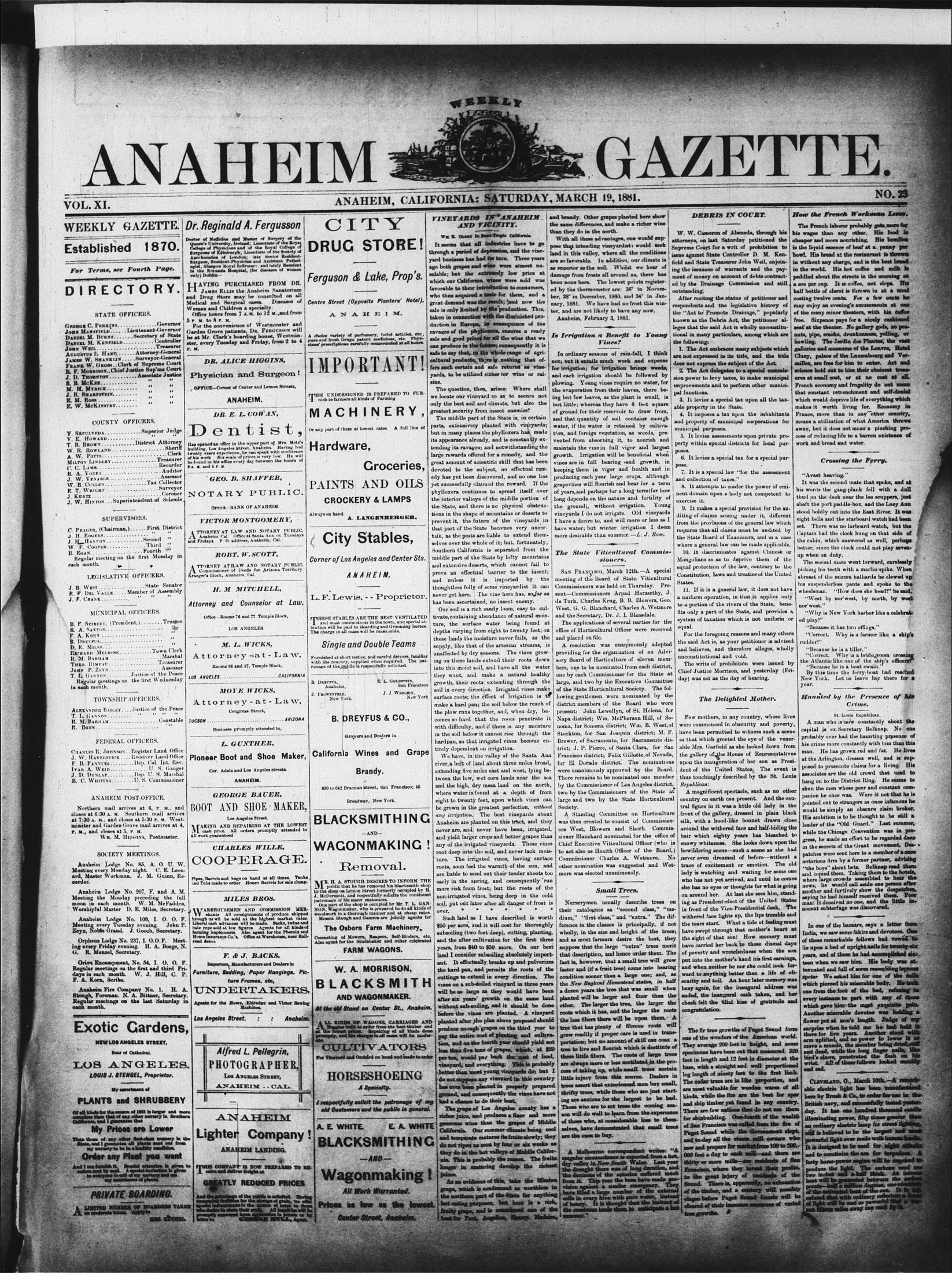
Searchable text
ANAHEIM
VOL. XI.
WEEKLY GAZETTE.
Established 1870.
For Terms, see Fourth Page.
DIRECTORY.
STATE OFFICERS.
GEORGE C. PERKINS.....Governor
JOHN MANSFIELD.....Lieutenant-Governor
DANIEL M. BURNS.....Secretary of State
DANIEL M. KENFIELD.....Controller
JOHN WEIL.....Treasurer
AUGUSTUS D. HART.....Attorney-General
JAMES W. SHANKLIN.....Surveyor-General
FRANK W. GROSS..Clerk of Supreme Court
R. F. MORRISON..Chief Justice Sup'ime Court
J. D. THORNTON.....Associate Justice
S. B. McKEE.....
M. H. MYRICK.....
J. R. SHARPSTEIN.....
E. M. ROSS.....
E. W. McKINSTRY.....
COUNTY OFFICERS.
Y. SEPULVEDA.....Superior Judge
V. E. HOWARD.....
T. B. BROWN.....District Attorney
W. R. ROWLAND.....Sheriff
A. W. POTTS....Clerk
MILTON LINDLEY.....Treasurer
C. C. LAMB....Recorder
B. A. YORRA....Auditor
Dr. Reginald A. Fergusson
Doctor of Medicine and Master of Surgery of the Queen's University, Ireland; Licentiate of the Royal College of Physicians and of the Royal College of Edinburgh; Licentiate of the Society of Apothecaries of London; late Senior Resident-Surggeon, Resident-Physician and Assistant Pathologist, Glasgow Royal Infirmary, and later Resident in the Rotunda Hospital, (for diseases of women only) Dublin.
HAVING PURCHASED FROM DR.
JAMES ELLIS the Anaheim Sanatorium and Drug Store may be consulted on all Medical and Surgical cases. Diseases of Women and Children a specialty.
Office hours from 7 A.M. to 12 M., and from 5 P.M. to 8 P.M.
For the convenience of Westminster and Garden Grove patients, Dr. Fergusson will be at Mr. Clark's boarding house, Westminster, every Tuesday and Friday, from 2 to 4 P.M.
DR. ALICE HIGGINS,
Physician and Surgeon!
OFFICE—Corner of Center and Lemon Streets,
ANAHEIM.
DR. E. L. COWAN,
Dentist,
Has opened an office in the upper part of Mrs. Metz's building, Los Angeles Street, Anaheim. Having had twenty years experience, he can speak with confidence of his work. His scale of prices is very low. He will be found in his office every day between the hours of 9 A.M. and 5 P.M.
COUNTY OFFICERS.
Y. SEPULVEDA..... Superior Judge
V. E. HOWARD..... ""
T. B. BROWN..... District Attorney
W. R. ROWLAND..... Sheriff
A. W. POTTS..... Clerk
MILTON LINDLEY..... Treasurer
C. C. LAMB..... Recorder
B. A. YORBA..... Auditor
J. W. VENABLE..... Assessor
W. B. CULLEN..... Tax Collector
E. T. WRIGHT..... Surveyor
J. KURTE..... Coroner
J. W. HINTON... Superintendent of Schools
SUPERVISORS.
C. PRAGER, (Chairman,).... First District
J. H. ROVERS..... ""
J. H. HANNON..... Second ""
W. F. COOPER..... Third ""
R. EGAN..... Fourth
Regular meeting on the first Monday in each month.
LEGISLATIVE OFFICERS.
J. B. WEST..... State Senator
R. F. DEL VALLE..... Member of Assembly
J. F. CRANK..... ""
MUNICIPAL OFFICERS.
B. F. SEIBERT, (President,).... Trussee
K. A. SAXTON..... ""
F. A. KORN..... ""
B. DREYFUS..... ""
D. E. MILES..... ""
Richard MELIOSE..... Town Clerk
R. M. BARHAM..... Marshal
THEO. RIMPAU..... Treasurer
John P. ZEYN..... Assessor
T. L. GANNON..... Justice of the Peace
Regular meetings on the first Wednesday in each month.
TOWNSHIP OFFICERS.
Alexander Bailey..... Justice of the Peace
T. L. GANNON..... ""
R. M. BARHAM..... Constable
R. BOHN..... ""
FEDERAL OFFICERS.
Charles R. Johnson.. Register Land Office
J. W. HAYERSTICK.. Receiver Land Office
F. B. FANNING..... Dep., Col., Int., Rev.
Ivar A. WEID..... U. S. Ganger
J. D. DUNLAP..... Dep., U.S. Marshal
B. C. WHITING..... U.S. Commissioner
ANAHEIM POST-OFFICE.
Northern mail arrives at 6, P.M., and closes at 6:30 A.M.
Southern mail arrives at 7:30 A.M., and closes at 5:30 P.M.
Westminster and Garden Grove mail arrives at 4, P.M., and closes at 5, P.M.
Wm. M. Higgins, Postmaster.
SOCIETY MEETINGS.
Anaheim Lodge No. 85, A.O.U.W.
Meeting every Monday night.
C.E Leonard, Master Workman.
J.M.Guinn, Recorder.
Anaheim Lodge No. 207, F.A.M.
Meeting the Monday preceding the full Physician and Surgeon OFFICE—Corner of Center and Lemon Streets,
ANAHEIM.
DR.E.L.COWAN,
Dentist,
Has opened an office in the upper part of Mrs Metra's building, Los Angeles Street, Anaheim Having had twenty years experience, he can speak with confidence of his work His scale of prices is very low He will be found in his office every day between the hours of 9 A.M and 5 P.M.
GEO.B.SHAFFER,
NOTARY PUBLIC.
Office—BANK OF ANAHEIM.
VICTOR MONTGOMERY,
ATTORNEY AT LAW AND NOTARY PUBLIC,
Anaheim, Cal Office at Santa Ana on Tuesday and Fridays P.O.address Anaheim, Cal.
ROBT.W.SCOTT,
ATTORNEY AT LAW AND NOTARY PUBLIC.
Commissioner of Deeds for Arizona Territory.
Kroeger's Block, Anaheim, Cal.
H.M MITCHELL,
Attorney and Counselor at Law,
Office—Rooms 76 and 77 Temple Block,
LOS ANGELES.
M.L.WICKS,
Attorney-at-Law,
Rooms 86 and 87, Temple Block,
LOS ANGELES.
MOYE WICKS,
Attorney-at-Law,
Congress Street,
TUCSON ARIZONA
Business promptly attended to.
L.GUNTHER,
Ploneer Boot and Shoe Maker,
Cor.Adele and Los Angeles streets.
GEORGE BAUER,
BOOT AND SHOE MAKER,
Los Angeles Street.
MAKING AND REPAIRING AT THE LOWEST cash price All orders promptly attended to All work guaranteed
CHARLES WILLE,
COOPERAGE.
Pipes, Barrels and kegs on hand at all times Tanks and Tubs made to order Honev Barrels for sale cheap.
MILES BRON
Northern mail arrives at 6, P. M., and closes at 6:30 A.M. Southern mail arrives at 7:30 A.M., and closes at 5:30 P.M. Westminster and Garden Grove mail arrives at 4, P. M., and closes at 5, P.M.
Wm. M. Higgins, Postmaster.
SOCIETY MEETINGS.
Anaheim Lodge No. 85, A. O. U. W. Meeting every Monday night. C. E. Leonard, Master Workman. J. M. Guinn, Recorder.
Anaheim Lodge No. 207, F. and A. M. Meeting the Monday preceding the full moon in each month. W. M. McFadden, Worshipful Master D. E. Miles, Secretary.
Anaheim Lodge No. 109, L. O. O. F. Meeting every Tuesday evening. John P. Zeyn, Noble Grand. J. Gooch, Secretary.
Orpheus Lodge No. 237, L. O.O.F. Meeting every Friday evening. H. A. Boege, N.G.R. Menzel, Secretary.
Orion Encampment, No. 54, L. O.O.F. Regular meetings on the first and third Fridays in each month. W. J. Hill, C.P.F.A. Korn, Scribe.
Anaheim Fire Company No. 1. H.A. Stough, Foreman. N.A.Bittner, Secretary. Regular meetings on the last Saturday in each month.
Exotic Gardens,
NEW LOS ANGELES STREET,
Rear of Cathedral.
LOS ANGELES.
LOUIS J. STENGEL, Proprietor.
My assortment of
PLANTS and SHRUBBERY
Of all kinds for the season of 1881 is larger and more complete than that of any other nursery in Southern California, and I guarantee that
My Prices are Lower
Than those of any other first-class nursery in the State, and I guarantee all plants sent out from my nursery to be in a healthy condition.
Order any Plant you want
And I can furnish it. Special attention is given to orders sent by mail. A special invitation is given to everyone to call at my nursery and see my assortment of plants.
PRIVATE BOARDING.
A LIMITED NUMBER OF BOARDERS TAKEN on moderate terms. Apply to
BOOT AND SHOE MAKER,
Los Angeles Street.
MAKING AND REPAIRING AT THE LOWEST cash price. All orders promptly attended to All work guaranteed.
CHARLES WILLE,
COOPERAGE.
Pipes, Barrels and kegs on hand at all times. Tanks and Tubs made to order. Honey Barrels for sale cheap.
MILES BROS.
WAREHOUSEMEN AND COMMISSION MERCHANTS
All consignments of produce shipped through us will be sold at the highest market rates.
Liberal cash advances will be made.
Sacks, twine and bale rope sold at low figures.
Agents for all kinds of farming implements.
Also agent for the Phoenix and Home Insurance Co.'s Office at Warehouse, near Railroad denot.
F. & J. BACKS,
Importers, Manufacturers and Dealers in Furniture, Bedding, Paper Hangings, Picture Frames, etc,
UNDERTAKERS,
Agents for the Howe, Eldredge and Victor Sewing Machines.
Los Angeles Street.: Anaheim.
Alfred L. Pellegrin,
PHOTOGRAPHER,
LOS ANGELES STREET,
ANAHEIM..CAL.
ANAHEIM
Lighter Company!
ANAHEIM LANDING.
THIS COMPANY IS NOW PREPARED TO REceive and deliver freight as GREATLY REDUCED PRICES
And the prices of the public is solicited. Having unguarded facilities for the storage of grain, we offer special indemnities in the matter of rakes to those who desire to store their grains. All insurances will be promptly answered upon application in person or by letter to GEORGE NULL, Agent.
WEEKLY
EIM GA
ANAHEIM, CALIFORNIA: SATURDAY, MARCH 19, 1881.
CITY DRUG STORE!
Ferguson & Lake, Prop's.
Centre Street (Opposite Planters' Hotel).
ANAHEIM.
A choice variety of perfumery, toilet articles, etc., pure and fresh Drugs, patent medicines, etc. Physicians' prescriptions carefully compounded at all hours.
IMPORTANT!
THE UNDERSIGNED IS PREPARED TO FURNISH to farmers all kinds of Farming
MACHINERY,
Or any part of them at lowest rates. A full line of Hardware, Groceries,
VINEYARDS IN ANAHEIM AND VICINITY.
Wm. R. Olden In Semi-Tropic California.
It seems that all industries have to go through a period of depression, and the vineyard business has had its turn. Three years ago both grapes and wine were almost unsalable; but the extremely low price at which our California wines were sold was favorable to their introduction to consumers, who thus acquired a taste for them, and a great demand was the result; and now the sale is only limited by the production. Thus, taken in connection with the diminished production in Europe, in consequence of the ravages of the phylloxera, ensures a ready sale and good prices for all the wine that we can produce in the future; consequently it is safe to say that, in the whole range of agricultural products, there is nothing that offers such certain and safe returns as vineyards, to be utilized either for wine or raisins.
The question, then, arises: Where shall we locate our vineyard so as to secure not only the best soil and climate, but also the greatest security from insect enemies?
The middle part of the State is, in certain parts, extensively planted with vineyards; but in many places the phylloxera has made its appearance already, and is constantly extending its ravages; and notwithstanding the large rewards offered for a remedy, and the great amount of scientific skill that has been devoted to the subject, no effectual remand brandy. Other grapes planted here show the same differences, and make a richer wine than they do in the north.
With all these advantages, one would suppose that intending vineyardists would seek land in this valley, where all the conditions are so favorable. In addition, our climate is as superior as the soil. Whilst we hear of damage from frosts all around us, there has been none here. The lowest points registered by the thermometer are: 36° in November, 38° in December, 1880, and 34° in January, 1881. We have had no frost this winter, and are not likely to have any now.
Anaheim, February 3, 1881.
Is Irrigation a Benefit to Young Vines?
In ordinary seasons of rain-fall, I think not; but it entails much work and expense for irrigation; for irrigation brings weeds, and each irrigation should be followed by plowing. Young vines require no water, for the evaporation from their leaves, there being but few leaves, as the plant is small, is but little; whereas they have 6 feet square of ground for their reservoir to draw from, and that quantity of soil contains enough water, if the water is retained by cultivation, and foreign vegetation, as weeds, prevented from absorbing it, to nourish and maintain the vine in full vigor and largest growth. Irrigation will be beneficial when vines are in full bearing and growth, in keeping them in vigor and health and in
MACHINERY,
Hardware,
Groceries,
PAINTS AND OILS
CROCKERY & LAMPS
Always on hand.
A. LANGENBERGER.
City Stables,
Corner of Los Angeles and Center Sts.
ANAHEIM.
L.F. Lewis, -- Proprietor.
THESE STABLES ARE THE BEST VENTILATED
and most commodious in the town, and special attention will be paid to Boarding and Grooming horses.
The charge in all cases will be reasonable.
Single and Double Teams
Furnished at short notice, and careful drivers, familiar with the country, supplied when required. The patronage of the public is respectfully solicited.
B. DREYFUS,
Anaheim,
J. FROWENFIELD,
New York.
B. DREYFUS & CO.,
Growers and Dealers in California Wines and Grape Brandy.
630 to 642 Brannan Street, San Francisco; 45 Broadway, New York.
BLACKSMITHING
AND
WAGONMAKING!
Removal.
MR. H. A. STOUGH DESIRES TO INFORM THE public that he has removed his blacksmith shop to the shop on Lemon Street formerly occupied by H. J. McDernott, and respectfully solicits the continued yards, to be utilized either for wine or raisins.
The question, then, arises: Where shall we locate our vineyard so as to secure not only the best soil and climate, but also the greatest security from insect enemies?
The middle part of the State is, in certain parts, extensively planted with vineyards; but in many places the phylloxera has made its appearance already, and is constantly extending its ravages; and notwithstanding the large rewards offered for a remedy, and the great amount of scientific skill that has been devoted to the subject, no effectual remedy has yet been discovered, and no one has yet successfully claimed the reward. If the phylloxera continues to spread itself over the interior valleys of the middle portion of the State, and there is no physical obstructions in the shape of mountains or deserts to prevent it, the future of the vineyards in that part of the State becomes very uncertain, as the pests are liable to extend themselves over the whole of it; but fortunately, Southern California is separated from the middle part of the State by lofty mountains and extensive deserts, which cannot fail to prove an effectual barrier to the insect; and unless it is imported by the thoughtless folly of some vineyardist it can never get here. The vine here has, so far as has been ascertained, no insect enemy.
Our soil is a rich sandy loam, easy to cultivate, containing abundance of natural moisture, the surface water being found at depths varying from eight to twenty feet; on these lands the moisture never fails, as the supply, like that of the artesian streams, is unaffected by dry seasons. The vines growing on these lands extend their roots down into this moist soil, and have all the water they want, and make a natural healthy growth, their roots extending through the soil in every direction. Irrigated vines make surface roots; the effect of irrigation is to make a hard pan; the soil below the reach of the plow runs together, and, when dry, becomes so hard that the roots penetrate it with difficulty, and if there is any moisture in the soil below it cannot rise through the hardpan, so that irrigated vines become entirely dependent on irrigation.
We have, in the valley of the Santa Ana river, a belt of land about three miles broad, extending five miles east and west, lying between the low, wet corn lands near the sea and the high, dry mesa land on the north, where water is found at a depth of from eight to twenty feet, upon which vines can be grown in the greatest perfection, without any irrigation. The best vineyards about Anaheim are planted on this tract, and they never are, and never have been, irrigated, and yield larger crops and better grapes than any of the irrigated vineyards. These vines root deep into the soil, and never lack moisture. The irrigated vines, having surface roots, soon feel the warmth of the sun, and are liable to send out their tender shoots too early in the spring, and consequently run more risk from frost; but the roots of the non-irrigated vines, being deep in the cold yards, to be utilized either for wine or raisins.
The question, then, arises: Where shall we locate our vineyard so as to secure not only the best soil and climate, but also the greatest security from insect enemies?
The middle part of the State is, in certain parts, extensively planted with vineyards; but in many places the phylloxera has made its appearance already, and is constantly extending its ravages; and notwithstanding the large rewards offered for a remedy, and the great amount of scientific skill that has been devoted to the subject, no effectual remedy has yet been discovered, and no one has yet successfully claimed the reward. If the phylloxera continues to spread itself over the interior valleys of the middle portion of the State, and there is no physical obstructions in the shape of mountains or deserts to prevent it, the future of the vineyards in that part of the State becomes very uncertain, as the pests are liable to extend themselves over the whole of it; but fortunately, Southern California is separated from the middle part of the State by lofty mountains and extensive deserts, which cannot fail to prove an effectual barrier to the insect; and unless it is imported by the thoughtless folly of some vineyardist it can never get here. The vine here has, so far as has been ascertained, no insect enemy.
Our soil is a rich sandy loam, easy to cultivate, containing abundance of natural moisture, the surface water being found at depths varying from eight to twenty feet; on these lands the moisture never fails, as the supply, like that of the artesian streams, is unaffected by dry seasons. The vines growing on these lands extend their roots down into this moist soil, and have all the water they want, and make a natural healthy growth, their roots extending through the soil in every direction. Irrigated vines make surface roots; the effect of irrigation is to make a hard pan; the soil below the reach of the plow runs together, and when dry, becomes so hard that the roots penetrate it with difficulty, and if there is any moisture in the soil below it cannot rise through the hardpan, so that irrigated vines become entirely dependent on irrigation.
We have, in the valley of the Santa Ana river,a belt of land about three miles broad, extending five miles east and west, lying between the low, wet corn lands near the sea and the high, dry mesa land on the north, where water is found at a depth of from eight to twenty feet upon which vines can be grown in the greatest perfection, without any irrigation. The best vineyards about Anaheim are planted on this tract,and they never are,and never have been,iirrigated,and yield larger cropsandbetter grapes than anyoftheirirrigatedvineyards.Thesevinesrootdeepinto,thesoil,andneverlackmoisture.Theirirrigatedvines,havingsurfaceroots,soonfeelthewarmthofthesun,andareliabletosendouttheirtendershootstoearlyinthespring,andconsequentlyrunmoreriskfromfrost;buttherootsofthenon-irrigatedvines,bearingdeinfineydisciplicthecontinued
The State Viticultural Commissioners.
SAN FRANCISCO,March 12th.-A special meeting oftheBoardofStateViticulturalCommissionerswasheldonThursday.Present—CommissionersArpaidHarazzy.J.deTurk,CherlesKrug,B.B.Blowers,Geo.West,G.G.Blanchard,CherlesA.WetmoreandtheSecretaryDr.J.I.Bleasdale.
The applicationsofseveralpartiesfortheofficeHorticulturalOfficerwerereceivedandplacedonfile.
A resolution was unanimously adopted providing fortheorganizationofanAdvisoryBoardofHorticultureofelevenmembers,一onetobe nominatedfromeachdistrict,一onebyeachCommissionerfortheStateatlarge,andtwobytheExecutiveCommitteeoftheStateHorticulturalSociety.ThefollowinggentlemenwerenominatedbythedistrictmembersoftheBoardwhowerepresent:JohnLewellyn.ofSt.Helena,forsnap district;Wm.McPherson Hill.ofSonoma,forsSonoma district;Wm.B.West.ofStockton,forsSanJoaquin district;M.F.Brewer.ofSacramento,forsacramento district;J.P.Pierce.ofSantaClara,forsSanFrancisco district;FelixGillette.ofNevada,forsEl Dorado district.ThenominationswereunanimouslyapprovedbytheBoardThereremainstobe nominatedonememberbytheCommissionerofLosAngelesdistrict,twobytheCommissionersoftheStateatlargeandtwobytheStateHorticulturalSociety.AStandingCommitteeonHorticulturewasthencreatedtoconsistofCommissionersWest,BlowersandShorb.CommisionerBlanchardnominatedfortheofficeChiefExecutiveViticulturalOfficer(whoiatoactalsoasHeathOfficeroftheBoard,CommissionerCharlesA.Wetmore.Noothernominationwas suggestedandWetmorewas electedunanimously.
BLACKSMITHING
AND
WAGONMAKING!
Removal.
MR. H. A. STOUGH DESIRES TO INFORM THE public that he has removed his blacksmith shop to the shop on Lemon Street formerly occupied by H. J. McDernott, and respectfully solicits the continued patronage of his many customers.
One part of the shop is occupied by Mr. T. L. GAN-NON, Wagonmaker, who is prepared to do all kinds of woodwork in a thorough manner and at cheap rates. Messrs. Stough and Gannon are jointly agents for The Osborn Farm Machinery.
Consisting of Mowers, Reapers, Self-Binders, etc. Also agent for the Studebaker and other celebrated FARM WAGONS.
W. A. MORRISON,
BLACKSMITH
AND WAGONMAKER.
At the old Stand on Center St., Anaheim.
ALL KINDS OF WAGONS, CARRIAGES AND BUGGLES built to order from the best timber and at the lowest price. Repairing of all kinds done promptly, and the charges in all cases will be moderate.
CULTIVATORS
For Vineyard and Orchard on hand and inade to order
HORSESHOEING
A Specialty.
I respectfully solicit the patronage of my old Customers and the public in general.
A. E. WHITE
E. A. WHITE
BLACKSMITHING
AND
Wagonmaking!
All Work Warranted.
Prices as low as the lowest.
Center Street, Anaheim.
The best vineyards about Anaheim are planted on this tract, and they never are, and never have been, irrigated, and yield larger crops and better grapes than any of the irrigated vineyards. These vines root deep into the soil, and never lack moisture. The irrigated vines, having surface roots, soon feel the warmth of the sun, and are liable to send out their tender shoots too early in the spring, and consequently run more risk from frost; but the roots of the non-irrigated vines, being deep in the cold soil, put out later after all danger of frost is over.
Such land as I have described is worth $50 per acre, and it will cost for thoroughly subsoiling (two feet deep), cutting, planting, and the after cultivation for the first three years, from $40 to $50 more. On our best land I consider subsoiling absolutely important. It effectually breaks up and pulverizes the hard-pan, and permits the roots of the cuttings to extend in every direction. The vines on a sub-soiled vineyard in three years will be as large as they would have been after six years' growth on the same land without sub-soiling, and it should be done before the vines are planted. A vineyard planted after the plan above proposed should produce enough grapes on the third year to pay the entire cost of planting and cultivation, and on the fourth year should yield not less than five tons of grapes, which, at $20 per ton, would pay back the cost of land, vineyard, and everything. This is probably better than most young vineyards do; but I do not suppose any vineyard in this country has ever been planted in properly prepared ground, and consequently the vines have not had a chance to do their best.
The grape of Los Angeles county has a richer juice, and produces a finer and more generous wine than the grapes of Middle California. Our summer climate being cool and temperate matures its fruits slowly; they do not ripen as soon by four or six weeks as they do in the hot valleys of Middle California. This is probably the reason. The fruits longer in maturing develop the richest juices.
As an evidence of this, take the Mission grape, which is condemned as worthless in the northern part of the State for anything but eating purposes, but here is a rich, fruity grape, and is considered one of the best for Peck, Angelica, Sherry. Madeira,
eight to twenty feet upon which vines can be grown in the greatest perfection, without any irrigation. The best vineyards about Anaheim are planted on this tract, and they never are, and never have been, irrigated, and yield larger crops and better grapes than any of the irrigated vineyards. These vines root deep into the soil, and never lack moisture. The irrigated vines, having surface roots, soon feel the warmth of the sun, and are liable to send out their tender shoots too early in the spring, and consequently run more risk from frost; but the roots of the non-irrigated vines, being deep in the cold soil, put out later after all danger of frost is over.
Such land as I have described is worth $50 per acre, and it will cost for thoroughly subsoiling (two feet deep), cutting, planting, and the after cultivation for the first three years, from $40 to $50 more. On our best land I consider subsoiling absolutely important. It effectually breaks up and pulverizes the hard-pan, and permits the roots of the cuttings to extend in every direction. The vines on a sub-soiled vineyard in three years will be as large as they would have been after six years' growth on the same land without sub-soiling, and it should be done before the vines are planted. A vineyard planted after the plan above proposed should produce enough grapes on the third year to pay the entire cost of planting and cultivation, and on the fourth year should yield not less than five tons of grapes, which, at $20 per ton, would pay back the cost of land, vineyard, and everything. This is probably better than most young vineyards do; but I do not suppose any vineyard in this country has ever been planted in properly prepared ground, and consequently the vines have not had a chance to do their best.
The grape of Los Angeles county has a richer juice, and produces a finer and more generous wine than the grapes of Middle California. Our summer climate being cool and temperate matures its fruits slowly; they do not ripen as soon by four or six weeks as they do in the hot valleys of Middle California. This is probably the reason. The fruits longer in maturing develop the richest juices.
As an evidence of this, take the Mission grape, which is condemned as worthless in the northern part of the State for anything but eating purposes, but here is a rich, fruity grape, and is considered one of the best for Peck, Angelica, Sherry. Madeira,
eight to twenty feet upon which vines can be grown in the greatest perfection, without any irrigation. The best vineyards about Anaheim are planted on this tract, and they never are, and never have been, irrigated, and yield larger crops and better grapes than any of the irrigated vineyards. These vines root deep into the soil, and never lack moisture. The irrigated vines, having surface roots, soon feel the warmth of the sun, and are liable to send out their tender shoots too early in the spring, and consequently run more risk from frost; but the roots of the non-irrigated vines, being deep in the cold soil, put out later after all danger of frost is over.
Such land as I have described is worth $50 per acre, and it will cost for thoroughly subsoiling (two feet deep), cutting, planting, and the after cultivation for the first three years, from $40 to $50 more. On our best land I consider subsoiling absolutely important. It effectually breaks up and pulverizes the hard-pan, and permits the roots of the cuttings to extend in every direction. The vines on a sub-soiled vineyard in three years will be as large as they would have been after six years' growth on the same land without sub-soiling, and it should be done before the vines are planted. A vineyard planted after the plan above proposed should produce enough grapes on the third year to pay the entire cost of planting and cultivation, and on the fourth year should yield not less than five tons of grapes, which, at $20 per ton, would pay back the cost of land, vineyard, and everything. This is probably the reason. The fruits longer in maturing develop the richest juices.
As an evidence of this, take the Mission grape, which is condemned as worthless in the northern part of the State for anything but eating purposes, but here is a rich, fruity grape, and is considered one of the best for Peck, Angelica, Sherry. Madeira,
eight to twenty feet upon which vines can be grown in the greatest perfection, without any irrigation. The best vineyards about Anaheim are planted on this tract, and they never are, and never have been,irrigated,and yield larger crops和better grapes than any oftheirvigriations.Thevinerootdeepintothesoil,andneverlackmoisture.Theirirrigatedvine,havingsurfaceroots,soonfeelthewarmthofthesun,andareliabletosendouttheirtendershootstoowearlyinthespring,andconsequentlyrunmoreriskfromfrost;buttherootsofthenon-irrigatedvine,bearingconditionsoonerthanalargeone;and,theNewEnglandHomesteadstates,halfadeweyearsthetreethatwassmallwhentplantedwillbelargerandfinerthantheother.Thelargerthetree,therootsfhelessfiberstherewillbeuponthem.Atreethathasplentyoffibrousrootswillgrowreadilyifpropercareisusedintransportation;butnoamountofskillcancoaxtreetoliveandflourishwhichisdestituteofthese little fibers.Therootsoflargetreesarealwaysmoreorlessmutilatedintheprocessof takingup,而smalltreecustomslittleinjuryfromthissource.Dealersintreesassertthatexperiencedmenbuysmallthriftytrees,whilethosewhoarejuststartingareanxiousforthelargesttobehassomewhoaretosettreesthecomingseasonwilldowelltolearnfromtheexperienceofthosewhoatconsiderablelosstothereseleves,havedemonstratedthatsmalltreeresaretheonestobuy.
A Melbourne correspondent writes: "angular circumstance is reported from a hot dry valley in New South Wales. Last year,the drought there was of long duration,andthedenizensoftheaparies sufferedmanyfromitThisyeartheboeshavemadepainvisionagainsimilaremergency.ThehavefilledalargenumberoftheextremelycellsineveryhivewithpurewaterinstalledhoneyItis thoughtthattheinstinctthecreatureleads themtoanticipateahummer."
GAZETTE.
NO. 23
DEBRIS IN COURT.
W. W. Cameron of Alameda, through his attorneys, on last Saturday petitioned the Supreme Court for a writ of prohibition to issue against State Controller D. M. Kenfield and State Treasurer John Weil, enjoining the issuance of warrants and the payment of money on account of debts contracted by the Drainage Commission and still outstanding.
After reciting the status of petitioner and respondents and the legislative history of the "Act to Promote Drainage," popularly known as the Debris Act, the petitioner alleges that the said Act is wholly unconstitutional in many particulars, among which are the following:
1. The Act embraces many subjects which are not expressed in its title, and the title does not express the subject of the Act.
2. The Act delegates to a special commission power to levy taxes, to make municipal improvements and to perform other municipal functions.
3. It levies a special tax upon all the taxable property in the State.
4. It imposes a tax upon the inhabitants and property of municipal corporations for municipal purposes.
5. It levies assessments upon private property within special districts for local purposes.
6. It levies a special tax for a special purpose.
7. It is a special law "for the assessment
How the French Workman Lives.
The French laborer probably gets more for his wages than any other. His food is cheaper and more nourishing. His bonification is the liquid essence of beaf at a penny per bowl. His bread at the restaurant is thrown in without any charge, and is the best bread in the world. His hot coffee and milk is peddled about the streets in the morning at a soot per cup. It is coffee, not slopa. His half bottle of claret is thrown in at a meal costing twelve cents. For a few cents he may enjoy an evening's amusements at one of the many minor theaters, with his coffee free. Sixpence pays for a nicely cushioned seat at the theater. No gallery gods, no peanuts, pipe, smoke, drunkenness, yelling, or howling. The Jardin des Plantes, the vast galleries and museums of the Louvre, Hôtel Cluny, palace of the Luxembourg and Versailles, are free for him to enter. Art and science hold out to him their choice treasures at small cost, or at no cost at all. French economy and frugality do not mean that constant retrenchment and self-denial which would deprive life of everything which makes it worth living for. Economy in France, more than in any other country, means a utilization of what America throws away, but it does not mean a pinching process of reducing life to a barren existence of work and bread and water.
Crossing the Ferry.
Viticultural Commissioners.
March 12th. A special Board of State Viticultural was held on Thursday. Preachers Arpad Haraszthy, Jas Krug, B. B. Blowers, Geo. Chard, Charles A. Wetmore, Dr. J. I. Bleasdale. Cons of several parties for the Cultural Officer were received.
Was unanimously adopted the organization of an Advocacy culture of eleven memorialized from each district, Commissioner for the State at by the Executive Committee Viticultural Society. The fellows were nominated by the members of the Board who were Lewellyn, of St. Helena, for Wm. McPherson Hill, of Soma district; Wm. B. West, of San Joaquin district; M. F. Framento, for Sacramento district; Santa Clara, for Sancti; Felix Gillotte, of Nevada, to district. The nominations easily approved by the Board. To be nominated one member Commissioner of Los Angeles district, Commissioners of the State at by the State Horticultural Committee on Horticulture led to consist of Commissioners and Shorb. Commissioner nominated for the office of the Viticultural Officer (who is Health Officer of the Board,) Charles A. Wetmore. Noanon was suggested and Wethed unanimously.
Small Trees.
sion power to levy taxes, to make municipal improvements and to perform other municipal functions.
3. It levies a special tax upon all the taxable property in the State.
4. It imposes a tax upon the inhabitants and property of municipal corporations for municipal purposes.
5. It levies assessments upon private property within special districts for local purposes.
6. It levies a special tax for a special purpose.
7. It is a special law "for the assessment and collection of taxes."
8. It attempts to confer the power of eminent domain upon a body not competent to exercise it.
9. It makes a special provision for the auditing of claims arising under it, different from the provisions of the general law which requires that all claims must be audited by the State Board of Examiners, and in a case where a general law can be made applicable.
10. It discriminates against Chinese or Mongolians so as to deprive them of the equal protection of the law, contrary to the Constitution, laws and treaties of the United States.
11. If it is a general law, it does not have a uniform operation, in that it applies only to a portion of the rivers of the State, benefits only a part of the State, and provides a system of taxation which is not uniform or equal.
For the foregoing reasons and many others the said Act is, as your petitioner is advised and believes, and therefore alleges, wholly unconstitutional and void.
The writs of prohibition were issued by Chief Justice Morrison, and yesterday (Friday) was set as the day of hearing.
The Delighted Mother.
Few mothers, in any country, whose lives were commenced in obscurity and poverty, have been permitted to witness such a scene as that which greeted the eye of the vulnerable Mrs. Garfield as she looked down from the gallery of the House of Representatives upon the inauguration of her son as President of the United States. The event is thus touchingly described by the St. Louis Republican:
A magnificent spectacle, such as no other country on earth can present. And the central figure in it was a little old lady in the front of the gallery, dressed in plain black silk, with a hood-like bonnet drawn close around the withered face and half-hiding the hair which eighty years has bleached to snowy whiteness. She looks down upon the bewildering scene—such a scene as she had never even dreamed of before—without a trace of excitement or emotion. The old lady is watching and waiting for some one who has not yet arrived, and until he comes she has no eyes or thoughts for what is going on around her. At last she sees him, stands at small cost, or at no cost at all. French economy and frugality do not mean that constant retrenchment and self-denial which would deprive life of everything which makes it worth living for. Economy in France, more than in any other country, means a utilization of what America throws away, but it does not mean a pinching process of reducing life to a barren existence of work and bread and water.
Crossing the Ferry.
"Avast heaving."
It was the second mate that spoke, and at his words the gang-plank fell with a dull thud on the deck near the lee scuppers, just abaft the port paddle-box, and the Luey Ann stood boldly out into the East River. It was eight bells and the starboard watch had been set. There was no larboard watch, but the Captain had the clock hung on that side of the cabin, which answered as well, perhaps better, since the clock could not play seven-up when on duty.
The second mate went forward, carelessly picking his teeth with a marlin-spike. When abreast of the mizzen halliards he clewed up his suspenderless pants and spoke to the wheelsman. "How does she head?" he said,
"West by nor'west, by north, by west nor'west."
"Why is New York harbor like a celebrated play?"
"Because it has two offings."
"Correct. Why is a farmer like a ship's rudder?"
"Because he is a tiller."
"Correct. Why is a bridegroom crossing the Atlantic like one of the ship's officers?"
"Because he is a boat swain."
By this time the ferry-boat had reached New York. Let us leave her there for a year.
Haunted by the Presence of His Crime.
St. Louis Republican.
A man who is now constantly about the capital is ex-Secretary Belknap. No one probably ever had the haunting presence of his crime more constantly with him than this man. He has grown red and fat. He lives at the Arlington, dresses well, and is supposed to prosecute claims for a living. His associates are the old crowd that used to hang on to the District Ring. He seems to shun the men whose peer and constant companion he once was. Were it not that he is pointed out to strangers as once infamous he would be simply an obscure claim broker. His ambition is to be thought to be still a leader of the "Old Guard." Last summer, while the Chicago Convention was in progress, he made an effort to be regarded deep in the secrets of the Grant movement. Despatches were sent here to a member of a once notorious firm by a former partner, advising "the boys" about bets. Belknap read them and copied them. Taking them to hotels, where large crowds assembled to hear the news, he would call aside one person after another andfurtively show the despatches, saying he had himself received them. Poor
Small Trees.
It usually describe trees on grass as "second class," "meadow class," and "extra." The different classes is principally, if not in size and height of the trees; farmers desire the best, they the large "extra" trees merit them, and hence order them. The latter, that a small tree will grow (a fruit tree) come into bearing larger than a large one; and, as Sound Homestead states, in half of the tree that was small when the larger and finer than the larger the tree, the larger the has, and the larger the roots there will be upon them. A plenty of fibrous roots will of proper care is used in transplants no amount of skill can coax and flourish which is destitute of roots. The roots of large trees or less mutilated in the protopopulation, while small trees sustain from this source. Dealers in most experienced men buy small, while those who are just start-ups for the largest to be had. He to set trees the coming season to learn from the experience at considerable loss to them demonstrated that small trees do buy.
The fir tree growths of Puget Sound form one of the wonders of the American world. They average 200 feet in height, and some specimens have been cut that measured 220 feet in length and 12 feet in diameter at the base, with a straight and well proportioned log length of ninety feet to the first limb. The cedar trees are in like proportion, and are most valuable for wooden ware of all kinds, while the firs are the best for spar and ship timber yet found in any country. There are few nations that do not use them for shipbuilding. One-fourth of the wealth of San Francisco was called from the fires of Puget Sound while the Government slept, and to-day all the steam mill owners who saw and prepare for market from 100 to 200,000 feet a day to each mill—and there are thirty or more mills—are residents of San Francisco, where they invest their profits, to the great injury of residents of the Sound. There is, apparently, no exhaustion of the timber, and a century will possibly elapse before Puget Sound forests will be cleared of their immense resources of varied tree growths.
In one of the bazaars, says a letter from India, we saw some fakirs and devotens. One of these remarkable fellows had vowed to lie upon a bed of upright nails for twenty-six years, and of these he had accomplished sixteen when we saw him. His body was attenuated and full of sores resembling leprosa spoter. We asked him for one of the nails which pierced his miserable body. He took one from the foot of the bed, refusing in every instance to part with any of those which gave him the most exquisite pain. Another miserable devotee was holding a flower pot at arm's length. Judge of my surprise when he told me he had held it there for five years. Another stood with arm uplifted, and no power to lower it or move a muscle, the member being drilled, still and dead, while the long finger nails, like bird's claws, penetrated the flesh on his wrist. All of these fellows looked meidly and sad.
CLEVELAND, O., March 10th.—A remarkable electric light has been manufactured here by Brush & Co., to order for use in the British navy, and successfully tasted yesterday. It has one hundred thousand candle illuminating power, fifty times greater than an ordinary electric lamp for street lighting, and is believed to be the largest and most powerful light ever made with human hands. It is designed to be used for night attacks and to scrutinize the sea for terpenees. A forty horse-power engine will be required to produce the light. The carbons used are two inches and a half thick. An intense heat will be generated between the carbon points—half a million degrees, one-thirdthick of the estimated heat of the sun. It is calculated that with ordinary reflectors a hand of light will be cast so powerful that a person liftsen miles away can read by it.