anaheim-gazette 1881-02-05
Scanned page
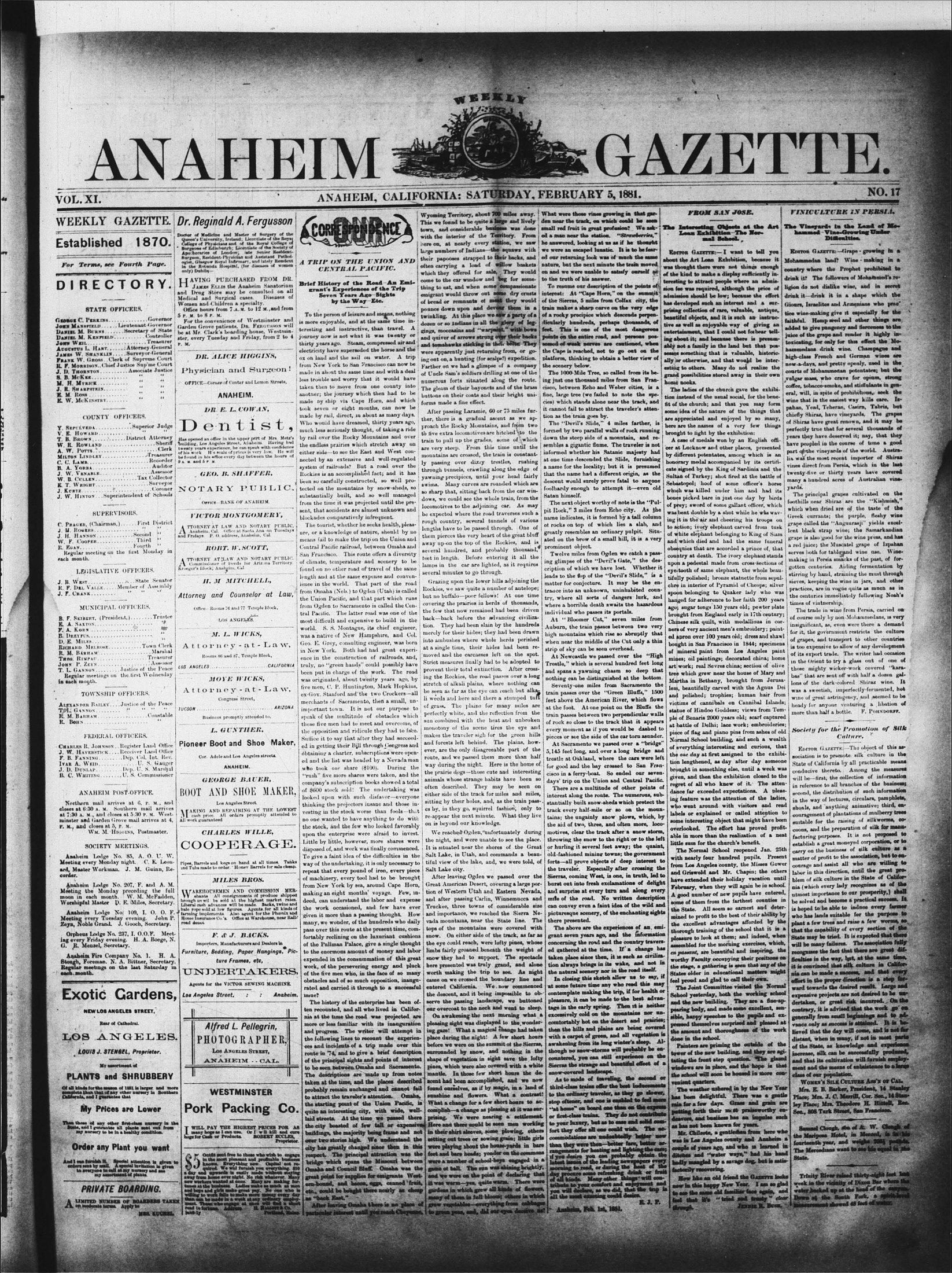
Searchable text
ANAHEIM
VOL. XI.
ANAHI
WEEKLY GAZETTE.
Established 1870.
For Terms, see Fourth Page.
DIRECTORY.
STATE OFFICERS.
GEORGE C. PERKINS ... Governor
JOHN MANSFIELD ... Lieutenant-Governor
DANIEL M. BURNS ... Secretary of State
DANIEL M. KENFIELD ... Controller
JOHN WEIL ... Treasurer
AUGUSTUS L. HART ... Attorney-General
JAMES W. SHANKLIN ... Surveyor-General
FRANK W. GROSS ... Clerk of Supreme Court
R. F. MORRISON, Chief Justice Supreme Court
J. D. THORNTON ... Associate Justice
S. B. McKKE ... ""
M. H. MYRICK ... ""
J. R. SHAHPSTEIN ... ""
E. M. ROSS ... ""
E. W. McKINSTRY ... "
COUNTY OFFICERS.
Y. SEPULVEDA ... Superior Judge
V. E. HOWARD ... ""
T. B. BROWN ... District Attorney
W. R. ROWLAND ... Sheriff
A. W. POTTS ... Clerk
MILTON LINDLEY ... Treasurer
C. C. LAMB ... Recorder
B. A. YORBA ... Auditor
J. W. VENABLE ... Assessor
Dr. Reginald A. Ferguson
Doctor of Medicine and Master of Surgery of the Queen's University, Ireland; Licentiate of the Royal College of Physicians and of the Royal College of Surgeons of Edinburgh; Licentiate of the Society of Appreciaries of London; late Senior Resident-Surgeon, Resident Physician and Assistant Pathologist, Glasgow Royal Infirmary, and later Resident in the Rotunda Hospital, (for diseases of women only) Dublin—
HAVING PURCHASED FROM DR. JAMES ELLIS the Anaheim Sanatorium and Drug Store may be consulted on all Medical and Surgical cases. Diseases of Women and Children a specialty.
Office hours from 7 A.M. to 12 M., and from 5 P.M. to 8 P.M.
For the convenience of Westminster and Garden Grove patients, Dr. Ferguson will be at Mr. Clark's boarding house, Westminster, every Tuesday and Friday, from 2 to 4 P.M.
DR. ALICE HIGGINS,
Physician and Surgeon!
OFFICE—Corner of Center and Lemon Streets,
ANAHEIM.
DR. E. L. COWAN,
Dentist,
Has opened an office in the upper port of Mrs Mettr's building, Los Angeles Street, Anaheim. Having had twenty years experience, he can speak with confidence of his work. It's scale of prices is very low. He will be found in his office every day between the hours of 9 A.M. and 6 P.M.
GEO. R. SHAFFER.
COUNTY OFFICERS.
Y. SEPULVEDA... Superior Judge
V. E. HOWARD... " "
T. B. BROWN... District Attorney
W. R. ROWLAND... Sheriff
A. W. POTTS... Clerk
MILTON LINDLEY... Treasurer
C. C. LAMB... Recorder
B. A. YORBA... Auditor
J. W. VENABLE... Assessor
W. B. CULLEN... Tax Collector
E. T. WRIGHT... Surveyor
J. KURTZ... Coroner
J. W. HINTON... Superintendent of Schools
SUPERVISORS.
C. PRAGER, (Chairman.) First District
J. H. ROGERS... " "
J. H. HANNON Second " "
W. F. COOPER Third " "
R. EGAN Fourth Regular meeting on the first Monday in each month.
LEGISLATIVE OFFICERS.
J. B. WEST State Senator
R. F. DEL VALLE Member of Assembly
J. F. CRANK " " " " " " " " " " " " " " " " " " " " " " " " " " " " " " " " " " " " " " " " " " " " " " " " " " ""
MUNICIPAL OFFICERS.
B. F. SEIBERT, (President.) Trustee
E. A. SAKTON ..." "
F. A. KORN ..." "
B. DREYPUS ..." "
D. E. MILES ..." "
RICHARD MELROSE Town Clerk
R. M. BARHAM Marshal
THRO, RIMPAU Treasurer
JOHN P. ZEYN Assessor
T. L. GANNON Justice of the Peace Regular meetings on the first Wednesday in each month.
TOWNSHIP OFFICERS.
ALEXANDER BAILEY Justice of the Peace
T. L. GANNON Constable
R. M. BARHAM Important town.
FEDERAL OFFICERS.
CHARLES R. JOHNSON Register Land Office
J. W. HAVESTICK Receiver Land Office
F. B. FANNING Dep. Col., Int. Rev.
IVAR A. WEID U. S. Gauger
J. D. DUNLAP Dep. U. S. Marshal
B. C. WHITING U. S. Commissioner
ANAHEIM POST-OFFICE.
Northern mail arrives at 6, P.M., and closes at 6:30 A.M. Southern mail arrives at 7:30 A.M., and closes at 5:30 P.M. Westminster and Garden Grove mail arrives at 4, P.M., and closes at 5, P.M.
WM. M.HIGGINS Postmaster.
SOCIETY MEETINGS.
Anaheim Lodge No. 85, A.O.U.W Meeting every Monday night.
C.K Leonard, Master Workman.J.M.Guinn.Recorder.
Anaheim Lodge No. 207,F and A.M.Meeting the Monday preceding the full moon in each month.W.M.Meafden,
OFFICE—Corner of Center and Lemon Streets,
ANAHEIM.
DR.E.L.COWAN,
Dentist,
Has opened an office in the upper part of Mrs Metra's building, Los Angeles Street, Anaheim Having two twenty years experience, he can speak with confidence of his work.H's scale of prices is very low.H will be found in his office every day between the hours of 9.A.M and 5.P.M.
GEO.B.SHAFFER,
NOTARY PUBLIC.
Office—BANK OF ANAHEIM.
VICTOR MONTGOMERY,
ATTORNEY AT LAW AND NOTARY PUBLIC,
Anaheim, Cal.. Office at Santa Ana on Tuesday and Fridays.P.O.address,Anaheim,Cal.
ROBT.W.SCOTT,
ATTORNEY AT LAW AND NOTARY PUBLIC.
Commissioner of Deeds for Arizona Territory.
Kroeger's Block; Anaheim, Cal.
H.MITCHELL,
Attorney and Counselor at Law,
Office—Rooms 76 and 77 Temple Block,
LOS ANGELES.
M.L.WICKS,
Attorney-at-Law,
Rooms 86 and 87,Temple Block,
LOS ANGELES.
MOYE WICKS,
Attorney-at-Law,
Congress Street,
TUCSON ARIZONA
L.GUNTHER.
Pioneer Boot and Shoe Maker,
Cor.Adele and Los Angeles streets.
GEORGE BAUER,
BOOT AND SHOE MAKER,
Los Angeles Street.
MAKING AND REPAIRING AT THE LOWEST cash price.All orders promptly attended toAll work guaranteed.
CHARLES WILLE,
COOPERAGE.
Pipes,Barrels and kegs on hand at all times.Tanks and Tubs made to order.Honev Barrels for sale cheap.
MILES BROS.
WAREHOUSEMEN AND COMMISSION MERCHANTS.All consignments of produce shipped
Northern mail arrives at 6, P. M., and closes at 6:30 A.M. Southern mail arrives at 7:30 A.M., and closes at 5:30 P.M. Westminster and Garden Grove mail arrives at 4, P. M., and closes at 5, P.M.
Wm. M. Higgins, Postmaster.
SOCIETY MEETINGS.
Anaheim Lodge No. 85, A. O. U. W. Meeting every Monday night. C. K. Leonard, Master Workman. J. M. Guinn, Recorder.
Anaheim Lodge No. 207, F. and A. M. Meeting the Monday preceding the full moon in each month. W. M. McFaulden, Worshipful Master D. E. Miles, Secretary.
Anaheim Lodge No. 109, I. O. O. F. Meeting every Tuesday evening. John P. Zeyn, Noble Grand. J. Gooch, Secretary.
Orpheus Lodge No. 237, I. O.O.F. Meeting every Friday evening. H. A. Boege, N. G. R. Menzel, Secretary.
Anaheim Fire Company No. 1. H. A. Stough, Foreman. N. A. Bittner, Secretary. Regular meetings on the last Saturday in each month.
Exotic Gardens,
NEW LOS ANGELES STREET,
Rear of Cathedral.
LOS ANGELES.
LOUIS J. STENGEL, Proprietor.
My assortment of PLANTS and SHRUBBERY
Of all kinds for the season of 1881 is larger and more complete than that of any other nursery in Southern California, and I guarantee that
My Prices are Lower
Than those of any other first-class nursery in the State, and I guarantee all plants sent out from my nursery to be in a healthy condition.
Order any Plant you want
And I can furnish it. Special attention is given to orders sent by mail. A special invitation is given to everyone to call at my nursery and see my assortment of plants.
PRIVATE BOARDING.
A LIMITED NUMBER OF BOARDERS TAKEN on moderate terms. Apply to
Los Angeles Street.
MAKING AND REPAIRING AT THE LOWEST cash price. All orders promptly attended to All work guaranteed.
CHARLES WILLE,
COOPERAGE.
Pipes, Barrels and kegs on hand at all times. Tanks and Tubs made to order. Honey Barrels for sale cheap.
MILES BROS.
WAREHOUSEMEN AND COMMISSION MERchants. All consignments of produce shipped through us will be sold at the highest market rates.Liberal cash advances will be made.Sacks, twine and bale rope sold at low figures.Agents for all kinds of farming implements.Also agent for the Phoenix and Home Insurance Co.'s Office at Warehouse, near Railroad detox.
F & J. BACKS.
Importers, Manufacturers and Dealers in Furniture, Bedding, Paper Hangings, Picture Frames, etc,
UNDERTAKERS,
Agents for the VICTOR SEWING MACHINE.
Los Angeles Street.: Anaheim.
Alfred L. Pellegrin,
PHOTOGRAPHER,
LOS ANGELES STREET,
ANAHEIM..CAL.
WESTMINSTER
Pork Packing Co.
I WILL PAY THE HIGHEST PRICES FOR AS many hogs as I can use. Or I will kill and cure hogs for Cash or Products.
ROBERT ECCLES,
Proprietor.
$5 Outfit sent free to those who wish to engage in the most pleasant and profitable business known.Everything new.Capital not required.Will furnish you everything.$10 a day and upwards is easily made without staying away from home over night.No risk whatever.Many new workkeys wanted at once.Many are making fortunes at the business.Ladies make as much as men and boys and girls make great pay.No one who is willing to work fails to make more money every day than can be made in a week at any ordinary employment.These who engage at once will find a short road to fortune.Address:H.Haller & Co.,Portland,Maine.
The history of the ten recounted,and no nia at the time the more or less familia and progress.The following lines see incidents of route in '74,and to of the principal sight to be seen between The descriptions are taken at the time,the probably remain unto attract the travelthe starting point o quite an interesting laid streets.At tha city boasted o buildings,the major over two stories high city has greatly chie respect.The prim bridge which spans Omaha and Council great point for suppern-bound,and ha etc.,could be bong as "back East."
After leaving On particular interest
WEEKLY
EIM GA
ANAHEIM, CALIFORNIA: SATURDAY, FEBRUARY 5, 1881.
CORRESPONDENCE
A TRIP ON THE UNION AND CENTRAL PACIFIC.
Brief History of the Road—An Emigrant's Experiences of the Trip Seven Years Ago—Sights by the Way—Ete.
To the person of leisure and means, nothing is more enjoyable, and at the same time interesting and instructive, than travel. A journey now is not what it was twenty or thirty years ago. Steam, compressed air and electricity have superseded the horse and the ox on land and the sail on water. A trip from New York to San Francisco can now be made in about the same time and with a deal less trouble and worry that it would have taken then to move from one county into another; the journey which then had to be made by ship via Cape Horn, and which took seven or eight months, can now be made by rail, direct, in about as many days. Who would have dreamed, thirty years ago, much less seriously thought, of taking a ride by rail over the Rocky Mountains and over the endless prairies which stretch away on either side—to see the East and West connected by an extensive and well-regulated system of railroads? But a road over the Rockies is an accomplished fact; and it has Wyoming Territory, about 700 miles away. This we found to be quite a large and lively town, and considerable business was done with the interior of the Territory. From here on, at nearly every station, we saw large numbers of Indians—the squaws with their papooses strapped to their backs, and often carrying a load of willow baskets which they offered for sale. They would come to the car window and beg for something to eat, and when some compassionate emigrant would throw out some dry crusts of bread or remnants of meat they would pounce down upon and devour them in a twinkling. At this place we saw a party of a dozen or so Indians in all the glory of leggings, moccasins and "warpaint," with bows and quiver of arrows strung over their backs and tomahawks sticking in their belts. They were apparently just returning from, or going out on, a hunting (for scalpe?) expedition. Farther on we had a glimpse of a company of Uncle Sam's soldiers drilling at one of the numerous forts situated along the route. The gleam of their bayonets and of the brass buttons on their coats and their bright uniforms made a fine effect.
After passing Laramie, 60 or 75 miles further, there is a gradual ascent as we approach the Rocky Mountains, and from two to five extra locomotives are hitched to the train to pull up the grades, some of which are very steep. From this time until the mountains are crossed, the train is constantly passing over dizzy trestles, rushing through tunnels, crawling along the edge of What were those vines growing in that garden near the track, on which could be seen small red fruit in great profusion? We asked a man near the station. "Strawberries," he answered, looking at us as if he thought we were an escaped lunatic. It is to be feared our returning look was of much the same nature, but the next minute the train moved on and we were unable to satisfy ourselves as to the truth of his answer.
To resume our description of the points of interest: At "Cape Horn," on the summit of the Sierras, 5 miles from Colfax city, the train makes a sharp curve on the very edge of a rocky precipice which descends perpendicularly hundreds, perhaps thousands, of feet. This is one of the most dangerous points on the entire road, and persons possessed of weak nerves are cautioned, when the Cape is reached, not to go out on the platform, thinking to obtain a better view of the scenery below.
The 1000-Mile Tree, so called from its being just one thousand miles from San Francisco, between Echo and Weber cities, is a fine, large tree (we failed to note the species) which stands alone near the track, and it cannot fail to attract the traveler's attention as the train goes by.
The "Devil's Slide," 4 miles farther, is formed by two parallel walls of rock running down the steep side of a mountain, and resembles a gigantic flume. The traveler is not informed whether his Satanic majesty had at one time descended the Slide, furnishing a name for the locality; but it is presumed that the name had a different origin as
less trouble and worry that it would have taken then to move from one county into another; the journey which then had to be made by ship via Cape Horn, and which took seven or eight months, can now be made by rail, direct, in about as many days. Who would have dreamed, thirty years ago, much less seriously thought, of taking a ride by rail over the Rocky Mountains and over the endless prairies which stretch away on either side—to see the East and West connected by an extensive and well-regulated system of railroads? But a road over the Rockies is an accomplished fact; and it has been so carefully constructed, so well protected on the mountains by snow-sheds, so substantially built, and so well managed from the time it was projected until the present, that accidents are almost unknown and blockades comparatively infrequent.
The tourist, whether he seeks health, pleasure, or a knowledge of nature, should by no means fail to make the trip on the Union and Central Pacific railroad, between Omaha and San Francisco. This route offers a diversity of climate, temperature and scenery to be found on no other road of travel of the same length and at the same expense and convenience in the world. That part of the road from Omaha (Neb.) to Ogden (Utah) is called the Union Pacific, and that part which runs from Ogden to Sacramento is called the Central Pacific. The latter road was one of the most difficult and expensive to build in the world. S. S. Montague, its chief engineer, was a native of New Hampshire, and Col. Geo. E. Grey, consulting engineer, was born in New York. Both had had great experience in the construction of railroads, and, truly, no "green hands" could possibly have been put in charge of the work. The road was originated, about twenty years ago, by five men, C. P. Huntington, Mark Hopkins, ex-Gov. Stanford and the two Crockers—all merchants of Sacramento, then a small, unimportant town. It is not our purpose to speak of the multitude of obstacles which these five men had to meet and overcome, of the opposition and ridicule they had to face. Suffice it to say that after they had succeeded in getting their Bill through Congress and obtaining a charter, subscriptions were opened and the list was headed by a Nevada man who took one share ($100). During the "rush" five more shares were taken, and the company's subscription books showed a total of $600 stock sold! The undertaking was looked upon with such disfavor—everyone thinking the projectors insane and those investing in the stock worse than fools—that no one wanted to have anything to do with the stock, and the few who looked favorably upon the enterprise were afraid to invest.
Little by little, however, more shares were disposed of, and work was finally commenced. To give a faint idea of the difficulties in the way of the undertaking, it is only necessary to repeat that every pound of iron, every piece of machinery, every tool had to be brought from New York by sea, around Cape Horn, making an eight months' voyage. Few, indeed, understand the labor and expense of Uncle Sam's soldiers drilling as one of the numerous forts situated along the route. The gleam of their bayonets and of the brass buttons on their coats and their bright uniforms made a fine effect.
After passing Laramie, 60 or 75 miles further, there is a gradual ascent as we approach the Rocky Mountains, and from two to five extra locomotives are hitched to the train to pull up the grades, some of which are very steep. From this time until the mountains are crossed, the train is constantly passing over dizzy trestles, rushing through tunnels, crawling along the edge of yawning precipices, until your head fairly swims. Many curves are rounded which are so sharp that, sitting back from the car windows, we could see the whole train, from the locomotives to the adjoining car. As may be expected where the road traverses such a rough country, several tunnels of various lengths have to be passed through. One of them pierces the very heart of the great bluff away up-on the top of the Rockies, and is several hundred, and probably thousand feet in length. Before entering it all the lamps in the car are lighted, as it requires several minutes to go through.
Grazing upon the lower hills adjoining the Rockies, we saw quite a number of antelope; but no buffalo—poor fellows! At one time covering the prairies in herds of thousands, the few that now remained had been driven back—back before the advancing civilization. They had been slain by the hundreds merely for their hides; they had been drawn into ambushes where whole herds perished at a single time, their hides had been removed and the carcasses left on the spot. Strict measures finally had to be adopted to prevent their total extinction. After crossing the Rockies, the road passes over a long stretch of alkali plains, where nothing can be seen as far as the eye can reach but alkali weeds and here and there a stumped tuft of grass. The plains for many miles are perfectly white, and the reflection from the sun combined with the heat and unbroken monotony of the scene tires the eye and makes the traveler sigh for the green hills and forests left behind. The plains, however, are the only disagreeable part of the route, and we passed them more than half way during the night. Here is the home of the prairie dogs—these cute and interesting animals whose strange habits have been so often described. They may be seen on either side of the track for miles and miles, sitting by their holes, and, as the train passes by, in they go, squirrel fashion, only to re-appear the next minute. What they live on is beyond our knowledge.
We reached Ogden, unfortunately during the night, and were unable to see the place. It is situated near the shores of the Great Salt Lake, in Utah, and commands a beautiful view of the lake, and, we were told, of Salt Lake city.
After leaving Ogden we passed over the Great American Desert, covering a large portion of Western Utah and Eastern Nevada, and after passing Carlin, Winnemcca and Of Uncle Sam's soldiers drilling as one of the numerous forts situated along the route. The gleam of their bayonets and of the brass buttons on their coats and their bright uniforms made a fine effect.
After passing Laramie, 60 or 75 miles further, there is a gradual ascent as we approach the Rocky Mountains, and from two to five extra locomotives are hitched to the train to pull up the grades, some of which are very steep. From this time until the mountains are crossed, the train is constantly passing over dizzy trestles, rushing through tunnels, crawling along the edge of yawning precipices, until your head fairly swims. Many curves are rounded which are so sharp that, sitting back from the car windows, we could see the whole train, from the locomotives to the adjoining car. As may be expected where the road traverses such a rough country, several tunnels of various lengths have to be passed through. One of them pierces the very heart of the great bluff away up-on the top of the Rockies, and is several hundred, and probably thousand feet in length. Before entering it all the lamps in the car are lighted, as it requires several minutes to go through.
Grazing upon the lower hills adjoining the Rockies, we saw quite a number of antelope; but no buffalo—poor fellows! At one time covering the prairies in herds of thousands, the few that now remained had been driven back—back before the advancing civilization. They had been slain by the hundreds merely for their hides; they had been drawn into ambushes where whole herds perished at a single time, their hides had been removed and the carcasses left on the spot. Strict measures finally had to be adopted to prevent their total extinction. After crossing the Rockies, the road passes over a long stretch of alkali plains, where nothing can be seen as far as the eye can reach but alkali weeds and here and there a stumped tuft of grass. The plains for many miles are perfectly white, and the reflection from the sun combined with the heat and unbroken monotony of the scene tires the eye and makes the traveler sigh for the green hills and forests left behind. The plains, however, are the only disagreeable part of the route, and we passed them more than half way during the night. Here is the home of the prairie dogs—these cute and interesting animals whose strange habits have been so often described. They may be seen on either side of the track for miles and miles, sitting by their holes, and as they train passes by in they go,squirrel fashion,only to re-appearthe next minute.What they live on is beyond our knowledge.
We reached Ogden,unfortunately duringthenight,andwereunabletoseetheplace。它is situatedneartheshoresoftheGreatSaltLake,inUtah,andcommandsabeautifulviewofthelake,andwewere told,ofSaltLakecity.
After leaving Ogden we passed overtheGreatAmericanDesert,coveringalargeportionofWesternUtahandEasternNevada,andafterpassingCarlin,WinnemccaandOfUncleSam'ssolversdrivingasoneofthenumerousforts situatedalongtheroute.Thegleamoftheibayonetsandofthebrassbuttonsonthecoatsandthebrightuniformsmadeafineeffect.
After passing Laramie,60or75milesfurtherthereisagradualascentasweapproachtheRockyMountains,andfromtwotofiveextralocomotivesarehitchedtothetraintopullupthegrades,someofwhichareverysteep.Fromthistimeuntilthemountainsarecrossed,thetrainisconstantlypassingoverdizzytrestles,rushingthroughtunnels,crawlingalongtheedgeofyawningprecipices,t Untilthetunnels,crawlingalongtheedgeofyawningprecipices,tUntilthetunnels,crawlingalongtheedgeofyawningprecipices,tUntilthetunnels,crawlingalongtheedgeofyawningprecipices,tUntilthetunnels,crawlingalongtheedgeofyawningprecipices,tUntilthetunnels,crawlingalongtheedgeofyawningprecipices,tUntilthetunnels,crawlingalongtheedgeofyawningprecipices,tUntilthetunnels,crawlingalongtheedgeofyawningprecipices,tUntilthetunnels,crawlingalongtheedgeofyawningprecipices,tUntilthetunnels,crawlingalongtheedgeofyawningprecipices,tUntilthetunnels,crawlingalongtheedgeofyawningprecipices,tUntilthetunnels,crawlingalongtheedgeofyawningprecipices,tUntilthetunnels,crawlingalongtheedgeofyawningprecipices,tUntilthetunnels,crawlingalongtheedgeofyawningprecipices,tUntilthetunnels,crawlingalongtheedgeofyawningprecipices,tUntilthetunnels,crawlingalongtheedgeofyawningprecipices,tUntilthetunnels,crawlingalongtheedgeofyawningprecipices,tUntilthetunnels,crawlingalongtheedgeofyawningprecipices,tUntilthetunnels,crawlingalongtheedgeofyawningprecipices,tUntilthetunnels,crawlingalongtheedgeofyawningprecipices,tUntilthetunnels,crawlingalongtheedgeofyawningprecipices,tUntilthetunnels,crawlingalongtheedgeofyawningprecipices,tUntilthetunnels,crawlingalongtheedgeofyawningprecipices,tUntilthetunnels,crawlingalongtheedgeofyawningprecipices,tUntilthetunnels,crawlingalongtheedgeofyawningprecipices,tUntilthetunnels,crawlingalongtheedgeofyawningprecipices,tUntilthetunnels,crawlingalongtheedgeofyawningprecipices,tUntilthetunnels,crawlingalongtheedgeofyawningprecipices,tUntilthetunnels,crawlingalongtheedgeofyawningprecipices,tUntilthetunnels,crawlingalongtheedgeofyawningprecipices,tUntilthetunnels,crawlingalongtheedgeofyawningprecipices,tUntilthetunnels,crawlingalongtheedgeofyawningprecipices,tUntilthetunnels,crawlingalongtheedgeofyawningprecipices,tUntilthetunnels,crawlingalongtheneged边缘边缘边缘边缘边缘边缘边缘边缘边缘边缘边缘边缘边缘边缘边缘边缘边缘边缘边缘边缘边缘边缘边缘边缘边缘边缘边缘边缘边缘边缘边缘边缘边缘边缘边缘边缘边缘边缘边缘边缘边缘边缘边缘边缘边缘边缘边缘边缘边缘边缘边缘边缘边缘边缘边缘边缘边缘边缘边缘边缘边缘边缘边缘边缘边缘边缘边缘边缘边缘边缘边缘边缘边缘边缘边境边境边境边境边境边境边境边境边境边境边境边境边境边境边境边境边境边境边境边境边境边境边境边境边境边境边境边境边境边境边境边境边境边境边境边境边境边境边境边境边境边境边境边境边境边境边境边境边境边境边境边境边境边境边境边境边境边境边境边境边境边境边境跨境跨境跨境跨境跨境跨境跨境跨境跨境跨境跨境跨境跨境跨境跨境跨境跨境跨境跨境跨境跨境跨境跨境跨境跨境跨境跨境跨境跨境跨境跨境跨境跨境跨境跨境跨境跨境跨境跨境跨境跨境跨境跨境跨境跨境跨境跨境跨境跨境跨境维度维度维度维度维度维度维度维度维度维度维度维度维度维度维度维度维度维度维度维度维度维度维度维度维度维度维度维度维度维度维度维度维度维度维度维度维度维度维度维度维度维度维度维度维度维度维度维度维度维度维度维度维度维度维度维度维度维度维度维度维度维度维度维度维度维度维度维度维度维度维度维度维度维度维度DimensionDimensionDimensionDimensionDimensionDimensionDimensionDimensionDimensionDimensionDimensionDimensionDimensionDimensionDimensionDimensionDimensionDimensionDimensionDimensionDimensionDimensionDimensionDimensionDimensionDimensionDimensionDimensionDimensionDimensionDimensionDimensionDimensionDimensionDimensionDimensionDimensionDimensionDimensionDimensionDimensionDimensionDimensionDimensionDimensionDimensionDimensionDimensionDimensionDimensionDimensionDimensionDimensionDimensionDimensionDimensionDimensionDimensionDimensionDimensionDimensionDimensionDimensionDimensionDimensionDimensionDimensionDimensionDimension dimension dimension dimension dimension dimension dimension dimension dimension dimension dimension dimension dimension dimension dimension dimension dimension dimension dimension dimension dimension dimension dimension dimension dimension dimension dimension dimension dimension dimension dimension dimension dimension dimension dimension dimension dimension dimension dimension dimension dimension dimension dimension dimension dimension dimension dimension dimension dimension dimension dimension dimension dimension dimension dimensions dimensions dimensions dimensions dimensions dimensions dimensions dimensions dimensions dimensions dimensions dimensions dimensions dimensions dimensions dimensions dimensions dimensions dimensions dimensions dimensions dimensions dimensions dimensions dimensions dimensions dimensions dimensions dimensions dimensions dimensions dimensions dimensions dimensions dimensions dimensions dimensions dimensions dimensions dimensions dimensions dimensions dimensions dimensions dimensions dimensions dimensions dimensions dimensions dimensions dimensions dimensions dimensions dimensions dimensions Dimensions Dimensions Dimensions Dimensions Dimensions Dimensions Dimensions Dimensions Dimensions Dimensions Dimensions Dimensions Dimensions Dimensions Dimensions Dimensions Dimensions Dimensions Dimensions Dimensions Dimensions Dimensions Dimensions Dimensions Dimensions Dimensions Dimensions Dimensions Dimensions Dimensions Dimensions Dimensions Dimensions Dimensions Dimensions Dimensions Dimensions Dimensions Dimensions Dimensions Dimensions Dimensions Dimensions Dimensions Dimensions Dimensions Dimensions Dimensions Dimensions DimensionDimensionDimensionDimensionDimensionDimensionDimensionDimensionDimensionDimensionDimensionDimensionDimensionDimensionDimensionDimensionDimensionDimensionDimensionDimensionDimensionDimensionDimensionDimensionDimensionDimensionDimensionDimENSIONDimENSIONDimENSIONDimENSIONDimENSIONDimENSIONDimENSIONDimENSIONDimENSIONDimENSIONDimENSIONDimENSIONDimENSIONDimENSIONDimENSIONDimENSIONDimENSIONDimENSIONDimENSIONDimENSIONDimENSIONDimENSIONDimENSIONDimENSIONDimENSIONDimENSIONDimENSIONDimENSIONDimENSIONDimENSIONDimENSIONDimENSIONDimENSIONDimENSIONDimENSIONDimENSIONDimENSIONDimENSIONDimENSIONDimENSIONDimENSIONDimENSIONDimENSIONDimENSIONDimENSIONDimENSIONdimensiondimensiondimensiondimensiondimensiondimensiondimensiondimensiondimensiondimensiondimensiondimensiondimensiondimensiondimensiondimensiondimensiondimensiondimensiondimensiondimensiondimensiondimensiondimensiondimensiondimensiondimensiondimensiondimensiondimensiondimensiondimensiondimensiondimensiondimensiondimensiondimensiondimensiondimensiondimensiondimensiondimensiondimensiondimensiondimensiondimensiondimensiondimensiondimensiondimens dimen
There are a multitude of other points of interest along the route. The numerous substantial built snow-sheds which protect each half-mile or so on the mountains; they unqiably snow plows which by,the aid of two three,and often moreLocationsfortheproblemsofnatural风景andsurroundingsallproblemsattemptedtoburrowoutintheturnandalloweverymileoftheroad.Nowrittendescription
thinking the projectors insane and those investing in the stock worse than fools—that no one wanted to have anything to do with the stock, and the few who looked favorably upon the enterprise were afraid to invest. Little by little, however, more shares were disposed of, and work was finally commenced. To give a faint idea of the difficulties in the way of the undertaking, it is only necessary to repeat that every pound of iron, every piece of machinery, every tool had to be brought from New York by sea, around Cape Horn, making an eight months' voyage. Few, indeed, can understand the labor and expense the work occasioned, and few have ever given it more than a passing thought. How many, we wonder, of the hundreds who daily pass over this route at the present time, comfortably reclining on the luxuriant cushions of the Pullman Palace, give a single thought to the enormous amount of money and labor expended in the consummation of this great work, of the persevering energy and pluck of the five men who, in the face of so many obstacles and of so much opposition, inaugurated and carried it through to a successful issue?
The history of the enterprise has been often recounted, and all who lived in California at the time the road was projected are more or less familiar with its inauguration and progress. The writer will attempt in the following lines to recount the experiences and incidents of a trip made over this route in 74, and to give a brief description of the principal sights and points of interest to be seen between Omaha and Sacramento. The descriptions are made up from notes taken at the time, and the places described probably remain unchanged and cannot fail to attract the traveler's attention. Omaha, the starting point of the Union Pacific, is quite an interesting city, with wide, well-laid streets. At the time we passed there the city boasted of few tall or expensive buildings, the majority being frame and not over two stories high. We understand the city has greatly changed since then in this respect. The principal attraction was the bridge which spans the Missouri between Omaha and Council Bluff. Omaha was the great point for supplies for emigrants Western-bound, and bacon, egg, canned fruit, etc., could be bought there nearly as cheap as "back East."
After leaving Omaha there is no place of particular interest until you reach Cheyenne,
sitting by their holes, and, as the train passes by, in they go, squirrel fashion, only to re-appear the next minute. What they live on is beyond our knowledge.
We reached Ogden, unfortunately during the night, and were unable to see the place. It is situated near the shores of the Great Salt Lake, in Utah, and commands a beautiful view of the lake, and, we were told, of Salt Lake city.
After leaving Ogden we passed over the Great American Desert, covering a large portion of Western Utah and Eastern Nevada, and after passing Carlin, Winnemucca and Truckee, three towns of considerable size and importance, we reached the Sierra Nevada mountains, near the State line. The tops of the mountains were covered with snow. On either side of the track, as far as the eye could reach, were lofty pines, whose limbs fairly groaned beneath the weight of snow they had to support. The spectacle here presented was truly grand, and alone worth making the trip to see. As night came on we crossed the boundary line and entered California. We now commenced the descent, and it being impossible to observe the passing landscape, we buttoned our overcoat to the neck and went to sleep.
On awakening the next morning what a pleasing sight was displayed to the wondering gaze! What a magical change had taken place during the night! A few short hours before we were on the summit of the Sierras, surrounded by snow, and nothing in the shape of vegetation in sight save the lofty pines, which were also covered with a white mantle. In those few short hours the descent had been accomplished, and we now found ourselves, as if by magic, in a land of sunshine and flowers. What a contrast! What a change for a few short hours to accomplish—a change as pleasing at it was surprising. We were nearing a settlement. Here and there could be seen men working in their shirt sleeves, some plowing; others setting out trees or sowing grain; little girls were playing about the house-yards in bare feet and bare heads; yonder on the commons were a number of school-boys engaged in a game of ball. The sun was shining brightly, and we were on the point of declaring that it was warm—yes, quite warm. There were gardens in which grew all kinds of flowers, many of them in full bloom; others in which grew vegetables—everything from cabbage to green peas, and, did our eyes deceive us?
GAZETTE.
JAY 5, 1881. NO. 17
FROM SAN JOSE.
The Interesting Objects at the Art Loan Exhibition—The Normal School.
EDITOR GAZETTE:—I want to tell you about the Art Loan Exhibition, because it was thought there were not things enough of the kind to make a display sufficiently interesting to attract people where an admission fee was required, although the price of admission should be low; because the effort has developed such an interest and a surprising collection of rare, valuable, antique, beautiful objects, and it is such an instructive as well as enjoyable way of giving an entertainment, that I could not forbear telling about it; and because there is presumably not a family in the land but that possesses something that is valuable, historically or otherwise, and that would be interesting to others. Many do not realize the grand possibilities stored away in their own home nooks.
The ladies of the church gave the exhibition instead of the usual social, for the benefit of the church; and that you may form some idea of the nature of the things that are appreciated and enjoyed by so many, here are the names of a very few things brought to light by the exhibition:
A case of medals won by an English officer at Lucknow and other places, presented by different potentates, among which is an honorary medal accompanied by its certificate signed by the King of Sardinia and the title "King of Sardinia."
VINICULTURE IN PERSIA.
The Vineyards in the Land of Mohammed-Vine-Growing Under Difficulties.
EDITOR GAZETTE:—Grape-growing in a Mohammedan land? Wine-making in a country where the Prophet prohibited to drink it? The followers of Mohammed's religion do not dialike wine, and in secret drink it—drink it in a shape which the Giours, Israelites and Armenians who practice wine-making give it especially for the faithful. Hemp seed and other things are added to give pungency and fierceness to the juice of the grape and render it highly intoxicating, for only for this effect the Mohammedana drink wine. Champagne and high-class French and German wines are now-a-days, and pretty openly, used in the courts of Mohammedan potentates; but the vulgar mass, who crave for opium, strong coffee, tobacco-smoke, and stimulants in general, will, in spite of prohibitious, seek the wine that in the easiest way kills care. Ispahan, Yezil, Teheran, Casirn, Tabriz, but chiefly Shiraz, have vineyards. The grapes of Shiraz have great renown, and it may be perfectly true that for several thousands of years they have deserved it; nay, that they have peopleled in the course of time a good part of the vineyards of the world. Australia was the most recent importer of Shiraz vines direct from Persia, which in the last twenty-five or thirty years have covered
miles from San Francisco and Weber cities, is a called to note the speeches near the track, and affect the traveler's attention by.
4 miles farther, is held walls of rock running of a mountain, and rename. The traveler is not Satanic majesty had led the Slide, furnishing it; but it is presumed different origin, as the may prove fatal to anyone who attempt it—even old
Ogden we catch a pass from Echo city. As the formed by a tall column which lies a slab, and an ordinary pulpit. Situated a small hill, it is a very northy of note is the "Pulver Devil's Gate," the desire have lost. Whether it be the "Devil's Slide," is a crime. It may be the ennown, uninhabited countryside of dangers lurk, and death awaits the hazardousness its portals.
Passed over the "High several hundred feet long chasm so deep that昏uished at the bottom. Passes from Sacramento the "Green Bluffs," 1500 American River, which flows on point on the Bluffs the two perpendicular walls the track that it appears you would be dashed to side of the car torn asunder. Passed over a "bridge" and over a long bridge and where the cars were left may crossed to San Francisco. So ended our seventh edition and Central Pacific. Attitude of other points of route. The numerous sub-snow-sheds which protect the tile or so on the mountain snow plows, which, by tree, and often more, loco-track after a snow storm, to the right or to the left feet away; the quaint, inner towns; the government projects of deep interest to especially after crossing the rest, is one, in truth, led to exclamations of delight every turn and along every No written description
The Normal School reopened Jan. 25th with nearly four hundred pupils. Present from Los Angeles county, the Misses Gower and Griswold and Mr. Chapin; the others have extended their holiday vacation until February, when they will again be in school. A good number of new pupils have entered.
The ladies of the church gave the exhibition instead of the usual social, for the benefit of the church; and that you may form some idea of the nature of the things that are appreciated and enjoyed by so many, here are the names of a very few things brought to light by the exhibition:
A case of medals won by an English officer at Lucknow and other places, presented by different potentates, among which is an honorary medal accompanied by its certificate signed by the King of Sardinia and the Sultan of Turkey; shot fired at the battle of Sebastopol; hoof of some officer's horse which was killed under him and had its bones picked bare in just one day by birds of prey; sword of some gallant officer, which was bent double by a shot while he was waving it in the air and cheering his troops on to action; ivory elephant carved from tusk of white elephant belonging to King of Siam and which died and had the same funeral obsequies that are accorded a prince of, that country at death. The ivory elephant stands upon a pedestal made from cross-sections of eye-tooth of same elephant, the whole beautifully polished; bronze statuette from sepulchre in interior of Pyramid of Cheops; silver spoon belonging to Quaker lady who was hanged for adherence to her faith 200 years ago; sugar tongs 150 years old; pewter plate brought from England early in 17th century; Chinese silk quilt, with medallions in corners of very ancient men's embroidery; painted apron over 100 years old; dress and shawl bought in San Francisco in 1844; specimens of mineral paint from Los Angeles paint mines; oil paintings; decorated china; home art work; real Sevres china; section of olive tree which grew near the house of Mary and Martha in Bethany, brought from Jerusalem, beautifully carved with the Agnus Dei and polished; trophies; human hair from victims of cannibals on Cannibal Islands; statue of Hindoo Goddess; views from Temple of Benaris 2000 years old; scarf captured at battle of Delhi; lace work; embroideries; piece of flag and piano pins from ashes of old Normal School building, and such a wealth of everything interesting and curious, that the one day at first assigned to the exhibition lengthened, as day after day someone brought in something else, until a week was given, and then the exhibition closed to the regret of all who knew of it. The attendance far exceeded expectations. A pleasing feature was the attention of the ladies, who went around with visitors and read labels or explained or called attention to some interesting object that might have been overlooked. The effort has proved profitable in more than the realization of a neat little sum for the church's benefit.
The Normal School reopened Jan. 25th with nearly four hundred pupils. Present from Los Angeles county, the Misses Gower and Griswold and Mr. Chapin; the others have extended their holiday vacation until February, when they will again be in school. A good number of new pupils have entered.
vulgar mass, who crave for opium, strong coffee, tobacco-smoke, and stimulants in general, will, in spite of prohibitions, seek the wine that in the easiest way kills care. Iz-pahan, Yezil, Teheran, Casirn, Tabriz, but chiefly Shiraz, have vineyards. The grapes of Shiraz have great renown, and it may be perfectly true that for several thousands of years they have deserved it; nay, that they have people in the course of time a good part of the vineyards of the world. Australia was the most recent importer of Shiraz vines direct from Persia, which in the last twenty-five or thirty years have covered many a hundred acres of Australian vineyards.
The principal grapes cultivated on the foothills near Shiraz are the "Kishmish," which when dried are of the taste of the Greek currants; the purple, fleshy wine grape called the "Anguurasji" yields excellent black strap wine; the Samarkandian grape is also good for the wine press, and has a red juice; the Muscatel grape of Iz-pahan serves both for table and wine use. Wine-making in Persia smacks of the past, of forgotten centuries. Aiding fermentation by stirring by hand, straining the must through sieves, keeping the wine in jars, and other practices, are in vogue quite as much as in the centuries immediately following Noah's times of vintnership.
The trade in wine from Persia, carried on of course only by non-Mohammedans, is very insignificant, as even were there a demand for it, the government restricts the culture of grapes, and transport to other countries is too expensive to allow of any development of its export trade. The writer had occasion in the Orient to try a glass out of one of those mighty wicker-work covered "karbas" that are sent off with half a dozen gallons of the dark-colored Shiraz wine. It was a sweetish, imperfectly-fermented, hot wine of great astringency, and seemed to be heady for anyone venturing a libation of more than half a bottle. F. Pohnendorff.
Society for the Promotion of Silk Culture.
EDITOR GAZETTE—The object of this association is to promote silk culture in the State of California by all practicable means conducive thereto. Among the measures will be—first, the collection of information in reference to all branches of the business; second, the distribution of such information in the way of lectures, circulars, pamphlets, shoals, and anything animative; third, encouragement of plantations of mulberry trees suitable for the raising of silkworms, cooons, and the preparation of silk for manufacturing purposes. It is not proposed to establish a great moneyed corporation, or to carry on the business of silk culture as a matter of profit to the association, but to encourage and assist all who are willing to labor in this direction, until the great problem of silk culture in the State of California (which every lady recognizes as of the utmost importance to our prosperity.) shall
new-sheds which protect the little or so on the mountainy snow plows, which, by tree, and often more, locotrack after a snow storm, to the right or to the left
feet away; the quaint,
long towns; the government
objects of deep interest to
especially after crossing the
rest, is one, in truth, led to
with exclamations of delight
every turn and along every
No written description
faint idea of the wild and
way, of the enchanting sights
The experiences of an emiriage, and the information
and the country traversetime. If a change has
when, it is such as civilization in its wake, and not in
any nor in the road itself.
Sketch allow us to say, if
any who read this may
give the trip, if for health or
made to the best advanspring. Then it is neither
the mountains nor unthe desert and prairies;
plains are being covered
seen, and all vegetation is
a long winter's sleep. Alorms will probably be enstill experience on the
beautiful effect of a
escape.
Traveling, the second or
offer the best inducements
traveler, as they go slower,
one is enabled to feel more
hard one than on the express
they do not contribute
as to ease and solid comons could wish. The acundoubtedly better now—better fare, better actating and lighting the ears;
can probably obtain the
leading newspapers every
or during the heat of the
refreshing drink or fruit
may other things*will comfort and enjoyment and
we did, that the trip is
being could desire.
E. J. P.
1st, 1891.
The Normal School reopened Jan. 25th with nearly four hundred pupils. Present from Los Angeles county, the Misses Gower and Griswold and Mr. Chapin; the others have extended their holiday vacation until February, when they will again be in school. A good number of new pupils have entered, some of them from the farthest counties in the State. All seem so earnest and determined to profit to the best of their ability by the excellent advantages afforded by the thorough training of the school that it is a pleasure to look at them; and indeed, when assembled for the morning exercises, which en passant, are beautiful and inspiring, the worthy Faculty occupying their positions on the stage, a gathering is seen that any of the States older in educational matters might feel proud and glad to call their own.
The Joint Committee visited the Normal School yesterday, both the working school and the new building. They are a fine-appearing body, and made some excellent, sensible happy speeches to the pupils and expressed themselves surprised and pleased at the amount and thoroughness of the work done in the school.
Painters are priming the outside of the tower of the new building, and they are agitating the front step question. The glazed windows are in place, and the hope is that the school will soon be housed in more convenient quarters.
The weather ushered in by the New Year has been delightful. There was a gentle rain for a few days. Grass and grain are putting forth their most praiseworthy endeavors, and business has an impulse such as has not been known for years.
Mr. Chileote, a gentleman from here who was in Los Angeles county and Anaheim a couple of years ago, and who is learned in ditches and "water ways," had his hand badly mangled by a savage dog, but is satisfactorily recovering.
How like an old friend the Gazette looks now in this happy New Year. I am so glad to see the same old familiar face again, and feel that it's "tried and trusty" clear through.
Jennie H. Bush.
in the way of lectures, circulars, pamphlets,
shoals, and anything animative; third, encouragement of plantations of mulberry trees suitable for the raising of silkworms, cooons, and the preparation of silk for manufacturing purposes. It is not proposed to establish a great moneyed corporation, or to carry on the business of silk culture as a matter of profit to the association, but to encourage and assist all who are willing to labor in this direction, until the great problem of silk culture in the State of California (which every lady recognizes as of the utmost importance to our prosperity.) shall be solved and become a practical success. It is hoped to be able to induce every farmer who has lands suitable for the purpose to plant a few trees and raise a few worms, so that the capability of every section of the State may be tried. It is expected that there will be many failures. The association fully recognizes the fact that there are great difficulties in the way, but, at the same time, it is convinced that silk culture in California can be made a success, and that every effort in the proper direction is a step forward towards the desired result. Large and expensive projects are not desired to be undertaken, or great risk incurred. On the contrary, it is advised that the work go on generally from small beginnings and to advance only as success is attained. It is believed that the day will come, and is not far distant, when in many, if not in most parts of the State, as knowledge and experience increase, silk can be successfully produced, and that its cultivation will furnish employment and the means of subsistence to a large class of our population.
Women's Silk Culture Ass'n of Cal.
Mrs. E. B. Barker, President, 14 Stanley Place; Mrs. J. C. Marrill, Cor. Sec., 14 Stanley Place; Mrs. Theodore H. Hittell, Resc.
Sen., 808 Turk Street, San Francisco.
Samuel Clough, son of A. W. Clough of the Mariposa Hotel, in Merced, is in his fourteenth year, and weighs 208 pounds. The Mercedans want to see his equal in the State.
Trinity River raised thirty-eight feet last week in the vicinity of Dixon Bar where the water backed up at the head of the cove-Down at the South York, a spirit-level measurement showed 43 feet of water;