anaheim-gazette 1881-01-22
Scanned page
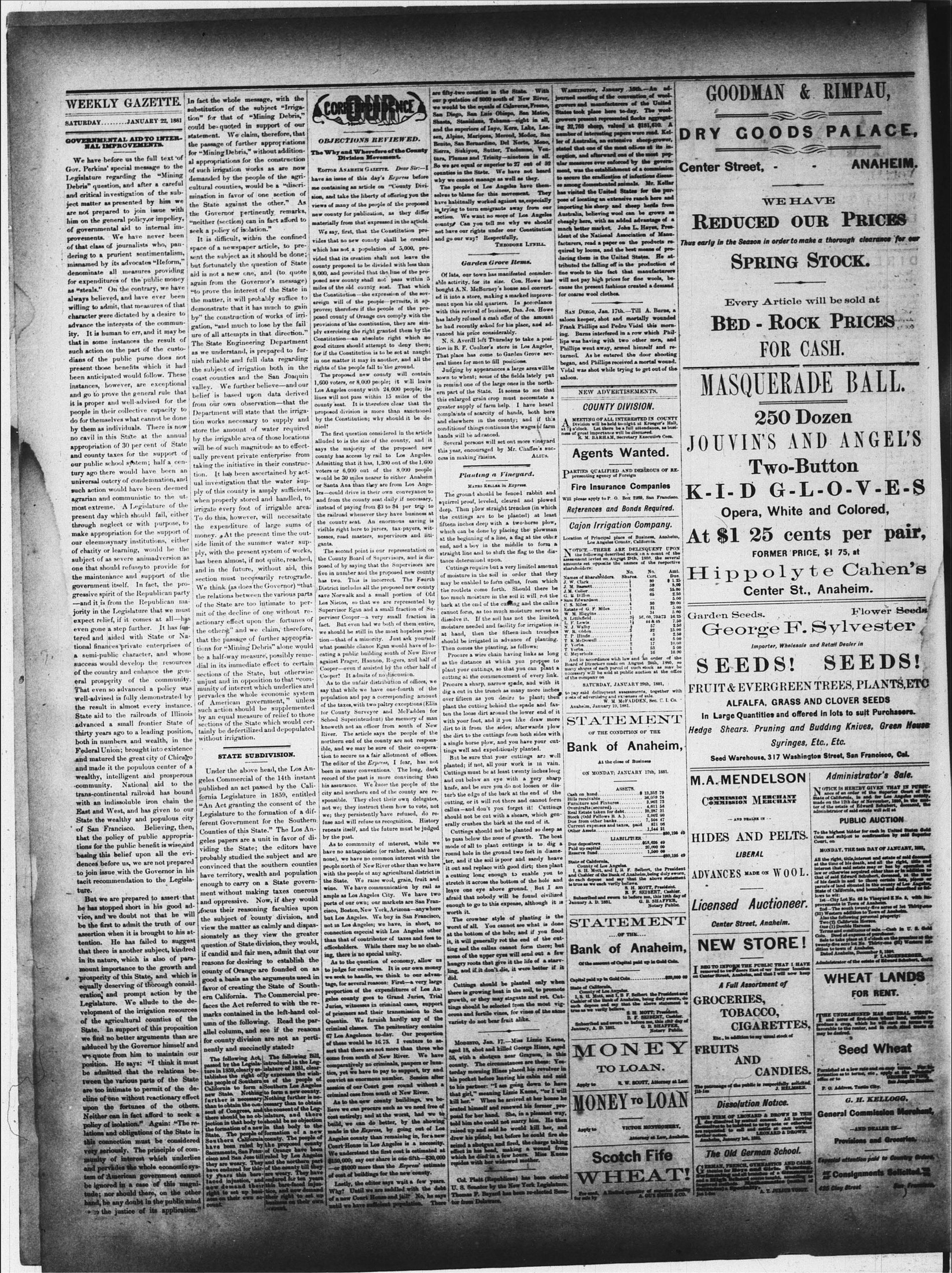
Searchable text
WEEKLY GAZETTE.
SATURDAY...JANUARY 22, 1881
GOVERNMENTAL AID TO INTER-NAL IMPROVEMENTS.
We have before us the full text of Gov. Perkins' special message to the Legislature regarding the "Mining Debris" question, and after a careful and critical investigation of the subject matter as presented by him we are not prepared to join issue with him on the general policy or impolicy, of governmental aid to internal improvements. We have never been of that class of journalists who, pandering to a prurient sentimentalism, misnamed by its advocates "Reform," denominate all measures providing for expenditures of the public money as "steals." On the contrary, we have always believed, and have ever been willing to admit, that measures of that character were dictated by a desire to advance the interests of the community. It is human to err, and it may be that in some instances the result of such action on the part of the custodians of the public purse does not present those benefits which it had been anticipated would follow. These instances, however, are exceptional and go to prove the general rule that it is proper and well-advised for the people in their collective capacity to do for themselves what cannot be done by them as individuals. There is now no cavil in this State at the annual appropriation of 30 per cent of State and county taxes for the support of our public school system; half a century ago there would have been an
In fact the whole message, with the substitution of the subject "Irrigation" for that of "Mining Debris," could be quoted in support of our statement. We claim, therefore, that the passage of further appropriations for "Mining Debris," without additional appropriations for the construction of such irrigation works as are now demanded by the people of the agricultural counties, would be a "discrimination in favor of one section of the State against the other." As the Governor pertinently remarks, "neither (section) can in fact afford to seek a policy of isolation."
It is difficult, within the confined space of a newspaper article, to present the subject as it should be done; but fortunately the question of State aid is not a new one, and (to quote again from the Governor's message) "to prove the interest of the State in the matter, it will probably suffice to demonstrate that it has much to gain by" the construction of works of irrigation, "and much to lose by the failure of all attempts in that direction." The State Engineering Department as we understand, is prepared to furnish reliable and full data regarding the subject of irrigation both in the coast counties and the San Joaquin valley. We further believe—and our belief is based upon data derived from our own observation—that the Department will state that the irrigation works necessary to supply and store the amount of water required by the irrigable area of those locations will be of such magnitude as to effectually prevent private enterprise from taking the initiative in their construction. It has been ascertained by act-
been anticipated would follow. These instances, however, are exceptional and go to prove the general rule that it is proper and well-advised for the people in their collective capacity to do for themselves what cannot be done by them as individuals. There is now no cavil in this State at the annual appropriation of 30 per cent of State and county taxes for the support of our public school system; half a century ago there would have been an universal outcry of condemnation, and such action would have been deemed agrarian and communistic to the utmost extreme. A Legislature of the present day which should fail, either through neglect or with purpose, to make appropriation for the support of our eleemosynary institutions, either of charity or learning, would be the subject of as severe animadversion as one that should refuse to provide for the maintenance and support of the government itself. In fact, the progressive spirit of the Republican party—and it is from the Republican majority in the Legislature that we must expect relief, if it comes at all—has even gone a step further. It has fostered and aided with State or National finances private enterprises of a semi-public character, and whose success would develop the resources of the country and enhance the general prosperity of the community. That even so advanced a policy was well-advised is fully demonstrated by the result in almost every instance. State aid to the railroads of Illinois advanced a small frontier State of thirty years ago to a leading position, both in numbers and wealth, in the Federal Union; brought into existence and matured the great city of Chicago and made it the populous center of a wealthy, intelligent and prosperous community. National aid to the trans-continental railroad has bound with an indissoluble iron chain the East and West, and has given to our State the wealthy and populous city of San Francisco. Believing, then, that the policy of public appropriations for the public benefit is wise, and basing this belief upon all the evidences before us, we are not prepared to join issue with the Governor in his tacit recommendation to the Legislature.
STATE SUBDIVISION.
Under the above head, the Los Angeles Commercial of the 14th instant published an act passed by the California Legislature in 1859, entitled "An Act granting the consent of the Legislature to the formation of a different Government for the Southern Counties of this State." The Los Angeles papers are a unit in favor of dividing the State; the editors have probably studied the subject and are convinced that the southern counties have territory, wealth and population enough to carry on a State government without making taxes onerous coast counties and the San Joaquin valley. We further believe—and our belief is based upon data derived from our own observation—that the Department will state that the irrigation works necessary to supply and store the amount of water required by the irrigable area of those locations will be of such magnitude as to effectually prevent private enterprise from taking the initiative in their construction. It has been ascertained by actual investigation that the water supply of this county is amply sufficient, when properly stored and handled, to irrigate every foot of irrigable area. To do this, however, will necessitate the expenditure of large sums of money. At the present time the outside limit of the summer water supply, with the present system of works, has been almost, if not quite, reached, and in the future, without aid, this section must necessarily retrograde. We think (as does the Governor) "that the relations between the various parts of the State are too intimate to permit of the decline of one without reactionary effect upon the fortunes of the others," and we claim, therefore, that the passage of further appropriations for "Mining Debris" alone would be a half-way measure, possibly remedial in its immediate effect to certain sections of the State, but otherwise unjust and in opposition to that "community of interest which underlies and pervades the whole economic system of American government," unless such action should be supplemented by an equal measure of relief to those sections of the State which would certainly be defertilized and depopulated without irrigation.
The editor of been in many record of these assurances city and north sponsible. Not we; they we; they per fuse and will repeats itself by the past.
As to com have no ant n none), we ha people north with the peo State. wine. We sample as Lo
with an indissoluble iron chain the East and West, and has given to our State the wealthy and populous city of San Francisco. Believing, then, that the policy of public appropriations for the public benefit is wise, and basing this belief upon all the evidences before us, we are not prepared to join issue with the Governor in his tacit recommendation to the Legislature.
But we are prepared to assert that he has stopped short in his good advice, and we doubt not that he will be the first to admit the truth of our assertion when it is brought to his attention. He has failed to suggest that there is another subject, kindred in its nature, which is also of paramount importance to the growth and prosperity of this State, and which is equally deserving of thorough consideration, and prompt action by the Legislature. We allude to the development of the irrigation resources of the agricultural counties of the State. In support of this proposition we find no better arguments than are adduced by the Governor himself and we quote from him to maintain our position. He says: "I think it must be admitted that the relations between the various parts of the State are too intimate to permit of the decline of one without reactionary effect upon the fortunes of the others. Neither can in fact afford to seek a policy of isolation." Again: "The relations and obligations of the State in this connection must be considered very seriously. The principle of community of interest which underlies and pervades the whole economic system of American government cannot be ignored in a case of this magnitude; nor should there, on the other hand, be any doubt in the public mind in the justice of its application."
An Act granting the consent of the Legislature to the formation of a different Government for the Southern Counties of this State." The Los Angeles papers are a unit in favor of dividing the State; the editors have probably studied the subject and are convinced that the southern counties have territory, wealth and population enough to carry on a State government without making taxes onerous and oppressive. Now, if they would focus their reasoning faculties upon the subject of county division, and view the matter as calmly and dispassionately as they view the greater question of State division, they would, if candid and fair men, admit that our reasons for desiring to establish the county of Orange are founded on as good a basis as the arguments used in favor of creating the State of Southern California. The Commercial prefaces the Act referred to with the remarks contained in the left-hand column of the following. Read the parallel column, and see if the reasons for county division are not as pertinently and succinctly stated:
The following Act, passed by the Legislature in 1859, clearly establishes the right of the people of Southern California to form a new State. Nothing further is necessary than to obtain the consent of Congress, and there should be no objection in that body to the formation of a new State. The people of Southern California have been ruled by Sacramento, San Francisco and San Jose till they are weary. They have endured for thirty years this harbored injustice, and now demand their right to set up businesses on their own account.
The following Bill, introduced in the Legislature of 1881, clearly expresses the wishes of the people of Southern Los Angeles to form a new county. Nothing further is necessary than to obtain the consent of the Legislature, and there should be no objection in that body to the formation of a new county. The people of the proposed county of Orange have been ruled by Los Angeles and the northern part of the county till they are weary. They have endured for ten years this barn-faced injustice, and now demand their right to set up businesses on their own account.
OBJECTIONS REVIEWED.
The Why and Wherefore of the County Division Movement.
EDITOR ANAHEIM GAZETTE. Dear Sir:—I have an issue of this day's Express before me containing an article on "County Division, and take the liberty of offering you the views of many of the people of the proposed new county for publication, as they differ materially from that expressed in the article.
We say, first, that the Constitution provides that no new county shall be created which has not a population of 5,000, provided that its creation shall not leave the county proposed to be divided with less than 8,000, and provided that the line of the proposed new county shall not pass within 5 miles of the old county seat. That which the Constitution—the expression of the sovereign will of the people—permits, it approves; therefore if the people of the proposed county of Orange can comply with the provisions of the constitution, they are simply exercising the right granted them by the Constitution—an absolute right which no good citizen should attempt to deny them; for if the Constitution is to be set at naught in one matter it may in another, and all the rights of the people fall to the ground.
The proposed new county will contain 1,600 voters, or 8,000 people; it will leave Los Angeles county with 24,000 people; its lines will not pass within 15 miles of the county seat. It is therefore clear that the proposed division is more than sanctioned by the Constitution; why should it be denied?
The first question considered in the article alluded to is the size of the county, and it says the majority of the proposed new county has access by rail to Los Angeles. Admitting that it has, 1,300 out of the 1,600 voters or 6,000 out of the 8,000 people are fifty-two counties in the State. With our population of 8000 south of New River, we would be the equals of Calaveras, Presno, San Diego, San Luis Obispo, San Mateo, Shasta, Stanislaws, Tehama—eight in all, and the superiors of Inyo, Kern, Lake, Lasen, Alpine, Mariposa, Merced, Modos, San Benito, San Bernardino, Del Norte, Mono, Sierra, Siskiyou, Sutter, Taulumne, Ventura, Plumas and Trinity—nineteen in all. So we are equal or superior to 27 out of 32 counties in the State. We have not heard why we cannot manage as well as they.
The people of Los Angeles have themselves to blame for this movement. They have habitually worked against us, especially in trying to turn emigrants away from our section. We want no more of Los Angeles county. Can you tell me why we should not have our rights under our Constitution and go our way? Respectfully,
THEODORE LYNILL.
Garden Grove Items.
Of late, our town has manifested considerable activity, for its size. Con. Howe has bought A.N. McBurney's house and converted it into a store, making a marked improvement upon his old quarters. In accordance with this revival of business, Dea. Jos. Howe has lately refused a cash offer of the amount he had recently asked for his place, and advanced his price considerably.
N. S. Averill left Thursday to take a position in B. F. Coulter's store in Los Angeles. That place has come to Garden Grove several times for men to fill positions.
Judging by appearances a large area will be sown to wheat; some of the fields lately put in remind one of the large ones in the northern part of the State. It seems to me that this enlarged grain crop must necessitate a greater supply of farm help. I have heard complaints of scarcity of hands, both here and elsewhere in the county; and if this condition of things continues the wages of farm hands will be advanced.
Several persons will set out more vineyard this year, encouraged by Mr. Chaffee's success in making raisins.
WASHINGTON, January 19th.—An adjourned meeting of the convention of wool-growers and manufacturers of the United States took place here today. The wool-growers present represented flocks aggregating 32,768 sheep, valued at $181,610. A number of interesting papers were read. Keller of Australia, an extensive sheep-grower, stated that one of the most obvious at its inception, and afterward one of the most popular measures ever enforced by the government, was the establishment of a commission to secure the eradication of infections diseases among domesticated animals. Mr. Kellar has visited the United States for the purpose of locating an extensive ranch here and importing his sheep and sheep herds from Australia, believing wool can be grown as cheaply here, with an added advantage of much better market. John L. Hayes, President of the National Association of Manufacturers, read a paper on the products required by looms, and the best means producing them in the United States. He attributed the falling off in the production of fine wools to the fact that manufacturer will not pay high prices for fine wools, because the present fashions created a demand for coarse wool clothes.
SAN DIEGO, Jan. 17th.—Till A. Burns, saloon keeper, shot and mortally wounded Frank Phillips and Pedro Vidal this morning. Burns interfered in a row which Phillips was having with two other men, and Phillips went away, armed himself and returned. As he entered the door shooting began, and Phillips received a mortal wound. Vidal was shot while trying to get out of the saloon.
NEW ADVERTISEMENTS.
COUNTY DIVISION.
A MEETING OF ALL INTERESTED IN COUNTY Division will be held tonight at Kroger's Haunt at 7 o'clock. Let there be a full attendance, as builness of great importance will be discussed.
K.M.BARHAM, Secretary Executive Com.
Agents Wanted.
PARTIES QUALIFIED AND DESIROUS OF R
The proposed new county will contain 1,600 voters, or 8,000 people; it will leave Los Angeles county with 24,000 people; its lines will not pass within 15 miles of the county seat. It is therefore clear that the proposed division is more than sanctioned by the Constitution; why should it be denied?
The first question considered in the article alluded to is the size of the county, and it says the majority of the proposed new county has access by rail to Los Angeles. Admitting that it has, 1,300 out of the 1,600 voters or 6,000 out of the 8,000 people would be 30 miles nearer to either Anaheim or Santa Ana than they are from Los Angeles—could drive in their own conveyance to and from the county seat daily if necessary, instead of paying from $3 to $4 per trip to the railroad whenever they have business at the county seat. An enormous saving is visible right here to jurors, tax-payers, witnesses, road masters, supervisors and litigants.
The second point is our representation on the County Board of Supervisors, and is disposed of by saying that the Supervisors are five in number and the proposed new county has two. This is incorrect. The Fourth District includes all the proposed new county save Norwalk and a small portion of Old Los Nietos, so that we are represented by Supervisor Egan and a small fraction of Supervisor Cooper—a very small fraction in fact. But even had we both of them entire, we should still in the most hopeless position—that of a minority. Just ask yourself what possible chance Egan would have of locating a public building south of New River against Prager, Hannon, Rogers, and half of Cooper—even if assisted by the other half of Cooper? It admits of no discussion.
As to the unfair distribution of offices, we say that while we have one-fourth of the population and pay a corresponding amount of the taxes, with two paltry exceptions (Ellis tor County Surveyor and McFadden for School Superintendent) the memory of man knoweth not an officer from south of New River. The article says the people of the northern end of the county are not responsible, and we may be sure of their co-operation to secure us a fair allotment of offices.
The editor of the Express, I fear, has not been in many conventions. The long, dark record of the past is more convincing than his assurance. We know the people of the city and northern end of the county are responsible. They elect their own delegates, not we; they instruct them how to vote, not we; they persistently have refused, do refuse and will refuse us recognition. History repeats itself, and the future must be judged by the past.
As to community of interest, while we have no antagonistic (or rather, should have none), we have no common interest with the people north of New River other than we have with the people of any agricultural district in the State. We raise wool, grain, fruit and wine. We have communication by rail as Los Angeles City. We have two sown to wheat; some of the fields lately put in remind one of the large ones in the northern part of the State. It seems to me that this enlarged grain crop must necessitate a greater supply of farm help. I have heard complaints of scarcity of hands, both here and elsewhere in the county; and if this condition of things continues the wages of farm hands will be advanced.
Several persons will set out more vineyard this year, encouraged by Mr. Chaffee's success in making raisins.
Planting a Vineyard.
MATZO KELLER in Express.
The ground should be fenced rabbit and squirrel proof, leveled, cleared and plowed deep. Then plow straight trenches (in which the cuttings are to be planted) at least fifteen inches deep with a two-horse plow, which can be done by placing the plowman at the beginning of a line, a flag at the other end, and a boy in the middle to form a straight line and to shift the flag to the distance determined upon.
Cuttings require but a very limited amount of moisture in the soil in order that they may be enabled to form callus, from which the rootlets come forth. Should there be too much moisture in the soil it will rot the bark at the end of the cutting and the callus cannot form, as too much moisture serves to dissolve it. If the soil has not the limited moisture needed and facility for irrigation is at hand, then the fifteen inch trenches should be irrigated in advance of planting. Then comes the planting, as follows:
Procure a wire chain having links as long as the distance at which you propose to plant your cuttings, so that you can plant a cutting at the commencement of every link. Procure a sharp, narrow spade, and with it dig a cut in the trench as many more inches over fifteen as you desire to plant; then plant the cutting behind the spade and fasten the loose dirt around the lower end of it with your foot, and if you like draw more dirt to it from the sides; afterwards plow the dirt to the cuttings from both sides with a single horse plow, and you have your cuttings well and expeditionally planted.
But be sure that your cuttings are well planted; if not, all your work is in vain. Cuttings must be at least twenty inches long and cut below an eye with a very sharp knife, and be sure you do not loosen or disturb the edge of the bark at the end of the cutting, or it will rot there and cannot form callus—and don't you forget it! Cuttings should not be cut with a shear; which generally crushes the bark at the end of it.
Cuttings should not be planted so deep as to pass below the zone of growth. The best mode of all to plant cuttings is to dig a round hole in the ground two feet in diameter, and if the soil is poor and sandy heave it out and replace with good dirt; then plant a cutting long enough to enable you to stretch it across the bottom of the hole and leave one eye above ground. But I am afraid that nobody will be found civilized
SALOON.
NEW ADVERTISEMENTS.
COUNTY DIVISION.
A MERTING OF ALL INTERESTED IN COUNTY Division will be held tonight at Krooger's Hall at 7 o'clock. Let there be a full attendance, as business of great importance will be discussed.
R.M.BARHAM, Secretary Executive Com.
Agents Wanted.
PARTIES QUALIFIED AND DESIROUS OF PRESENTING AGENCY OF FOREIGN Fire Insurance Companies
Will please apply to P.O. Box 2299, San Francisco
References and Bonds Required
Cajon Irrigation Company.
Location of Principal place of Business, Anaheim Los Angeles County, California.
NOTICE—THERE ARE DELINQUENT UPON THE following described stock on a count of assessment levied on August 28th, 1880. The seven amounts set opposite the names of the respective shareholders:
No. No.A
Names of Shareholders Shares Cert.
J.W. Clark 1
J.M. Basnett 1
J.M. Coller 3
G.R. Dillon 6
Sam Edwardson 1
C.S. Miles 4
Estate G.F. Miles 1
W.M. Higgins 1
S.Littelfield 3
N.J. Lewis 1
W.J. Walby 1
W.R. Olden 3
T.P. Hinde 5
T.K. McDewell 4
P.Yorla 2
T.Yorla 1
C.Meyeriols 2
16
And in accordance with law and an order of Board of Directors made on August 28th, 1880, many shares of each parcel of such stock as may necessary will be sold at public auction at the office company on
SATURDAY, JANUARY 29th, 1881,
To pay said delinquent assessments, together costs of advertising and expenses of sale.
W.M. McFADDEN, Sec.C.I.C.
Anaheim January 10, 1881.
STATEMENT OF THE Bank of Anaheim
At the close of Business
ON MONDAY; JANUARY 17th, 1881.
ASSETS.
Cash on hand... $13,352 79
Bills receivable... $36,059 24
Furniture and Fixtures... $3,962 73
Overdrafts secured... $4,611 58
Real Estate taken for debt... $10,287 31
Stock (Odd Fellows A.A.)... $2,002 00
Due from other banks... $7,504 47
Current expenses and taxes paid... $821 06
Other Assets... $1,544 21
LIABILITIES... $58,605 49
Paid up capital... $20,000 00
Reserve fund... $1,500 00
State of California.
County of Los Angeles.
I.S.H. Mott, and I.R.F. Seibert, the President and Cashier of the Bank of Anaheim being daily do decompose and say that the above state is true as we each verily believe.
S.H. MOTT, President R.F. SEIBERT,
Subscribed and sworn to before me this morning.
As to community of interest, while we have no antagonistic (or rather, should have none), we have no common interest with the people north of New River other than we have with the people of any agricultural district in the State. We raise wool, grain, fruit and wine. We have communication by rail as ample as Los Angeles City. We have two ports of our own; our markets are San Francisco, Boston, New York, Arizona—anywhere but Los Angeles. We buy in San Francisco, not in Los Angeles; we have, in short, no connection especial with Los Angeles other than that of contributor of taxes and fees to officeholders. While there may be no clashing, there is no special unity.
As to the question of economy, allow us to judge for ourselves. It is our own money we seek to handle, we think to our advantage, for several reasons: First—a very large proportion of the expenditures of Los Angeles county goes to Grand Juries, Trial Juries, witnesses in criminal cases, support of prisoners and their transmission to San Quentin. We furnish hardly any of the criminal classes. The penitentiary contains 67 Los Angelenos to-day. Our proportion of these would be 16.75. I venture to assert that there are not more than three who come from south of New River. We have comparatively no criminals, paupers or lunatics, yet we have to pay to support, try and convict an enormous number. Session after session of our Court goes round without a criminal case from south of New River.
As to the new county buildings, we believe we can procure such as we need free of cost entirely; and at the worst, had we to build, we can do better, by the showing made in the Express, by going out of Los Angeles county than remaining in, for a new Court House in Los Angeles is a necessity. We understand the first cost is estimated at $150,000; say our share is one-fifth—$30,000—or $1000 more than the Express' estimate of cost of buildings for the new county.
Lastly, the editor says wait a few years. Why? Until we are saddled with the debt of a new Court House and jail? No, he says until we have sufficient population. There cutting, or it will rot there and cannot form callus—and don't you forget it! Cuttings should not be cut with a shears, which generally crushes the bark at the end of it.
Cuttings should not be planted so deep as to pass below the zone of growth. The best mode of all to plant cuttings is to dig a round hole in the ground two feet in diameter, and if the soil is poor and sandy heave it out and replace with good dirt; then plant a cutting long enough to enable you to stretch it across the bottom of the hole and leave one eye above ground. But I am afraid that nobody will be found civilized enough to go to this expense, although it is worth it.
The crowbar style of planting is the worst of all. You cannot see what is done at the bottom of the hole; and if you flood it, it will generally rot the end of the cutting and the callus cannot form there; but some of the upper eyes will send out a few hungry roots that give it the life of a starving, and if it don't die, it were better if it did.
Cuttings should be planted only when there is growing heat in the soil, to promote growth, or they may stagnate and rot. Cuttings should be selected from the most vigorous and fertile vines, for vines of the same variety do not bear fruit alike.
Modesto, Jan. 17.—Miss Lizzie Kuene, aged 18, shot and killed George Hines, aged 55, with a shotgun near Grayson, in this county. The circumstances are these: Yesterday morning Hines placed his revolver in his pocket before leaving his cabin and said to his partner: "I am going down to have that girl," meaning Lizzie Kuene, "or I will kill her." When he arrived at her house he seated himself and renewed his former proposal for her hand. She, in a pleasant way, told him she could not marry him. He then raised up and said he would kill her, and drew his pistol; but before he could fire she seized a shotgun and fired, the charge taking effect in his head, making a wound from which he died in a few hours. Miss Kuene resides with her widowed mother.
Col. Flatt (Republican) has been elected U.S. Senator by the New York Legislature. Thomas P. Bayard has been re-elected Senator from Delaware.
GOODMAN & RIMPAU,
DRY GOODS PALACE,
Center Street, - - ANAHEIM.
WE HAVE
REDUCED OUR PRICES
Thus early in the Season in order to make a thorough clearance for our
SPRING STOCK.
Every Article will be sold at
BED - ROCK PRICES
FOR CASH.
MASQUERADE BALL.
250 Dozen
JOUVIN'S AND ANGEL'S
Two-Button
MASQUERADE BALL.
250 Dozen
JOUVIN'S AND ANGEL'S
Two-Button
K-I-D G-L-O-V-E-S
Opera, White and Colored,
At $1 25 cents per pair,
FORMER PRICE, $1 75, at
Hippolyte Cahen's
Center St., Anaheim.
Garden Seeds.
Flower Seeds
George F. Sylvester
Importer, Wholesale and Retail Dealer in
SEEDS! SEEDS!
FRUIT & EVERGREEN TREES, PLANTS, ETC
ALFALFA, GRASS AND CLOVER SEEDS
In Large Quantities and offered in lots to suit Purchasers.
Hedge Shears. Pruning and Budding Knives, Green House
Syringes, Etc., Etc.
Seed Warehouse, 317 Washington Street, San Francisco, Cal.
M.A. MENDELSON
COMMISSION MERCHANT
AND DEALER IN
HIDES AND PELTS.
LIBERAL
ADVANCES MADE ON WOOL.
Administrator's Sale.
NOTICE IS HEREBY GIVEN THAT IN PURSUANCE of an order of the Superior Court of the State of California, in and for Los Angeles county, made on the 12th day of November, 1880, in the master of the estate of Edward Schubert, deceased, the administrator of said estate will sell at
PUBLIC AUCTION
To the highest bidder for cash in United States Gold Coin and subject to confirmation by said Superior Court, on
MONDAY, THE 24TH DAY OF JANUARY, 1881,
All the right, title, interest and estate of said deceased at the time of his death, and all the right, title and interest that said estate may or has by operation of law or otherwise acquired other than or in addition to that of said Edward Schubert, deceased, at the time of his death in and to those certain lee, pleaser or parcels of land situated in the county of Los Angeles, State of California, and bounded and described no follows to it:
HIDES AND PELTS.
LIBERAL
ADVANCES MADE ON WOOL.
Licensed Auctioneer.
Center Street, Anaheim.
NEW STORE!
I REG TO INFORM THE PUBLIC THAT I HAVE removed to two doors East of my former location on Center Street, Anaheim, and that I will now keep
A Full Assortment of
GROCERIES,
TOBACCO,
CIGARETTES.
Etc., in addition to my usual stock of
FRUITS
AND
CANDIES.
The patronage of the public is respectfully solicited.
J. HELMSEN.
Dissolution Notice.
THE FIRM OF LEONARD & DROWN IS THIS day dissolved by mutual consent. All knowing themselves to be indebted to us by note or otherwise are requested to call and settle at once without further notice.
LEONARD & DROWN.
Anaheim, January 1st, 1831.
The Old German School.
GERMAN, FRENCH, GYMNASTICS AND CALIBRATION FOR MAYA and GIRLS. Forming, Swimming and all branches of a Grammar school and a High School course taught, according to improved methods. Mathematical (method of Siemens) a Specialty.
A. T. JULIUS VONZEL.
PUBLIC AUCTION
To the highest bidder for cash in United States Gold Coin and subject to confirmation by said Superior Court, on
MONDAY, THE 24th DAY OF JANUARY, 1831,
All the right, title, interest and estate of said deceased at the time of his death, and all the right, title and interest that said estate may or has by operation of law or otherwise acquired other than or in addition to that of said Edward Schubert, deceased, at the time of his death in and to those certain lots, places or parcels of land situated in the county of Los Angeles, State of California, and bounded and described no follows to wit:
1st—City Lot No. 68 in Vineyard E No. 5, with improvements in Town of Anaheim.
2nd—The south twenty-five acres of 1st Thirty-one (31) Western addition to Town of Anaheim.
Also the following personal property:
Two (2) California Horse.
One (1) Double Harness.
Terms and conditions of sale.—Cash in U. S. Gold Coin. Dead at expiration of purchaser.
Sale to take place at 2 o'clock on the premises at the twenty-five acre lot No. Thirty-one (31) Western addition to town of Anaheim.
Dated Anaheim, December 8, 1831.
F. LANGENBERGER.
Administrator of the estate of Edward Schubert, Gold Coin.
WHEAT LANDS
FOR RENT.
THE UNDERSIGNED HAS SEVERAL THROWS and acres of first-class wheat land, articles to produce a crop, which he will cast on tame very favorable to the renter, and in each district treats as may be desired.
Seed Wheat
Furnished at a low rate and on may terms. For information as to terms, etc., apply at the "General Office" or to
P. O. Address, Tustin City.
G. H. KELLOGG.
General Commission Merchant,
—and DEALER IN—
Provisions and Groceries.
Especial attention paid to Country Orders.
Consignments Solicited.
425 Clay Street San Francisco.