anaheim-gazette 1881-01-01
Scanned page
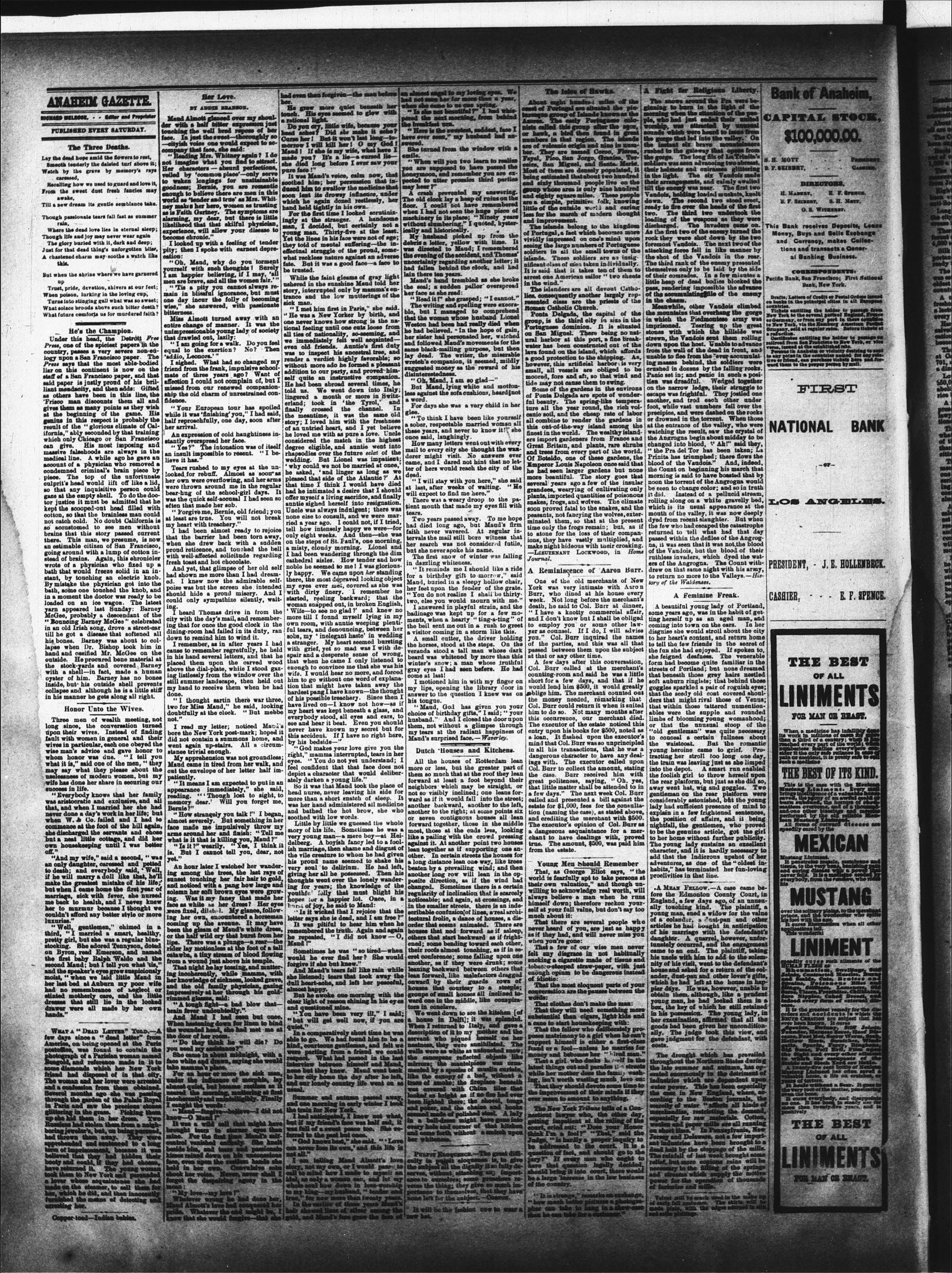
Searchable text
ANAHEIM GAZETTE.
RICHARD MELROSE. - Editor and Proprietor
FUBLISHED EVERY SATURDAY.
The Three Deaths.
Lay the dead hope amid the flowers to rest,
Smooth tenderly the daisied turf above it;
Watch by the grave by memory's rays caressed,
Hacalling how we used to guard and love it,
From the sweet dust fresh fancies may awake,
Till a new dream its gentle semblance take.
Though passionate tears fall fast as summer rain,
Where the dead love lies in eternal sleep;
Though life and joy may never wear again
The glory burled with it, dark and deep;
Just for that dead thing's unforgetten bliss,
A chastened charm may soothe a watch like this.
But when the shrine where we have garnered up
Trust, pride, devotion, shivers at our feet;
When poison, lurking in the loving cup,
Turns into stinging gall what was so sweet;
What solace broods above such bitter death?
What future comforts us for murdered faith?
He's the Champion.
Under this head, the Detroit Free Press, one of the spiciest papers in the country, passes a very severe non-entology upon a San Francisco paper. The Press says that the most able-bodied liar on this continent is now on the staff of a San Francisco paper, and that said paper is justly proud of his brilliant mendacity, and then adds: Gifted as others have been in this line, the Frisco man discounts them all and gives them as many points as they wish at the beginning of the game. His genius in this respect is probably the result of the "glorious climate of California," ably seconded by that training which only Chicago or San Francisco can give. His most imposing and massive falsehoods are always in the medical line. A while ago he gave an account of a physician who removed a condemned criminal's brain piece by Her Love.
BY ADDIE BRANSON.
Mand Almott glanced over my shoulder with a half bitter expression just touching the well brad repose of her face. In just the sweet—thoroughly so—cityish voice one would expect to accompany that face, she said:
"Reading Mrs. Whitney again? I do not imagine what you find to attract. Her characters—absurd perfections, veiled by 'common place'—only serve to waken longings for unattainable goodness; Bernie, you are romantic enough to believe there are men in this world as 'tender and true' as Mrs. Whitney makes her hero, women as trusting as is Faith Gartney. The symptoms are alarming, my dear, but there is little likelihood that that skilful physician, experience, will allow your disease to become chronic."
I looked up with a feeling of tender pity; then I spoke with earnest depreciation:
"Oh, Maud, why do you torment yourself with such thoughts! Surely I am happier believing, if I may, 'all men are brave, and all the women fair.'"
"Tis a pity you cannot always remain in blissful ignorance, but must one day incur the folly of becoming wise," she answered, with passionate bitterness.
Miss Almott turned away with an entire change of manner. It was the unimpressionable young lady of society that drawled out, lazily:
"I am going for a walk. Do you feel equal to the exertion? No? Then 'addio, Leonora.'"
I sighed. What had so changed my friend from the frank, impulsive schoolmate of three years ago? Want of affection I could not complain of, but I missed from our renewed companionship the old charm of unrestrained confidence.
"Your European tour has spoiled while it was 'finishing' you," I had said, half reproachfully, one day, soon after her arrival.
An expression of cold haughtiness instantly overspread her face.
"Yes?" The intonation was of itself an insult impossible to resent. "I believe it has."
Tears rushed to my eyes at the unlooked for rebuff. Almost as soon as had even then forgiven—their her.
He grew more quiet touch. His eyes seemed a rational light.
Do you cry, little wife, head ache? Did she mourn I will kill her! Mand! If she is my wife made you? It's a lie—she died long before I pure face!"
It was Mand's voice, cootbed him; her persuaded him to swallow the soon lost its drowsy in which he again dozed hand held tightly in his cage.
For the first time I lookingly at the stranger man, I decided, but o young man. Thirty-five Yet the lines in his face were told of mental suffeffectual struggle of the what reckless nature against fate. But it was a good be trusted.
While the faint gleam ushered in the sunshine story, interrupted only by trance and the low murk sick man.
"I met him first in Prison." He was a New Yorker one never knows how tional feeling until one of ties of nationality, so we immediately felt we even old friends. Aunts was to inspect his ance render a verdict highly without more ado he for addition to our party, and self quite an instruction He had been abroad seven told us. We went down lingered a month or erland; took in 'the finally crossed the meantime, it was story; I loved him with of an untried heart, and he loved me with as pur considered the match degree eligible, and au rhapsodies over the futu wedding. But Lionel 'why could we not be he asked,' and linger
staff of a San Francisco paper, and that said paper is justly proud of his brilliant mendacity, and then adds: Gifted as others have been in this line, the 'Frisco man discounts them all and gives them as many points as they wish at the beginning of the game. His genius in this respect is probably the result of the "glorious climate of California," ably seconded by that training which only Chicago or San Francisco can give. His most imposing and massive falsehoods are always in the medical line. A while ago he gave an account of a physician who removed a condemned criminal's brain piece by piece. The top of the unfortunate culprit's head would lift off like a lid, so that any inquisitive person could gaze at the empty shell. To do the doctor justice it must be admitted that he kept the scooped-out head filled with cotton, so that the brainless man could not catch cold. No doubt California is so accustomed to see men without brains that this story passed current there. This man, we presume, is now an estimable citizen of San Francisco, going around with a lump of cotton instead of brains. Again, this chronicler wrote of a physician who fixed up a bath that would freeze solid in an instant, by touching an electric knob. By mistake the physician got into the bath, some one touched the knob, and in a moment the doctor was ready to be loaded on an ice wagon. The latest yarn appeared last Sunday: Barney McGee, probably a descendant of the "Bouncing Barney McGee" celebrated in an old Irish song, drove a street-car till he got a disease that softened all his bones. Barney was about to collapse when Dr. Bishop took him in hand and ossified Mr. McGee on the outside. He procured bene material at the stock-yards and covered Barney with a shell—in fact, made a human oyster of him. Barney has no bones inside, but his outside shell prevents collapse and although he is a little stiff in his manner he gets along all right.
Honor Unto the Wives.
Three men of wealth meeting, not long since, the conversation turned upon their wives. Instead of finding fault with women in general and their wives in particular, each one obeyed the wise man's advice and gave honor to whom honor was due. "I tell you what it is," said one of the men, "they may say what they please about the uselessness of modern women, but my wife has done her share in securing our success in life.
"Everybody knows that her family was aristocratic and exclusive, and all that, and when I married her she had never done a day's work in her life; but when W. & Co. failed and I had to commence at the foot of the hill again, she discharged the servants and chose but a neat little cottage, and did her own housekeeping until I was better off."
"And my wife," said a second, "was an only daughter, caressed and petted to death; and everybody said, 'Well, if he will marry a doll like that, he'll make the greatest mistake of his life,' but when I came home the first year of marriage, sick with fever, she nursed mate of three years ago? Want or affection I could not complain of, but I missed from our renewed companionship the old charm of unrestrained confidence.
"Your European tour has spoiled while it was 'finishing' you," I had said, half reproachfully, one day, soon after her arrival.
An expression of cold haughtiness instantly overspread her face.
"Yes?" The intonation was of itself an insult impossible to resent. "I believe it has."
Tears rushed to my eyes at the unlooked for rebuff. Almost as soon as her own were overflowing, and her arms were thrown around me in the regular bear-hug of the school-girl days. It was the quick self-accusal I had seen so often that made her sob.
"Forgive me, Bernie, old friend; you at least are true. You will not break my heart with treachery."
I had been almost ready to rejoice that the barrier had been torn away, when she drew back with a sudden proud reticence, and touched the bell with well-affected solicitude regarding fresh toast and hot chocolate.
And yet, that glimpse of her old self had shown me more than I had dreamed. I knew now the admirable self-poise was but the screen she intended should hide a proud misery. And I could only sympathize silently, waiting.
I heard Thomas drive in from the city with the day's mail, and remembering that for once the good clock in the dining-room had failed in its duty, ran down to remind him to wind it.
I remember, as in after years I had cause to remember regretfully, he held in his hand several letters, and that he placed them upon the carved wood above the dial-plate, while I stood gazing listlessly from the window over the still summer landscape, then held out my hand to receive them when he had done.
"I thought sartin there war three, two for Miss Maud," he said, looking doubtfully at the clock. "But mebbe not."
I read my letter; noticed Maud's bore the New York post-mark; hoped it did not contain a summons home, and went again up-stairs. All a circumstance trivial enough.
My apprehension was not groundless; Maud came in tired from her walk, and cut the envelope of her letter half impatiently.
"It means I am expected to put in an appearance immediately," she said, reading. "'Though lost to sight, to memory dear.' Will you forget me, Bernie?"
"How strangely you talk!" I began, almost severely. But something in her face made me impulsively throw my arms around her and finish: "Tell me what is it that is killing you, Maud?"
"Is it?" wearily. "Yes, I think it is. But I cannot tell you, dear, not yet."
An hour later I watched her wandering among the trees, the last rays of sunset touching her fair hair to gold, and noticed with a pang how large and solemn her soft brown eyes were growing. Was it my faney that made her self quite an instruction?
He had been abroad seven told us. We went down lingered a month or so erland; took in 'the meantime', it was story; I loved him with of an untried heart, and he loved me with as pure considered the match degree eligible, and au rhapsodies over the future wedding. But Lionel why could we not be me he asked, 'and linger pleased that side of that time I think I we had he intimated a desire offer myself a living scarce auntie sighed herself in Unole was always indulge none else to consult, and tried a year ago. I could tell how intensely happy only eight weeks. And on the steps of St. Paul's misty, cloudy morning I had been wandering the cathedral aisles. How noble he seemed to me up happy. We came up there, the most degrave my eyes ever met, covet with dirty finery. I started, reeling back woman snapped out, in 'Wife—to see no glad?' more till I found myself own room, with auntie ful tears, and denounce sobs, my 'inelegant hail a stranger. My heart sigh with grief, yet so mad spair and a desperate sigh that when he came I enough to convince me wife. I would hear no him to go without one tion that might have a hardest pang I have known of his possible treacheries have lived on—I know my heart was kept benew everybody stood, all exe see and hear it beat. I never have known my this accident. If I have by his bedside—"
"God makes your love right," mamma interrure eyes. "You do not yet feel confident that this depict a character that stately darken a young life.
So it was that Maud head nurse, never leave more than a short snake was her hand administrate and bathed the hot soothed with low words.
Little by little we guess story of his life. Some very young man—a meddelberg. A boyish fashish marriage, then shamh the vile creature to which his proud name seems very soul to delirium giving her all he possess thoughts went over the ing for years; the kynouthful folly that mans for a hannier
was aristocratic and exclusive, and all that, and when I married her she had never done a day's work in her life; but when W. & Co. failed and I had to commence at the foot of the hill again, she discharged the servants and chose but a neat little cottage, and did her own housekeeping until I was better off."
"And my wife," said a second, "was an only daughter, careless and petted to death; and everybody said, 'Well, if he will marry a doll like that, he'll make the greatest mistake of his life,' but when I came home the first year of marriage, sick with fever, she nursed me back to health, and I never knew her to murmur because I thought we couldn't afford any better style or more luxuries."
"Well, gentlemen," chimed in a third, "I married a smart, healthy, pretty girl, but she was a regular blue-stocking. She adored Tennyson, doted on Byron, read Emerson, and named the first baby Ralph Waldo and the second Maud; but I tell you what 'tis," and the speaker's eyes grew suspiciously moist, "when we laid little Maud in her last bed at Auburn my poor wife had no remembrance of logleot or stinted motherly care, and the little dresses that still lie in the looked drawer were all made by her own hands."
What a "Dead Letter" Told.—A few days since a "dead letter" from America, on being opened at the Paris postoffice, was found to contain the photograph of a Parisian woman named Bengold, and reference made in it to some diamonds which her New York friend had disposed of in that city. The woman and her lover were arrested and a confession from them obtained. Several months ago she was passing through the garden of the Palais Royal in Paris and saw the precious stones glittering in the grass. Ploking them up she hid them in her dress. Two Russians had stolen them from a neighboring jeweler's, but, on being pursued, had thrown them away. They were apprehended and sentenced to a long term of imprisonment, because it was believed that they had hidden their booty and could, if they had chosen, have returned it. The young woman took them to New York and persuaded a lover whose acquaintance she had made on the staircase, to call them for her, which he did, and then innocently furnished the means of detecting and arresting her.
Copper-toad—Indian babies.
How strangely you talk!" I began, almost severely. But something in her face made me impulsively throw my arms around her and finish: "Tell me what is it that is killing you, Maud?"
"Is it?” weearily. “Yes, I think it is. But I cannot tell you, dear, not yet.”
An hour later I watched her wandering among the trees, the last rays of sunset touching her fair hair to gold, and noticed with a pang how large and solemn her soft brown eyes were growing. Was it my fancy that made her face as white as her dress? Her eyes were fixed, dilated. My glance, following her own, encountered a horseman coming up the avenue. It may have been the gleam of Maud's white dress, or the half wild cry that burst from her lips. There was a plunge—a rear—the rider lay motionless at the foot of a tall catawha, a tiny stream of blood flowing from a wound just above his temple.
That night he lay tossing, and muttering incoherently, while mamma, with her knowledge of sickness, looked grave, and the old family physician, gasping impressively at her through his gold-rimmed glasses, mid:
"A tough fight—a bad blow that brain fever undoubtedly."
And Maud I had seen but once. When hastening down for linen to bind the wounded head, she had met me at the door of her room.
"Do they think he will die? Do you need my assistance?" She came in about midnight, with a face white and drawn, saying she would take mamma's place.
For an hour or more the sick man, under the influence of morphine, lay almost quiet, but became restless as it neared the morning, muttering at first incoherently and unintelligibly. Finally I caught the words:
"Maud—forgive—believe—I did not know—O Maud!"
It was a wild call that might have brought tears to shimmer eyes than mine. For the first time Maud's self-control vanished entirely. She knelt beside him, and tears and passionate kisses rained down on his unconscious face, even upon the restless hands she held in her own. Convulsive sobs shook her voice. Never, never shall I forget the despairing agony in the mean:
"My love—my love!"
Whatever wrong he had done her, Maud Almost's love had conquered her pride. Whatever the end might be, I know that she would forgive—that she more than a short snatch was her hand administered and bathed with low words.
Little by little we gutted story of his life. Some very young man—a men delberg. A boyish farish marriage, then shamed his vile creature to whisper very soul to delirium giving her all he possessed thoughts went over the ing for years; the knight youthful folly that no hopes for a happier life burst of joy, he said to:
"Is it wicked that I letter says she is dead,
It was pitiful to her remembered the truth,
he repeated,” I did Maud!”
Sometimes he was “would he ever find his forgive if she but knew
And Maud's tears fell she listened; tears that dull heart-sache, and let almost happy.
But he swoke one more clear light of reason shine and questioned mine.
“You have been vee“ but will get well no quiet.”
In a comparatively able to go. We had for kind, courteous gentleness parting from a respect. What had passed interview between him none but they know.
To her city home the day and our lonely country usual.
Summer and autumn in earl train for New York.
I had anticipated, I but if my friend's face was full of a sweet pea furred to the past but o
"God knows best," she can never lose its own,
not all."
I am telling Mandal story, not my own, or I call to mind how I must idel, as only a woman o whole soul how down it to my king—my husband true,” for now more than
In the earlier of these hair showed lines of gold, and Mandal's face g
had even then forgiven—the man before her.
He grew more quiet beneath her touch. His eyes seemed to glow with a rational light.
Do you cry, little wife, because your head sches? Did she make it ache? Curse her! But it won't last long—to-morrow I will kill her! O my God! Mand! If she is my wife, what have I made you? It's a lie—a cursed lie—she died long before I ever saw your pure face!
It was Mand's voice, calm now, that soothed him; her persuasion that induced him to swallow the medicine that soon lent its drowsy influence, under which he again dozed restlessly, her hand held tightly in his own.
For the first time I looked scrutinizingly at the stranger. A handsome man, I decided, but certainly not a young man. Thirty-five at the least. Yet the lines in his face were not of age; they told of mental suffering—the ineffectual struggle of the proud, somewhat reckless nature against an adverse fate. But it was a good face—a face to be trusted.
While the faint gleams of gray light ushered in the sunshine Maud told her story, interrupted only by mamma's entrance and the low mutterings of the sick man.
"I met him first in Paris," she said. "He was a New Yorker by birth, and one never knows how strong is the national feeling until one cuts loose from all ties of nationality, so seeming, and we immediately felt well acquainted—even old friends. Auntie's first duty was to inspect his ancestral tree, and render a verdict highly favorable; so without more ado he formed a pleasant addition to our party, and proved himself quite an instructive companion. He had been abroad several times, he told us. We went down into Italy; lingered a month or more in Switzerland; took in 'the Tyrol,' and finally crossed the channel. In the meantime, it was the same old story; I loved him with the freshness of an untried heart, and I yet believe he loved me with as pure a love. Uncle considered the match in the highest degree eligible, and auntie went into rhapsodies over the future eclat of the wedding. But Lionel was impatient; 'why could we not be married at once,' he asked, 'and linger as long as we
an almost angel to my loving eye. We had not seen her for more than a year, when she came to us one spring.
"Is she not beautiful?" I had whispered the next morning, from behind the breakfast urn.
"Here is the sweetest, sadest, face I have ever seen," my husband had answered.
She turned from the window with a smile.
"When will you two learn to realize you are supposed to have passed the honeymoon, and remember you are expected to utter proxies third parties may hear?"
A crash prevented my answering. The old clock lay a heap of ruins on the floor. I could not have remembered when I had not seen the huge piece of machinery in its place; "Ninety years without slumbering," I quoted, hysterically and historically.
My husband picked up from the debris a letter, yellow with time. It was directed to Maud; I remembered the evening of the accident, and Thomas' uncertainty regarding another letter; it had fallen behind the clock, and had lain there ten years.
Maud's hand trembled as she broke the seal; a sudden pallor overspread her face as she read:
"Read it!" she grasped; "I cannot."
The writing and spelling were exasperable, but I managed to comprehend that the woman whose husband Lionel Weston had been really died when he had believed. In the hope of gain, her sister had personated her, watched and followed Maud's movements for the same black-mailing purpose, but then lay dead. The writer, the miserable wretch's companion, it seemed, mildly suggested money as the reward of his disinterestedness.
"Oh, Maud, I am so glad—"
But Maud, lying white and motionless against the sofa cushions, heard not a word.
For days she was a very child in her glee.
"To think I have been like yourself a sober, respectable married woman all these years, and never to know it!" she once said, laughingly.
How many letters went out with every mail to every city she thought the wanderer might visit. No answers ever came, and I dared not hint that no letter of hers would reach the city of the dead.
The Isles of Hawks.
About eight hundred miles off the coast of Portugal are situated the picturesque group of Islands known as the Amores. The early Portuguese colonists called this group after the agor, or hawk, a bird then found in great numbers in that region. The islands are of volcanic origin and nine in number. They are named Coroo, Flores, Fayal, Pico, San Jorge, Granica, Terceira, San Miguel, and Santa Maris. Most of them are densely populated, it being estimated that about two hundred and sixty thousand people live on the group whose area is only nine hundred and eighty square miles. These people are a simple, primitive folk, knowing little of the outside world and caring less for the marsh of modern thought and improvement.
The islands belong to the kingdom of Portugal, a fact which becomes more vividly impressed on one's mind upon seeing the large numbers of Portuguese soldiers in all the small towns of the islands. These soldiers are an insignificant class of men taken individually. It is said that it takes ten of them to arrest one American sailor "two sheets in the wind."
The islanders are all devout Catholics, consequently another largely represented class are the priests of the Roman Catholic Church.
Ponta Delgada, the capital of the group, is the third city in size in the Portuguese dominion. It is situated on San Miguel. There being no natural harbor at this port, a fine breakwater has been constructed out of the lava found on the island, which affords a good protection to the shipping. As however, this artificial harbor is very small, all vessels are obliged to be moored, fore and aft, so that wind and tide may not cause them to swing.
Some of the gardens in the environs of Ponta Delgada are spots of wonderful beauty. The spring-like temperature all the year round, the rich volcanic soil, and the cheap rate of labor all combine to render the gardens in this out-of-the-way island among the finest in the world. The wealthy islanders import gardeners from France and Great Britain, and plants, rare shrubs and trees from every part of the world. Of Boteldo, one of these gardens, the Emperor Louis Napoleon once said that he had seen larger gardens but none
self quite an instructive companion. He had been abroad several times, he told us. We went down into Italy; lingered a month or more in Switzerland; took in 'the Tyrol,' and finally crossed the channel. In the meantime, it was the same old story; I loved him with the freshness of an untried heart, and I yet believe he loved me with as pure a love. Uncle considered the match in the highest degree eligible, and auntie went into rhapsodies over the future eclat of the wedding. But Lionel was impatient; 'why could we not be married at once,' he asked, 'and linger as long as we pleased that side of the Atlantic?' At that time I think I would have died had he intimated a desire that I should offer myself a living sacrifice, and finally auntie sighed herself into resignation. Uncle was always indulgent; there was none else to consult, and we were married a year ago. I could not, if I tried, tell how intensely happy we were—for only eight weeks. And then—she was on the steps of St. Paul's, one morning, a misty, cloudy morning. Lionel and I had been wandering through the dim cathedral aisles. How tender and how noble he seemed to me! I was gloriously happy. We came upon her standing there, the most deprived looking object my eyes ever met, covered as she was with dirty finery. I remember he started, reeling backward; that the woman snapped out, in broken English, 'Wife—to see no glad?' and knew no more till I found myself lying in my own room, with auntie weeping plentiful tears, and denouncing, between her sobs, my 'inelegant haste' in wedding a stranger. My heart seemed bursting with grief, yet so mad was I with despair and a desperate sense of wrong, that when he came I only listened to enough to convince me that she was his wife. I would hear no more, and forced him to go without one word of explanation that might have taken away the hardest pang I have known—the thought of his possible treachery. Since then I have lived on—I know not how—as if my heart was kept beneath a glass, and everybody stood, all eyes and ears, to see and hear it beat. Even you should never have known my secret but for this accident. If I have no right here, by his bedside—
"God makes your love give you the right," mamma interrupted, tears in her eyes.
"You do not yet understand; I feel confident that that face does not depict a character that would deliberately darken a young life."
So it was that Maud took the place of head nurse, never leaving his side for more than a short snatch of sleep. It was her hand administered all medicine and bathed the hot brow, she who soothed with low words.
Little by little we guessed the whole story of his life. Sometimes he was a very young man—a mere boy—at Heidelberg. A boyish fancy led to a foolish marriage, then shame and disgust of the vile creature to whom he had given his proud name seemed to shake his very soul to delirium. He had left, giving her all he possessed. Then his thoughts went over the lonely wandering for years; the knowledge of the youthful folly that must blight his house for a hamper lot. Once, in a disinterestedness.
"Oh, Maud, I am so glad—"
But Maud, lying white and motionless against the sofa cushions, heard not a word.
For days she was a very child in her glee.
"To think I have been like yourself a sober, respectable married woman all these years, and never to know it!" she once said, laughingly.
How many letters went out with every mail to every city she thought the wanderer might visit. No answers ever came, and I dared not hint that no letter of hers would reach the city of the dead.
"I will stay with you here," she said at last, after weeks of waiting. "He will expect to find me here."
There was a weary droop to the patient mouth that made my eyes fill with tears.
Two years passed away. To me hope had died long ago, but Maud's firm faith never wavered. At regular intervals the mail still bore witness that her search was not considered futile, but she never spoke his name.
The first snow of winter was falling in dazzling whiteness.
"It reminds me I should like a ride for a birthday gift to morrow," said Maud, buried in a sleepy hollow chair, her feet upon the fender of the grate.
"You do not realize I shall be thirty-two, else you would naurn with me."
I answered in playful strain, and the badinage was kept up for a few moments, when a hearty "ting-a-ting" of the bell sent me out in a rush to greet a visitor coming in a storm like this.
A small cutter, the driver holding the horses, stood at the steps. On the veranda stood a tall man whose dark beard was whitened by more than this winter's snow; a man whose truthful gray eyes I had seen before. He had come at last!
I motioned him in with my finger on my lips, opening the library door in answer to the question I knew was on his tongue.
"Maud, God has given you your choice of birthday gifts." I said; "your husband." And I closed the door upon them, not without a glimpse through my tears at the radiant happiness of Maud's surprised face.—Waverley.
Dutch Houses and Kitchens.
All the houses of Rotterdam lean more or less, but the greater part of them so much that at the roof they lean forward at least a foot beyond their neighbors which may be straight, or not so visibly inclined; one leans forward as if it would fall into the street; another backward, another to the left, another to the right; at some points six or seven contiguous houses all lean forward together, those in the middle most, those at the ends less, looking like a pailing with the crowd pressing against it. At another point two houses lean together as if supporting one another. In certain streets the houses for a long distance lean one way, like trees beaten by a prevailing wind; and then another long row will lean in the opposite direction, as if the wind had changed. Sometimes there is a certain regularity of inclination that is scarcely noticeable and seems at crossroads and moored, fore and aft, so that wind and tide may not cause them to swing.
Some of the gardens in the environs of Ponta Delgado are spots of wonderful beauty. The spring-like temperature all the year round, the rich volcanic soil, and the cheap rate of labor all combine to render the gardens in this out-of-the-way island among the finest in the world. The wealthy islanders import gardeners from France and Great Britain, and plants, rare shrubs and trees from every part of the world. Of Boteldo, one of these gardens, the Emperor Louis Napoleon once said that he had seen larger gardens but none more beautiful. The story goes that several years ago a few of the insular grandees, wearying of cultivating only plants, imported quantities of poisonous snakes, frogs, and wolves. The climate soon proved fatal to the snakes, and the peasants, not fancying the wolves, exterminated them, so that at the present time only the frogs remain; but, as if to stone for the loss of their companions, they have vastly multiplied, and make night hideous with their croaking.
—LIEUTENANT LOCKWOOD, in Home Journal.
A Reminiscence of Aaron Burr.
One of the old merchants of New York was very intimate with Aaron Burr, who dined at his house every week. Not long before the merchant's death, he said to Col. Burr at dinner,
"I have a knotty commercial affair, and I don't know but I shall be obliged to employ you or some other lawyer as counsel. If I do, I will advise you." Col. Burr inquired the names of the parties, and this was all that passed between them upon the subject at that or any other time.
A few days after this conversation, Col. Burr called at the merchant's counting-room and said he was a little short for a few days, and that if he would lend him $500, it would greatly oblige him. The merchant counted out the money needed, remarking that Col. Burr could return it when it suited him to do so. Not many months after this occurrence, our merchant died. The executor of the estate noticed this entry upon his books for $500, noted as a loan. It flashed upon the executor's mind that Col. Burr was so unprincipiled in all his transactions, that he was a dangerous character to have any dealings with. The executor called upon Col. Burr to collect the amount stating the case. Burr received him with great politeness, saying: "Oh yes, that little matter shall be attended to in a few days." The next week Col. Burr called and presented a bill against the estate for $1,000, fees for the consultation (naming the case), as stated above, and crediting the merchant with $500. The executor's opinion of Col. Burr as a dangerous asquaintance for a merchant to have dealings with proved true. The amount $500 was paid him from the estate.
Young Men Should Remember
That, as George Eliot says,"the world is fearfully apt to take persons at their own valuation," and though unwilling to acknowledge real worth, will always believe a man when he runs
more than a short snatch of sleep. It was her hand administered all medicine and bathed the hot brow, she who soothed with low words.
Little by little we guessed the whole story of his life. Sometimes he was a very young man—a mere boy—at Heidelberg. A boyish fancy led to a foolish marriage, then shame and disgust of the vile creature to whom he had given his proud name seemed to shake his very soul to delirium. He had left, giving her all he possessed. Then his thoughts went over the lonely wandering for years; the knowledge of the youthful folly that must blight his hopes for a happier lot. Once, in a burst of joy, he said to Mand:
"Is it wicked that I rejoice that the letter says she is dead, and I am free?"
It was pitiful to hear him when he remembered the truth. Again and again he repeated, "I did not know—O, Mand!"
Sometimes he was "so tired—when would he ever find her? She would forgive if she but knew."
And Mand's tears fell like rain while she listened; tears that took away the dull heart-ache, and left her peaceful, almost happy.
But he awoke one morning with the clear light of reason shining in his eyes and questioned mine.
"You have been very ill," I said; "but will get well now, if you are quiet."
In a comparatively short time he was able to go. We had found him to be a kind, courteous gentleman, and felt we were parting from a friend we could respect. What had passed in the last interview between himself and Mand, none but they knew. Mand went back to her city home the day after he left, and our lonely country life went on as usual.
Summer and autumn passed away, and one morning in early winter I took the train for New York.
I had anticipated, I knew not what, but if my friend's face was half and it was full of a sweet peace too. She referred to the past but once.
"God knows best," she said. "'Love can never lose its own,' and this life is not all."
I am telling Mand Almott's love story, not my own, or I would pass to call to mind how I made to myself an idol, as only a woman can, and let my whole soul how down in love-worship to my king—my husband, "tender and true," for now more than twenty years.
In the earliness of those years Mand's hair showed lines of silver among the gold, and Mand's face grew the face of ward as if it would fall into the street; another backward, another to the left, another to the right; at some points six or seven contiguous houses all lean forward together, those in the middle most, those at the ends less, looking like a pailing with the crowd pressing against it. At another point two houses lean together as if supporting one another.
In certain streets the houses for a long distance lean one way, like trees beaten by a prevailing wind; and then another long row will lean in the opposite direction, as if the wind had changed. Sometimes there is a certain regularity of inclination that is scarcely noticeable; and again, at crossings, and in the smaller streets, there is an indescribable confusion of lines, a real architectural frolic, a dance of houses, a disorder that seems animated. There are houses that nod forward as if asleep, others that start backward as if frightened; some bending toward each other, their roofs almost touching, as if in secret conference; some falling upon one another, as if they were drunk; some leaning backward between others that lean forward, like malefactors dragged onward by their guards rows of houses that courtesy to a steeple; groups of small houses all inclined toward one in the middle, like conspirators in conclave.
We went down to see the kitchen [of a house in Delft]; it was splendid. When I returned to Italy, and gave a description of it to my mother and the servant who piqued herself on her neatness, they were annihilated. The walls were as white as untouched snow; the sancenpans reflected objects like mirrors; the mantelpiece was ornamented by a species of muslin curtain, like the canopy of a bad, without a trace of smoke; the fireplace beneath was covered with China tiles that looked as bright as if no fire had ever been lighted there; the shovel, tongs and poker, and the chains and hooks seemed made of polished steel. A lady in a ball-dress might have gone into every hole and corner of that kitchen and come forth without a smich upon her whiteness.
FULPIE ELOQUENCE.—The great difficulty in puigit eloquence is to give the subject all the dignity it so fully deserves, without attaching any importance to ourselves; some preachers reverse the thing; they give so much importance to themselves, that they have none left for the subject.—Quaron.
It will be the fashion now to wear a new hat.
Young Men Should Remember
That, as George Eliot says, "the world is fearfully apt to take persons at their own valuation," and though unwilling to acknowledge real worth, will always believe a man when he runs himself down; therefore reckon yourself at your full value, but don't say too much about it:
That there are several people who never heard of you, are just as happy as if they had, and will never miss you when you're gone:
That a few of our wise men never felt any disgrace in not habitually smoking a cigarette made of tissue and tobacco-steeped straw-paper, with just enough opium to be dangerous instead of idiotic;
That the most eloquent parts of your conversation are the pauses between the words:
That clothes don't make the man:
That they will need something more substantial than cigars, light kids and a cane to start housekeeping with:
That the fellow who deliberately proposes matrimony to a girl when he can't support himself is either a first-class fraud or a fool—unless he marries for money and behomes her "bired man."
That a girl who decks herself in the latest things out and parades on streets while her mother does the family washing isn't worth wasting much love on:
That they should devote some time to the improvement of their minds if they ever mean to amount to anything.
The New York Tribune tells of a Connecticut lawyer who, the other day, getting impatient at the ruling of the court, cried out: "Does your Honor think I'm a foot?" "That," said the Judge, "is hardly a proper inquiry to be addressed to the court. It is a question of fact, and should go to the jury?" If every man who ought to have that question legally decided, should bring it into court, there would be a large increase in the law business of the country.
"It is strange," remarks an exchange,
"how much better pictures a photographer can take to hang in a show-case than he can take for a customer."
A Fight for Religious Liberty.
The snows around the Pra were beginning to burn in the light of the morning when the attention of the people, who had just ended their united worship, was attracted by unusual sounds which were heard from the gorge that led into the valley. On the instant six brave mountaineers rushed to the gateway that opens from the gorge. The long fils of La Trinita's soldiers was seen advancing two abreast, their helmets and cuirasses glittering in the light. The six Vaudois made their arrangements, and calmly awaited till the enemy was near. The first two Vaudois, holding loaded muskets, knelt down. The second two stood erect, ready to fire over the heads of the first two. The third two undertook the loading of the weapons as they were discharged. The invaders came on. As the first two of the enemy turned the rock they were shot down by the two foremost Vaudois. The next two of the attacking force fell in like manner by the shot of the Vaudois in the rear. The third rank of the enemy presented themselves only to be laid by the side of their comrades. In a few minutes a little heap of dead bodies blocked the pass, rendering impossible the advance of the accumulating file of the enemy in the chasm.
Meanwhile, other Vaudois climbed the mountains that overhang the gorge in which the Piedmontese army was imprisoned. Tearing up the great stones with which the hillside was strewn, the Vaudois sent them rolling down upon the host. Unable to advance from the wall of the dead in front, and unable to flee from the ever accumulating masses behind, the soldiers were crushed in dozens by the falling rocks. Panic set in; and panic in such a position was dreadful. Wedged together on the narrow ledge, their struggle to escape was frightful. They jostled one another, and trod each other under foot, while vast numbers fell over the precipice, and were dashed on the rocks or drowned in the torrent. When those at the entrance of the valley, who were watching the result, saw the crystal of the Angrognna begin about midday to be changed into blood, "Ah!" said they, "the Pra del Tor has been taken; La Prinita has triumphed; there flows the blood of the Vaudoia." And, indeed, the Count on beginning his march that morning is said to have hoasted that day.
Bank of Anaheim,
CAPITAL STOCK,
$100,000.00.
S. H. MOTT President
B. F. SKIBERT, Casimir.
DIRECTORS:
H. MANWRY, E. F. SPENCE.
K. F. SKIBERT, S. H. MOTT.
O. S. WITHERBY.
This Bank receives Deposits, Loans Money, Buys and Sells Exchange and Currency, makes Collections and transacts a General Banking Business.
CORRESPONDENTS:
Pacific Bank, San Francisco; First National Bank, New York.
Drafts; Letters of Credit or Postal Orders issued on banks in the principal cities in all European countries.
Tickets entitling the holder to passage from New York to the several ports of England, France or Germany, or from any port in these countries to New York, via the Hamburg American Postal Company, sold at regular rates. Return tickets at a reduction.
Courtificates entitling the holder to passage on railroad from San Francisco to New York, or vice versa, issued at the established rate.
Persons in Anaheim or vicinity desiring to sent to any point in the countries named for any relative or friend, can purchase tickets here and forward them to the proper person by mail.
FIRST
NATIONAL BANK
OF-
FIRST
NATIONAL BANK
or
LOS ANGELES.
PRESIDENT, J. E. HOLLENBECK.
CASHIER, E. F. SPENCE.
A Feminine Freak.
A beautiful young lady of Portland, some years ago, was in the habit of getting herself up as an aged man, and coming into town on the cars. In her disguise she would stroll about the city to her heart's content, and return home to tell the few friends in the secret of the fun she had enjoyed. If spoken to, she feigned deafness. The venerable form had become quite familiar in the streets of Portland; but none dreamed that beneath those grey hairs nestled soft auburn ringlets; that behind those goggles sparkled a pair of roguish eyes; that the seedy old coat covered shoulders that might rival those of Venus; that within those tattered unmentionables were the supple and rounded limbs of blooming young womanhood; or that the unusual stoop of the "old gentleman" was quite necessary to conceal a certain fullness about the waistcoat. But the romantic young heroine came to grief. Protecting her stroll too long one day, the train was leaving just as she limped into the depot. A smart run enabled the foolish girl to throw herself upon the rear platform, but just as she did so, away went hat, wig and goggles. Two gentlemen on the rear platform were considerably astonished, but the young lady had sufficient presence of mind to explain in a few frightened sentences, the position of affairs, and it being nightfall, the gentlemen, who proved to be the genuine article, got the girl to her home without further publicity. The young lady sustains an excellent character, and it is hardly necessary to add that the indicous upahot of her adventures, as one of the "oldest inhabits," has terminated her fun-loving proclivities in that line.
A MEAN FELLOW.—A case came before the Edmonton County Court, in
A MEAN FELLOW.—A case came before the Edmonton County Court, in England, a few days ago, of an unusually touching kind. The plaintiff, a young man, sued a widow for the value of a colander, a dust-pan and other articles he had bought in anticipation of his marriage with the defendant's daughter. A quarrel, however, unfortunately occurred, and the engagement came to an end. The plaintiff, taking his uncle with him to add to the solemnity of his visit, went to the defendant's house and asked for a return of the colander, dust-pan and other lover's gifts, which he had left at the house in happier days. He was, however, unable to obtain them, although, like a prudent young man, he had looked them in a box, the key of which he still retained in his possession. The young lady, in her examination, affirmed that all the goods had been given her unconditionally. The judge took this view, and gave judgment for the defendant, with costs.
The drought which has prevailed throughout the Northern States during the late summer and autumn, has operated enormously to the detriment of industries which are dependent upon water power. This has been especially the case in New England, where, according to the Boston journals, the scarcity of water "affects all kinds of merchandise, restricting the demand, especially for raw materials. Cotton, woolen and paper mills are all running on short time." In Pennsylvania, New Jersey and Delaware, not a few important industries have been brought to a dead halt by the stoppage of the mills. The rainfall of last week brought some relief, but more copious rains will be necessary to the filling of the springs and streams which supply the motive power for the operation of thousands of factories and mills.
Velvet will be much used in the make up of early fall customers. The skirts will be made plain, with the edges adorned in silk and satin plaitings.