anaheim-gazette 1880-11-13
Scanned page
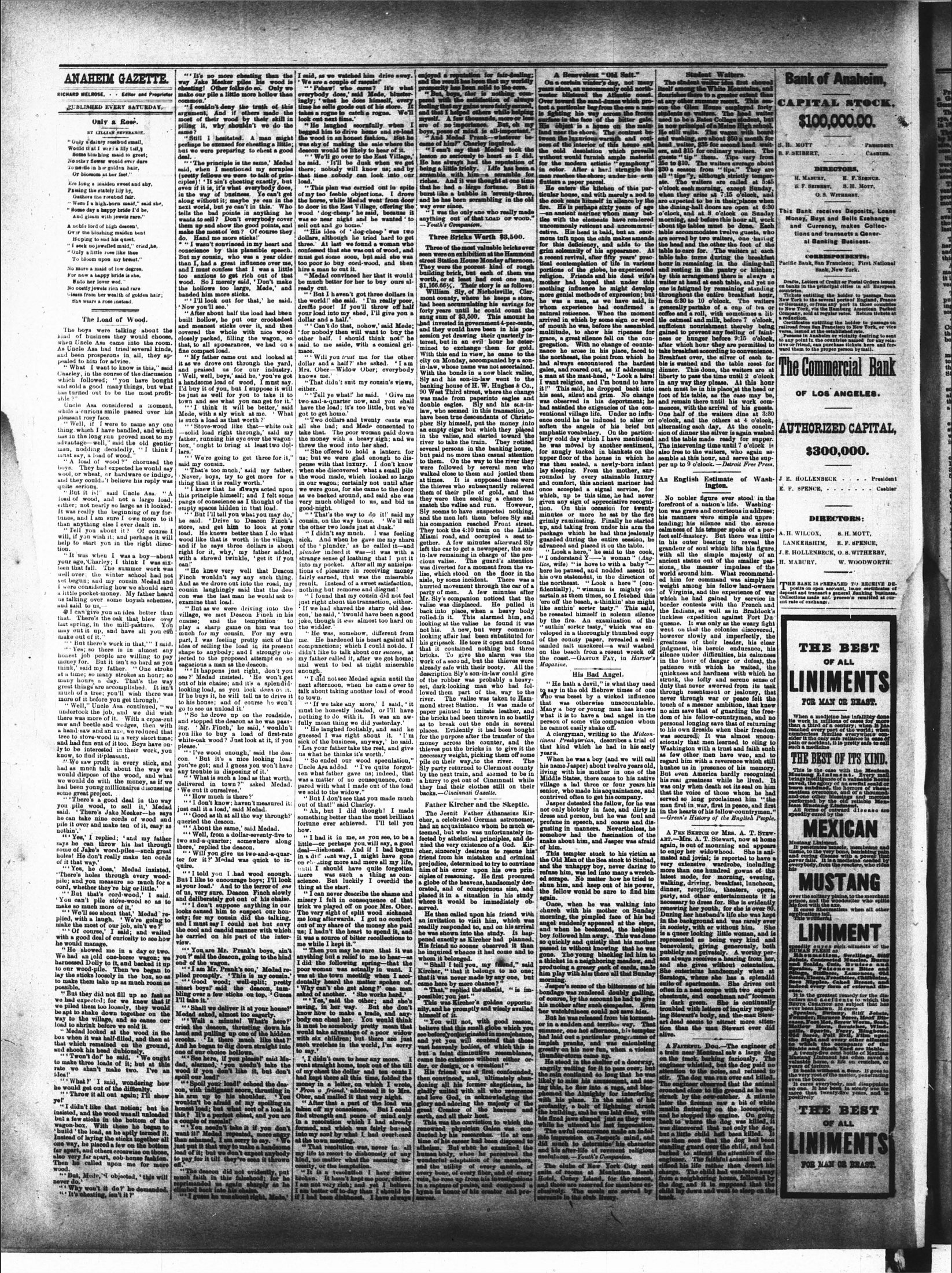
Searchable text
ANAHEIM GAZETTE.
RICHARD MELROSE. • Editor and Proprietor
BUBLISHED EVERY SATURDAY.
Only a Rose.
BY LILLIAN SEVERANCE.
"Only a dainty roostbud small,
Would that I were a lily tall,
Some blushing maid to greet;
No other Sower would ever dare
To nest in her golden hair,
Or bloom at her feet."
Ere long a maiden sweet and shy,
Passing the stately hily by,
Gathers the rosebud fair.
"Were I a high-born maid," said she,
"Some day a happy bride I'd be,
And gleam with jewels rare."
A noble lord of high descent,
Over the blushing maiden bent
Hoping to end his quest.
"I seek no jewelled maid," crieed he,
"Only a little rose like thee
To bloom upon my breast."
No more a maid of low degree,
For now a happy bride is she,
Unto her lover wed.
No costly jewels rich and rare
Cleam from her wealth of golden hair;
She wears a rose instead.
The Load of Wood.
The boys were talking about the kind of business they would choose,
when Uncle Asa came into the room.
As Uncle Asa had tried several kinds,
and been prosperous in all, they appealed to him for advice.
"What I want to know is this," said Charley, in the course of the discussion which followed; "you have bought and sold a good many things, but what has turned out to be the most profitable?"
Uncle Asa considered a moment, while a curious smile passed over his pleasant rosy face.
"Well, if I were to name any one thing which I have handled, and which has in the long run proved most to my advantage—well," said the old gentleman, nodding decidedly, "I think I must say, a load of wood."
"A load of wood?" chorused the boys. They had expected he would say wool or wheat, or hardware or indigo.
"It's no more cheating than the way Jake Meeker piles his wood is cheating! Other folks do so. Only we make our pile a little more hollow than common."
"I couldn't deny the truth of this argument. And if others made the most of their wood by their skill in piling it, why shouldn't we do the same?
"Still I hesitated. A man might perhaps be excused for cheating a little; but we were preparing to chest a good deal.
"The principle is the same,' Medad said, when I mentioned my scruples (pretty fellows we were to talk of principles)! 'It sinn't cheating exactly, but even if it is, it's what everybody does, in the way of business. Ye can't get along without it; maybe ye can in the next world, but ye can't in this.' Who tells the bad points in anything he wants to sell? Don't everybody cover them up and show the good points, and make the most of 'em? Of course they do. Hand me more sticks!
"I wasn't convinced in my heart and conscience by this plausible speech. But my cousin, who was a year older than I, had a great influence over me, and I must confess that I was a little too anxious to get rich out of that wood. So I merely said, 'Don't make the hollows too large, Mede,' and handed him more sticks.
"I'll look out for that,' he said. 'Now you'll see.'
"After about half the load had been built hollow, he put our crookedest and meanest sticks over it, and then covered the whole with nice wood closely packed, filling the wagon, so that, to all appearances, we had on a fine compact load.
My father came out and looked at it as we drove out through the yard, and praised us for our industry. 'Well, well, boys,' said he, 'you've got a handsome load of wood. I must say. I'd buy it of you, but I suppose it will be just as well for you to take it to town and see what you can get for it.'
"I think it will be better,' said Mede, with a sly wink at me. 'What is such a load as that worth?'
"Stove-wood like that—white oak—solid load right through," said my father, running his eye over the wagon-box, "ought to bring at least two dollars."
"We're going to get three for it," said my cousin.
"That's too much,' said my father.
I said, as we watched,
"We are a couple of people everybody does,' smiling; 'what he did time he sells goods takes a rogue to carry out next time.'
"He laughed at begged him to drive the wood in an home was shy of making deacon would be lit."
"We'll go over here said. 'It'll be there; nobody will that time nobody load.'"
"This plan was done of my too feeble of the horse, while Meadow door in the East wood 'dog-cheap' was so near night he sell out and go home."
"His idea of 'dollars, although three.' At last we confessed that she must get some soon too poor to buy coarse hire a man to cut it."
"Medad convince be much better for ready cut."
Uncle Asa considered a moment, while a curious smile passed over his pleasant rosey face.
"Well, if I were to name any one thing which I have handled, and which has in the long run proved most to my advantage—well," said the old gentleman, nodding decidedly, "I think I must say, a load of wood."
"A load of wood?" chornused the boys. They had expected he would say wool, or wheat, or hardware or indigo, and they couldn't believe his reply was quite serious.
"But it is!" said Uncle Asa. "A load of wood, and not a large load, either; not nearly so large as it looked. It was really the beginning of my fortunes, and I am sure I owe more to it than anything else I ever dealt in.
"Tell you about it? Of course I will, if you wish it; and perhaps it will help to start you in the right direction."
"It was when I was a boy—about your age, Charley; I think I was sixteen that fall. The summer work was well over; the winter school had not yet begun; and my cousin Medad and I were considering how we should earn a little pocket-money. My father heard us talking over some boyish schemes, and said to us,
"I can give you an idea better than that. There's the oak that blew over last spring, in the mill-pasture. You may cut it up, and have all you can make out of it."
"But there's work in that," I said.
"Yes; so there is in almost any honest job people are willing to pay money for. But it isn't so hard as you think," said my father.
"One stroke at a time; so many strokes an hour; so many hours a day. That's the way great things are accomplished. It isn't much of a tree; you'll wish there was more of it before you get through."
"Well," Uncle Asa continued, "we undertook the job, and we did wish there was more of it. With a cross-cut saw and beetle and wedges, then with a hand-saw and an axe, we reduced that tree to stove-wood in a very short time; and had fun out of it too. Boys have only to be interested in their work, you know, to find it pleasant."
"We saw profit in every stick, and had as much talk about the way we would dispose of the wood, and what we would do with the money, as if we had been young millionaires discussing some great project."
"There's a good deal in the way you pile wood, to sell it," Medad said. "There's Jake Meeker—he says he can take nine cords of wood and pile it over and make ten of it, easy as nothin'."
"Yes,' I replied; 'and my father says he can throw his hat through some of Jake's wood-piles—such great holes! He don't really make ten cords of it that way."
"Yes, he does,' Medad insisted. 'There's holes through every wood-pile; and you measure so much for a cord, whether they're big or little.'"
"But that's cord-wood,' I said.
"Well, well, boys,' said he, 'you've got a handsome load of wood, I must say. I'd buy it of you, but I suppose it will be just as well for you to take it to town and see what you can get for it.'"
"I think it will be better, said Mede, with a sly wink at me. 'What is such a load as that worth?'"
"'Stove-wood like that—white oak—solid load right through,' said my father, running his eye over the wagon-box, 'onght to bring at least two dollars.'"
"We're going to get three for it," said my cousin.
"That's too much,' said my father. 'Never, boys, try to get more for a thing than it is really worth.'"
"I knew that he always acted upon this principle himself; and I felt some pangs of conscience as I thought of the empty spaces hidden in that load."
"But I'll tell you what you may do,' he said. 'Drive to Deacon Finch's store, and get him to look at your load. He knows better than I do what wood like that is worth in the village, and if he says three dollars is about right for it, why,' my father added, with a shrewd twinkle, 'get it if you can.'"
"He knew very well that Deacon Finch wouldn't say any such thing. And as we drove out into the road, my cousin laughingly said that the deacon was the last man he would ask to examine that load."
"But as we were driving into the village, we met Deacon Finch in his ensisie; and the temptation to play a sharp game on him was too much for my cousin. For my own part, I was feeling pretty sick of the idea of selling the load in its present shape to anybody; and I strongly objected to the proposed attempt on so sagacious a man as the deacon."
"It happens just right, don't you see?' Medad insisted. 'He won't get out of his chaise; and it's a splendid-looking load, as you look down on it. If he buys it, he will tell us to drive it to his house; and of course he won't go to see us unload it.'"
"So he drove up on the roadside, and stopped the deacon as he was passing. 'Mr. Finch,' he said, 'wouldn't you like to buy a load of first-rate white-oak wood? Just look at it, if you please.'"
"I've wood enough,' said the deacon. 'But it's a nice looking load you've got; and I guess you won't have any trouble in disposing of it.'"
"What is such a load as that worth, delivered in town?" asked Medad. "We cut it ourselves."
"How much is there?'
"I don't know; haven't measured it: just call it a load,' said Medad.
"Good as th at all the way through? queried the deacon.
"About the same,' said Medad.
"Well, from a dollar-seventy-five to two-and-a-quarter; somewhere along there,' replied the deacon.
"Will you give us two-and-a-quarter for it?' Medad was quick to inquire.
"I told you I had wood enough. But I like to encourage boys; I'll look at your load.' And to the terror of one of us, very sure. Deacon Finch slowly and deliberately got out of his chaise."
"Well, well, boys,' said he, 'you've got a handsome load of wood, I must say. I'd buy it of you, but I suppose it will be just as well for you to take it to town and see what you can get for it.'"
"I think it will be better,' said Mede, with a sly wink at me. 'What is such a load as that worth?'"
"Stove-wood like that—white oak—solid load right through,' said my father, running his eye over the wagon-box, 'onght to bring at least two dollars.'"
"We're going to get three for it," said my cousin.
"That's too much,' said my father. 'Never, boys, try to get more for a thing than it is really worth.'"
"I knew that he always acted upon this principle himself; and I felt some pangs of conscience as I thought of the empty spaces hidden in that load."
"But I'll tell you what you may do,' he said. 'Drive to Deacon Finch's store, and get him to look at your load. He knows better than I do what wood like that is worth in the village, and if he says three dollars is about right for it, why,' my father added, with a shrewd twinkle, 'get it if you can.'"
"He knew very well that Deacon Finch wouldn't say any such thing. And as we drove out into the road, my cousin laughingly said that the deacon was the last man he would ask to examine that load."
"But as we were driving into the village, we met Deacon Finch in his ensisie; and the temptation to play a sharp game on him was too much for my cousin. For my own part, I was feeling pretty sick of the idea of selling the load in its present shape to anybody; and I strongly objected to the proposed attempt on so sagacious a man as the deacon."
"It happens just right, don't you see?' Medad insisted. 'He won't get out of his chaise; and it's a splendid-looking load, as you look down on it. If he buys it, he will tell us to drive it to his house; and of course he won't go to see us unload it.'"
"So he drove up on the roadside, and stopped the deacon as he was passing. 'Mr. Finch,' he said, 'wouldn't you like to buy a load of first-rate white-oak wood? Just look at it, if you please.'"
"I've wood enough,’ said the deacon. 'But it's a nice looking load you've got; and I guess you won't have any trouble in disposing of it.'"
“What is such a load as that worth, delivered in town?” asked Medad. "We cut it ourselves."
"I told you I had wood enough. But I like to encourage boys; I'll look at your load.’ And to the terror of one of us, very sure. Deacon Finch slowly and deliberately got out of his chaise."
There's a good deal in the way you pile wood, to sell it,' Medad said.
'There’s Jake Meeker—he says he can take nine cords of wood and pile it over and make ten of it, easy as nothin’.
Yes,’ I replied; ‘and my father says he can throw his hat through some of Jake’s wood-piles—such great holes! He don’t really make ten cords of it that way.’
Yes, he does,’ Medad insisted.
‘There’s holes through every wood-pile; and you measure so much for a cord, whether they’re big or little.’
But that’s cord-wood,’ I said.
‘You can’t pile stove-wood so as to make so much more of it.’
We’ll see about that,’ Medad replied, with a laugh. 'We’re going to make the most of our job, ain’t we?'
Of course,’ I said; and waited with a good deal of curiosity to see how he would manage.
He showed me in a day or two. We had an old one-horse wagon; we harnessed Dolly to it, and backed it up to our wood-pile. Then we began to lay the sticks loosely in the box, so as to make them take up as much room as possible.
But they did not fill up so fast as we had expected; for we knew that if we piled them too loosely, they would be apt to shake down together on the way to the village, and so cause our load to shrink before we sold it.
Medad looked at the wood in the box when it was half-filled, and then at that which remained on the ground, and shook his head dubiously.
Twon’t do!’ he said. 'We ought to make three loads of it; but at this rate we shan’t make two. I've an idea!'
What?' I said, wondering how he would get out of the difficulty.
Throw it all out again; I'll show ye!
I didn’t like that notion; but he insisted, and the wood was all unloaded but a few sticks in the bottom of the wagon-box. With these he began to build’ the load, as he aptly termed it. Instead of laying the sticks together all one way, he placed a few on the bottom far apart, and others crosswise on those, also very far apart, cob-house fashion. Then he called upon me for more wood.
But, Mede,’ I objected, 'this will never do.’
Why won’t it do?' he demanded.
It's cheating, isn't it?
I said, as we watched him drive away. 'We are a couple of rascals!'
'Pshaw! who cares? It's what everybody does,' said Mede, blusteringly; 'what he does himself, every time he sells goods out of his store. It takes a rogue to catch a rogue. We'll look out next time.'
'He laughed scornfully when I begged him to drive home and re-load the wood in an honest fashion. But he was shy of making the sale where the deacon would be likely to hear of it.'
'We'll go over to the East Village,' he said. 'It'll be dusk when we get there; nobody will know us; and by that time nobody can look into our load.'
'This plan was carried out in spite of my too feeble objections. I drove the horse, while Meded went from door to door in the East Village, offering the wood 'dog-cheap' he said, because it was so near night and he wanted 'to sell out and go home.'
'His idea of 'dog-cheap' was two dollars, although he tried hard to get three.' At last we found a woman who confessed that she was out of wood, and must get some soon, but said she was too poor to buy cord-wood, and then hire a man to cut it.
Medad convinced her that it would be much better for her to buy ours already cut.
'But I haven't got three dollars in the world!' she said. 'I'm really poor, dreffle poor! If you'll throw off half your load into my shed, I'll give you a dollar and a half.'
'Can't do that, nohow,' said Mede; 'for nobody then will want to buy the other half. I should think not!' he said to me aside, with a comical grimace.
'Will you trust me for the other dollar and a half?' she asked. 'I am Mrs. Ober—Widow Ober; everybody knows me.'
'That didn't suit my cousin's views, either.'
'Tell ye what!' he said. 'Give me two-and-a-quarter now, and you shall have the load; it's too little, but we've got to get home.'
'Two dollars and twenty cents was all she had; and Mede consented to take that. The poor woman paid down the money with a heavy sigh; and we threw the wood into her shed.'
'She offered to hold a lantern for us; but we were glad enough to dispense with that luxury. I don't know when she discovered what a small pile enjoyed a reputation for fair-dealing; and the result has been that my worldly prosperity has been solid to the core.
"But, boys, that is nothing compared with the satisfaction of always feeling that my gains were fairly earned, and that I helped others while helping myself. A few thousands, more or less are of no importance. But, ok my boys, peace of mind is all-important."
"And Medad Prank—whatever became of him?" Charley inquired.
"I can't say that Medad took the lesson so seriously to heart as I did. He has always had the reputation of being a little tricky. Life has been a scramble with him—a scramble for riches. And it was thought at one time that he had a large fortune. But it burst like a bubble in seventy-three, and he has been scrambling in the old way ever since.
'I was the only one who really made anything out of that LOAD OF WOOD.' —Youth's Companion.
Three Bricks Werth $3,500.
Three of the most valuable bricks ever seen were on exhibition at the Hammond street Station House Monday afternoon. They were the poorest kind of rough building brick, but each of them was worth, or at least had cost one man, $1,166.68%. Their story is as follows:
William Sly, of Nicholsville, Clermont county, where he keeps a store, had been accumulating his savings for forty years until he could count the snug sum of $3,500. This amount he had invested in government 4-per-centes, and they would have been in his possession yet drawing their quarterly interest, but in an evil hour he determined to exchange them for gold. With this end in view, he came to the city on Monday, accompanied by a son-in-law, whose name was not ascertained. With the bonds in a new black valise, Sly and his son-in-law went to the banking house of H.W.Hughes & Co., 90 West Third street, where the change was made from paperinto eagles and double eagles. Sly and his son-in-law, who seemed in this transaction, have been true descendants of Christopher Sly himself, put the money into an empty cigar box which they placed in the valise, and started toward the river to take the train. They noticed several persons in the banking house, but paid no more than casual attention to them. On the way to the river they were followed by several men who walked close to them and jostled them.
A Benevolent "Old Salt."
On a certain winter's day, not many years since, an uncommonly cold north-winter blistered the Atlantic coast. Over toward the sand-dunes which protect a particular bay from the sea a man is fighting his way across the frozen surface in the face of the bitter gale. His object is a house on the mainland near the shore. The contrast between the luxurious warmth and contess of the interior of this house and the cold desolation which prevails without would furnish ample material for the modern artistic "symphony" in color. After a hard struggle the man reaches the shore; under his arm flutters a paper parcel.
He enters the kitchen of this particular house, and with merely a nod to the cook seats himself in silence by the fire. He is perhaps sixty years of age—an ancient mariner whom many battles with the elements have rendered uncommonly reticent and uncommunicative. His head is bald, but an enormous tuft upon the chin makes amends for this deficiency, and adds to the grim solemnity of his appearance. At a recent revival, after fifty years' practical contemplation of life in various portions of the globe, he experienced religion. Friends and his dead wife's mother had hoped that under this soothing influence he might develop more genial methods of expression; but he was a man, as we have said, in whom experience had confirmed a natural resilience. When the moment arrived in which by some sign or word of mouth he was, before the assembled multitude, to show his ripeness for grace, a great silence fell on the congregation. With no change of countenance he arose in his place, faced to the northeast, the point from which he had always encountered the hardest gales, and roared out, as if addressing a man at the mast-head," Look here! I want religion, and I'm bound to have it!" This said, he dropped back into his seat, silent and grim. No change was observed in his deportment; he had satisfied the exigencies of the conventional village life. Under no influence could he be induced to alter or soften the angels of his brief but emphatic vocabulary. On the particularly cold day which I have mentioned he was moved by another sentiment, for snugly tucked in blankets on the upper floor of the house in which he was then seated, a newly-born infant lay sleeping. From the mother, aur-
"That didn't suit my cousin's views, either.
'Tell ye what!' he said. 'Give me two-and-a-quarter now, and you shall have the load; it's too little, but we've got to get home.'
"Two dollars and twenty cents was all she had; and Mede consented to take that. The poor woman paid down the money with a heavy sigh; and we threw the wood into her shed."
"She offered to hold a lantern for us; but we were glad enough to dispense with that luxury. I don't know when she discovered what a small pile the wood made, which looked so large in our wagon; certainly not until after we were gone, for she came to the door as we backed around, and said she was very much obliged to us, and bid us good-night."
"That's the way to do it!" said my cousin, on the way home. "We'll sell the other two loads just at dusk."
"I didn't say much. I was feeling sick. And when he gave me my share of the plunder," as he called it—and plunder indeed it was—it was with a strange sense of loathing that I put it into my pocket. After all my anticipations of pleasure in receiving money fairly earned, that was the miserable result. Instead of a sweet satisfaction, nothing but remorse and disgust!
"I found that my cousin did not feel just right about the transaction, either. If we had shaved the sharp old deacon,' he said, "'twould have been a good joke, though it was almost too hard on the widder.'"
"He was, somehow, different from me. He hardened his heart against all compunctions; which I could not do. I didn't like to talk about our success, as my father called it, after we got home; and went to bed at night miserable enough."
"I did not see Medad again until the next afternoon, when he came over to talk about taking another load of wood to town."
"If we take any more,' I said, 'it must be honestly loaded, or I'll have nothing to do with it. It was an awfully mean thing we did yesterday.'"
"He laughed foolishly, and said he guessed I was right about it. 'I'm sick of the business, anyway,' he said. 'Let your father take the rest, and give us what he thinks it's worth.'"
"So ended our wood speculation," Uncle Asa added. "I've quite forgotten what father gave us; indeed, that was a matter of no consequence, compared with what I made out of the load we sold to the widow."
"But I don't see that you made much out of that!" said Charley.
"Ah, but I did though! I made something better than the most brilliant fortune ever achieved. I'll tell you how."
"I had it in me, as you see, to be a little—or perhaps you will say, a good deal—dishonest. And if I had begun in a different way, I might have gone on cleaning more and more all my life, until I should have quite forgotten mere was such a thing as conscience. But luckily I overdid the thing at the start."
"I can never describe the shame and misery with the bonds in a new black valise." Sly and his son-in-law went to the banking house of H.W. Hughes & Co., 90 West Third street, where the change was made from paperinto eagles and double eagles. Sly and his son-in-law, who seemed in this transaction to have been true descendants of Christopher Sly himself, put the money into an empty cigar box which they placed in the valise, and started toward the river to take the train. They noticed several persons in the banking house, but paid no more than casual attention to them. On the way to the river they were followed by several men who walked close to them and jostled them at times. It is supposed these were the thieves who subsequently relieved them of their pile of gold, and that they were then seeking a chance to snatch the valise and run. However, Sly seems to have suspected nothing, and the men left them before Sly and his companion reached Front street. They took the 4:10 train on the Little Miami road, and occupied a seat together. A few minutes afterward Sly left the car to get a newspaper, the son-in-law remaining in charge of the precious valise. The guard's attention was diverted for a moment from the valise, which stood on the floor in the aisle, by some incident. There was a hurried movement through the car of a party of men. A few minutes after Mr. Sly's companion noticed that the valise was displaced. He pulled it back into place, when a heavy body rolled in it. This alarmed him, and looking at the valise he found it was not his. A new, but very common-looking affair had been substituted for his gripsack. He tore it open and found that it contained nothing but three bricks. To give the alarm was the work of a second, but the thieves were already safe with their booty. All the description Sly's son-in-law could give of the robber was probably a heavy-set, dark-looking man who had followed part of the way to the river. The valise was taken to Hammond street Station. It was made of paper painted to imitate leather, and the bricks had been thrown in so hastily as to break out the ends in several places. Evidently it had been bought for the purpose after the transfer of the money across the counter, and the thieves put the bricks in to give it the necessary weight, picking them off some pile on their way to the river. The Sly party returned to Clermont county by the next train, and seemed to be in a hurry to get out of Cincinnati while they had their clothes still on their backs.—Cincinnati Gazette.
Father Kircher and the Skeptic.
The Jesuit Father Athanasius Kircher, a celebrated German astronomer, had an acquaintance whom he much esteemed, but who was unfortunately infected by atheistical principles, and denied the very existence of a God. Kircher, sincerely desirous to rescue his friend from his mistaken and criminal prejudice, determined to try to convince him of his error upon his own principles of reasoning. He first procured a globe of the heavens, handsomely decorated, and of conspicuous size, and placed it in a situation in his study a man at the mast-head," Look a here! I want religion, and I'm bound to have it!" This said, he dropped back into his seat, silent and grim. No change was observed in his deportment; he had satisfied the exigencies of the conventional village life. Under no influence could he be induced to alter or soften the angels of his brief but emphatic vocabulary. On the particularly cold day which I have mentioned he was moved by another sentiment, for snugly tucked in blankets on the upper floor of the house in which he was then seated, a newly-born infant lay sleeping. From the mother, surrounded by every attainable luxury and comfort, this ancient mariner had once accepted a signal service, for which, up this time, he had never given any sign of appreciative recognition. On this occasion for twenty minutes or more he sat by the fire grimly ruminating. Finally he started up, and taking from under his arm the package which he had thus jealously guarded during the entire session, he advanced and placed it on the table.
"Look a here," he said to the cook,
"I onderstand Y——’woman” (Anglice, wife) “is hove to with a baby” (here he paused, and nodded assent to his own statement, in direction of northeast.” "Look a here” (confidentially), “wimmin is mighty on-sartain at them times, so I fetched this ‘ere off the beach,’ a-thinkin’ she might like suthin’ sorter tasty.” This said, he resealed himself in solemn silence by the fire. An examination of the “suthin’ sorter tasty,” which was enveloped in a thoroughly thumbed copy of the county paper, revealed a well-sanded salt mackerel—a waif washed on the beach from a recent wreck off the coast.—GASTON FAY, in Harper’s Magazine.
His Bad Angel.
"He hath a devil,” is what they used to say in the old Hebrew times of one who was beset by a wicked influence that was otherwise unaccountable. Many a boy or young man has known what it is to have a bad angel in the person of some vile companion whom he cannot easily shake off.
A clergyman, writing to the Midcontinent Presbyterian, describes a trial of that kind which he had in his early years.
When he was a boy (and will call his name Jasper) about twelve years old, living with his mother in one of the Middle States, there came to his native village a lad three or four years his senior, who made his acquaintance, and contrived often to get his company.
Jasper detested the fellow, for he was not only blotchy in face, and dirty in dress and person, but he was foul and profane in speech, and coarse and disguising in manners. Nevertheless, he somehow had the fascination of the snake about him, and Jasper was afraid of him.
This tempter stuck to his victim as the Old Man of the Sea stuck to Sinbad, and the unhappy boy, never daring to refuse him, was led into many a wretched scrape. No matter how he tried to ahun him, and keep out of his power, the fellow would be sure to find him again.
But I don't see that you made much out of that! said Charley.
"Ah, but I did though! I made something better than the most brilliant fortune ever achieved. I'll tell you how.
"I had it in me, as you see, to be a little—or perhaps you will say, a good deal—dishonest. And if I had begun in a different way, I might have gone on cheating more and mere all my life, until I should have quite forgotten there was such a thing as conscience. But luckily I overdid the thing at the start.
"I can never describe the shame and misery I felt in consequence of that trick we played off on poor Mrs. Ober. The very sight of split wood sickened me long afterwards. I got no comfort out of my share of the money she paid us; I hadn't the heart to spend it, and it was a source of bitter recollections to me while I kept it."
"Then you may be sure that it was anything but a relief to me to hear—as I did the following spring—that the poor woman was actually in want. I was at the town meeting when I accidentally heard the matter spoken of. 'Why can't she get along?' one man asked of another. 'She works hard.'
"'Yes,' said the other; and she's saving, in her way. But she don't know how to make a trade, and anybody can cheat her. You would think it must be somebody pretty mean that would take advantage of a poor widow with six children; but there are just such wretches in the world, I'm sorry to say.'"
"I didn't care to hear any more. I went straight home, took out of the till of my chest the dollar and ten cents I had kept there all this time, folded the money in a letter, on which I wrote, 'From a friend,' addressed it to Mrs. Ober, and mailed it that very night.
"After that a part of the load was taken off my conscience. But I could find strength and peace of mind only in a resolution which I had already formed, and which was fairly burned into my soul by what I had overheard at the town meeting.
"That resolution was, never in all my life to resort to dishonesty of any kind, no matter what the seeming necessity, or the temptation.
"It is a resolution I have never broken. It hasn't kept me poor, either. I am not very rich; and yet I believe I am better off to-day than I should be if I had been dishonest. I have always Father Kircher and the Skeptic.
The Jesuit Father Athanasius Kircher, a celebrated German astronomer, had an acquaintance whom he much esteemed, but who was unfortunately infected by atheistical principles, and denied the very existence of a God. Kircher, sincerely desirous to rescue his friend from his mistaken and criminal prejudice, determined to try to convince him of his error upon his own principles of reasoning. He first procured a globe of the heavens, handsomely decorated, and of conspicuous size, and placed it in a situation in his study where it would be immediately observed.
He then called upon his friend with an invitation to visit him, which was readily responded to, and on his arrival he was shown into the study. It happened exactly as Kircher had planned. His friend no sooner observed it than he inquired whence it had come and to whom it belonged.
"Shall I tell you, my friend," said Kircher, "that it belongs to no one; that it was never made by any one, but came here by mere chance?"
"That," replied the atheist, "is impossible; you jest."
This was Kircher's golden opportunity, and he promptly and wisely availed himself of it.
"You will not, with good reason, believe that this small globe which you see before you originated in mere chance, and yet you will contend that those vast heavenly bodies, of which this is but a faint diminutive resemblance, came into existence without either order, or design, or a creation!
His friend was at first confounded, then convinced, and ultimately abandoning all his former skepticism, he gladly united with all who reverence and love God, in acknowledging the glory and adoring the majesty of the great Creator of the heavens and earth, and all their host.
This was the conviction to which the renowned physician Galen was conducted by his researches. He at one time of his career had been disposed to atheism. But when he examined the human body, when he perceived the wonderful adaptation of its members, and the utility of every muscle, of every bone, of every fiber, and of every vein, he rose up from his investigations in a rapture of praise, and composed a hymn in honor of his creator and preserver.
Jasper detested the fellow, for he was not only blotchy in face, and dirty in dress and person, but he was foul and profane in speech, and coarse and disgusting in manners. Nevertheless, he somehow had the fascination of the snake about him, and Jasper was afraid of him.
This tempter stuck to his victim as the Old Man of the Sea stuck to Sinbad, and the unhappy boy, never daring to refuse him, was led into many a wretched scrape. No matter how he tried to ahun him, and keep out of his power, the fellow would be sure to find him again.
Once, when he was walking into church with his mother on Sunday morning, the pimpled face of his bad angel suddenly appeared at the steps, and when he beckoned, the helpless boy followed him away. This was done so quickly and quietly that his mother passed in without knowing that he was gone. The young blackleg led him to a thicket in a neighboring mound, and producing a greasy pack of cards, made him play with him there all that Sunday morning.
Jasper's sense of the bitterness of his bondage was rendered doubly galling, of course, by the account he had to give his mother after such escapes. Even her watchfulness could not save him.
But he was released from his torment or in a sudden and terrible way. That summer, one hot afternoon, his tempter had laid out a particular programme of impish pranks, and was calculating greatly on his new fun, when a violent thunder-storm came up.
He stood in the shelter of a doorway, angrily waiting for it to pass over; but the rain continued so long that he was likely to miss his amusement, and seeing this, he flow into a rage, and blasphemed the Almighty for interfering with his plans. In the midst of his profanity, a bolt of lightning struck the building, and he was laid dead, with his fixed jaws shaped just as they were while he uttered his last imprecation.
The awful occurrence made an indelible impression on Jasper's mind, and did much to determine his character and his after-life of reverent religious usefulness. — Youth's Companion.
The clubs of New York City rent units of rooms at Manhattan Beach Hotel, Coney Island, for the season, and these are reserved for members exclusively. The meals are serval by servants in the club livery.
Bank of Anaheim,
CAPITAL STOCK,
$100,000.00.
S. H. MOTT
PRESIDENT
B. F. SEIBERT,
CASHIER.
DIRECTORS.
H. MABURY,
E. F. SPENCE.
B. F. SEIBERT,
S. H. MOTT,
O. S. WITHEARY.
This Bank receives Deposits, Loans Money, Buys and Sells Exchange and Currency, makes Collections and transacts a General Banking Business.
CORRESPONDENTS:
Pacific Bank, San Francisco; First National Bank, New York.
Drafts, Letters of Credit or Postal Orders issued on banks in the principal cities in all European countries.
Tickets entitling the holder to passage from New York to the several ports of England, France or Germany, or from any port in these countries to New York, via the Hamburg American Passed Company, sold at regular rates. Return tickets at a reduction.
Certificates entitling the holder to passage on railroad from San Francisco to New York, or vice versa, issued at the established rate.
Persons in Anaheim or vicinity desiring to sent to any point in the counties named for any relative or friend, can purchase tickets here and forward them to the proper person by mail.
The Commercial Bank
OF LOS ANGELES.
AUTHORIZED CAPITAL,
$300,000.
An English Estimate of Washington.
No nobler figure ever stood in the forefront of a nation's life. Washington was grave and courteous in address; his manners were simple and unpretening; his silence and the serene calmness of his temper spoke of a perfect self-mastery. But there was little in his outer bearing to reveal the grandeur of soul which lifts his figure, with all the simple majesty of an ancient statue out of the smaller passions, the meaner impulses of the world around him. What recommended him for command was simply his weight among his fellow land-owners of Virginia, and the experience of war which he had gained by service in border contests with the French and the Indians, as well as in Braddock's luckless expedition against Fort Duquesne. It was only as the weary fight went on that the colonies discovered, however slowly and imperfectly, the greatness of their leader, his clear judgment, his heroic endurance, his silence under difficulties, his calmness in the hour of danger or defeat, the patience with which he waited, the quickness and hardness with which he struck, the lofty and serene sense of duty that never swerved from its task through resentment or jealousy, that never through war or peace felt the touch of a meaner ambition, that knew no aim save that of guarding the freedom of his fellow-countrymen, and no personal longing save that of returning to his own fireside when their freedom was secured. It was almost unconsciously that men learned to cling to Washington with a trust and faith such as few other men have won, and to regard him with a reverence which still hushes us in presence of his memory. But even America hardly recognized his real greatness while he lived. It was only when death set its seal on him that the voice of those whom he had served so long proclaimed him "the man first in war, first in peace, and first in the hearts of his fellow-countrymen."—Green's History of the English People.
A Pen Sketch of Mrs. A. T. Stewart.—Mrs. A. T. Stewart, now at home again, is out of mourning and appears to enjoy her widowhood. She is animated and jovial; is reported to have a very extensive wardrobe, including more than one hundred gowns of the latest mode, for morning, evening, walking, driving, breakfast, luncheon, dinner, reception, theaters, opera, party, and other entertainments it is liberty to pass the time until 2 o'clock in any way they please. At this hour each must be in his place at the head or foot of his table, as the case may be, and remain there until his work commences, with the arrival of his guests. One half of the waiters dine at 3:30 o'clock, and the others at 4 o'clock, alternating each day. At the conclusion of dinner the silver is again washed and the table made ready for supper. The intervening time until 7 o'clock is also free to the waiters, who again assemble at this hour, and serve the supper up to 9 o'clock.—Detroit Free Press.
The Bank is prepared to receive deposits on open account; issue certificates of deposit and transact a general banking business. Collections made and processes remitted at current rate of exchange.
The Best of All Liniments for Man or Beast.
When a medicine has infallibly done its work in millions of cases for more than a third of a century; when it has reached every part of the world; when numberless families everywhere consider it the only safe reliance in case of pain or accident, it is pretty safe to call such a medicine.
The Best of Its Kind.
This is the case with the Merriam Mustang Limiment. Every mail brings intelligence of a valuable house saved, the agony of an awful seldom or burns subdued, the horrors of rheumatism overcome, and or a thousand-and-one blessings and mercies performed by the old reliable Merriam Mustang Limiment.
All forms of outward disease are speedily cured by the Mexican Mustang Limiment.
It penetrates muscle, membrane and tissue, to the very bone, banishing pain and curing disease with a power that never fails. It is a medicine needed by everybody, from the renchoo, who rides his MUSTANG over the solitary plains, to the merchant
A PEN SKETCH OF MRS. A. T. STEWART.—Mrs. A. T. Stewart, now at home again, is out of mourning and appears to enjoy her widowhood. She is animated and jovial; is reported to have a very extensive wardrobe, including more than one hundred gowns of the latest mode, for morning, evening, walking, driving, breakfast, luncheon, dinner, reception, theaters, opera, party, and other entertainments it is necessary to dress for. She is evidently renewing her youth, for she is over 80. During her husband's life she was kept in the background and was rarely ever in society, with or without him. She is a queer looking little woman, and is represented as being very kind and benevolent, giving generously, both publicly and privately. A worthy person always receives a hearing from her, and she gives without ostentation. She entertains handsomely when at Saratoga, where she has a splendid suite of apartments. She drives out often in a neat coupe with two superb chestnuts, and coachman and footman in dark green. She is continually troubled with letters of inquiry regarding Stewart's body, and the man Stewart dead seems to attract more attention than the man Stewart ever did alive.
A FAITHFUL DOG.—The engineer of a train near Montreal saw a large dog on the track, barking furiously. The engineer whistled, but the dog paid no attention to the noise, and refused to stir. The dog was run over and killed. The engineer observed that the animal crouched close to the ground as he was struck by the cow-catcher. A minute later the fireman saw a bit of white muslin fluttering on the locomotive, and he stopped the engine. On going back to where the dog was killed, it was discovered that not only the dog, but a little child had been killed. It was then seen that the dog had been standing guard over the child, and had barked to attract the attention of the engineer. The faithful animal had sacrificed his life rather than desert his charge. The child had wandered away from a neighboring house, followed by the dog, and it is supposed that the child lay down and went to sleep on the truck.