anaheim-gazette 1880-10-30
Scanned page
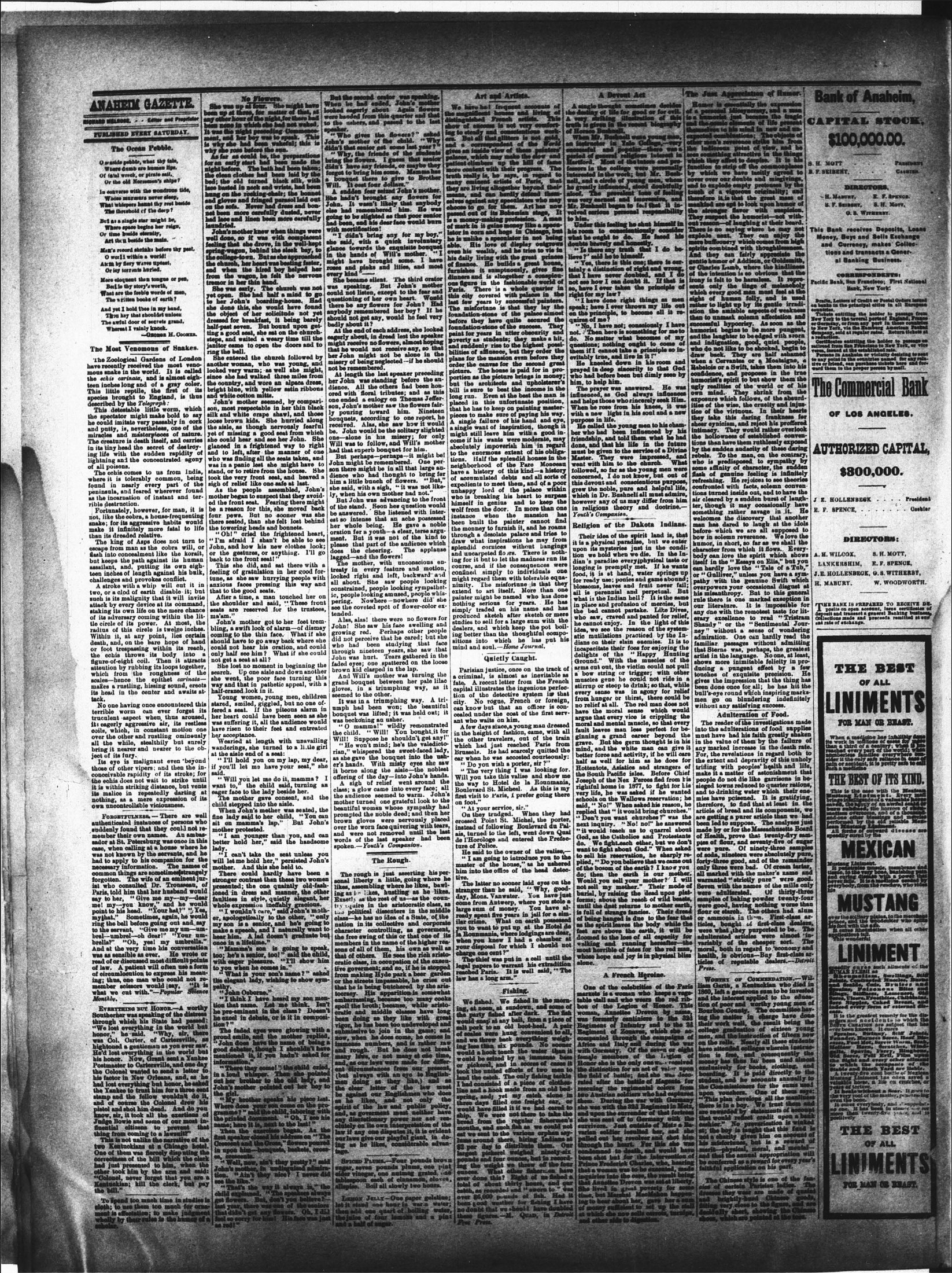
Searchable text
ANAHEIM GAZETTE.
MICHARD MELROSE. Editor and Proprietor
PUBLISHED EVERY SATURDAY.
The Ocean Pebble.
O maritime pebble, what thy tale,
Where dumb are human lips.
Of fatal wreck, or pirate sail,
Or the old Norsemen's ships?
In converse with the wondrous tide,
Whose murmurs never sleep,
What whispers haunt thy rest beside
The threshold of the deep?
But as a single star might be,
Where space begins her reign,
Or time besides eternity,
Art then beside the main.
Man's record shrinks before thy past,
O world within a world!
As in flery waves upcast,
Or ley torrents hurried.
More eloquent than tongue or pen,
Best to thy story's worth,
What are the feeble words of men,
The written books of earth?
And yet I hold these in my hand,
Thou key that shouldst unlock
The awful door of secrets grand,
Whereat I vainly knock.
—Gordon H. Coomer.
The Most Venomous of Snakes.
The Zoological Gardens of London have recently received the most venomous snake in the world. It is called the echis carinata, and is almost eighteen inches long and of a gray color. This little reptile, the first of its species brought to England, is thus described by the Telegraph:
This detestable little worm, which the spectator might make bold to say he could imitate very passably in cork and putty, is, nevertheless, one of the miracles and masterpieces of nature. The creature is death itself, and carries in its tiny head the secret of destroying life with the sudden rapidity of lightning and the concentrated agony of all poisons.
The echis comes to us from India,
No Viewers.
She was up at four. She might have been up at three, for matter of that, at any other hour of the night; for there had been none in which she had not waked. It was the night preceding Commencement, and her boy was to speak. This is why she had been wakeful; this is why she rose before the sun.
As far as could be, the preparations for an early start had been made the night before. The bath had been taken; the clean clothes had been laid by the bed; the old turned black silk, with lace basted in neck and wrists, had been hung on the rocking-chair; the bonnet and gloves and fringed parasol laid out on the sofa. Never had dress and bonnet been more carefully dusted, never had lace and linen been more carefully laundried.
John's mother knew when things were well done, so if was with complacent feeling that she drove, in the well-kept spring-wagon, behind the sleek bay, to the college-town. But as she approached the church, her heart was beating faster, and when the hired boy helped her from the wagon, he felt the nervous tremor in her thin hand.
She was early. The church was not yet open. She had half a mind to go to her John's boarding-house. Had she done this, she would have found the object of her solicitude not yet dressed for breakfast, it being barely half-past seven. But bound upon getting a good seat, she sat on the church-stepe, and waited a weary time till the janitor came to open the doors and to ring the bell.
She entered the church followed by another woman, who was young, and looked very warm; as well she might, since she had walked three miles from the country, and wore an alpaca dress, bright blue, with yellow satin ribbons and white cotton mitts.
John's mother seemed, by comparison, most respectable in her thin black silk and white crape shawl, and those loose brown kids. She hurried along the aisle, as though nervously fearful yet of missing a good seat from which she could hear and see her John. She glanced in a frightened way to right and to left, after the manner of one who was finding all the seats taken, and was in a panic less she might have to stand, or to retire from the house. She
the echis carinata, and is almost eighteen inches long and of a gray color. This little reptile, the first of its species brought to England, is thus described by the Telegraph:
This detestable little worm, which the spectator might make bold to say he could imitate very passably in cork and putty, is, nevertheless, one of the miracles and masterpieces of nature. The creature is death itself, and carries in its tiny head the secret of destroying life with the sudden rapidity of lightning and the concentrated agony of all poisons.
The echis comes to us from India, where it is tolerably common, being found in nearly every part of the peninsula, and feared wherever found as the incarnation of instant and terrible destruction.
Fortunately, however, for man, it is not, like the cobra, a house-frequent snake; for its aggressive habits would make it infinitely more fatal to life than its dreaded relative.
The king of Asps does not turn to escape from man as the cobra will, or flash into concealment like the korait, but keeps the path against its human assailant, and, putting its own eighteen inches of length against his bulk, challenges and provokes conflict.
A stroke with a whip will cut it in two, or a clod of earth disable it; but such is its malignity that it will invite attack by every device at its command, staking its own life on the mere chance of its adversary coming within the little circle of its power. At most, the radius of this circle is twelve inches. Within it, at any point, lies certain death, and, on the bare hope of hand or foot trespassing within its reach, the echis throws its body into a figure-of-eight coil. Then it attracts attention by rubbing its loops together, which from the roughness of the scales—hence the epithet carinata—makes a rustling, hissing sound, erects its head in the center and awaits attack.
No one having once encountered this terrible worm can ever forget its truculent aspect when thus aroused, its eagerly aggressive air, its restless coils, which, in constant motion one over the other and rustling omineously all the while, stealthily but surely bring it nearer and nearer to the object of its fury.
Its eye is malignant even beyond those of other vipers; and then the inconceivable rapidity of its stroke; for the echis does not wait to strike until it is within striking distance, but vents its malice in repeatedly darting at nothing, as a mere expression of its own uncontrollable viciousness.
FORGETFULNESS—There are wall authenticated instances of persons who suddenly found that they could not remember their own names. An ambassador at St. Petersburg was once in this case, when calling at a house where he was not known by the servants, and he had to apply to his companion for the necessary information. The names of common things are sometimes strangely forgotten. The wife of an eminent jurist who consulted Dr. Tronsaeau, of Paris, told him that her husband would say to her: "Give me my—my—dear
John's mother seemed, by comparison, most respectable in her thin black silk and white crape shawl, and those loose brown kids. She hurried along the aisle, as though nervously fearful yet of missing a good seat from which she could hear and see her John. She glanced in a frightened way to right and to left, after the manner of one who was finding all the seats taken, and was in a panic lest she might have to stand, or to retire from the house. She took the very front seat, and heaved a sigh of relief like one safe at last.
As the people assembled, John's mother began to suspect that they avoided the front seat. Fearing there might be a reason for this, she moved back four pews. But no sooner was she there seated, than she felt lost behind the towering heads and bonnets.
"Oh!" cried the frightened heart,
"I'm afraid I shan't be able to see John, and how his new clothes look; or the gestures, or anything. I'll go back to the front seat!"
This she did, and sat there with a feeling of gratulation in her good fortune, as she saw hurrying people with anxious faces pressing this way and that to the good seats.
After a time, a man touched her on the shoulder and said, "These front seats are reserved for the trustees," ma'am."
John's mother got to her feet trembling, a swift look of alarm—of dismay coming to the thin face. What if she should have to go away back where she could not hear his oration, and could only half see him? What if she could not get a seat at all?
She lost no moment in beginning the search. Up one aisle and down another she went, the poor face turning this way and that in pathetic appeal, with a half-crazed look in it.
Young women, young men, children stared, smiled, giggled, but no one offered a seat. If the piteous alarm in her heart could have been seen as she was suffering it, all the audience would have risen to their feet and entreated her acceptance.
Wearied at length with unavailing wanderings, she turned to a little girl at the aisle end of a seat:
"I'll hold you on my lap, my dear, if you'll let me have your seat," she said.
"Will you let me do it, mamma? I want to," the child said, turning an eager face to the lady beside her.
The mother gave consent, and the child stepped into the aisle.
When John's mother was seated, the fine lady said to her child, "You can sit on mamma's lap." But John's mother protested.
"I am younger than you, and can better hold her," said the handsome lady.
"I can't take the seat unless you will let me hold her," persisted John's mother. And this she held to.
There could hardly have been a stronger contrast than these two women presented; the one quaintly old-fashioned in dress and manner, the other fashionless in style quietly elegant her
FORGETFULNESS — There are well authenticated instances of persons who suddenly found that they could not remember their own names. An ambassador at St. Petersburg was once in this case, when calling at a house where he was not known by the servants, and he had to apply to his companion for the necessary information. The names of common things are sometimes strangely forgotten. The wife of an eminent jurist who consulted Dr. Tronsseau, of Paris, told him that her husband would say to her, "Give me my—my—dear me! my—you know," and he would point to his head. "Your hat?" "Yes, my hat." Sometimes, again, he would ring the bell before going out and say to the servant, "Give me my umbrel—umbrel—oh dear!" "Your umbrella?" "Oh, yes! my umbrella." And at the very time his conversation was as sensible as ever. He wrote or read of or discussed most difficult points of law. A patient will often use a form of cirumlocation to express his meaning; thus, one man who could not remember scissors would say, "It is what we cut with." — Popular Science Monthly.
EVERYTHING BUT HONOR. — A worthy Southerner was speaking of the distress through which his State had passed: "We lost everything in the world but honor," he said. "Why, air, there was Col. Carter, of Cartersville, as hightoned a gentleman as you ever saw. He'd lost everything in the world but his honor. Now, Grant sent a Yankee Postmaster to Cartersville, and one day the Colonel wanted to send a letter to his factor in New Orleans, and, as he had lost everything but honor, he asked the Yankee to trust him for a three cent stamp and the fellow wouldn't do it, and of course the Colonel drew his pistol and shot him dead. And do you know, air, it took all the exertions of Judge Bowie and some of our most influential citizens to prevent that thing from coming to a lawsuit."
This is not unlike the narrative of the two Kentuckians at a Chicago hotel. One of them was fiercely disputing the correctness of the bill which the clerk had just presented to him, when the other took him by the arm and said: "Colonel, never forget that you are a Kentuckian; kill the clerk, but pay the bill."
To spend too much time in studies is sloth; to use them too much for ornament is affectation; to make judgment wholly by their rules is the humour of a scholar.
The mother gave consent, and the child stepped into the aisle.
When John's mother was seated, the fine lady said to her child, "You can sit on mamma's lap." But John's mother protested.
"I am younger than you, and can better hold her," said the handsome lady.
"I can't take the seat unless you will let me hold her," persisted John's mother. And this she held to.
There could hardly have been a stronger contrast than these two women presented; the one quaintly old-fashioned in dress and manner, the other faultless in style, quietly elegant, her whole expression ineffably gracious.
"I wouldn't care," said John's mother, apologetically to the other, "only my son is a senior, and he's going to make a speech, and I naturally want to hear him. A lad doesn't graduate but once in a lifetime."
"Mamma's son is going to speak, too; he's a senior, too!" said the child, with eager pleasure. "I'll show him to you when he comes in."
"What is your son's name?" asked the elegant lady, wishing to show sympathy.
"John Osborne."
"I think I have heard my son mention that name. Let me think. Isn't he pre-eminent in the class? Doesn't he excel in debate, or is it in composition?"
The faded eyes were glowing with a proud smile, and the mother replied, "John does have the name of being a good debater, though I shouldn't have mentioned it, if you hadn't asked for information."
"There they come!" the child cried, in a loud whisper. Then she pointed out her brother to the old lady, and John's mother pointed out her boy to the girl.
"My brother speaks his piece last. Where does your son come on the programme?" said the child, laboring with the printed document. "Oh, I see his name; here it is, next to the last!"
Then the exercise began. As the first speaker closed his address on "The Crescent and the Cross," flowers poured in upon him—bouquets, baskets, crosses, arcs.
"Well, now, isn't they pretty?" said John's mother, in undignified admiration. "Ain't they nice? I never did see the like."
"That's the way it always is," the child explained. "The speakers always get flowers. But, don't you believe?—last year, there was one of the seniors that didn't get any flowers. Oh, I did feel so sorry for him! His face was just as red!"
The might have matter of that, at for there had not waked. Commence- speak. This is fun.
Preparations been made the had been taken; enn laid by the black silk, with artists, had been sir; the bonnet carol laid out dress and bonnet dusted, never more carefully
Things were complacent in the well kept sleek bay, to the approached beating faster, boy helped her at the nervous church was not a mind to go house. Had have found attitude not yet being barely sound upon getting on the church any time till the doors and to
Followed by was young, and well she might, three miles from alpaca dress, satin ribbons
By comparisher thin black awl, and those hurried along invonavally fearful beat from which other John. She way to right manner of one seats taken, and might have to the house. She
But the second orator was speaking. When he had ended, John's mother looked eagerly about Again flowers were handed from this quarter and that to the users, and passed to the last speaker.
"Who gives the flowers?" asked John's mother of the child. "Why didn't that senior get some last year?"
"Why, the friends of the students bring the flowers. I guess that senior didn't have any friends, or maybe they forgot to bring him some. Mamma has a bouquet there to give to Brother Will. It cost four dollars."
A sudden fear seized John's mother. She hadn't brought any flowers for John. It wasn't likely that anybody else had remembered him. He was going to be slighted as that poor senior had been, and his dear face would burn with mortification!
"I didn't bring any for my boy," she said, with a quick involuntary glance towards the exquisite bouquet in the hands of Will's mother. "I might have brought some. I have roses and pinks and lilies, and most every kind"
She became silent. The third orator was speaking. But John's mother could not listen, except to the fear and questioning of her own heart. Would there be any flowers for John? Had anybody remembered her boy? If he should not get any, would he feel very badly about it?
At the end of each address, she looked eagerly about, in dread lest the speaker might receive no flowers, almost hoping that he would not receive any, so that her John might not be alone in the misery of being neglected—if he should not be remembered.
At length the last speaker preceding her John was standing before the audience. All the others had been honored with floral tributes; and as this one ended a eulogy on Thomas Jefferson, John's mother saw the flowers fairly pouring toward him. Nineteen bouquets, according to one report, he received. Alas, she saw how it would be. John would be the solitary slighted one—alone in his misery; for only Will was to follow, and Will's mother had that superb bouquet for him.
But perhaps—perhaps—it might be! John might be remembered. One person there might be in all that large audience who had thought to bring for
Art and Artists.
We have had frequent accounts of the magnificent houses and living of distinguished French artists. This show of encomia is not very comforting to steady and consultations workers. But all that glitters is not gold, and a correspondent of the World gives an inside view of these painters' palaces, which may make the slow and patient climbers up the hill of fame more content with their progress. The truth really is, he says, in regard to many eminent artists of Paris, that they are living altogether beyond their means, and can hardly defend themselves against any speculators who may choose to go for them. Art has now passed out of its Bohemian stage. It is a money-making profession. A man of mark in it gains money like a speculator in corn and hogs in Chicago, but he is unlike a speculator in not being able. His love of display outgrows even his wealth, and he tries to vie in his daily living with the great princes of finance. He builds a great house, furnishes it sumptuously, gives fine dinners and is altogether a conspicuous figure in the fashionable world of Paris. There is a whole quarter in this city covered with palaces in the last few years by successful painters. The misfortune is that they lay the foundation-stone of the palace almost before they have quite secured the foundation-stone of the success. They paint for years in utter obscurity and poverty as students; they make a hit, and suddenly rise to the highest possibilities of affluence, but they order the plans for the mansion even before they order the canvas for the second great picture. The house is paid for in proportion as the picture brings in money; but the architects and upholsterer's bill is sure to beat the income in the long run. Even at the best the man is placed in this unfortunate position, that he has to keep on painting masterpieces to make sure of paying his way. A single failure of his hand and eye, a single want of inspiration, though it might still leave him with a good income if his wants were moderate, may absolutely impoverish him in regard to the enormous extent of his obligations. Half the splendid houses in the neighborhood of the Pare Monceau have a history of this kind—a history
A Devout Act
A single thought sometimes decides the destiny of life for good or for evil. A very striking illustration of this truth is given in the recent biography of Horace Bushnall.
When Mr. Bushnall was young men an instructor in Tale College,—were successful and popular—there was parled of general religious interest Hartford. Most of the tutors and professors in the college were personal interested in the work; but Mr. Bushnell, and a circle of young men, who he greatly influenced, stood doubtful aloof. The prevalent tone of feeling was very earnest and impressive, so Mr. Bushnall began to fail that it involved curious personal responsibility to him.
Under this feeling he shut himself his room to conscientiously const what he ought to do. He faced doubts bravely and honestly.
"Is there any truth that I do live?" said he to himself.
"Yes, there is this one; there is mainly a distinction of right and wrong that I have never doubted, and I do not see how I can doubt it. If that so, have I ever taken the principle right for my law?
"I have done right things as to speak; have I ever thrown my life on the principle, to become all its quires of me?
"No, I have not; consciously I do not." Then here is something for me do. No matter what becomes of questions; nothing ought to come them if I cannot take a principle so evitably true, and live in it!" He kneeled down in his room prayed in deep sincerity to that who had before been but dimly seen him, to help him.
The prayer was answered. He infinenced, as God always influences and helps those who sincerely seek Him. When he rose from his knees, it with a new light in his soul and a purpose in life.
He called the young men to his ober who had been influenced by friendship, and told them what he done, and that his life in the future must be given to the service of a Dear Master. They were impressed, went with him to the church.
Followed, so far as the young men
At length the last speaker preceding her John was standing before the audience. All the others had been honored with floral tributes; and as this one ended a eulogy on Thomas Jefferson, John's mother saw the flowers fairly pouring toward him. Nineteen bouquets, according to one report, he received. Alas, she saw how it would be. John would be the solitary slighted one—alone in his misery; for only Will was to follow, and Will's mother had that superb bouquet for him.
But perhaps—perhaps—it might be John might be remembered. One person there might be in all that large audience who had thought to bring for him a little bunch of flowers. "But," she said, with a sigh, "it was not likely, when his own mother had not."
But John was advancing to the front of the stand. Seon hes question would be answered. She listened with interest so intense that an ache possessed her whole being. He gave a noble oration for a youth—a clear, terse argument. But it was not of the kind to please that part of the audience which does the cheering. The applause lagged—and the flowers!
The mother, with unconscious entreaty in every feature and motion, looked right and left, backward and all about. She saw people looking constrained, people looking sympathetic, people looking amused, people whispering. Nowhere—nowhere did she see the coveted spot of flower-color extended.
Alas, alas! there were no flowers for John! She saw his face swelling and growing red. Perhaps other people did not perceive that he cared; but she who had been studying that face through nineteen years, she saw that John was hurt. Tears gathered in the faded eyes; one spattered on the loose brown kid clasped in the lap.
And Will's mother was turning the grand bouquet between her pale lilac gloves, in a triumphing way, as it seemed to the other.
It was in a triumphing way. A triumph had been won; the beautiful bouquet was lifted; it was held out; it was beckoning an usher.
"O mamma!" wildly remonstrated the child. "Will! You bought it for Will! Suppose he shouldn't get any!"
"He won't mind; he's the valedictorian," whispered the sweet-faced lady, as she gave the bouquet into the usher's hands. With misty eyes she saw it borne along the aisle—the noblest offering of the day—into John's hands.
A sigh of relief went around the class; a glow came into every face; all the audience seemed to warm. John's mother turned one grateful look to the beautiful woman whose sympathy had prompted the noble deed; and then her brown gloves were nervously placed over the worn face quivering with tears, and were not removed until the last words of the last speaker had been spoken.—Youth's Companion.
The Rough.
The rough is just asserting his personal liberty a little, going where he likes, assembling where he likes, bawling as he likes, hustling as he likes.
At length the last speaker preceding her John was standing before the audience. All the others had been honored with floral tributes; and as this one ended a eulogy on Thomas Jefferson, John's mother saw the flowers fairly pouring toward him. Nineteen bouquets, according to one report, he received. Alas, she saw how it would be. John would be the solitary slighted one—alone in his misery; for only Will was to follow, and Will's mother had that superb bouquet for him.
But perhaps—perhaps—it might be John might be remembered. One person there might be in all that large audience who had thought to bring for him a little bunch of flowers. "But," she said, with a sigh, "it was not likely, when his own mother had not."
But John was advancing to the front of the stand. Seon hes question would be answered. She listened with interest so intense that an ache possessed her whole being. He gave a noble oration for a youth—a clear, terse argument. But it was not of the kind to please that part of the audience which does the cheering. The applause lagged—and the flowers!
The mother, with unconscious entreaty in every feature and motion, looked right and left, backward and all about. She saw people looking constrained, people looking sympathetic, people looking amused, people whispering. Nowhere—nowhere did she see the coveted spot of flower-color extended.
Alas, alas! there were no flowers for John! She saw his face swelling and growing red. Perhaps other people did not perceive that he cared; but she who had been studying that face through nineteen years, she saw that John was hurt. Tears gathered in the faded eyes; one spattered on the loose brown kid clasped in the lap.
And Will's mother was turning the grand bouquet between her pale lilac gloves, in a triumphing way, as it seemed to the other.
It was in a triumphing way. A triumph had been won; the beautiful bouquet was lifted; it was held out; it was beckoning an usher.
"O mamma!" wildly remonstrated the child. "Will! You bought it for Will! Suppose he shouldn't get any!"
"He won't mind; he's the valedictorian," whispered the sweet-faced lady, as she gave the bouquet into the usher's hands. With misty eyes she saw it borne along the aisle—the noblest offering of the day—into John's hands.
A sigh of relief went around the class; a glow came into every face; all the audience seemed to warm. John's mother turned one grateful look to the beautiful woman whose sympathy had prompted the noble deed; and then her brown gloves were nervously placed over the worn face quivering with tears, and were not removed until the last words of the last speaker had been spoken.—Youth's Companion.
The Rough.
The rough is just asserting his personal liberty a little, going where he likes, assembling where he likes, bawling as he likes, hustling as he likes.
At length the last speaker preceding her John was standing before the audience. All the others had been honored with floral tributes; and as this one ended a eulogy on Thomas Jefferson, John's mother saw the flowers fairly pouring toward him. Nineteen bouquets, according to one report, he received. Alas, she saw how it would be. John would be the solitary slighted one—alone in his misery; for only Will was to follow, and Will's mother had that superb bouquet for him.
But perhaps—perhaps—it might be John might be remembered. One person there might be in all that large audience who had thought to bring for him a little bunch of flowers. "But," she said, with a sigh, "it was not likely, when his own mother had not."
But John was advancing to the front of the stand. Seon hes question would be answered. She listened with interest so intense that an ache possessed her whole being. He gave a noble oration for a youth—a clear, terse argument. But it was not of the kind to please that part of the audience which does the cheering. The applause lagged—and the flowers!
The mother, with unconscious entreaty in every feature and motion, looked right and left, backward and all about. She saw people looking constrained, people looking sympathetic, people looking amused, people whispering. Nowhere—nowhere did she see the coveted spot of flower-color extended.
Alas, alas! there were no flowers for John! She saw his face swelling and growing red. Perhaps other people did not perceive that he cared; but she who had been studying that face through nineteen years, she saw that John was hurt. Trees gathered in the faded eyes; one spattered on the loose brown kid clasped in the lap.
And Will's mother was turning the grand bouquet between her pale lilac gloves, in a triumphing way, as it seemed to the other.
It was in a triumphing way. A triumph had been won; the beautiful bouquet was lifted; it was held out; it was beckoning an usher.
"O mamma!" wildly remonstrated the child. "Will! You bought it for Will! Suppose he shouldn't get any!"
"He won't mind; he's the valedictorian," whispered the sweet-faced lady, as she gave the bouquet into the usher's hands. With misty eyes she saw it borne along the aisle—the noblest offering of the day—into John's hands.
A sigh of relief went around the class; a glow came into every face; all the audience seemed to warm. John's mother turned one grateful look to the beautiful woman whose sympathy had prompted the noble deed; and then her brown gloves were nervously placed over the worn face quivering with tears, and were not removed until the last words of the last speaker had been spoken.—Youth's Companion.
The Rough.
The rough is just asserting his personal liberty a little, going where he likes, assembling where he likes, bawling as he likes, hustling as he likes.
At length the last speaker preceding her John was standing before the audience. All the others had been honored with floral tributes; and as this one ended a eulogy on Thomas Jefferson, John's mother saw the flowers fairly pouring toward him. Nineteen bouquets, according to one report, he received. Alas, she saw how it would be. John would be the solitary slighted one—alone in his misery; for only Will was to follow, and Will's mother had that superb bouquet for him.
But perhaps—perhaps—it might be John might be remembered. One person there might be in all that large audience who had thought to bring for him a little bunch of flowers. "But," she said, with a sigh, "it was not likely, when his own mother had not."
But John was advancing to the front of the stand. Seon hes question would be answered. She listened with interest so intense that an ache possessed her whole being. He gave a noble oration for a youth—a clear, terse argument. But it was not of the kind to please that part of the audience which does the cheering. The applause lagged—and the flowers!
The mother, with unconscious entreaty in every feature and motion, looked right and left, backward and all about. She saw people looking constrained, people looking sympathetic, people looking amused, people whispering. Nowhere—nowhere did she see the coveted spot of flower-color extended.
Alas, alas! there were no flowers for John! She saw his face swelling and growing red. Perhaps other people did not perceive that he cared; but she who had been studying that face through nineteen years, she saw that John was hurt. Trees gathered in the faded eyes; one spattered on the loose brown kid clasped in the lap.
And Will'smother was turningthe grandbouquetbetweenherpalelilacgloves.ina triumphingway.asitseemedtotheother.
Itwasinatriumphway.Atriumphingway.asitseemedtotheother
Alas,aalas!therewerenoflowersforJohn!Shesawhisfaceswellingandgrowingred.Perhapsotherpeople didnotperceivethathecaredbutshewhohadbeenstudyingthatfacethroughnineteenyears,shesawthatJohnwashurt.Treesgatheredinthefadedeyes;onespatteredontheloosbrownkidclaspedinthelap.
AndWill'smotherwasturningthegrandbouquetbetweenherpalelilacgloves.ina triumphingway.asitseemedtotheother
Atlengththelastspeakerprecedingtheworldofthestand.Severohestquestionwouldbeanswered.Shelistenedwithinterestsointhefeatureandmotionofalltravelerswhowouldstillleavehimwithagoodincomeifhiswantsweremoderatemayabsolutelyimpoverishhimselfingeniusandtokeepthewolffromthedoor.InmorethanoneinstancewhenthemansionhasbuiltthepaintercannotfindthemonkeytoushipitthenroamsthroughadesolipalaceandtriestocrawldwhatinspirationshemayfromsplendidcorneswithouthangingsundecarpetedfloorsThereis nothingforitbuttoletthemadnessrunitscourse,andiftheconsequenceswereconfinedsimplytoindividualsonemightregardthemwithtolerableequality.Themisfortuneisthattheyextendtoartitself.Morethanonepaintermightbenamedwhohassdone nothingseriousforyears.Hewithsimplytradiedonhisnameandhasproducedsketchaftersketchormeresstudiesto sellforlargesumwiththedeals,andwhichkeepthepotboilingbetterthanthethoughtfulcompositionsintowhichhehasputhismindand soul.-HomeJournal.
QuietlyCaught.
Parisian justice once onthetrackofacriminal,iis almostas inevitableasfate.ArecentletterfromtheFrenchcapitalillustratestheingeniousperfectionofthedetectivesysteminthatcity.No rogue,Frenchorforeigncanknowbutthatanofficerisconcealedunderthecoastofthefirstservantwhowaitsonhim.A fewdayssince,ayoungmandressedintheheightoffashion,camewithalltheothertravelersoutofthetrainwhichhadjustreachedParisfromBrussels.Hewithscarcequittedthecarwhenhewasaccostedcourteously:“Do you wishaporter,sir?”
“TheverythingIwaslookingfor.WillyoutakethisvaliseandshowmehowtothereachtravelersoutofthetrainwhichhadjustreachedParisfromBrussels.Hewithscarcequittedthecarwhenhewasaccostedcourteously:“Do you wishaporter,sir?”
Ontheytrudged。WhentheyhadcrossedPointSt.Michel,theporter,intsteadoffollowingBoulevardDuPalais,turnedtotheleft.wentdownQuai deL'HorologeandenteredthePrefectureOfPolice.Hewithsaidtotheownerofthevalise,-“Iamgoingtointroduceyoutothemasterofthehouse,”ashuseredhimintoetheofficeofheaddetective.
The latter than sooner laid eyes onthe stranger than he said,“Why,goodday,Mons.Vanwater.Youhavejust
Hewithsaidtotheownerofthevalise,-“Iamgoingtointroduceyoutothemasterofthehouse,”ashuseredhiminto.theofficeofheaddetective.
The latter than sooner laid eyes onthe stranger than he said,“Why,goodday,Mons.Vanwater.Youhavejust
Hewithsaidtotheownerofthevalise,-“Iamgoingtointroduceyoutothemasterofthehouse,”ashuseredhiminto.theofficeofheaddetective.
The latter than sooner laid eyes onthe stranger than he said,“Why,goodday,Mons.Vanwater.Youhavejust
Hewithsaidtotheownerofthevalise,-“Iamgoingtointroduceyoutothemasterofthehouse,”ashuseredhiminto.theofficeofheaddetective.
The latter than sooner laid eyes onthe stranger than he said,“Why,goodday,Mons.Vanwater.Youhavejust
Hewithsaidtotheownerofthevalise,-“Iamgoingtointroduceyoutothemasterofthehouse,”ashuseredhiminto.theofficeofheaddetective.
The latter than sooner laid eyes onthe stranger than he said,“Why,goodday,Mons.Vanwater.Youhavejust
Hewithsaidtotheownerofthevalise,-“Iamgoingtointroduceyoutothemasterofthehouse,”ashuseredhiminto.theofficeofheaddetective.
The latter than sooner laid eyes onthe stranger than he said,“Why,goodday,Mons.Vanwater.Youhavejust
Hewithsaidtotheownerofthevalise,-“Iamgoingtointroduceyoutothemasterofthehouse,”ashuseredhiminto.theofficeofheaddetective.
The latter than sooner laid eyes onthe stranger than he said,“Why,goodday,Mons.Vanwater.Youhavejust
Hewithsaidtotheownerofthevalise,-“Iamgoingtointroduceyoutothemasterofthehouse,”ashuseredhiminto.theofficeofheaddetective.
The latter than sooner laid eyes onthe stranger than he said,“Why,goodday,Mons.Vanwater.Youhavejust
Hewithsaidtotheownerofthevalise,-“Iamgoingtointroduceyoutothemasterofthehouse,”ashuseredhiminto.theofficeofheaddetective.
The latter than sooner laid eyes onthe stranger than he said,“Why,goodday,Mons.Vanwater.Youhavejust
Hewithsaidtotheownerofthevalise,-“Iamgoingtointroduceyoutothemasterofthehouse,”ashuseredhiminto.theofficeofheaddetective.
The latter than sooner laid eyes onthe stranger than he said,“Why,goodday,Mons.Vanwater.You havejust
Hewithsaidtotheownerofthevalise,-“Iamgoingtointroduceyoutothemasterofthehouse,”ashuseredhiminto.theofficeofheaddetective.
The latter than sooner laid eyes onthe stranger than he said,“Why,goodday,Mons.Vanwater.You havejust
Hewithsaidtotheownerofthevalise,-“Iamgoingtointroduceyouto-themasterofthehouse,”ashuseredhiminto.theofficeofheaddetective.
The latter than sooner laid eyes onthe stranger than he said,“Why,goodday,Mons.Vanwater.You havejust
Hewithsaidto_themaster_of_the house,”ashuseredhim INTO THE MASTER OF THE HOUSE.”
The latter than sooner laid eyes onTHEMASTEROFTHESHOUSE.”
The latter than sooner laid eyes onTHEMASTEROFTHESHOUSE.”
The latter than sooner laid eyes onTHEMASTEROFTHESHOUSE.”
The latter than sooner laid eyes onTHEMASTEROFTHESHOUSE.”
The latter than sooner laid eyes onTHEMASTEROFTHESHOUSE.”
The latter than sooner laid eyes onTHEMASTEROFTHESHOUSE.”
The latter than sooner laid eyes onTHEMASTEROFTHESHOUSE.”
The latter than sooner laid eyes onTHEMASTEROFTHESHOUSE.”
The latter than sooner laid eyes onTHEMASTEROFTHESHOUSE.”
The latter than sooner laid eyes onTHEMASTEROFTHESHOUSE.”
The latter than sooner laid eyes onTHEMASTEROFTHESHOUSE.”
The latter than sooner laid eyes onTHEMASTEROFTHESHOUSE.”
The latter than sooner laid eyes onTHEMASTEROFTHESHOUSE.”
The latter than sooner laid eyes onTHEMASTEROFTHESHOUSE.”
The latter than sooner laid eyes onTHEMASTEROFTHESHOUSE.”
The latter than sooner laid eyes onTHEMASTEROFTHESHOUSE.”
The latter than sooner laid eyes onTHEMASTEROFTHESHOUSE.”
The latter thantheremeraldsontheremeraldsontheremeraldsontheremeraldsontheremeraldsontheremeraldsontheremeraldsontheremeraldsontheremeraldsontheremeraldsontheremeraldsontheremeraldsontheremeraldsontheremeraldsontheremeraldsontheremeraldsontheremeraldsontheremeraldsontheremeraldsontheremeraldsontheremeraldsontheremeraldsontheremeraldsontheremeraldsontheremeraldsontheremeraldsontheremeraldsontheremeraldsontheremeraldsontheremeraldsontheremeraldsontheremeraldsontheremeraldsontheremeraldsontheremeraldsontheremeraldsontheremeraldsontheremeraldsontheremeraldsontheremeraldsontheremeraldsontheremeraldsontheremeraldsontheremeraldsontheremeraldsontheremeraldsontheremeraldsontheremeraldsontheremeraldsontheremeraldsontheremeraldsontheremeraldsontheremeraldsontheremeraldsontheremeraldsontheremeraldsontheremeraldsontheremeraldsontheremeraldsontheremeraldsonTHERMERALDONDERS”
The latter thantheremeraldondders”
The latter thantheremeraldondders”
The latter thantheremeraldondders”
The latter thantheremeraldondders”
The latter thantheremeraldondders”
The latter thantheremeraldondders”
The latter thantheremeraldondders”
The latter thantheremeraldondders”
The latter thantheremeraldondders”
The latter thantheremeraldondders”
The latter thantheremeraldondders”
The latter thantheremeraldondders”
The latter thantheremeraldondders”
The latter thantheremeraldondders”
The latter thantheremeraldondders”
The former thantheremeraldondders”
The former thantheremeraldondders”
The former thantheremeraldondders”
The former thantheremeraldondders”
The former thantheremeraldondders”
The former thantheremeraldondders”
The former thantheremeraldondders”
The former thantheremeraldondders”
The former thantheremeraldondders”
The former thantheremeraldondders”
The former thantheremeraldondders”
The former thantheremeraldondders”
The former thantheremeraldondders”
The former thantheremeraldondders”
The former thantherermaldondders”
The former thantherermaldondders”
The former thantherermaldondderds”
The former thantherermaldondderds”
The former thantherermaldondderds”
The former thantherermaldondderds”
The former thantherermaldondderds”
The former thantherermaldondderds”
The former thantherermaldondderds”
The former thantherermaldondderds”
The former thantherermaldondderds”
The former thantherermaldondderds”
The former thantherermaldondderds”
The former thantherermaldondderds”
The former thantherermaldondderds”
The former thantherermalldondderds”
The former thantherermalldondderds”
The former thantherermalldondderds”
The former thantherermalldondderds”
The former thantherermalldondderds”
The former thantherermalldond derds”
The former thantherermalldond derds”
The former thantherermalldond derds”
The former thantherermalldond derds”
The former thantherermalldond derds”
The former thantherermalldond derds”
The former thantherermalldond derds”
The former thantherermalldond derds”
These two women mainly old-fashioned herbality a little, going where he likes,assembling where he likes,bawling as he likes,hustling as he likes,hustling as he likes,hustling as he likes,hustling as he likes,hustling as he likes,hustling as he likes,hustling as he likes,hustling as he likes,hustling as他喜欢她喜欢她喜欢她喜欢她喜欢她喜欢她喜欢她喜欢她喜欢她喜欢她喜欢她喜欢她喜欢她喜欢她喜欢她喜欢她喜欢她喜欢她喜欢她喜欢她喜欢她喜欢她喜欢她喜欢她喜欢她喜欢她喜欢她喜欢她喜欢她喜欢她喜欢她喜欢她喜欢她喜欢她喜欢她喜欢她喜欢她喜欢她喜欢的她喜欢她喜欢的她喜欢的她喜欢的她喜欢的她喜欢的她喜欢的她喜欢的她喜欢的她喜欢的她喜欢的她喜欢的她喜欢的她喜欢的她喜欢的她喜欢的她喜欢的她喜欢的她喜欢的她喜欢的她喜欢的她喜欢的她喜欢的她喜欢的她喜欢的她喜欢的她喜欢的她喜欢的她喜欢的她喜欢的她喜欢的她喜欢的她喜欢的她喜欢的她喜欢的她在reservation,她分享了,在reservation,她分享了,在reservation,她分享了,在reservation,她分享了,在reservation,她分享了,在reservation,她分享了,在reservation,她分享了,在reservation,她分享了,在reservation,她分享了,在reservation,她分享了,在reservation,她分享了,在reservation,她分享了,在reservation,她分享了,在reservation,她分享了,在reservation,她分享了,在reservation,她分享了,在reservation,她分享了,在reservation,
These two women mainly old-fashioned herbality a little,goining where she likes,bawling as she likes,hustling as she likes,hustling as she likes,hustling as sheikes,hustling as sheikes,hustling as sheikes,hustling as sheikes,hustling as sheikes,hustling as sheikes,hustling as sheikes,hustling as sheikes,hustling as sheikes,hustling as sheikes,hustling as sheikes,hustling as sheikes,hustling as sheikes,hustling as sheikes,hustling as sheikes,hustling as sheikes,hustling as sheikes,hustling as sheikes,hustling as sheikes,hustling as sheikes,hustling as sheikes,hustling assheikes,hustlings,hustlings,hustlings,hustlings,hustlings,hustlings,hustlings,hustlings,hustlings,hustlings,hustlings,hustlings,hustlings,hustlings,hustlings,hustlings,hustlings,hustlings,hustlings,hustlings,hustlings,hustlings,hustlings,hustlings,hustlings,hustlings,hustlings,hustlings,hustlings,hustlings,hustlings,
These two women mainly old-fashioned herbality a little,goining where she likes,bawling as she likes,hustling as sheikes,hustings:hustings:hustings:hustings:hustings:hustings
The rough.
The rough is just asserting his personal liberty a little, going where he likes, assembling where he likes, bawling as he likes, hustling as he likes. Exactly as the rest of us—as the country requires in the aristocratic class, as the political dissenters in the middle class—he has no idea of a State, of the nation in its collective and corporate character controlling, as government, the free swing of this or that one of its members in the name of the higher reasons of all of them, his own as well as that of others. He sees the rich aristocratic class, in occupation of the executive government; and so, if he is stopped from making Hyde park a beer garden or the streets impassable, he cries out that he is being butchered by the aristocracy. His apparition is somewhat embarrassing, because too many cooks spoil the broth; because, while aristocratic and middle classes have long been doing as they like with great vigor, he has been too undeveloped and submissive to join in the game; and now, when he does come, he comes in immense numbers, and is rather raw and rough. But he does not break many laws, or not many at one time, and as our laws were made for different circumstances from our present, (but always with an eye to Englishmen doing as they like), and as the clear letter of the law must be against our Englishmen who does as he likes, and not only the spirit of the law and public policy, and as government must neither have any discretionary power nor act resolutely on its own interpretation of the law if any one disputes it, it is evident our laws give our playful giant, in doing as he likes, considerable advantage.
SIXOOD PLUME.—Four pounds brown sugar, seven pounds plums, one pint elder vinegar, one nutmeg grated, one tablespoon each of cinnamon, cloves, allspice. Boil all slowly two hours.
LEMON JELLY—One paper gelatine; let it stand one hour in warm water; then add one quart of boiling water, the juice of four lemons and a pint and a half of sugar.
At your service, sir."
On they trudged. When they had crossed Point St. Michel, the porter, instead of following Boulevard du Palais, turned to the left, went down Quai de l'Horologe and entered the Prefecture of Police.
He said to the owner of the valise,
"I am going to introduce you to the master of the house," as he ushered him into the office of the head detective.
The latter no sooner laid eyes on the stranger than he said, "Why, good day, Mons. Vanwater. You have just come from Antwerp, where you stole a large sum of money. You have already spent five years in jail for a similar crime. What on earth possessed you to want to put up at the Hotel de Rounmania, where lodgings are dear, when you knew I had a chamber at your disposal for which I should not charge one cent?"
The thief was put in a cell until the legal papers to warrant his extradition reached Paris. It is well said, "The law has a long arm."
Fishing.
We flashed. We flashed in the morning, at neon, at sundown, and some of the party flashed after dark. The fish would snap at any bait, from a piece of salt pork to an old boot-heal. A pair of scales were hung convenient to all, and we throw back everything weighing less than six pounds. No sooner would a hook touch the water than it would be seized by an immenses bass or pickerel, and in scores of cases it took the united efforts of two men to land the catch. The only fishing tackle I had consisted of a piece of clothesline and a hook made from an old bedspring, and yet my catch alone in three days filled one freight car, or would have filled it if we had cared to ship. We were not there to take the bread from the regular fisherman's mouths, and such fish as we could not eat we sent to the various orphan saylums around there, hiring Indians at $2 per day to distribute them. Our largest pickerel weighed ninety-six pounds and four ounces, but in recording the weight we throw off the four ounces. What other fishermen have ever done this? Eight of us flashed a total of about thirty hours, and our catch, as recorded and "sworn to" was over 60,000 pounds of fish. Had it been good weather for fishing I have no doubt that we should have doubled these figures—M. Quad, in Detroit Press.
A French Heroine.
One of the celebrities of the markets is a woman who keeps a table stall and who wears the bonn of the Legion of Honor. woman, Annette Dreven by was formerly cantiniere to the Regiment of Infantry and to the Regiment of Zonavus, which is accompanied through the camp Africa and Italy and during with Germany. Of the seven female members of the Legion Honor she is the only one who was distinction for an act of valor the field of battle; and she was rated after the battle of Magny-recucing the regimental colors two Austrian soldiers who had on them. During the war with Go she was with the 321 Regiment in and upon the surrender of that she was sent off to Germany with survivors. Just outside of Metz varian soldier insulted her, and pulled out her revolver and shouted through the heart. For this air condensed to death, and would been shot but for the interviewee Prince Frederick Charles, who loved that a woman was to be entrusted in the case, the result that Annette Dreven was set at She lived in great poverty for time, but Marshal Manchouk being to hear about her, gave her of money sufficient to set up at which she now sells carrots, tea and other sides to digestion.
A Devout Act
I thought sometimes decides why of life for good or for evil, writing illustration of this event in the recent biography Bushnell.
Mr. Bushnell was young man, older in Yale College—very and popular—there was a general religious interest in Most of the tutors and pre-college were personally in the work; but Mr. Bushnell circle of young men, whom influenced, stood doubtfully the prevalent tone of feeling earnest and informative, and shall begin to feel that it is serious personal responsibility this feeling he shut himself in to conscientiously consider ought to do. He faced his lavely and honestly. Are any truth that I do be held to himself?
Here is this one; there is constriction of right and wrong, we never doubted, and I do now I can doubt it. If that is ever taken the principle of my law?
Do done right things as men have I ever thrown my life out principle, to become all it reme?
Have not; consciously I have no here is something for me to matter what becomes of my; nothing ought to come of cannot take a principle so in true, and live in it!" Beeled down in his room and a deep sincerity to that God before been but dimly seen by help him.
Mayer was answered. He was led, as God always influences those who sincerely seek Him. Rose from his knee, it was new light in his soul and a new life.
Led the young men to his cham- had been influenced by his up, and told them what he had that his life in the future given to the service of a Divine They were impressed, and him to the church. What so far as the young men were
The Just Appreciation of Humor.
Humor is essentially the expression of a personal idiosyncrasy, and a man is a humorist just because the tragic and the comic elements of life present themselves to him mind in new and unexpected combinations; The objects of other men's revenge strike him from the indiscious point of view, and he sees something attractive in the things which they affect to despair. It is his function to strip off the commonplaces by which we have tacitly agreed to cover over our doubts and misgivings, and to explode empty pretences by the touch of a vigorous originality; and therefore it is that the great mass of mankind are apt to look upon humor of the stronger flavor with suspicion. They suspect the humorist—not without reason—of laughing at their board. There is no saying where he may not exploit next. They can enjoy the more buffoonery which comes from high spirits combined with thoughtlessness. And they can fairly appreciate the gentle humor of Addison, or Goldsmith, or Charles Lamb, where the kindness of the intention is so obvious that the irony is felt to be harmless. It represents only the tinge of melancholy which every good man must feel at the sight of human folly, and is used rather to light up by its gentle irradiation the amiable aspects of weakness than to unmask solemn affectation and successful hypocrisy. As soon as the humorist begins to be more pungent, and the laughter to be edged with sore and indignation, good, quiet people, who do not like to be shocked, begin to draw back. They are half ashamed when a Cervantes or a Montaigne, a Rabelois or a Swift, takes them into his confidence, and proposes in the true humorist's spirit to but show them the ugly realities of the world or of his own mind. They shrink from the exposure which follows, of the absurdities of the wise, the cruelty and injustice of the virtuous. In their hearts they take this daring frankness for sheer cynicism, and reject his proffered intimacy. They would rather overlook the hollowness of established conventions than have them ruthlessly exposed by the sudden audacity of these daring rebels. To the man, on the contrary, who is predisposed to sympathy by some affinity of character, the sudden flash of genuine feeling is infinitely...
The Commercial Bank
OF LOS ANGELES.
AUTHORIZED CAPITAL,
$800,000.
J E. HOLLENBEGK . President
E. F. SPENCE . Cashier
DIRECTORS:
A. H. WILCOX, S. H. MOTT,
LANKERSHIM, E. F. SPENCE,
J.E. HOLLENBEOK, G.S. WITHERBY,
H. MABURY, W. WOODWORTH.
THE BANK IS PREPARED TO RECEIVE DEPOSITS ON OPEN ACCOUNT, ISSUE CERTIFICATE OF DEPOSIT AND TRANSACTION A GENERAL BANKING BUSINESS. Collections made and proceeds remitted at current rate of exchange.
THE BEST OF ALL
LINIMENTS
FOR MAN OR BEAST.
When a medicine has infiltrated its work in millions of cases for more than a third of a century; when it has reached every part of the world; when numberless families everywhere consider it the only safe reliance in case of pain or accident, it is pretty safe to call such a medicine.
THE BEST OF ITS KIND.
This is the case with the Mexican Mustang Ketamine. Every mail brings intelligence of a valuable horse saddled, the agony of an awful scald or burn subdued, the horrors of mustamism overcome, and of a thousand-and-one other blessings and miracles performed by the old reliable Mexican Mustang Ketamine.
All forms of enward disease are speedily cured by the MEXICAN Mustang Ketamine.
Do you believe that we came out of the earth? I know you enen the earth is our mother, you sell your mother? I will my mother." Their mode of raising the dead upon plainshe the reach of wild beasts
The reader of the investigations made into the adulterations of food supplies must have had his faith greatly shaken in the value of them by the failure of any marked increase in the death rate. For, the revelations in regard both to the extent and deprivation of this unholy trifling with peoples' health and life, make it a matter of astonishment that people do not die like garrisons in besieged towns reduced to quarter rations, and to drinking water which their enemies have poisoned. It is gratifying, therefore, to find that at least in the article of bread and its components, we are getting a purer article than we had been led to suppose. The analyses just made by or for the Massachusetts Board of Health, prove that twenty-five samples of flour, and seventy-five of sugar were pure. Of ninety-three samples of soda, nineteen were absolutely pure, forty-three good, and of the remainder only three were bad. Of cream tartar, all marked with the maker's name and warranted "strictly pure" were good. Seven with the names of the mills only were adulterated. Of thirty-three samples of baking powder twenty-four
A French Heroine.
of the celebrities of the Paris is a woman who keeps a vegetable and who wears the red ribbon of the Legion of Honor. This Annette Dreven by name, formerly cantiniere to the 32d cent of Infantry and to the 2d cent of Zonavus, which she attended through the campaign of Italy and during the war in Germany. Of the seven or eight members of the Legion of she is the only one who received distinction for an act of valor upon aid of battle; and she was decoated after the battle of Magenta for the regimental color from Austrian soldiers who had captured During the war with Germany with the 32d Regiment in Metz, on the surrender of that fortress sent off to Germany with the corn. Just outside of Metz a soldier insulted her, and she out her revolver and shot him in the heart. For this she was mended to death, and would have shot but for the intervention of Frederick Charles, who, hearing woman was to be executed, made lies into the case, the result being Annette Dreven was set at liberty. lived in great poverty for some time Marshal Mancheton happen-hear about her, gave her a sum pay sufficient to set up the shall she now sells carrots, turnips, other sides to digestion.
Worthy of Comendation.—William Garth, a Kentuckian who died in 1860, left a generous sum to be invested and the interest applied to the education of poor and worthy young men of Bourbon County. The committee having the matter in charge have done their work well, the result being the college graduation of sixteen young men, and the instruction of fifteen now on the rolls. Nearly all these students have attended colleges wherein instruction is free, and consequently the money has thus far been used almost exclusively for books, clothing, and boarding. It is paid directly to the student, and he accounts annually to the Commissioners for the sums used upon vouchers. One of them says: "This plan develops all the manliness there is in a boy. We trust them and are rewarded by statements of account that would reflect credit upon a bank cashier." No pravirication is winked at; the boy is taught that this fund is not a charity given him on account of his misfortunes, but is a reward of merit—physical, moral, and mental—and that the annual appropriation will be conferred as a reward for every year's faithful application on his part.
The Chinese style is one of the fancies of certain Parisian ladies. The dresses they wear are made of quaint and brightly-bued Chinese goods, fitting very close to the figure, and are decidedly short, showing the Chinese shoes, which are pointed at the toe.