anaheim-gazette 1880-10-23
Scanned page
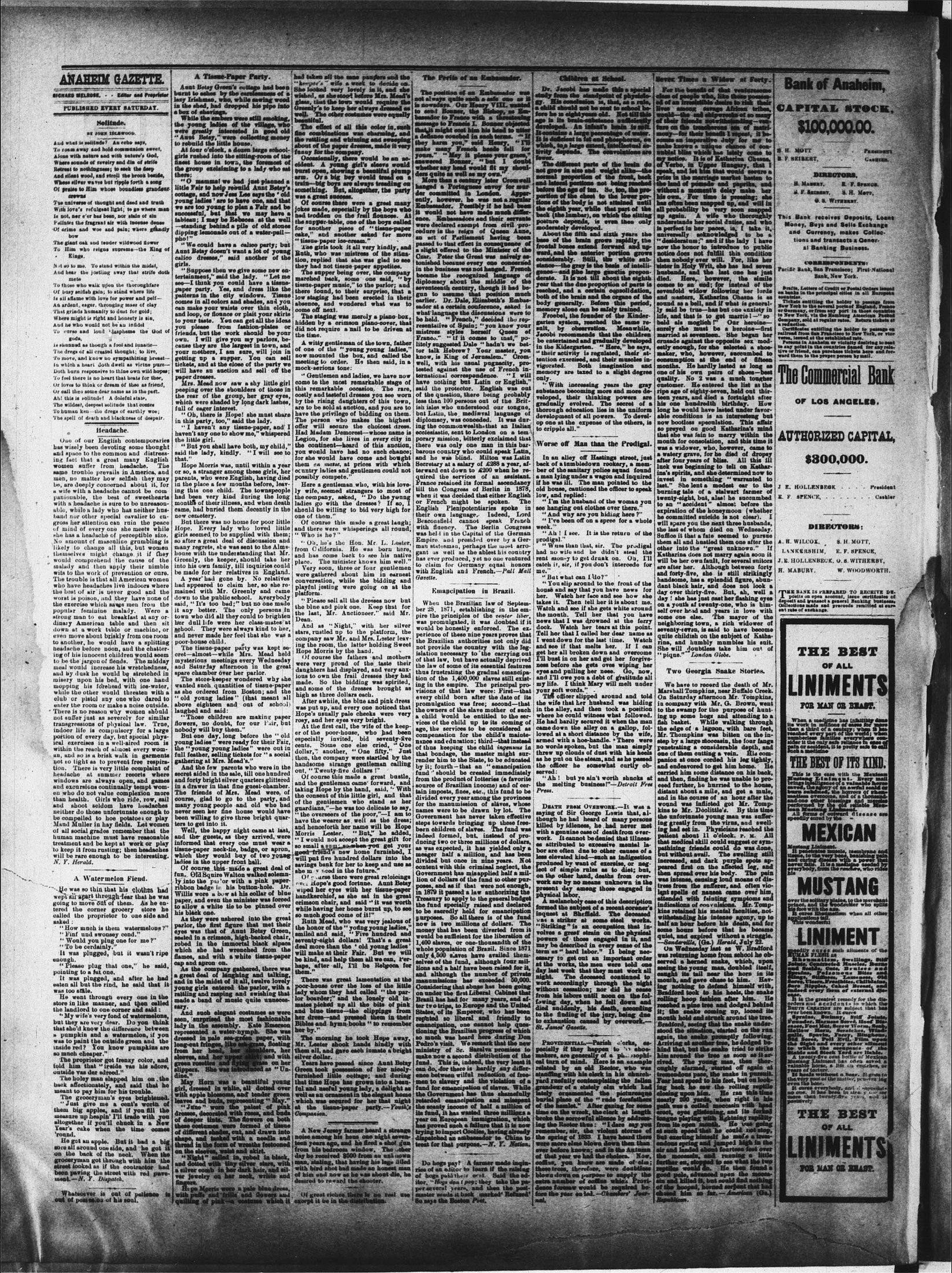
Searchable text
ANAHEIM GAZETTE.
RICHARD MELROSE. • Editor and Proprietor
PUBLISHED EVERY SATURDAY.
Solitude.
BY JOHN IDLEWOOD.
And what is solitude? An echo says,
To roam away and hold communion sweet,
Alone with nature and with nature's God,
Where sounds of revelry and dim of strife
Retreat to nothingness; to seek the deep
And silent wood, and stroll the brook beside,
Whose silver waves but ripple forth a song
Of praise to Him whose boundless grandeur
crewns
The universe of thought and deed and truth
With love's refulgent light; to go where man
is not, nor e'er has been, nor stain of sin
Pollinates the fragrant air with incense dense
Of crime and woe and pain; where grandly bow
The giant oak and tender wildwood flower
To Him who reigns supreme—the King of Kings.
Not so to me. To stand within the midst,
And hear the jostling away that strife doth
mete
To those who walk upon the thoroughfare
Of busy selfish gain; to stand where life
Is all shame with love for power and self—
An ardent, eager, thronging mass of clay
That grinds humanity to dust for gold;
Where might is right and honesty is sin,
And he who would not be an infidel
To curse and loud blaspheme the God of gods,
Is shunned as though a fool and lunatic—
The dregs of all created thought; to live,
To move, and know no sympathizing breast—
In which a heart doth dwell as virtue pure—
Doth burn responsive to thine own wild hopes;
To feel there is no heart that boasts for thee,
Or loves to think or dream of thee as friend,
Or call thee some dear name as in the past.
Ah! this is solitude! A doleful state,
The wildest, deepest solitude that comes
To human ken—the dregs of earthly woe;
The spell of death and blackness of despair.
Headache.
One of our English contemporaries has wisely been devoting some thought
and space to the common and distressing fact that a great many English women suffer from headache. The same trouble prevails in America, and
A Tissue-Paper Party.
Aunt Betsy Green's cottage had been burnt to ashes by the carolessness of a lazy Irishman, who, while sawing wood in the shed, had dropped his pipe into a box of shavings.
While the embers were still smoking, the young ladies of the village, who were greatly interested in good old "Aunt Betsy," were collecting money to rebuild the little house.
At four o'clock, a dozen large school-girls rushed into the sitting-room of the finest house in town, the foremost of the group exclaiming to a lady who sat there:
"O mammal we had just planned a little Fair to help rebuild Aunt Betsy's cottage, and now Jess Lee says the 'old young ladies' are to have one, and that we are too young to plan a Fair and be successful, but that we may have a tableau; I may be Rebecca at the well—standing behind a pile of old stones dipping lemonade out of a water-pail—pho!"
"We could have a calico party; but Aunt Betsy doesn't want a lot of young calico dresses," said another of the girls.
"Suppose then we give some new entertainment," said the lady. "Let me see—I think you could have a tissue-paper party. Yes, and dress like the patterns in the city windows. Tissue comes in all colors and shades, and you can make your waists over thin cloth, and loop, or flounce or plait your skirts to your taste. You can get all the ideas you please from fashion-plates or friends, but the work should be your own. I will give you my parlors, because they are the largest in town, and your mothers, I am sure, will join in getting up a supper. You can sell tickets, and at the close of the party we will have an auction and sell off the paper dresses.
Mrs. Mead now saw a shy little girl peeping over the shoulders of those in the rear of the group, her gray eyes, which were shaded by long dark lashes, full of eager interest.
"Oh, there is Hope! she must share in this party, too," said the lady.
"I haven't any tissue-paper, and I haven't any one to show me," whispered the little girl.
"But you shall have both, my child," said the lady, kindly. "I will see to that."
Hope Morris was, until within a year or so, a stranger among these girls, her had taken all the sand "keeper's" wife a wife. She looked very lovely wished, as she stood by glass, that the town Greenly's to keep her well. The other cost beautiful.
The effect of all fine combinations with the rattling and whistle about of the paper drunk funny for the company.
Occasionally, there cident. A young girl burst open, showing arm. Or a big boy train—big boys are not something. But, albeit it was a great success.
Of course there were jokes made, especially had trodden on the supper-table, one for another piece cake," and another "tissue-paper ice-cream."
The girls took it all Ruth, who was mis-tention, replied that she had not tissue-paper.
The supper being marched back, some tissue-paper music," there found, to their low staging had been absence, and wonder come off next.
The staging was midden by a crimson did not require a nausea the time.
A witty gentleman of one of the "young" now mounted the bending meeting to order. Mock-serious tone:
"Gentlemen and lad come to the most reckless this remarkable oocostly and tasteful drive by the rising daughter are to be sold at auctions have the privilege of The person who may offer will secure that Had Madam Demore Legion, for she lives the continent—heard you would have heard them ennusse, at country ladies and got
To feel there is no heart that beats for thee,
Or loves to think or dream of thee as friend,
Or call thee some dear name as in the past.
Ah! this is solitude! A doleful state,
The wildest, deepest solitude that comes
To human ken—the dregs of earthly woe;
The spell of death and blackness of despair.
Headache.
One of our English contemporaries has wisely been devoting some thought and space to the common and distressing fact that a great many English women suffer from headache. The same trouble prevails in America, and men, no matter how selfish they may be, are deeply concerned about it, for a wife with a headache cannot be companionable, the best of sweethearts with a headache is sure to be unreasonable, while a lady who has neither husband nor other special cavalier to engrass her attention can ruin the peace of mind of every one she meets while she has a headache of perceptible size. No amount of masonline grumbling is likely to change all this, but women themselves might change it if they would comprehend the cause of the malady and then apply their nimble wits to the work of prevention or cure. The trouble is that all American women who have headaches live indoors where the best of air is never good and the worst is poison, and they have none of the exercise which saves men from the popular feminine malady. Were a strong man to eat breakfast at any ordinary American table and then sit down at a work table or machine, or even move about briskly from one room to another, he would have a splitting headache before noon, and the chattering of his innocent children would seem to be the jargon of fiends. The midday meal would increase his wretchedness, and by dusk he would be stretched in misery upon his bed, with one hand mopping his forehead with ice-water, while the other would threaten with a club or pistol any one who dared to enter the room or make a noise outside. There is no reason why women should not suffer just as severely for similar transgressions of physical law. True, indoor life is compulsory for a large portion of every day, but special physical exercises in a well-aired room is within the reach of almost every woman, and so is a brisk walk in garments not so tight as to prevent free respiration. There is very little complaint of headache at summer resorts where windows are always open, and games and excursions continually tempt women who do not value complexion more than health. Girls who ride, row, sail and shoot seldom have headaches neither do those unfortunate enough to be compelled to hoe potatoes or play Maud Muller in hay fields. Let women of all social grades remember that the human machine must have reasonable treatment and be kept at work or play to keep it from rusting; then headaches will be rare enough to be interesting.
N. Y. Herald.
A Watermelon Fiend.
He was so thin that his clothes had wept all apart through fear that he was
Mrs. Mead now saw a shy little girl peeping over the shoulders of those in the rear of the group, her gray eyes, which were shaded by long dark lashes, full of eager interest.
"Oh, there is Hope! she must share in this party, too," said the lady.
"I haven't any tissue-paper, and I haven't any one to show me," whispered the little girl.
"But you shall have both, my child," said the lady, kindly. "I will see to that."
Hope Morris was, until within a year or so, a stranger among these girls, her parents, who were English, having died in the place a few months before, leaving this one child. The townspeople had been very kind during the long months of their illness, and when death came, had buried them decently in the new cemetery.
But there was no home for poor little Hope. Every lady who loved little girls seemed to be supplied with them; so after a great deal of discussion and many regrets, she was sent to the Almshouse with the understanding that Mr. Greenly, the keeper, should take her into his own family, till inquiries could be made for her relatives in England.
A year had gone by. No relatives had appeared to claim her, so she remained with Mr. Greenly and came down to the public school. Everybody said, "It's too bad;" but no one made it any better. The only persons in town who did all they could to brighten her dull life were her class-mates at school. They were always kind to her, and never made her feel that she was a poor-house child.
The tissue-paper party was kept secret—almost—while Mrs. Mead held mysterious meetings every Wednesday and Saturday afternoon in the great spare chamber over her parlor.
The store-keeper wondered why she wanted such quantities of tissue-paper as she ordered from Boston; and the "old young ladies" (that meant all above eighteen and out of school) laughed and said:
"Those children are making paper flowers, no doubt, for our Fair, but nobody will buy them."
But one day, long before the "old young ladies" were ready for their Fair, the "young young ladies" were out in full feather, selling tickets for "a social gathering at Mrs. Mead's."
And the few parents who were in the secret aided in the sale, till one hundred and forty bright silver quarters glittered in a drawer in that fine guest-chamber. The friends of Mrs. Mead were, of course, glad to go to the party, and many young people and old who had never seen her fine house would have been willing to give three bright quarters to get into it.
Well, the happy night came at last, and the guests, as they arrived, were informed that every one must wear a tissue-paper neck-tie, badge, or apron, which they would buy of two young ladies in the upper front hall.
Of course this made a great deal of fun. Old Squire Walton walked solemnly into the parlor with a pink paper-ribbon badge in his button-hole. Dr. Willis wore a bow at his collar of blue paper dresses.
Mrs. Mead now saw a shy little girl peeping over the shoulders of those in the rear of the group, her gray eyes, which were shaded by long dark lashes, full of eager interest.
"Oh, there is Hope! she must share in this party, too," said the lady.
"I haven't any tissue-paper, and I haven't any one to show me," whispered the little girl.
"But you shall have both, my child," said the lady, kindly. "I will see to that."
Hope Morris was, until within a year or so, a stranger among these girls, her parents, who were English, having died in the place a few months before, leaving this one child. The townspeople had been very kind during the long months of their illness, and when death came, had buried them decently in the new cemetery.
But there was no home for poor little Hope. Every lady who loved little girls seemed to be supplied with them; so after a great deal of discussion and many regrets, she was sent to the Almshouse with the understanding that Mr. Greenly, the keeper, should take her into his own family, till inquiries could be made for her relatives in England.
A year had gone by. No relatives had appeared to claim her, so she remained with Mr. Greenly and came down to the public school. Everybody said, "It's too bad;" but no one made it any better. The only persons in town who did all they could to brighten her dull life were her class-mates at school. They were always kind to her, and never made her feel that she was a poor-house child.
The tissue-paper party was kept secret—almost—while Mrs. Mead held mysterious meetings every Wednesday and Saturday afternoon in the great spare chamber over her parlor.
The store-keeper wondered why she wanted such quantities of tissue-paper as she ordered from Boston; and the "old young ladies" (that meant all above eighteen and out of school) laughed and said:
"Those children are making paper flowers, no doubt, for our Fair, but nobody will buy them."
But one day, long before the "old young ladies" were ready for their Fair, the "young young ladies" were out in full feather, selling tickets for "a social gathering at Mrs. Mead's."
And the few parents who were in the secret aided in the sale, till one hundred and forty bright silver quarters glittered in a drawer in that fine guest-chamber. The friends of Mrs. Mead were, of course, glad to go to the party,and many young people and old who had never seen her fine house would have been willing to give three bright quarters to get into it.
Well, the happy night came at last, and the guests, as they arrived, were informed that every one must wear a tissue-paper neck-tie,badge,or apron,which they would buy of two young ladies in the upper front hall.
Of course this made a great deal of fun. Old Squire Walton walked solemnly into the parlor with a pink paper-ribbon badge in his button-hole. Dr. Willis wore a bow at his collar of blue paper dresses.
Mrs. Mead now saw a shy little girl peeping over the shoulders of those in the rear of the group,her gray eyes,which were shaded by long dark lashes,full of eager interest.
"Oh,there is Hope! she must share in this party,too," said the lady.
"I haven't any tissue-paper,and I haven't any one to show me," whispered the little girl.
"But you shall have both,my child," said the lady,kindly. "I will see to that."
Hope Morris was,until within a year or so,a stranger among these girls,her parents,who were English,having died in the place a few months before,leaving this one child. The townspeople had been very kind during the long months of their illness,and when death came,had buried them decently in the new cemetery.
But there was no home for poor little Hope. Every lady who loved little girls seemed to be supplied with them; so after a great deal of discussion and many regrets,she was sent to the Almshouse with the understanding that Mr. Greenly,the keeper,应该 take her into his own family,till inquiries could be made for her relatives in England.
A year had gone by. No relatives had appeared to claim her,so she remained with Mr. Greenly和 came down to the public school.Everybody said,"It's too bad;" but no one made it any better. The only persons in town who did all they could to brighten her dull life were her class-mates at school. They were always kind to her,and never made her feel that she was a poor-house child.
The tissue-paper party was kept secret—almost—while Mrs. Mead held mysterious meetings every Wednesday and Saturday afternoon in the great spare chamber over her parlor.
The store-keeper wondered why she wanted such quantities of tissue-paper as she ordered from Boston; and the "old young ladies" (that meant all above eighteen and out of school) laughed and said:
"Those children are making paper flowers,no doubt,for our Fair,但 nobody will buy them."
But one day,长before the "old young ladies" were ready for their Fair,the "young young ladies" were out in full feather,selling tickets for "a social gathering at Mrs.Mead's."
And the few parents who were in the secret aided in the sale,till one hundred and forty bright silver quarters glittered in a drawer in that fine guest-chamber.The friends of Mrs.Mead were,of course,glad to go to the party,and many young people and old who had never seen her fine house would have been willing to give three bright quarters to get into it.
Well,the happy night came at last,and the guests,as they arrived,were informed that every one must wear a tissue-paper neck-tie,badge,或 apron,这 would buy of two young ladies in the upper front hall.
Of course this made a great deal of fun.Old Squire Walton walked solemnly into the parlor with a pink paper-ribbon badge in his button-hole.Dr.Willis wore a bow at his collar of blue paper dresses."
A Watermelon Fiend.
He was so thin that his clothes had wept all apart through fear that he was going to move out of them. As he entered the corner grocery store he called the proprietor to one side and asked:
"How much is them watermelons?"
"Finf und swonsey cend."
"Would you plug one for me?"
"To be cordainly."
It was plugged, but it wasn't ripe enough.
"Please plug that one," he said, pointing to a fat one.
It was plugged, and after he had eaten all but the rind, he said that it was too stale.
He went through every one in the store in like manner, and then called the landlord to one corner and said:
"My wife's very fond of watermelons, but they are very dear. Do you think that she'd know the difference between a pumpkin and a watermelon, if you was to paint the outside green and the inside red? You know pumpkins are so much cheaper."
The proprietor got frenzy color, and told him that "inside vas his sdore, outside vas der adreed."
The holey man slapped him on the back affectionately, and said that he meant to pay him for his trouble.
The groceryman's eyes brightened.
"Just give me a cent's worth of them big apples, and if you fill the measure up heapin' I'll trade with you altogether if you'll chuck in a New Year's cake when the time comes round."
He get an apple. But it had a big sore all around one side, and he got it on the back of the neck. When the groceryman got through with him the street looked as if the contractor had been paving the street with red pavement.—N.Y. Dispatch.
Whatsoever is out of patience is out of possession of his soul.
had taken all the same panthers and the "heper's" wife a week to decide on. She looked very lovely in it, and she wished, as she stood before Mrs. Mead's glass, that the town would require the Greenly's to keep her always dressed as well. The other costumes were equally beautiful.
The effect of all this color in such fine combinations was charming, and the rattling and whizzing and sweeping about of the paper dresses made it very funny for the company.
Occasionally, there would be an accident. A young girl's sleeve would burst open, showing a beautiful plump arm. Or a big boy would tread on a train—big boys are always treading on something. But, altogether, the party was a great success.
Of course there were a great many jokes made, especially by the boys who had trodden on the frail flonces. At the supper-table, one of the boys called for another piece of "tissue-paper cake," and another asked for more "tissue-paper ice-cream."
The girls took it all very kindly, and Euth, who was mistress of the situation, replied that she was glad to see they had not tissue-paper appetites.
The supper being over, the company marched back, some one said, "by tissue-paper music," to the parlor; and there found, to their surprise, that a low staging had been erected in their absence, and wondered what was to come off next.
The staging was merely a piano-box, hidden by a crimson piano-cover, that did not require a nail to be driven at the time.
A witty gentleman of the town, father of one of the "young young ladies," now mounted the box, and called the meeting to order. He then said, in a mock-serious tone:
"Gentlemen and ladies, we have now come to the most remarkable stage of this remarkable occasion. The rare, costly and tasteful dresses you see worn by the rising daughters of this town, are to be sold at auction, and you are to have the privilege of bidding on them. The person who makes the highest offer will secure the choicest dress. Had Madam Demorest—whose name is Legion, for she lives in every city in the continent—heard of this auction, you would have had no such chance; for she would have come and bought them en masse, at prices with which country ladies and gentlemen could not
The Perils of an Embassador.
The position of an Embassador was not always quite such a safe one as it is nowadays. Our Henry VIII wanted to send Bonner, the Bishop, as Embassador to France with a threatening message to Francis I. Bonner objected that it might cost him his head to utter a defiance conceived in such terms. "If they harm you," said Henry, "I'll make many French heads fall for yours." "May it please your grace," answered Bonner, "but I doubt whether any head would fit my shoulders quite as well as my own."
More than a century later Cromwell hanged a Portuguese envoy for murder committed in London. Apparently, however, he was not a regular Embassador. Possibly if he had been it would not have made much difference. Embassadors and their servants were declared exempt from civil procedure is the reign of Queen Anne, an act of Parliament having been passed to that effect in consequence of a slight offered to the Minister of the Czar. Peter the Great was naively astonished because every one concerned in the business was not hanged. French became the recognized language of diplomacy about the middle of the seventeenth century, though it had begun to assume that position much earlier. Dr. Dale, Elizabeth's Embassador at a certain conference, asked in what language the discussions were to be held. "French," decided the representative of Spain; "you know your mistress styles herself Queen of France." "If it comes to that," politely suggested Dale "hadn't we better talk Hebrew? Your master, you know, is King of Jerusalem." Cromwell, with his usual pugnacity, protested against the use of French international correspondence. "I will have nothing but Latin or English," said the protector. English was out of the question, there being probably less than 100 persons out of the British Isles who understood our tongue, but Latin, the medieval language of diplomacy, was conceded. It was during the commonwealth that an Italian ecclesiastic, sent to London on a temporary mission, bitterly exclaimed that there was only one man in this barbarous country who could speak Latin, and he was blind. Milton was Latin Secretary at a salary of £288 a year, afterward cut down to £200 when he re-
Children at School.
Dr. Jacobi has made this a special study from the standpoint of physiology. His conclusion is, that, as a rule, a child should not be sent to school before he is eight years old. Not till this age is its brain substance sufficiently developed. An infant's brain is soft. It contains a large percentage of water. It is deficient in fat and phosphorus, on which, to a large extent, intellectual activity depends. The convolutions are fewer.
The different parts of the brain do not grow in size and weight alike—the normal proportion of the front, back and lateral portions not being reached before the age of ten. So, too, the proportion of the chest to the lower portions of the body is not attained until the eighth year, while that part of the back (the lumbar), on which the sitting posture depends, is even then only moderately developed.
About the fifth and sixth years the base of the brain grows rapidly, the frontal bones extend forward and upward, and the anterior portion grows considerably. Still, the white substance—the gray is the basis of intelligence—and the large gaudia preponderate. It is not till about the eighth year that the due proportion of parts is reached, and a certain consolidation both of the brain and the organs of the body generally. Before this period, memory alone can be safely trained.
Froebel, the founder of the Kindergarten system, reached the same result, by observation. Meanwhile, Jacobi recommends that the children be entertained and gradually developed in the Kidergarten. "Here," he says, "their activity is regulated, their attention exercised, and their muscles invigorated. Both imagination and memory are taxed to a slight degree only.
With increasing years the gray substance becoming more and more developed, their thinking powers are gradually evolved. The secret of a thorough education lies in the uniform development of all powers. To develop one at the expense of the others, is to cripple all."
Worse off Man than the Prodigal.
In an alley off Hastings street, just back of a tumbledown rookery, a member of the sanitary police squad found
"Gentlemen and ladies, we have now come to the most remarkable stage of this remarkable occasion. The rare, costly and tasteful dresses you see worn by the rising daughters of this town, are to be sold at auction, and you are to have the privilege of bidding on them. The person who makes the highest offer will secure the choiceest dress. Had Madam Demorest—whose name is Legion, for she lives in every city in the continent—heard of this auction, you would have had no such chance; for she would have come and bought them en masse, at prices with which country ladies and gentlemen could not possibly compete."
Here a gentleman who, with his lovely wife, seemed strangers to most of the company, asked, "Do the young ladies go with the dresses? If so, I should be willing to bid very high for one of them."
Of course this made a great laugh; and there were whisperings all round, "Who is he?"
"Oh, he's the Hon. Mr. L. Lester, from California. He was born here, and has come back to see his native place. The minister knows him well."
Very soon, three or four gentlemen were gathered about him in earnest conversation, while the bidding and playful jesting were going on at the platform.
"Please sell all the dresses now but the blue and pink one. Keep that for the last, Mr. Auctioneer." said Mr. Dean.
And as "Night," with her silver stars, rustled up to the platform, the company saw Mr. and Mrs. Lester leaving the room, the latter holding Sweet Hope Morris by the hand.
Of course the fathers and mothers were very proud of the taste their daughters had displayed, and very anxious to own the frail dresses they had made. So the bidding was spirited, and some of the dresses brought as high as three dollars each.
After awhile, the blue and pink dress was put up, and every one noticed that Hope's usually pale cheeks were very rosy, and her eyes very bright.
At the first call, the wife of the keeper of the poor-house, who had been especially invited, bid seventy-five cents. Some one else cried, "One dollar," another, "One fifty." Just then, the company were startled by the handsome strange gentleman calling out, "Twenty-five dollars!"
Of course this made a great bustle, and the gentleman came forward, and taking Hope by the hand, said, "With the consent of this little girl, and that of the gentlemen who stand as her guardians,"—he was too delicate to say, "the overseers of the poor."—I am to have the wearer as well as the dress; and henceforth her name will be Hope Morris Lester. "But," he added, "I would not accept the great gift for so small a sum so when you get your good friend's new home furnished, I will put five hundred dollars into the savings bank for her to keep and use as she may need in the future."
Of course there were great reloicings over Hope's good fortune. Aunt Betsey wiped her eyes with her tissue-paper handkerchief, as she sat in the great international correspondence. "I will have nothing but Latin or English," said the protector. English was out of the question, there being probably less than 100 persons out of the British lales who understood our tongue, but Latin, the medieval language of diplomacy, was conceded. It was during the commonwealth that an Italian ecclesiastic, sent to London on a temporary mission, bitterly exclaimed that there was only one man in this barbous country who could speak Latin, and he was blind. Milton was Latin Secretary at a salary of £288 a year, afterward cut down to £200 when he required the services of an assistant. France retained its formal ascendancy till the Congress of Berlin in 1878, when it was decided that either English or French might be spoken. The English Plenipotentiaries spoke in their own language. Indeed, Lord Beaconsfield cannot speak French with fluency. The Berlin Congress was held in the Capital of the German Empire, and presided over by a German statesman, perhaps the most arrogant as well as the ablest his country has ever produced, yet no one ventured to claim for Germany equal honors with English and French.—Pall Mall Gazette.
Emancipation in Brazil.
When the Brazilian law of September 28, 1871, establishing in the empire the principles of the center liberation, was promulgated, it was doubted if it would be honestly enforced. The experience of these nine years proves that the Brazilian authorities not only did not provide the country with the legislation necessary to the carrying out of that law, but have actually deprived the law of some of its essential features thus frustrating the gradual emancipation of the 1,400,000 slaves still existing in the empire. The principal provisions of that law were: First—that every child born after the date of its promulgation was free; second—that the owners of the slave mother of such a child would be entitled to the services of the child up to its coming of age, the services to be considered as compensation for the child's maintenance and education; third—that instead of thus keeping the child ingenuus in that bondage, the master might surrender him to the State, to be educated by it; fourth—that an "emancipation fund" should be created immediately from the product of lotteries (a favorite source of Brazilian income) and of certain imposts, fines, etc., this fund to be divided every year among the provinces for the manumission of slaves, whose names were to be drawn by lot. The Government has never taken effective steps towards bringing up these freeborn children of slaves. The fund was indeed formed, but instead of producing two or three millions of dollars, as was expected, it has yielded only a meager half a million, and has been divided but once in nine years. Not content with this criminal neglect, the Government has misapplied half a million of dollars of the fund to other purposes, and as if that were not enough, in 1879 it passed a law authorizing the Treasury to apply to the general budget only.
With increasing years the gray substance becoming more and more developed, their thinking powers are gradually evolved. The secret of a thorough education lies in the uniform development of all powers. To develop one at the expense of the others, is to cripple all.
Worse off Man than the Prodigal.
In an alley off Hastings street, just back of a tumbledown rookery, a member of the sanitary police squad found a man lying under a wagon and inquired if he was ill. The man pointed to the old house, cautioned the officer to speak low, and replied:
"I'm the husband of the woman you see hanging out clothes over there."
And why are you hiding here?
"I've been off on a spree for a whole week."
"Ah! I see. It is return of the prodigal."
Wuss than that air. The prodigal had no wife and he didn't steal the rent money to get drunk on. Oh, I'll catch it, sir, if you don't intercede for me."
But what can I do?
"You slip around to the front of house and say that you have news for her. Watch her face and see how she takes it. Then tell her it is about me. Watch and see if she gets white around the month. Tell her that you have news that I was drowned at the ferry dock. Watch her tears at this point. Tell her that I called her dear name as I went down for the last time. Watch and see if that melts her. If I can get her all broken down and overcome I'll bust in on her and get her forgiveness before she gets oves wiping her eyes and pulling her nose. Go now, and I owe you a debt of gratitude all my life. I think Mary will melt under your soft words."
The officer slipped around and told the wife that her husband was hiding in the alley, and then took a position where he could witness what followed. He had hardly secured it when he came down the alley on a gallop, followed at a short distance by the wife, armed with a hoe handle. There were no words spoken, but the man simply threw up clouds of dust with his heels as he put on the steam, and as he passed the officer he somewhat curtly observed:
"Ah! but ye ain't worth shucks at the melting business!"—Detroit Free Press.
Death from Overwork.
It was a saying of Sir George Lewis that although he had heard of many persons killed by idleness, he had never met with a genuine case of death from work. It cannot be denied that illnesses attributed to excessive mental labor are often due to other causes of a less elevated kind—such as indigestion produced by want of exercise, or neglect of simple rules as to diet; but on the other hand, deaths from work are by no means unknown in the present day among those engaged in physical labor.
of the gentlemen who stand as her guardians,"—he was too delicate to say,
"the overseers of the poor,"—I am to have the wearer as well as the dress;
and henceforth her name will be Hope Morris Lester. "But," he added,
"I would not accept the great gift for so small a sum, when you get your good friend's new home furnished, I will put five hundred dollars into the savings bank for her to keep and use as she needed in the future."
Of course there were great reloicings over Hope's good fortune. Aunt Betay wiped her eyes with her tissue-paper handkerchief, as she sat in the great crimson chair, and said "it was worth while having her home burnt up, to see so much good come of it!"
Ruth Mead, who was very jealous of the honor of the "young young ladies," smiled and said, "Five hundred and seventy-eight dollars! That's a great deal more than the 'old young ladies' will make at their Fair. But we will be kind, and help them all we can. Perhaps, after all, I'll be Rebecca for them."
There was great lamentation at the poor-house over the loss of the little lady whom they had called "the parlor boarder;" and the lonely old inmates picked up all the bits of pink and blue tissue—the clippings from her dress—and pressed them in their Bibles and hymn-books "to remember her by."
The morning he took Hope away, Mr. Lester shook hands hindly with them all, and gave each inmate a bright silver dollar.
Years have passed since Aunt Betay Green took possession of her nicely-furnished little cottage; and during that time Hope has grown into a beautiful and useful young lady, a delight as well as an ornament in the elegant home which was secured for her that night at the tissue-paper party.—Youth's Companion.
A New Jersey farmer heard a strange noise among his hens one night seventeen years ago, and he fired a shot gun from his bedroom window. The other day he received $500 from an unknown man, stating, that having his legs dilled with bird shot had made an honest man of him and now as he was about die, he desired to reward the shooter.
Of great riches there is no real use except it be in the distribution.
Do hogs pay? A farmer made inquiries of an editor to learn if the raising of hogs paid their cost. Said the editor, "Hogs don't pay; they take the paper several years, and then the postmaster sends it back marked' Refused' So says the Boston Post.
DEATH FROM OVERWORK.—It was a saying of Sir George Lewis that, although he had heard of many persons killed by idleness, he had never met with a genuine case of death from overwork. It cannot be denied that illnesses attributed to excessive mental labor are often due to other causes of a less elevated kind—such as indigestion produced by want of exercise, or neglect of simple rules as to diet; but, on the other hand, deaths from overwork are by no means unknown in the present day among those engaged in physical labor.
A melancholy case of this description formed the subject of a recent coroner's inquest at Sheffield. The deceased was a striker at some steel works. "Striking" is an occupation that involves a great strain on the physical powers of those engaged in it, and may be described in every sense of the term as "hard labor." It being necessary to get out an important order at the works, the men were told one day last week that they must work all night. The deceased continued to work accordingly through the night without cessation; nor did he cease from his labors until noon on the following day, when he fell down and died suddenly, his death, according to the finding of the jury, being due to exhaustion caused by overwork.—St. James' Gazette.
PROVIDENTIAL.—Parish clerks, especially if they happen to be shoe-makers, are generally of a philosophical turn of mind. Here is an example related by an old Rector, who was standing with his clerk in his churchyard ruefully contemplating the fallen grandeur of a stately elm which had lately ornamented the picturesque burial place of the "rude forefathers of the hamlet." After gazing for some time on the wreck, the clerk at length broke the sorrowful silence by addressing the Rector thus: "I dare say you remember, air, the violent storms of the spring of 1833. I have heard there were more elms blown down than ever before known; and in the Autumn of that year we had chalkers. Now, coffins, you know are made of elm; these trees, therefore, were doubtless blown down on purpose to supply the extra number of coffins white. Providence forewould be required before the year on led.—Chambers' Journal."
Never Times a Widow at Forty.
For the benefit of that venture some clam of people who, like those possessed of an irresistible desire to risk their lives among savage African tribes, would—the and shipwrecks of so many of their friends notwithstanding—vulture on the treacherous sea of matrimony—for their benefit I repeat, it becomes an imperative duty for me to make known a unique chance of conubial bliss which has lately come to my notice. It is of Katharina Chasna, of Verbo, in Upper Hungary, that I speak, and let him that would assure a prize in the marriage market hasten to the land of pomade and paprika, and without a moment's delay make her his own. For time is pressing; she has often been snapped up, and will in all probability be very soon snapped up again. A wife who thoroughly understands her social duties, and who is perfect in her pace, is, I take it, universally acknowledged to be a "desideratum;" and if the lady I have now the honor to introduce to public notice does not fulfill this condition then nobody ever will. For, like her sister in Holy Writ, she has had seven husbands, and the last one has just died. Here, however, the simile comes to an end; for instead of the sevenfold widow following her lords and masters, Katharina Chasna is as sound as a bell, and if what is generally said be true—has but one anxiety in life, and that is to get married—"so bald als么 moglich!" Our heroine—surely she must be a heroine—first married at seventeen. She began her crusade against the opposite sex modestly enough, for she selected a shoe-maker, who, however, succumbed to consumption at the end of fifteen months. He hardly lasted as long as one of his own pairs of shoes—best quality. No 2 was a much tougher customer. He entered the list at the ripe age of eighty-seven, held out thirteen years, and died a fortnight after his one hundredth birthday. How long he would have lasted under favorable conditions is an interesting but now bootless speculation. This affair so preyed on good Katharina's mind that she was fain to marry within the month for consolation, and this time it was a widower, who, however, came to a watery grave, for he died of dropsy after four years of bliss. All this ill luck was beginning to tell on Katharina's spirits, and she determined now to
Bank of Anaheim,
CAPITAL STOCK,
$100,000.00.
B. H. MOTT President
B. F. SEIBERT Cashier.
DIRECTORS:
H. MASERY R. F. SPENGS.
M. F. SEIBERT S. H. MOTT.
O. S. WITHERBY.
This Bank receives Deposits, Loans Money, Buys and Sells Exchange and Currency, makes Collections and transacts a General Banking Business.
CORRESPONDENTS:
Pacific Bank, San Francisco; First National Bank, New York.
Drafts, Letters of Credit or Postal Orders issued on banks in the principal cities in all European countries.
Tickets entitling the holder to passage from New York to the several ports of England, France or Germany, or from any port in those countries to New York, via the Hamburg American Passed Company, sold at regular rates. Return tickets at a reduction.
Certificates entitling the holder to passage on railroad from San Francisco to New York, or vice versa, issued at the established rate.
Persons in Anaheim or vicinity desiring to sent to any point in the countries famed for any relative or friend, can purchase tickets here and forward them to the proper person by mail.
The Commercial Bank
OF LOS ANGELES.
AUTHORIZED CAPITAL,
$300,000.
Two Georgia Snake Stories.
We have to record the death of Mr. Marshall Tomphins, near Buffalo Creek. On Saturday afternoon Mr. Tompkins, in company with Mr. G. Brown, went to the swamp for the purpose of hunting up some hogs and attending to a fish basket. While walking through the edge of a lagoon, with bare feet, Mr. Thompkins was bitten on the in-step by a large moosein, the four fangs penetrating a considerable depth, and one of them cutting a vein. His companion at once corded his leg tightly, and endeavored to get him home. He carried him some distance on his back, and then, finding he was unable to proceed further, he hurried to the house, distant about a mile, and got a mule, and in the course of an hour after the wound was inflicted got Mr. Tompkins to Mr. Doolittle's. By this time the unfortunate young man was suffering greatly from the virus, and swelling had set in. Physicians reached the patient about 11 o'clock. P.M. All that medical skill could suggest or sympathizing friends could do was done, but without avail. The swelling still increased, and dark purple spots appeared first on the affected leg, and then spread over his body. The pain was intense, causing loud moans of distress from the sufferer, and often violent spells of nausea came over him, attended with fainting symptoms and quality. No 2 was a much tougher customer. He entered the list at the ripe age of eighty-seven, held out thirteen years, and died a fortnight after his one hundredth birthday. How long he would have lasted under favorable conditions is an interesting but now bootless speculation. This affair so preyed on good Katharina's mind that she was fain to marry within the month for consolation, and this time it was a widower, who, however, came to a watery grave, for he died of dropay after four years of bliss. All this ill luck was beginning to tell on Katharina's spirits, and she determined now to invest in something "warranted to last." She lent a modest ear to the burning tale of a stalwart farmer of twenty-eight, but, alas! he succumbed to an "accident" almost before the expiration of the honeymoon (whether he committed suicide is not clear). I will spare you the next three husbands, the last of whom died on Wednesday. Suffice it that a fate seemed to pursue them all and hustled them one after the other into the "great unknown." If Katharina does not marry again soon it will be her own fault, for several suitors are after her. Although between forty and forty-five, she is still strikingly handsome, has a splendid figure, abundant black hair, and does not look a day over thirty-five. But, ah, a day! she has just cast her flashing eyes on a youth of twenty-one, who is himself over head and years in love with some one else. The mayor of the neighboring town, a rich widower of seventy-seven, is said to have become quite childish on the subject of Katharina, and humbly mumbles his suit. She will doubtless take him out of "pique." London Globe.
The BANK IS PREPARED TO RECEIVE DEPOSIT AND GRANDFATHER A GENERAL BANKING BUSINESS. Collections made and proceeds remitted at current rate of exchange.
THE BEST OF ALL LINIMENTS FOR MAN OR BEAST.
When a medicine has inhibited its work in millions of cases for more than a third of a century; when it has reached every part of the world; when members families everywhere consider it the only safe reliance in case of pain or accident, it is pretty safe to call such a medicine.
THE BEST OF ITS KIND.
This is the case with the Maxican Mustang Liniment. Every mail brings intelligence of a valuable horse saved, the agony of an awful scald or burns subdued, the horrors of rheumatism overcome, and of a thousand-and-one other blessings and merces performed by the old reliable Mexican Mustang Liniment.
All forms of outward disease are speedily cured by the MEXICAN Mustang Liniment.
It penetrates muscle, membrane and tissue, to the very bone, banishing pain and curing disease with a power that never fails. It is a medicine needed by everybody, from the remote, who rides his MUSTANG
It was a rare Lewis that, although of many persons he had never met death from overdenied that illness excessive mental lacure exercise, or negaas to diet; but, deaths from overknown in the those engaged in this description of a recent coroner's trial. The deceased some steel works. Occupation that inn on the physical engaged in it, and every sense of the"It being necimportant order men were told one they must work all used continued to through the night nor did he cease noon on the folne fell down and death, according jury, being due by overwork.
On Wednesday last as W. Bradford was returning home from school he observed a horned snake, which, upon seeing the young man, doubled itself, caught its tail near the horn in its mouth, and gave chase to him. Having nothing to defend himself with, Bradford took to his heels, the snake rolling hoop fashion after him. He reached a pine tree and dodged behind it; the snake coming up, loosed its mouth hold and struck around the tree. Bradford, seeing that the snake understood the situation, started on the run again, the snake promptly following. Arriving at another tree, he dodged behind that, but the snake tried to strike him around the tree as soon as it arrived. The young man, then thoroughly alarmed, started off again at tremendous pace, the snake in pursuit. Fear lent speed to his feet, but on looking back he saw the rolling reptile closing upon him. He ran this time nearly 200 yards, when right in his path was a coiled moccasin with head erect, eyes glistening, and its formed tongue playing with lightning rapidity from its open mouth. He was going at such speed that he could not stop, but exerting himself he made a tremendous spring and jumped high in the air and landed about fourteen feet over the mooseau, and running a little further on, stopped to see what the two reptiles would do. He then found a good pole, advanced upon the mooseau and killed it, but could find nothing of the hooped, horned serpent that had chased him so far. — American (Ga.) Republican.
and one other blessings and merits performed by the old reliable Mexican Mustang Linemen.
All forms of outward disease are speedily cured by the
MEXICAN
Mustang Liniment.
It penetrates muscles, membranes and tissue, to the very bone, banishing pain and curing disease with a power that never fails. It is a medicine needed by everybody, from the remote who rides his
MUSTANG
over the solitary plains, to the merchant prince, and the woodsucker who splits his face with the axe.
It erases Rheumatism when all other applications fail.
LINIMENT
spreadly eures such alliments of the HUMAN FLESH as
Rhythmias, Swellings, Stiff Joints, Contracted Muscles, Burns and Sores, Guts, Bruises and Sprains, Poisonous Bites and Stings, Stiffness, Lameness, Old Sore, Ulcers, Frontbites, Chilblains, Sore Nipples, Caked Breast, and induced every form of external disease.
It is the greatest remedy for the disorders and accidents to which the Braun Creation are subject that has ever been known. It cures.
Sprouts, Swimmy, Stiff Joints,
Founder, Harmens Norch, Moof Diseases,
Foot Mist, Sew Worm, Seah,
Mallow Horn, Seratchee, Windgills,
Spavin, Pawy, Blughems,
Old Sore, Poll Evil, Film upon the sight and every other element to which the companions of the Stable and Stock Kord are liable.
A twenty-five cent bottle of Mexican Mustang Liniment has often saved a valuable horse, a life on crutches, or years of torture.
It heals without a Scar. It goes to the very root of the matter, penetrating even the bone.
It cures everybody, and can supplement no one. It has been in steady use more than twenty-five years, and is positively
THE BEST OF ALL
LINIMENTS
FOR MAN OR BEAST.