anaheim-gazette 1880-10-16
Scanned page
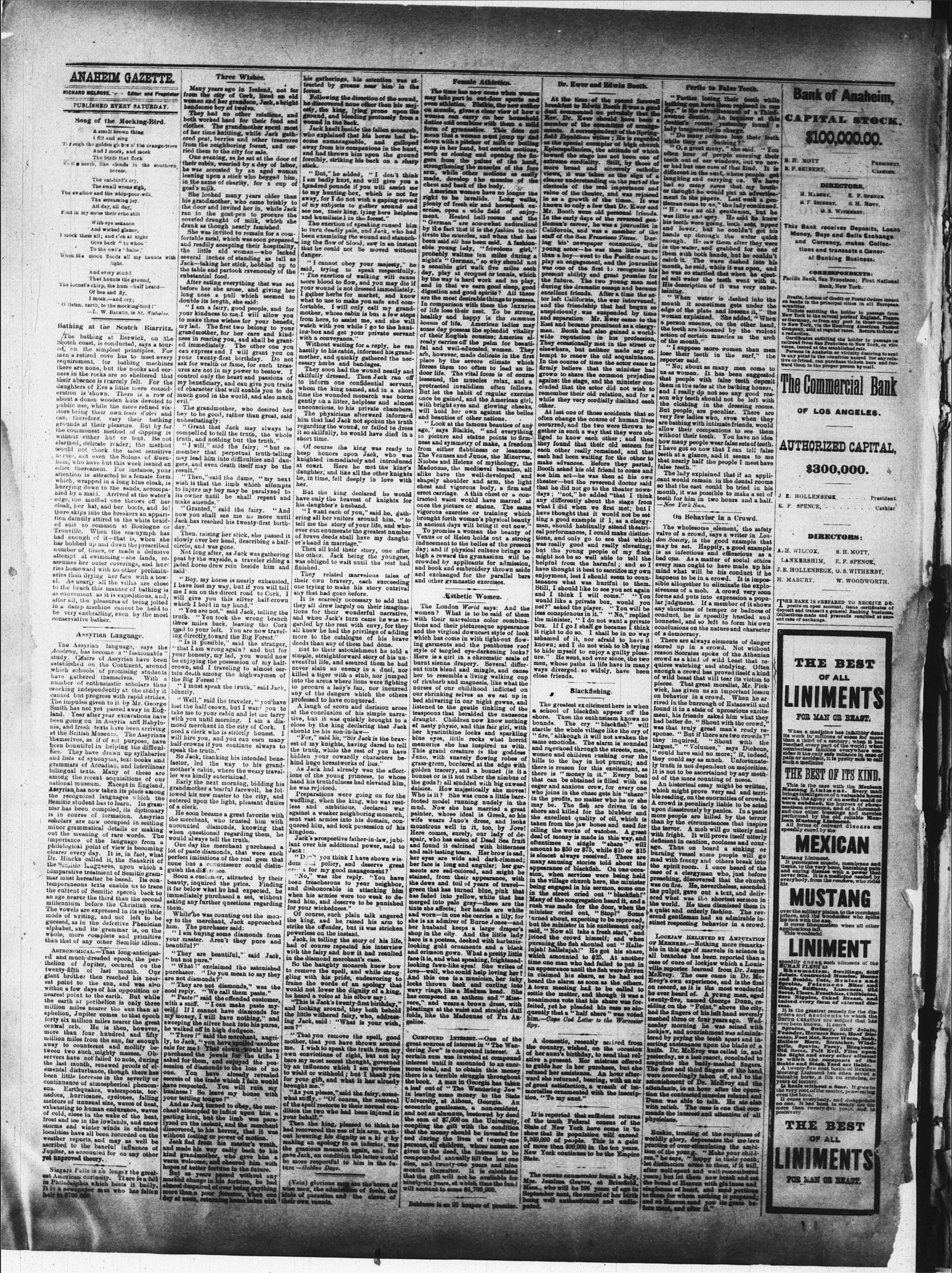
Searchable text
ANAHEIM GAZETTE.
RICHARD MELROSE. Editor and Proprietor
PUBLISHED EVERY SATURDAY.
Song of the Mocking-Bird.
A small brown thing
I flit and sing
Through the golden globes of the orange-trees
And I mock, and mock
The birds that flock
To north, like cloaks in the southern breeze.
The cat-bird's cry,
The small wrens sting,
The swallow and the whip-poor-will.
The screaming Jay,
All day, all day,
Find in my notes their echo still.
With eye askance
And wicked glance,
I mock them all; and then at night
Give back "in whoo"
To the owl's "haloe"
When the moon floods all my haunts with light.
And every sound
That haunts the ground,
The loonst's chirp, the hum—half heard—
Of bee and fly,
I mock—and cry;
"O listen, earth, to the mocking-bird!"
—L. W. Backus, in St. Nicholas.
Bathing at the Scotch Biarritz.
The bathing at Berwick, on the Scotch coast, is conducted, says a tourist, on the simplest principles. For men a retired cove has to meet every requirement, for bathing machines there are none, but the nooks and corners in the rocks are so sheltered that their absence is scarce felt. For the daughters of Eve a little mere consideration is shown. There is a row of about a dozen wooden huts devoted to public use, while the more refined visitors bring their own tents d'abri and can, therefore, vary their bathing grounds at their pleasure. But by far the commonest method of dipping is without either hut or tent. Be not alarmed, delicate reader; the method would not shock the most sensitive nerves, not even the Solons of Burnham, who have but this week issued an edict thereanent. For instance, your attention is attracted to her.
Three Wishes.
Many years ago in Ireland, not far from the city of Cork, lived an old woman and her grandson, Jack, a bright handsome boy of twelve.
They had no other relations, and both worked hard for their food and clothes. The grandmother spent most of her time knitting, while Jack gathered peat, berries and other treasures from the neighboring forest, and carried them to the city for sale.
One evening, as he sat at the door of their cabin, wearied by a day of labor, he was accosted by an aged woman leaning upon a stick who begged him, in the name of charity, for a cup of goat's milk.
She looked many years older than his grandmother, who came briskly to the door and invited her in, while Jack ran to the goat-pen to procure the coveted draught of milk, which she drank as though nearly famished.
She was invited to remain for a comfortable meal, which was soon prepared, and readily accepting their hospitality, the little old woman—who lacked several inches of standing as tall as Jack—taking her stick, hobbled up to the table and partook ravenously of the substantial food.
After eating everything that was set before her she arose, and giving her long nose a pull which seemed to double its length, she said:
"I am a fairy, good people, and for your kindness to me, I will allow you to make three wishes for your benefit, my lad. The first two belong to your grandmother, for her care and kindness in rearing you, and shall be granted immediately. The other one you can express and I will grant you on your twenty-first birthday. Do not ask for wealth or fame, for such treasures are not in my power to bestow. I control only the heart and passions of my beneficiary, and can give you traits of character that will enable you to do much good in the world, and also much evil."
The grandmother, who desired her bey to be good, rather than great, said unhesitatingly:
"Grant that Jack may always be compelled to tell the truth, the whole truth, and nothing but the truth."
"I will," said the fairy; "but remember that perpetual truth-telling may lead him into difficulties and dangers, and even death itself may be the result."
Assyrian Language.
The Assyrian language, says the Academy, has become a "fashionable" study. Claims of Assyrian have been established on the Continent, around which schools of promising students have gathered themselves. With a number of enthusiastic scholars thus working independently at the study it cannot but progress with rapid strides. The impulse given to it by Mr. George Smith has not yet passed away in England. Year after year excavations have been going on in Assyria and Babylonia, and fresh texts have been arriving at the British Museum. The Assyrians themselves, as if of set purpose, have been bountiful in helping the difficulties. They have drawn up syllabaries and lists of synonyms, text books and grammars of Accadian, and interlinear bilingual texts. Many of these are among the recent acquisitions of our national museum. Except in England, Assyrian has now taken its place among the recognized languages which the Semitic student has to learn. Its grammar has been compiled, its dictionary is in course of formation. Assyrian scholars are now occupied in settling minor grammatical details or making out the meaning of rare words. The importance of the language from a philological point of view is becoming clearer every day. It is, in fact, what Dr. Hincks called it, the Sanskrit of the Semitic languages, upon which a comparative treatment of Semitic grammar must hereafter be based. Its contemporaneous texts enable us to trace the current of Semitic speech back to an age nearer the third than the second control only the heart and passions of my beneficiary, and can give you traits of character that will enable you to do much good in the world, and also much evil."
The grandmother, who desired her boy to be good, rather than great, said unhesitatingly:
"Grant that Jack may always be compelled to tell the truth, the whole truth, and nothing but the truth."
"I will," said the fairy; "but remember that perpetual truth-telling may lead him into difficulties and dangers, and even death itself may be the result."
"Then," said the dame, "my next wish is that the limb which attempts to injure my boy may be paralyzed to its owner until he shall repent and make amends."
"Granted," said the fairy. "And now you shall see me no more until Jack has reached his twenty-first birthday."
Then, raising her stick, she passed it slowly over her head, describing a half-circle, and was gone.
Not long after, as Jack was gathering peat by the wayside, a traveler riding a jaded horse drew rein beside him and said:
"Boy, my horse is nearly exhausted, I have lost my way, but if you will tell me I am on the direct road to Cork, I will give you this silver half-crown which I hold in my hand."
"You are not," said Jack, telling the truth. "You took the wrong branch three miles back, leaving the Cork road to your left. You are now traveling directly toward the Big Forest."
"Is it possible," said the stranger, "that I am wrong again? and but for your honesty, my lad, you would now be enjoying the possession of my half-crown, and I traveling to almost certain death among the highwaymen of the Big Forest!"
"I must speak the truth," said Jack, bluntly.
"Well," said the traveler, "you have lost the half-crown, but I want you to take me to your cabin and let me tarry with you until morning. I am a diamond merchant in the city of Cork. I need a clerk who is strictly honest. I will hire you, and you can earn many half-crowns if you continue always to speak the truth."
So Jack, thanking his intended benefactor, led the way to his grandmother's cabin, where the weary traveler was kindly entertained.
Early the next morning, bidding his grandmother a tearful farewell, he followed his new master to the city, and entered upon the light, pleasant duties of a clerk.
He soon became a great favorite with the merchant, who trusted him with uncounted diamonds, knowing that when questioned regarding them, he would always tell the truth.
One day the merchant purchased a lot of paste diamonds, that were such perfect imitations of the real gem that none but a connoisseur could distinguish the difference.
Soon a customer, attracted by their beauty, inquired the price. Finding it far below what he had expected, he immediately purchased a set, without skillfully dressed.
To inform one colleague whom the king named gently on a litter, he unconscious; to his unconscious; to his short time.
Of course the king did regarding the wounded it so skilfully, he would short time.
The physicians told him that had Jack made knighted immediate at court. Here he daughter, and like sister he, in time, fell dearest.
But the king did have only the bravery his daughter's husband.
"I want each of you ering all her suitors to tell me the story of ever can enumerate that of brave deeds shall her hand in marriage."
Then all told their other. Jack being obliged to wait until finished.
They related many their own bravery; one trying to make any that had gone before.
It is scarcely needed they all drew largely for their work and when Jack's turn garded by the rest would all knew he had paid more to the catalogue deeds than any of them.
But to their astonishment simple, straightforward eventful life, and assures never slain an enemy killed a tiger with a knife into the arena where he procured a lady's fist any of the dangers we professed to have conceived.
A laugh of scorn amid at the conclusion of an active but it was quick close by the king decided should be his son-in-law.
"For," said he, "Sir est of my knights, having the truth, while the man hidden your cowardly hind huge breastwork."
As Jack had already ions of the young prince hand his truthfulness he was rejoiced.
Preparations were made wedding, when the king less and ambitious against a weaker neighbor sent vast armies into quered him, and took pledge kingdom.
Jack's prospective fallant over his additional Jack:
"Don't you think I dom and policy, and creed for my good man?
No," was the reply been treacherous to him and dishonorable in when his armies were
Astronomical.—That long-anticipated and much-dreaded epoch, the perihelion of Jupiter, occurred on the twenty-fifth of last month. Our giant brother then reached his nearest point to the sun, and was also within a few days of his opposition or nearest point to the earth. But while the earth at perihelion is only three million miles nearer the sun than at aphelion, Jupiter comes to that epoch forty six million miles nearer the great central orbit. He is then, however, more than four hundred and fifty million miles from the sun, far enough away to counteract and mollify between two such mighty masses. Observers have not failed to note, during the last month, renewed proofs of elemental disturbance, though there has been little increase in the severity or continuance of atmospheric phenomena. Earthquakes, waterspouts, tornadoes, hurricanes, cyclones, falling meteors of unusual size, waves of heat, exhausting to human endurance, waves of cold, close in the wake of the heat, frost and ice in the lowlands, and snow storms and winter winds in elevated localities have all been recorded on the weather reports, and may as well be ascribed to the baneful influence of Jupiter, as accounted for on any other yet unproved theory.
Niagara Falls is no longer the greatest American curiosity. There is a fall in Philadelphia which beats it badly. It is a newspaper man who has fallen hair to $100,000.
his gatherings, his attention was attracted by groans near him in the forest.
Following the direction of the sound, he discovered none other than his majesty, the king, lying prone upon the ground, and bleeding profusely from a wound in the back.
Jack knelt beside the fallen monarch, who explained that his horse had become unmassageable, and galloped away from his companions in the hunt, and had thrown him upon the ground forcefully, striking his back on a sharp stick.
"But," he added, "I don't think I am badly hurt, and will give you a hundred pounds if you will assist me to my hunting-box, which is not far away, for I do not wish a gaping crowd of my subjects to gather around and see me, their king, lying here helpless and humiliate in the forest."
The exertion of speaking caused him to turn deadly pale, and Jack, who had been examining the wound and stanching the flow of blood, saw in an instant that he could not be moved without danger.
"I cannot obey your majesty," he said, trying to speak respectfully.
"The exertion of walking will cause more blood to flow, and you may die if your wound is not dressed immediately. I gather herbs for market, and know what to use to make you safe and comfortable. I will only call my grandmother, whose cabin is but a few steps from here, to assist me, and she will watch with you while I go to the hunting-box and get your private servant with a conveyance."
Without waiting for a reply, he ran hastily to his cabin, informed his grandmother, and quickly gathered the necessary herbs and bandages.
They soon had the wound neatly and skilfully dressed. Then Jack ran off to inform one confidential servant, whom the king named, and in a short time the wounded monarch was borne gently on a litter, helpless and almost unconscious, to his private chambers.
The physicians afterward informed him that had Jack not spoken the truth regarding the wound, or failed to dress it so skilfully, he would have died in a short time.
Of course the king was ready to heap honors upon Jack, who was knighted immediately and introduced at court. Here he met the king's daughter, and like all the other knights
Female Athletics.
The time has now come when women may take part in out-door sports and even athletics. Blakie, the new author on muscles, gives a clear view of how a woman can carry on her household duties and combine with them a mild form of gymnastics. This does not mean that a woman must jump up and down with a pitcher of milk or boiling soup in her hand, but certain motions, such as closing and opening the fingers from the palms of the hand, strengthening the muscles of the fore arm, while other motions as easily made, develop the muscles of the chest and back of the body.
American women have no longer the right to be invalids. Long walks, plenty of fresh air and horseback exercise, open a wide field of enjoyment. Heated ball rooms and the "German" are somewhat neutralized by the fact that it is the fashion to cultivate the muscles, and when that has been said all has been said. A fashionable young lady, "frivolous girl," probably waltzes ten miles during a night's "German," so why should not a sensible girl walk five miles each day, play at croquet or tennis, which by the way is hard work and no play, and in that we earn good sleep, good digestion and good spirits? All these are the most desirable things to possess. In comparison with them the luxuries of life lose their zest. To be strong, healthy and happy is the summum bonum of life. American ladies may some day possess the splendid vitality of their English cousins; America already carries off the palm for beautiful and well-educated women. They are, however, made delicate in the first place by the severe climate which forces them too often to lead an indoor life. The vital force is of course lessened, the muscles relax, and a protracted invalidism often follows. But let the habit of regular exercise once be gained, and the American girl, with bright eyes and glowing cheeks, will hold her own against the belles and beauties of other nations.
"Look at the famous beauties of any age," says Blaikie, "and everything in picture and statue points to firmness and symmetry of make, a freedom from either flabbiness or leanness. The Venuses and Junos, the Minervas, Niobes and Helens of mythology, the Madonnas, the medival beauties, all alike have the well-developed head."
Dr. Ewer and Edwin Heath.
At the time of the recent farewell breakfast to Edwin Booth it was a good deal commented on privately that the Rev. Dr. Ewer should have been a member of the committee of arrangements. A correspondent of the Springfield Republican writes; He is regarded as the special exemplar of high church Episcopalianism, the attitude of which toward the stage has not been one of extreme cordiality. Still, by those of more broad and sincerely catholic views, it was taken as the sign of a clearer understanding on the part of the clericals of the real importance and value of the theater, and was rejoiced in as a growth of the times. It was known to only a few that Dr. Ewer and Mr. Booth were old personal friends. In the early days of the reverend gentleman's career, he was a journalist in California, and was a member of the staff of the San Francisco Times. During his newspaper connection, the young actor—he was then little more than a boy—went to the Pacific coast to play an engagement, and the journalist was one of the first to recognize his present ability and great promise for the future. The two young men met during the dramatic season and became excellent friends. After a time the actor left California, the war intervened, and the friendship that had begun so auspiciously was suspended by time and separation Mr. Ewer came to the East and became prominent as a clergyman. Booth had also gained a worldwide reputation in his profession. They occasionally met in the street or elsewhere, but neither made any attempt to renew the old acquaintance. In the course of time the actor came to firmly believe that the minister had grown to share the common prejudice against the stage, and the minister concluded that the actor did not wish to remember their old relation, and for a while they very cordially disliked each other.
At last one of those accidents that so often change the course of human lives occurred; and the two were thrown together in such a way that they were obliged to know each other; and then they found that their old esteem for each other really remained, and that each had been waiting for the other to make advances. Before they parted, Booth asked his old friend to come and see him at her home.
skilfully dressed. Then Jack ran off to inform one confidential servant, whom the king named, and in a short time the wounded monarch was borne gently on a litter, helpless and almost unconscious, to his private chambers.
The physicians afterward informed him that had Jack not spoken the truth regarding the wound, or failed to dress it so skilfully, he would have died in a short time.
Of course the king was ready to heap honors upon Jack, who was knighted immediately and introduced at court. Here he met the king's daughter, and like all the other knights he, in time, fell deeply in love with her.
But the king declared he would have only the bravest of knights for his daughter's husband.
"I want each of you," said he, gathering all her suitors around him, "to tell me the story of your life, and whoever can enumerate the greatest number of brave deeds shall have my daughter's hand in marriage."
Then all told their story, one after the other. Jack being the youngest, was obliged to wait until the rest had finished.
They related marvelous tales of their own bravery, each succeeding one trying to make his story outrival any that had gone before.
It is scarcely necessary to add that they all drew largely on their imaginations for their wonderful narrative, and when Jack's turn came he was regarded by the rest with envy, for they all knew he had the privilege of adding more to the catalogue of his brave deeds than any of them had done.
But to their astonishment he told a simple, straightforward story of his uneventful life, and assured them he had never slain an enemy in a duel, nor killed a tiger with a club, nor jumped into the arena where lions were fighting to procure a lady's fan, nor incurred any of the dangers which the others professed to have conquered.
A laugh of scorn and derision arose at the conclusion of his simple narrative, but it was quickly brought to a close by the king declaring that Jack should be his son-in-law—
"For," said he, "Sir Jack is the bravest of my knights, having dared to tell the truth, while the rest of you have hidden your cowardly characters behind huge breastworks of lies."
As Jack had already won the affectations of the young princess, to whose hand his truthfulness had elevated him, he was rejoiced.
Preparations were going on for the wedding, when the king, who was restless and ambitious, declared war against a weaker neighboring monarch, sent vast armies into his domain, conquered him, and took possession of his kingdom.
Jack's prospective father-in-law, jubilant over his additional power, said to Jack:
"Don't you think I have shown wisdom and policy, and deserve great credit for my good management?"
No," was the reply. "You have been treacherous to your neighbor, and dishonorable in attacking him when his armies were too weak to defend skillfully dressed. Then Jack ran off to inform one confidential servant, whom the king named, and in a short time the wounded monarch was borne gently on a litter, helpless and almost unconscious, to his private chambers.
The physicians afterward informed him that had Jack not spoken the truth regarding the wound, or failed to dress it so skilfully, he would have died in a short time.
Of course the king was ready to heap honors upon Jack, who was knighted immediately and introduced at court. Here he met the king's daughter, and like all the other knights he, in time, fell deeply in love with her.
But the king declared he would have only the bravest of knights for his daughter's husband.
"I want each of you," said he, gathering all her suitors around him, "to tell me the story of your life, and whoever can enumerate the greatest number of brave deeds shall have my daughter's hand in marriage."
Then all told their story, one after the other. Jack being the youngest, was obliged to wait until the rest had finished.
They related marvelous tales of their own bravery, each succeeding one trying to make his story outrival any that had gone before.
It is scarcely necessary to add that they all drew largely on their imaginations for their wonderful narrative, and when Jack's turn came he was regarded by the rest with envy, for they all knew he had the privilege of adding more to the catalogue of his brave deeds than any of them had done.
But to their astonishment he told a simple, straightforward story of his uneventful life, and assured them he had never slain an enemy in a duel, nor killed a tiger with a club, nor jumped into the arena where lions were fighting to procure a lady's fan, nor incurred any of the dangers which the others professed to have conquered.
A laugh of scorn and derision arose at the conclusion of his simple narrative, but it was quickly brought to a close by the king declaring that Jack should be his son-in-law—
"For," said he, "Sir Jack is the bravest of my knights, having dared to tell the truth, while the rest of you have hidden your cowardly characters behind huge breastworks of lies."
As Jack had already won the affectations of the young princess, to whose hand his truthfulness had elevated him, he was rejoiced.
Preparations were going on for the wedding, when the king, who was restless and ambitious, declared war against a weaker neighboring monarch, sent vast armies into his domain, conquered him, and took possession of his kingdom.
Jack's prospective father-in-law, jubilant over his additional power, said to Jack:
"Don't you think I have shown wisdom and policy, and deserve great credit for my good management?"
No," was the reply. "You have been treacherous to your neighbor, and dishonorable in attacking him when his armies were too weak to defend skillfully dressed. Then Jack ran off to inform one confidential servant, whom the king named, and in a short time the wounded monarch was borne gently on a litter, helpless and almost unconscious, to his private chambers.
The physicians afterward informed him that had Jack not spoken the truth regarding the wound, or failed to dress it so skilfully, he would have died in a short time.
Of course the king was ready to heap honors upon Jack, who was knighted immediately and introduced at court. Here he met the king's daughter, and like all the other knights he, in time, fell deeply in love with her.
But the king declared he would have only the bravest of knights for his daughter's husband.
"I want each of you," said he, gathering all her suitors around him, "to tell me the story of your life, and whoever can enumerate the greatest number of brave deeds shall have my daughter's hand in marriage."
Then all told their story, one after the other. Jack being the youngest, was obliged to wait until the rest had finished.
They related marvelous tales of their own bravery, each succeeding one trying to make his story outrival any that had gone before.
It is scarcely necessary to add that they all drew largely on their imaginations for their wonderful narrative, and when Jack's turn came he was regarded by the rest with envy, for they all knew he had the privilege of adding more to the catalogue of his brave deeds than any of them had done.
But to their astonishment he told a simple, straightforward story of his uneventful life, and assured them he had never slain an enemy in a duel, nor killed a tiger with a club, nor jumped into the arena where lions were fighting to procure a lady's fan, nor incurred any of the dangers which the others professed to have conquered.
A laugh of scorn and derision arose at the conclusion of his simple narrative, but it was quickly brought to a close by the king declaring that Jack should be his son-in-law—
"For," said he, "Sir Jack is the bravest of my knights, having dared to tell the truth, while the rest of you have hidden your cowardly characters behind huge breastworks of lies."
As Jack had already won the affectations of the young princess, to whose hand his truthfulness had elevated him, he was rejoiced.
Preparations were going on for the wedding, when the king, who was restless and ambitious,declared war against a weaker neighboring monarch,sent vast armies into his domain,conquered him,and took possession of his kingdom.
Jack's prospective father-in-law,jubilant over his additional power,said to Jack:
"Don't you think I have shown wisdom and policy,and deserve great credit for my good management?"
No," was the reply. "You have been treacherous to your neighbor,and dishonorable in attacking him when his armies were too weak to defend skillfully dressed. Then Jack ran off to inform one confidential servant,whom the king named,and in a short time the wounded monarch was borne gently on a litter,helpless and almost unconscious,to its private chambers.
The physicians afterward informed him that had Jack not spoken the truth regarding the wound,or failed to dress it so skilfully,he would have died in a short time.
Of course the king was ready to heap honors upon Jack,who was knighted immediately and introduced at court. Here he met the king's daughter,and like all the other knights he,in time,fell deeply in love with her.
But the king declared he would have only the bravest of knights for his daughter's husband.
"I want each of you," said he,gathering all her suitors around him,"to tell me the story of your life,and whoever can enumerate the greatest number of brave deeds shall have my daughter's hand in marriage."
Then all told their story,一 aftertheother.Jackbeingthekingisreadytowatchthemselfinthesuccessofthestoryandthemselfinthesuccessofthestoryandthemselfinthesuccessofthestoryandthemselfinthesuccessofthestoryandthemselfinthesuccessofthestoryandthemselfinthesuccessofthestoryandthemselfinthesuccessofthestoryandthemselfinthes successofthestoryandthemselfinthessuccessofthestoryandthemselfinthessuccessofthestoryandthemselfinthessuccessofthestoryandthemselfinthessuccessofthestoryandthemselfinthessuccessofthestoryandthemselfinthessuccessofthestoryandthemselfinthessuccessofthestoryandthemselfinthessuccessofthestoryandthemselfinthes successofthestoryandthemselfinthessuccessofthestoryandthemselfinthessuccessofthestoryandthemselfinthessuccessofthestoryandthemselfinthessuccessofthestoryandthemselfinthessuccessofthestoryandthemselfinthessuccessofthestoryandthemselfinthes successofthestoryandthemselfinthessuccessofthestoryandthemselfinthes successofthestoryandthemselfinthessuccessofthestoryandthemselfinthessuccessofthestoryandthemselfinthes successofthestoryandthemselfinthes successofthestoryandthemselfinthes successofthestoryandthemselfinthes success ofthe stryliondontsbeautifulformsforkindesignationsofnatureonlyhappiestableformsforkindesignationsofnatureonlyhappiestableformsforkindesignationsofnatureonlyhappiestableformsforkindesignationsofnatureonlyhappiestableformsforkindesignationsofnatureonlyhappiestableformsforkindesignationsofnatureonlyhappiestableformsforkindesignationsofnatureonlyhappiestableformsforkindesignationsofnatureonlyhappiestableformsforkindesignationsofnatureonlyhappiestableformsforkindesignationsofnatureonlyhappiestableformsforkindesignationsofnatureonlyhappiestableformsforkindesignationsofnatureonlyhappiestableformsforkindesignationsofnatureonlyhappiestableformsforkindesignationsofnatureonlyhappiestableformsforkindesignationsofnatureonlyhappiestableformsforkindesignationsofnatureonlyhappiestableformsforkindesignationsofnatureonlyhappiestableformsforkindesignationsofnatureonlyhappiestableformsforkindesignationsofnatureonlyhappiestableformsforkindesignationsofnatureonlyhappiestableformsforkindesignationsofnatureonlyhappiestableformsforkindesignationsofnatureonlyhappiestableformsforkindesignationsofnatureonlyhappiestableformsforkindesignationsofnatureonlyhappiestableformsforkindesignationsofnatureonlyhappiestableformsforkindesignationsofnatureonlyhappiestableformsforkindesignationsofnatureonlyhappiestableformsforkindesignationsofnatureonlyhappiestableformsforkindesignationsofnatureonlyhappiestableformsforkindesignationsofnatureonlyhappiestableformsforkindesignationsofnatureonlyhappiestableformsforkindesignationsofnatureonlyhappiestableformsforkindesignationsofnatureonlyhappiestableformsforkindesignationsofnatureonlyhappiestableformsforkindesignationsofnatureonlyhappiestableformsforkindesignationsofnatureonlyhappiestableformsforkindesignationsofnatureonlyhappiestableformsforkindesignationsofnatureonlyhappiestableformsforkindesignationsofnatureonlyhappiestableformsforkindesignationsofnatureonlyhappiestableformsforkindesignationsofnatureonlyhappiestableformsforkindesignationsofnatureonlyhappiestableformsforkindesignationsofnatureonlyhappiestableformsforkindesignationsofnatureonlyhappiestableformsforkindesignationsofnatureonlyhappiestableformsforkindesignationsofnatureonlyhappiestableformsforkindesignationsofnatureonlyhappiestableformsforkINDESIGNATIONSOFTHEMOVEMENT
The greatest excitement here is when a school of blackfish appear off the shore. Then the enthusiasm knows no bounds. The cry "blackfish!" will startle the whole village like the cry of fire," although it will not awaken the same emotions. The alarm is sounded and rageohed through the streets,men women and children rushing over hills to lay bay in hot pursuit; and so there is reason for this excitement,the there is " money in it." Every boat that can be obtained is filled with an eager and anxious crew,forgiving every one who joins in the chase gets his "share" in the profits,nothing who he or she may be. The fish are driven in to shore and killed for the blubber and excellent quality of oilwhich is taken from the jaw bones and used for oiling-the works of watches.A great deal of money is made in this way,and oftentimes a single "share"will amount to $50 or $75,而$10 or $15 is almost always received. There are many amusing stories told about the appearance of blackfish.On one occasionwhen services were being heldin-the village church here,the minister being engaged in his sermon,some onein-the street cried out "blackfish!"
Manyofthecreatingshowmadwiththespiritofpreachingwasonfirepulledwidely
wedding, when the king, who was restless and ambitious, declared war against a weaker neighboring monarch, sent vast armies into his domain, conquered him, and took possession of his kingdom.
Jack's prospective father-in-law, jubilant over his additional power, said to Jack:
"Don't you think I have shown wisdom and policy, and deserve great credit for my good management?"
No," was the reply. "You have been treacherous to your neighbor, and dishonorable in attacking him when his armies were too weak to defend him, and deserve to be punished for your wickedness."
Of course, such plain talk angered the king, and he raised his arm to strike the offender, but it was stricken powerless on the instant.
Jack, in telling the story of his life, had of course repeated his interview with the fairy and how it had resulted in the diamond merchant's case.
So the haughty monarch knew how to remove the spell, and while struggling with his pride, endeavoring to frame the words of an apology that would not lower the dignity of a king, he heard a voice at his elbow say:
"This is Jack's twenty-first birthday," and looking around, they both beheld the little withered fairy, who, addressing Jack, said: "What is your wish, son?"
"That you remove the spell, good mother, that you have thrown around me. I wish to speak the truth from my own convictions of right, but not lay bare my most secret thought, governed by an influence which I am powerless to wield or withhold; but I thank you for your gift, and what it has already brought me."
"As you please," said the fairy, somewhat stiffly. "Of course, the removal of the spell restores to their normal condition the two who had been injured in your behalf."
Then the king, pleased to think he had recovered the use of his arm, without lowering his dignity as a king by making an apology to an inferior, was the gracious monarch again, and forgave Jack, on condition the latter would be more respectful to him in the future—Golden Days.
(Vain) glorious men are the scorn of wise men, the admiration of fools, the idols of parasites and the slaves of their own vanity.
Compound Interest.—One of the great sources of interest in "The Wandering Jew" is compound interest. A certain sum was invested at compound interest until it amounted to an enormous total, and to obtain this money there is a terrible struggle throughout the book. A man in Georgia has taken a leaf out of "The Wandering Jew" in leaving some money to the State University, at Athens, Georgia. An eccentric gentleman, a non-resident, and not an alumnus, bestowed by deed the sum of $7,000 on the University, coupling the gift with the condition that the money should be invested for and during the lives of twenty-one persons, all children, whose names are given in the deed, the interest to be compounded annually till the last one dies, and twenty-one years and nine months thereafter. It is calculated that the gift will not be available for ninety-six years, at which time the fund will amount to some $1,700,000.
Boldness is an ill keeper of promise.
A domestic, recently arrived from the country, wished, on the occasion of her aunt's birthday, to send that relative a present. Her mistress offered to guide her in her purchase, but she refused her assistance. An hour afterward she returned, bearing with an air of great satisfaction, a wreath of immortelles ornamented with the inscription, "To my aunt."
It is reported that sufficient returns of the tenth Federal census of the State of New York have come in to show that its population will exceed 5,000,000 of people. This is a gain of more than 600,000 in the ten years. New York continues to be the Empire State.
The census enumerator found a lady, Mrs. Jemima Graves, at Brimfield, Mass., who will be 106 years of age in September next, the record of her birth being well authenticated and undisputed.
Bank of Anaheim,
CAPITAL STOCK,
$100,000.00.
S. H. MOTT
PRESIDENT
R. F. SEIBERT
DIRECTORS:
H. MABRY, R. F. SPENOR.
K. F. SEIBERT, S. H. MOTT.
O. S. WITHERBY.
This Bank receives Deposits, Loans
Money, Buys and Sells Exchange
and Currency, makes Collections and transacts a General Banking Business.
CORRESPONDENTS:
Pacific Bank, San Francisco; First National Bank, New York.
Drafts, Letters of Credit or Postal Orders issued on banks in the principal cities in all European countries.
Tickets entitling the holder to passage from New York to the several ports of England, France or Germany, or from any port in those countries to New York, via the Hamburg American Packed Company, sold at regular rates. Return tickets at a reduction.
Certificates entitling the holder to passage on railroad from San Francisco to New York, or vice versa, issued at the established rate.
Persons in Anaheim or vicinity desiring to sent to any point in the countries named for any relative or friend, can purchase tickets here and forward them to the proper person by mail.
The Commercial Bank
OF LOS ANGELES.
AUTHORIZED CAPITAL,
$300,000.
The common prejudice and the minister condid not wish to relation, and for a
diadially disliked each
sease accidents that so
curse of human lives
two were thrown tothat they were obher; and then
their old esteem for
remained, and that
ing for the other to
before they parted,
friend to come and
then at his own
overend doctor said
to the theater nowaded "that I think
at the stage from
the first met; but I
would not be set
if I, as a clergyally attend theatricould make distinceto see that which
I really elevating; people of my flock
able to tell the
marmal; and so I
to sacrifice my own
would seem to counhurtful to them.
To see you act again
come." "You
box, would you
wer. "You will be
"No," replied
not want a private
age because I think
shall be in no way
afraid to have it
wish to be trying
joy a guilty pleasever since, the two
life have in many
daily, have been
On Behavior in a Crowd.
The wholesome element, the safety valve of a crowd, says a writer in London Society, is the good example that may be set. Happily, a good example is as infectious and efficacious as a bad one. As a matter of social ethics every man ought to have made up his mind what will be his conduct if he happens to be in a crowd. It is impossible altogether to eliminate the explosiveness of a mob. A crowd very soon forms and puts into expression a popular judgment. If a member of it shows any shortness of temper or badness of conduct, he is speedily hustled and bonneted, and so left to form his own conclusions on the nature and character of a democracy.
There are always elements of danger stored up in a crowd. Not without reason Soorates spoke of the Athenian crowd as a kind of wild Least that requires watching and studying. Often enough a crowd has proved itself a kind of wild beast that will tear its victim to pieces. That great moralist, Mr. Pickwick, has given us an important lesson on behavior in a crowd. When he arrived in the burrough of Estanswill and found it in a state of uproarious excitement, his friends asked him what they had better do. "Shout with the crowd," was that truly great man's ready response. "But if there are two crowds?" they inquired. "Shout with the largest," "Volumes," says Dickens, "could have said no more;" if, indeed, they could say as much. Unfortunately truth is not dependent on majorities. It is not to be ascertained by any method of the more counting of noses.
An historical essay might be written, which might prove very sad and terrible reading, on the enormities of crowds. A crowd is peculiarly liable to be acted upon disastrously by panics. In a panic more people are killed by the terror than by the circumstances that inspire the terror. A mob will go utterly mad with fright. It will prove itself utterly deficient in caution, coolness and courage. Thus on board a sinking or burning vessel some people will go mad with frenzy and others break into the spirit room. I once heard of the case of a clergyman who, just before preaching, discovered that the church was on fire. He, nevertheless, ascended the pulpit, gave out a text, and delivered what was the shortest sermon in
THE BANK IS PREPARED TO RECEIVE DEPOSITS ON OPEN ACCOUNT, ISSUE CERTIFICATES OF DEPOSIT AND TRANSACT A GENERAL BANKING BUSINESS. Collections made and proceeds remitted at current rate of exchange.
THE BEST OF ALL LINIMENTS FOR MAN OR BEAST.
When a medicine has infallibly done its work in millions of cases for more than a third of a century; when it has reached every part of the world; when numberless families everywhere consider it the only safe reliance in case of pain or accident; it is pretty safe to call such a medicine
THE BEST OF ITS KIND.
This is the case with the Mexican Mustang Liniment. Every mail brings intelligence of a valuable horse saved, the agony of an awful scalp or bare sabined, the horrors of rheumatisms overcome, and of a thousand-and-one other blessings and mercies performed by the old reliable Mexican Mustang Liniment.
All forms of outward disease are speedily cured by the MEXICAN Mustang Liniment.
It penetrates muscle, membrane and tissue, to the very bone, banishing pain and curing disease with a power that never fails. It is a medicine needed by everybody, from the remote, who rides his MUSTANG
A crowd is peculiarly liable to be acted upon disastrously by panics. In a panic more people are killed by the terror than by the circumstances that inspire the terror. A mob will go utterly mad with fright. It will prove itself utterly deficient in caution, coolness and courage. Thus on board a sinking or burning vessel some people will go mad with frenzy and others break into the spirit room. I once heard of the case of a clergyman who, just before preaching, discovered that the church was on fire. He, nevertheless, ascended the pulpit, gave out a text, and delivered what was the shortest sermon in the world. He then dismissed them in a quiet and orderly fashion. The reverend gentleman had an admirable instinct respecting behavior in a crowd.
LOCKJAW KELIEVED BY AMPUTATION OF MEMBERS.—Nothing more remarkable in this age of marvels in science in all branches has been reported than a case of cure of lockjaw which a Louisville reporter learned from Dr. James McEvoy. The case came in Dr. McEvoy's own experience, and is the first on record, as it is the most wonderful he ever heard of. A young man, aged twenty-five, named George Dunn, residing on the "Point," above the city, had the fingers of his left hand severely mashed three or four years ago. Wednesday morning he was seized with lookjaw, and nourishment was administered by prying the teeth apart and inserting sustenance upon the blade of a knife. Dr. McEvoy was called in, and yesterday, as a last resort, concluded to amputate the badly-mashed fingers. The first and third fingers of the hand were accordingly taken off, and to the astonishment of Dr. McEvoy and the attendants, in an hour after the operation the contracted muscles relaxed and Dunn was able to talk. He ate also with relish. The case is one that commands the interest and attention of all physicians.
Euskin, treating of the emptiness of worldly glory, deprives the modern practice of over-stimulating the ambition of the young. "Make your children," he says, "happy in their youth; let distinction come to them, if it will, after well-spent and well-remembered years; but let them now break and eat the bread of Heaven with glutness and singleness of heart, and send portions to them for whom nothing is prepared; and so Heaven send you its grace before meat, and after it."