anaheim-gazette 1880-10-09
Scanned page
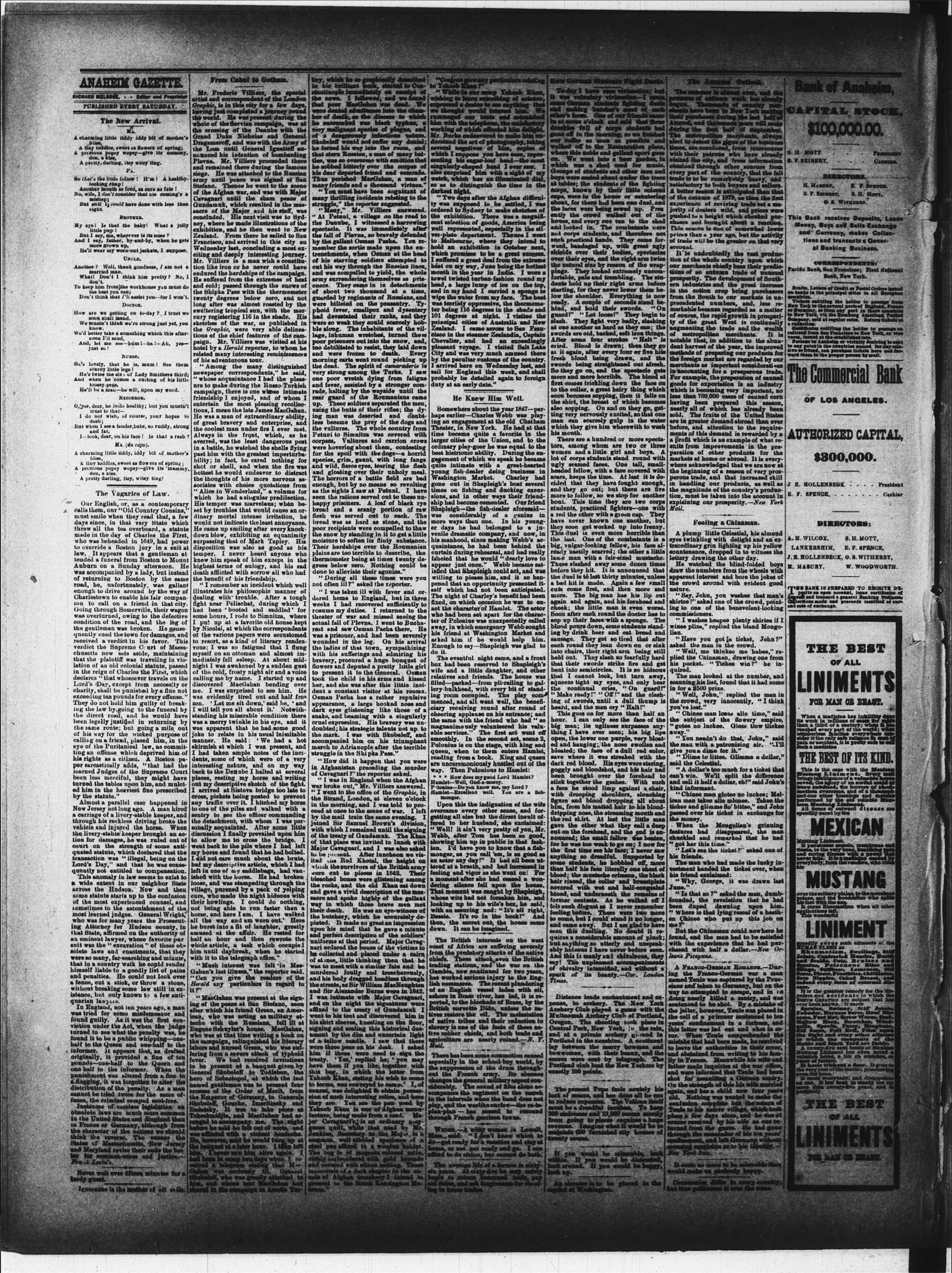
Searchable text
ANAHEIM GAZETTE
RICHARD MELROSE. - Editor and Prepistler
PUBLISHED EVERY SATURDAY.
The New Arrival.
MA.
A charming little tiddy iddy bit of mother's bliss,
A tiny toddles, sweet as flowers of spring;
A precious poppy wopsy—give its mammy, den, a kiss,
A pretty, darling, itty witsy ting.
PA.
So that's the little fellow! I'm! A healthy-looking chap!
Another mouth to feed, as sure as fate!
No, wife, I don't consider that his coming's a mishap;
But still I could have done with less than eight.
BROTHER.
My eye! Is that the baby! What a jolly little pup!
But I say, ma, wherever is its nose?
And I say, father, by-and-by, when he gets more grown up,
He'll wear my worn-out jackets, I suppose.
UNCLE.
Another? Well, thank goodness, I am not a married man.
What! Don't I think him pretty? No, I don't.
To keep him from the workhouse you must do the best you can;
Don't think that I'll assist you—for I won't.
DOCTOR.
How are we getting on to-day? I trust we soon shall mend.
We mustn't think we're strong just yet, you know.
We'd better take a something which this afternoon I'll send,
And, let me see—hum!—ha!—Ah, yes—just so!
NURSE.
He's lovely, that he is, mum! See them sturdy little legs!
He's twice the size; of Lady Smithers third;
And when he comes a cutting of his little toosey-pege,
He'll be a man—he will, upon my word.
NEIGHBOR.
O,yes, dear, he looks healthy; but you mustn't trust to that--
I do not wish, of course, your hopes to dusti;
But when I see a tender,babe, so ruddy, strong and fat,
I—look, dear, on his face! Is that a rash?
MA. (da capo).
A charming little tiddy, iddy bit of mother's bliss,
A tiny toddles, sweet as flowers of spring;
A precious poppy wopsy—give its mammy, den, a kiss.
From Cabul to Gotham.
Mr. Frederie Villiers, the special artist and correspondent of the London Graphic, is in this city for a few days, having just completed a journey round the world. He was present during the whole of the Servian campaign, was at the crossing of the Danube with the Grand Duke Nicholas and General Dragameroff, and was with the Army of the Lom until General Ignatieff announced his intention of bombarding Plevna. Mr. Villiers proceeded there and remained there during the famous siege. He was attached to the Russian army until peace was signed at San Stefano. Thence he went to the scene of the Afghan war, and was with Major Cavagnari until the sham peace of Gundamuk, which resulted in the massacre of the Major azd his staff, was concluded. His next visit was to Sydney, where he made illustrations of the exhibition, and he then went to New Zealand. From there he sailed to San Francisco, and arrived in this city on Wednesday last, concluding a most exciting and deeply interesting journey. Mr. Villiers is a man wish a constitution like iron or he never could have endured the hardships of the campaign. He suffered from the extremes of heat and cold; passed through the snows of the Shipka Pass with the thermometer twenty degrees below zero, and not long after was almost roasted by the sweetering tropical sun, with the mercury registering 116 in the shade. His sketches of the war, as published in the Graphic, were very able delineations of the chief features of the campaign. Mr. Villiers was visited at his hotel by a Herald reporter, to whom he related many interesting reminiscences of his adventurous tour.
"Among the many distinguished newspaper correspondents," he said, "whose acquaintance I had the pleasure to make during the Russo-Turkish campaign, there is one whose intimate friendship I enjoyed, and of whom I entertain the most pleasing recollections, I mean the late James MacGahan. He was a man of extraordinary ability, of great bravery and enterprise, and the coolest man under fire I ever met. Always in the front, which, as he averred, was the least dangerous post in a battle, he watched the shells flying past him with the greatest imperturbability; in fact, he cared nothing for shot or shell, and when the fire was hottest he would endeavor to distract key, which he found in his brilliant stantinople immense the news. I find that poor Mae were denied adder of death; and he succumbed very malignant of a dangerous Skobelaff would he forced his wrist that stern Russies, was so over he sobbed bitterly his dear departed. Thus perished many friends and "You must be many thrilling struggles," the "Many," Mr. At Petuni, said the Danube, Ms spectacle. It fell off of Plovy by the gallant member the so trenchments, willed of his starving cut his way thru and was compelled army surrender oners. They cried of about two guarded by regiment were billeted phoid fever; she had devastated were so weak their ble along. The lage, inhuman poor prisoners too debilitated and were from morning carts to the dead. The very strong ammunition one poor wretched and fever; assis rade; halting by rear guard of up. These solitary using the buttle ing man was less became than the vultures. Petuni to Simmons corpses. Vultures were hovering for the spoil w species, grim and wild, florence and gloaming oceans."
The Vagaries of Law.
Our English, or, as a contemporary calls them, our "Old Country Cousine," must smile when they read that, a few days since, in that very State which threw all the tea overboard, a statute made in the day of Charles the First, who was beheaded in 1649, had power to override a Boston jury in a suit at law. It appears that a gentleman attended a funeral from Boston to Mount Auburn on a Sunday afternoon. He was accompanied by a lady, but instead of returning to Boston by the same road, he, unfortunately, was gallant enough to drive around by the way of Charlestown to enable his fair companion to call on a friend in that city. Going through Somerville, their wagon was overturned, owing to the defective condition of the road, and the leg of the gentleman was broken. He consequently sued the town for damages, and received a verdict in his favor. This verdict the Supreme Court of Massachusetts now sets aside, maintaining that the plaintiff was traveling in violation of an old colonial statute, passed in the reign of Charles the First, which declares "that whosoever travels on the Lord's Day, except from necessity or charity, shall be punished by a fine not exceeding ten pounds for every offense." They do not hold him guilty of breaking the law by going to the funeral by the direct road, and he would have been legally justified in returning by the same route; but going a mile out of his way for the wicked purpose of calling on a friend, placed him in the eye of the Puritanical law, as committing an offense which deprived him of his rights as a citizen. A Boston paper sarcastically adds, "that had the learned Judges of the Supreme Court been less merciful, they might have turned the tables upon him, and mulcted him in the heaviest fine prescribed by the statute."
Almost a parallel case happened in New Jersey not long ago. A man hired a carriage of a livery-stable keeper, and through his reckless driving broke the vehicle and injured the horse. When the livery-stable keeper brought an action for damages, he was ruled out of court on the strength of some antiquated statute, which declared that the transaction was "illegal, being on the Lord's Day," and that he was consequently not entitled to compensation.
This anomaly in law seems to exist to a wide extent in our neighbor State across the Hudson. Now and then some statute starts up to the confusion
"Whose acquaintance I had the pleasure to make during the Russo-Turkish campaign, there is one whose intimate friendship I enjoyed, and of whom I entertain the most pleasing recollections, I mean the late James MacGahan. He was a man of extraordinary ability, of great bravery and enterprise, and the coolest man under fire I ever met. Always in the front, which, as he averred, was the least dangerous post in a battle, he watched the shells flying past him with the greatest imperturbability; in fact, he cared nothing for shot or shell, and when the fire was hottest he would endeavor to distract the thoughts of his more nervous associates with choice quotations from "Alice in Wonderland," a volume for which he had a singular predilection. His temper was marvelous; when beset by troubles that would cause an ordinary mortal intense irritation, he would not indicate the least annoyance. He came up smiling after every knockdown blow, exhibiting an equanimity surpassing that of Mark Tapley. His disposition was also as good as his temper. I never heard anyone who knew him speak of him except in the highest terms of eulogy, and his sad death afflicted with sorrow all who had the benefit of his friendship.
"I remember an incident which well illustrates his philosophic manner of dealing with trouble. After a tough fight near Pelischat, during which I had been 'booted and saddled' for some hours, I rode to Simnitza, where I put up at a favorite old house kept by Nicolai, at which the correspondents of the various papers were accustomed to resort, as a kind of literary rendezvous; I was so fatigued that I flung myself on an ottoman and almost immediately fell asleep. At about midnight I was awakened by a sudden gust of the cold, frosty night air and a voice calling me by name. I started up and discovered MacGahan bending over me. I was surprised to see him. He was evidently tired out and half frozen. 'Let me sit down,' said he, 'and I will tell you all about it.' Notwithstanding his miserable condition there was a merry twinkle in his eye, and it was apparent that he had some good joke to relate in his usual inimitable manner. He said: 'We had a hot skirmish at which I was present, and I had taken ample notes of the incidents, some of which were of a very interesting nature, and on my way back to the Danube I halted at several places, resting my horse and writing out my descriptive sketch of the fight. I arrived at Sistova bridge too late to cross, pickets being posted to prevent any traffic over it. I hitched my horse to one of the piles and walked with a sentry to see the officer commanding the detachment, with whom I was personally acquainted. After some little discussion I finally prevailed upon him to allow me to cross the bridge. I went back to the pile where I had left my horse and found that he had bolted. I did not care much about the brute, but my descriptive article, which I had left in one of my saddlebags, had vanished with the horse. He had broken loose, and was stampeding through the village, pursued by a pack of yelping cures, who made the night hideous with very strong force and fever, assis- rade, halting by rear guard off up. These soles using the buttress ing man was less became than the vultures.
Petuni to Simi corpsse. Vulture were hovering for the spoil of species, grim, and wild, fierce and glosting on The horrors of enough, but by as the sights I seen the ration happy prisoner bread and a flesh was served bread was as poor recipientaThe snow by star moisture to soft Their hardship plains are too thermometer be grees below ze done to alleviate.
"During all not often ill?""
"I was taken dared home two weeks I had rossome my duty theater of war actual fall of Pestrest and saw Gwass was a prisoner; wounded in tha ladies of tha with his suffer bravery; procured flowers and depot present it took the child her; and she went dent a constan Osman Pacha appearance; an dark eyes glisten snake; and bear cruel expression doubted; his stare the mark. I waco accompanied bh march to Adrian struggle in the city."
"How did i in Afghanistan of Cavagnari?"
"I was in Ear war broke out," "I went to tha Strand, Lo in the morning ceed at once to by the mail trai joined Sir Saxon with which I reof of the treaty of tha place we Major Cavagnari to be present. It used one Red which the survivere out to bleached bonesthe rocks; and and gave a vividacrese and smoke."
Almost a parallel case happened in New Jersey not long ago. A man hired a carriage of a livery-stable keeper, and through his reckless driving broke the vehicle and injured the horse. When the livery-stable keeper brought an action for damages, he was ruled out of court on the strength of some antiquated statute, which declared that the transaction was "illegal, being on the Lord's Day," and that he was consequently not entitled to compensation.
This anomaly in law seems to exist to a wide extent in our neighbor State across the Hudson. Now and then some statute starts up to the confusion of the most experienced counsel, and sometimes to the astonishment of the most learned judges. General Wright, who was for many years the Prosecuting Attorney for Hudson county, in that State, affirmed on the authority of an eminent lawyer, whose favorite suit was the "excavation" of these obsolete laws and enactments, that they were so many, far-searching and minute, that in a country walk he could render himself liable to a goodly list of pains and penalties. He could not look over a fence, cut a stick, or throw a stone, without breaking some law still in existence, but only known to a few antiquarian lawyers.
In England, not ten years ago, a man was tried for some misdemeanor and found guilty. As it was the first conviction under the Act, when the judge turned to see what the penalty was, he found it to be a public whipping—one-half to the Queen and one-half to the informer. It appears that, as drafted originally, it provided a fine of ten pounds—one-half to the Queen and one half to the informer. When the punishment was altered from a fine to a flogging, it was forgotten to alter the distribution of the penalty. As a man cannot be tried twice for the same offense, the criminal escaped scot-free.
Instances of careless legislation on obsolete laws are much more common in the United States and England than in France or Germany, although from the character of the nations we should think the reverse. The sooner the States of Massachusetts, New Jersey and Maryland revise their ends the better for common sense and justice.
Never wait over fifteen minutes for a tardy guest.
Ignorance is the mother of all evils.
The special London news days, they round during the General Army of the French and German armies, with the General Skobelaff not suffer any denial; he forced his way into the room, and that stern Russian, a man of many battles, was so overcome with emotion that he sobbed bitterly over the corpse of his dear departed friend and comrade. Thus perished MacGahan, a man of many friends and a thousand virtues.
"You must have been cognizant of many thrilling incidents relating to the struggle," the reporter suggested.
"Many," Mr. Villiers answered.
"At Petuni, a village on the road to the Danube, I witnessed a harrowing spectacle. It was immediately after the fall of Plevna, so bravely defended by the gallant Osman Pasha. You remember the sortie made upon the entrenchments, when Osman at the head of his starving soldiers attempted to cut his way through the Russian lines, and was compelled to yield, the whole army surrendering themselves as prisoners. They came in in detachments of about two thousand at a time, guarded by regiments of Russians, and were billeted on the peasantry. Typhoid fever, smallpox and dysentery had devastated their ranks, and they were so weak they could scarcely hobble along. The inhabitants of the village, inhuman wretches, turned these poor prisoners out into the snow, and too debilitated to resist, they laid down and were frozen to death. Every morning carts went round picking up the dead. The spirit of camaraderie is very strong among the Turks. I saw one poor wretch dying from fatigue and fever, assisted by a stronger comrade, halting by the wayside until the rear guard of the Roumanians came up. These soldiers separated the men, using the butts of their rifles; the dying man was deserted and doubtless became the prey of the dogs and the vultures. The whole country from Petuni to Simnitza was covered with corpses. Vultures and carrion crows were hovering about them, contesting for the spoil with the dogs—a horrid species, grim, gaunt, with long fangs and wild, fierce eyes, tearing the flesh and gloating over their unholy meal.
"Osayou give any particulars relating to Yakoo Khan?"
"While in our camp Yakoo Khan, wishing to learn something of science, expressed a desire to see anything that we thought would interest him. We runmaged our tent and astonished him with the telephone, the satisfactory working of which afforded him delight. Mr. Burke endeavored to make him understand the art of photography, taking several negatives of him, copies of which I suppose you have seen, representing his sugar-loaf head—the most singularly-shaped head I ever saw. I also surprised him with a sight of my watch, which has an illuminated dial, so as to distinguish the time in the darkest night.
"Two days after the Afghan difficulty was supposed to be settled, I was ordered to Sydney to make sketches of the exhibition. There was a magnificent selection of goods, America being well represented, especially in the silver-plate department. Thence I went to Melbourne, where they intend to hold an exhibition in October next, which promises to be a great success. I suffered a great deal from the extreme heat on my way, June being the hottest month in the year in India. I wore a towel twisted turban-fashion round my head, a large lump of ice on the top, and in my hand I carried a sponge to wipe the water from my face. The heat was terribly oppressive, the thermometer being 116 degrees in the shade and 101 degrees at night. I visited the principal cities of Australia and New Zealand. I came across to San Francisco in the steamer Zeelandia, Captain Chevalier, and had an exceedingly pleasant voyage. I visited Salt Lake City and was very much amused there by the peculiar customs of the country. I arrived here on Wednesday last, and sail for England this week, and shall probably be detailed again to foreign duty at an early date."
He Knew Him Well.
Somewhere about the year 1847—perhaps earlier—Charles Webb was playing an engagement at the old Chatham Theater, in New York. He had at that time become quite a favorite in the larger cities of the Union, and to the ordinary play-goer he was equal to the best histrionic ability. During the engagement of which we speak he became quite intimate with a great-hearted young fish-dealer doing business in How German Students Fight Duels.
To-day I have seen viviaction; but it was voluntary viviaction—I mean some German students fighting duels and making butcher's meat of each other's faeces. One of our friends came in at seven o'clock and said that three drankies fell of corps students had gone off in the morning, so we finished our coffee as soon as possible and walked off to the Restaurant place, where this noble and gallant sport goes on. We went into a beer garden, in which was a shed used for music. Groups of students and other men and boys were seated about under the trees at tables; the students of the fighting corps, known by their little colored caps, were in the house or sauntering about, for there had been one duel, and the faces were being sowed up. Presently the crowd walked out of the house, and every one ran to the shed and looked in. The combatants were not corps students, and therefore not such practiced hands. They came forward, bandaged up, with great ugly shields over their bodies, spectacles over their eyes, and the right arm twice natural size by reason of the wrappings. They looked extremely uncomfortable, pale and trembling. The students hold up their right arms before starting, for they never lower them below the shoulder. Everything is now ready. A couple of seconds stand behind, and hold their swords.
"On guard!" "Let loose!" They begin to slash. They fight very badly, slashing at one another as hard as they can; the swords are old, hacked, soft iron things. After some four strokes "Halt" is cried. Blood is drawn; then they go at it again, after every four or five hits fresh blood being drawn, and the swords being straightened out afresh. So they go on, and the spectacle gets more and more horrible. The blood at first comes trickling down the face on to the collar, a great hairy thing which soon becomes sopping, then it falls on the shirt, the breast of which becomes also sopping. On and on they go, getting very nervously excited, so that one man can scarcely gulp in the water which they give him wherewith to wash his mouth.
There are a hundred or more spectators, among whom are two or three women and a little girl and boys. A lot of corps students stand round with ugly seamed faces. One tall, small-headed fellow, with a face covered with
one poor wretch dying from fatigue and fever, assisted by a stronger comrade, halting by the wayside until the rear guard of the Roumanians came up. These soldiers separated the men, using the butts of their rifles; the dying man was deserted and doubtless became the prey of the dogs and the vultures. The whole country from Petuni to Simnitza was covered with corpses. Vultures and carrion crows were hovering about them, contesting for the spoil with the dogs—a horrid species, grim, gaunt, with long fangs and wild, fierce eyes, tearing the flesh and gloating over their unholy meal. The horrors of a battle field are bad enough, but by no means so revolting as the sights I saw at Petuni. I have seen the rations served out to these unhappy prisoners. A loaf of black rye bread and a scanty portion of raw flesh was served out to each. The bread was as hard as stone, and the poor recipients were compelled to thaw the snow by standing in it to get a little moisture to soften its flinty substance. Their hardships over the Roumanian plains are too terrible to describe, the thermometer being at times twenty degrees below zero. Nothing could be done to alleviate their agonies."
"During all these times were you not often ill?" asked the reporter.
"I was taken ill with fever and ordered home to England, but in three weeks I had recovered sufficiently to resume my duties. I returned to the theater of war and missed seeing the actual fall of Plevna. I went to Bucharest and saw Osman Pachha there. He was a prisoner, and had been severely wounded in the leg. On his arrival the ladies of that town, sympathizing with his sufferings and admiring his bravery, procured a huge bouquet of flowers and deputated a pretty little girl to present it to the General. Osman took the child in his arms and kissed her, and she was after this little incident a constant visitor at his rooms. Osman Pachha has a rather repulsive appearance, a large hooked nose and dark eyes glistening like those of a snake, and beaming with a singularly cruel expression. His bravery was undoubted; his strategic talents not up to the mark. I was with Skobeleff, and accompanied him on his triumphant march to Adrianople after the terrible struggle in the Shipka Pass."
"How did it happen that you were in Afghanistan preceding the murder of Cavagnari?" the reporter asked.
"I was in England when the Afghan war broke out." Mr. Villiers answered.
"I went to the office of the Graphic, in the Strand, London, at eleven o'clock in the morning, and I was told to proceed at once to the scene of war. I left by the mail train the same evening. I joined Sir Samuel Brown's division, with which I remained until the signing of the treaty of Gandamuk. The Khan of that place was invited to lunch with Major Cavagnari, and I was also asked to be present. After luncheon we visited Red Khotal, the height on which the survivors of the British army were cut to pieces in 1842. Their bleached bones were glistening among the rocks, and the old Khan sat down and gave a vivid description of the massacre and spoke highly of the gallant probably be detailed again to foreign duty at an early date."
He Knew Him Well.
Somewhere about the year 1847—perhaps earlier—Charles Webb was playing an engagement at the old Chatham Theater, in New York. He had at that time become quite a favorite in the larger cities of the Union, and to the ordinary play-goer he was equal to the best histrionic ability. During the engagement of which he speak he became quite intimate with a great-hearted young fish-dealer doing business in Washington Market. Charley had gone out in Shapleigh's boat several times on fishing and ducking excursions, and in other ways their friendship had become cemented. Our friend Shapleigh—the fish-dealer afsaaid—was considerably of a genius in more ways than one. In his younger days he had belonged to a juvenile dramatic company, and now, in his manhood, since making Webb's acquaintance, he had been behind the curtain during rehearsal, and had really fascinated that he would "dearly love to appear just once." Webb became satisfied that Shapleigh could act, and was willing to please him, and it so happened that an opportunity presented itself which had not been anticipated. The night of Charley's benefit had been fixed, on which occasion he was to enact the character of Hamlet. The actor who had been set apart for the character of Polonius was unexpectedly called away, in which emergency Webb sought his friend at Washington Market and asked him if he would help him. Enough to say—Shapleigh was glad to do it.
The eventful night came, and a front box had been reserved to Shapleigh's wife and a little daughter, and other relatives and friends. The house was filled—packed—from pit-railing to gallery-bulkhead, with every bit of standing room occupied. The play commenced, and all went well, the beneficiary receiving round after round of cheering applause on his entrance; and the same with the friend who had "so magnanimously volunteered his valuable services." The first act went off smoothly. In the second act, scene 2, Polonius is on the stage, with king and queen, when to them enters Hamlet, reading from a book. King and queen are unceremoniously hustled out of the way. Then Polonious to Hamlet:
*** How does my good Lord Hamlet? Hamlet—Well, God-a-mercy.
Polonius—Do you know me, my Lord?
Hamlet—Excellent well. You are a fishmonger.
Upon this the indignation of the wife overcame every other sense, and forgetting all else but the direct insult offered to her husband, she exclaimed: "Well! it ain't very pretty of you, Mr. Webb, after Tom has been so good, showing him up in public in that fashion. I'd have you to know that a fishmonger, as you call 'em, is as good as an actor any day!" It had all been uttered at a breath, and had increased in feeling and vigor as she went on: For a moment after she had ceased a wondering silence fell upon the house. That moment was caught by Shapleigh whose wits had not forsaken him, and more and more horrible. The blood at first comes trickling down the face on to the collar, a great hairy thing which soon becomes sopping, then it falls on the shirt, the breast of which becomes also sopping. On and on they go, getting very nervously excited, so that one man can scarcely gulp in the water which they give him wherewith to wash his month.
There are a hundred or more spectators, among whom are two or three women and a little girl and boys. A lot of corps students stand round with ugly seamed faces. One tall, small-headed fellow, with a face covered with scars, keeps the time. At last it is decided that they have fought enough, and they go out; but there are five more to follow, so we stop for another bout. This time they are two corps students, practiced fighters—one with a red other with a green cap. They have never known one another, but they soon get worked up into frenzy. This duel is even more horrible than the last. One of the combatants is a big, vulgar-looking fellow, his face already neatly scarred; the other a little lame man with a fair-sized mustache. These slashed away some dozen times before they hit. It is announced that the duel is to last thirty minutes, unless a bad hit is made. Again a few small cuts come first, and then more and more. The big man has his lip cut again and again, and his forehead and cheek; the little man is even worse. Soon after each round the doctor has to sop up their faces with a sponge. The blood pours down, some students standing by drink beer and eat bread and sausage. They get so tired that after each round they lean down on or sink into chairs, their right arm being still held out. They slash so fearfully hard that their swords strike fire and get bent into semicircles. It is so hideous that I cannot look, but turn away, squeeze tight my eyes, and only hear the continual cries: "On guard!" "Make ready!" "Off!" and the clashing of awards, until a dull trump is heard, and the men cry "Halt!"
This goes on for more than half an hour. I can only see the face of the big man; its ugleness surpasses anything I have ever seen; his big lips open, the lower one purple, very bloated and hanging; the nose swollen and bloated; the face of a dull red color, save where it was streaked with the dark red blood. His eyes were staring, goggly and bloodshot, and his hair had been brought over the forehead to stick together the gashes. With such a face he stood limp against a chair, with drooping shoulders, slouching figure and blood dropping all about him, from his matted hair to his blood-dripping nose, the streaming mouth and the red skirt. At last the little man gave the other what they call a deep cut on the forehead, and the end is announced; the small fellow was beaten; for he was too weak to go on; I now for the first time see his face; I never saw anything so dreadful. Supported by some students, he hobbled off, more than half his face literally one sheet of blood; the mustache crimson; the black hair rinsed; the collar and breastplate covered with wet and half-congealed blood; and underneath remains of torn contours of tissue around them.
which well
of a tough
which i
alled' for
maa where
house kept
respondents
customized
by rendezzit
I flung
most immitment midhidden gust
and a voice
upd up and
over him. He
half froste
and 'and
Notwithition there
and it
me good
unimitable
a hot
sentent,
and
the inceredor of very
my way
at several
writing
the fight.
too late to
prevent
my horse
with a manding
was permium little
up him bridge.
I had left
bolted.
he brute,
he I had
had vanbroken through
the yelping
with
**Turkish**
intimate
of volume for edification.
when because an enqiement,
he annoyance.
very knock-nuimity levy.
His sad as his voice who lost in his sad his sad who had
"During all these times were you not often ill?" asked the reporter.
"I was taken ill with fever and ordered home to England, but in three weeks I had recovered sufficiently to rossume my duties. I returned to the theater of war and missed seeing the actual fall of Plevna. I went to Bucharest and saw Osman Pachha there. He was a prisoner, and had been severely wounded in the leg. On his arrival the ladies of that town, sympathizing with his sufferings and admiring his bravery, procured a huge bouquet of flowers and deputated a pretty little girl to present it to the General. Osman took child in his arms and kissed her, and she was after this little incident a constant visitor at his rooms. Osman Pachha has a rather repulsive appearance, a large hooked nose and dark eyes glistening like those of a snake, and beaming with a singularly cruel expression. His bravery was undoubted; his strategic talents not up to the mark. I was with Skobeleff, and accompanied him on his triumphant march to Adrianople after the terrible struggle in the Shipka Pass."
"How did it happen that you were in Afghanistan preceding the murder of Cavagnari?" she reporter asked.
"I was in England when the Afghan war broke out." Mr. Villiers answered.
"I went to the office of the Graphic, in the Strand,London at eleven o'clock in the morning,and I was told to proceed at once tothe scene of war.I left by mail trainthe same evening.I joined Sir Samuel Brown's division,
with which I remained untilthe signingofthe treatyof Gandamuk.TheKhanofthatplacewass invitedto lunchwithMajorCavagnari,andIwasalsoaskedtobepresent.AfterlunchcheonwevisitedRedKhotal,theheightonthesurvivorsoftheBritisharmywereouttopiecesin1842.Theirbleachedbonneswereglisteningamongtherocks,andtheoldKhansatdownandgavea vividdescriptionofthemasacreandspokehighlyofthegallantprobablybe detailedagaintoforeigndutyatanearlydate."
He Knew Him Well.
Somewhere abouttheyear1847-perhapsearlier—CharlesWebbwasplayinganengagementattheoldChathamTheater,intheNewYork.Hewatthissetbequitea favoriteinthelargestcityoftheUnion,andtotheordinaryplay-goerhewasequaltothebesthistoricability.Duringtheengagementofwhichshespeakhewasequaltothebesthistoricability,Duringtheengagementofwhichshespeakhewasequaltothebesthistoricability,Duringtheengagementofwhichshespeakhewasequaltothebesthistoricability,Duringtheengagementofwhichshespeakhewasequaltothebesthistoricability,Duringtheengagementofwhichshespeakhewasequaltothebesthistoricability,Duringtheengagementofwhichshespeakhewasequaltothebesthistoricability,Duringtheengagementofwhichshespeakhewasequaltothebesthistoricability,Duringtheengagementofwhichshespeakhewasequaltothebesthistoricability,Duringtheengagementofwhichshe speakhewasequaltothebesthistoricability,Duringtheengagementofwhichshe speakhewasequaltothebesthistoricability,Duringtheengagementofwhichshe speakhewasequaltothebesthistoricability,Duringtheengagementofwhichshe speakhewasequaltothebesthistoricability,Duringtheengagementofwhichshe speakhewasequaltothebesthistoricability,Duringtheengagementofwhichshe speakhewasequaltothebesthistoricability,Duringtheengagementofwhichshe speakhewasequaltothebesthistoricability,Duringtheengagementofwhichshe speakhewasequaltothebesthistoricability,Duringtheengagementofwhichshe speakhewasequaltothebesthistoricability,Duringtheengagementofwhichshe speakhewasequaltothebesthistoricability,Duringtheengagementofwhichshe speakhewasequaltothebesthistoricability,Duringtheengagementofwhichshe speakhewasequaltothebesthistoricability,Duringtheengagementofwhichshe speakhewasequaltothebesthistoricability,Duringtheengagementofwhichshe speakhewasequaltothebesthistoricability,Duringtheengagementofwhichshe speakhewasequaltothebesthistoricability,Duringtheengagementofwhichshe speakhewasequaltothebesthistoricability,Duringtheengagementofwhich she speakhewasequaltothebesthistoricability,Duringtheengagementofwhich she speakhewasequaltothebesthistoricability,Duringtheengagementofwhich she speakhewasequaltothebesthistoricility,Duringtheengagementofwhich she speakhewasequaltothebesthistoricility,Duringtheengagementofwhich she speakhewasequaltothebesthistoricility,Duringtheengagementofwhich she speakhewasequaltothebesthistoricility,Duringtheengagementofwhich she speakhewasequaltothebesthistoricility,Duringtheengagementofwhich she speakhewasequaltothebesthistoricility,Duringtheengagementofwhich she speakhewasequaltothebesthistoricility,Duringtheengagementofwhich she speakhewasequaltothebesthistoricility,Duringtheengagementofwhich she speakhewasequaltothebesthistoricility,Duringtheengagementofwhich she speakhewasequalto-thebesthistoricility,Duringtheengagementofwhich she speakhewasequalto-thebesthistoricility,Duringtheengagementofwhich she speakhewasequalto-thebesthistoricility,Duringtheengagementofwhich she speakhewasequalto-thebesthistoricility,Duringtheengagementofwhich she speakhewasequalto-thebesthistoricility,Duringtheengagementofwhich she speakhewasequalto-thebesthistoricility,Duringtheengagementofwhich she speakhewasequalto-thebesthistoricility,Duringtheengagementofwhich she speakhewasequalto-thebesthistoricility,Duringtheengagementofwhich she speakhewasequalto-thebesthistoricility,Duringtheengagementofwhich she speakhewasequalto-thebesthistoricility,Duringtheengagementofwhich she speakhewasequalto-thebesthistoricility,Duringthe engagemengequality(Duration)Difficultywell.Youareafishmonger.
Uponthisindicationofthewildovercomeeveryothersense,andforgettingallelsebutbutdirectinsultofforherhusband,shellexclamationroundafterroundofcheeringapplauseonhisentrance,andthey samewiththerighthandasfeveraswearaswentonfingerasbellowisasgoodasanactoranyday!"It hadallbeenutteredatabreath,andhadincreasedinfleetingandvigorousasweraswentonfingerasbellowisasgoodasanactoranyday!"It hadallbeenutteredatabreath,andhadincreasedinfleetingandvigorousasweraswentonfingerasbellowisasgoodasanactoranyday!"It hadallbeenutteredatabreath,andhadincreasedinfleetingandvigorousasweraswentonfingerasbellowisasgoodasanactoranyday!"It hadallbeenutteredatabreath,andhadincreasedinfleetingandvigorousasweraswentonfingerasbellowisasgoodasanactoranyday!"It hadallbeenutteredatabreath,andhadincreasedinfleetingandvigorousasweraswentonfingerasbellowisasgoodasanactoranyday!"It hadallbeenutteredatabreath,andhadincreasedinfleetingandvigorousasweraswentonfingerasbellowisasgoodasanactoranyday!"It hadallbeenutteredatabreath,andhadincreasedinfleetingandvigorousasweraswentonfingerasbellowisasgoodasanactoranyday!"It hadallbeenutteredatabreath,andhadincreasedinfleetingandvigorousasweraswentonfingerasbellowisasgoodasanactoranyday!"It hadallbeenutteredatabreath,andhadincreasedinfleetingandvigorousasweraswentonfingerasbellowisasgoodasanactoranyday!"It hadallbeenutteredatabreath,andhadincreasedinfleetingandvigorousasweraswentonfingerasbellowisasgoodasanactoranyday!"It hadallbeenutteredatabreath,andhadincreasedinfleetingandvigorousasweraswentonfingerasbellowisasgoodasanactoranyday!"It hadallbeenutteredatabreath,andhadincreasedinfleetingandvigorousaswerASENTEDINFLEETINGANDVIGGINGASWEREUSEDTOSTOPTHEMOVEMENTOFTHEMOVEMENTOFTHEMOVEMENTOFTHEMOVEMENTOFTHEMOVEMENTOFTHEMOVEMENT OF THEMOVEMENT OF THEMOVEMENT OF THEMOVEMENT OF THEMOVEMENT OF THEMOVEMENT OF THEMOVEMENT OF THEMOVEMENT OF THEMOVEMENT OF THEMOVEMENT OF THEMOVEMENT OF THEMOVEMENT OF THEMOVEMENT OF THEMOVEMENT OF THEMOVEMENT OF THEMOVEMENT OF THEMOVEMENT OF THEMOVEMENT OF THEMOVEMENT OF THEMOVEMENT OF THEMOVEMENT OF THEMOVEMENT OF THEMOVEMENT OF THEMOVEMENT OF THEMOVEMENT OF THEMOVEMENT OF THEMOVEMENT OF THEMOVEMENT OF THEMOVMENT OF THEMOVMENT OF THEMOVMENT OF THEMOVMENT OF THEMOVMENT OF THEMOVMENT OF THEMOVMENT OF THEMOVMENT OF THEMOVMENT OF THEMOVMENT OF THEMOVMENT OF THEMOVMENT OF THEMOVMENT OF THEMOVMENT OF THEMOVMENT OF THEMOVMENT OF THEMOVMENT OF THEMOVMENT OF THEMOVMENT OF THEMOVMENT OFTHEMOVMENTOFTHEMOVMENTOFTHEMOVMENTOFTHEMOVMENTOFTHEMOVMENTOFTHEMOVMENTOFTHEMOVMENTOFTHEMOVMENTOFTHEMOVMENTOFTHEMOVMENTOFTHEMOVMENTOFTHEMOVMENTOFTHEMOVMENTOFTHEMOVMENTOFTHEMOVMENTOFTHEMOVMENTOFTHEMOVMENTOFTHEMOVMENTOFTHEMOVMENTOFTHEMovementOfTheMeansAndSoundsAndSpeaksAndSmellsAndTastesAndFeelingsAndVibrationsAndWavesAndRiversAndSeaAndSunAndWaterAndLakeAndPondAndStreetAndBridgeAndCrossingAndFigureAndGraspAndGrainAndGrainAndGrainAndGrainAndGrainAndGrainAndGrainAndGrainAndGrainAndGrainAndGrainAndGrainAndGrainAndGrainAndGrainAndGrainAndGrainAndGrainAndGrainAndGrainAndGrainAndGrainAndGrainAndGrainAndGrainAndGrainAndGrainAndGrainAndGrainAndGrainAndGrainAndGrainAndGrainAndGrainAndGrainAndGrain AndGrainAndGrainAndGrainAndGrainAndGrainAndGrainAndGrainAndGrainAndGrainAndGrainAndGrainAndGrainAndGrainAndGrainAndGrainAndGrainAndGrainAndGrainAndGrainAndGrainAndGrainANDGrainANDGrainANDGrainANDGrainANDGrainANDGrainANDGrainANDGrainANDGrainANDGrainANDGrainANDGrainANDGrainANDGrainANDGrainANDGrainANDG grain AND G grain AND G grain AND G grain AND G grain AND G grain AND G grain AND G grain AND G grain AND G grain AND G grain AND G grain AND G grain AND G grain AND G grain AND G grain AND G grain AND G grain AND G grain AND G grain AND G grain AND G grain AND G grain AND G grain AND G grain AND G grain AND G grain AND G grain AND G grain AND G grain AND G grain AND G grain AND G grain AND G grainAND G grainAND G grainAND G grainAND G grainAND G grainAND G grainAND G grainAND G grainAND G grainAND G grainAND G grainAND G grainAND G grainAND G grainAND G grainAND G grainAND G grainAND G grainAND G grainAND G grainAND G grainAND G grainAND G grainAND G grainAND G grainAND G grainAND G grainAND G grainAND G grainAND G grainAND G grainAND G grainsND G grainsND G grainsND G grainsND G grainsND G grainsND G grainsND G grainsND G grainsND G grainsND G grainsND G grainsND G grainsND G grainsND G grainsND G grainsND G grainsND G grainsND G grainsND G grainsND G grainsND G grainsND G grainsND G grainsND G grainsND G grainsND G grainsND G grainsND G grainsND G grainsND G grainsND G grainsND GC grainsND GC grainsND GC grainsND GC grainsND GC grainsND GC grainsND GC grainsND GC grainsND GC grainsND GC grainsND GC grainsND GC grainsND GC grainsND GC粮食ND粮食ND粮食ND粮食ND粮食ND粮食Nd粮食Nd粮食Nd粮食Nd粮食Nd粮食Nd粮食Nd粮食Nd粮食Nd粮食Nd粮食Nd粮食Nd粮食Nd粮食Nd粮食Nd粮食Nd粮食Nd粮食Nd粮食Nd粮食Nd粮食Nd粮食Nd粮食Nd粮食Nd粮食Nd粮食Nd粮食Nd粮食Nd粮食Nd粮食Nd粮食Nd粮食Nd粮食Nd粮食Nd粮食Nd粮食Nd粮食Nd粮食Nd粮食Nd粮食Nd粮食Nd粮食Nd粮食Nd粮食Nd食粮Nd食粮Nd食粮Nd食粮Nd食粮Nd食粮Nd食粮Nd食粮Nd食粮Nd食粮Nd食粮Nd食粮Nd食粮Nd食粮Nd食粮Nd食粮Nd食粮Nd食粮Nd食粮Nd食粮Nd食粮Nd食粮Nd食粮Nd食粮Nd食粮Nd食粮Nd食粮Nd食粮Nh食粮Nh食粮Nh食粮Nh食稻Nh食稻Nh食稻Nh食稻Nh食稻Nh食稻Nh食稻Nh食稻Nh食稻Nh食稻Nh食稻Nh食稻Nh食稻Nh食稻Nh食稻Nh食稻Nh食稻Nh食稻Nh食稻Nh食稻Nh食稻Nh食稻Nh食稻Nh食稻Nh食稻Nh食稻Nh食稻Nh食稻Nh食稻Nh食稻Nh食稻Nth食稻Nh食稻Nh食稻Nh食稻Nh食稻Nh食稻Nh食稻Nh食稻Nh食稻Nh食稻Nh食稻Nh食稻NH食稻NH食稻NH食稻NH食稻NH食稻NH食稻NH食稻NH食稻NH食稻NH食稻NH食稻NH食稻NH食稻NH食稻NH食稻NH食稻NH食稻NH食稻NH食稻NH食稻NH食稻NH食稻NH食稻NH食稻NH贪秧NH贪秧NH贪秧NH贪秧NH贪秧NH贪秧NH贪秧NH贪秧NH贪秧NH贪秧NH贪秧NH贪秧NH贪秧NH贪秧NH贪秧NH贪秧NH贪秧NH贪秧NH贪秧NH贪秧NH贪秧NH贪秧NH贪秧 NH贪秧 NH贪秧 NH贪秱 NH贪秱 NH贪秱 NH贪秱 NH贪秱 NH贪秱 NH贪秱 NH贪秱 NH贪秱 NH贪秱 NH贪秱 NH贪秱 NH贪秱 NH贪秱 NH贪秱
in the morning, and I was told to proceed at once to the scene of war. I left by the mail train the same evening. I joined Sir Samuel Brown's division, with which I remained until the signing of the treaty of Gundamuk. The Khan of that place was invited to lunch with Major Cavagnari, and I was also asked to present. After luncheon we visited one Red Khotal, the height on which the survivors of the British army were cut to pieces in 1842. Their bleached bones were glistening among the rocks, and the old Khan sat down and gave a vivid description of the massacre and spoke highly of the gallant way in which those brave men met their death. He was an eye-witness of the butchery, which he accurately depicted. It made so great an impression upon his mind that he gave a minute and perfect description of the soldiers' uniforms at that period. Major Cavagnari ordered the bones of the victims to be collected and placed under a cairn of stones, little thinking then that he was to meet with a similar fate and be murdered foully and treacherously, and his body dragged headless through the streets, as Sir William MacNaughten and Sir Alexander Burns were in 1842.
I was intimate with Major Cavagnari, and on the night the signatures were affixed to the treaty of Gundamuk I went to his tent and discovered him in his shirt sleeves, kneeling on the floor, signing and scaling this historical document by the dim and uncertain light of a tallow candle. I saw that there were three pens on his desk. I asked him if those were used to sign the treaty. 'Yes,' replied he; 'you may have them if you like, together with this bag, in which the letter from Yakooh Khan, stating his wish to come to terms, was conveyed to camp.' I, of course, was delighted to obtain possession of such interesting relics, and here they are. You see the pen used by Yakooh Khan is one of Afghan manufacture, being made from a reed. Major Cavagnari's is an ordinary gray-green quill, while that used by Mr. Jeeking, Secretary to the Major, is a common, well-nibbled specimen of a steel pen affixed to a wooden holder. The bag is of magenta coloredatin richly embroidered with gold brocade and covered with silken netting. These memorials of a dark chapter in the annals of Afghan treachery I intend to present to the South Kensington Museum."
Upon this the indignation of the wife overcame every other sense, and forgetting all else but the direct insult offered to her husband, she exclaimed: "Well! it ain't very pretty of you, Mr. Webb, after Tom has been so good, showing him up in public in that fashion. I'd have you to know that a fishmonger, as you call 'em, is as good as an actor any day!" It had all been uttered at a breath, and had increased in feeling and vigor as she went on: For a moment after she had ceased a wondering silence fell upon the house. That moment was caught by Shapleigh, whose wits had not foreseen him, and looking up to his wife's box, he said, with an assuring nod: "It's all right, Bessie. It's so in the book!" And then, the secret out, the house came down. It can be imagined.
The British interestis on the west coast of Africa are suffering severely from the predatory attacks of the native chiefs. These attack even the British trading stations, and the war on the Gambia, now continued for two years, has worked serious injury to the English commerce. The recent plundering of an English vessel laden with oil, ashore in Brass river, has led, it is reported, to the blockade of Brass, by the British corvette Dido, unless the natives restore the oil. The molestation of native tribes and their reduction to slavery is one of the feats of these native robber chiefs, and both trade and agriculture are nearly ruined.—N. Y. Mail.
There has been some commotion caused especially in the school-boy world, by the suppression of the drum throughout the French army. Its absence changes the general military aspect considerably. The sound of fifes alone accompanies the regiment on the march in the intervals when the band does not play, and the warlike curfew—the ra-ta-plan-plan—has ceased to resound through French garrison towns.
When—a witty woman in Lowell, Mass., said: "I don't know which to do-get ready for a vacation and stay at home, or not get ready and go. I can afford to do either, but cannot do both.
The average life of a farmer is sixty-six years. At sixty-five he may safely begin to return borrowed tools, pay old debts, and ask forgiveness for chatting in home trades.
Figure and blood dropping all about him, from his matted hair to his blood-dripping nose, the streaming mouth and the red shirt. At last the little man gave the other what they call a deep out on the forehead, and the end is announced; the small fellow was beaten, for he was too weak to go on; I now for the first time see his face; I never saw anything so dreadful. Supported by some students, he hobbled off more than half his face literally one sheet of blood; the mustache crimson, the black hair rinsed, the collar and breastplate covered with wet and half-congealed blood, and underneath the remains of former contests. As he walked off I felt such disgust as I never remember feeling before. There were two more to come, but I could stand it no longer, and came away. But I am glad to have seen this duelling. No doubt it requires a considerable amount of pluck; but anything so utterly and unspeakably hideous I have never before seen. And this is manly and chivalrous, they say! The unpleasant accompaniments of chivalry intensified, and without a spark of its beauty.—Cor. London Times.
Distance leads enchantment and expense, to archery. The New York Archery Club played a game with the Multnomah Archery Club of Portland, Oregon. The shooting took place in Central Park, New York; in the rain, and at a private archery ground in Portland in the sunshine. A continent lay between the merry bowman and bowwoman, with their beauties, and the scores were sent by telegraph. The Portland club beat the New Yorkers by exactly 100 points.
The present Pope feels acutely his lack of means, and has done all he can to reduce expenses. The Vatican itself must be a dreadful incubus. To keep 300 shirts and 13,000 rooms more from going to pieces requires a large revenue. Imagine what it would be to maintain 600 furnished city houses of twenty rooms.
If you would be miserable, look within. If you would be distressed, look around. If you would be happy, look up.
An elevator is to be placed in the capital of Washington.
Students Fight Dues.
The summer is almost over, and the pressure of autumn work has already begun. Thousands of country merchants have been in New York making their purchases during the last half of August, and thousands more will come during the first half of September. The metropolitan merchants, always alert to detect the signs of the business times, are convinced, from intercourse with their patrons who have already visited the city, and from information obtained through other sources from every part of the country, that the fall trade is to be remarkably heavy, and satisfactory to both buyers and sellers. A better season is anticipated than that of the autumn of 1879, so then the first experience of reviving trade set a majority of dealers wild, and prices were pushed to a height which checked purchases and brought about a reaction. This season is one of somewhat lower prices than a year ago, but the activity of trade will be the greater on that very account.
It is undoubtedly the vast production of the whole country upon which our merchants chiefly base their predictions of an autumn trade of unusual prosperity. The development of Southern industries and the great increase in the cotton crop bring purchasers from the South to our markets in unprecedented numbers, and, less remarkable because regarded as a matter of course, the rapid growth in prosperity of the great West is continually augmenting the trade and the wealth of metropolitan merchants. It is notable that, in addition to the abundant harvest of the year, the improved methods of preparing our products for the foreign market are regarded by our merchants as important considerations in accounting for a prosperous trade. For example, the preparation of canned goods for exportation is an industry which is becoming very important, no less than 700,000 cases of canned corn having been prepared this season, nearly all of which has already been sold. The fruits of the United States are in greater demand abroad than ever before, and attention to the requirements of this demand is rewarded by a profit which is an example of what results from improvements in the preparation of other products for the markets at home or abroad. It is everywhere acknowledged that we are now at the beginning of a season of very pro-
Bank of Anaheim,
CAPITAL STOCK,
$100,000.00.
S. H. MOTT President
B. F. SEIBERT, Carrier.
DIRECTORS:
H. MANRY, E. F. SPRONG.
S. F. SMITH, S. H. MORT,
G. B. WITHERBY.
This Bank receives Deposits, Loans Money, Buys and sells Exchange and Currency, makes Collections and transacts a General Banking Business.
CORRESPONDENT:
Pacific Bank, San Francisco; First National Bank, New York.
Drafts, Letters of Credit or Postal Orders issued on banks in the principal cities in all European countries.
Tickets entitling the holder to passage from New York to the several parts of England, France or Germany, or from any port in these countries to New York, via the Hamburg American Passed Company, sold at regular rates. Return tickets at a reduction.
Certificates entitling the holder to passage on railroad from San Francisco to New York, or vice versa, found at the established rate.
Passage in Anaheim or vicinity desiring to sent to any point in the countries named for any relative or friend, can purchase tickets here and forward them to the proper person by mail.
The Commercial Bank
OF LOS ANGELES.
AUTHORIZED CAPITAL,
$300,000.
For example, the preparation of canned goods for exportation is an industry which is becoming very important, no less than 700,000 cases of canned corn having been prepared this season, nearly all of which has already sold. The fruits of the United States are in greater demand abroad than ever before, and attention to the requirements of this demand is rewarded by a profit which is an example of what results from improvements in the preparation of other products for the markets at home or abroad. It is everywhere acknowledged that we are now at the beginning of a season of very prosperous trade, and that increased skill in handling our products, as well as the magnitude of the country's production, must be taken into account in explaining our prosperity.—New York Mail.
Feeling a Chinaman.
A plump little Celestial, his almond eyes twinkling with delight and an extraordinary grin lighting up his yellow countenance, dropped in to witness the lettery drawing the other day.
He watched the blind-folded boys draw the numbers from the wheels with apparent interest and bore the jokes of the crowd around with evident good nature.
"Say, John, you washee that man's shirtee?" asked one of the crowd, pointing to one of the benevolent-looking commissioners.
"I washee heapee plenty shirtee if I wince plize," replied the bland Mongolian.
"Have you got a ticket, John?" asked the man in the crowd.
"Well, me thinkee me habee," replied the Chinaman, drawing one from his pocket. "Tickee win?" he inquired.
The man looked at the number, and scanning his list, found that it had come in for a $500 prize.
"Well, John," replied the man in the crowd, very innocently, "I think you've lost."
Chinean man loses alle time," said the subject of the flowery empire, "gotee no luckee. Gless tlow tlickee away."
"You needn't do that, John," said the man with a patronizing air. "-I'll give you a dime for it."
Dlime to littee. Glimme a dollar," said the Celestial.
"A dollar's too much for a ticket that can't win. We'll split the difference and call it half a dollar, eh?" said John's kind informant.
Chinean man glottee no luckee; Mexican man takes alle milonce. Taken the tickee and glimme flo' bittee," and John passed over his ticket in exchange for the money.
When the Mongolian's grinning features had disappeared, the man chuckled and remarked that he had "got her this time."
"Let's see the ticket?" asked one of his friends.
The man who had made the lucky investment handed the ticket over, when his friend exclaimed:
"Why, George, it was drawn last June."
"Is that so?" asked the man, dumb-founded, the revelation that he had before and attention to the requirements of this demand is rewarded by a profit which is an example of what results from improvements in the preparation of other products for the markets at home or abroad. It is everywhere acknowledged that we are now at the beginning of a season of very prosperous trade, and that increased skill in handling our products, as well as the magnitude of the country's production, must be taken into account in explaining our prosperity.—New York Mail.
Feeling a Chinaman.
A plump little Celestial, his almond eyes twinkling with delight and an extraordinary grin lighting up his yellow countenance, dropped in to witness the lettery drawing the other day.
He watched the blind-folded boys draw the numbers from the wheels with apparent interest and bore the jokes of the crowd around with evident good nature.
"Say, John, you washee that man's shirtee?" asked one of the crowd, pointing to one of the benevolent-looking commissioners.
"I washee heapee plenty shirtee if I wince plize," replied the bland Mongolian.
"Have you got a ticket, John?" asked the man in the crowd.
"Well, me thinkee me habee," replied the Chinaman, drawing one from his pocket. "Tickee win?" he inquired.
The man looked at the number, and scanning his list, found that it had come in for a $500 prize.
"Well, John," replied the man in the crowd, very innocently, "I think you've lost."
Chinean man loses alle time," said the subject of the flowery empire, "gotee no luckee. Gless tlow tlickee away."
"You needn't do that, John," said the man with a patronizing air. "-I'll give you a dime for it."
Dlime to littee. Glimme a dollar," said the Celestial.
"A dollar's too much for a ticket that can't win. We'll split the difference and call it half a dollar, eh?" said John's kind informant.
Chinean man glottee no luckee; Mexican man takes alle milonce. Taken the tickee and glimme flo' bittee," and John passed over his ticket in exchange for the money.
When the Mongolian's grinning features had disappeared, the man chuckled and remarked that he had "got her this time."
"Let's see the ticket?" asked one of his friends.
The man who had made the lucky investment handed the ticket over, when his friend exclaimed:
"Why, George, it was drawn last June."
"Is that so?" asked the man, dumb-founded, the revelation that he had before and attention to the requirements of this demand is rewarded by a profit which is an example of what results from improvements in the preparation of other products for the markets at home or abroad. It is everywhere acknowledged that we are now at the beginning of a season of very prosperous trade, and that increased skill in handling our products, as well as the magnitude of the country's production, must be taken into account in explaining our prosperity.—New York Mail.
Feeling a Chinaman.
A plump little Celestial, his almond eyes twinkling with delight and an extraordinary grin lighting up his yellow countenance, dropped in to witness the lettery drawing the other day.
He watched the blind-folded boys draw the numbers from the wheels with apparent interest and bore the jokes of the crowd around with evident good nature.
"Say, John, you washee that man's shirtee?" asked one of the crowd, pointing to one of the benevolent-looking commissioners.
"I washee heapee plenty shirtee if I wince plize," replied the bland Mongolian.
"Have you got a ticket, John?" asked the man in the crowd.
"Well, me thinkee me habee," replied the Chinaman, drawing one from his pocket. "Tickee win?" he inquired.
The man looked at the number, and scanning his list, found that it had come in for a $500 prize.
"Well, John," replied the man in the crowd, very innocently, "I think you've lost."
Chinean man loses alle time," said the subject of the flowery empire, "gotee no luckee. Gless tlow tlickee away."
"You needn't do that, John," said the man with a patronizing air. "-I'll give you a dime for it."
Dlime to littee. Glimme a dollar," said the Celestial.
"A dollar's too much for a ticket that can't win. We'll split the difference and call it half a dollar, eh?" said John's kind informant.
Chinean man glottee no luckee; Mexican man takes alle milonce. Taken the tickee and glimme flo' bittee," and John passed over his ticket in exchange for the money.
When a medicine has infiltribly done its work in millions of cases for more than a third of a century; when it has reached every part of the world; when numberless families everywhere can star it only safe reliance in case of pain or incident; it is pretty safe to call such a medicine
THE BANK IS PREPARED TO RECEIVE DEPOSITS ON OPEN ACCOUNT, ISSUE CERTIFICATION OF DOCUMENT AND TRANSFOT A GENERAL BANKING BUSINESS COLLECTION MADE AND PRECEDURE REMITTED AT SUCH RATE OF EXCHANGE.
dropping all about matted hair to his bloodthe streaming mouth and
At last the little man
what they call a deep
dead, and the end is anmall fellow was beaten,
weak to go on; I now for
see his face; I never saw
beautiful. Supported by
he hobbled off, more
once literally one sheet of
noose crimson, the black
collar and breastplate
wet and half-congealed
beneath the remains of
As he walked off I
as I never remember
There were two more
could stand it no longer,
But I am glad to have
ing. No doubt it rerrable amount of pluck;
but utterly and unspeakave never before seen.
By and chivalrous, they
meant accompaniments
sensified, and without a
beauty.—Cor. London
a enchantment and exery. The New York
played a game with the
hory Club of Portland,
shooting took place in
New York, in the rain,
the archery ground in
sunshine. A continent
is merry howman and
their beautx, and the
st by telegraph. The
beat the New Yorkers by.
Pepe feels acutely his
and has done all he can.
The Vatican itself
ful incubus. To keep
13,000 rooms morally
pictures a large
one what it would be to
framed city houses of
be miserable, look
would be distressed,
you would be happy,
be placed in the
region.
ican man takes alle milone. Taken the tickee and glimme flo' bittee," and John passed over his ticket in exchange for the money.
When the Mongolian's grinning features had disappeared, the man chuckled and remarked that he had "got her this time."
"Let's see the ticket?" asked one of his friends.
The man who had made the lucky investment handed the ticket over, when his friend exclaimed:
"Why, George, it was drawn last June."
"Is that so?" asked the man, dumb-founded, the revelation that he had been duped dawning upon him.
"Where is that lying rescaled of a heathen Chinese who put up this job on me?"
But the Chinaman could nowhere be found, and the man had to be satisfied with the experience that he had purchased with half a dollar.—New Orleans Picayune.
A Franco-German Romance.—During the Franco-German war a man named Teule was captured by the Prussians and taken to Germany, but on the way he attempted to escape, and in doing nearly killed a sentry, and was sentenced to be shot. By a mistake of the jailer, however, Teule was placed in the cell of a prisoner sentenced to ten years' confinement in a fortress, and this latter was led out and shot in error. When Teule comprehended the mistake that had been made, he resolved to leave the authorities in their error, and abstained from writing to his family in France. Meanwhile his wife and father made inquiries at the war office, and were informed that Teule had been shot for assaulting a German sentry. On the strength of this his wife married again, and has a child now four years old. Nothing was wanted to make the confusion complete but the return of Teule to his native village, which took place a few days since, and he was of course received by his wife as one returned from the grave. He had gone through the remainder of his ten years' confinement, and left Germany without answering apasion as to his identity.—New York Sun.
It costs us more to be miserable than would make us perfectly happy.
Communication in every country; but true politeness is ever the main.
performed by the old reliable Magnaeam Mustang Linniment.
All forms of outward disease are speedily cured by the
MEXICAN
Mustang Linniment.
It penetrates muscle, membrane and tissue, to the very bone, bumbling pain and curing disease with a power that never fails. It is a medicine used by everybody, from the rundale, who rides his
MUSTANG
over the solitary plains, to the merchant prince, and the woodsitter who splits his foot with the axe.
It curses Kinematism when all other applications fail.
This wonderful
LINIMENT
speedily cures such ailments of the HUMAN PLEASH as
Meknastians, Swellings, Stiff Jejuta, Constructed Muscles, Burds and Gallee, Cuts, Brushes and Spines, Poisonous Bites and Snings, Siltiness, Lameness, Old Sorces, Ulcers, Frostkite, Chillbestane, Sleep Nipples, Unked Breast, and indeed every form of external disease.
It is the greatest remedy for the disorders and accidents to which the Eugyn Curarion are subject that has ever been known. It curses
Sprouts, Swimmy, Stiff Jejuta,
Founder, Barnes Nerve, Hoof Disease,
Foot Mist, Sear Worm, Seah,
Mallow Morn, Barrothesae, Wind-galls,
Spavils, Firey, Hinghane,
Old Sorces, Fall Melt, Plim upon the sight and every other aliment to which the compacts of the Stable and Stock Yard are liable.
A twenty-five cent battle of Mexican Mustang Linniment has often saved a valuable horse, a life on erriches, or years of torture.
It hauls without a scar. It goes to the very root of the tatter; perforating even the bone.
It curses everybody, and disappoints no one. It has been in steady use for more than twenty-five years, and is positively